Jun 072024
 

Shaun Pierson

William Eric Brown

Sophia Chai

Sheida Soleimani

Gonzalo Reyes Rodriguez

Kevin Landers

Brittany Nelson

The seven artists on view at Luhring Augustine for the exhibition Tiptoeing Through the Kitchen, Recent Photography, each bring a unique vision to their practice. The artists included in this show are William Eric Brown, Sophia Chai, Kevin Landers, Brittany Nelson, Shaun Pierson, Gonzalo Reyes Rodriguez, and Sheida Soleimani. Below is more detailed information on the work from the gallery.

From the press release-

“Taking pictures is like tiptoeing into the kitchen late at night and stealing Oreo cookies.”  – Diane Arbus

Materialized in varying ways, kinship and cultural inheritance are frequent touchstones for many of these artists. William Eric Brown’s works — the source images for which were taken in Antarctica in the 1950s by the artist’s father while serving in the US Navy and stationed on an icebreaker — are instilled with new significance through his manipulation and reconceptualization, which address the current reality of climate change and its effects on the arctic. Sophia Chai explores her memory of learning the Korean alphabet as a child through her work. By drawing and painting the shapes and lines of the characters on the walls and floor of her studio, Chai reimagines them in space, thereby abstracting written communication into an embodiment of the sensation of each word being formed inside the mouth.

Sheida Soleimani stages elaborately constructed tableaux to address interwoven narratives of family, politics, and caregiving that trace both personal and public histories. Her carefully fabricated scenes demonstrate her commitment to approaching her practice with measured sensitivity; rather than divorcing her subjects from their own realities, Soleimani creates a contemplative space in which each incorporated object or image conveys an intentional message. Similarly, Shaun Pierson’s work illuminates the complex dynamics in the relationship between photographer and subject. Entwining conflicting sensations of inhibition and desire, Pierson lays bare the often simultaneously transactional and vulnerable apparatus and process of making photographs. Kevin Landers’ photographs, taken on the streets of New York and across the country, are rooted firmly in the here and now. He documents a collection of seemingly unnoticed moments, paying careful attention to unexpected details that, more often than not, most people would simply walk past — ephemera such as an abandoned shopping cart or an intricately woven spider web, expanding our notion of landscape beyond simply the pastoral.

Queer desire and a longing for another space and time are explored through the re-authoring of found or archival images in the works of Gonzalo Reyes Rodriguez and Brittany Nelson. Reyes Rodriguez pairs images from his own history with a series of photographs he purchased from a bookshop in Mexico City — dated between 1987 and 1993, the found snapshots evidence the personal experiences of a young, presumably queer, man known to us as “Technoir.” By combining the two archives, Reyes Rodriguez invites us to dwell in a space of merged memories, neither of which we can fully inhabit, and of the desire to know more. While at first glance Brittany Nelson’s use of archival materials is less overtly personal, her work considers themes of otherness, isolation, and the desire for connection. In one of the series on view, she perceived a sense of romantic devastation in the images taken by Opportunity, the Mars rover, which she amplifies by re-printing them using the 1920s analog bromoil photographic process, thereby infusing them with an added eerie, otherworldly quality.

Though varied in their approaches to photographic practice, what unifies these artists is their investigation of longing, care, and lineage — familial and otherwise — and the way in which they use the medium and the process of making the work as a means to engage with others, with themselves, and to challenge expectations. Generating a constellated conversation that draws upon photography’s history, yet turns toward something altogether new, the artists included in Tiptoeing Through the Kitchen, Recent Photography imbue the seemingly unknown with flashes of recognition.

This exhibition closes 6/8/24.

May 302024
 

Beverly Semmes’ exhibition Cut Paste, at Susan Inglett Gallery, expands on her previous work with new textures and fabrics. A red velvety robe hovers behind a sky blue painting containing a wave of blond curls and a partial eye looking out at you. Two pairs of hands on yellow mirror each other.  Duplicates appear again in the paintings adorning textured vests sewn to a gauzy orange fabric.

The materials enhance the details of their attached paintings, but they also create questions about their meaning. What is the purpose of the robe, the high heels, manicured nails, the fake (or real) white fur – do they represent luxury or the illusion of it?

From the press release-

I begin by drawing and painting on an image from a porn or fashion magazine page. I then use scissors and tape to further separate the image. from this context/environment. A new image is born from these parts, most of which belong to my longtime friend Nikie, who modeled in the early 2000s. The pair of hands, the foot in a shoe, those are all Nikie’s.

—Beverly Semmes

In Cut Paste, Semmes ups the ante in her perennial mixing of mediums, found images, scale and techniques. Early on Semmes brought her roughhewn ceramic pots literally into the folds of regal wall-to-floor sculptures, her signature works, setting them out like buoys in the pooling fabric. Now paintings enter the fray, no longer separate but equal. While several large paintings are presented conventionally, others are treated as accessories to the fabric pieces, where they appear at chest height. Smaller than a breast plate, too large to be a pendant, the odd coupling trades in the artist’s long standing engagement with Surrealism and the absurd. One of the assemblages has a companion piece–a full-size, independent version of the “worn” painting–amplifying the dialogue between historically cisgendered sewing and painting, the one grounded in the here and now, the other conjuring a world apart. The paintings are themselves hybrids resulting from a recursive process of hand painting on iterative hi-res scans of the cut, pasted and taped magazine drawings. But paint has the final word, variously altering, accentuating and concealing what lies beneath.

The group of work as a whole is set to the rhythm of repetition through doubling and Rorschaching. A pair of wall-mounted twins in orange organza, standing shoulder to shoulder like choir boys, wear matching paintings. Doubling down, the small canvases feature a mirrored composite image involving photographic and painted bare legs, red pitchers, a sofa and stripes. The image has then been further altered–abstracted–by its upended presentation as a vertical when it actually reads horizontally. The fluid positionality carries on throughout the exhibition in the way Semmes toggles between abstraction and figuration, digital or painted illusionism and IRL, pitchers and stilettos, dressed and undressed, power and vulnerability. Here Semmes levels the playing field, using her favorite models along with long-coveted fabrics, shapes, objects, and patterns as fodder for an unhinged formalism. Her restless process of cutting and pasting leads the way.

This exhibition closes 6/1/24.

May 242024
 

“After Storm in the Fen”, 2024, Oil on canvas

“Squall Lines”, 2024, Oil on canvas

For Rachel MacFarlane’s exhibition, Coming Events Cast Their Light Before Them, at Hollis Taggart, she has painted several dreamlike landscapes based on her travels to places impacted by climate events. She first creates maquettes from her observations (three are on view) and then uses them as the basis for the paintings.

From the press release-

At its core, MacFarlane’s work is about lamenting the loss of specific landscapes through creating and depicting new worlds where humans are no longer the protagonists. MacFarlane spends much of her time immersed in unique geographical environments – often ones that have been heavily impacted by climate change-related weather events. While working on her newest body of work, MacFarlane spent extensive time in places ranging from the Adirondacks to Wolfe’s Neck Woods State Park in Maine, and from Prince Edward Island right after it had been hit by Hurricane Fiona to Clearwater, Manitoba during unprecedented flooding. As has always been her practice, MacFarlane does not document while she travels, instead preferring to absorb the atmosphere of a place and spend time really immersed in its sights and sounds. Upon returning to her studio, MacFarlane transforms her observations into three-dimensional maquettes created out of paper, paint, and plastic.

As MacFarlane describes it, a lot of play takes place at her collage table, as she manufactures new spaces based loosely on the spirit of specific ones, drawing on a myriad of influences from theatre and architecture to the world-building of science fiction literature and movies. The paintings in this show were specifically influenced by MacFarlane’s research into the Augsburg Book of Miracles, a manuscript depicting celestial and weather phenomena made in Augsburg, Germany in the sixteenth century. MacFarlane was moved and inspired by how these anonymous illustrators centuries before her were also dedicated to tracking warning signs in the landscape and to recording them in creative ways.

While she describes the model-building as a distancing method, it is also one that creates intimacy, as the scale shift to a shallow box model leads to the creation of a miniature world we can literally hold in our hands versus the enormity of the environment. After MacFarlane distills the memory of a place into an object, she further transforms it into its final form on the canvas, using bold colors and thick brushwork that highlights the painterliness and artifice of her landscapes. As art critic Barry Schwabsky notes in the catalogue essay, these multiple translations and transformations allow MacFarlane to “operate with and against flatness and depth, illusion and physicality, naturalness and theatricality… Her work gives pleasure but also warns that with all these unavoidable antitheses, the choice of one pole or the other would be hopeless, and we have to learn to live with the tensions between them.”

This exhibition closes 5/25/24.

May 242024
 

“The Water-Bearer (Version 20)”,2024, Acrylic, charcoal, colored pencil, graphite, ink and marker on canvas with collage

“The Water-Bearer (Version 20)”,2024 (detail)

“The Fish (Version 20)”, 2023, Acrylic, colored pencil, graphite, ink, permanent marker and oil-based permanent marker on canvas with collage

“The Fish (Version 20)”, 2023, (detail)

Tomorrow (5/25/24) is the last day to see Edward Holland’s mixed media zodiac paintings, At the Bottom of the Celestial Sea, at Hollis Taggart. The layers of color and the collaged items combine to form fascinating portraits of the astrological signs, while also hinting at larger themes.

From the press release-

Edward Holland’s zodiac painting series, which he started creating in 2014, are inspired by the many dimensions of zodiac signs from the astronomical to the astrological and the mythological. Holland incorporates the linear geometry of a zodiacal constellation in each painting, using this as a kind of framework onto which he collages printed papers ranging from notes from his neighbors and poems by Lawrence Ferlinghetti to maps and doodles created by his two daughters. Holland then builds on this foundation with graphite and paint, at times scribbling out the words on the printed papers, and at others layering expressive brushwork – usually incorporating the color associated with the given zodiac – in what resemble fragments of Abstract Expressionist paintings. The resulting works are almost like abstracted portraits of each zodiac, inviting the viewer into a game of excavating their many layers of meaning.

To take one example, The Archer (Version 18), 2024, is scaffolded by the constellation of Sagittarius rendered in purple and anchored by moments of bold yellow, which is complementary of the color attributed to the zodiac. Partially hidden beneath layers of paint are instructions for how to bandage a wounded leg as well as anatomical drawings of legs, nodding to Sagittarius’ association with lower limbs. Peeking through at the center of the canvas is the signature moustache of Frank Zappa, the legendary musician and composer born under the sign of Sagittarius. Each painting contains dozens of such zodiacal associations – some more obscure than others, with certain material so painted over that it is no longer visible to the viewer. While it may seem that Holland would search for such reference material intentionally, he only ever uses materials he finds on the street or which is shared with him by friends and family. This adds a sense of wonder to the works, as the material has come to the artist through serendipity.

For more on the artist and this series, Artnet recently visited him in his studio to discuss his work and process.


May 212024
 

“blood compass” 2023, Cotton and acrylic yarn

“summer somewhere (for Danez)”, 2020, Woven cotton and acrylic yarn

“how to approach a foal”, Cotton and acrylic yarn, 2024

“american wedding”, 2019, Cotton and acrylic yarn

Diedrick Brackens’ weavings for blood compass, currently at Jack Shainman’s two New York City locations, have a mystical language all their own. In the gallery’s newest space, inside the landmark Clock Tower Building, his creations look particularly majestic.

From the gallery-

In these weavings, the artist maps an imagined place —visualizing the internal mechanisms and symbols that animate his work while removing the anchor of direct narrative. The scenes depicted in each weaving exist out of time, suspended between a distant past and a world to come. The works in this series are set at dusk, twilight, and deep night—hours that become vehicles for ritual and interiority. The silhouetted inhabitants of this in-between realm are archetypes that Brackens once described as ciphers, or “needles through which I slip the threads of biography and myth, and pass through a mesh of history and context.”

His figures are accompanied by an ecosystem of symbols and shapes that have recurred over the course of his practice. The animals, natural elements, and man-made objects, accrue significance every time they are cast in this ever-evolving mythology. The characters in this series are placed in dialogue with lightning bolts, waning suns, and sourceless orbs of light—open-ended devices of orientation. In these distilled arrangements, footholds for straightforward interpretation dissolve—inviting viewers to parse the compositions and uncover meaning.

Brackens’ semiotic language emerges from lived experience, but also through revisiting books, poems, and legends. In blood compass, some of these references—alluded to in his titles— include the novel Mind of My Mind by Octavia Butler, the poem “How you might approach a foal” by Wendy Videlock, and the Bible’s parable of the prodigal son. These stories, though dramatically diverse in genre and subject, speak to Brackens’ inclination to loop, lose, and locate one’s self in that which is known, but also to shape-shift, forming new meaning from that which is “familiar.” He approaches these symbols—weighted with memory, context, and history—with fresh eyes or, as Videlock’s poem concludes, ”like you / are new to the world.”

The show closes downtown on 5/24, but continues through 6/1/24 at the Chelsea location where the selections below are from.

“if you have ghosts”, 2024, Cotton and acrylic yarn


“towards the greenest place on earth”, 2023, Cotton and acrylic yarn

“favorable conditions”, 2023, cotton and acrylic yarn

May 172024
 

“Island”, 2024. Acrylic on paper

“Daredevil”, 2024, Acrylic and colored pencil on paper, and “L’Observatoire“, 2024, Acrylic on paper

Yancey Richardson is currently showing two exhibitions which focus on architecture and city life. Mary Lum’s paintings and collages for temporary arrangements combine elements of city life found on her walks in New York and Paris. Fragments she discovers along the way combine to form dynamic interpretations of these environments.

From the press release-

Lum mines aspects of daily life, vistas of architecture, design, and advertising that could easily go unnoticed. These familiar and often mundane sights are transformed into something more: juxtapositions and layers of random elements, which show both spontaneity and control, perhaps revealing a glimpse into the soul of a city.

The exhibition title temporary arrangements refers to Lum’s journeys though the streets of New York and Paris, observing the fragments of a crumbling façade of a building, a vendor’s pushcart, or a poster for a vernissage, which may have a short shelf life in the urban environment. Lum takes photographs on the streets looking at geometric forms, planes of color, and text. She pulls off bits of advertising posters that are peeling from their bases and collects printed materials – all of which are collaged in her sketchbooks, becoming the basis for her paintings. These elements provide inspiration for Lum, who creates a collision of perspectives and forms that boldly announce the delights of quiet discoveries.

Susan Cross, Senior Curator, Mass MoCA, wrote that Lum’s work “suggests the speed of daily life and the fragmented way in which we encounter language in the world. Language speeds up and slows down, much in the way that when we are walking or riding a bike in the city our pace is determined by what we notice around us. Words come together and fall apart, with each individual viewer making meaning.”

Influenced by Cubism and Russian Constructivism, Lum is also interested in the concept of psychogeography, as practiced by members of the Situationist International movement in the 1950s and ‘60s. Referring to the effect of a geographical location on the emotions and behavior of the individual, one may see Lum’s interdisciplinary practice as a physical manifestation of this phenomenon. Lum also finds inspiration in artist and activist Corita Kent’s graphic style and fractured text as well as artist Ray Yoshida’s use of comics, which tell stories with isolated fragments.

Mary Lum wrote, “A couple of years ago I saw a William Kentridge exhibition at the Royal Academy in London. One of the things that kept jumping out at me from that show was the phrase: ’FIND THE LESS GOOD IDEA.’ That painted phrase was repeated several times in various parts of the exhibition, and each time I saw it I got a little jolt of recognition. I’m not sure exactly what Kentridge meant by that phrase (it’s related to his Centre for the Less Good Idea in Johannesburg), but to me it meant everything about the way I work. I took the reference to mean finding the things that are in the margins, those things that are on the periphery, those things that are between the lines, that you see out of the corner of your eye. Not through a concerted effort, but by paying attention, looking around, looking the other way. And often, later, you are not sure that you’ve seen these things at all.”

For Lynn Saville’s exhibition Elevated, she has captured NYC at its most peaceful time, twilight.

From the press release-

Twilight in the city, after the sun disappears below the horizon and the hustle and bustle has dissipated, is where Lynn Saville finds refuge and inspiration. For decades, she has documented these fleeting, dream-like moments suspended in time within the urban landscape.

Elevated showcases Saville’s mastery of the city’s natural light. Much like Edward Hopper, who painted the solitude of New York City through its buildings and rooftops, Saville’s photographs transform architectural elements and structures into dramatic geometric forms and patterns through light and shadows. Saville describes the importance of capturing images at twilight, “During this transitional time, the change from daylight to moonlight and artificial light seems to awaken the city’s own dreams, apart from the business and errands of its inhabitants. For me, these dreams are expressed in basic shapes and patterns, as if the infrastructure were communing with its own geometry while distracting details are hidden in shadow. The shifting light brings out forms that may disappear in the darkness of night or remain invisible during the more chaotic visual world of daylight.”

As the exhibition title implies, photographs featured in the show were taken from the elevated platforms of New York City’s mass transit system or from the street looking upward at structures on rooftops. These photographs explore perspectives on the language of the built environment and our perception of the cityscape. For example, Elevated subway platforms offer an expanse of skyline structures such as rooftops, water towers, and upper sections of nearby buildings, which along with the coming and goings of trains become the focal point.

Both of these exhibitions close 5/18/24.

May 172024
 

“New body, new body”, 2024, Oil and graphite on linen

“Our family portrait/ Dancing over the town”, 2024, Oil and graphite on linen

“In Bed” 2024, and “The world was different when Leonard painted Emily”, 2024, Oil and graphite on linen

“I love basketball”, 2024, Oil and graphite on linen

Tanya Merrill’s exhibition, Watching women give birth on the internet and other ways of looking, at 303 Gallery explores the way we look at the world today while referencing classical imagery from the past. What has changed in the way we see ourselves, our place in society, and our place in time? How much has changed because of self documentation and the internet? All of these questions feel even more prevalent now with technology and environmental issues moving at an accelerated pace.

From the press release-

True to her propensity for a cyclical and narrative installation, the show begins and ends with the creation of life. Each painting represents a diverse point of interest and concern to the artist— sexuality and ideas of fertility, the natural world and the fraught state of the environment, and the broader implications of contemporary technology, sports, and religion on the artist’s experience as a woman today.

The scale of the subjects in each canvas approximate life, creating a one-to-one perspective when standing in front of, say, a tree trunk, a cat perched on a fish tank, or a man admiring himself with a basketball. One work shows a trompe l’oeil stack of papers illustrating a 15th century manuscript: an early representation of a woman’s fertility cycle in relation to the stars. The modes for distributing images have changed, but the need to see them has not—jump ahead 800 years and the show’s namesake painting frames the edge of a computer screen, documenting the recent phenomenon of sharing one’s birthing story and corresponding photographs publicly on the internet.

Humans have always employed tools for looking. The earliest manufactured mirrors were made from volcanic glass in Turkey and date some 8000 years ago, the invention of the telescope advanced our understanding of Earth’s place in the cosmos, a phone now captures our own image with a recent poll finding 92 million selfies are taken every day around the world: the Allegory of Sight and mythology of Narcissus regenerates.  In I love basketball, a naked man gazes affectionately at himself in the mirror. Coyly, he holds a basketball in front of his own genitalia; pensive yet playful, he engages the long tradition of masculinity in sports seen throughout art history. Across the gallery, a pregnant woman is doubled in the frame and photographs her changing body. The technology she clutches, perhaps soon to be obsolete, will be inextricably linked to the start of the 21st century.

The North American cecropia moth is seen on its host plant, a white birch tree, one of the few plants a Cecropia larva can eat. A recent report found dramatic rates of decline that may lead to the extinction of 40% of the world’s insect species over the next few decades. And with a single nest of baby birds needing up to 9,000 caterpillars before they are ready to fledge, the looming demise and precarity of our food chain is blatant. Merrill is compelled to paint the species that are still here, a record that they really did live before they died. The ecologist David Wagner says of the insect decline, “… We don’t know if it’s an apocalypse or Armageddon.”

In Our family portrait/ Dancing over the town, three skeletons– two human and one dog– are seen romping joyfully, even in death. The couple, winged and facing eternity together, point to religious imagery from a 17th century wall tomb, while the surrounding landscape references the art movements of Europe which inspired the Hudson River School Painters— an homage to the place this exhibition was made. Merrill’s studio in the Hudson Valley can be seen nestled in the bottom left corner of the canvas.

This exhibition closes 5/18/24.

May 132024
 

“The Lazy Logic of Ignava Ratio”, 2009, Acrylic on canvas

“The Lazy Logic of Ignava Ratio”, 2009, Acrylic on canvas (detail)

Ryan McGuiness’s brightly colored screen printed paintings for WYSIWYG at Miles McEnery Gallery are incredibly dense with imagery, yet still manage not to feel too overwhelming. The combinations of graphics and patterns do require a closer look though.

The title of the exhibition references the acronym for What You See Is What You Get, which refers to software that allows creators to see and edit their product in the form it will resemble when printed or displayed.  Whether there is more to these paintings than what is seen remains up to the viewer.

“Condition Report”, 2022 and “Recreational Use”, 2022, Acrylic on wood

“Only a Thief Thinks Everybody Steals”, 2008, Acrylic on canvas

May 132024
 

“Capturing the Moment”, 2023, Acrylic on canvas

“Prismatic Window”, 2023, Acrylic on canvas

“El Paraíso”, 2023, and “Coin Laundry”, 2023, Acrylic on canvas

“Kurashiki Ki”, 2023, Acrylic on canvas

“Daikanyama”, 2023, Acrylic on canvas

Brian Alfred’s paintings for his exhibition Beauty is A Rare Thing at Miles McEnery Gallery capture moments from his travels around the world. Small details are removed to focus on shapes and colors, resulting in works that are extremely pleasing to the eye.

From the press release-

…Alfred’s process, honed over the past two decades, distills his source imagery to its most essential forms, layering idyllic elements together and segmenting forms into two dimensional planes of mostly-solid color to reveal a sense of stillness that can be tranquil, unsettling, or both. His compositions are reminiscent of architectural ukiyo-e prints, both in technique and style, while his exploration of collage continues to inform the resulting paintings.

“Alfred captures the ephemeral, silencing the noise of the world and focusing solely on the composition,” writes Annabel Keenan. “In every image, there is a sense that he is not only preserving the memory of a place, but also the essence of a specific time. This show… is more personal than his others.” Beauty is a Rare Thing casts a newfound appreciation on the everyday, presenting an aura of hope over our ever changing world.

Also included in a separate room are his portraits of contemporary musicians, pictured below.

Mar 152024
 

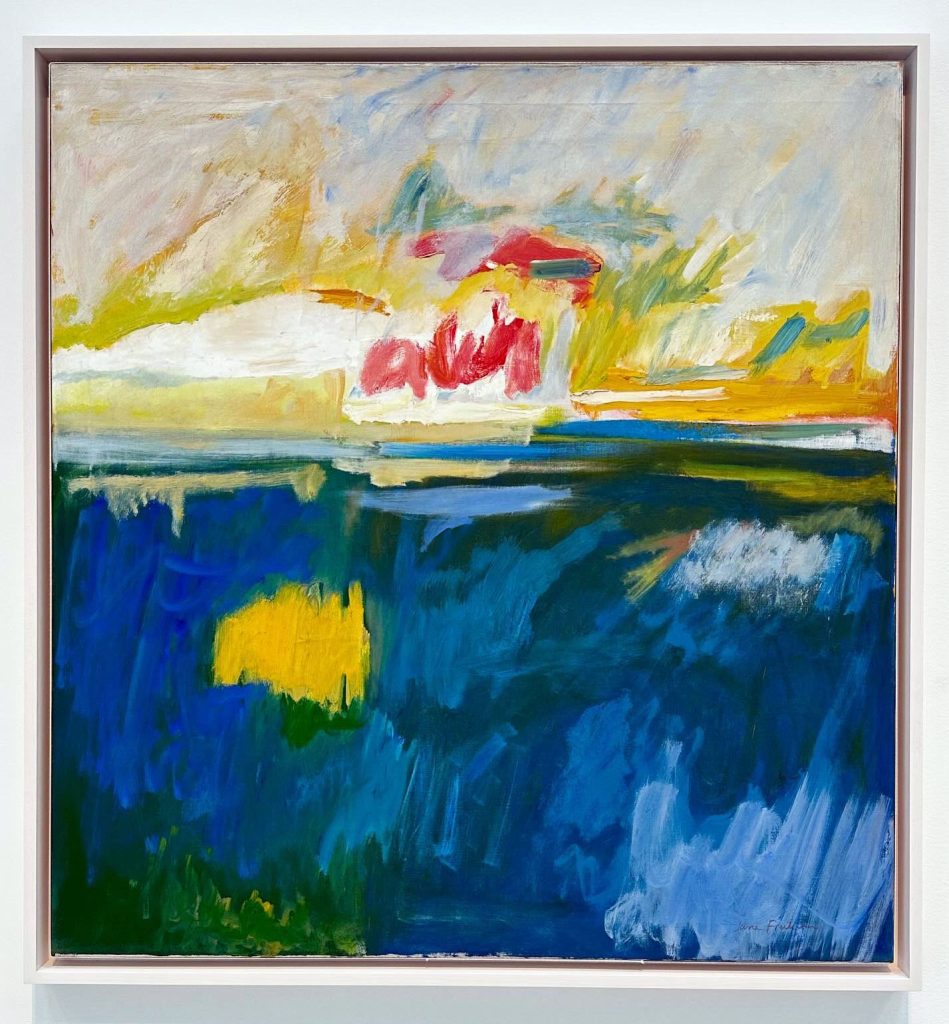
“Northern Lights”, 1959, oil on linen

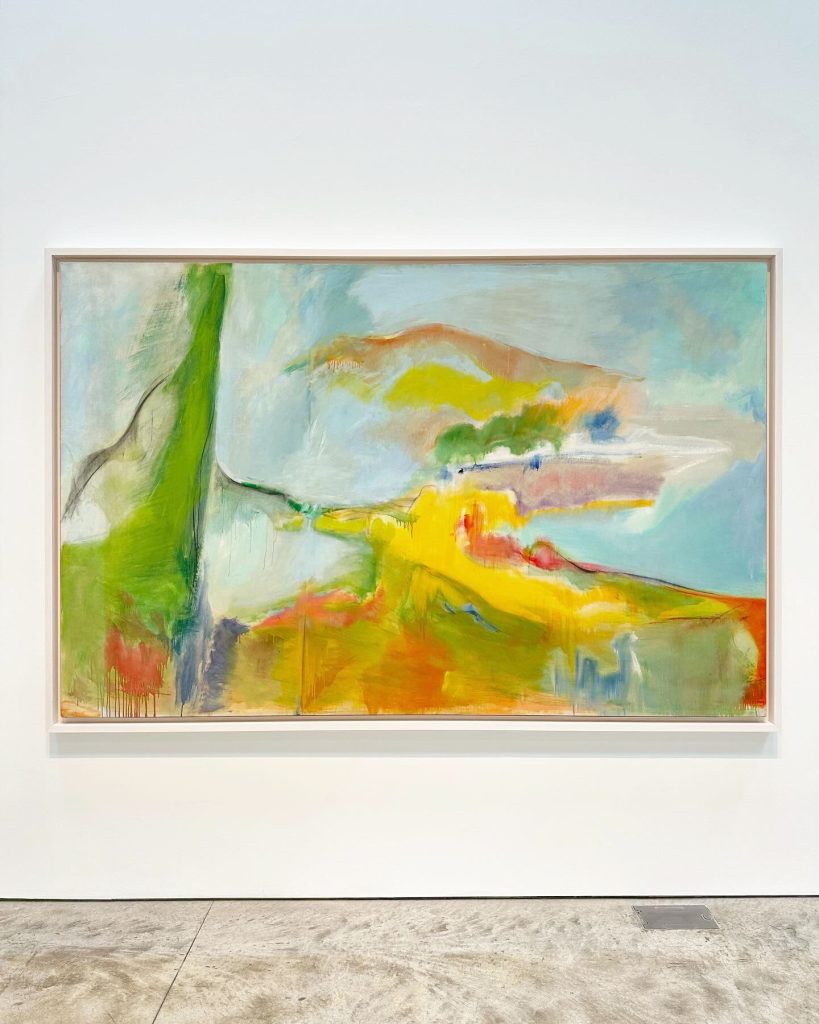
“Untitled (Near the Cove)”, c. 1958, oil on linen

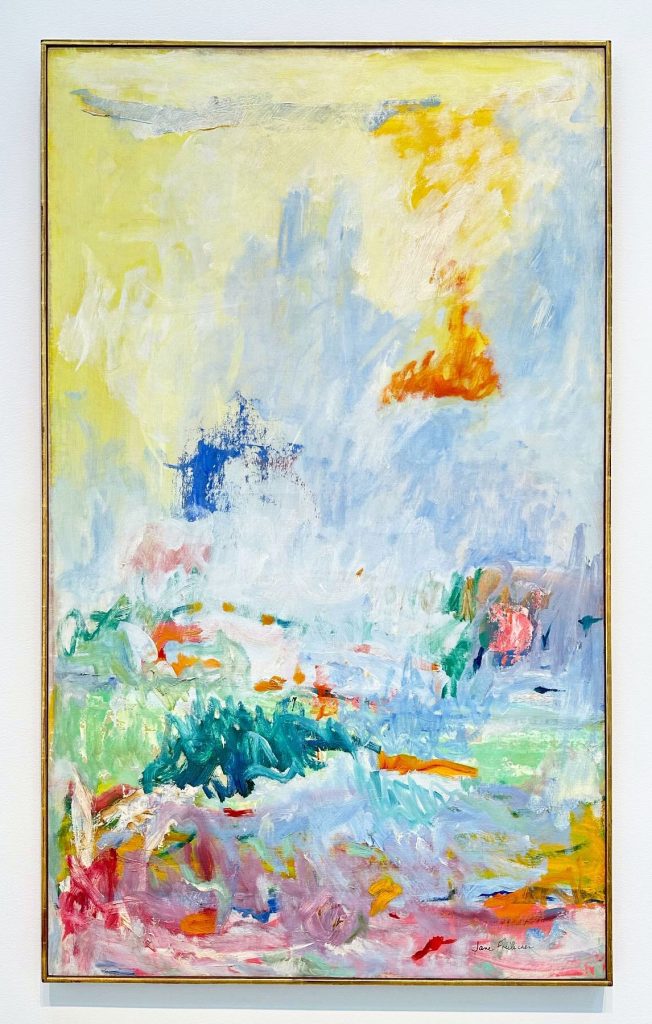
“Fresh Air”, c.1958-1962, oil on canvas

Although better known for her figurative paintings, Jane Freilicher also created several large abstract paintings which were on view last year at Kasmin gallery in NYC.  The paintings hint at a recognizable landscape, but through her use of color and energetic brush strokes she evokes the feeling of being immersed in the beauty of nature- without the boundaries of a more realistic representation.

From the gallery about the work-

The exhibition presents a group of paintings in degrees of abstraction, realized by Freilicher between 1958 and 1962, a period of great inventiveness when the artist was spending stretches of time in Long Island but had yet to establish a studio there. The series marks a crucial moment of discovery and focus for Freilicher, who went on to integrate the freedom, fluidity, and confidence developed during this period into her more recognizable still lifes and landscapes of later decades.

Freilicher’s abstractions have their roots in observation, informed by her studies with legendary abstract painter Hans Hofmann at his schools in New York and Provincetown. In this group of paintings, pastoral landscapes from Water Mill, Long Island, are translated through the lens of the artist’s memory into confident gestural compositions defined by their use of color and sensitive depiction of light. In a 2006 interview for The New York Sun, the artist tells writer Jennifer Samet of this evolutionary moment in her practice: “I remember being overwhelmed by aqueous light and the obliteration of the horizon by fog.” Freilicher’s palette returns repeatedly here to a combination of off-white and light blue, rendered in loose brushwork across an expansive pictorial space to give a palpable impression of the airy, open landscape of the country.

Breaking out of the domestic scale necessitated by previous studio spaces, this generative period saw Freilicher regularly visiting Water Mill and then returning to her Manhattan studio where she would collapse the formal elements of the rural and coastal environments into energetic, improvisational paintings that were significantly larger than her earlier works. While approaching pure abstraction, the paintings from this period retain a compositional recognition of their ordering principles—the horizon line, a boat’s mast, the position of the sun in the sky, and, in the artist’s words, “long vistas of clouds and water.”

The metamorphosis of landscapes that figure prominently in the artist’s life are representative of, as Roberta Smith identified in 2006, “a more personal, grounded version of Color Field painting.” This observation bridges Freilicher to a loose group of contemporaries whose considerations of their immediate environments brought great warmth and aliveness to varying shades of abstraction—Milton Avery, Etel Adnan, Joan Mitchell, Agnes Martin, and Willem de Kooning (whose own abstract landscapes inspired by his time on Long Island went on view at Sidney Janis Gallery in 1959).