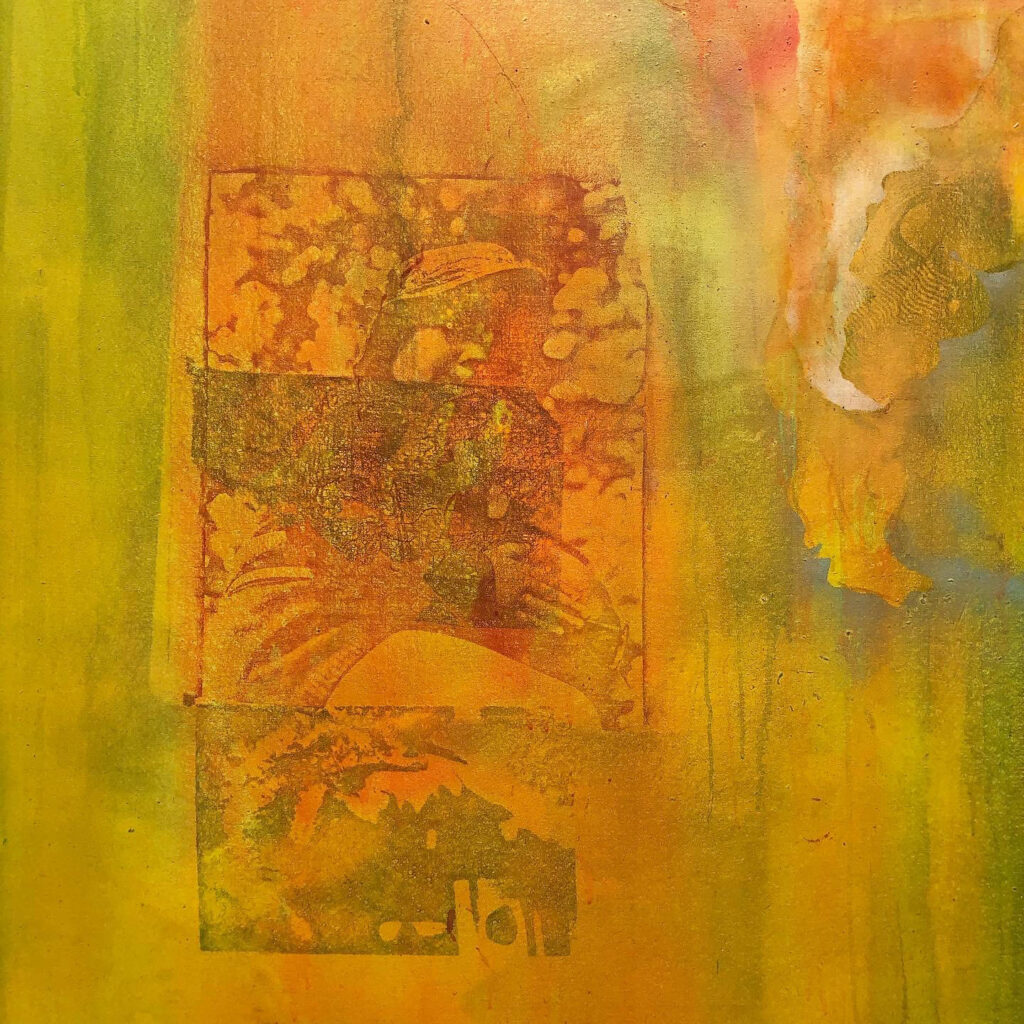
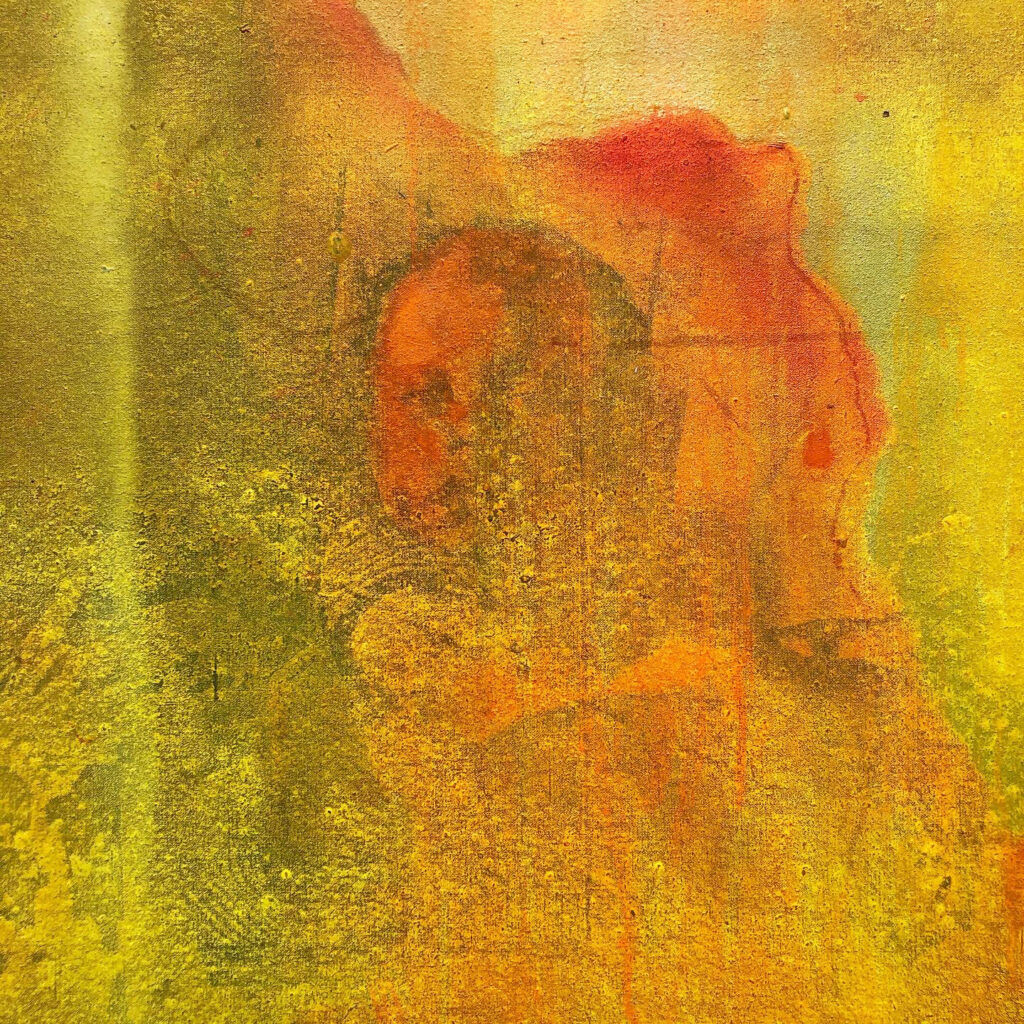
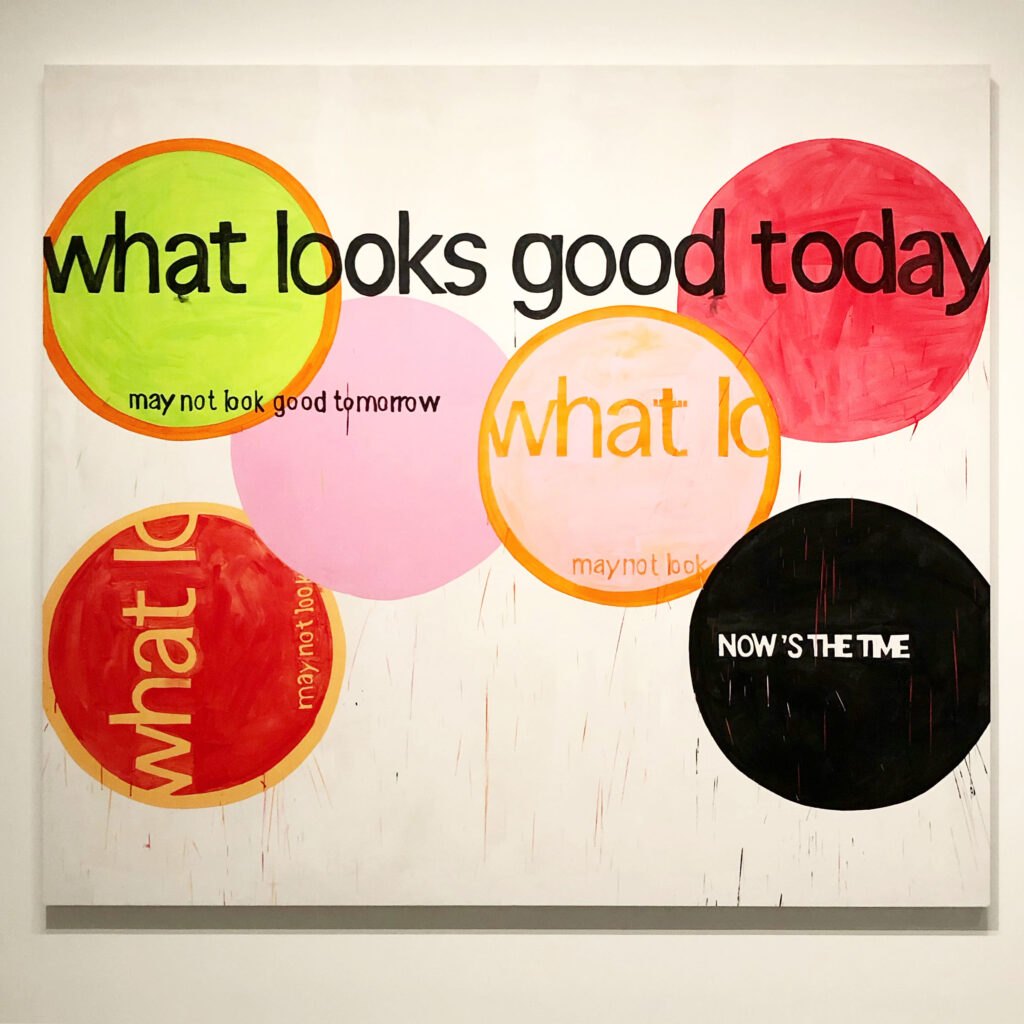
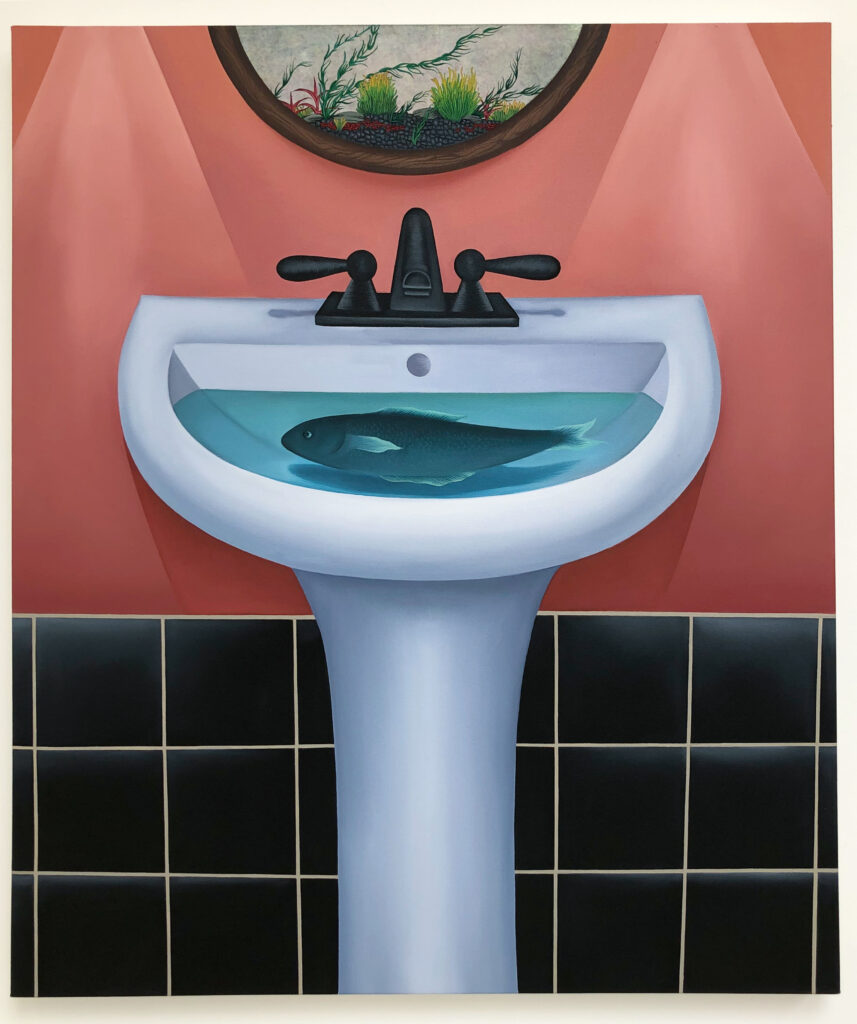
Michael Majerus‘ what looks good today may not look good tomorrow, 2000, currently on view at Museum of Modern Art in NYC.

Michael Majerus‘ what looks good today may not look good tomorrow, 2000, currently on view at Museum of Modern Art in NYC.

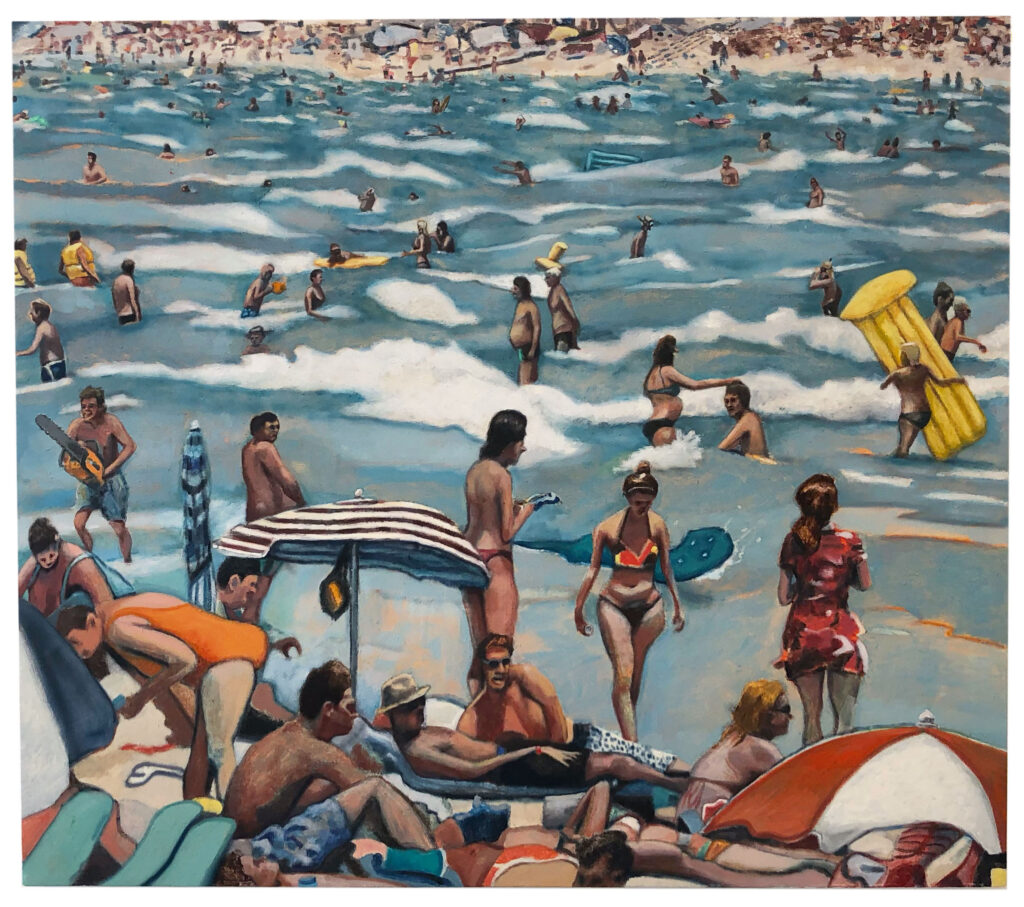
This painting, Reverse Beach, 2019, is from Rob Thom’s exhibition at M+B Los Angeles, The Beast. Thom’s vision of American life takes on many forms, often focused on its more absurd qualities.
For more about his work, check out his interview at Interlocutor or his Instagram.

Quarantine, 2018
This painting is from Julie Curtiss’ exhibition Altered States at VSF gallery in Los Angeles in 2018.
From the press release from that show-
Depicting mostly female subjects in her works, Curtiss creates an undulating dreamscape where the depths of a woman’s psyche are as important and palpable as her body. Rife with swirling curvatures and oscillating lines that convey both physical movement as well as cognitive dissonance, Curtiss’ subjects are secretive and faceless, inhabiting uncanny narratives driven by the logic of dreams. Teetering between dichotomies of seduction and repulsion, feral and domestic, their countenances are strategically concealed with thick mounds of serpentine hair, clawed hands and razor-sharp nails that conjure the anatomy of cold-blooded beasts. For Curtiss’ latest series of paintings and gouaches on paper, marine imagery permeates the narratives: koi, lotuses, fishtails in lieu of feet, a lobster claw clasping a glossy manicured finger … a nod to the 1980s science-fiction film “Altered States,” whose protagonist descends into a bottomless search for the self by way of floatation tanks – sensory deprivation chambers filled with body-temperature saltwater (water being the Jungian dream symbol for the unconscious). While Curtiss invites us to dive deeper into the layered, mercurial mind of her subjects, we are inevitably faced with a reflection of our own subconscious.
She is currently showing her newer work, which includes sculptures, at White Cube Mason’s Yard, in an exhibition titled Monads and Dyads, closing 6/26/21.

This mural, Play Her Voice, is by one of Afghanistan’s first female street artists, Shamsia Hassani and is located in Eugene, Oregon.
She was also one of Hammer Museum’s resident artists in 2016. While in Los Angeles she met with local artists, painted the mural seen below (image via her website) and showed her work in an exhibition at Seyhoun Gallery in West Hollywood.

Make sure to check out her Instagram for updates on her current work.

Bluff, 2019
This painting is from Jarvis Boyland‘s 2019 solo exhibition, On Hold at Kohn Gallery in Los Angeles.
From the press release-
Born and raised in Memphis, TN, Boyland navigates intersections of black identity through portraiture. His paintings focus on queer men of color within intimate spaces. Boyland sees the domestic space as the foundation of social ideologies and an incubator that molds the facade of masculinity. Based on photographic images that the artist reconfigures to create specific compositions, Boyland’s paintings sensitively highlight the nuances of these complex interpersonal relationships, identities, and locales.
The idea of comfort is a recurring theme in Jarvis Boyland’s work. The complex intersections of blackness and queerness shape his delicate renderings of the black male body in repose. The figures in On Hold: dream big and beautifully, yet they are fully grounded and aware in their leisure. Boyland’s palette suggests stillness in the digital age of app culture that shapes modern interaction while evoking David Hockney’s 1970s California and the coolness of Barkley Hendricks. Black bodies are not welcomed in cyberspace but are privileged in Boyland’s paintings. Expectations, aspirations, and dreams that infuse queer experiences come into focus. Situated within domestic environments, Boyland’s paintings emphasize limpness through intimate gestures of distant closeness, overlapping satin garments, and a seemingly shared vanishing point. Coy yet cocky, pretty and promiscuous, commanding yet chaste––luxury is embodied by the three figures waiting on the phone with varied expressions in these slumber-party-themed works. There is tense correspondence, a deliberation about relationships within the group of artists pictured, all of whom grew up in the American South: D’Angelo Williams, Cameron Clayborn, and Jarvis Boyland. Skowhegan School of Painting and Sculpture brought these artists together and influenced the tone of this series. On Hold: expands Boyland’s oeuvre of queer relationships. Through his aperture, Boyland’s group and individual portraits collectively depict an idyllic sensibility towards reality.

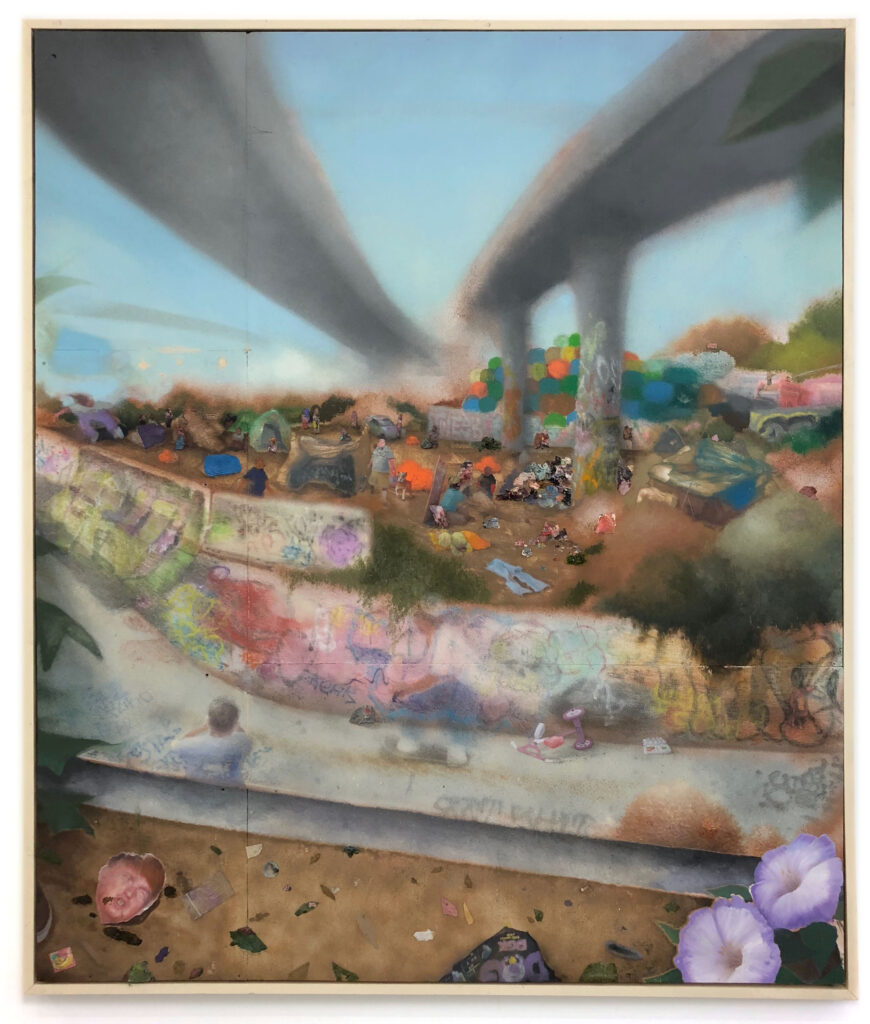
Wasteland Paradise, 2018

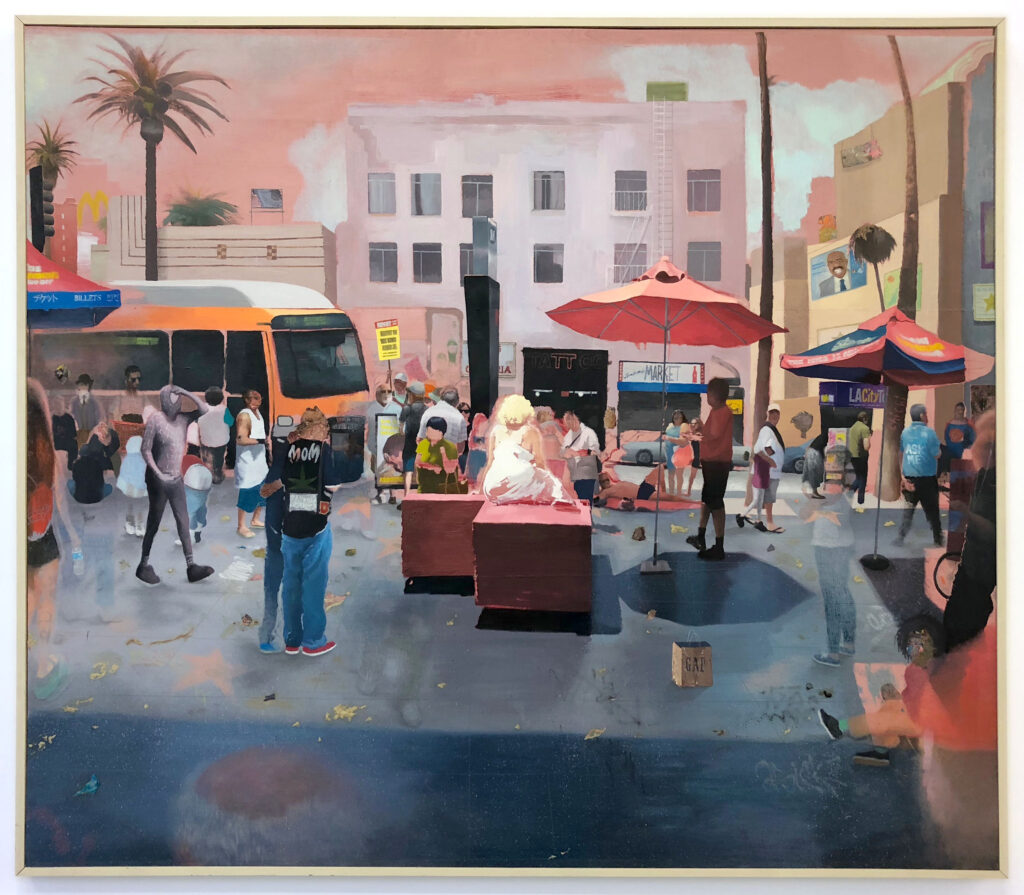
Hollywood/ Highland, 2017
These paintings are from Michael Alvarez’s 2018 exhibition We’re Out Here at Marlborough gallery in New York.
From the press release–
Taking inspiration from his immediate surroundings in the domestic sphere, at work in alternative education high schools and Juvenile Detention Centers, and the city at large, Alvarez creates a compound narrative of life as lived in the complex sprawl of his native Los Angeles. From the glitz and dashed hopes of Hollywood Boulevard to the backyard barbeque we begin to see through carefully constructed surfaces, revealing a tender humanity.
Also depicted are more marginal and thornier hybrid sites. Concrete drainage ditches, that double as skateboarding spots and broad canvasses for graffiti murals, are also host to homeless encampments, presenting a friction between an ascendant and hopeful lawlessness and the desperation of pure survival. Similarly, the eponymous painting We’re Out Here, which was created in collaboration with his incarcerated students (Alvarez’s portraits are interspersed with students’ original artworks) underscores the fine line and expanding gulf between opportunity and a dead-end existence.
Technically, Alvarez mixes a matter-of-fact style with dashes of magical realism. Exhibiting a keen understanding of photo-specific technique, figures blur and ghost across the images suggesting movement through time and space in a static image. Appropriately, snapshot source material ranges from the posed semi-formality of the family portrait to the yearbook-candid playfulness of his students. These images are collaged or cleverly composited into painted scenes that are invested with a warmth, humor and realism that supersedes mere depiction.
Alvarez recently was part of a group show at Sow and Tailor in Los Angeles. Follow his Instagram for more updates on his work and shows.

Potatoes, Grapes, and a Lemon, 2019

Pear and Cherry Juice, 2019
These paintings are from Holly Coulis‘ 2019 exhibition Stilly at Philip Martin Gallery.
From the press release–
Holly Coulis’s paintings operate as stages where still life scenes unfold. A table, or tables, create an initial structure where simplified, geometric forms are arranged and interact. There is a sense of order in these scenes as though the fruits and dishes had been laid out by some external force. Through layers of paint, linear elements are created, giving the illusion of colorful stripes or energy fields around individual objects. These works feel familiar, but upend our sense of figure/ground, horizon-line, perspective, and scale. In these newest paintings, the still life begins to verge into abstraction.
Coulis works from a visual vocabulary built up over years of practice, and the sense of discovery and newness in her works occurs as she continues to explore her own paintings and their possibilities: “I rarely look at a scene. It’s more about shapes of things I know. Things like oranges, lemons, cherries: they’re all very easy shapes.” Standing in front of her works, we are immediately involved in a scene of pleasure and abundance, surprise and stimulation – a stimulation that is physical, intellectual and aesthetic.
Her new exhibition, Orbit, which also includes her sculptures, is currently on view at the same gallery in Culver City until 7/2/21.

Not My Burden, 2019

From a Tropical Space, 2019

From a Tropical Space (detail)

Analogous Colors, 2020

The Aftermath, 2020

For Titus Kaphar’s first exhibition at Gagosian Gallery in NYC, From A Tropical Space, he has created moving scenes of loss, with children cut out of the paintings. While the cutouts and vivid colors are the first things that get noticed, on a longer look you can see that the women in these paintings are not just missing children, but often pieces of their own bodies are affected. Arms, a hand fading away or turning blue, a leg with only one sock and shoe- these women are losing more than what has been cut away from them, they are losing parts of themselves.
From the press release-
A painter, sculptor, filmmaker, and installation artist, Kaphar reexamines American history by deconstructing existing representations and styles through his own formal innovations. His practice seeks to dislodge history from its status as “past” in order to understand its continuing impact on the present. Using materials including tar, glass, and rusted nails—together with highly refined oil painting—and employing techniques such as cutting, shredding, stitching, binding, and erasing, he reworks canonical art historical codes and conventions. And by uncovering the conceptual and narrative underpinnings of certain source images, he explores the manipulation of cultural and personal identity as a central thematic concern while inventing new narratives.
While much of Kaphar’s work begins with an exhaustive study of pre-twentieth-century master painting techniques, From a Tropical Space sees him wield these various methods to create an emotionally saturated visual landscape that is entirely contemporary. Just as artists, through time, have translated the fraught and mercurial sociopolitical contexts in which they operate into new and often radical aesthetic modes, so do the pervasive social and cultural anxieties of the world in which we find ourselves resonate throughout Kaphar’s new work.
In From a Tropical Space, Kaphar presents a haunting narrative of Black motherhood wherein collective fear and trauma crescendo in the disappearance of children, literalized through the physical excision of their images from the canvases themselves. The absence of each juvenile figure—whether seated in a stroller or held in a woman’s arms—reveals only the blank gallery wall beneath. The intense coloration of the suburban environments in which the figures are set only heightens a pervasive tension—these are images for uncertain times. Included in the exhibition is Analogous Colors (2020). Demonstrating further the broader resonance of Kaphar’s recent work, the painting was featured on the cover of the June 15 issue of Time magazine, which included a report on the protests sparked by George Floyd’s killing at the hands of Minneapolis police.
This exhibition closes 12/19/20.

Shirley (Spa Boutique2go), 2018

Lean, 2018

Charles, 2016

Miles and Jojo, 2015

Jireh, 2013
Currently at the New Museum is Jordan Casteel: Within Reach, the artist’s first solo museum exhibition in New York City. It includes paintings from her series Visible Man (2013–14) and Nights in Harlem (2017), and recent portraits of her students at Rutgers University-Newark.
From the museum’s information page-
In her large-scale oil paintings, Casteel has developed a distinctive figurative language permeated by the presence of her subjects, who are typically captured in larger-than-life depictions that teem with domestic details and psychological insights.
Portraying people from communities in which the artist lives and works—including former classmates at Yale, where she earned an MFA; street vendors and neighbors near her home in Harlem; and her own students at Rutgers University-Newark in New Jersey—Casteel insists upon the ordinary, offering scenes with both the informality of a snapshot and the frontality of an official portrait. In these richly colorful works, Casteel draws upon ongoing conversations on portraiture that encompass race, gender, and subjectivity, connecting her practice to the legacy of artists like Alice Neel, Faith Ringgold, and Bob Thompson, among others. Casteel’s studies in anthropology and sociology also inform her works, which can often be read as a reflection on the presentation of the self in everyday life and as an investigation of the relationships that tie together intimacy and distance, familiarity and otherness.
Casteel’s subjects, who are frequently black men looking directly at the viewer, are self-possessed and casually posed, but, as they stare in the distance, they also seem to ponder questions about masculinity and class, belonging and displacement. In the exchange of gazes between the sitters, the artist, and the viewers, her paintings blur impulses and aspirations to compose a nuanced portrait of daily life in the US.
From her earliest series, Visible Man, Casteel has challenged conventional depictions of blackness while simultaneously reconfiguring stereotypes and expectations around femininity and desire. In Jiréh (2013), a student from the Yale School of Drama appears unclothed and in repose at home, gazing tranquilly at the viewer from a patterned couch. More than on any sense of erotic tension, the painting rests on a sense of empathy and quietness. In later works, Casteel’s encounters with her subjects are animated by a different sense of place: in Nights in Harlem, Casteel shifts her attention outside, to men and women who populate the streets of her neighborhood. Posed in their environments, these figures reflect the communal spaces and social relationships they inhabit.
Along with her depictions of life in Harlem, Casteel also explores scenarios in which anonymity and individuality seem to coexist. In her cropped “subway paintings”—one of which lends its title to the exhibition—she zooms in on the everyday gestures she observes on New York City trains. Even against the anonymous weight of strangers clasping cell phones and huddling near doorways, the body still remains legible, its identity concealed but its inner life nevertheless present. In these, as in many of her works, Casteel captures the sensory experience of life in the city, while conjuring the complex emotional landscape of her sitters.
This exhibition closes 1/3/21.


Currently at Petzel in NYC is Derek Fordjour’s solo exhibition, SELF MUST DIE, which incorporates painting, sculpture and Fly Away, a performance collaboration between Fordjour and award-winning puppeteer Nick Lehane.
From the press release-
The show, Fordjour’s first with the gallery, is an offering of creative labor in response to our current moment, a deeply personal and collective state of anxiety around death and hyper-visible racial violence. It examines the nature of martyrdom, vulnerabilities inherent to living in a Black body, performance of competency, and the liminal space existing between autonomy and control.
In SELF MUST DIE, Fordjour interrogates the inevitability of actual death, made more urgent by the realities of a global pandemic, and points to the aspirational death of the artist’s ego brought into focus by a burgeoning career. It is both cultural manifesto and personal declaration. The show is comprised of three parts: VESTIBULE, a site-specific sculptural installation; Fly Away, a live puppetry art performance; and a suite of new paintings.
VESTIBULE offers a collection of sculptural objects imbued with biblical allegory and the spirit of James Cone’s Black Theology of Liberation. It refashions the gallery as a secular yet sacred space of memorial. Among its features, the small entry compels visitors to undergo a destabilizing bodily shift that elicits an intimate and reorienting experience. A directional light from above slowly combs the entire room, invoking both searchlight and spotlight, ideas central to the recent death of Breonna Taylor. Constructed of bituminous coal and wrought iron, Taylor Memorial hangs from above.
Fly Away, a collaboration between Fordjour and award-winning puppeteer Nick Lehane, is performed by a stellar cast, with an original score composed by John Aylward and performed live by oboist Hassan Anderson. The puppet is a Fordjour-designed, hand-sculpted figure crafted by Robert Maldonado. The protagonist’s narrative arc rises and falls along a journey of personal discovery. Larger themes that course through Fordjour’s body of work become resonant.
Spanning two galleries are several new paintings, executed in Fordjour’s signature collage technique, representing the latest developments in his studio practice. The first is a suite of paintings based on Black funerary tradition. The second gallery presents a broad range of subjects including several at monumental scale.
This exhibition closes 12/19/20.