Dec 042020


Ida Applebroog’s exhibition Applebroog Birds at Hauser & Wirth’s New York location is a delightful collection of paintings and sculpture. But there is more to them than meets the eye.

From the press release-

For more than six decades, American artist Ida Applebroog has continuously engaged with the polemics of human behavior, often exploring interrelated themes of power, gender, politics, and sexuality in works that span and challenge the boundaries of her mediums. Her forthcoming exhibition ‘Applebroog Birds,’ opening 12 November at Hauser & Wirth New York, finds the 91 year old artist advancing her trenchant political inquiry through avian portraits, paintings, and sculptures, all of which are ripe with symbolism relevant to this unprecedented moment. This exhibition expands upon the ‘Angry Birds of America’ works she began making in 2016 and reaffirms her status as one of contemporary art’s most consistently inventive political image-makers.

A pioneering artist of the feminist movement since the 1970s, Applebroog constantly evolves her visual vocabulary and draws from a diverse array of themes, memories, and mass media sources. These range from her own genitalia to dolls and mannequins, to cartoon characterizations of people in her life, to fashion models and accouterment – and, most recently, birds. In 2016, Applebroog became captivated by ornithology and John James Audubon’s skill at merging art and nature. She developed an interest in drawing birds nestled in trees. Quickly realizing that Audubon and other ornithologists work from taxidermal birds, Applebroog began collecting birds and reading ornithological books, eventually producing her own models in plaster and paint.

Her series ‘Angry Birds of America’ was developed during a time of grief and rage, expressed with new intensity in American politics: it was the year that saw the beginning of Donald J. Trump’s presidency, the concomitant rise of white nationalism and anti-immigration violence. Mass shootings in Las Vegas and Texas, the #MeToo movement, and women’s long suppressed anger at accepted sexual affront and assault in the workplace were brought into public focus. Some of Applebroog’s ‘Angry Birds of America’ works will be on view at Hauser & Wirth, having been presented at the Kunstmuseum Thun, Switzerland, in its 2019 exhibition ‘Ida Applebroog.’ Centered on Applebroog’s paintings and sculptures of dead birds, these works provide viewers with analogs for the underlying amalgam of violence and beauty that exist in the world around us, both natural and manmade.

Applebroog’s images and sculptures of birds depict a wide range of avian types. Her ‘White Bird’ sculptures, inspired in part by Applebroog’s studio menagerie of stuffed birds, have the aspect of phantoms in flight, forms that seem to bob gently on unseen air currents, while the ‘Specimens’ works, innate and individually tagged, suggest findings from an ornithologist’s lab. The bird portraits on mylar similarly emit a feeling of taxidermy’s strange temporality. These works evolve from images that are printed with inks that the artist then manipulates by hand. Though the animal depicted in each work has expired, Applebroog’s skill in returning a carcass to life is in full view, creating a metaphor for contemporary political life in America and a call to action.

In an essay titled ‘Bird on a Wire,’ originally published in the Kunstmuseum Thun’s catalogue for Applebroog’s 2019 solo exhibition, art historian Jo Applin notes the irony that President Trump has his own, ‘ill-advised addiction to social media through which, like the proverbial caged canary, he tweets, and tweets, and tweets all manner of bizarre statements, unfounded allegations, and lies.’ In ‘Applebroog Birds,’ the artist’s portrait of a bald eagle – the national symbol of the United States of America – keeps company with a flock of dead birds.

This exhibition is on view until 12/19/20, by appointment.

Nov 012020
 

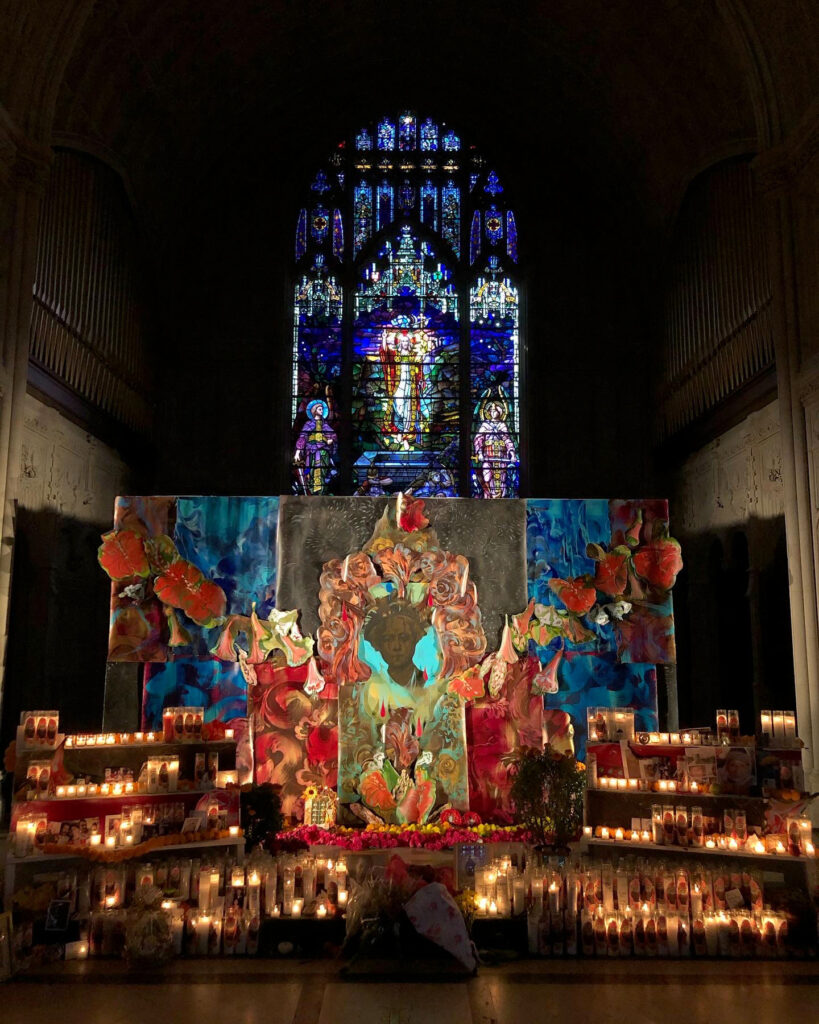
Artist Scherezade García’s large-scale community altar at Green-Wood Cemetery’s Historic Chapel for Día de los Muertos. Visitors were encouraged to bring personal offerings to a community altar, including flowers, photographs, and notes, among other objects.

Info from the artist’s Instagram

Inspired by altars found throughout Mexico and the Mexican diaspora, Garcia’s altar combines her own unique style with this centuries-old celebration of the departed.

The centerpiece of the altar is a weeping, cinnamon-colored Statue of Liberty. By mixing all the colors in her palette, Garcia achieves a brown hue that embodies the ideals of diversity and inclusiveness. Her rendition of the Statue of Liberty, an iconic symbol of New York City, evokes the multitudes of immigrants that have found home here, including large Latin and Caribbean American communities. Garcia has dedicated the altar to all the New Yorkers who fell victim to the coronavirus.

Oct 302020
 

Diego Rivera’s Mandragora, 1939 seen at the San Diego Museum of Art.

From the museum’s wall description-

Diego Rivera created many portraits during his long career. Some portrayed unnamed individuals who agreed to pose for the artist, while others depicted close friends and well-known figures in the arts. The sitter of this work has been identified as Maya Guarina. The delicate lace headpiece and dress worn by Guarina contrast with the skull she she holds in her hands and the spiderweb in the upper left-hand corner. In the upper right-hand corner emerges a small mandrake, a plant identified as a hallucinogen and associated with magic. While these objects might reveal something about Guarina, they also contribute to an enigmatic portrait with Surrealist qualities,

Oct 282020
 

This is the last week to see the exhibition, Luchita Hurtado. Together Forever, at Hauser & Wirth’s Chelsea, New York location. The exhibition was organized with Hurtado, who sadly passed away this year at the age of 99. There is also a video on the website of Hurtado’s son discussing the exhibition and his mother’s work that is worth watching for additional insight into the artist and her work.

From the gallery’s website-

‘Together Forever’ presents over thirty works from the 1960s through the present day in which she explored the self and the surrounding world as her primary subject. Many of these highly personal artworks – recent paintings of birth along with early works on paper that have remained largely private up to this point – will be on view to the public for the first time.

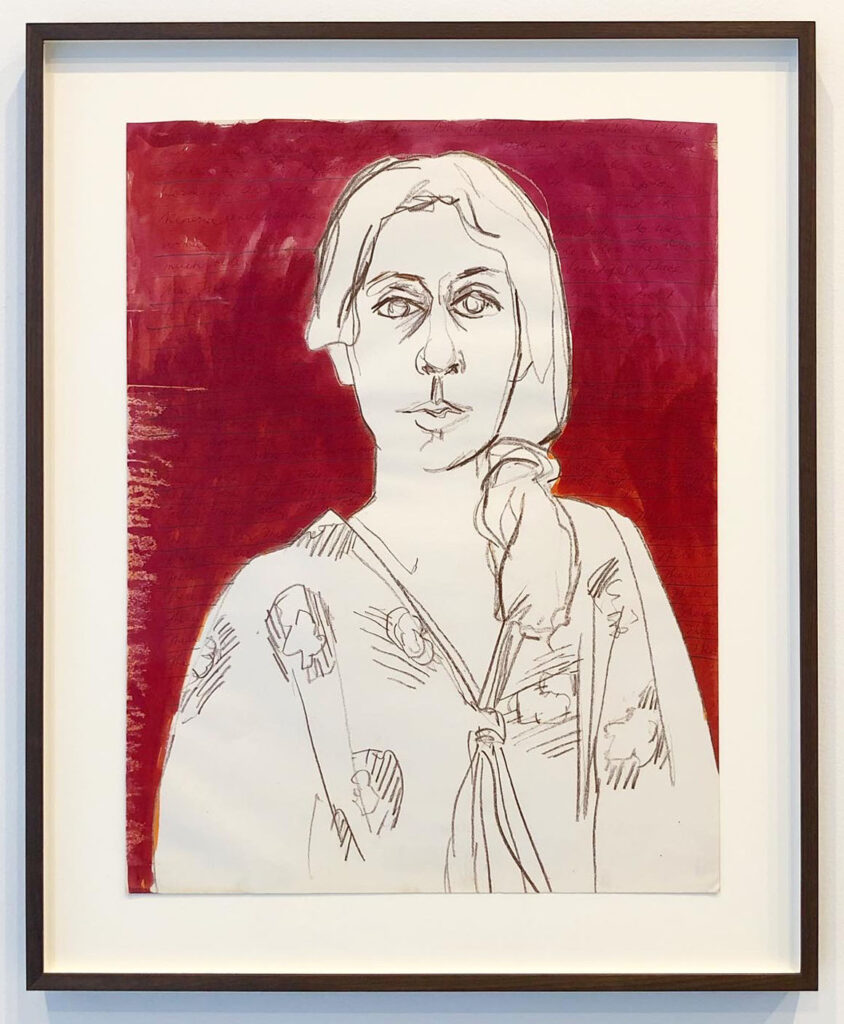
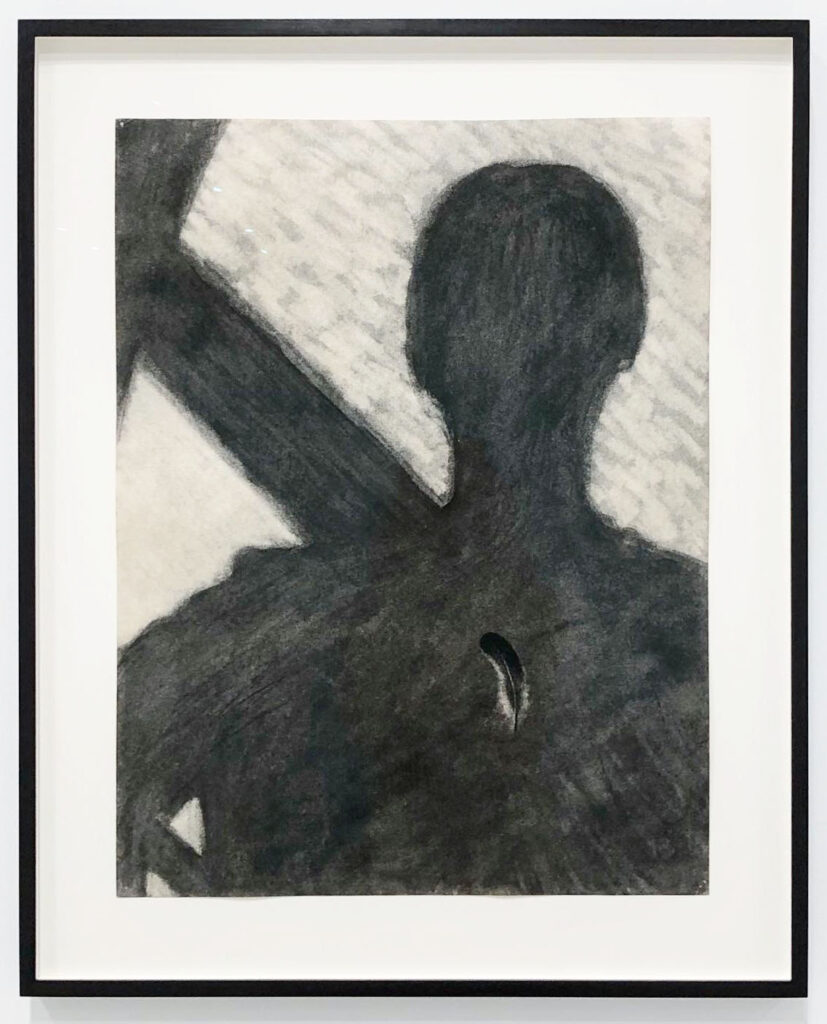
Parallel to a dynamic period of experimentation between abstraction and figuration in the early 1960s, Hurtado also focused her work inward, marking a trajectory to uncover new forms of self through portraits of herself in mirrors, looking down at her own body, and studies of her shadow. Describing this time in her practice, Hurtado explained “At a certain point, I said ‘there is no way that I can express, let’s say, except by painting myself.’ I said, ‘This is a landscape, this is the world, this is all you have, this is your home, this is where you live.’ You are what you feel, what you hear, what you know.” [1]

Throughout her practice up until recent years, Hurtado documented the forms of shadows in photographs and drawings, studying their size, shape, and potential. In early examples from the series included in this exhibition, the artist rendered her own body with oil, charcoal, or graphite on paper, sometimes juxtaposed with her own environment. In some works, a number of figures are depicted. However, these are multiple representations of her own shadow and the artist remains in solitude as her only subject. Another work from the series does not depict a figure at all, but only text where the artist states, ‘The only reasonable facsimile of me is in my shadow’.

During this solitary time of artmaking, Hurtado served as her own model and prioritized her own subjective experience in the world. These works represent significant moments of introspection, seclusion, and the claiming of time for herself. In an early self-portrait in crayon and ink on paper, the artist is surrounded with the text of her own poem written about family and memories of her life in New York before motherhood. Other works, such as ‘Untitled,’ show the artist interacting with the everyday domestic objects in her home – a bookshelf, a window, a door. Another work, also ‘Untitled,’ shows Hurtado emitting a single tear as she poses amongst plants.

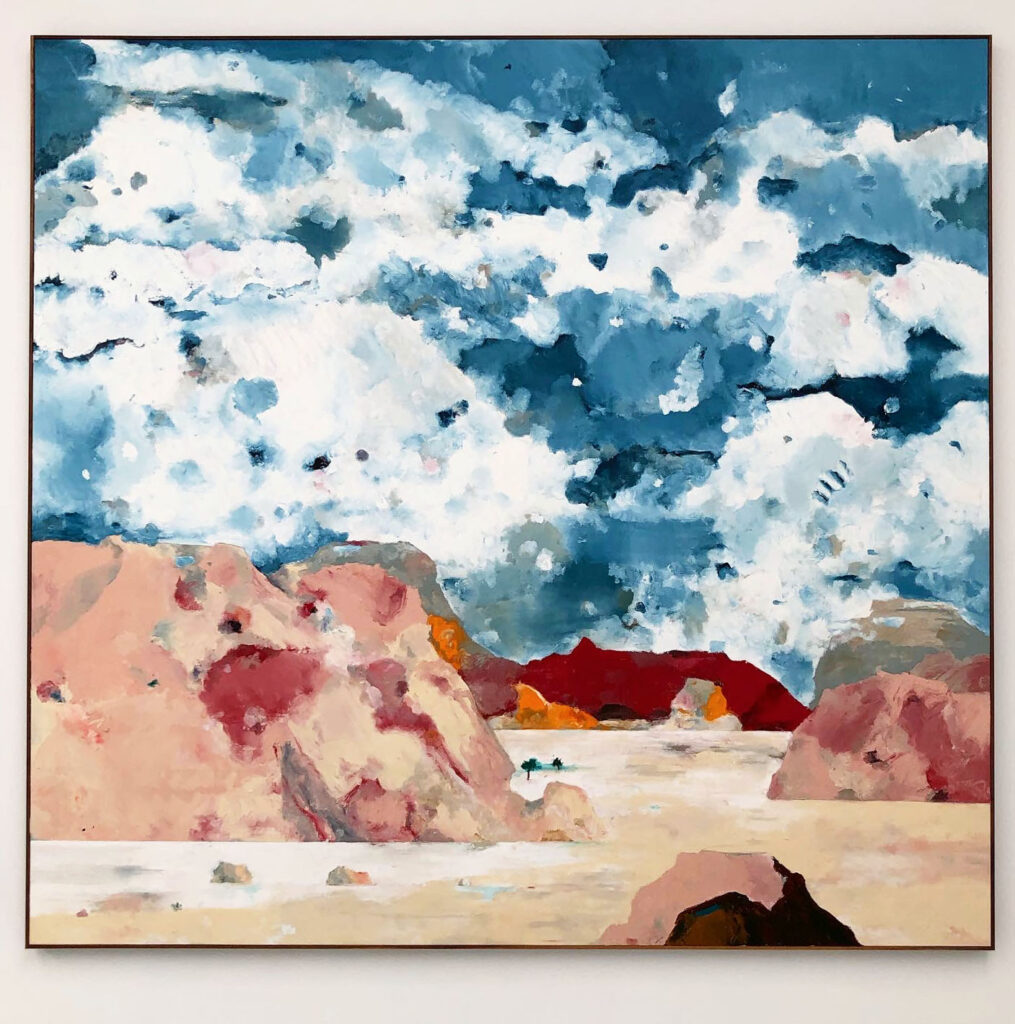
In the most recent paintings on view, Hurtado evolves into the landscape as she explored ways in which her own body would transform and regenerate the earth. Functioning as a symbolic proxy and an intimate meditation on the Earth as mystic progenitor, these works underscore the interconnection between corporeality and the natural world – a delicate balance that is now in jeopardy.

‘Luchita Hurtado. Together Forever’ celebrates the various forms of the artist throughout her career and life. Even in the last days of her life, Hurtado continued to experiment and push the boundaries of her own practice.

This exhibition closes 10/31/20.

Oct 102020
 

The Mountain, 2020

The Mountain, Center Painting


The Mountain, Center Painting, Detail

Untitled, 2020

Detail of the above painting

Untitled, 2020

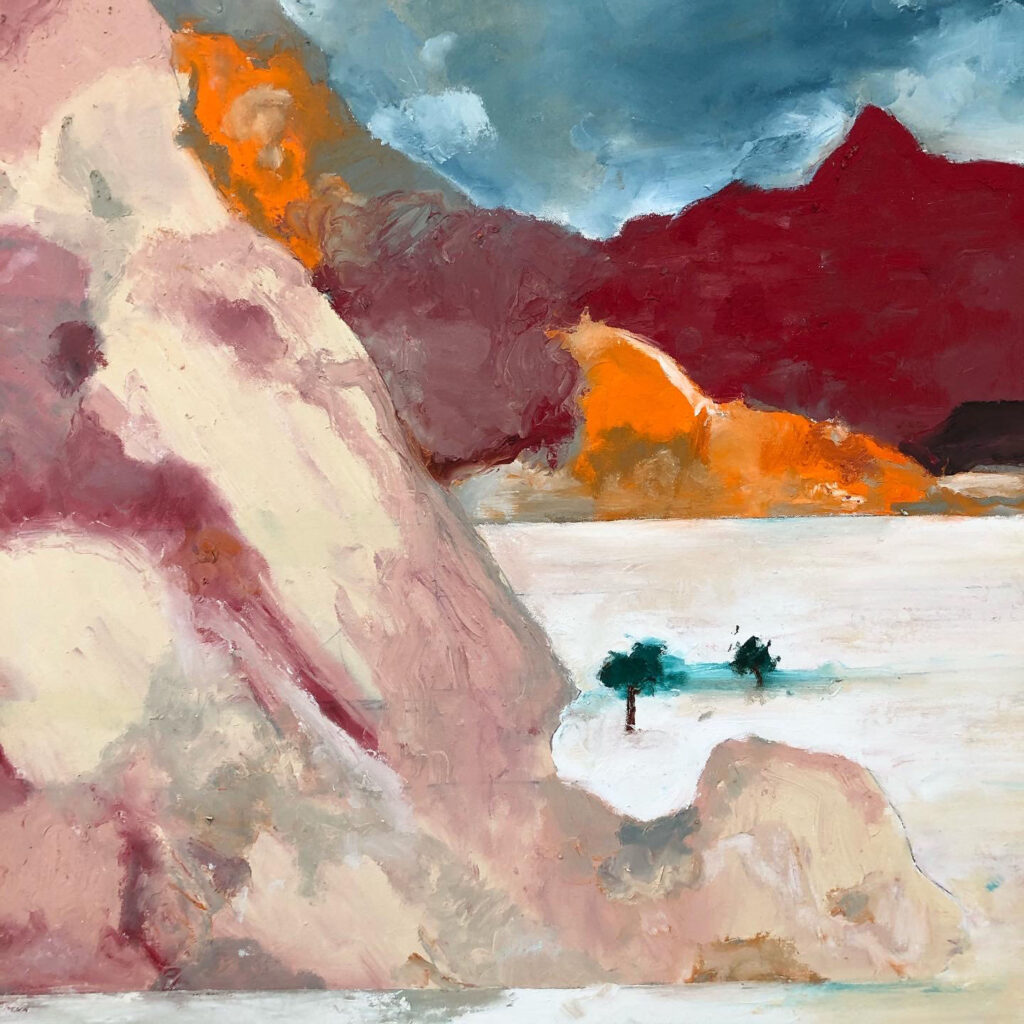
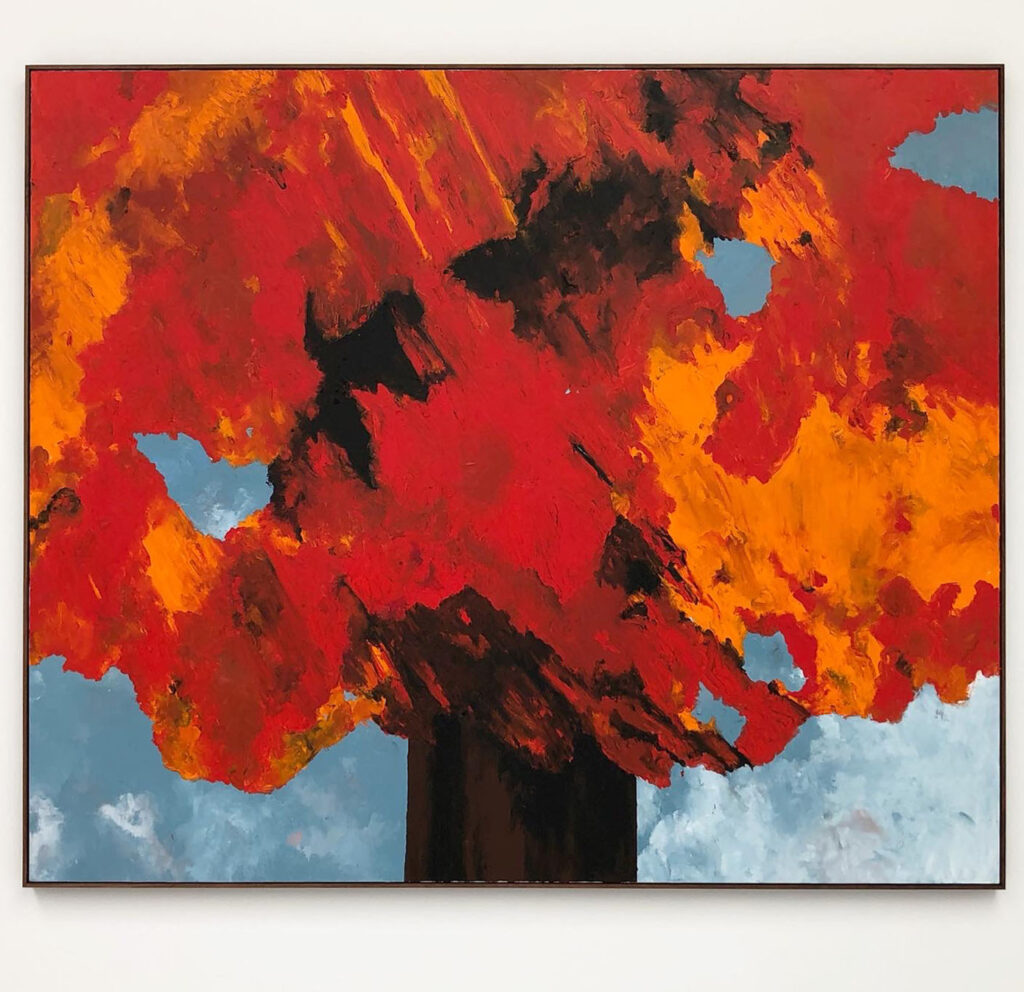
Currently at David Zwirner’s 19th Street location is Traveling Light, an exhibition of new work by Belgian-born, New York–based artist Harold Ancart. The stunning large scale paintings were created using oil stick and graphite.

From the press release

On view in one gallery space will be a new series of paintings that depicts trees. These works were painted between Ancart’s Brooklyn studio and a makeshift outdoor studio in Los Angeles, which he traveled to during lockdown. Pointing to references as varied as René Magritte, Egon Schiele, Gustav Klimt, and Piet Mondrian, who approached this subject matter in distinct ways, Ancart’s tree paintings blur form and color, figure and ground, and figuration and abstraction.

In the adjoining gallery space, there will be two multipanel canvases that situate the viewer between a mountain-scape and a seascape, both monumental in scale. These works are inspired in part by the artist’s encounter with the modernist landscape murals of the American painter Gottardo Piazzoni (1872–1945) permanently installed at the De Young Museum, San Francisco.

The exhibition constructs an immersive landscape experience, and together, the works on view comprise a meditation on the expansive possibilities of painting.

The two quotes from Ancart below (taken from the gallery’s website) describe the concept of the exhibition a bit more.

“It is a very strange time to think about traveling, and it is a strange time to think about freedom. I didn’t conceive the exhibition this way, but I guess meaning always catches up with you. I am opening this exhibition, Traveling Light, at a time when no one travels.… But there are always means of transportation, and I think painting is very much one of them.”

“I actually did conceive the exhibition as a walk.… I think it is very important, as a painter, that you can wander freely through paint. And I think it is very important as a viewer that you can wander equally freely through it. You don’t need to know where you are going.”

This exhibition closes 10/17/20.


Jul 122020
 

One of the pieces from Drew Heitzler’s 2015 exhibition Pacific Palisades at Blum and Poe Los Angeles.

Jul 062020
 

Today, July 6th, is the four year anniversary of the fatal shooting of Philando Castile by a police officer during a traffic stop in Minnesota. Castile was shot five times while his girlfriend and her four year old daughter were in the car.

Mark Bradford’s 150 Portrait Tone, 2017, currently at LACMA, is a devastating large scale work that uses excerpts from Philando Castile’s girlfriend Diamond Reynolds’s dialogue from the video she live streamed on Facebook from the incident.

From LACMA’s wall description of the work-

Bradford notes that he was moved by the multiple subjects Reynolds simultaneously addressed and the different spaces they occupied: her boyfriend, Castile, next to her (“stay with me”); the officer outside the car (“please, officer, don’t tell me that you just did this”); God (“Lord, please Jesus, don’t tell me that he’s gone”); as well as the unknown receiver on the other side of her lifestream (“please don’t tell me he just went like that”).

Like many of Bradford’s works, the mural-size composition contains elements of both abstraction and realism. In places, layers of manipulated paint render the text almost illegible. The dark form in the background, however, evokes all-too-real associations with the horrific shooting, such as Castile’s twisted arm and the dark-red bloodstain spread across his white shirt, both visible in the live stream feed.

The title, “150 Portrait Tone”, refers to the name and color code of the pink acrylic used throughout the painting (most conspicuous in a large patch at the work’s bottom edge). Like the now-obsolete “flesh” crayon in the Crayola 64 box (the color was renamed “peach” in 1962), the color “portrait tone” carries inherent assumptions about who, exactly, is being depicted. In the context of Bradford’s painting, the title presents a sobering commentary on power and representation.

Jul 032020
 

Absconded From the Household of the President of the United States, 2016

Billy Lee: Portrait in Tar, 2016

Twisted Tropes, 2016

Monumental Inversions: George Washington, 2016

The above images are from Titus Kaphar’s exhibition Shifting Skies at Jack Shainman Gallery in 2017. Kaphar recently created the cover of the June 15th issue of Time Magazine covering the George Floyd protests.