May 132024
 

“A beautiful figure without a tongue”, 2024, oil and pencil on canvas

“A beautiful figure without a tongue”, 2024, oil and pencil on canvas (detail)

“Open Season”, 2024, oil and pencil on canvas

“Open Season”, 2024, oil and pencil on canvas (detail)

“Where our love once lay, a dark and tortured jungle grew”, 2023, oil and pencil on canvas

“Where our love once lay, a dark and tortured jungle grew”, 2023, oil and pencil on canvas (detail)

A sense of foreboding looms over the paintings in Sanam Khatibi’s exhibition We Wait Until Dark at P.P.O.W gallery. In the details are smaller skeletons, ritual objects, and dead animals blood soaks the ground. Life and death are personified in both the figures and the natural surroundings. Flowers bloom or wilt, bones are scattered, a hummingbird shares a moment with a skeleton in one painting while a dead bird lies on the ground in another. Khatibi’s works have many potential meanings, like their art historical predecessors, and leave it to the viewer to come to their own conclusions.

From the press release-

…People who devote their lives to art can often cite an event that placed them on their destined path. Among the earliest memories Belgian artist Sanam Khatibi recalls is the day she discovered a book on Hieronymous Bosch left out on the table by her mother. She was five. That one might advance from consuming the rapturous reproductions of The Garden of Earthly Delights at such a young age to painting expansive, primal scenes of a troubled Paradise is one excellent example of artistic “fate.”

In Khatibi’s paintings and sculptures, the veil between desire and restraint, life and death, and the natural and spirit worlds proves thin. Again and again, the artist returns to t­he figure of a nude goddess navigating a verdant, savage land beyond the protective scrim of “civilization.” In the absence of technology, politics, bills, e-mail, and even clothing, she exhibits her most feral qualities for survival: devouring, eating, attacking, killing, and hunting. Khatibi’s subjects are perennial (desire, seduction, domination, submission), and her references to allegorical forms are extensive (17th-century Dutch still life vanitas, the motif of Death and the Maiden, antiquarian amulets, and anthropological relics), all channeled into displays of human folly and erotic obsession.

Paintings by Khatibi are full of expressions of voracity: for sex, earthly delights, experience, and transcendence, and what happens when you tempt the devil. In Where our love once lay, a dark and tortured jungle grew (2023), a fey skeleton seizes a beautiful maiden by the hair under a lightening blue sky –– a grotesque quid pro quo that recalls Lucas Cranach the Elders’ The Ill-Matched Couple (1553); or even Kawanabe Kyōsai’s Hell Courtesan (1831–1889). Decrepit and aging, his skull sprouts strawlike strands of hair, the last indication of vitality. In Open Season (2024), an Amazonian goddess places an intimate offering of amulets and animal sacrifices before a pool of water. There is a sense of reckless abandon: a human skull, a pomegranate cracked open, blood spilling over the cerulean earth––a feast for ravenous souls.

Khatibi’s Eden is repeatedly transformed into a Bosch-like tale of passionate, potentially fatal encounters (a locus amoenus turned upside down into a “locus terribilis”). In A beautiful figure without a tongue (2024), the skeletal personification of Death reappears. A maniacal grin spreads across his decaying face as he slinks away, clutching an ornate vase to his chest. Are these the spoils of Death to be hoarded in a cavernous underworld?

Throughout the exhibition, Khatibi faithfully intertwines two genres of painting (figurative landscape and still life), leaving seemingly ancillary details from one scene to reveal as sharp memento mori in another––as in Overnight Black Aphids Appeared, growing on the tips of the Sophora Sun King (2023). Here, the reappearance of skulls, amulets, and small creatures sans personnages gives the impression of a romantic sojourn set apart from the larger narrative. Each of Khatibi’s objects pulses into realism with near-scientific observation, appearing magnificent and fragile, possibly even forbidden. Placed against a velvety black ground, they fall into shadow as if pulled amorously into the afterlife. –Lola Kramer

Also included in the exhibition are several smaller works, like the one pictured below. In these darker paintings the details stand out against their black background, but the mystery of their meaning remains.


“Overnight Black Aphids Appeared, growing on the tips of the Sophora Sun King”, 2023 oil on canvas

May 132024
 

“The Lazy Logic of Ignava Ratio”, 2009, Acrylic on canvas

“The Lazy Logic of Ignava Ratio”, 2009, Acrylic on canvas (detail)

Ryan McGuiness’s brightly colored screen printed paintings for WYSIWYG at Miles McEnery Gallery are incredibly dense with imagery, yet still manage not to feel too overwhelming. The combinations of graphics and patterns do require a closer look though.

The title of the exhibition references the acronym for What You See Is What You Get, which refers to software that allows creators to see and edit their product in the form it will resemble when printed or displayed.  Whether there is more to these paintings than what is seen remains up to the viewer.

“Condition Report”, 2022 and “Recreational Use”, 2022, Acrylic on wood

“Only a Thief Thinks Everybody Steals”, 2008, Acrylic on canvas

May 132024
 

“Capturing the Moment”, 2023, Acrylic on canvas

“Prismatic Window”, 2023, Acrylic on canvas

“El Paraíso”, 2023, and “Coin Laundry”, 2023, Acrylic on canvas

“Kurashiki Ki”, 2023, Acrylic on canvas

“Daikanyama”, 2023, Acrylic on canvas

Brian Alfred’s paintings for his exhibition Beauty is A Rare Thing at Miles McEnery Gallery capture moments from his travels around the world. Small details are removed to focus on shapes and colors, resulting in works that are extremely pleasing to the eye.

From the press release-

…Alfred’s process, honed over the past two decades, distills his source imagery to its most essential forms, layering idyllic elements together and segmenting forms into two dimensional planes of mostly-solid color to reveal a sense of stillness that can be tranquil, unsettling, or both. His compositions are reminiscent of architectural ukiyo-e prints, both in technique and style, while his exploration of collage continues to inform the resulting paintings.

“Alfred captures the ephemeral, silencing the noise of the world and focusing solely on the composition,” writes Annabel Keenan. “In every image, there is a sense that he is not only preserving the memory of a place, but also the essence of a specific time. This show… is more personal than his others.” Beauty is a Rare Thing casts a newfound appreciation on the everyday, presenting an aura of hope over our ever changing world.

Also included in a separate room are his portraits of contemporary musicians, pictured below.

Apr 122024
 

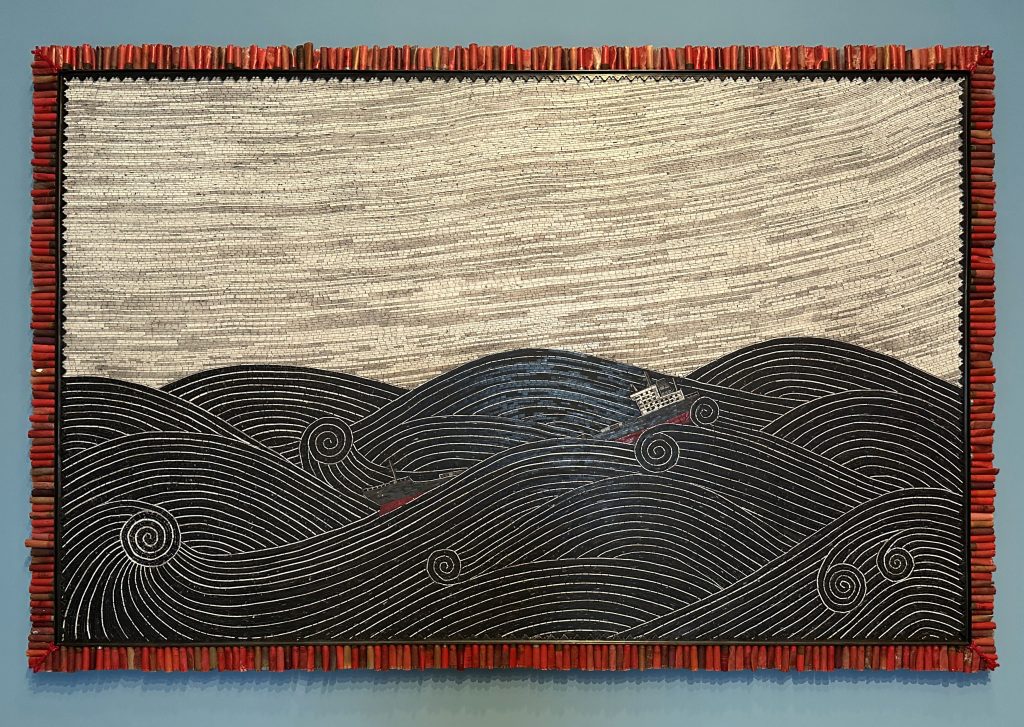
“Erika”, 2021, VCT, shotgun shells, and drink stirrers

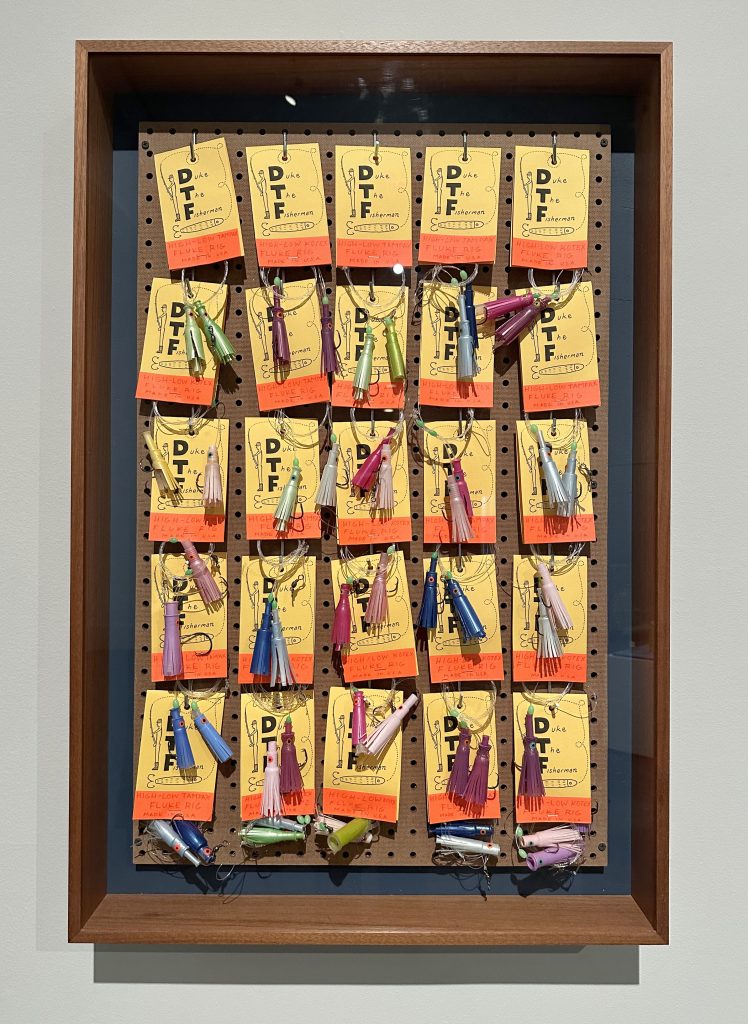
“Duke the Fisherman’s High Quality Fluke Rigs Made in the USA™”, 2022, Found tampon applicators, fishing line, fishing hooks, nail polish, peg board, card stock

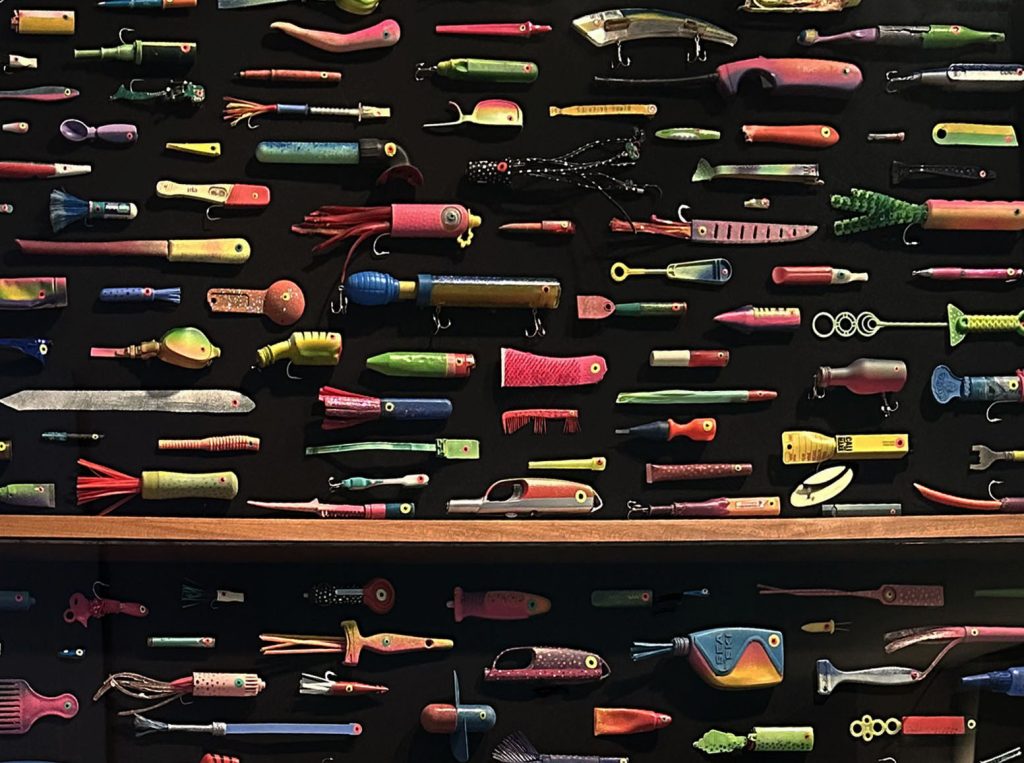
Detail of “Monument to Five Thousand Years of Temptation and Deception V, VI, VII”, 2022, Salvaged plastic, paint, fishhooks

The images above are from Duke Riley’s exhibition DEATH TO THE LIVING, Long Live Trash, on view at Brooklyn Museum in 2023. The artist’s inventive fishing lures, made from discarded plastic items found around waterways, are engaging to look at but highlight the grim reality of how much garbage is polluting our natural environment.

From the museum-

In DEATH TO THE LIVING, Long Live Trash, Brooklyn-based artist Duke Riley uses materials collected from beaches in the northeastern United States to tell a tale of both local pollution and global marine devastation. Riley’s contemporary interpretations of historical maritime crafts—such as scrimshaw, sailor’s valentines, and fishing lures—confront the catastrophic effect that the oil, food, and beverage industries have had on the environment through single-use plastics. The works are presented in the seventeenth- and eighteenth-century Jan Martense Schenck and Nicholas Schenck Houses, alongside a selection of historical scrimshaw from our collection, directly connecting environmental injustices past and present.

In his contemporary interpretations of scrimshaw—ink drawings etched into bone by sailors—Riley replaces the medium’s customary whale teeth with repurposed plastic containers, detergent bottles, toothbrushes, and other waste. The works incorporate the maritime imagery traditional to scrimshaw, but expand it to portray international business executives that the artist identifies as responsible for the perpetuation of single-use plastics. Also on view are Riley’s fishing lures and sailor’s valentines, similarly created with detritus found on northeast coastal beaches. The exhibition juxtaposes corporation-driven pollution with new short films by Riley that highlight New York community members working to remediate plastic damage and restore our waterways.

Erika, the mosaic pictured above, depicts the 1999 shipwreck of MV Erika which, after splitting in two during a heavy storm, released thousands of tons of oil into the Bay of Biscay off the coast of Brittany.

In the video below, Riley gives a brief tour of the Brooklyn show.

Some of the work from this exhibition is currently on view at Museum of Fine Arts St. Petersburg as part of their exhibition, The Nature of Art.


Mar 292024
 

Richard Serra passed away on Tuesday, 3/26/24. In the video above, as part of PBS News Hour, Serra takes an interviewer on a tour of his 2007 MoMA exhibition, Richard Serra: 40 Years.

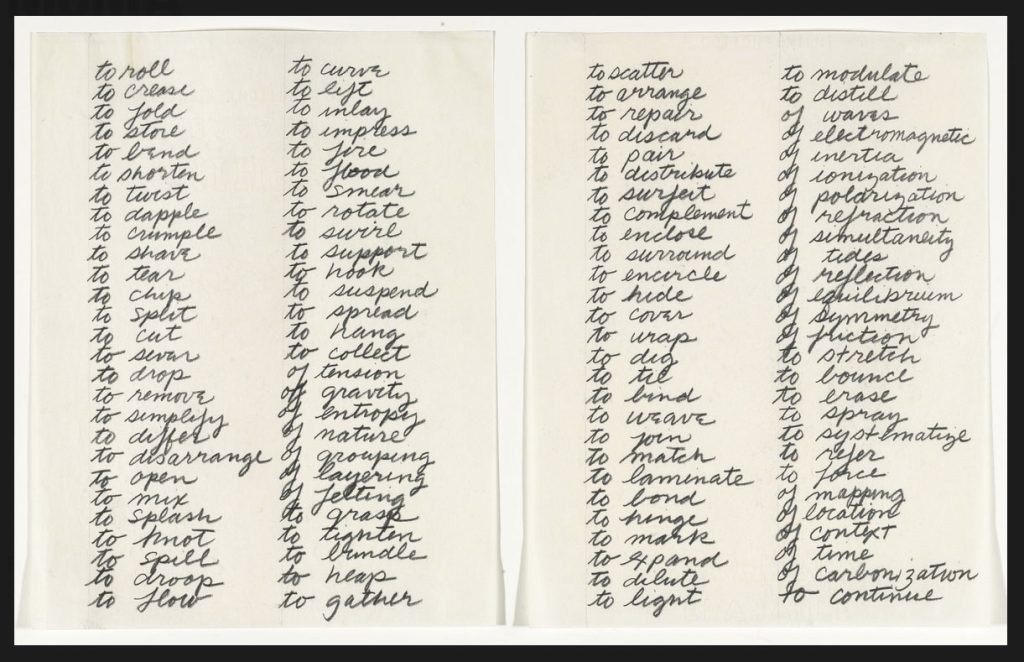
The program also provides some background on his history and discusses a bit of his creative process. One technique was to use a list of verb actions. He would choose one from the list and apply that to different materials. He explains in the video how he used “to lift” for a rubber sculpture in the exhibition.

Richard Serra, “Verb List”, 1967 (image via MoMA)

If you are in Los Angeles, one of his most famous sculptures, Band (2006), is currently on view at LACMA. In NYC you can see Equal (2015), which consists of eight forged steel boxes stacked in pairs, at the Museum of Modern Art.

Mar 152024
 

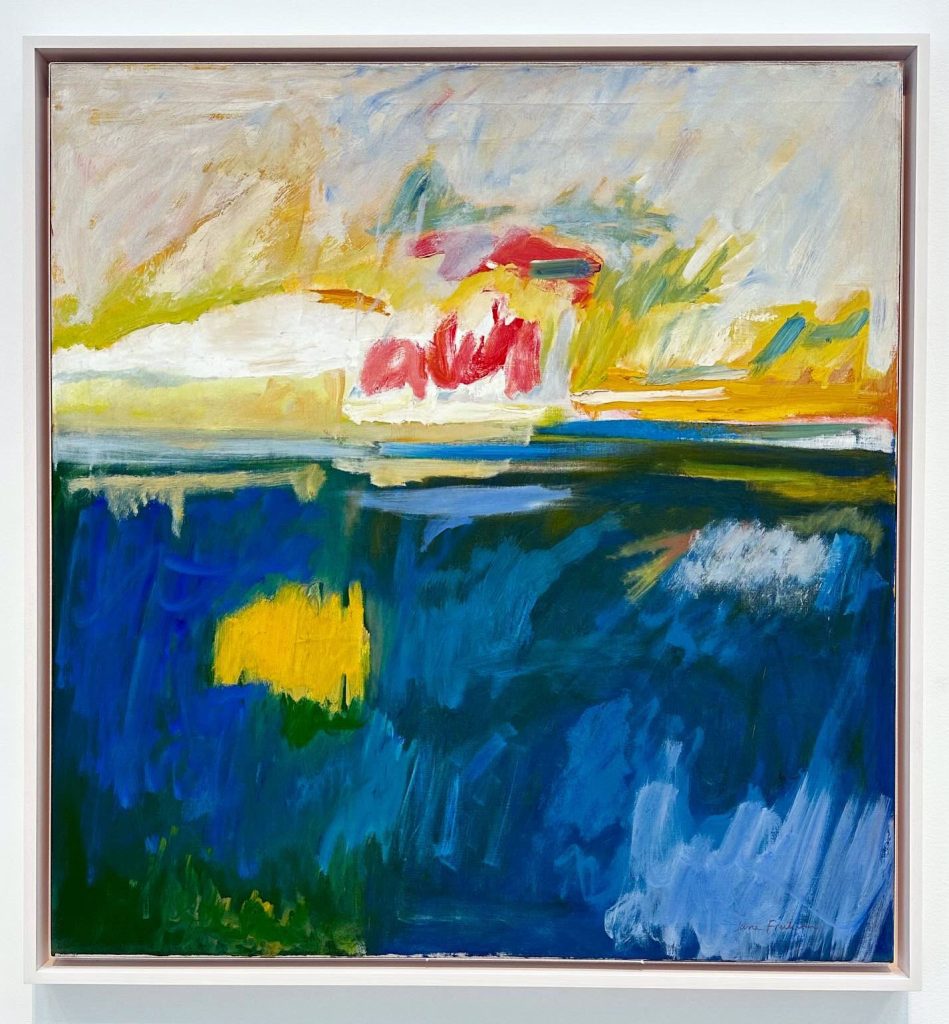
“Northern Lights”, 1959, oil on linen

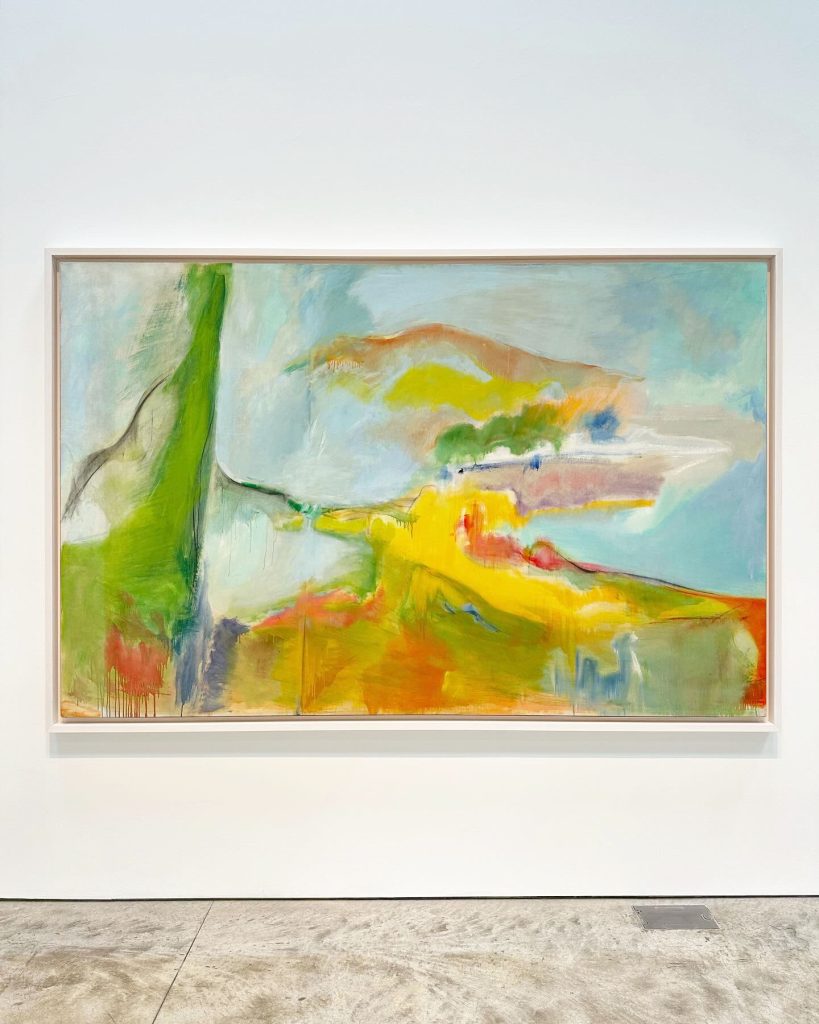
“Untitled (Near the Cove)”, c. 1958, oil on linen

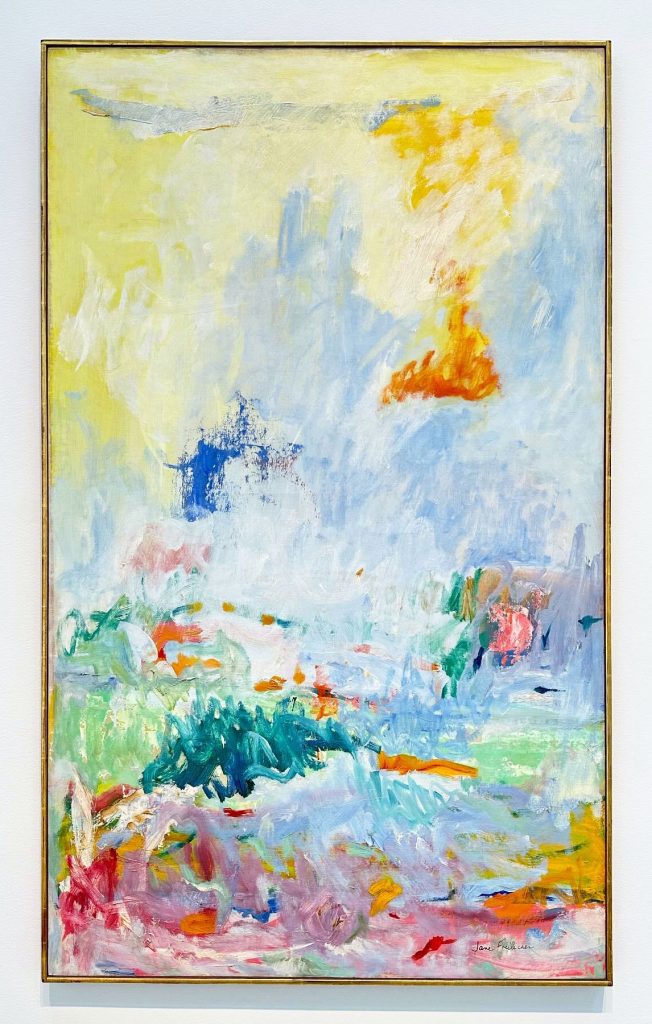
“Fresh Air”, c.1958-1962, oil on canvas

Although better known for her figurative paintings, Jane Freilicher also created several large abstract paintings which were on view last year at Kasmin gallery in NYC.  The paintings hint at a recognizable landscape, but through her use of color and energetic brush strokes she evokes the feeling of being immersed in the beauty of nature- without the boundaries of a more realistic representation.

From the gallery about the work-

The exhibition presents a group of paintings in degrees of abstraction, realized by Freilicher between 1958 and 1962, a period of great inventiveness when the artist was spending stretches of time in Long Island but had yet to establish a studio there. The series marks a crucial moment of discovery and focus for Freilicher, who went on to integrate the freedom, fluidity, and confidence developed during this period into her more recognizable still lifes and landscapes of later decades.

Freilicher’s abstractions have their roots in observation, informed by her studies with legendary abstract painter Hans Hofmann at his schools in New York and Provincetown. In this group of paintings, pastoral landscapes from Water Mill, Long Island, are translated through the lens of the artist’s memory into confident gestural compositions defined by their use of color and sensitive depiction of light. In a 2006 interview for The New York Sun, the artist tells writer Jennifer Samet of this evolutionary moment in her practice: “I remember being overwhelmed by aqueous light and the obliteration of the horizon by fog.” Freilicher’s palette returns repeatedly here to a combination of off-white and light blue, rendered in loose brushwork across an expansive pictorial space to give a palpable impression of the airy, open landscape of the country.

Breaking out of the domestic scale necessitated by previous studio spaces, this generative period saw Freilicher regularly visiting Water Mill and then returning to her Manhattan studio where she would collapse the formal elements of the rural and coastal environments into energetic, improvisational paintings that were significantly larger than her earlier works. While approaching pure abstraction, the paintings from this period retain a compositional recognition of their ordering principles—the horizon line, a boat’s mast, the position of the sun in the sky, and, in the artist’s words, “long vistas of clouds and water.”

The metamorphosis of landscapes that figure prominently in the artist’s life are representative of, as Roberta Smith identified in 2006, “a more personal, grounded version of Color Field painting.” This observation bridges Freilicher to a loose group of contemporaries whose considerations of their immediate environments brought great warmth and aliveness to varying shades of abstraction—Milton Avery, Etel Adnan, Joan Mitchell, Agnes Martin, and Willem de Kooning (whose own abstract landscapes inspired by his time on Long Island went on view at Sidney Janis Gallery in 1959).

Mar 082024
 

“Valentine”, 2022, oil on linen

“Braid”, 2022, oil on linen

“Braid”, 2022, oil on linen (detail)

The two colorful paintings above are from Andrea Belag’s 2023 solo exhibition, Currents, at Bienvenu Steinberg & J in New York.

From the gallery’s press release-

Since the 1990s, Belag has constantly modified her approach to abstraction through various transitions and mutations. Her internal genealogy matters as much as her relationship to a tradition of abstraction. In the words of artist and critic Julian Kreimer: “it’s not hard to metaphorize those traces, lines left behind by larger swaths of paint that were wiped away, lines whose own shifting colors reveal how they are made by what they’ve touched and changed. But as with so many of Belag’s paintings, the point isn’t to nail down the metaphors (…) Belag’s work becomes an edge condition for painting without flirting with minimalist near-nothingness; it tests out where beauty can emerge, and what we can get to work. It opens up from a few wiped shapes into a sophisticated object able to transport one into a reverie about slippage, slipping away, the here and not hereness of life, death, and the varieties of love”.

Geometry and order have progressively given place to swirling swaths of color, solidity replaced by suspended motion. Painting is an all consuming action. She paints standing up, leaning over and often walking around the canvas placed horizontally. It starts with the arm and as she walks around the canvas her whole body gets involved. Transparent colors on the surface are not fixed and can create form or dissolve into light. She rubs, smudges, and scraps to create translucent, softly luminous surfaces where the brushwork is strikingly visible. “My paintings are contemporary because I paint in the here and now. It’s unavoidable. The artists I feel indebted to are Henri Matisse, Mary Heilmann, Joan Mitchell, Gerhard Richter, Bill Traylor, and Japanese Zen gardens. Style is a dead-end, but I have a point of view. I love transparency and the touch of materials, so I have created a way of painting where I make this possible. I use mostly transparent pigments and fine linen, and I paint wet into wet. The marks are on one layer of the painted surface with very little overlap or pentimento. Color makes space and light come through the paint and emotion comes through as well. There is fear and desire in painting, and that’s addictive. Haptics are the touchstones.” (Andrea Belag, 2023)

Her current solo exhibition, Twombly’s Green, opened this week at Steven Harvey Fine Art Projects.

From their press release-

This grouping of work is, as the title suggests, inspired by Belag’s recollection of Cy Twombly’s use of the color Hooker’s green in his “Pond Paintings.” She writes-

These paintings are inspired by my memory of Twombly’s green and white paintings that I first saw in the Menil Collection in Houston in 2015. I was stunned by his paint handling and his use of Hooker’s Green.

Since then, I learned he painted quickly and directly with his hands. Discovering the “Pond Paintings” was unexpected and I kept thinking about them. Hooker’s green is opaque and dark. But the dark value doesn’t overwhelm the hue. Instead, there is richness and depth without a trace of yellow.

When I identified the pigment and started to paint with it, I felt a vibration. There was a time when painting with green was taboo and now it is ubiquitous.

Is green in the zeitgeist?

All painted within the last twelve months, these works are a continuation of the artist’s practice of lush, energetic abstraction. Playing with circularity in an ongoing attempt to “get away from the grid,” Belag uses color as forms in space, bodies set in motion. Citing foundational inspirations in Matisse and Guston, who she later studied with at the New York Studio School, Belag’s work can also be related to vanguard practitioners of 80s abstraction such as Bill Jensen, David Reed and Mary Heilmann. Her immediate peers Christopher Wool and Joyce Pensato are also compass points in the stripped down dedication to raw painterly brio they share.

This exhibition is on view until 4/13/24.


Feb 242024
 

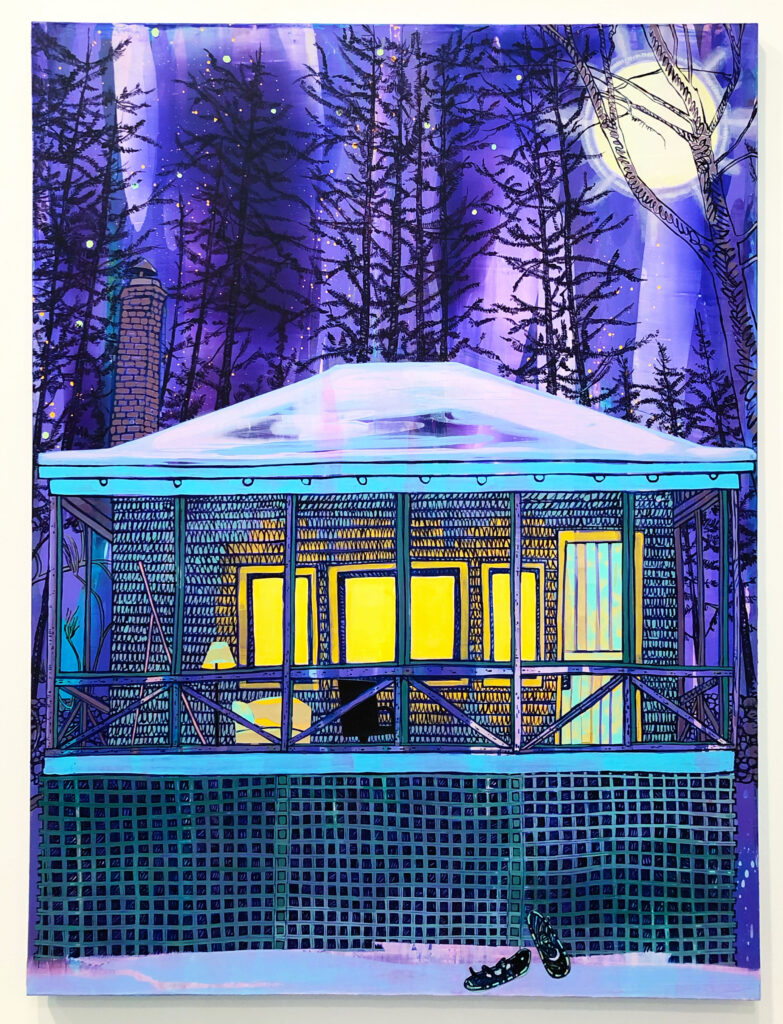
Hope Gangloff’s painting MacDowell Cheney Cabin in the Winter Super Moon, 2019, was shown at her 2019 solo exhibition at Susan Inglett Gallery in NYC.  It is one of several created during her residency at MacDowell Colony in Peterborough, New Hampshire.

Feb 232024
 

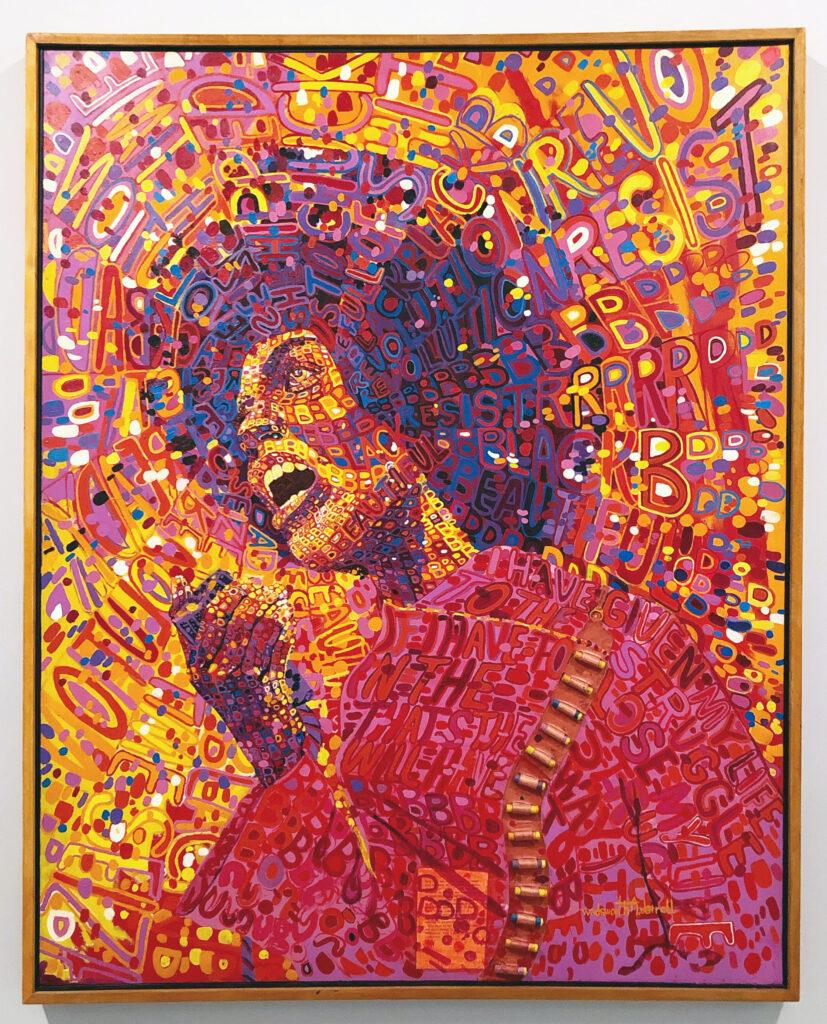
Wadsworth A. Jarrell’s Revolutionary (Angela Davis), 1971, spotted at Brooklyn Museum in 2020, is based off of a photograph of the activist.  The colorful painting includes words from her speeches and actual bullet cartridges.

From the museum about the work-

Wadsworth Jarrell’s Revolutionary (Angela Davis) is one of the most recognized paintings associated with the Black Arts Movement, a cultural manifestation of the Black Power Movement. Artists of this movement sought to create uplifting images that called upon Black people to harness their collective power. The power of communal action is here expressed through a chromatic swirl of individual colors that coalesce into a unified image of the radical activist and intellectual Angela Davis. Davis’s militant clothing—complete with bullet cartridges—was modeled after the Revolutionary Suit designed by artist Jae Jarrell, Wadsworth’s wife. An icon of Black Power, Davis continues to lead the prison abolition movement today.

Jarrell, along with his wife, is part of the African American artist collective AFRICOBRA, formed in Chicago in 1968.

Below is part of a statement about the group from their website by another of the founders, Gerald Williams.

AFRICOBRA began very loosely in 1968 as an association of visual artists. We decided to commit our selves to the collective exploration, development, and perpetuation of an approach to image making which would reflect and project the moods, attitudes, and sensibilities of African Americans independent of the technical and aesthetic strictures of Euro-centric modalities.  Jeff Donaldson, who spearheaded the movement,Wadsworth Jarrell, Jae Jarrell, Barbara Jones-Hogu, and myself, Gerald Williams opened the lid on what we called AFRICOBRA – African Commune of Bad Relevant Artists.  It was an original name that came to identify our place within the broader context of Black art.

Our mission was to encapsulate the quintessential features of African-American consciousness and world view as reflected in real time 1968 terms.  For months, beginning as early as 1967, we examined and talked about the forms of expression and images produced by previous generations of artists.  We came to the realization that there was not the existence of a consistent, unequivocal, uniquely Black aesthetic in visual arts as there was in other disciplines, notably music and dance. Many of our contemporary artists, at the time, generally said that they “were artists who happened to be black”, or held the view that their work was expressing universal ideas or concepts that were not tied to such a narrow category as Black art.   The notion of an intrinsically Black view point, expressed in characteristically “Black ways”  was a relatively alien idea for the most part.  That notion begged the question as to whether it was possible to create a style or approach to art that at its core could be identified as African-American or Black, notwithstanding  the presence of Black imagery or subject matter.  If imagery and subject matter were the sole criteria then the question was moot.  One could conclude, thereby, that Winslow Homer or any number of artists produced Black art when they painted Black images.  After numerous brain storming sessions where such topics were discussed, after test projects and critiques,  the five of us mapped out the core principles that became the foundation of AFRICOBRA.


Feb 162024
 

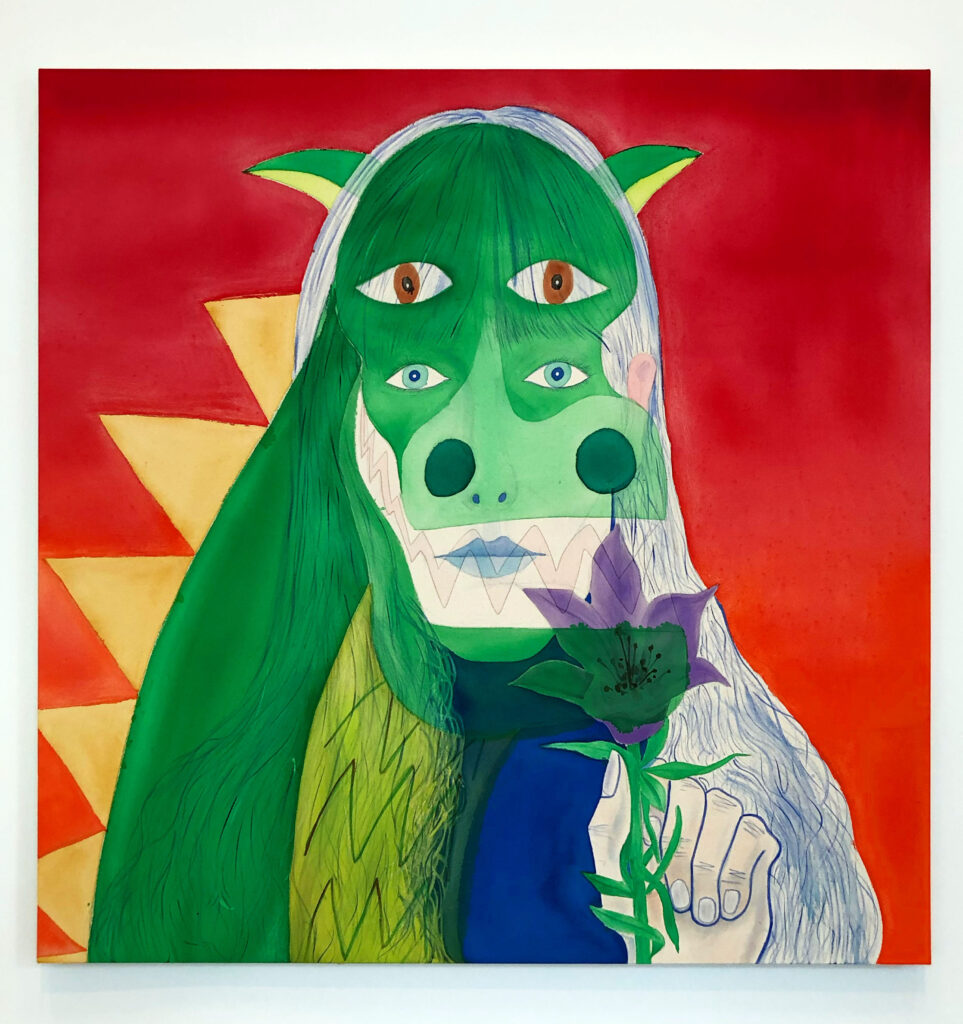
Gentle Ladies Dragon Man, 2021, (Acrylic and graphite on canvas) by Jason Fox was part of the group show Time-Slip at Petzel Gallery in New York in 2021.