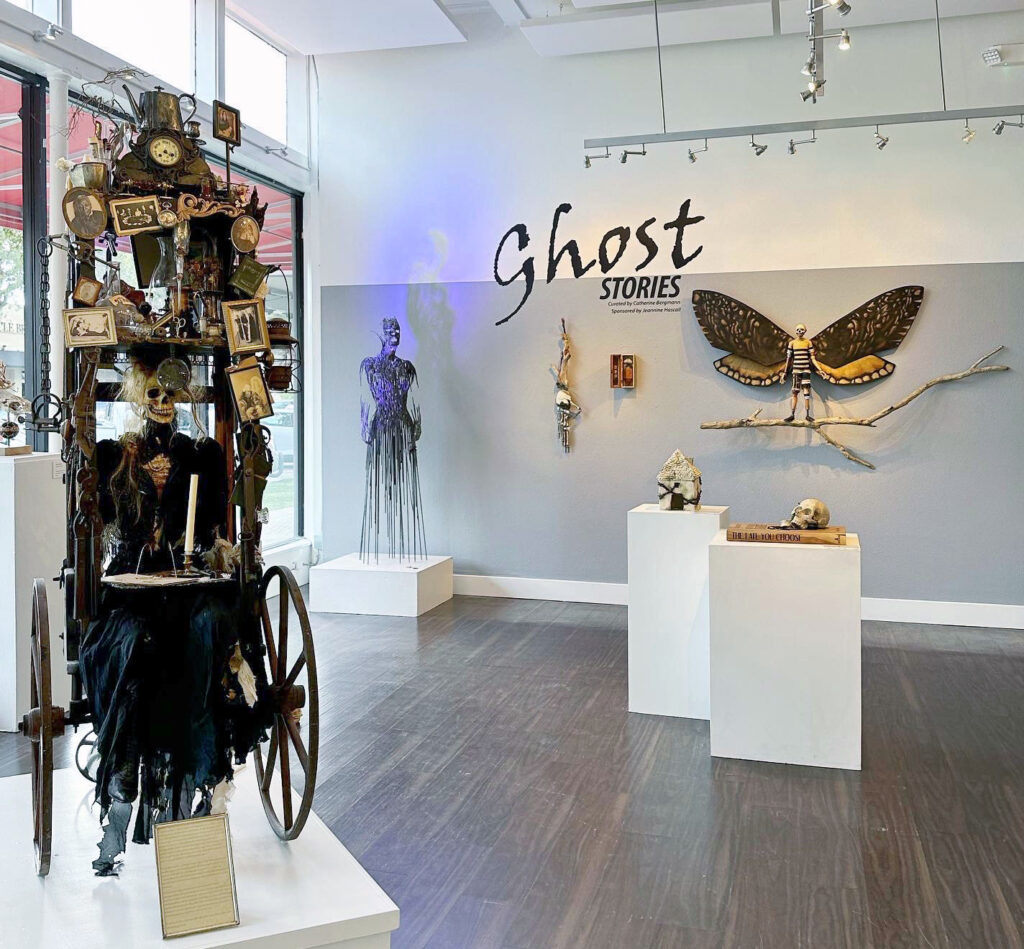
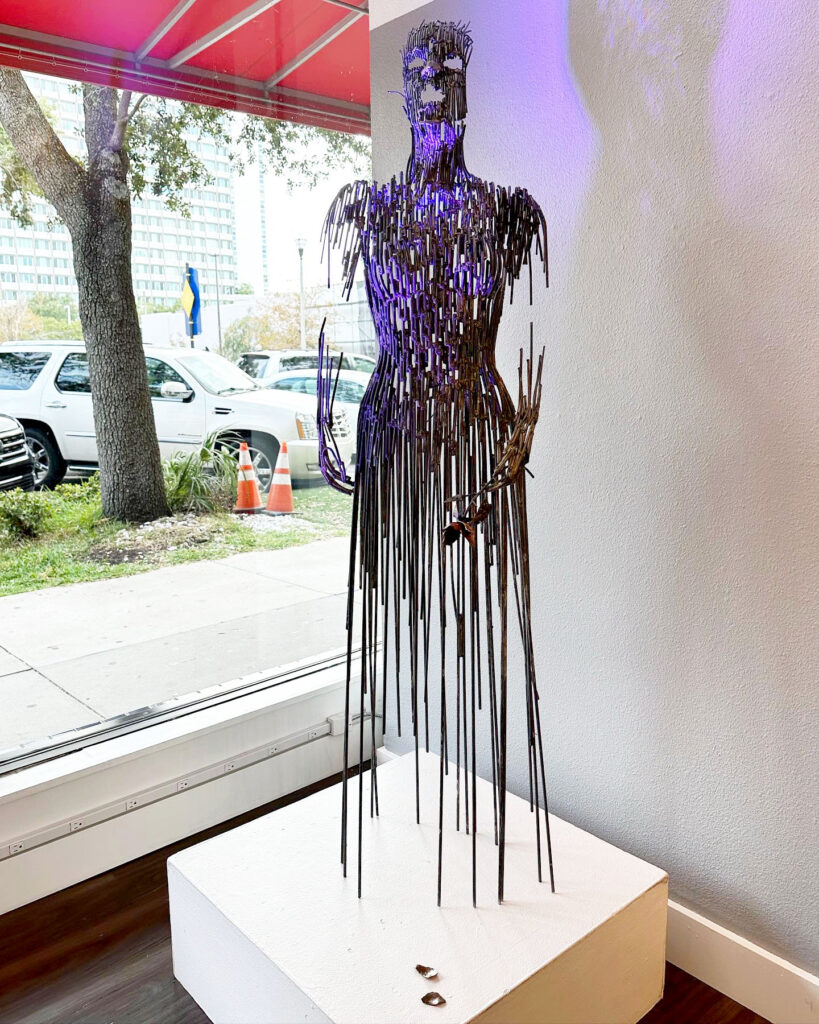
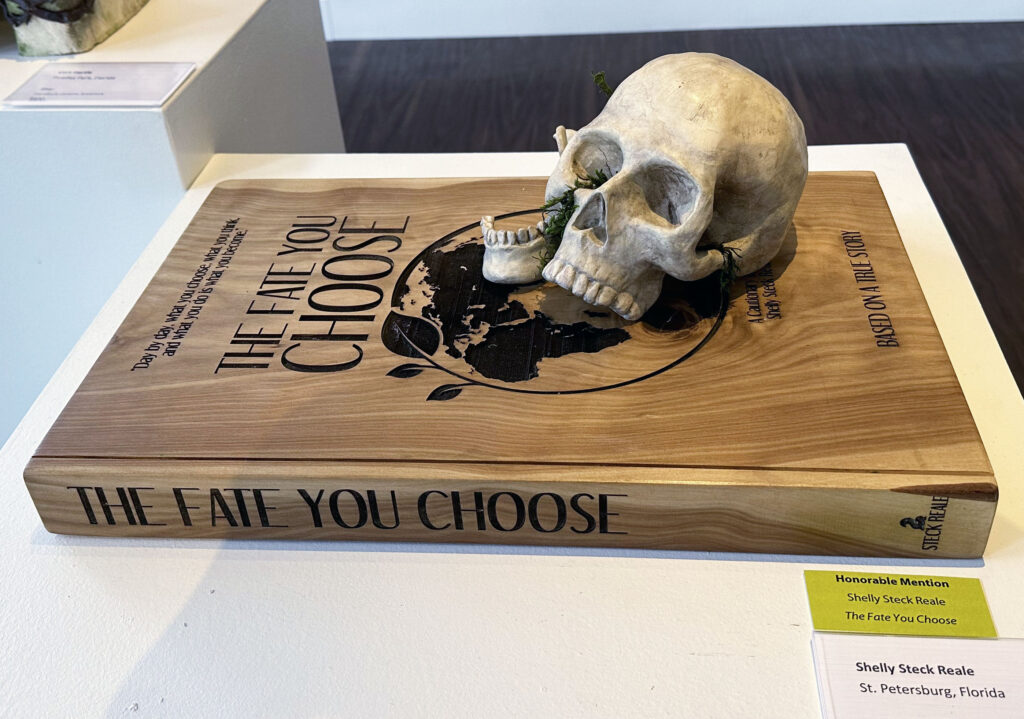
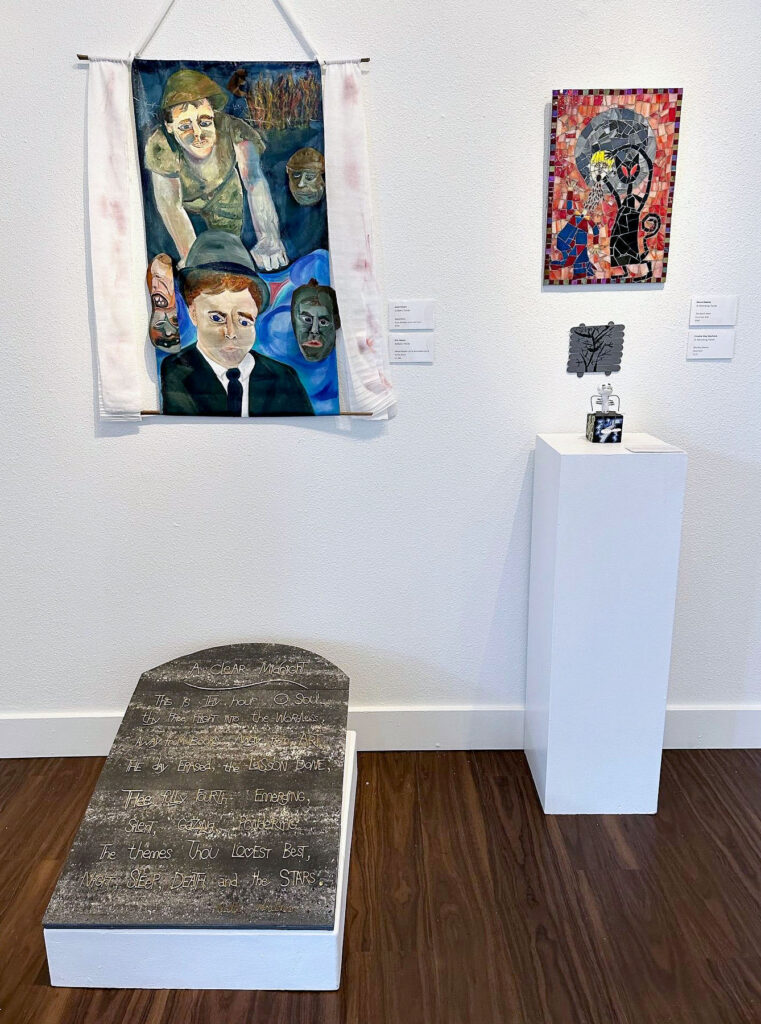
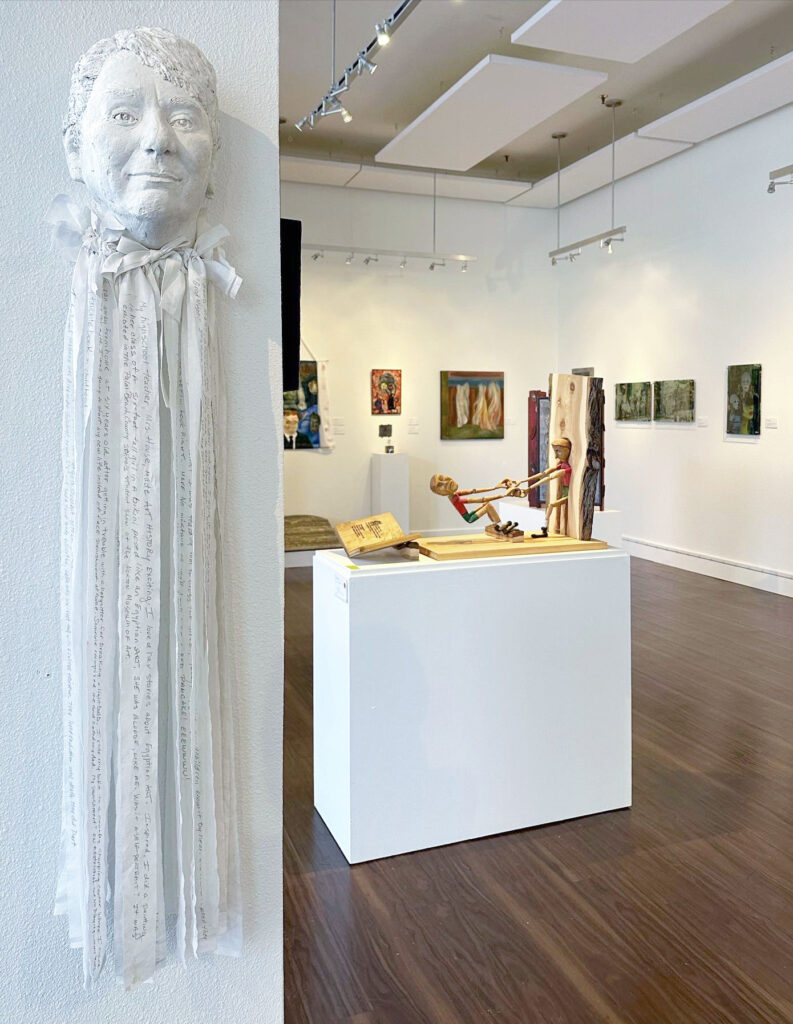
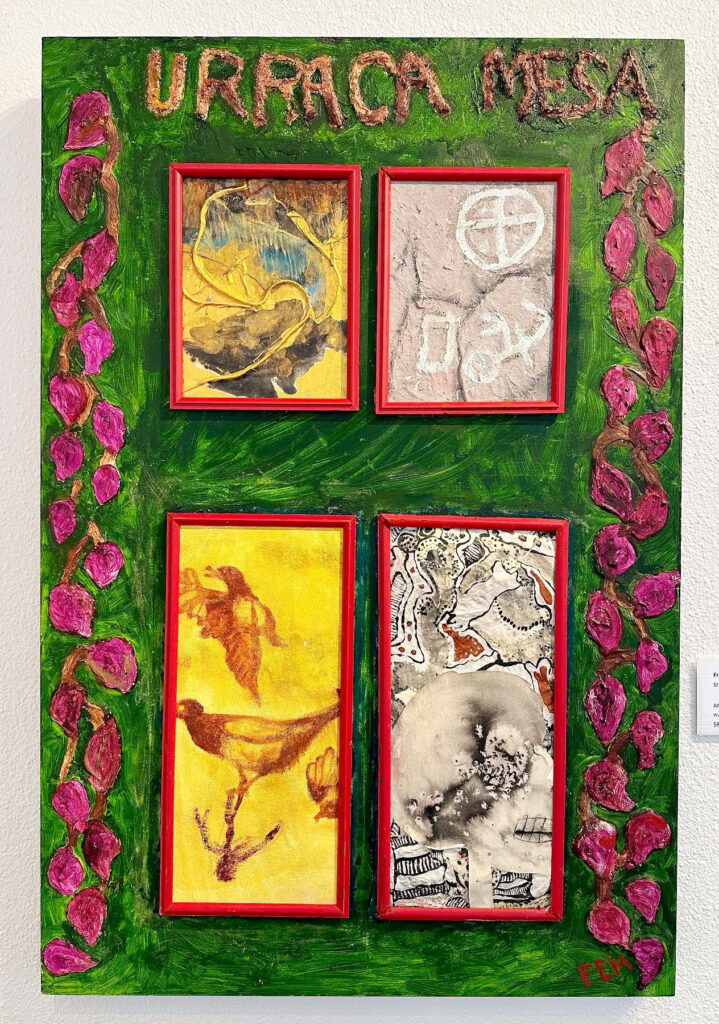
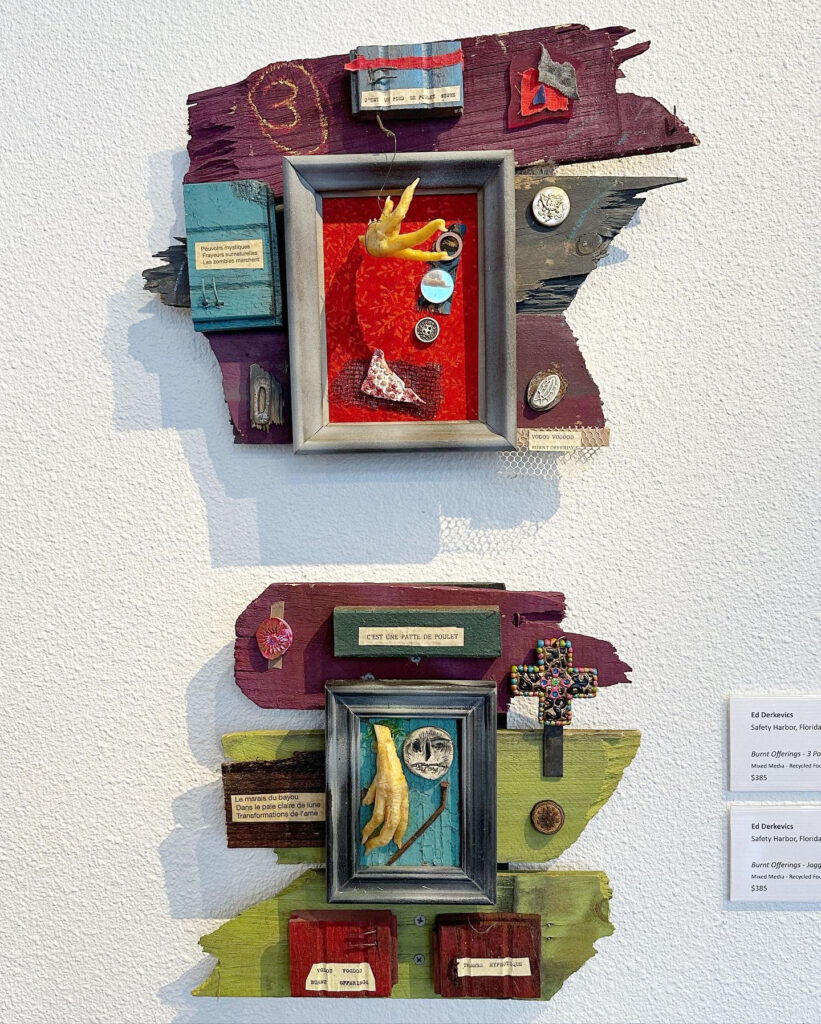
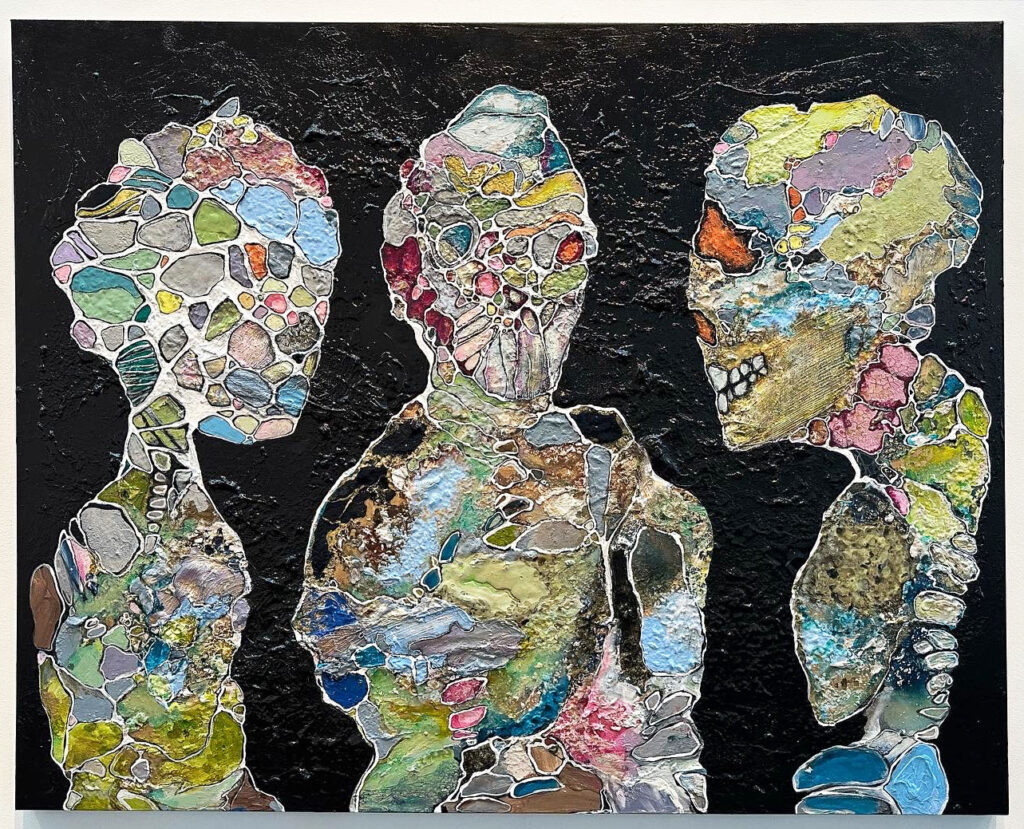
On Thursday, 10/5/23, in partnership with Keep St. Pete Lit, a group of local writers will be telling ghost stories at the gallery inspired by pieces from the exhibition. The reading will take place at 6pm.
Below are a few more selections-
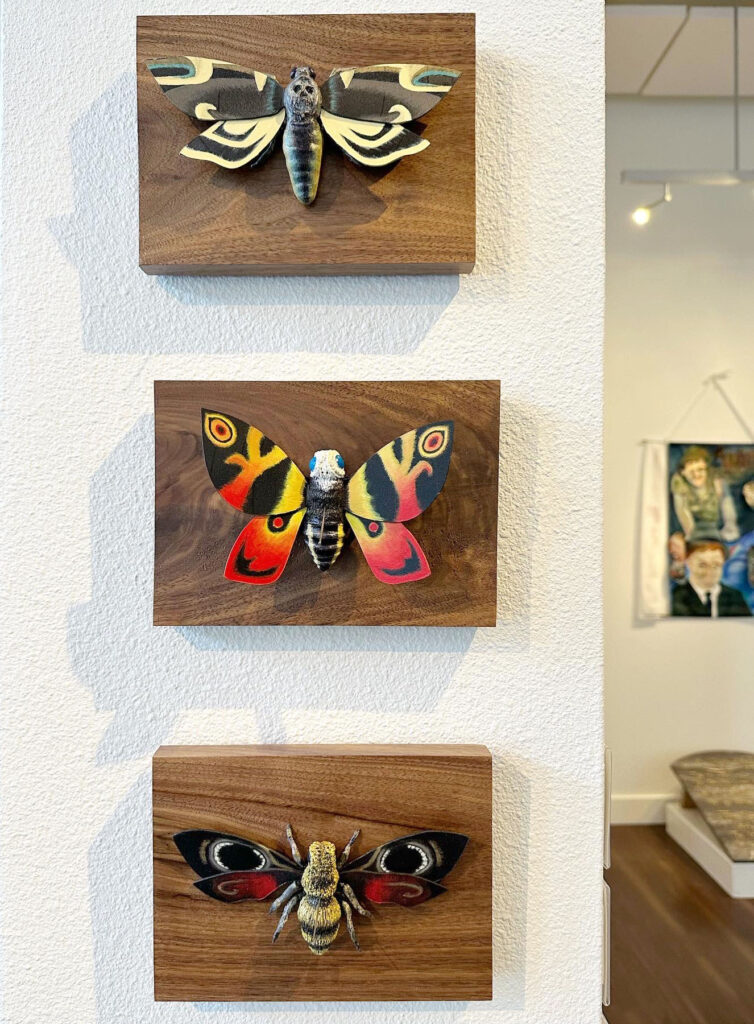
Work by Alegrobot, Hand sculpted paper clay, acrylic paint
Janet Folsom, “Apparitions”, Mixed media (top left); Eric Folsom, Gravestone, bronze on marble; Donna Slawsky, (top right) “The Devil’s Work”, Stained glass, beads, and Creative Clay, Stephanie,(bottom right) “Monkey Dreams”, Mixed Media
About Creative Clay, who contributed several works to the exhibition-
“Creative Clay achieves its mission by providing ongoing studio arts workshops for individuals with disabilities five days per week. Creative Clay teaching artists provide students with education and experience in artistic techniques, as well as vocational skills related to the display, promotion, and sale or their expressive work.”
Katie Deits, “Haunted by the Past”, Ceramic, cotton, pencil, acrylic paint (left) and Nick Reale, “Out of the Wood” wood sculpture
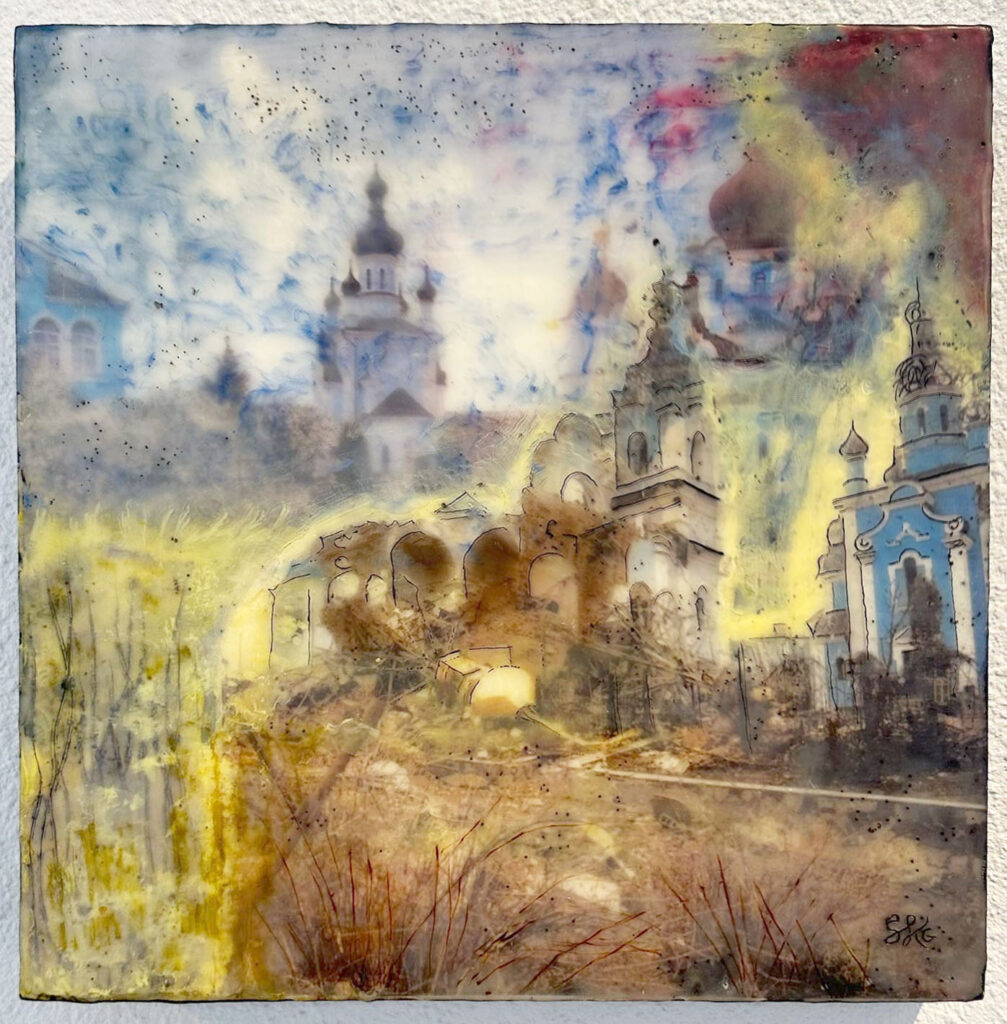
Francine Michel “Mysteries of Urraca Mesa”, Water mixable oil, collage
Ed Derkevics, “Burnt Offerings”- “3 Potions” and “Jagged”- Mixed Media, recycled found objects
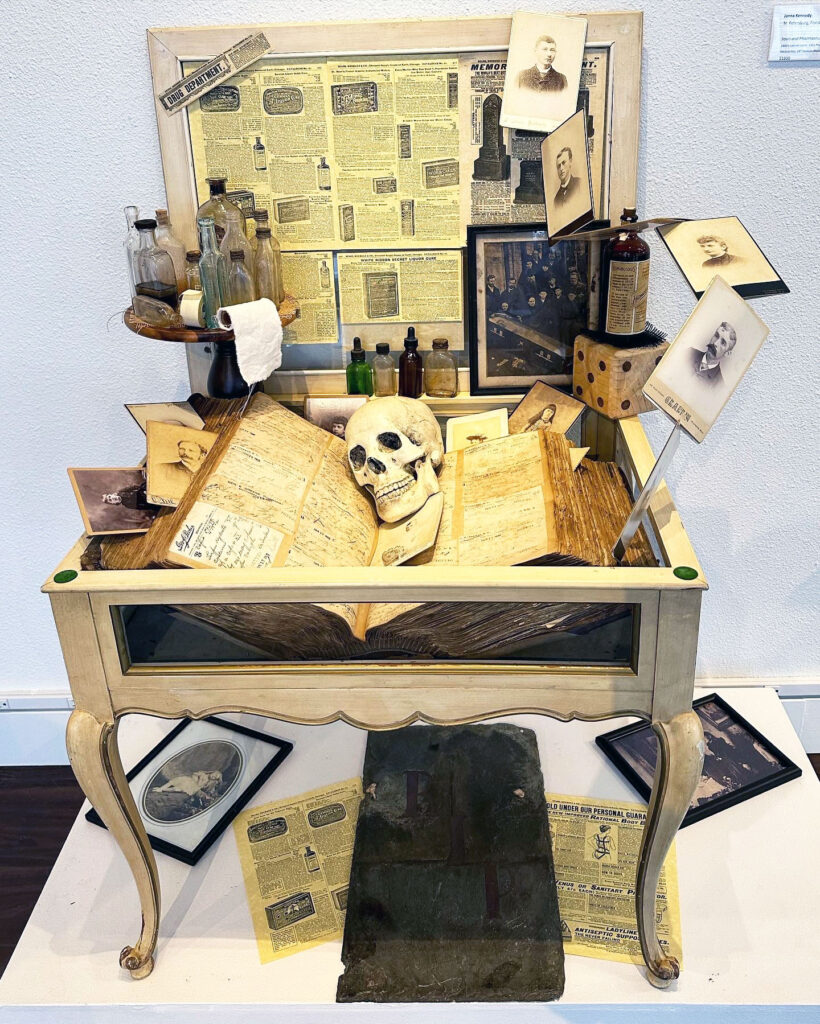
Janna Kennedy, “Souls and Pharmaseuticles”, 1800s Cabinet Cards, 1902 Pharmacy Ledger & Medical Ads, 19th Century Medicine Bottles
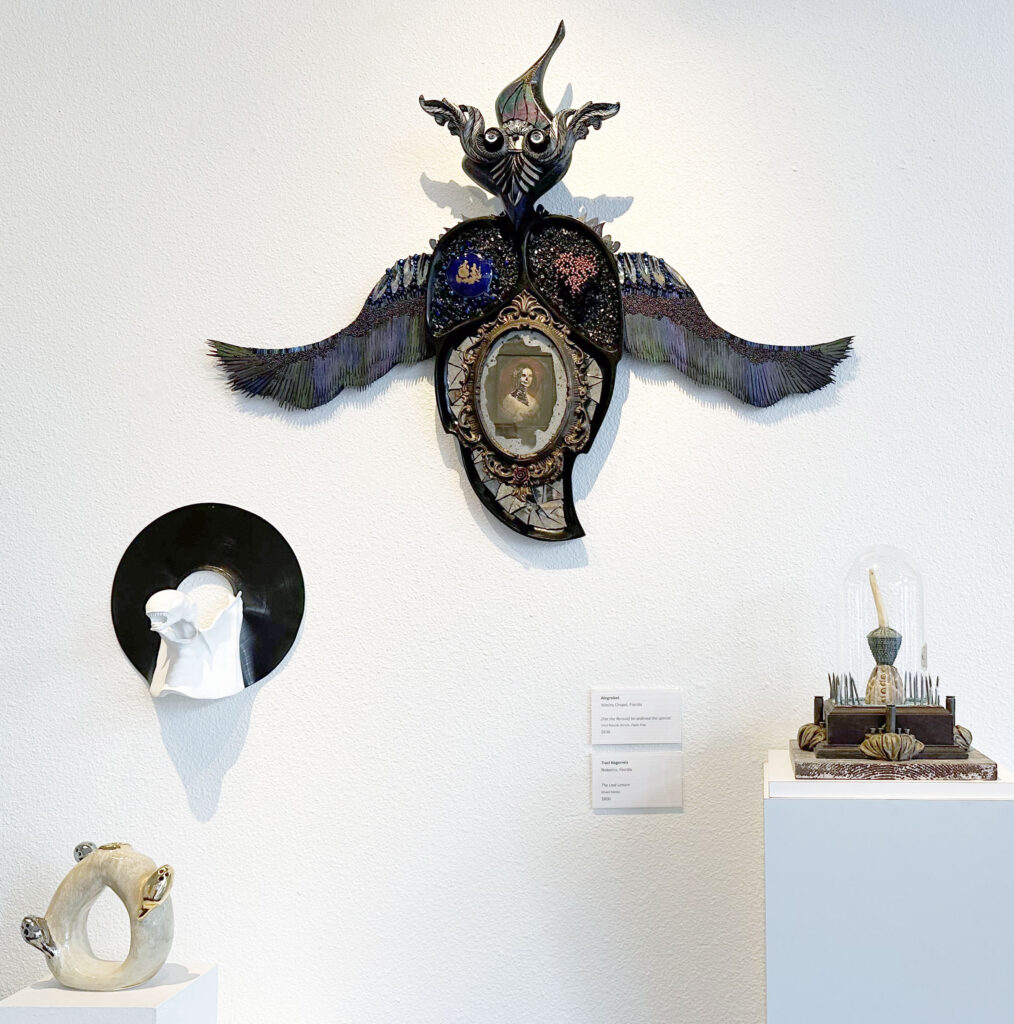
LA Finfinger, Ghost Ceramic work (bottom left); Alegrobot, “(For the Record) he ordered the special”, Vinyl record, paper clay; Traci Kegerreis, “The Lost Lenore”, Mixed media (center top); Demeree Barth, “Remembering Sedlec Ossuary”, Clay, bullet casings, wood display stand, found objects (bottom right)
“System of (architecture)” 2023, (black) and “System of (emotion)”, 2023, (pink), Stoneware and glazes
“Line, Dot, Squiggle (a search for something more)”, 2022, Micron, colored pencil, silver leaf, vellum and colored porcelain on paper
“Line, Dot, Squiggle (a search for something more)”, 2022, (detail)
Pictured above are some of the works from Iren Tete’s exhibition systems of (entanglement) at Art Center Sarasota. These engaging sculptures (and one mixed media work) explore the various systems that surround and influence our daily lives.
The artist’s statement about the exhibition-
things fold and unfold meander, bend, and twist until they become other things
We make deliberate and accidental choices which result in further deliberate and accidental choices. This evolves into a network of choices, a system leading from present to future, defined by scientific reasoning yet clouded by emotional irrationality.
Systems surround us, and perhaps even define us. Systems of (entanglement) navigates, questions, and tenderly accepts these systems –
systems of thought
systems of architecture
systems of gravity
systems of language
systems of emotion
systems of logic
systems of history
systems of memory
systems of time
systems of
I engage with these numerous systems while making. My thoughts oscillate between those of simple actions – pinch, coil, squeeze- to those of things that are infinitely complex and a part of something else – such as time. These separate systems interconnect and grow into something bigger that is a part of the entangled network of systems where one thing becomes another.
“Paolo and the Bomb”, 2023, Assemblage of diverse materials
“Lions Escape from the Zoo or Portrait of Andy Kaufman”, 2023, Assemblage of diverse materials
Center work- “Hive, Helmet, and Butter Brick”, 2023, Assemblage of Diverse Materials
“Colossus in Repose”, 2023, Assemblage of diverse materials
“All Their Friends Are Rabbits”, 2023, Assemblage of diverse materials
After visiting Ry McCullough in his studio back in May to see what he was working on, I was very excited to finally see his exhibition SUPERPOSITIONS at Art Center Sarasota. His mixed media sculptures capture the imagination as the viewer imagines the connections between the objects in the work. The titles provide often humorous clues, but make sure to check out his Instagram for more background on his inspirations.
About the work from the center-
McCullough’s practice engages the fields of printmaking, creative writing, drawing, sound, and sculpture to create unique systems that probe the margins and boundaries of how art crafts language and communicates meaning. Using these systems of making as a guide for a range of media processes, they articulate parameters that can expand or collapse, generating opportunities for discovery in thematic investigations of the philosophical, abstract, and fluid state of being across time and space. SUPERPOSITIONS is inspired by an affection for the traditions of still life, modernist abstraction, and humor.
Artist Statement-
The SUPERPOSITIONS project comprises works of collage, sculpture, and wall-bound hybrids that exist between two-dimensional and three-dimensional space. The tension between these two spatial expressions is celebrated within this project through the playful application of collage. More than a tradition of material operations, McCullough views collage as a bundle of behaviors, a toolbox, and a signifier of fragmentation that forms an ethos of revision and reorganization.
McCullough is attracted to humble materials such as plywood and paper, concrete and plaster, foam and found things, essential stuff that requires intervention to establish meaningful presence through the relations it forms to other components in each work. The formal language is idiosyncratic; combinations of hard and soft edges, geometric and organic form, and a buffet of color with a penchant for balance. These works are propelled by the forces of potential change, by the energies of process, and by developing a poetic and clumsy status of unfinishedness.
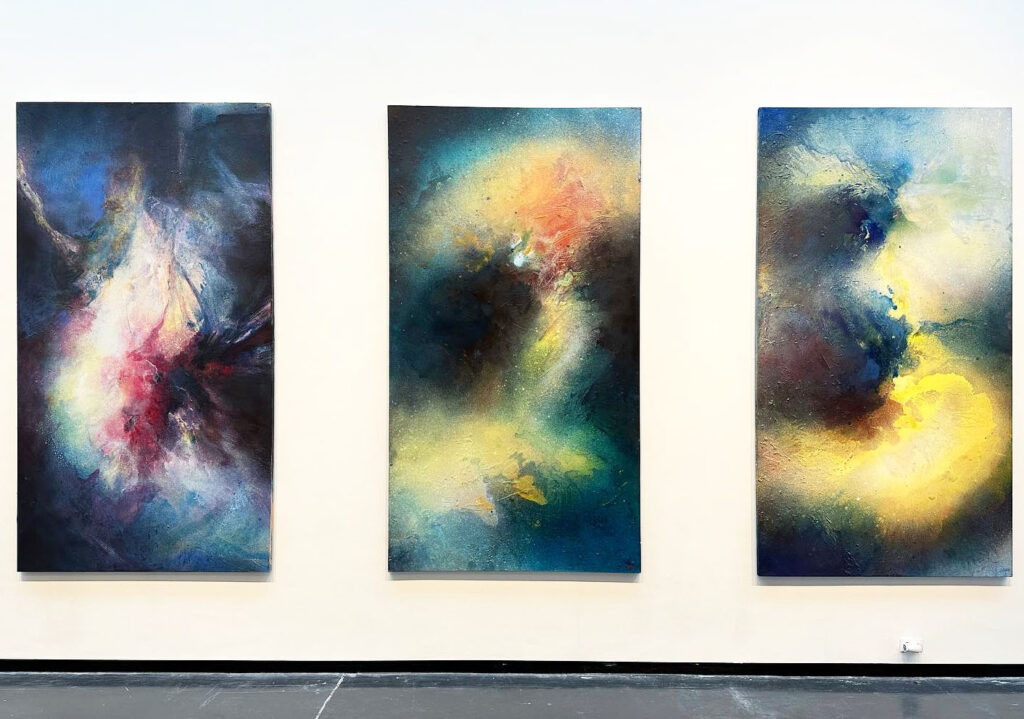
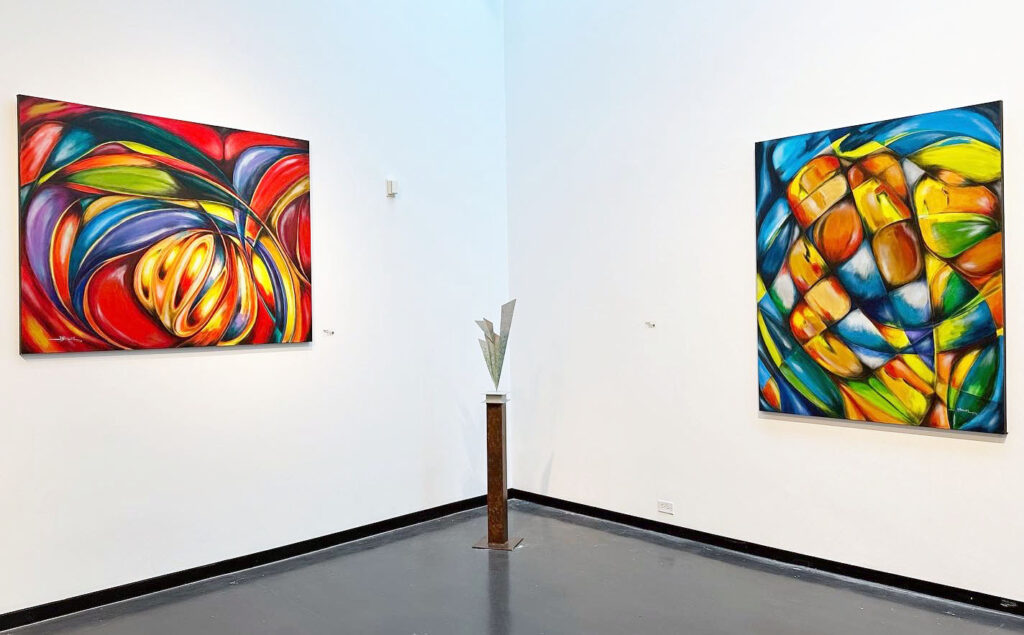
Angel Rivera Morales, “Dystopian Paradise I, II, and III”, 2023, Acrylic and oil on canvas
Gilbert Salinas, “As We Speak”, 2022, Mixed media on canvas
Juan Nieves Burgos, “Germinar de patria” and “Mundo sin tiranos”, 2019; Carmen Rojas Gines, “She Warrior-SW3 “Guerrera”-G3″, Steel metal
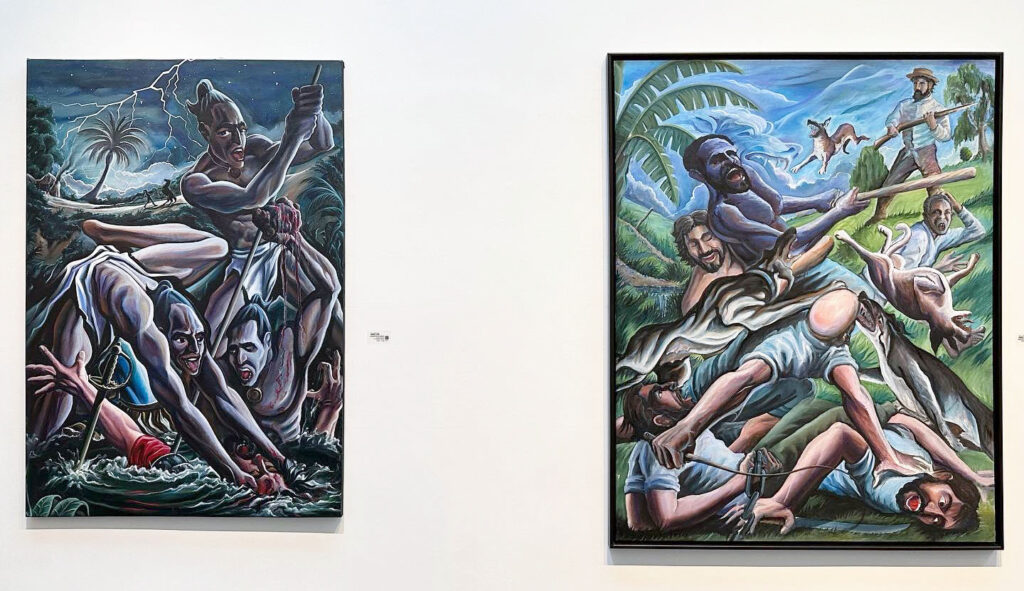
Valentin Tirado Barreto, “Salcedos Death- La Muerte de Salcedo” and “Rebellion of the slaves- Rebelión”, Acrylic on canvas
Currently at Creative Pinellas is the group exhibition Keepers of Heritage: Hidden Tales / Custodios de la Herencia: Cuentos Ocultos, on view until 10/15/23.
From the Creative Pinellas website-
Keepers of Heritage is an extended collaborative effort whose purpose is to document, present and promote the contributions of artists of Puerto Rican artists in the Caribbean archipelago and abroad.
Its roots go back to 2015 with the presentation of the “La Diaspora” exhibition at the Terrace Gallery in Orlando City Hall. Since then, the collective has expanded and traveled to institutions such as the National Museum for Puerto Rican Arts and Culture in Chicago, the Appleton Museum of Art in Ocala, and the Albin Polasek Museum in Winter Park, Florida.
Over eight years, the collective has documented and presented the work of nearly 30 artists whose artistic practices include a diversity of mediums such as painting, drawing, sculpture, engraving, multimedia, and photography.
He is currently showing his work at The Little House, located at 451 N. La Cienega Blvd. in Los Angeles, presented by Dries Van Noten.
From their press release-
On view will be a selection of recent work by Sam Falls which merges photography, painting, and installation which results in captivating pieces that invite viewers to explore the relationship between humans and the environment. The works in the exhibition offer a meditation on the sublime dichotomy of mortality, including ceramics combining fossilized images of nature and the human form, as well as found airbags from crashed cars that are embroidered with symbolic idioms on the transience of time and life quoted from ancient Greek and Roman sundials.
Falls’ artistic process explores the varying representations of nature and materials through the passage of time. Rain, sunlight, wind, and the gradual effects of weathering all contribute to the unique aesthetic of each piece, creating a dialogue between art and nature that captures the essence of life represented in time and space. By exposing his artwork to elements, he invites the environment to act as a collaborator in reinterpreting organic materials into new forms.
Launched in 2006 to support the next wave of contemporary portraiture in the United States, the National Portrait Gallery’s celebrated triennial Outwin Boochever Portrait Competition is a major survey of the best American portraiture selected by internationally prominent jurors and curators. Now in its sixth edition, The Outwin: American Portraiture Today presents 42 works selected from over 2,700 entries, that foreground the vibrancy and relevance of portraiture today. In addition to paintings, photographs, drawings, and sculptures, The Outwin includes video, performance art, and textiles, highlighting the limitless possibilities of contemporary portraiture.
Open to both emerging and established artists, this year’s entrants were encouraged to submit work that moves beyond traditional definitions of portraiture, and to explore a portrait’s ability to engage with the social and political landscape of our time. The variety of media and subjects featured in the exhibition invite audiences of all backgrounds to find relation in the human experience.
Since its inception, finalists for the exhibition have been determined by a panel of jurors including three Portrait Gallery staff members and four external professionals (critics, art historians, artists). The competition is endowed by and named for Virginia Outwin Boochever (1920 – 2005) who, for 19 years, volunteered as a docent at the Portrait Gallery. Her commitment to advancing the art of portraiture is continued through the support of her children.
Below are a selection of works from the show and information about them from the museum.
Alison Elizabeth Taylor– Anthony Cuts under the Williamsburg Bridge, Morning, 2020 (pictured above)
On walks around her Brooklyn neighborhood during the COVID-19 lockdowns, Alison Elizabeth Taylor encountered the hair groomer Anthony Payne, who,with his workplace shuttered, had taken his scissors, mirror, and chair to the streets. Payne sought to financially support the Black Lives Matter movement, especially in the aftermath of George Floyd’s murder, and turned over proceeds from his donation-based haircuts to organizations advocating for social justice.
Taylor’s process, one she developed and named “marquetry hybrid,” incorporates vivid paints, inkjet prints, and the natural grains of over one hundred veneers. Marquetry, with its inlaid combination of woods, can “memorialize,” Taylor notes. She acknowledges the history of the craft, which was favored by Louis XIV (1654-1715) when he was acquiring furniture for Versailles. By giving Payne this “royal treatment,” Taylor aims to pay tribute to him.”I want him to see how much his example meant to me,” she explained.
Kira Nam Greene, “Kyung’s Gift in Pojagi (From the series “Women in Possession of Good Fortune”)”, 2019 Oil, gouache, colored pencil, and acrylic ink on canvas
Kira Nam Greene– Kyung’s Gift in Pojagi (From the series “Women in Possession of Good Fortune”), 2019
In this mixed-media work, by Kira Nam Greene, the artist Kyung Jeon faces us with relaxed self-assurance. She is carefully positioned on her couch as her long black hair falls over her orange and turquoise tunic. In the foreground, a wooden cylinder containing paint brushes reveals her medium of choice. A plate with persimmons, consumed during the harvest festival Chuseok to celebrate good fortune, brims with potential while the rest of the painting pulsates with action.
Greene situates her friend in a fantasy world that echoes Jeon’s artwork and their mutual interest in the traditional Korean fabric quilting technique of pojagi. Two rabbits, representing Jeon’s Chinese zodiac, appear to be concocting a potion. Flowers sprout as kaleidoscopic patterns envelop her. The reference to pojagi, the visible paint drips in the background painting, and the hands of the sitter- left unfinished- invoke the role of tradition, process, and exploration in artmaking.
Stuart Robertson, “Self Portrait of the Artist” from the “Out and Bad” series, 2020, Aluminum, earth, acrylic paint, enamel, paper,metallic bubble wrap, sequins, and gold foil on wood
Stuart Robertson– Self Portrait of the Artist from the Out and Bad series, 2020
“In my world, skin is high-tech, amorphous, and armored,” the artist Stuart Robertson observes. “Blackness is percussive, lustrous, flexible, and indestructible.” Self-Portrait of the Artist depicts a fragment of a man- half of his face and his upper torso-shiny and monumental. A black beard delineates his jaw, and a small gold hoop adorns his ear. Although the figure is cropped beyond recognition, the work’s title provides a clue.
Through the alternation of flat and repoussé aluminum sheets, Robertson achieves a hypnotic effect, a poignant tension playing on what he reveals or hides from us viewers. His refusal to depict his entire face or figure challenges the notion of what a portrait should be and blocks the objectification of the Black male body, so often sexualized in visual culture. Simultaneously, Robertson delivers an irrepressible, resplendent image of that body, one inspired by the aesthetics of Jamaica’s dancehall culture.
Vincent Valdez, “People of the Sun (Grandma and Grandpa Santana)”, 2019, Oil on canvas
Vincent Valdez– People of the Sun (Grandma and Grandpa Santana), 2019
An elderly couple faces us with the gentle authority that old age provides. People of the Sun (Grandma and Grandpa Santana) is a portrait of Vincent Valdez’s maternal grandparents. “My grandparents spent most of their time outside,” the artist recalled. “Grandpa spent his entire life working under the blazing Texas sun as a carpenter and yard worker, cutting lawns in the wealthy communities of San Antonio right up until he passed away. Grandma was constantly working with her hands–raising kids, washing, sewing clothes, and tending the plants in her yard.”
The Santanas are depicted in a space defined by details the artist remembers: their vintage AM radio, their plants, their homemade clothes. The bedsheet, like the Virgen de Guadalupe’s aura, signals their spiritual role in the family. This portrait connects the pair to the Indigenous and mestizo cultures of the American Southwest, including the Aztec and Maya, who honored the sun.
For more work from the exhibition, please head to page 2.
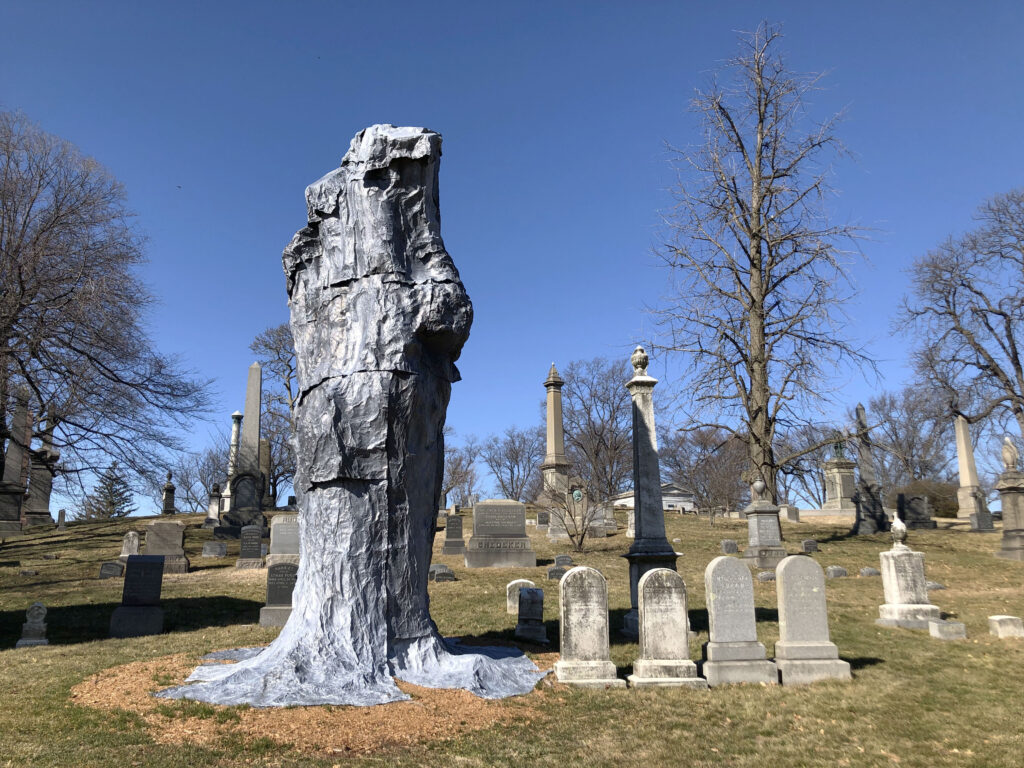
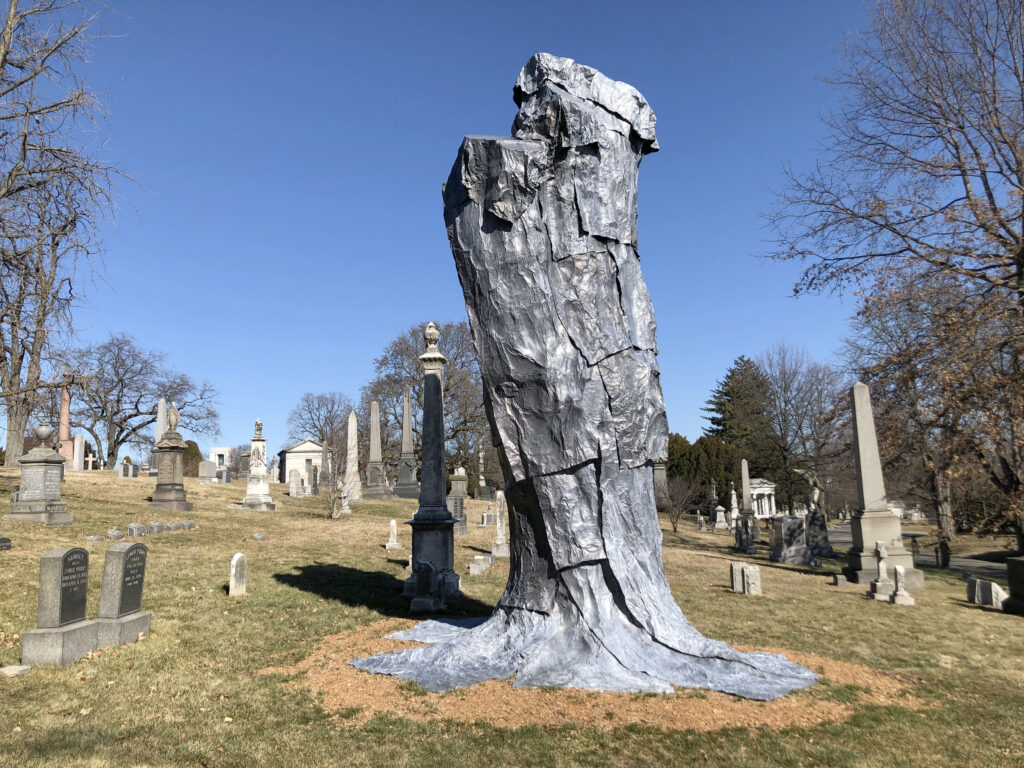
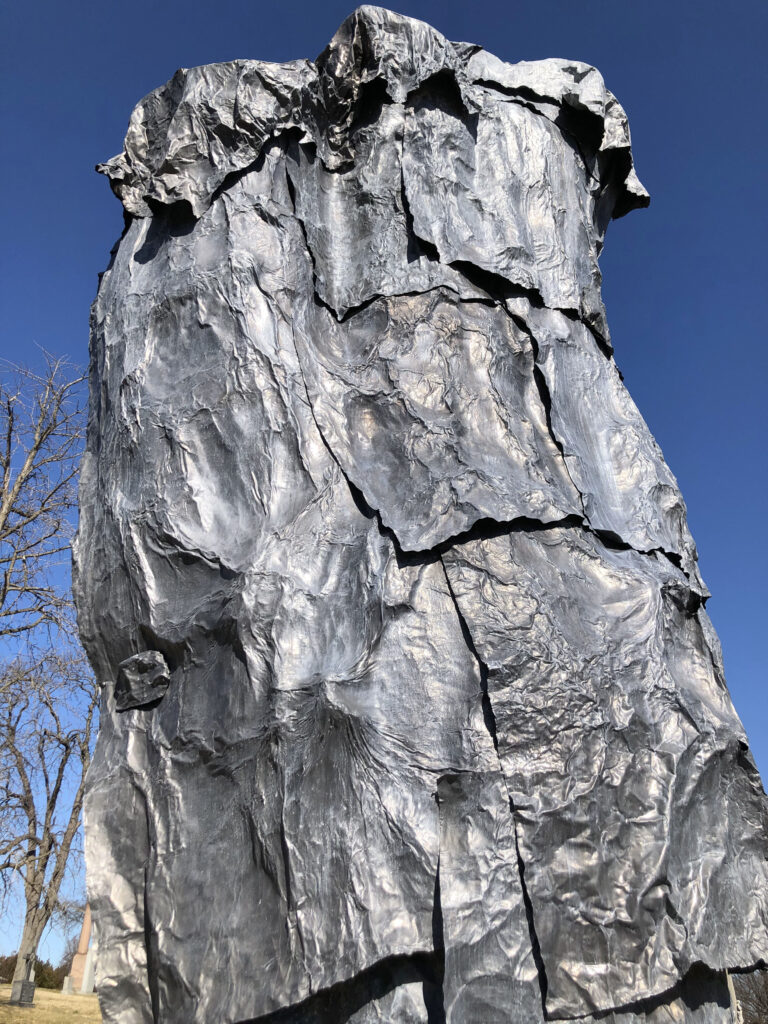
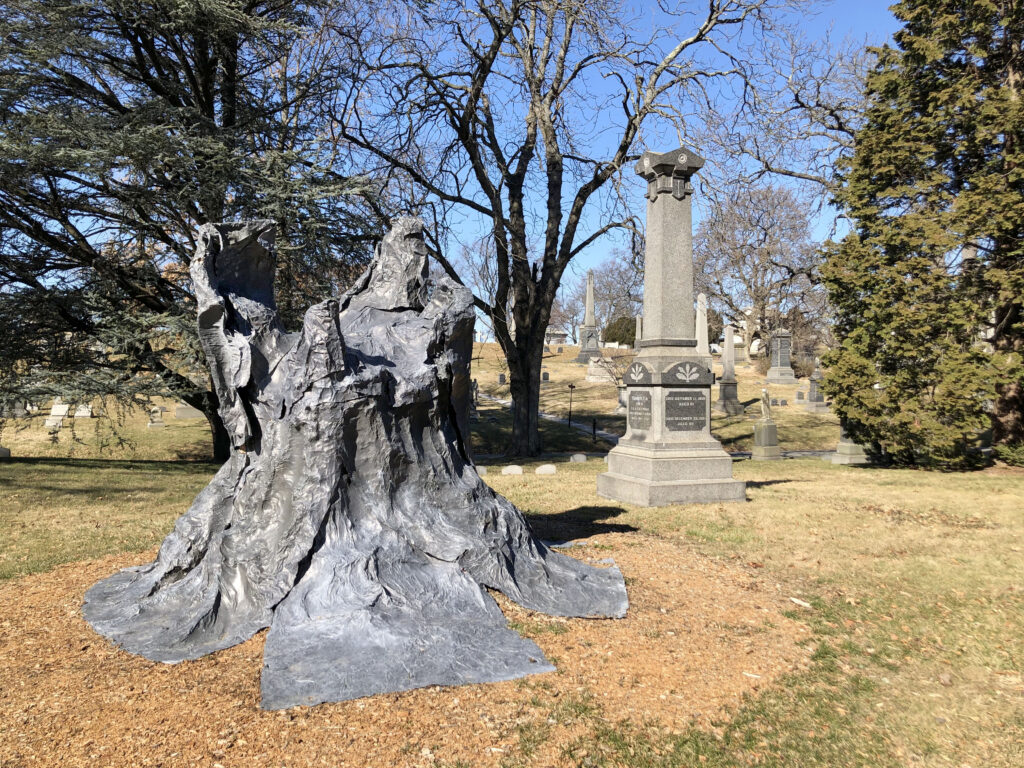
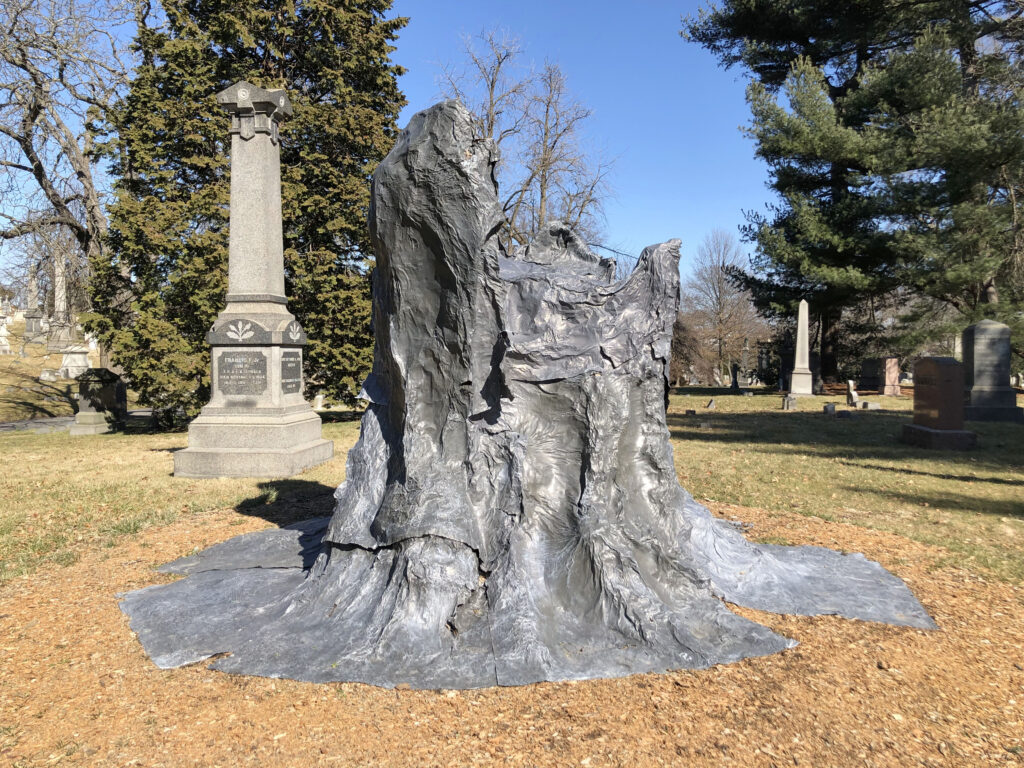
Above are two of the works from Athena LaTocha’sThe Remains of Winter (Battle Hill, East), 2022, currently at Greenwood Cemetery in Brooklyn.
From the cemetery’s website about the work-
Athena LaTocha creates large-scale works inspired by her close observations of the natural world, from the deserts and mountains of the Southwest to the Great Plains. She often incorporates elements of these environments, including soil, sand, bark, and rocks. Recently, she has been particularly drawn to trees, considering them as record keepers that bear the markings of time.
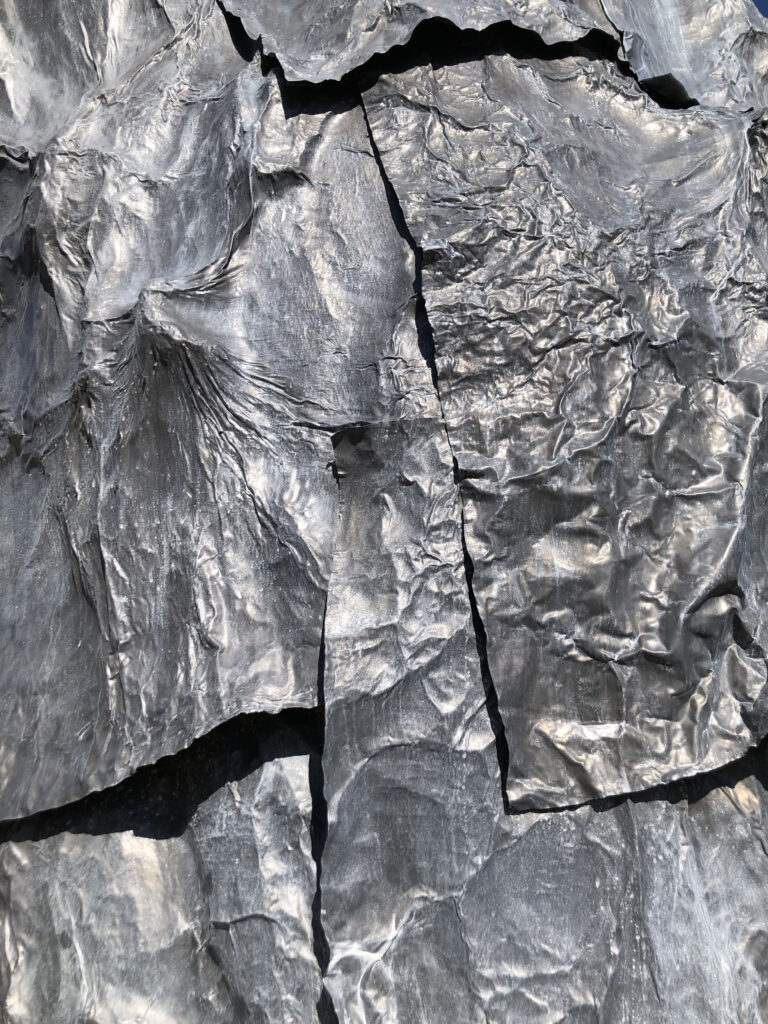
Inspired by Green-Wood’s centuries-old trees and its legacy as a place of remembrance, LaTocha has created The Remains of Winter. She cloaked the remains of two massive European beeches on Battle Hill in thin sheets of lead, a material that has been used for centuries in coffins to slow the decomposition of the body. By hand-forming this malleable metal onto the trees, LaTocha captures the unique details of their shapes and forms, even as they slowly degrade beneath the lead.
All around these sculptures, the Cemetery is in a continuous cycle of transformation. Felled trees are turned into mulch for new plantings, earth is removed then replaced for each new burial, and even the stone monuments themselves slowly erode. Through The Remains of Winter, LaTocha memorializes these shifts and changes while also raising profound questions about what we choose to commemorate and mourn—whether it is what we can witness before us or that which, like the movement of continents and land masses, unfolds over lifetimes.
The sculptures will remain on view through September 2023.
“Bryson Funmaker”, 2020, Inkjet print and beadwork
The Museum of Fine Arts St. Petersburg is currently showing an impressive collection of work from photographer Tom Jones. The photos, in multiple series, focus on Native American identity, history, cultural appropriation, and the Ho-Chunk Nation of Wisconsin, of which Jones is a member. The work engages visually while also being informative.
From the museum’s press release for Tom Jones: Here We Stand–
For over twenty years, Tom Jones has created a visual record and exploration of his Ho-Chunk community. Born in North Carolina and raised in Orlando after a short stint in Minneapolis, Jones returned to the Midwest, moving to Wisconsin at age 15. He then made his way to Chicago for graduate school at Columbia College. Jones’s father worked with Kodak and owned a photography lab, helping shape the artist’s understanding of the practical aspects of photography from an early age. During graduate school, Jones began an ongoing photographic essay on the contemporary life of his Ho-Chunk community, beginning first with the elders.
The show comprises over a dozen series, ranging from the documentary to the conceptual. Of his series on Veterans’ memorials at the annual Black River Falls Pow-Wow, Jones says, “I was interested in the way families made very conscious decisions about how they want their loved ones memorialized.” Other series include the emotionally intimate, though larger than life, beaded portraits. “Beading is a metaphor for our ancestors watching over us. I am also referencing an experience I had when I was about 8 or 9 years old. My mother took me to see a Sioux medicine man named Robert Stead. He led the call to the spirits, the women began to sing, and the ancestors appeared as orbs of light. This event inspired the series Strong Unrelenting Spirits.“
Jones’s photographs examine identity and geographic place with an emphasis on the experience of Native American communities. He is interested in how American Indian material culture is portrayed through commodification and popular culture. Much of his work counteracts and corrects decades of misinformation and misrepresentation of American Indians, particularly targeting the field of U.S. history. Jones’s critical assessment of the romanticized representation of Native peoples in photography re-examines historic pictures taken by white photographers. This reassessment questions the assumptions about identity within the American Indian culture by non-natives and natives alike. “While each of Jones’s series is distinctly different, the message remains consistent: the Ho-Chunk are not vanishing or frozen in time,” said Dr. Jane Aspinwall, Senior Curator of Photography. “Jones’s photographs emphasize a solid, generational commitment to family, tribal community, and land. His photographs reclaim appropriated images and set the historical record straight.”
Below are a some selections from a few of the series in the exhibition.
“Trenton and Roger Littlegeorge”, 2011
“Dorothy Crowfeather”, 1999
“Dear America” series
About the Dear America series pictured above-
Using each line from the first two verses of the song, America (“My Country Tis of Thee”) as the title of fourteen of the works in the Dear America series, Jones questions whose history is being propagated here. With dry wit and an unfailing commitment to truth, Jones exposes atrocities like the massive effort by the U.S. government to assimilate Native American children to non-Native culture, the merciless seizing of Native lands, and the mass hanging of thirty-eight Sioux and Ho-Chunk men under President Lincoln in 1862. He also highlights Native American identity in relation to cowboy culture, the thoughtless misappropriation of Native American customs, and the influence of the Iroquois Confederacy on the U. S. Constitution. Jones’s aim is to broaden the “traditional” historical American narrative to be more representative of all people, especially the original inhabitants of this land.
About the Ho-Chunk Veterans Memorials, pictured above-
“I wanted to do this photographic essay to honor our veterans… One in four American Indian males is a United States veteran. Ho-Chunks have fought in every war for the United States except for the War of 1812. The Ho-Chunks did this even though they were not granted the right to vote until 1924, and during the Indian Removal Act, were removed at least seven times from Wisconsin by the United States government. This is the conviction we have as a people… I honor these people who give of themselves freely to protect this land. Traditionally, Ho-Chunks are taught to live their lives for the betterment of others. The veterans have done this.’
-Tom Jones
From Jones’ “”Native” Commodity” series
About the “Native” Commodity” series-
The Wisconsin Dells, one of the most popular tourist destinations in the state, is home to spectacular natural scenery and the largest concentration of waterparks. Located on Ho-Chunk ancestral land, the area is now highly commercialized, with much of its identity resting on the appropriation of Native American stereotypical tropes. In this series, Jones documented this unabashed use of Native American symbols, images, and place names in advertising and popular culture. The sale of “Native American” crafts made in China, the liberal use of names of historically important figures like Black Hawk, and the indiscriminate mix of tribal communities into one conglomerate-tipis from the Plains next to totem poles from the Pacific Northwest next to Pueblo pottery. The Dells serve as a microcosm for how images of Native Americans are reproduced and reframed into a collective memory that is often distorted. Jones wryly noted that none of the Native American objects feature anything specifically attributable to the Ho-Chunk Nation.