Dec 162025
 

“Allegory of Winter”, 1948, Goache and paper

“The Juggler (The Magician)”, 1956, Oil and inlaid mother of pearl on board

Surrealist artist Remedios Varo was born on December 16th, 1908, in Spain. Throughout her life, she was a part of avant-garde circles— first in her homeland, and later in Paris and Mexico. She and several other intellectuals and artists fled to Mexico during World War II, where they were given asylum and citizenship. It was there that she would create the majority of her best-known works.

Varo’s paintings are filled with symbolism and mystical imagery. They also often reference her own experiences creating art. While Allegory of Winter (first image) is currently in a private collection, The Juggler (The Magician) can be seen at the Museum of Modern Art.

From MoMa about the work-

This painting’s titular juggler (or magician) stands on the platform of a carnivalesque cart filled with fantastical objects and animals. He performs before seemingly identical figures robed in a single gray cloak. To produce this composition, Varo worked in the manner of early Renaissance masters: she transposed preparatory drawings onto a gesso-primed panel, which had been scratched to give the surface variation. She also deployed decalcomania, a technique favored by the Surrealists in which materials such as paper or aluminum foil are pressed onto wet paint to transfer a pattern that may then be embellished. This textured effect can be seen in the magician’s garments and in the background trees.


Dec 122025
 

Cleveland artist Jake Kelly‘s 2010 mural was inspired by the artwork and concepts of ArtsCollinwood‘s portfolio project students. Along with his numerous murals band posters, and fliers, he has also made several comics detailing darker moments from Cleveland’s history.

He also created the fictional series, The Lake Erie Monster, with fellow artist John G. A few issues are currently available online for free.

More about the series from their website-

The flagship story is an “adaptation” of a fake movie that J. Kelly developed for a series of Ten Imaginary Movie Posters. Set in the 1970s, we follow a cast of eclectic characters as they have to navigate the choppy waters stirred up by a Monster born out of the pollution from a city gone to seed. Along with the main title, each issue will feature at least one short back up story.

The Aither‘s 2023 interview with Kelly is also worth a read for more information on the artist.


Dec 112025
 

Alex Da Corte‘s Soft Power was on view from the High Line until June of last year.

His latest exhibition, Parade, is currently on view at Matthew Marks in NYC, on view until 12/20/25. The Pink Panther appears in this show as well- Da Corte depicts himself as the character painting the gallery pink.

From the High Line website about the billboard-

Known for his immersive installations, sculptures, and films, Alex Da Corte’s work explores themes of identity, consumerism, and taste, challenging societal norms and reimagining the familiar in unexpected ways. The artist draws from myriad sources, including popular and consumer culture, art history, classical literature, and modern design, seamlessly weaving together disparate elements into cohesive narratives. His adept use of vibrant color and surreal imagery lends a dreamlike quality to his work that captivates viewers and blurs the lines between fantasy and reality.

Da Corte presents a new artwork for the High Line’s 18th Street Billboard, inspired by the Pink Panther, a Friz Freleng creation designed for the animated opening sequence of a 1963 Hollywood comedy that came to embody the film and has evolved, through 60 years of spin-offs and reinventions, into cultural ubiquity. Pink’s durability across many generations has allowed it to sell countless products, from fiberglass insulation foam to artificial sweetener, yet the creature’s essence remains out of reach. With neither master nor peer—and seemingly eternally unbound by the rules of others—Pink represents a certain queer freedom. Da Corte revives Pink as an icon of resistance, supine but poised, wielding a sign of universal protest, brandishing a clear pink purpose. “There is a difference between falling down and laying down,” Da Corte explains. “I call that soft power.” This billboard is an advertisement for the value of such power.

Dec 112025
 

Sasha Gordon‘s two billboards- My Love of Upholstery (2024) and Untitled (2024), are currently on view from the High Line in NYC.

From the High Line website about the work-

Sasha Gordon creates surreal paintings and drawings that explore themes of sexuality, gender, race, and the body. Often depicting herself as subject, Gordon is keenly attuned to art historical themes of portraiture and self-portraiture, and of the politics of representation. She approaches these categories with inventiveness and humor, using the uncanny to communicate very real concerns around self-image and identity.

For the High Line – Moynihan Connector Billboard, Gordon presents two works, My Love of Upholstery (2024) and Untitled (2024). Both hail from the artist’s most recent body of work, in which she examines challenging taboos and standards of representation. Her images present a wide range of emotional states, frequently considered through the lens of her identity as a queer Asian American woman. Through endless avatars, she portrays the othering of unconventional human bodies and her own experiences of alienation. Towering over 30th Street and Dyer Avenue, the artist’s fluctuating visage appears at massive scale, marked by a distinct unnaturalness—in My Love of Upholstery, where she depicts herself with a Pinocchio-like wood-grain body, and in Untitled, in which her face and pupils are marked with five-pointed stars. These visions are simultaneously anxious and intimate, teetering somewhere between tender fantasy and nightmare. Her avatars, looming large within their frames, offer both artist and audience an outlet for exploring contradictory emotions and complex personal experiences.

Dec 102025
 

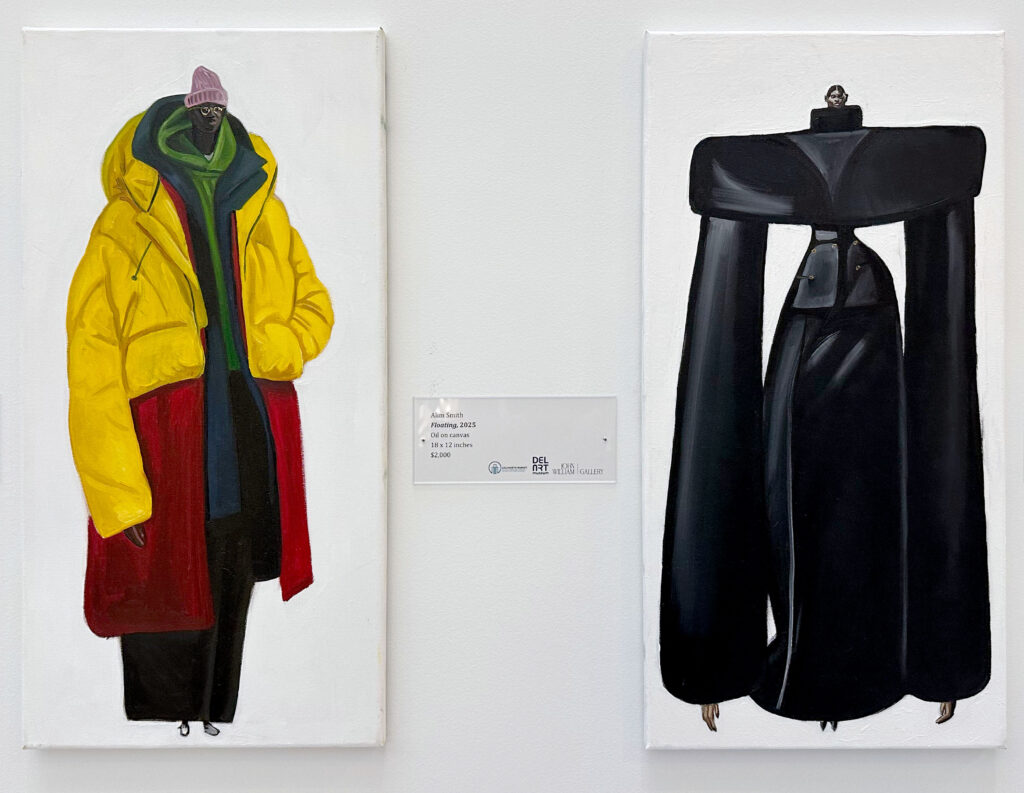
Alim Smith, “Floating” and “Thought A New Dress Would Make it Better”, 2025, Oil on canvas

Paintings by Alim Smith

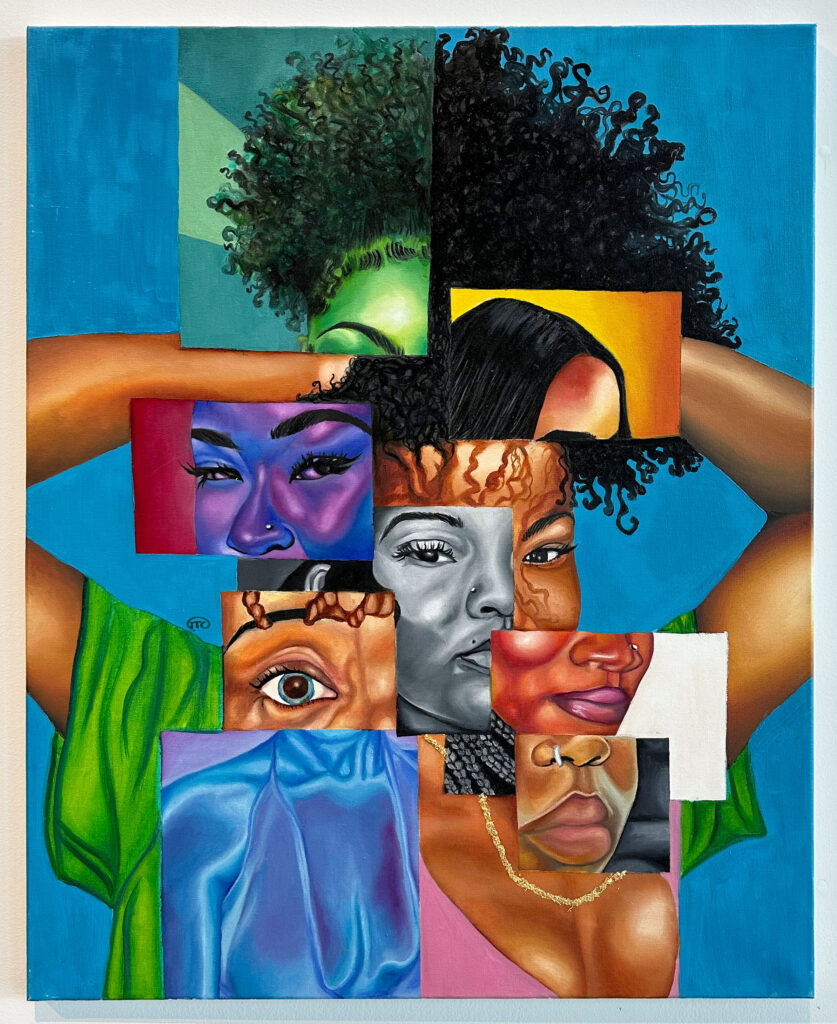
Taylor Gordon, “To Be A Black Woman”, 2023, Oil on canvas

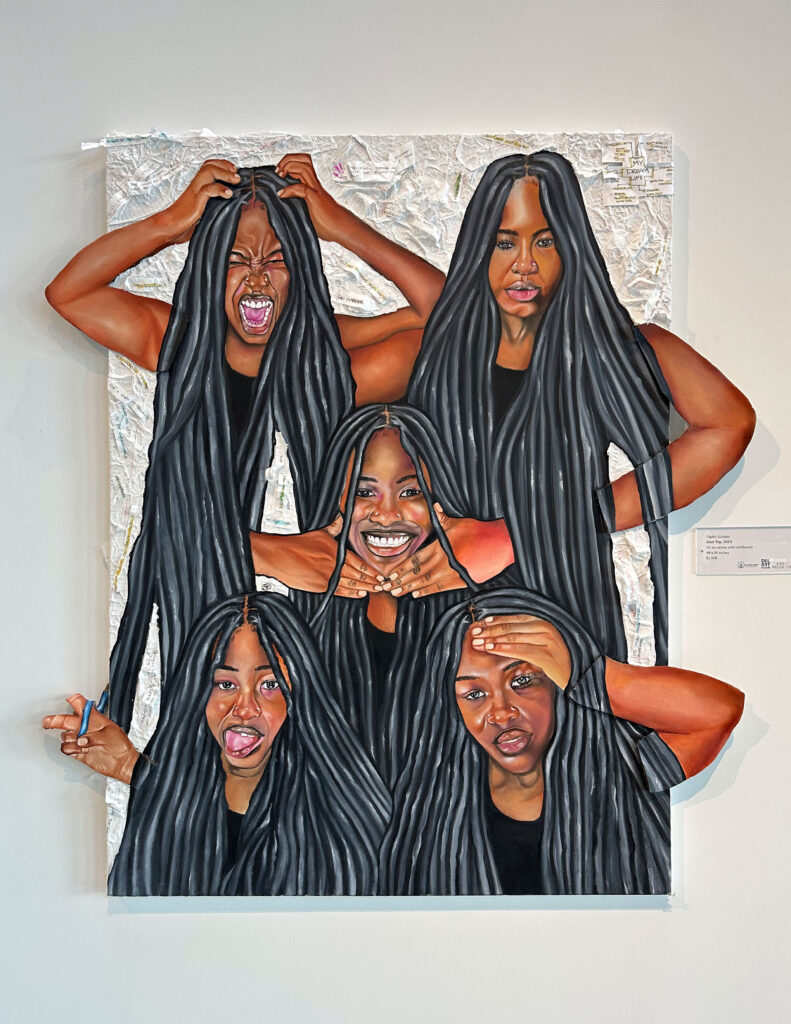
Taylor Gordon, “Dear Tay”, 2023, Oil on canvas with cardboard

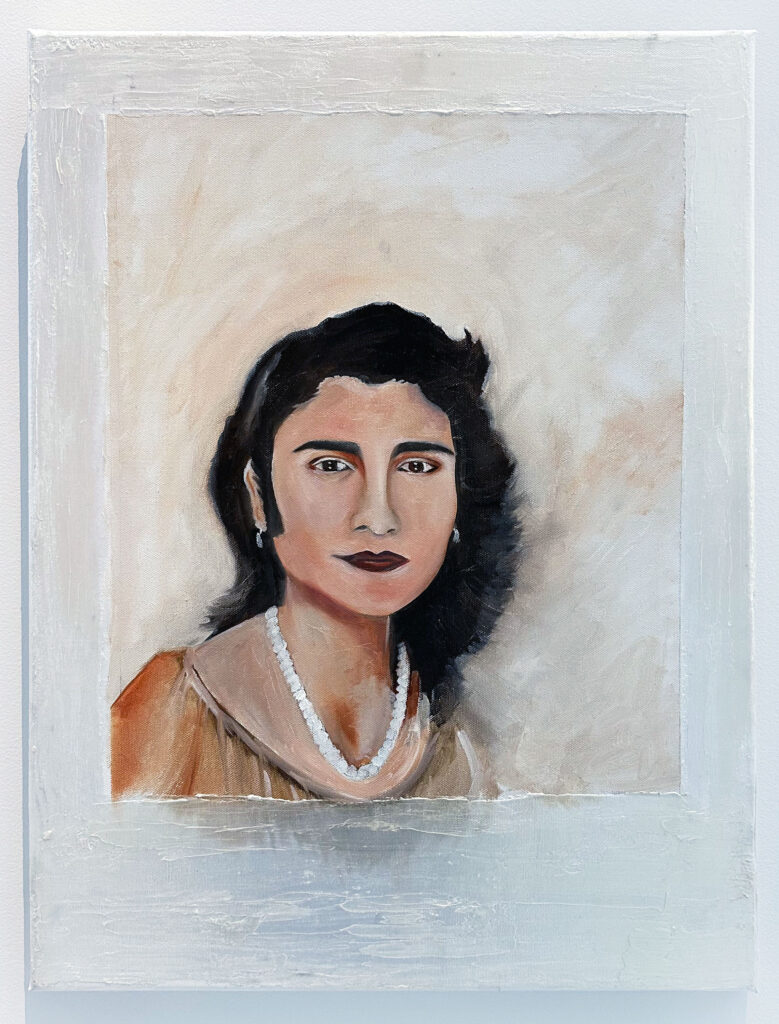
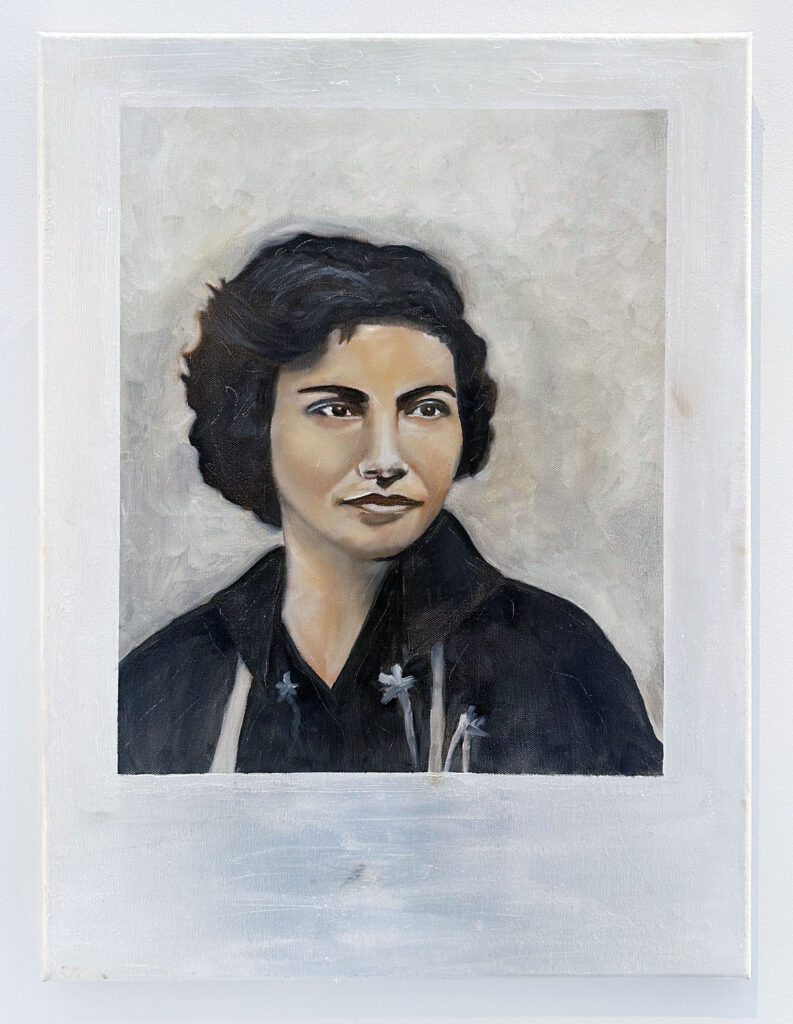
Manuel Ramos, “Abuela Gorin”, 2025, Oil on canvas

Manuel Ramos, “Abuela Olga”, 2025, Oil on canvas

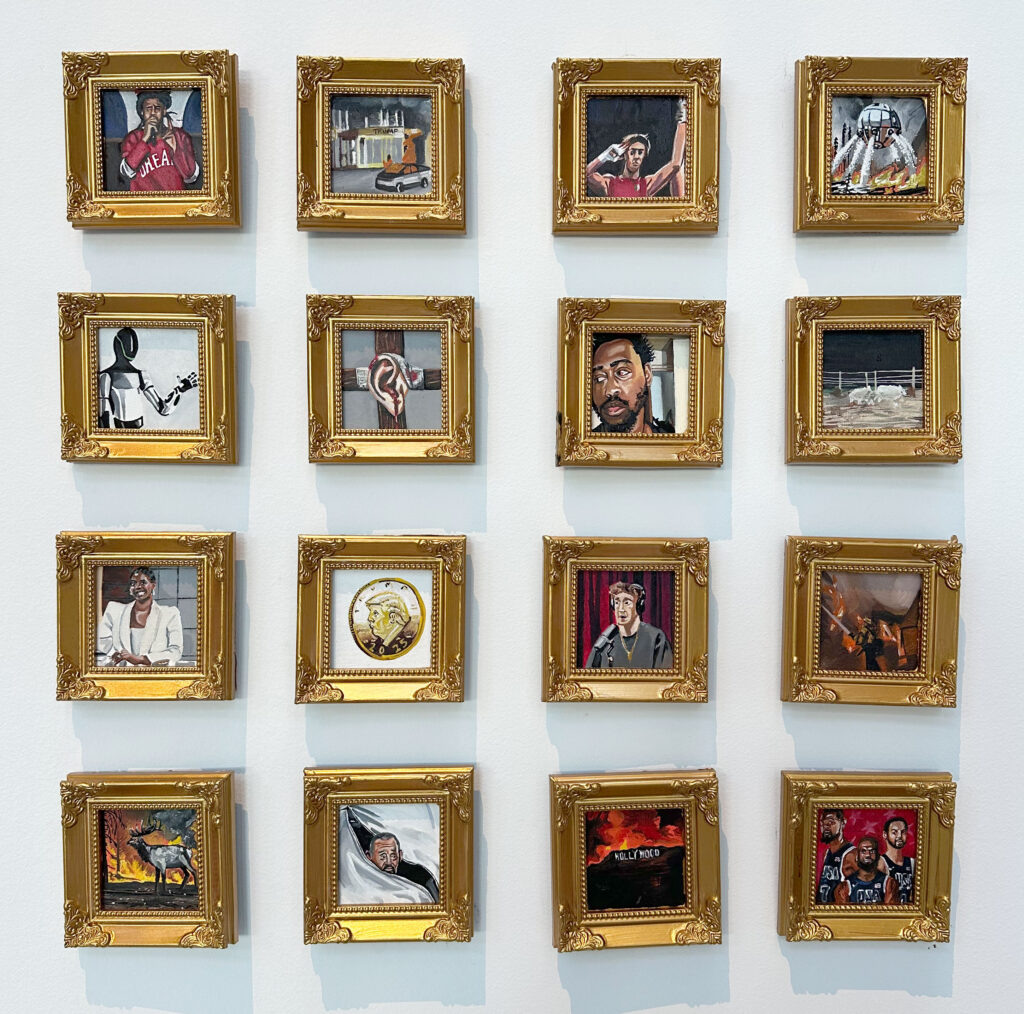
Currently on view at John William Gallery in Wilmington is Colorful Voices: Taylor Gordon, Alim Smith, Manuel Ramos, featuring unique paintings by the three Delaware artists.

From the gallery about the exhibition-

Colorful Voices: Taylor Gordon, Alim Smith, Manuel Ramos brings together three distinctive practices that articulate the richness of contemporary community life through color, portraiture, and cultural reference. The exhibition seeks to foreground the vitality of local voices while offering a space in which viewers might consider how identity, humor, and heritage are translated into visual form.

Taylor Gordon’s paintings situate themselves within the lineage of Black contemporary art, yet remain deeply personal. Her chromatic sensibility infuses each figure with layered emotional resonance, encouraging conversations around beauty, resilience, and the multiplicity of Black experience beyond reductive narratives. Manuel Ramos, or “RAmos ART,” approaches portraiture with a keen attentiveness to light and surface, imbuing his sitters with an understated dignity that resonates quietly yet powerfully. Emerging from a self-taught practice shaped during the pandemic, his canvases record moments of presence that hover between the intimate and universal. Alim Smith, or “Yesterday Nite,” works in a spontaneous visual language, fusing surrealism, popular culture, and sly humor. His rhythmic compositions and vivid palette translate music, memory, and cultural archetypes into forms at once playful and incisive.

Together these artists propose color as more than visual pleasure: it becomes a conduit for empathy, critique, and joy. Colorful Voices invites us to engage with works that are celebratory yet searching, attuned to both the textures of daily life and the broader currents shaping our communities. In gathering their practices, the exhibition hopes to affirm art’s capacity to nurture dialogue and to render visible the stories that animate shared experience.

This exhibition is on view until 12/18/25.

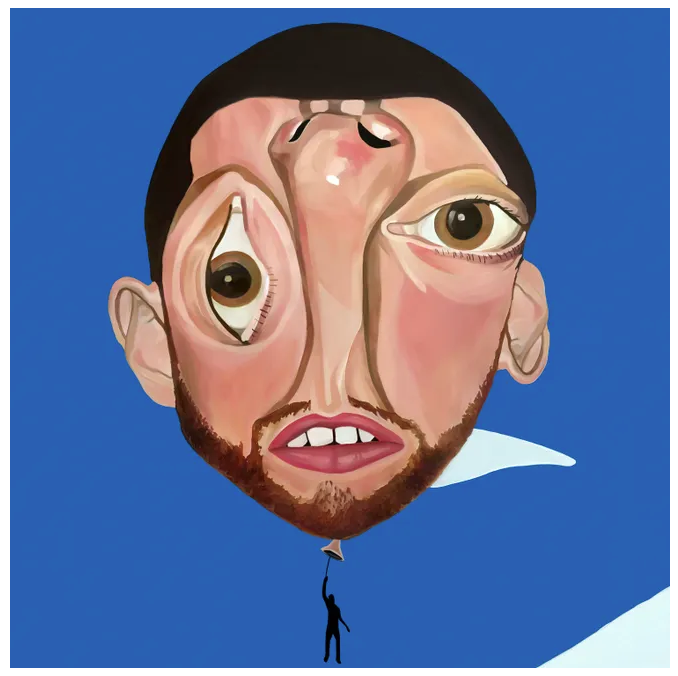
Alim Smith’s work may look familiar- he created work for the television series Atlanta and the cover art for Mac Miller‘s second posthumous album, Balloonerism, released earlier this year. Miller reached out to him in 2018, after finding his work on Instagram. Smith was recently nominated for a Grammy award for “Best Recording Package” for this album.

Mac Miller’s “Balloonerism” cover art by Alim Smith

Dec 052025
 

In addition to his numerous street art pieces, Alexandre Farto, aka Vhils, has shown his unique creations in various galleries around the world. The works above are from his 2018 exhibition Annihilation at Over the Influence gallery’s temporary location in Los Angeles.

From the gallery about the show-

Presenting a reflection on the current model of globalized development and the forces shaping and affecting local identities around the world today, Annihilation emphasizes the global impact of Los Angeles culture and the subsequent breakdown of unique global identities across continents. For his first solo exhibition in the United States since 2011, Vhils has taken the opportunity to set up a dialogue between the United States, Europe, and China to address the growing struggle for hegemonic supremacy between global powers and the ensuing social and economic impact on the world at large. Annihilation shares the stories of the citizens who breathe vitality into densely populated urban epicenters. Based on a variety of source material, from advertisements collected in cities worldwide to salvaged wooden doors, the new patchwork-like series intentionally dilutes the readability of each individual portrayed, a reflection on how identity is both formed and affected by the city’s visual discourse. This intentional juxtaposition of contrasts mirrors the interplay between elements from various cultures which we observe at work today in large urban contexts.

Vhils-Strata, which presents a selection of his work from the past twenty years, is currently on view at the Museum of Urban and Contemporary Art (MUCA) in Munich, Germany until 3/1/26.

He also recently created the site-specific installation, Doors of Cairo, located near the Pyramids in Giza in Egypt. It is part of  Forever is Now 05 and is on view until 12/7/25.

Dec 052025
 

Portuguese artist Alexandre Farto, aka Vhils, created this mural of TJ Mizell (Jam Master Jay‘s son) in 2018.

It is one of many street art projects organized by LISA Project NYC.

Dec 032025
 

Robert Therrien‘s larger than life sculpture of a table and chairs for Under The Table (1994) has been delighting visitors to The Broad in Los Angeles for years. Robert Therrien: This is a Story, recently opened at the museum is the largest exhibition of the late artist’s work to date.

From The Broad about the exhibition-

Therrien’s meditations on scale and material are a deeply influential and well-known approach within the field of contemporary sculpture, significant to The Broad’s own identity as a museum, and long admired by visitors of all ages. The installation showcases Therrien’s personal vocabulary of images and symbols—from enormous tables, chairs, and dishes, to intimate drawings of snowmen, birds, and chapels—as they become a language of continuous creation and transformation for the artist over time. Featuring more than 120 works spanning five decades, the exhibition offers unprecedented access to the artist’s exploration of scale, memory, and perception, just miles from the downtown Los Angeles home and studio space he operated out of for close to thirty years beginning in 1990. Many of the works on view, including those created just before Therrien’s untimely death in 2019, have never been featured in museum exhibitions and will offer new avenues of understanding his practice.

The exhibition is on view until 5/5/2026.

Nov 282025
 

Los Angeles based artist Llyn Foulkes sadly passed away last week. An innovative artist and musician, it was always fun to see his work around California.

The painting above, Post Card from Chatsworth, 1984, was on view at Palm Springs Art Museum in 2018.

About the work from the museum-

Foulkes is known for his acerbic perspective, dry humor, and distinctive style that draws from American popular culture. In the 1980s the artist returned to making Post Card paintings, which he originally created in the 1960s. This image of a seemingly desolate landscape features a large rock, an inscription, a post-office cancellation, and small self portrait. In celebrating the grand nature of the American landscape, the oversize format of the postcard also documents the absurdity of our own touristic impulses. Chatsworth is a neighborhood in northwest Los Angeles, but the area had previously been home to Native Americans, and its caves bear markings of rock art formations.

Nov 272025
 

Lily van der Stokker created Thank You Darling in 2023 for the High Line in NYC.

From the High Line website about the work-

Lily van der Stokker is one of the Netherlands’ most celebrated contemporary artists. In 1983 she moved to New York, opening a small artist-run gallery space in the East Village and has since lived alternately in both New York City and Amsterdam.

For over 30 years, van der Stokker’s drawings and monumental wall paintings have subverted artistic convention and aesthetic expectations, employing an Easter candy color palette to depict clouds, flowers, swirls, and other traditionally feminine or decorative motifs. Van der Stokker annotates these compositions with handwritten text—spelling out intimate thoughts, personal musings, notes-to-self and social niceties. Her visual language is nostalgic and comforting; her playful squiggly patterns are more likely at home in the margins of a student’s notebook as they mindlessly doodle or test out their first name with the surname of a crush than they are within the white walls of a gallery. In fact, van der Stokker’s practice is in some ways defined by this incongruity. She notes, “if I make an artwork about family problems, administrative tasks, or the common flu…I’m bringing in a whole spectrum of new subject matter that is normally absent in art.” By placing on a pedestal what has traditionally been viewed as feminine or domestic, and thus superfluous and inconsequential within the realm of “serious” visual art, van der Stokker reclaims what has long been disregarded and overlooked.

In a 1990 New York Times review of van der Stokker’s debut exhibition, critic Roberta Smith remarked, “the messages conveyed in this terminally cheerful manner usually have a double edge.” Van der Stokker’s work, which she has referred to as “feminist conceptual pop art,” is undeniably joyful and positive, however, it often simultaneously speaks to weighty themes—aging, health, and, more generally, the lived experience of being a woman within patriarchal structures. Hidden in plain sight, disguised by the veneer of her compositions’ cute and charming appearances, is reality. Occasionally mundane, sometimes cheery, and at other moments, cynical or intimate—“a baby, another baby…all my no baby friends live in N.Y.,” a past mural reads. One divulges, “whoopy doo…I am…really ugly…sorry,” in cartoonish thought bubbles. “My mother will loan me €80,000 to help me buy the house,” another reveals. Van der Stokker considers the texts to be the primary component of her work, and with each work she lays bare a vulnerable inner-world for all to see—if they’re willing to look beyond the candy-coated facade.

On the High Line, van der Stokker presents Thank You Darling, a monumental, site-specific mural. Thank You Darling is painted on the side of a building, turning the architecture and shape of the edifice into the frame for the artist’s pastel and fluorescent-hued work. The light blue background is dotted with multi-colored, simple flowers in a decorative all-over pattern that appear to float across the facade—some just coming into view from the edges of the frame. Superimposed over this, read the words “THANK YOU DARLiNG,” spelled out in a juvenile, arbitrary blend of lower and upper-case lettering. Van der Stokker’s puffy bubble-letters are a classic example of playful adolescent penmanship, seemingly lifted right out of a teenager’s diary. In this location on 22nd street, Thank You Darling actively engages with its audience, expressing gratitude to all those who pass, while reclaiming, at massive scale, intimate language that is often mocked or disparaged as being feminine and unserious.