Oct 252019
 

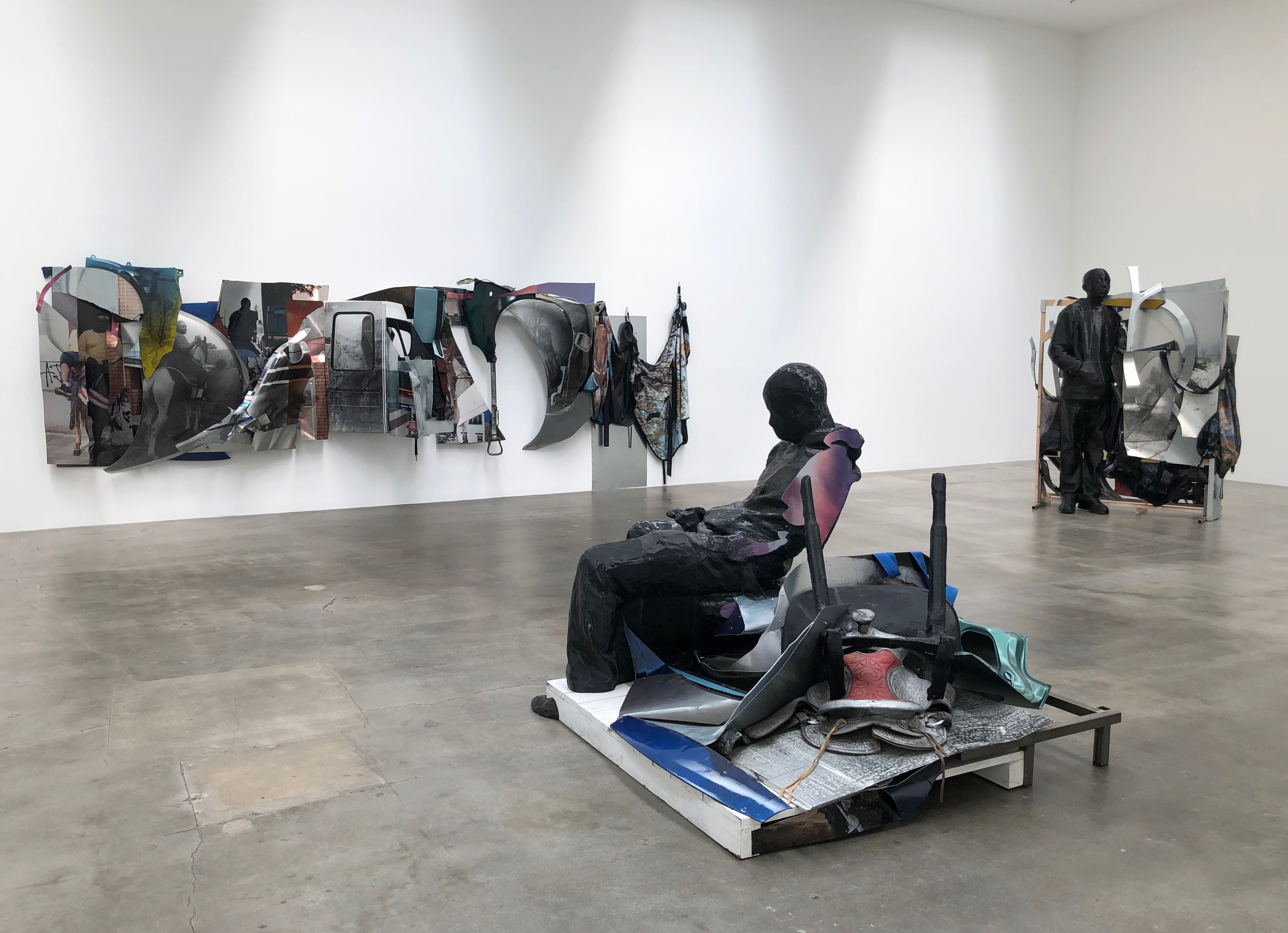
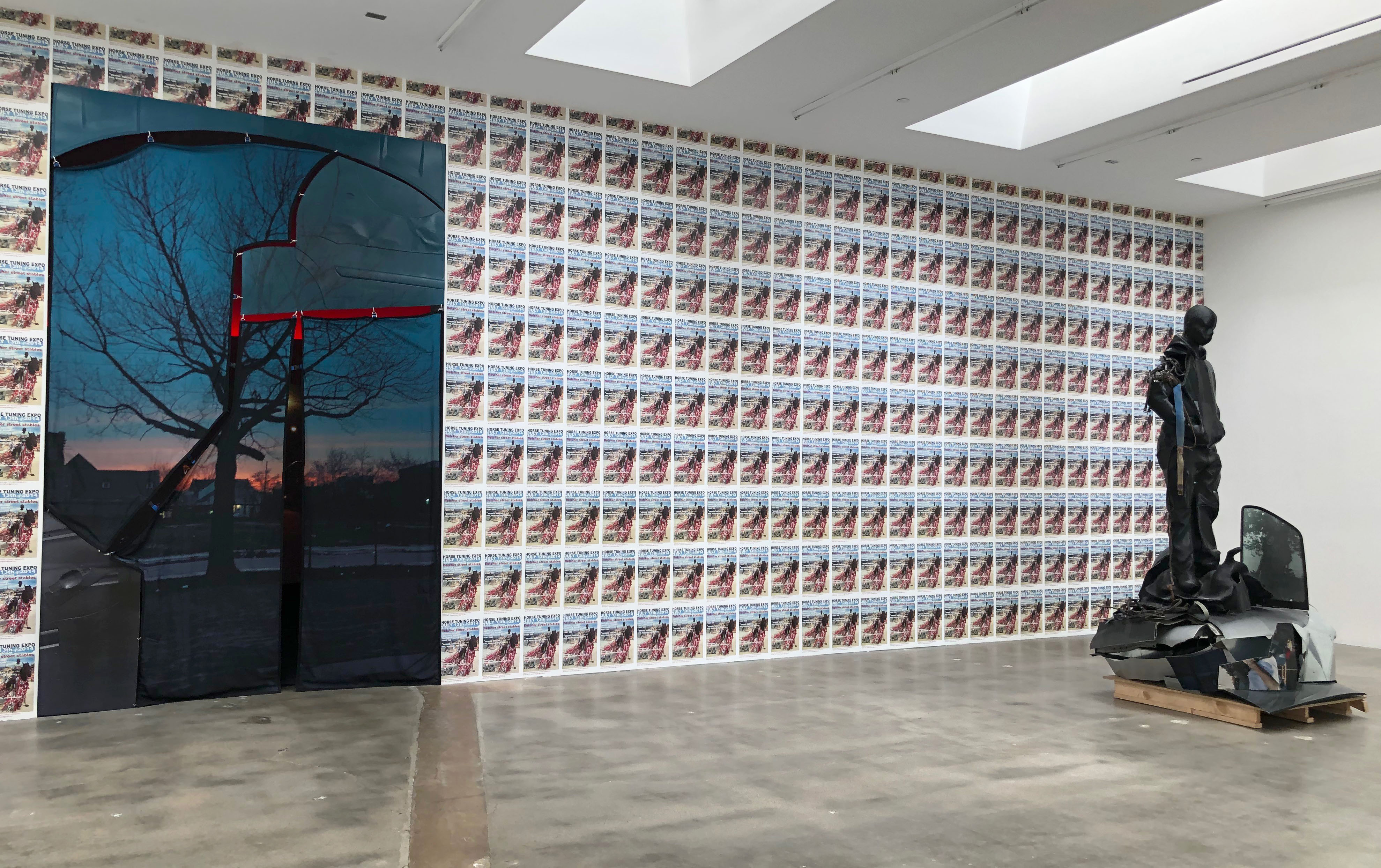
Paris-based Algerian artist Mohamed Bourouissa’s first solo exhibition in Los Angeles, Pour une poignée de Dollars (For A Fistful of Dollars), at Blum & Poe, combines film, sculpture, drawing and photography to expand on his project Horse Day, also on view at the gallery.

From the press release-

Initially driven to capture his own community and generation of immigrant youth living in the outskirts of Paris, in recent years Bourouissa’s focus has expanded to the US, the UAE, and beyond. In 2014 the artist spent nearly a year in North Philadelphia, PA living among the young men of the Fletcher Street Urban Riding Club, a non-profit established over 100 years ago by African American cowboys. This area increasingly struggles with unemployment and drug abuse, economic and social conditions from which the center attempts to provide a refuge—rescuing horses and mentoring boys who may otherwise find support hard to come by. Bourouissa instigated a collaboration with the community of riders and local artists—a riding competition and pageant called “Horse Day” in which equestrian participants arrived clad in decadent regalia, costumes including linked blank CDs, streamers, fake flowers, or fabric Pegasus wings. Using the cowboy as an emblem of a narrative of domination, the critical documents Bourouissa and the Fletcher Street community produced—sculptures, costumes, drawings, photography, and a video mixing tropes of westerns, documentaries and hip-hop—explore social injustice as it relates to geographical space, spotlight contemporary America’s culture of segregation, and intend to forge a new creative space for marginalized groups. Within a new body of sculptural work, the artist integrates images of riders and/or horses into the body parts of automobiles, as curator Okwui Enwezor once put it: “Bringing together two myths, the cowboy and the urban lowrider with his customized car, a sort of collision of the frontier and Compton.” This 3-D montage connects representations of domination and power, as well as industries and communities facing crisis.

Bourouissa’s work focuses on rituals of friendship, an exploration of alterity and the role images play in channels of distribution, investigations into the politics of representation and subjectivity. Seeking to humanize his community as social subjects, Bourouissa engages all sorts of imagery, initiating agency where is it often deprived. Bourouissa’s work is a hybrid of documentation and formal composition, collaborative choreographed representations of reality on the margins, channeling a wide range of historical precedents from Caravaggio and Delacroix to Fanon, rap music, and the Harlem Renaissance.

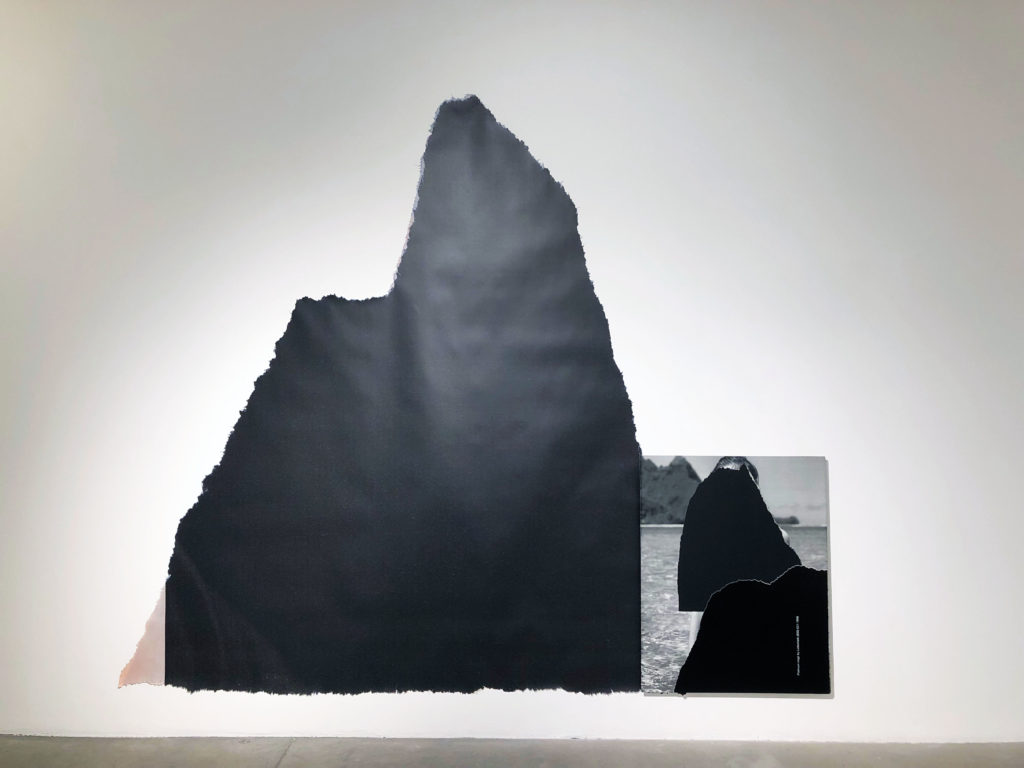
In a separate space behind the main gallery is Anya Gallaccio’s Stroke (pictured below), a room where the walls are painted with dark chocolate.  The work was originally created in September of 1994, for Blum & Poe’s inaugural exhibition at their original location in Santa Monica. Twenty-five years later, it has been recreated in an exhibition space the exact dimensions of the original gallery.

It’s worth checking out for the smell alone. It’s overpowering.

From the press release-

Stroke plays with perceptions of desire and their disconnection from reality. In this chocolate-covered room, an idea pulled from a childlike fantasy comes to life and goads the viewer’s appetite for pleasure. The whimsical notion of an edible room is contrasted with the strikingly rich, dark color of the walls and their heavy, sometimes putrid, smell. Of this disconnect, Gallaccio states, “the idea of a chocolate room is one thing, and the reality of a chocolate room is very much something else.” Created by thousands of small, repeated brush strokes for which the installation is named, prolonged looking is rewarded when one sees new colors, textures, and patterns appearing out of the darkness.

Rooted in the formal language of Minimalism, Gallaccio’s practice uses organic materials to subvert and reframe that male-dominated moment in art history. Trees, flowers, fruit, and ice are investigated for their fluidity and impermanence, and decay becomes a part of the installation to be embraced. The unpredictability of these ephemeral materials yields a freeing inability to control the final product, from which unexpected results emerge. These materials, pulled from a feminine, domestic space, challenge a masculine past and reclaim a place in history. As noted in the original press release from 1994: “Feminist in material, natural in its decay, subversively Freudian, Stroke is an enigmatic and challenging work.”


Both of these exhibitions close 10/26/19.

Oct 232019
 

Luis De Jesus Los Angeles is currently showing Laura Krifka: The Game of Patience.

From the press release

The Game of Patience features new figurative paintings by artist Laura Krifka that depict female and male subjects in intimate moments within carefully constructed interiors. Krifka deftly paints her bare-skinned protagonists reading, drawing, daydreaming, watching, and waiting. The peep of a phallus and the highlight of a thigh gap allude to the pleasure of stillness, supplemented by the visual tension meticulously sculpted throughout the domestic spaces. A notable development in Krifka’s content is the genesis of idiosyncratic wallpapers that appear to direct the viewer’s gaze rather than lay flat. These imagined patterns create parallel planes of space, shift color and shape inexplicably, and build psychological tension, functioning like maps for the dream logic of each painting.

At the heart of Krifka’s practice are post-modern and contemporary critiques of canonical Painting. Krifka treats the false dichotomies of subject and object, male and female, observer and observed as comedic jumping off points before bending or breaking the rules and moving on to more nuanced and poetic concerns. Sensually charged in the pinks, purples, pea-greens, and ochers of afternoon reveries, all the protagonists are depicted in vulnerable situations, and Krifka wanders through paintings with surprising detail and care, in search of consent and a deeper understanding of the nature of desire.

This exhibition closes 10/26/19.


Oct 232019
 

Currently at Various Small Fires gallery in Los Angeles is Robin F. Williams’ painting exhibition, With Pleasure.

From the press release-

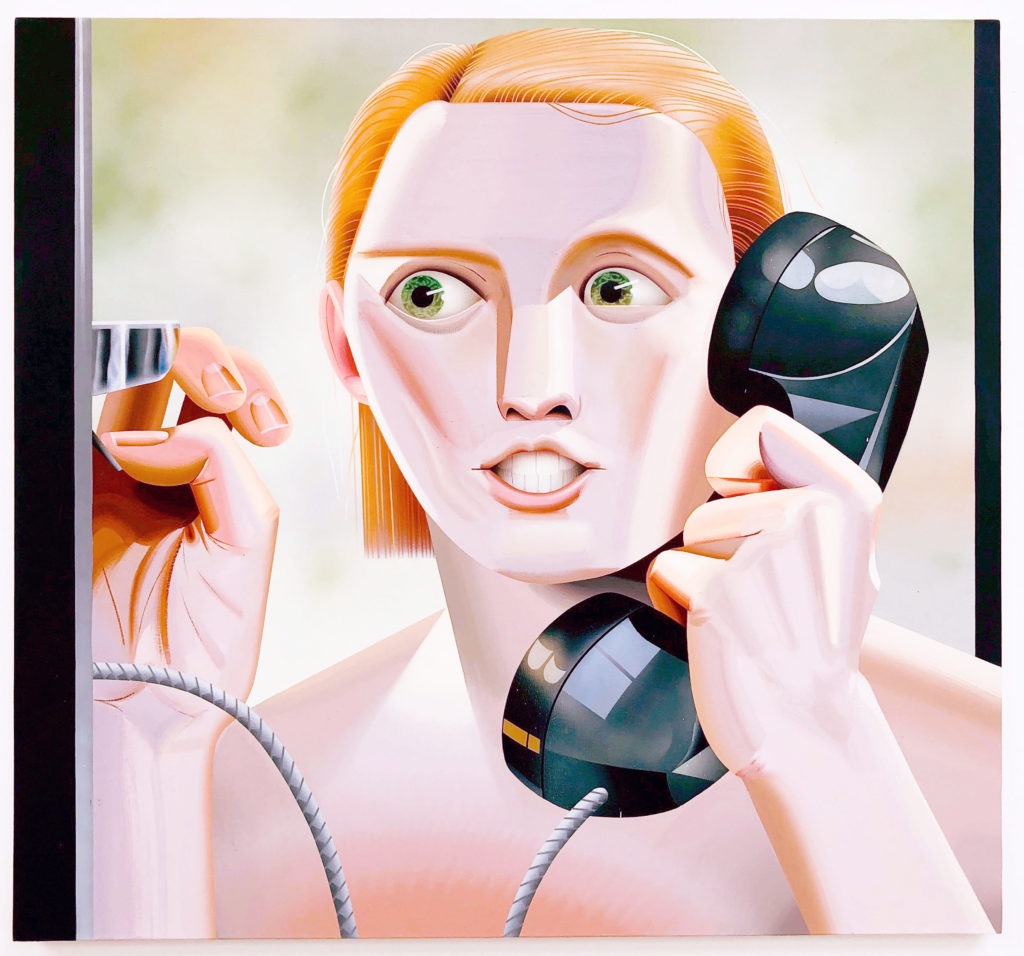
In a series of new paintings that re-imagine the coded narratives of American media, Williams isolates and derails the sexual suggestiveness, pandering strategies, and gendered objectifications utilized in representations of women.

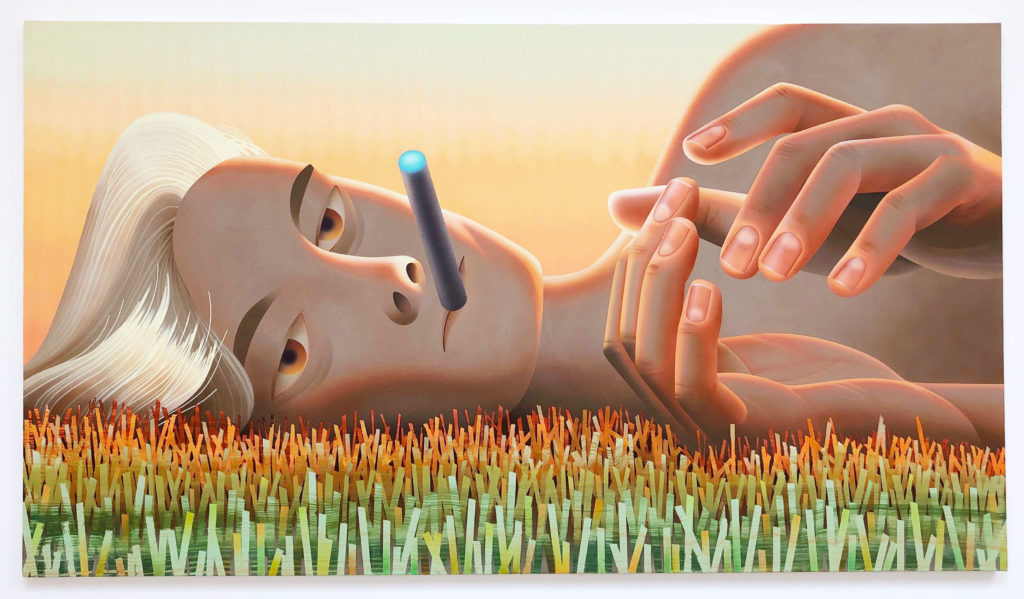
Embodiments of feminine AIs (Siri and Alexa) as nude figures lend Williams’ paintings an air of consciousness, as if aware of the viewer and their own status as female simulacrum. Appropriated from cigarette ad campaigns, paintings such as Alive With Pleasure, Alexa Plays Ball, and Slow Clap subvert their cast of sexually compliant “cool girls” who catch footballs, play around the ankles of men, and smoke seductively. By contrast, Williams’ subjects are stone-faced and defiant, unwilling to embody the latent desires of the viewer.

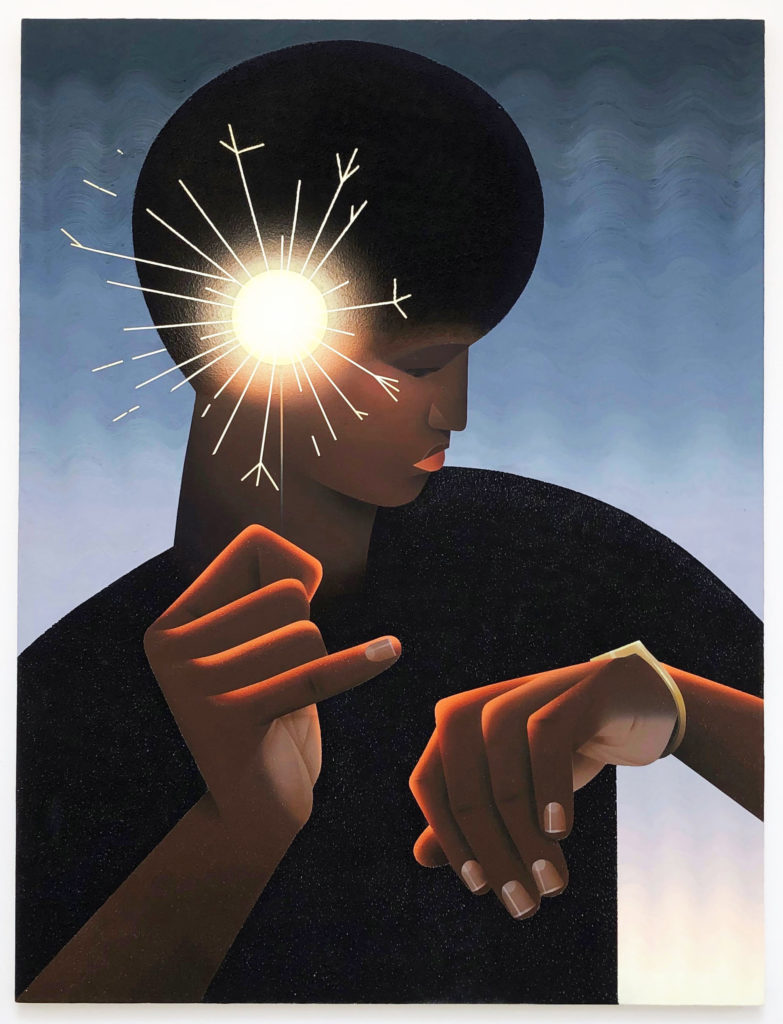
Williams’ paintings play with chronology both through distinctive painting techniques such as stain painting and airbrushing, and through visual markers recreated and reimagined for the present day. In Slow Clap, a cigarette is replaced by the newer, yet equally ominous vape; a languid repose is substituted for a derisive “slow clap”, the gap between the subject’s hands leaving her gesture permanently unresolved. Eye on the Time depicts a black woman with tightly coiffed 1960s afro who impatiently turns her gaze away from the burning 4th of July sparkler in one hand to the wristwatch on her other arm, counting down the seconds for its patriotic light to extinguish. In Weathervane, a gymnast appropriated from a 1972 Life Magazine cover poses precariously on a rooftop amidst an approaching storm; she gazes out coldly toward the viewer, the purveyor of her ornamental function.

In each painting, Williams’ female figures wait, caught in a perpetual state of questioning, forever burning, and locking eyes as if to challenge their embodied roles: woman as technology, tool, or paragon. These figures, aware of their identity as paintings, must answer the call to remain frozen in time. They refuse, however, to do it with pleasure.

This show closes 10/26/19.
Oct 102019
 

From the press release-

Klowden Mann is proud to present San-Diego-based artist Andrea Chung’s first solo exhibition with the gallery, … Only to meet nothing that wants you. The exhibition features large-scale cyanotype works depicting under-sea images of coral that have then been bleached with sugar crystals—a material woven throughout Chung’s practice for over a decade in reference to its relationship to colonialism in the Caribbean. The cyanotypes are placed in context with a brass chandelier that recalls designs from the 19th century; where crystals would hang, Chung has hung glass vials filled with sugar in various shades.

Chung’s practice often utilizes perishable and precious materials with strong underlying histories, forming relationships to pre-emancipation images of the Caribbean, touristic misrepresentations of people and place, the export or import of goods and materials, and the labor of the human body. Completing the quote by Nayyirah Waheed that Chung used as the title of her first solo museum exhibition at the Museum of Contemporary Art San Diego in 2017, “You broke the ocean in half to be here,” the title of the exhibition at Klowden Mann answers with the second half of the phrase, “…Only to meet nothing that wants you.”

In the cyanotype works, coral bleaching becomes a metaphor for colonialism, and the expanding of the philosophy and impact of imperialism on colonial populations and cultures. The addition of sugar crystals to the already highly sensitive cyanotypes underlines Chung’s interest in creating work that defies the notion of artworks as static objects that are meant to remain unchanging and unyielding in the face of shifting environments and time; in a way that also reflects the constant uncontrolled and irresponsible effects of human actions on the environment, and on vulnerable populations. The works are intended to shift and change over the course of the exhibition, as the sugar embeds further in the cyanotype, falls, and expands. The works are linked to the environment in which they are placed in a way that Chung cannot predict and control—and along with the chandelier, ask the audience to consider who pays for the superficial opulence and beauty to which so many have become accustomed.

The work in this exhibition is really stunning, and the fact that it is work that is changing with time, makes seeing it feel even more special. Like so much of the beauty in the world, and especially in nature, you appreciate it, while wondering how long it will still be around to be seen.

This exhibition closes 10/12/19.

Aug 302019
 

This is the last weekend (closing 9/1) to see Black is Beautiful: The Photography of Kwame Brathwaite at Skirball Cultural Center.

From the center’s website-

See the iconic images that amplified one of the most influential cultural movements of the 1960s: “Black Is Beautiful.” Featuring over forty photographs of black women and men with natural hair and clothes that reclaimed their African roots, Black Is Beautiful: The Photography of Kwame Brathwaite, organized by Aperture Foundation, New York, is the first-ever major exhibition dedicated to this key figure of the second Harlem Renaissance.

Inspired by the writings of activist and black nationalist Marcus Garvey, Brathwaite (b. 1938) combined his political vision with the medium of photography to effect social change. Along with his brother Elombe Brath (1936–2014), Brathwaite founded two organizations that were instrumental in realizing his vision: African Jazz-Art Society and Studios, a collective of artists, playwrights, designers, and dancers, in 1956; and Grandassa Models, a modeling group for black women, in 1962. Working with AJASS and Grandassa Models, Brathwaite organized fashion shows featuring clothing designed by the models themselves, created stunning portraits of jazz luminaries, and captured behind-the-scenes photographs of the black arts community.

During an era when segregation still prevailed across the United States, Brathwaite’s work challenged mainstream beauty standards that excluded women of color. His photographs celebrated black beauty and instilled a sense of pride throughout the community. Black Is Beautiful: The Photography of Kwame Brathwaite demonstrates how the medium of photography is an essential cultural tool in the dissemination of new visual paradigms and political ideas.

Aug 222019
 

A Universe of One, 2018

A Universe of One, 2018 (detail)

The Dream of Flight, 2019

The Dream of Flight, 2019 (detail)

Currently at Kohn Gallery is New York-based artist María Berrío’s first solo exhibition in Los Angeles.

From the press release-

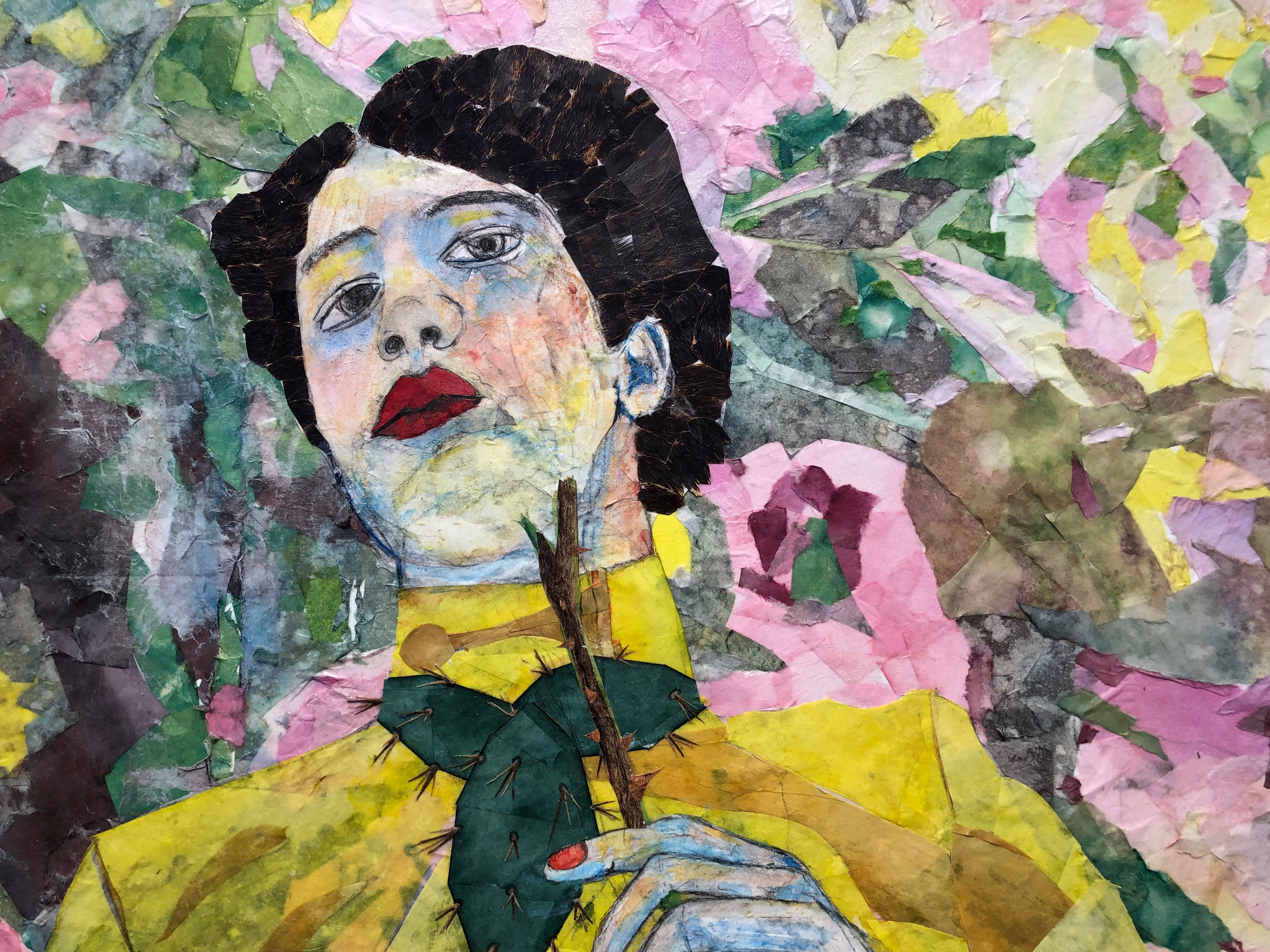
Inspired by her youth in the countryside of Bogotá, Colombia, Berrío’s paintings explore the experience of immigrant identity, intercultural connectivity and the beauty that is found in the diversity of cultures and countries. Berrío depicts her figures with richly detailed and patterned backgrounds of exteriors and interiors. The large, detailed mixed media canvases employ lush, carefully crafted, multilayered Japanese papers and paint, resulting in scenes replete with pensive yet confident figures amid a scene of visual exuberance.

Berrío’s work often places female figures at the center of her intricately woven landscapes. Painted with watercolor details, her figures stare out of the composition determined to confront the viewer from their own surreal surroundings. Her work is evocative of predecessors such as Gustav Klimt and Egon Schiele, both known for their exceptional degree of emotional directness and figural distortion in the place of conventional beauty. Berrío’s works float seamlessly between historical and contemporary artistic styles as they employ a wide visual vernacular ranging from expressionism to graphic, abstract marks.

The variety of media and techniques found in María Berrío’s practice emphasizes the interwoven cultural breadth of the world in which we live, where globalization and injustice touch the lives of everyone. Each character Berrío paints is a symbol of this new reality and the strength that can issue from it. For the artist, a female soldier on the front lines is as brave and mighty as the mother who protects her children from the perils of war. These depictions of women are seen as guiding spirits who are strong, vulnerable, compassionate, courageous and in harmony with Nature and themselves. With these combinations of human traits and emotions, Berrío fortifies her belief that with womanhood every action is considered beautiful and strong, no matter how small or large.

For her current show, A Cloud’s Roots, Berrío focuses especially on place and migration. The individuals are seen in preparation for their travels, in moments of transition, and in various states of uncertainty. Berrío states, “the ambiguity is intentional; although I may have a specific idea in mind when making the work, the actual piece lacks cultural specificity to allow for all symbolic possibilities.” Berrío therefore gravitates towards symbols with global cultural significance, such as braids, birds, and flowers, with the hope that they allow diverse audiences to bring their own understanding to the work.

In her recent work, A Cloud’s Roots (2018), Berrío creates a fictional species of tree based on the dragon’s blood tree, found exclusively on an island off the coast of Yemen. The dragon’s blood tree has adapted perfectly to the island’s desert-like climate and rocky soil, inhospitable to most other plant life. It is a powerful symbol of survival and resilience, able to thrive even in the most unlikely conditions. The figures in the piece are compelled to leave their home but they carry with them the knowledge that they too have the power to put down roots wherever they go.

By reflecting on the beauty of our immigrant nation, Berrío’s new body of work aims to rewrite the narrative of American history to include the stories of people who have long been excluded. It makes space for those who were not born in this country, but come here full of hope and desire to make it their home. As the art canon expands its scope and redefines its boundaries, Berrío imagines a future in which people with diverse perspectives can walk into an institution and see themselves reflected back. Berrío states, “so many immigrants, myself included, are stuck in the inbetween, not quite from here, and no longer from there. I create work that bears witness to this liminal state of being and acknowledges it as an essential part of being American. I wish to convey that which can never be conveyed: the sheer joy of being, of creation, and the undiscoverable mystery of being alive.”

This exhibition closes 8/24/19.

Also, if you are in New York City, she recently created several glass and ceramic mosaics that can be seen in the Fort Hamilton Pkwy Station.


Aug 092019


When trying to talk about the David Hammon’s exhibition at Hauser and Wirth Los Angeles, his first in Los Angeles in 45 years, it’s hard to know where to start. There are no titles or descriptions of any of the works in the show, although there is writing on the walls in certain places. The press release, shown below, is a mass of lines and a dedication to jazz musician Ornette Coleman.

Before you enter either of the two massive galleries housing the exhibition you encounter a courtyard filled with tents, some with “this could be u and u” stenciled on them. Tents also line the corridor under Martin Creed’s neon piece, EVERYTHING IS GOING TO BE ALRIGHT, with a rack of fancy vintage coats nearby. Once predominantly in Skid Row, Los Angeles’ tent cities have been growing rapidly on street corners and under bridges and highways all over the city, but they often just blend into the background for people walking and driving past. What does a fake tent city in the courtyard of a high end gallery in a newly gentrified neighborhood mean? Is its fake version more affecting than the real one to gallery and restaurant patrons wandering by?

The work in the show feels at times random, clever, humorous, and confounding, but also impressive, thought provoking, and most importantly never dull. There are stacks of art history books sitting on scales. A water filled bowl that contains what once was a snowball Hammons had sold on the street at one point in his career, sits on a wooden shelf. A room with empty glass cubes on wood columns requires you to bend down to see the feet underneath. A book titled A History of Harlem is filled with empty black pages.

In the room pictured below is a three legged chair next to a wall of photos of women sitting in it. Nearby, one of Ornette Coleman’s suits is surrounded by glass.

Another room is filled with paint splattered and damaged fur coats, one facing an antique mirror that is covered. The symbolism feels a bit heavy handed, like the tents, but it works in that there are still several ways to interpret what Hammons might be saying.

Throughout the exhibition paintings are covered in various ways. One in paper, ripped with a bit of the painting visible. Others are partially hidden with tarps, plastic, different fabrics, even an antique rug (shown below). Once again, you can interpret the meaning of this in several ways. With the rug, for example, it’s turned so that only a bit of its design is visible in front of a painting that is not completely visible. These rugs are often associated with old money and sometimes are hung on walls themselves as artwork. Or is it just another assemblage, a visual combination to be taken at face value.

Ultimately the interpretation of all of the work is up to the viewer. There is something freeing in that, not being given answers. Sure, it’s nice to have an explanation of an artist’s intentions sometimes, but you often add your own ideas anyway. Art should make you think, question things, look at the world from a new perspective- this exhibition does all of that and more.

David Hammons at Hauser & Wirth Los Angeles closed 8/11/19.


Jul 122019
 

Juan Capistrán, Psychogeography of Rage (sending up searchlights in the form of flames) Western, 2019

Kim Fisher- Los Angeles Hedge, 2019

Kim Fisher, Woman Behind Rocks, 2019

Sabrina Gschwandtner, Cinema Sanctuary, 2019

Sabrina Gschwandtner, Cinema Sanctuary (close-up)

Enrique Castrejon, You, me, and all of us are in this together/Reach out to those that don’t know their status, 2019

Enrique Castrejon, You, me, and all of us are in this together/Reach out to those that don’t know their status, 2019 close-up

Every year The City of Los Angeles Department of Cultural Affairs (DCA) awards grants to the city’s best mid-career artists. The work created with these grants is then shown in the Los Angeles Municipal Art Gallery (LAMAG) in Barnsdall Park for the C.O.L.A.(City of Los Angeles) exhibitions.

COLA 2019 is made up of 11 artists working in various mediums. Two of the artists, Juan Capistrán and Kim Fisher were also shown together as part of Hammer Museum’s biennial exhibition, Made in L.A. 2014. For this show, Capistrán created large brick sculptures that he placed in sites in South Los Angeles that haven’t been rebuilt since the 1992 LA Riots. In his section of work in the gallery, he includes photos of these temporary site specific installations as well as some of the brick sculptures- two of which have balloons tied to them spelling GRATIS. The bricks can be seen as objects of destruction or building blocks, and the dual meanings work well in the context of the work.

Kim Fisher’s large collages capture another side of Los Angeles. From the hedge she used for the largest piece, to the ocean, swimming pools, and car culture, included in her others, the graphics and color come together in a way that feels very much like the traditional ideas associated with the city.  The different sections, created to look as if they were torn or cut from magazines, form collages that feel like scattered memories that have somehow arranged themselves cohesively.

Sabrina Gschwandtner took forgotten films made by female directors and stitched them together to form patterns drawn from the history of quilt-making. The use of a craft that is traditionally associated with women and tying it an artistic pursuit that women are only more recently being acknowledged for is an interesting juxtaposition. The resulting work is stunning graphically and reminiscent of Agnés Varda’s colorful house of film reels created for LACMA’s Agnés Varda in Californialand from 2014.

Enrique Castrejon created sculptures that stem from his work in an LGBTQ center in Los Angeles. His sculptures of fragmented bodies are surrounded by strips of paper with HIV infection rates. The humanity of the figures contrasts with the overwhelming strips of typed documentation that swarms all around them.

All of the work created for this exhibition is incredibly strong and these annual exhibitions are a great way to see some of the best work being created by Los Angeles artists today. If you can’t make it to the exhibition there is a video on the site that takes you on a walk through with one of the curators. Also make sure to catch Stephanie Taylor’s Municipal Art Song, which plays at the entrance to the exhibition. She created song lyrics based on text from LAMAG and DCA’s websites and catalogs, and used them to create sheet music using Schoolhouse Rock! as an inspiration. The result is really funny, especially if you read a lot of press releases.

This exhibition closes 7/14/19.


Jun 292019
 

“Graduation”, (1949) © Estate of Roy DeCarava

We look at so many images today that often the value of individual photos decreases with the abundance of them. That’s why it is such a pleasure to spend time with Roy DeCarava’s black and white photographs at The Underground Museum. His images have a meditative beauty to them. They catch your eye and hold it. There is a richness to his compositions, his use of textures and light.

While at The Underground Museum, also take a moment to look through a copy of De Carava’s book collaboration with writer Langston Hughes, The Sweet Flypaper of Life in the book store.  The images in it influenced artist Kahlil Joseph’s film Flypaper (2017), which was recently shown at MOCA.  Kahlil Joseph’s brother, artist Noah Davis, who sadly passed away in 2015, founded The Underground Museum with his wife, artist Karon Davis, in 2012.

Roy DeCarava: The Work of Art closes 6/29/19.


“Bill and son”(1962) © Estate of Roy DeCarava


Jun 272019
 

This is the last week to see Kirsten Everberg’s painting exhibition, Life Still, at 1301PE before it closes on 6/29/19.

From the press release

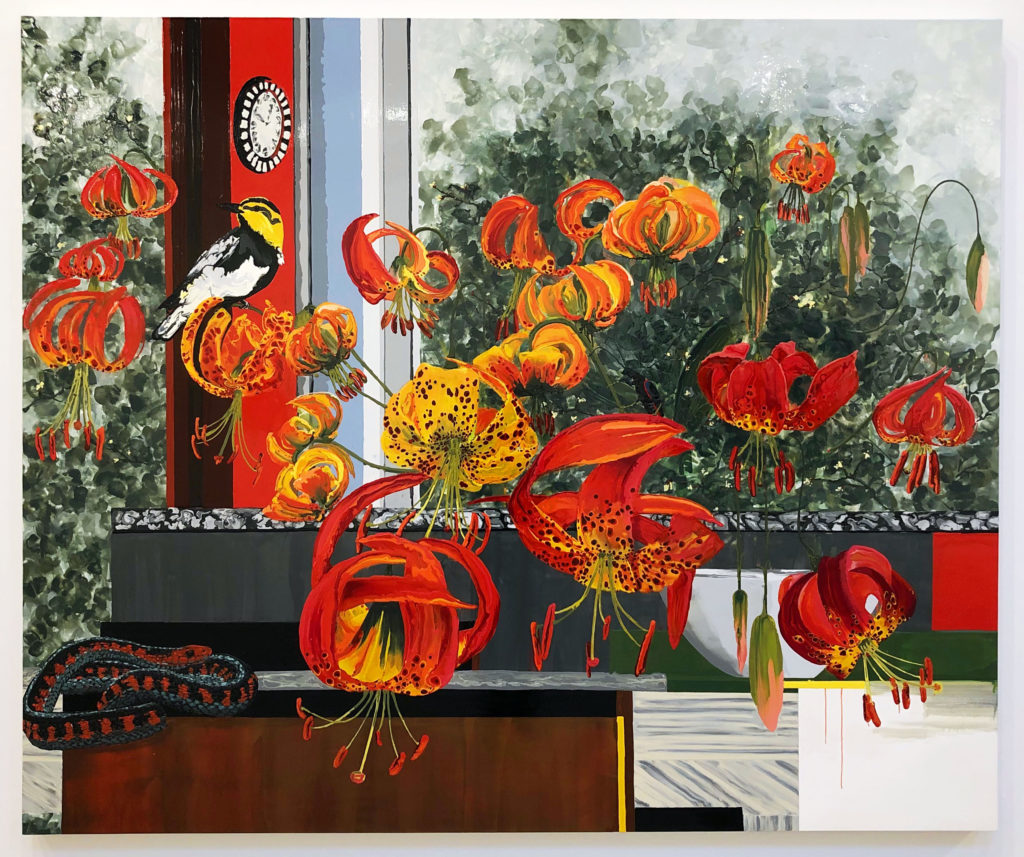
With a new body of work that is based primarily on the genre and history of Dutch Golden Age still life paintings Everberg replaces the traditional elements with plant and animal species simultaneously listed as extinct or endangered, native and non-native. Symbolic not just as demonstrations but for their ability to transcend deceptively “earthy splendors”, these paintings have the capacity to create meaning in the larger moment we find ourselves in while being contained primarily in architectural settings. Everberg’s attention to detail is highlighted by the shifting perspective that is at the same time unstable and precise, and the scale is amplified, elevating the objects and creatures to sometimes imposing monumentality, refusing to be unseen or marginalized.

Using a unique combination of oil and enamel paint, Everberg’s works hover between representation and pure paint. There is always a tension here between the convincing depiction of space and the abstract skeins of color that dance across the canvas. What appears to be the exterior of a house or a dense jungle from far away is reconfigured into glossy pools of paint close-up. Everberg’s mastery of her medium is demonstrated by how deftly she walks this line. Narrative and image; truth and fiction; surface and what lies beneath – are all woven together in her captivating works.