Feb 272026
 

Pictured is one of Nick Cave‘s Soundsuits, created using found fabrics and metal and wood toys. It was on view at Columbus Museum of Art in 2024.

From the museum about the work-

Nick Cave’s Soundsuits are sculptural costumes, some of which were made to be worn, others to remain stationary. Although these suits often appear whimsical and joyful, they also respond to suffering and injustice. Cave created his first suit in response to the beating of Rodney King by Los Angeles police officers in 1991, an event that focused attention on discriminatory policing and racial profiling. Reflecting the artist’s lived experience as an African American man, the Soundsuits camouflage the wearer’s body, concealing markers of race, gender, and class.

In the Art21 video below you can see some of his Soundsuits in motion. He studied with the Alvin Ailey American Dance Theater and that influence can be seen here as well.

Art 21-Nick Cave in Chicago- Season 8

Cave’s latest exhibition, Mammoth, recently opened at the Smithsonian American Art Museum in Washington D.C. and will be on view until January of 2027.

About that show from SAAM-

In Mammoth, Cave remakes the museum’s galleries into an immersive environment marked by the crafted hides and bones of mammoths, a video projection of the long-dead animals come to life, and hundreds of transformed found objects—from vintage tools to his grandmother’s thimble collection—presented like paleontological specimens on a massive light table. By showcasing the ordinary and often forgotten bits and pieces of the world we live in, Cave’s work shines light on what we value and how we make meaning together. It evokes the lives and cultures we have lost, as well as the magical possibilities of a universe created through imagination and the humblest of materials.

Focused on the fundamental connections between people and their environment, Cave asks how we can begin to make sense of our relationship with a landscape that continues to evolve. How might we adapt, persevere, even thrive? As the contemporary world increasingly challenges what it means to be human, Cave envisions a space of both grief and possibility.


Feb 212025
 

As part of PST ART: Art & Science Collide, The Getty is highlighting the incredible work created by the engineers and artists that made up the group Experiments in Art and Technology (E.A.T). The exhibition focuses on the history of the group and two of its most ambitious projects- 9 Evenings: Theatre & Engineering (1966) and the Pepsi Pavilion from Expo ’70 in Japan.

From the museum-

In 1966, engineers Billy Klüver and Fred Waldhauer and artists Robert Rauschenberg and Robert Whitman founded Experiments in Art and Technology (E.A.T.), a not-for-profit organization dedicated to promoting and supporting collaborations between artists, engineers, and scientists. These partnerships brought disparate fields together, bridging the gap between culture and emerging technology. E.A.T.’s debut event, 9 Evenings: Theatre & Engineering (1966), integrated art, theatre, and engineering at the 69th Regiment Armory in New York City, resulting in a technology-aided performance experience that proved to be a launchpad for artistic exploration. Their second major project, the Pepsi-Cola Pavilion at Expo ’70 in Osaka, Japan (1970), presented a multisensory environment featuring experiments with sound, light, lasers, a mirrored dome, and fog. Through their collaborations, E.A.T. artists and engineers came to believe that such team efforts could benefit society; subsequent multidisciplinary endeavors, such as Projects Outside Art (1970), addressed issues of housing, education, environmental sustainability, and communication.

About 9 Evenings

In 1965, Swedish electrical engineer Billy Klüver and American artist Robert Rauschenberg gathered 10 avant-garde artists and 30 Bell Labs engineers to participate in a collaborative, multidisciplinary project combining new technologies with theatre, dance, and music. The event,9 Evenings: Theatre & Engineering, took place at the 69th Regiment Armory in New York, from October 13-22, 1966. More than 10,000 people attended performances by John Cage, Lucinda Childs, Oyvind Fahlström, Alex Hay, Deborah Hay, Steve Paxton, Yvonne Rainer, Rauschenberg, David Tudor and Robert Whitman. These performances incorporated technological equipment such as photocells, doppler sonar, remote controls, infrared cameras, and transistors. In addition, 9 Evenings engineers created the Theatre Electronic Environmental Modular, a flexible, wireless, networked control system, and the Proportional Control System (PCS), which used photocells to adjust light and sound levels. The event led to the founding of Experiments in Art and Technology the following month.

Below are images and objects from two of the nine evenings, Open Score and Physical Things

Performance description of “Open Score” by Robert Rauschenberg

About Open Score

Open Score began with a tennis match between professional player Mimi Kanarek and painter Frank Stella. Engineer William Kaminski wired their rackets with transmitters that caused every strike of the ball to emit a loud sound and extinguish an overhead light. The game continued until the Armory was completely dark. At that point, a cast of 300 volunteers walked onto the court and performed a series of loosely choreographed movements while infrared cameras projected their images onto large screens. Rauschenberg described the action as “the conflict of not being able to see an event that is taking place right in front of one except through a reproduction,” an idea that resonates in today’s world of social media, streaming, and smartphones. For the second performance, Rauschenberg added a third section in which he carried dancer Simone Forti around the Armory in a burlap bag while she sang an Italian ballad.

About Steve Paxton and Dick Wolff’s Physical Things

For 9 Evenings, Paxton created an enormous, inflated sculpture using Polyethylene and box fans and invited visitors to walk through the structure at their own pace, confronting different environments and performances along the way. After climbing through a 100-foot inflated tower, participants emerged into an enclosed area with wire loops suspended above their heads. Using modified transistor radios, they could listen to an array of sounds, including animal noises and sports commentary. One’s location underneath the sound loops determined which part of the score was audible, allowing people to choose where to linger and what to listen to.

One of the group’s most ambitious projects was for the Pepsi Pavilion (pictured above).

From the museum-

In 1970, the Pepsi-Cola Corporation commissioned E.A.T. to design a pavilion for Expo ’70 in Osaka, Japan. Artists Robert Whitman, Robert Breer, David Tudor, and Forrest Myers made early contributions to the design of the pavilion; eventually the design team included 20 artists and 50 engineers and scientists.

Outside the pavilion, a water-vapor cloud sculpture by the artist Fujiko Nakaya covered the white, faceted dome. On the plaza, seven of Breer’s Floats, six-foot-high dome-shaped sculptures, glided in slow motion while emitting sounds.

Visitors entered the pavilion through a tunnel and descended a staircase into a clamshell-shaped room lit by moving patterns of laser light. On the far end, another staircase led up into the Mirror Dome, a 90-foot diameter, 210-degree spherical mirror made of aluminized Mylar. Within the Mirror Dome, visitors’ reflected images appeared to float upside down above their heads.

You can find more images and further documentation here.

This exhibition closes 2/23/25.

Dec 202024
 

Chau Nguyen, “Bài Học Về Phong Cảnh / Landscape Didactics”, 2022, sand painting

Zalika Azim, “Blood Memories (or a going to ground)”, 2023, video

Azza El Siddique, “Vessels”, 2019, ceramic, rust

Suneil Sanzgiri, “Two Refusals (Would We Recognize Ourselves Unbroken)”, 2023, video

Currently on view at The Delaware Contemporary is we are what we lose, an exhibition featuring artists Zalika Azim, Suneil Sanzgiri, Azza El Siddique, and Chau Nguyen. Through sculpture, dance, video and photography, these artists investigate issues of loss through what gets left behind.

From the museum-

“The real phenomenon of loss is both the inventory of what no longer exists and the impossible measure of what survives.” —Canisia Lubrin

What does the fugitive offer to sites of ruins? Is it a hum, a murmur, a cry, a shadow, a haunting, a poem, a memory, a scene, a loved one, a vessel, a movement, a gathering?

Fugitivity routes and unroutes our understanding of topographic terrains created through the unfolding of displacement, relocation, and exile. In the wake of migratory catastrophes, ruins are the aftermath of loss and devastation, leaving behind vestigial remnants and residuals. Reaching for traces, illegibility, and livability, the fugitive attempts to depict and texture multiple lifeworlds within ruins marked in loss and devastation. Gesturing towards the specter, how might placing what happens within sites of ruins —the permeable, usable, corporeal, and inhabitable—at the heart of our critiques and interventions enliven our imaginative possibilities?

Ruins present a set of spatial, material, visual, and psychic dimensions of un/being and becoming, as well as modes of fugitive resistance and expression. Tending to the juxtaposition of being unplaced, we are what we lose focuses on the provoking void that ruins leave behind and expresses spatial, narrative, and material practices actively and painstakingly situated in the hold of the catastrophes as means of reworlding and unworlding towards livable possibilities.

Partaking in worlding decomposition, Zalika Azim, Suneil Sanzgiri, Azza El Siddique, and Chau Nguyen present visual, narrative, and sonic performances that desire and action towards the otherly present meaning and aliveness by uncomposing time and working with the permeability of the artistic mediums. By engaging with the barely perceptible imaginations, unplaced yearnings, and tactile and vulnerable terrains, the artists orient toward spectral terrains that suture, resist, and refuse the knowability of the fugitive. Viewers will reflect on the histories of ruins haunting our contemporary sites and their capacity to mutate to make complicated ways of knowing, feeling, and seeing the world.

More information on Suneil Sanzgiri’s video installation, pictured above, from his website

How do we live through and narrate moments of revolution and revolt, and how do we understand these experiences across time and distance? Using imaging technologies to meditate on what it means to witness from afar, Suneil Sanzgiri explores the complexities of anti-colonialism, nationalism, and diasporic identity. His work is inspired by his family’s legacy of resistance in Goa, India, an area under Portuguese occupation for over 450 years until its independence in 1961. Two Refusals (Would We Recognize Ourselves Unbroken?), the artist’s newest two-channel video installation, combines archival footage, animation, interviews, and a script written by poet Sham-e-Ali Nayeem. The film tells the stories of the mutual struggle in India and Africa against Portuguese colonialism, highlighting the solidarity that developed between the two continents during the 1960s and 1970s.

This exhibition closes 12/29/24.

Mar 092023


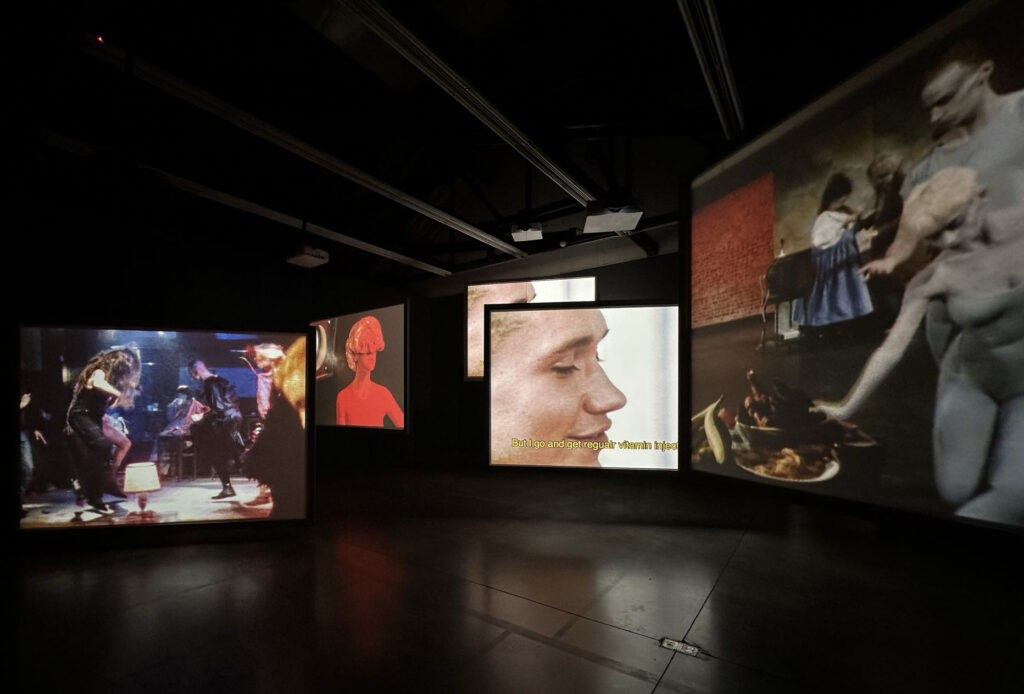
It often feels like we are oversaturated with images in today’s world, but the energy at the Charles Atlas exhibition A Prune Twin at Luhring Augustine gets the balance right.

From the gallery’s press release-

Luhring Augustine is pleased to announce A Prune Twin, the gallery’s third solo exhibition with pioneering film and video artist Charles Atlas. The presentation will mark the American debut of this major multi-channel installation with sound that was originally commissioned by the Barbican Centre, London as the centerpiece of their 2020 exhibition, Michael Clark: Cosmic Dancer; which traveled to the Victoria and Albert Museum in Dundee, Scotland in 2021.

The collaboration between the two artists began in 1984 when the young dancer, Clark, performed in two single-channel films by Atlas: Parafango and Ex-Romance. However, it was not until the groundbreaking Hail the New Puritan in 1986, that the relationship between the two artists was deeply cemented. Originally commissioned as an arts documentary by Channel 4 of the BBC, Hail the New Puritan turned the genre on its head, presenting a highly stylized and fictionalized version of a typical day in Clark’s life – an “anti-documentary”, as Atlas has called it.  The two artists also worked closely together on another Channel 4 production, Because We Must (1989), which was full of extreme theatricality in its dance, choreography, scenery, costumes, and directorial position.

In A Prune Twin, Atlas pulls material from these two major films to create an immersive eight-channel installation of sound and moving image. He extends the idea of choreography to camera and sound, flowing across and throughout screens and monitors; in this sense, Atlas choreographs his own past material into a new and compelling dance all of its own. Evident in this work, and many others by Atlas, is his strong affection and attraction to exceptionally creative collaborators, his sensitivity to movement and how to capture it on film, and his novel skills as both a storyteller and observer. Much like MC9, an immersive installation that compiles Atlas’ extensive work with Merce Cunningham, A Prune Twin surrounds the viewer in a beautifully choreographed spectacle. The work captures the spirit and passion of a 35-year collaborative relationship, one that continues to this day – currently realized through the lighting design that Atlas produces for all of Clark’s live performances, an endeavor he has undertaken since the 1980s.

Jan 202023
 

Artist Alex Katz created this mural, Bill 2, a portrait of modern dancer and choreographer Bill T. Jones, in 2019 for Murals of La Jolla in San Diego. Murals of La Jolla is a project started in 2010 by The Athenaeum and the La Jolla Community Foundation. It commissions artists to create work to be displayed on buildings around La Jolla. A map of all the murals currently on view can be found here.

From the Murals of La Jolla website about the work-

Alex Katz’s mural, Bill 2, celebrates Bill T. Jones, one of the most noted and recognized modern-dance choreographers of our time. Executed in Katz’s bold and simplified signature style, Bill 2 depicts Jones’ visage, through a series of distinct expressions. The repetition of his face has a cinematic and lyrical quality, reinforcing his place in the world of dance, music and film. Portions of the face are dramatically cropped, giving the viewer only quick and gestural glimpses of Jones. Bill 2, is a striking homage to two artists, Katz and Jones, both renowned in their respective fields of visual and performing arts. The mural’s proximity to the new Conrad Prebys Performing Arts Center gives a nod to the interconnected worlds of art, music, and dance.

The Guggenheim museum in NYC is currently showing Alex Katz: Gathering, a retrospective of the artist’s work from the late 1940’s until the present. The exhibition will be up until February 20, 2023.

From their website about the exhibition-

Emerging as an artist in the mid-20th century, Katz forged a mode of figurative painting that fused the energy of Abstract Expressionist canvases with the American vernaculars of the magazine, billboard, and movie screen. Throughout his practice, he has turned to his surroundings in downtown New York City and coastal Maine as his primary subject matter, documenting an evolving community of poets, artists, critics, dancers, and filmmakers who have animated the cultural avant-garde from the postwar period to the present.

Staged in the city where Katz has lived and worked his entire life, and prepared with the close collaboration of the artist, this retrospective will fill the museum’s Frank Lloyd Wright rotunda. Encompassing paintings, oil sketches, collages, drawings, prints, and freestanding “cutout” works, the exhibition will begin with the artist’s intimate sketches of riders on the New York City subway from the late 1940s and will culminate in the rapturous, immersive landscapes that have dominated his output in recent years.

Bill T. Jones/Arnie Zane Company has numerous performances every year. Conceived and directed by Bill T. Jones, and choreographed by Jones with Janet Wong and the Bill T. Jones/Arnie Zane Company, the latest work, Curriculum II, will be performed at on March 10, 11, and 12, at the Institute of Contemporary Art Boston.

Jones also hosts the series Bill Chats at NYC’s The New School. On January 30th, he will be in conversation with Bessie Award-winning theater director and performance artist, Niegel Smith and curator, producer, and director, Kamilah Forbes. For more events check out the New York Live Arts calendar.


Mar 252016
 
jameswellingregenprojectsorange

“4995” (image courtesy of Regen Projects)

jameswellingregenprojectsyellow

“4600” (image courtesy of Regen Projects)

jameswellingregenprojectsred1

“0521” (image courtesy of Regen Projects)

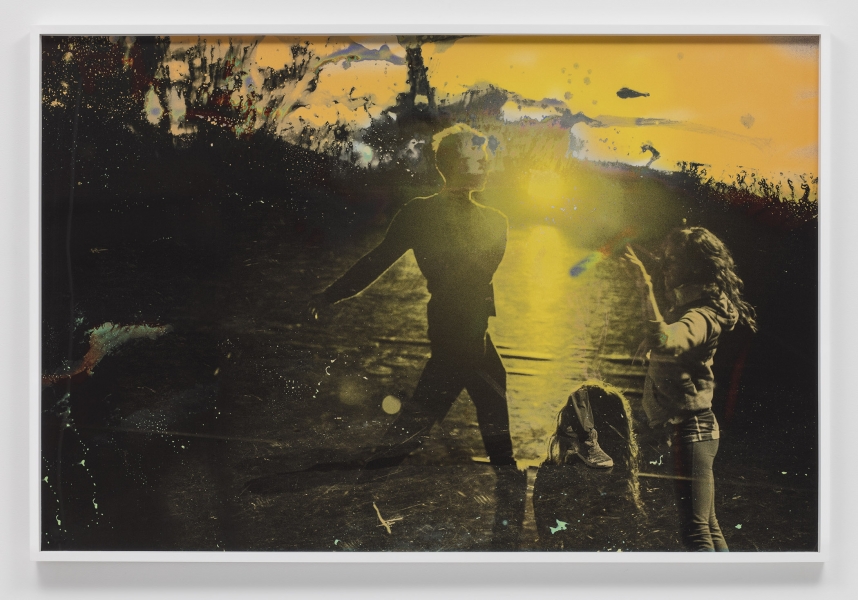
For his current solo exhibition Choreograph at Regen Projects, James Welling combines his images of architecture and landscape (common in his previous work), with photographs of dancers to create beautiful dreamlike worlds. Welling once studied dance at the University of Pittsburgh before stopping after a year to go to CalArts, and his continued love of dance is evident in the work.

The process for the creation of these layered images is explained in the press release

To create these works Welling photographed over a dozen dance companies in New York, Philadelphia, Ottawa, and Los Angeles. The dance photographs were then merged with photographs of architecture (buildings by Frank Lloyd Wright, Marcel Breuer, and Paul Rudolph) and landscape imagery (western Connecticut, southern Florida, and Switzerland) in Photoshop’s fundamental red, green, and blue color channels, which are basic to all color photographs. The resulting electronic files were altered by the artist using Photoshop’s Hue and Saturation layers to create complicated, multi-hued photographs, which were then printed on rag paper using a 10 color Epson Stylus Pro 9900 inkjet printer.

For more information on how he achieved the look of the photos in Photoshop, there is a booklet at the front desk that contains a breakdown of the color channels and a list of each color adjustment layer.

This show closes 3/26/16.


Mar 192015
 

Sea Lions- Tell You

Things to do in Los Angeles this weekend (3/19-3/22/15)-

Thursday

The first of the four Venice Art Crawls this year is tonight and will have art, live painting, music, performances and more

Jason Reitman’s live read at LACMA for tonight is Dazed and Confused. Advanced tickets are sold out but there will be some available at the door two hours before showtime

Thursday and Friday

The members of The Both return to Largo for Aimee Mann and Ted Leo’s One Way Mission to March: a Springtime Variety Show along with Jonathan Coulton and Tim Heidecker

Friday

Tijuana Panthers are playing with Oxnard band Sea Lions at the Echo

Saturday

The Million Dollar Theater downtown is showing Bonnie and Clyde with live jazz/ragtime before the screening ($10)

Church Sessions is hosting an evening with John Doe and Exene from X and Robyn Hitchcock at the First Unitarian Church

Sunday

of Montreal is playing at the Regent Theater

LAXART gallery in Hollywood is having another panel discussion on photography titled Remembering Forward from 4-6pm (free)-

Heidi Duckler Dance Company’s newest piece explores the intersection of dance and architecture as the audience moves around Mayne’s Morphosis in Culver City for Space Opera– discounted to $15 if you are a Culver City resident, or $25 if not

Artist William Pope.L and MOCA Senior Curator Bennett Simpson discuss Pope.L’s Trinket at the MOCA Geffen (free with RSVP and museum admission)

Ciclavia is taking over the San Fernando Valley this time

Jan 302014
 

GRMLN- Teenage Rhythm

Things to do in Los Angeles this weekend (1/30-2/2/14)-

Thursday-

Saturday-

Sunday-

  • Chinese New Year continues in Chinatown with more bands and performances- full list including Saturday’s events here

All weekend-

  • Paramount Ranch is having an art festival Saturday and Sunday- it’s the first one and looks intriguing and it’s FREE
Dec 192013
 

Suicidal Tendencies- Institutionalized

Things to do in Los Angeles this weekend-

Thursday (12/19)-

Friday (12/20)-

Saturday (12/21)-

Sunday (12/22)-