Apr 122023
 

There are only a few days left to see Franz West’s large, fun sculptures, Echolalia, at David Zwirner in NYC.

From the press release-

Executed in 2010, only a few years before the artist’s death, Echolalia consists of seven colorful, larger-than-life sculptures that seem to stand slightly off-balance, interspersed with three cushioned divans. The work’s title—which refers to the repetition of words and sounds made by young children when learning to talk—was inspired by the artist’s son, who at the time of its creation was three years old and brought his own, distinct perspective to his father’s oversized works.

Not exhibited publicly in more than ten years, the work represents the apotheosis of West’s commitment to sculpture as social space, integrating the viewer within an immersive, total environment. Conceptually, the installation manifests the intersection of many of West’s ongoing interests—most notably, the playfulness of sculpture, the participation of the viewer, and the importance of language.

A voracious reader throughout his lifetime, West was constantly and consistently incorporating various philosophical, psychoanalytical, and historical lines of thinking in his work, as though language itself was another material one could work with.

When Echolalia debuted in Rome in 2010, West published excerpts from the readings that came to influence the work, which included writings from figures across eras and disciplines, including Jacques Lacan, William Shakespeare, Sigmund Freud, Karl Marx, Mike Davis, Jean-Paul Sartre, Max Weber, and over a dozen others.

West’s sculptures and installations often invite the public’s interaction, engaging his viewers in order to subvert traditional exhibition models. In the mid-1970s, he began creating his so-called Passstücke, or Adaptives, a number of which are on view in a concurrent exhibition of West’s work at our Paris gallery.

These roughly hewn, abstracted sculptural forms were intended to be handled by the viewer in a manner of his or her choosing, thereby “adapting” the works to their own physical being and context.

Extending this interest, in Echolalia, the individual sculptures are seemingly weightless and on wheels, meaning the exhibitor can hypothetically rearrange these elements, interacting with the sculpture and evidencing the artist’s longstanding fascination with spatial manipulation and play.

This exhibition closes 4/15/23.

Apr 122023


How does one truly reckon with history?  The imagery in Yael Bartana’s three channel film Malka Germania at Petzel Gallery draws you in and presents you with this question for the entire 43 minutes. Drifting along with the film’s protagonist, scenes of beauty and destruction unfold- but seeing the eagle rise from the water as Hitler and Albert Speer’s proposed Volkshalle continues to emerge, you feel as stunned as those on the beach.

From the press release-

Malka Germania investigates the longing for collective redemption for German and Jewish histories as a response to an age of anxiety.

Malka Germania is Hebrew for “Queen Germany.” The name references a female designation for the Messiah: Malka Meshichah, or the “Anointed Queen.” In Bartana’s film, a new androgynous Messiah, Malka Germania, joins forces with the Israeli Army to liberate Berlin from its collective traumas, memories, and inherited pasts.

The 3-channel video portrays Malka as she walks through Berlin’s haunted landscape, revisiting historical events that seamlessly blend with contemporary scenes. The film weaves subconscious elements through surreal hallucinations, the biblical and mystical to leave questions of redemption, national myths and collective identities for the viewer to contemplate.

This exhibition closes 4/15/23.


Mar 282023
 

“Oil Bunkering #9, Niger Delta, Nigeria”, 2016

“Gold Tailings #1, Doornkop Gold Mine, Johannesburg, South Africa”, 2018,

“Salt Ponds #1, Near Fatick, Senegal”, 2019

“Salt Ponds #1, Near Fatick, Senegal”, 2019 (detail)

“Uranium Tailings #13, Husab Uranium Mine, Namibia”, 2018

Edward Burtynsky’s photographs are visually arresting and often made more so by the need to look closer to discover what exactly is being captured. Some look like paintings at first glance before you realize there are roads or other man made structures contained within them.

From the Sundaram Tagore’s press release-

Since the early 1980s, Edward Burtynsky has been photographing industrial landscapes across the globe, documenting in remarkable detail the human imprint on the planet through terraforming, extraction, urbanization and deforestation. For African Studies, premiering in New York simultaneously at Sundaram Tagore Gallery and Howard Greenberg Gallery, he focused on Sub-Saharan Africa, traveling to Kenya, Nigeria, Ethiopia, Ghana, Senegal, South Africa, Botswana, Namibia, Madagascar and Tanzania between 2015 and 2020.

Burtynsky’s interest in Africa was sparked 20 years ago while he was working on his landmark 2004 photographic project China, which explores the country’s rapid globalization and the construction of the Three Gorges Dam. The series, and subsequent award-winning documentary film by Jennifer Baichwal, Manufactured Landscapes (2006), chronicle China’s transformation into the world’s leading manufacturer and depository for its waste. Burtynsky witnessed firsthand the immense environmental—and by extension, human—cost of development, and he predicted Africa would be the next, and perhaps the last, region to undergo major industrial expansion.

Presented in large-format photographs, African Studies conveys the fragility of the natural world, bringing together images of lush, undisturbed landscapes and environments irretrievably altered by industry. The series was largely photographed from aerial perspectives, a viewpoint that distills the continent’s diverse topography into graphic patterns and gradients of sumptuous color. The resulting effect seemingly transforms the marks of human infrastructure into painterly abstract compositions. In these images, as in all his work, Burtynsky skillfully integrates critical reporting with sublime visual aesthetics creating a harmonious balance between content and form.

“With this project I hope to continue raising awareness about the cost of growing our civilization without the necessary consideration for sustainable industrial practices and the dire need for implementing globally organized governmental initiatives and binding international legislations in order to protect present and future generations from what stands to be forever lost,” Burtynsky said.

Also on view in another section of the gallery are works from his series, Natural Order. The photographs were taken in Grey County, Ontario, during the lockdown in the spring of 2020.

This quote from Burtynsky was on the wall nearby in regards to the series-

“From the frigid sleep of winter to the fecund urgency of spring, these images are an affirmation of the complexity, wonder and resilience of the natural order in all things. I find myself gazing into an infinity of apparent chaos, but through that selective contemplation, an order emerges an enduring order that remains intact regardless of our own human fate.”

This exhibition closes 4/1 at Sundaram Tagore Gallery and 4/22 at Howard Greenberg Gallery.


Mar 172023
 

Sheila Isham, “Chung Fu II– Wind with Lake”, 1972

Hollis Taggart in NYC is currently showing Beyond the Brush: Sheila Isham 1969-1978, which showcases the artist’s dreamy spray gun paintings.

From the press release-

Isham led an extraordinary life traveling around the world with her diplomat husband, carefully absorbing and transforming the myriad cultures and traditions she encountered into her own distinct abstract style. Beyond the Brush explores Isham’s enduring interest in philosophy, nature, and spirituality through the lens of a specific technique and decade in the artist’s illustrious career: her spray gun works from 1968 through 1978. Although Isham’s work is held in some of the country’s most esteemed museum collections – including the Museum of Modern Art, New York; Hirshhorn Museum; Washington, D.C.; and Minneapolis Institute of Art; to name just a few – it has not been the focus of a major solo exhibition in the United States for over a decade. Spanning both floors of Hollis Taggart’s recently expanded flagship at 521 West 26th Street, Beyond the Brush intends to reintroduce audiences to Isham’s ethereal works and celebrate her remarkable ability to translate the metaphysical into the visual.

Born in New York City in 1927, Sheila Isham married Hayward Isham, a U.S. Foreign Service officer, after she graduated from Byrn Mawr College. Her husband’s career caused the couple to frequently relocate internationally, while Isham’s inquisitiveness led her to fully immerse herself in each culture, diligently studying local beliefs and traditions. In Germany, she became the first American to be accepted at the Berlin Academy of Fine Arts, where she studied from 1950 to 1954 under German Expressionists. In 1955, Isham accompanied her husband to Moscow, where she immersed herself in Russian avant-garde art, and in 1962, to Hong Kong, where she began a rigorous study of classical Chinese calligraphy as well as Eastern philosophies. During her time in Hong Kong, Isham was especially influenced by her studies with the master Feng Kanghou, who oversaw her calligraphic efforts. After a brief return to the United States, the Ishams moved to Haiti in 1974, where the artist became especially preoccupied by the natural world and studying the effects of light.

While in Hong Kong and upon her return to the United States in the early 1970s, Isham became interested in merging Eastern and Western artistic traditions and philosophies. This spiritual inquiry led her into the atmospheric color abstractions that are the focus of Beyond the Brush. Aiming to achieve an impressionistic light effect and to imbue her abstraction with spirituality, Isham embraced the spray gun – an instrument that releases pigment under pressure – which she had been experimenting with since the mid-1960s. This technique, along with her delicate palette, allowed her to create cloud-like forms that capture the sensation of ethereality. As Patricia Lewy notes in her catalogue essay, “Isham followed an internal drive to affirm a higher consciousness through color and form,” leading her to develop of a singular, meditative visual language. Beyond specific cultural influences, it is Isham’s commitment to spirituality and interest in the sublime that provides the strongest thread between the works in Beyond the Brush.

“We are thrilled to devote both floors of the gallery to this incredibly rich decade of Sheila Isham’s career,” said Hollis Taggart. “Though Isham – now in the ninety-fifth year of her life – contributed greatly to the art of the twentieth century, her fascinating life and oeuvre has not been studied or exhibited extensively, especially in the past decade. With Beyond the Brush, we hope to not only begin to give Isham’s work the scholarship it deserves – starting with Patricia Lewy’s scholarly catalogue essay – but also to share the sheer beauty of her canvases with wider audiences.”

This exhibition closes 3/18/23.

Mar 092023


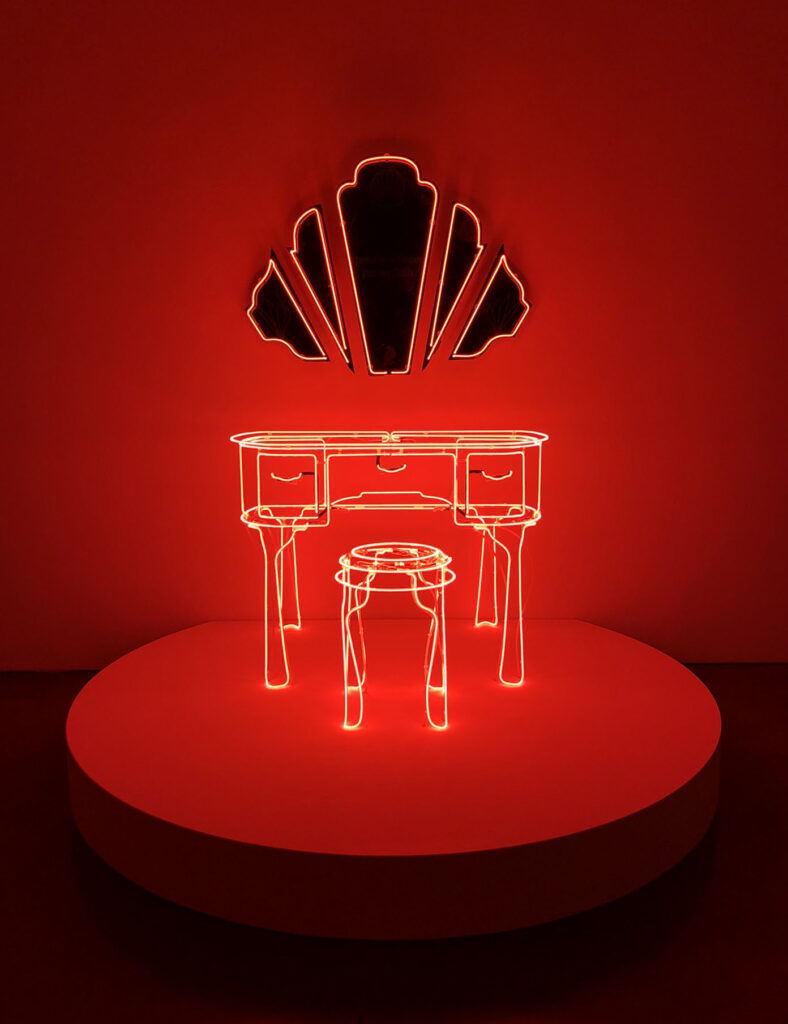
Ja’Tovia Gary “Citational Ethics (Zora Neale Hurston, 1943)”, 2023, wood, neon and engraved obsidian

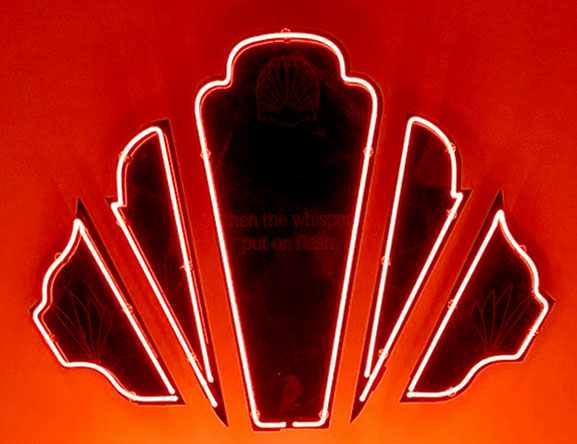
Ja’Tovia Gary “Citational Ethics (Zora Neale Hurston, 1943)”, 2023, wood, neon and engraved obsidian (detail)

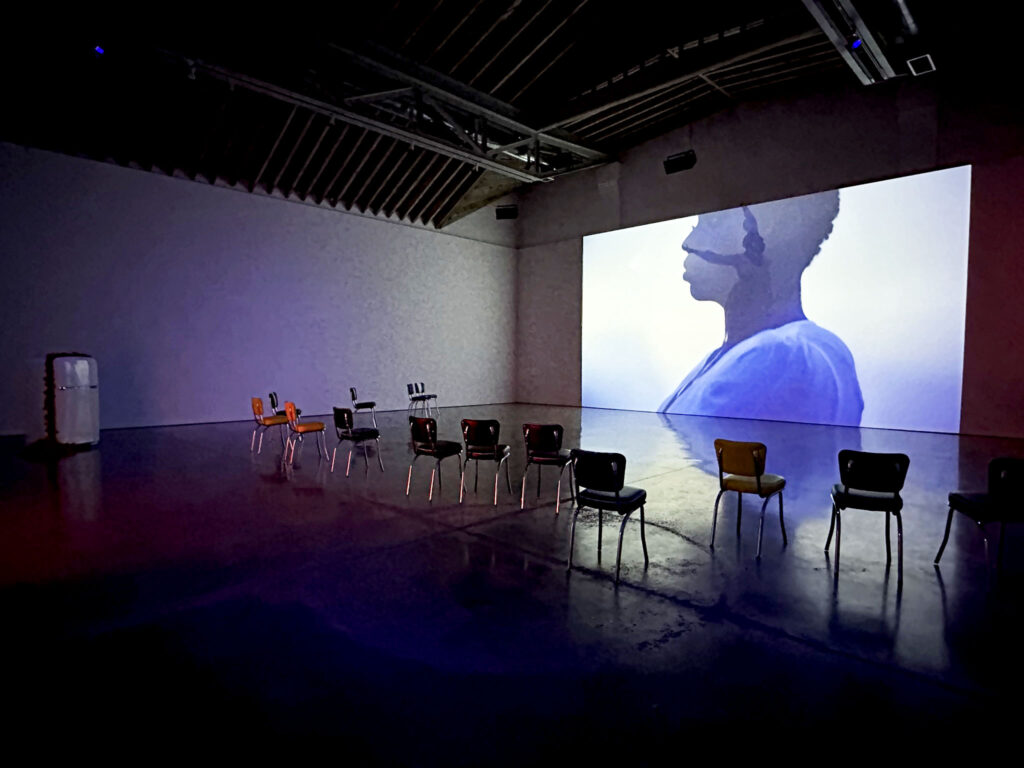
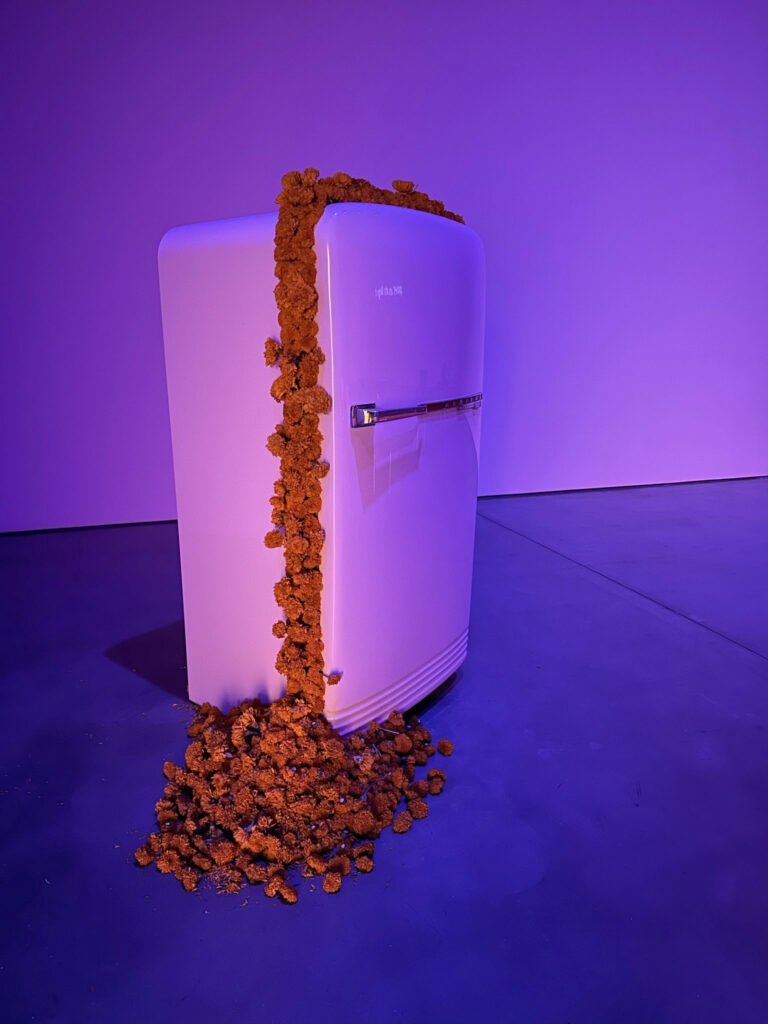
Currently at Paula Cooper Gallery in NYC is Ja’Tovia Gary’s You Smell Like Outside…, an exhibition that centers around her 2023 film, Quiet As It’s Kept, and includes two new sculptures.

From the press release-

The artist continues her practice of interrogating and re-contextualizing multiple archives, concerning herself with the power and responsibility of language and the radical possibilities of narrative. The exhibition title You Smell Like Outside… is a Black Southern phrase that foregrounds the artist’s specific cultural origins with discursive traditions that invoke an interior knowledge. Inspired by Toni Morrison’s 1993 Nobel Laureate lecture, Gary attempts to heighten the contradictions between a living and a dead language. Notions of domesticity, interior and exterior, and the conflict between perception and being perceived are explored in the show.

With a filmic and sculptural language uniquely her own, Gary eloquently intervenes into foundational renderings of Black life to expand the conversation and the possibilities of being. The artist considers what is destabilized when we include the cinematic within the category of language, asserting: “if we are to ensure the future efficacy of storytelling, we must boldly and audaciously insist upon new narrative forms.” Quiet As It’s Kept (2023) is a contemporary response to The Bluest Eye, Toni Morrison’s first novel published in 1970. Set in Ohio in 1941, the book is an evocative illustration of the everyday particulars of colorism and its ravaging effects on the intramural. Themes of embodiment, psychoanalysis, and beauty are explored in both the source text and the answering film. Instinctual and eviscerating, the film encourages viewers to make meaning that is rooted in the subjective and examine their position within looking relations.

Following Gary’s critically acclaimed films THE GIVERNY DOCUMENT (2019) and An Ecstatic Experience (2015), Quiet As It’s Kept (2023) is an intimate bricolage of vintage Hollywood, direct animation, original super 8 and 16mm film footage, and documentary conventions. Mediating on the gaze and Black women’s particular embodied realities, Gary also re-contextualizes contemporary social media footage. Creating conceptual links for each viral clip to a character, event, or thematic element from Morrison’s story, the film emphasizes questions around the book’s themes of internalized and externalized anti-blackness in contemporary culture. Situated within an immersive installation with domestic elements, the film asks the viewer to employ an oppositional gaze that allows for narrative structures that run counter to those of the mainstream.

High John de Conquer came to be a man, and a mighty man at that. But he was not a natural man in the beginning. First off, he was a whisper, a will to hope, a wish to find something worthy of laughter and song. Then the whisper put on flesh. [1]

The sculptures in Gary’s Citational Ethics series illuminate the words of Black women through the medium of neon, with the title of each work serving as a citation for the quote. Citational Ethics (Zora Neale Hurston, 1943) cites Zora Neale Hurston’s 1943 essay on High John de Conquer, a Southern folk trickster figure who brought joy, laughter, and strength to enslaved people while continuously evading capture. The sculpture is a vanity mirror set which gestures towards a speculative future past. Comprising a desk, stool, and fan-shaped obsidian mirror, the object invokes the Harlem Renaissance, Art Deco, and southern Black Hoodoo lore. A departure from the previous works in the series, the quote is etched into the highly polished black stone said to bring about visions through gazing, while the furniture is rendered in neon. Drawing the viewer in to read the words written in the mirror while bathed in red light, the sculpture summons an intimate encounter with the self and spirit.

[1] Zora Neale Hurston, “High John de Conquer,” in The American Mercury, October 1943, pp. 450-458

This exhibition closes 3/11/23

Mar 092023
 

Lilian Thomas Burwell, “Enfolded”, 1973

Lilian Thomas Burwell, “Untitled”, c. 1980

Lilian Thomas Burwell, “Montagne”, 2012

The work above is from Lilian Thomas Burwell’s exhibition Enfolded at Berry Campbell gallery in NYC.

From the press release–

Living and working  in Highland Beach, Maryland, Burwell, age 95, was recently hailed as the “Tom Brady of Artists” in the New York Times. In 2022, Burwell received Howard University’s Lifetime Achievement Award along with Betye Saar.

Lilian Thomas Burwell: Enfolded highlights the dynamic transition in Burwell’s abstract visual language from two-dimensional painterly canvases to three-dimensional sculptural forms. Burwell’s paintings from the late 1970s and early 1980s employ a distinctly bold palette and reference the natural world, featuring organic forms that abstract biotic phenomena. In 1984, Burwell literally cut into a canvas, creating a shape beyond the square. This pivotal act gave way to Burwell’s examination of form, bringing forth Burwell’s signature style of three-dimensional, painted wall sculpture. Dr. David Driskell described Burwell’s work as, “transcendental in showing stylistic diversity of earthly beauty and cosmic vision.”

This exhibition closes 3/11/23.

Mar 092023


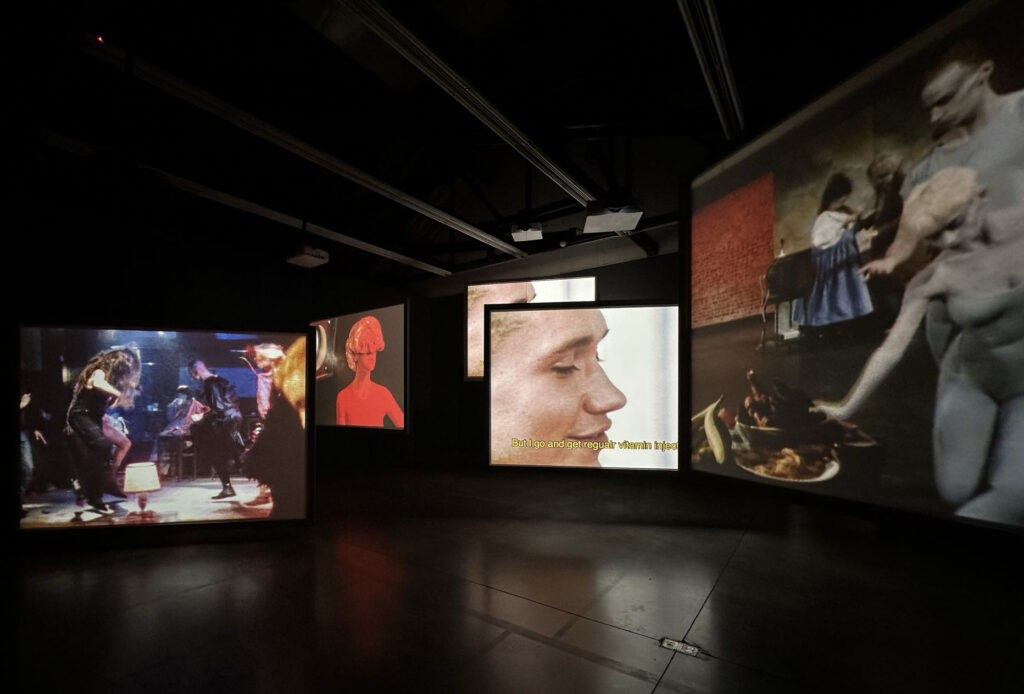
It often feels like we are oversaturated with images in today’s world, but the energy at the Charles Atlas exhibition A Prune Twin at Luhring Augustine gets the balance right.

From the gallery’s press release-

Luhring Augustine is pleased to announce A Prune Twin, the gallery’s third solo exhibition with pioneering film and video artist Charles Atlas. The presentation will mark the American debut of this major multi-channel installation with sound that was originally commissioned by the Barbican Centre, London as the centerpiece of their 2020 exhibition, Michael Clark: Cosmic Dancer; which traveled to the Victoria and Albert Museum in Dundee, Scotland in 2021.

The collaboration between the two artists began in 1984 when the young dancer, Clark, performed in two single-channel films by Atlas: Parafango and Ex-Romance. However, it was not until the groundbreaking Hail the New Puritan in 1986, that the relationship between the two artists was deeply cemented. Originally commissioned as an arts documentary by Channel 4 of the BBC, Hail the New Puritan turned the genre on its head, presenting a highly stylized and fictionalized version of a typical day in Clark’s life – an “anti-documentary”, as Atlas has called it.  The two artists also worked closely together on another Channel 4 production, Because We Must (1989), which was full of extreme theatricality in its dance, choreography, scenery, costumes, and directorial position.

In A Prune Twin, Atlas pulls material from these two major films to create an immersive eight-channel installation of sound and moving image. He extends the idea of choreography to camera and sound, flowing across and throughout screens and monitors; in this sense, Atlas choreographs his own past material into a new and compelling dance all of its own. Evident in this work, and many others by Atlas, is his strong affection and attraction to exceptionally creative collaborators, his sensitivity to movement and how to capture it on film, and his novel skills as both a storyteller and observer. Much like MC9, an immersive installation that compiles Atlas’ extensive work with Merce Cunningham, A Prune Twin surrounds the viewer in a beautifully choreographed spectacle. The work captures the spirit and passion of a 35-year collaborative relationship, one that continues to this day – currently realized through the lighting design that Atlas produces for all of Clark’s live performances, an endeavor he has undertaken since the 1980s.

Mar 092023
 

Joani Tremblay “Untitled (naphthol red)”, 2022

Joani Tremblay “Untitled (Death Valley), 2022

Joani Tremblay “Untitled (violet mountains)”, 2022

Closing on 3/11/23 is Joani Tremblay’s exhibition of paintings, Intericonicity at Harper’s gallery in NYC.

From the press release-

Tremblay presents twelve oil paintings made since April 2022 that largely depict the landscape of rural Pennsylvania. In contrast to the chromatic levity of recent work portraying citrus fruits or the American southwest, here Tremblay hews to a darker palette of rich greens and blues inspired by farmland valleys just thawing at the start of spring. This is what she saw driving from New York City through the Laurel Highlands to reach Fallingwater, the iconic house that Frank Lloyd Wright designed as a nature retreat for a wealthy retail magnate.

How we use the land lies at the heart of Tremblay’s work. A road’s placement, a water reclamation initiative, or the machinations of land ownership matter for Tremblay not so much for their factual circumstance as for the power relations that structure them. Behind the myths of the untouched landscape or nature as a fierce inevitable conqueror over human ambition lies a question about our standpoint when we approach a particular vista. Will we simply look? Take a photograph, or retrieve a rock to carry with? Commission a plan to shape the earth this way or that? Wright erected Fallingwater over a waterfall so that it literally straddles but symbolically surmounts the tributary’s onrush. Even its windows are unframed, the better to create an illusion of coextension with the same nature it tames. Built from 1935–39, at the height of the great economic depression, Wright used nearby laborers, supporting the local economy to forge an elaborate private gem amid the picturesque.

In this vein, contradictory impulses about our treatment of the land fuel Tremblay’s paintings, which are, for the most part, each made of three constituent components painted in the following order: sky, ground, and internal frame that focuses our vision like an aperture on the landscape beyond. In Untitled (rain), ice blue shards interpose themselves between roiling clouds anchored by the slender arcs of an emerald frame, while a flaming sky tops amethyst buttes seen through the undulating rays of a cobalt-green opening in Untitled (violet mountains). Tremblay works in oil, building up the texture of certain parts of her internal borders through varying degrees of thickness applied with a loaded sponge, in contrast to the smooth finish of those borders’ flat gradients and the medium texture of her landscape’s painted fields. But as her framing devices and the near-realism of her depictions of earth suggest, the discourse of photography undergirds her work conceptually.

In the nineteenth century, government-funded photographers such as Timothy O’Sullivan spread westward, scrutinizing the earth. One of his images records a measuring stick alongside a text left on Inscription Rock by a Spanish invader, literalizing the human desire to regulate nature. Though Tremblay’s landscapes at first seem to aspire to such precision, she deploys lossy processes in the studio that encourage a departure from the indexical, supposedly truthful exactitude of landscape photography. Tremblay projects a digitally-mocked-up composition onto her canvas, but by using a poor-quality projector, she ensures that the image is too grainy to copy fastidiously at close range. And although she initially sourced one of her favorite skies—visible here in Untitled (rain)—from John Constable, she has painted it so many times that it has become her own via the minute changes materialized through repetition. She looks to her own work, not Constable’s, when she paints this sky anew. Thus, Tremblay charts a middle path between photography’s documentary dream and landscape painting’s glorification of subjective experiences in nature, drawing on these themes to surface accrued ideologies latent in the very notion of the landscape view.

Although Tremblay’s vistas arise from her personal travel, they seem uncannily familiar because they draw from a cultural imaginary rather than from specific locales. To wit, Tremblay conducts research on Instagram, where curated landscapes are already shot through with aesthetic codes long established by artists from Ansel Adams to Lawren Harris and Arthur Dove. Photography’s indexical referentiality is at a remove twice over in Tremblay’s work, first through the interpretive act of painting by hand, and second by encoding within it a whole set of images and conventions for their appearance that encircle us in the digital realm.

Unlike a palimpsest, in which a first layer of representation is covered over by a second, Tremblay’s work operates through intericonicity, a term derived from semiotics. Intericonicity offers a way to understand a relation of copresence between two or more images which may appear eidetically or actually as one image within another. This realm of infinite reproduction and false memory offsets a more straightforward mood each painting’s chromatic scheme seems to deliver. The smooth, inky valleys of Untitled (sunset and trees) might suggest placidity, for instance, the sheer height of Untitled (Laurel Highlands) soaring power. But because each work signals allusions to so many art historical or geographic references alongside their ideological effects, that mood resists resolution. Said differently, these are not easy paintings to decode. Their sharpness of focus functions on multiple strata at once.

Mar 082023
 

Chiharu Shiota, “Connected to the Universe”, 2023

Chiharu Shiota, “Connected to the Universe”, 2023 (detail)

Chiharu Shiota, “Connected to the Universe”, 2023, detail

“Connected to the Universe”, 2023

Chiharu Shiota’s gorgeous installations are just one part of her engaging exhibition, Signs of Life, at Templon in NYC. The installations lead to other rooms of smaller sculptures as well as  paintings.

From the press release-

After a foundation degree in painting at Seika University in Kyoto, Chiharu Shiota chose to pursue her artistic studies in Berlin, focusing on performance. Her practice soon shifted towards site-specific installations. She skilfully weaves knotted threads to create fantastical scenes combining salvaged window frames, a piano, suitcases, books and used clothes. Bordering on drawing and sculpture, her fabulous ephemeral, immersive installations have become her signature. Since her impressive installation for the Japanese Pavilion at the Venice Bienniale in 2015, she has become one of the key figures on the international art scene and is regularly invited to show her work at museums worldwide.

In a hyper-connected world, Chiharu Shiota’s new exhibition questions the notion of the “web”, a living organism similar to the structures that make up the universe or the neurons our brains are built on. Created on-site over two weeks, a large-scale installation made of red threads symbolizes this permanent connection of information, collective memory and the world’s knowledge which cuts across cultures and continents. At the heart of the work are two arms, her own, placed on the ground. They are cast in bronze, palms facing up to the sky. “I always thought that if death took my body, I wouldn’t exist anymore,” explains the artist. “I’m now convinced that my spirit will continue to exist because there is more to me than a body. My consciousness is connected to everything around me and my art unfolds by way of people’s memory.”

The installation is followed by a series of sculptures. Enfolded at the centre of each one, as though frozen in place by the intertwined threads, are objects from daily life. “I feel that the objects we possess are like a third skin,” she says. “We accumulate these things and transpose our presence and our memory to them.” Often obsolete, weighed down by impenetrable histories, these objects — old suitcases, stained dolls, miniature pieces of furniture and tiny bottles — represent the treasures offered up by memory, to be seen but not touched.

“State of Being (Dress)”, 2022

State of Being (Photos), 2022

State of Being (Photos), 2022 (detail)

This exhibition closes 3/9/23.

Mar 042023
 

Alex Prager’s photographs, top floor of the gallery

Alex Prager, “Run” film still

Alex Prager, “Run” film still

Alex Prager, “Run” film still

Alex Prager, “Run” film still

It’s hard not to be delighted by Alex Prager’s latest exhibition, Part Two: Run at Lehmann Maupin gallery in NYC. Upon arriving on the lower level of the gallery you are met with a pinball machine, brightly colored photos, and the sculpture of a woman’s body with her head crushed under a giant silver ball. In the next room, the short film Run sucks you in to it’s strange world.

From the press release-

Directly responding to a period of cultural ambivalences and uncertainties, the exhibition urgently examines human perseverance and explores the opportunities for empathy, participation, and action present both within art and everyday life.

Across her practice, Prager crafts rich, often ambiguous narratives that examine the cultural mythologies and archetypes that shape collective existence. As she deploys and deconstructs artistic and narrative conventions, Prager explores how both our senses of self and our engagement with others are often mediated by familiar stories and tropes. Occupying a tenuous relationship to time and place, the artist’s carefully choreographed figures remain suspended between the past and the present, and Prager gestures to a collective will to exist that not only transcends our immediate circumstances but persists despite them.

The foundation for Prager’s latest body of work is the artist’s powerful new film, Run. Featuring musical compositions by Ellen Reid and Philip Glass and starring Katherine Waterston, the film deploys cinematic archetypes and absurdist humor as it examines human resilience in the face of catastrophe. An otherwise ordinary day in an uncannily generic setting erupts into chaos when a massive, mirrored sphere propels itself through a community. Here, forward motion is countered by retrospection. Figures collide into their own reflections in the sphere’s surface, and Prager suggests a curative, collective reckoning with those forces outside of our control.

The New York exhibition presents Run in dialogue with photographs and sculptures that further complicate and enrich the film’s fundamental concerns. Prager’s photographic work Sleep (2022) shows the intricately staged mass of people from Run, as they momentarily lay on the ground, after each colliding with the accelerating mirrored ball. Sleep humorously deconstructs the conventions of the film still, and Prager unveils the absurdist potential of suspending a single moment in time. Dramatizing the scene’s ambiguities, the work offers a narrative with a multitude of possible conclusions. Directly engaging the film’s central image, Prager’s sculpture Ball (2022) shows a hyper-realistic figure of a woman, whose head appears to be crushed by the mirrored sphere. As viewers approach the object, they are likewise confronted by their reflections, and they, too, become enfolded within Prager’s lively narratives. Here, as throughout the exhibition, Prager invites viewers into her visually and symbolically saturated works, suggesting that they, too, have critical parts to play.

Part Two: Run marks the culmination of a multipart exhibition, which also included distinct presentations at Lehmann Maupin Palm Beach in November 2022 and Lehmann Maupin London in January 2022.

Make sure to head to the top floor of the gallery as well, where the exhibition continues with more photographs.

This exhibition closes 3/4/23.