May 162023
 

“Salon, Apartment of Valerian Rybar and Jean-Francois Daigre, Rue du Bac, Paris”, 2015, acrylic paint, acrylic caulk, acrylic transfer, GAC 800 on canvas mounted on wood

“Salon, Apartment of Valerian Rybar and Jean-Francois Daigre, Rue du Bac, Paris”, 2015, (detail)

“Salon, Rue du Bac, Paris”, 2022, acrylic and acrylic caulking on canvas mounted on board

“Salon, Rue du Bac, Paris”, 2022, (detail)

“Aquarium (Taboo)”, 2019

“Aquarium (Taboo)”, 2019

Currently at Arsenal Contemporary are Dorian FitzGerald’s paintings for his exhibition Fitzcarraldo. The images above are a few of the larger paintings from the show. The works initially look like photographs, but on closer inspection you can see more of the process involved in their creation.

Below is a section from the press release that discusses FitzGerald’s work and the paintings pictured above. For more on the other works shown, including some of the smaller paintings, head to gallery’s website.

FitzGerald has spent the last two decades meticulously crafting a compelling, often monumental body of works, several of which have taken years to finish. His various lines of inquiry revolve around a central tenet: that the excesses, the follies, the deceptions and indulgences, the grand edifices, the opulence, the waste and plunder, the vanities, the subterfuges and the chummy pacts of the wealthy and the powerful, are all fodder for scrutiny. His subjects have ranged from the outdoor stage at the secretive Bohemian Grove during a production of Faust, a fake crown of costume jewelry made by the British to impress the King of Adra and help them facilitate their slave trade, to the staggering array of sunglasses collected by Elton John, to a vast aquarium stocked with black market fish. In this regard, FitzGerald has been compared to a contemporary court painter, albeit one who fully understands the paradox of using ostensibly beautiful works of art to deliver barbed comment on the very subjects he has so painstakingly rendered. FitzGerald’s large paintings are constructed with acrylic paint (and occasionally caulking) in a slow, precise method that the artist has refined in his studio over several years. The pre-process involves researching imagery, preparing it with custom software, making a large-scale acetate transfer onto canvas and then building up the paint slowly in a manner that resembles a kind of pointillism filtered through vector graphics. Both colour theory and the physical properties of paint, such as drying times and viscosity, are brought to bear in the setting of the final image. The infinite patience and granular attention to detail suggest a kinship with Tibetan sand painting. While the latter, once finished, is soon wiped away to drive home the impermanence of all things, FitzGerald’s works tend to hold a mirror up to that innately human wish to be exalted and remembered in the minds of others before the scythe comes down, as it inevitably does for queen, shepherd (and artist) alike.

Anchoring the exhibition is a pair of monumental paintings, both depicting a room in a Parisian apartment. Salon, Apartment of Valerian Rybar and Jean-François Daigre, Rue du Bac, Paris (2015) is the furnished version. Daigre and Rybar’s New York- and Paris-based firm Valerian Rybar & Daigre Design Corporation was renowned for providing the most lavish interior design and decorating for society doyennes from Miami Beach to Marakkesh in the 1970s and 1980s. It was closed following Rybar’s death in 1992. Their clients included Guy and Marie-Helene de Rothschild, Nicholas and Genevieve DuPont, Antenor and Beatriz Patino, Samuel and Mitzi Newhouse, Pierre and Sao Schlumberger, Sir James Goldsmith, Christina Onassis and Stavros Niarchos. They employed a host of artisans all over the world who did anything from paint Medieval tapestries on blank walls to create mother-of-pearl panels for a bathroom. They designed much of the furniture and rugs and were meticulous about the choice of fabrics, using opulent materials like satins trimmed with gold thread. The related painting, four years in the making, acts as a kind of coda. Salon, Rue de Bac, Paris (2022), depicts the same room after Rybar’s death, now an empty hall of mirrors en route to being dismantled. The searing band of red in the centre of the painting, glowing behind a door already off its hinges, is a peek into the molten bedroom that they had once kitted out like a Roman general’s tent.

Aquarium (Taboo) (2018), at 128” long and 40” high, was two years in the making. The painting shows a vibrant aquatic scene, with dazzling exotic fish and a mesmerizing array of coral. But the fish are black market, the coral has been pilfered, the 240-gallon tank is overcrowded with 53 specimens and the entire enterprise is kept alive by a complex system that is wholly unnatural and requires constant vigilance to prevent collapse. Of course, wild fish bound for the aquarium market must be caught alive and thus there exists an unsavoury network of divers who prowl the world’s reefs to find the most exotic and rare, often using cyanide spray to stun them (or inadvertently kill them if too much is used). The cyanide, when it settles on coral, soon kills that too.

This exhibition closes on 5/20/23.

May 112023


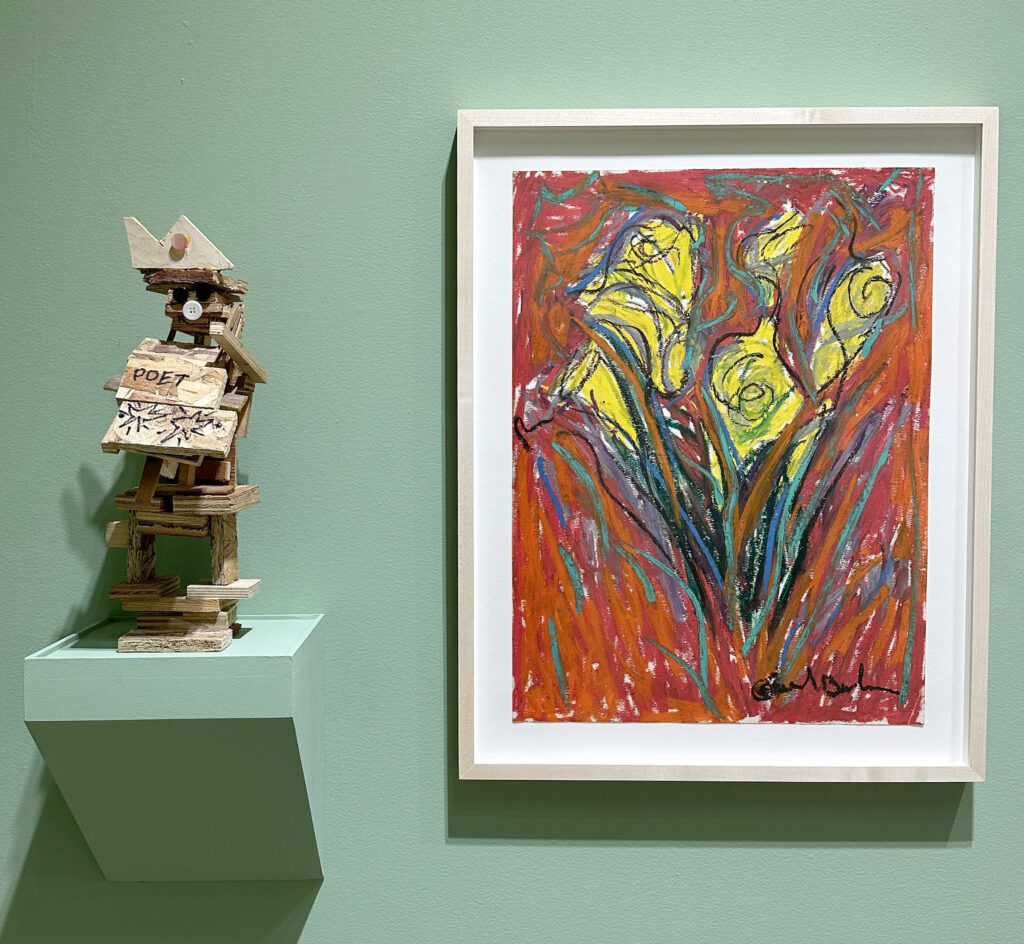
Andrew Edlin Gallery is currently showing a collection of rarely seen works by artist Beverly Buchanan. It covers her years as an abstract expressionist painter in NYC and her later work inspired by the rural South.

The gallery’s press release gives a really good history of this wonderful artist-

The first section of the show features the artist’s abstract paintings and works on paper from the 1970s, alongside post-minimalist sculpture from the late 1970s and early 1980s. The second section introduces a later, more personal side of Buchanan’s oeuvre, her colorful depictions of flowers and small folk-inspired assemblages created during the same period as her well-known “shacks.” A number of the works in the show, many of which were part of the artist’s private collection, have never been shown.

Though Buchanan wrote about her love of “making things” from an early age, it wasn’t until 1971, when she began taking evening classes taught by African-American painter Norman Lewis (1909-1979) at the Art Students League in New York, that her career as an artist took off. Abstract still-lifes that she made in Lewis’s class in 1972 are displayed here for the first time. That same year, her paintings were included in a group show at Cinque Gallery, a nonprofit space co-founded by Lewis and Romare Bearden (1911-1988), which showcased the art of emerging minority artists.

Having witnessed demolition sites in Harlem and SoHo, Buchanan evoked the visual erosion of architectural facades through what she dubbed her “Wall” paintings. In 1976 she presented a selection that she called “Torn Walls” in a two-person show titled City Walls at the Montclair Art Museum in New Jersey. In his New York Times review, David Shirey described the show as “indisputably a tinderbox of a display that will cause sparks to fly” and “the kind …one sees more regularly at the Whitney Museum and at some of New York’s avantgarde galleries.” Three of these paintings are being shown for the first time since that exhibition, forty-seven years ago. The show also includes a monotype, small studies, and a large painting from a series she titled “Black Walls.” The latter was originally featured in Shackworks, a seminal exhibition that opened at the Montclair Art Museum in 1994 and traveled to nine other institutions from 1994-1996.

By the late 1970s, Buchanan was further exploring the aesthetics of architectural decay through sculpture, i.e., cast concrete assemblages, made from pieces of stone, brick debris, clay, and cement mixtures. She arranged these works in clusters on the floor, documenting them with photographs, and exhibited them, notably at Truman Gallery in New York in 1978, and at the feminist artist cooperative A.I.R. Gallery in 1980 in its groundbreaking show Dialectics of Isolation, curated by Ana Mendieta. Some of the small black terracotta works on display may be considered as studies for these larger assemblages.

After moving to Georgia in 1977, Buchanan became increasingly interested in making what she referred to as “environmental sculpture,” artworks that mimicked exterior surfaces and were also site-specific installations that were allowed to decay over time and become part of the surroundings. Most notably, in 1979 she completed Ruins and Rituals (also the title of the Brooklyn Museum retrospective from 2016-2017), and in 1980 Marsh Ruins, with funding from a Guggenheim Fellowship. To construct the three mounds that comprise Marsh Ruins, Buchanan produced her own tabby cement. Composed of the lime from burned oyster shells mixed with sand, water, ash, and other shells, tabby is what colonial settlers used to build structures in coastal Georgia, the location of Marsh Ruins. In her zine “Making Tabby for Brick Sculptures,” Buchanan documented the labor-intensive process of making tabby, a task that in the eighteenth century was typically delegated to enslaved workers. Two smaller iterations of these structures, with bits of oyster shell showing in the concrete, are laid out in the show alongside four other examples of her cast concrete assemblages. Though little is known about their exhibition history, we do know that the artist placed these cast concrete works in her garden in Athens, Georgia. They retain stripes of the green, blue, black and earth-toned paint with which Buchanan initially covered them. The faint outline of her signature “B.B.” is also visible.

Buchanan’s later work is intimately linked to her natural surroundings and folk art. As a native Southerner, she drew on memories from her childhood as well as the lush Georgian landscape and yard art of local self-taught artists. A passionate gardener, Buchanan produced vivid oil pastel flower drawings and small assemblage works. She loved to rummage through thrift stores collecting marbles, wedding toppers, and beads, to create what she referred to as her “Christmas trees,” and “spirit jars,” her take on memory jugs, a prized Southern Folk Art form. Buchanan was particularly moved by a visit to folk artist Nellie Mae Rowe’s home in Fayette County, Georgia, and reminisced: “Being at Nellie Mae Rowe’s home was like being engulfed in a magic forest of her work because every surface had a mark from her hand and the simple chewing gum works made you never take gum as just chewing gum again.” A distinctive chewing gum jug and pin are also included in the show.

This exhibition closes 5/13/23.

May 092023
 

“Curtains”, 1972, Acrylic and fabric on canvas

“Curtains”, 1972 (detail)

“Voyage”, 1973, Acrylic and collage on canvas

“Shrine: Homage to M.L.”, 1963, Oil on canvas

“Big Ox”, 1967, acrylic on canvas

There’s only a few days left to see Miriam Schapiro: The André Emmerich Years, Paintings from 1957–76 at Eric Firestone Gallery.

From the press release-

Miriam Schapiro (1923–2015) is now well-known as a pioneer of the Women’s Art Movement, and for her contribution to the Pattern and Decoration Movement. She fused craft work, traditionally made by women, with modern painting in collages termed “femmage.” However, this exhibition will additionally shed light on her early Abstract Expressionist canvases, and her pioneering approach utilizing computer technology to create Hard Edge geometric painting in the 1960s. Spotlighting the legacy of this feminist artist, the exhibition will explore three stylistic phases, with significant examples from these two decades of Schapiro’s career.

This exhibition closes 5/13/23.

May 042023
 

“Day 11: Flight Simulator”, 2023 Oil, inkjet transfer, enamel, and paper on canvas

“Carousel”, 2023 Oil, inkjet transfer, enamel, and paper on canvas

“Day 5: In Praise of Shadows”, 2023 Oil, inkjet transfer, enamel, and paper on canvas

“Day 3: Janitor”, 2022 Oil, inkjet transfer, enamel, and paper on canvas

Above are some of Ho Jae Kim’s enchanting mixed media works from his exhibition, Carousel at Harper’s gallery.

From the press release written by the artist-

The centerpiece of this exhibition, its namesake painting, depicts a carousel with 31 horses signifying the days of the month. For each of these “days,” I built a unique narrative in honor of liminal spaces, the mundane, and the quotidian. Just as life continues regardless of our psychology, the carousel will turn whether or not there is a rider. While I prepared for this exhibition, I thought of the displacement I’ve experienced by tragic events out of my control. One summer night in 2022, my stepfather committed suicide. He left a brief note for my mother before driving to a nearby railroad where he waited for a train to take his life. Since then, I have been plagued with a vision of the train’s headlights—a magnificent bright light that dissolves the contours of everything in its path. I became a prisoner to this light that exists within my dark fantasy.

We rely on fleeting moments of significance to define life, but the majority of our lives are shaped by non-moments of transition, endurance, and dormancy. For this reason, I chose to create representations of less significant moments in order to build a body of work that can paint a better picture of reality. Luxurious portrayals of life as depicted in movies and pop culture cultivate dreams of becoming a character in a fantasy, but these dreams are quickly shattered by the constraints and circumstances of daily life. We become psychologically displaced and rejected by the fantasies that once served as our vitality. We begin to live in a state of purgatory, caught between reality and our dreams.

In The Divine Comedy, during the transition from the Inferno to Purgatory, Dante turns right to see the light from the east on Easter Sunday, a day of resurrection. With this new orientation, Dante’s purgatory becomes a place of hope, where lost souls can choose to repent or find redemption. The horses on my carousel face to the left, in the direction of the spiraling Inferno, but if the audience chooses to imagine the mechanism rotating, the horses will eventually turn right as they continue their clockwise journey. Similarly, as the halos, arches, circles, and light in my paintings become juxtaposed with the mundanity of the subjects, they transform those quiet non-moments into divinity, and the prisoners of my narratives are granted redemption.

This body of work began as a tragedy, but it has the potential to become a comedy. And just as I wish for my loved ones to see the beauty that is within their souls, I hope that my divine scenes of nothingness can become a vehicle for others to redeem themselves in purgatory and indulge in the beauty that is inherent in every life.

This exhibition closes 5/6/23.


May 032023
 

“Sun and Moon Spectrum”, 2022

“Sun and Moon Spectrum”, 2022 (detail)

“Radiant Sun with Trees (Yellow, Pink, Green)”, 2023

“Gingko Trees (Gold and Violet)”, 2023

It’s the last few days to see Amy Lincoln’s exhibition of dreamy paintings at Sperone Westwater.

From the press release-

These large-scale seascapes and landscapes reference atmospheric elements—air, water, light and clouds—and engage concepts of light reflection and refraction. Working in a more expansive format, Lincoln continues her exploration of the cosmos.

Lincoln covers each of her wood panels with acrylic paint in gradations of colors from light to dark to develop a precise perspective and imply the illusion of space. Sun and Moon Spectrum, the centerpiece of the exhibition, measures over 11 feet wide, her largest seascape to date. “This painting moves sequentially through the colors of rainbow, starting at yellow, then to orange, red, magenta, purple and blue,” says Lincoln. “Bands of color progress from and divide the two glowing orbs of sun and moon, shifting from light to dark and back to light again, while also moving from warm to cool colors.” The visual conceit of moving through a color spectrum references Ellsworth Kelly’s work, a nod to the minimal abstraction that has influenced her recent practice.

In this new series, Lincoln also utilizes as subject matter botanical and forest imagery (for example, Radiant Sun with Trees (Yellow, Pink, Green), 2022). Like the waves in the seascape paintings, the fir and gingko trees repeated throughout the foreground and background serve to enhance depth and perspective. “This creates an overall simplicity and focus on color, pattern and space,” says Lincoln. “I also didn’t want to be too dependent on the seascape imagery as a formula. I wanted to apply the inventive approach to color I had learned in making the seascapes to a different set of imagery.”

This exhibition closes 5/6/23.

Apr 282023
 

“My Gut”, 2022, acrylic, ink, marker, wax crayon, paracord, thread on canvas

“My Gut”, 2022 (detail)

“Bodybuilder”, 2023, acrylic, ink, wax crayon, paracord, thread on canvas

Annie Bielski’s dynamic mixed media paintings from her exhibition, Agita, are currently on view in Rachel Uffner Gallery’s upstairs space.

From the gallery’s press release-

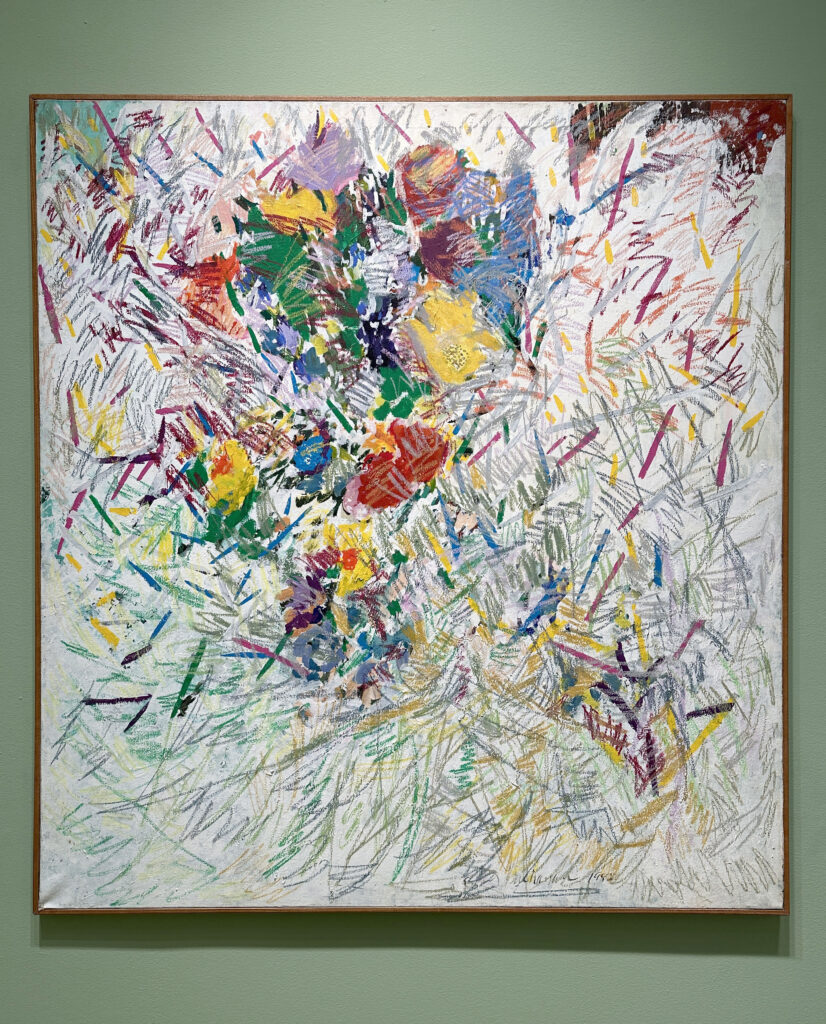
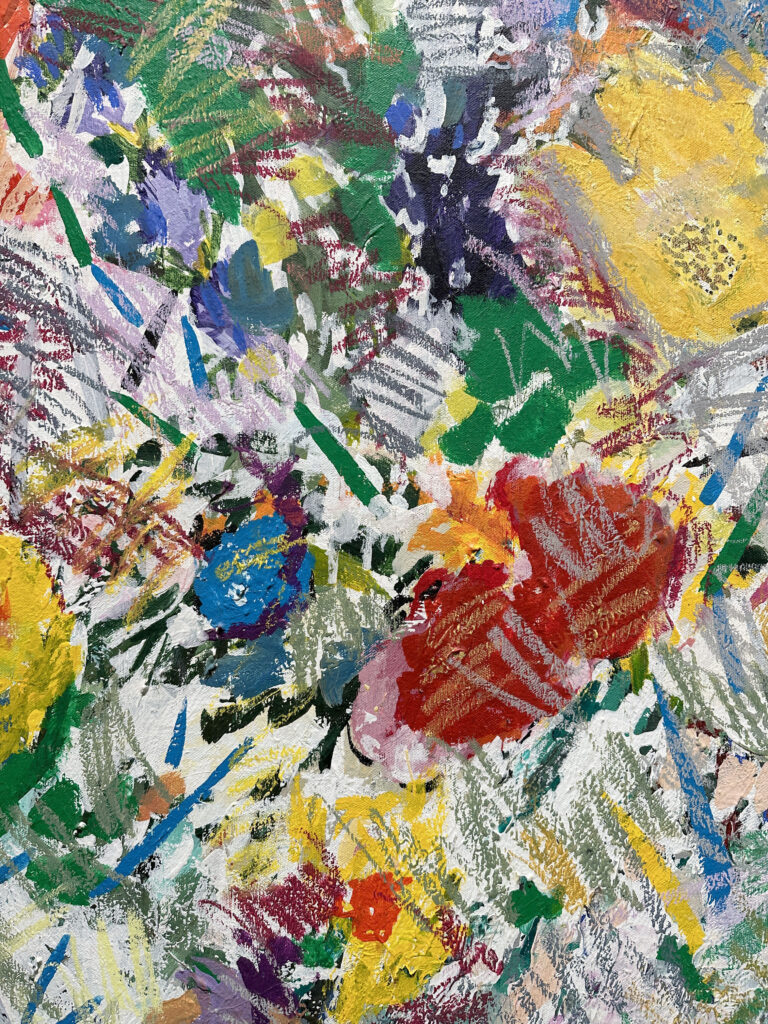
Annie Bielski makes works that are big washes of feeling, then she goes in and fills in the shapes. The volumes need to be filled—satiated. Going over and over them with crayon or oil stick in repetitive gestures. This is to say that her paintings are both records of the artist’s bodily limits (the paintings go as far as my arm) and examples of the limitless potential of materials left to their own devices (the oil stick is cakey and glossy lipstick falling off and crumbling and being smooth). The drawing ends when the stick is worn down and there is nothing but residue left on your hands.

The result of this dialogue is evident in the forms that she generates. Each form is an organ: it has a specific function, processes in its own way the work’s shared fluids and biles—but compacts to mass when crammed together in the cavity of the canvas. The material challenging the body to collapse into its most erratic gestures, the body wondering if the material might ultimately generate some kind of meaning. Everything is always taut, ready to burst.

What happens next? Eating a hotdog from a cart in Central Park (beginning a painting) when suddenly the agita rises (heartburning) and the world immediately becomes askance, shifting off its axis to accommodate room for your pain. How do I make this okay?? / When will the painting be finished?? Needing to take off every thing that constricts you; unbuttoning your pants, loosening your bra, unwinding your braid, then going to lie down. A body would be sexy but it’s the byproduct of spasmodic internal combustion. Classic.

For her, the conditions that painting creates are tragicomic. This understanding is traced in wavering—moments of gravity or self-seriousness are transmuted into a bunch of bananas or a floral motif. But each little disaster is kept in check by a kind of logic, perhaps provisional, a pact with the inherent nature of all unruly things to meander. It is ultimately a win-win contract between generosity and flexibility, a willingness on her part to accept the mess of point A to point B.

The result is a series of works that are bright and unsettled, grotesque and pulsating, alive with the pure tension of compromise. Rachel Uffner Gallery is pleased to present a solo exhibition of new paintings and drawings by artist Annie Bielski. The show is titled Agita, and if you know, you know.

This exhibition closes 4/29/23.

Apr 282023
 

Installation by Molly A. Duff

Work by Trinity Oribio (left) and Manon VanScoder (videos on right)

Currently on view at The USF Contemporary Art Museum is SOMEDAY YOU’LL HAVE TO SAY IT OUT LOUD, an exhibition of eight students graduating with MFA degrees from the USF School of Art and Art History.

The artists included are Molly Duff, Kai Holyoke, Caitlin Nobilé, Trinity Oribio, Rachel Treide, Manon VanScoder, Alicia Watkinson, and Willow Wells.

For the artists’ statements about their work, as well as more information on the exhibition, the museum has produced this PDF.

The show will be on view until 5/6/2023.

Installation by Molly A. Duff, another view

Alicia Watkinson, “Notations in Passing II”, 2023, plywood, lightbulbs, ceramic bases, timers. Duration of light set daily according to the previous day’s activities and observations

Alicia Watkinson, “Notations in Passing II”, 2023 (detail)

Photo transfer on glass by Rachel Treide

Still from video by Rachel Treide

Caitlin Nobilé, “The gap in the door”, 2023 triptych, acrylic on wood

Willow Wells, “Whispers”, 2023, oil painting on panel

Trinidad Oribio “Untitled”, 2023 oil on canvas

Trinidad Oribio, “La Trinidad”, 2023, archival pigment print

Video installation by Manon VanScoder

Manon VanScoder, “each day is an endless scroll”, 2023

Kai Holyoke “Paradise Lakes”, 2023

Kai Holyoke “Paradise Lakes”, 2023


Apr 262023
 

“Nancy Reading”, 1963-1964, Oil on canvas

“60 T-Bird”, 1964, Oil on canvas

“60 T-Bird”, 1964 (detail)

“Potrero Table”, 1994, Oil on canvas

Gladstone Gallery is currently showing an exhibition of captivating work by the late Robert Bechtle. The show includes paintings, watercolors, and drawings.

From the press release-

In Bechtle’s works, classic cars, urban and suburban streetscapes of his native Bay Area in California, and portraits of himself and those close to him are transposed with a candor and familiarity that allows the viewer to absorb quotidian scenes with a heightened and sharpened awareness. Formally flawless, the artist captures every detail, shadow, and reflection to further draw the viewer into each quiet scene. While many of his works are depicted with realist precision, others are portrayed by employing a looser, Impressionistic technique, demonstrating the artist’s fluid ability to memorialize moments in time without one set approach. Beyond these physical attributes, Bechtle has an astute aptitude for bringing to life the unseen facets of an instance in time: isolation, emptiness, contemplativeness, and the passage of time and light are transformed from invisible characters to palpable features that seem to become secondary subjects of the works. Through an unmatched ability to depict light and details with the exactitude of a Renaissance painter, subtle details, and textures, these overlooked, everyday vignettes are transformed into significant life moments that tell a deeply personal story of contemporary life.

Another important component of this exhibition are a series of significant portraits and self-portraits made throughout his career. In Potrero Table (1994), Bechtle depicts himself and art historian Whitney Chadwick, his second wife of nearly 40 years, sitting at the dining table at their house in Potrero Hill. With astonishing clarity, the artist meticulously captures every detail of the late-night scene. Frequently turning the lens back onto himself for the entirety of his artistic practice, Bechtle’s self-portraits lay bare the process of aging, and the physical and psychological changes that come with the lived experience. These tender and honest chronicles are essential clues to understanding Bechtle’s overall artistic oeuvre, the care he had for Whitney, and highlight his ability to separate from the constantly moving and evolving world in order to pause and reflect on his surroundings with clarity and rigor. Through intense concentration and sensitivity, Bechtle’s wide-ranging body of work chronicles a remarkable life, filled with the beautiful, overlooked, and often discarded instances that make it so special.

This exhibition closes 4/29/23.
Apr 252023
 

It’s the last week to see the Gerhard Richter exhibition at David Zwirner. The show includes a group of Richter’s last paintings from 2016-17, two of which are pictured above, as well as a new glass sculpture and recent works on paper.

From the press release-

Celebrated worldwide as one of the most important artists of his generation, with a career spanning from the 1960s to the present, Richter has pursued a diverse and influential practice characterized by a decades-long commitment to painting and its formal and conceptual possibilities. The artist has consistently probed the relationship between painting and photography, engaging a variety of styles and innovative techniques in a complex repositioning of genres. In Richter’s work, dual modes of representation and abstraction fundamentally question the way in which we relate to images.

The exhibition will bring together a significant group of Richter’s last oil paintings, made in 2016–2017, a number of which will be shown in New York for the first time. Richter stopped making oil paintings in 2017, and the final work on canvas he made will be on view in the exhibition. Part of the artist’s Abstrakte Bilder (Abstract Paintings) series—a cornerstone of his practice since the 1970s—the works on view exemplify Richter’s investigations into chance occurrences and the painted medium’s historical and material properties. With their highly worked and intricately stratified surfaces, the last paintings foreground the sheer physical presence of paint and color, enacting a mode of composition that is aleatory yet deliberately planned.

Centrally featured will be 3 Scheiben (3 Panes) (2023), a new glass sculpture that continues Richter’s exploration of human perception and the built environment. Comprising three sequential rectangular panes of transparent yet reflective glass—each one positioned upright and measuring almost ten feet in height—the installation invites viewers to look at, through, and beyond its surface, revealing the inherently subjective and situational nature of perceived reality. Richter has consistently created glass and mirrored works since 1967, often presenting them alongside his paintings and drawings and placing them in the larger context of their surrounding architecture. Crucially, while sculptural, these free-standing glass works are also positioned as a literal reflection on painting and image-making; they respond to the art-historical notion of the painting as both a mirror and a window, while also acting as a powerful corollary to the blurred effect of Richter’s photo paintings, which the artist began experimenting with in the 1960s. As critic Hal Foster notes, “The felt analogy between a composed painting and a contemplative viewer is so fundamental that we are not aware of it until it is interfered with. And this is precisely what the glass pieces do: our reflection, in the sense of our mirrored image, disrupts our reflection, in the sense of our contemplation.”1

An expansive suite of new works on paper from 2021–2022—some made with ink and others with graphite and colored pencil—will also be on view. Richter’s drawings constitute a significant element of his practice, allowing him to explore another aspect of the role of the artist’s hand in the creation of a dynamic and abstract pictorial narrative. Many of these works feature passages of cloudy graphite rubbings juxtaposed with equally hazy semi-erased portions. The artist embeds a sparse network of crisscrossing arcs and lines amongst this backdrop, forming an enigmatic topography that seems to map out the very possibilities of image-making itself. Other drawings on view are composed of abstract monochrome washes of ink and graphite, taking on a decisively painterly appearance; as Richter describes, these works on paper chart out a parallel but complementary path to his painted oeuvre, much like that of “a poem and a novel by the same author.”2

Also on view will be mood, a group of inkjet prints that relate to a recent series of colored ink drawings by Richter, both of which debuted at the Fondation Beyeler in Basel in 2022. Part of the artist’s extensive career-long experiments with the iterative translation and interplay of mediums, these vibrant prints are almost indistinguishable from their ink counterparts, revealing Richter’s continued fascination with the possibilities of image reproduction.

This exhibition closes 4/29/23.

Apr 212023
 

“Star study, portrait of my mother”, 2023

“Night reading (garden path, a pear halved, portrait of my mother, two birds)”, 2023

“Page unfolded (stoneware vase with peony scroll)”,2023

“Night studio (kingfisher, bone comb, moon through clouds, ink lily)”, 2023

“Night reading (moonscapes, garden window)”, 2023

Margot Samel is currently showing Perimeter, a series of dreamy, personal paintings by Olivia Jia.

From the press release-

Painted in what the artist has described as a ‘nocturnal’ palette, these works have a somnambulant quality, appearing as if scenes encountered in a state between sleep and waking. Each is constructed around a tableau that the artist has arranged, often incorporating material collected by herself, or in the possession of family members. Ideas of kinship and heritage – in this instance informing Jia’s own diasporic identity, as the child of Chinese immigrants to the United States – are negotiated through the constellations of elements she gathers together in her compositions. Staged in a studio workspace, depicted either late at night, or in an imagined facsimile of that location, these paintings act as tools with which a greater degree of self-recognition might be arrived at.

It could be said that our sense of belonging is partly understood in relation to our belongings, and the belongings of those closest to us. This is a principle that Jia employs to reconcile personal narratives with broader cultural dynamics. Artifacts resembling family heirlooms, lost during periods of political upheaval, are sought out in the annals of art history. Genres, be that of the Still-life, Huaniaohua, the Chinese tradition of ‘Bird and Flower’ painting, or American Naturalist illustration become prospective frameworks to be infused with anecdote or biographical allusions, and mined for accidentally shared motifs. What is being honed in these paintings is an iconographic system, one that reflects on the points at which individual experience intersects with collective accounts.

Images, carefully folded for storage, and books left open at resonant pages, frequently act as framing devices within Jia’s compositions. These devices draw our attention to the mechanics of printed reproduction, and its capacity as an authoritative repository for knowledge. What they also highlight, however, is how affect can be produced through combinations of such factual information. The sombrely lit surfaces upon which these objects and images are depicted are at once tabletops or pinboards upon which objects might be placed, and psychic spaces onto which desire might be projected. Here, the act of painting itself is presented as analogous to the nature of Jia’s arrangements of collected material: as it too constitutes an archival structure in which the objective properties of documents and the subjective nature of memory are able to coalesce.

This exhibition closes 4/22/23.