Oct 182019
 

“Crescent (Timekeeper)”

“Crescent (Timekeeper)”

“Crescent (Timekeeper)” Detail

Sarah Sze’s exhibition at Tanya Bonakdar’s gallery in New York is stunning. There is so much to look at, to appreciate. There are so many pieces to all of the work, and yet it never feels overwhelming. It makes you want to keep looking.

It’s also immersive. The windows on the outside of the gallery are covered in her work, as is the staircase alcove. The video projections in the main room travel all around the room, surrounding you with visuals and sound. Upstairs the floors of the gallery have paint splattered on them, accompanying the works on the walls.

Detail of the above work

In a room on the first floor is a “studio space” where you can gain insight into Sze’s process and how she makes these elaborate works.

From the press release-

Sze’s latest body of work frays “the seam between the real and the image” (Smith). Through complex constellations of objects and a proliferation of images, Sze expands upon the never- ending stream of visual narratives that we negotiate daily, from magazines and newspapers, television and iPhones, to cyberspace and outer space. The works evoke the generative and recursive process of image-making in a world where consumption and production are more interdependent, where the beginning of one idea is the ending of another—and where sculpture gives rise to images, and images to sculpture.

In this new exhibition, Sze expands her work by embedding her nuanced sculptural language into the material surfaces of painting and into the digital realm through the interplay of cloth, ink, wood, paper, metal, paint, found objects, light, sound and structural supports—collapsing distinctions between two, three and four dimensions. This body of work fundamentally alters our sense of time, place, and memory by transforming our experiences of the physical world around us. Both objects and images, Sze says, are “ultimately reminders of our own ephemerality”.

This exhibition closes 10/19/19.


Oct 032019
 

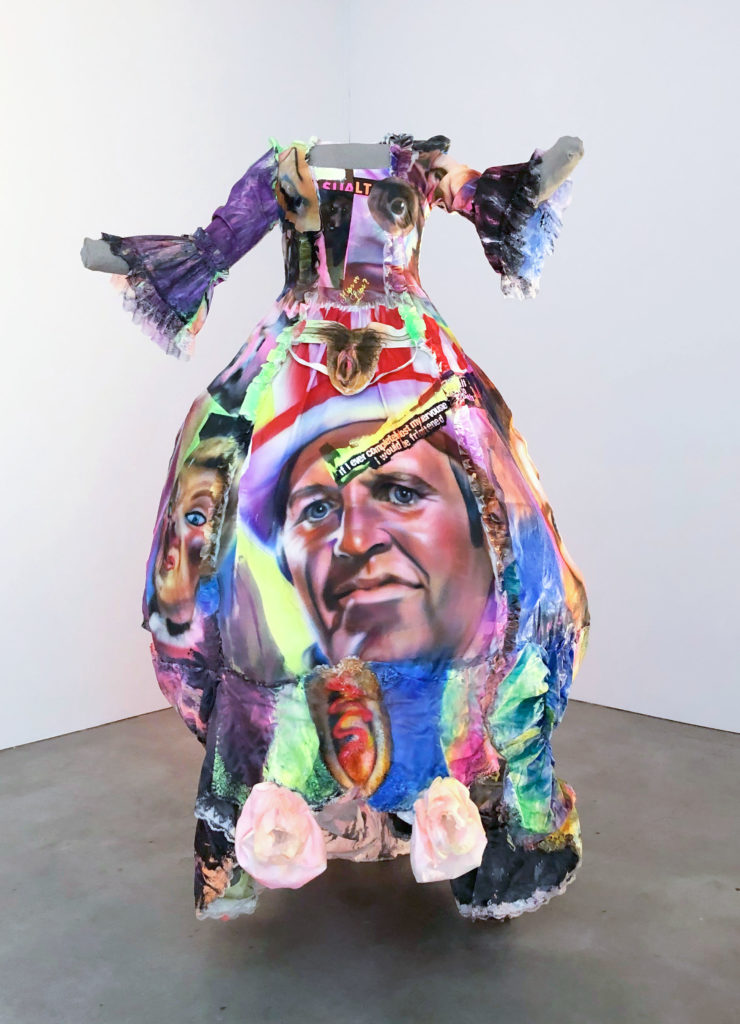
Jim Krewson’s “tribute to a vanishing subculture”, A Requiem for Paul Lynde, currently in the Viewing Room in the back of Marlborough Gallery’s downtown location, “questions the loss and amnesia of marginal identity in a new age of equality, instant access, Instagram influencers and celebrity, from homosexuality to homogenization in 20 short years.”

The airbrushed wedding dress spins with images that include Lynde himself, as well as Lady Elaine Fairchild from Mister Rogers’ Neighborhood, and the Madame puppet, a Wayland Flowers creation. Flowers’ puppet had her own sitcom in 1982 and also took over Paul Lynde’s center square on Hollywood Squares. Sadly Flowers, an openly gay entertainer, passed away in 1988 at the age of 48 from AIDS related Kaposi’s sarcoma.

If you love of a certain time period of pop culture and Paul Lynde than it will be hard not to embrace this project. But it’s also interesting as a meditation on the state of gay pop culture in the past, the place it is in today, and the question of where it may go in the future now that it is has such a strong, but less subversive place, within mainstream media.

In the main viewing space of Marlborough Gallery is Joe Zucker’s multi-panel 100-Foot-Long-Piece created from 1968 to 1969.

From the press release

This masterwork, exhibited here with a large body of related archival material, comprises a blueprint for Zucker’s long and diverse practice. It plants a flag for the artist’s ongoing inventiveness, irony, and eclecticism.

With the creation of this work, Zucker presents the viewer with a puzzle-like, encyclopedic visual vocabulary, anticipating subsequent pictorial and conceptual approaches such as New Image, Neo-Expressionism, Appropriation, Neo Geo, as well as more recent process- based abstraction, with a self-referential, wry regard for the embedded, associative meaning of his imagery and materials.

100-Foot-Long Piece is a linear aggregate in which gestural abstraction rubs elbows with hard edged grids, silk-screened passages, sculptural reliefs, and a host of other styles and forms. One is mindful of both physical and critical tropes of progressive art history from the physicality of the frieze to a qualitative timeline tracing the contributions of Modernism.

Both shows close 10/5/19.

Sep 202019
 

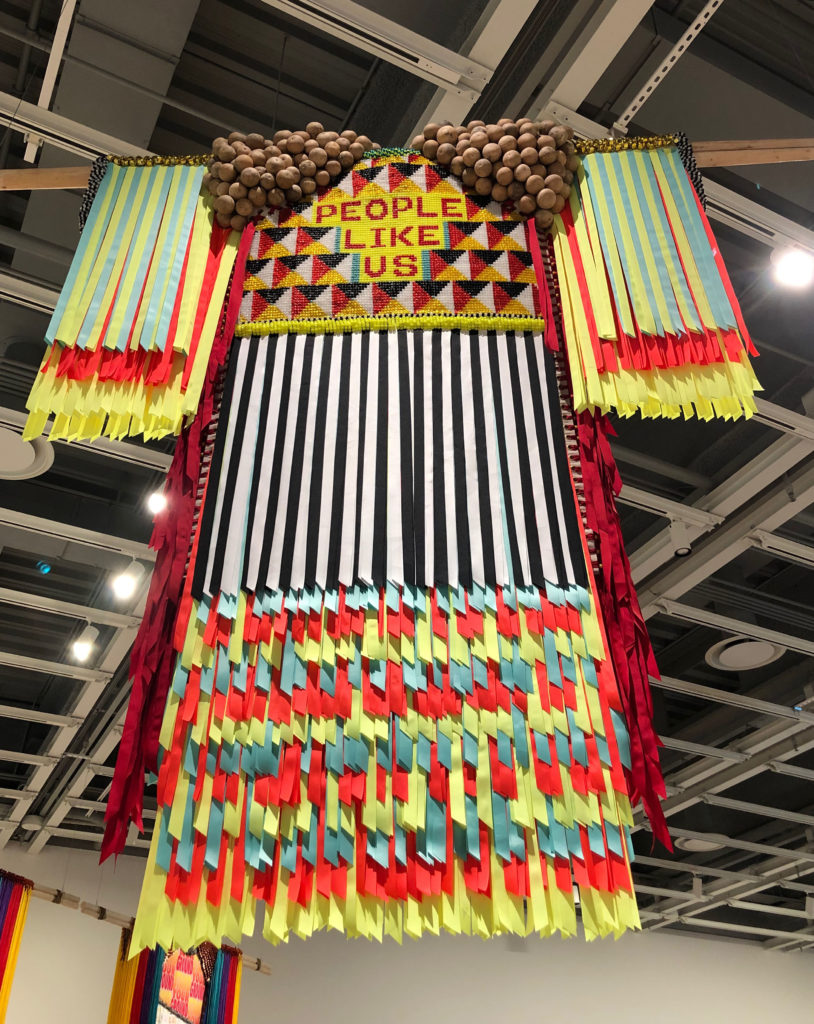
Jeffrey Gibson, “PEOPLE LIKE US”, 2019

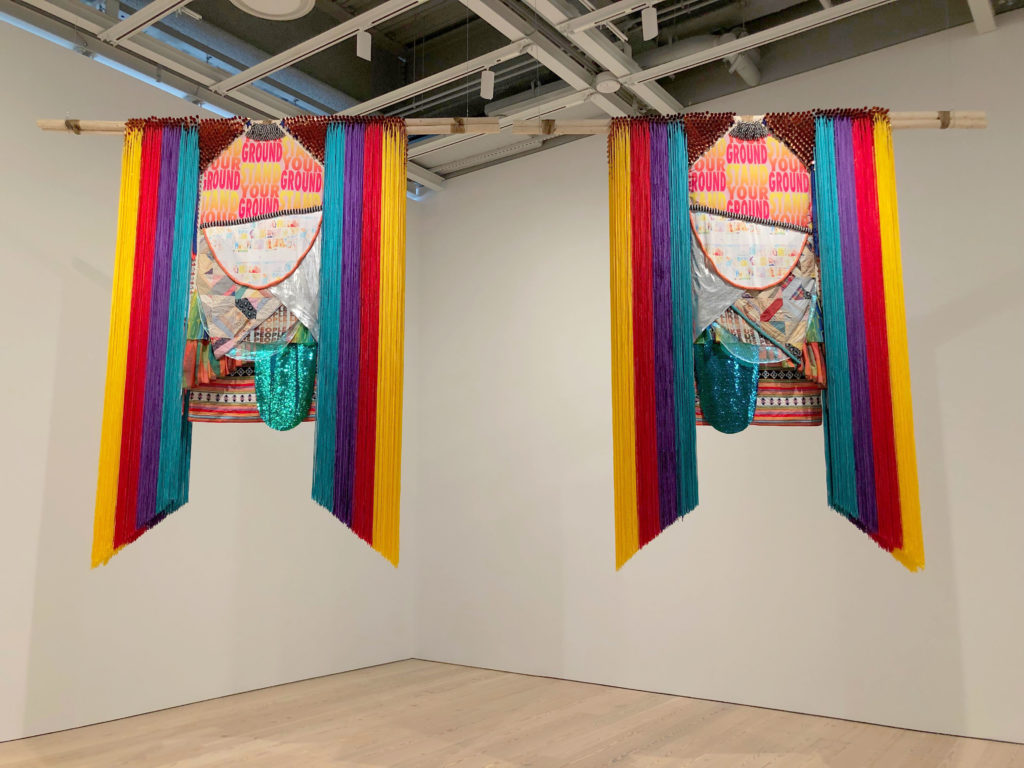
Jeffrey Gibson

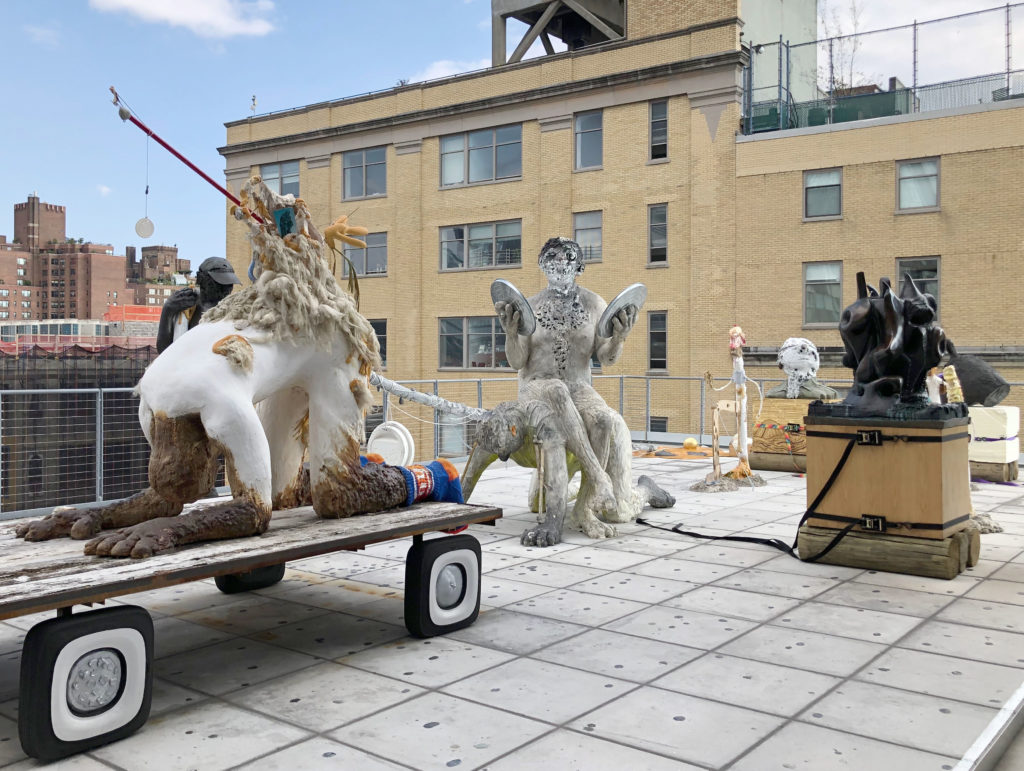
2019’s Whitney Biennial presents an interesting selection of work, by a mostly young and diverse group of artists. The works included in the show are consistently good, and often intriguing, but this time around nothing is particularly outrageous or polarizing- a contrast to many of the previous iterations.

Not that there wasn’t any drama surrounding the show. This time around, however, the controversy was not with an artwork but with former Whitney executive board member Warren B. Kanders and his ownership of Safariland, a tear-gas canister maker. He has since resigned after protests and threats of withdrawal from several of the artists included in the show. Artist collective Forensic Architecture’s film, Triple Chaser, on view in the exhibition, investigates Safariland and Kanders.

Below are a few highlights from the exhibition.

Janiva Ellis ” Uh Oh, Look Who Got Wet”, 2019

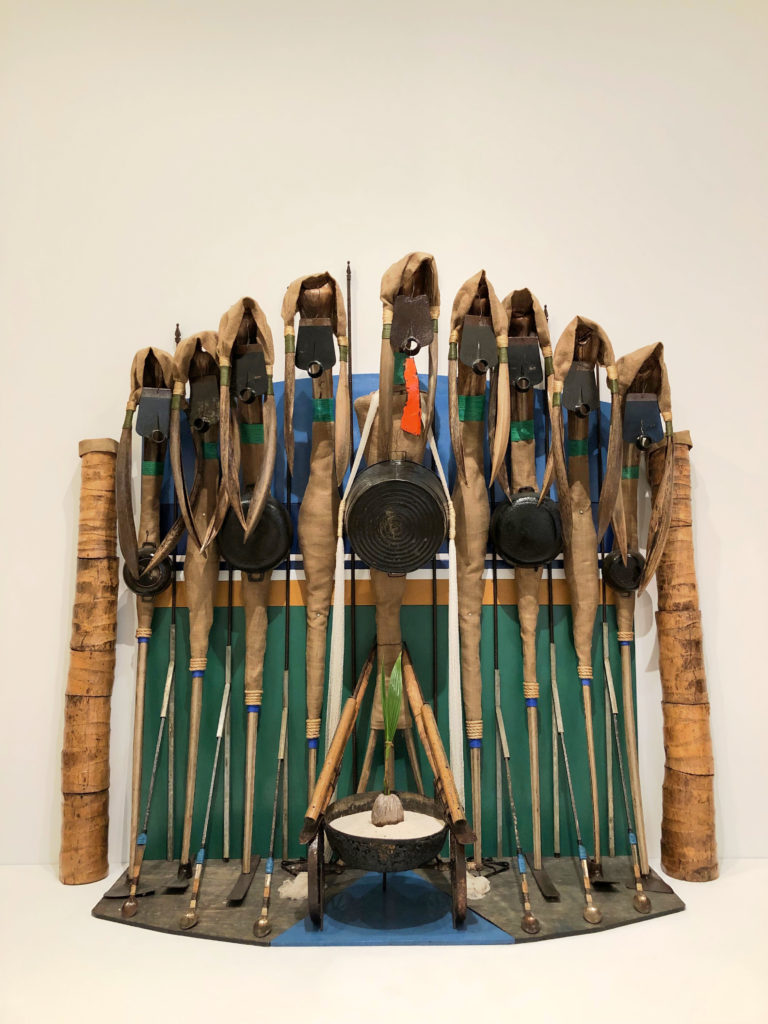
Daniel Lind-Ramos, “Centinelas (Sentinels)”, 2013

Section of Nicole Eisenman’s, “Procession”, 2019

This exhibition closes 9/22/19.


Aug 092019


When trying to talk about the David Hammon’s exhibition at Hauser and Wirth Los Angeles, his first in Los Angeles in 45 years, it’s hard to know where to start. There are no titles or descriptions of any of the works in the show, although there is writing on the walls in certain places. The press release, shown below, is a mass of lines and a dedication to jazz musician Ornette Coleman.

Before you enter either of the two massive galleries housing the exhibition you encounter a courtyard filled with tents, some with “this could be u and u” stenciled on them. Tents also line the corridor under Martin Creed’s neon piece, EVERYTHING IS GOING TO BE ALRIGHT, with a rack of fancy vintage coats nearby. Once predominantly in Skid Row, Los Angeles’ tent cities have been growing rapidly on street corners and under bridges and highways all over the city, but they often just blend into the background for people walking and driving past. What does a fake tent city in the courtyard of a high end gallery in a newly gentrified neighborhood mean? Is its fake version more affecting than the real one to gallery and restaurant patrons wandering by?

The work in the show feels at times random, clever, humorous, and confounding, but also impressive, thought provoking, and most importantly never dull. There are stacks of art history books sitting on scales. A water filled bowl that contains what once was a snowball Hammons had sold on the street at one point in his career, sits on a wooden shelf. A room with empty glass cubes on wood columns requires you to bend down to see the feet underneath. A book titled A History of Harlem is filled with empty black pages.

In the room pictured below is a three legged chair next to a wall of photos of women sitting in it. Nearby, one of Ornette Coleman’s suits is surrounded by glass.

Another room is filled with paint splattered and damaged fur coats, one facing an antique mirror that is covered. The symbolism feels a bit heavy handed, like the tents, but it works in that there are still several ways to interpret what Hammons might be saying.

Throughout the exhibition paintings are covered in various ways. One in paper, ripped with a bit of the painting visible. Others are partially hidden with tarps, plastic, different fabrics, even an antique rug (shown below). Once again, you can interpret the meaning of this in several ways. With the rug, for example, it’s turned so that only a bit of its design is visible in front of a painting that is not completely visible. These rugs are often associated with old money and sometimes are hung on walls themselves as artwork. Or is it just another assemblage, a visual combination to be taken at face value.

Ultimately the interpretation of all of the work is up to the viewer. There is something freeing in that, not being given answers. Sure, it’s nice to have an explanation of an artist’s intentions sometimes, but you often add your own ideas anyway. Art should make you think, question things, look at the world from a new perspective- this exhibition does all of that and more.

David Hammons at Hauser & Wirth Los Angeles closed 8/11/19.


Aug 082019
 

In addition to the murals created for POW! WOW! Antelope Valley 2018, artist Dan Witz also created a few small pieces like the one shown above. For more of his work, check out his website and Instagram.

Aug 082019
 

In addition to the murals created for POW! WOW! Antelope Valley 2018, there were also several smaller works including several of Spenser Little’s wire sculptures. For more of his work, check out his Instagram.

Jul 192019
 

Woven Stories, at the Museum of Art and History (MOAH) in Lancaster, is a collection of narrative fiber artworks as well as five solo exhibitions and five site specific installations. There are so many great pieces in the show it was hard to narrow down which artists to include, but below are a few that stood out.

Victor Wilde, Momma Bears, 2019

Vojislav Radovanovic, TWO SIDES OF A LUCID DREAM, 2018

Vojislav Radovanovic, TWO SIDES OF A LUCID DREAM, 2018

Orly Cogan, Confections

Orly Cogan, Sugar ‘n Spice ‘n Everything Nice

Upstairs, the solo exhibitions are equally impressive. Several of these artists utilize nontraditional materials to create their unique work.

Nicola Vruwink uses the film from cassette tapes instead of traditional yarn to create her pieces.

For her large sculptures, Elisabeth Higgins O’Connor, uses materials from second hand shops. The pieces of broken furniture and scraps of fabric form animal figures caught in awkward poses.

Elisabeth Higgins O’Connor, Blamethirst

Peter Hiers’ sculptures are made from found scraps of tires. Using this discarded material, he gives new life to what would ordinarily be littering the sides of highways.

Peter Hiers, Circular Logic, 2010

This exhibition closes 7/21/19.

While in Lancaster, make sure to also check out MOAH Cedar nearby, which is showing Collateral Damage, an immersive installation by Snezana Saraswati Petrovic.


Jun 072019
 

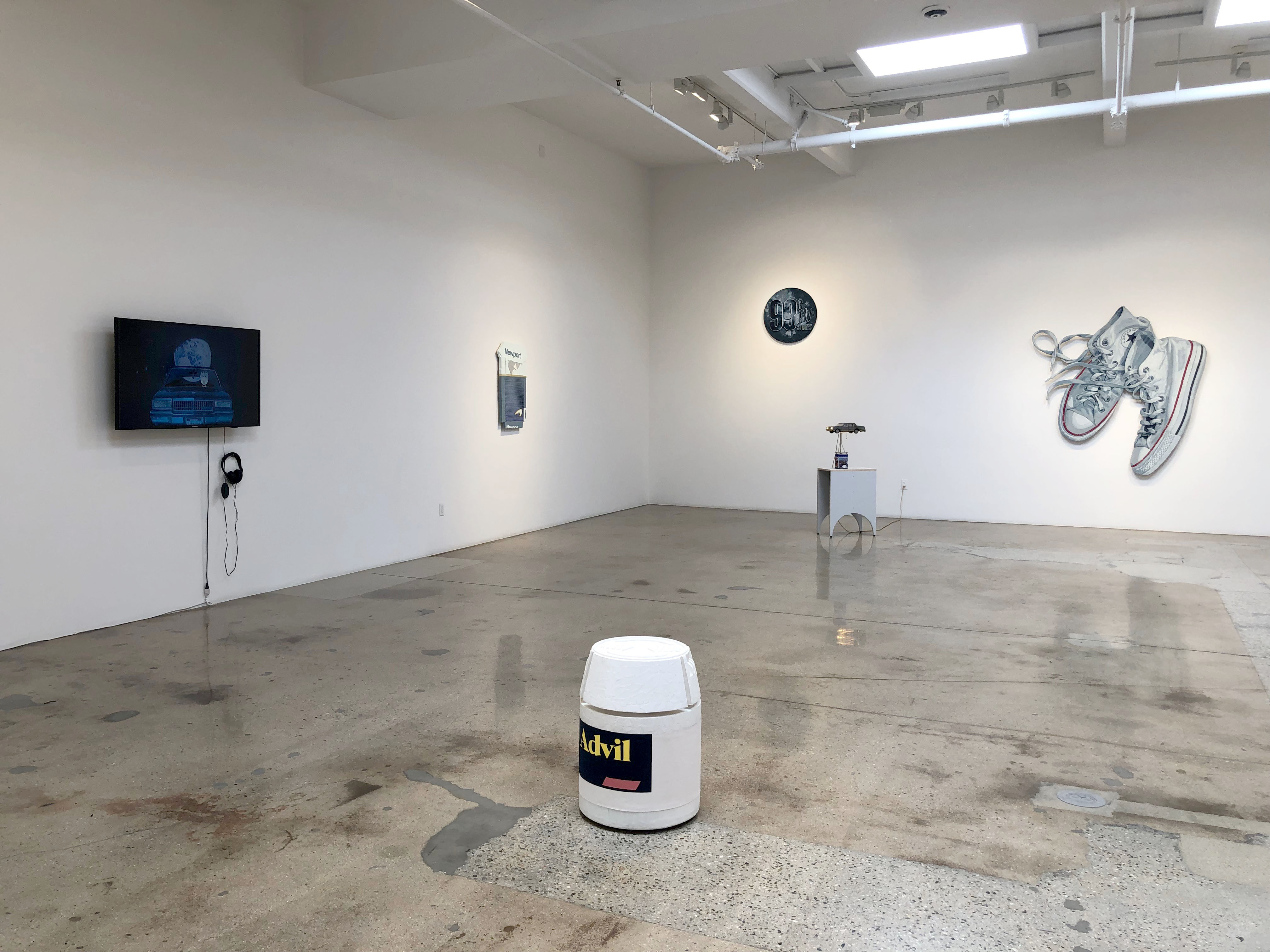
This is the last weekend to see Nick Doyle’s show The Great Escape at Steve Turner in Hollywood.

From the press release

Steve Turner is pleased to present The Great Escape, a solo exhibition by New York-based Nick Doyle, that features sculptural works depicting everyday objects including an oversized bottle of Advil; losing lottery tickets; a pressed dress shirt; a pair of Converse shoes; a miniature Chevron sign; a crushed Newport cigarette box; and two air fresheners. Inspired by the idea of the American road trip, Doyle meticulously assembled these works from a multitude of materials–steel, plywood, brass, paper, sandpaper, canvas, chain, tin foil, light bulbs, electrical wire, concrete, and most importantly, denim. Worn by miners, cowboys, hippies, bikers, punks and bad boys, denim represents westward expansion, rugged individualism and a kind of masculinity that Doyle questions with these works. Doyle also created three small kinetic “Executive Toys” in which he examines the underlying pressure and violence of corporate culture. Finally, there is a three-minute music video that combines puppetry and found footage. The main character is a spork dressed in a suit and tie who is on the road singing a song of lament. It ends with some Saguaro cacti singing Amazing Grace against a desert backdrop.

There is also the group show Power of Ten, in the smaller galleries, which has some great pieces by Maccabee Shelley, Hannah Epstein, Paige Jiyoung Moon and others.

Jun 062019
 

Taking up an entire level of the BCAM Building at LACMA, Robert Rauschenberg: The 1/4 Mile or 2 Furlong Piece, is a wonderful testament to the artist’s work and creativity. It is also the first time it has ever been shown in its entirety.

There is so much variety in the materials, subjects, colors, and styles, that as you wander from section to section, it’s easy to notice new things the longer you look. Despite the differences among the different sections, they are bound together by a creative exuberance. LACMA recommends an hour to wander the 1/4 mile of work, but you may want to spend longer.

This exhibition will close on 6/9/19.

May 302019
 

George Condo’s current exhibition at Sprüth Magers, What’s The Point?, is asking the question many of us are asking more and more these days. There’s a controlled chaos to many of these compelling large paintings, much like the world we often find ourselves in.

From the press release

What’s the Point of consistency in art?

Every time I put a brushstroke down on a canvas I ask myself, “What’s the Point?”

What’s the Point of each and every mark going onto the painting? It is important for an artist to ask themselves that question. I am intentional with every move I make as a painter. Even if it appears to be random or an accident, or just a part of a painting that seems less important than another, it is not and cannot ever be. The choice of color has a point. It may be to balance an area of a painting in coordination with another part or to equalize the fine line between perception and reality within the abstract perception of a formal set of guidelines (that never apply to anything other than the singular experience invested in each artwork). There is no guideline to the unknown. It is a path cut out in the wild with a machete looking for a clearing and hoping to arrive at a destination. That, I believe, is the point, in fact: to arrive at your destination. It may be on the other end of an illogical equation which finally makes sense only some number of years later, or finally does not make sense in the end but remains the ultimate ending: the finished painting.

One can see the entire world through this lens, to ask What’s the Point of meaningless intangibles and vacant thoughts, blank space or overpopulated ruminations. The degree to which the mind can play games with itself or the degree to which it can be misled with false, if not real, information. Real information can in fact be false today. We are living in a time when what is presented to us in the news cycle is real—there is no doubt that it is in fact what is being presented. However, What’s the Point in believing in the material content when it could be a truth constructed to make you believe something for the purpose of political manipulation?

What’s the Point of being consistent? In the words of Ralph Waldo Emerson, “consistency is the hobgoblin of little minds.”
—George Condo

Monika Sprüth and Philomene Magers are pleased to present What’s the Point?, an exhibition of new paintings by George Condo at Sprüth Magers, Los Angeles. One of the most significant artists of the last several decades, Condo creates works that dramatically bridge an array of painterly approaches, moods, and influences from diverse fields such as art history, music, philosophy, and popular culture. The artist’s compositions often begin with the human figure, rendered variously in fluid networks of black lines and interlacing planes of bold color that move seamlessly between controlled precision and unabashed exuberance. His canvases tap into the extremes of human emotion and, at a moment of crisis in American and global politics, a sense of mania and disorder that nonetheless holds out hope for progress and resolution. The paintings in What’s the Point? demonstrate the breadth of Condo’s artistic references, for example, from seventeenth-century portraiture of beggars and thieves found in the work of Dutch and Italian masters, to his own compendium of painterly gestures, which together form a trenchant picture of contemporary human consciousness.

Upstairs the gallery is showing the work of Thea Djordjadze which “combines a variety of artistic, industrial, and unconventional materials to produce works full of contrasts and complexity, which she puts into conversation with the architecture and atmosphere of her exhibition spaces through intimate, considered arrangements.”

Both of these exhibitions close 6/1/19.