Jan 242020
 

Sadie Barnette’s recreation of her father Rodney Barnette’s bar, Eagle Creek Saloon for The New Eagle Creek Saloon at ICA LA is not only beautiful, but it also celebrates an important piece of history.

From the museum’s website-

For her first solo museum presentation in Los Angeles, Oakland-based artist Sadie Barnette (b. 1984) will reimagine the Eagle Creek Saloon, the first black-owned gay bar in San Francisco, established by the artist’s father Rodney Barnette, founder of the Compton, CA chapter of the Black Panther Party. From 1990–93 Barnette’s father operated the bar and offered a safe space for the multiracial LGBTQ community who were marginalized at other social spaces throughout the city at that time.

Barnette engages the aesthetics of Minimalism and Conceptualism through an idiosyncratic use of text, decoration, photographs, and found objects that approach the speculative and otherworldly. Barnette’s recent drawings, sculptures, and installations have incorporated the 500-page FBI surveillance file kept on her father and references to West Coast funk and hip-hop culture to consider the historical and present-day dynamics of race, gender, and politics in the United States. Using materials such as spray paint, crystals, and glitter, she transforms the bureaucratic remnants from a dark chapter in American history into vibrant celebrations of personal, familial, and cultural histories and visual acts of resistance. The New Eagle Creek Saloon is a glittering bar installation that exists somewhere between a monument and an altar, at once archiving the past and providing space for potential actions.

The museum is also showing No Wrong Holes: Thirty Years of Nayland Blake (pictured below).

From the museum’s website-

For over 30 years, artist, educator, and curator Nayland Blake (b. 1960) has been a critical figure in American art, working between sculpture, drawing, performance, and video. No Wrong Holes marks the most comprehensive survey of Blake’s work to date and their first solo institutional presentation in Los Angeles.

Heavily inspired by feminist and queer liberation movements, and subcultures ranging from punk to kink, Blake’s multidisciplinary practice considers the complexities of representation, particularly racial and gender identity; play and eroticism; and the subjective experience of desire, loss, and power. The artist’s sustained meditation on “passing” and duality as a queer, biracial (African American and white) person is grounded in post-minimalist and conceptual approaches made personal through an idiosyncratic array of materials (such as leather, medical equipment, and food) and the tropes of fairy tales and fantasy. Particular focus will be paid to work produced while Blake lived on the West Coast, first in the greater Los Angeles area as a graduate student at CalArts, followed by a decade in San Francisco—years bookended by the advancement of the HIV/AIDS epidemic in the 1980s and the “culture wars” of the 1990s.

Feeder 2, 1998

The gingerbread house, pictured above, is one of Blake’s best known works and was created using actual gingerbread. It references the fairy tale Hansel and Gretel as it recreates the house used to lure the children to their potential doom.

From the wall description-

Fairy tale and fantasy are themes to which the artist often returns as a mirror onto society and culture. Further, duality and the act of revealing are critical to Blake’s practice: as a biracial, white-passing, queer, gender non-binary person, Blake’s identity is one that is not obvious and is predicated on existing in two spaces at once. Though initially captivating through its inviting sight and scent, over time, the once-pleasant sensorial experience of Feeder 2, with its cold, empty interior, becomes overwhelming, even nauseating, as it challenges the truth of perception and association.

Both of these exhibitions close 1/26/20.

Jan 162020
 

Drink More, 1964 by Ushio Shinohara (left piece) and Untitled, 1980s by Nobuaki Kojima (sculpture on right)

Souvenir, 1964, by Jasper Johns

Shadow of a Hanger, 1971 by Jiro Takamatsu

Japan is America at Fergus McCaffrey gallery in Chelsea “explores the complex artistic networks that informed avant-garde art in Japan and America between 1952 and 1985. Starting with the well-documented emergence of “American-Style Painting” that ran parallel to the Americanization of Japan in the 1950s, Japan Is America endeavors to illustrate the path and conditions from Japanese surrender in 1945 to that country’s putative cultural take-over of the United States some forty years later”.

Artists in the show include: Yuji Agematsu, Ruth Asawa, James Lee Byars, John Cage, Joe Goode, Sam Francis, Marcia Hafif, Noriyuki Haraguchi, Tatsuo Ikeda, Shigeo Ishii, Ishiuchi Miyako, Jasper Johns, Alison Knowles, Nobuaki Kojima, Tomio Miki, Sadamasa Motonaga, Hiroshi Nakamura, Natsuyuki Nakanishi, Senga Nengudi, Yoko Ono, Ken Price, Robert Rauschenberg, Ed Ruscha, Richard Serra, Ushio Shinohara, Fujiko Shiraga, Kazuo Shiraga, Jiro Takamatsu, Anne Truitt, and Toshio Yoshida.

This exhibition closes 1/18/20.

Jan 102020
 

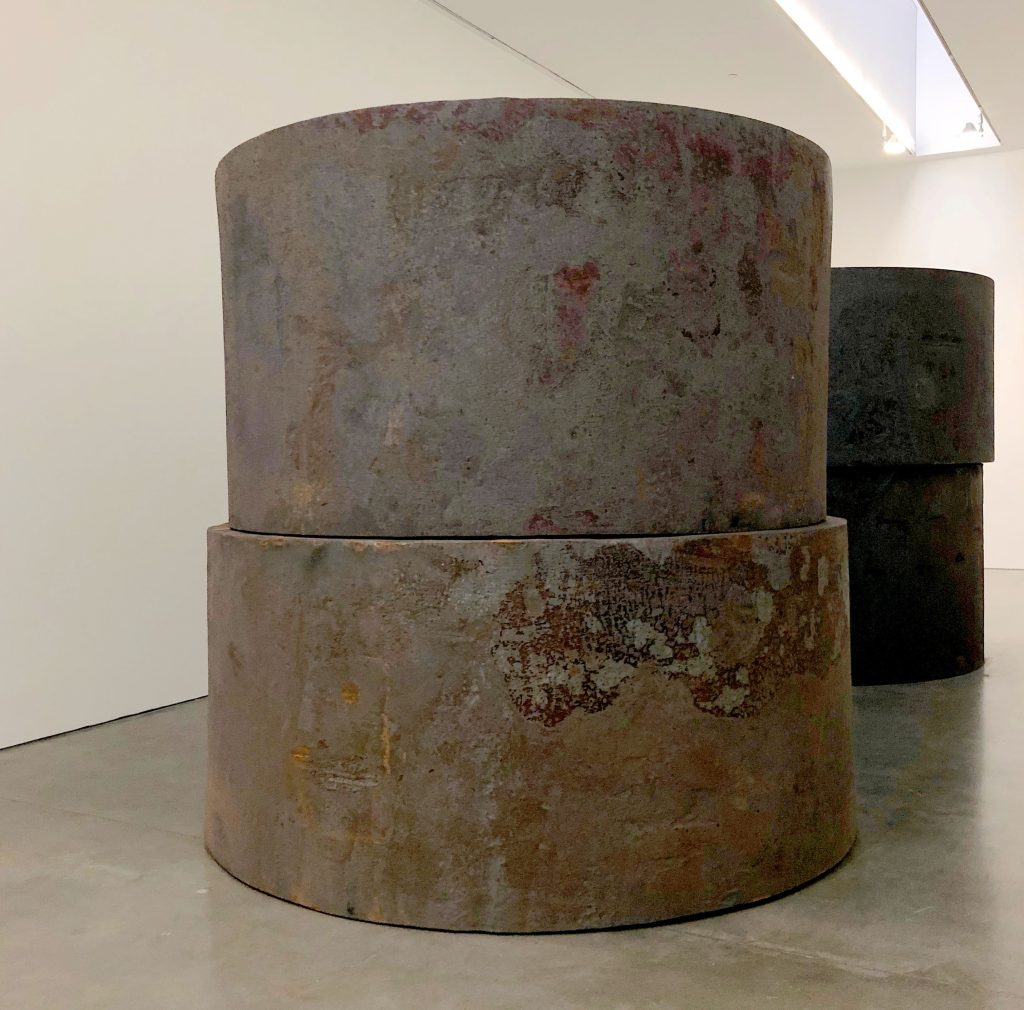
Gagosian is currently showing artist Richard Serra’s work at two of their locations. Above are works from Serra’s Rounds series and fill the entire West 24th Street location (closing 1/11/20), and in the 21st Street space is his Reverse Curve sculpture (closing 2/1/20).

Jan 092020
 

Blum & Poe in Los Angeles is currently showing two very different exhibitions. In the main gallery is a selected survey of work by Harvey Quaytman spanning three decades.

From the press release-

Harvey Quaytman (b. 1937, Rockaway, NY; d. 2002, New York, NY) came of age in the downtown art scene of 1960s New York, living and working in SoHo studios first on Grand Street and later at 231 Bowery, where he would remain through the late ’90s. Long considered an artist’s artist, the painter enjoyed a close-knit and vibrant artistic and social milieu, over the years sharing studio addresses with Brice Marden, Ron Gorchov, and James Rosenquist, among others. Quaytman’s emerging career as a young painter began in the heyday of Ab Ex with a marked allegiance to Gorky and de Kooning. This approach was slowly shed as the decade unfolded, as his work began to lean towards sculpture—compositions with curvilinear shaped canvases and rectilinear U-shaped bases that inhabited a newfound objecthood. This was followed by a forty-year engagement with geometric abstraction, his approach to painting in contradistinction to the prevailing trends of the era—first with Pop Art and later Neo Expressionism. Despite painting being declared “dead” by Minimalist and Conceptual artists of the time, Quaytman maintained a commitment to the medium and to his vision throughout, helping to shape an alternate trajectory for American painting.

The artist’s work in the ‘70s developed into shield-like forms that balance on curved platforms, conjuring a motion that would result in a critic calling them “rocking rectangles”—the body of work later known simply as “rocker” paintings. These eccentrically shaped works were hand-crafted (he would steam and bend the wooden stretchers himself), and inherently related to movement—inspired by Islamic calligraphy, rocking chairs, and the flight patterns of airplanes and birds. His experiments with shape continued in the late ‘70s, and through the manipulation of geometric intersections and overlapping forms that all the while imply motion, a unique group of paintings resembling anchors or pendulums emerged. In the 1980s, Quaytman began his cruciform paintings, investigations of the cross shape not as emblem but as two meeting vectors; Constructivist, perpendicular geometric compositions that focused on the reduced palette of black, white, red, rusted iron, and metallic gold. While these paintings represented a stark departure from his previous work, Quaytman continued to pursue visual movement as he conjured an interplay of symmetry and asymmetry.

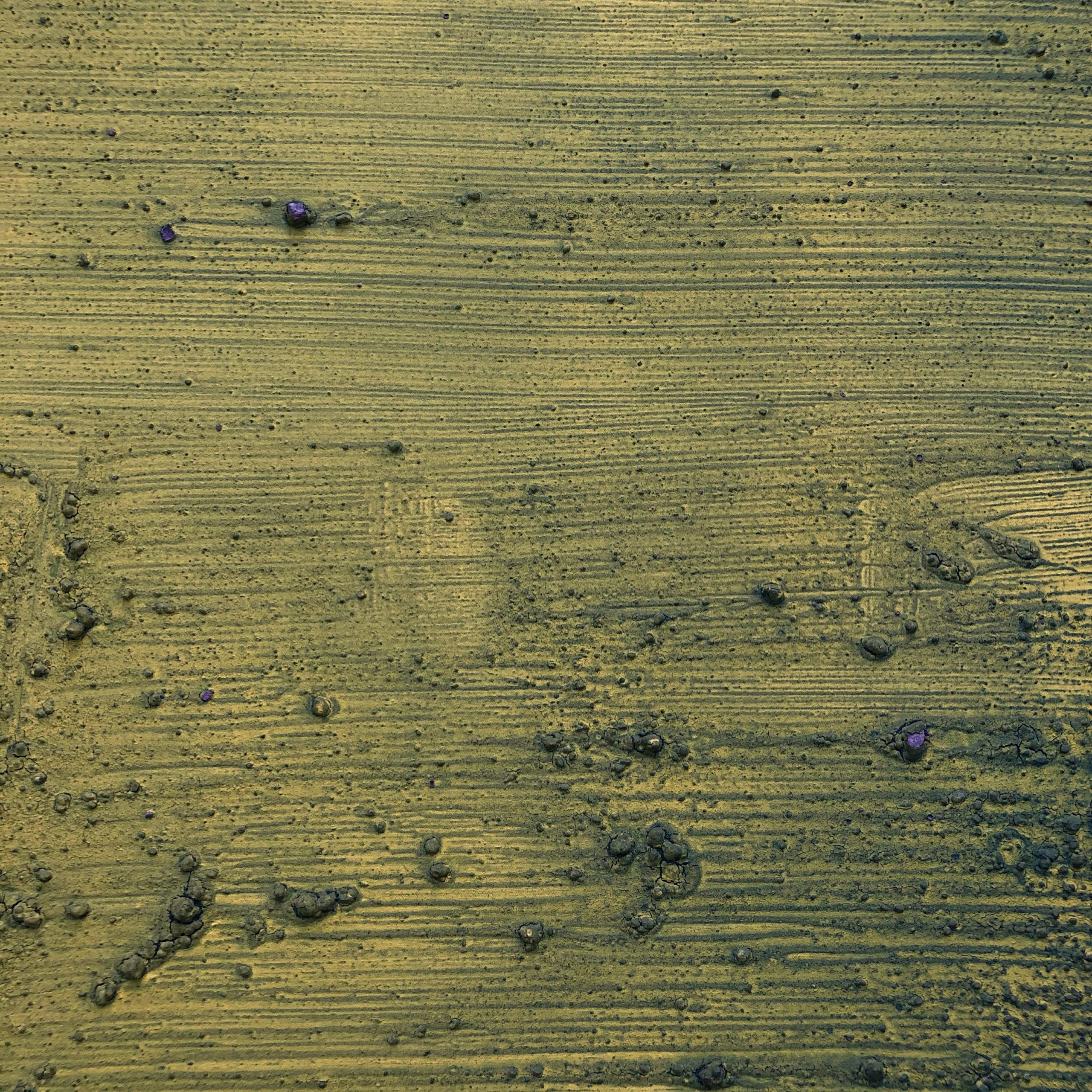
Many of the works become even more intriguing up close.  His use of different materials to achieve varying tones and textures makes them come alive.

The press release discusses a bit about his process in creating them-

As his paintings evolved in form and shape, variously touching upon Abstract Expressionism, Minimalism, Process Art, and Constructivism, Quaytman simultaneously developed a rigorous practice of experimentation with pigment. He was interested in the history, alchemy, and chromatic effects of color, seeking out unique tonalities at specialty stores at home and abroad, becoming a master of color and texture. He skillfully poured paint, spreading Rhoplex over canvas with broad wallpaper brushes after dusting it with pure pigment that settled in thick, unpredictable strata. He later flecked canvas with glass or iron filings and used additives such as marble dust in paint he always mixed himself. On this subject, he said: “It is very important to me to be reminded that I am not an alchemist but a man engaged in coded, layered conversation with my fellow man on what I hope to be (on another) level than words or music.”

On the second floor are Matt Johnson’s delightful sculptures whose familiar materials seem to defy gravity as they balance on each other in the compositions.

From the press release–

In an ever-expanding practice in search of the peculiar and the sublime, Johnson elevates the mundane to the exceptional. With a new body of work in carved and polychromed wood sculpture, Johnson depicts configurations of raw industrial materials from cinder block, brick, rebar, to traffic cones—permutations of information composed according to gravity, balance, and primitive instinct. A crude horse, a procession of block figures, cantilevered props, and fragile towers make reference to the concept of knowledge with small gestures—a lighter, a match book, a lightbulb, an atlas, and a monograph on Matisse. The doweled joints of glue and/or epoxy between bricks, blocks, and bars exist here not to defy gravity but to freeze balance and preserve delicate moments of experimental groupings. Like a still life, these works are organized information, like subatomic particles, atoms and elements, molecules and compounds, glued by gravity, and magnetic polarity, surfing in a sea of electrical conductivity.

Both of these exhibitions close 1/11/20.


Jan 032020
 

Closing 1/5/20  at Hauser & Wirth’s Los Angeles location is Charles Gaines’ exhibition Palm Trees and Other Works. This exhibition will debut new works from his signature Gridworks series.

Using photographs of native trees from Palm Canyon near Palm Springs, Gaines selectively layers paint on acrylic sheets atop black and white photographs of corresponding landscapes with trees. Following this process, each tree is assigned a distinctive color and a numbered grid that reflects the positive space of the tree in the original photographic image.

The exhibition also includes new watercolor work and Manifesto 3– which takes Martin Luther King, Jr.’s speech given at the University of Newcastle upon Tyne (1967) and James Baldwin’s essay Princes and Powers (1957) and using a rule-based system to convert letters from the text into their equivalent musical notes creating a musical score.

From Hauser & Wirth’s website-

Reflecting on his personal history, Gaines observed that ‘one thing that made me different from other conceptual artists is that I was not shying away from language or meaning or content’ – a truth perhaps best exemplified by ‘Manifestos 3’ (2018). This work functions as a systematic transliteration of revolutionary manifestos into musical notation. The installation is comprised of two parts: a single channel video monitor that scrolls the manifesto texts, and two large graphite drawings of the music scores that were produced by the translation. Each text scrolls in succession on a monitor while a recording of the music produced by Gaines’s system plays. Created by way of a rule-based system, Gaines transcribes letters ‘A – H’ from the text into their equivalent musical notes. The use of the letter ‘H’ represents the code used in early Baroque tradition for B-flat. All other letters and spaces between words are noted as rests or silent beats. While the resulting composition does sound intentional, it is controlled only by the preconceived notation system that follows the compositional structure of language. This produces the fluidity that the audience hears.

The two political texts transcribed in ‘Manifestos 3’ are Martin Luther King, Jr.’s speech given at the University of Newcastle upon Tyne (1967), wherein King nominates racism, poverty, and war as the three most urgent problems of the contemporary world, and James Baldwin’s essay ‘Princes and Powers’ (1957) which describes the dominating power of cultural control. These two manifestos are systematically translated into the above described musical notations as written and arranged for piano by Gaines and edited by John Eagle.

This series not only takes social justice and politics on as its subject, but also as it may critique our understanding of the relationship of the practice of art and politics. By converting these powerful and poignant texts into music, Gaines unites the rational, mathematical, and lyrical structures of music with the irrationality of violence, racial tensions, and social injustice. The predetermined process developed by Gaines widens the distance between concepts and their interpretation, effectively removing the artist’s subjectivity while empowering the viewer’s. The combination of the elegiac music with the stirring words of the scrolling manifestos creates an unexpected conflict for the viewer; it is within this dissonance that the indelible truths of Gaines’s work are revealed.


Jan 032020
 

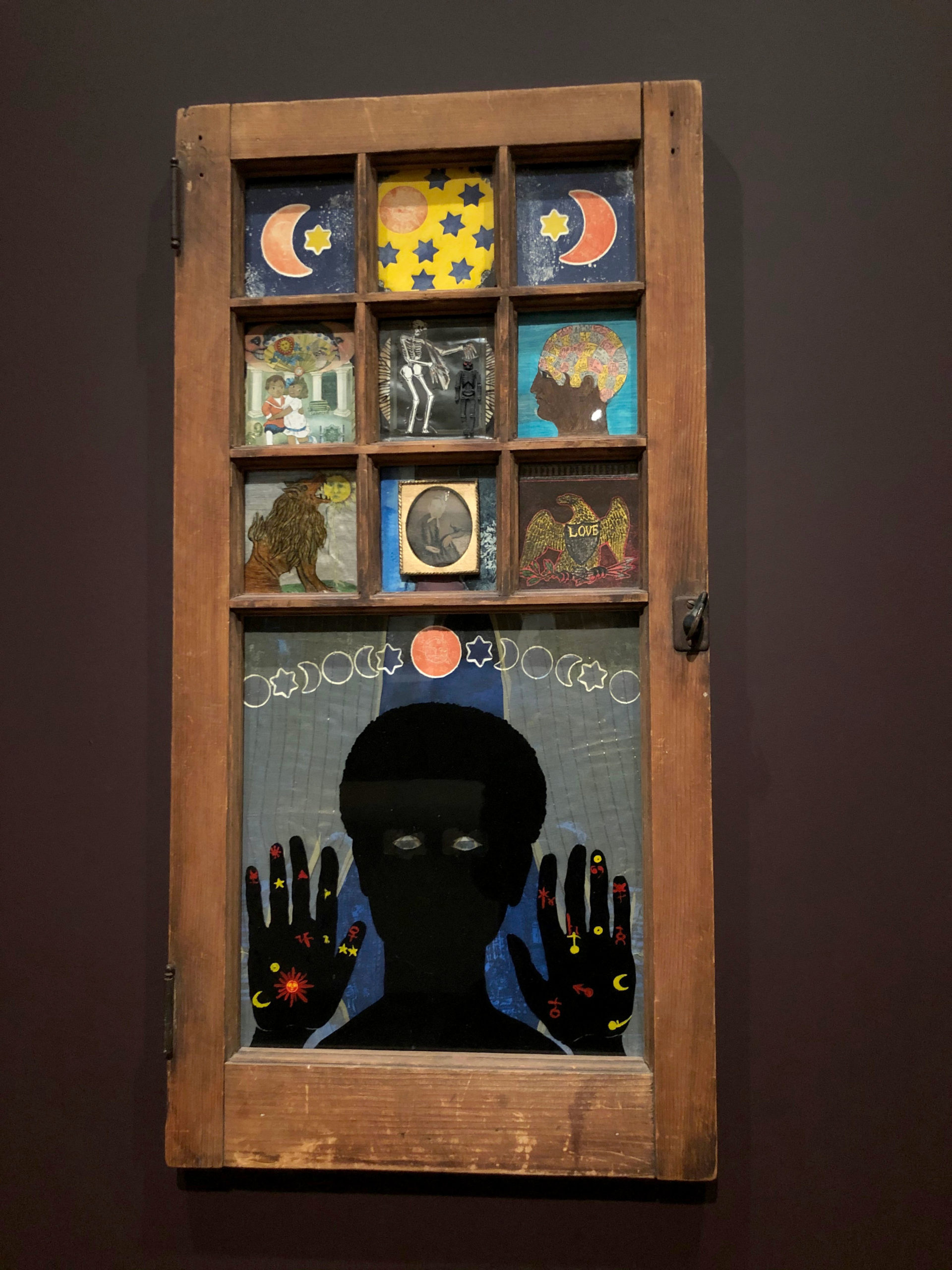
Black Girls Window, 1969

Mystic Window for Leo, 1966

As part of MoMA’s Opening Season, they are showing Betye Saar’s 1969 work, Black Girl’s Window, along with several of her works on paper.

The exhibition “explores the relation between her experimental print practice and the new artistic language debuted in that famous work, tracing themes of family, history, and mysticism, which have been at the core of Saar’s work from its earliest days.”

This exhibition closes 1/4/20.

Dec 202019
 

Artist Jennifer Bartlett has been exploring the image of the archetypal house since the 1970s. For her current exhibition at Marianne Boesky Gallery, The House was Quiet and the World was Calm: Jennifer Bartlett 1970–2014, a variety of these works are on display. It’s interesting to think of the traditional basic shape of the house, one often used to draw a house as a child, here expanded upon and explored in various ways and mediums. The viewer is also challenged to think about what they imagine when they think of the concept of house, of home.

From the press release–

… For Bartlett, the appeal of the house lies, in part, in its incredible universality. The simple square crowned with a triangle conjures an expansive array of emotions, memories, and associations across the spectrum of individuals. And in the U.S., it holds a particular place in the national psyche—a symbol of the deeply entrenched notion of the American dream. Subjected to Bartlett’s ongoing and systematic explorations of painting and printing techniques, however, the house in instances is flattened, reformulated, and distorted to a range of formal and emotional effects.

This exhibition closes 12/21/19.

Dec 192019
 

Anish Kapoor’s exhibition at Lisson Gallery’s 24th Street location is a reflective wonderland where the sculptures twist your perception of your surroundings as you move around them. If his work looks familiar, he has created many public outdoor works including Cloud Gate, also known as “The Bean”, which is permanently installed in Millennium Park in Chicago.

The exhibition continues at Lisson Gallery’s smaller 10th Avenue space with several of Kapoor’s colorful wall-based circular sculptures in semi-reflective hues.

Both of these exhibitions close 12/20/19.


Dec 132019


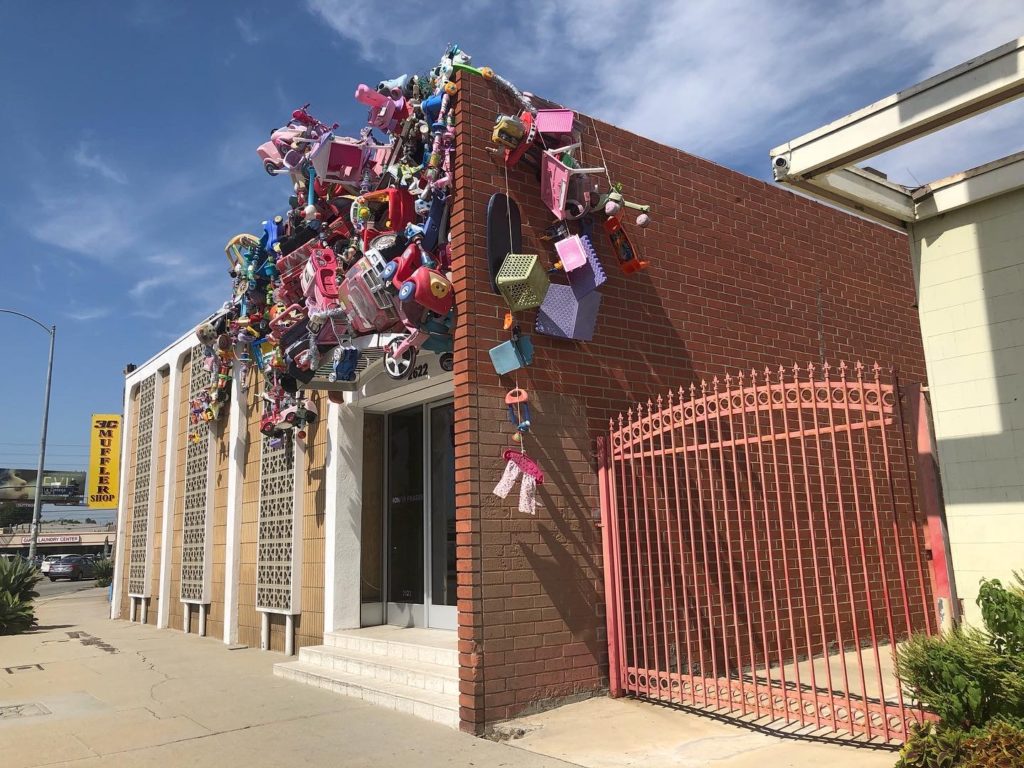
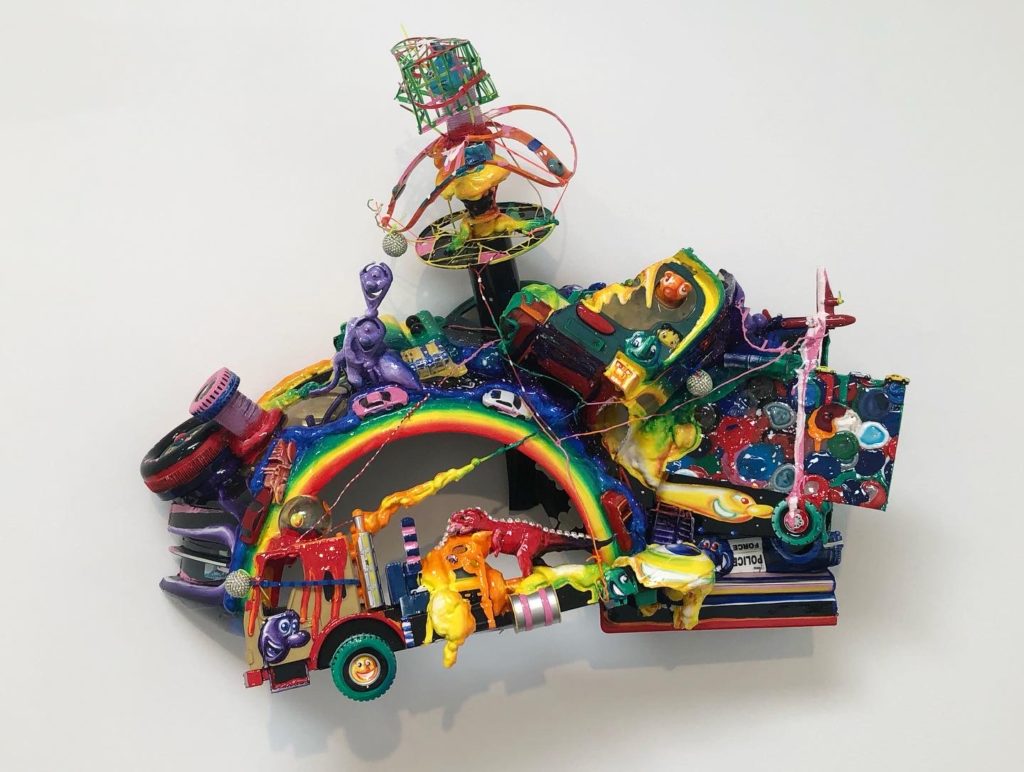
Closing on 12/14/19 is Kenny Scharf’s current exhibition at Honor Fraser, Optimistically Melting!. The exhibition includes multiple installations, paintings, and sculptures- including new ceramic work.

From the press release-

After four decades of constant production, Scharf’s latest group of paintings introduces a new subject: the still life. The trope of flowers in a vase appears throughout Western art, notably in the work of artists such as Jan Brueghel the Elder, Vincent Van Gogh, and Andy Warhol. In Flores Flores Flores (2019), happy flowers spring from a vase casually set on a table at the center. Closer inspection finds a less happy flower at the edge of the table with X’s over its eyes, a cartoon signifier of death. Further, the viewer notices the drips of darkness in the background, adding to a growing sense of unease in the work, something sinister lurks behind the pleasant centerpiece. These signifiers of global anxiety become more overt in the artist’s Sloppy Melt series of paintings, also to be included in the exhibition, which feature dripping cartoon figures and screen-printed news headlines in English and Korean about climate change. With clear memories of smog days as a child growing up in Southern California, environmental concerns have appeared throughout Scharf’s oeuvre. The artist believes it is important to be mindful of future damage we will cause to the environment if we continue to prioritize comfort and ease in the present.

In the 80s, Kenny Scharf began collecting plastic detritus that he found along the beach in Brazil, where he was living at the time. The artist would assemble these discarded items into sculptures for the wall, giving them new life as aesthetic objects called Lixos (“trash” in Portuguese). Though the sculptural practice has continued intermittently, Scharf made a habit of collecting discarded plastics from around the world, which have not degraded over the years. More recently, the artist began collecting all of his single-use plastics and stringing them together as a garland around his studio, a constant reminder of daily waste. In light of the current reckoning with the overproduction of plastics and climate change denial, Scharf will present a new body of Lixos in the gallery along with a giant garland wrapped around the outside of the building. Materials for the garland will be collected at Honor Fraser Gallery throughout the summer and leading up to the exhibition. In addition to creating a personal alternative to recycling methods that require more toxic chemicals, Scharf aims to shine more light on this urgent issue. As in his paintings, deep concerns about our future lie beneath these brightly colored works.

Expanding his sculptural practice, Kenny Scharf will unveil a group of large ceramics featuring his signature characters in the round. Produced in collaboration with Stan Edmondson in Pasadena, these works were fired locally and hand-glazed by the artist. Bordering on living sculpture, the pots will contain greenery to be nurtured beyond the term of the exhibition, a gesture of possibility and hope rom the artist. In addition to converting carbon dioxide into oxygen, caring for plants has proven to be a beneficial practice for humans as it requires patience, reduces stress, and promotes close observation. These plants grown by the artist himself contain Scharf’s intention for a more respectful and conscientious future.

Nov 232019
 

The Second Home Serpentine Pavilion, designed by Spanish architects Lucia Cano and Jose Selgas of SelgasCano, is a bright and colorful addition to the park that houses the La Brea Tarpits and LACMA.

The installation will be up and accessible to the public until 11/24/19 (although tickets are available for Monday 11/25 and Friday 11/29). Get free tickets here.