May 242019
 

Wendy White’s exhibition Racetrack Playa, at Shulamit Nazarian, is a very American show. Her collages of old car ads ,and their often blatant sexism, combined with the use of denim as a sculptural medium, play with the iconography of America’s past to force us to think about America today. How do you reconcile a love of the open road and exploring natural landscapes with the environmental destruction caused by using cars fueled with oil to get there? How much of the past perception of women as objects still informs thinking today? Will America get out of its wood paneled basement to move into a better place- or will its longing for the past continue to slow its progress?

From the press release-

Shulamit Nazarian is pleased to announce representation of New York-based artist Wendy White. The artist’s first solo exhibition in Los Angeles, Racetrack Playa, will feature new paintings, sculptures, pigment prints, and a site-specific installation.

The exhibition takes its name from a three-mile dry lakebed in Death Valley National Park where sliding rocks or “sailing stones” have inscribed mysterious linear imprints on the landscape. Using this scarred landscape as a metaphor for our current times, the works in Racetrack Playa explore power, entitlement, and imperialism via the aesthetics and evolution of American car culture.

In pieces that function as both homage and critique, White collapses signs of racing and car culture with references to 20th-century American painting. Multiple-canvas works such as Posi Track and Burnout (both 2019) take cues from James Rosenquist’s famous Vietnam War-era painting F-111 (1964–65). In White’s versions, images of mangled engines, worn tire treads, and damaged landscapes suggest a trampling of both philosophical ideals and the natural environment. In addition, the works make reference to Andy Warhol’s Death and Disasters series and Jackson Pollock’s drip paintings.

The exhibition also includes new works from the artist’s ongoing Jeans series. These pieces make use of worn denim, a quintessentially American fabric associated with labor and a sense of rugged individualism. Co-opting the material and its cultural connotations as a substrate for painting, White makes marks with dripped and splattered bleach before garnishing each piece with flat cut-out rainbows, beer bottles, and energy drinks.

A site-specific installation complete with wood paneled walls, carpet, and one of White’s signature denim sofas creates a quasi-automotive shop backdrop for a new suite of unique pigment prints. Carving directly into the paneling, White references the DIY aesthetic of the 70s muscle car era by way of hand-drawn symbols, slogans and logos.

Taken together, the works in Racetrack Playa riff on the visual cues of car culture, the resilient materiality of denim, and the sexiness of commercial graphics to examine a society long drawn to speed and dominance. Reexamining this typically male-dominated arena, White pushes back on advertising’s false promise that perhaps all of your desires are for the taking, if you just smoke the right cigarettes and drive the right car.

This exhibition closes 5/25/19.

May 232019
 

This is the last weekend (5/25/19) to see Vanessa German’s excellent sculpture exhibition, $LANG: Short Language in Soul, at Gavlak Los Angeles.

From the press release-

$LANG is German’s first solo exhibition in Los Angeles, the artist’s native city, and her first with Gavlak. The exhibition features a body of work created by German during her recent month long residency at Aguacate in Puerto Vallarta, Mexico. Though assembled in Mexico, many of the found objects incorporated in the sculptures were sourced from the artist’s current neighborhood of Homewood in Pittsburgh, Pennsylvania – the historic black neighborhood whose residents are often faced with systemic, institutionalized racism, and violence in their daily lives.

A self-trained “citizen artist,” German explores the power of art and love as a transformative force in the dynamic cultural ecosystem of communities and neighborhoods. As the founder of the ARThouse, a community arts initiative in her own neighborhood ravaged by gun violence, German’s art extends to helping local children heal through art  making. Recently recognized as the 2018 recipient of the Don Tyson Prize, the majority of German’s $200,000 grant is going toward opening a Museum of Resilience to honor the neighborhood’s large population of black single mothers. Her spoken-word performance art, influenced heavily by hip-hop, opera and the long tradition of Negro spirituals, calls attention to the epidemic of racially charged violence and advocates for compassion and empathy in daily  life. Similarly, German’s sculptural work blends spirituality, beauty, and femininity to focus  on empowering black women and girls. In a transformative way, the artist hopes that her work gives a space for positive and inclusive manifestations of love and awareness.

Born in Wisconsin, German moved to Mid-City Los Angeles at seven months old along with her five siblings and mother, Sandra German, a fiber artist and quilter. “We were makers as a way of life. We were raised by making something,” German explains about her formative years. The multi-media works assembled for $LANG explore her lived experience growing up black in Los  Angeles and how the power of art kept her alive. German writes:

As a strange, dirty, round, nappy black girl in Los Angeles, never really smelling good, or looking hair-combed & pressed, i was always inventing things that i deeply, profoundly believed had power. People made fun of me for this. i wrote poems to cure cancer. i drew and drew and drew and drew and refused to pick my pencil up from the paper until i’d driven any thought of disbelief from my mind. i was furious with these thoughts of creativity and power; that i was alive and could make *things that had the power to do *something. i believed this like a deep, deep fire. It kept me alive.

On view in the gallery are a series of 15 mixed-media assemblage sculptures using vintage tennis rackets, titled from the specific branding text on each. German’s use of rackets stems from Intermediate axis theorem, or tennis racket theorem, an effect in classical mechanics defining the  movement of a rigid body with three distinct principal moments of inertia. German explains: “Here in this work is the rigid body (black femaleness) reckoning with three distinct principal moments of inertia: Americanness; the aesthetics  of femininity (body and sex and identity), Blackness and the value in the striations of the known and unknown, and Love & Creative Power.” German utilizes historically black found objects such as hair weave and cowrie shells to adorn her hand painted portraits of black women, creating majestic and empowered presentations of a community so commonly subjected to violence and oppression in American society.

Also on view are five of German’s signature sculptures of which she refers to as “power figures,” or “tar babies.” Created by sculpting and hand painting large figures, adding a wide range of materials from feathers, glitter, seashells, plastic toys, bottle caps, vintage products, and fabric found from both Homewood and her travels. These female figures are based on traditional Congolese Nkisi Power Figure sculptures, which create protection, fend off evil spirits, and punish wrongdoers. German’s rococo meets folk power figures confront the violence of white supremacy and racism. German describes her process of assembling these sculptures as wholly spiritual.

May 162019
 

Blum & Poe is currently showing  Parergon: Japanese Art of the 1980s and 1990s Part II, the gallery’s second installment of their survey.

From the press release-

Part II of Parergon expands on the thematic territories explored in Part I, with seminal installations and sculptures from the era and performances by renowned figures of noise, sound, and electro-acoustic music genres. Kenji Yanobe’s Tanking Machine (Rebirth) (2019) is a darkly humorous, interactive, sci-fi sculpture first presented in 1989 that addresses the ever-present reality of nuclear crisis through a retro-futurist narrative. Influential multimedia artist, Kodai Nakahara’s bizarre installations of figurine-like marble stones and brightly, suspended spheres reflect a humorous take on sculpture’s “post-medium” condition.  As an intellectual and artist, Kenjiro Okazaki’s practice engages with theories of perception through interdisciplinary genres spanning architecture, literary theory, painting, reliefs, sculpture, robotics, and dance. Trained in both Japan and the U.S., Yukinori Yanagi’s large-scale and site-specific installations interrogate the politics of institutional borders and boundaries often drawing from semiotic systems of symbolic imagery. Psychedelic ’60s graphic designer Tadanori Yokoo revisits strategies of historical pastiche with his figurative noir paintings that hang alongside his cut-canvas portraits of Dada figures, as well as ceramic depictions of spiritual mediums. Finally, a dedicated Japanese noise archive of photography, journals, and vinyl records from Tokyo’s experimental underground will also be featured on the second floor giving historical context to the live performances.

The exhibition title makes reference to the gallery in Tokyo (Gallery Parergon, 1981-1987) that introduced many artists associated with the New Wave phenomenon, its name attributed to Jacques Derrida’s essay from 1978 which questioned the “framework” of art, influential to artists and critics during the period. Parergon brings together some of the most enigmatic works that were first generated during a rich two-decade period that are pivotal to the way we perceive and understand contemporary Japanese art today.

This exhibition closes 5/18/19.


May 112019


Ry Rocklen’s show Food Group: Genesis at Honor Fraser presents typical American foods and those that consume them from a new perspective. People in food costumes appear in small sculptures on paper plates, while in another room the food items appear large, reminiscent of the food sculptures of Claes Oldenburg.

From the press release

Ry Rocklen’s sculptural practice is dedicated to the forms of the hyper familiar, an investigation of human subjectivity through the archetypal objects of our existence. Working with objects so familiar that they are committed to muscle memory and woven into our DNA, his artwork often aims to reclaim and exalt the individuality of the serialized object. For his exhibition with Honor Fraser, Rocklen will present Food Group: Genesis, an exploration of some of America’s favorite handheld foods through costume, 3D-printed sculpture, and video.

The iconic forms of tacos, burgers, pizza, and other fast foods served as inspiration for elaborate costumes that Rocklen rented from a Hollywood studio or fabricated himself. The artist and his collaborators were then scanned in the round wearing the costumes to create the source images, which were then 3D printed at the natural size of the foods they were wearing. The resulting collection of figurines form the core of Food Group: Genesis, an exhibition built around the simple concept of enlarging a familiar object with the purpose of shrinking it back to its natural size, a multiyear investigation by the artist.

In 2016, Ry Rocklen began production on Scale Model for the World’s Biggest T- Shirt, a T-shirt over 16 feet tall that was intended to be shrunken down to its normal size through a process similar to that used in the production of Food Group. After further consideration, the artist decided to also create a giant figure to wear the massive garment. He was then left with Mr. Pillowman, a giant made of pillows, after it had served its original purpose. As Rocklen continued his exploration of scale through Food Group, he came to think of Mr. Pillowman as the precursor to the Food Group endeavor and so it is included in the exhibition literally as the man behind the curtain.

At no point in the process of making the figurines are both the foodstuffs and the wearer their actual size, one is always enlarged while the other shrunken. They are simultaneously in and out of scale. The figurines are at once generic and intensely specific as they couple actual individuals with popular foods. They are devotional forms meant for devouring. They are both predator and prey, with an abundance of softening power.

Food Group can be a lens through which to view the world. The works are vehicles to explore issues of scale, media, form, desire, subjectivity, politics, and our environment. They are loci of delight, connection, guilt, and destruction. In the guise of ubiquitous foods, the costumes evoke an immediate relationship to the human body as it is affected by everything put into and on it, making food a means for sculpting oneself from within.

This exhibition closes 5/18/19.

May 092019
 

Various Small Fires (VSF) is currently showing unholy ghost, Diedrick Brackens’ first solo exhibition at the gallery.

From the press release-

Employing the loom to explore intricate weaving techniques from West Africa, Kente textiles, and European tapestries, Brackens stitches together narratives of the American South, rebirth, and the changing of seasons for his new body of work. The titles and themes for this exhibition take inspiration from Essex Hemphill’s poem The Father, Son and Unholy Ghosts.

For Brackens, who identifies as a black queer person, the act of naming and birthing oneself is a radical gesture. Drawing from his personal life, ancestry, American history, and folklore, Brackens’ weavings are encoded with symbolic animals and materials that tease the knotted threads of American identity and sociopolitics. A bloodhound sniffs the ground for a subterranean figure in hiding, alluding to the terrorization of black bodies through the omnipresence of state-sanctioned violence. Catfish, on the other hand, occupy the space of spirits; swimming parallel to a levitating body, inside the heart of an aquatic being, or by hands outstretched to the sky, they are both ancestor and sustenance, the origin of human life. The silhouetted figures are born from Brackens’ projected shadow, a mirror of the self sewn with jet black yarns.

Brackens was included in Hammer Museum’s Made in L.A. 2018, their biennial exhibition of artists from the greater Los Angeles area. Below is a video made for that show that shows the artist creating and discussing his work.

Also on view are Anna Sew Hoy’s sculptures (pictured below) and a sound program by Dawn Kasper that plays in the entrance to the courtyard of the gallery space.

These exhibitions will close 5/11/19.

Apr 242019
 

TOTAL youth, 2019

TOTAL youth (side view), 2019

Sea Within A Sea, 2019

Sea Within A Sea, 2019 (side view)

“…We are constantly changing and rearranging our point of view. Tomorrow we will remember yesterday. The abstraction is real, more real than nature…” (punctuation mine)- text from Willie Stewart’s video Love Song (2019)

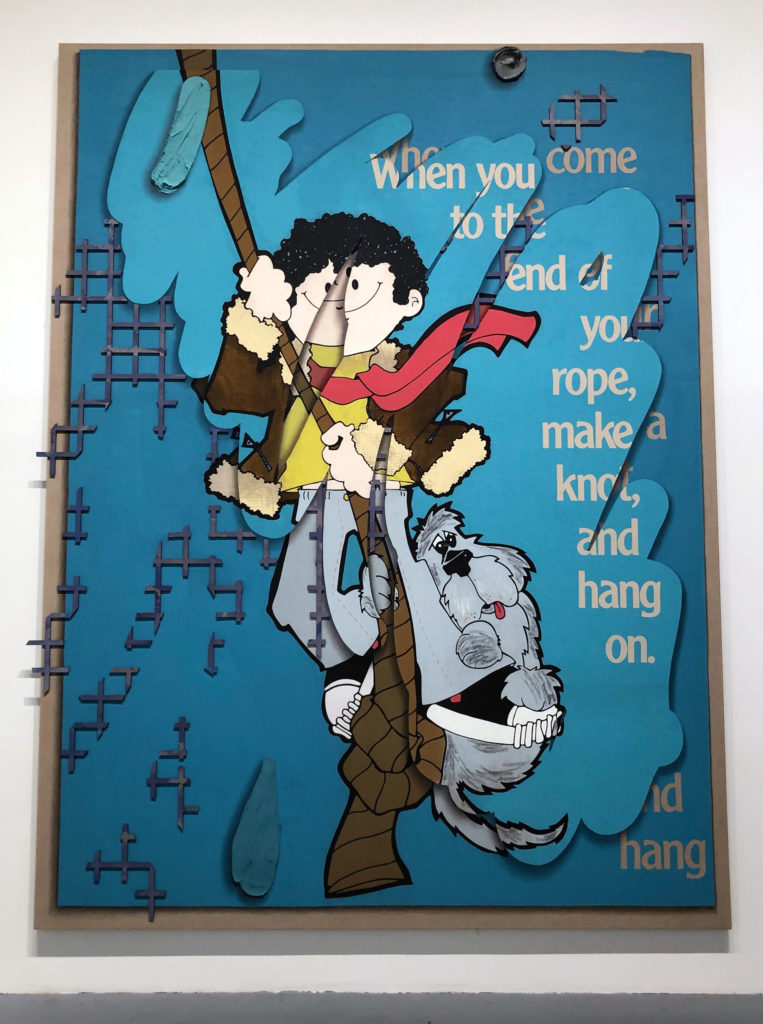
Nostalgia is something we all live with to a greater or lesser extent. The past informs our present and how we perceive things. Why do we see things the way we do? How do we frame the things we see and put them together?

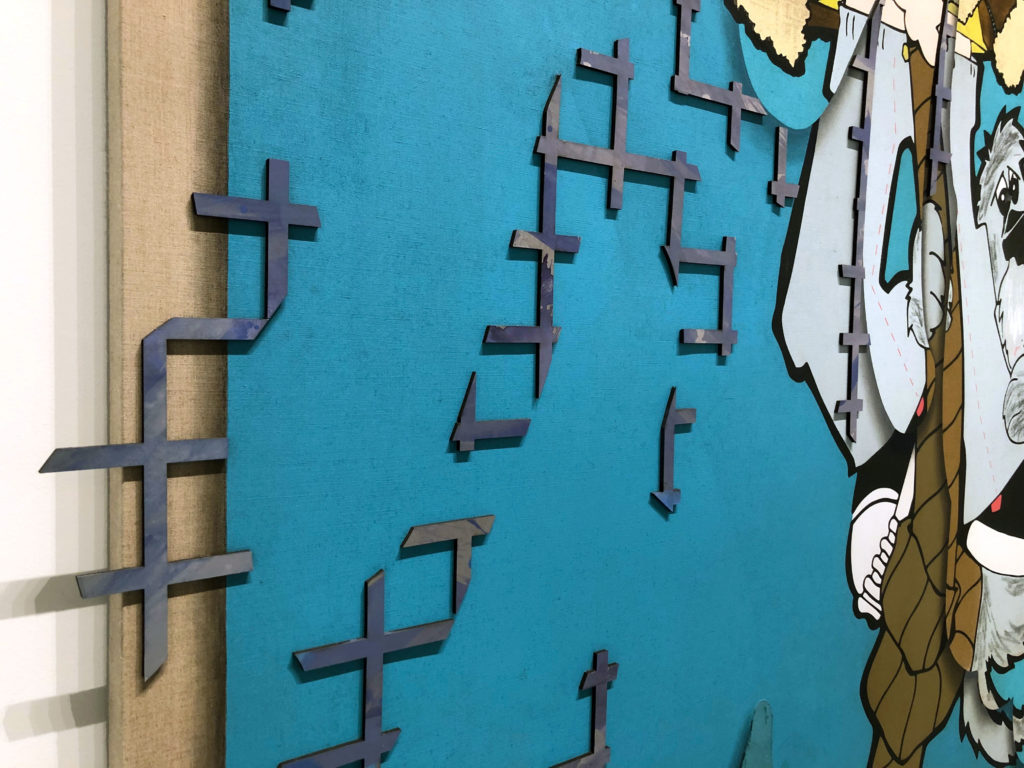
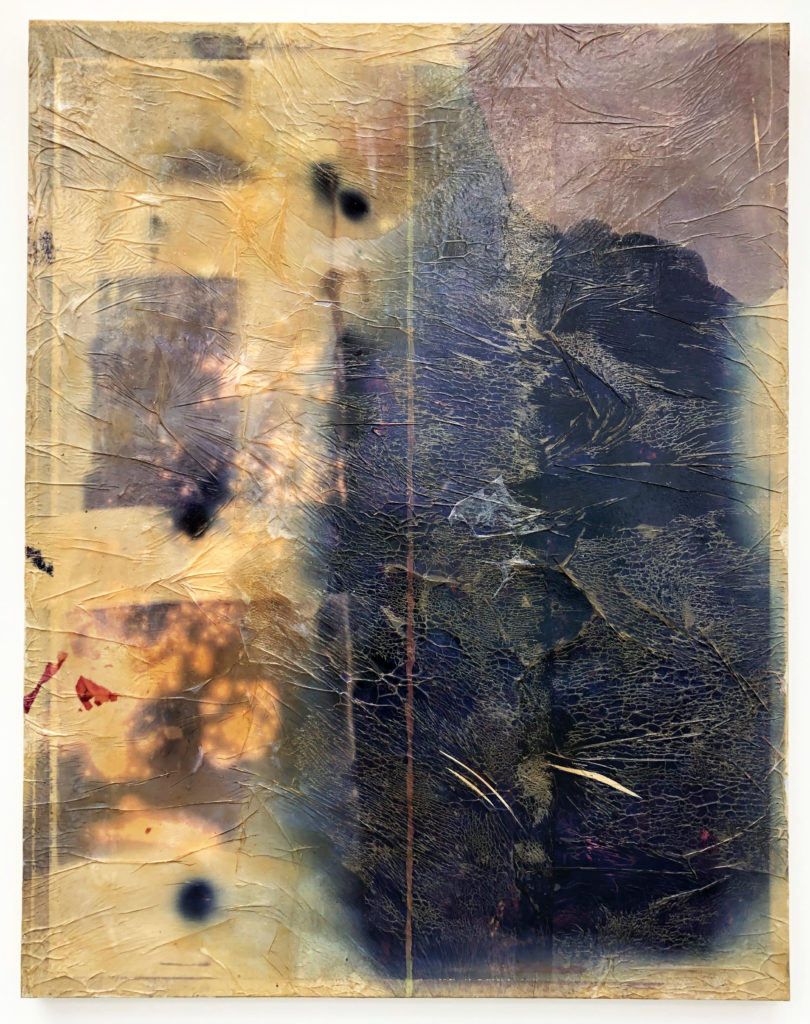
For Willie Stewart’s exhibition In Between Days at Morán Morán gallery, he recreated VHS tapes, album covers, 1970s wood paneling, flowers, paintings of flowers, and more, through layers of detailed painting combined with sculpture. Their titles reference songs from bands like Depeche Mode, Germs, The Horrors, and The Cure and add additional meaning to the content of the work. Within the text of the video in the exhibition. they change their context once again.

The perception of the viewer adds yet another layer when they make their own connections based on personal associations with the objects in the work. In that way, the meaning often becomes less about the work at face value, and more about the meaning you bring to it. For some it may be no more than just an admiration of the beauty and skill of the work. Maybe it won’t resonate to some at all. But for others who remember VHS tapes more vividly or know the bands referenced, the nostalgia adds an extra appreciation.

This exhibition closes 4/27/19.

Apr 052019
 

Currently at Hauser & Wirth’s Los Angeles location is Piero Manzoni. Materials of His Time.

From the press release

Piero Manzoni. Materials of His Time is the first exhibition with the gallery and the first in Los Angeles in over 20 years devoted to the seminal figure of postwar Italian Art and progenitor of Conceptualism. Curated by Rosalia Pasqualino di Marineo, director of the Piero Manzoni Foundation in Milan, this exhibition focuses on Manzoni’s revolutionary approach to unconventional materials through the exploration of what he dubbed ‘Achromes’ – paintings without color. Over 70 ‘Achromes’ will be on view, comprised of such materials as sewn cloth, cotton balls, fiberglass, synthetic and natural fur, straw, cobalt chloride, polystyrene, stones, and more. The exhibition situates Manzoni as a peer of such artists as Lucio Fontana and Yves Klein, whose experiments continue to influence contemporary art-making today. ‘Materials of His Time’ will also present, for the first time, the items on a wish list Manzoni outlined in a 1961 letter to his friend Henk Peeters: a room all in white fur, and another coated in fluorescent paint, totally immersing the visitor in white light.

The “Achromes” are simple but pleasing in their graphic simplicity. Lacking in color, they stand out against the soothing muted colors of the walls.

Heading upstairs, there’s something so delightful about stepping into the white fur room that fulfills Manzoni’s dream. The room itself has a white felt floor and fake fur lines the walls, ceiling and door. It may not be as thrilling now that installation art is more common in museums and galleries, but after reading the artist’s quote, knowing he got his wish makes it much more special. The artist died in 1963 at the young age of 29, too soon to see how much would change in the art world. Also, after seeing an exhibition that focuses on objects with so many different textures, having a chance to touch the furry walls is oddly satisfying.

This exhibition closes 4/7/19.

Apr 042019
 

People, the current sculpture exhibition at Jeffrey Deitch’s Hollywood gallery, fills the large room with work in a variety of media but all representing human beings in some way.

From the press release-

More than fifty standing, sitting and hanging figurative sculptures will fill Jeffrey Deitch’s new Los Angeles gallery. The artists in the show span several generations from the 1980s to the present, with an emphasis on emerging talent.

All of the works in the exhibition reflect a contemporary approach to sculpture inspired by the innovations of Dada, Surrealism, Assemblage and by the influence of non- or meta- art sources like department store mannequins.

Only one work in the show is carved or modeled in the traditional way. Some are made from body casts, others are constructed with found objects and only a few use conventional sculptural materials like bronze.

The works in the exhibition reflect the diversity of the artists who created them and the diversity of the people who the sculptures represent. The styles range from hyperrealism to allegory. The subjects range from ordinary individuals to creatures of fantasy. The works explore the uncanny confrontation of the artificial and the real while simultaneously responding to the multiple approaches to human identity in the contemporary world.

One of the sculptures, Totem, by Narcissister even incorporates live women. This adds to the unsettling feeling that some of the other sculptures, like Nobody, by Karon Davis (who founded The Underground Museum with her late husband Noah Davis), might have included real people as well (they don’t).

Karon Davis, “Nobody”, 2019

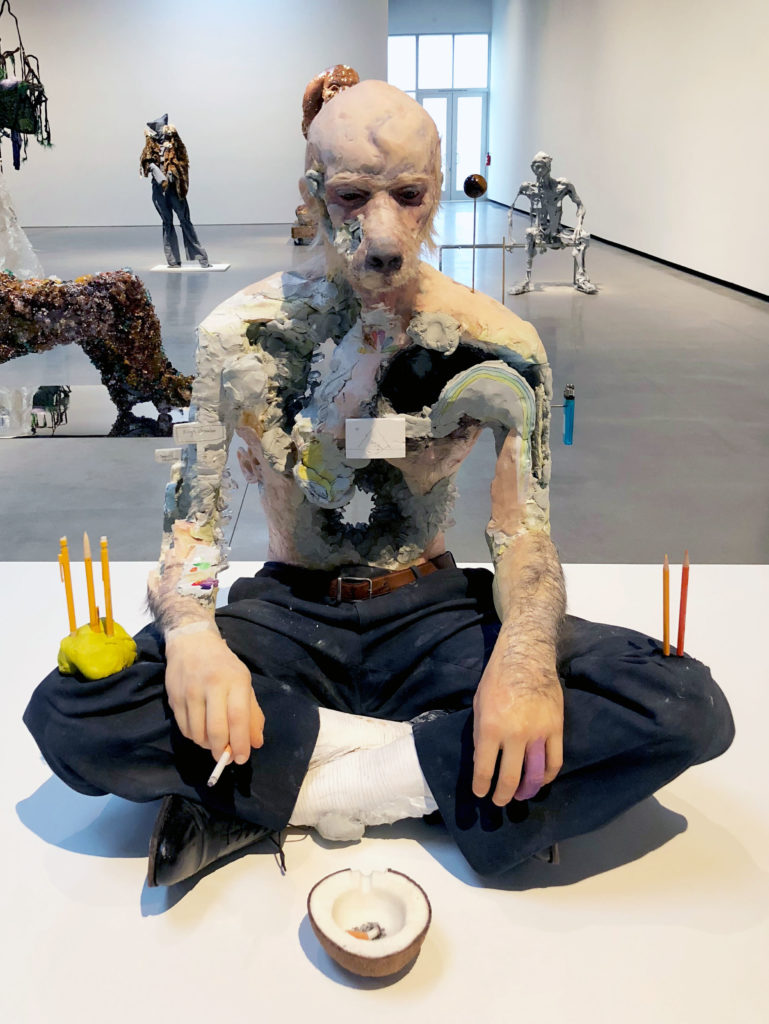
One of the strongest pieces in the exhibition is David Altmejd’s Pyramid in which a human/dog hybrid figure sits smoking while its back opens to expose insides composed of quartz, a hand, and several ears protrude from its sides. The little details are fascinating. He’s even painted one of the figure’s fingers purple, perhaps a reference to Human, the Ibizan hound with one purple leg that was included in Pierre Huyghe’s exhibition at LACMA.

People was inspired by Mike Kelley’s exhibition and book project The Uncanny, from 1993, and that’s definitely an accurate description of how it feels to wander around in this particular room of sculptures.

This exhibition closes 4/6/19.


Mar 222019


Currently at The Geffen Contemporary at MOCA are Laura Owens mid-career survey and Zoe Leonard: Survey. Two very different exhibitions, each exceptional in their own way.

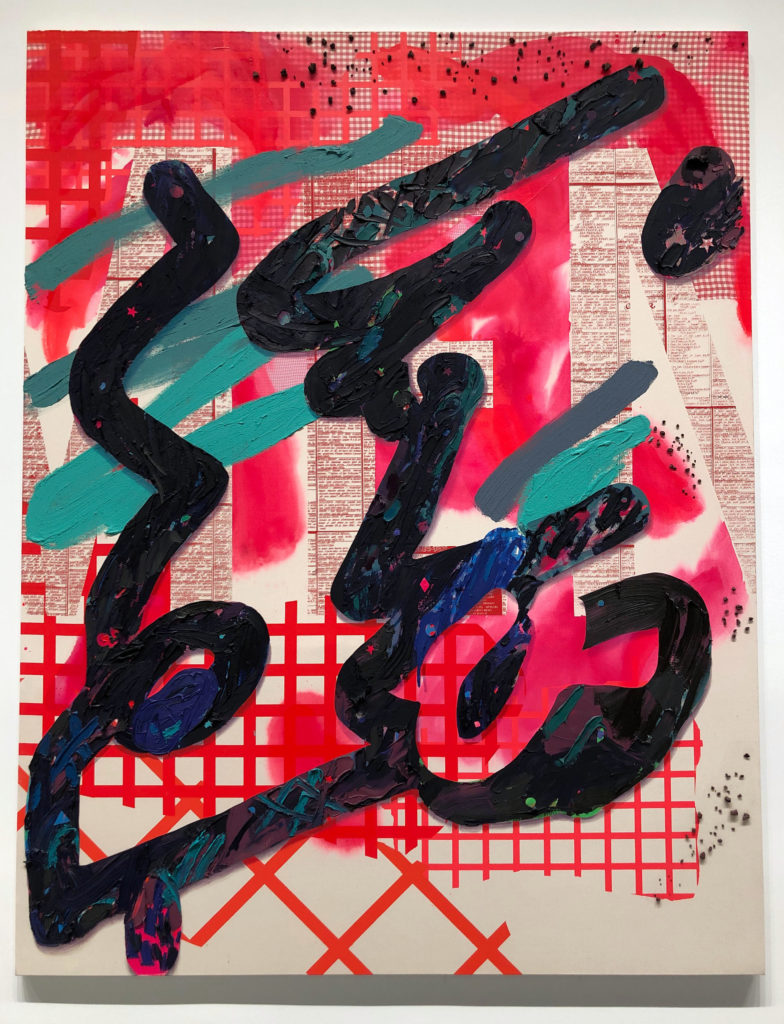
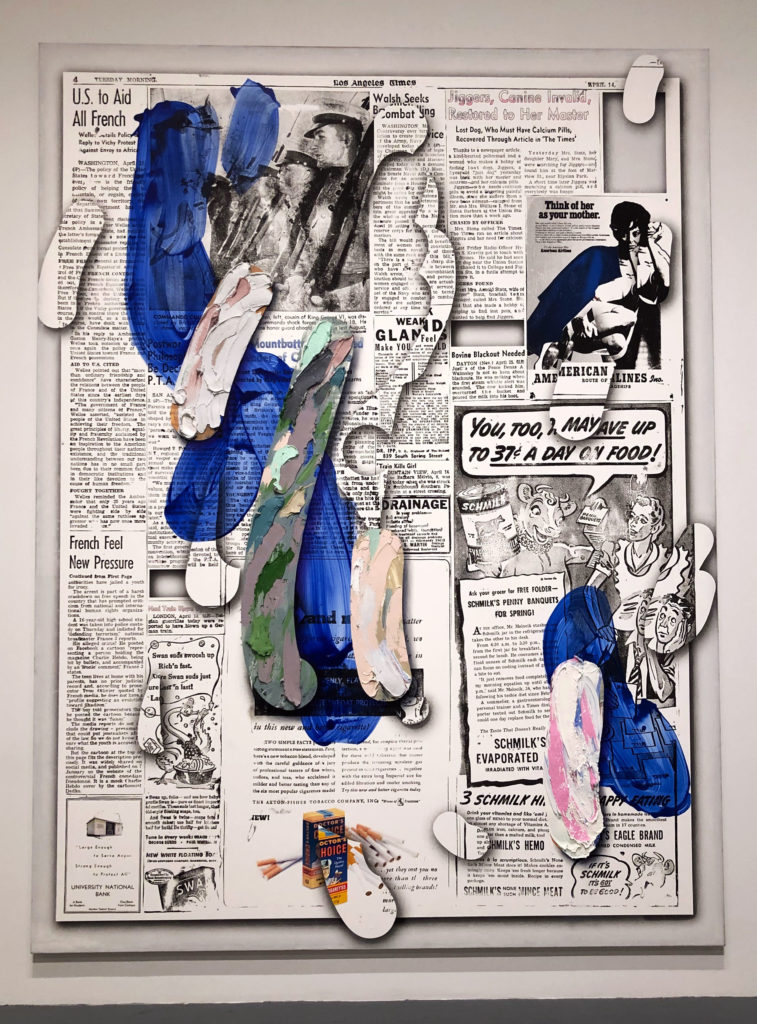
Laura Owens’ exhibition (pictured above), captures the exuberance of her work throughout her career from the mid-1990s until today. Looking at the colorful paintings, it’s the details you don’t notice at first that give them added depth and life. Textured paint seems to float above the canvas and in some of the work sculptural pieces extend beyond the frame. Traveling from room to room you can see her style grow and change while still keeping elements from the previous work.

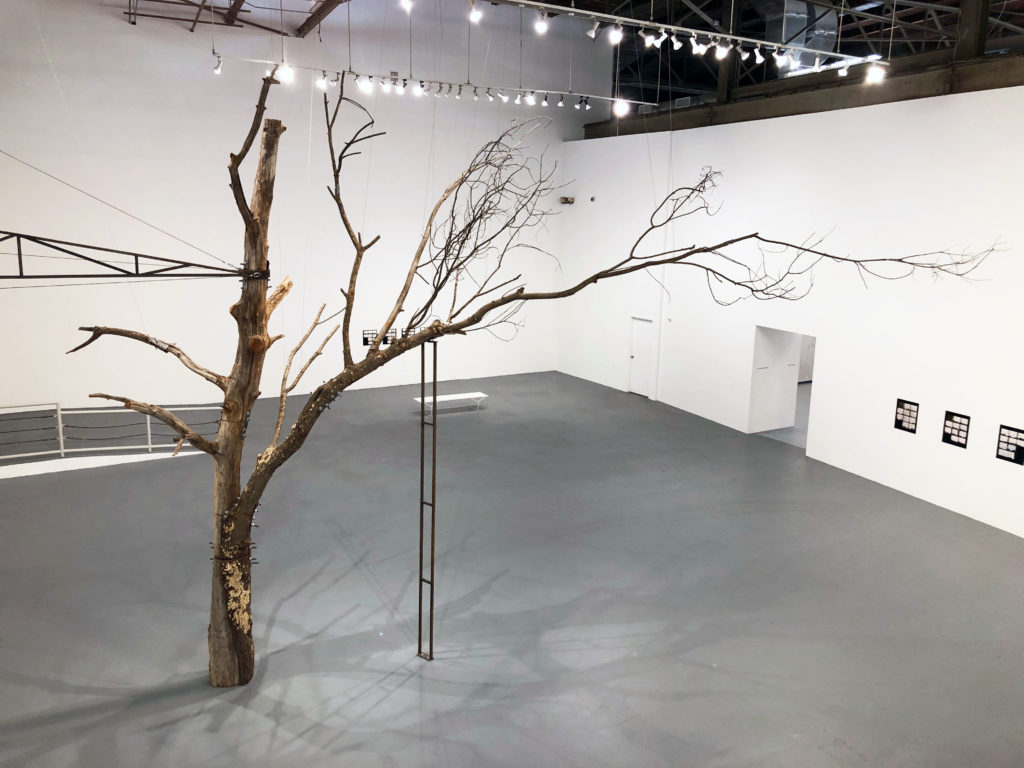
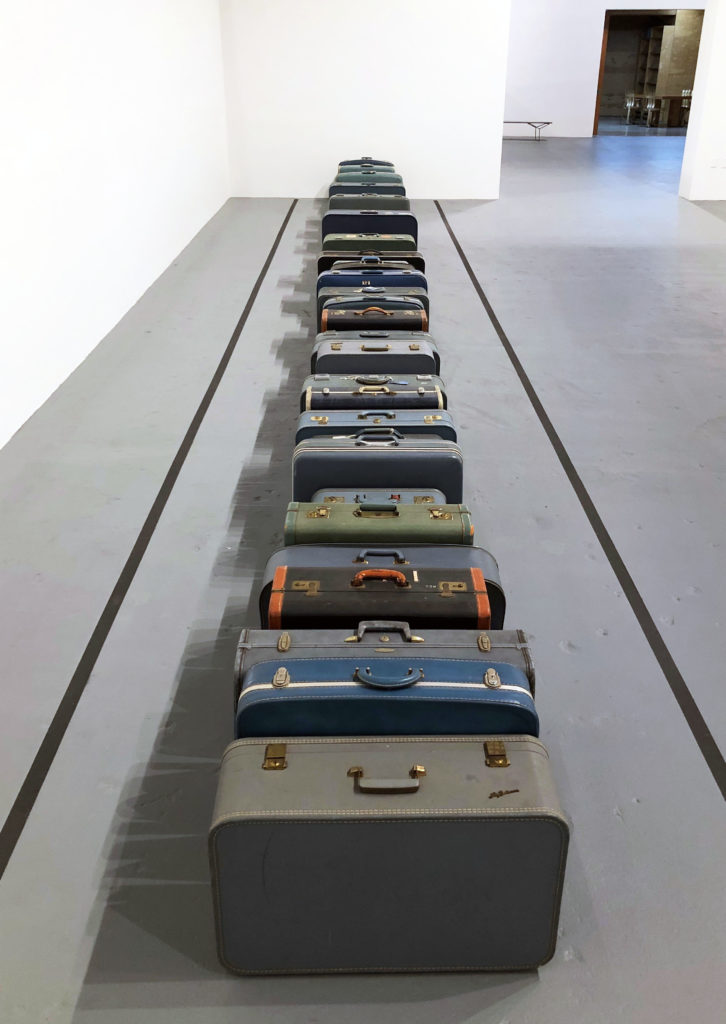
Zoe Leonard’s exhibition (seen below) is a thought provoking collection of the artist’s work that varies between the political and the personal and sometimes a blending of the two.

A tree sliced apart and bolted back together is suspended in a room that also contains contact sheets of birds in flight. In another, there’s a line of suitcases, one for every year of the artist’s life. There are photos taken of the sun and a table with stacks of postcards of various views of Niagara Falls.  Black and white photos of animals who have been killed and dismembered confront you in another section of the gallery. Nature, death, and the passing of time are common themes present in Leonard’s work and in our own lives. The effect is meditative.

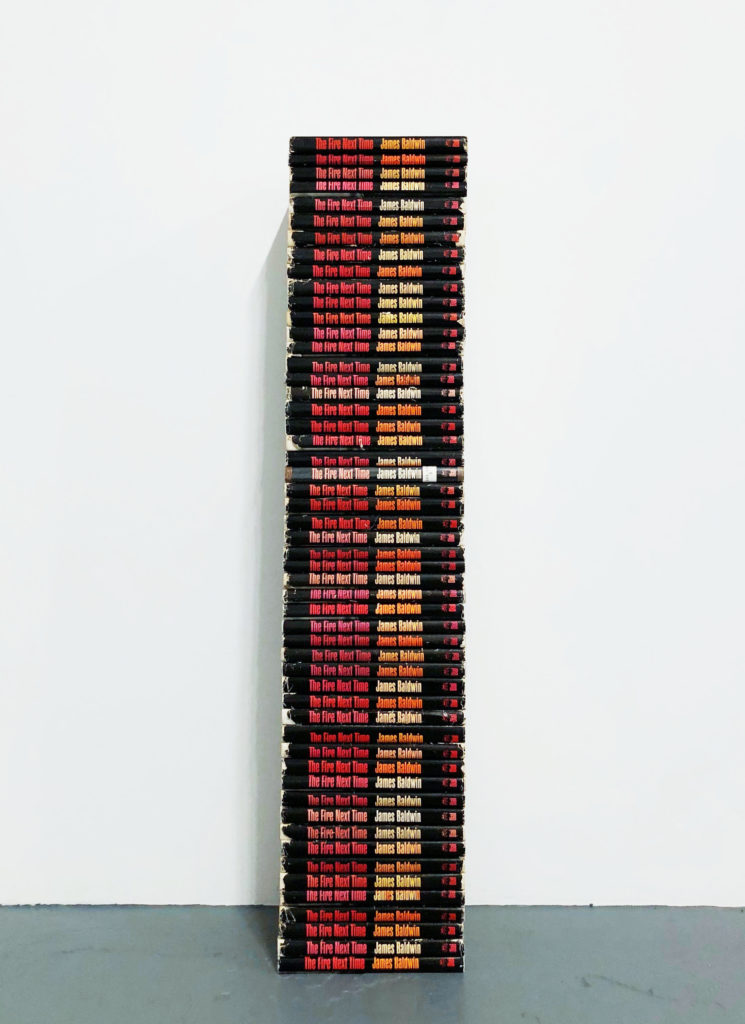
There are also the more overtly political works. For Tipping Point (pictured below) which she created in 2016, she created a tower of 53 copies of James Baldwin’s The Fire Next Time, one for each year since the book was published. On one wall a typed copy on onionskin of her famous work I want a president, that she wrote when poet Eileen Myles ran for president, hangs between two pieces of glass. (This work was also printed as a large mural for The Highline in New York in 2016)

From MOCA’s website-

New York–based artist Zoe Leonard (b. 1961) is among the most critically acclaimed artists of her generation. Over the past three decades, she has produced work in photography and sculpture that has been celebrated for its lyrical observations of daily life coupled with a rigorous, questioning attention to the politics and conditions of image making and display.

Zoe Leonard: Survey is the first large-scale overview of the artist’s work in an American museum. The exhibition looks across Leonard’s career to highlight her engagement with a range of themes, including gender and sexuality, loss and mourning, migration, displacement, and the urban landscape. More than it focuses on any particular subject, however, Leonard’s work slowly and reflectively calibrates vision and form. Using repetition, subtle changes of perspective, and shifts of scale, Leonard draws viewers into an awareness of the meanings behind otherwise familiar images or objects. A counter-example to the speed and disposability of image culture today, Leonard’s photographs, sculptures, and installations ask the viewer to reengage with how we see.

On Sunday, 3/24, MOCA Senior Curator Bennett Simpson will lead a final walkthrough of both of these exhibitions before they close on Monday 3/25/19.  Admission is free to the museum and this event this weekend.
Mar 212019
 

Noboru Tsubaki “Fresh Gasoline”, 1989

Yukinori Yanagi “Ground Transposition”, 1987/2019 (balloons) and Shinro Ohtake “Retina (Night Fever 1)”, 1990 (left on wall) and “Retina (DNA Shadow III)” (right on wall), 1990

Shinro Ohtake “Retina (DNA Shadow III)”, 1990


Blum & Poe’s current exhibition Parergon: Japanese Art of the 1980s and 1990s, is a selected survey exhibition of Japanese art of the 1980s and ‘90s, curated by Mika Yoshitake. It includes the work of over twenty-five visual artists in a variety of media including painting, sculpture, video, and photography.

From the press release

The exhibition title makes reference to the gallery in Tokyo (Gallery Parergon, 1981-1987) that introduced many artists associated with the New Wave phenomenon, its name attributed to Jacques Derrida’s essay from 1978 which questioned the “framework” of art, influential to artists and critics during the period. Parergon brings together some of the most enigmatic works that were first generated during a rich two-decade period that are pivotal to the way we perceive and understand contemporary Japanese art today. In the aftermath of the conceptual reconsideration of the object and relationality spearheaded by Mono-ha in the 1970s, this era opened up new critical engagements with language and medium where artists explored expansions in installation, performance, and experimental multi-genre practices.

When the U.S. and Europe were witnessing a return to Expressionism alongside a postmodern aesthetic of simulacra and deconstruction characterized by the Pictures generation, this zeitgeist of cultural capitalism was instead manifest under Japan’s unique social and geo-political conditions resulting from the rise and burst of the bubble economy. Artists began to explore subversive artistic languages and integrate underground subcultures into their practice using a variety of media, ranging from experimentations in electro-acoustic music, geopolitical and conceptual photography, and appropriations of advertisement culture. Others addressed the internalization of historical avant-garde and modernist aesthetics that were filtered through a new poetics of form, space, and language.

In the post-1989 Hirohito era, politics of gender, nuclear crisis, and critique of nationalism are especially poignant among artists from the Kansai region. This period also witnesses the rise of art collectives in the mid-90s and their darkly humorous performances and conceptual practices that reevaluated the history of Japan’s postwar avant-garde. These events reflect on a subculture generated out of a profoundly unique “infantile capitalism,” anticipating the explosive rise of the Neo-Pop generation.

This exhibition is presented on the occasion of Blum & Poe’s 25-year anniversary. Parergon commemorates a special facet of the gallery’s history rooted in this very timeframe in Japan—with Tim Blum’s early years as an art dealer and curator spent in Tokyo in the early ‘90s—and charts a bridge between the Japanese art historical territories the gallery has long championed. Parergon pursues the creative significance of the years between the milestones of Mono-ha and the Neo-Pop generation now synonymous with Takashi Murakami and Yoshitomo Nara.

This exhibition closes 3/23/19. Part II will open 4/6/19.