Jul 222022
 

Typewriter Eraser, Scale X, 1999, part of The ARIA Fine Art collection in Las Vegas

Artist Claes Oldenburg passed away this week at the age of 93. He was most famous for his large scale sculptures of everyday objects, many of which were produced with his wife Coosje van Bruggen, who passed away in 2009.

While primarily working in sculpture, early in his career in the 1960s he also created “happenings”- theatrical art related performances and collaborations with other artists in his circle. In 1985 he returned to performance and along with van Bruggen, architect Frank Gehry, and writer Germano Celant presented Il Corso del Coltello (The Course of the Knife) in Venice, Italy. In 2021, Pace Gallery in NYC, as part of the two gallery exhibition Claus & Coosje, showed work from this performance, pictured below.

From Pace’s website about the performance-

This ambitious event involved the creation and embarkation of a sea-worthy sculpture in the shape of a giant Swiss army knife. With oars protruding from its red-enameled hull as if from a Viking longship, the image of Oldenburg and van Bruggen’s Knife Ship sailing the Grand Canal has become iconic, while the massive kinetic sculpture was later shown in the rotunda of the Guggenheim Museum in New York, at the Centre Pompidou in Paris, and finally at the Museum of Contemporary Art, Los Angeles.

With so much of Oldenburg’s work, the examination of the ordinary object engages the viewer with what they might previously taken for granted and gives them a chance to look again with new eyes. There is also something lighthearted and fun, as well as investigative, about his body of work.

(image via Whitney Museum’s website)

The Whitney Museum has a video showing the process of assembling his soft sculpture Giant BLT (Bacon, Lettuce, and Tomato Sandwich) 1963, which involves putting the sandwich together piece by piece.

For more on Oldenburg, MoMA has a tribute that includes the words of people who knew him as well as his own. His 1961 artist statement is wonderful and worth reading in its entirety, here is the opening section-

I AM FOR

I am for an art that is political-erotical-mystical, that does something other than sit on its ass in a museum.
I am for an art that grows up not knowing it is art at all, an art given the chance of having a starting point of zero.
I am for an art that embroils itself with the everyday crap and still comes out on top.
I am for an art that imitates the human, that is comic, if necessary, or violent, or whatever is necessary.
I am for all art that takes its form from the lines of life itself, that twists and extends and accumulates and spits and drips, and is heavy and coarse and blunt and sweet and stupid as life itself.

I am for an artist who vanishes, turning up in a white cap painting signs or hallways.

The Guardian’s obituary is also worth a read for more information on the artist’s history.

Jul 042022
 

Jasper Johns’ Three Flags, 1958, is currently on view at the Whitney Museum of American Art in NYC.

Information about the work from the Whitney’s website-

In 1954, Jasper Johns began painting what would become one of his signature emblems: the American flag. As an iconic image–comparable to the targets, maps, and letters that he also has depicted–Johns realized that the flag was “seen and not looked at, not examined.” The execution and composition of Three Flags elicit close inspection by the viewer. The painting draws attention to the process of its making through Johns’s use of encaustic, a mixture of pigment suspended in warm wax that congeals as each stroke is applied; the resulting accumulation of discrete marks creates a sensuous, almost sculptural surface. The work’s structural arrangement adds to its complexity. The trio of flags—each successively diminished in scale by about twenty-five percent—projects outward, contradicting classical perspective, in which objects appear to recede from the viewer’s vantage point. By shifting the visual emphasis from the flag’s emblematic meaning to the geometric patterns and variegated texture of the picture surface and the canvas structure, Johns explores the boundary between abstraction and representation. As he remarked, this painting allowed him to “go beyond the limits of the flag, and to have different canvas space.”


Aug 062021


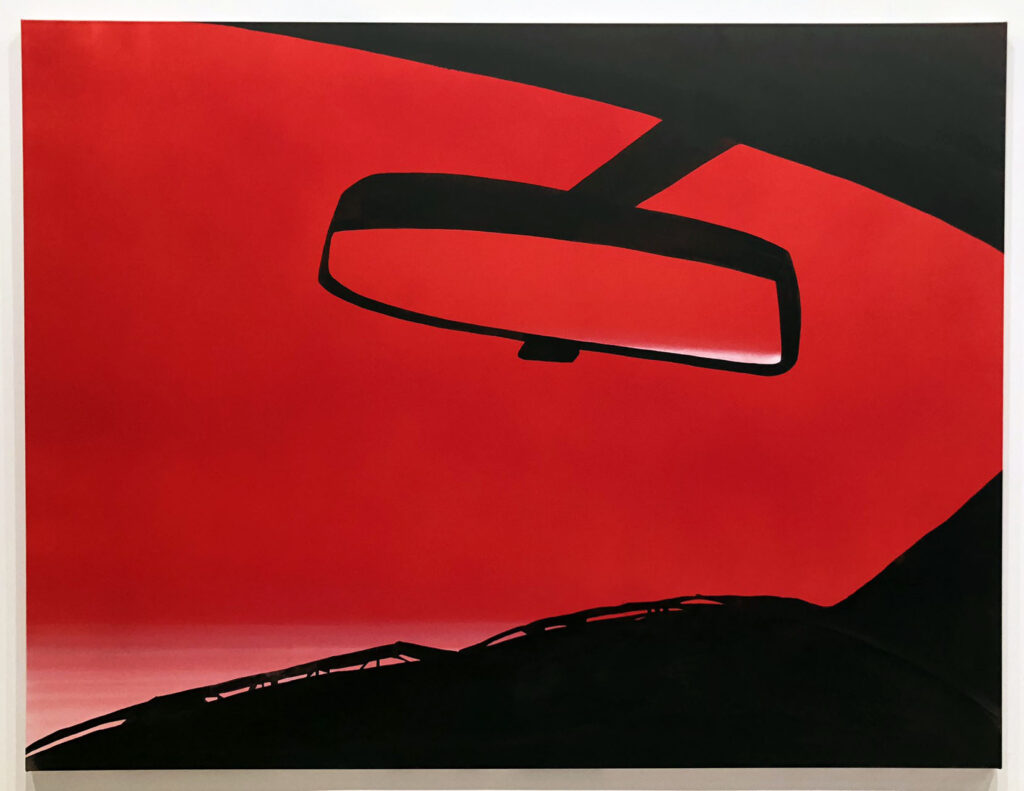
Calvin Marcus’ Los Angeles Painting, 2018, was part of the 2019 Whitney Biennial. The next one is postponed until Spring 2022.

Marcus’ current work can be seen in Beverly Hills at Clearing until 9/3.


Sep 202019
 

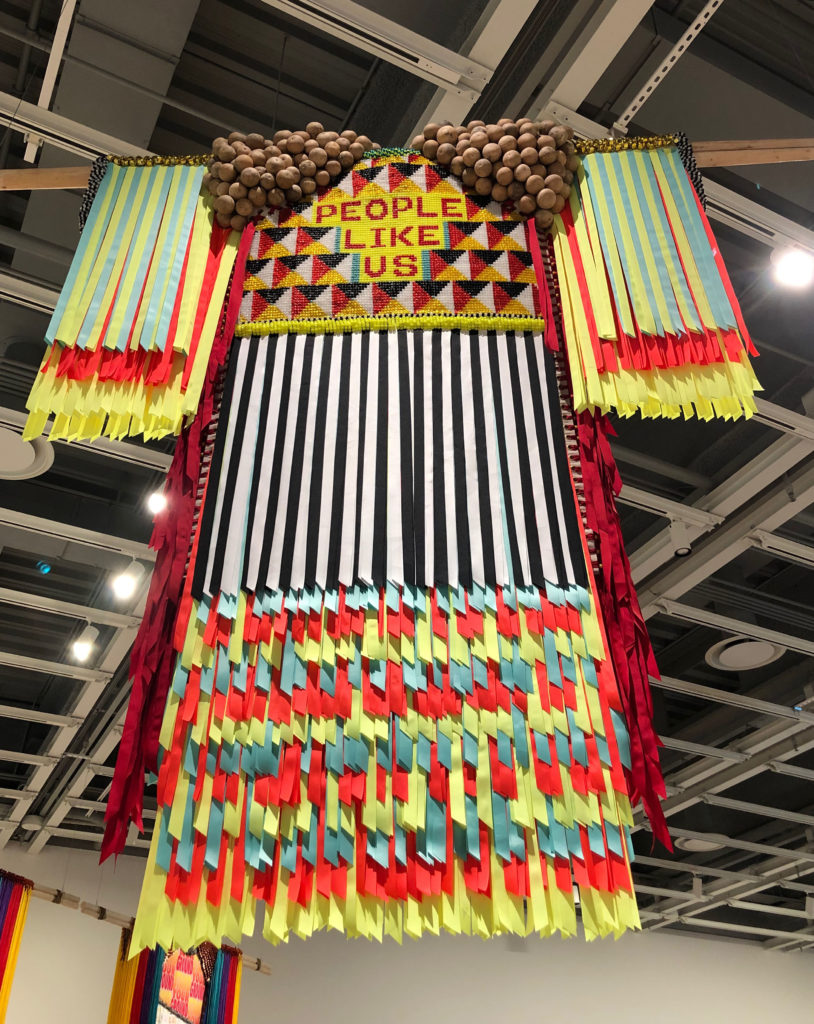
Jeffrey Gibson, “PEOPLE LIKE US”, 2019

Jeffrey Gibson

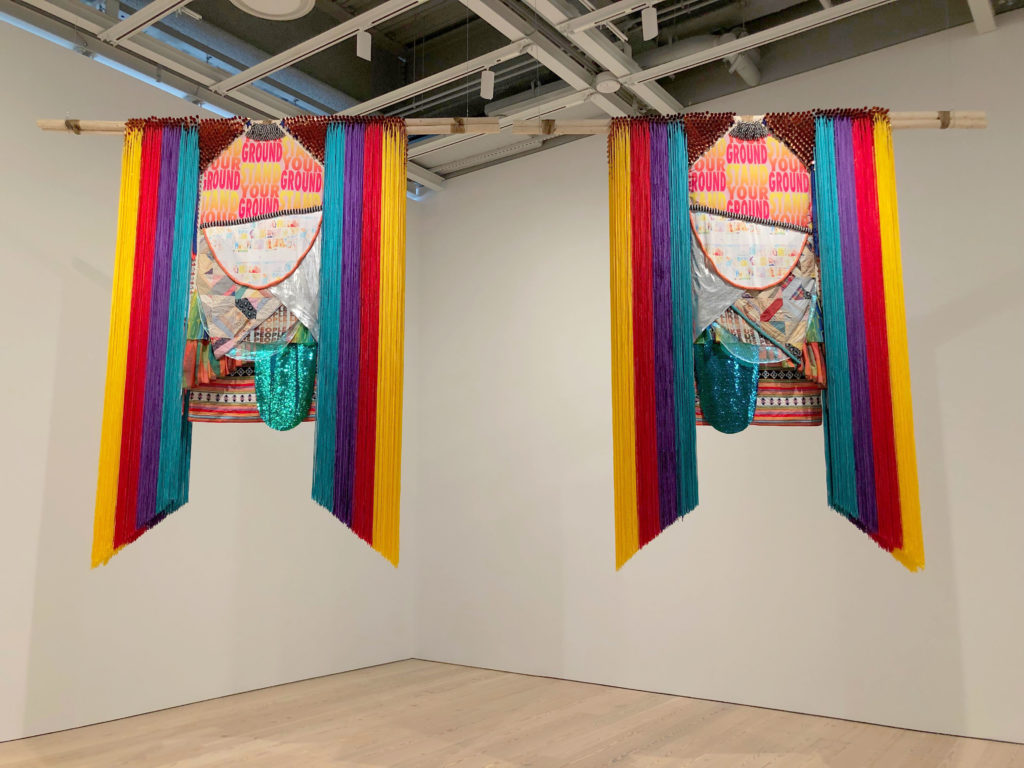
2019’s Whitney Biennial presents an interesting selection of work, by a mostly young and diverse group of artists. The works included in the show are consistently good, and often intriguing, but this time around nothing is particularly outrageous or polarizing- a contrast to many of the previous iterations.

Not that there wasn’t any drama surrounding the show. This time around, however, the controversy was not with an artwork but with former Whitney executive board member Warren B. Kanders and his ownership of Safariland, a tear-gas canister maker. He has since resigned after protests and threats of withdrawal from several of the artists included in the show. Artist collective Forensic Architecture’s film, Triple Chaser, on view in the exhibition, investigates Safariland and Kanders.

Below are a few highlights from the exhibition.

Janiva Ellis ” Uh Oh, Look Who Got Wet”, 2019

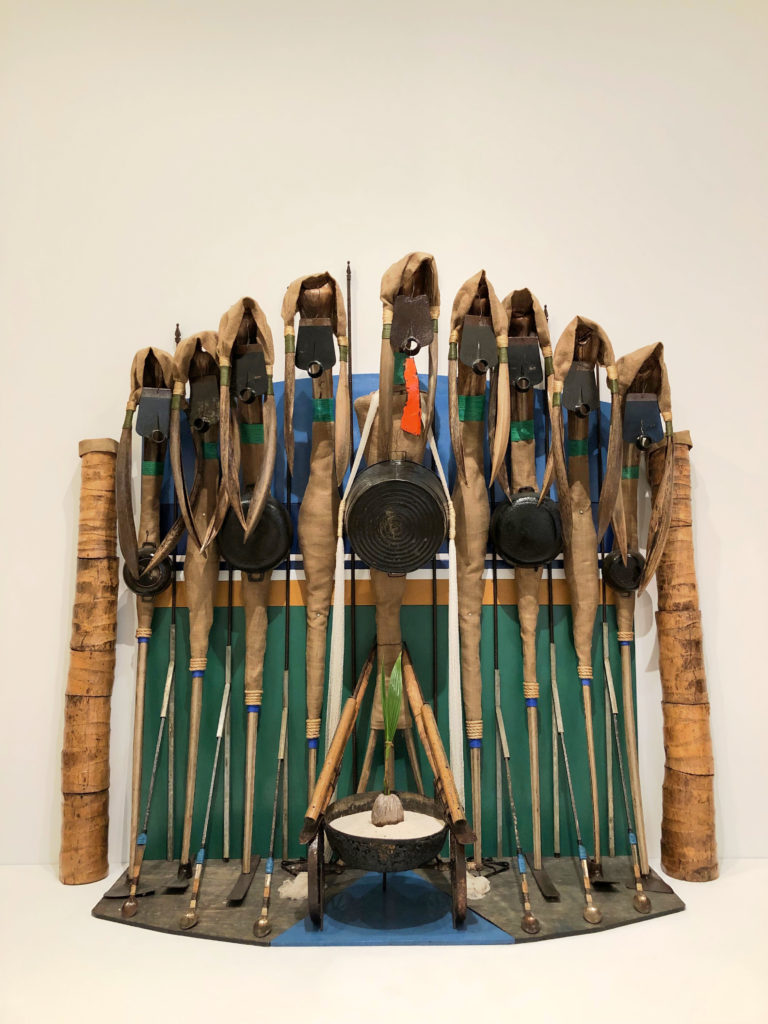
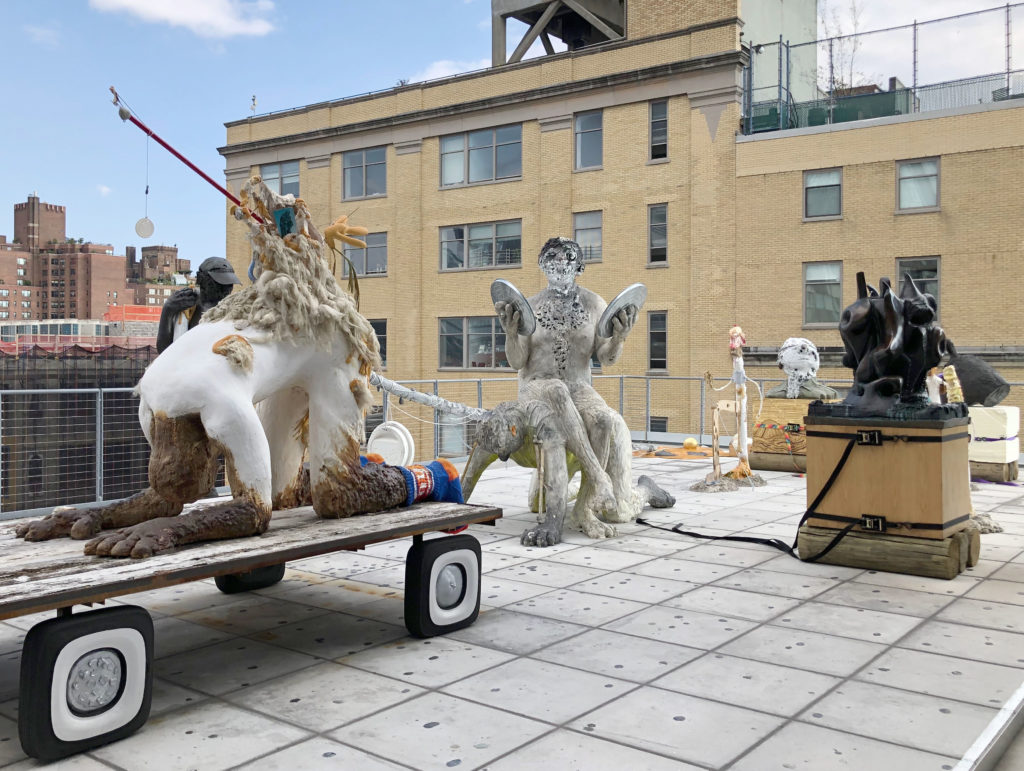
Daniel Lind-Ramos, “Centinelas (Sentinels)”, 2013

Section of Nicole Eisenman’s, “Procession”, 2019

This exhibition closes 9/22/19.


Mar 292019
 

The Whitney Museum’s exhibition, Andy Warhol – From A to B and Back Again is a great representation of the artist’s body of work. Despite the fact that so much of it has been seen before, the curation makes so much of it feel fresh.

Andy Warhol’s artistic legacy is vast. He created a prolific amount of work throughout his career and the exhibition covers a lot of it. From his early commercial illustrations to his more abstract pieces, his collaborations with Basquiat, his silk screen portraits, his videos, films, and books, there is a lot to see. Below are a few highlights.

Warhol’s fascination with death is seen in numerous works in the exhibition. In 129 Die In Jet, 1962 (pictured above), he recreated the newspaper cover by hand and even used a sponge-blotting technique to reproduce the look of the halftone image. It’s interesting to see how this work foreshadowed his move to the screen printing process. This technique combined with his interest in the subject of death can be seen in his car crash paintings made the following year.

There’s a room dedicated to reproducing Warhol’s Cow Wallpaper, which he used to fill a room in the Castelli Gallery as part of a 1966 installation where he “retired from painting”. He used it again in 1971 for a retrospective at the Whitney, where he directed that all the works be hung on it for the exhibition. It’s a creative way to tie in that history and to present the various colored flower paintings.

Some of Warhol’s portrait series, Ladies and Gentlemen, 1975, which focused on members of New York’s queer community, is included in the show. It’s a nice contrast to his portraits that more commonly feature socialites and Hollywood celebrities.

His giant portrait of Mao is impressive, and takes up a wall in one of the galleries. It’s a reproduction of a painting by Zhang Zhenshi, which was at the time thought to be the most widely reproduced artwork in the world. Warhol created the work in response to reading about then President Nixon’s trip to meet with the Chinese leader, while China was still considered an enemy of the United States.

On a separate floor are several monitors playing Warhol’s video work and work related to the artist. Included is one of him eating a Burger King burger, shot by Danish documentarian Jørgen Leth, that the fast food chain used as part of their ad in this year’s Superbowl.

Warhol was a constantly evolving artist who worked in many mediums, in effective ways. The exhibition is a testament to Warhol’s unique perspective and how his work continues to resonate in a time period where so much of what he was commenting on has even more relevance.

Andy Warhol – From A to B and Back Again, closes 3/31/19 and is free Friday from 7-10pm.

Mar 022019
 

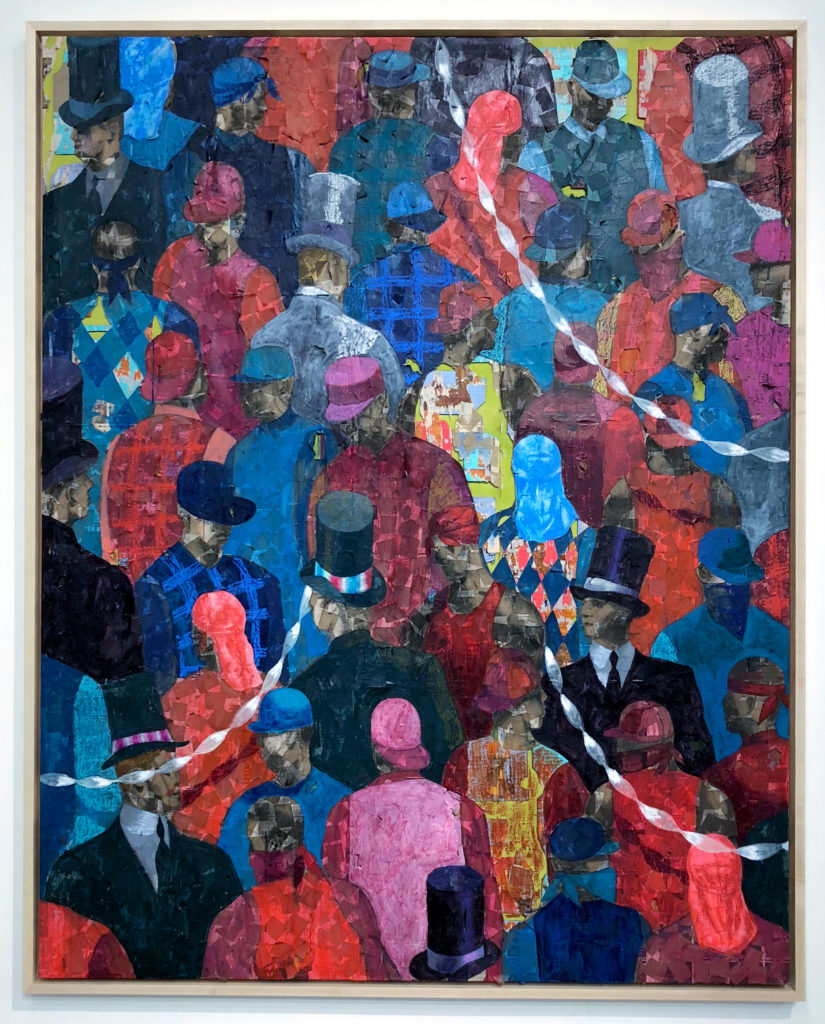
Derek Fordjour, Two Party System, 2019


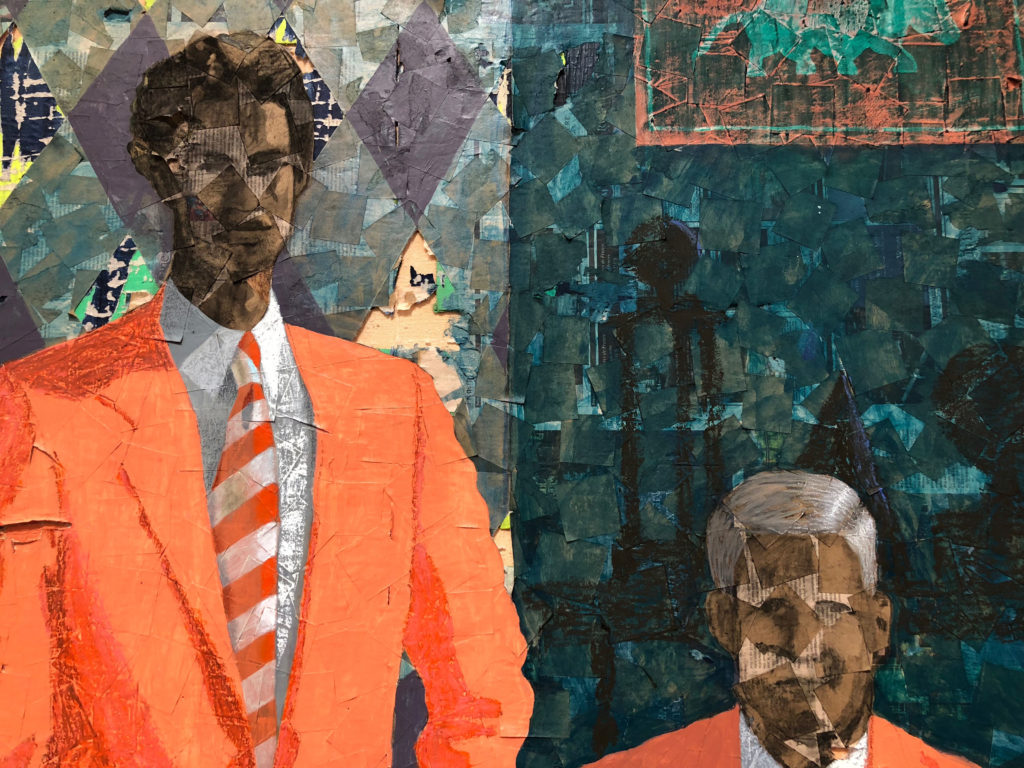
JRRNNYS, Derek Fordjour’s solo exhibition at Night Gallery, includes new paintings and sculptures that “advance explorations of earlier works, returning to the subjects of crowds and athletic competitions to illustrate the entrenchment of power relations, capital flows, and racial inequality within the economic and social systems of the United States”. The paintings are made of multiple layers of painted cardboard and newspaper that are then scored and sections are removed.

This interview with the artist from artnet goes into more detail on his fascinating process and the reasons behind it.

Signing Day, 2019

Signing Day detail


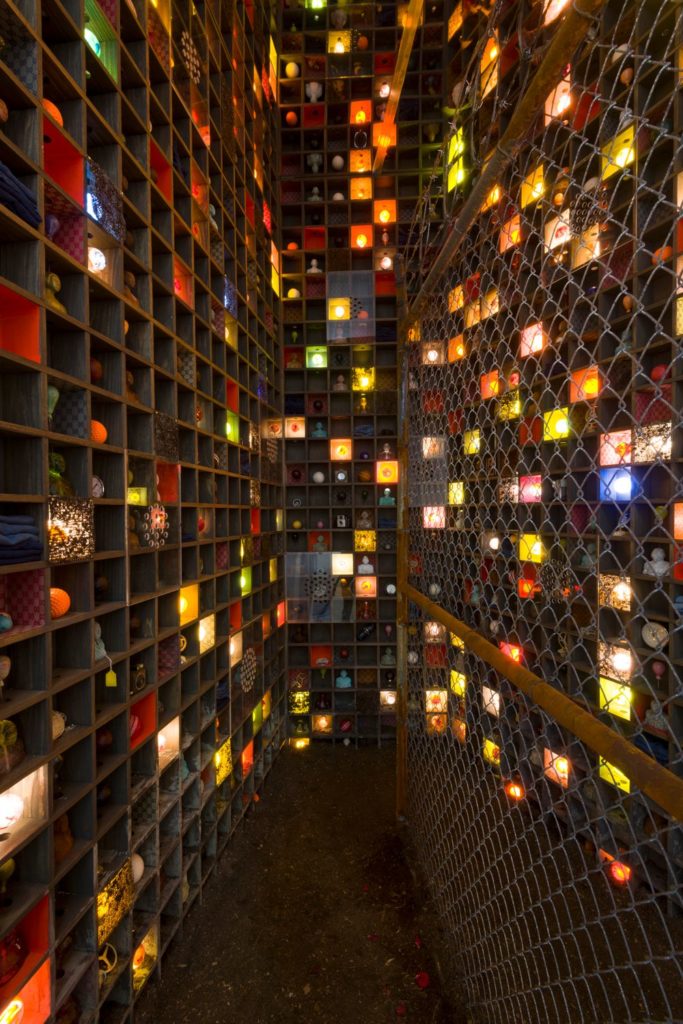
The centerpiece of the exhibition is the installation STOCKROOM Ezekiel.

From the press release–

…The work takes its name from the 1884 letters of Ezekiel Archey, an 25-year-old unjustly held as a prisoner sent to labor at the Pratt Coal Mines in Birmingham. Archey’s letters, sent to the Alabama inspector of prisons, are among the most prominent primary-source documentation of the ravages of the convict leasing system, acknowledging the stark preponderance of black prisoners and the gruesome treatment of the laborers by their supervisors. Fordjour’s installation responds to Archey’s letters by creating a walled-in structure comprised of over 1,000 individually constructed compartments – cells, as the artist calls them – painstakingly organized with a variety of found and handmade objects, though by a logic that is never explicated to the viewer. Lights in individual cells blink on and off variously, while small speakers let forth bursts of music by the dictates of a rigid but similarly inscrutable pattern, luring the viewer in the eye-popping manner of the carnival game or game board. The intermittent sounds of music range from the early field recordings of 20th century ethnomusicologist Alan Lomax to 80s- and 90s-era drug dealer anthems to modern day Trap music, a largely Southern genre of hip-hop inspired by the illegal drug trade. The viewer has entered a gamelike arena whose rules remain obscure. With time, the objects that populate the shelves come into focus. Some cells contain familiar items – balls extracted from various sporting contests, the lottery and billiards, cameras, hood ornaments from luxury sports cars, decommissioned prison uniforms, and hundreds of hand blown glass balloons, among others. Others are closed off with metal grating, while still more are lined with the ubiquitous fabrics of luxury designers, invoking the aspirational quests of poverty-stricken urban communities. Finally, many cells contain small busts of the same expressionless figure, molded from resin, copper, metal, plaster, dirt, and salt – materials which stand in for the most prominent products from the era of convict leasing, including the coal mines and steel plants of of Alabama and the molasses distilleries of Florida. Taken individually, the contents of these cells suggest luxury and labor, surveillance and displacement, strategy and competition; as a whole, the work suggests the laws of chance taking place within the confines of a framework that is as unknowable as it is oppressive. From the era of Pig Laws to our current three-strikes mandatory sentencing, educational lotteries to modern day sporting empires, Fordjour’s installation points to the tragic persistence of unjust structures that define American life, employing contemporary commodities while invoking history. At once mournful and flickering with possibility, the installation conjures notions of personal loss and gain within the macro-scale context of the inscrutable systems that have determined the fates of black and brown people through the nation’s history.

Derek Fordjour, STOCKROOM Ezekiel, 2019 image via Night Gallery

This exhibition closes 3/2/19.

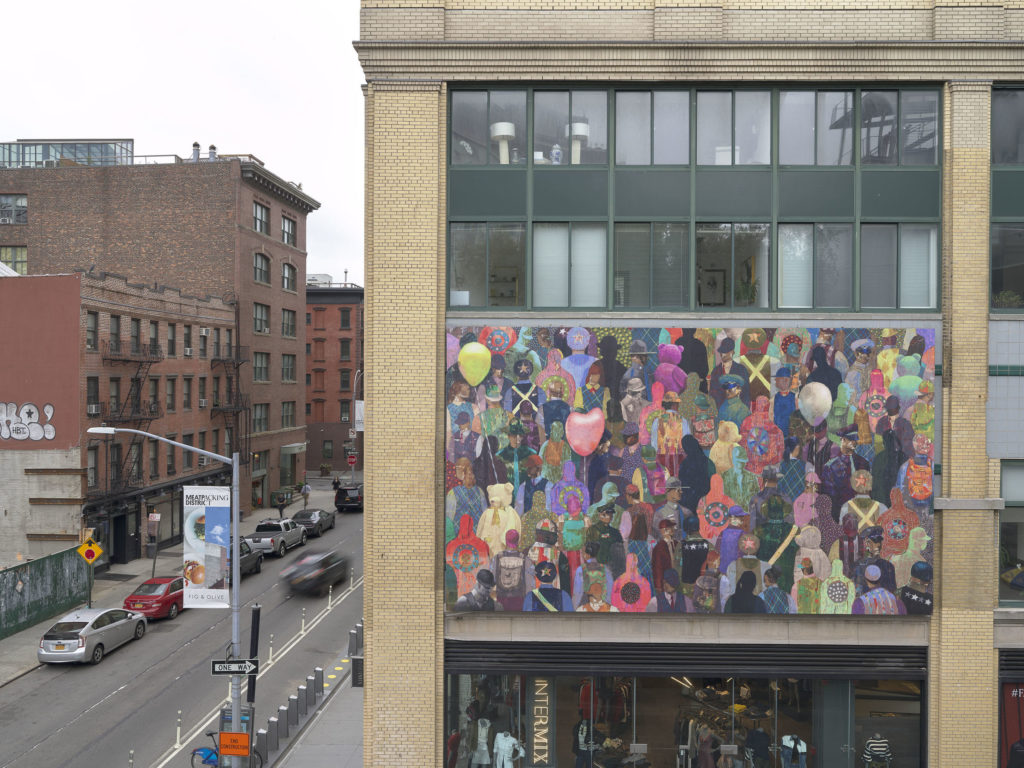
If you are in NYC you can see one of Fordjour’s new works, Half Mast, as a public art installation for the Whitney Museum. The large vinyl reproduction of his painting can be seen at the intersection of Gansevoort and Washington Streets, directly across from the Whitney and the High Line.

Derek Fordjour, Half Mast. Image via Whitney Museum