Dec 112025
 

Sasha Gordon‘s two billboards- My Love of Upholstery (2024) and Untitled (2024), are currently on view from the High Line in NYC.

From the High Line website about the work-

Sasha Gordon creates surreal paintings and drawings that explore themes of sexuality, gender, race, and the body. Often depicting herself as subject, Gordon is keenly attuned to art historical themes of portraiture and self-portraiture, and of the politics of representation. She approaches these categories with inventiveness and humor, using the uncanny to communicate very real concerns around self-image and identity.

For the High Line – Moynihan Connector Billboard, Gordon presents two works, My Love of Upholstery (2024) and Untitled (2024). Both hail from the artist’s most recent body of work, in which she examines challenging taboos and standards of representation. Her images present a wide range of emotional states, frequently considered through the lens of her identity as a queer Asian American woman. Through endless avatars, she portrays the othering of unconventional human bodies and her own experiences of alienation. Towering over 30th Street and Dyer Avenue, the artist’s fluctuating visage appears at massive scale, marked by a distinct unnaturalness—in My Love of Upholstery, where she depicts herself with a Pinocchio-like wood-grain body, and in Untitled, in which her face and pupils are marked with five-pointed stars. These visions are simultaneously anxious and intimate, teetering somewhere between tender fantasy and nightmare. Her avatars, looming large within their frames, offer both artist and audience an outlet for exploring contradictory emotions and complex personal experiences.

Nov 272025
 

Lily van der Stokker created Thank You Darling in 2023 for the High Line in NYC.

From the High Line website about the work-

Lily van der Stokker is one of the Netherlands’ most celebrated contemporary artists. In 1983 she moved to New York, opening a small artist-run gallery space in the East Village and has since lived alternately in both New York City and Amsterdam.

For over 30 years, van der Stokker’s drawings and monumental wall paintings have subverted artistic convention and aesthetic expectations, employing an Easter candy color palette to depict clouds, flowers, swirls, and other traditionally feminine or decorative motifs. Van der Stokker annotates these compositions with handwritten text—spelling out intimate thoughts, personal musings, notes-to-self and social niceties. Her visual language is nostalgic and comforting; her playful squiggly patterns are more likely at home in the margins of a student’s notebook as they mindlessly doodle or test out their first name with the surname of a crush than they are within the white walls of a gallery. In fact, van der Stokker’s practice is in some ways defined by this incongruity. She notes, “if I make an artwork about family problems, administrative tasks, or the common flu…I’m bringing in a whole spectrum of new subject matter that is normally absent in art.” By placing on a pedestal what has traditionally been viewed as feminine or domestic, and thus superfluous and inconsequential within the realm of “serious” visual art, van der Stokker reclaims what has long been disregarded and overlooked.

In a 1990 New York Times review of van der Stokker’s debut exhibition, critic Roberta Smith remarked, “the messages conveyed in this terminally cheerful manner usually have a double edge.” Van der Stokker’s work, which she has referred to as “feminist conceptual pop art,” is undeniably joyful and positive, however, it often simultaneously speaks to weighty themes—aging, health, and, more generally, the lived experience of being a woman within patriarchal structures. Hidden in plain sight, disguised by the veneer of her compositions’ cute and charming appearances, is reality. Occasionally mundane, sometimes cheery, and at other moments, cynical or intimate—“a baby, another baby…all my no baby friends live in N.Y.,” a past mural reads. One divulges, “whoopy doo…I am…really ugly…sorry,” in cartoonish thought bubbles. “My mother will loan me €80,000 to help me buy the house,” another reveals. Van der Stokker considers the texts to be the primary component of her work, and with each work she lays bare a vulnerable inner-world for all to see—if they’re willing to look beyond the candy-coated facade.

On the High Line, van der Stokker presents Thank You Darling, a monumental, site-specific mural. Thank You Darling is painted on the side of a building, turning the architecture and shape of the edifice into the frame for the artist’s pastel and fluorescent-hued work. The light blue background is dotted with multi-colored, simple flowers in a decorative all-over pattern that appear to float across the facade—some just coming into view from the edges of the frame. Superimposed over this, read the words “THANK YOU DARLiNG,” spelled out in a juvenile, arbitrary blend of lower and upper-case lettering. Van der Stokker’s puffy bubble-letters are a classic example of playful adolescent penmanship, seemingly lifted right out of a teenager’s diary. In this location on 22nd street, Thank You Darling actively engages with its audience, expressing gratitude to all those who pass, while reclaiming, at massive scale, intimate language that is often mocked or disparaged as being feminine and unserious.

Nov 202025
 

In Welcome to Li’l Wolf, 2022-3 Fellow Amy Ritter‘s solo exhibition at A.I.R. Gallery, she explores the mobile home park where she grew up and her parents continue to live. Throughout her career she has documented several mobile home parks around the U.S. and considers how they reflect on the American Dream. For this exhibition the work is more personal and includes depictions of her father, his life, and his feelings of nostalgia.

From the press release-

In 2015, Ritter created the MH Archive to document the forgotten and marginalized mobile home communities across the United States. Through meticulous documentation consisting of interviews, photography, recordings, and video, Ritter has gained a deeper understanding of the diverse world of manufactured housing. This ongoing process of visiting mobile home parks now brings her back to where her interests originated, Li’l Wolf, her parents’ mobile home community in eastern Pennsylvania. Using her father’s camcorder from the ’90s, she turns her focus inside her childhood home for the first time. She offers the audience a glimpse into her father’s life by investigating the spaces he inhabits.

When the visitor first steps into the gallery, they are confronted by Li’l Wolf 6, part of the artist’s ongoing MH Window Series. In this life-sized photograph, taken of a window at her parents’ home, Ritter captures the exterior of a world often guarded and hidden from society. Installed opposite the photograph is the video “Happy Birthday Dean.” Here, Ritter gives the viewer an intimate tour of the inside of her father’s home, culminating with footage from a recent birthday party. The celebration evokes feelings of nostalgia in her father and a yearning for his childhood—a time when things were easier for him. As his age has increased, so too have his fears and resistance to change, encapsulated by the fifteen-minute video Fear | Comfort, projected on the central wall.

The insecurities that haunt Ritter’s father flicker across the projector and TV screen. But, unlike the details of his home’s exterior, they remain partly hidden from view. The viewer is asked to project onto Ritter’s father their own baggage about the American Dream. Seen through his daughter’s lens, he becomes a window into the psyche of an entire generation, leaving us with the question: “How do we restore the dignity of those who get left behind?”

Ritter more recently created work in a similar vein for the 2025 installation What Does it Feel Like To Be You at Ortega y Gasset Projects.

Nov 072025
 

“Drexler Pigeon (Columba blued)”, 2022, Oil on wood panel

Clive Smith‘s incredibly detailed trompe-l’œil paintings of birds were part of the 2024 exhibition From Cellar to Garret at Marc Straus gallery in NYC.

The first image is of the painting Drexler Pigeon (Columba blued) which uses elements from fellow artist Lynne Drexler’s 1961 painting Blued.


Nov 052025
 

Iván Argote created Dinosaur (2024) for the fourth High Line Plinth commission. The giant sculpture was cast in aluminum and celebrates one of NYC’s most common sights- the pigeon.

From the High Line’s website about the work-

Dinosaur was first submitted as a proposal for the High Line Plinth in 2020, among 80 proposals that included the third High Line Plinth commission, Pamela Rosenkranz’s Old Tree (2023). The meticulously hand-painted, humorous sculpture challenges the grandeur of traditional monuments celebrating significant historical figures, instead choosing to canonize the familiar New York City street bird. Posed on a concrete plinth that resembles the sidewalks and buildings that New York’s pigeons call home, Dinosaur reverses the typical power dynamic between bird and human, towering 21 feet above the Spur, over the countless pedestrians and car drivers that travel down 10th Avenue.

Reflecting on the work’s title, Argote notes, “The name Dinosaur makes reference to the sculpture’s scale and to the pigeon’s ancestors who millions of years ago dominated the globe, as we humans do today… the name also serves as a reference to the dinosaur’s extinction. Like them, one day we won’t be around anymore, but perhaps a remnant of humanity will live on—as pigeons do—in the dark corners and gaps of future worlds. I feel this sculpture could generate an uncanny feeling of attraction, seduction, and fear among the inhabitants of New York.”

Dinosaur, like the pigeons that inspired it, bears witness to the city’s evolution and confronts us with our ever-changing relationship with the natural world and its inhabitants. The oft-overlooked and derided creatures that seem to over-populate the city first arrived in the US via Europe, likely in the 1800s. They were kept as domesticated animals and were most notably used as reliable message carriers. Pigeons have an internal GPS, known as “homing,” that allows them to always find their way back home. This skill once made the bird indispensable in war—they served as military messengers in both World War I and World War II, saving hundreds of soldiers’ lives by transporting messages quickly to both the trenches and front lines. Many of these pigeons received gallantry awards and were celebrated as war heroes, before technology eventually rendered them obsolete.

Dinosaur recognizes this seemingly prosaic figure and celebrates its anonymity amongst the urban landscape, while also taking aim at classic monuments erected in honor of great men, who all too often are neither honorable nor great. Argote humorously suggests that, in fact, the not-wild—but no longer domesticated—birds are likely more deserving of being placed on a pedestal and celebrated for their contributions to society than most. Further, by highlighting their origins, Argote reminds viewers that, to some degree, everyone is an immigrant. Even the pigeon, a New York fixture, initially migrated here and made the city their home, like millions of other “native” New Yorkers.

Oct 312025
 

Today’s flashback is to a few of the intricate works from Sofia Love‘s 2023 exhibition Vaquera at Shelter in NYC.

From the gallery about the exhibition-

Vaquera – not determined by an article, the word becomes both a noun and an adjective, an iconic figure and a way of being in the world. For Brooklyn-based painter Sofia Love’s debut solo exhibition in New York, vaquera is both a manifesto of queer self-fashioning and a patron saint.

Born and raised in Boston, but with deep family ties to the Mexican community of Laredo, TX, Love’s acrylic paintings serve as a negotiation between ancestral memory and contemporary identity. The titular cowgirl recurs throughout the exhibition – gun-slinging, brown, and frequently nude – framed by expanses of desert. She’s a real, historical cowgirl. She’s the artist traversing her own imagination. She’s a badass dyke. For Love, vaquera is an object of desire and an extension of herself.

While there are traditional canvases, the majority of works on view take the form of nichos, intimate yet elaborately decorated altars that can be found in homes across Mexico. Dedicated to deceased ancestors or particular saints, nichos blend folk spirituality with Catholicism, smuggling pre-Colombian vernacular traditions into contemporary, Westernized culture. Love’s nichos draw on this history to produce art objects that exist at the border of painting and sculpture, with frames that extend the content and imagery of the paintings they enshrine.

The resulting works each have interiors and exteriors, the painting and the frame, in which ambivalent scenes are surrounded by totems and animals that seem to hint at the psychological subtext of the central image. Figures reappear across the framed nichos like characters in a narrative, each with its own personal connotation for the artist. Skulls, moths, storks tell stories that are only partially legible from an external perspective. Like the vaquera herself, Love’s layered compositions refuse any easy interpretation.


Oct 202025
 

The Solitude-Funnel, 1921, was created by Suzanne Duchamp, who was born today, October 20th in 1889.

From the Museum of Modern Art about the work-

In Solitude-Funnel (1921), one of the last works that Duchamp made in the context of Dada in Paris, she combined fields of pigment with cut-out circles of metallic foil in a composition that juxtaposes painted and collaged geometric forms with a puzzling inscription. The thin, black lines emanating from the black circle at the center resemble the funnel described in the title, or the spokes of a bicycle wheel.

Her first comprehensive solo exhibition ever is currently on view at Schirn Kunsthalle Frankfurt until 1/11/26.

Oct 162025
 

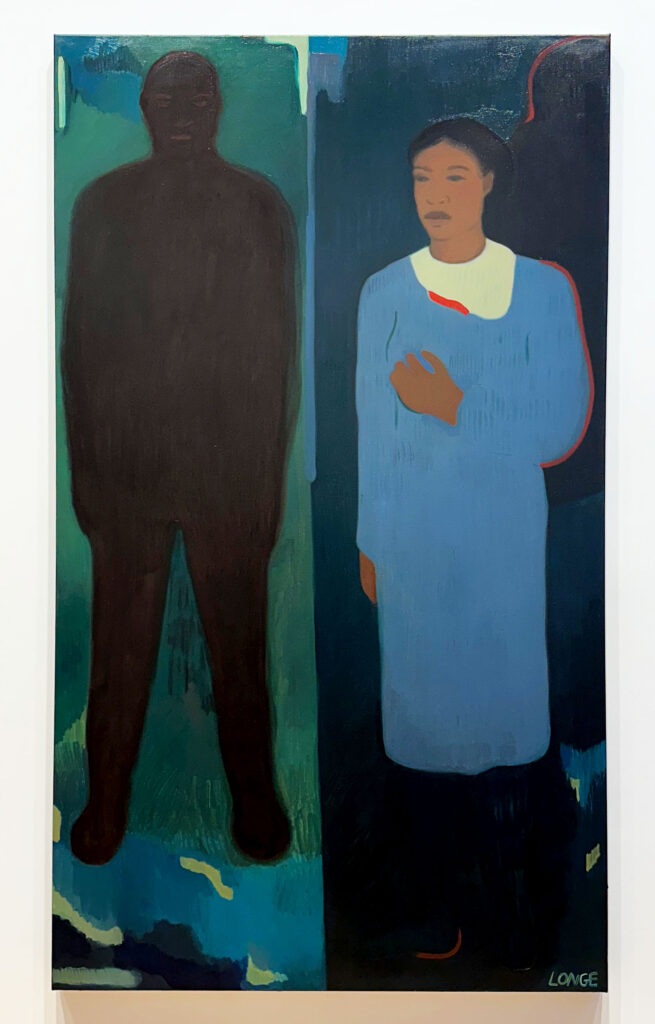
Sahara Longe “Skull”, 2024, Oil on Linen

“As We Are (after Otto Friedrich)”, 2024, Oil on Linen

“Liar”, 2024, Oil on linen

This week’s throwback is to Sahara Longe‘s paintings from her 2024 exhibition at Timothy Taylor gallery in NYC, Sugar.

From the gallery about the work-

Featuring twelve vivid and haunting canvases, Longe’s second exhibition with the gallery sees the artist reconceiving various art histories to arrive at an uncanny interplay of figures, allegories, and enigmatic landscapes. The show will be accompanied by an essay by Ferren Gipson, art historian and writer based in London.

In paintings characterised by a preternatural handling of line, colour, and figuration, Longe depicts partially abstracted subjects in atmospheric environments. Working on thick grain linen with raw pigment in a distinct palette of vermillion, lilac, raw sienna, and ochre, she renders her scenes with a fluid painterly freedom that is nevertheless quiet and precise in its effect. Across her work, she recalls aspects of the Symbolist ethos, which moved between nostalgia and rupture, seeking not to capture something directly, but rather convey the sensations it produces.

In her new paintings, Longe focuses on the nude. Articulated in spare, suggestive gestures, her subjects, largely women, are pictured huddled together, embracing a lover, or striding alone. Some set their gaze on an unknown distance, others stare down the viewer, and one confronts a fish. Each seems possessed by a disquieting tension that is emphasised by a shadowy apparition lurking in many of the works. Masculine in stature, the incubus perches over a scene or cradles another figure therein. Where Longe’s previous series reflect on social dynamics, depicting parties and crowds, these paintings are more personal; the artist explains that the new works look inward rather than outward. Expressive, brushy marks bring subtle notions of agitation, dreaminess, and intimacy to otherwise minimal passages of colour.

These paintings further explore the ideas set out in Longe’s earliest work, which emerged from her study of classical portraiture at Charles H. Cecil Studios in Florence; in her early canvases, Longe integrated and recontextualised themes and styles of old-master paintings. Here, her compositions draw from Secessionist painter Otto Friedrich’s nudes and Symbolist Ferdinand Hodler’s ominous portraits. They likewise reveal the influence of a recent trip to Oslo, where Longe was taken by Henrik Sorensen’s mural (1938–50) in Oslo City Hall (where the Nobel Peace Prize is selected), and the marginalia of illuminated manuscripts. Ushering these disparate sources and traditions into her singular aesthetic, Longe poses subtle questions about representation—who it serves, and what narratives it upholds—just as she underscores figuration’s expressive potential.

Oct 102025
 

Today’s flashback is to Huma Bhabha‘s spooky figures for Before The End, which was on view until March of this year at Brooklyn Bridge Park.  It is just one of the many projects organized by Public Art Fund.

From Public Art Fund about the work-

With the ominous title Before the End, Huma Bhabha (b. 1962, Karachi, Pakistan) sets the stage to evoke mythologies as old as humankind. Conceived for Brooklyn Bridge Park, Bhabha’s four monumental painted and patinated bronzes were cast from carved cork and skull fragments. The mysterious figures recall ancient effigies cut into tombstones, their surfaces evoking centuries of eroded sediment and stone. Yet, unlike a tomb, these four-sided vertical forms stand elevated above the earth, their bones open to the sky.

Before the End” is a title borrowed from the writings of Vincent of Beauvais (ca. 1184–1264), whose medieval imagination sparked with supernatural and apocalyptic visions. Today, the related popular genres of horror and science fiction continue to inspire Bhabha, as does art history from antiquity to the present day. Her rough-hewn figures are ambiguous—are they emerging or trapped within, rising from the depths of the earth or returning to the underworld? Set amidst an expansive landscape where the natural and man-made converge, Bhabha’s sculptures captivate through contradiction, seemingly forged in geological time yet animated with a visceral sense of immediacy.


Oct 072025
 

William Wegman‘s portraits of his Weimaraner dogs were recreated in glass mosaic form by Mayer of Munich in 2018 for “Stationary Figures”, lcated in the 23rd Street subway station. The eleven murals brighten up the walls and are one of the many projects created by MTA Arts & Design.

From MTA Arts & Design about the work-

Photographed with the artist’s deadpan sense of humor, the dogs take on human attributes, from wearing street clothes like a shiny raincoat or flannel shirt, to being grouped like passengers as they gaze into space or peer down the platform as if waiting for the train.

Situated in bold blocks of color, the larger-than-life mosaic dogs are bursting into space and interacting with commuters. The mosaic fabricator, Mayer of Munich, interpreted the photographs taken for this project by meticulously transforming the facial expressions, skin textures and patterns of the dogs’ vibrant attire into glass mosaic. Wegman has lived and worked in the neighborhood for decades, and together with his dogs Flo and her brother Topper, they have created images that enliven this busy station.

Speaking about the project, Wegman said, “I wanted to create portraits of individual characters, people who you might see next to you on the platform. For these I dressed the dogs in more or less ordinary clothes, nothing too fashionable. I was very interested in the way in which photographs, even the out of focus dogs in the background of some images, could be translated into mosaic by Mayer of Munich, who skillfully turned gray stones into gray dogs.”

Below are the two series consisting of three panels each-