Jan 032020
 

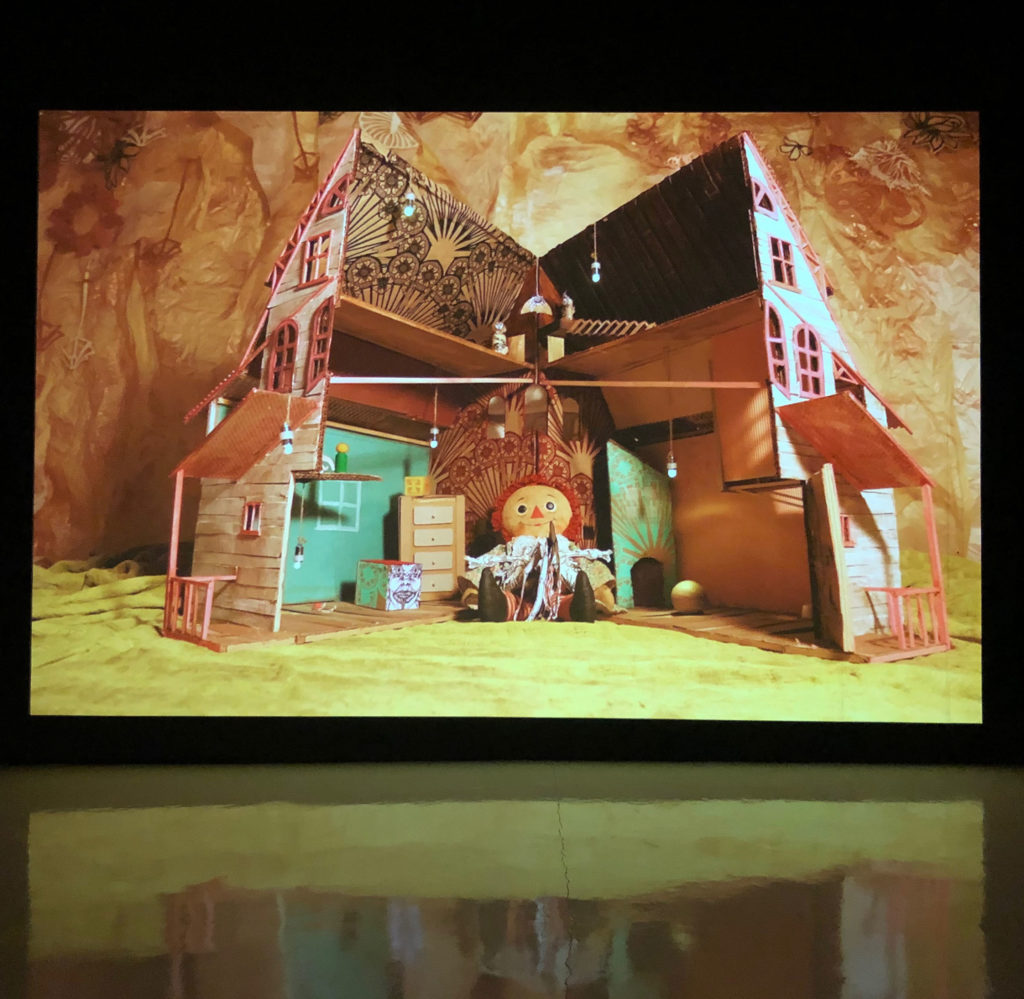
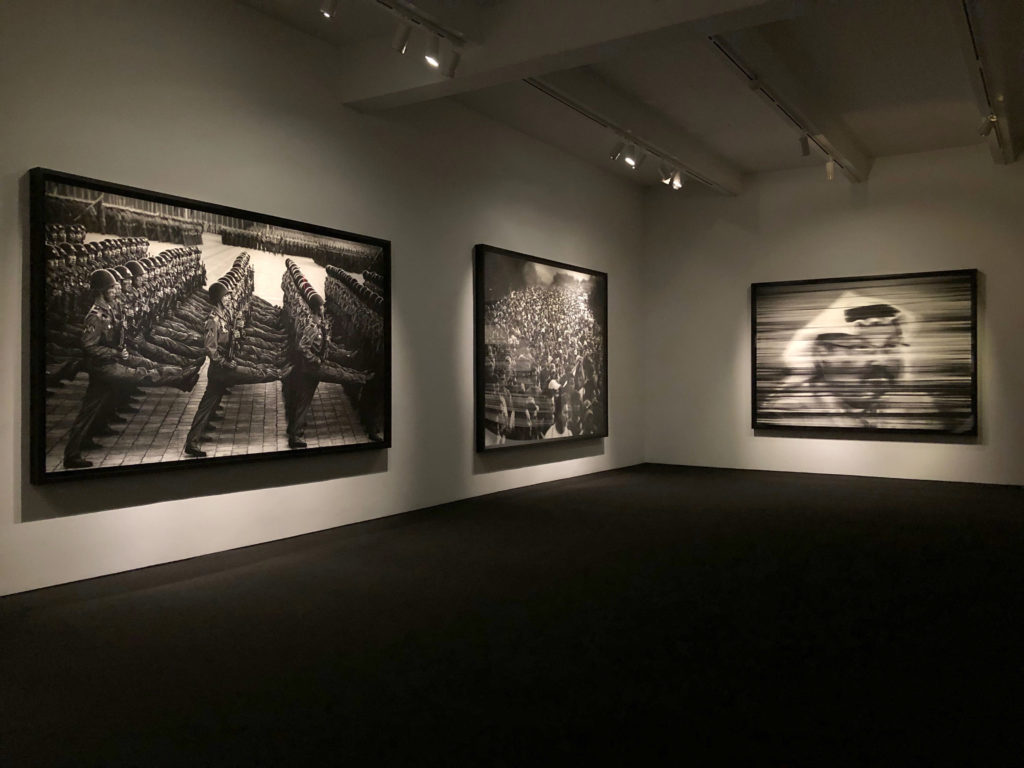
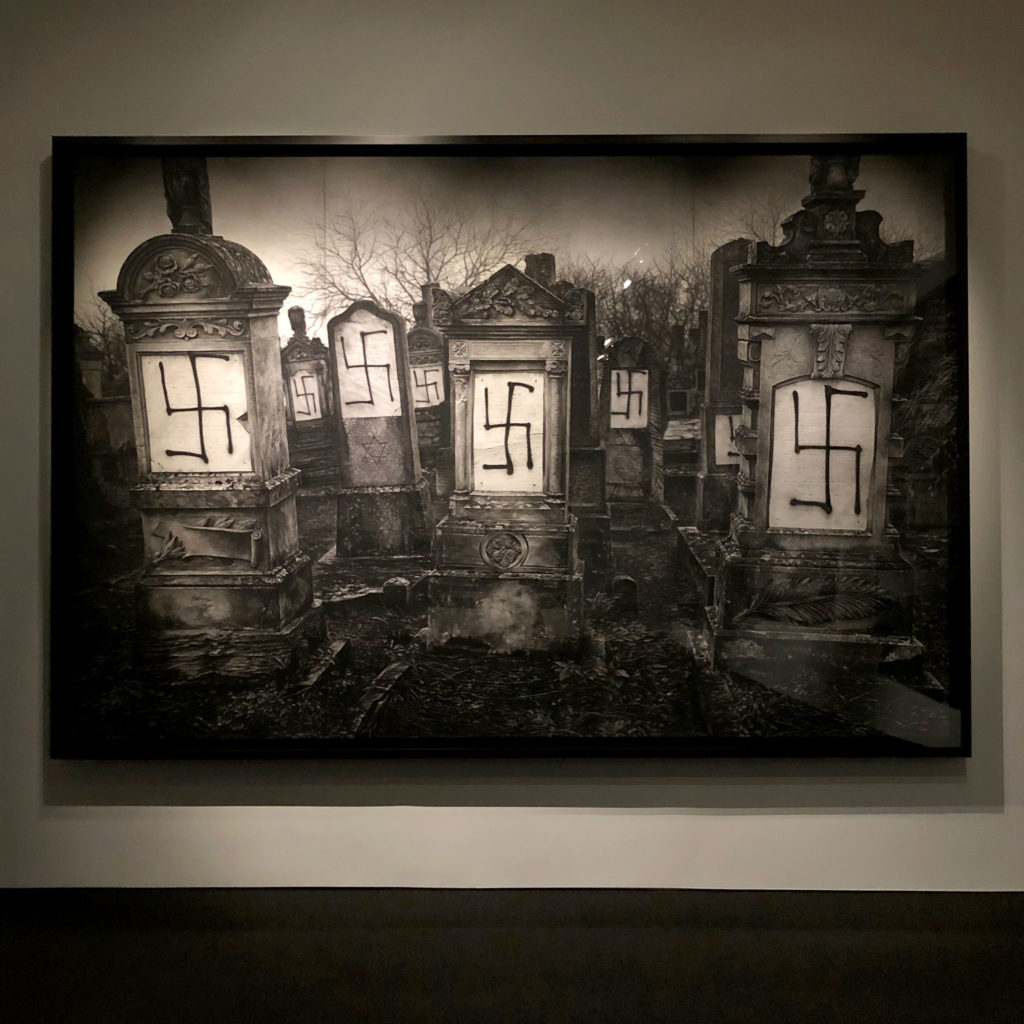
Death March, 2012

Death March, 2012 (detail)

Currently at Luis de Jesus Los Angeles is Hugo Crosthwaite’s incredible exhibition, TIJUAS!(Death March, Tijuana Bibles, and Other Legends).

From the press release-

Hugo Crosthwaite has spent much of his adult life working on both sides of the U.S. and Mexico border, observing and documenting the extraordinary ebb and flow of humanity that makes this region one of the most existentially dynamic places on the North American continent. In Tijuas!, Crosthwaite will present selections from several bodies of work that continue his exploration of this ever-evolving culture, among them the Tijuana Bibles, a new series of animated videos and books, recent graphite-and-ink on canvas and panel paintings, new Tijuanerias ink drawings, and Death March, a phenomenal and monumental work that preceded his celebrated performative murals. This will be the first time this work will be presented since it was commissioned in 2010 for Morbid Curiosity: The Richard Harris Collection at the Chicago Cultural Center.

This exhibition closes 1/4/20.

Jan 032020
 

Black Girls Window, 1969

Mystic Window for Leo, 1966

As part of MoMA’s Opening Season, they are showing Betye Saar’s 1969 work, Black Girl’s Window, along with several of her works on paper.

The exhibition “explores the relation between her experimental print practice and the new artistic language debuted in that famous work, tracing themes of family, history, and mysticism, which have been at the core of Saar’s work from its earliest days.”

This exhibition closes 1/4/20.

Jan 032020
 

The Occult Enthusiast, 2019

The Occult Enthusiast, 2019 (detail)

Conspiracy Screen, 2019

Conspiracy Screen, 2019 (detail)

The GloFish Enthusiast, 2019

A Moment Eclipsed #1, 2019

The paintings in the Hernan Bas exhibition TIME LIFE at Lehmann Maupin’s 24th Street location tell stories. What those stories are, in some ways, ends up being up to the viewer. There is something really fun about that- paintings that your imagination can expand upon.

From the press release

This exhibition will include seven large-scale paintings and one decorative room screen that feature a series of strange and seemingly obscure or forgotten moments that have influenced American culture. This body of work illustrates Bas’ innate ability to highlight cult phenomena from the past that offer insight into the political and social concerns of today. Rather than focusing on a singular subject matter, as Bas has done previously, this series spans time periods and themes, providing a unique perspective on American subculture and a contemporary version of History Painting.

Bas is best known for his narrative paintings that weave together adolescent adventures and the paranormal with classical poetry, religious stories, mythology, and literature. His subjects are often young men, typically in the transitional moment between boyhood and manhood. While the young male figure remains prominent in this body of work, each individual painting becomes an in-depth investigation into a singular critical subject, addressing topics such as LGBTQIA+ activism and desire, politics, news, conspiracy theories, and the occult. The title of the exhibition, TIME LIFE, is inspired by the Time-Life Book series Mysteries of the Unknown. Published between 1987 and 1991, each book focused on a different paranormal topic, such as ghosts, UFOs, psychic powers, and dreams. For TIME LIFE, Bas has similarly produced a series of paintings, each focused on a singular topic, that navigate the boundaries between pop culture and history, fiction and reality, and the artist’s personal interests and curiosities.

The Sip In, 2019

For The Sip In (pictured above) however, there is more of a specific story that Bas is telling.

From the press release-

For the large-scale painting, The Sip In (2019), Bas drew inspiration from a photograph that was recently featured in The New York Times for the 50th anniversary of Stonewall. The image depicts the 1966 “sip in” at Julius’ bar, where three young men, dressed in suits, were refused service for being openly gay. The bar still exists today and is now known as the oldest gay bar in New York City. Bas was intrigued by this irony and hidden piece of New York history, as well as by the compositional similarity to Leonardo da Vinci’s The Last Supper (1495). Bas’ interpretation highlights this formal similarity by removing the body of the bartender, leaving only his apparition in the form of a white glove hovering over a glass, making the young men the primary subjects of the painting. This representation of 1960s gay activism through the formal likeness to an iconic religious painting depicting Christ just prior to his death emphasizes the violence the LGBTQIA+ community continues to endure, especially as their rights are increasingly at risk due to the current presidential administration’s discriminatory language and policies.

This exhibition closes 1/4/20.


Dec 282019
 

The images above are from Michelle Handelman’s film Irma Vep, The Last Breath, starring Zackary Drucker and the late Flawless Sabrina.

The video installation is based on Musidora, the French silent film actress, and the character she is best known for Irma Vep from the 1915 film Les Vampires directed by Louis Feuillade.

From the exhibition’s caption-

It’s a piece about living in the shadows, criminal anxiety, and the relationship between the artist and her creation, both fictional and real.

Irma Vep and Musidora are played by Zackary Drucker (Transparent) and the late Flawless Sabrina (The Queen), two artists whose identities transgress the border of art and life. Together, they developed a relationship that documents a cultural evolution of gender.

Musidora was an early 20th century feminist who took control of her career, not only acting, but also producing/directing films and theater. She was an artistic force of her time, producing several works by her lover Colette and having many documented affairs with both men and women. After financing dried up for her projects, she lived in relative obscurity until her death in Paris, 1957. In her later years, she worked the ticket booth of the Cinematheque Francaise, where few people ever knew that the woman selling them their movie tickets was France’s beloved vamp of the silver screen.

Irma Vep, The Last Breath takes up motifs from the silent movie such as gazes, affected body language and the figure of the masked woman. It’s shot on a starkly illuminated set that makes space for anxious projections of desire on the void that is Irma Vep- a space between genders, between vamps of the silent era and the contemporary queer- smashing the shiny veneer to reveal dark, subconscious layers of fluid identity.

The film is part of the larger exhibition Idol Worship, a group show curated by Emily Colucci, at Smack Mellon which “celebrates the ongoing cultural, social and political significance of role model adoration as an essential survival strategy”.

The exhibition closes 12/29/19.

Dec 272019
 

Volcanic Eruption At The Junk Yard, 2019

Standoff at the Bedrock Bunny Club, 2019

After The Rapture (Border Town), 2019

Rosson Crow’s paintings for her exhibition Trust Fall at The Hole are bright, chaotic, and very reflective of the times we are living in.

From the press release-

Rosson Crow is in one sense an American History Painter—capitalized—who has made paintings across a range of subjects, foreign and domestic, but always meditating on the American story and her place in it. Since her debut show at Canada Gallery in 2004 while still an undergrad, Crow has established herself as a big, brainy, macho painter who nonetheless maintains a performative seduction with color and content.

This new exhibition features ten immersive panorama paintings that meditate on our 2019 moment in America. In what is her most urgent and timely work to date, she grapples with the erosion of American institutions and even of reality and truth itself. “Chaos autopsies” she calls them, each taking on specific aspects of her thinking—or dreaming—about current issues. KonMari is about the latest trend of disciplinary minimalism but depicts a giant landfill of “fast fashion”; After the Rapture in a Border Town shows a human-free street at the Mexican border; Volcanic Eruption at the Junk Yard is a fierce, fiery pit of melting old cars, while Ocean Front Property in Arizona is pretty self explanatory. No humans are present in any of the works, unless a cardboard cutout or statue; in this trust fall there is no one to catch us.

Using luminous oil paint, spray paint and thrown enamel, Crow builds up the surfaces of her works as she layers their content; bleeding into one another, the paintings feel like a tinted vintage post card, hi-contrast outlines whose colors have melted with time. Using moments of photo transfer for snippets of text, bumper stickers or beer cans, the repeating transfers confer a sense of glitching in the painted image, heightening their theatrical illusionism while questioning their reality; has this image been photoshopped? Has this video been edited? How much can we trust our own eyes?

The paintings are topical but not didactic. Ignorance, absurdity and swirling misinformation make the current political landscape untraversable; to a civilian psyche it makes analysis and action extremely difficult.  The exhaustion that comes from this onslaught must make artmaking even harder; most retreat, make head-in-the-sand works that don’t attempt any sociopolitical issues. Crow has always made works that highlight the staged nature of space, that look at fake or contrived scenes, like the painting above; in this Garden of Eden recreation from a religious-themed creationism park, the plants look like they are from Home Depot not an actual tropical jungle. Looking “behind the curtain” at manipulated reality is a non-partisan issue that speaks to both sides of the cultural divide, as everyone is stuck in this morass together; everyone wants to unravel the myriad ways we are secretly controlled and how power is written into our lived and virtual environment.

This exhibition closes 12.29.19.

Dec 202019
 

Artist Jennifer Bartlett has been exploring the image of the archetypal house since the 1970s. For her current exhibition at Marianne Boesky Gallery, The House was Quiet and the World was Calm: Jennifer Bartlett 1970–2014, a variety of these works are on display. It’s interesting to think of the traditional basic shape of the house, one often used to draw a house as a child, here expanded upon and explored in various ways and mediums. The viewer is also challenged to think about what they imagine when they think of the concept of house, of home.

From the press release

… For Bartlett, the appeal of the house lies, in part, in its incredible universality. The simple square crowned with a triangle conjures an expansive array of emotions, memories, and associations across the spectrum of individuals. And in the U.S., it holds a particular place in the national psyche—a symbol of the deeply entrenched notion of the American dream. Subjected to Bartlett’s ongoing and systematic explorations of painting and printing techniques, however, the house in instances is flattened, reformulated, and distorted to a range of formal and emotional effects.

This exhibition closes 12/21/19.

Dec 202019


Jack Shainman Gallery is currently showing two solo exhibitions of recent paintings by Meleko Mokgosi. The first, (a painting from which is pictured above) is titled The social revolution of our time cannot take its poetry from the past but only from the poetry of the future.

From the press release-

The title of Mokgosi’s 20th Street installation, The social revolution of our time cannot take its poetry from the past but only from the poetry of the future., is taken from Karl Marx’s The Eighteenth Brumaire of Louis Bonaparte. This text points to the limits of revolutionary discourses and proposes that it is only through disavowing the past that revolutionary action can occur. Similar to this argument, this body of work argues both for a disavowal of past grand narratives as well as the recuperation of non-Western forms of knowledge that were not privileged to coexist with conventional or established discursive frameworks. All twelve paintings are paired with a text that is taken from the writings of women either from Africa or the African Diaspora. The texts and paintings examine a wide range of issues, from African feminism and the struggle for liberation by African countries, to love, solidarity, and aesthetics. By pairing text and image, Mokgosi’s work aims to further questions around the politics of representation and strategies of resistance.

The second exhibition is Pan-African Pulp, pictured below.

From the press release-

…Mokgosi’s body of work at 24th Street, uses popular southern African pulp magazines or photo-novels to examine, broadly, the history of Pan-Africanism. These photo-novels, colloquially referred to as look-books, were first printed in the 1960s as an off-shoot of Drum Publications. Unlike Drum magazine, which addressed politics and issues of race in South Africa, photo-novels such as Lance Spearman avoided engaging with debates around politics, instead choosing to offer entertaining James Bond-like episodes of crime fighting. The photo novels—a less expensive alternative to filmmaking—are composed of staged photographs depicting action scenes, and follow a script conveyed with speech bubbles written in English, combining elements of comic books, films, and magazines.

Mokgosi has appropriated this trope and created new dialogue and plots within the existing imagery. By specifically focusing on Pan-Africanism, Mokgosi hopes to find meaningful ways of reconceptualizing the importance of a movement that sought to build alliances towards Black consciousness and foregrounding the rights and aspirations of Africans to self-determination and self-governance. Mokgosi reflects, “There is no doubt about the injustices, inhumanity, exploitation, violence, and racism caused by and associated with the Euro-American slave trade, European imperialism in Africa, and institutionalized racism in the Americas; the effects of these are ongoing and reflected not only in cultural and geopolitical contexts but also in the very reproduction and circulation of capital.” This work is the first of many stages through which Mokgosi intends to engage with and ask urgent questions around Pan-Africanism and solidarity.

Both of these exhibitions close 12/21/19.

Dec 202019
 

The paintings in Li Songsong’s One of My Ancestors, at Pace Gallery in Chelsea, are rich in both color and texture. Li creates his paintings from found photographs, adding another dimension to the work.

From the press release-

In the process of reinterpreting found imagery drawn from public sources such as everyday news items, Li adopts an impartial attitude. “I did not deliberately look for these images,” he explains, “It just happened. For example, a friend of mine went to an old book stall in Beijing to buy old magazines. I saw a good photo, and then I used it. I don’t seem to care about the content of the image itself. Of course, they are a starting point, but they will affect you more on a psychological level than in a narrative way.”

Li is interested in the ways in which images can trigger memories and emotions—a psychological impact magnified by his technique. The use of impasto and the dense materiality of his brushstrokes elicit a potent haptic response, while his palette of cool shades of gray, green, and beige create an estrangement from his chosen subject matter, as seen in Little Brother (2017), South (2017), and Civil Rather than Military (2018). Through his signature use of compact blocks of color, Li deconstructs and reassembles images, pushing his art towards abstraction.

This exhibition closes 12/21/19.

Dec 192019
 

Anish Kapoor’s exhibition at Lisson Gallery’s 24th Street location is a reflective wonderland where the sculptures twist your perception of your surroundings as you move around them. If his work looks familiar, he has created many public outdoor works including Cloud Gate, also known as “The Bean”, which is permanently installed in Millennium Park in Chicago.

The exhibition continues at Lisson Gallery’s smaller 10th Avenue space with several of Kapoor’s colorful wall-based circular sculptures in semi-reflective hues.

Both of these exhibitions close 12/20/19.


Dec 192019
 

For Peter Halley’s Heterotopia II, at Greene Naftali’s ground floor gallery in Chelsea, he has created a delightful, brightly colored maze-like installation.

From the press release

In Des Espaces Autres (1984), Michel Foucault defines heterotopia in opposition to utopia. While utopias are unrealized representations of a perfected society, heterotopias exist within all societies as realms differentiated from everyday life. Examples include ceremonial, sacred, and institutional spaces such as chapels, cemeteries, libraries, and prisons. They are spaces designated for special activities – creating their own sense of time and operating according to their own standards.

Through a range of media – painting, architectural installation, digital prints, and critical writing – Peter Halley’s work has illuminated the structures of social space and communication that shape our experience of contemporary life. For his second solo exhibition at Greene Naftali, Halley presents Heterotopia II, the latest in a series of large-scale installations exploring the relationship between painting and architectural space. Halley has created a multi-colored, labyrinthine structure in the ground floor gallery housing eight new shaped-canvas paintings, titled after imaginary planets from Isaac Asimov’s science-fictional universe.

The installation is enclosed by tall neon yellow walls coated in Roll-a-Tex, with only a narrow slot in the front wall offering the viewer a preemptive glimpse inside. The interior space is organized around a glowing yellow core – an inaccessible inner sanctum whose light is solely visible through three distinctive apertures. Around the core are arrayed eight interconnected rooms rendered in vivid colors, each defined by architectural elements, including staircases, keyhole windows, beams, and columns. The arrangement of these elements playfully nods to motifs in the work of architects Peter Eisenmann, Hans Hollein, Luis Barragán, and Louis Kahn, as well as to Halley’s own oeuvre. Halley’s installation, with its candy colored surfaces, is a postmodern reverie on neoplasticism and modernist geometry, founded on a tension between rationalist geometry and lyrical color.

Visitors circulating through the maze-like installation encounter Halley’s shaped-canvas paintings one-by-one, as the interactions between two-dimensional image and three-dimensional architecture unfolds. Composed of multiple interlocking prisons and cells, the paintings create ambiguous figure-ground relationships, while echoing the geometric plan of their three-dimensional setting.

This exhibition closes 12/20/19.