
Wayne Thiebaud’s Make Up Girl (1982), seen at the San Diego Museum of Art. The museum is currently closed due to COVID-19 but they have a lot of excellent online programming including virtual performances, lectures, virtual tours and more.

Wayne Thiebaud’s Make Up Girl (1982), seen at the San Diego Museum of Art. The museum is currently closed due to COVID-19 but they have a lot of excellent online programming including virtual performances, lectures, virtual tours and more.

Erik Parker’s Good Vibrations (2018) from his 2018 exhibition at Mary Boone Gallery, New Mood.


Currently at Nancy Hoffman Gallery in New York is Purdy Eaton’s delightful painting exhibition Eat and Live. Eat and Die.
From the press release-
Eaton’s upcoming exhibition is a nod to Bruce Nauman’s One Hundred Live and Die. Eat and Live, Eat and Die; the essence of all life: plants, animals, humans, kings, queens, and cockroaches are all bound to this ethos. This, like Nauman’s other phrases, Feel and Live, Feel and Die, is simultaneously fatalistic and equalizing. The chaos of politics, climate volatility, and random violence is rightfully fear inducing and overwhelming, yet there is something hopeful and meditative about the reality you eat you live, you eat you die. There will always be a tomorrow no matter how dystopic.
Eaton’s darkly humorous oil paintings riff on this dichotomy. As climate change and divisive politics tear at our foundations, we are placated by funny cat videos and TikTok memes. Play and Live, Play and Die. We can see the big picture, but sometimes it is just too depressing and overwhelming, and we want to enjoy that gorgeous sunset even if it is made of toxins.
In a series about state birds, Eaton examines the warped reality that many of the state birds are no longer able to inhabit the states they were legislated to represent. The California quail, California’s state bird for nearly a century, is leaving the state as their range is becoming too warm for them to stay. In Eaton’s depiction, the quail appear in front of a lovely sunset, but on further inspection, they might actually be escaping the latest wildfire. In another painting, Paul Bunyan rises in the foreground, while an American loon flies in another direction. The juxtaposition of this iconic strongman roadside attraction—symbolic of the American celebration of “man taming the wilderness”—-with a bird that can no longer live in Minnesota, hints that it might be time to reexamine our origin stories. In another painting from the series, a Northern Flicker with bright yellow plumage rises from a background of rockets in Huntsville, Alabama. As the location of early launches, these relics of NASA’s glory years are now tourist attractions. Space is no longer the purview of science and human progress—it has become the escape hatch, the place to go when we need a Plan B.
Eaton also spins Nauman’s duality to remind us that despite the apocalyptic visions we read about daily, it is not all bad for all creatures. Fireflies, for instance, are flourishing. The Canada Goose, once on the verge of extinction, has become so common as to be a nuisance. With these color-rich and storied paintings, Eaton is asking us to realize that this is our moment to be alive, before we all die, and that the flowers are indeed quite beautiful.
This exhibition closes 3/14/20.

This mural, Untitled (Questions) (1990/2018), by artist Barbara Kruger, is on the wall of The Geffen Contemporary at MOCA in Los Angeles until November 2020. The work was originally commissioned by MOCA in 1989 for the exhibition A Forest of Signs: Art in the Crisis of Representation, and was last installed in 1990 on the south wall of MOCA’s building (now The Geffen Contemporary at MOCA).


Currently at Sikkema Jenkins & Co. gallery in New York is on the lower frequencies I speak 4U (alquimia sagrada), a solo exhibition of work by william cordova.
From the press release-
For the artist’s fourth solo exhibition at the gallery, cordova has developed a multi-media installation seeking to explore “the juxtaposition of past structures to more contemporary structures that illuminate the ephemeral nature of our existence, as beings who create material culture as a means of documentation and memory.”
The exhibition incorporates large-scale drawing collages, photography, and sculpture into an environment that reflects on abstract forms rooted in sacred geometries, while also drawing from historical moments and monuments of resistance. Two large scale sculptures, untitled (RMLZ), and untitled (palenque), reference both Brutalist and pre-Columbian architecture, specifically the temple-Citadel sites at Sacsayhuaman and Ollantaytambo. Incorporating the architectural motifs found at these sites, such as zigzags and grids, cordova’s sculptures thread an ephemeral repository, meditating on the concepts of image encoding from biological, natural, galactic, and cultural sources. The sculptures disrupt the formal structure of the gallery, creating alternative perceptions of space and time.
In his series rumi maki, william cordova takes on an ethnographic approach in addressing shared symbolism found in textile data encoding and architectural design. Named after the ancient Andean martial arts, rumi maki consists of multi-colored collages on paper, constructed from vivid layers of recycled paint chips. The arrangement of colors and patterns carry latent meanings, dependent on geography, culture, and the readings of celestial bodies. As cosmological maps, the collages synthesize the sacred geometries of architecture with the visual narratives of historical civilizations. Its form also recalls pioneering early video installation artist Beryl Korot, and her contributions to the 1970s video journal Radical Software.
ogun (el siglo de silencio) sees the artist return to large-scale collage on paper after several years focused on site-specific installations and smaller-scaled work. This work introduces viewers to a new series titled el quinto suyo (the fifth suyo), collages culled from reclaimed paint chip samples and recycled cardboard pigmented with old discarded oil stick paint. Literary references permeate cordova’s collages; texts such as El Siglo de Las Luces by Alejo Carpentier, El Monte by Lydia Cabrera and Decimas by Nicomedes Santa Cruz point to his ongoing interest in the distribution of power, spirituality, and labyrinths of perception.
In the back gallery is an exhibition of paintings (pictured below) by Josephine Halvorson, titled On The Ground.


From the press release-
On The Ground, also the title of her essay in Art In America (June/July 2018), continues Halvorson’s exploration of the ground—as a motif, material, and metaphor. Each painting registers an area of ground through Halvorson’s close observation and pictorial description, while its accompanying surround incorporates crushed rocks and debris from the site of the painting’s making. Together, they realize a faithful translation of place and time. The work in this exhibition was made in the Berkshire mountains, the Mojave Desert, and Matanzas, Cuba.
These hybrid paintings are made with gouache, site material, dry pigment, and printmaking. They expand Halvorson’s on-site practice of transcribing direct experience by hand. While her previous work in oil allowed her encounter with an object to congeal over the course of a day, Halvorson has turned to gouache, a fast drying and graphic medium, which, like handwriting, records her observations in real time. Her paint application is indelible and fresco-like, transferring color from the brush into the absorbent ground of the panel.
Touching down at various points of interest—a piece of plastic, a blade of grass—Halvorson’s notational marks establish a correspondence between environment, painting, and viewer. Like a map, they depict the literal scape of the ground while offering an escape from mimesis. The reality of proximity breaks down as one gets lost in the archeology of a single stride. Gravel becomes galactic. The surround acts as a legend or key, a space for evidence and tools of calibration. A ruler, coins, or color chart orient the onlooker in terms of scale and perception, and the site material indexes the painting to its original locale. These are paintings of verification and memorialization. They ask how we make sense of what we see, how we express that witnessing, and how an account of experience is made concrete.
Both of these exhibitions close 2/29/20.


Currently at Pace Gallery in New York are Nigel Cooke’s ten large-scale paintings. The paintings have an exuberant intensity to them. Close up the shades of varying color, layers of paint, and the textures created by the brush strokes, show the detail that went in to creating the overall effect of the work.
From the press release-
Completed over the past year, these ten new large-scale paintings mark a significant shift in the artist’s direction toward a more performative, energetic, and abstract approach to figuration. This shift was propelled by a recent residency in the city, where Cooke remarked that “the entire philosophy of what it is I am doing has been adjusted.” These works, which reference actions, places, and people, exist as matrices in which the artist’s free and open process meets wider themes of metaphor, spirit, nature, representation, and the living material quality of paint. In this way, these new works draw on the legacies of American artists such as Willem de Kooning and Clyfford Still as well as Abstract Expressionism, British Figuration, Spanish painting, and Chinese silk painting.
…These dynamic compositions become transitional grids that unfix and multiply the idea of what a figure is, reflecting a complex interplay of vigor, chance, and intuition. They begin with a single color drawn in a loose structure that drives the painting process forward. Building up the canvas in lines and washes, the paintings move away from a defined image, resulting in a myriad of possibilities from the mud and grit of real landscapes to atmospheric emanations or presences. As such, they do not depend on a fixed viewpoint but drift between states, contradicting themselves over time and allowing for the possibility of transformation.
Furthering Cooke’s radical shift in his practice, the paintings were executed on raw canvas—a first for the artist. The natural linen endows the paintings with a unique brownish ground and a textured weave that is seen throughout the works. This material quality also impacts Cooke’s mark-making as washes develop into thickets of dark staining and lines that taper off and sometimes produce kasure or “flying white,” an ancient Chinese silk painting technique known for its ribbon-like strokes that sputter and appear to leap off of the surface of the canvas.
This exhibition closes 2/29/20.

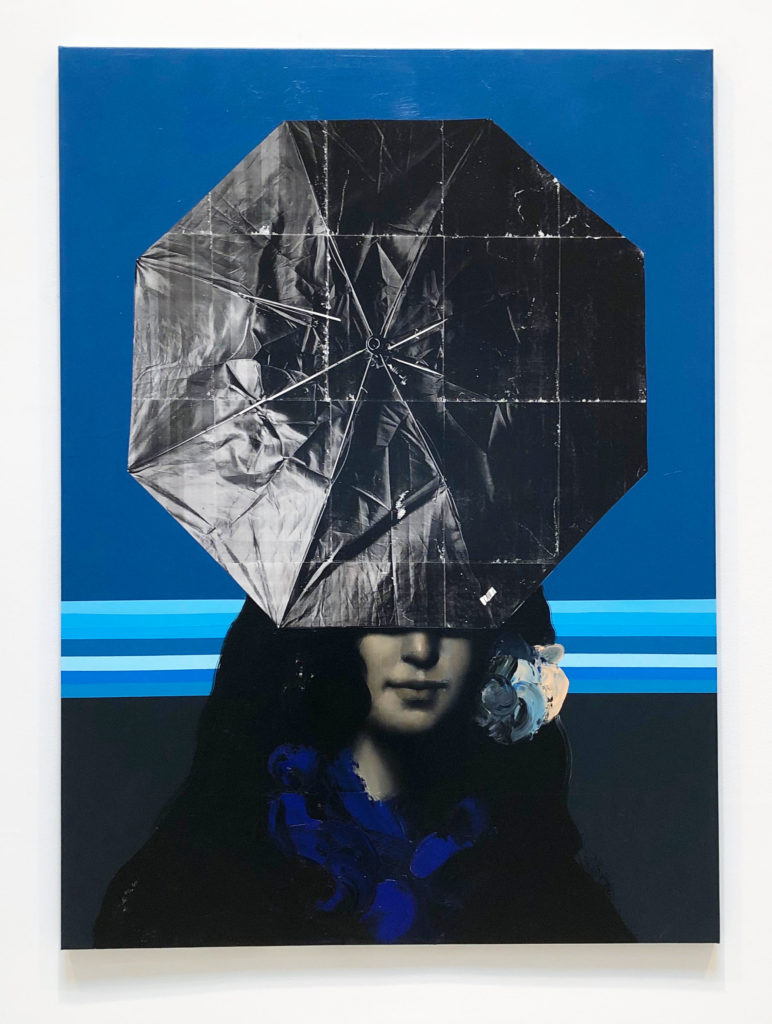
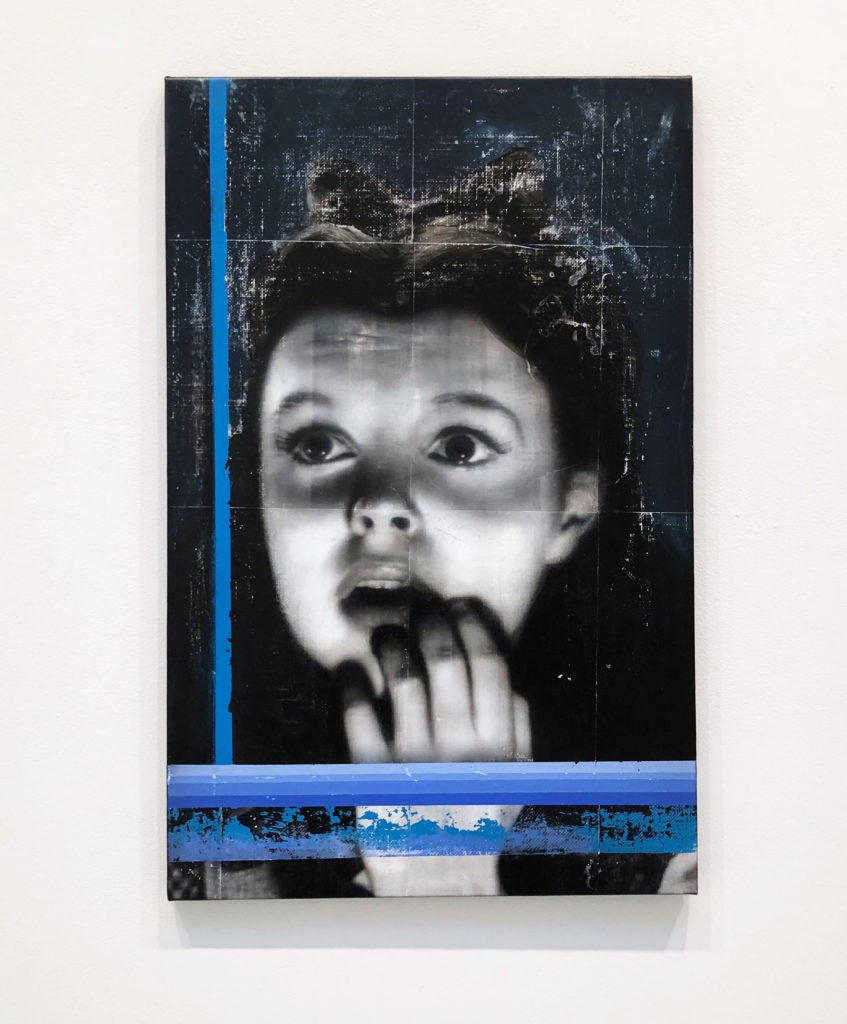
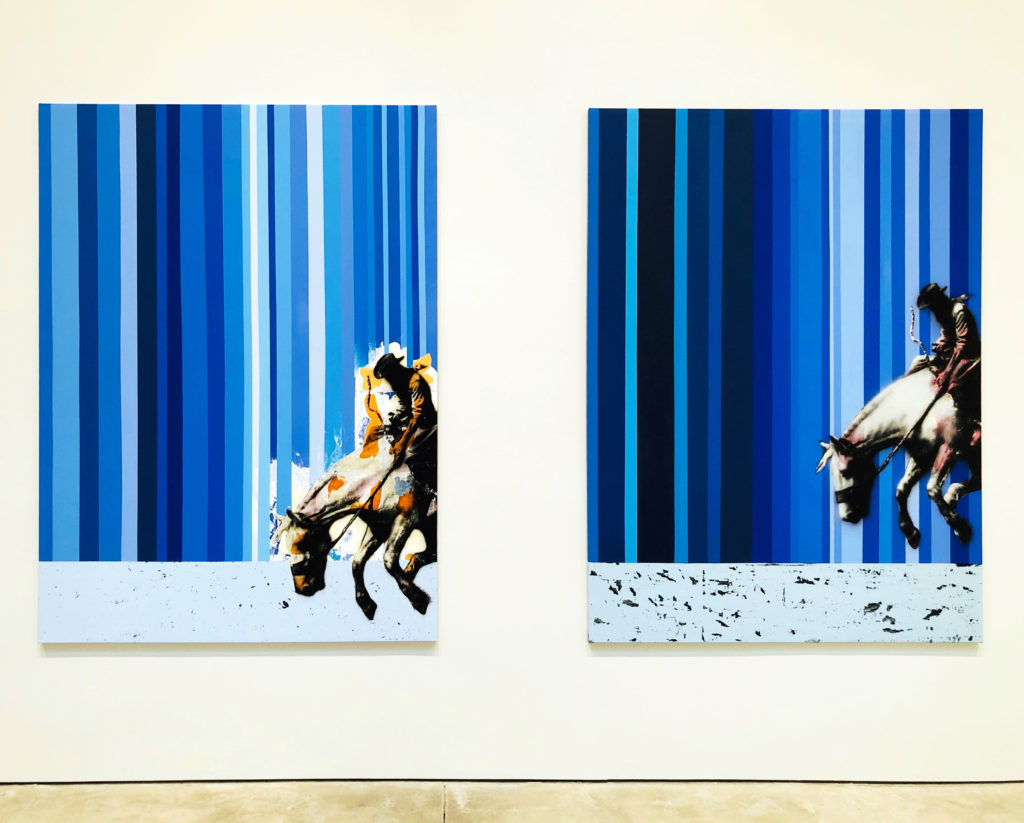
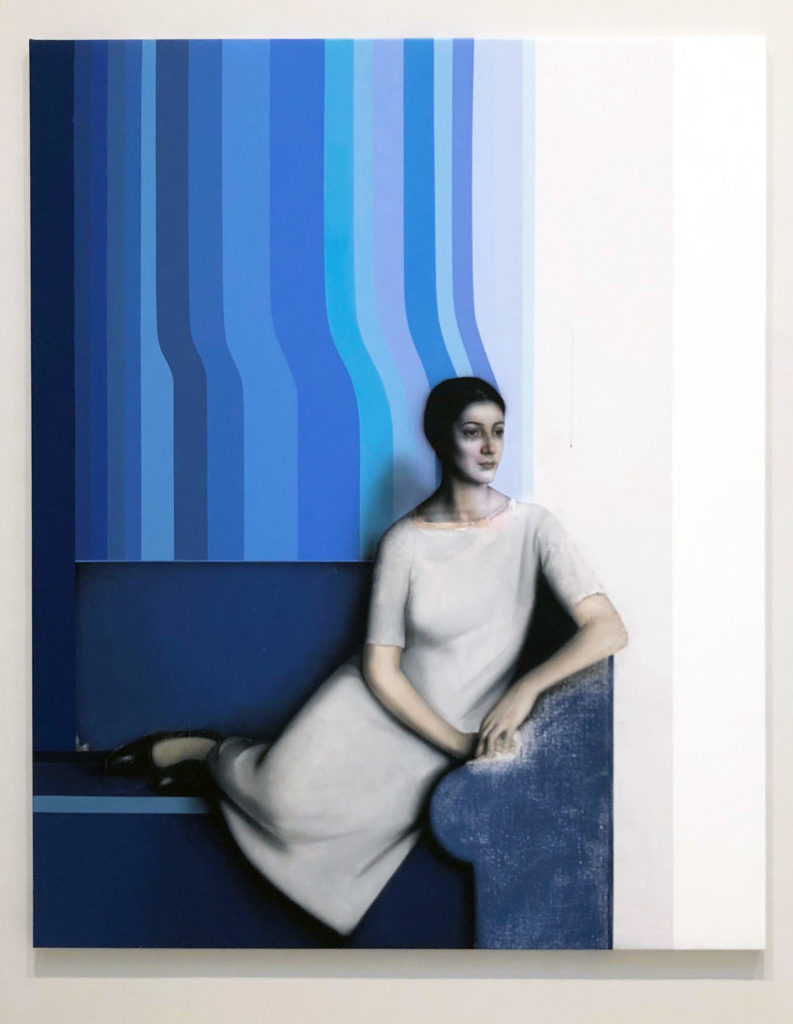
Currently at Blain Southern gallery’s New York location is Mircea Suciu’s Universal Fatigue.
From the press release-
Part of the Cluj School, Mircea Suciu (b. 1978, Baia Mare, Romania) is regarded as one of Romania’s leading artists. During his formative years he witnessed the country’s tumultuous transition after the only violent overthrow of a communist government in the 1989 revolutions. Describing himself as an image creator rather than a traditional painter, Suciu mines and references art history and contemporary imagery, reducing down the elements and adding colour coded symbolism. He has ‘his own complex way of making things in which painting, photography, drawing and print all cooperate while playing their individual parts’ 1
Inspired by his former studies on the restoration of Baroque paintings, Suciu has developed a process he calls ‘monoprinting’. A photographic image is split into a grid of A4 surfaces, each one printed onto an acetate sheet onto which a layer of acrylic paint is applied. The paint acts as a ‘glue’ that adheres to directly to the canvas and once dry, the acetate sheet is peeled off. The result is a transference of the printed image with associated faults and imperfections which Suciu then ‘restores’ by re-painting with oil and acrylic paint. Sometimes, as with works in the Disintegration series, he overlays the image multiple times using various colours until he creates a surface that is barely recognisable from the original. As a final stage the whole image is repainted. This multi-layered process creates compositions of reinvented images which allude to history, memory and eventual dissolution of all things.
‘A characteristic of my work is frailty, not regarding the subject but the relationship between the surfaces that constitute the ensemble of the whole picture.’ – Mircea Suciu
This exhibition closes 2/21/20.
Mary Jane, 2008
Untitled, 2015
1975 (8), 2013
Painting for My Dad, 2011
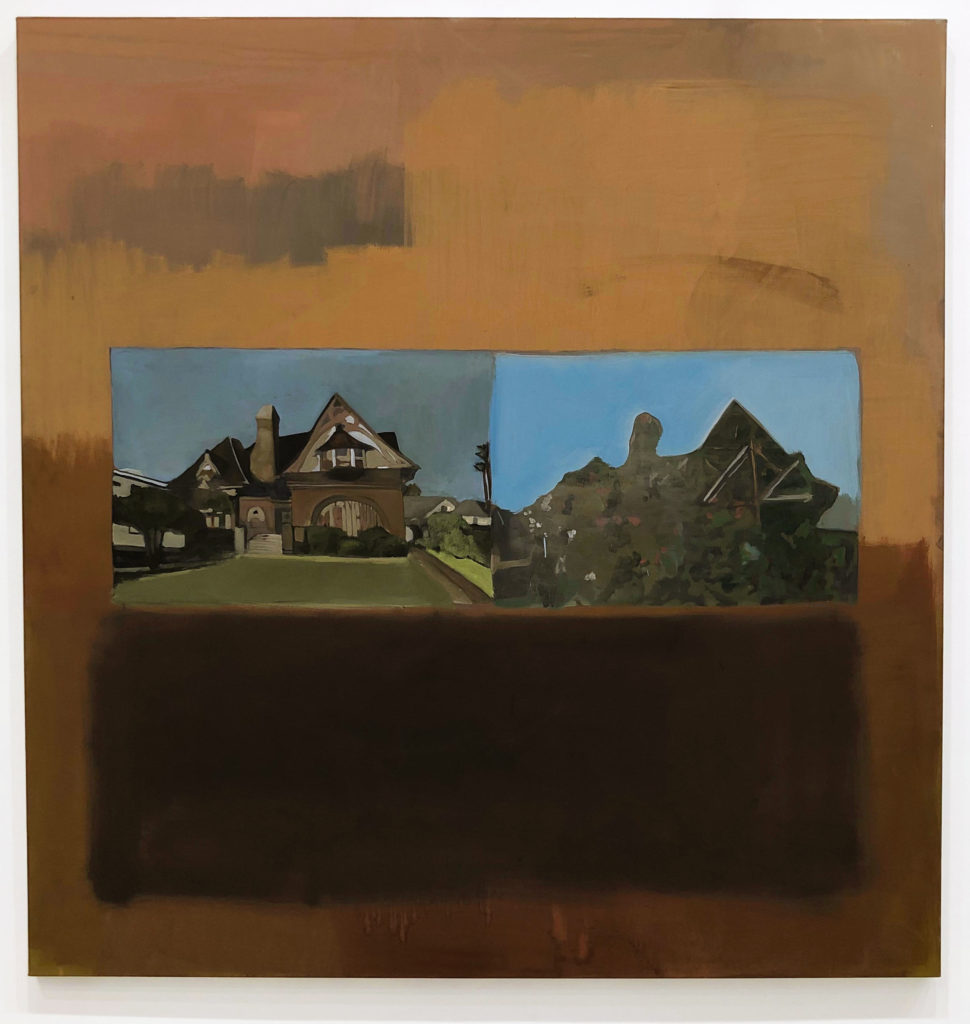
The “Fitz”, 2015
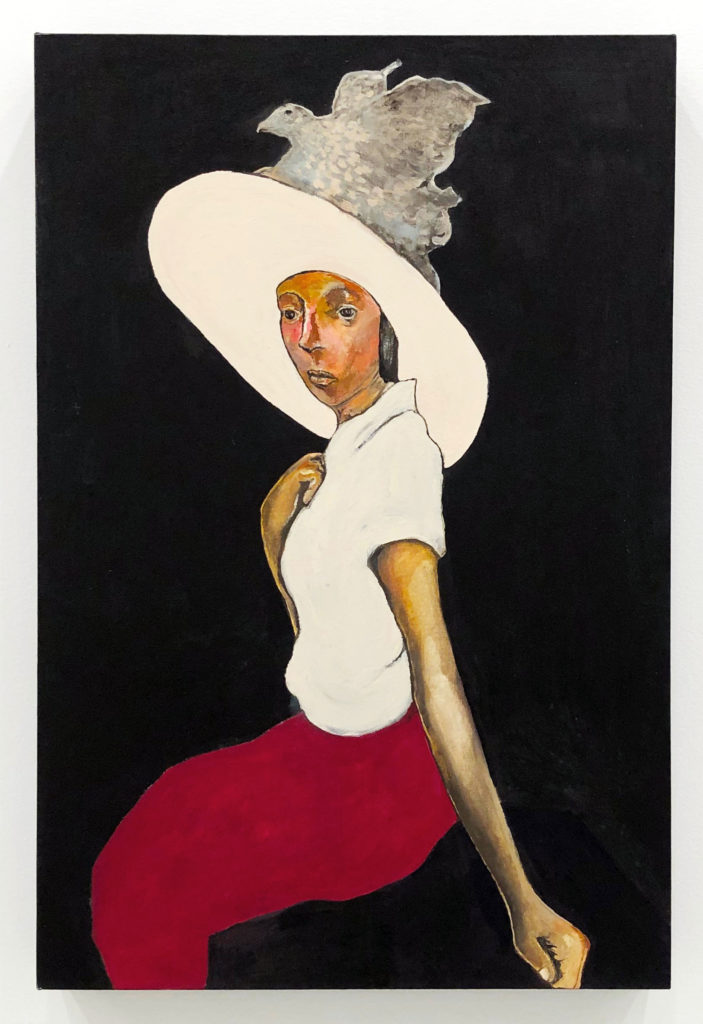
Black Widow, 2007
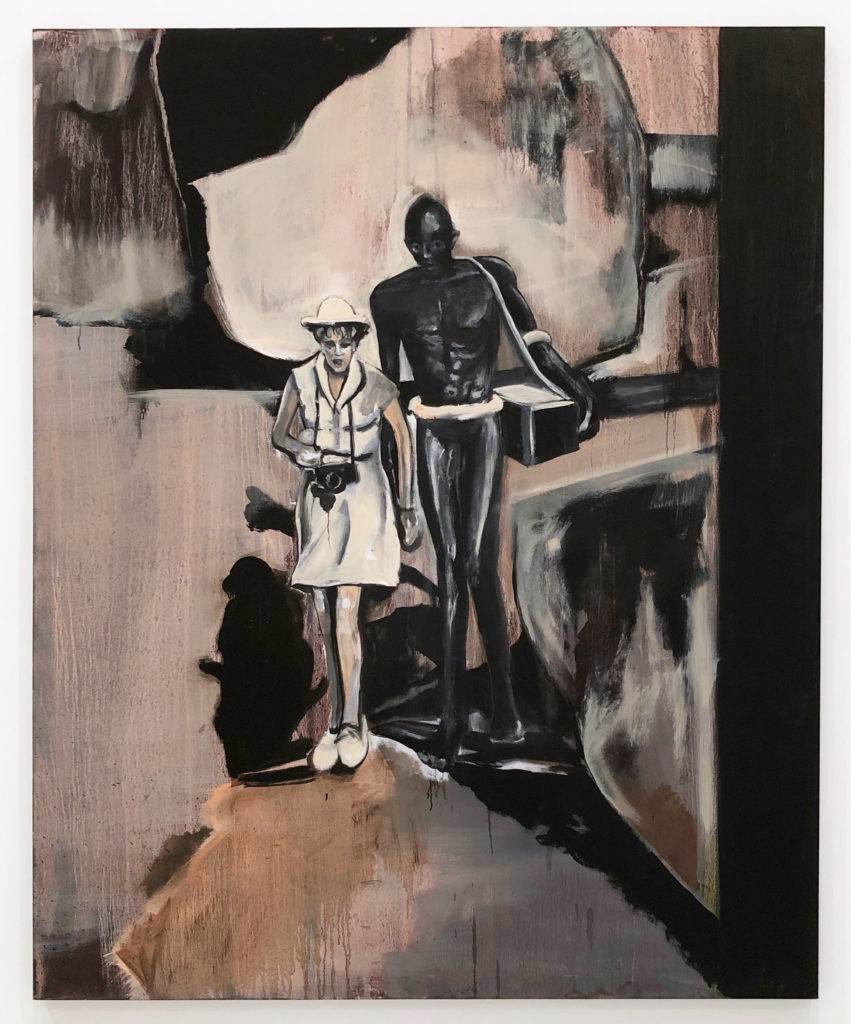
Leni Riefenstahl, 2010
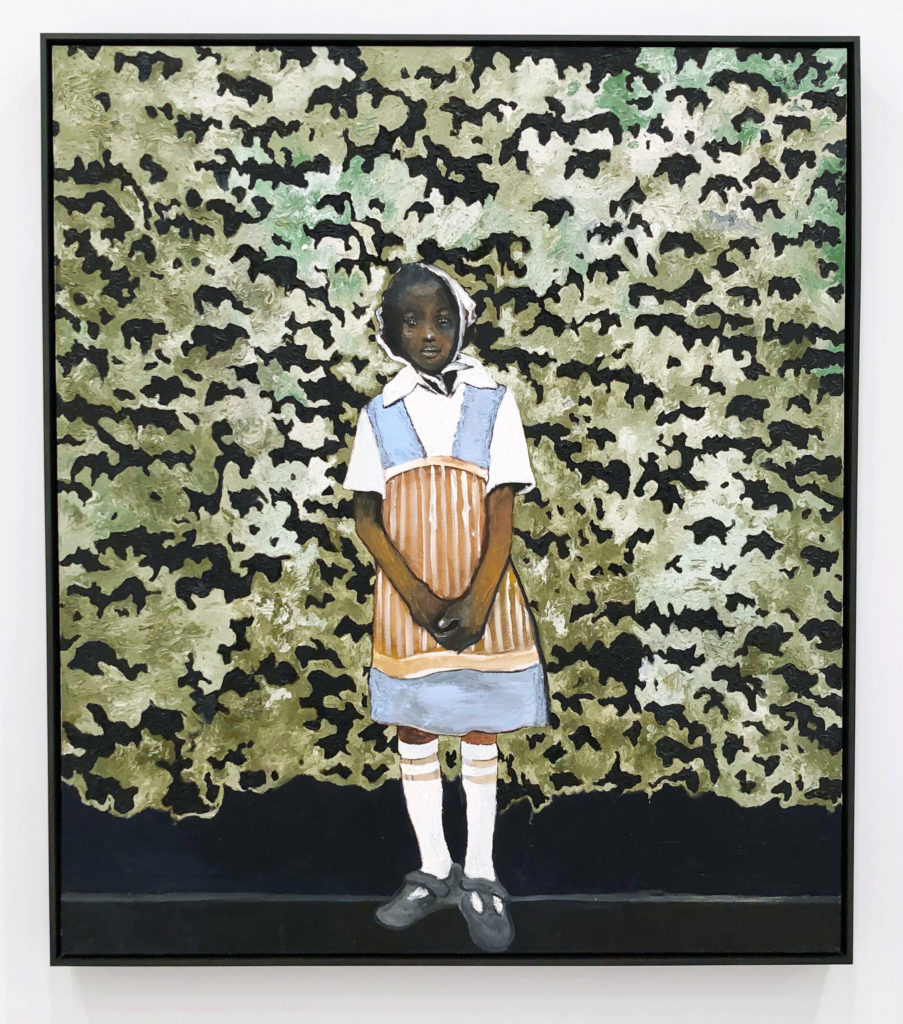
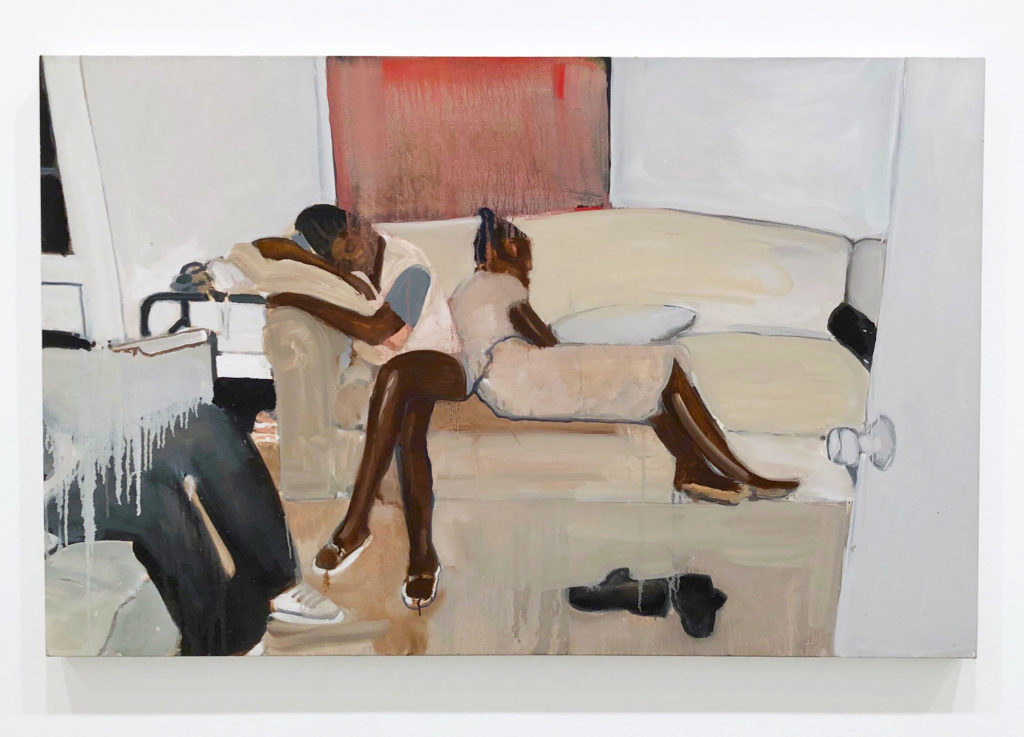
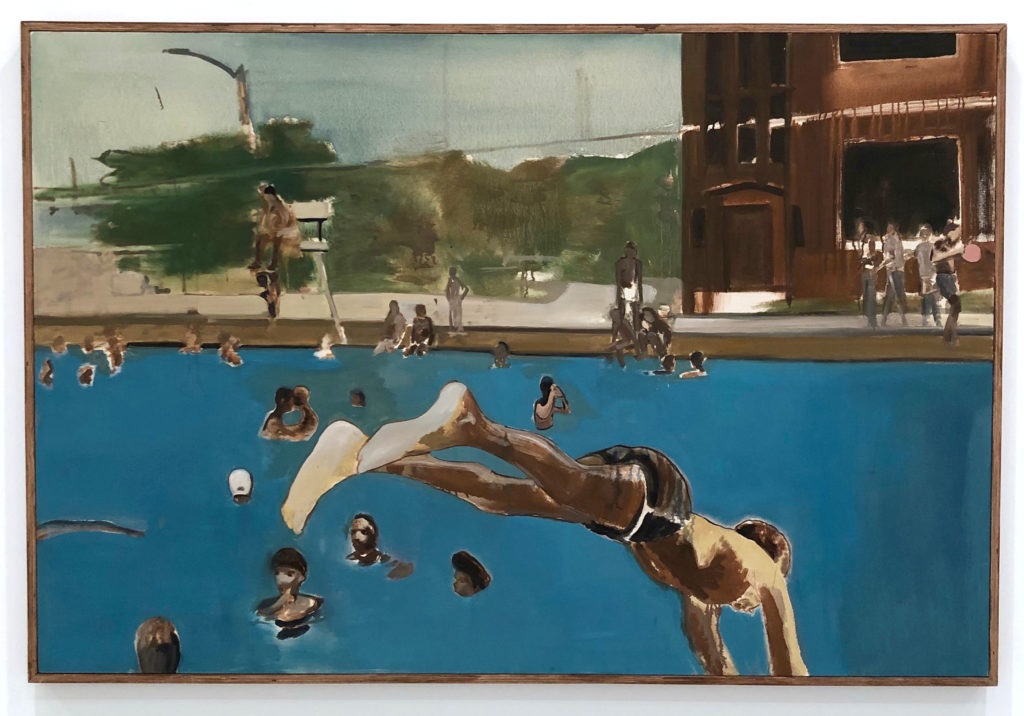
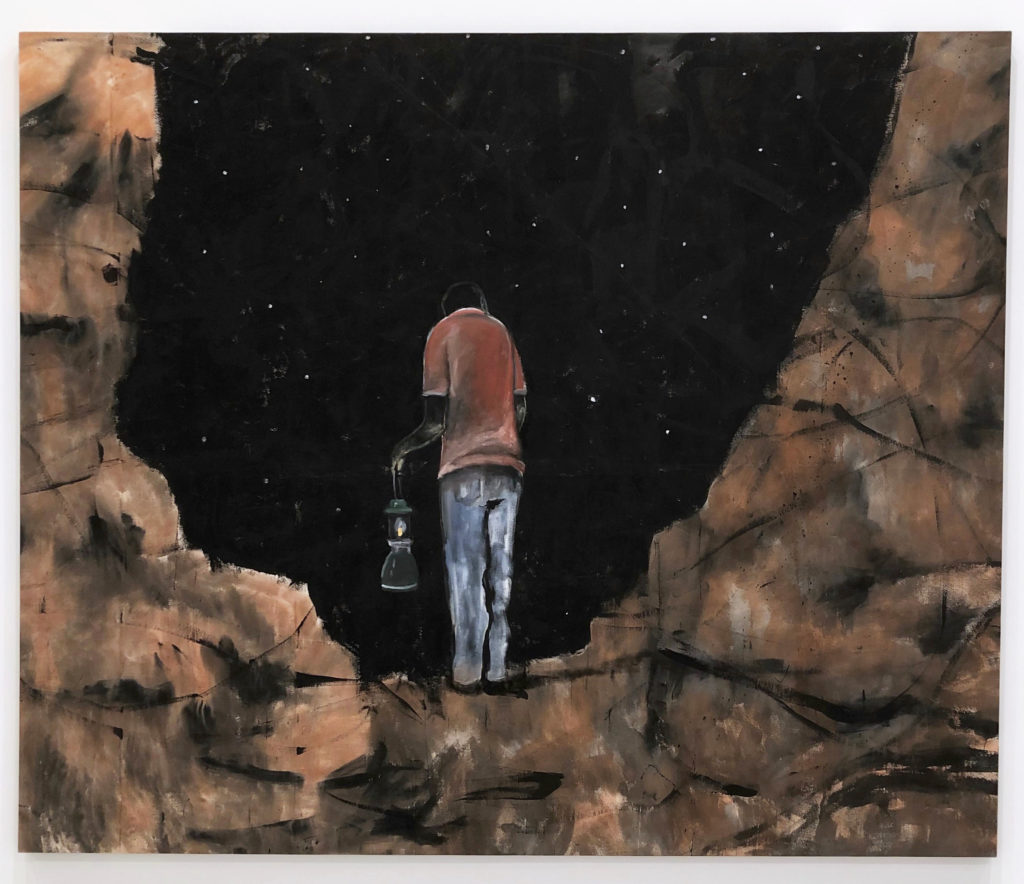
Artist Noah Davis’s superb paintings are currently on view at David Zwirner gallery’s two 19th Street locations in New York until 2/22. Although his career was brief, he died in 2015, what he accomplished in his life is admirable.
From the press release–
Davis’s body of work encompasses, on the one hand, his lush, sensual, figurative paintings and, on the other, an ambitious institutional project called The Underground Museum, a black-owned-and-operated art space dedicated to the exhibition of museum-quality art in a culturally underserved African American and Latinx neighborhood in Los Angeles. The works on view will highlight both parts of Davis’s oeuvre, featuring more than twenty of his most enduring paintings, as well as models of previous exhibitions curated by Davis at The Underground Museum. The exhibition also includes a “back room,” modeled on the working offices at The Underground Museum, featuring more paintings by Davis, as well as BLKNWS by Davis’s brother Kahlil Joseph; a sculpture by Karon Davis, the artist’s widow; and Shelby George furniture, designed by Davis’s mother Faith Childs-Davis.
Helen Molesworth notes:
Noah Davis (b. Seattle, 1983; d. Ojai, California, 2015) was a figurative painter and cofounder of The Underground Museum (UM) in Los Angeles. Despite his untimely death at the age of thirty-two, Davis’s paintings are a crucial part of the rise of figurative and representational painting in the first two decades of the twenty-first century.
Loneliness and tenderness suffuse his rigorously composed paintings, as do traces of his abiding interest in artists such as Marlene Dumas, Kerry James Marshall, Fairfield Porter, and Luc Tuymans. Davis’s pictures can be slightly deceptive; they are modest in scale yet emotionally ambitious. Using a notably dry paint application and a moody palette of blues, purples, and greens, his work falls into two loose categories: There are scenes from everyday life, such as a portrait of his young son, a soldier returning from war, or a housing project designed by famed modernist architect Paul Williams. And there are paintings that traffic in magical realism, surreal images that depict the world both seen and unseen, where the presence of ancestors, ghosts, and fantasy are everywhere apparent.
Generous, curious, and energetic, Davis founded, along with his wife, the sculptor Karon Davis, The Underground Museum, an artist- and family-run space for art and culture in Los Angeles. The UM began modestly—Noah and Karon worked to join three storefronts in the city’s Arlington Heights neighborhood. Davis’s dream was to exhibit “museum-quality” art in a working-class black and Latino neighborhood. In the early days of The UM, Davis was unable to secure museum loans, so he organized exhibitions of his work alongside that of his friends and family, and word of mouth spread about Davis’s unique curatorial gestures.
In 2014 Davis began organizing exhibitions using works selected from The Museum of Contemporary Art’s collection as his starting point. In the aftermath of Davis’s passing, the team of family and friends he gathered continued his work at The UM, transforming it into one of the liveliest and most important gathering places in Los Angeles for artists, filmmakers, musicians, writers, and activists.
If you are in Los Angeles, The Underground Museum is definitely worth a visit, and if you cannot make it to this exhibition in NYC- a portion of it moves there this March.
Also, Kahlil Joseph’s “BLKNWS” will be shown the Brooklyn Academy of Music in NYC from 3/23-6/21/20.
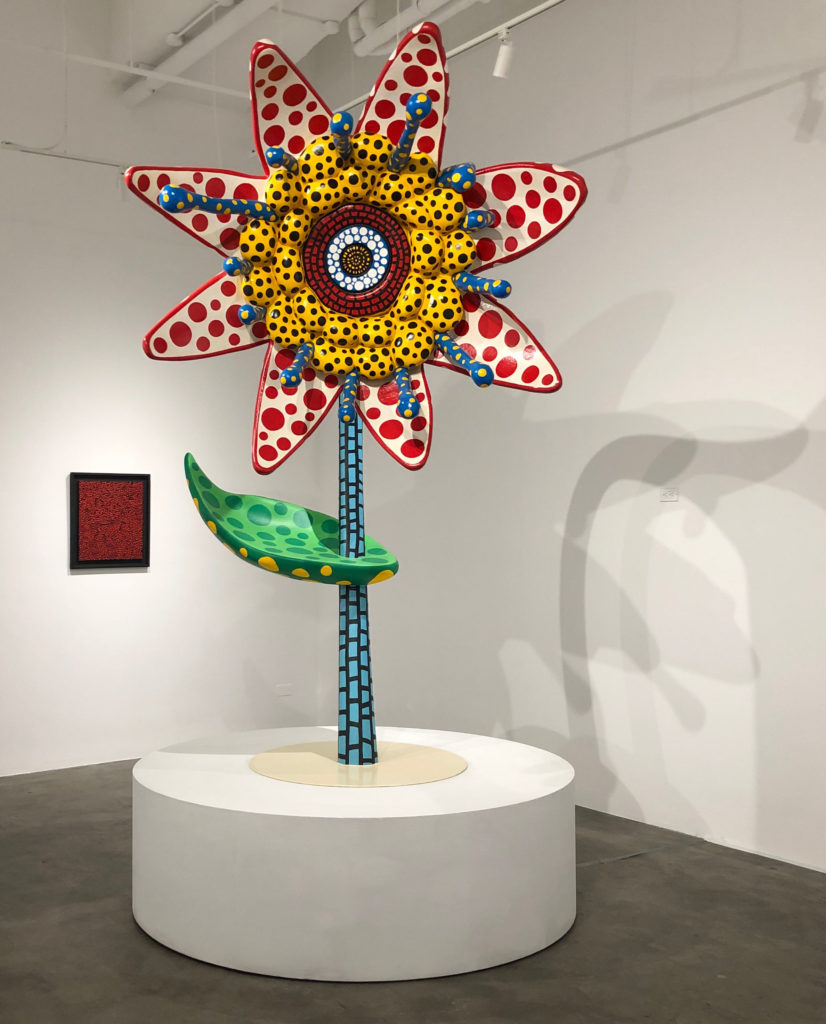
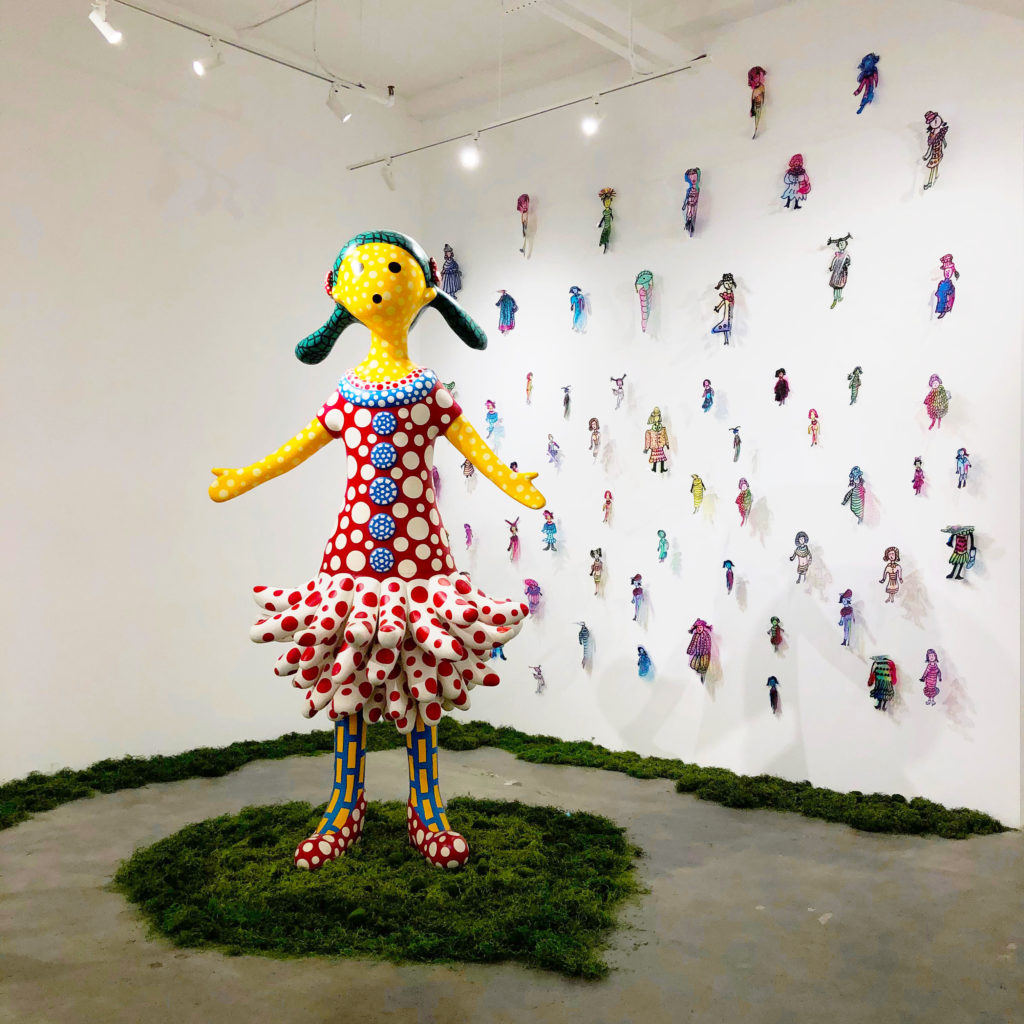
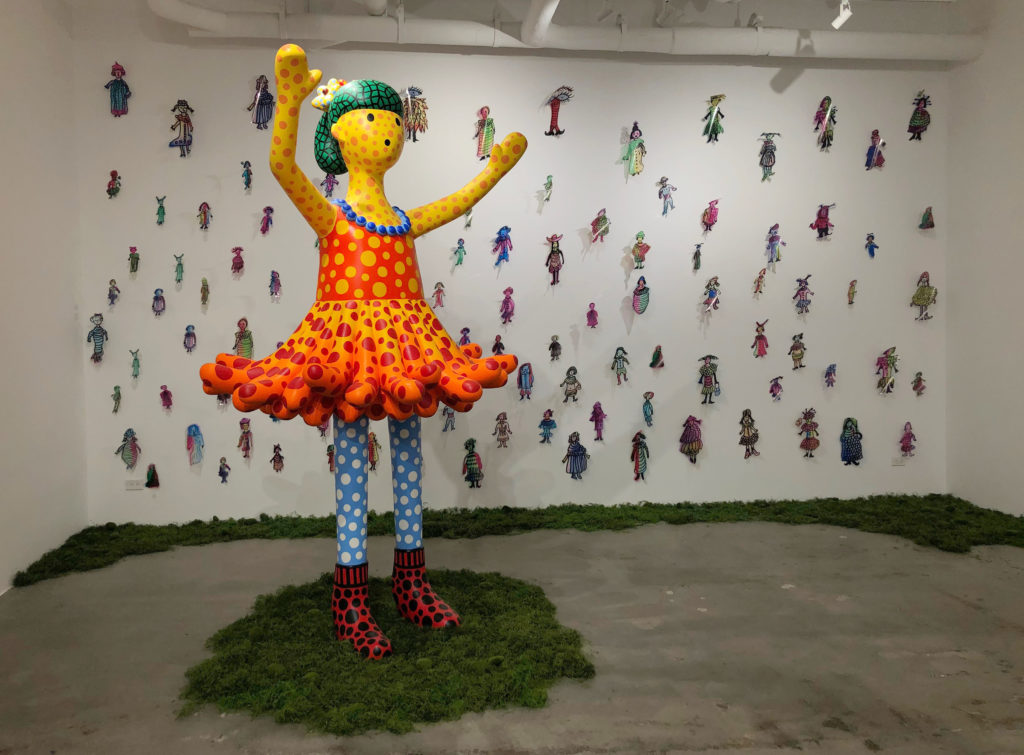
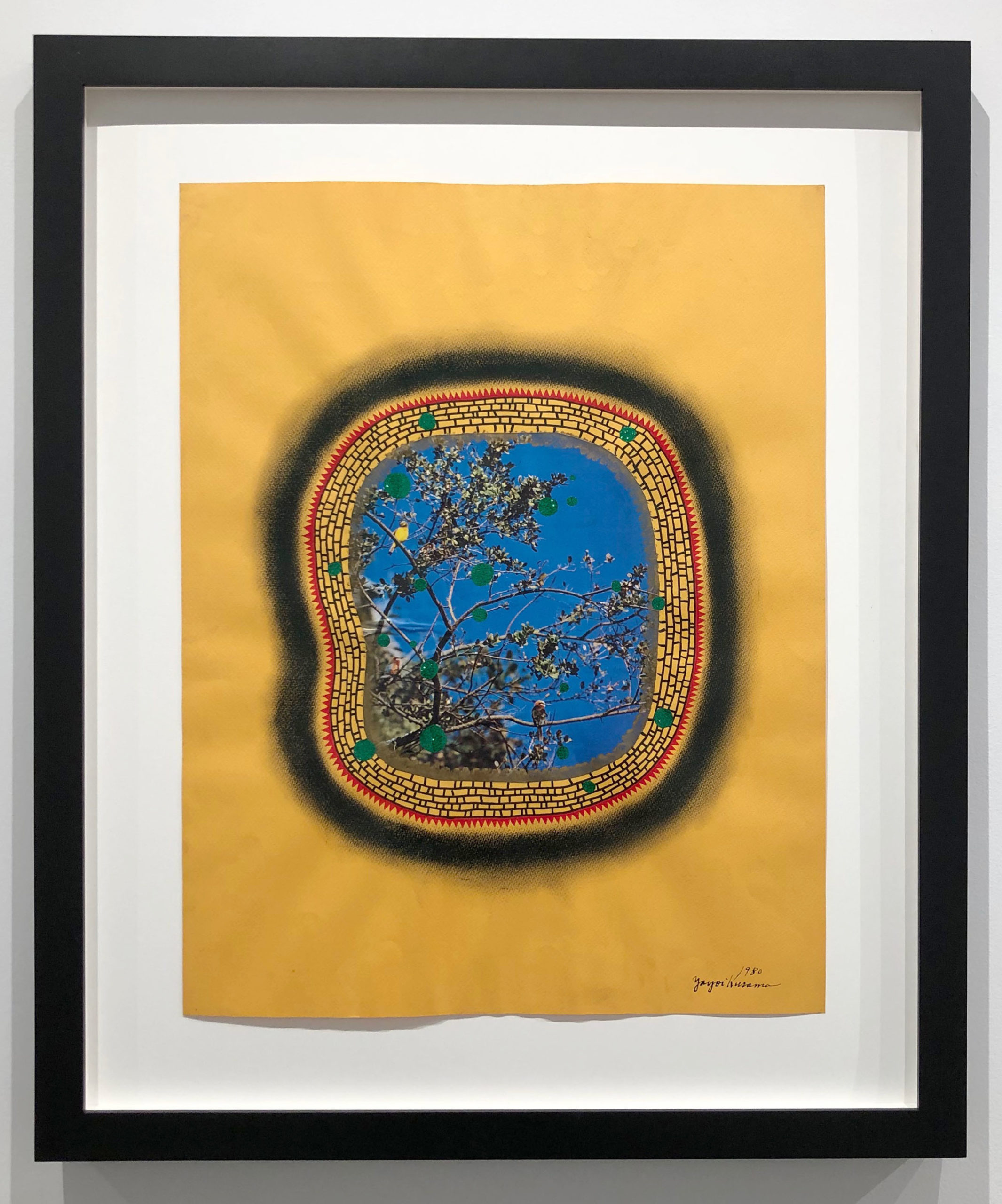
For its inaugural exhibition at its Chelsea New York location, Mucciaccia Gallery is showing the work of Yayoi Kusama. The show includes sculptures, her signature infinity polka dot paintings, and several of her works on paper.
This exhibition closes 2/15/20.

Otis Quaicoe, Black Feathers, 2019

Chloe Wise, Stuck between a hard rock and a café, 2019

Laura Sanders, Victorine, By Herself, 2019

Nona Garcia, After Elaine Navas, 2019

Robin F. Williams, Siri Defends Her Honor, 2019
Currently at Marianne Boesky Gallery in Chelsea is Xenia: Crossroads in Portrait Painting, an outstanding collection of paintings by 17 artists and spanning both of the gallery’s locations.
From the press release–
Marianne Boesky Gallery is pleased to present Xenia: Crossroads in Portrait Painting, an exhibition that explores the resurgence of portraiture as an incisive platform through which to consider the nature and meaning of identity. As our globalized society becomes increasingly marked by emigration, resettlement, and technological interconnectedness, so too have notions of the self become exponentially fractured and complex. Through the work of seventeen artists, Xenia: Crossroads in Portrait Painting captures the ways in which artists are leveraging the power of the portrait to express these intricacies, exposing the relationship between identity, place, and shifting social norms.
Xenia: Crossroads in Portrait Painting will feature new and recent works by a wide range of artists, including Polina Barskaya, Amoako Boafo, Cristina Canale, Somaya Critchlow, Ndidi Emefiele, Maria Farrar, Nona Garcia, Cindy Ji Hye Kim, Doron Langberg, Otis Quaicoe, Laura Sanders, Pamela Phatsimo Sunstrum, Rodel Tapaya, Salman Toor, Hannah van Bart, Robin F. Williams, and Chloe Wise. The group of artists were born and currently live across five continents and over twenty countries, many having relocated by choice or necessity.
Across their vivid and insightful portraits, the individual is depicted as both of singular and communal experience, and as reflecting multiple signifiers of acceptance, displacement, environment, consumerism, and cultural references. In instances, the figure is amputated, aggregated, and multi-acculturated; it is shown within empty expanses and amongst other bodies and objects. Yet despite the spectrum of perspectives and the various formal and conceptual approaches, the artists’ visions are united by a central sense of humanity.
This connection is also encapsulated in the exhibition title, which takes its name from the ancient Greek concept of “xenia” or “guest-friendship”. This notion is mentioned in Teju Cole and Fazal Sheiekh’s 2019 book, Human Archipelago, and refers to the extension of generosity to visitors from afar. Together, the artists’ work speaks to the multicity of factors that shape identity—thus highlighting that “otherness” is purely notional. And at the same time, the act of painting another being can be seen as an act of xenia itself.
“Throughout art history, portraits have served as indicators of social values and personal circumstances. The incredible reemergence of the genre speaks to its ongoing power to reflect our perceptions of ourselves and the world we occupy. I find particularly fascinating the depth and diversity of approaches contemporary artists are taking to portraiture, and the way that their work so aptly encapsulates the complexity of identifying who you are and where you’re from today. Xenia offers a sampling of some of the most exciting voices reshaping portraiture within contemporary practice and speaks to art’s incredible ability to connect with social and political dialogues,” said Marianne Boesky.
This exhibition closes 2/15/20.