Sep 122025
 

Born today, 9/12, artist Robert Irwin used light and space in his work as a way to create an experience for the observer. He started out as a painter but later became well known for his site-specific installations and architectural and outdoor projects- including the central garden at the Getty Center in Los Angeles (pictured below) and his work for the Chinati Foundation in Marfa, Texas.

The works above are from his 2020 exhibition, Unlights, at Pace Gallery in New York.

About that show from Pace-

Irwin’s new works are composed from unlit six-foot fluorescent lights mounted to fixtures and installed in vertical rows directly on the wall. The glass tubes are covered in layers of opulently colored translucent gels and thin strips of electrical tape, allowing the reflective surfaces of unlit glass and anodized aluminum to interact with ambient illumination in the surrounding space and produce shifting patterns of shadow and chromatic tonality. Reflecting his recent turn toward the perceptual possibilities of unlit bulbs, Irwin’s new body of work expands the range of possibilities for how we experience sensations of rhythm, pulsation, expansion and intensity, while continuing the artist’s long-standing interest in registering the immediacy of our own presence in space.

Expanding from his breakthrough disc paintings of the late 1960s, Irwin’s new works effectively dissolve the perceived border between object and environment, focusing the viewer’s consciousness on the act of perception. Each light fixture in Irwin’s sculptures contains one or two unlit bulbs—or no bulb at all—while alternating gaps of “empty” wall are painted in subtle shades of gray, producing a sense of uncertainty about what is tactile and what is merely optical. As the shadowed, painted and reflected intervals of space reverberate in the viewer’s visual field, the wall itself enters the composition, destabilizing any sense of figure and ground. To encounter Irwin’s sculptures is thus to allow oneself to be caught in a ceaseless oscillation between flatness and volume, transparency and opacity, solidity and atmosphere.

In Irwin’s art, the object functions as a kind of score for orchestrating “the continual development and extension of humans’ potential to perceive the world.” Although unlit, the bulbs in these new sculptures are therefore never “off.” Their optically rich surfaces serve as energetic loci for heightening the sensory possibilities of the human body. In their chromatic complexity, the works convey an almost painterly quality, recalling Irwin’s origins as a second-generation Abstract Expressionist painter in the 1950s. Suggesting a rhythmic, minimal composition of repeated linear elements, the works also evoke his innovative line paintings of the early 1960s, which involve us physically and perceptually in an open-ended, immersive and transitory experience of seeing.

Widely recognized as a pivotal figure in contemporary art, Irwin is closely associated with the Light and Space movement that emerged in Los Angeles in the 1960s, and he has continued to live and work in Southern California for his entire career. He first used fluorescent lights as substrates for producing what he has called a “conditional art” in the 1970s, often in combination with architectural scrims and other spatial interventions. In the 1990s he introduced colored gels to the fluorescent tubes to alter the chromaticism of the light, and, over the past decade, began isolating the bulbs and fixtures as sculptural objects in their own right. In returning to the use of solely ambient light, Irwin’s new sculptures embody the culmination of seven decades of rigorous experimentation.

“Everything in the world is ultimately conditional,” Irwin has observed. “There is nothing that’s transcended or infinite or whatever you want to call it. Everything acts within a set of conditions.” Like all of Irwin’s works, his new sculptures respond differently to the conditions of each specific environment in which they are installed, attuning our senses to a given context and making possible an intuitive and incidental experience of seeing that resists rational or conceptual explanation. “It’s not about answers,” the artist once remarked, but rather about the act of questioning: “It’s the constant pursuit of the possibilities of what art is.”

Getty Center, Los Angeles

Below is one of his earlier paintings Untitled, 1964-6, which was on view at Palm Springs Art Museum for the 2024 exhibition Particles and Waves: Southern California Abstraction and Science, 1945-1990.

From the museum about the work-

Although this work appears to have a monochromatic white surface from afar, a matrix of thousands of painted dots becomes visible from a closer vantage point. Irwin aimed to highlight the visual effects of color interaction by juxtaposing light green and lavender, complementary colors across from each other on a color wheel. The canvas’s outwardly bowed supports and the increasing density of dots towards the painting’s center further heighten the viewer’s perceptual experience of the work.

The documentary Robert Irwin: A Desert of Pure Feeling, does an excellent job detailing his life, art, and the philosophy behind his work. It is well worth a watch and inspiring to watch him still at work in Marfa at 87. He passed away in 2023 at the age of 95.

Apr 232025
 

“Untitled”, 2024, camera obscura Ilfochrome photograph (far left) and “Untitled Head” and “Head 2”, 2024, multi-layered pigment print and hand-applied gesso on canvas

“Black and White Poppies”, 2022, gelatin silver contact print mounted to board and mounted to aluminum (left) and “Untitled”, 2024, multi-layered pigment-print and hand applied gesso on canvas (right)

Richard Learoyd‘s exhibition A Loathing of Clocks and Mirrors, on view at Pace, features his recent dreamlike photographs from 2018-2025.  Many of the works were made using a custom-built camera obscura, while others were created using multiple impression printing layered with gesso on canvas.

More from the gallery-

Deeply inspired by Dutch Golden Age painting, Learoyd’s latest works take viewers on a journey through intimate moments and intricate details, examining the relationship between subject, light, and space. The photographs on display explore a range of subjects, from hauntingly evocative portraits to still-life compositions that breathe life into the simplest of objects.

Learoyd’s unique photographic processes require an immense degree of technical precision, resulting in incredibly detailed, luminous prints with a tactile richness rarely seen in contemporary photography. Reflecting on the delicate interplay between light, shadow, and form, Learoyd’s work is imbued with a surreal, auratic presence that speaks to his enduring interest in the notion of collective photographic memory—the idea that a picture can be felt and understood on a subconscious level. The artist is renowned for his masterful use of light and his ability to capture the profound depth and stillness of the human experience.

“Light and space have always been central to my work,” Learoyd explains. “I want to capture more than just an image; I want to convey a sense of time, intimacy, and presence—things that transcend the immediate and evoke a more timeless feeling.”

Highlights in the exhibition, carefully curated by Learoyd, include a photograph of clasped hands, an ode to Alfred Stieglitz’s images of Georgia O’Keeffe’s hands from the first half of the 20th century. Also on view will be the artist’s most recent body of work, a series of photographs created using a new and transformative process of multiple impression printing layered with hand coated gesso on canvas. These multi-dimensional works showcase the artist’s exploration of depth, texture, time, and the relationship between photography and materiality.

This exhibition closes 4/26/25.

Dec 022022
 

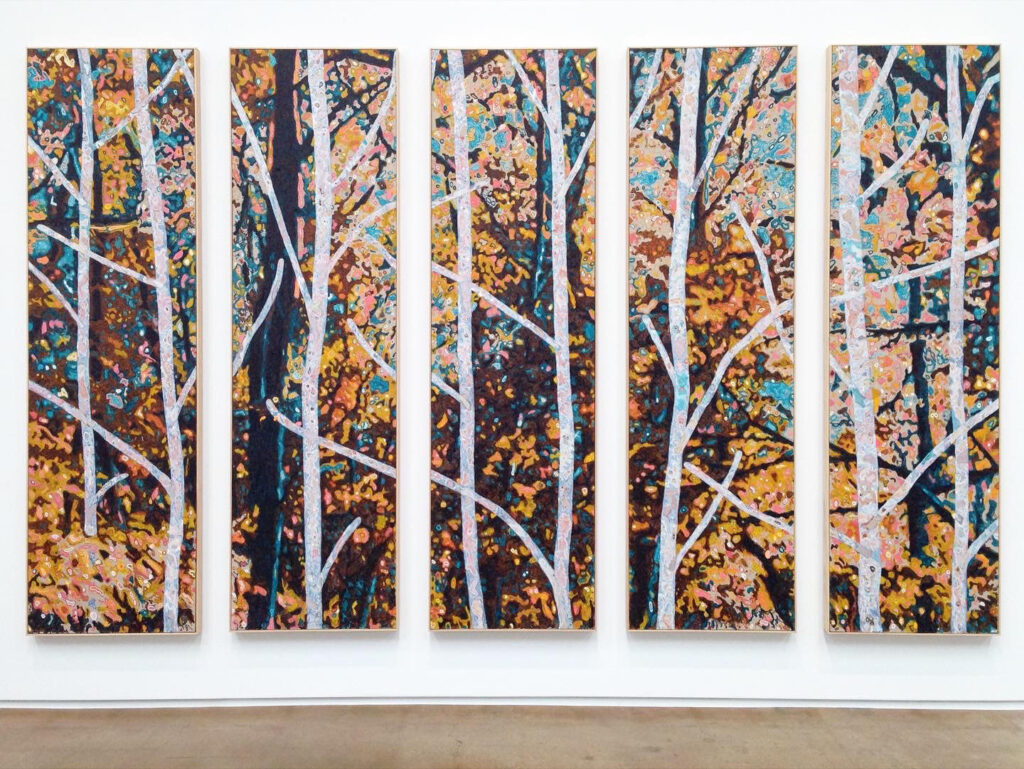
The Divided Cell (paravent), 2015, by William Monk, part of his exhibition, The Cloud is Growing in the Trees at Kohn Gallery in 2015. This was the artist’s first exhibition in California.

From the Kohn Gallery’s press release-

…This exhibition is the culmination of Monk’s practice over the last few years during which time he has created universes within his paintings that reflect on the relationship of the object and spectator.

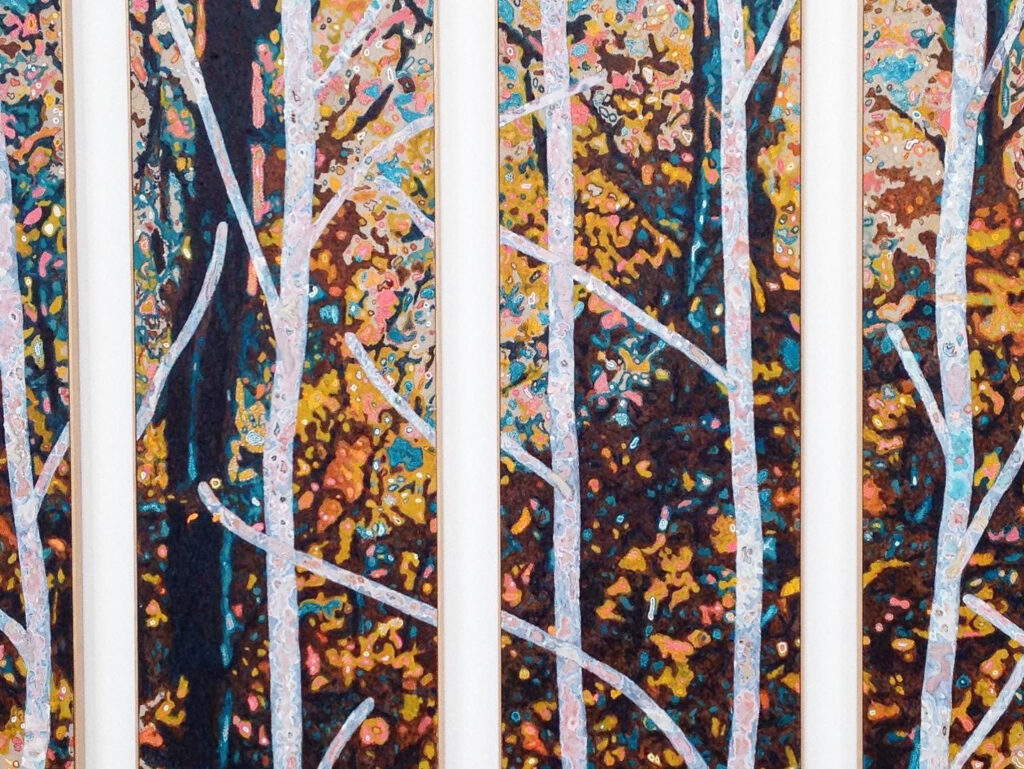
In Monk’s paintings a sense of repetition breaks down the figuration, creating visual mantras in which the human scale of the work increases this subtlety rather than amplifying the model. This rhythm happens throughout Monk’s work, surrendering figurative logic to arrive at something stranger and more powerful. Beautifully atmospheric and energetic, these paintings invite a more direct physical connection, drawing in the space between our inner and outer realms of experience.

The artist’s unique relationship to image and paint lead him to enigmatic subject matter such as forests, galaxies, and the open road. The Cloud is Growing in the Trees underscores this mysterious, almost psychedelic relationship that invites the viewer in as an active participant.

Monk is now represented by Pace Gallery and will be part of their booth at Art Basel in Miami. You can find more of his work, including what is at Art Basel, on Instagram.


Aug 082021
 

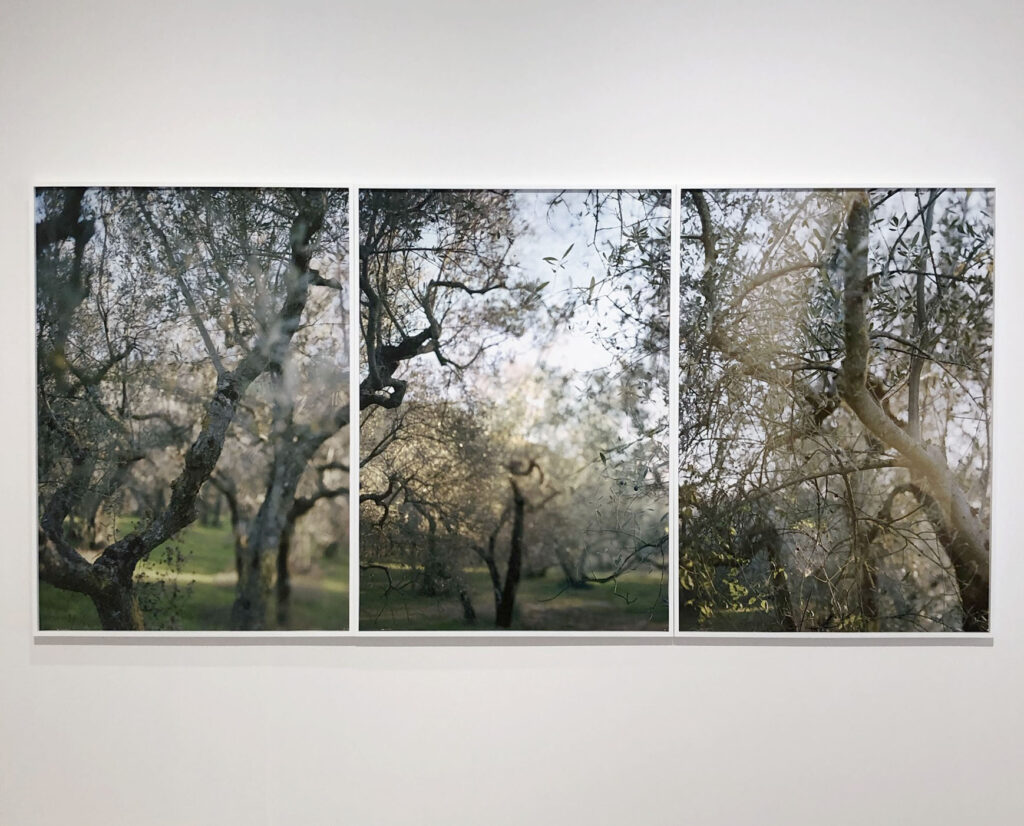
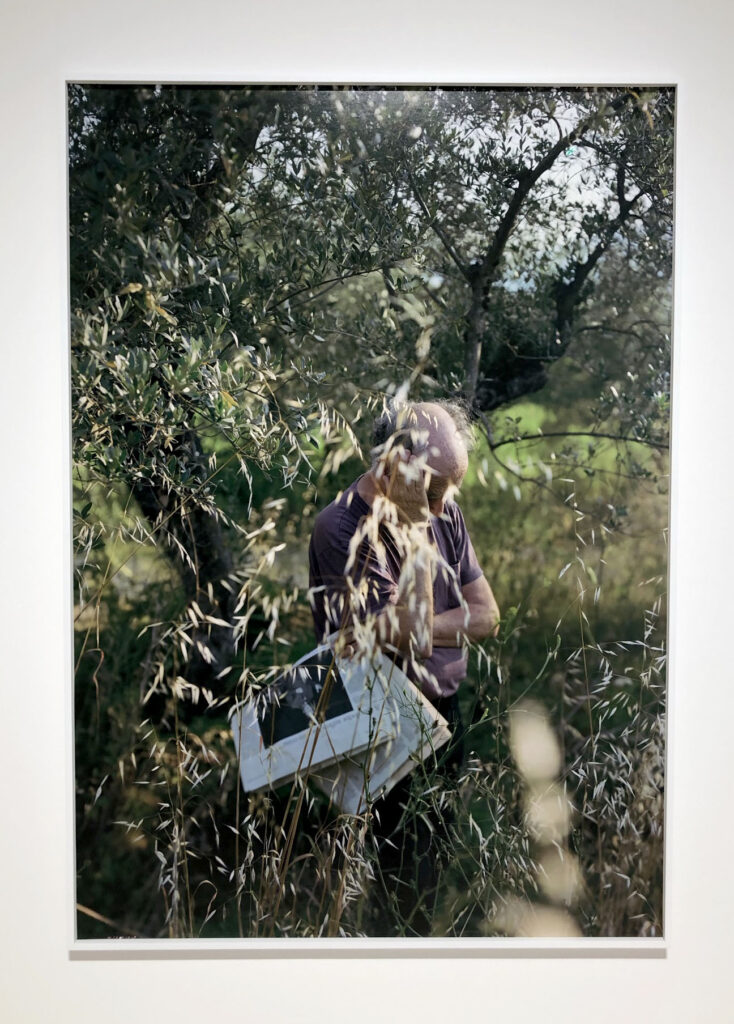
Pace Gallery is currently showing the lovely, meditative photographs of JoAnn Verburg at their NYC location.

From the press release-

JoAnn Verburg: For Now debuts recent multiple-frame photo and video works by the renowned American photographer depicting olive trees captured on three continents. Exemplifying Verburg’s multidisciplinary practice, which for over four decades has existed at the intersection of a range of art-historical traditions, including still life and portraiture, these experiential artworks offer a contemplative respite from the cacophonous urban environment outside of Pace’s gallery space in New York. In response to a period of social and political unrest and a global health crisis, Verburg’s presentation invites viewers to pause and enter a world of self-reflection while simultaneously diving into landscapes from Italy to California to Israel. Generating what the artist has called an “imagined reality,” her images become vehicles for orchestrating a performative and existential encounter between the viewer and the world.

For Now marks Verburg’s first solo exhibition with Pace since the gallery began representing her in 2020, and only the second exhibition in New York since her survey exhibition Present Tense: Photographs by JoAnn Verburg at The Museum of Modern Art in 2007.

Since her last exhibition in New York in 2010, Verburg has been experimenting with the intriguing implications of creating an installation of photos and videos within an urban environment that both acknowledge the environment and provide an escape from it. In this sense, Verburg’s desire to exhibit her images of olive trees in New York reflects her interest in the disjuncture between the contemplative space of the gallery and the busy world outside. Like the pioneering Italian still life artist Giorgio Morandi, Verburg returns repeatedly to the same subject matter—arranging and rearranging her images in three-dimensional space through use of vantage point, framing, and light, while employing techniques of classical craftsmanship, including the production of each singular print herself. In the editing process, she manipulates elements forward and back in space, creating emphases and clarifying her images by manipulating color like a painter. Having studied sociology as an undergraduate, her artwork also reflects a deep philosophical engagement with the social and formal histories of photography as well as the work of key practitioners who blended formalist concerns with sociological awareness, such as Diane Arbus and Robert Frank.

While the subject matter depicted in For Now is olive trees, the subject of the exhibition itself is the experience of the present moment—what Verburg calls “Vermeer time,” evoking the sense of suspended animation that characterizes the paintings of Dutch master Johannes Vermeer. “Her pictures describe spaces and moments suspended in the reverie that precedes action,” observed the celebrated photographer, curator, and critic John Szarkowski, “Like a Leyden jar, they are containers of potential.” Treating the olive grove as both landscape and still life, her focus on a limited range of subject matter suggests a connection between her work and the Minimalist and serial practices of the 1970s. Yet Verburg’s practice is also aligned with Old Master paintings: her works resist the acceleration and velocity of contemporary culture…

If you are unable to see the works in person, the Pace website has them on view as well as the full press release and a video of the artist in her studio.

This exhibition closes on 8/20/21.

Feb 272020
 

Currently at Pace Gallery in New York are Nigel Cooke’s ten large-scale paintings. The paintings have an exuberant intensity to them. Close up the shades of varying color, layers of paint, and the textures created by the brush strokes, show the detail that went in to creating the overall effect of the work.

From the press release-

Completed over the past year, these ten new large-scale paintings mark a significant shift in the artist’s direction toward a more performative, energetic, and abstract approach to figuration. This shift was propelled by a recent residency in the city, where Cooke remarked that “the entire philosophy of what it is I am doing has been adjusted.” These works, which reference actions, places, and people, exist as matrices in which the artist’s free and open process meets wider themes of metaphor, spirit, nature, representation, and the living material quality of paint. In this way, these new works draw on the legacies of American artists such as Willem de Kooning and Clyfford Still as well as Abstract Expressionism, British Figuration, Spanish painting, and Chinese silk painting.

…These dynamic compositions become transitional grids that unfix and multiply the idea of what a figure is, reflecting a complex interplay of vigor, chance, and intuition. They begin with a single color drawn in a loose structure that drives the painting process forward. Building up the canvas in lines and washes, the paintings move away from a defined image, resulting in a myriad of possibilities from the mud and grit of real landscapes to atmospheric emanations or presences. As such, they do not depend on a fixed viewpoint but drift between states, contradicting themselves over time and allowing for the possibility of transformation.

Furthering Cooke’s radical shift in his practice, the paintings were executed on raw canvas—a first for the artist. The natural linen endows the paintings with a unique brownish ground and a textured weave that is seen throughout the works. This material quality also impacts Cooke’s mark-making as washes develop into thickets of dark staining and lines that taper off and sometimes produce kasure or “flying white,” an ancient Chinese silk painting technique known for its ribbon-like strokes that sputter and appear to leap off of the surface of the canvas.

This exhibition closes 2/29/20.