A Brief History of John Baldessari (narrated by Tom Waits)
American conceptual artist John Baldessari passed away last week on January 2, 2020 at the age of 88.

A Brief History of John Baldessari (narrated by Tom Waits)
American conceptual artist John Baldessari passed away last week on January 2, 2020 at the age of 88.


Closing 1/5/20 at Hauser & Wirth’s Los Angeles location is Charles Gaines’ exhibition Palm Trees and Other Works. This exhibition will debut new works from his signature Gridworks series.
Using photographs of native trees from Palm Canyon near Palm Springs, Gaines selectively layers paint on acrylic sheets atop black and white photographs of corresponding landscapes with trees. Following this process, each tree is assigned a distinctive color and a numbered grid that reflects the positive space of the tree in the original photographic image.
The exhibition also includes new watercolor work and Manifesto 3– which takes Martin Luther King, Jr.’s speech given at the University of Newcastle upon Tyne (1967) and James Baldwin’s essay Princes and Powers (1957) and using a rule-based system to convert letters from the text into their equivalent musical notes creating a musical score.
From Hauser & Wirth’s website-
Reflecting on his personal history, Gaines observed that ‘one thing that made me different from other conceptual artists is that I was not shying away from language or meaning or content’ – a truth perhaps best exemplified by ‘Manifestos 3’ (2018). This work functions as a systematic transliteration of revolutionary manifestos into musical notation. The installation is comprised of two parts: a single channel video monitor that scrolls the manifesto texts, and two large graphite drawings of the music scores that were produced by the translation. Each text scrolls in succession on a monitor while a recording of the music produced by Gaines’s system plays. Created by way of a rule-based system, Gaines transcribes letters ‘A – H’ from the text into their equivalent musical notes. The use of the letter ‘H’ represents the code used in early Baroque tradition for B-flat. All other letters and spaces between words are noted as rests or silent beats. While the resulting composition does sound intentional, it is controlled only by the preconceived notation system that follows the compositional structure of language. This produces the fluidity that the audience hears.
The two political texts transcribed in ‘Manifestos 3’ are Martin Luther King, Jr.’s speech given at the University of Newcastle upon Tyne (1967), wherein King nominates racism, poverty, and war as the three most urgent problems of the contemporary world, and James Baldwin’s essay ‘Princes and Powers’ (1957) which describes the dominating power of cultural control. These two manifestos are systematically translated into the above described musical notations as written and arranged for piano by Gaines and edited by John Eagle.
This series not only takes social justice and politics on as its subject, but also as it may critique our understanding of the relationship of the practice of art and politics. By converting these powerful and poignant texts into music, Gaines unites the rational, mathematical, and lyrical structures of music with the irrationality of violence, racial tensions, and social injustice. The predetermined process developed by Gaines widens the distance between concepts and their interpretation, effectively removing the artist’s subjectivity while empowering the viewer’s. The combination of the elegiac music with the stirring words of the scrolling manifestos creates an unexpected conflict for the viewer; it is within this dissonance that the indelible truths of Gaines’s work are revealed.


Petzel Gallery is currently showing Walead Beshty’s solo show “Abstract of A Partial Disassembling of an Invention Without a Future: Helter-Skelter and Random Notes in Which the Pulleys and Cogwheels Are Lying Around at Random All Over the Workbench”. The sheer volume of work covering the walls is overwhelming and impressive in its assembly.
From the press release-
The work A Partial Disassembling of an Invention Without a Future: Helter-Skelter and Random Notes in Which the Pulleys and Cogwheels Are Lying Around at Random All Over the Workbench, was originally commissioned by the Barbican Centre, London. The London-born, Los Angeles-based artist first exhibited the work there in 2014, covering the 273 ft long Curve gallery from floor to ceiling in cyanotype prints. The prints were produced over the duration of a year (October 9, 2013–October 8, 2014) and are chronologically installed in proportion to the exhibition space. For its New York première at Petzel, approximately 5,120 cyanotypes (38% of the total 15,616 sq. ft work) will be presented.
In A Partial Disassembling of an Invention … , each cyanotype (a 19th Century photographic process using ferric ammonium citrate and potassium ferro-cyanide) was produced by placing tools and other objects used in the production process of the studio on cellulose waste material generated by that same process (such as wood, cardboard, or paper) that was coated with UV-sensitive cyanotype material. After being exposed to sunlight and washed in water, the object’s silhouette appears in reverse against a cyan-blue background.
In using everyday objects, such as receipts, prescriptions, invoices, financial statements, legal documents, letters, gallery invitations, etc. from the working life of the studio, an inherent transparency is embedded in the work, demystifying the artwork and exposing its process of coming to be. Representative of the lives of those who made it, the cyanotypes expose both aspects of identity and circumstance, situating the work within political, social, and economic exchange without being representational or depictive in the conventional sense. While both the Barbican and Petzel iterations deal with debris, this new display has a more overtly American immediacy to it. Considering the resurgent discourse on the politics of representation, there is a new urgency to exhibiting the work for the questions it evokes about the modes and uses of representation, such as how art can accurately display real world conditions of labor, production and power, and whether a truly accurate and transparent form of representation is possible.
Beshty will also show Prologue to A Partial Disassembling of an Invention Without a Future: Helter-Skelter and Random Notes in Which the Pulleys and Cogwheels Are Lying Around at Random All Over the Workbench, which are the cyanotypes that were produced in anticipation of the Barbican work from August 1, 2013–October 8, 2013, along with seven volumes of the 59-volume archive of the work. The books—in their Prologue and Opus volumes—comprise bound pages printed recto and verso of the entire work reproduced at 1:2 scale. The volumes create both an archival record of Beshty’s workspace as well as an index of all the tools and artefacts used for the work’s own making.
The title of the project is a reference to Hollis Frampton’s hypothetical lecture he muses about in a talk delivered at the Whitney Museum of American Art, but never actually gives. The title of this phantom lecture alludes to the origins of the medium, and its inevitable obsolescence. It also calls forward the question of the role objects play when they have ceased being useful. Wrenched by time from their intended use, the objects become purely aesthetic, becoming the focus of contemplation in both historical and poetic terms.
This exhibition closes 12/14/19.


Currently at Brooklyn Museum is Garry Winogrand: Color, the first exhibition dedicated to Winogrand’s color photographs.
From Brooklyn Museum’s website-
While almost exclusively known for his black-and-white images that pioneered a “snapshot aesthetic” in contemporary art, Winogrand produced more than 45,000 color slides between the early 1950s and late 1960s.
Coming from a working-class background in the Bronx and practicing at the time when photographs had little market value, Winogrand did not have the resources to produce costly and time consuming prints of his color slides during his lifetime. Yet, he remained dedicated to the medium for nearly twenty years.
The exhibition presents an enveloping installation of large-scale projections comprising more than 400 rarely or never-before seen color photographs that capture the social and physical landscape of New York City and the United States. On his numerous journeys through Midtown Manhattan and across the country, Winogrand explored the raw visual poetics of public life—on streets and highways, in suburbs, at motels, theaters, fairgrounds, and amusement parks. For him, the industrially manufactured color film, which was used by commercial and amateur photographers, perfectly reproduced the industrially manufactured colors of consumer goods in postwar America. By presenting this group of largely unknown color work, Garry Winogrand: Color sheds new light on the career of this pivotal artist as well as the development of color photography before 1970.
Winogrand’s photos are always captivating, both in his style and subject matter, and now there is the addition of time, which adds nostalgia to their allure.
The exhibition begins with a slide projector showing single slides, most of which aren’t on view in the main room (shown below).


The main room (shown below) has slides rotating on the walls along both sides of the large room with seats in the center for viewing. The pairings often accentuate each others colors, with the smaller slide of each pair staying up longer. It is definitely worth making the time to see them all.


Also included in the exhibition are a room of Winogrand’s black and white photographs and a video of him discussing his work.
This exhibition closes 12/8/19.
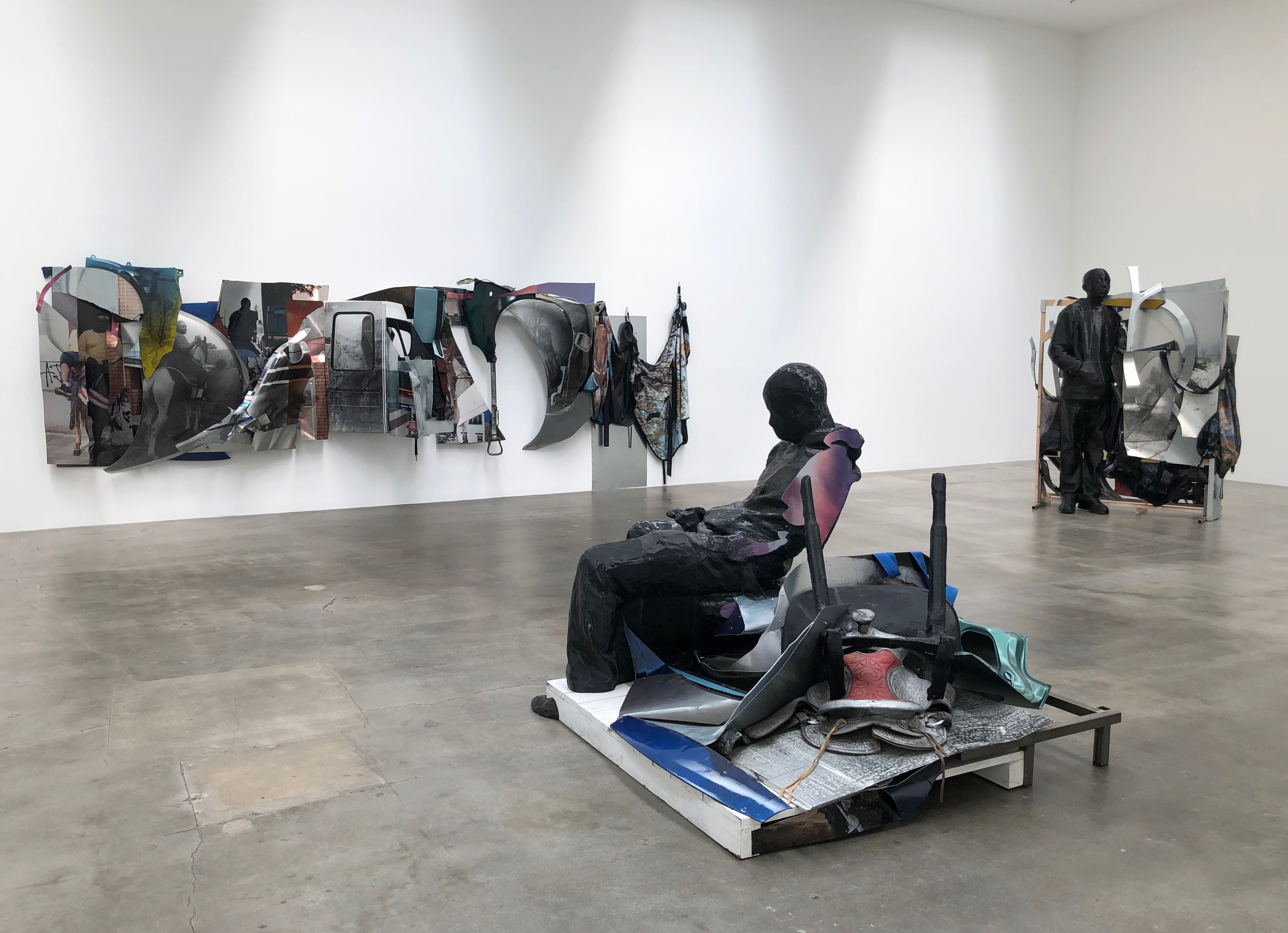
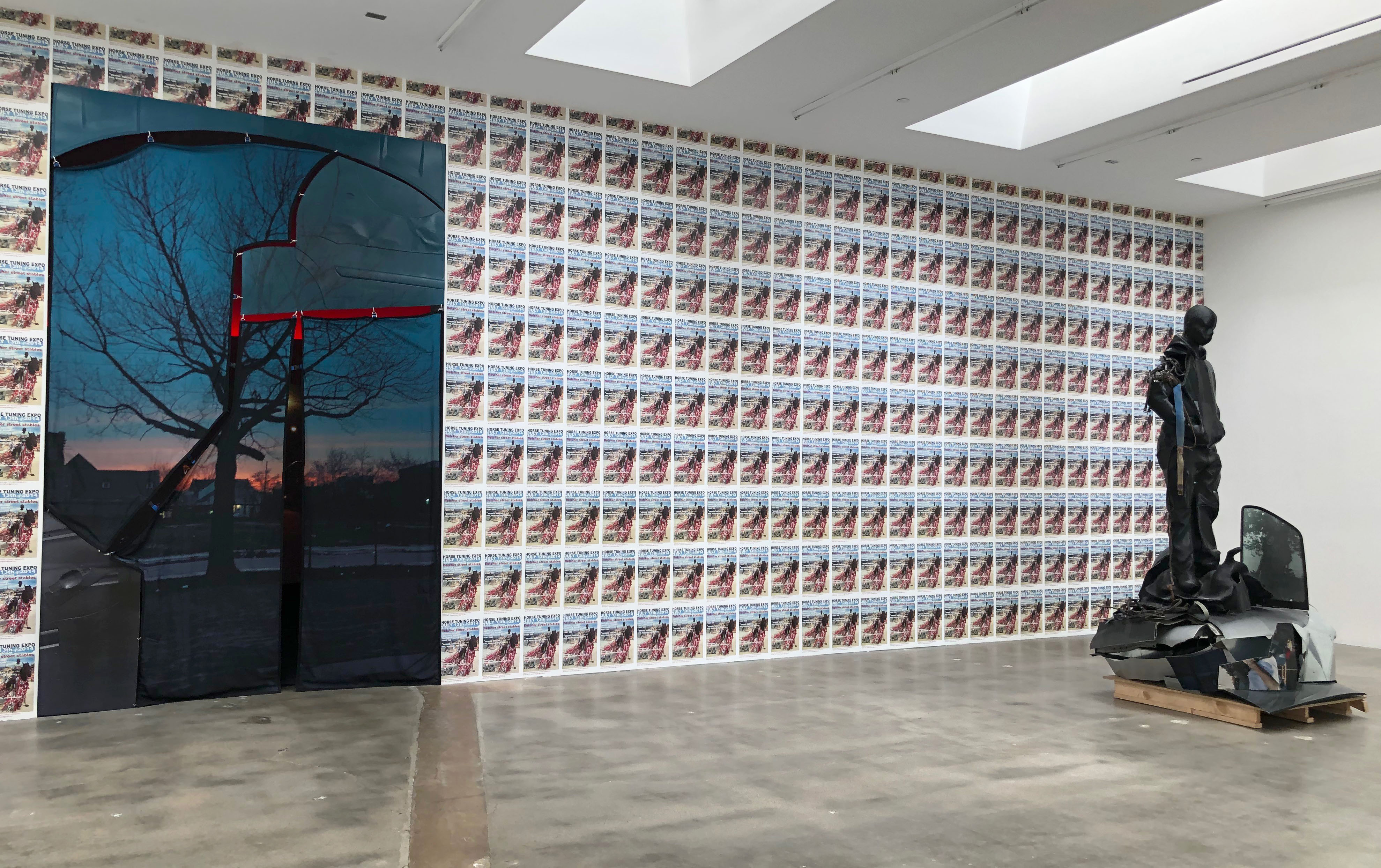
Paris-based Algerian artist Mohamed Bourouissa’s first solo exhibition in Los Angeles, Pour une poignée de Dollars (For A Fistful of Dollars), at Blum & Poe, combines film, sculpture, drawing and photography to expand on his project Horse Day, also on view at the gallery.
From the press release-
Initially driven to capture his own community and generation of immigrant youth living in the outskirts of Paris, in recent years Bourouissa’s focus has expanded to the US, the UAE, and beyond. In 2014 the artist spent nearly a year in North Philadelphia, PA living among the young men of the Fletcher Street Urban Riding Club, a non-profit established over 100 years ago by African American cowboys. This area increasingly struggles with unemployment and drug abuse, economic and social conditions from which the center attempts to provide a refuge—rescuing horses and mentoring boys who may otherwise find support hard to come by. Bourouissa instigated a collaboration with the community of riders and local artists—a riding competition and pageant called “Horse Day” in which equestrian participants arrived clad in decadent regalia, costumes including linked blank CDs, streamers, fake flowers, or fabric Pegasus wings. Using the cowboy as an emblem of a narrative of domination, the critical documents Bourouissa and the Fletcher Street community produced—sculptures, costumes, drawings, photography, and a video mixing tropes of westerns, documentaries and hip-hop—explore social injustice as it relates to geographical space, spotlight contemporary America’s culture of segregation, and intend to forge a new creative space for marginalized groups. Within a new body of sculptural work, the artist integrates images of riders and/or horses into the body parts of automobiles, as curator Okwui Enwezor once put it: “Bringing together two myths, the cowboy and the urban lowrider with his customized car, a sort of collision of the frontier and Compton.” This 3-D montage connects representations of domination and power, as well as industries and communities facing crisis.
Bourouissa’s work focuses on rituals of friendship, an exploration of alterity and the role images play in channels of distribution, investigations into the politics of representation and subjectivity. Seeking to humanize his community as social subjects, Bourouissa engages all sorts of imagery, initiating agency where is it often deprived. Bourouissa’s work is a hybrid of documentation and formal composition, collaborative choreographed representations of reality on the margins, channeling a wide range of historical precedents from Caravaggio and Delacroix to Fanon, rap music, and the Harlem Renaissance.
In a separate space behind the main gallery is Anya Gallaccio’s Stroke (pictured below), a room where the walls are painted with dark chocolate. The work was originally created in September of 1994, for Blum & Poe’s inaugural exhibition at their original location in Santa Monica. Twenty-five years later, it has been recreated in an exhibition space the exact dimensions of the original gallery.
It’s worth checking out for the smell alone. It’s overpowering.
From the press release-
Stroke plays with perceptions of desire and their disconnection from reality. In this chocolate-covered room, an idea pulled from a childlike fantasy comes to life and goads the viewer’s appetite for pleasure. The whimsical notion of an edible room is contrasted with the strikingly rich, dark color of the walls and their heavy, sometimes putrid, smell. Of this disconnect, Gallaccio states, “the idea of a chocolate room is one thing, and the reality of a chocolate room is very much something else.” Created by thousands of small, repeated brush strokes for which the installation is named, prolonged looking is rewarded when one sees new colors, textures, and patterns appearing out of the darkness.
Rooted in the formal language of Minimalism, Gallaccio’s practice uses organic materials to subvert and reframe that male-dominated moment in art history. Trees, flowers, fruit, and ice are investigated for their fluidity and impermanence, and decay becomes a part of the installation to be embraced. The unpredictability of these ephemeral materials yields a freeing inability to control the final product, from which unexpected results emerge. These materials, pulled from a feminine, domestic space, challenge a masculine past and reclaim a place in history. As noted in the original press release from 1994: “Feminist in material, natural in its decay, subversively Freudian, Stroke is an enigmatic and challenging work.”

Both of these exhibitions close 10/26/19.


Alex Prager’s exhibition at Lehmann Maupin’s 22nd Street location combines sculpture and still photography with her new film Play The Wind. The photographs in the show recreate scenes from the film, but are not from the film itself. There are also photos of scenes that could have been from the film, but are not. These allow the viewer to consider alternate narratives to the story they have just seen. The photos also offer an opportunity to see many of the details from the film seen only briefly while watching.
Running for eight minutes, Play the Wind is a journey into a bizarre version of Los Angeles. It’s seen mainly through the window of a car, the way many Los Angeles residents often see it. Places seem familiar, as do many of the large cast of extras who inhabit this world, even if you are not personally familiar with the city.
The cab driver, played by Dimitri Chamblas (dean of the Sharon Disney Lund School of Dance at CalArts), drives through situations that seem both surreal and possible at the same time, like many things that happen in LA. At one point the cab driver, drives past an accident on the highway and sees a car vertical between two other cars with children in a school bus leaning out of the windows to observe. He passes alongside and moves on. It’s just another moment in a chaotic Los Angeles day. When he locks eyes with a woman played by actress Riley Keough, the film changes to her perspective and it all becomes even more dreamlike.
From the press release–
…She anchors her characteristically elaborate fictional scenes within the real Los Angeles, shooting for the first time in many years primarily on location rather than in the studio—a decision that harkens back to when Prager began her career over a decade ago. Though the images contain large constructed set pieces and are populated with carefully cast extras (numbering up to 300), the presence of the Los Angeles streets infuses an element of urban lifeblood that is palpable in the work. Prager’s perception of Los Angeles is one of the artifice and drama befitting Hollywood, with real world chaos that overflows into sci-fi dystopia and post-apocalyptic dread. She toys with these visions of the city disseminated on film, TV, and within the popular imagination, which inform our characterization of a place as much as our own memories.
Technically important to the making of this film was Prager’s collaboration with a team to produce set designs and props that would add a layer of artifice and duplicity to her real-world locations. The interference of these traditional illusionary effects upon the actual Los Angeles streets and locations Prager shot on creates an unnerving sensation, hinting at the reality that might exist just outside of our perception. All of these elements are recast in the series of photographs, which appear in different configurations or on various scales that further destabilize any linear narrative. Drawing on the concept of a distorted memory, Prager has found ways to incorporate objects seen in the photographs and film into the gallery as sculpture, with the intent to further dislodge our understanding of place and time and bring us deeper into her highly constructed world.
Connoisseurs of Prager’s work will likely spot the references to her past series, such as the noir themed Compulsion (2012), or the archetypical ingénue of The Big Valley (2008). This self-referencing becomes yet another layering device, mixing Prager’s career-spanning themes and the greater art historical genres from which they are drawn to create work both entirely new, yet seemingly familiar. Prager’s incorporation of her past into her present work serves as a reminder that while the past may not be returned to, it does remain with us, appearing in surprising, sometimes unsettling ways.
This exhibition closes 10/26/19.

“Crescent (Timekeeper)”

“Crescent (Timekeeper)”

“Crescent (Timekeeper)” Detail
Sarah Sze’s exhibition at Tanya Bonakdar’s gallery in New York is stunning. There is so much to look at, to appreciate. There are so many pieces to all of the work, and yet it never feels overwhelming. It makes you want to keep looking.
It’s also immersive. The windows on the outside of the gallery are covered in her work, as is the staircase alcove. The video projections in the main room travel all around the room, surrounding you with visuals and sound. Upstairs the floors of the gallery have paint splattered on them, accompanying the works on the walls.


Detail of the above work
In a room on the first floor is a “studio space” where you can gain insight into Sze’s process and how she makes these elaborate works.

From the press release-
Sze’s latest body of work frays “the seam between the real and the image” (Smith). Through complex constellations of objects and a proliferation of images, Sze expands upon the never- ending stream of visual narratives that we negotiate daily, from magazines and newspapers, television and iPhones, to cyberspace and outer space. The works evoke the generative and recursive process of image-making in a world where consumption and production are more interdependent, where the beginning of one idea is the ending of another—and where sculpture gives rise to images, and images to sculpture.
In this new exhibition, Sze expands her work by embedding her nuanced sculptural language into the material surfaces of painting and into the digital realm through the interplay of cloth, ink, wood, paper, metal, paint, found objects, light, sound and structural supports—collapsing distinctions between two, three and four dimensions. This body of work fundamentally alters our sense of time, place, and memory by transforming our experiences of the physical world around us. Both objects and images, Sze says, are “ultimately reminders of our own ephemerality”.
This exhibition closes 10/19/19.

From Ishiuchi Miyako’s “Scars” series (1991-)

Images from the “ひろしま/ hiroshima” series, 2007-present
Ishiuchi Miyako’s exhibition occupies both floors of Fergus McCaffrey’s Chelsea gallery space and includes over 70 photographs from five series made over four decades, including many early and never-before-seen works.
On the first floor are the artist’s somber black and white photos of the buildings of her hometown of Yokosuka. Yokosuka was also the home of a US Naval Base, established in 1945. In another room is work from her Scars series, for which she photographed the damage left behind by injury, illness, and trauma. These portraits focus not on the people but on the imprints on their bodies. Despite that, they don’t feel impersonal or voyeuristic. There is a tenderness to these images.
Photographs of objects dominate the rest of the exhibition. There are a series of images of her mother’s possessions, taken before she passed away. She also photographed Frida Kahlo’s belongings, including a pair of her shoes that were different sizes- accommodating the physical issues Kahlo had after her bout with polio as a child.
The photos of items donated to the Hiroshima Peace Museum, for the ひろしま/ hiroshima series, are especially moving. The articles of clothing worn by residents of Hiroshima when the atomic bomb was dropped on the city are worn and damaged. It’s hard not to think of what happened to the people who owned them.
Each series of photographs is unique, but tying them together is the idea of capturing what gets left behind. It can be a city or a scar or a person’s possessions after they die, but they have an effect. Ishiuchi’s photos record that effect in an impressive and thought provoking way.
This exhibition closes 10/18/19.


From the press release-
Klowden Mann is proud to present San-Diego-based artist Andrea Chung’s first solo exhibition with the gallery, … Only to meet nothing that wants you. The exhibition features large-scale cyanotype works depicting under-sea images of coral that have then been bleached with sugar crystals—a material woven throughout Chung’s practice for over a decade in reference to its relationship to colonialism in the Caribbean. The cyanotypes are placed in context with a brass chandelier that recalls designs from the 19th century; where crystals would hang, Chung has hung glass vials filled with sugar in various shades.
Chung’s practice often utilizes perishable and precious materials with strong underlying histories, forming relationships to pre-emancipation images of the Caribbean, touristic misrepresentations of people and place, the export or import of goods and materials, and the labor of the human body. Completing the quote by Nayyirah Waheed that Chung used as the title of her first solo museum exhibition at the Museum of Contemporary Art San Diego in 2017, “You broke the ocean in half to be here,” the title of the exhibition at Klowden Mann answers with the second half of the phrase, “…Only to meet nothing that wants you.”
In the cyanotype works, coral bleaching becomes a metaphor for colonialism, and the expanding of the philosophy and impact of imperialism on colonial populations and cultures. The addition of sugar crystals to the already highly sensitive cyanotypes underlines Chung’s interest in creating work that defies the notion of artworks as static objects that are meant to remain unchanging and unyielding in the face of shifting environments and time; in a way that also reflects the constant uncontrolled and irresponsible effects of human actions on the environment, and on vulnerable populations. The works are intended to shift and change over the course of the exhibition, as the sugar embeds further in the cyanotype, falls, and expands. The works are linked to the environment in which they are placed in a way that Chung cannot predict and control—and along with the chandelier, ask the audience to consider who pays for the superficial opulence and beauty to which so many have become accustomed.
The work in this exhibition is really stunning, and the fact that it is work that is changing with time, makes seeing it feel even more special. Like so much of the beauty in the world, and especially in nature, you appreciate it, while wondering how long it will still be around to be seen.
This exhibition closes 10/12/19.
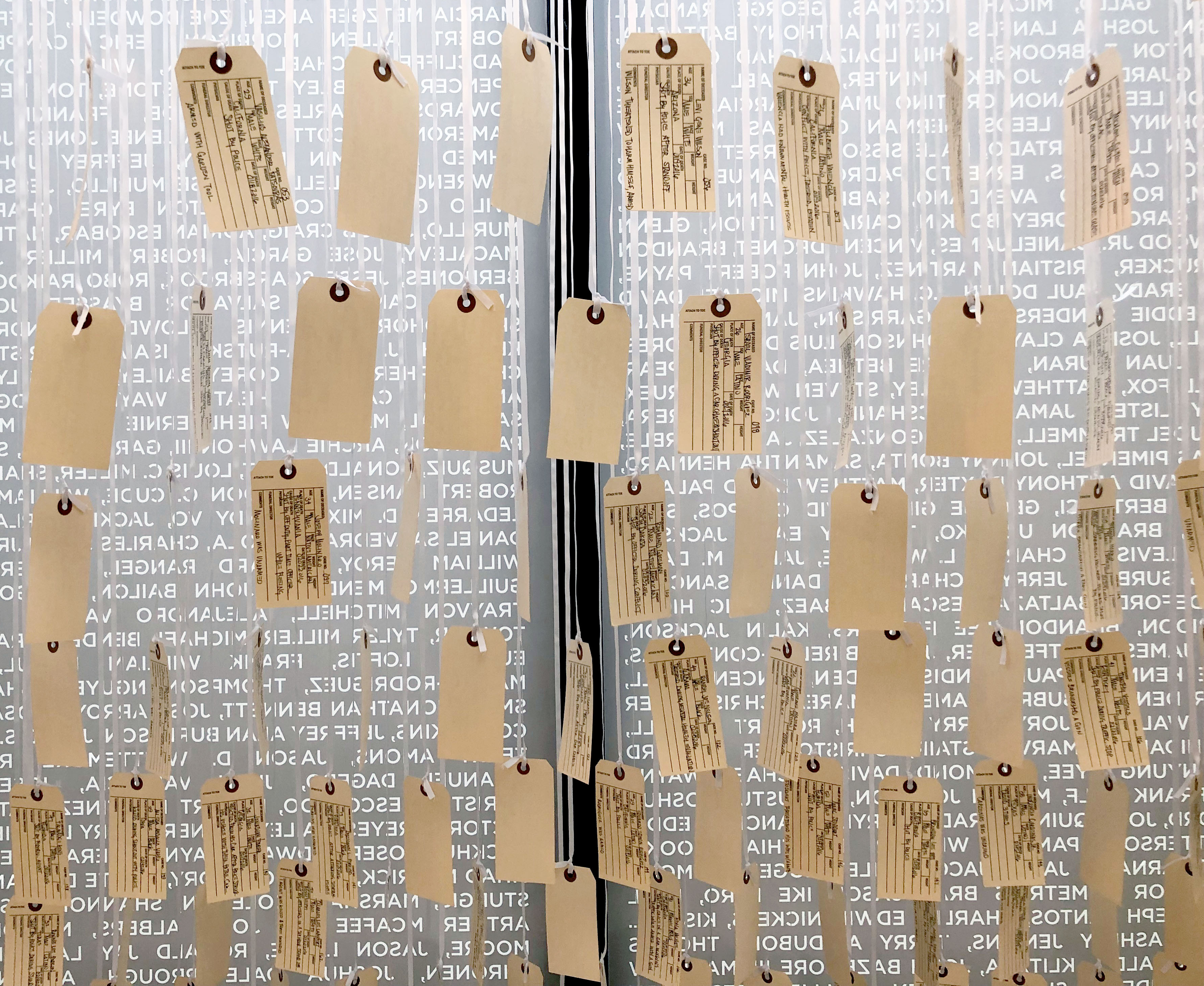

The Museum of Broken Windows is a free pop-up experience in New York City, a project by the NYCLU currently located Cooper Union.
From the Museum of Broken Windows/ NYCLU websites-
The broken windows theory is an academic theory proposed by social scientists James Q. Wilson and George Kelling in 1982. The academic theory, which first appeared in The Atlantic Monthly, states that signs of disorder in a neighborhood, like a broken window, encourages petty crimes and leads to more serious crimes. This postulation was adopted by the New York City Police Department and has led to the criminalization of poverty and the over-policing of Black and Brown communities at disproportionate rates. The theory has never been proven to be effective at reducing crime.
The Museum showcases the ineffectiveness of broken windows policing, which criminalizes our most vulnerable communities. The strategy of broken windows policing is outdated and has never been proven to be effective at reducing crime. For decades, communities of color have been disproportionately impacted by broken windows policing.
It is time for a change. New Yorkers are coming together for important conversations on policing and what it means to feel and be safe. Using art and creativity, the Museum of Broken Windows will provide a powerful and emotional experience that critically looks at the system of policing in New York.
Pictured above are “…and counting” by Ann Lewis (each tag is filled out with the name of a person killed by police) and one of the group of portraits by Tracy Hetzel of women who have lost loved ones because of broken window policing. The one pictured is of Gwen Carr who is holding a picture of her son Eric Garner.
This show ends on 10/8/19.