Aug 082021
 

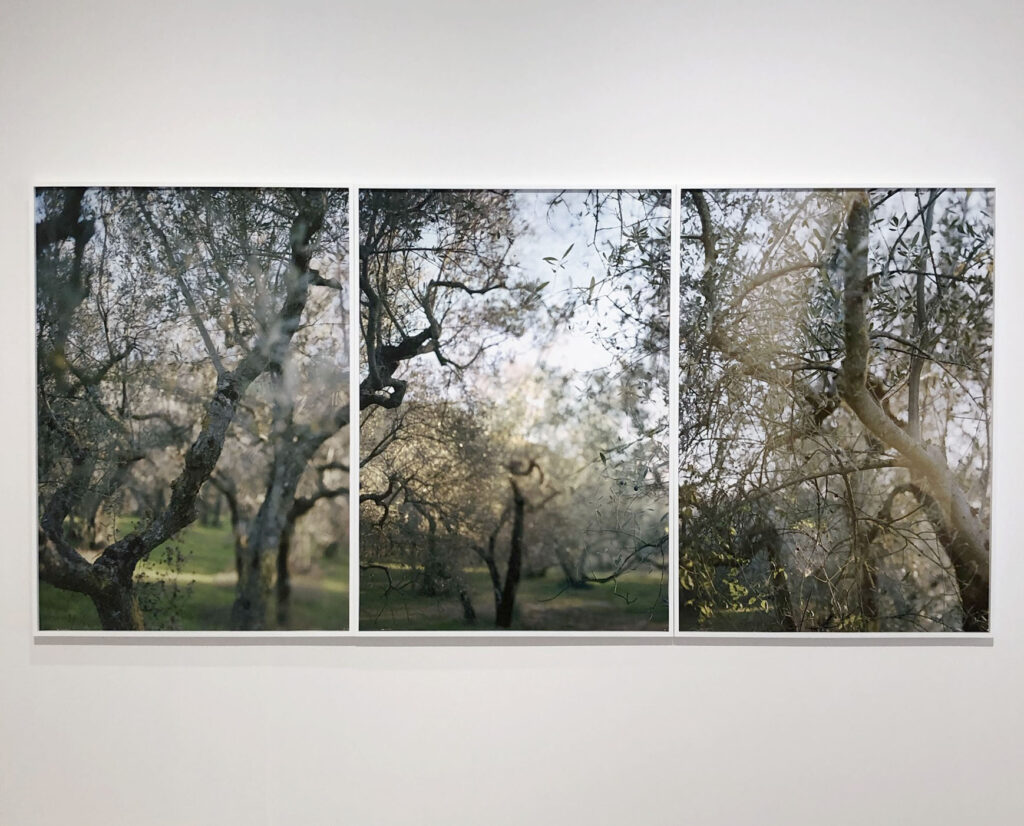
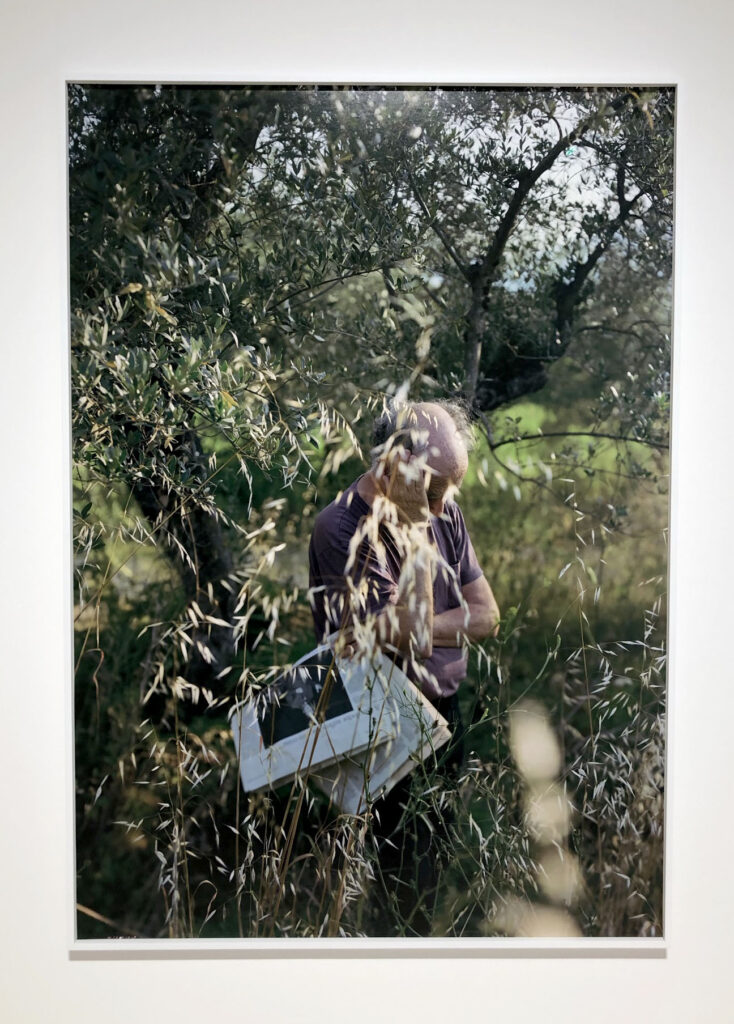
Pace Gallery is currently showing the lovely, meditative photographs of JoAnn Verburg at their NYC location.

From the press release-

JoAnn Verburg: For Now debuts recent multiple-frame photo and video works by the renowned American photographer depicting olive trees captured on three continents. Exemplifying Verburg’s multidisciplinary practice, which for over four decades has existed at the intersection of a range of art-historical traditions, including still life and portraiture, these experiential artworks offer a contemplative respite from the cacophonous urban environment outside of Pace’s gallery space in New York. In response to a period of social and political unrest and a global health crisis, Verburg’s presentation invites viewers to pause and enter a world of self-reflection while simultaneously diving into landscapes from Italy to California to Israel. Generating what the artist has called an “imagined reality,” her images become vehicles for orchestrating a performative and existential encounter between the viewer and the world.

For Now marks Verburg’s first solo exhibition with Pace since the gallery began representing her in 2020, and only the second exhibition in New York since her survey exhibition Present Tense: Photographs by JoAnn Verburg at The Museum of Modern Art in 2007.

Since her last exhibition in New York in 2010, Verburg has been experimenting with the intriguing implications of creating an installation of photos and videos within an urban environment that both acknowledge the environment and provide an escape from it. In this sense, Verburg’s desire to exhibit her images of olive trees in New York reflects her interest in the disjuncture between the contemplative space of the gallery and the busy world outside. Like the pioneering Italian still life artist Giorgio Morandi, Verburg returns repeatedly to the same subject matter—arranging and rearranging her images in three-dimensional space through use of vantage point, framing, and light, while employing techniques of classical craftsmanship, including the production of each singular print herself. In the editing process, she manipulates elements forward and back in space, creating emphases and clarifying her images by manipulating color like a painter. Having studied sociology as an undergraduate, her artwork also reflects a deep philosophical engagement with the social and formal histories of photography as well as the work of key practitioners who blended formalist concerns with sociological awareness, such as Diane Arbus and Robert Frank.

While the subject matter depicted in For Now is olive trees, the subject of the exhibition itself is the experience of the present moment—what Verburg calls “Vermeer time,” evoking the sense of suspended animation that characterizes the paintings of Dutch master Johannes Vermeer. “Her pictures describe spaces and moments suspended in the reverie that precedes action,” observed the celebrated photographer, curator, and critic John Szarkowski, “Like a Leyden jar, they are containers of potential.” Treating the olive grove as both landscape and still life, her focus on a limited range of subject matter suggests a connection between her work and the Minimalist and serial practices of the 1970s. Yet Verburg’s practice is also aligned with Old Master paintings: her works resist the acceleration and velocity of contemporary culture…

If you are unable to see the works in person, the Pace website has them on view as well as the full press release and a video of the artist in her studio.

This exhibition closes on 8/20/21.
Nov 262020
 

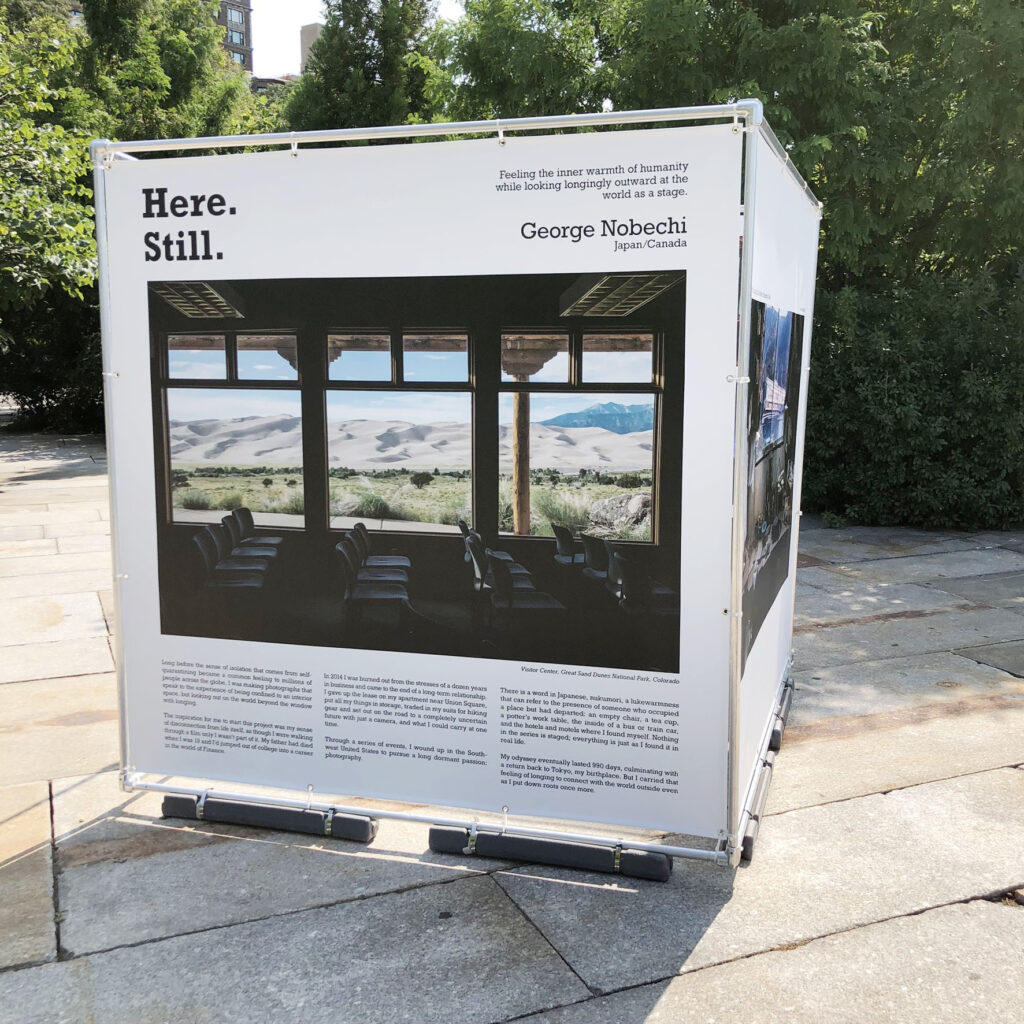
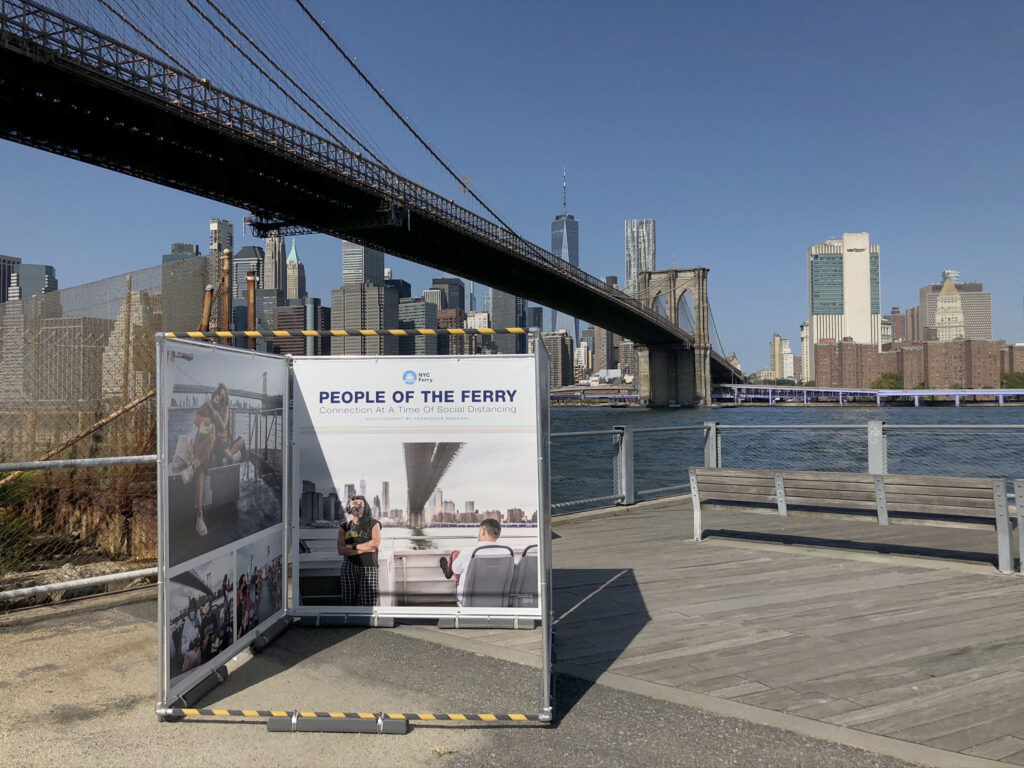
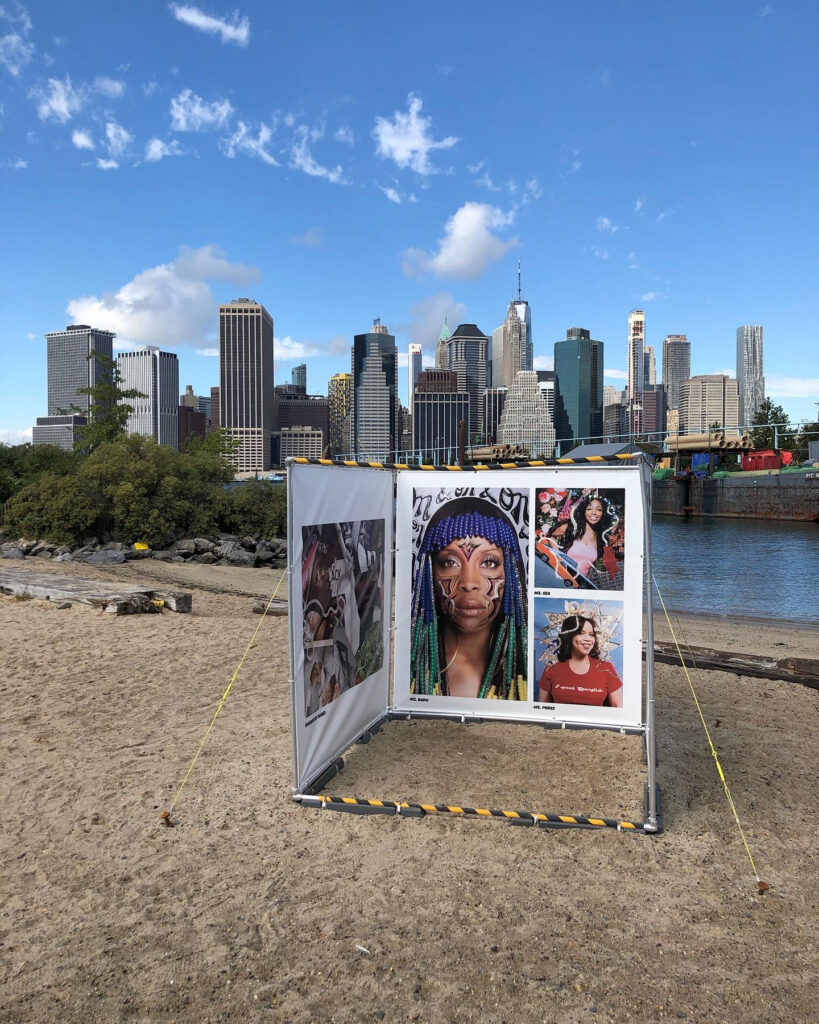
This year because of the pandemic, Photoville’s 2020 version is entirely outside. It is in all five boroughs of New York City, but the majority of the exhibits are located in Brooklyn Bridge Park.

It closes this weekend (9/29/20) and is a wonderful way to get some fresh air and see some excellent work.

Pictured above is work by anonymous art collective Mz. Icar featuring Erin Patrice O’Brien (VALUE: In terms of Iconography), George Nobechi (Here. Still.), and Francesca Magnani (People of the Ferry 2020. Connection at a Time of Social Distancing). 

For more information on these works and to check out samples from the other installations check out Photoville’s website.

May 182020


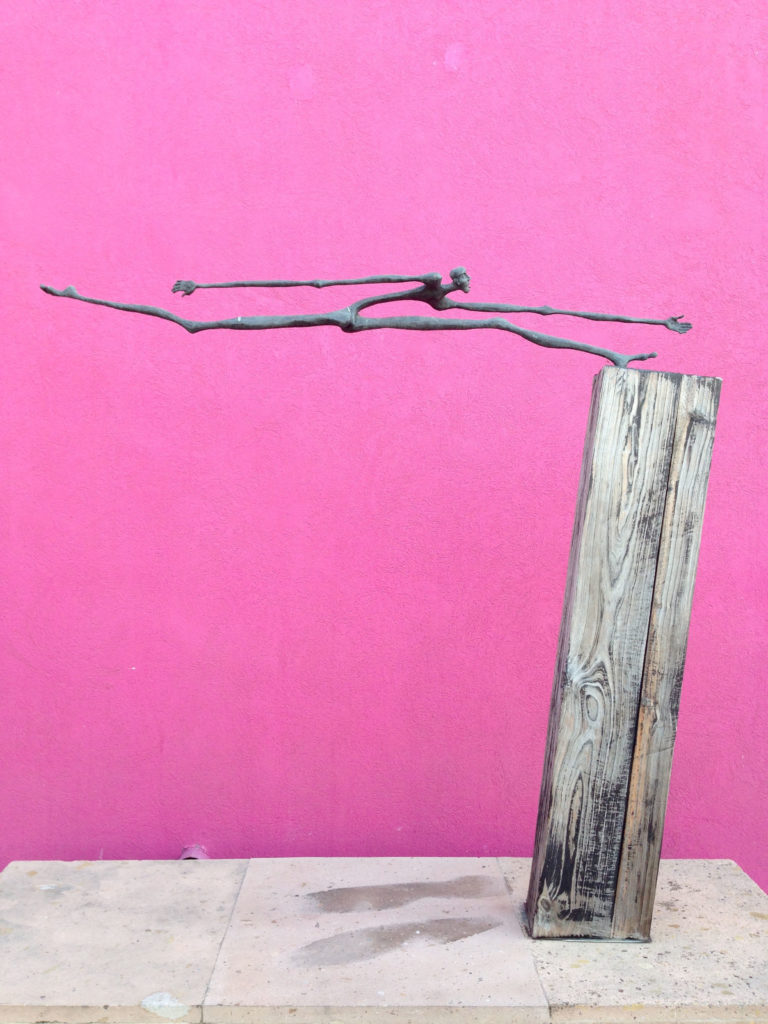
Two works from Museum of Latin American Art’s outdoor sculpture garden, just one of the great things about this Long Beach museum.

Currently they are showing Arte, Mujer, y Memoria: Arpilleras from Chile; Dreamland: A Frank Romero Retrospective;  En Vision: Picturing the Self -selected pieces from MOLAA’s Permanent Collection in conversation with self-portraits by students of Las Fotos Project, a community-based nonprofit organization that inspires teenage girls through photography, mentorship and self-expression; and the work of Afro Cuban artists José Bedia and Belkis Ayón; in addition to work from the museum’s permanent collection, as part of their Museum en Casa online programming.

Mar 062020
 

Spoons, 1979.

For Sandy Skoglund’s exhibition Winter, at Ryan Lee gallery in New York, she has partially recreated the environment she used to created the title piece. Many of her photographs are created by building new worlds-this is a chance to immerse yourself in one of them.

The exhibition also includes a collection of her work from the late ’70s to 2005, including Radioactive Cats from 1980 (pictured below).

From the press release-

Skoglund describes Winter as “a study in perseverance and persistence, an artificial landscape celebrating the beautiful and frightening qualities of the coldest season.” In the photographic image, a man, woman, and child punctuate an icy blue scene. They are inside of an iceberg, perhaps, surrounded by its craggy walls. Standing pensive with hands in the pockets of their winter coats, only the child, a red-headed girl, looks out toward the viewer. The trio is joined in this fantastical setting by a cluster of three snowflake-emblazoned owls and a female figure that seems to have frozen mid-slumber. The imagery evolved from Skoglund’s interest in similarity and difference among snowflakes. Her fascination with the appearance of correspondence versus the reality of difference extends from earlier investigations of the liminal territory between the natural and the artificial, or order and chaos. Through her constructed imagery, Skoglund explores the space between what the human eye and the camera can see.

Since the late 1970s, Skoglund has been celebrated for her panoramic installations—entire environments that she meticulously designs, constructs, and then re-visualizes photographically. Skoglund likens Winter to “a very slow shutter speed on a camera. Time stands still but also inches forward.” Relentlessly inventive, Skoglund challenges herself to experiment with new creative technologies, always in search of the medium best suited for her message. For Winter, which was part of a larger project on the four seasons, years of experimenting with various forms of clay modeling and 3D-printing led to the ultimate inclusion of digitally-cut metal snowflakes bearing ultraviolet cured ink, and the computer-sculpted figure and owls.

Radioactive Cats, 1980. (image courtesy of Ryan Lee )

This exhibition closes 3/7/20.


Feb 272020
 

Currently at Sikkema Jenkins & Co. gallery in New York is on the lower frequencies I speak 4U (alquimia sagrada), a solo exhibition of work by william cordova.

From the press release-

For the artist’s fourth solo exhibition at the gallery, cordova has developed a multi-media installation seeking to explore “the juxtaposition of past structures to more contemporary structures that illuminate the ephemeral nature of our existence, as beings who create material culture as a means of documentation and memory.”

The exhibition incorporates large-scale drawing collages, photography, and sculpture into an environment that reflects on abstract forms rooted in sacred geometries, while also drawing from historical moments and monuments of resistance. Two large scale sculptures, untitled (RMLZ), and untitled (palenque), reference both Brutalist and pre-Columbian architecture, specifically the temple-Citadel sites at Sacsayhuaman and Ollantaytambo. Incorporating the architectural motifs found at these sites, such as zigzags and grids, cordova’s sculptures thread an ephemeral repository, meditating on the concepts of image encoding from biological, natural, galactic, and cultural sources. The sculptures disrupt the formal structure of the gallery, creating alternative perceptions of space and time.

In his series rumi maki, william cordova takes on an ethnographic approach in addressing shared symbolism found in textile data encoding and architectural design. Named after the ancient Andean martial arts, rumi maki consists of multi-colored collages on paper, constructed from vivid layers of recycled paint chips. The arrangement of colors and patterns carry latent meanings, dependent on geography, culture, and the readings of celestial bodies. As cosmological maps, the collages synthesize the sacred geometries of architecture with the visual narratives of historical civilizations. Its form also recalls pioneering early video installation artist Beryl Korot, and her contributions to the 1970s video journal Radical Software.

ogun (el siglo de silencio) sees the artist return to large-scale collage on paper after several years focused on site-specific installations and smaller-scaled work. This work introduces viewers to a new series titled el quinto suyo (the fifth suyo), collages culled from reclaimed paint chip samples and recycled cardboard pigmented with old discarded oil stick paint. Literary references permeate cordova’s collages; texts such as El Siglo de Las Luces by Alejo Carpentier, El Monte by Lydia Cabrera and Decimas by Nicomedes Santa Cruz point to his ongoing interest in the distribution of power, spirituality, and labyrinths of perception.

In the back gallery is an exhibition of paintings (pictured below) by Josephine Halvorson, titled On The Ground.

From the press release-

On The Ground, also the title of her essay in Art In America (June/July 2018), continues Halvorson’s exploration of the ground—as a motif, material, and metaphor. Each painting registers an area of ground through Halvorson’s close observation and pictorial description, while its accompanying surround incorporates crushed rocks and debris from the site of the painting’s making. Together, they realize a faithful translation of place and time. The work in this exhibition was made in the Berkshire mountains, the Mojave Desert, and Matanzas, Cuba.

These hybrid paintings are made with gouache, site material, dry pigment, and printmaking. They expand Halvorson’s on-site practice of transcribing direct experience by hand. While her previous work in oil allowed her encounter with an object to congeal over the course of a day, Halvorson has turned to gouache, a fast drying and graphic medium, which, like handwriting, records her observations in real time. Her paint application is indelible and fresco-like, transferring color from the brush into the absorbent ground of the panel.

Touching down at various points of interest—a piece of plastic, a blade of grass—Halvorson’s notational marks establish a correspondence between environment, painting, and viewer. Like a map, they depict the literal scape of the ground while offering an escape from mimesis. The reality of proximity breaks down as one gets lost in the archeology of a single stride. Gravel becomes galactic. The surround acts as a legend or key, a space for evidence and tools of calibration. A ruler, coins, or color chart orient the onlooker in terms of scale and perception, and the site material indexes the painting to its original locale. These are paintings of verification and memorialization. They ask how we make sense of what we see, how we express that witnessing, and how an account of experience is made concrete.

Both of these exhibitions close 2/29/20.

Feb 212020
 

Currently at Blain Southern gallery’s New York location is  Mircea Suciu’s Universal Fatigue.

From the press release-

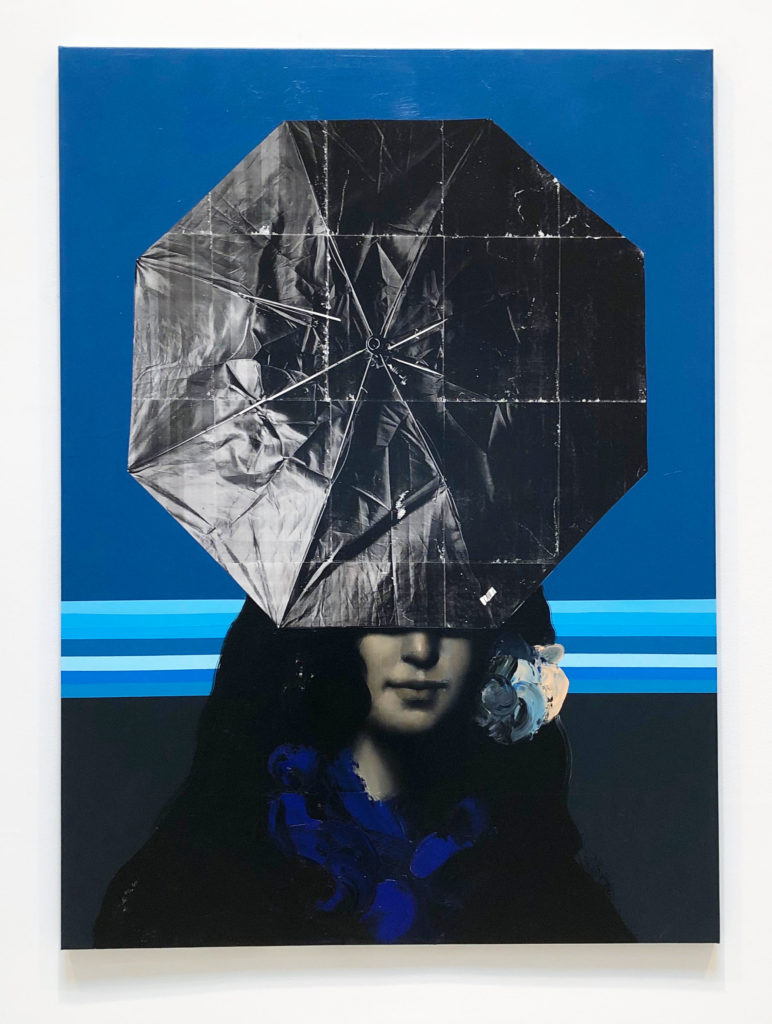
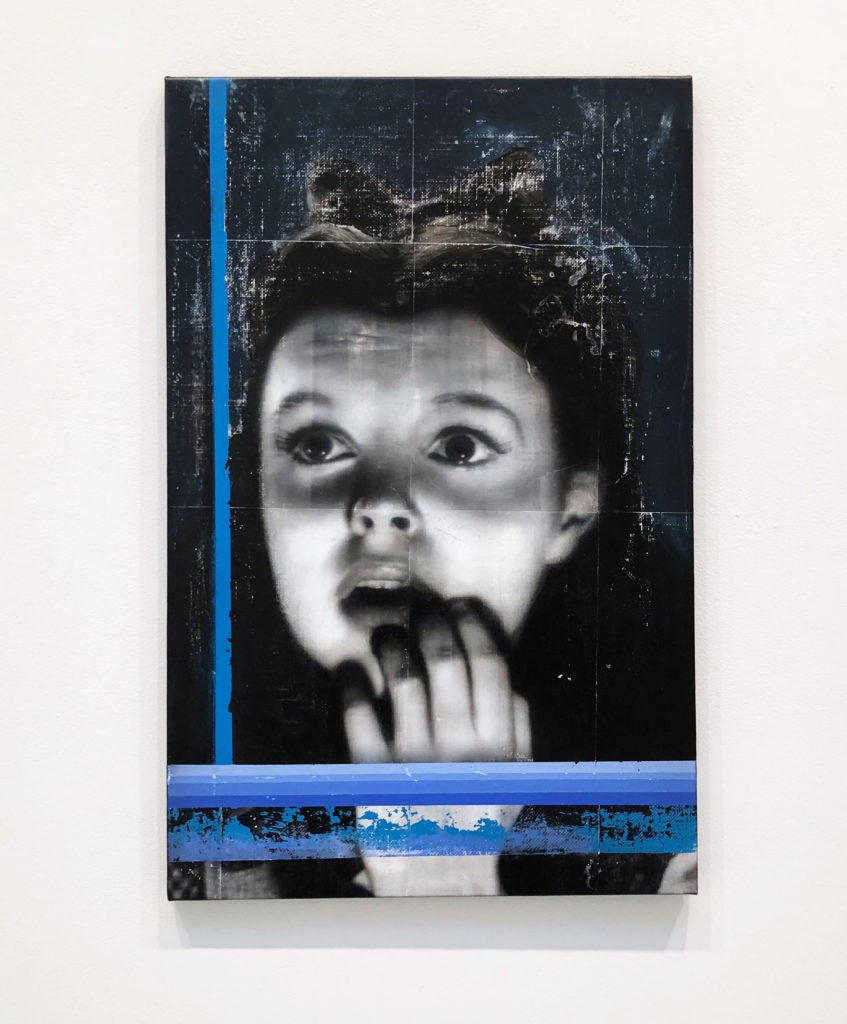
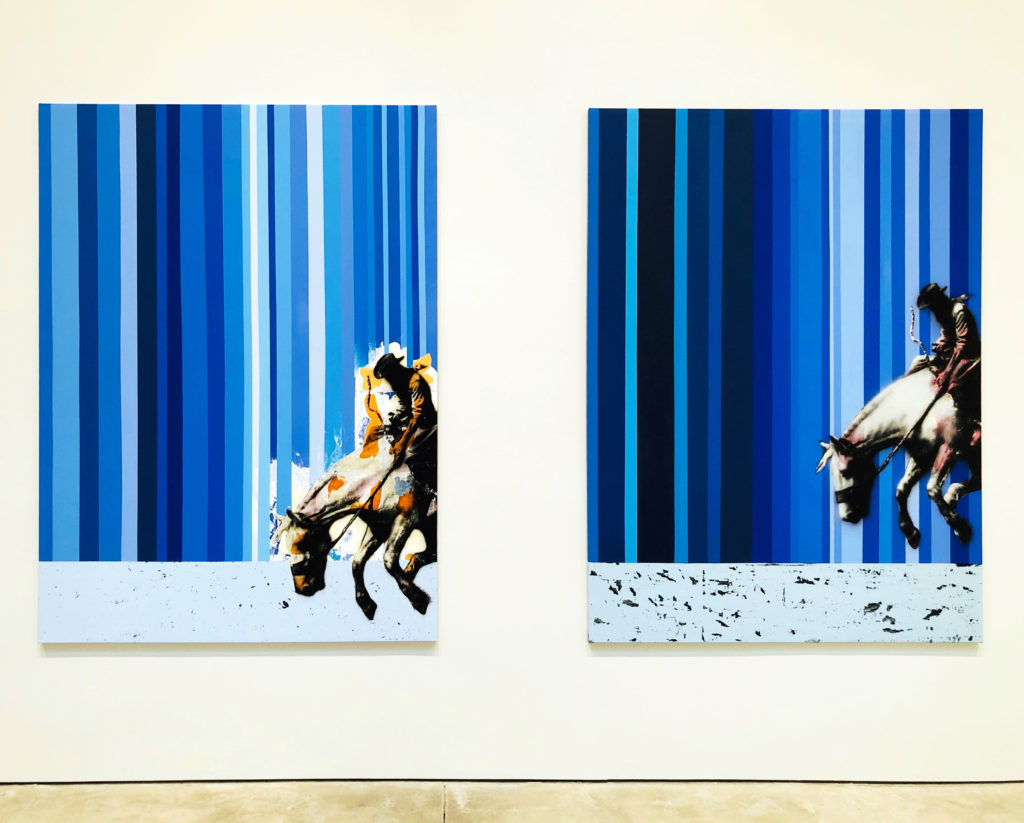
Part of the Cluj School, Mircea Suciu (b. 1978, Baia Mare, Romania) is regarded as one of Romania’s leading artists. During his formative years he witnessed the country’s tumultuous transition after the only violent overthrow of a communist government in the 1989 revolutions. Describing himself as an image creator rather than a traditional painter, Suciu mines and references art history and contemporary imagery, reducing down the elements and adding colour coded symbolism. He has ‘his own complex way of making things in which painting, photography, drawing and print all cooperate while playing their individual parts’ 1

Inspired by his former studies on the restoration of Baroque paintings, Suciu has developed a process he calls ‘monoprinting’. A photographic image is split into a grid of A4 surfaces, each one printed onto an acetate sheet onto which a layer of acrylic paint is applied. The paint acts as a ‘glue’ that adheres to directly to the canvas and once dry, the acetate sheet is peeled off. The result is a transference of the printed image with associated faults and imperfections which Suciu then ‘restores’ by re-painting with oil and acrylic paint. Sometimes, as with works in the Disintegration series, he overlays the image multiple times using various colours until he creates a surface that is barely recognisable from the original. As a final stage the whole image is repainted. This multi-layered process creates compositions of reinvented images which allude to history, memory and eventual dissolution of all things.

‘A characteristic of my work is frailty, not regarding the subject but the relationship between the surfaces that constitute the ensemble of the whole picture.’ – Mircea Suciu

This exhibition closes 2/21/20.


Feb 132020
 

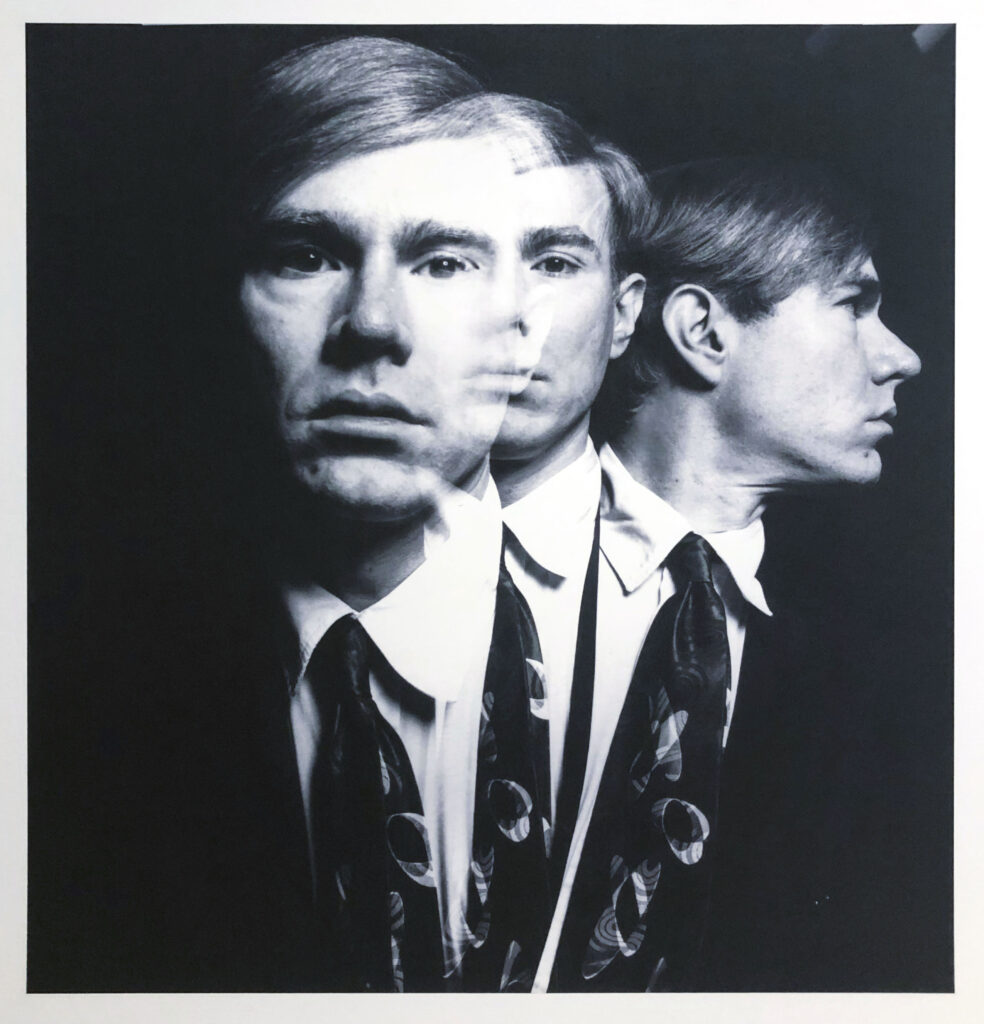
Part of what makes Andy Warhol such an incredible artist is the variety and volume of work he created in his lifetime. Currently in both of Jack Shainman Gallery‘s locations are a selection of Warhol’s photographs that are not often seen. Photo collages, “stitched photos”, nudes, and, of course, photos of celebrities, come together to give new perspective on Warhol’s work within the medium of photography.

From the press release-

Warhol’s photographic oeuvre remains one of the most central and enduring aspects of his creative process. Initially inspired by commercially available press photos of celebrities, such as iconic images of Marilyn Monroe, Elvis Presley, and Marlon Brando, as well as newspaper photographs of death and disasters, Warhol incorporated photographs as source material for the creation of his silk-screened paintings and prints. With the creation of a singular visual vocabulary, Warhol articulated his sensibilities while conveying his detached, observing eye through the use of a dispassionate machine: the camera.  Photography spanned the entirety of Warhol’s career as he fused numerous genres of photo-making.

By the mid-1960s, Warhol’s eye turned to the moving image as he began making 16mm black and white short films, dubbed Screen Tests, which featured his “Superstar” Factory crew. Several Screen Tests are on view in this exhibition, including films that highlight Factory life, some very early notions of performance art, and the raw visual materials for Lou Reed’s The Velvet Underground EP. These films catalyzed into Warhol’s revolutionary conceptual feature-length films, including Sleep, Empire, and Heat.

Concurrent with his exploration of film, Warhol utilized photobooths in Times Square to create serial images of art dealers, collectors, and bright young creatives who frequented the Factory. These strips became source material for some of Warhol’s most iconic early portraiture, including paintings of art dealer, Holly Solomon, collectors, Judith Green and Edith Skull, and Warhol Superstars, such as Jane Holzer and Edie Sedgwick. Towards the end of the 1960s, Warhol began carrying with him a Polaroid camera used largely to document friends in his inner circle, including Mick Jagger, Diana Vreeland, Lee Radziwill, and Nan Kempner. Warhol referred to the Polaroid camera as “his date” – always with him, a tool for both engaging with his subjects, as well as a distancing mechanism.

In 1977, Warhol’s Swiss dealer, Thomas Ammann, presented him with the gift of a 35mm Minox camera, which became the artist’s primary photo-making instrument until the time of his death in 1987. The resulting unique silver gelatin prints, which were produced during the final decade of Warhol’s life, illuminate most comprehensively the artist’s personal and artistic sphere. Warhol’s final and most obscure body of work, a series of “stitched photos,” was created by sewing together these silver gelatin prints in serial panels of four, six, or nine identical images.  Nearly five-hundred stitched photo works were created in all, most of which are now in the permanent collections of global institutions.

This exhibition brings together one of the largest selections of Warhol’s stitched photos, created within the culminating moment of Warhol’s photographic oeuvre and, indeed, his entire career.  In January 1987, Robert Miller Gallery opened the sole photography show ever presented during the artist’s life, as Warhol intended to make an incredible push for photography as a medium to be appreciated as a central part of his narrative and art-making processes. Six weeks later, Warhol died unexpectedly.

This exhibition closes 2/15/20.


Jan 242020
 

Sadie Barnette’s recreation of her father Rodney Barnette’s bar, Eagle Creek Saloon for The New Eagle Creek Saloon at ICA LA is not only beautiful, but it also celebrates an important piece of history.

From the museum’s website-

For her first solo museum presentation in Los Angeles, Oakland-based artist Sadie Barnette (b. 1984) will reimagine the Eagle Creek Saloon, the first black-owned gay bar in San Francisco, established by the artist’s father Rodney Barnette, founder of the Compton, CA chapter of the Black Panther Party. From 1990–93 Barnette’s father operated the bar and offered a safe space for the multiracial LGBTQ community who were marginalized at other social spaces throughout the city at that time.

Barnette engages the aesthetics of Minimalism and Conceptualism through an idiosyncratic use of text, decoration, photographs, and found objects that approach the speculative and otherworldly. Barnette’s recent drawings, sculptures, and installations have incorporated the 500-page FBI surveillance file kept on her father and references to West Coast funk and hip-hop culture to consider the historical and present-day dynamics of race, gender, and politics in the United States. Using materials such as spray paint, crystals, and glitter, she transforms the bureaucratic remnants from a dark chapter in American history into vibrant celebrations of personal, familial, and cultural histories and visual acts of resistance. The New Eagle Creek Saloon is a glittering bar installation that exists somewhere between a monument and an altar, at once archiving the past and providing space for potential actions.

The museum is also showing No Wrong Holes: Thirty Years of Nayland Blake (pictured below).

From the museum’s website-

For over 30 years, artist, educator, and curator Nayland Blake (b. 1960) has been a critical figure in American art, working between sculpture, drawing, performance, and video. No Wrong Holes marks the most comprehensive survey of Blake’s work to date and their first solo institutional presentation in Los Angeles.

Heavily inspired by feminist and queer liberation movements, and subcultures ranging from punk to kink, Blake’s multidisciplinary practice considers the complexities of representation, particularly racial and gender identity; play and eroticism; and the subjective experience of desire, loss, and power. The artist’s sustained meditation on “passing” and duality as a queer, biracial (African American and white) person is grounded in post-minimalist and conceptual approaches made personal through an idiosyncratic array of materials (such as leather, medical equipment, and food) and the tropes of fairy tales and fantasy. Particular focus will be paid to work produced while Blake lived on the West Coast, first in the greater Los Angeles area as a graduate student at CalArts, followed by a decade in San Francisco—years bookended by the advancement of the HIV/AIDS epidemic in the 1980s and the “culture wars” of the 1990s.

Feeder 2, 1998

The gingerbread house, pictured above, is one of Blake’s best known works and was created using actual gingerbread. It references the fairy tale Hansel and Gretel as it recreates the house used to lure the children to their potential doom.

From the wall description-

Fairy tale and fantasy are themes to which the artist often returns as a mirror onto society and culture. Further, duality and the act of revealing are critical to Blake’s practice: as a biracial, white-passing, queer, gender non-binary person, Blake’s identity is one that is not obvious and is predicated on existing in two spaces at once. Though initially captivating through its inviting sight and scent, over time, the once-pleasant sensorial experience of Feeder 2, with its cold, empty interior, becomes overwhelming, even nauseating, as it challenges the truth of perception and association.

Both of these exhibitions close 1/26/20.

Jan 162020
 

Sexy Robot_Floating, 2019 by Hajime Sorayama

Tokyo Pop Underground curated by Tokyo gallerist Shinji Nanzuka and currently at Jeffrey Deitch gallery in Los Angeles “explores the complex history of Japanese contemporary art from the 1960s to the present through the works of seventeen artists who emerged from pop and underground culture”.

From the press release-

Shinji Nanzuka explains that “originally in Japan, most of what is referred to as art are practical items, developed together and in integration with popular culture.” He cites examples from calligraphy to folding screens, paintings on sliding paper doors, lacquerware, netsuke, and the Ukiyo-e prints that served as posters and commercial portraits. He also mentions art historian Naoyuki Kinoshita’s study of intricately realistic handicrafts such as iki-ningyou, life-like dolls that were made for exhibitory performances. Nanzuka’s mission in this exhibition is to present contemporary artistic commentaries on this Japanese artistic heritage.

Deviating from the mainstream current of “art for art’s sake” when he opened his Tokyo gallery in 2005, Nanzuka decided to focus on artists whose works at the time were not considered to be art. Artists like Keiichi Tanaami, Harumi Yamaguchi, and Hajime Sorayama, whose works are now celebrated in the international art world, were looked down upon as producers of commercial and popular art. Nanzuka saw them as prime exponents of the idiosyncratic nature of Japan’s culture and history.

Another reason that Tanaami, Yamaguchi, Sorayama, and Toshio Saeki did not receive recognition until recently is the radical intensity of their practice. The expressions of sex and violence in their work are statements of anti-authority and anti-uniformity. The aggressive portraits of women painted by Harumi Yamaguchi show her engagement with the women’s liberation movement of the 1970s. Sorayama’s sexualized robots predict a dystopian future.

There are strong links between the underground Japanese culture from which many of these artists emerged and the American graffiti and skateboard subcultures that were embraced by Japanese youth. Haroshi, one of the younger artists in the show, constructs his works entirely from wood sliced from skateboards donated by friends and professional skateboarders to compose a collective portrait of his enlarged, international community.

The artists in Tokyo Pop Underground reflect the strains in contemporary Japanese culture as it rebuilt itself after the ruins of war and confronts numerous natural disasters. Their work reflects what Nanzuka describes as “the crazy cross-cultural exchange” between the West, the East, and the Far East, shaping a new international artistic language.

This exhibition closes 1/18/20.