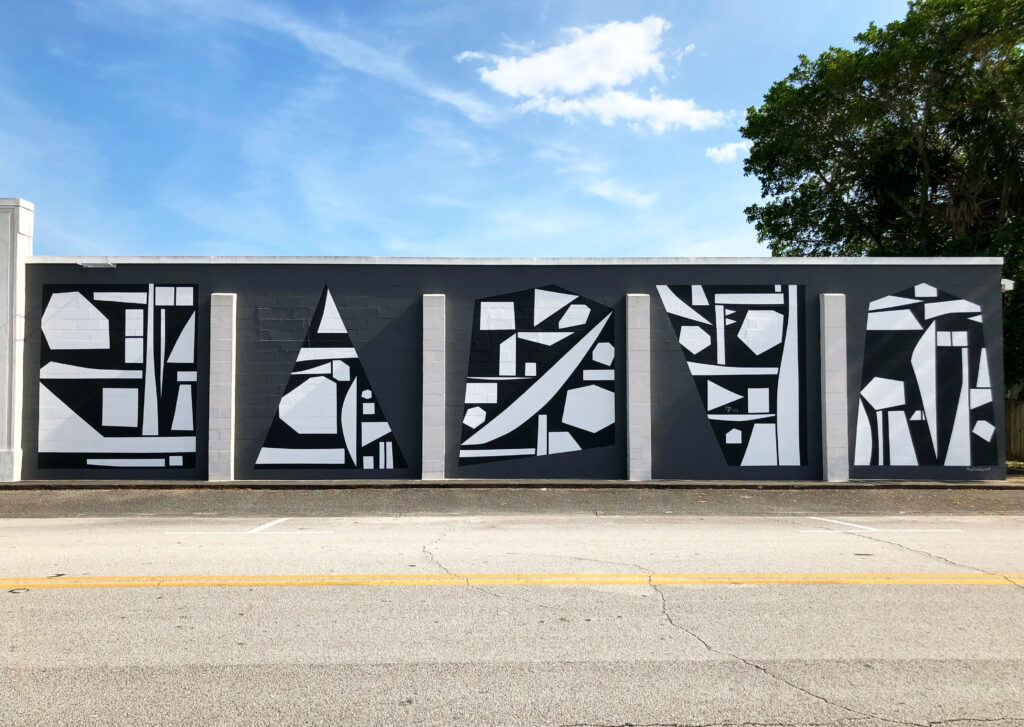
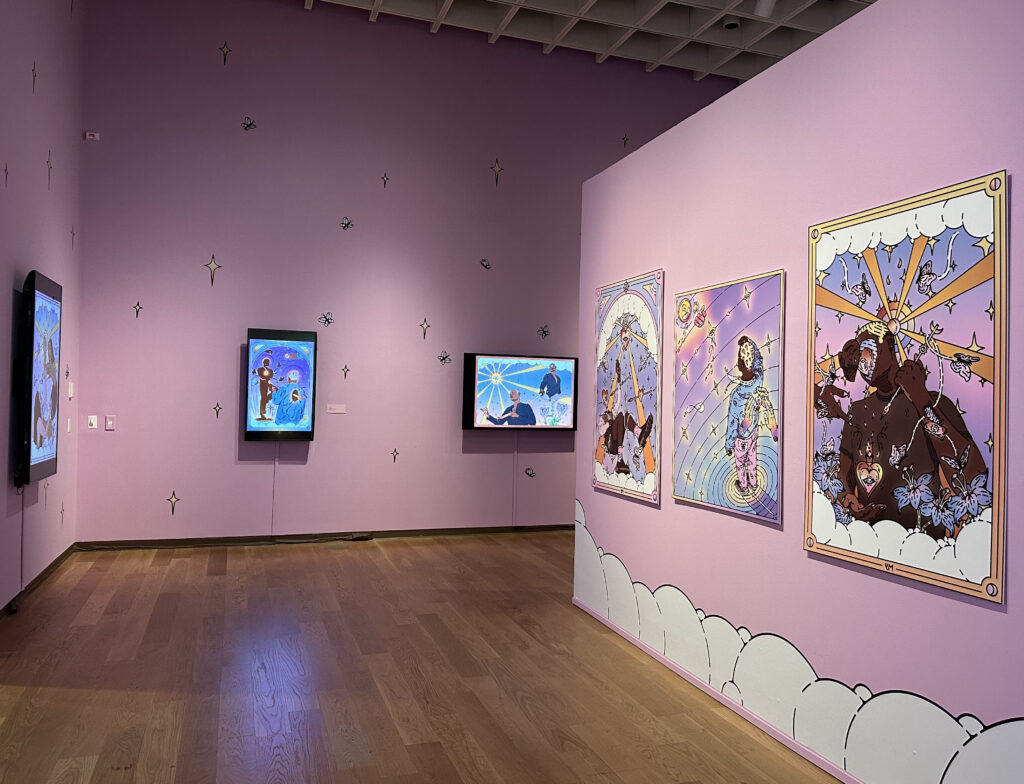
This mural was created by Hyland Mather, aka The Lost Object, in 2017 for Anti Gravity Project and The Foosaner Art Museum in the Eau Gallie Arts District in Melbourne, Florida. The museum, sadly, closed in 2021.

This mural was created by Hyland Mather, aka The Lost Object, in 2017 for Anti Gravity Project and The Foosaner Art Museum in the Eau Gallie Arts District in Melbourne, Florida. The museum, sadly, closed in 2021.
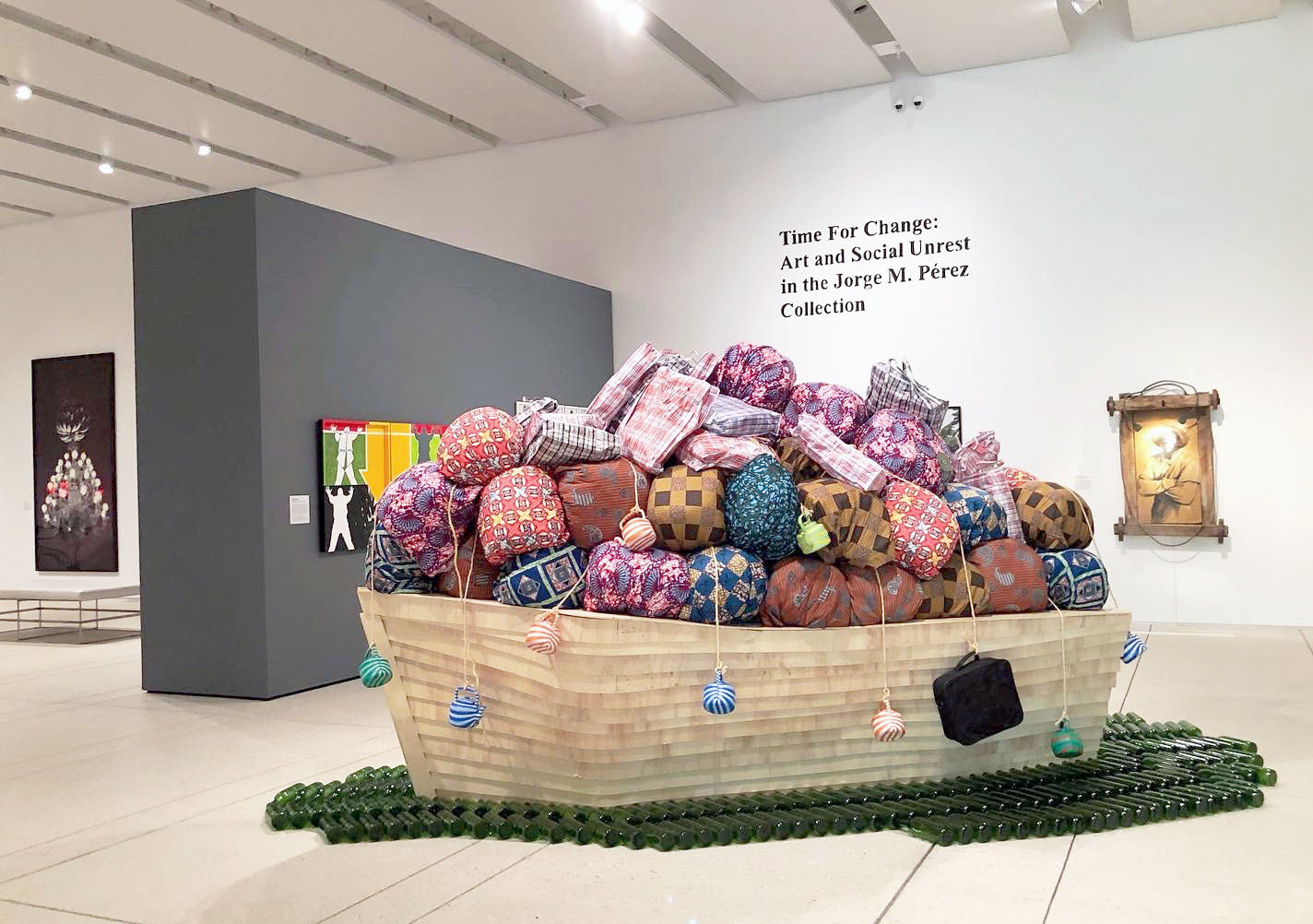
Barthélémy Toguo (Cameroonian, b. 1967), “Road to Exile”, 2018. Wooden boat, cloth bundles, glass bottles, and plastic containers
Currently on view at Tampa Museum of Art is Time for Change: Art and Social Unrest in the Jorge M. Pérez Collection. The exhibition highlights art from around the world that focuses on social issues.
From the museum-
“It is enough for the poet to be the bad conscience of his age”, stated Saint-John Perse in his 1960 Nobel Prize acceptance speech. Something similar could be said when artists address the transformations of society. We should not ask for measurable political action when their role is to point out, to render evident, to shake us from indifference. Art may not provide answers, but most of the time it interrogates and proposes uncomfortable issues, almost like rubbing salt in a wound. Artists are seldom celebratory, nor do they usually provide solutions-art’s potency lays in the symbolic efficacy of the actions it proposes more than in the practical effects they entail. Paraphrasing Brazilian poet Ferreira Gullar, “art exists because life is not enough.”
Time for Change is structured around six themes or nuclei: Entangled Histories, Extraction and Flows, Artivism, State Terror, Spatial Politics, and Emancipatory Calls. The sections are organically linked and establish dialogue and correlations among artworks that do not necessarily illustrate an argument nor are they contained by one. Entangled Histories proposes essential questions: how do we remember as a society? Who is forgotten by History, and for what reasons? Extraction and Flows examines displacement of peoples (usually forced), as well as the unequal logic on the territory. Artivism: Art in the Social Sphere focuses on political unrest and public protest on the streets. State Terror signals how protest is countered with repression and violence. The fifth section, Spatial Politics, reflects on modern architecture and its role in creating segregated communities. Lastly, Emancipatory Calls summons to reclaim difference, in the understanding that a more just society can only be built on respect for one’s right to be different.
A comprehensive look at the Jorge M. Pérez Collection reveals a tendency towards art with an interest in social change- art that examines the conflicts and contradictions of contemporary society, art that critically analyzes historical events and reframes them in the present. Many of the 60 works on view, due to their size or complexity have rarely been exhibited and are shown together for the first time in Time for Change.
About the main work pictured above, Barthélémy Toguo’s Road to Exile, from the museum–
In 2018, the Parrish Art Museum in Water Mill, New York hosted Barthélémy Toguo’s first solo exhibition in the United States. While on site at the Parrish he made Road to Exile, a large-scale installation highlighting the plight of refugees, in particular African migrants in search of a better and safer quality of life. The installation features a life-sized wooden boat that rests on glass bottles. A metaphor of the dangerous voyage across the sea, the bottles represent the fragile line between life and death. The boat nearly overflows with bundles wrapped in brightly colored African textiles and serve as stand-ins for the body. In Road to Exile Toguo employs imagery of the boat as a means of escape rather than a vessel for exploration or adventure.
Below are images from the exhibition as well as some information on a few of the works.
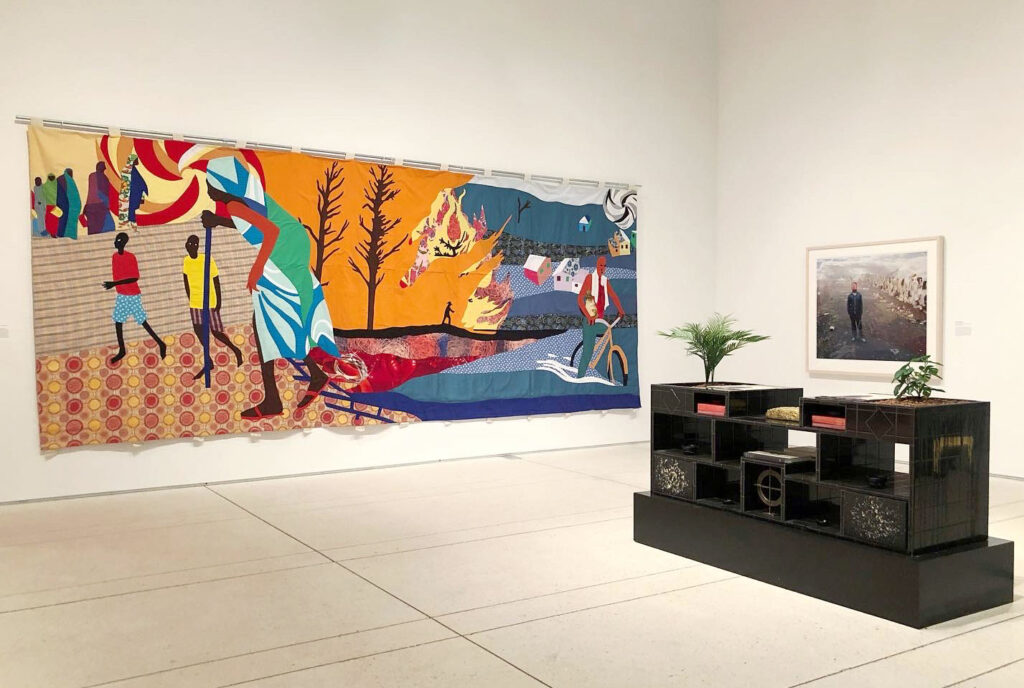
Rashid Johnson, “A Place for Black Moses, (2010), bottom right sculpture, and Christopher Myers “How to Name a Famine, a Fire, a Flood”, 2019, left wall piece
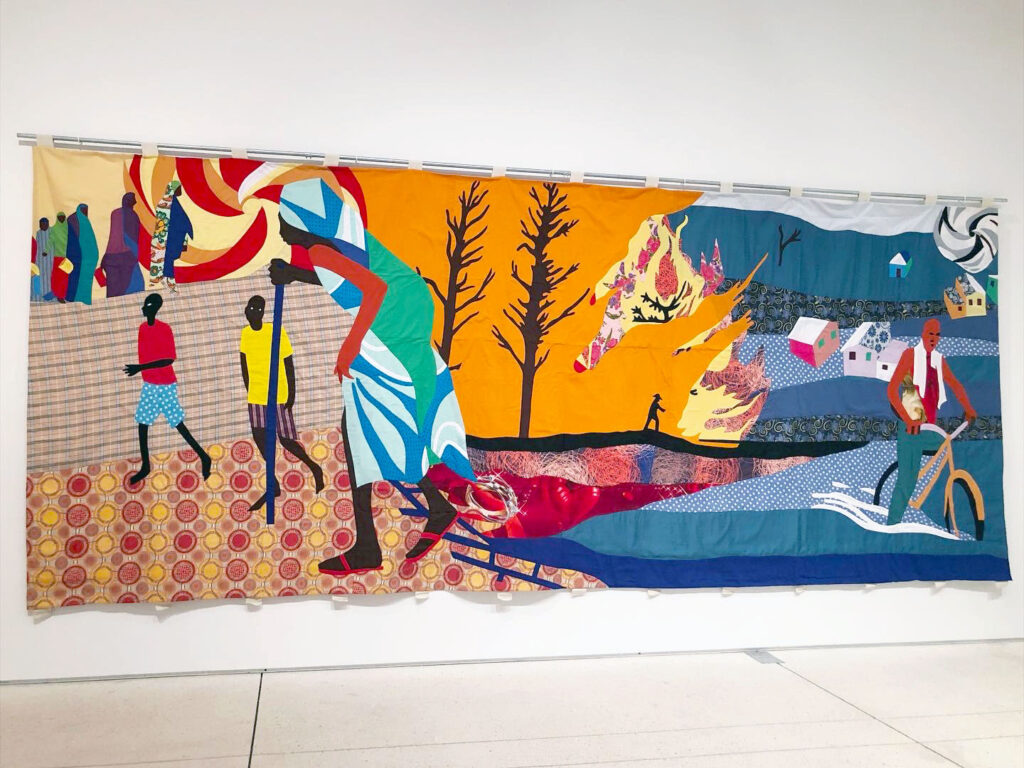
Christopher Myers “How to Name a Famine, a Fire, a Flood”, 2019, Applique fabric
From the museum about the above work-
Storytelling anchors Christopher Myers’ artistic practice. Working in a range of media, he mines history and creates art that links the past to the present. Myers’ tapestries, such as How to Name a Famine, a Fire, a Flood draws on the rich tradition of quilt making as a quiet yet radical form of resistance and protest. The stories depicted center on the effects of globalization on individuals and more specifically, communities of color. In How to Name a Famine, a Fire, a Flood, Myers portrays three different natural disasters linked to climate change. With vivid color and patterned fabric, he illustrates the impact and devastation of these catastrophic events in neighborhoods with minority populations.
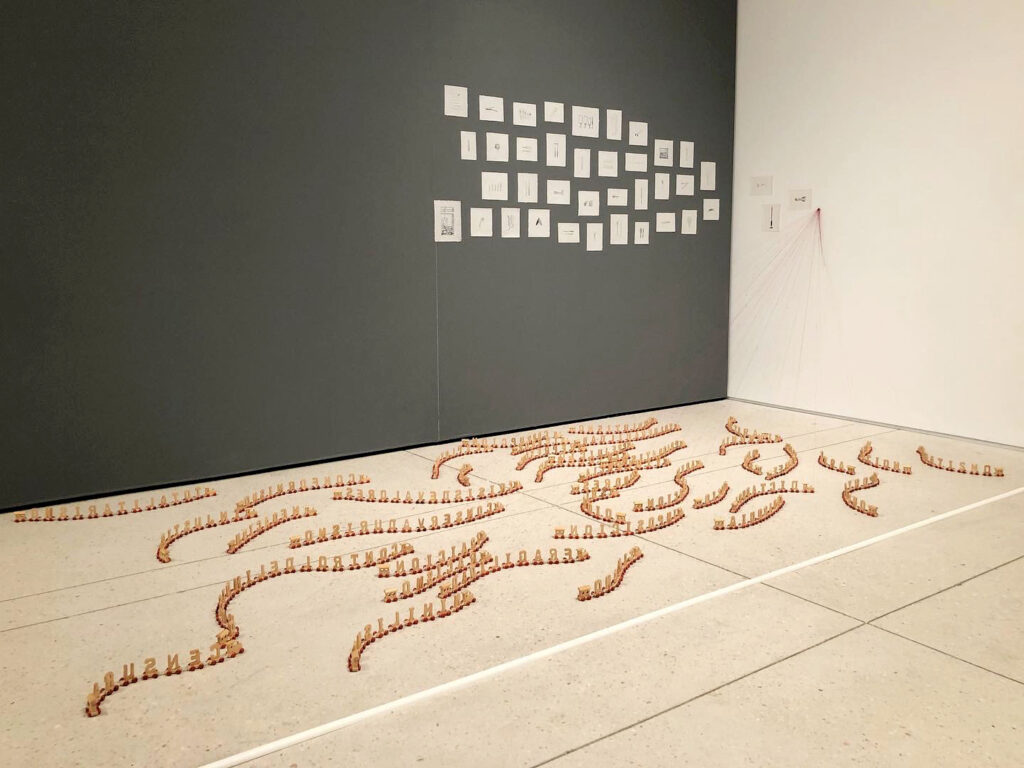
Carlos Garaicoa “La habitacion de mi negatividad (The Room of My Negativity)”, 2003, 39 ink and pencil drawings on rice paper and toy train installation
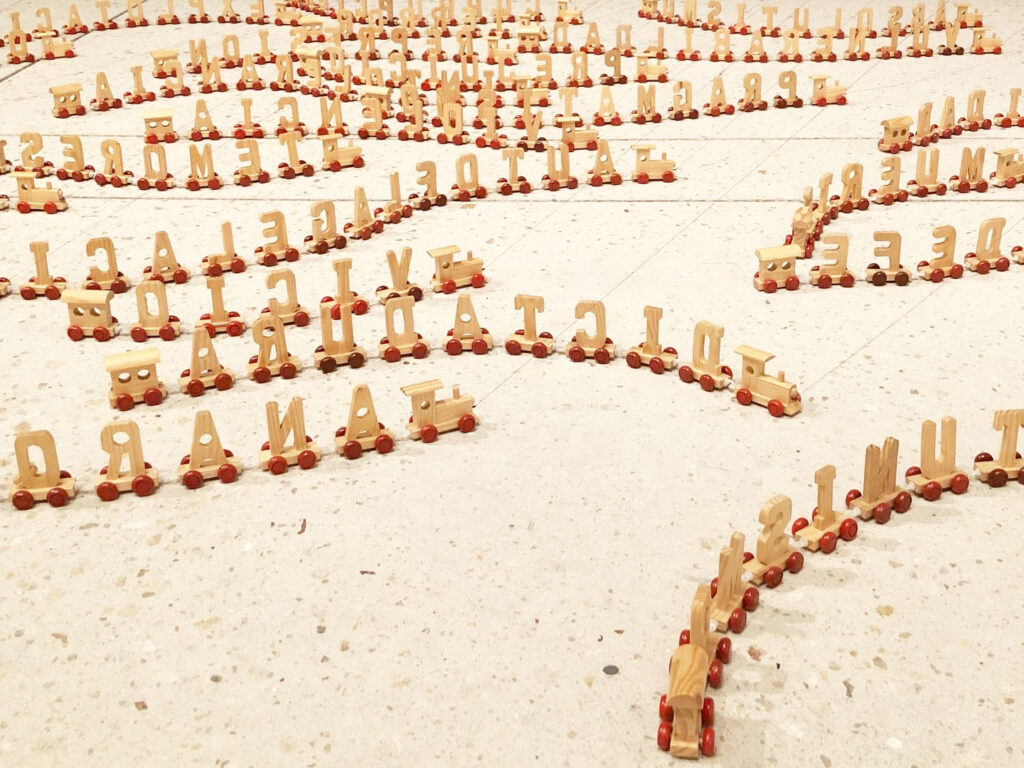
Carlos Garaicoa “La habitacion de mi negatividad (The Room of My Negativity)”, 2003 (detail)

Carlos Garaicoa “La habitacion de mi negatividad (The Room of My Negativity)”, 2003 (detail)
About the above work from the museum-
Carlos Garaicoa works in a variety of media, ranging from installation, photography, and video to performance and public interventions. His early work in the 1990s focused on the urban decay of Havana as result of its political climate and economic strife. La habitacion de mi negatividad (The Room of My Negativity), turns Garaicoa’s lens inward. In this installation, comprised of toy trains and drawings of medical instruments, the artist explores his psyche and subconscious. The train’s engine pulls words that represent Garaicoa’s negative thoughts. Each train is connected to thin red thread that acts as a vein or conduit for the negative thoughts to travel. Arrange in a curved form, the train shapes mimic brain waves or the slink of a snake. Garacoia’s drawings of medical tools serve as mechanisms in which the negatively could be excavated from one’s mind.
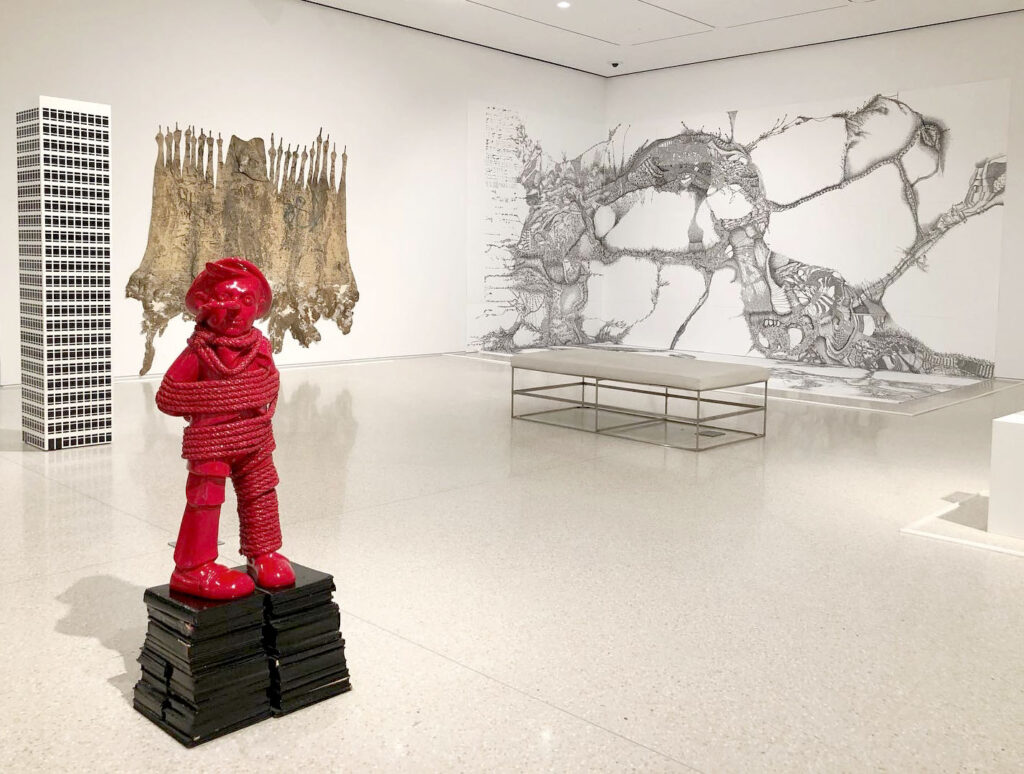
Esterio Segura, “La historia se muerde la cola (History Bites its Tail)”, 2015, (statue bottom left); Anamaría Devis, “Infinito (Infinite)”, 2018(upper right)
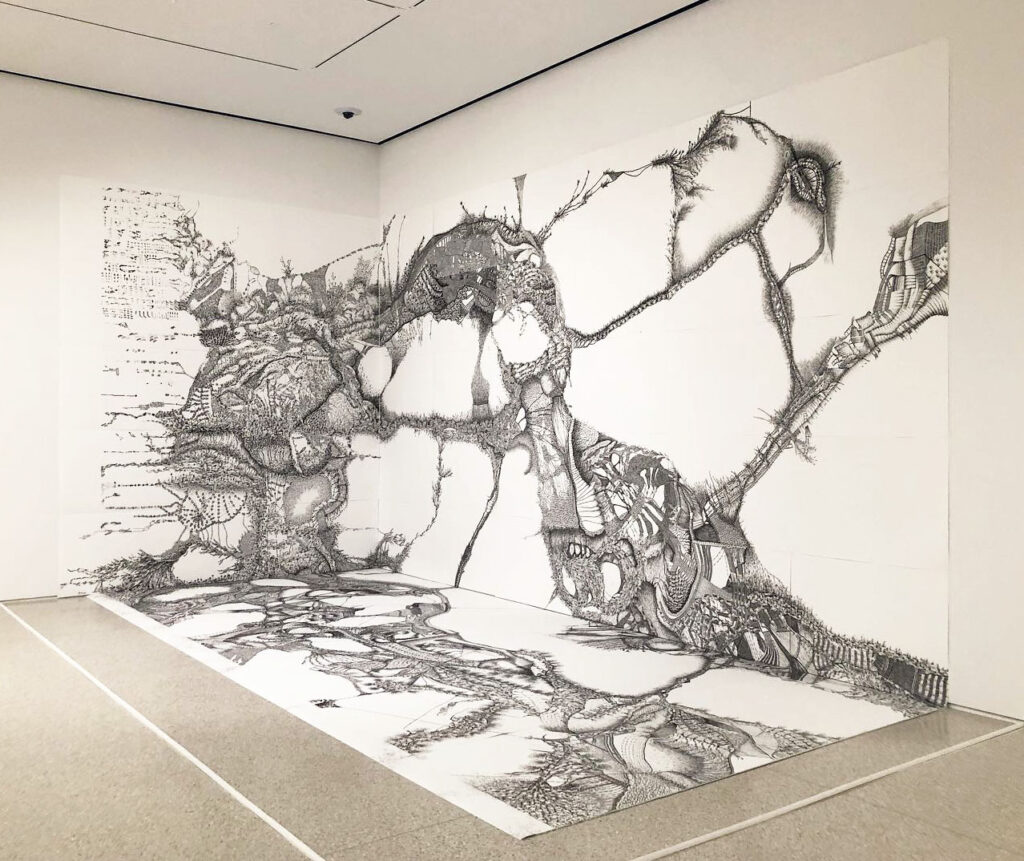
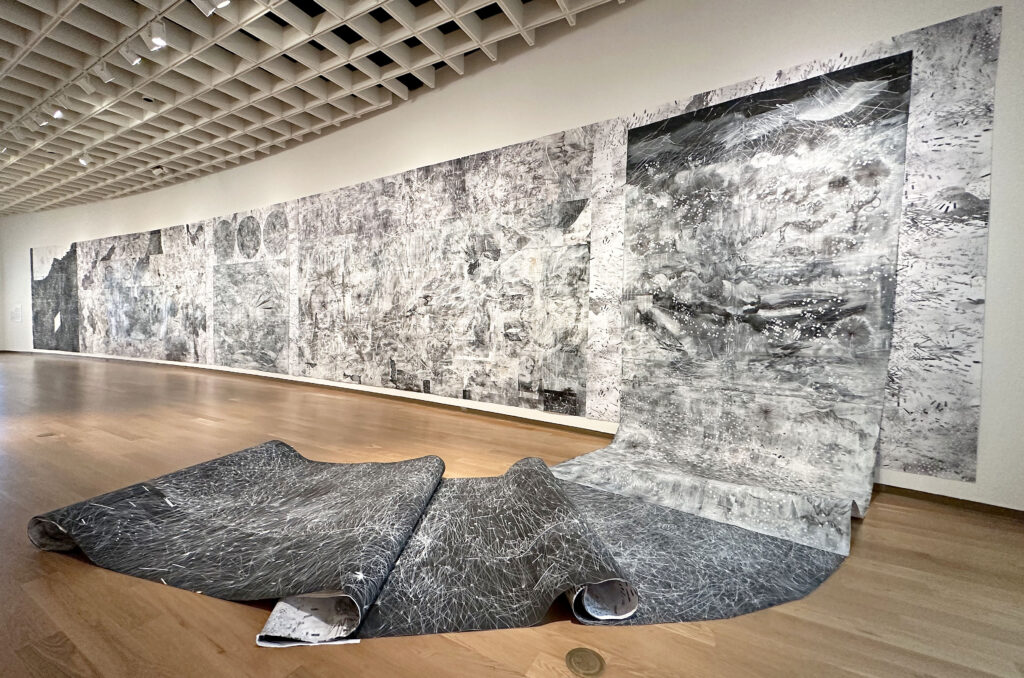
Anamaría Devis, “Infinito (Infinite)”, 2018, Ink on paper
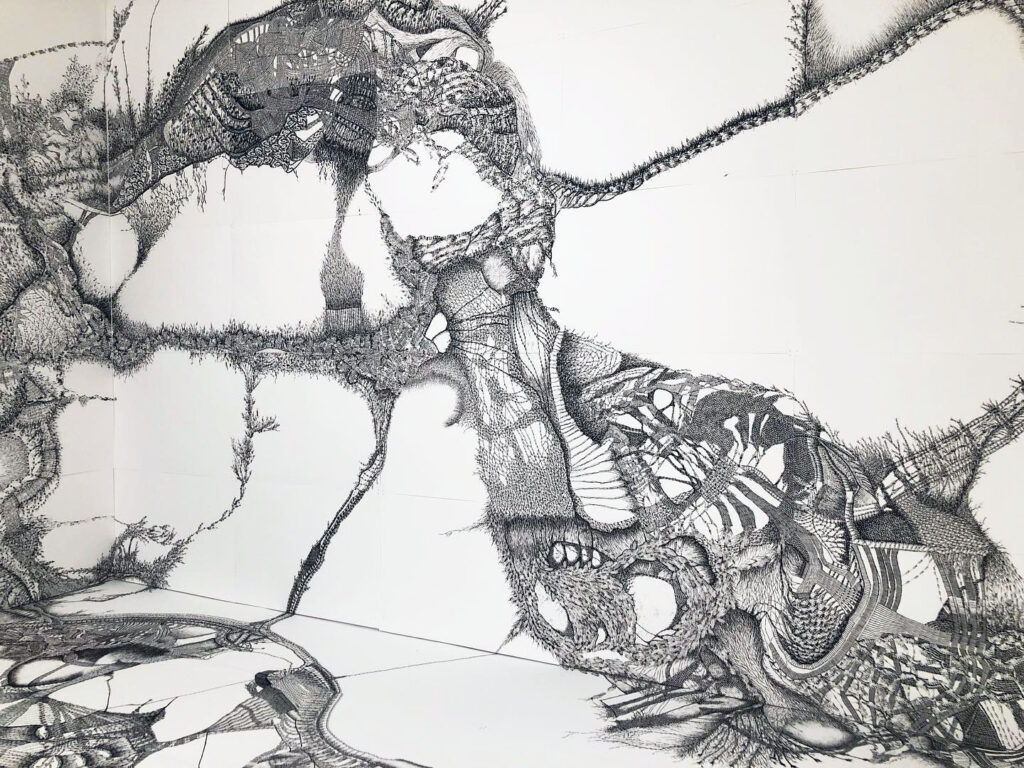
Anamaría Devis, “Infinito (Infinite)”, 2018, Ink on paper (detail)
About this work from the museum-
Anamaría Devis’ large-scale installation Infinito (Infinite) represents the artist’s study of African history in San Basilio de Palenque, Colombia. Escaped slaves founded Palenque and it was the first free town in the Americas during colonial times. While researching this history, Devis discovered that in this region of Colombia, braided hairstyles worn by Africans served as escape maps. Braid patterns reflected safe points in the area’s topography. This silent form of resistance inspired her to look at other bodily topographies like the characteristics of fingerprints, which also had names associated with cartography such as crossing, island, and fork. Devis then began to create drawings that incorporated footprints, braid patterns, and elements of nature. From the drawings she made stamps and each panel of paper that comprises Infinito (Infinite) is rendered from Devis’ various imprints. The result is an abstract representation of the body and landscape visualized through mapping and codes.
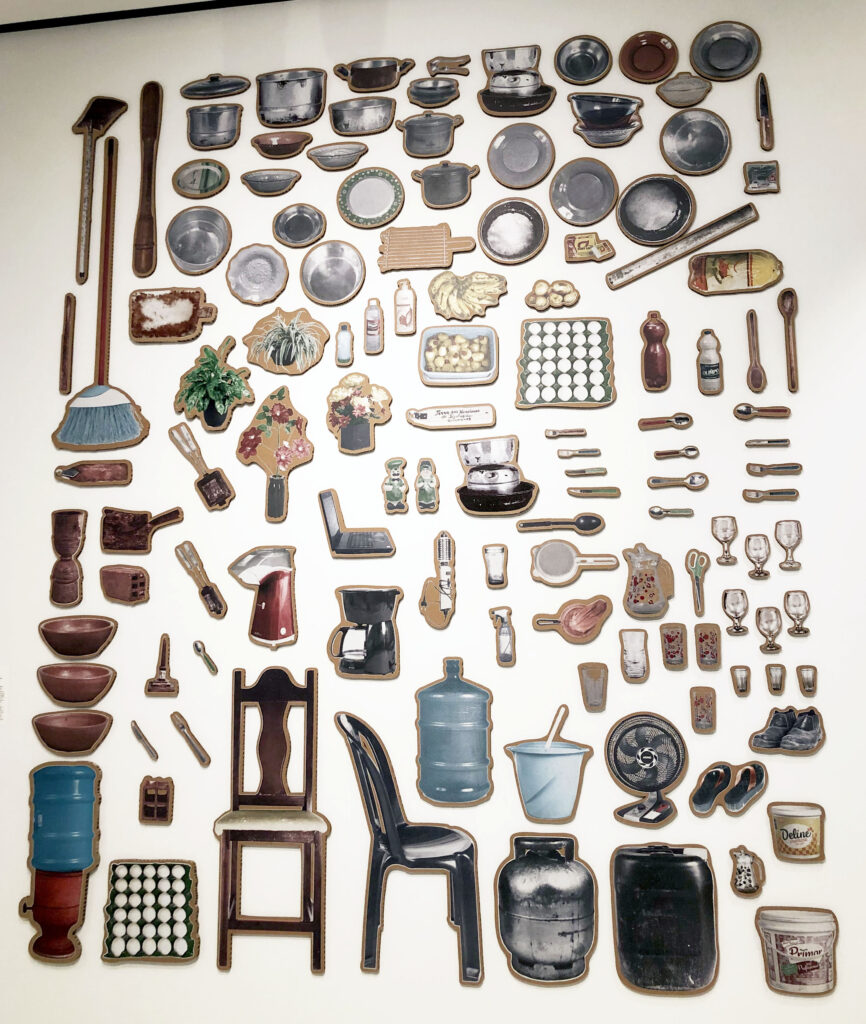
Jonathas de Andrade, “A batalha de todo dia de Dona Luzia, de Tejucupapo (The daily battle of Dona Luzia, from Tejucupapo)”, 2022 Images printed on raw falconboard
About this work from the museum-
Jonathas de Andrade collaborated with the Brazilian theater company Teatro Heroínas de Tejucupapo to create a visual reenactment of the historic 1646 Battle of Tejucupapo. For nearly 25 years, between 1630 and 1654, the Dutch occupied the northeast of Brazil including Tejucupapo, a small community in the city of Goiana. During the Battle of Tejucupapo, a brigade of black and indigenous women forced Dutch soldiers to retreat by arming themselves with household and farm objects. The Teatro Heroínas de Teiucupapo commemorates this female-led rebellion each April by restaging the battle with local actors.
Artist Jonathas de Andrade celebrates the power and courage of Tejucupapo’s women with his large-scale photographic installation A batalha do todo dia de Tejucupapo (The Battle of Tejucupapo). The work on this wall, A batalha de todo dia de Dona Luzia, de Tejucupapo (The daily battle of Dona Luzia, from Tejucupapo), presents everyday objects from the home of one of the women participating in Teatro Heroínas de Tejucupapo. This inventory explores the daily struggles, as well as strength, of Brazil’s black and indigenous women that have spanned centuries.
This exhibition will close on Sunday, 8/27/23.

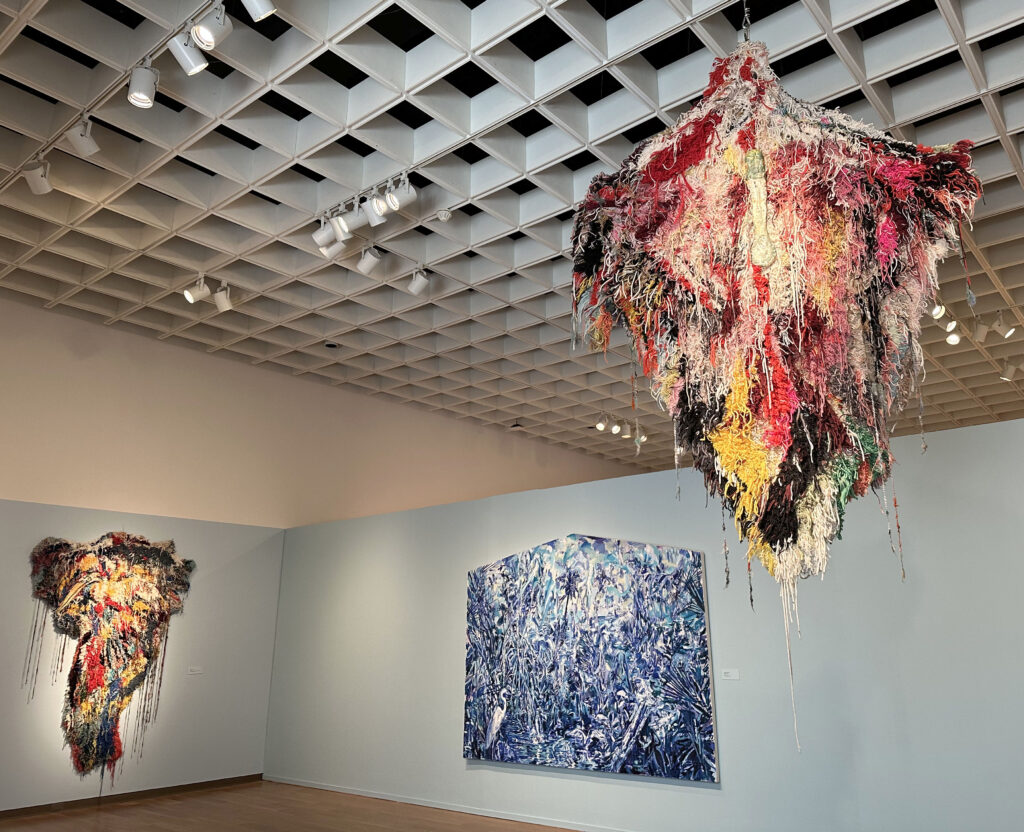
Leora Stewart (1943-2021) “Banyan Tree”, Fiber wall hanging

Leora Stewart “Banyan Tree”, Fiber wall hanging (detail)

Norma Lewis (1929-2015) “Kimono”, Paper fiber

Nneka Jones- “Layers of Identity”, Fiber collage and embroidery on canvas

Kathleen “Kaki” King, “Syngonium”, Earthenware

Abraham Rattner (1893-1978), “Birds”, 1971, Wool

Taylor Robenalt, “Rookery Queen”, Ceramic

Josette Urso, “Chola”, 1990, Fabric collage, found object quilt

Duncan McClellan, “Alchemy”, 2013, Hand blown glass, sand carved
The works above are from Material Mastery: Florida CraftArt Permanent Collection of Fine Craft on view at Leepa Rattner Museum of Art in Tarpon Springs.
From the museum-
Florida CraftArt (formerly known as Florida Craftsmen) was organized in 1951 by Stetson University art professors Elsa and Louis Freund as a statewide organization celebrating fine craft. As the only statewide nonprofit representing Florida’s fine craft artists, Florida CraftArt is a member-supported organization helping mentor and advance artists. Now headquartered at 5th Street and Central Avenue in St. Petersburg, this vibrant organization has been at the center of St. Pete’s artistic renaissance.
The Leepa-Rattner Museum of Art is delighted to partner with Florida CraftArt to showcase their permanent collection and enduring contribution to Florida’s cultural heritage. The goals of this collection are to recognize the significance of Florida’s fine craft art in our broad artistic landscape, document the rich tradition of craft art statewide and beyond, and to educate and inspire future generations of artists and arts appreciators.
This exhibition will close 8/27/23.
Artists included in this post-

Norbert Gonsalves, “Mood Indigo” and “Mellow Yellow”

“Interrupted Structure #61” by Babette Herschberger, Mixed media collage and acrylic on panel and “Stoneware Cups”


“Maia” and “Hektor” clay works by Craig Wood

Ceramic pieces by Jennifer Rosseter
Above are a few pieces from some of the artists in Salon Gestalt at the Morean Center for Clay in St. Pete, Florida.
From the center about the show-
Salon Gestalt is an annual exhibition of work created by the studio artists working out of the Morean Center for Clay. As the largest clay center in the Southeast United States, we take pride in the diverse collection of work that is created within these walls. Since 2001 our historic train station has brought together innumerable artists who, despite their individuality, find common ground in a shared passion for clay. Our center is a space where artists engage in dialogue, exchange ideas, and challenge one another. There is power in community, and clay has the unique ability to foster a strong sense of camaraderie. In sharing space, these artists support one another and grow together, nurturing both individual artistic practice and collective ambition.
Salon Gestalt is a reinterpretation of the Paris Salon. While the original exhibitions have a history of exclusion and classism, our revision of the Salon rejects the notion that there is hierarchy in the arts. The Morean Center for Clay is a space where the novice and experienced artists can come to create and learn in a communal environment where everyone is accepted as equal. Together these artists form a collection of work that creates something greater than the sum of its parts.
For more about the artists pictured above, head to the websites and Instagram links below.
Norbert Gonsalves (@shree_norbert)
Babette Herschberger (@abstractbabz)
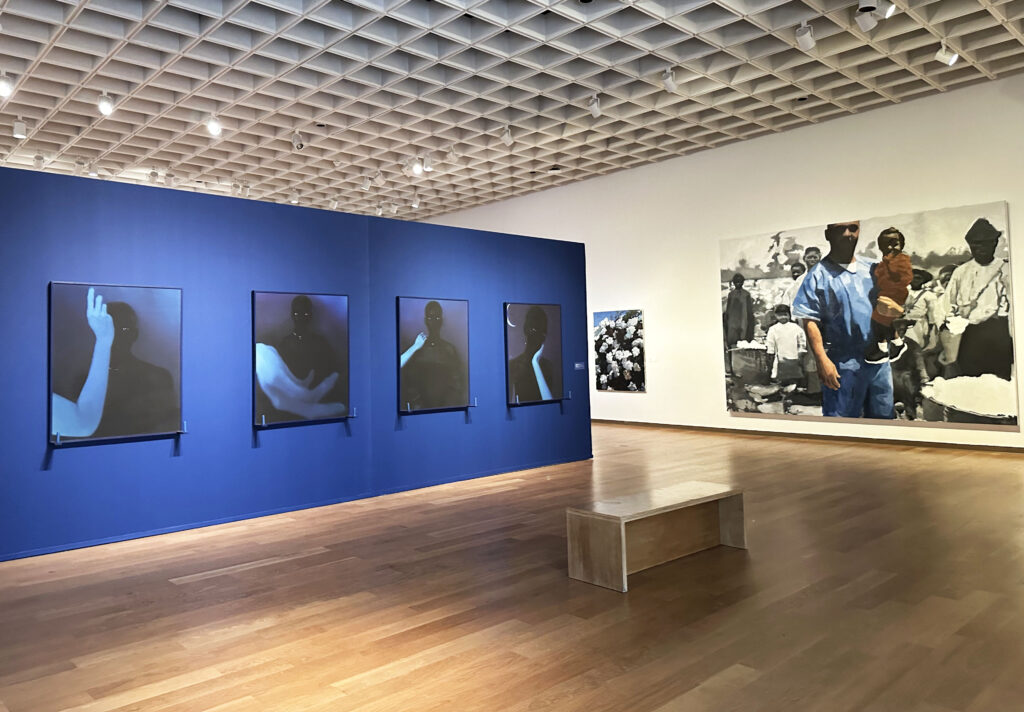
Work by Elliot and Erick Jiménez (photographs, left) and Reginald O’Neal (paintings, right)
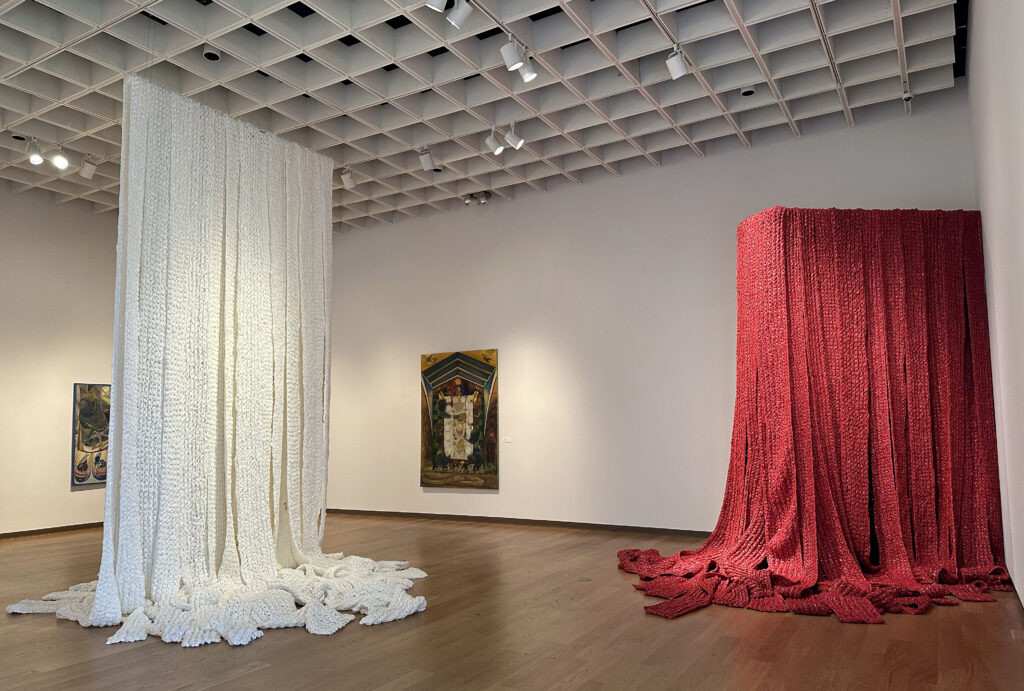
Sculptures by Akiko Kotani, Paintings by MJ Torrecampo
Work by Denise Treizman
Work by Amy Schissel

Photography by Peggy Levison Nolan
Work by Magnus Sodamin
Work by Yosnier Miranda
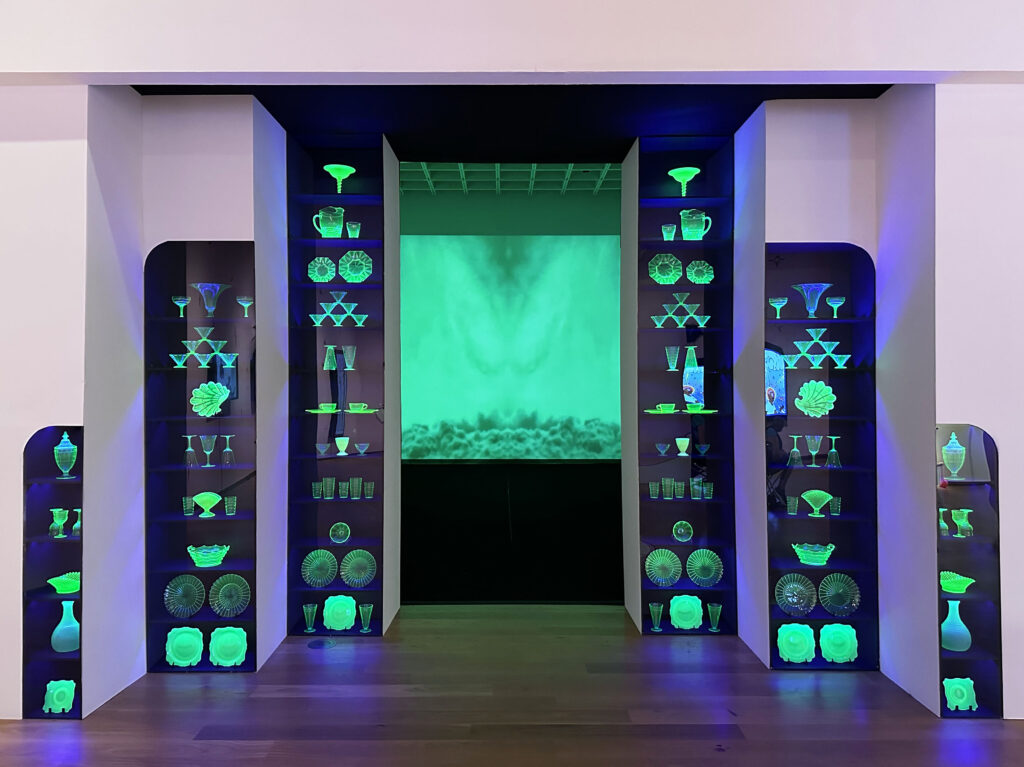
Work by Cara Despain
There is some really impressive work currently on view for the 2023 Florida Prize in Contemporary Art at Orlando Museum of Art.
From the museum site about the exhibition-
The Florida Prize in Contemporary Art is organized by the Orlando Museum of Art to bring new recognition to the most progressive artists in the State. Each year OMA’s curatorial team surveys artists working throughout the State before inviting ten to participate. One artist will receive a $20,000 award made possible with the generous support of local philanthropists Gail and Michael Winn. Artists range from emerging to mid-career, often with distinguished records of exhibitions and awards that reflect recognition at national and international levels. In all cases, they are artists who are engaged in exploring significant ideas of art and culture in original and visually exciting ways.
This year’s artists are-
Denise Treizman (@denisetreizman )
MJ Torrecampo (@mjtorrecampo )
Peggy Levison Nolan (@peggylevisonnolan )
Reginald O’Neal (@_reginaldoneal_ )
Elliot & Erick Jimenez – (@elliotanderick )
Yosnier Miranda (@occurrences)
Magnus Sodamin (@magnificentmagnus )
On the following pages below are more works by the above artists and detailed information on their work in the exhibition.


The work above is from Regina Durante Jestrow’s current exhibition Free Form Connections at Dunedin Fine Art Center.
The artist’s statement about the exhibition-
This exhibition includes my organically shaped geometric art quilts from various series from 2020-23. I utilize improvisation, repeat patterns and shifts in scale while incorporating colors, textures, and structures representative of the diversity of the people and the natural surroundings of my current home in South Florida.
I use diversely toned second-hand, gifted, or saved fabrics and dyes from locally sourced plants and rust. Textiles are also manipulated with burning and staining with inks and acrylic paint. Other materials, such as neoprene, sequins, and faux leather, reference Miami’s pop culture.
Along with my constant interest in American Folk-Art Quilts, geometric-abstract artists from the mid to late twentieth century are my influencers, including Gees Bend quilters, Elizabeth Murray, Helen Frankenthaler, Anni Albers, and Gego. These artistic voices have driven me to create quilts of scale with strong personal symbolism and narrative.
This exhibition is on view until 8/13/23.
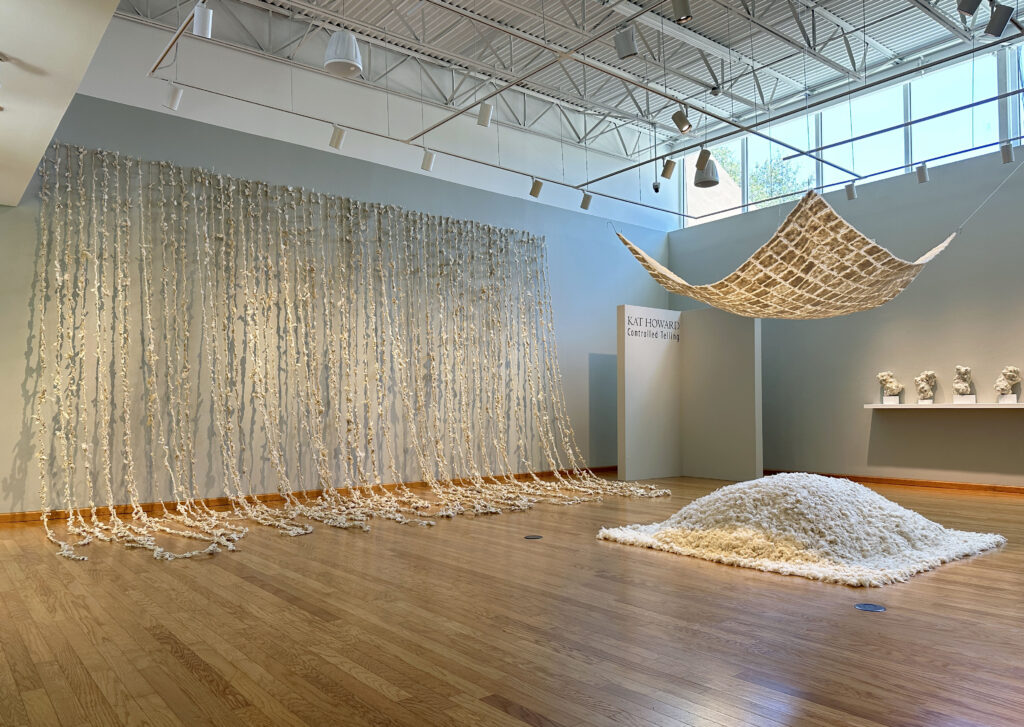
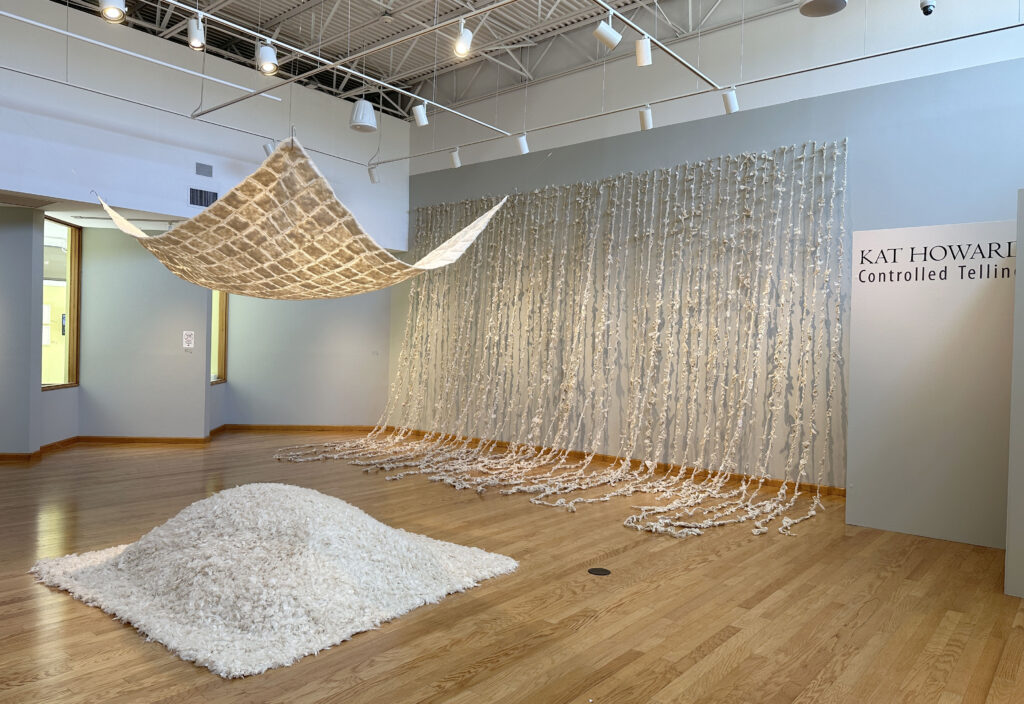
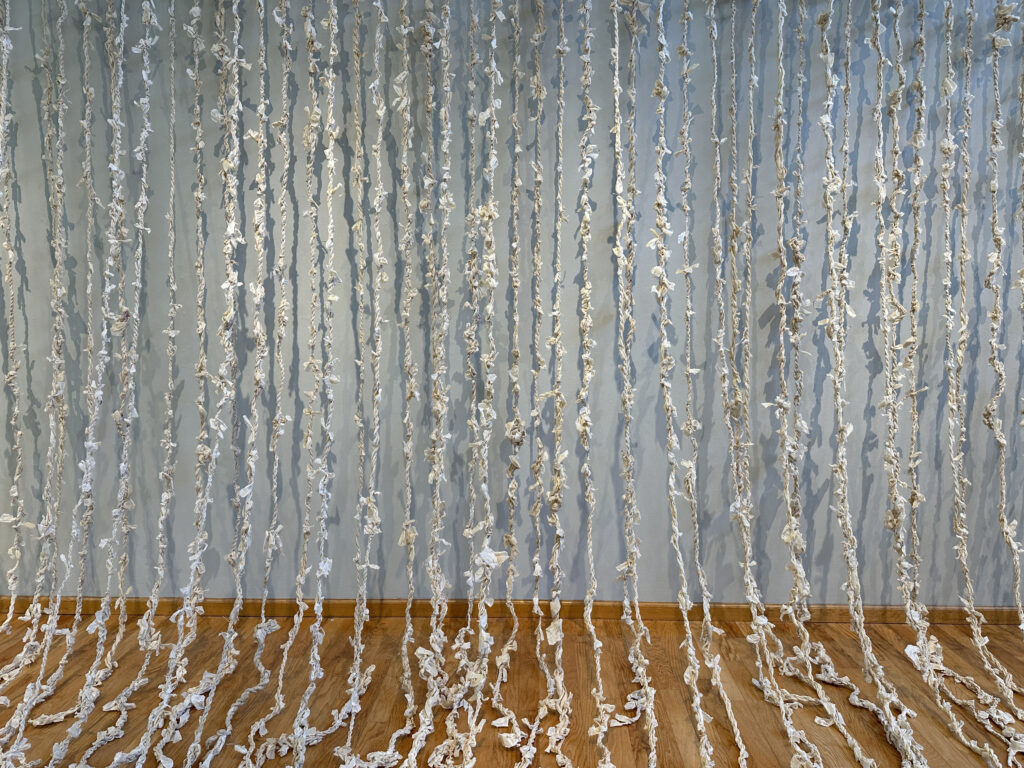
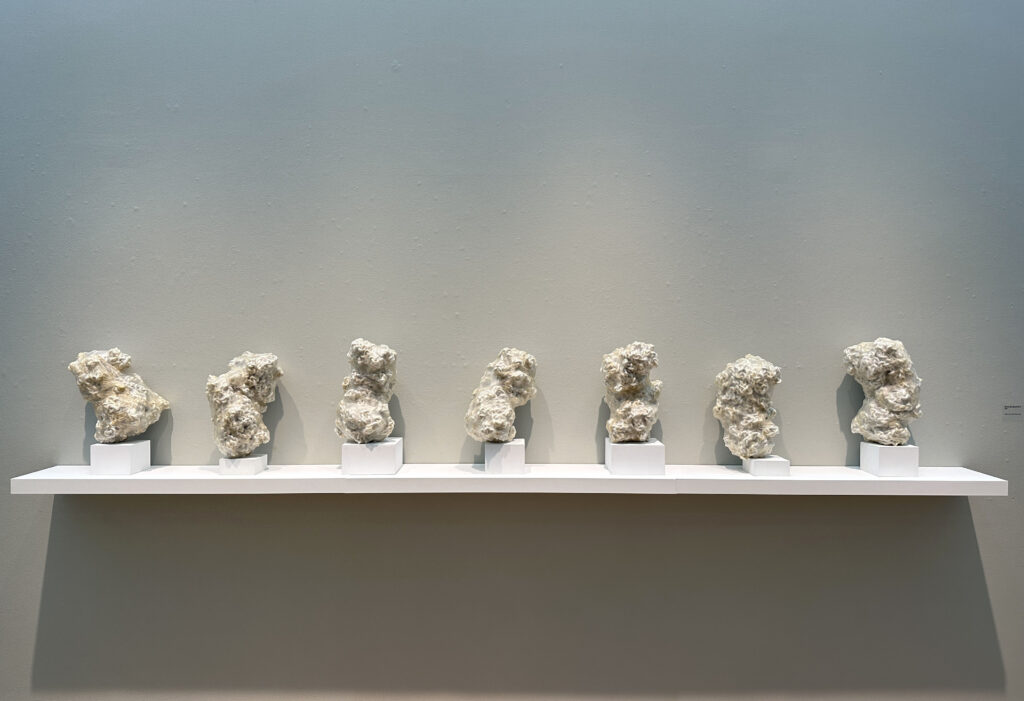

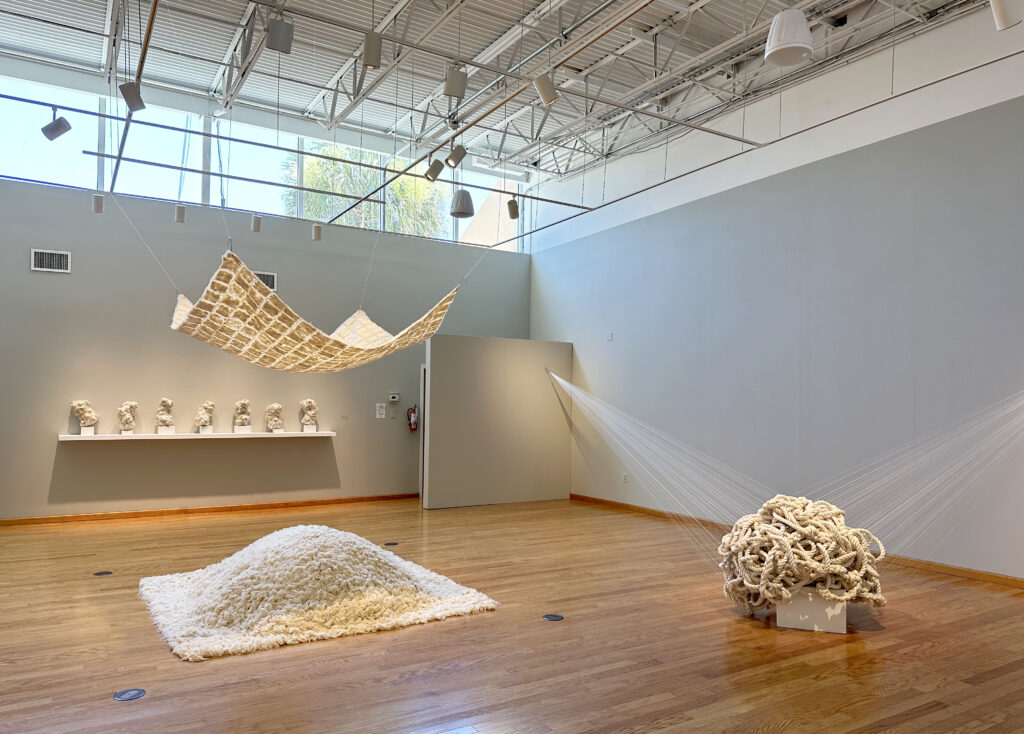
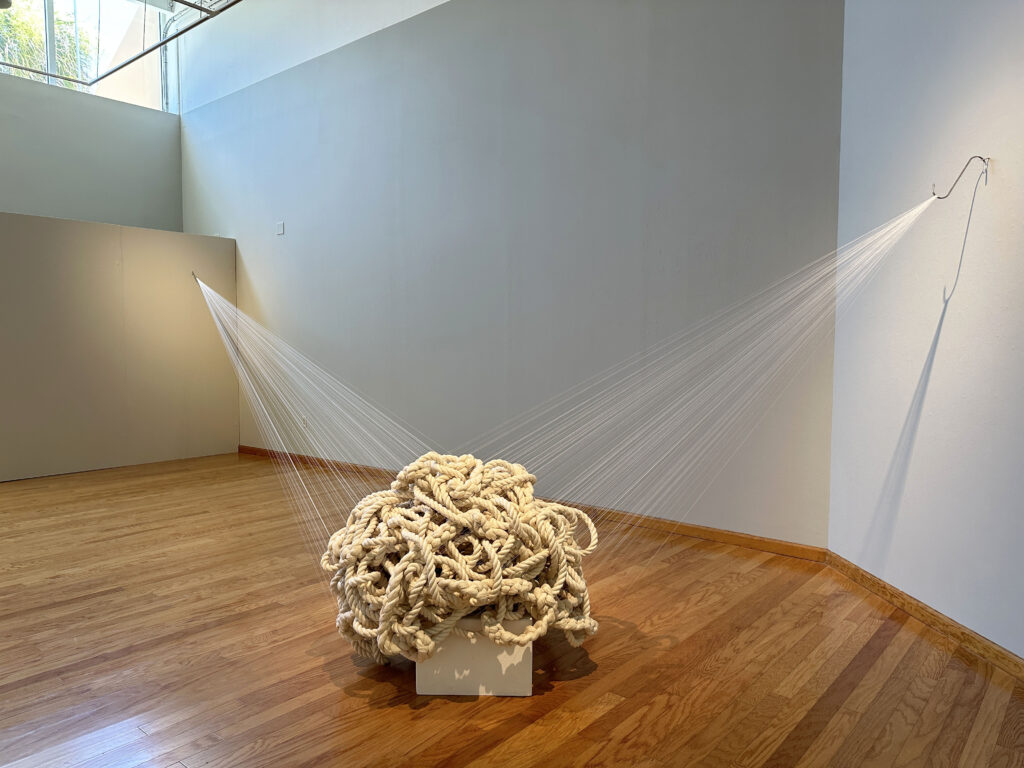
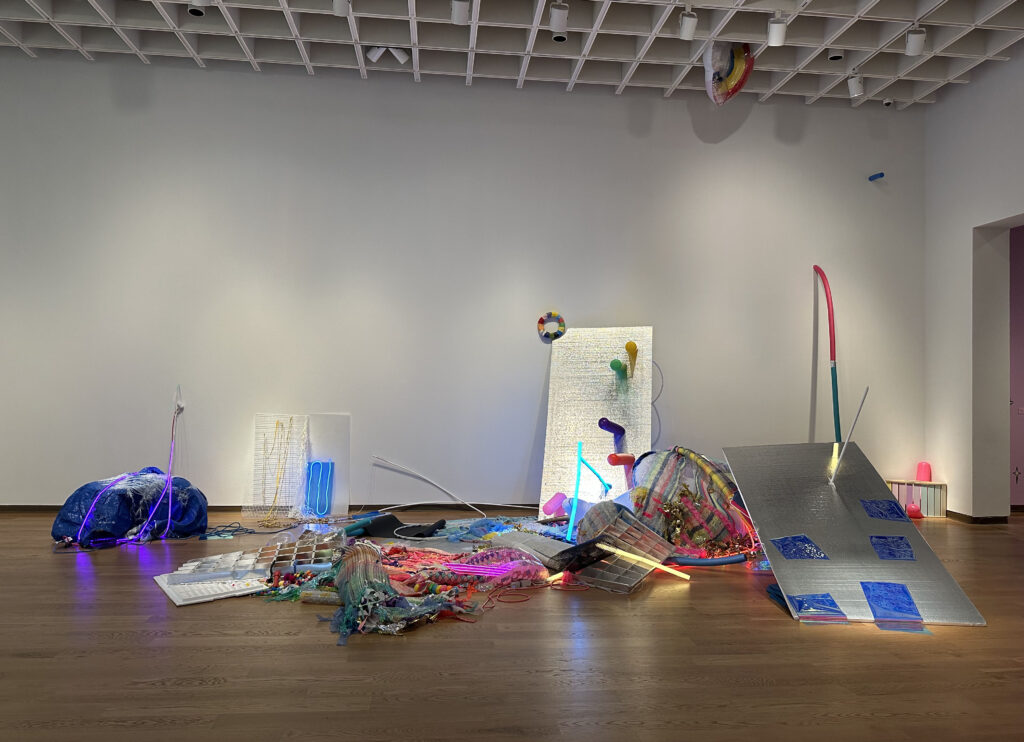
The sculptures above are from Kat Howard’s current exhibition Controlled Telling, at Dunedin Fine Art Center.
From the gallery about the work-
Kat Howard’s work interrogates the complicated process of healing from trauma. The sculptures in ‘Controlled Telling’ examines the burden and pressure to conceal the truth.
Existing as various restricted forms of cotton, bound braids, transparent quilts, compressed scraps of muslin, mound of raw material, or hand-twined waxed rope, the writhing abstracted bodily forms overwhelm and invade the viewer’s personal space, emulate the feeling of tension, imploring the viewer to navigate physically and emotionally around them.
Howard creates visual art that uses abstraction, the innate language of texture, and the repulsion/attraction of touch to interrogate her identity as a survivor of abuse and sexual violence. The material and texture of the object is integral to her practice, and its connection to the body. Evidence of the hand and the physical marks of the body are always present in her work. What happens to the body when it is forced to become a vessel for trauma? In what ways do we physically carry pain? How is the self altered afterwards?
Howard’s pieces either have a physicality to them that feels almost human, or they are twisted abstractions from the domestic landscape. Repetition and labor are vital aspects to the work. Through the labor, the anxiety tethered to a desire for freedom is palpable. The viewer can sense the thousands of hours, and the fevered precision which act as an echo of the madness in the mind that comes to claim the body. What does freedom look like? The answer is in taking up space. The answer is in speaking up. The answer is in the attempt.
This exhibition is on view until 8/13/23.


There are so many wonderful, detailed art works in Hannah O’Hare Bennett’s current exhibition Recede, on view at Dunedin Fine Art Center. They are all worthy of a closer look.
Below is the artist’s statement about the work-
“From the moment we are born until we die, we are almost constantly in contact with cloth as we move through our lives. Without thinking about it, we are familiar with its varied qualities–the simplicity of white cotton, the luxury of silk velvet, the flexibility of knitting, the structure of weaving. We can see the impact of time in a piece of fabric: how it wrinkles, stains, takes repairs, unravels. Handmade paper is a kind of non-woven cloth and is in fact often made of recycled cotton or linen. It can be dyed, stitched, wrinkled, torn, and repaired much in the same way as fabric.
My work explores the expressive possibilities of these materials, which I use to deal with my fascination with time altered urban and rural landscapes. A piece of land in the Oregon outback, the brick wall of buildings in Madison, a leafy Minneapolis neighborhood, etc. are all impacted by the passing of time, actions of human beings, weather. These occurrences can be incremental or sudden, and the change they bring almost imperceptible or very radical, each change layering on top of what came before. I use that observation to inspire my work. Fabric surfaces are worked over with layers and layers of pigments, embellished with embroidery, dunked into dye, cut and torn. Paper pulp is poured, dipped, mixed with sawdust, painted, crumpled and smoothed out again. In this small human way, I am channeling the world into the objects I create.”
The exhibition closes 8/13/23.

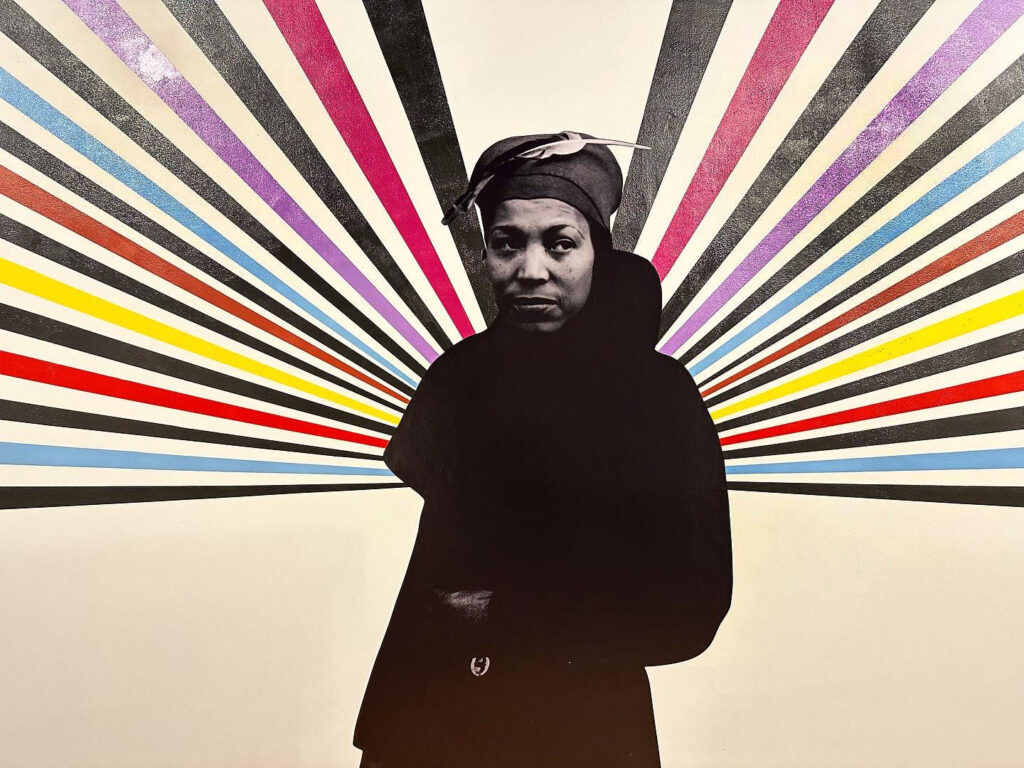
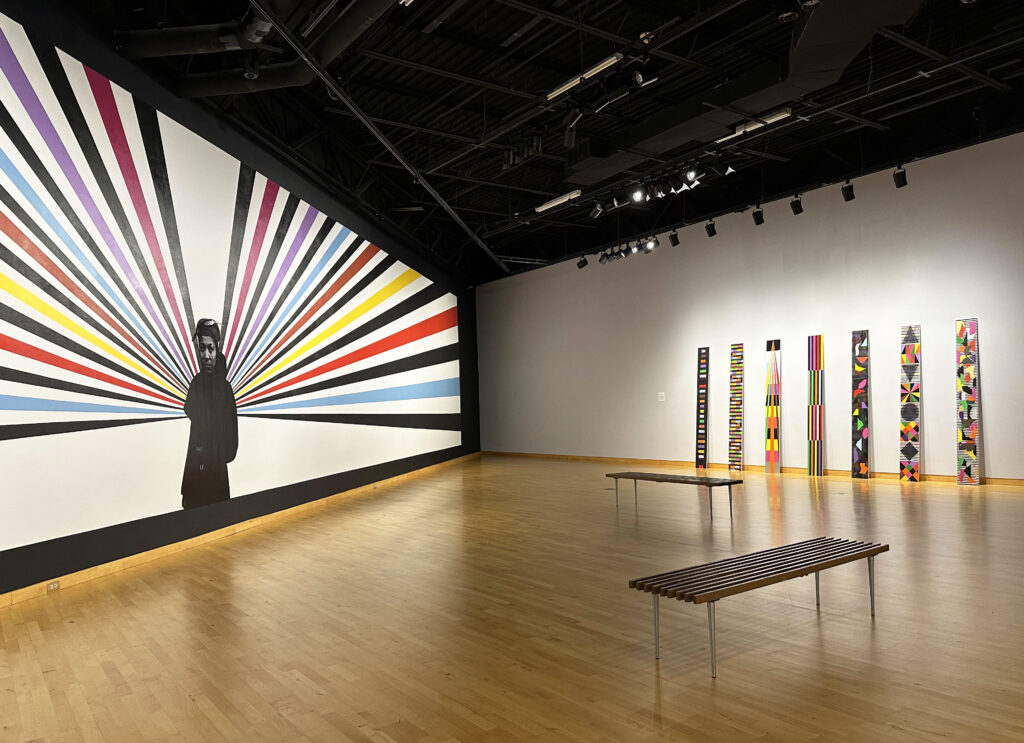
Currently at the University of Florida’s Contemporary Art Museum is Rico Gatson: Visible Time. The exhibition includes a collection of the artist’s paintings and works on paper, video works from 2001-present, and a life size mural of author Zora Neale Hurston.
From the museum’s website about the exhibition-
For more than two decades, Brooklyn-based artist Rico Gatson has been celebrated for his vibrant, colorful, and layered artworks. Inspired by significant moments in African American history, identity politics and spirituality, his oeuvre includes images of protests and longstanding injustices—touching on subjects like the murder of Emmett Till, the Watts Riots, and the formation of the Black Panthers—as well as dynamic abstract geometries that celebrate Pan-Africanist aesthetics and Black cultural and political figures.
About the mural, Zora III, commissioned by the museum (pictured above)-
Zora Neale Hurston was an American author, anthropologist, and filmmaker. She portrayed racial struggles in the early-1900s American South and published research on hoodoo (a set of spiritual practices, traditions, and beliefs created by enslaved Africans in the Southern U.S.). The most popular of her four novels is Their Eyes Were Watching God, published in 1937. Born in Notasulga, Alabama, Hurston grew up near Orlando, in Eatonville, Florida, incorporated in 1887 as one of the first self-governing all-black municipalities in the country. Despite her landmark achievements, Hurston died penniless and in obscurity in 1960-her novels and other writings largely unknown, until they were single-handedly rescued by novelist Alice Walker in 1975. Through his wall painting Rico Gatson extends the monumental impact of Hurston’s legacy-and Walker’s- into a visual arena reminiscent of the Mexican Muralists and hand-painted cinema signs.
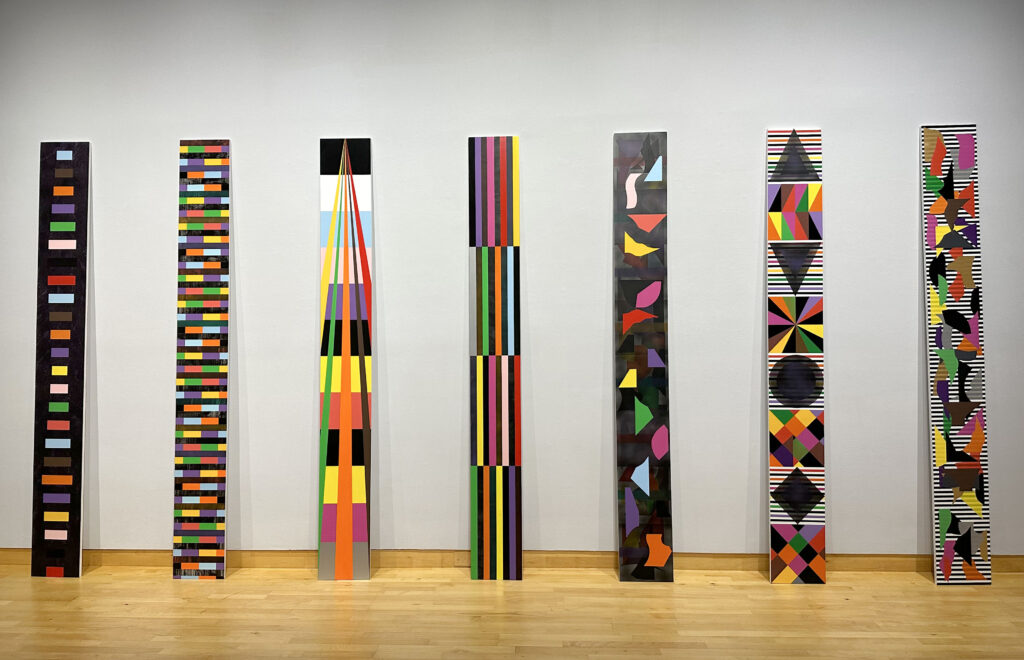
“Untitled (Seven Panels)”, 2022 acrylic paint on wood, in seven parts
From the museum’s wall plaque about the above paintings-
According to catalog contributor Mark Fredricks, Rico Gatson’s “panel paintings” resemble “a musical framework.” Arranged together along a single wall, the “rhythm” animating their colorful compositions and their “uniformity of structure” suggest, anthropomorphically speaking, musicians in a jazz combo. One of the many ways in which Gatson draws on music as a lasting influence in his art, his seven panels approximate what legendary jazz player Albert Ayler described as “the healing force of the universe,” but in three dimensions.
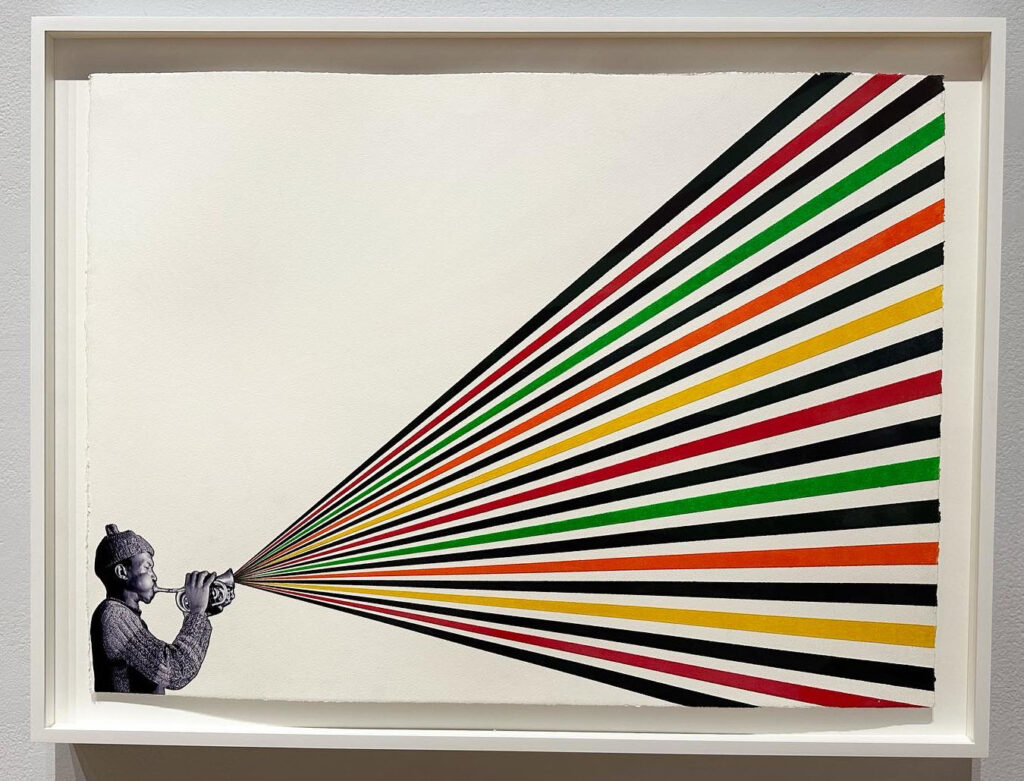
“Don” 2022, Color pencil and photo-collage on paper
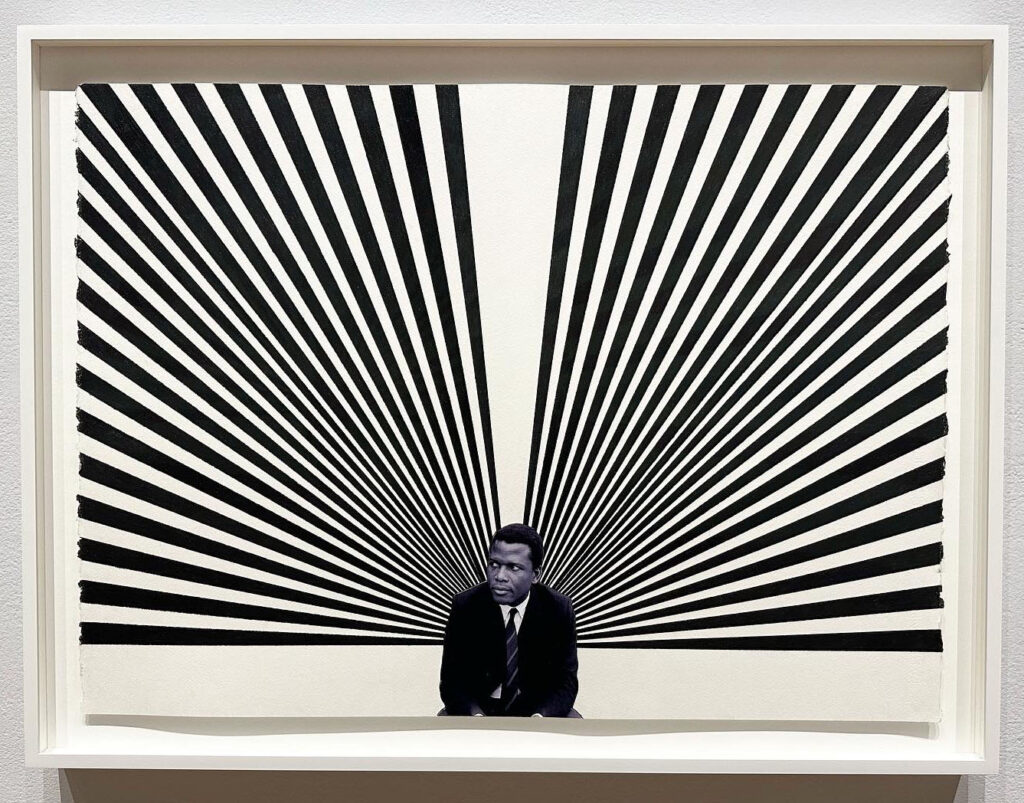
“Sidney” 2022, Color pencil and photo-collage on paper
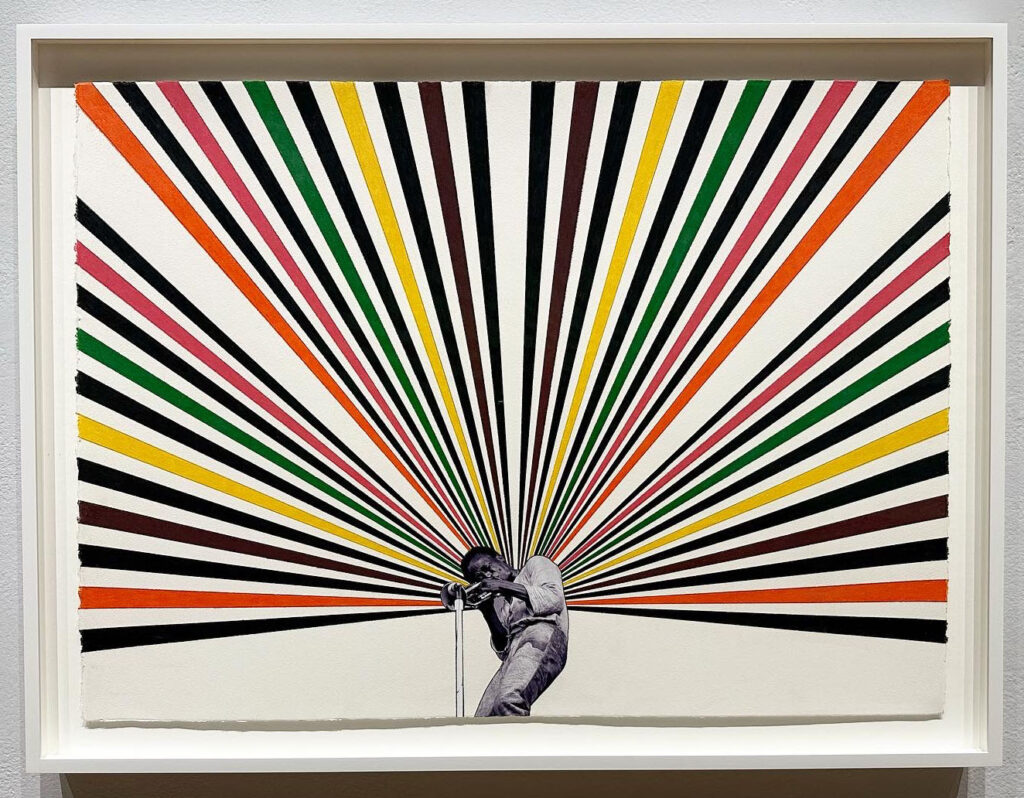
“Miles #2″ 2022, Color pencil and photo-collage on paper
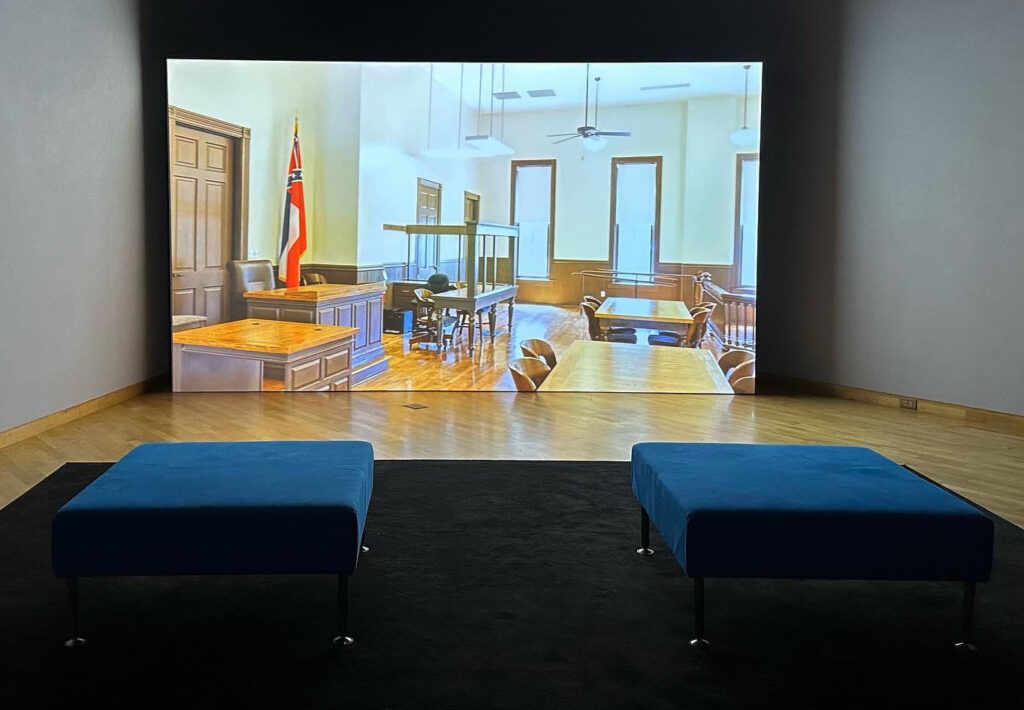
Below are images are from Four Stations, one of the five moving image works in the exhibition. For this work, Gatson traveled to Money, Mississippi and took handheld footage along the trail of places and events that led to the lynching of 14-year-old Emmett Till.
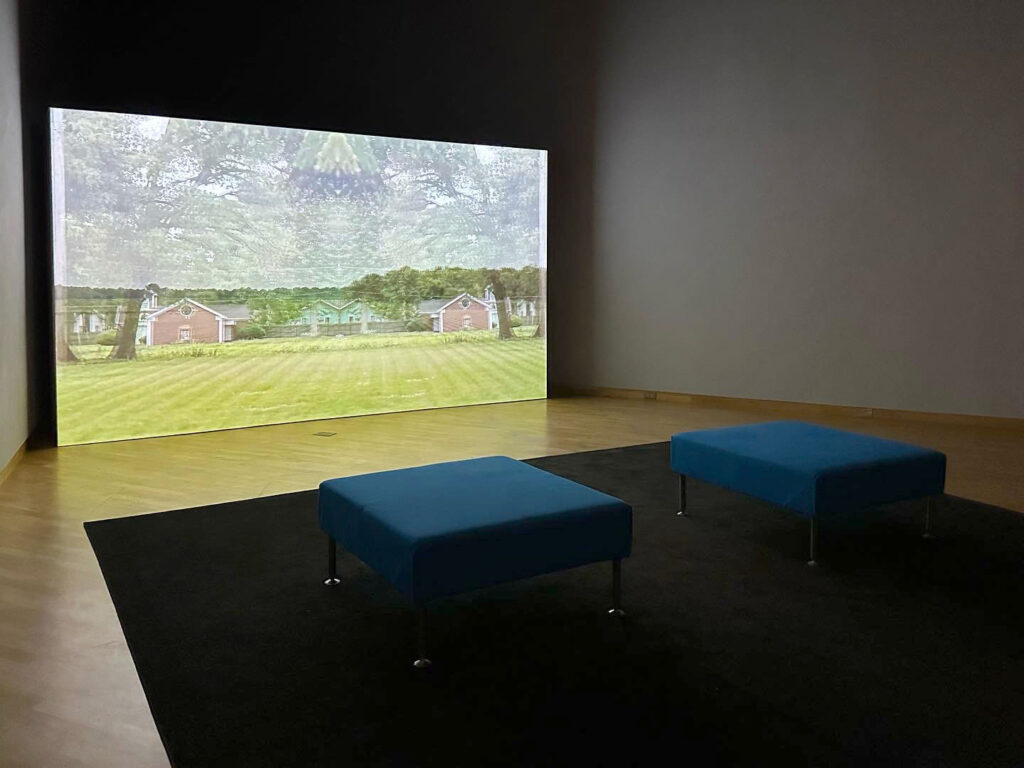
“Four Stations” 2017
On one of the smaller screens is Gun Play, 2001, a film collage that mixes sequences from Foxy Brown and The Good, the Band and the Ugly, combining them together with kaleidoscopic effects.
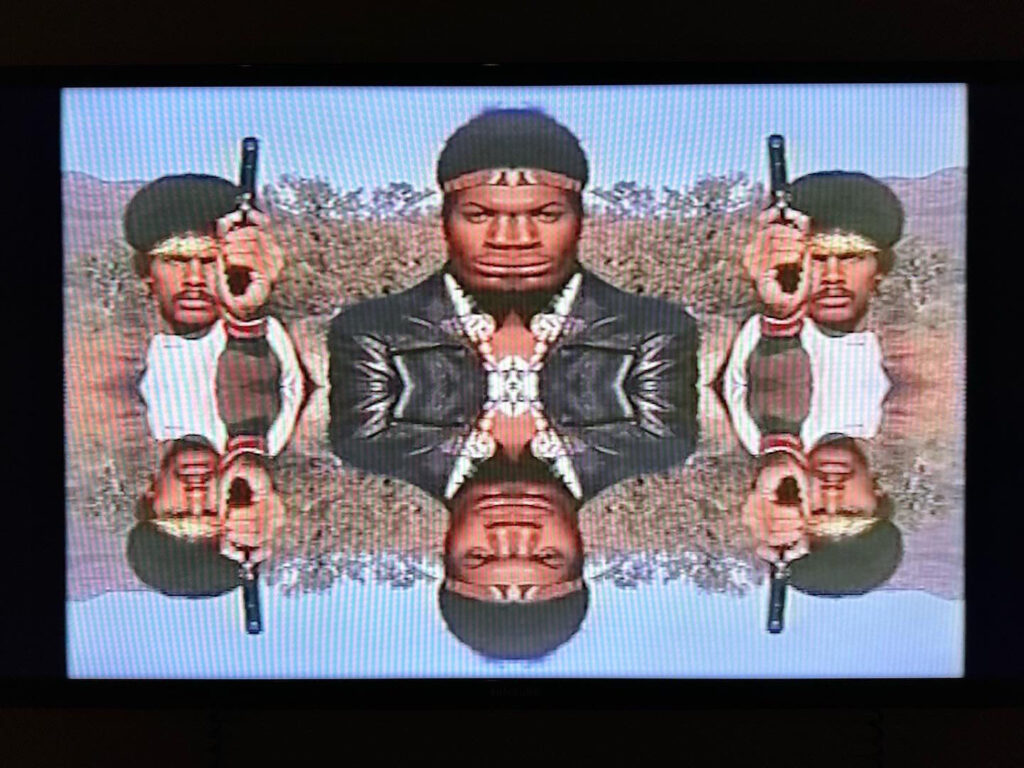
“Gun Play”, 2001, single-channel video, color, sound
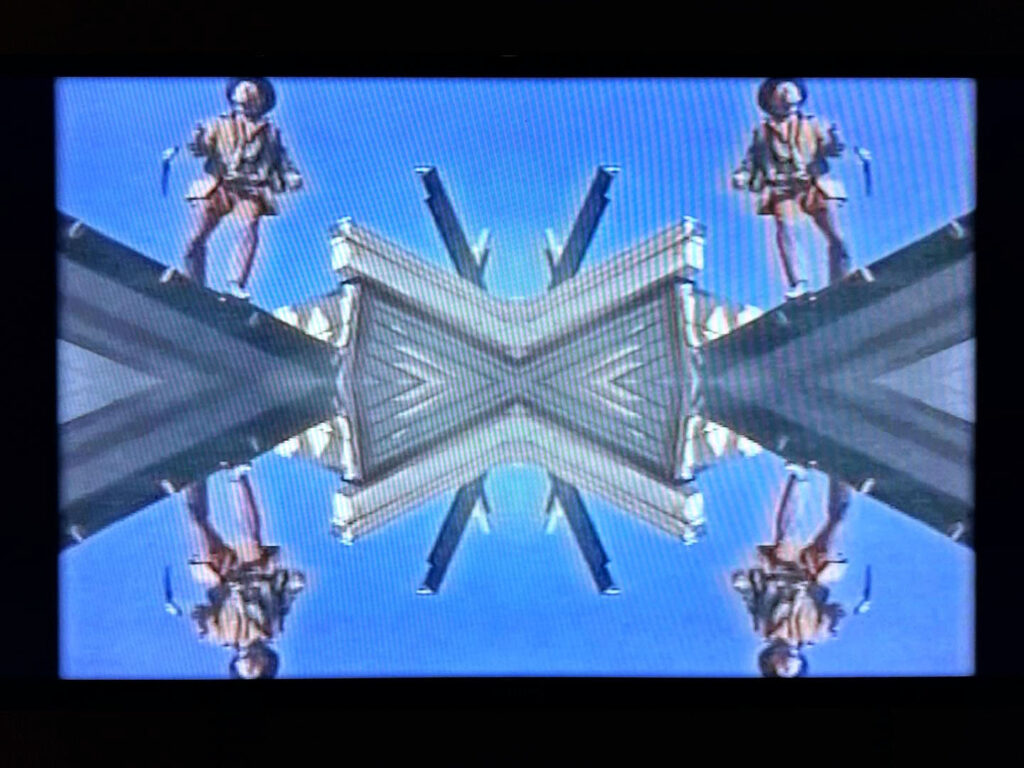
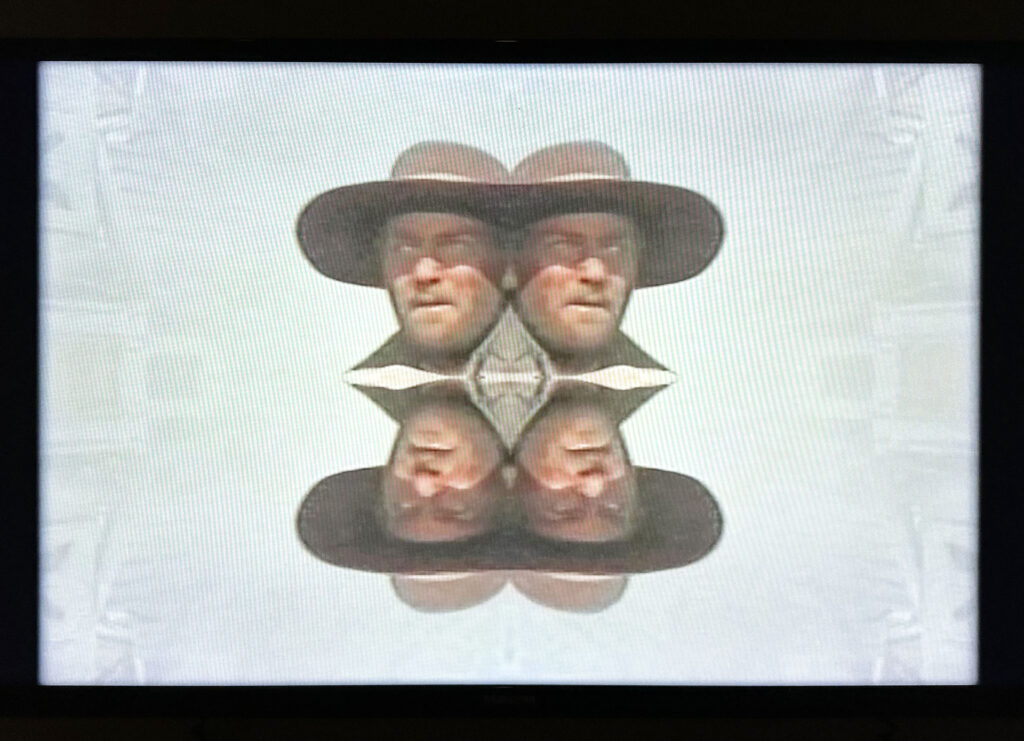
This Thursday 7/27/23, the museum will be showing Spike Lee’s Do the Right Thing, the last of the three films chosen by Gatson to accompany the exhibition.
The exhibition will close on Saturday, 7/29.

“Precarious recline”, 2015, Found lawn chairs, strap, bottle
This sculpture, Precarious recline, is from Bjorn Copeland’s 2015 exhibition Over Easy at Various Small Fires Los Angeles. It was created using discarded furniture found around East Los Angeles.
The exhibition also included a sound sculpture, Scrambled Eggs, Mexican Radio Edit (2015). It was made in collaboration with the artist’s Black Dice band mates Eric Copeland and Aaron Warren, and combined signals from multiple car radios in an unpredictable and erratic disharmony. The resulting composition was synthesized in real-time and constantly changing.
The video below is for White Sugar, from Black Dice’s 2021 album Mod Prog Sic.