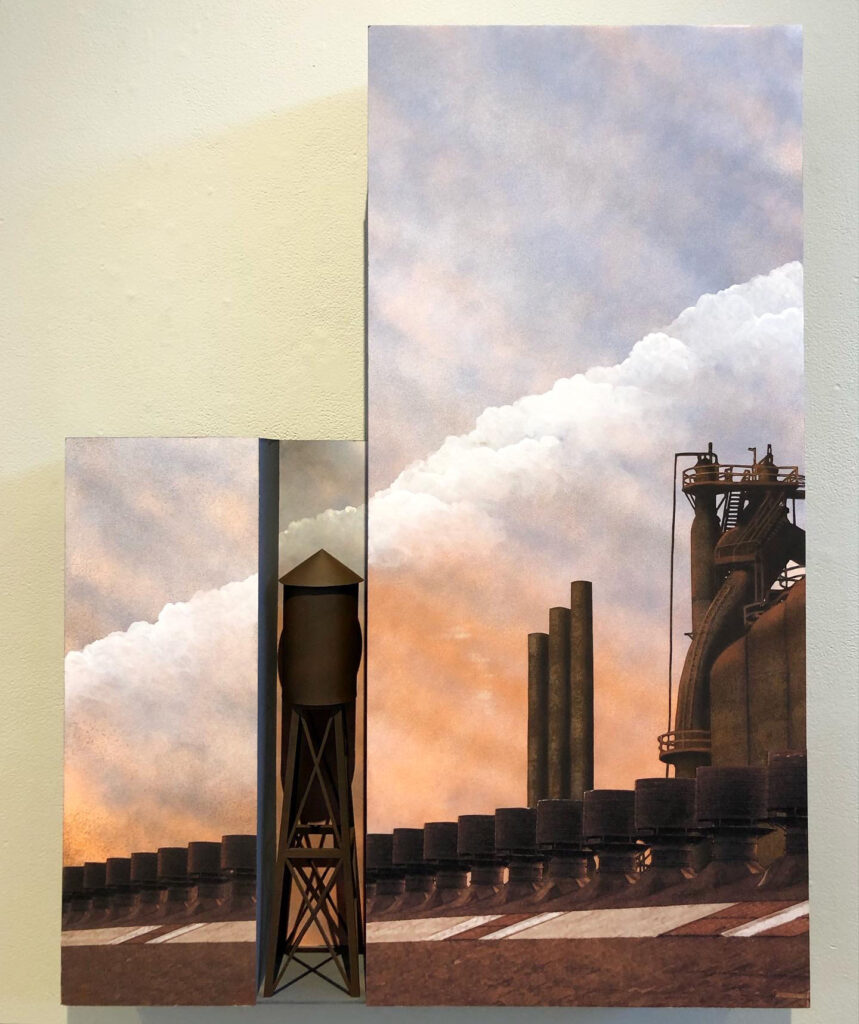
“THERE IS A PERIOD WHEN IT IS CLEAR THAT YOU HAVE GONE WRONG BUT YOU CONTINUE. SOMETIMES THERE IS A LUXURIOUS AMOUNT OF TIME BEFORE ANYTHING BAD HAPPENS.”
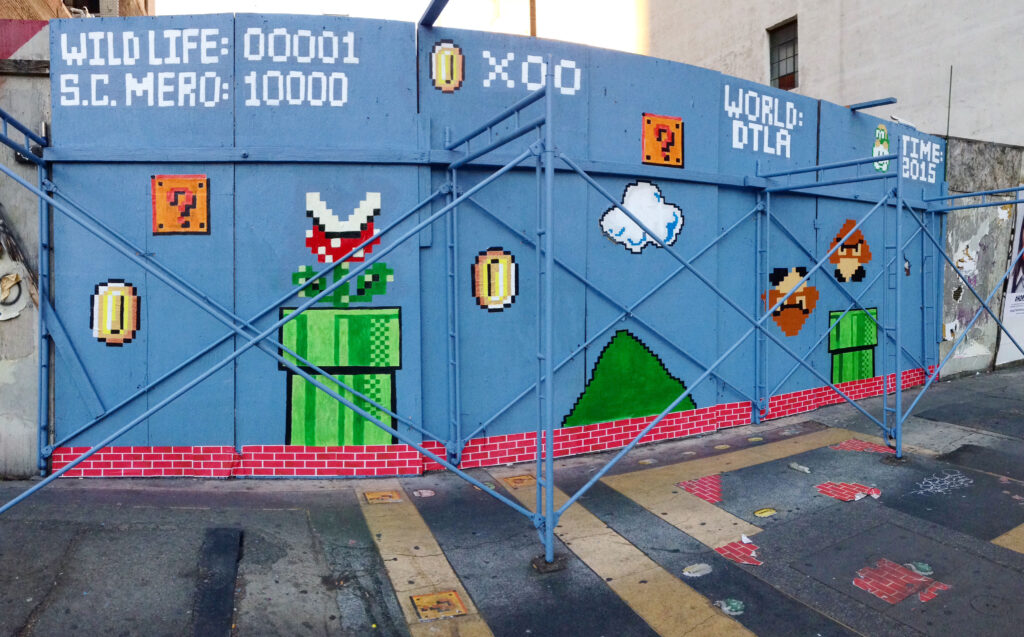
Going back to 2015 for this mural by Wildlife and S.C. Mero, who still create work in the area. Also check out Mero’s other page, where she highlights neighborhood (DTLA) events, people and art- including work by Wildlife.
Typewriter Eraser, Scale X, 1999, part of The ARIA Fine Art collection in Las Vegas
Artist Claes Oldenburg passed away this week at the age of 93. He was most famous for his large scale sculptures of everyday objects, many of which were produced with his wife Coosje van Bruggen, who passed away in 2009.
While primarily working in sculpture, early in his career in the 1960s he also created “happenings”- theatrical art related performances and collaborations with other artists in his circle. In 1985 he returned to performance and along with van Bruggen, architect Frank Gehry, and writer Germano Celant presented Il Corso del Coltello (The Course of the Knife) in Venice, Italy. In 2021, Pace Gallery in NYC, as part of the two gallery exhibition Claus & Coosje, showed work from this performance, pictured below.
From Pace’s website about the performance-
This ambitious event involved the creation and embarkation of a sea-worthy sculpture in the shape of a giant Swiss army knife. With oars protruding from its red-enameled hull as if from a Viking longship, the image of Oldenburg and van Bruggen’s Knife Ship sailing the Grand Canal has become iconic, while the massive kinetic sculpture was later shown in the rotunda of the Guggenheim Museum in New York, at the Centre Pompidou in Paris, and finally at the Museum of Contemporary Art, Los Angeles.
With so much of Oldenburg’s work, the examination of the ordinary object engages the viewer with what they might previously taken for granted and gives them a chance to look again with new eyes. There is also something lighthearted and fun, as well as investigative, about his body of work.
(image via Whitney Museum’s website)
The Whitney Museum has a video showing the process of assembling his soft sculpture Giant BLT(Bacon, Lettuce, and Tomato Sandwich) 1963, which involves putting the sandwich together piece by piece.
For more on Oldenburg, MoMA has a tribute that includes the words of people who knew him as well as his own. His 1961 artist statement is wonderful and worth reading in its entirety, here is the opening section-
I AM FOR
I am for an art that is political-erotical-mystical, that does something other than sit on its ass in a museum.
I am for an art that grows up not knowing it is art at all, an art given the chance of having a starting point of zero.
I am for an art that embroils itself with the everyday crap and still comes out on top.
I am for an art that imitates the human, that is comic, if necessary, or violent, or whatever is necessary.
I am for all art that takes its form from the lines of life itself, that twists and extends and accumulates and spits and drips, and is heavy and coarse and blunt and sweet and stupid as life itself.
I am for an artist who vanishes, turning up in a white cap painting signs or hallways.
The Guardian’s obituary is also worth a read for more information on the artist’s history.
Magenta Swimming in Yellow, 2015-7, by Rona Pondick from her solo exhibition at Zevitas Marcus. The sculpture was created using pigmented resin and acrylic.
In 2013, Pondick began an intensive period of experimentation with materials that were new to her practice: resins and acrylics. Over a period of five years, she developed complex methods of working with these materials and came to understand their sculptural potential. This exhibition is the first time this body of work has been seen on the West Coast.
Since her career began in 1984, Rona’s work has consistently referenced the body, in both a metaphorical and literal sense. Her sculptural practice has been no less defined by her ceaseless exploration of new materials and methods. Stainless-steel was Rona’s primary medium for the better part of a decade beginning in 1998. Her newest works are made from resins, acrylics and modeling compound.While thematically related to Rona’s earlier work, these new sculptures are notable for their extraordinary use of color and the way in which the artist’s hand is ever present, elements which heighten the sense of fragility and humanity that have always been achingly present in her work.
Artist Sophie Calle’sHere Lie The Secrets of the Visitors of the Green-Wood Cemetery, a 25 year long public artwork. The project debuted on April 29th and 30th, 2017.
To inaugurate the project, the public was invited to Green-Wood Cemetery, a National Historic Landmark, in Sunset Park, Brooklyn, to privately unburden and inter their most intimate confessions.
During the two-day opening, in a setting nestled among the mausoleums and monuments of Green-Wood’s verdant rolling hills, visitors transcribed their secrets onto paper, and deposited them into the earth below, through a slot on a marble obelisk of Calle’s design. The artist was on hand during the two-day event to receive some visitors’ secrets.
The two-day performance was free and open to the public. Guests were invited to spend the day exploring the sculptures and monuments throughout Green-Wood, a tradition that dates back to the early 1800s. Free maps of the cemetery, specially designed to accompany Calle’s installation, were be available. Guided walking tours emphasizing the cemetery’s symbols and iconography were offered at no cost.
Visitors to the Cemetery can now see Calle’s installation during regular cemetery hours and independently deposit secrets into the marble obelisk. Calle has also pledged to return periodically over the next 25 years, each time the grave is filled, to exhume and cremate them in a ceremonial bonfire service and moment of remembrance.
Everyone has a secret to tell, now there’s a place to put one of yours.
Happy Indigenous People’s Day! The work above, Because You Enter My House, It Becomes Our House, is by Choctaw-Cherokee artist Jeffrey Gibson. The sculpture was commissioned for Socrates Sculpture Park in New York, but is currently located at deCordova Sculpture Park and Museum in Lincoln, Massachusetts.
The deCordova website gives the following information about Gibson and the work-
Jeffrey Gibson weaves together his Choctaw-Cherokee heritage and queer identity into vibrantly patterned painting, sculpture, video, performance, and installation. Drawing on Indigenous process and materials and queer camp aesthetics, his artistry aims to transcend binary thinking and corrects nostalgic views of indigeneity. Merging styles and historical references, Gibson states, “I have continued to think about my practice as encompassing the past and present while considering the future.” Gibson often integrates phrases and words into his artwork, with language drawn from pop songs to activist slogans, to offer open-ended declarations of love, community, and liberation.
Standing over 40 feet wide and 20 feet tall at the entrance to deCordova’s Sculpture Park, Gibson’s Because Once You Enter My House, It Becomes Our House commands attention to its stepped form and psychedelic facade. Originally commissioned by Socrates Sculpture Park in Long Island City, this installation expands Gibson’s signature artistry and collaborative process to a monumental scale. He took inspiration from North American Indigenous history, as well as queer nightlife to create this monument advocating for Indigenous space and culture. The tri-layered form references the earthen forms of the ancient Mississippian city of Cahokia which flourished in the seventh through the fourteenth centuries before European contact.
The title, Because Once You Enter My House, It Becomes Our House, comes from the song “Can You Feel It” by Mr. Fingers (Larry Heard). Gibson evokes 80s and 90s-era house music and night clubs as they provided welcoming spaces for queer communities and people of color. Mr. Finger’s lyrics embrace intimacy, generosity, acceptance, and community. This installation echoes this broad communal ethos as Gibson invited fellow Indigenous artists–Eric-Paul Riege (Diné), Luzene Hill (Eastern Band of Cherokee Indians), and Dana Claxton (Hunkpapa Lakota)–to co-create the wheat-pasted posters covering the façade of the installation and stage performances on and around the ziggurat.
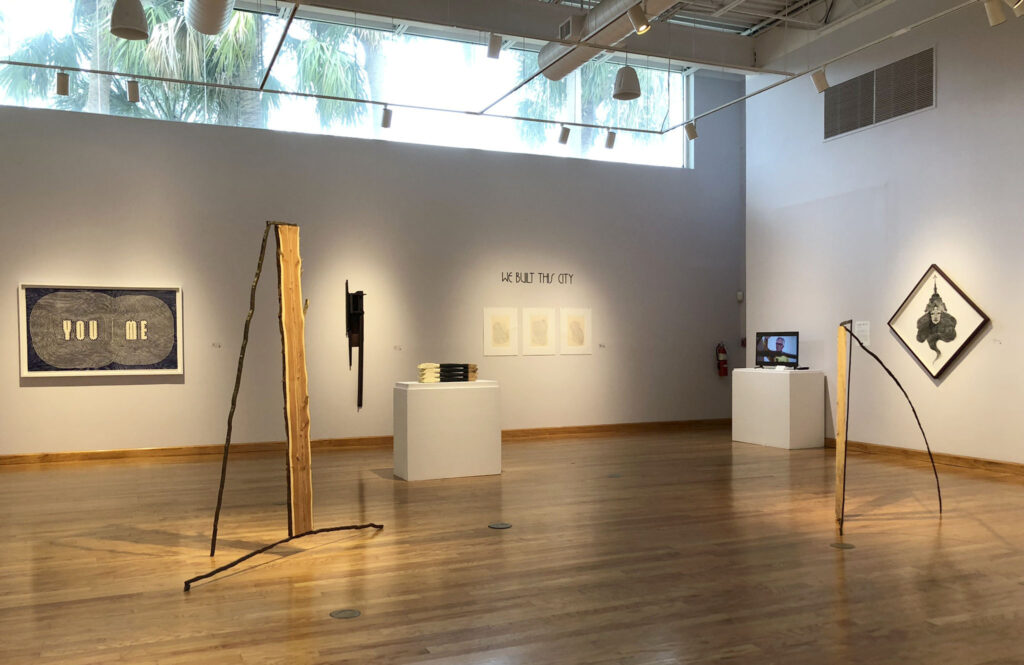
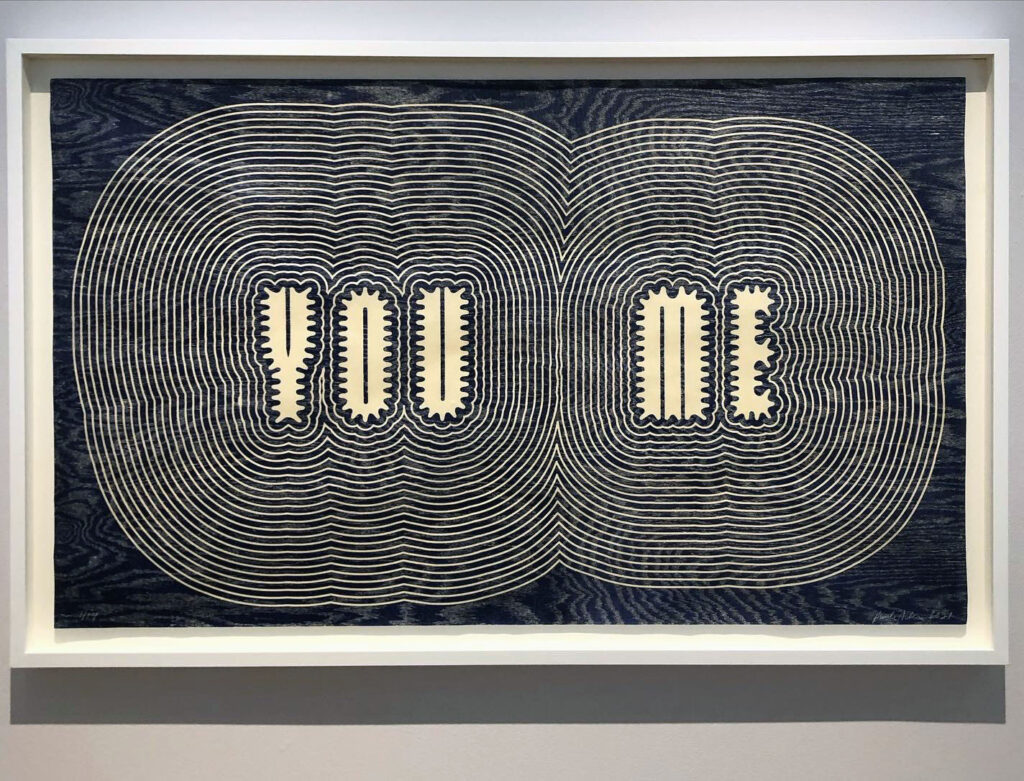
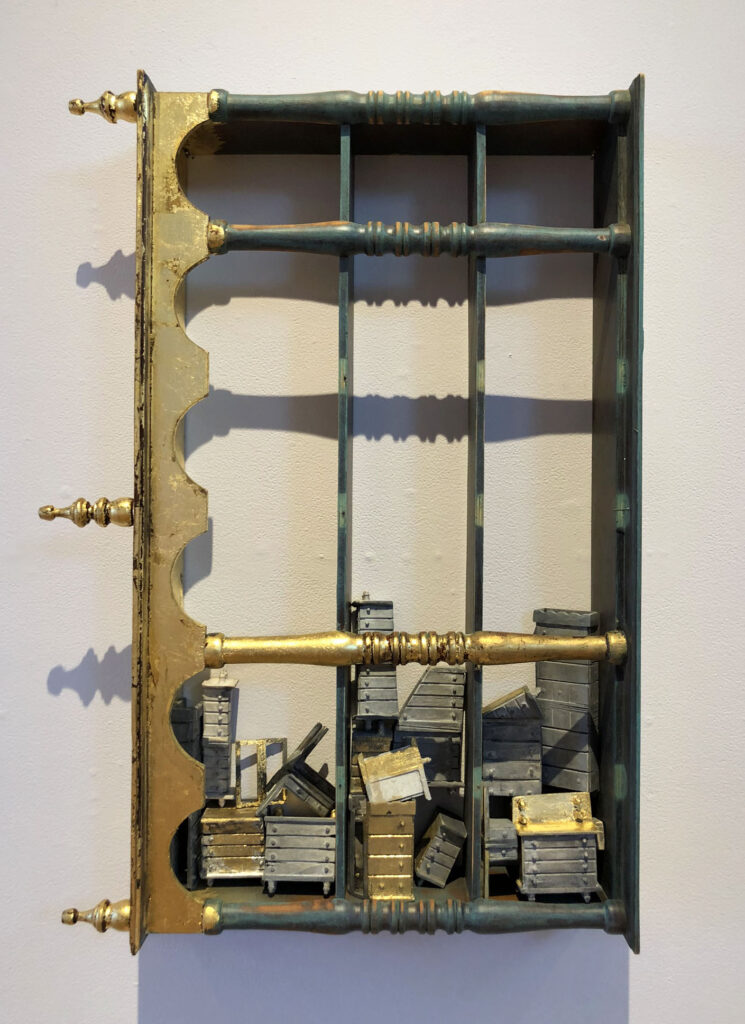
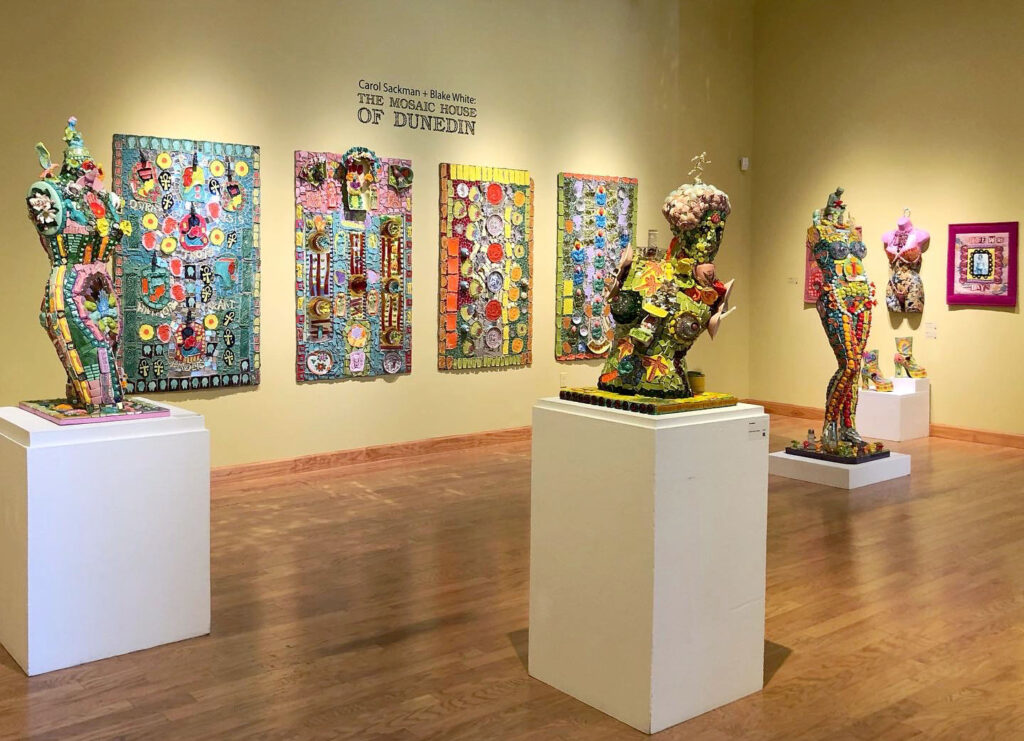
Skyway 20/21: A Contemporary Collaboration, is the second iteration of a joint exhibition across four institutions that highlights contemporary art created in the Central Florida region. Artists selected by a jury are from five counties- Hillsborough, Pinellas, Pasco, Manatee, and Sarasota. The exhibitions are an excellent sampling of the work being made in the Tampa Bay area.
The works shown in this post are from the exhibition at the Tampa Museum of Art. The museum has a video playlist on YouTube that includes all of the artists in the exhibition discussing their work. The links below are to the artists’ websites or those videos.
For Selina Román’s XS series, she created abstract self portraits that examine standards of beauty in relation to expectations of weight and body. The title XS references an extra small size and alludes to the word excess.