Aug 112021
 

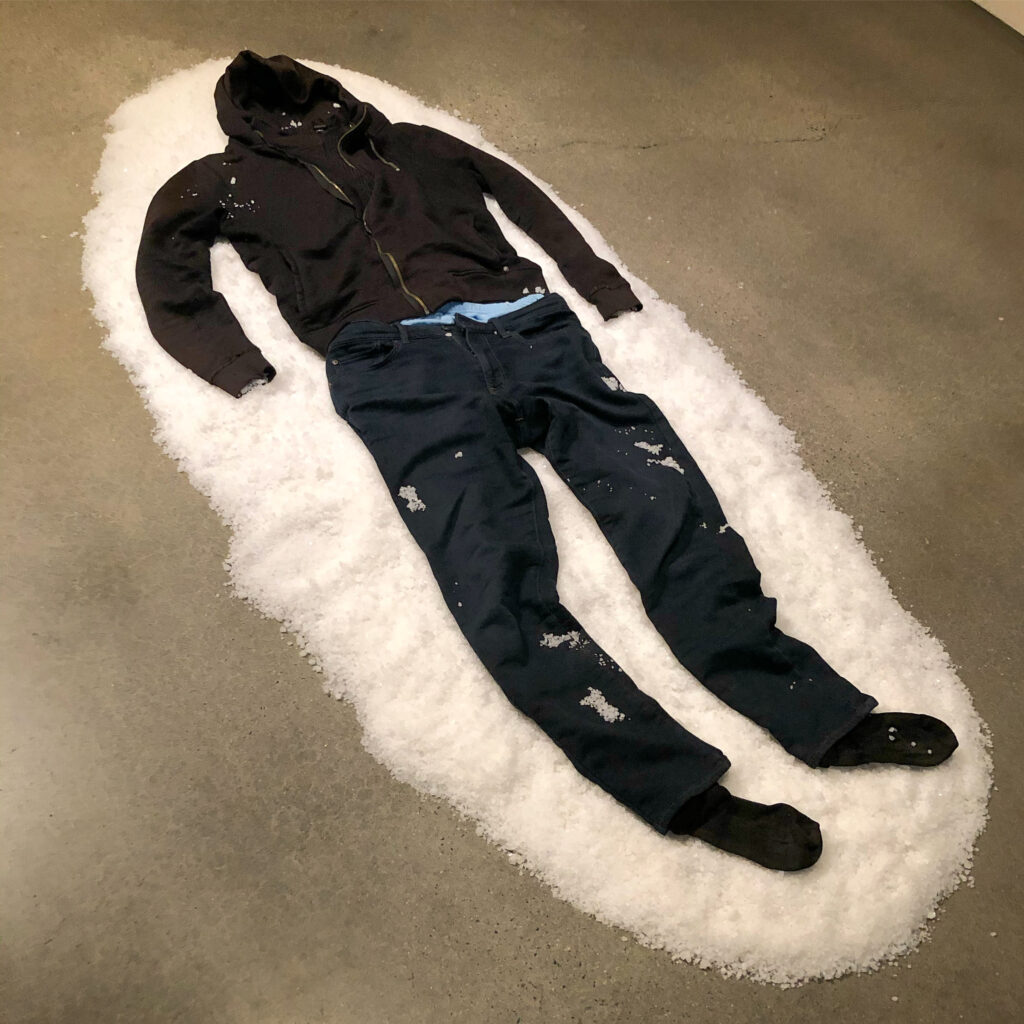
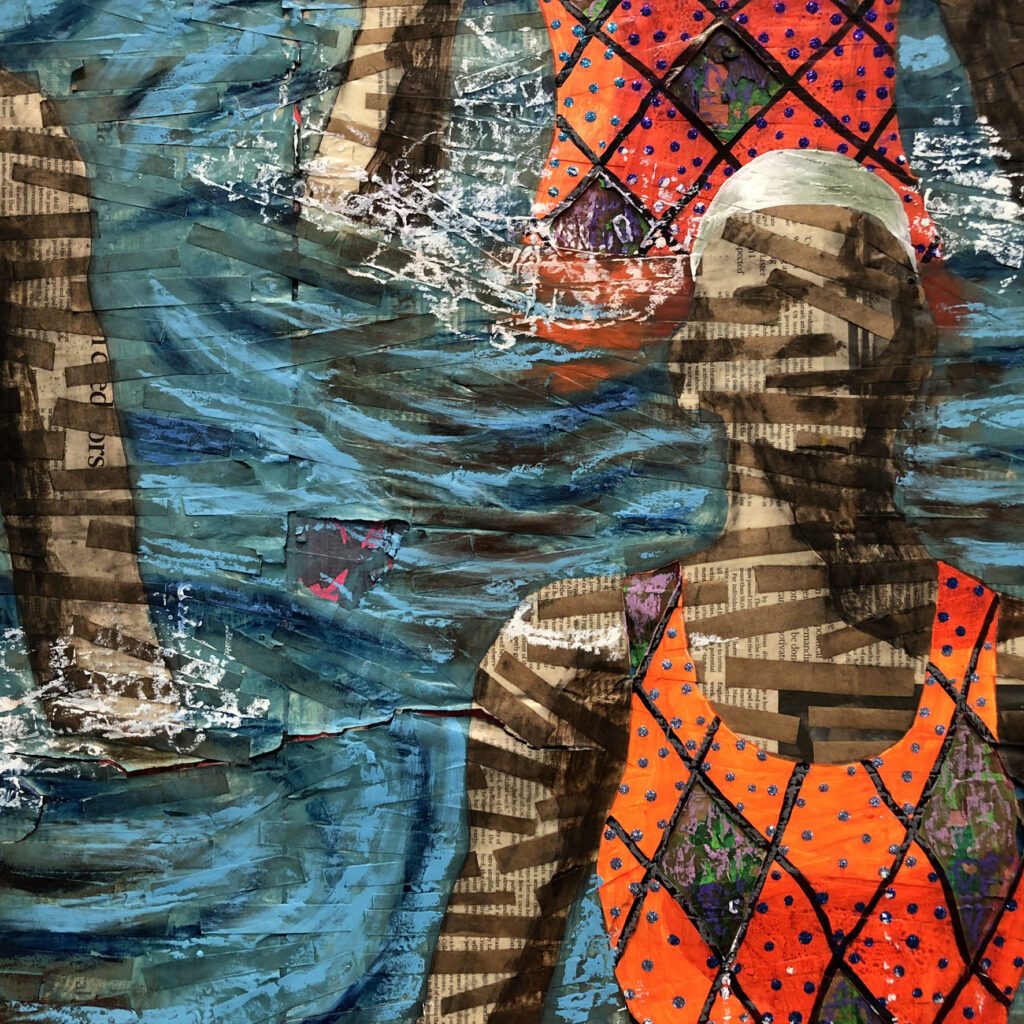
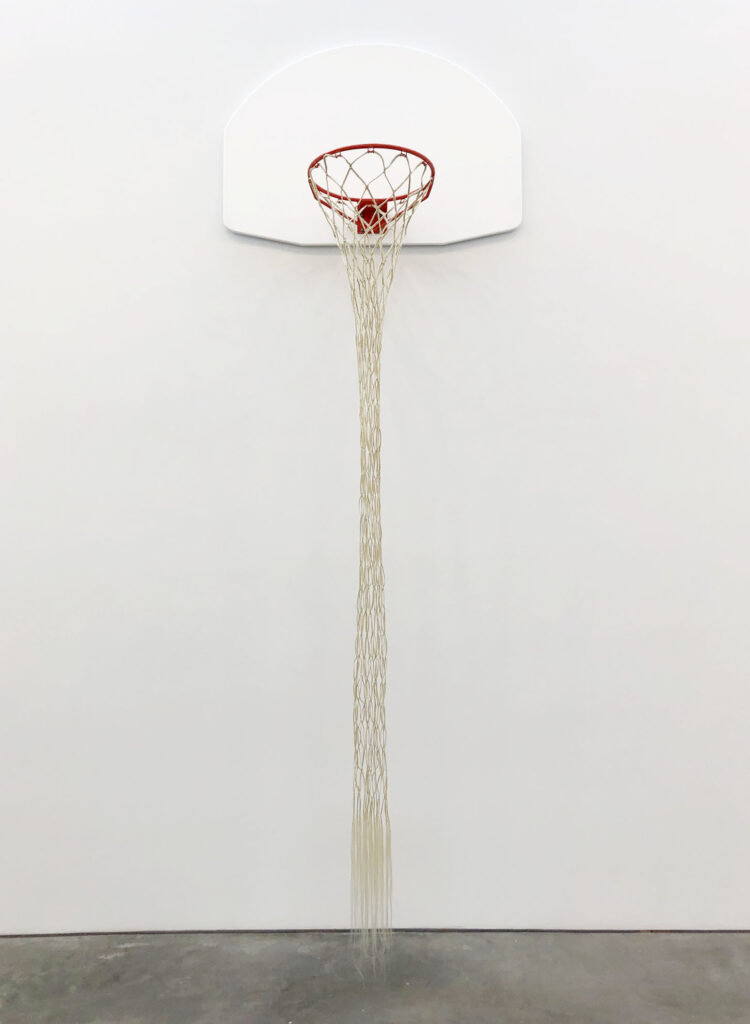
Rapunzel, 2021

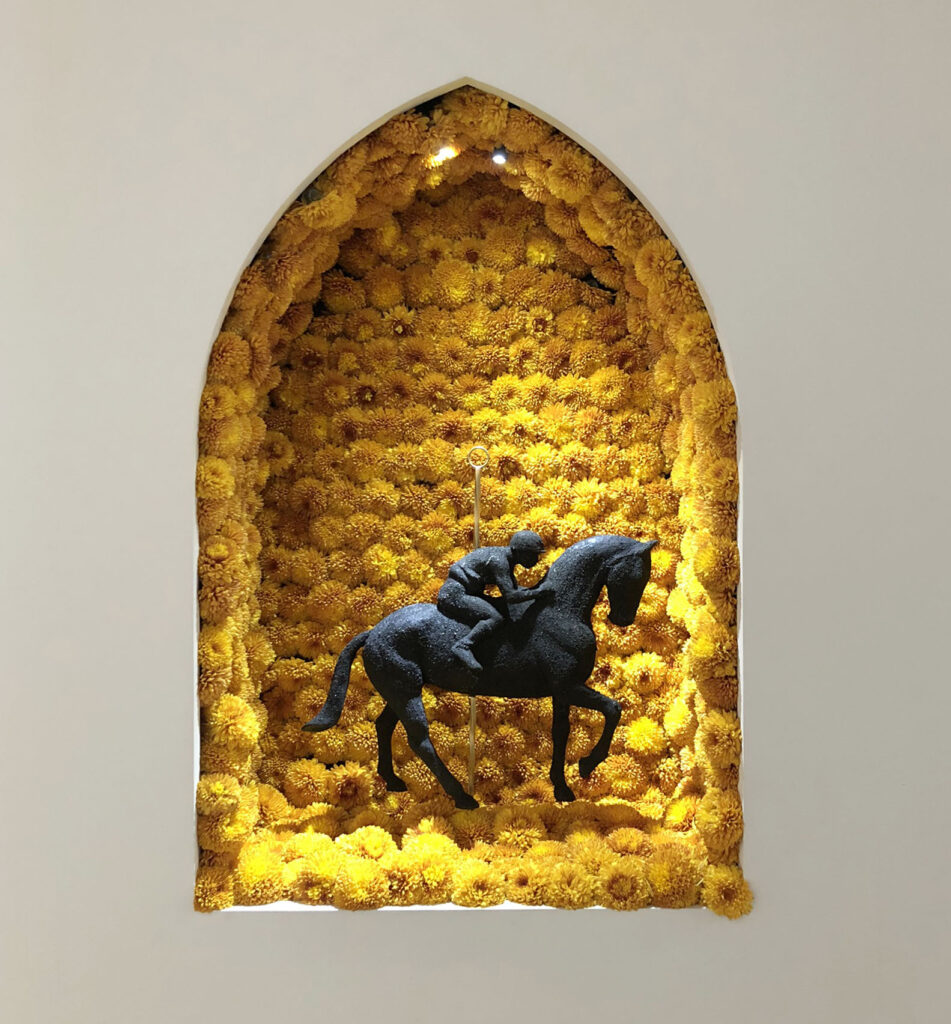
Fruity, 2021
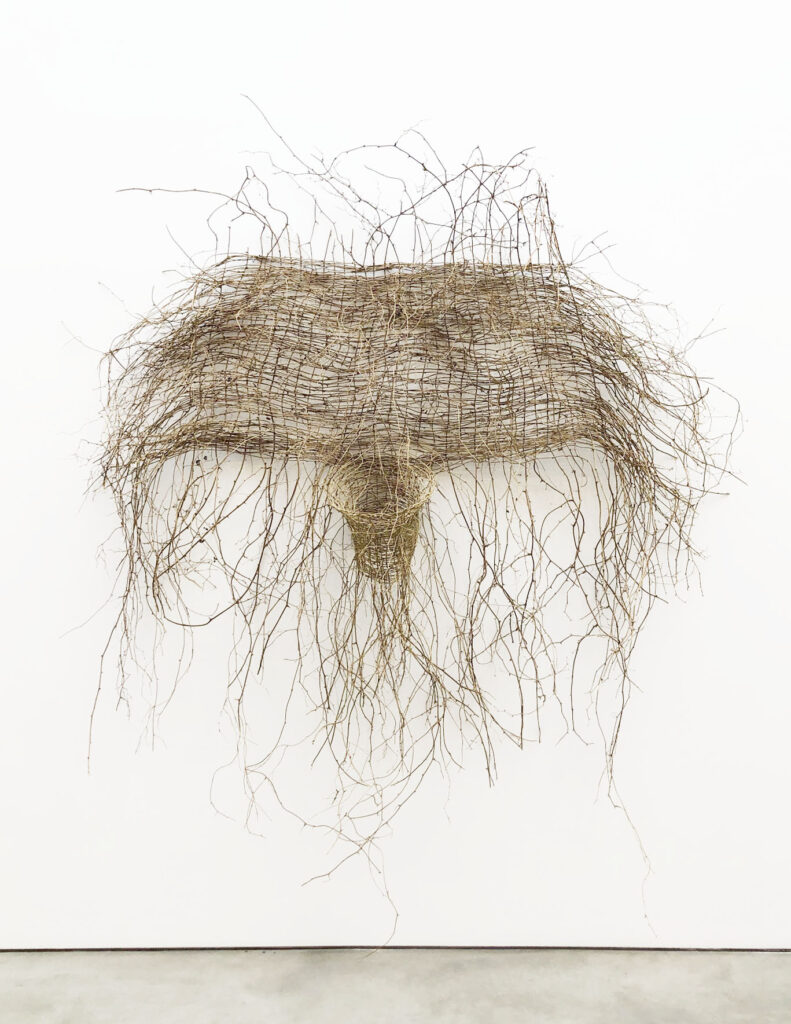
Fee-fi-fo-fum, 2021

Good Hair, 2021
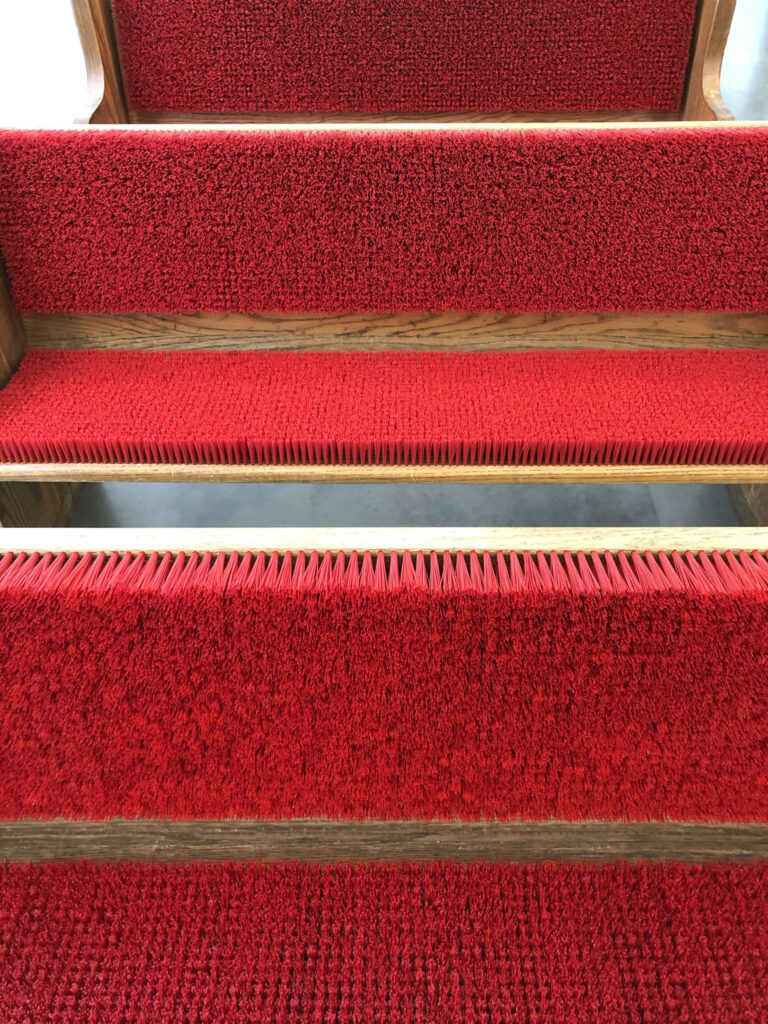
Lisson Gallery in New York is currently showing Hugh Hayden: Huey. This new body of work by Hayden “examines the American experience via agency, appearance, athletics and religion” and “interweaves symbols of the institutions that play key roles in an American upbringing with equally ever-present fairy tales to produce a new series of sculptures in wicker, vine, and ebony.”

More from the press release-

Hugh Hayden has previously examined the concept of the American Dream as well as the role historical foodways and dining traditions have played in shaping American identity. For Huey, the Texas-born artist chronicles and remixes his upbringing in the American South. Church, sport, school and hair are highlighted as Hayden probes the ingrained nature of cultural expectations. The exhibition is split into a trinity of rooms: a barber shop cum sanctuary, a basketball chapel and an ebony crypt, all of which harbor Hayden’s meticulously sculpted, sawed, sanded and woven objects.

The sanctuary features “Good Hair,” a new body of bristled wooden works that explore expectations of appearance and refinement in obligatory adolescent participation in athletics, education and religion. For Hayden the bristles render a subject simultaneously desirable yet uncomfortable, creating order via an abrasive action that, like the American Dream, is challenging and difficult to inhabit.

In the second chapel-like space hang woven basketball hoops out of hair, rattan and vine. The works are a childhood reimagination of the iconic peacock chairs the artist grew up with as well as an homage to the 1967 portrait of Black Panthers co-founder Huey P. Newton seated in one. The braided and woven works conflate tedious domestic handwork with hypermasculine athletics to materialize a queerness at odds with the fairy tale-like aspirations and reservations of becoming a professional athlete.

The final room of the exhibition is a meditation on agency, blackness and invisibility. Works sculpted from Gabon and Texas ebonies are presented in a daylight-lit, all-black room shifting in and out of visibility. Sculptures that reference the body, both moving fast as well as relaxing, offer an opportunity to reflect on the many hues of blackness.

This exhibition closes 8/13/21.

Aug 102021
 

summer syllables, 2021

soft, dark, demigod, 2021

marshling, 2021

Currently at Jack Shainman Gallery is Diedrick Brackens: Rhyming Positions, the artist’s second exhibition with the gallery. Brackens’ weavings use nature as symbolism to tell stories about the current world.

From the press release-

In several tableaux situated in nature, Brackens plays with the idea of creating home in a wild space, honoring the outdoors as a place in which queerness lives. This is a nod to the history of queer and femme folks who have gathered in nature, creating safe spaces for ritual and communion. This notion of commune is present in summer syllables, in which two figures stretch in lyrical movement, seemingly fashioning loops out of their own bodies, as if flowing one into the other within a vast, yellow landscape. In soft, dark, demigod, a figure bends over, caught within a thicket of roses in full bloom. This moment is indicative of Brackens’ own observation of the outside world over the course of the past year, as he has relished in these quiet moments of continued life as flowers grow. The presence of roses hint at the sensuality and eroticism that are apparent throughout this body of work and in Brackens’ practice more broadly.

In marshling a lone figure stands poised in the water, akimbo, surrounded by catfish and flora of the swamp. Catfish are a recurring motif in Brackens’ work, an emblem of the American South, embodying the soul and ancestral spirits. Continuing his practice of pulling from traditional folklore, two rabbits rest on chairs in each their own, almost as if they have been conjured up by the figure seated in their midst. Rabbits, creatures that live both above and below the earth, have shown up throughout African and African-American tales and literature as messengers and trickster figures. To Brackens, the animals in these works feel less literal and more like other humans or spirits  in communion with the figures, the trio seated together almost as if awaiting a dance.

This exhibition closes 8/20/21.

Jul 192021
 

End-To-End Encrypted (Lot’s Wife), 2020 by Elliot Reed, part of the group show Wish at Metro Pictures.

From the press release-

This exhibition closes 7/30/2021.

Jul 142021
 

For Marlene McCarty’s current exhibition Into The Weeds: Sex & Death at Sikkema Jenkins, she has combined her large scale drawings with an indoor and outdoor garden.

From the press release-

Using everyday materials such as graphite and ballpoint pen, McCarty’s work often focuses on representations of the female body, femininity, and its position within familial and biological systems. Her subjects are depicted engaging in unorthodox or transgressive social formations, breaking down the traditional, accepted interactions among humans and other species, as well as between humans and nature. For Into the Weeds, McCarty turns to plants, and their complex ecocultural role within society to explore issues of reproductive health, physical autonomy, public space, and the symbiosis of growth and decay.

Throughout history, certain plants and weeds have been foraged and cultivated for a wide range of purposes, both curative and toxic. The alkaloids of the deadly nightshade, for example, have also been used to treat fevers and inflammation, while mugwort has been used to regulate menstruation and induce abortion. Seedlings have been cultivated and installed alongside McCarty’s densely drawn compositions of plants, weeds, body parts, clothing, and abstract geometric forms. Meticulously shaded limbs and flowers interlace one another, mirroring each other’s shape with the curl of a finger or the droop of a petal. This interplay of human body and plant is disrupted by various symbols alluding to a hegemony of white western culture: a Civil War ball gown, cowboy hat, and fragments of Modernist architecture, including the honeycomb-esque Vessel at Hudson Yards. Within these chimerical gardens lies a contentious ecosystem, constantly negotiating the power dynamics across gender, race, health, and history.

This exhibition is on view until 7/30/21.

Jun 252021
 

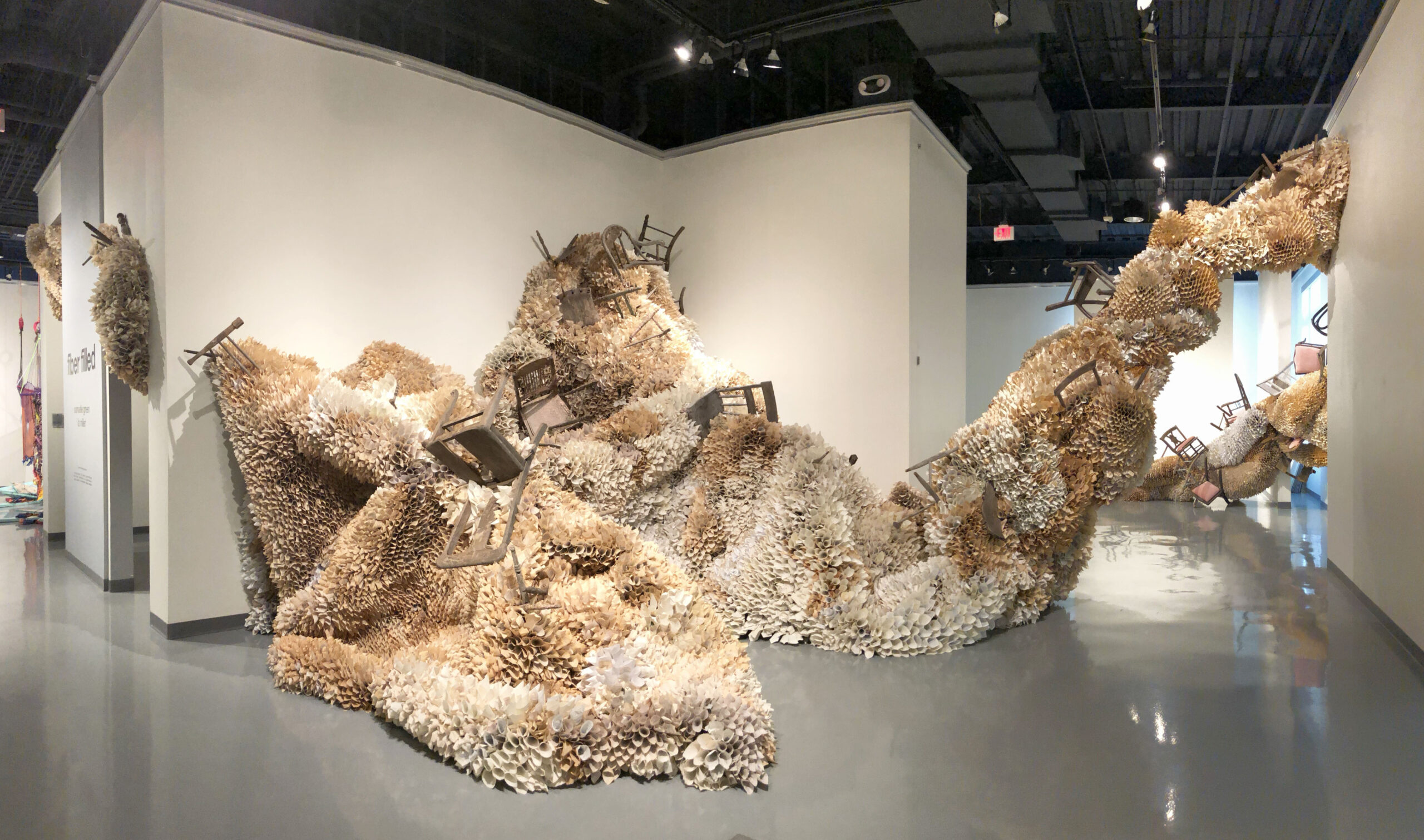
Currently at the Spartanburg Museum of Art in South Carolina is fiber filled, an exhibition consisting of two art installations. The one pictured above is by artist Samuelle Green, titled Manifestation 8: Permutation 1.

Her statement about the work-

There is structure and design inherent in the natural world, which we constantly draw from and take for granted. We generally fail to acknowledge the skill, time, and detail required to manifest the intricate structures found in objects we encounter regularly- such as those found in bird and wasps nests, beehives, spiderwebs, rock formations, anthills, feathers, etc.

My work, especially the large scale installations like this one, reference these natural forms as they merge with human-made objects, inspiring contemplation.

Also check out the museum’s site for a short video from the artist going into more detail on her process.

The other installation is by Liz Miller, titled Alchemical Conundrum, part of which is seen below.

Her statement about the work-

My work explores the fallibility of infrastructure and the precariousness of perceptions, as seen through a materially-intensive process-based lens. I create elaborate site specific installations that are equal parts absurd, menacing, and poetic. Pattern and tactility confuse and complicate identification, camouflaging recognizable forms and evoking recognition when applied to non-objective forms. The tensions between fact/fiction and dimensionality/flatness are endlessly fascinating to me, playing out my work as a dialogue between reality and illusion.

More recently I have become fascinated with rope and knotting as a byproduct of my large-scale installations, where I utilize rope to achieve tension that gives volume to otherwise flat materials. The varied use of rope and knotting across cultures and history ranges from utilitarian to decorative, and even deadly. I create interdependent knotted topographies that allude to both structure and malleability. The repeated act of tying by hand integrates an emphatic sense of strength, while the flexibility and nuance of the textile material ensures structural permutations. The resulting works are only quasi-architectural providing metaphorical insight laced with humor as related to a variety of structural and systemic behavior.

This exhibition closes 6/30/21.

Jun 242021


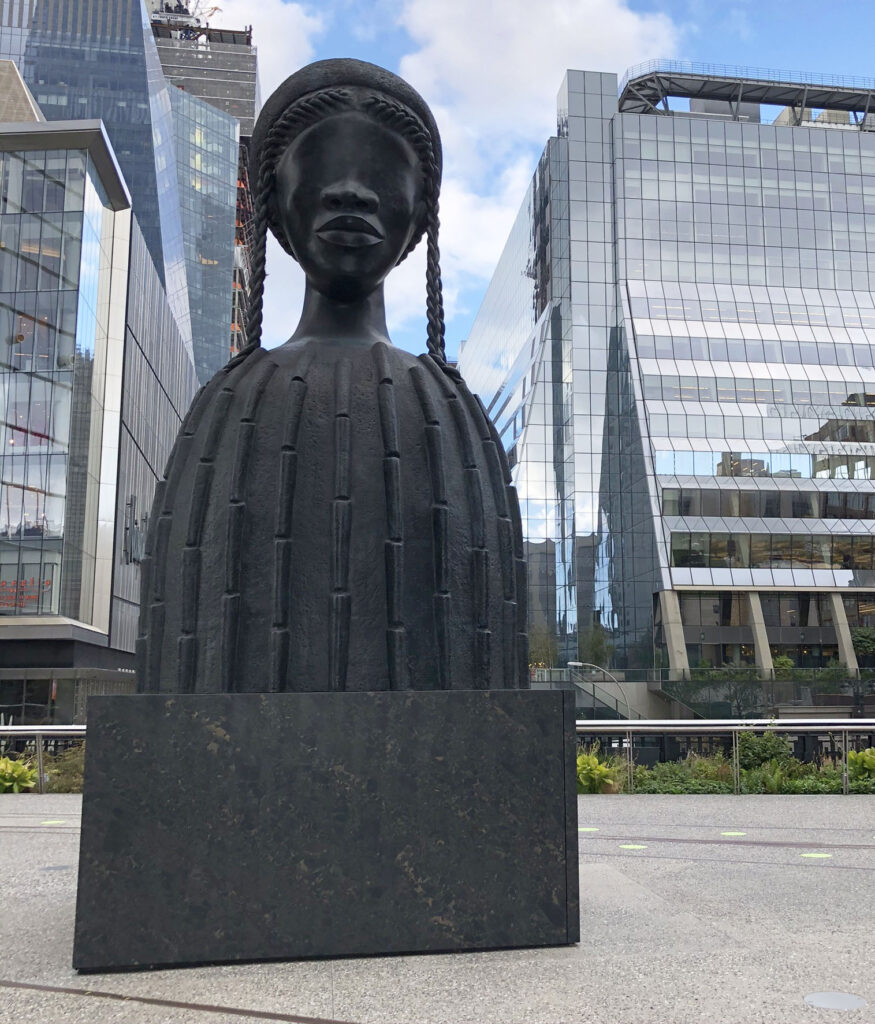
From The High Line’s information page on this work-

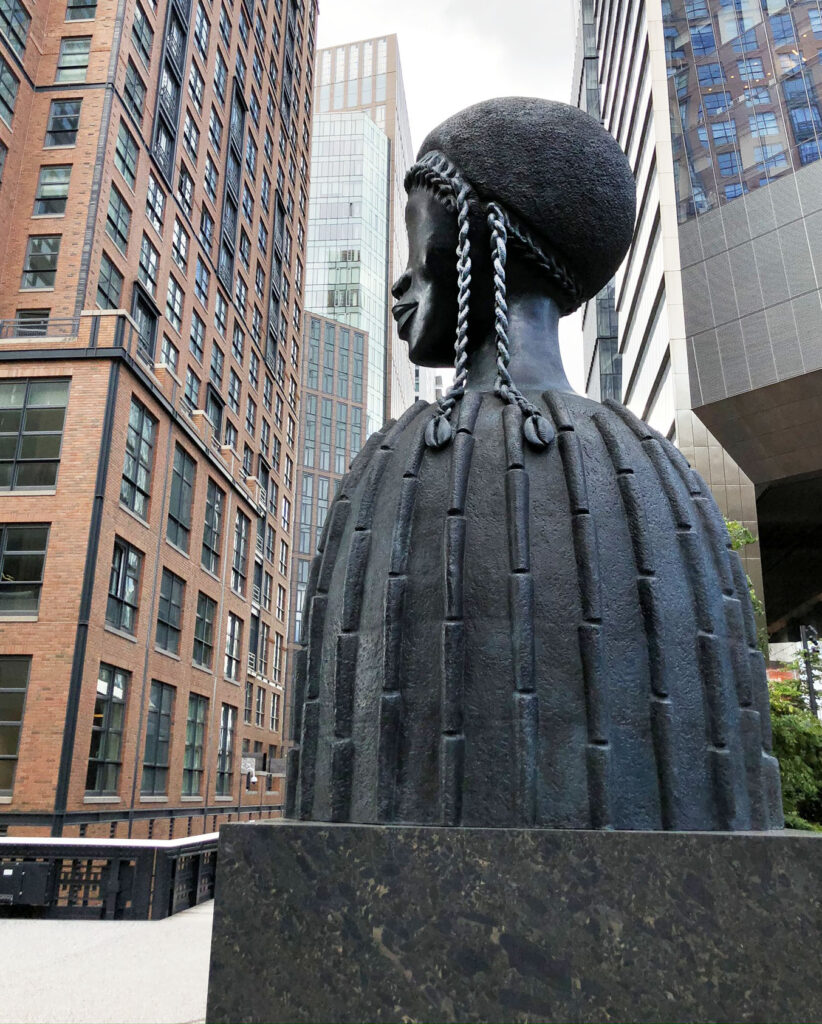
Simone Leigh presents Brick House, a 16-foot-tall bronze bust of a Black woman with a torso that combines the forms of a skirt and a clay house. The sculpture’s head is crowned with an afro framed by cornrow braids, each ending in a cowrie shell. Brick House is the inaugural commission for the High Line Plinth, a new landmark destination for major public artworks in New York City. This is the first monumental sculpture in Leigh’s Anatomy of Architecture series, an ongoing body of work in which the artist combines architectural forms from regions as varied as West Africa and the Southern United States with the human body. The title comes from the term for a strong Black woman who stands with the strength, endurance, and integrity of a house made of bricks.

Brick House references numerous architectural styles: Batammaliba architecture from Benin and Togo, the teleuk dwellings of the Mousgoum people of Cameroon and Chad, and the restaurant Mammy’s Cupboard in Natchez, Mississippi. The sculpture contrasts sharply against the landscape it inhabits, where glass-and-steel towers shoot up from among older industrial-era brick buildings, and where architectural and human scales are in constant negotiation. Resolutely facing down 10th Avenue, Leigh’s powerful Black female figure challenges us to consider the architecture around us, and how it reflects customs, values, priorities, and society as a whole.

Leigh works across sculpture, video, installation, and social practice, stitching together references from different historical periods and distant geographical locations. As a sculptor, Leigh works predominantly in ceramics—a medium that she mastered early in her career—continually pushing the boundaries of her chosen material by working in new methods and larger scales. In her intersectional practice, Leigh focuses on how the body, society, and architecture inform and reveal one another. She examines the construction of Black female subjectivity, both through specific historical figures such as Josephine Baker and Katherine Dunham, and more generally through overlapping historical lineages across Europe, Africa, the US, and the Caribbean.

The High Line’s website also has some excellent videos and additional information on the making of the sculpture well worth checking out.  This work was on view until May of 2021.

Jun 102021
 

NEW YORK CLEARING by Antony Gormley was on view in Brooklyn Bridge Park from 2/4-3/27/20. The work consisted of a single line made of 11 miles of square aluminum tubing that looped and coiled without a beginning or end, “turning itself into an environment for the viewer that counters the grid of modernism and the city with swooping lines of energy”.

This is one of a series of art works that were part of Connect, BTS– a global public art initiative supported by the K-Pop Group BTS and organized by a group of curators under the direction of independent curator Daehyung Lee. The project took place in five cities on four continents with 22 contributing contemporary artists.

May 262021
 

Mel Chin’s animatronic sculpture Wake, formerly on display in NYC’s Times Square, is now on view in Asheville, North Carolina until December 1.

From The Community Foundation of Western North Carolina website-

Wake was commissioned as part of Mel Chin: All Over the Place, a multi-site survey of his works from across many decades that took place in several New York City locations. A collaborative group, led by UNC Asheville’s Steam Studio and CFWNC, formed to plan and raise funds for the sculpture to be seen locally.

Wake – 60 feet long, 34 feet wide and 24 feet high, conceived and designed by the artist – was engineered, sculpted and fabricated by an interdisciplinary team of UNC Asheville students, faculty, staff and community artists led by Chin. Wake is interactive and features decks and places to sit and contemplate.

Wake evokes the hull of a shipwreck crossed with the skeletal remains of a marine mammal. The structure is linked with a carved, 21-foot-tall animatronic sculpture, accurately derived from a figurehead of the opera star Jenny Lind that was once mounted on the 19th century clipper ship, USS Nightingale. Jenny Lind moves subtly as she breathes and scans the sky.

“She may be looking at what cannot be seen as she moves away from the wreckage of her past,” explained Chin. “It’s about relationships we have to history. It’s almost an obligation to understand our relationships with our environment now and an opportunity to project what things could be like far into the future if we’re not engaged.”

The artwork is not only a comment on climate change, it calls forth a history that includes ships, like the USS Nightingale and many other vessels, used to move tea, guns and slaves that augmented the nation’s burgeoning economy. “These expanding past economies serve as prologue and perhaps a warning to our current environmental dilemma,” said Chin.

“Wake is a powerful comment on how the tides of history have shaped many communities, including Asheville,” said Steph Dahl, who manages the City of Asheville’s Public Art Program. “The piece asks us to acknowledge and discuss a long and complicated past, one that has left us operating in a sea of racial inequities and environmental crises. Wake’s temporary presence in an empty lot where the history and future of the Southside and South Slope meet is part of its power, and its impermanent nature underscores some of the tough questions we need to address together.

“Jenny Lind was the Beyoncé or Adele of her time,” said Chin. “She was brought by P.T. Barnum to tour America as the Swedish Nightingale. Barnum initiated American mass marketing and the world still lives in the real wake of this marketing enterprise. American commercialism provided profound advancement and wealth, but it came with real costs including colonialism, enslavement and rapid expansion. Jenny Lind, an abolitionist herself, had nothing to do with the USS Nightingale, but as its figurehead, she is an integral part. You can’t escape the web you’re in whether you are in New York City or Western North Carolina.”

Since the late 90’s Chin has lived and worked in Egypt Township, outside of Burnsville in Yancey County, North Carolina. His work has been exhibited by major art centers nationally and globally. He is described in his MacArthur entry as “a category-defying artist whose practice calls attention to complex social and environmental issues. In an expansive body of work ranging from collages, sculptural objects, animated films and video games to large-scale, collaboratively produced public installations, Chin demonstrates a unique ability to engage people from diverse backgrounds and to utilize unexpected materials and places.”

Dec 042020
 

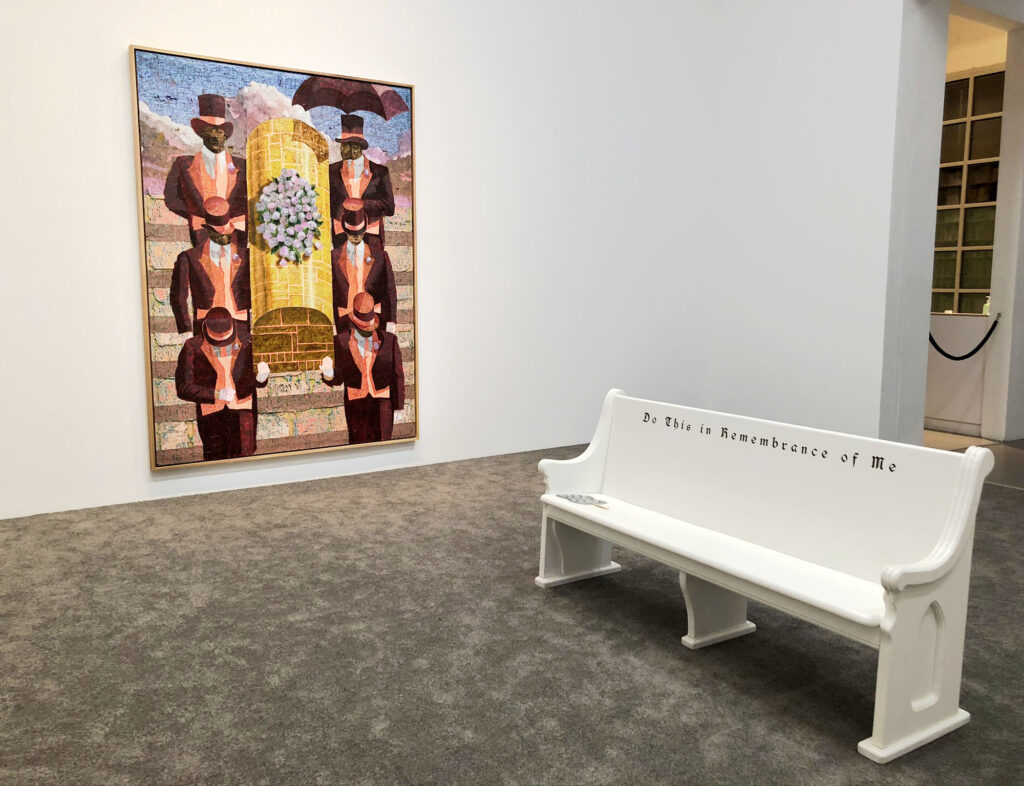
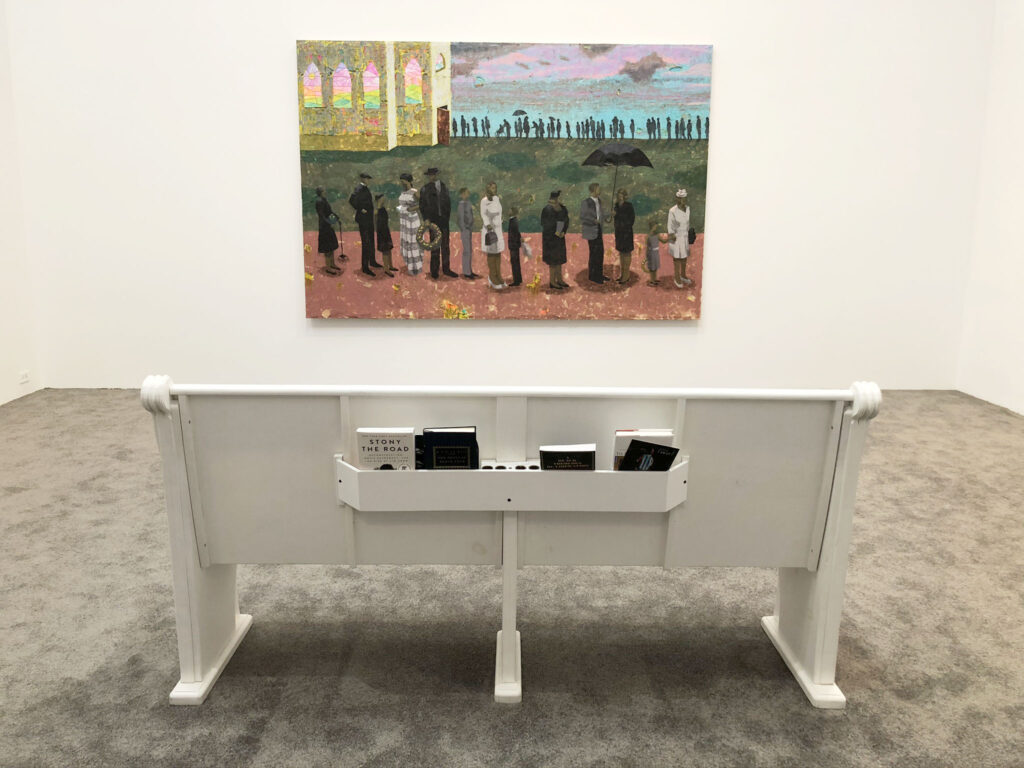
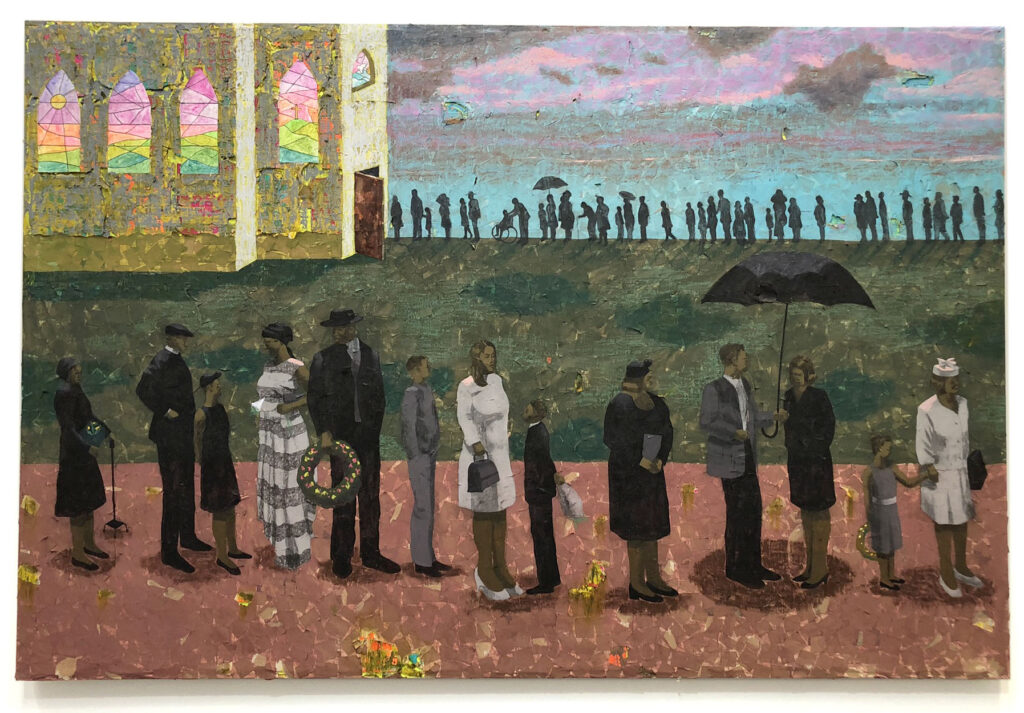
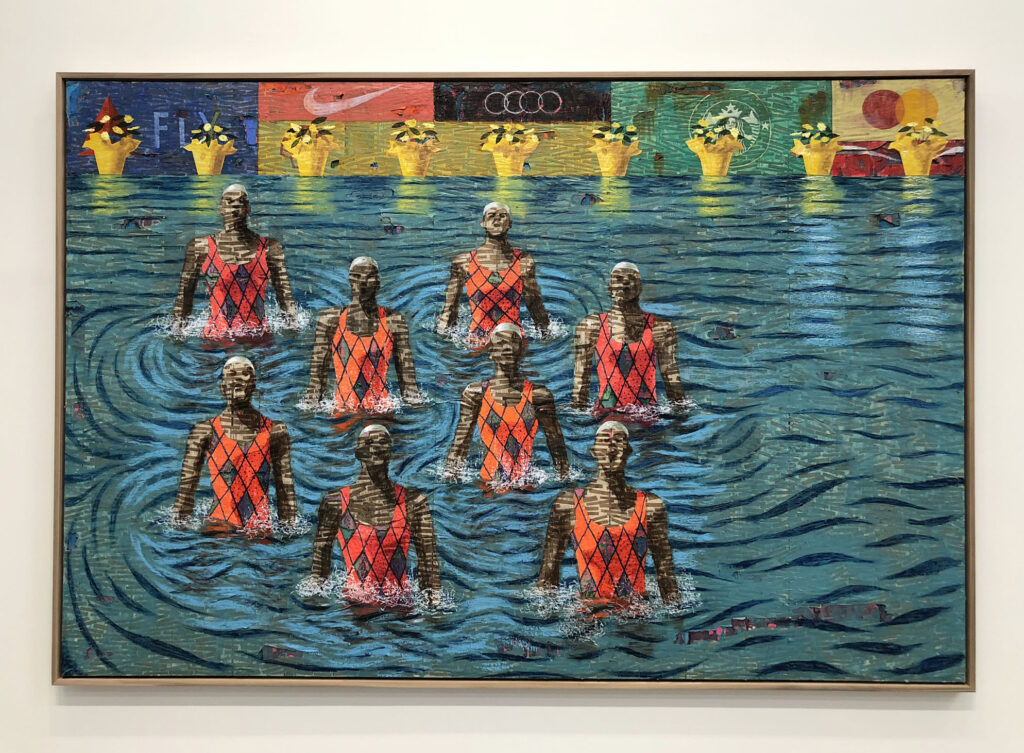
Currently at Petzel in NYC is Derek Fordjour’s solo exhibition, SELF MUST DIE, which incorporates painting, sculpture and Fly Away, a performance collaboration between Fordjour and award-winning puppeteer Nick Lehane.

From the press release-

The show, Fordjour’s first with the gallery, is an offering of creative labor in response to our current moment, a deeply personal and collective state of anxiety around death and hyper-visible racial violence. It examines the nature of martyrdom, vulnerabilities inherent to living in a Black body, performance of competency, and the liminal space existing between autonomy and control.

In SELF MUST DIE, Fordjour interrogates the inevitability of actual death, made more urgent by the realities of a global pandemic, and points to the aspirational death of the artist’s ego brought into focus by a burgeoning career. It is both cultural manifesto and personal declaration. The show is comprised of three parts: VESTIBULE, a site-specific sculptural installation; Fly Away, a live puppetry art performance; and a suite of new paintings.

VESTIBULE offers a collection of sculptural objects imbued with biblical allegory and the spirit of James Cone’s Black Theology of Liberation. It refashions the gallery as a secular yet sacred space of memorial. Among its features, the small entry compels visitors to undergo a destabilizing bodily shift that elicits an intimate and reorienting experience. A directional light from above slowly combs the entire room, invoking both searchlight and spotlight, ideas central to the recent death of Breonna Taylor. Constructed of bituminous coal and wrought iron, Taylor Memorial hangs from above.

Fly Away, a collaboration between Fordjour and award-winning puppeteer Nick Lehane, is performed by a stellar cast, with an original score composed by John Aylward and performed live by oboist Hassan Anderson. The puppet is a Fordjour-designed, hand-sculpted figure crafted by Robert Maldonado. The protagonist’s narrative arc rises and falls along a journey of personal discovery. Larger themes that course through Fordjour’s body of work become resonant.

Spanning two galleries are several new paintings, executed in Fordjour’s signature collage technique, representing the latest developments in his studio practice. The first is a suite of paintings based on Black funerary tradition. The second gallery presents a broad range of subjects including several at monumental scale.

This exhibition closes 12/19/20.

Dec 042020


Ida Applebroog’s exhibition Applebroog Birds at Hauser & Wirth’s New York location is a delightful collection of paintings and sculpture. But there is more to them than meets the eye.

From the press release-

For more than six decades, American artist Ida Applebroog has continuously engaged with the polemics of human behavior, often exploring interrelated themes of power, gender, politics, and sexuality in works that span and challenge the boundaries of her mediums. Her forthcoming exhibition ‘Applebroog Birds,’ opening 12 November at Hauser & Wirth New York, finds the 91 year old artist advancing her trenchant political inquiry through avian portraits, paintings, and sculptures, all of which are ripe with symbolism relevant to this unprecedented moment. This exhibition expands upon the ‘Angry Birds of America’ works she began making in 2016 and reaffirms her status as one of contemporary art’s most consistently inventive political image-makers.

A pioneering artist of the feminist movement since the 1970s, Applebroog constantly evolves her visual vocabulary and draws from a diverse array of themes, memories, and mass media sources. These range from her own genitalia to dolls and mannequins, to cartoon characterizations of people in her life, to fashion models and accouterment – and, most recently, birds. In 2016, Applebroog became captivated by ornithology and John James Audubon’s skill at merging art and nature. She developed an interest in drawing birds nestled in trees. Quickly realizing that Audubon and other ornithologists work from taxidermal birds, Applebroog began collecting birds and reading ornithological books, eventually producing her own models in plaster and paint.

Her series ‘Angry Birds of America’ was developed during a time of grief and rage, expressed with new intensity in American politics: it was the year that saw the beginning of Donald J. Trump’s presidency, the concomitant rise of white nationalism and anti-immigration violence. Mass shootings in Las Vegas and Texas, the #MeToo movement, and women’s long suppressed anger at accepted sexual affront and assault in the workplace were brought into public focus. Some of Applebroog’s ‘Angry Birds of America’ works will be on view at Hauser & Wirth, having been presented at the Kunstmuseum Thun, Switzerland, in its 2019 exhibition ‘Ida Applebroog.’ Centered on Applebroog’s paintings and sculptures of dead birds, these works provide viewers with analogs for the underlying amalgam of violence and beauty that exist in the world around us, both natural and manmade.

Applebroog’s images and sculptures of birds depict a wide range of avian types. Her ‘White Bird’ sculptures, inspired in part by Applebroog’s studio menagerie of stuffed birds, have the aspect of phantoms in flight, forms that seem to bob gently on unseen air currents, while the ‘Specimens’ works, innate and individually tagged, suggest findings from an ornithologist’s lab. The bird portraits on mylar similarly emit a feeling of taxidermy’s strange temporality. These works evolve from images that are printed with inks that the artist then manipulates by hand. Though the animal depicted in each work has expired, Applebroog’s skill in returning a carcass to life is in full view, creating a metaphor for contemporary political life in America and a call to action.

In an essay titled ‘Bird on a Wire,’ originally published in the Kunstmuseum Thun’s catalogue for Applebroog’s 2019 solo exhibition, art historian Jo Applin notes the irony that President Trump has his own, ‘ill-advised addiction to social media through which, like the proverbial caged canary, he tweets, and tweets, and tweets all manner of bizarre statements, unfounded allegations, and lies.’ In ‘Applebroog Birds,’ the artist’s portrait of a bald eagle – the national symbol of the United States of America – keeps company with a flock of dead birds.

This exhibition is on view until 12/19/20, by appointment.