Apr 222023
 

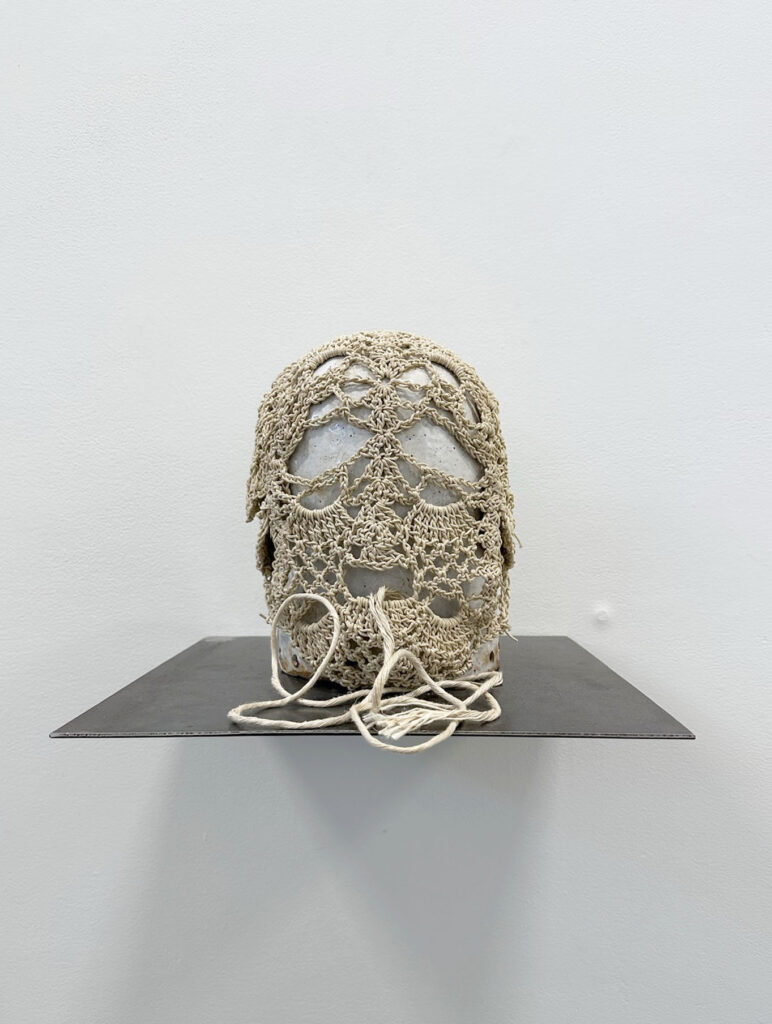
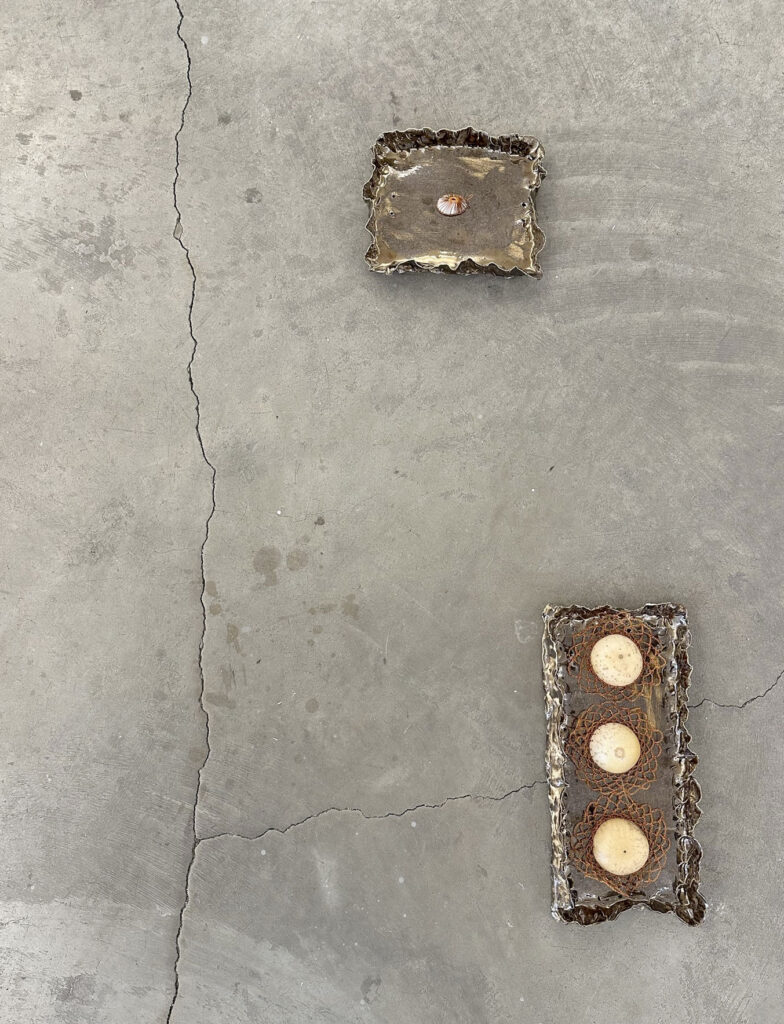
cabeza güera, 2019 Glazed ceramic and crochet cotton

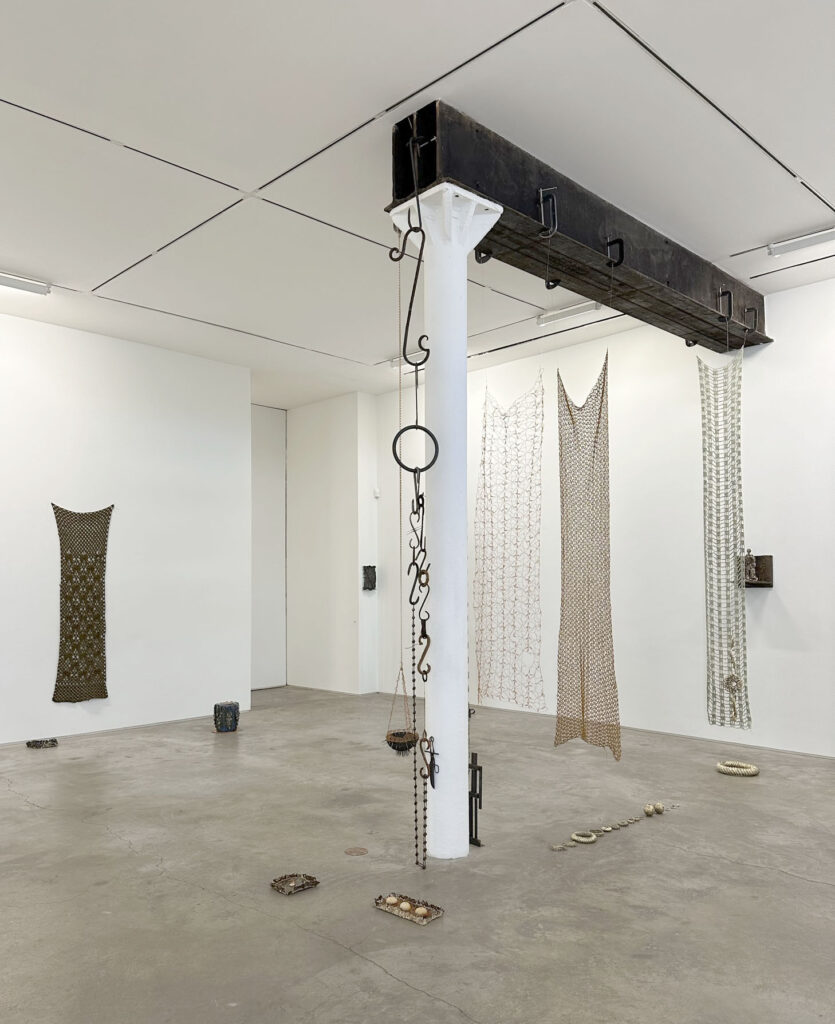
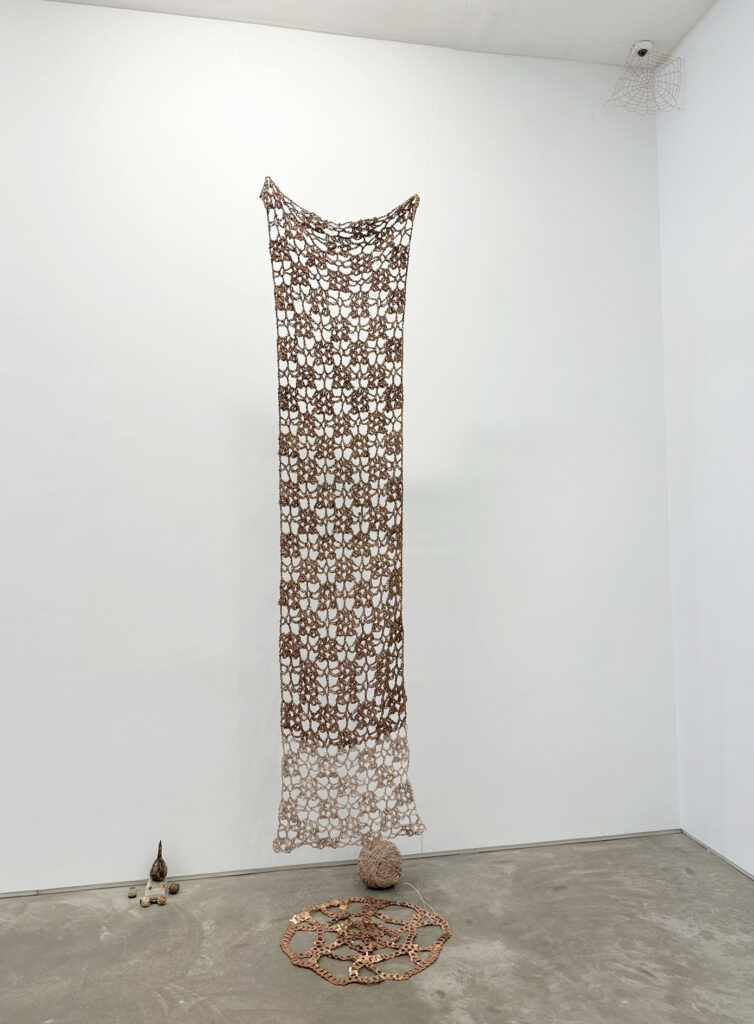
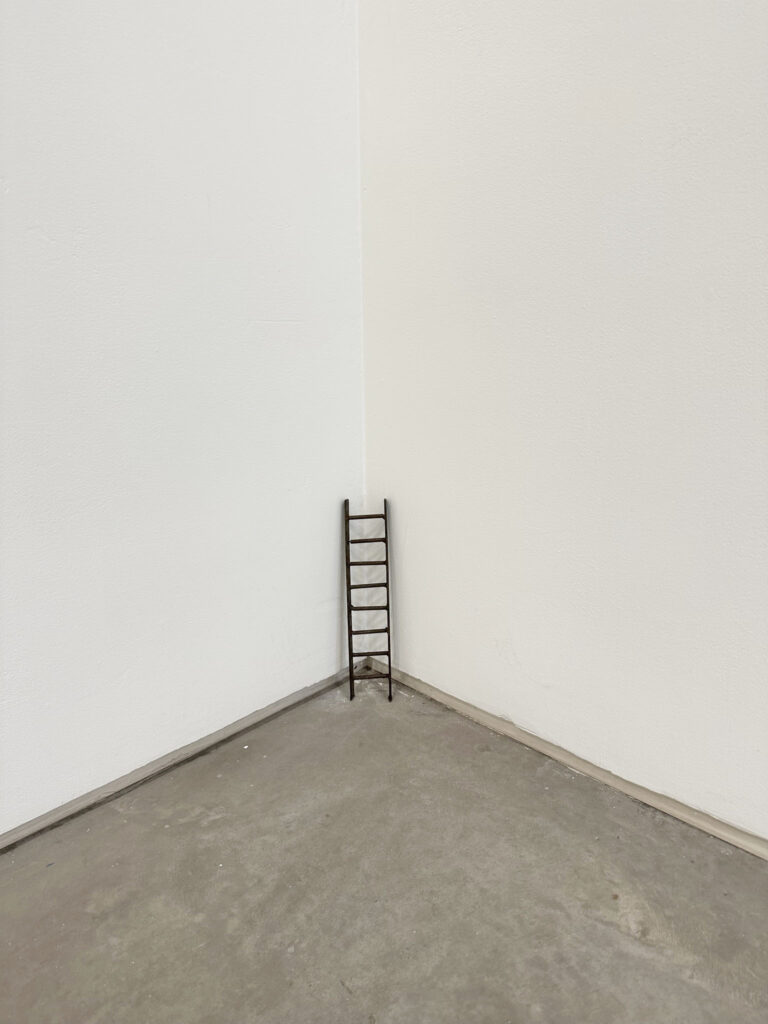
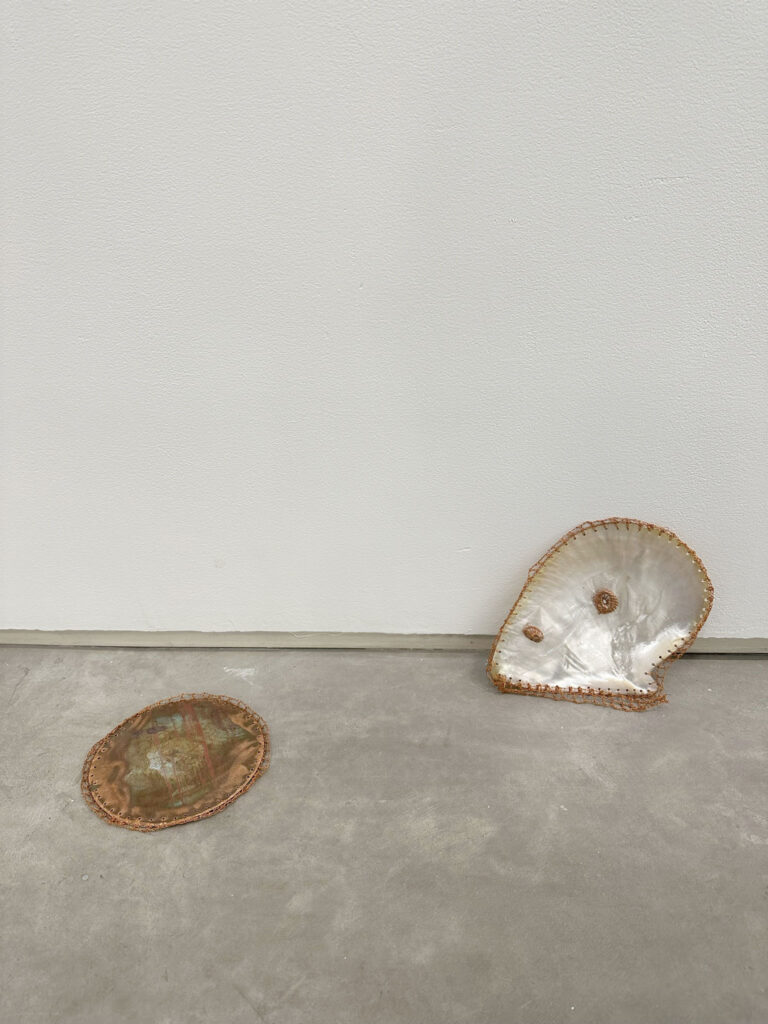
“encuero”, 2022-2023, Crochet leather and copper; “gotitas”, 2023 Agate, glazed ceramic, plasma cut metal, steel, onyx, palm, and seed podand; “telaraña de cobre”, 2020 (web in upper corner)

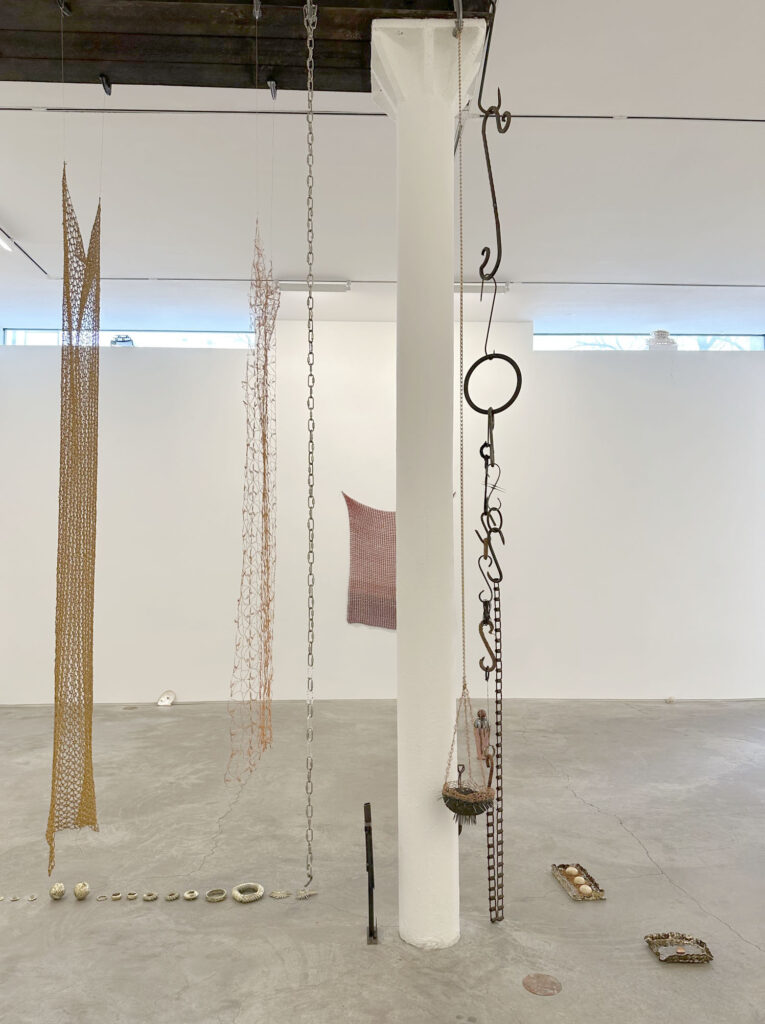
“trastes ceramica”, 2023 Glazed ceramic, gourds, crochet copper wire, and limpet shell

There’s only two days left to see ektor garcia: esfuerzo at James Fuentes. The enchanting sculptures inspire curiosity and encourage the viewer to imagine the story behind the work while also admiring their construction.

From Art Daily about the exhibition-

Each of ektor garcia’s exhibitions are more like a marker of a moment of pause in his work, rather than a presentation of something complete or discrete. In this way his works are evidence of a continual natural progression, as things build on top of each other, evolving. In relation to the specific time and place of this newest exhibition; it marks a cyclical continuation of the garcia’s presentations at the New Museum in 2017 and Sculpture Center in 2019—both of which moments in the artist’s life when he was traveling a lot, largely moving between Mexico, being on the road, and New York, specifically. This is the case once again, today:

For this show garcia traveled from his studio in Mexico City, suitcases filled with materials, to occupy the basement space below the gallery at 55 Delancey St in the lead up to the exhibition’s opening to the public. He has also retrieved objects previously exhibited or in storage—for example a 15-ft copper link piece recently exhibited at the Henry Art Museum has been broken into smaller pieces, added to and reconfigured into a new work(s). The exhibition title, esfuerzo translates to effort; as in a big push, like a birth, which feels apt for what the artist does. Pieces come together little by little over a long period of time; and the work comprises many small parts that each reflect his esfuerzo in making them. Another translation for esfuerzo could be output; and, shortened, fuerza means strength. Via his artistic practice, garcia is the conduit or vessel through which that life-force runs, resulting in an output that is this body of work. garcia is constantly making, hands always moving; this is simply part of how he lives his life. The work therefore isn’t made toward constructing a larger conceptual conceit; instead, its making is its meaning, the working is the work. Its presence in the space is evidence of all this; making room for it to be approached and even interceded, we inherently take part in the work’s life cycle, even potentially changing its course by entering this domain.

This sense of force, therefore, isn’t tied to garcia’s hand only, but relates externally as well. One piece in the show, cochinilla (2022), is woven from wool dyed red from the shell of the cochineal insect. Last year it was installed on the exterior of the Museum of Contemporary Art in Monterrey, Mexico, and upon taking it down garcia’s realized it had become sun bleached unexpectedly. With other pieces he more deliberately pushes, forcing change, for example by using a blowtorch against copper to catalyze an oil-spill patina. Over time, crochet has been one constant; a crocheted piece needs time, and then it meets time. In his words: “The materials are vibrating back and forth, taking turns. That is how they evolve.” And so although the works reference the past they do not prioritize it; likewise the future. Rather, in the style of the ouroboros, they are cyclical, perpetual, and most generous about the present.

Artist Cy Gavin wrote this piece to accompany the exhibition, which is worth a read as well.


Apr 192023
 

“…from dawn to dusk, (January)”, 2022

“…from dawn to dusk, (May)”, 2022

“…from dawn to dusk, (December)”, 2022

“white blind (bright red) (02.13)”, 2002

“white blind/bright red (02.6)”, 2002

“Untitled (98.5)”, 1998

From “nowhere near” Untitled (NW 18), 1999

“… and to draw a bright white line with light (Untitled 11.10)”, 2011

Uta Barth’s two part exhibition at Tanya Bonakdar Gallery is a fascinating look at the artist’s work.  It includes the New York debut of her most recent piece, …from dawn to dusk, a nearly 360-degree installation of images commissioned by the J. Paul Getty Trust.

From the press release-

Barth’s expansive 2022 series … from dawn to dusk focuses on the intersection of Southern California light with the architecture of the Getty Center. It traces the changing light at one location of the Richard Meier built campus, for the period of one year. The location was photographed every five minutes, from dawn to dusk, on two days each month, for the entirety of the year. Made with a GigaPan, over 64,000 images were captured and a Timelapse video sequence now shows the progression of this movement of light. As the view repeats from panel to panel, there are subtle changes in light as well as more dramatic blurring and color shifts, which invoke inverted optical afterimages and other visual phenomena that occur when staring at a fixed point for a prolonged period of time. Presented as twelve consecutive single views, the video is embedded among the still images of the installation, and it comes as a surprise to discover what one first assumes to be a still photograph to actually be the moving summation of the show.

In the upstairs galleries, Elizabeth Smith’s selection of work reveals the foundations of the artist’s renowned and influential practice, as well as the trajectory that led to the explorations found in …from dawn to dusk. Elizabeth Smith shared her thoughts on Barth’s practice as she approached this exhibition:

It’s been almost thirty years since I worked with Uta Barth to present her first solo museum show at MOCA in 1995. In relation to her newest project, the gallery’s invitation to select some key examples from both her early series and subsequent ones has offered a welcome opportunity to reengage with and consider the full trajectory of her work. From her earliest to her most recent photographs, Barth’s practice has centered on a nuanced investigation of visual experience, free from narrative. Light, color, the passage of time, and the shifting nature of the process of vision through bodily experience are the ongoing subjects of her resonant images, probed in various ways over decades.

Throughout her career, Uta Barth has made visual perception the subject of her work. Regarded for her “empty” images that reference painterly abstraction, the artist carefully renders blurred backgrounds, cropped frames and the natural qualities of light to capture incidental and fleeting moments, those which exist almost exclusively within our periphery. With a deliberate disregard for both the conventional photographic subject and the point-and-shoot role of the camera, Barth’s work delicately deconstructs conventions of visual representation by calling our attention to the limits of the human eye.

As Leah Ollman writes in her recent Los Angeles Times profile of the artist,

From her earliest years as an artist, Barth’s attention has been drawn to the eye’s behavior: what attracts it, what makes it stay, what causes it to double back, what generates after-images and optical fatigue. Learning to photograph was, for her, a way of learning to see.

This exhibition closes 4/22/23.


Apr 182023
 

“Untitled (Thicket)”, 2022, Steel, wood and paint

“Untitled”, 2020-22, Bronze and paint (two parts)

“Untitled (Fence I)”, 2020, Papier mache

Rachel Whiteread’s sculptures at Luhring Augustine’s Tribeca location draw the eye in with their textures, colors, and in some the unique combinations of items. They are even more intriguing when you discover they are often not what they first appear to be.

From the press release-

As is typical in Whiteread’s work, the sculptures in this exhibition communicate a high-low dialogue: discarded, seemingly inconsequential items are rendered in often precious, high-art materials, which transforms and elevates them from their original context and reading. The eye is tricked, and careful observation is required of the viewer. What appears to be spray-painted cardboard is in reality patinated bronze or silver, or shimmering metallic papier-mache, and assemblages of found materials are in reality amalgams of both found objects and hand-crafted simulacra. Cartons, boxes, branches, crates, cardboard, packing materials, and pipes overlap and interchange, creating an installation that becomes a pleasing visual puzzle. Whiteread created the works for this exhibition specifically with the light-filled, high-ceilinged Tribeca gallery in mind, so a beautiful optical play with colors and materials punctuates the space and draws the viewer into close examination of these human-scaled pieces. Silver and bronze casts of empty, anonymous boxes have a weighty presence, in contrast to the disposable nature of their form. The floor pieces are ghostly white assemblages of both found and cast objects, mostly debris; sitting wraithlike on the floor, each beckons the viewer to circle them and decode their elements.

This exhibition closes 4/22/23.


Mar 292023
 

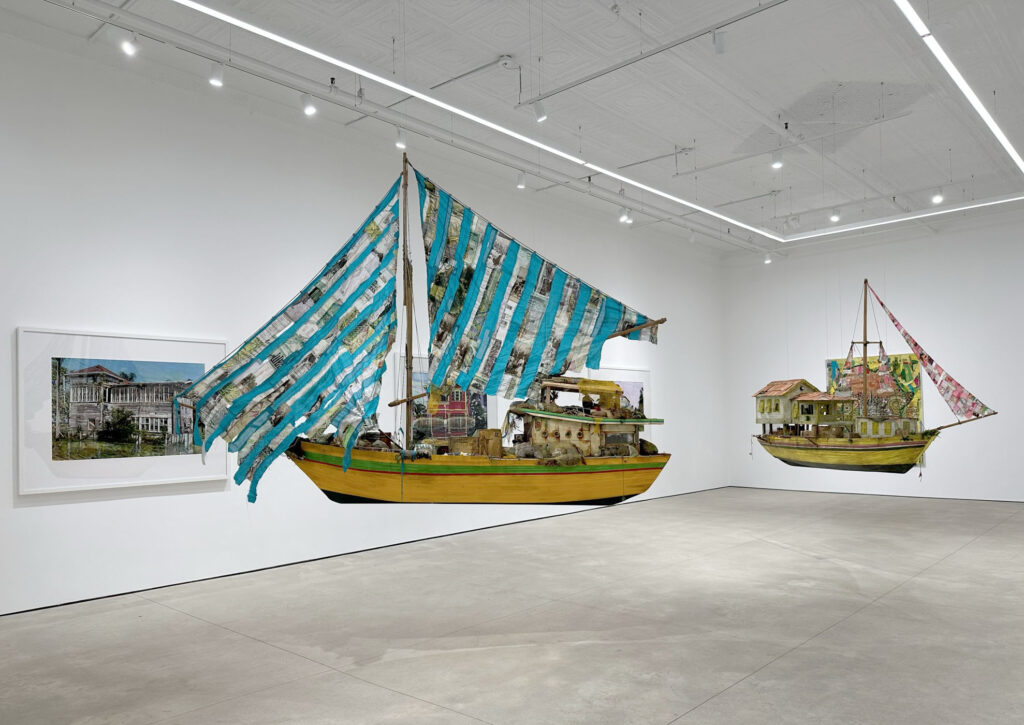
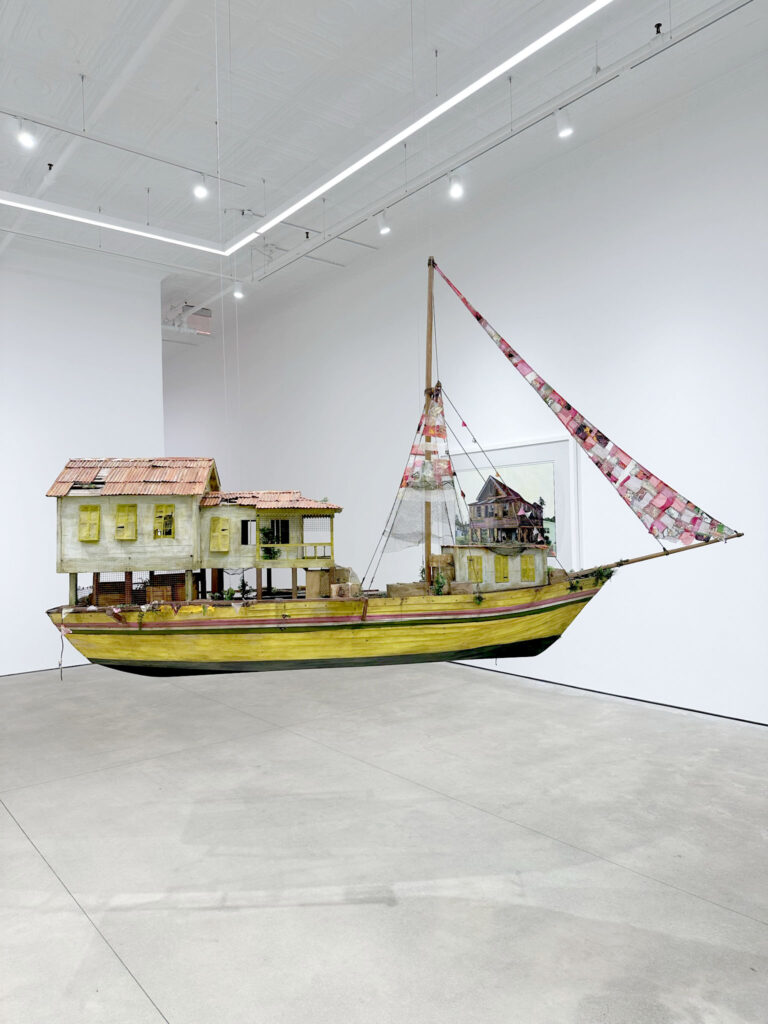
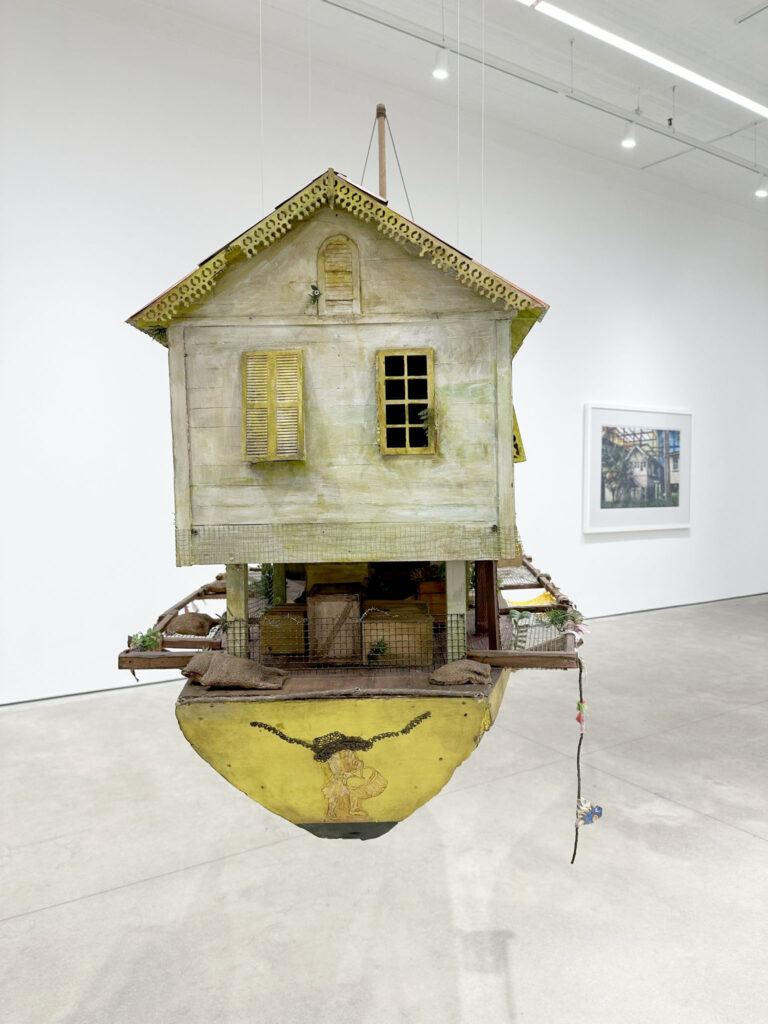
Hew Locke, “Listening to the Land” room view

“The Relic”, 2022

“The Relic” 2022 (another side)

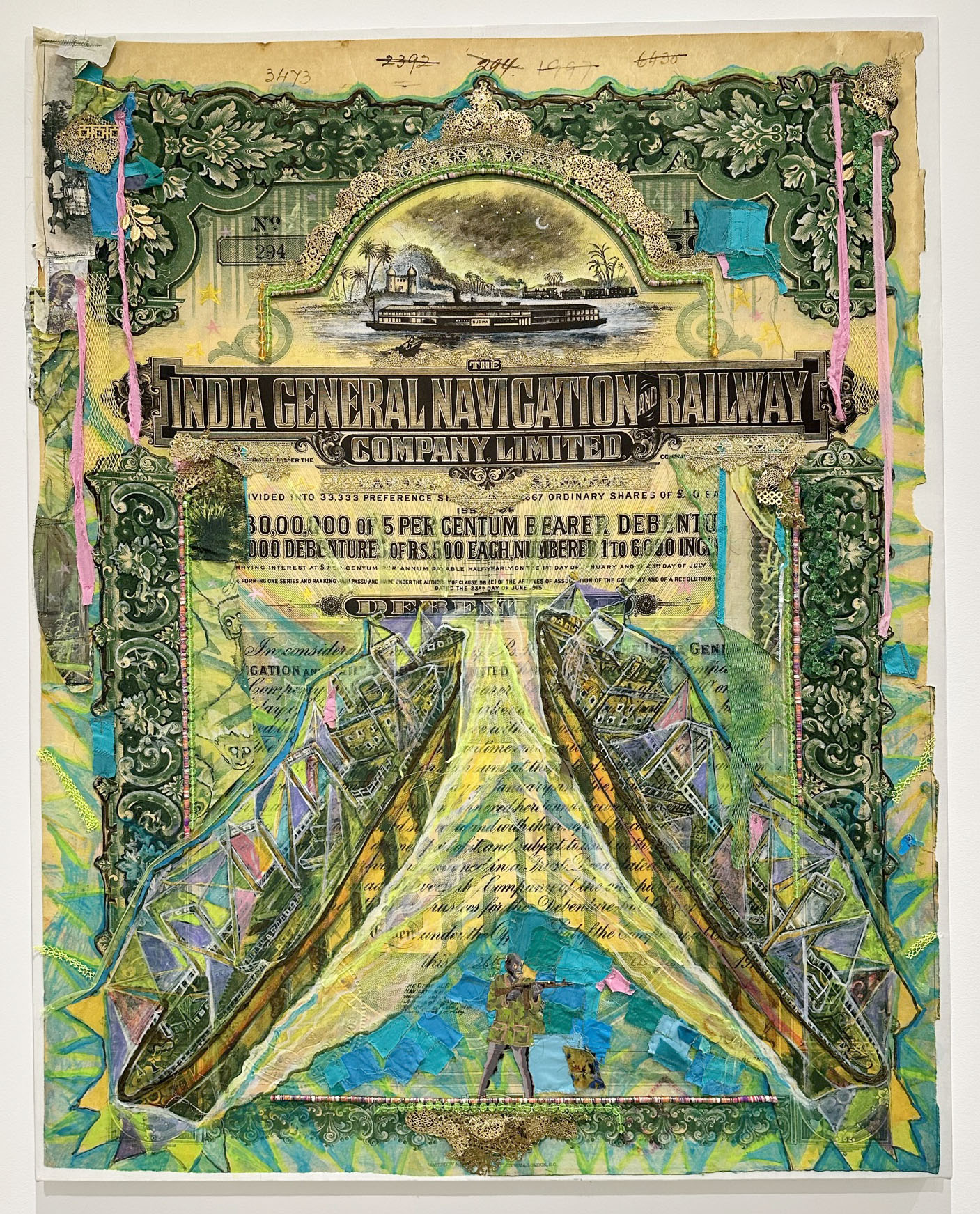
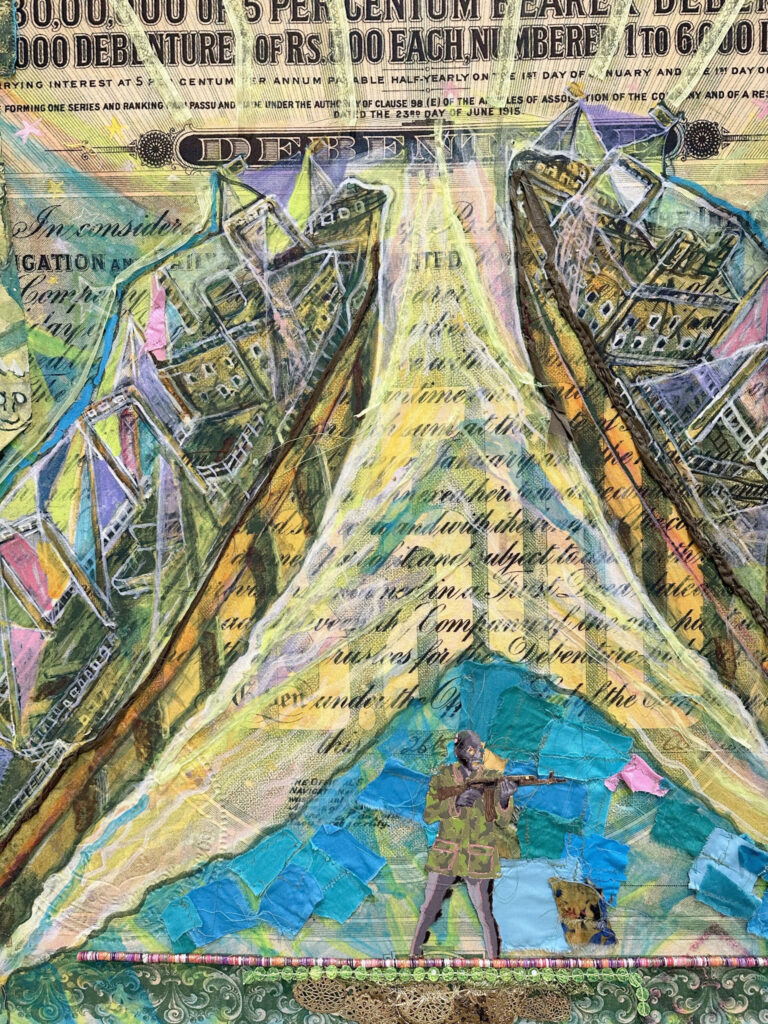
“Raw Materials 3”, 2022

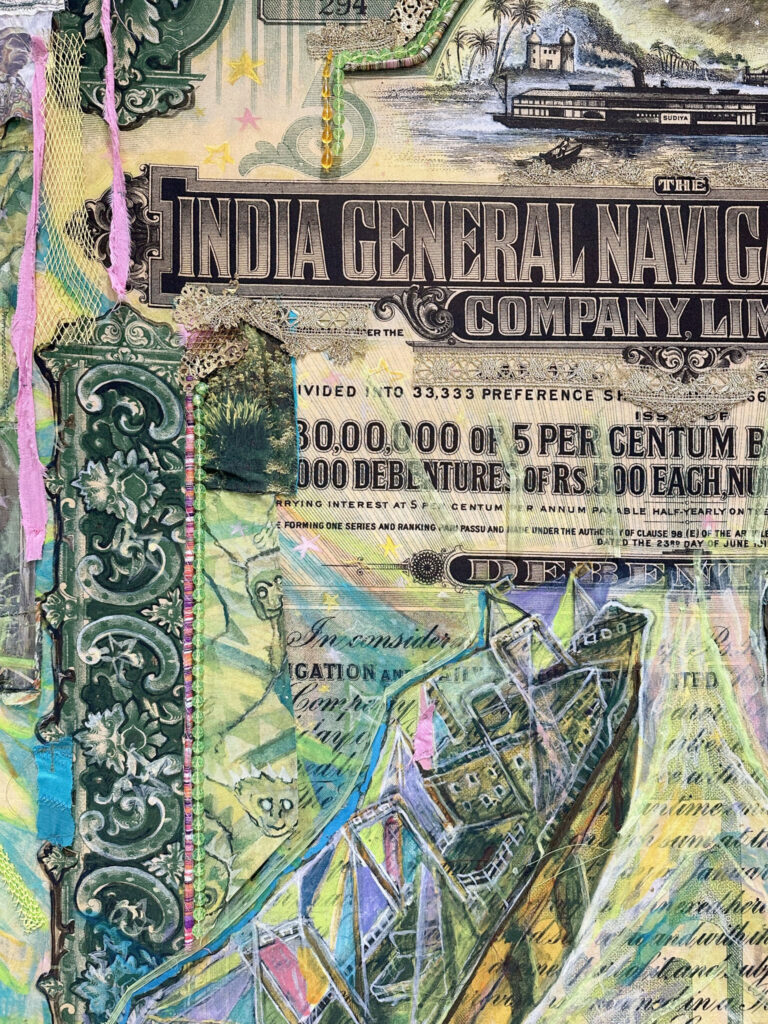
“Raw Materials 3”, 2022 (detail)

“Raw Materials 3”, 2022 (detail)

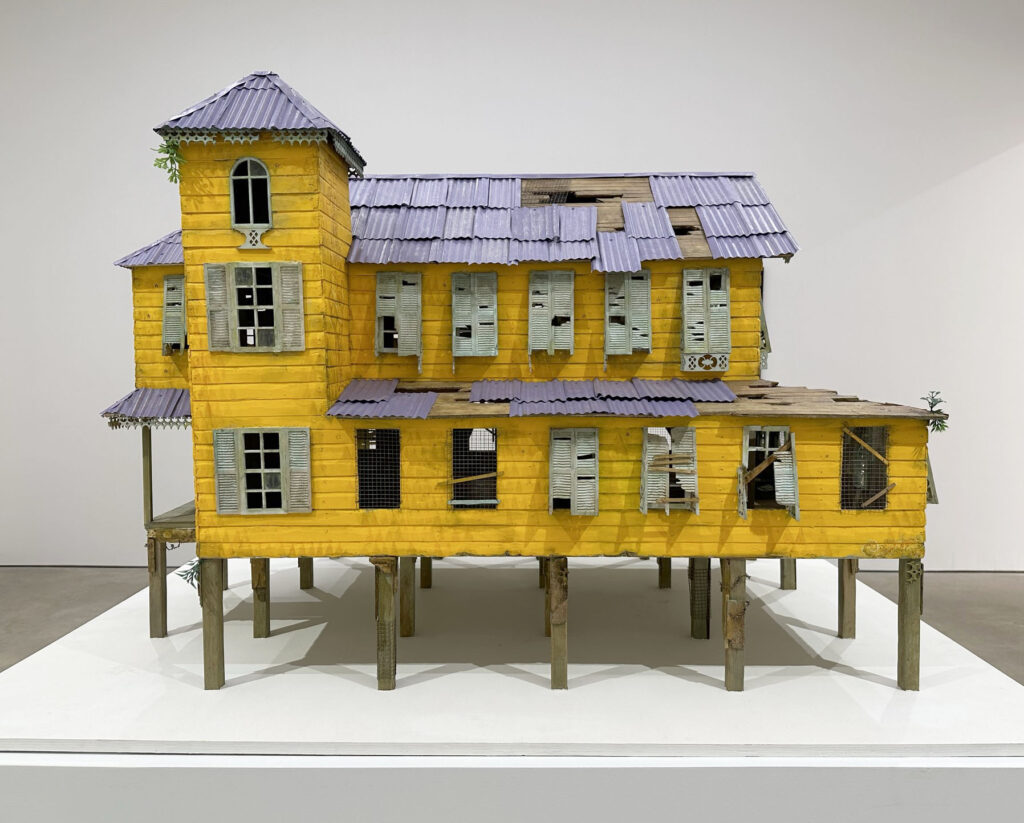
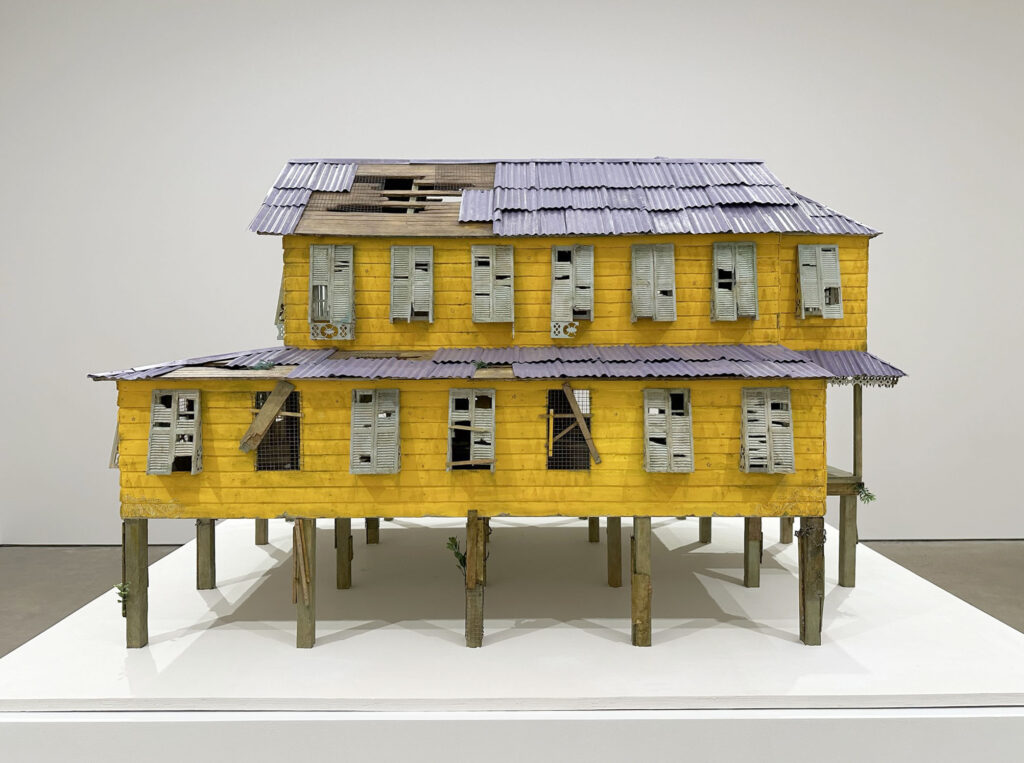
“Jumbie House 2”, 2022

“Jumbie House 2”, 2022

For Hew Locke’s exhibition, Listening to the Land, at P.P.O.W. he has created intricate sculptures and paintings that are fascinating in person.

From the press release-

Locke is known for exploring the languages of colonial and post-colonial power, and the symbols through which different cultures assume and assert identity. Furthering the themes explored in his celebrated commission The Procession at Tate Britain, and his concurrent installation Gilt on the façade of The Metropolitan Museum of Art, this exhibit engages with contemporary and historical inequities while reflecting on the landscape and history of the Caribbean. The exhibition draws its title from a poem by Guyanese political activist and poet Martin Carter which situates itself between two opposing forces of the landscape – sea and forest. Locke’s show features new sculptures and wall works with recurring motifs of stilt-houses, boats, memento mori, and share certificates referencing tensions between the land, the sea, and economic power. Reflecting on these links, Locke notes, “The land was created to generate money for colonial power, now the sea wants it back.”

Translating to ‘land of many waters,’ Guyana and its physical, economic, and political landscape serve as one of the primary sources for Locke’s work. Having spent his childhood in this newly independent nation, the artist witnessed first-hand an era of radical transformation. Now, the country teeters on the precipice of an oil boom and is one of the world’s fastest growing economies. Juxtaposing personal meditations on the climate crisis with political commentary on the history of a globalized world, Locke contemplates the ways in which colonies were exploited to accumulate capital, and observes how Guyana’s economic future lies in the exploitation of its waters. Locke’s new boat sculptures The Relic and The Survivor embody this broad worldview as the two battered wrecks drift through time and history. Evoking the fragmented and diverse legacies of the global diaspora, the boats’ patchwork sails are interspersed with photo transfers of 19th Century cane cutters and banana boat loaders, while their decks are loaded with cargo that could allude to colonial plunder, trade goods or personal belongings.

Based on an abandoned plantation house, Locke’s newest sculpture Jumbie House 2 features layered images that unveil the spirits that haunt this colonial vestige. Presented alongside are a series of painted photographs of dilapidated vernacular architecture across Georgetown and rural Guyana. Constantly under threat of being washed away by storms or rising sea levels, these crumbling structures echo anxieties surrounding climate change and historical erasure. A new series of mixed media wall works, Raw Materials, is derived from antique share certificates and bonds. Locke richly decorates the appliques with acrylic, beads, and patchwork to draw attention to the complex ways in which the past shapes the present. The image of an 1898 Chinese Imperial Gold Loan behind painted Congolese figures connects the global economy at the height of Empire to current Sino-African trade networks. In another work, a painted representation of a Nigerian Ife mask, alongside an image of David Livingstone, is layered on a French-African Mortgage Bond from 1923, connecting exploration and exploitation of African land, to current conversations surrounding the repatriation of artifacts. Taken together, the works in Locke’s Listening to the Land echo William Faulkner’s adage “The past is never dead. It’s not even past.”

This exhibition closes 4/1/23.

The Procession, mentioned above, can now be seen at Baltic Centre for Contemporary Art, in Gateshead, England until June 11th, 2023.

Gilt, also mentioned above, is on view at The Metropolitan Museum of Art until May 30th, 2023.


Mar 232023
 

Stefan Kürten, “We are all made of stars”, 2013

Stefan Kürten, “Running to Stand Still”, 2014

Stefan Kürten, “Running to Stand Still”, 2014 (detail)

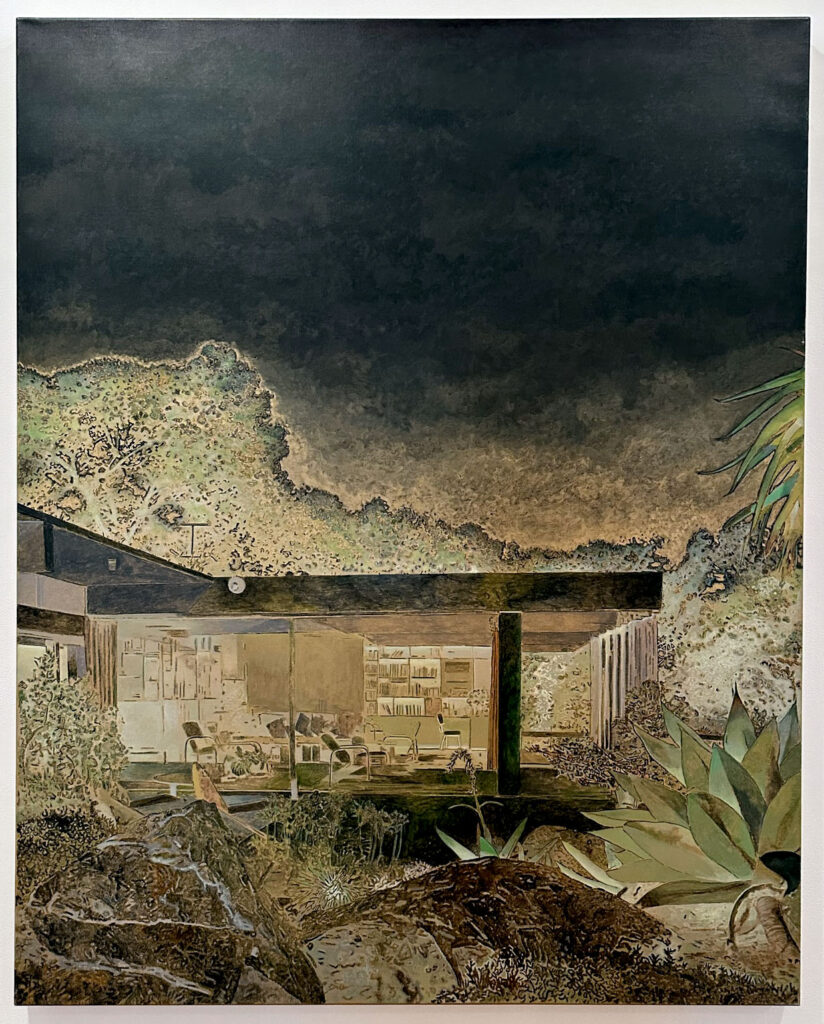
Stefan Kürten, “Fine Wrinkles”, 2000

Rita McBride, “Mae West Mandala (Oaxaca), 2009 and “Color Test (Green Bar)”, 2009

Stefan Kürten’s paintings of houses and Rita McBride’s wall coverings (and other sculptures) work with each other to question the concept of home, as well as the objects you might find within one. The exhibition, titled I Continue To Live In My Glass House, is on view at Alexander and Bonin until 3/25/23.

From the press release-

Stefan Kürten is known for detailed depictions of homes. Although constructed from both found and invented imagery, his homes feel known or experienced. The slippage between archetypes, memories, and dreams are central to his compositions. Set in lush landscapes and mysteriously unpeopled, Kürten’s homes evoke modern art or design museums with iconic sculptures and furniture viewable inside and outside of their transparent walls.

Rita McBride’s work invites us to reconsider structures and design elements such as ductwork, awnings, wall coverings and other utilitarian objects. McBride represents a bentwood chair in Murano glass, fastened together by a material that evokes spun candy or plastic wrap. Chair (1999) comments on the life of a domestic object whose usage necessitates an inventive approach to repair or stabilization.
McBride is also showing Particulates, an art installation that combines lasers with ambient dust and water molecules, will be on view at the Hammer Museum in Los Angeles starting 3/27/23.


Mar 172023
 

Currently at Derek Eller Gallery in NYC is Alyson Shotz: Alloys of Moonlight. The exhibition highlights her unique work which becomes more intriguing the more time you spend looking at it.

From the press release-

Featuring a monumental polychromatic steel sculpture and luminescent three-dimensional aluminum wall works, Alloys of Moonlight delves further into questions that Shotz has been exploring throughout her nearly 30-year career: how do we grasp the mysterious forces that shape the universe, and how do we reconcile observable reality with the noumenal reality of environmental phenomena? This new body of work explores the dialectic between these axes, as Shotz refines a sculptural language to visualize the unseen and the sublime forces that frame the natural world. The works in Alloys of Moonlight act as instruments by which to measure and reflect the ineffable forces of nature.

In the center of the gallery is Aphelion, a looped steel sculpture that turns and twists in ways that seem to defy nature, leading the eye in an endless serpentine path around its undulating curves. The sculpture transforms as the viewer moves around the piece, its colors shifting from gold to green to blue. Changes in light and time of day are registered by the changing colors of Aphelion’s surface, a phantom quality mirrored in the spatial nature of the work. Made of the least amount of material to hold its shape, Aphelion constitutes a delicate synthesis between positive and negative space. It is as much composed of a mesh-like steel as the air that flows through it. The form, which is born of the artist’s longstanding interest in knots and non-orientable surfaces like the Mobius Strip, is similarly fugitive and beguiling. Comparable entangled structures serve a fundamental role in the quantum-mechanical foundations of nature itself, and knot-like forms likewise have appeared as cultural signifiers throughout art history in Roman, Byzantine, Chinese, African and Islamic art.

The walls of the gallery feature a series of crumpled aluminum sheets, painted in a hazy spectrum of light-reflective mineral colors. Rather than the two-dimensional geometry of a flat plane, these pieces are spatial objects that delineate the magnitude of a prior impact. Named Alloys of Moonlight after the title of the show, each piece has a particular form, a shape that quantifies the exact nature of an individual collision. Conversely, the folding also embeds the aluminum sheets with a degree of potential energy and the suggestion of an incomplete natural process: the unfurling of a leaf or the folding of a wing. As representations or diagrams, these works define form through a negative logic—rather than creating sculptural volume through physical material, thin walls of aluminum outline the shape of an interior void. Alloys of Moonlight subverts the expectation of concrete immutability, instead using space as a sculptural medium. This language of spatial ambiguity is paralleled by the striking luminescent surfaces of the works, which are similarly variable. Like the orbits of moons around planets, each piece is in constant flux, registering changes in sunlight as well as the shifting position of the viewer. The sculptures in this exhibition exemplify the interplay between what is visible, concrete, measurable, and a more ethereal subtext that structures the natural world. Alloys of Moonlight renews and deepens Shotz’s exploration of the delicate and sublime space between these realities.

This exhibition closes 3/18/23.

Mar 082023
 

Chiharu Shiota, “Connected to the Universe”, 2023

Chiharu Shiota, “Connected to the Universe”, 2023 (detail)

Chiharu Shiota, “Connected to the Universe”, 2023, detail

“Connected to the Universe”, 2023

Chiharu Shiota’s gorgeous installations are just one part of her engaging exhibition, Signs of Life, at Templon in NYC. The installations lead to other rooms of smaller sculptures as well as  paintings.

From the press release-

After a foundation degree in painting at Seika University in Kyoto, Chiharu Shiota chose to pursue her artistic studies in Berlin, focusing on performance. Her practice soon shifted towards site-specific installations. She skilfully weaves knotted threads to create fantastical scenes combining salvaged window frames, a piano, suitcases, books and used clothes. Bordering on drawing and sculpture, her fabulous ephemeral, immersive installations have become her signature. Since her impressive installation for the Japanese Pavilion at the Venice Bienniale in 2015, she has become one of the key figures on the international art scene and is regularly invited to show her work at museums worldwide.

In a hyper-connected world, Chiharu Shiota’s new exhibition questions the notion of the “web”, a living organism similar to the structures that make up the universe or the neurons our brains are built on. Created on-site over two weeks, a large-scale installation made of red threads symbolizes this permanent connection of information, collective memory and the world’s knowledge which cuts across cultures and continents. At the heart of the work are two arms, her own, placed on the ground. They are cast in bronze, palms facing up to the sky. “I always thought that if death took my body, I wouldn’t exist anymore,” explains the artist. “I’m now convinced that my spirit will continue to exist because there is more to me than a body. My consciousness is connected to everything around me and my art unfolds by way of people’s memory.”

The installation is followed by a series of sculptures. Enfolded at the centre of each one, as though frozen in place by the intertwined threads, are objects from daily life. “I feel that the objects we possess are like a third skin,” she says. “We accumulate these things and transpose our presence and our memory to them.” Often obsolete, weighed down by impenetrable histories, these objects — old suitcases, stained dolls, miniature pieces of furniture and tiny bottles — represent the treasures offered up by memory, to be seen but not touched.

“State of Being (Dress)”, 2022

State of Being (Photos), 2022

State of Being (Photos), 2022 (detail)

This exhibition closes 3/9/23.

Mar 032023
 

Renée Stout, “Navigating the Abyss”, 2022

Renée Stout, “A Question for Christoper Wool“, 2022

Renée Stout, “Escape Plan D (with Hi John Root, Connecting the Dots)”, 2022

Renée Stout, “Wall of the Forlorn”, 2022

Renée Stout, exhibition room

Renée Stout, “Armored Heart/Caged Heart”, 2005

Renée Stout’s exhibition at Marc Straus in NYC,  Navigating the Abyss, presents a collection of her recent work in various mediums. From sculpture and painting to photography, her skillful and inventive work draws you in.

From the press release-

Starting out as a photo-realist painter depicting life in everyday urban neighborhoods, Stout soon developed an interest in the mystical and spiritual traditions in African American communities. Fascinated with fortunetelling and the healing power of Hoodoo, Vodou and Santeria still practiced within the African Diaspora in the American Southeast and Caribbean, she delved into ancient spiritual traditions and belief systems. She has drawn inspiration from a wide variety of sources such as current social and political events, Western art history, the culture of African Diaspora, and daily city life. While her artistic practice is rich with references and resonances, her works are eventually unique manifestations of her own imagination, populated by mysterious narratives and imagined characters derived from the artist’s alter ego.

In this exhibition, we encounter a group of portraits depicting Hoodoo Assassins and Agents (#213 and #214) who, in Stout’s imagination, are healers, seers, and empaths from a Parallel Universe in which fairness and balance rules. Erzulie Yeux Rouge (Red Eyes) is a spirit from the Haitian Pantheon of spirits whose empathic nature makes her a fierce guardian or protector of women, children, and betrayed lovers. Ikengas, originating in the Igbo culture of Southeastern Nigeria, are shrine figures that are meant to store the owner’s chi (personal god), his ndichie (ancestors) and his ike (power), and are generally associated with men. Stout’s Ikenga (If You Come for the Queen, You Better Not Miss) is a powerful female figure with her breasts and horns turned into weapons, and she is adorned with jewels and charms to boost her powers. Beyond the playful yet powerful imagination of these female characters are serious undertones of political commentary as Stout ponders the concepts of these deities while witnessing the recent rulings in our society that infringe on women’s rights.

In Escape Plan D (With Hi John Root, Connecting the Dots) Stout maps out her potential escape to the Parallel Universe when the daily news weighs unbearably on her psyche.

Visions of the Fall, in Thumbnails is a series of five small paintings that comments on the current state of our world and its imagined future with the titles as upcoming stages of its evolution.

American Memory Jar is an entirely black sculpture consisting of a glass jar covered with thin-set mortar, plastic and metal toy guns, topped with a doll head and adorned with a bead and rhinestone cross pendant. Memory Jugs are an American folk-art form that memorializes the dead adorned with objects associated with the deceased. Stout’s jar is a bitter but painfully accurate assessment.

While Stout’s work alludes to history, racial stereotyping, societal decay, and a set of alarming tendencies in our socio-political structures and ecosystem, it also reveals possibilities and the promise of healing. Various works reference healing herbs, potions, and dreams. Herb List, Spell Diagram and The Magic I Manifest speak of Stout’s belief in the power of consciousness, in the existence of more solid and fertile grounds, and of individual responsibility.

There is one overarching narrative that clearly emerges from Stout’s work – her personal history and spiritual journey as a woman and as an artist.

This exhibition closes 3/5/23.


Mar 022023
 

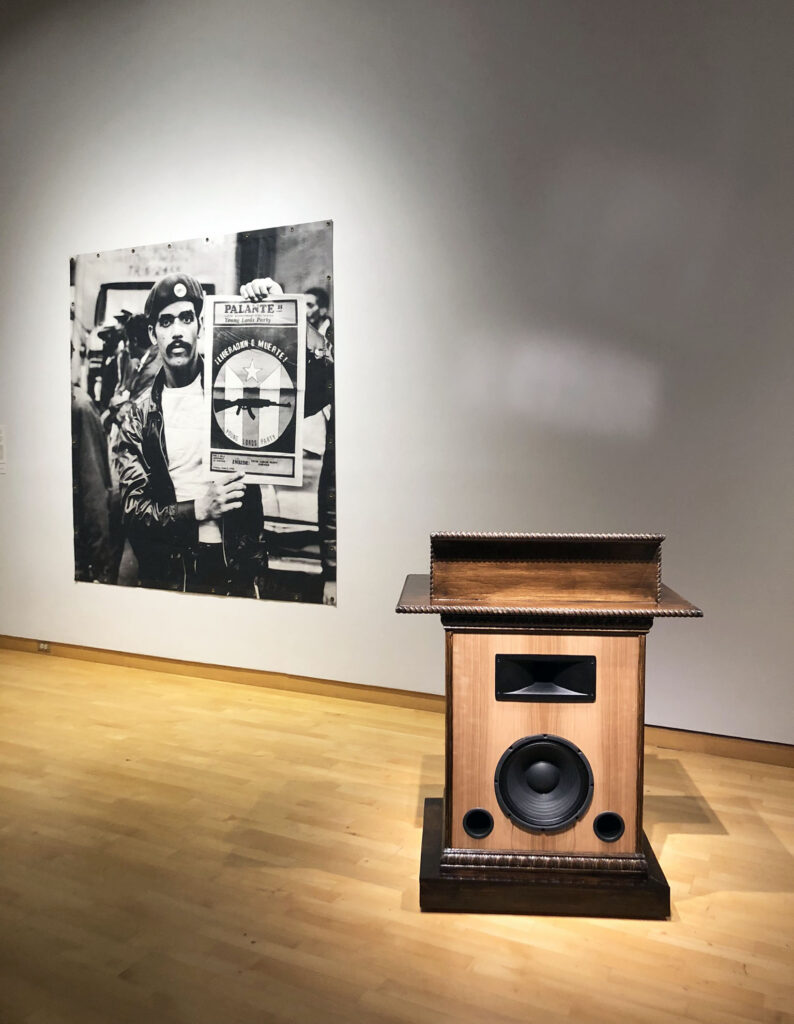
Artist Miguel Luciano– Vinyl banner from the public art project “Mapping Resistance: The Young Lords in El Barrio”, 2019 Image: Young Lords Member with Pallante Newspaper (1970)” by Hiram Maristany and “The People’s Pulpit” (2022), a repurposed vintage pulpit from the First Spanish Methodist Church in East Harlem.

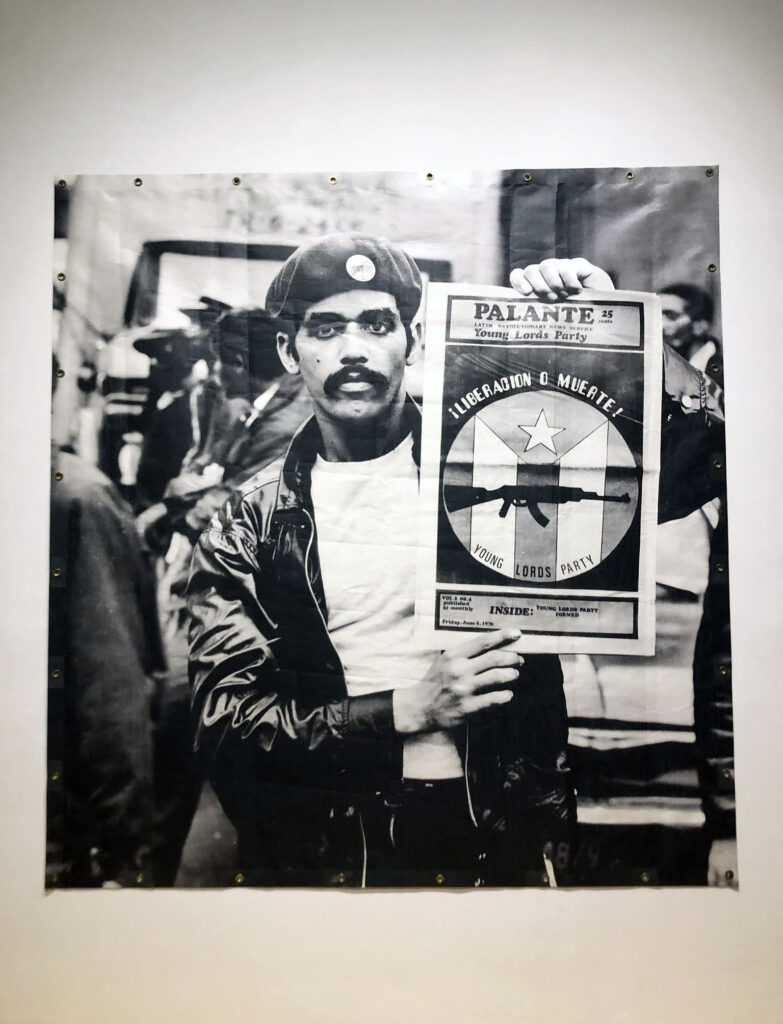
Miguel Luciano- Vinyl banner from the public art project “Mapping Resistance: The Young Lords in El Barrio”, 2019 Image: Young Lords Member with Pallante Newspaper (1970)” by Hiram Maristany


Poor People’s Art: A (Short) Visual History of Poverty in the United States at USF Contemporary Art Museum in Tampa uses installations and artworks to tell the story of, and expand perspectives on, The Poor People’s Campaign- from its origins in the late 1960s to the present day form, as well as comment on poverty and other social issues. Both educational and engaging, it shows that despite long struggles and some progress, we are still very far from much needed social change, especially in regards to poverty.

The museum also produced a free full color, 48 page workbook that you can pick up there or download as a PDF that can be downloaded from their website.

From the gallery’s website-

Dr. Martin Luther King Jr. is well known for his “I Have a Dream” speech, yet much less emphasis is placed on his campaign to seek justice for America’s poor, “The Poor People’s Campaign.” This was a multi-cultural, multi-faith, multi-racial movement aimed at uniting poor people and their allies to demand an end to poverty and inequality. Fifty-three years after Dr. King’s death, the Reverend William Barber II launched a contemporary push to fulfill MLK’s ambitious brief — one that calls for a “revolution of values” that unites poor and impacted communities across the country. The exhibition Poor People’s Art: A (Short) Visual History of Poverty in the United States represents a visual response to Dr. King’s “last great dream” as well as Reverend Barber’s recent “National Call for Moral Revival.”

With artworks spanning more than 50 years, the exhibition is divided into two parts: Resurrection (1968-1994) and Revival (1995-2022). Resurrection includes photographs, paintings, prints, videos, sculptures, books, and ephemera made by a radically inclusive company of American artists, from Jill Freedman’s photographs of Resurrection City, the tent enclave that King’s followers erected on the National Mall in 1968, to John Ahearns’ plaster cast sculpture Luis Fuentes, South Bronx (1979). Revival offers contemporary engagement across a range of approaches, materials, and points of view. Conceived in a declared opposition to poverty, racism, militarism, environmental destruction, health inequities, and other interlocking injustices, this exhibition shows how artists in the US have visualized poverty and its myriad knock-on effects since 1968. Participating artists include John Ahearn, Nina Berman, Martha De la Cruz, Jill Freedman, Rico Gatson, Mark Thomas Gibson, Corita Kent, Jason Lazarus, Miguel Luciano, Hiram Maristany, Narsiso Martinez, Adrian Piper, Robert Rauschenberg, Rodrigo Valenzuela, William Villalongo & Shraddha Ramani, and Marie Watt.

Below are some images from the show and the descriptions from the museum.

About the two works above from the museum’s walls-

A multimedia visual artist whose work explores themes of history, popular culture, and social justice, Miguel Luciano revisits the history of the Young Lords, a revolutionary group of young Puerto Rican activists who organized for social justice in their communities beginning in the late 1960s. Luciano’s first contribution to Poor People’s Art is a vinyl banner from the public art project Mapping Resistance: The Young Lords in El Barrio (2019), a collaboration with artist Hiram Maristany. It features the photograph “Young Lords Member with Pa’lante Newspaper (1970)” by Maristany, who was the official photographer of the Young Lords and a founding member of the New York chapter. This banner, along with nine other enlarged Maristany photographs, were installed throughout East Harlem at the same locations where their history occurred 50 years prior.

Luciano’s second contribution to Poor People’s Art is the sculpture The People’s Pulpit (2022), a repurposed vintage pulpit from the First Spanish Methodist Church in East Harlem. The Young Lords famously took over the church in 1969 and renamed it “The People’s Church”; they hosted free breakfast programs, clothing drives, health screenings, and other community services there. In this exhibition, The People’s Pulpit features an historic recording of Nuyorican poet Pedro Pietri reciting the celebrated poem Puerto Rican Obituary during the Young Lord’s takeover of The People’s Church.

Placards created by USF Contemporary Art Museum students, faculty and staff

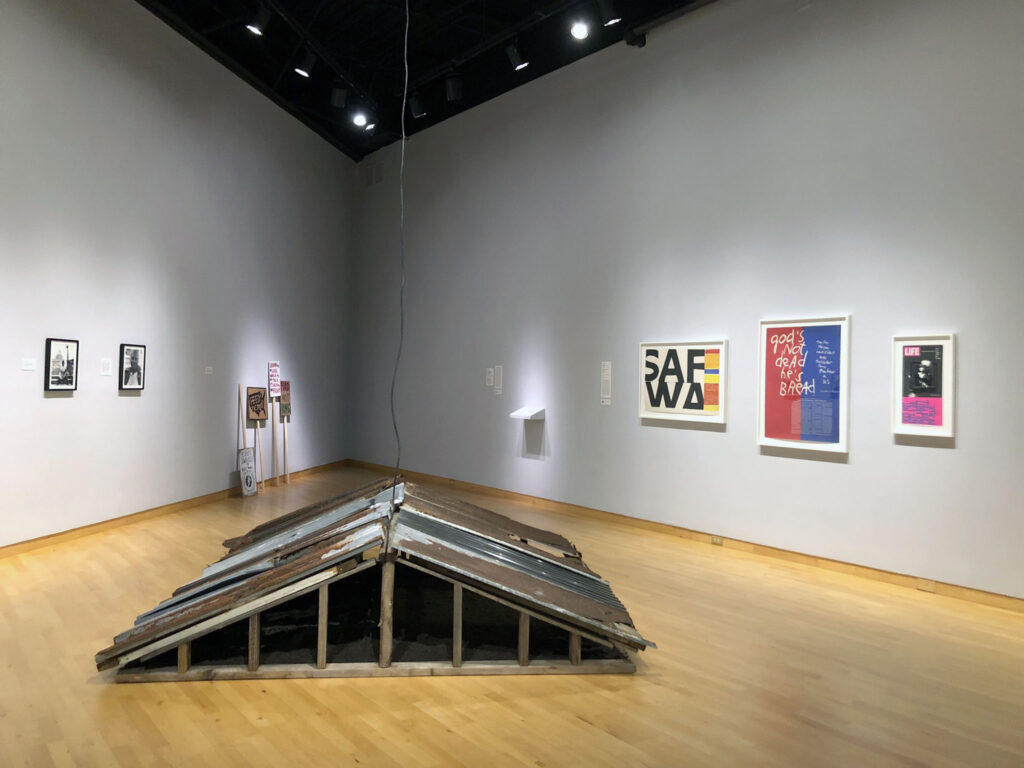
Martha De La Cruz, “Techo de Sin (Roof of Without)”, 2021, made from stolen, scavenged and donated materials found in Southwest Florida.

About the above work from the wall plaque-

Afro-Taino artist Martha De la Cruz fashioned her sculptural installation Techo de sin (Roof of Without), 2021, from stolen, scavenged and donated materials found in Southwest Florida. According to the artist, “Florida is home to a large population of Latin American migrants who have ended up in the US largely due to economic pressures, exploitation and veins of power etched by Europe and the US.” Her powerful work deals with the results of this disjunction and the “symptoms thereabouts (e.g. houselessness, fugitiv-ity, government corruption, and income disparity, etc.).” According to De la Cruz, the word “sin” is a common Dominican mispronunciation for the word “zinc.” The sculpture is animated by a single light bulb that turns on for just ten minutes a day.

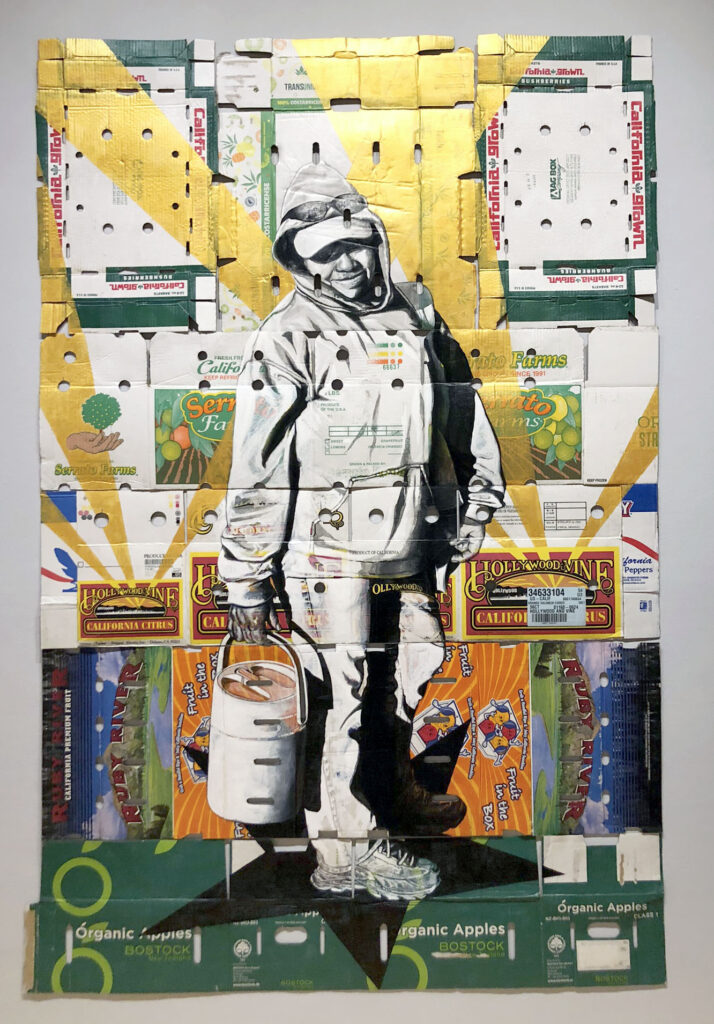
Narsiso Martinez “Hollywood & Vine”, 2022

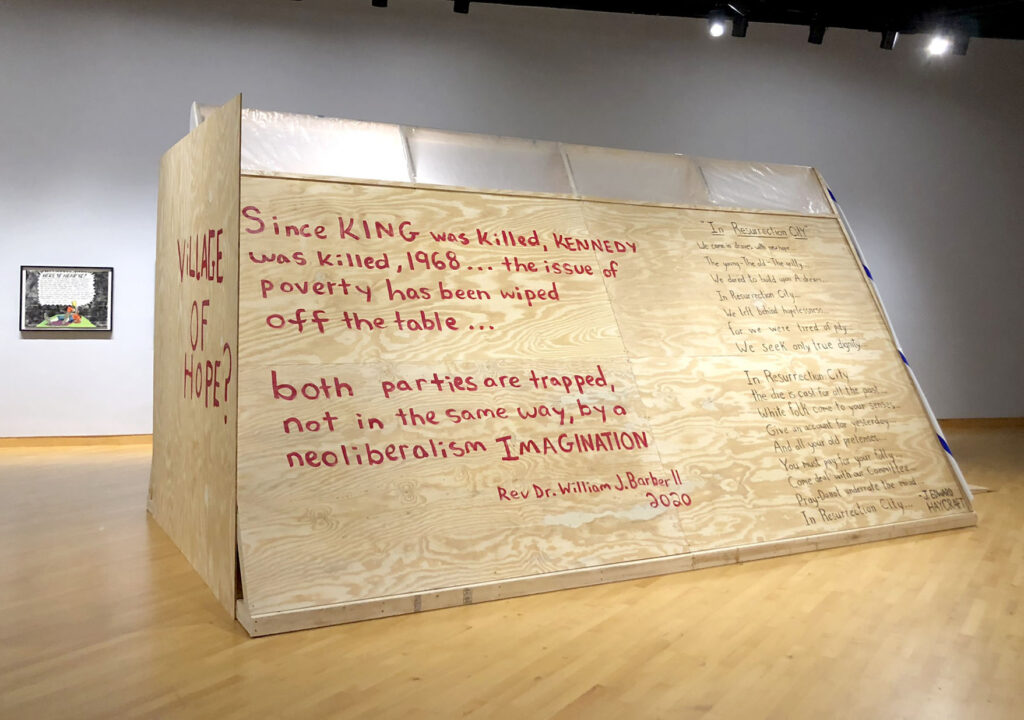
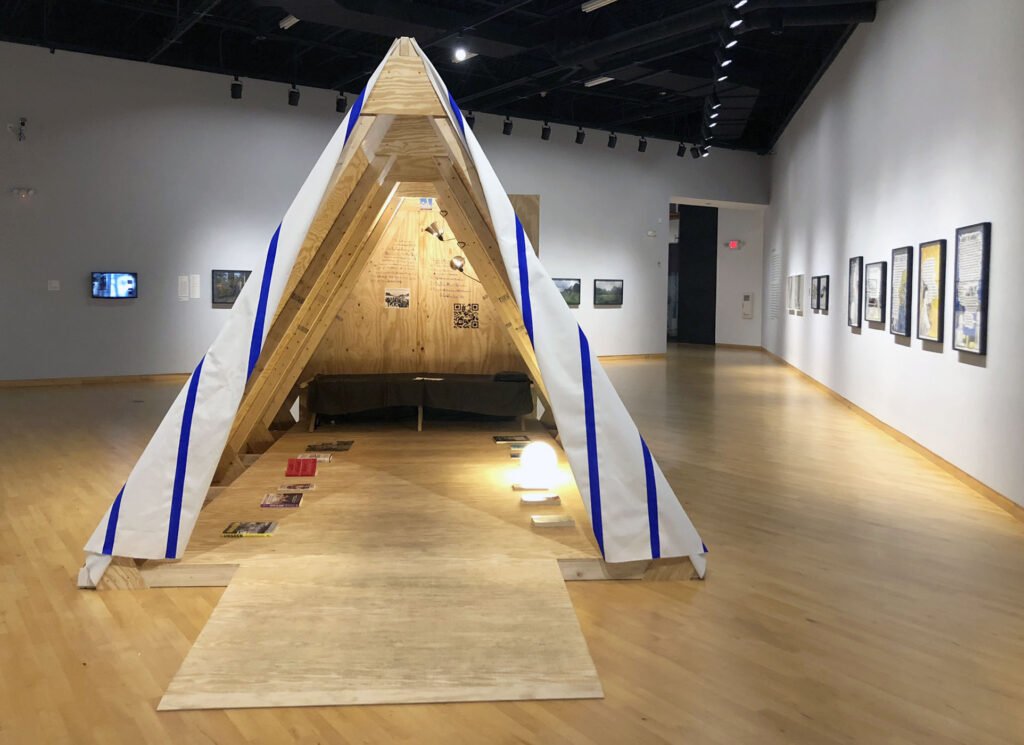
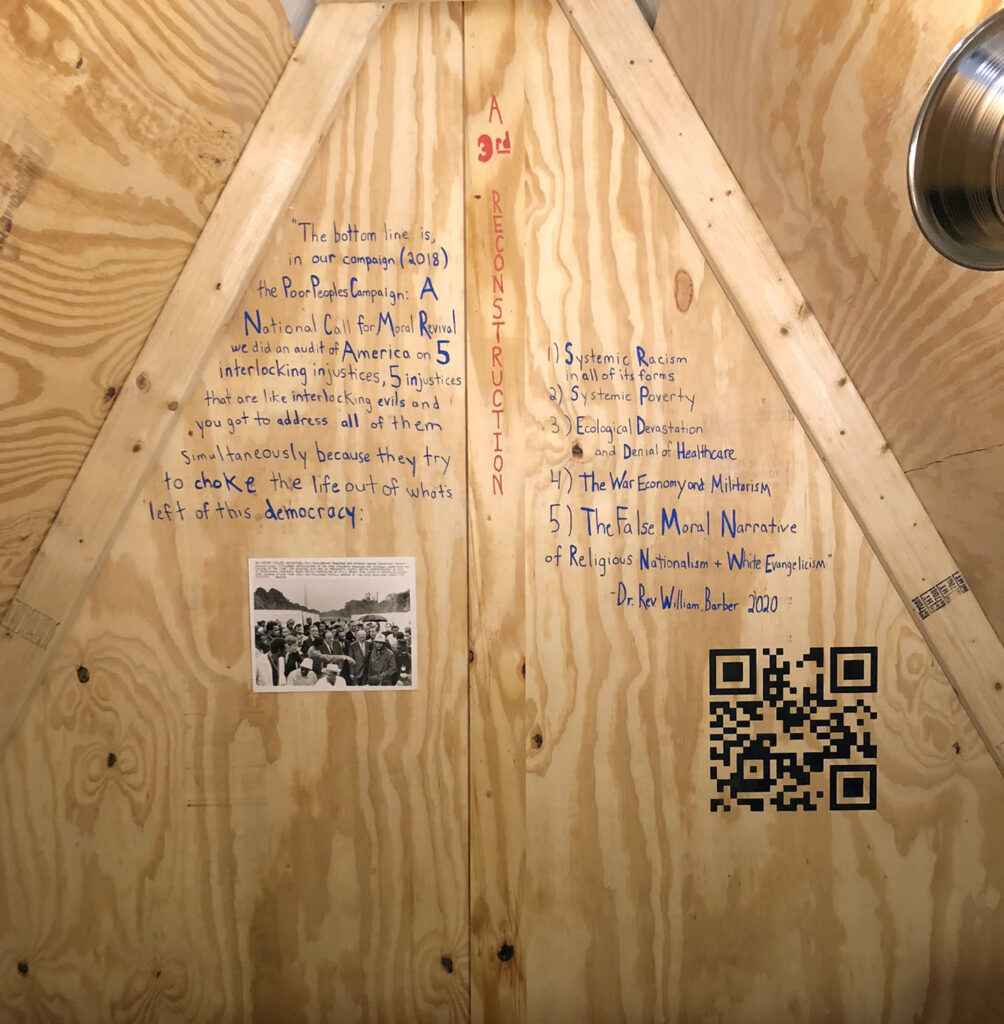
Jason Lazarus “Resurrection City /Poor People’s Campaign: A National Call for Moral Revival / A Third Reconstruction”, 2023, plywood, utility fabric, blankets, sleeping cot, paint, lamp, plastic, research library, historical ephemera

From the wall plaque about the Lazarus installation-

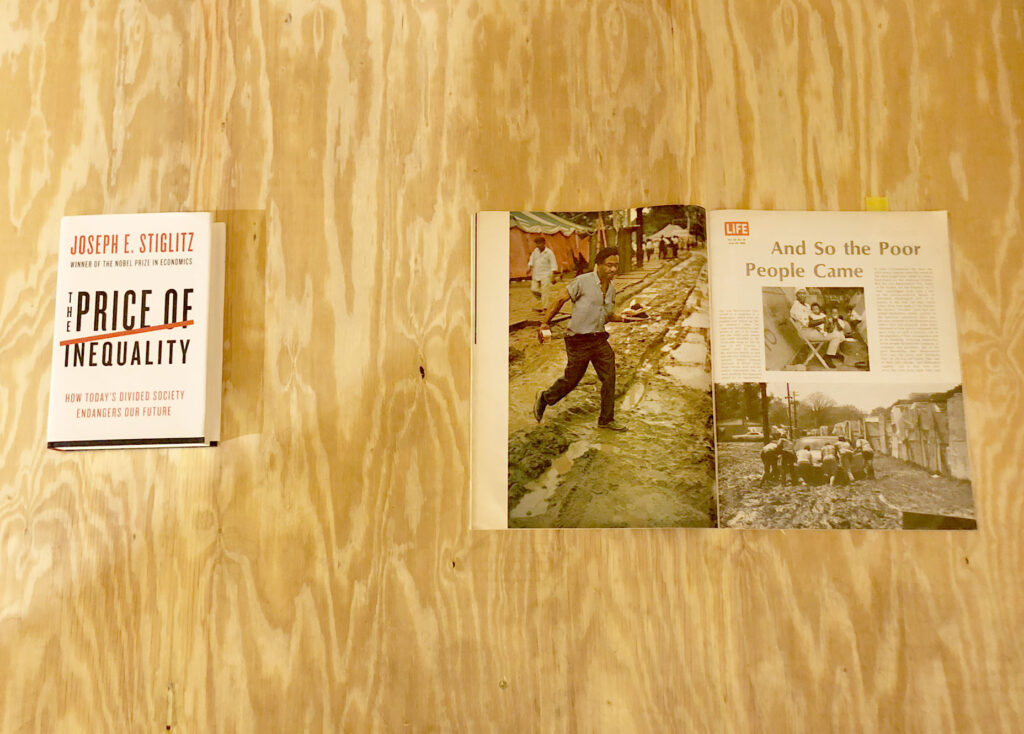
Jason Lazarus’s sculptural installation Resurrection City/Poor People’s Campaign: A National call for Moral Revival/A Third Reconstruction (2023) is anchored in the artist’s historical research and several key photographs of Resurrection City. A tent-like shelter inspired by the temporary residences that populated the 1968 mass protest, the interactive sculpture contains simple sleeping quarters and a curated library filled with physical literature and ephemera centered on both the 1968 Poor People’s Campaign and the 2018 Poor People’s Campaign: A National Call for Moral Revival, co-led by Rev. Dr.William Barber and Rev. Dr. Liz Theoharis. The library allows for audiences to trace, listen, and talk about the history of advocating for the poor, from 1865 to the present. Additionally, the artist provides a custom transcription (and a QR hyperlink) to Barber’s 49-minute address on the syndicated radio show “The Breakfast Club” in which he carefully outlines his powerful vision for how we might address poverty going forward.

Inside the Jason Lazarus installation

A book and magazine from Jason Lazarus’ installation floor

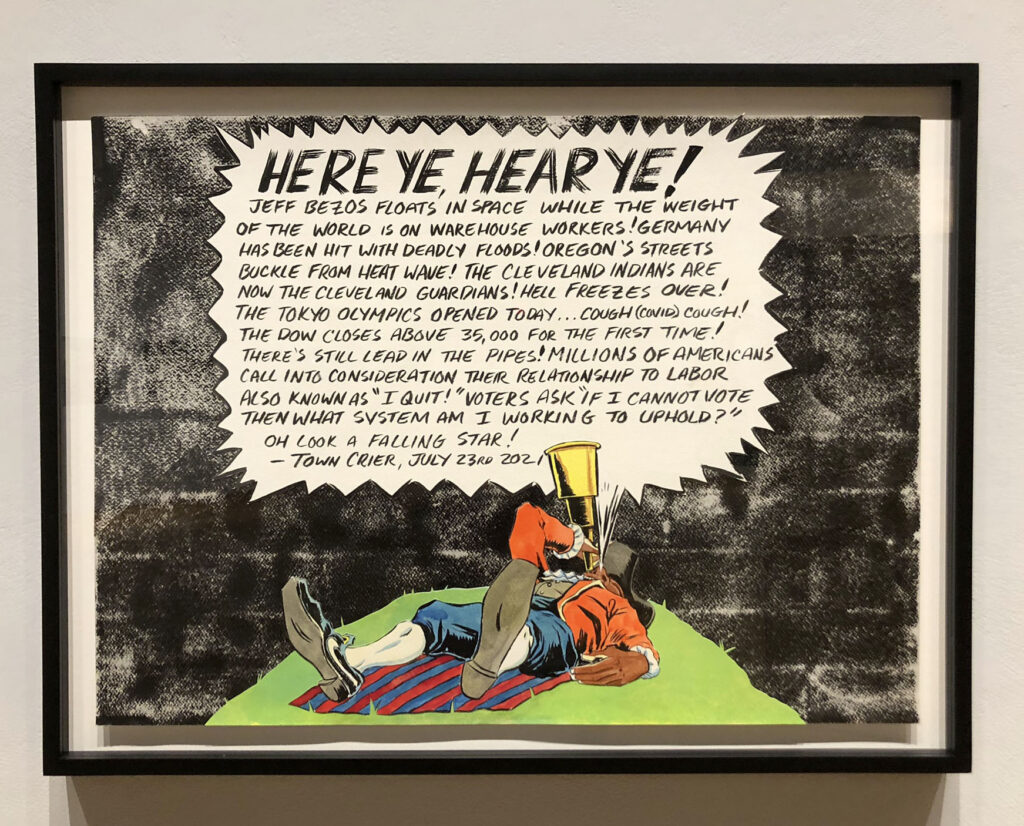
Mark Thomas Gibson, “Town Crier July 23rd”, 2021

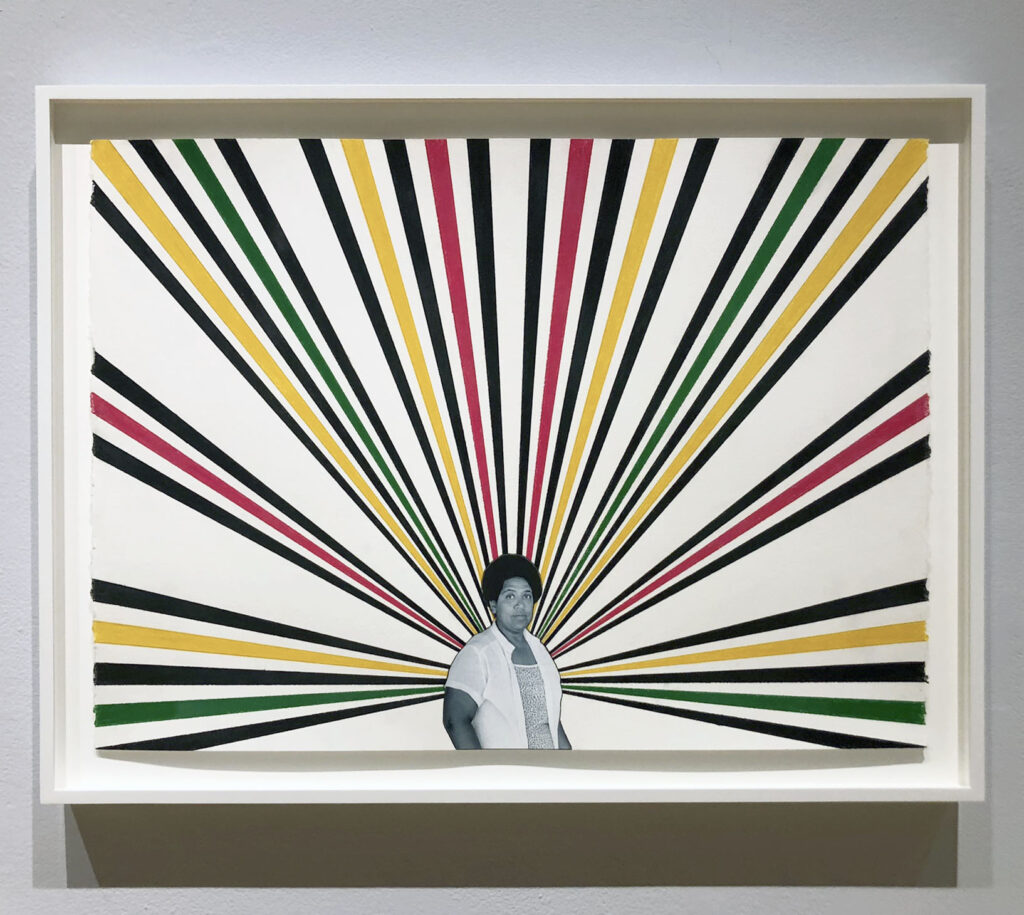
Rico Gatson, “Audre #2”, 2021

Jill Freedman, “Poor People’s Campaign, Resurrection City” 1968

About Jill Freedman’s photograph-

In the spring of 1968, the talented young street photographer Jill Freedman quit her day job as a copywriter in New York City to join the Poor People’s March on Washington. Freedman lived in Resurrection City for the entire six weeks of the encampment’s existence, photographing its residents as they rallied, made speeches, protested in front of government buildings, confronted police, built makeshift kitchens, organized clothing swaps, and dealt with flooding, petty crime, and illness. One of the most important postwar documentarians, and one of the few women photographers of the era, Freedman captured it all. Freedman’s 2017 book, Resurrection City, 1968-from which this exhibition draws a dozen powerful images-showcases the photographs that she made as a participant in the original Poor People’s Campaign. In multiple ways, Freedman’s images are the sympathetic perch upon much of which much of the present exhibition loosely hangs.

This exhibition closes 3/4/23.

Feb 242023
 

Micaela Amateau Amato, “Yoran Por Aire (contes brevas)”

Photographs by Amadia Shadow Rabbit

Film still from Kiara Mohammed Amin’s “Black Presence”

Film still from Kiara Mohammed Amin’s “Black Presence”

Soonoqo: We Become Body in Waves of Light and Sound at Dunedin Fine Art Center is a multimedia exhibition of 18 artists from around the world who “share a common desire for healing, communal growth and interdependence with nature” curated by S. Toxosi.

S. Toxosi’s statement about the exhibition (from the gallery wall)-

I do not possess the language to truly describe the be-holdings within Soonoqo. As a term within the Somali language, it would be difficult to translate into contemporary English. It considers a pluralistic worldview that allows ‘becoming and returning’ to bear witness of itself, within oneself while conjoining through space and time. Soonoqo, basks in the universal soul. Its otherness is imbued as the ‘physical cosmos’ and all its avatars and manifestations.

To speak in metaphor or in a sense of ‘poetic meditation’, one would engulf whirling vortexes, volcanoes and maelstroms that end up in other universes from which bring new revelations or images, The senses are engaged as viewed in Bruno Ferreira Abdala’s video art When Mother Breathes. It is here we can see a pluralist’s sensibility where the cohorts of Soonoqo ‘become and return’ with offerings that contend with the mythical genesis through the acknowledgement and practices of ancestral wisdom, queering mores, spirituality and love. Thus creating fission through initiating and remembering. There is a subtlety of conjuration, ritual, humility, vulnerability in K. Tauches’s Q.A.L. video-making that unfolds and reveals the sentience of a Nature that provides true sustainability.

Soonoqo is a web of interconnected lights in continuous synchrony. It enables manifestations from varied domains of areas of perceptibility through human inner weavings of life experiences and becomes a variety of communicative prowess that encompasses video arts, film, photography, the written word and sonic compositions. These forms all ultimately resonate with and point toward healing where one/all is purified, catalyzed and cleansed through cooperation with nature, technology, shadow matter, dark matter and invisible matter. As can be seen in the film Womb not Tomb by Dea, where she investigates and yields to the teaching of the four elements or in Kiara Mohammed Amin’s Black Presence, a short film of talismanic energy and transformation.

Artists included in the exhibition- Brandy Eve Allen, Viveka Krumm, Harry Wilson Kapatika, Cara Judea Alhadeff, Sadie Sheldon, Chelsea Rowe, Micaela Amateau Amato, Saudade Toxosi, Jennifer Pyron, Amadia Shadow Rabbit, K.Tauches, Javier T. Dones, Bruno Ferreira Abdala, Sall Lam Toro, Kiara Mohamed Amin, Nayetesi, Dea

For more information on this exhibition check out @soono.qo and this conversation with S. Toxosi and DFAC Curators Catherine Bergmann and Nathan Beard which is very informative.