
Swiss artist Cuno Amiet’s Mutter und Kind im Garten (Mother and Child in Garden), circa 1903, part of LACMA’s 2014 exhibition Expressionism in Germany and France: From Van Gogh to Kandinsky.

Swiss artist Cuno Amiet’s Mutter und Kind im Garten (Mother and Child in Garden), circa 1903, part of LACMA’s 2014 exhibition Expressionism in Germany and France: From Van Gogh to Kandinsky.
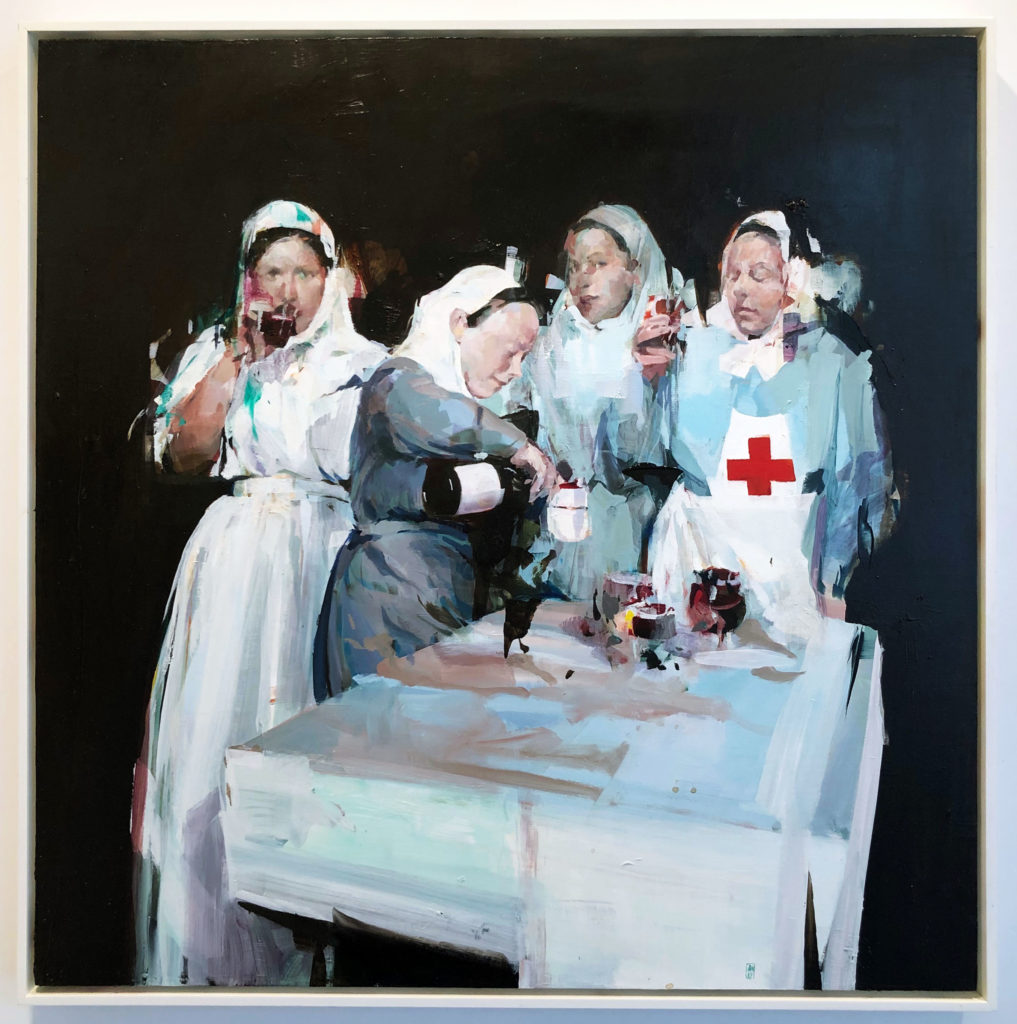
Alex Kanevsky’s Nurses With Wine, 2019 from his painting exhibition Liberation and Disorientation at Hollis Taggart gallery in NYC.
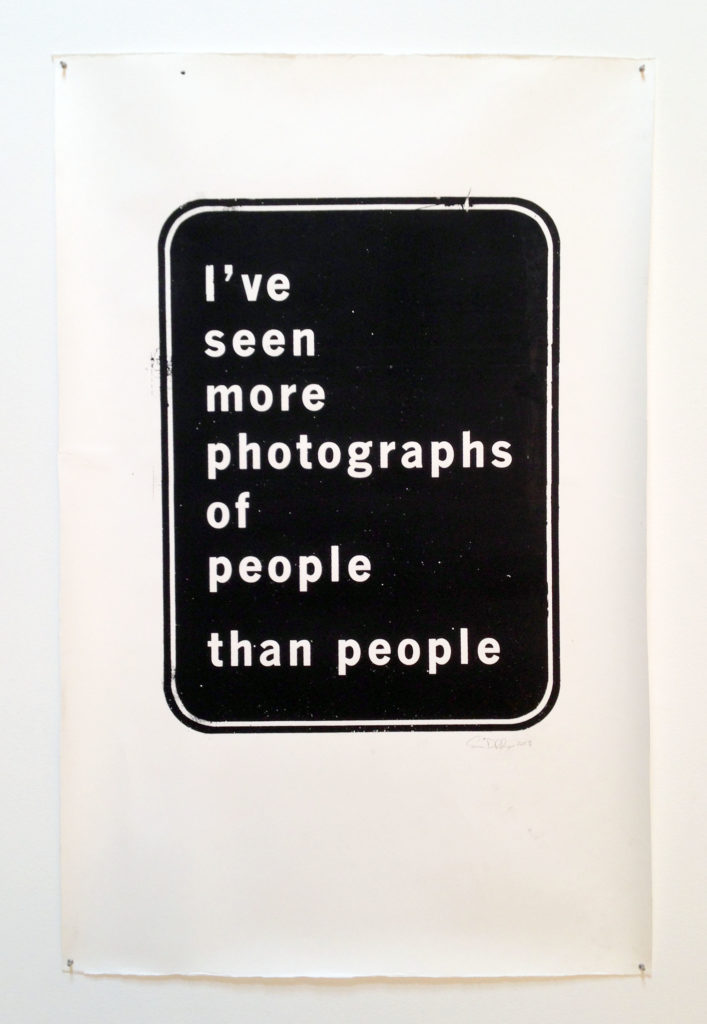
One of artist Sean Duffy’s Road Signs, part of a group exhibition in 2013 at Vielmetter Los Angeles.

Wayne Thiebaud’s Make Up Girl (1982), seen at the San Diego Museum of Art. The museum is currently closed due to COVID-19 but they have a lot of excellent online programming including virtual performances, lectures, virtual tours and more.

Erik Parker’s Good Vibrations (2018) from his 2018 exhibition at Mary Boone Gallery, New Mood.

For Doug Wheeler’s fourth solo exhibition at David Zwirner’s NYC location, he created the immersive light installation 49 Nord 6 Est 68 Ven 12 FL (2011–2012), shown above.
This exhibition opened on 1/24/20 but was closed due to the Coronavirus (COVID 19) pandemic.


Currently at Nancy Hoffman Gallery in New York is Purdy Eaton’s delightful painting exhibition Eat and Live. Eat and Die.
From the press release-
Eaton’s upcoming exhibition is a nod to Bruce Nauman’s One Hundred Live and Die. Eat and Live, Eat and Die; the essence of all life: plants, animals, humans, kings, queens, and cockroaches are all bound to this ethos. This, like Nauman’s other phrases, Feel and Live, Feel and Die, is simultaneously fatalistic and equalizing. The chaos of politics, climate volatility, and random violence is rightfully fear inducing and overwhelming, yet there is something hopeful and meditative about the reality you eat you live, you eat you die. There will always be a tomorrow no matter how dystopic.
Eaton’s darkly humorous oil paintings riff on this dichotomy. As climate change and divisive politics tear at our foundations, we are placated by funny cat videos and TikTok memes. Play and Live, Play and Die. We can see the big picture, but sometimes it is just too depressing and overwhelming, and we want to enjoy that gorgeous sunset even if it is made of toxins.
In a series about state birds, Eaton examines the warped reality that many of the state birds are no longer able to inhabit the states they were legislated to represent. The California quail, California’s state bird for nearly a century, is leaving the state as their range is becoming too warm for them to stay. In Eaton’s depiction, the quail appear in front of a lovely sunset, but on further inspection, they might actually be escaping the latest wildfire. In another painting, Paul Bunyan rises in the foreground, while an American loon flies in another direction. The juxtaposition of this iconic strongman roadside attraction—symbolic of the American celebration of “man taming the wilderness”—-with a bird that can no longer live in Minnesota, hints that it might be time to reexamine our origin stories. In another painting from the series, a Northern Flicker with bright yellow plumage rises from a background of rockets in Huntsville, Alabama. As the location of early launches, these relics of NASA’s glory years are now tourist attractions. Space is no longer the purview of science and human progress—it has become the escape hatch, the place to go when we need a Plan B.
Eaton also spins Nauman’s duality to remind us that despite the apocalyptic visions we read about daily, it is not all bad for all creatures. Fireflies, for instance, are flourishing. The Canada Goose, once on the verge of extinction, has become so common as to be a nuisance. With these color-rich and storied paintings, Eaton is asking us to realize that this is our moment to be alive, before we all die, and that the flowers are indeed quite beautiful.
This exhibition closes 3/14/20.


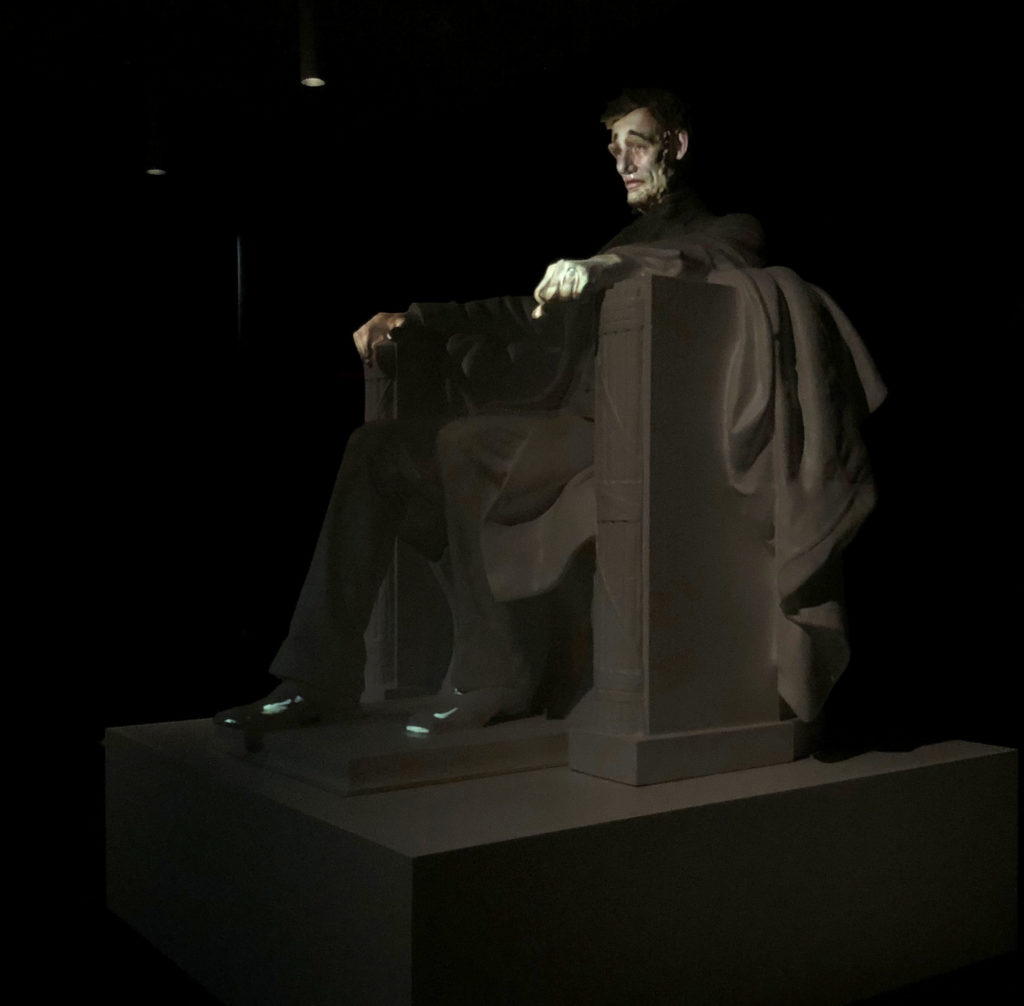
Currently at Galerie Lelong & Co. is Krzysztof Wodiczko: A House Divided…, a projection installation work that explores the diverse political issues in the United States. For this project Wodiczko projects videos of various people from New York’s Staten Island discussing their political views. Their bodies appear superimposed on two large statues of Abraham Lincoln, which face each other in the room.
From the press release-
The exhibition’s title refers to the phrase “A house divided against itself cannot stand” from Abraham Lincoln’s 1858 speech during an unsuccessful run for U.S. Senate, which quoted a passage from the Bible, Matthew (12:22-28). Lincoln borrowed a familiar phrase in order to garner support for the contentious proposition of unifying a rapidly expanding nation teetering on the brink of war. Wodiczko repurposes the statement in a contemporary setting to highlight the partisan contention. In 2019, Wodiczko conducted research of suburban social landscapes in the Tri-State area before choosing Staten Island, a New York City borough that is racially and ethnically diverse yet a simultaneously politically divided geography: north as liberal-leaning and south as conservative-leaning. “Speaking to each other, they explain and exchange their positions and disagreements while expressing their mutual wish for careful and respectful listening to the opposite side,” says Wodiczko.
This exhibition closes 3/7/20 but the artist’s most recent site-specific projection, Monument, is showing in Madison Square Park (starting at dusk) through May 10th.
For Monument, Wodiczko projects “the likenesses and spoken narratives of resettled refugees—who have originated from different parts of the world—onto the Park’s 1881 monument to Admiral David Glasgow Farragut. A looping video projection will bring the monument to life with stories of displacement that illuminate how war, conflict, and political fallout impact individuals globally, encouraging visitors to consider how the history of conflict is memorialized.”


Spoons, 1979.
For Sandy Skoglund’s exhibition Winter, at Ryan Lee gallery in New York, she has partially recreated the environment she used to created the title piece. Many of her photographs are created by building new worlds-this is a chance to immerse yourself in one of them.
The exhibition also includes a collection of her work from the late ’70s to 2005, including Radioactive Cats from 1980 (pictured below).
From the press release-
Skoglund describes Winter as “a study in perseverance and persistence, an artificial landscape celebrating the beautiful and frightening qualities of the coldest season.” In the photographic image, a man, woman, and child punctuate an icy blue scene. They are inside of an iceberg, perhaps, surrounded by its craggy walls. Standing pensive with hands in the pockets of their winter coats, only the child, a red-headed girl, looks out toward the viewer. The trio is joined in this fantastical setting by a cluster of three snowflake-emblazoned owls and a female figure that seems to have frozen mid-slumber. The imagery evolved from Skoglund’s interest in similarity and difference among snowflakes. Her fascination with the appearance of correspondence versus the reality of difference extends from earlier investigations of the liminal territory between the natural and the artificial, or order and chaos. Through her constructed imagery, Skoglund explores the space between what the human eye and the camera can see.
Since the late 1970s, Skoglund has been celebrated for her panoramic installations—entire environments that she meticulously designs, constructs, and then re-visualizes photographically. Skoglund likens Winter to “a very slow shutter speed on a camera. Time stands still but also inches forward.” Relentlessly inventive, Skoglund challenges herself to experiment with new creative technologies, always in search of the medium best suited for her message. For Winter, which was part of a larger project on the four seasons, years of experimenting with various forms of clay modeling and 3D-printing led to the ultimate inclusion of digitally-cut metal snowflakes bearing ultraviolet cured ink, and the computer-sculpted figure and owls.

Radioactive Cats, 1980. (image courtesy of Ryan Lee )
This exhibition closes 3/7/20.


Currently at Pace Gallery in New York are Nigel Cooke’s ten large-scale paintings. The paintings have an exuberant intensity to them. Close up the shades of varying color, layers of paint, and the textures created by the brush strokes, show the detail that went in to creating the overall effect of the work.
From the press release-
Completed over the past year, these ten new large-scale paintings mark a significant shift in the artist’s direction toward a more performative, energetic, and abstract approach to figuration. This shift was propelled by a recent residency in the city, where Cooke remarked that “the entire philosophy of what it is I am doing has been adjusted.” These works, which reference actions, places, and people, exist as matrices in which the artist’s free and open process meets wider themes of metaphor, spirit, nature, representation, and the living material quality of paint. In this way, these new works draw on the legacies of American artists such as Willem de Kooning and Clyfford Still as well as Abstract Expressionism, British Figuration, Spanish painting, and Chinese silk painting.
…These dynamic compositions become transitional grids that unfix and multiply the idea of what a figure is, reflecting a complex interplay of vigor, chance, and intuition. They begin with a single color drawn in a loose structure that drives the painting process forward. Building up the canvas in lines and washes, the paintings move away from a defined image, resulting in a myriad of possibilities from the mud and grit of real landscapes to atmospheric emanations or presences. As such, they do not depend on a fixed viewpoint but drift between states, contradicting themselves over time and allowing for the possibility of transformation.
Furthering Cooke’s radical shift in his practice, the paintings were executed on raw canvas—a first for the artist. The natural linen endows the paintings with a unique brownish ground and a textured weave that is seen throughout the works. This material quality also impacts Cooke’s mark-making as washes develop into thickets of dark staining and lines that taper off and sometimes produce kasure or “flying white,” an ancient Chinese silk painting technique known for its ribbon-like strokes that sputter and appear to leap off of the surface of the canvas.
This exhibition closes 2/29/20.