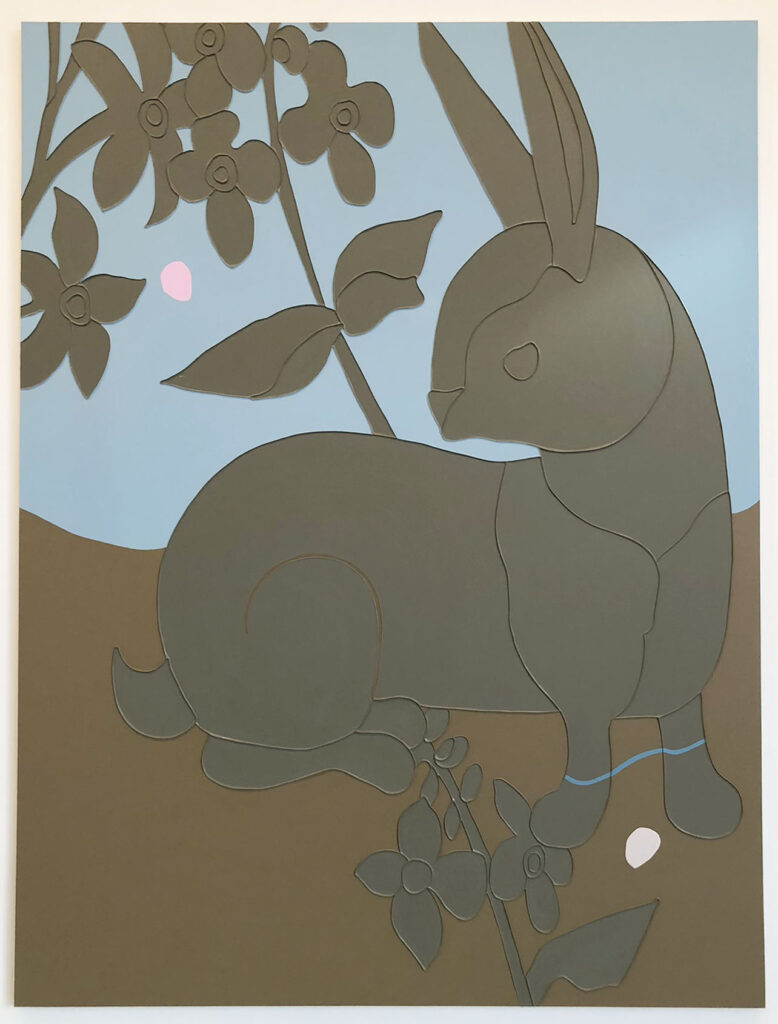
Gary Hume’s Petals, 2017, from his 2019 exhibition at Matthew Marks Gallery’s Los Angeles location.

Gary Hume’s Petals, 2017, from his 2019 exhibition at Matthew Marks Gallery’s Los Angeles location.

This painting, How Soon Is Meow, by Johannah O’Donnell, was part of The Werk Gallery’s first show in February of 2023.
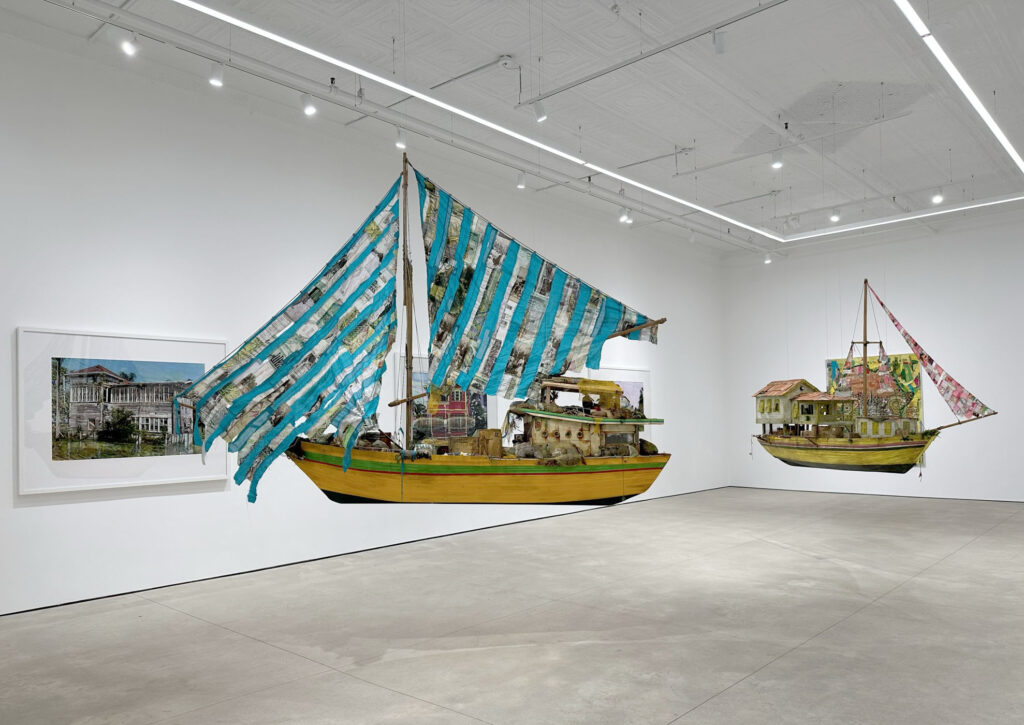
Hew Locke, “Listening to the Land” room view
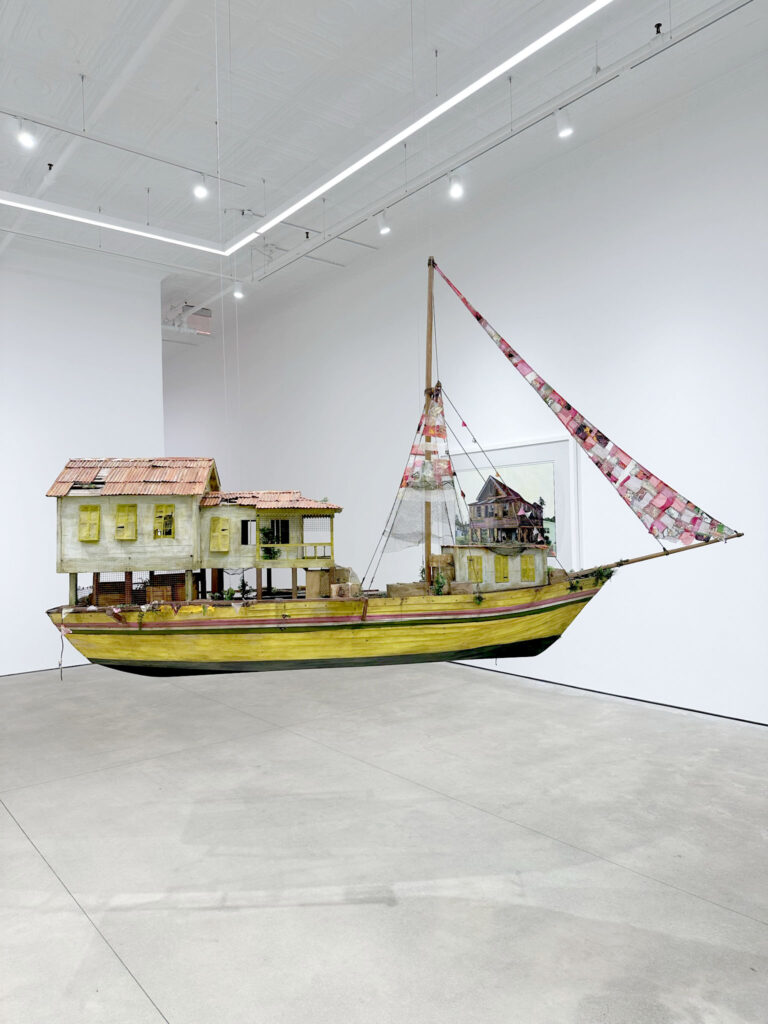
“The Relic”, 2022
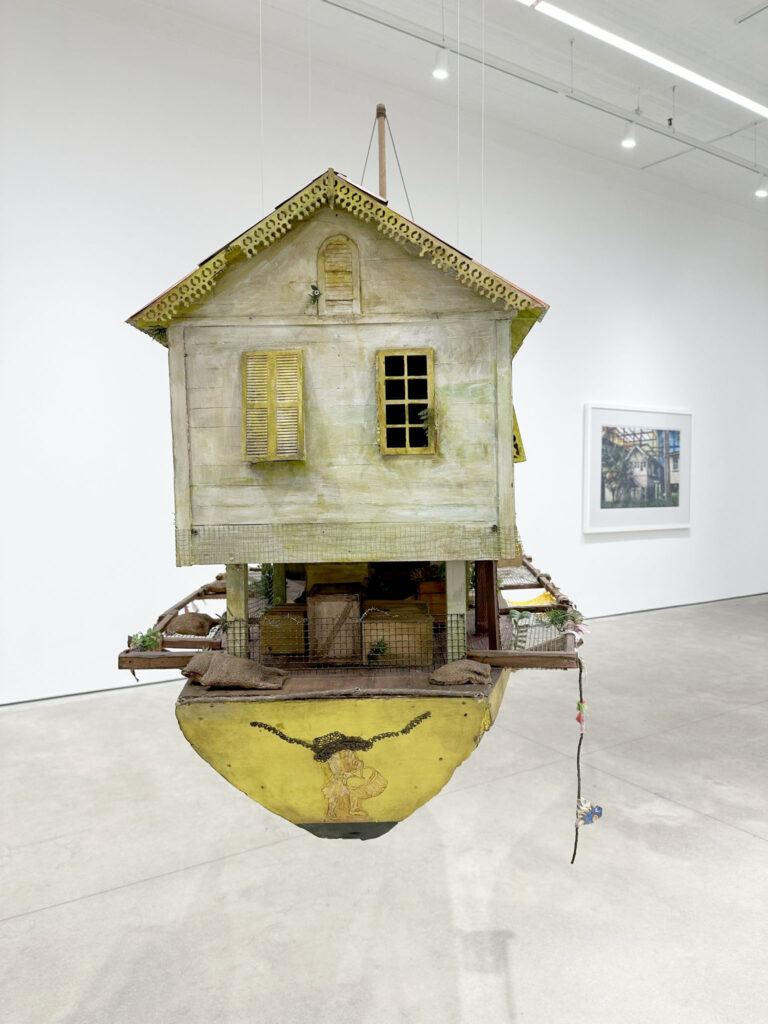
“The Relic” 2022 (another side)
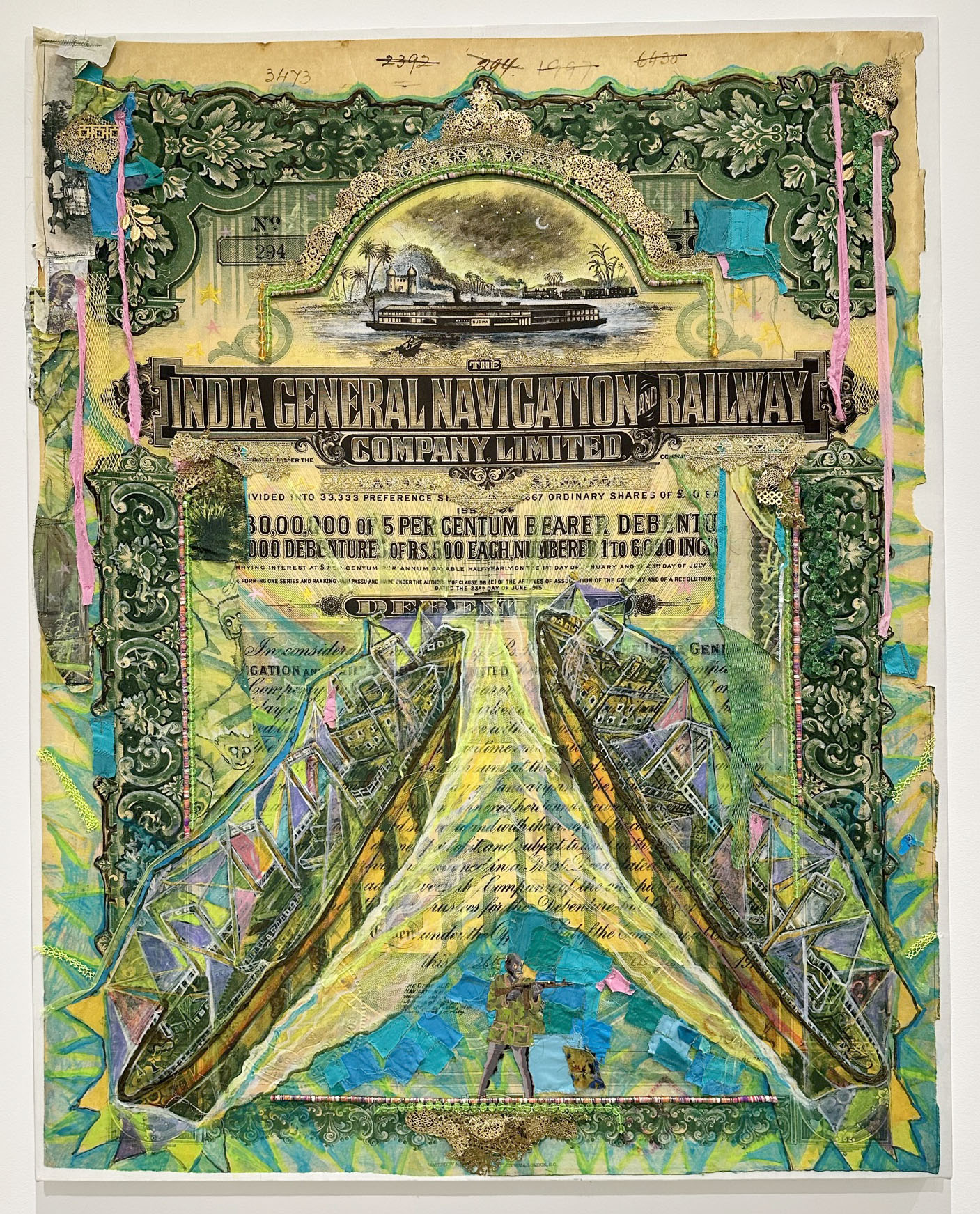
“Raw Materials 3”, 2022
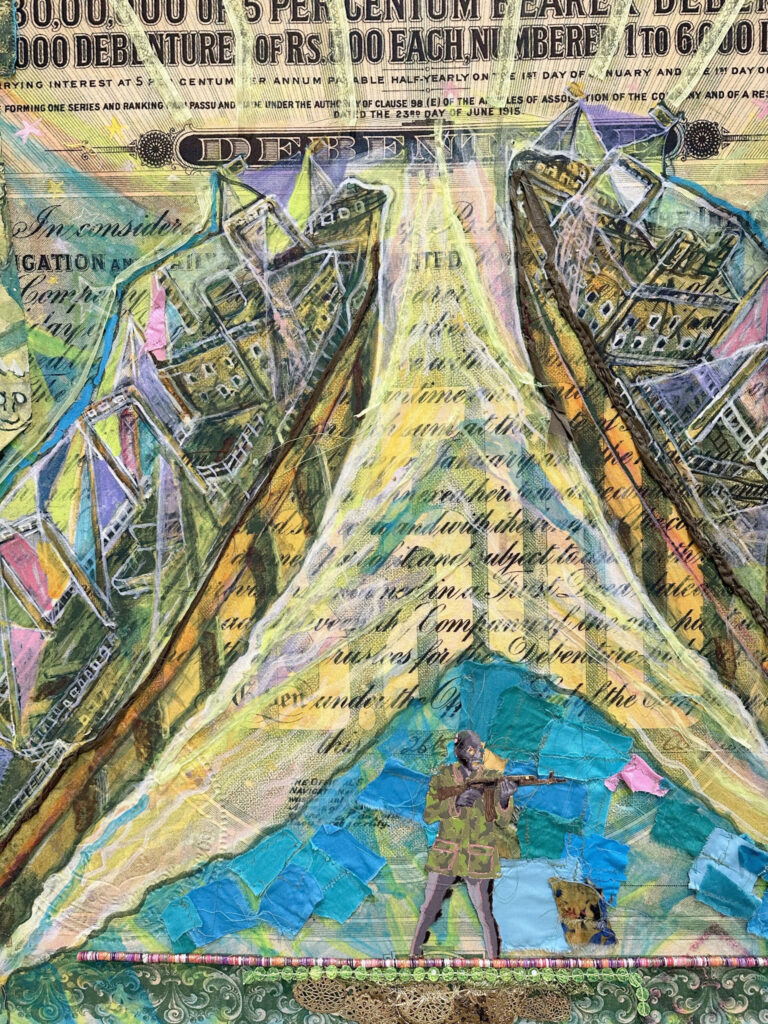
“Raw Materials 3”, 2022 (detail)
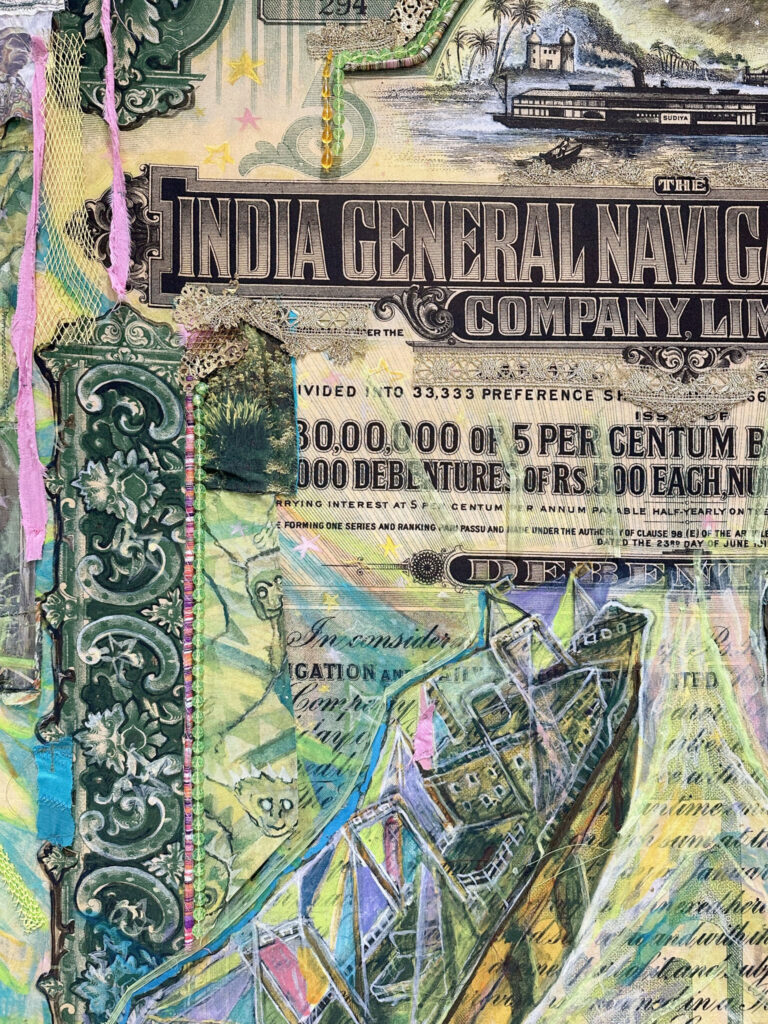
“Raw Materials 3”, 2022 (detail)
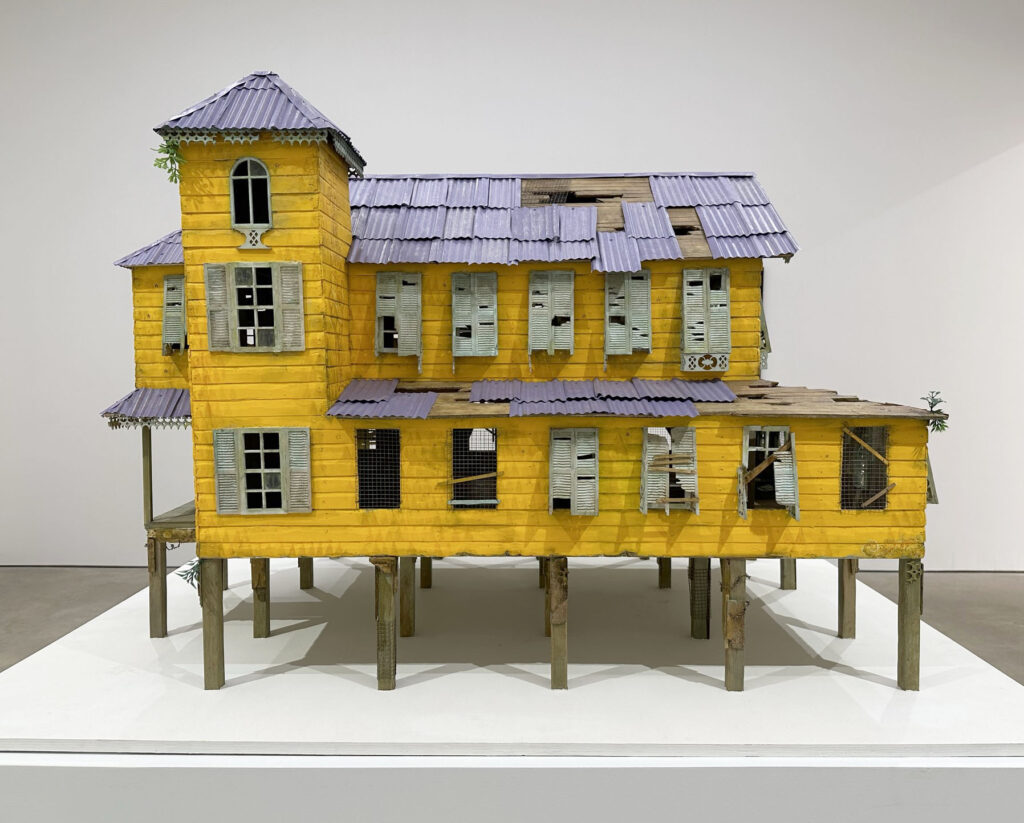
“Jumbie House 2”, 2022
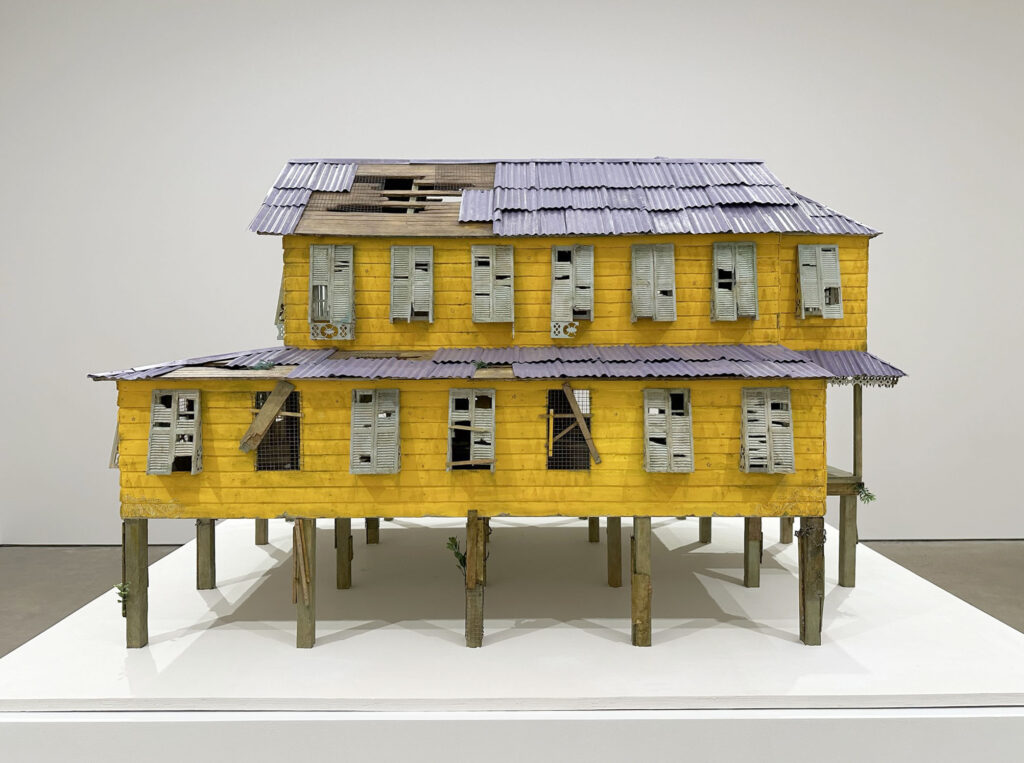
“Jumbie House 2”, 2022
For Hew Locke’s exhibition, Listening to the Land, at P.P.O.W. he has created intricate sculptures and paintings that are fascinating in person.
From the press release-
Locke is known for exploring the languages of colonial and post-colonial power, and the symbols through which different cultures assume and assert identity. Furthering the themes explored in his celebrated commission The Procession at Tate Britain, and his concurrent installation Gilt on the façade of The Metropolitan Museum of Art, this exhibit engages with contemporary and historical inequities while reflecting on the landscape and history of the Caribbean. The exhibition draws its title from a poem by Guyanese political activist and poet Martin Carter which situates itself between two opposing forces of the landscape – sea and forest. Locke’s show features new sculptures and wall works with recurring motifs of stilt-houses, boats, memento mori, and share certificates referencing tensions between the land, the sea, and economic power. Reflecting on these links, Locke notes, “The land was created to generate money for colonial power, now the sea wants it back.”
Translating to ‘land of many waters,’ Guyana and its physical, economic, and political landscape serve as one of the primary sources for Locke’s work. Having spent his childhood in this newly independent nation, the artist witnessed first-hand an era of radical transformation. Now, the country teeters on the precipice of an oil boom and is one of the world’s fastest growing economies. Juxtaposing personal meditations on the climate crisis with political commentary on the history of a globalized world, Locke contemplates the ways in which colonies were exploited to accumulate capital, and observes how Guyana’s economic future lies in the exploitation of its waters. Locke’s new boat sculptures The Relic and The Survivor embody this broad worldview as the two battered wrecks drift through time and history. Evoking the fragmented and diverse legacies of the global diaspora, the boats’ patchwork sails are interspersed with photo transfers of 19th Century cane cutters and banana boat loaders, while their decks are loaded with cargo that could allude to colonial plunder, trade goods or personal belongings.
Based on an abandoned plantation house, Locke’s newest sculpture Jumbie House 2 features layered images that unveil the spirits that haunt this colonial vestige. Presented alongside are a series of painted photographs of dilapidated vernacular architecture across Georgetown and rural Guyana. Constantly under threat of being washed away by storms or rising sea levels, these crumbling structures echo anxieties surrounding climate change and historical erasure. A new series of mixed media wall works, Raw Materials, is derived from antique share certificates and bonds. Locke richly decorates the appliques with acrylic, beads, and patchwork to draw attention to the complex ways in which the past shapes the present. The image of an 1898 Chinese Imperial Gold Loan behind painted Congolese figures connects the global economy at the height of Empire to current Sino-African trade networks. In another work, a painted representation of a Nigerian Ife mask, alongside an image of David Livingstone, is layered on a French-African Mortgage Bond from 1923, connecting exploration and exploitation of African land, to current conversations surrounding the repatriation of artifacts. Taken together, the works in Locke’s Listening to the Land echo William Faulkner’s adage “The past is never dead. It’s not even past.”
This exhibition closes 4/1/23.
The Procession, mentioned above, can now be seen at Baltic Centre for Contemporary Art, in Gateshead, England until June 11th, 2023.
Gilt, also mentioned above, is on view at The Metropolitan Museum of Art until May 30th, 2023.
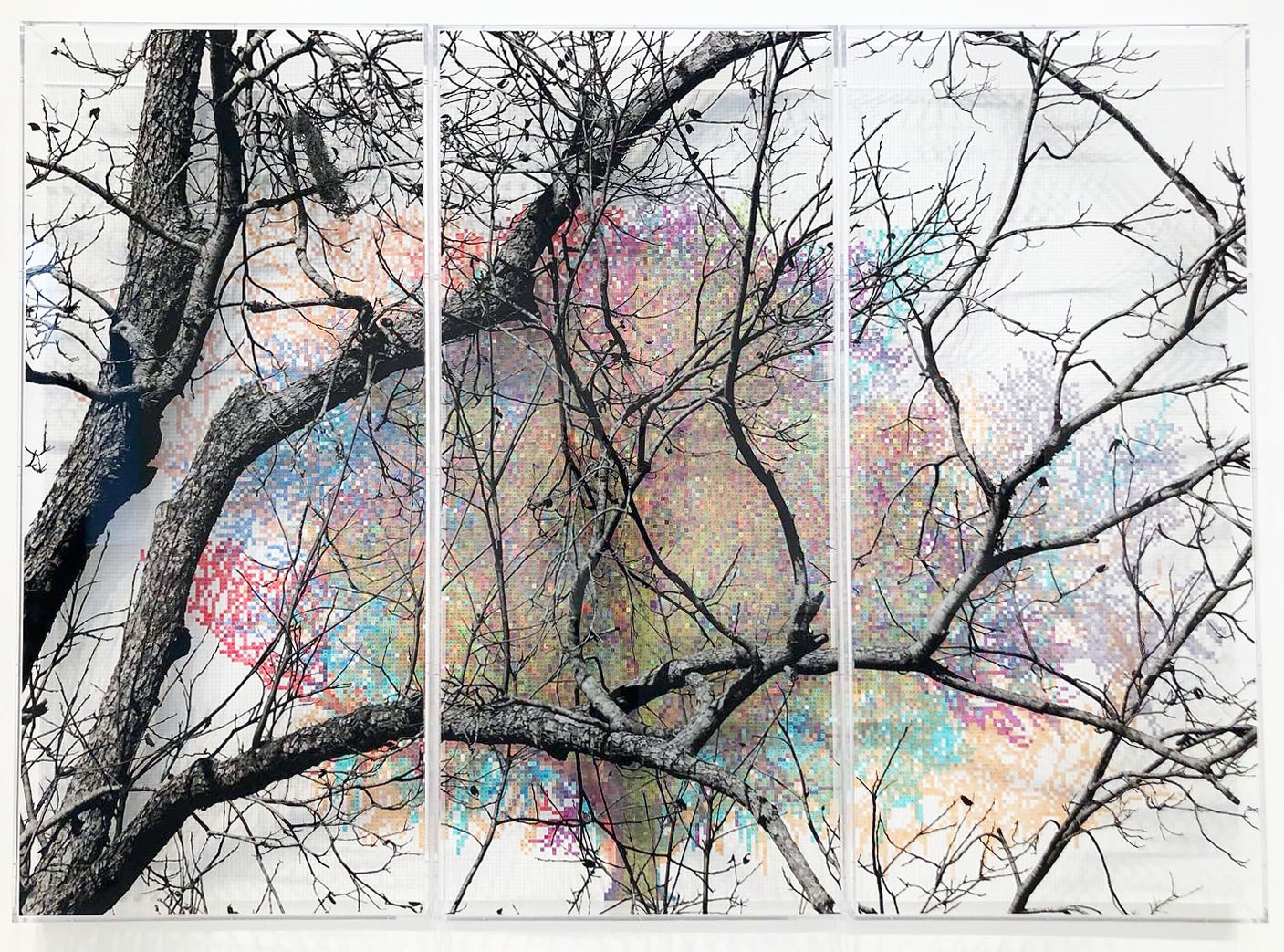


Charles Gaines’ work never fails to impress and his recent exhibition, Southern Trees, at Hauser and Wirth in NYC, is no exception.
From the press release-
One of the most important conceptual artists working today, the show explores the evolution of Gaines’s complex practice, demonstrating how he has continued to forge new paths within the innovative framework of two of his most acclaimed series, Numbers and Trees and Walnut Tree Orchard. The exhibition’s title, ‘Southern Trees,’ alludes directly to the 150-year-old pecan trees pictured in the new works, and symbolically to the opening lyrics of ‘Strange Fruit,’ Billie Holiday’s haunting protest anthem from the 1930s.
The image of the tree has been central to Gaines’s practice since he first began the Walnut Tree Orchard series in the 1970s. In ‘Southern Trees,’ Gaines advances the series using pecan trees photographed on a visit to Boone Hall Plantation in Charleston County, South Carolina––not far from where the artist was born and lived until he was five years old. Presented alongside a key early example from the walnut tree series, eight new triptych works on paper revisit and expand upon this significant original body of work.
‘Walnut Tree Orchard: Set M’ (1977), on loan from the Whitney Museum of American Art, New York, pairs a black and white photograph of a walnut tree with two drawings derived from it––an ink outline of the same tree and a grayscale grid that plots all of the trees included in the series up until that point. The newest series, titled Pecan Trees (2022), begins similarly, with a stark black and white photograph of a tree; yet in the drawings that accompany it, Gaines has filled in the outline of the tree with solid ink and used vibrant watercolors to plot all the previous trees in the final drawing. These successive modifications to scale, color and background demonstrate Gaines’s theory that while ‘the system has never changed, the outcome is always different.’
This extends to Gaines’s new Numbers and Trees Plexiglas series, which begin with the artist assigning each tree a distinctive color and numbered grid––breaking down the composition into individual cells that reflect the full form of the tree depicted in the photograph on the surface. However, Gaines reverses his signature process in this new series by overlaying the forms of the trees one at a time and in progression on the back panel of the work rather than on the front. He then brings the photograph to the surface by printing an enlarged detail of the most recently added tree on the work’s Plexiglas surface. This approach brings the tree’s shadowy branches to the foreground, highlighting its textural details and contrasting tones while obscuring the colorful numbered grids painted underneath it. This reversal produces a dramatically different effect, igniting a more somber, yet stirring, reaction to the work as the austere branches, dripping with moss, dominate the picture.
Created through carefully considered systems rather than through the artist’s own imagination or intuition, these new works remove the artist’s subjectivity by following a set of self-determined rules and procedures. The works call into question both the objective nature of the trees and the subjective natural and material human actions that surround them. The fastidious layering process allows Gaines to reveal the differences between the trees’ shapes where the forms do not align. These differences, highlighted by the artist’s systems, suggest the arbitrary nature of other manufactured systems in our society––such as politics, gender, race and class.
This exhibition closes 4/1/23.

“Oil Bunkering #9, Niger Delta, Nigeria”, 2016

“Gold Tailings #1, Doornkop Gold Mine, Johannesburg, South Africa”, 2018,

“Salt Ponds #1, Near Fatick, Senegal”, 2019

“Salt Ponds #1, Near Fatick, Senegal”, 2019 (detail)

“Uranium Tailings #13, Husab Uranium Mine, Namibia”, 2018
Edward Burtynsky’s photographs are visually arresting and often made more so by the need to look closer to discover what exactly is being captured. Some look like paintings at first glance before you realize there are roads or other man made structures contained within them.
From the Sundaram Tagore’s press release-
Since the early 1980s, Edward Burtynsky has been photographing industrial landscapes across the globe, documenting in remarkable detail the human imprint on the planet through terraforming, extraction, urbanization and deforestation. For African Studies, premiering in New York simultaneously at Sundaram Tagore Gallery and Howard Greenberg Gallery, he focused on Sub-Saharan Africa, traveling to Kenya, Nigeria, Ethiopia, Ghana, Senegal, South Africa, Botswana, Namibia, Madagascar and Tanzania between 2015 and 2020.
Burtynsky’s interest in Africa was sparked 20 years ago while he was working on his landmark 2004 photographic project China, which explores the country’s rapid globalization and the construction of the Three Gorges Dam. The series, and subsequent award-winning documentary film by Jennifer Baichwal, Manufactured Landscapes (2006), chronicle China’s transformation into the world’s leading manufacturer and depository for its waste. Burtynsky witnessed firsthand the immense environmental—and by extension, human—cost of development, and he predicted Africa would be the next, and perhaps the last, region to undergo major industrial expansion.
Presented in large-format photographs, African Studies conveys the fragility of the natural world, bringing together images of lush, undisturbed landscapes and environments irretrievably altered by industry. The series was largely photographed from aerial perspectives, a viewpoint that distills the continent’s diverse topography into graphic patterns and gradients of sumptuous color. The resulting effect seemingly transforms the marks of human infrastructure into painterly abstract compositions. In these images, as in all his work, Burtynsky skillfully integrates critical reporting with sublime visual aesthetics creating a harmonious balance between content and form.
“With this project I hope to continue raising awareness about the cost of growing our civilization without the necessary consideration for sustainable industrial practices and the dire need for implementing globally organized governmental initiatives and binding international legislations in order to protect present and future generations from what stands to be forever lost,” Burtynsky said.
Also on view in another section of the gallery are works from his series, Natural Order. The photographs were taken in Grey County, Ontario, during the lockdown in the spring of 2020.


This quote from Burtynsky was on the wall nearby in regards to the series-
“From the frigid sleep of winter to the fecund urgency of spring, these images are an affirmation of the complexity, wonder and resilience of the natural order in all things. I find myself gazing into an infinity of apparent chaos, but through that selective contemplation, an order emerges an enduring order that remains intact regardless of our own human fate.”
This exhibition closes 4/1 at Sundaram Tagore Gallery and 4/22 at Howard Greenberg Gallery.

Kirsty Wither “Tumbling Crowd”

Yelena Lezhen “Clockwork Bird Song”

Esther Rosa “Goes around, comes around III”
This weekend is the Affordable Art Fair in NYC. It’s a chance to check out and buy art at reasonable prices.The fair goes to Hampstead, London next, and will return to New York in September of 2023.
For more on the artists pictured above and their galleries-
Kirsty Wither runs the London gallery Cameron Contemporary with her husband, Robin Cameron.
Yelena Lezhen’s work was shown by Barcelona gallery Manifest Destiny Art. Check out her Instagram for current work.
Esther Rosa’s sculpture was part of InSight Artspace’s booth. Her Instagram is also a good place to see her work.
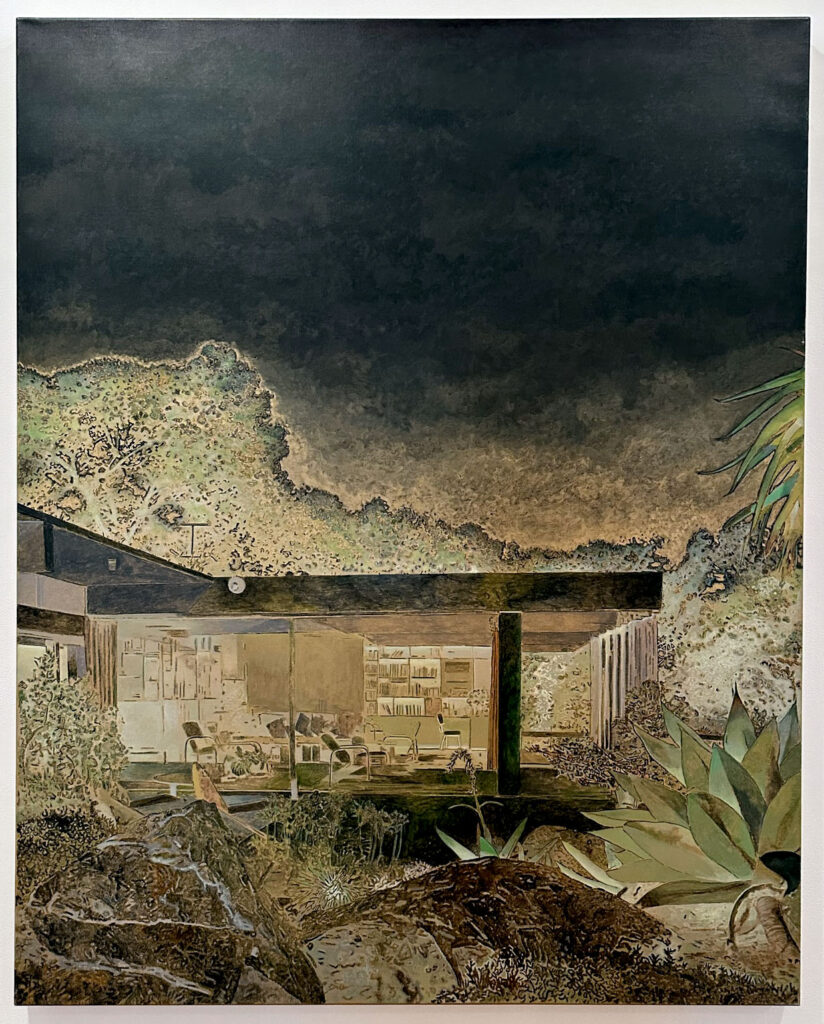
Stefan Kürten, “We are all made of stars”, 2013
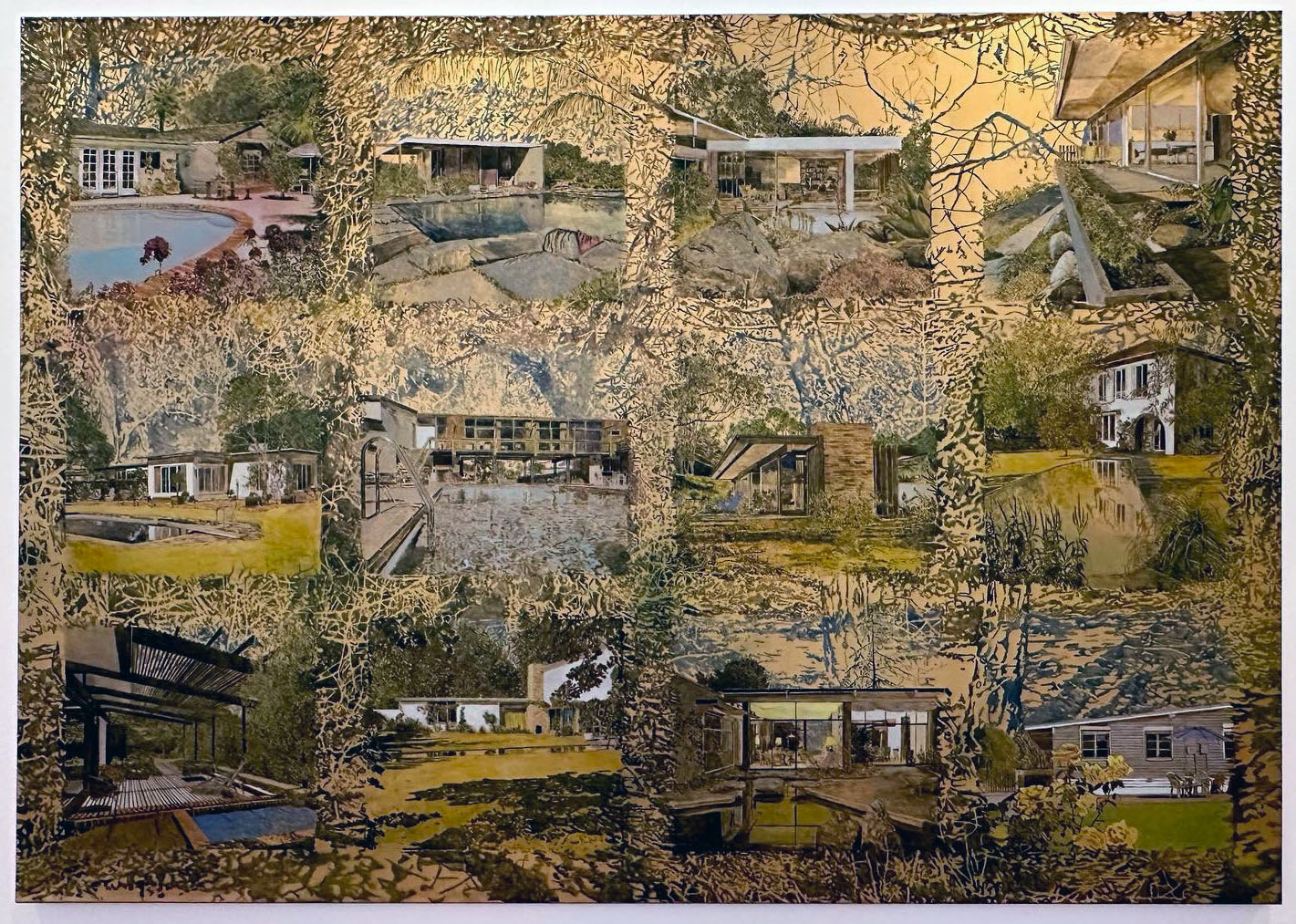
Stefan Kürten, “Running to Stand Still”, 2014
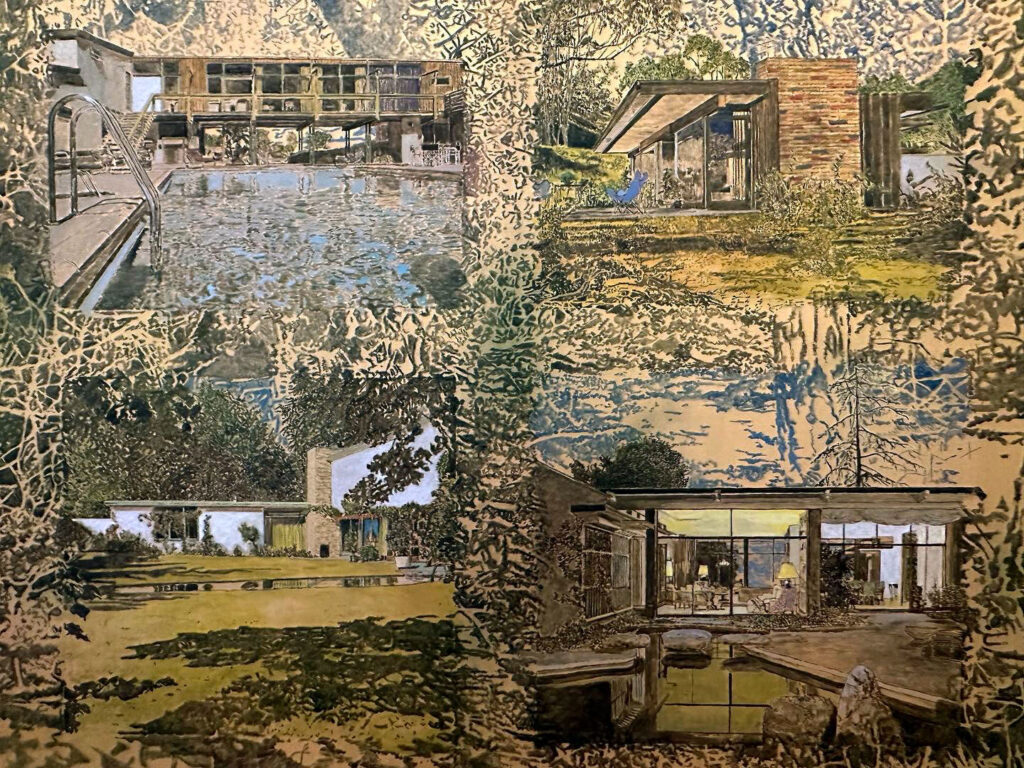
Stefan Kürten, “Running to Stand Still”, 2014 (detail)
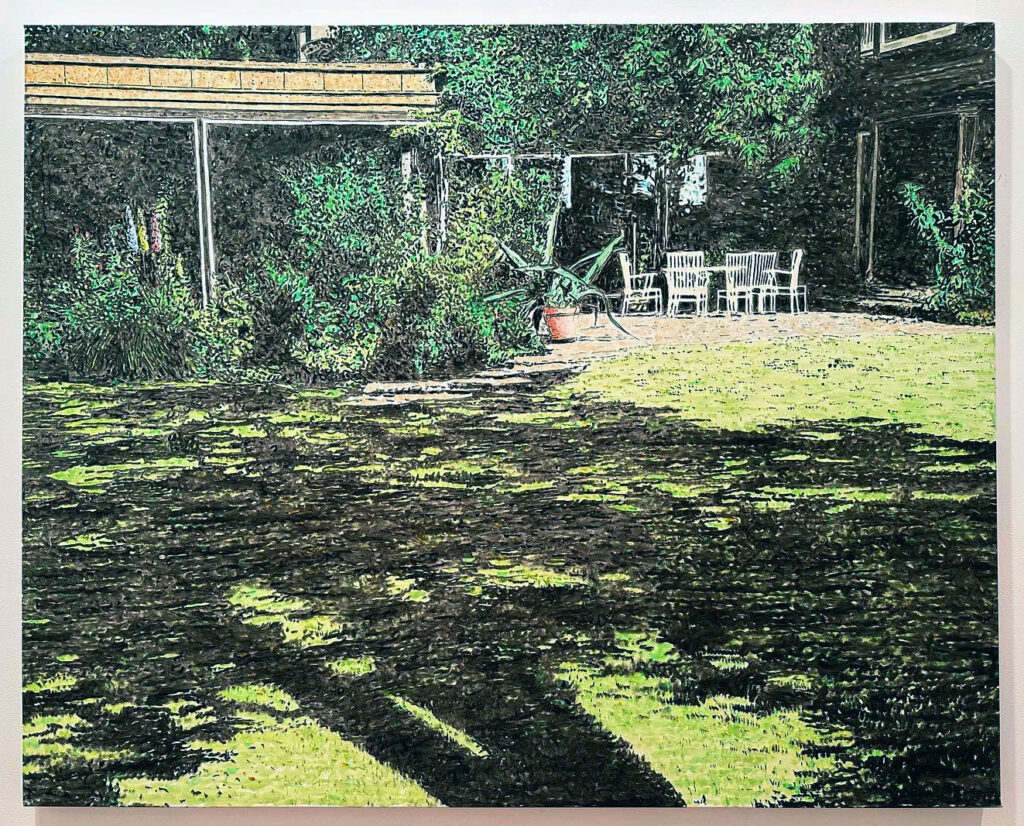
Stefan Kürten, “Fine Wrinkles”, 2000
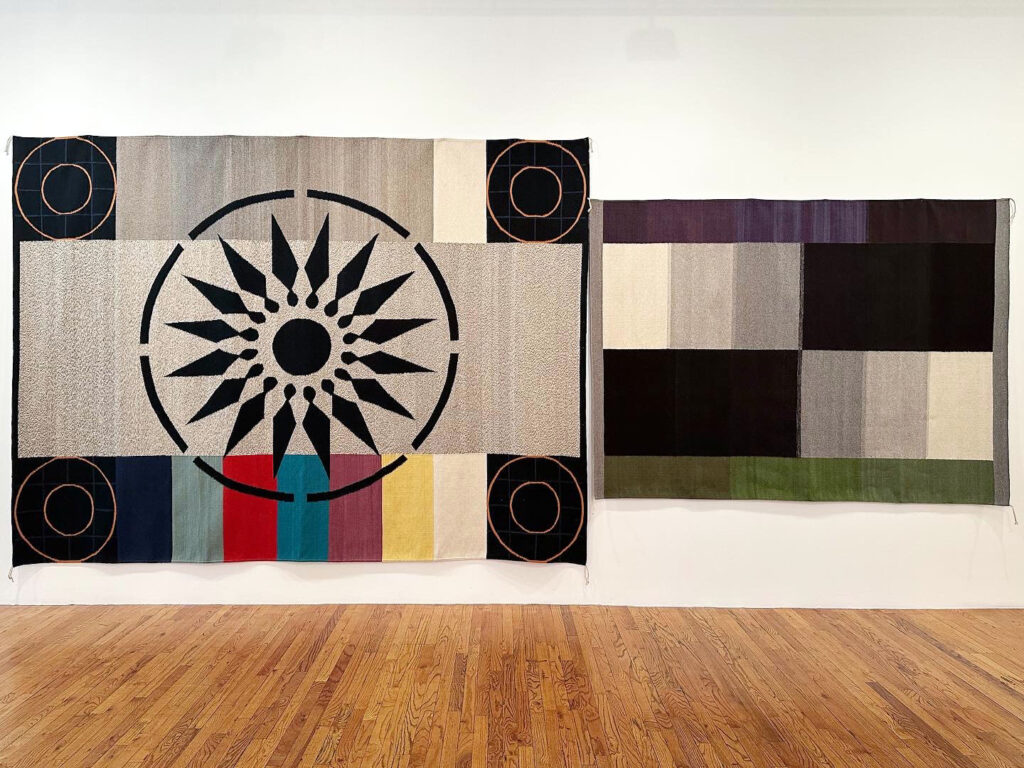
Rita McBride, “Mae West Mandala (Oaxaca), 2009 and “Color Test (Green Bar)”, 2009
Stefan Kürten’s paintings of houses and Rita McBride’s wall coverings (and other sculptures) work with each other to question the concept of home, as well as the objects you might find within one. The exhibition, titled I Continue To Live In My Glass House, is on view at Alexander and Bonin until 3/25/23.
From the press release-
Stefan Kürten is known for detailed depictions of homes. Although constructed from both found and invented imagery, his homes feel known or experienced. The slippage between archetypes, memories, and dreams are central to his compositions. Set in lush landscapes and mysteriously unpeopled, Kürten’s homes evoke modern art or design museums with iconic sculptures and furniture viewable inside and outside of their transparent walls.

Rajan Krishnan, “House and a Little Cashew Tree”, 2010

Rajan Krishnan, “Language of Woods”, 2009

Rajan Krishnan, “Language of Woods”, 2009 (detail)

Rajan Krishnan “Bird from the Grove by the River”, 2011
Beautiful paintings by the late Rajan Krishnan from his exhibition Ecologue at Aicon Contemporary.
From the press release-
A play on the word eclogue, a genre of short poems about pastoral life, the suffix ‘logue’ denotes discourse of a specific type, ‘Ecologue’ then is an ecological discourse. This specific conversation about the ecological happens through contact between coarse canvas and the paint on the bristles of Rajan Krishnan’s brush, it is a document : a letter, a journal, a portrait, a story, a manual.
Krishnan’s paintings have been described by his wife and journalist Renu Ramnath as “documents of change.” The careful renderings of Kerala’s agrarian landscape (trees, birds, forests, rivers) are engrossed in larger themes of societal transition and movement – progress and decay, each individual painting freezing a moment in time. In this series of paintings, Krishnan visualizes a vibrant world so full of detail, yet isolated, in an aura of nothingness, compressed, with no backgrounds or foregrounds. His paintings bring the viewer in to meditate on existence. A boat, a fish, a tree, a house, a monkey just as they are.
The artist’s commitment to his home state of Kerala is admirable, as a topography to be both admired and critiqued as a landscape full of possibility. Andrew Shea recalls, for “those who knew him and those who admired his spirit and work, the palpable absence of the artist himself wanes slightly amidst the remarkable body of work he has left behind and his legacy as a pioneer of the uniquely collaborative and welcoming community of artists he nurtured within Kochi and further afield.”
Art historian Kathleen Wyma writes “Krishnan’s paintings seize on sites of crystallized memory as critical interventions into the present. Re-calling and re-recollecting the flow and ebb of time (both real and imagined). His images simultaneously evoke the will to remember and the desire to heed the accretions of localized time.” In our current moment, as questions of climate worsen and the illusion of development as progress remains, every intentional stroke of Krishnan’s brush acts as a tool for contemplation. Scenes of dried up rivers, singular fish, and labyrinth-like groves invite us to reflect on the past, present, and future.

Erika Ranee, “Nacre”, 2023

Erika Ranee, “Nacre”, 2023 (detail)

Erika Ranee, “You Go First”, 2023

Erika Ranee, “You Go First”, 2023 (detail)

Erika Ranee, “You Go First”, 2023 (detail)
The paintings by Erika Ranee, part of her exhibition, All Natural at Klaus von Nichtssagend Gallery, are densely constructed and require a closer look to truly appreciate the work it took to create the intense final products.
From the press release-
Ranee takes inspiration from the world all around her; a crosstown bus ride might reveal pops of color in a passenger’s bright blue IKEA bag seen against municipal orange plastic seats. A bucket of “Purple Dark” acrylic, discontinued by Guerra Paints but gifted to the artist, might bring to mind dahlias and peonies, her favorite flowers. All Natural refers to Ranee’s time spent between NYC and rural Western Massachusetts, and an ongoing fascination with both the fertile, natural world of the countryside and a – no-less fecund – urbanized terrain shaped by its human inhabitants. The title also obliquely refers to drawings Ranee made of her niece’s braided hair extensions, some of which have been collaged into her paintings’ surfaces, fomenting another set of layered meaning to the works.
Ranee employs a wide variety of painting techniques to create her abstractions. Image and surface are developed through wide-ranging and multitudinous applications and removals of material in dense layers. Wide swaths of color are poured, allowing multi-directional deltas that show the influence of gravity and entropy. Lustrous, glossy paints sit under or beside bubbling and crackled powdery pigments on the canvas. Elements are collaged from sources including blacklight posters, coloring book pages, found children’s drawings and spray-stenciled botanical matter. In places, cut scraps of other paintings are glued onto her raucous surfaces then painted over, cut up, torn out and painted again. Some layers include ink drawings on newsprint shellacked or encased in gel mediums, then incised and peeled to reveal hidden forms underneath. Patterns resembling electric Lichtenberg formations are made through spray paint expelled directly into wet shellac. The result is a body of work that invites us to look closely, examine details, and wonder at its making, all while reveling in the lush colors and forms that ebb and flow before us.
This exhibition closes 3/25/23.


The images above are from Annette Kelm’s photography exhibition Present Past Perfect at Andrew Kreps Gallery.
From the press release-
In her work, Kelm moves freely between studio, and documentary photography to explore the function and history of objects, as well as the implications of their representation. A series of new photographs document ephemeral still lives built in her studio, combining colored paper and cardstock backdrops, with vegetation and found objects. Ultimately, these contemporary Vanitas-like compositions are left open-ended, as Kelm discloses their constructed nature, as seen in works like Sumach / Essigbaum, 2023, where the edge of a table and curve of the backdrop suggest the provisional process of the works’ making. Through this strategy, Kelm explores the implications of the framing and display of objects, as well as the value systems in which they exist.
A new series of photographs documenting vintage button pins continue Kelm’s ongoing exploration into the graphic manifestations of protest. Adorned with slogans such as “Keep Abortion Legal” and “If his home is his castle, let him clean it”, each button pin is affixed to a uniformly cropped jean jacket. Sharing an overhead view, and a serial format, the varying placement of each button suggests the individuality of an imagined wearer, culminating in a crowded, all-over composition.
Kelm’s interest in the socio-cultural history of objects is evoked in her 2019 series Recyclingpark Neckartal, presented here for the first time in the United States. The series documents 14 travertine columns originally commissioned by the National Socialists from Lauster quarry in Stuttgart in the 1930s, as part of an unrealized monument to Benito Mussolini planned for “Germania”, the planned reconstruction of Berlin overseen by Albert Speer. Kelm captures these in multiple angles in their current location, a recycling center. Seen through trees and brush, the columns stand overshadowed by a towering waste incinerator, surrounded by parked cars and traces of activity. Together, these views suggest the often uneasy approach society takes to addressing its dark past.