Mar 102023
 

Bonam Kim, “Untitled (401 Suydam Street), 2022”, Dollhouse miniatures, taxidermy pigeon, wood, paint and “Can’t Stand Up For Falling Down”, 2018, wood, screw, silicone

Bonam Kim, “Untitled (401 Suydam Street)”, 2022, Dollhouse miniatures, taxidermy pigeon, wood, paint

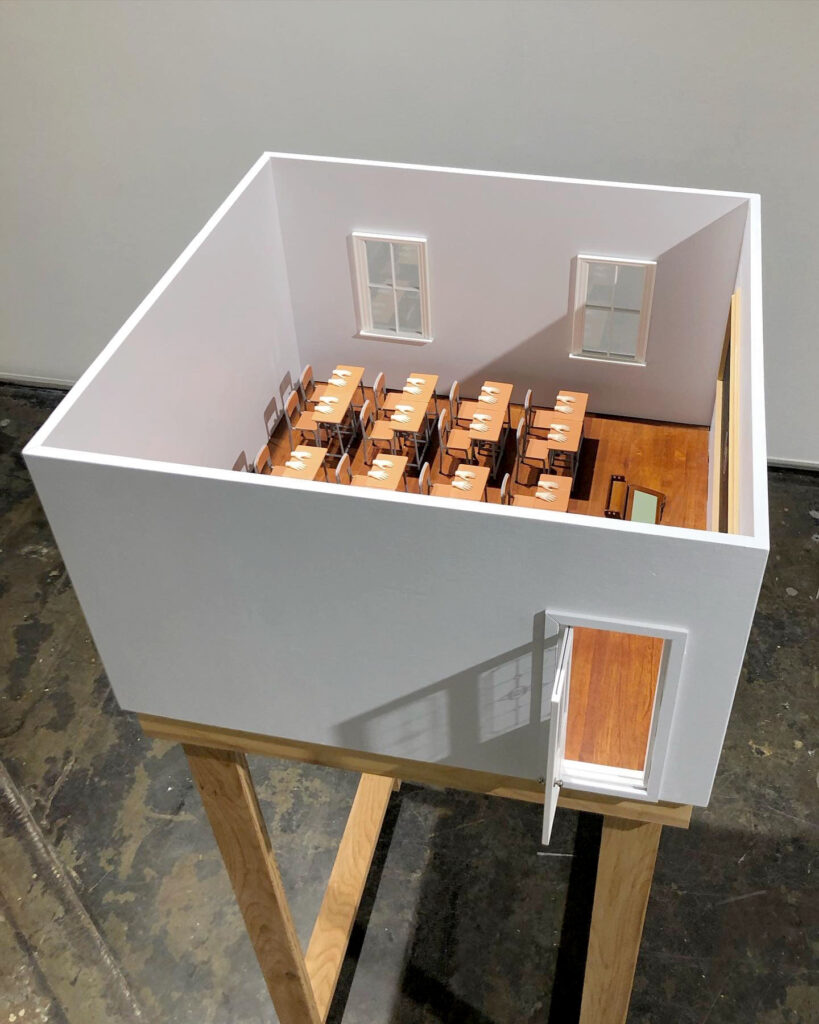
Bonam Kim, “Untitled (Classroom)”, 2022, Dollhouse miniatures, wood, paint, paper

Bonam Kim, “Untitled (Classroom)”, 2022, Dollhouse miniatures, wood, paint, paper

Bonam Kim, “Untitled (1990-2005)”, 2022, Wall clock, dollhouse miniatures, wood

It’s the last weekend to see Bonam Kim’s GOOD JOB WELL DONE, at A.I.R. Gallery in Brooklyn. The collection of sculptures are each based on events in Kim’s life and are incredible creations.

From the press release-

Kim grew up with her brother’s architectural models and drawings scattered around their house. Captivated by the relationship between model and actual space, she gained an acute sense of her spatial surroundings. This sensibility, combined with her love of making things with her hands, led her to constructing miniatures of her world. These objects invite us to navigate not only the spaces she has occupied physically, but also the psychological space of her experiences and memories. By manipulating scale and taking a bird’s-eye view perspective, Kim reclaims power over the past and present. Works like Between Dream and Dark and Can’t Stand Up For Falling Down playfully explore the frustrations of cross-cultural exchange, while Untitled (April 2, 2020) and Untitled (203 Harrison Pl) evince feelings of isolation and accumulation during the pandemic era.

In Untitled (Classroom), Kim recreates a typical classroom from memory. Within it she presents us with some of the artifacts of the post-war South Korean educational system: politely folded hands are given a “stamp of approval” on the blackboard, commended for their conformity. Kim continues this examination of the way architectural spaces regulate human behavior in Untitled (401 Suydam Street), a model of the artist’s bedroom. She restages an event in which her apartment’s ceiling had become infested by pigeons, eroding her sense of personal space and producing an uneasy awareness of surveillance—of being observed at her most intimate by an other.

Untitled (1990-2005) contends with a traumatizing childhood experience where Kim suffered a severe hand burn which led her to have multiple surgeries over an extended period of time. These memories led her to grow averse to going into spaces that brought forth memories of the hospital’s formal qualities, such as hair salons. With the piece she distills the relation between time, space, and memory, turning a wall clock into an operating room and hair salon. This sense of spatial unease is echoed in the piece Untitled (Mexico City-Seoul), which models the circumstances of renewing her visa in the middle of the 2020 pandemic. Having to ping-pong between Mexico and Seoul without knowing when she would be able to return to the United States made her reflect on the arbitrariness of the system, which is mirrored in the piece by an embassy office held within a lottery box, pointing to a bureaucratic opacity that leaves the user in a sort of Kafkaesque limbo.

This exhibition closes 3/12/23.

Mar 092023


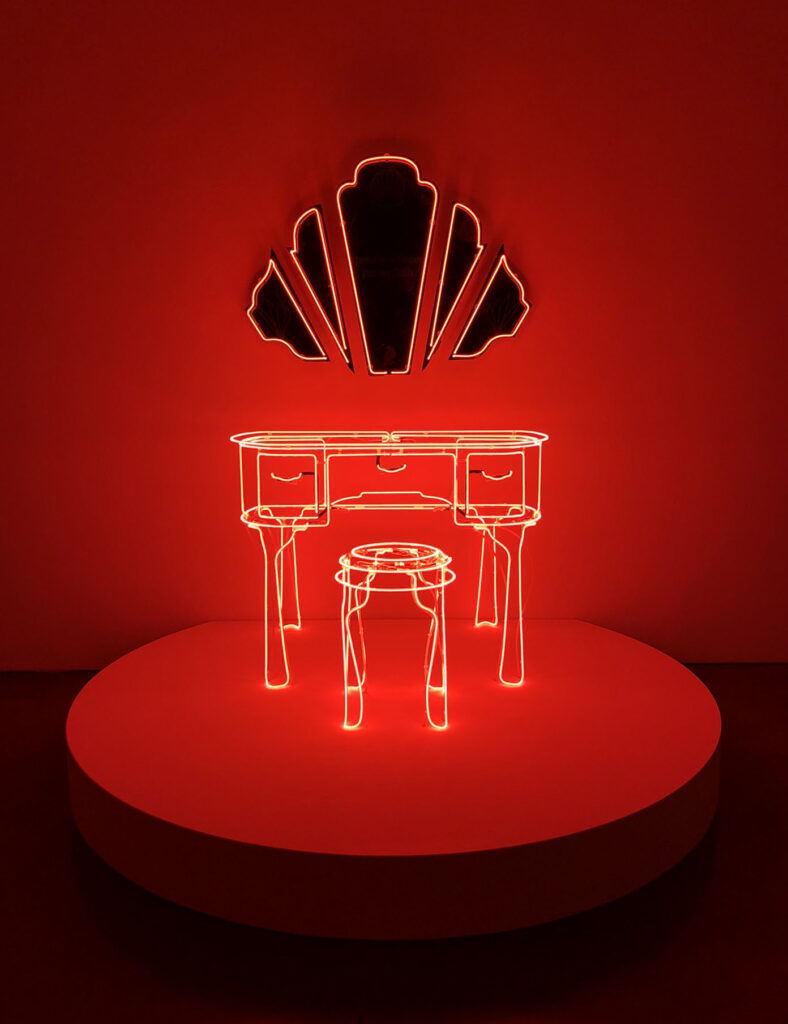
Ja’Tovia Gary “Citational Ethics (Zora Neale Hurston, 1943)”, 2023, wood, neon and engraved obsidian

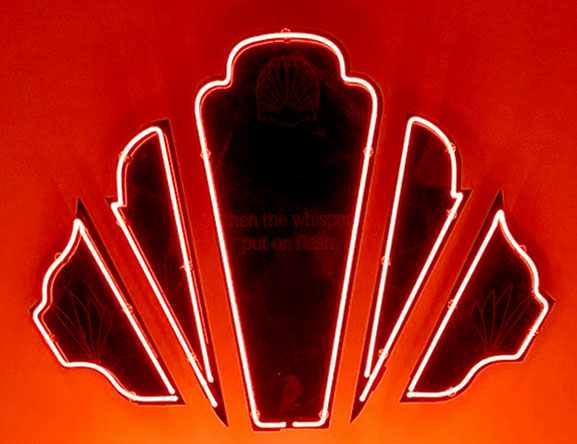
Ja’Tovia Gary “Citational Ethics (Zora Neale Hurston, 1943)”, 2023, wood, neon and engraved obsidian (detail)

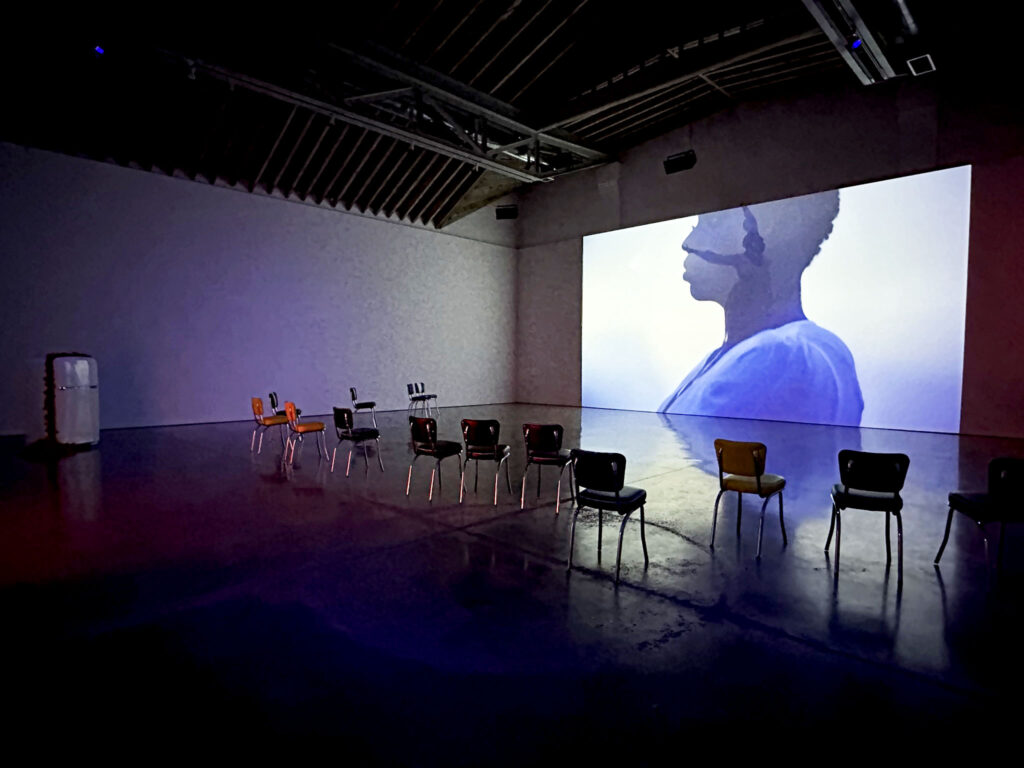
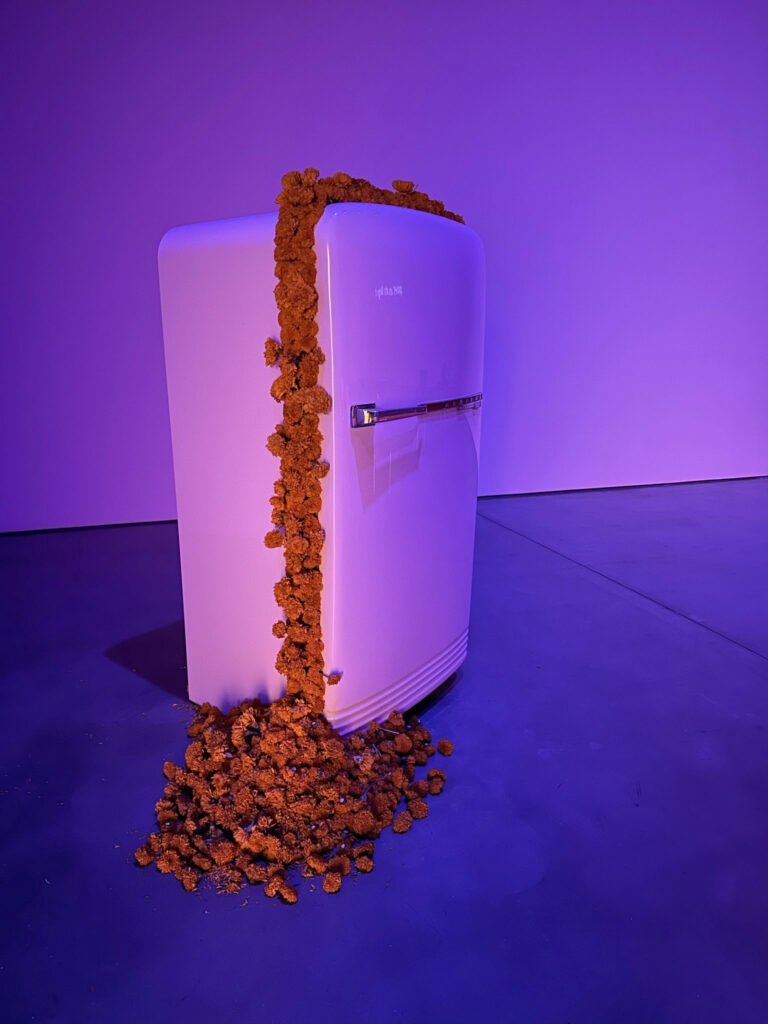
Currently at Paula Cooper Gallery in NYC is Ja’Tovia Gary’s You Smell Like Outside…, an exhibition that centers around her 2023 film, Quiet As It’s Kept, and includes two new sculptures.

From the press release-

The artist continues her practice of interrogating and re-contextualizing multiple archives, concerning herself with the power and responsibility of language and the radical possibilities of narrative. The exhibition title You Smell Like Outside… is a Black Southern phrase that foregrounds the artist’s specific cultural origins with discursive traditions that invoke an interior knowledge. Inspired by Toni Morrison’s 1993 Nobel Laureate lecture, Gary attempts to heighten the contradictions between a living and a dead language. Notions of domesticity, interior and exterior, and the conflict between perception and being perceived are explored in the show.

With a filmic and sculptural language uniquely her own, Gary eloquently intervenes into foundational renderings of Black life to expand the conversation and the possibilities of being. The artist considers what is destabilized when we include the cinematic within the category of language, asserting: “if we are to ensure the future efficacy of storytelling, we must boldly and audaciously insist upon new narrative forms.” Quiet As It’s Kept (2023) is a contemporary response to The Bluest Eye, Toni Morrison’s first novel published in 1970. Set in Ohio in 1941, the book is an evocative illustration of the everyday particulars of colorism and its ravaging effects on the intramural. Themes of embodiment, psychoanalysis, and beauty are explored in both the source text and the answering film. Instinctual and eviscerating, the film encourages viewers to make meaning that is rooted in the subjective and examine their position within looking relations.

Following Gary’s critically acclaimed films THE GIVERNY DOCUMENT (2019) and An Ecstatic Experience (2015), Quiet As It’s Kept (2023) is an intimate bricolage of vintage Hollywood, direct animation, original super 8 and 16mm film footage, and documentary conventions. Mediating on the gaze and Black women’s particular embodied realities, Gary also re-contextualizes contemporary social media footage. Creating conceptual links for each viral clip to a character, event, or thematic element from Morrison’s story, the film emphasizes questions around the book’s themes of internalized and externalized anti-blackness in contemporary culture. Situated within an immersive installation with domestic elements, the film asks the viewer to employ an oppositional gaze that allows for narrative structures that run counter to those of the mainstream.

High John de Conquer came to be a man, and a mighty man at that. But he was not a natural man in the beginning. First off, he was a whisper, a will to hope, a wish to find something worthy of laughter and song. Then the whisper put on flesh. [1]

The sculptures in Gary’s Citational Ethics series illuminate the words of Black women through the medium of neon, with the title of each work serving as a citation for the quote. Citational Ethics (Zora Neale Hurston, 1943) cites Zora Neale Hurston’s 1943 essay on High John de Conquer, a Southern folk trickster figure who brought joy, laughter, and strength to enslaved people while continuously evading capture. The sculpture is a vanity mirror set which gestures towards a speculative future past. Comprising a desk, stool, and fan-shaped obsidian mirror, the object invokes the Harlem Renaissance, Art Deco, and southern Black Hoodoo lore. A departure from the previous works in the series, the quote is etched into the highly polished black stone said to bring about visions through gazing, while the furniture is rendered in neon. Drawing the viewer in to read the words written in the mirror while bathed in red light, the sculpture summons an intimate encounter with the self and spirit.

[1] Zora Neale Hurston, “High John de Conquer,” in The American Mercury, October 1943, pp. 450-458

This exhibition closes 3/11/23

Mar 092023
 

It’s the last few days to see Jean-François Bouchard’s Exile from Babylon at Arsenal Contemporary in NYC. The film in the back room of the gallery gives you a chance to see the people who are missing from the photos. Alone or in groups, they drift between the three screens among the vast open space of the desert.

From the press release-

For this new body of work, the Canadian artist documented a squatters’ camp in California. Driven by homelessness, drug addiction or libertarianism, some Americans choose to reject modern society – Babylon as they call it – to form unlikely communities of squatters and wanderers seeking collective refuge. On a decommissioned military base in the desert, the community photographed by Bouchard lives without any form of local government and without any basic services such as running water, electricity, or garbage removal. On inhospitable grounds, they established themselves in shanties, makeshift tents, shipping containers, crumbling recreational vehicles, and even dens dug into the ground.

For Exile from Babylon, Bouchard has elected to represent the community’s grueling reality metaphorically through a series of still life photographs of trees. Each is adorned with garbage and debris that were either thrown at them or carried through the harsh desert winds. Collectively, these surreal postapocalyptic scenes testify to vast disparities that exist in our modern societies and the quest of fascinating characters for a sense of fulfillment derived through absolute freedom and how it is acquired at a great personal sacrifice.

This exhibition closes 3/11/23


Mar 092023
 

Lilian Thomas Burwell, “Enfolded”, 1973

Lilian Thomas Burwell, “Untitled”, c. 1980

Lilian Thomas Burwell, “Montagne”, 2012

The work above is from Lilian Thomas Burwell’s exhibition Enfolded at Berry Campbell gallery in NYC.

From the press release

Living and working  in Highland Beach, Maryland, Burwell, age 95, was recently hailed as the “Tom Brady of Artists” in the New York Times. In 2022, Burwell received Howard University’s Lifetime Achievement Award along with Betye Saar.

Lilian Thomas Burwell: Enfolded highlights the dynamic transition in Burwell’s abstract visual language from two-dimensional painterly canvases to three-dimensional sculptural forms. Burwell’s paintings from the late 1970s and early 1980s employ a distinctly bold palette and reference the natural world, featuring organic forms that abstract biotic phenomena. In 1984, Burwell literally cut into a canvas, creating a shape beyond the square. This pivotal act gave way to Burwell’s examination of form, bringing forth Burwell’s signature style of three-dimensional, painted wall sculpture. Dr. David Driskell described Burwell’s work as, “transcendental in showing stylistic diversity of earthly beauty and cosmic vision.”

This exhibition closes 3/11/23.

Mar 092023


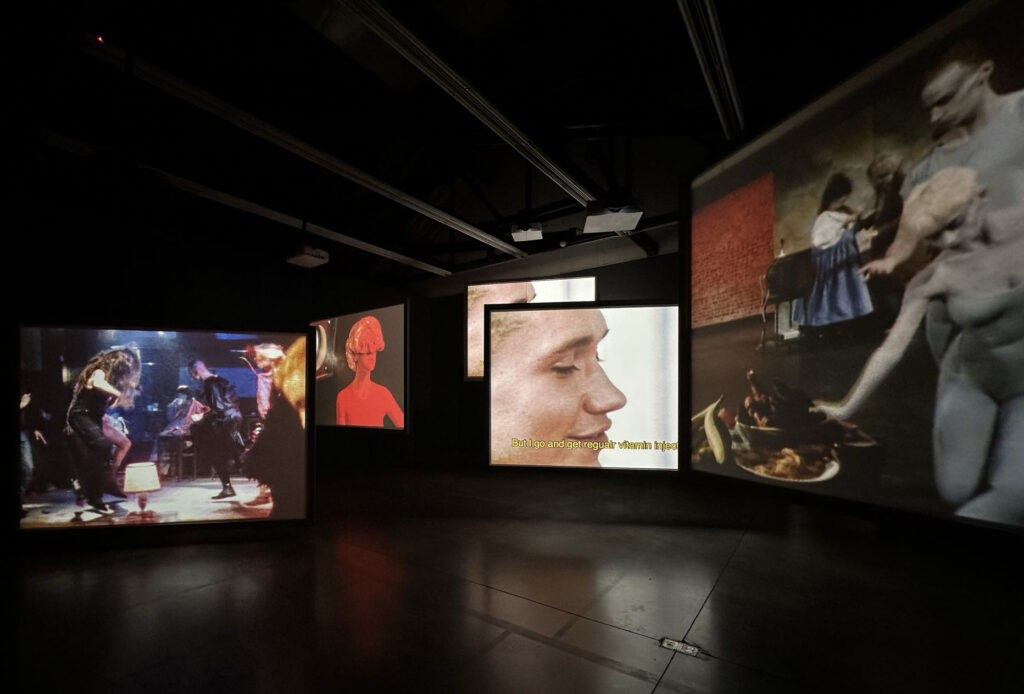
It often feels like we are oversaturated with images in today’s world, but the energy at the Charles Atlas exhibition A Prune Twin at Luhring Augustine gets the balance right.

From the gallery’s press release-

Luhring Augustine is pleased to announce A Prune Twin, the gallery’s third solo exhibition with pioneering film and video artist Charles Atlas. The presentation will mark the American debut of this major multi-channel installation with sound that was originally commissioned by the Barbican Centre, London as the centerpiece of their 2020 exhibition, Michael Clark: Cosmic Dancer; which traveled to the Victoria and Albert Museum in Dundee, Scotland in 2021.

The collaboration between the two artists began in 1984 when the young dancer, Clark, performed in two single-channel films by Atlas: Parafango and Ex-Romance. However, it was not until the groundbreaking Hail the New Puritan in 1986, that the relationship between the two artists was deeply cemented. Originally commissioned as an arts documentary by Channel 4 of the BBC, Hail the New Puritan turned the genre on its head, presenting a highly stylized and fictionalized version of a typical day in Clark’s life – an “anti-documentary”, as Atlas has called it.  The two artists also worked closely together on another Channel 4 production, Because We Must (1989), which was full of extreme theatricality in its dance, choreography, scenery, costumes, and directorial position.

In A Prune Twin, Atlas pulls material from these two major films to create an immersive eight-channel installation of sound and moving image. He extends the idea of choreography to camera and sound, flowing across and throughout screens and monitors; in this sense, Atlas choreographs his own past material into a new and compelling dance all of its own. Evident in this work, and many others by Atlas, is his strong affection and attraction to exceptionally creative collaborators, his sensitivity to movement and how to capture it on film, and his novel skills as both a storyteller and observer. Much like MC9, an immersive installation that compiles Atlas’ extensive work with Merce Cunningham, A Prune Twin surrounds the viewer in a beautifully choreographed spectacle. The work captures the spirit and passion of a 35-year collaborative relationship, one that continues to this day – currently realized through the lighting design that Atlas produces for all of Clark’s live performances, an endeavor he has undertaken since the 1980s.

Mar 092023
 

Nic Dyer “Greedy”, 2022, acrylic, sculpey, wire, and resin on canvas

Nic Dyer “Greedy”, 2022 (detail)

Nic Dyer, “Breadcrumbs”, 2022 acrylic, paper mache, sculpey, air dry clay, pumice, garnet, powdered tire, black magnum, black mica, artificial foliage, 3D printed rocks, plastic cookies, rocks, stickers, cellophane, googly eyes, pearls, gemstones, sticks, toothpicks, feather. plastic corn, plastic crayon, wooden ladybugs, and wire on canvas


Nic Dyer, “Breadcrumbs”, 2022 (detail)

Nic Dyer “Forbidden Fruit”, 2023, acrylic, aerosol acrylic, polymer clay, and wire on canvas


Nic Dyer “Forbidden Fruit”, 2023 (detail)

Currently at Hashimoto Contemporary in NYC are Nic Dyer’s sculptural paintings for their exhibition, BREADCRUMB.

From the press release-

BREADCRUMB dives into the artists long term exploration of the act of consumption, utilizing their work to examine the role of food in our lives as well as the broader culture. The exhibition is comprised of a series of eight maximal and detailed mixed media paintings, filled with fruits and candies set within meticulously rendered landscapes. Trails of sweets guide ones eye across the canvas, while rows of three-dimensional ants march towards the scattered bounty.  From individual blades of grass to minuscule flies, each detail is painstakingly executed. Rounded fleshy apples and ripened bitten fruit tantalizingly call out to the viewer, although to what end?

For this new body of work, Dyer uses well-known narratives to explore the temptation of food. Inspired by fairytales and biblical parables such as that of Adam and Eve, Hansel and Gretel, and Little Red Riding Hood, the artist pulls from these stories, mixing and remixing elements to create deliberately ambiguous messages. Is food the reward? The cause or the effect, and how do we reconcile the two?

This exhibition closes 3/11/23.

Mar 092023
 

Joani Tremblay “Untitled (naphthol red)”, 2022

Joani Tremblay “Untitled (Death Valley), 2022

Joani Tremblay “Untitled (violet mountains)”, 2022

Closing on 3/11/23 is Joani Tremblay’s exhibition of paintings, Intericonicity at Harper’s gallery in NYC.

From the press release-

Tremblay presents twelve oil paintings made since April 2022 that largely depict the landscape of rural Pennsylvania. In contrast to the chromatic levity of recent work portraying citrus fruits or the American southwest, here Tremblay hews to a darker palette of rich greens and blues inspired by farmland valleys just thawing at the start of spring. This is what she saw driving from New York City through the Laurel Highlands to reach Fallingwater, the iconic house that Frank Lloyd Wright designed as a nature retreat for a wealthy retail magnate.

How we use the land lies at the heart of Tremblay’s work. A road’s placement, a water reclamation initiative, or the machinations of land ownership matter for Tremblay not so much for their factual circumstance as for the power relations that structure them. Behind the myths of the untouched landscape or nature as a fierce inevitable conqueror over human ambition lies a question about our standpoint when we approach a particular vista. Will we simply look? Take a photograph, or retrieve a rock to carry with? Commission a plan to shape the earth this way or that? Wright erected Fallingwater over a waterfall so that it literally straddles but symbolically surmounts the tributary’s onrush. Even its windows are unframed, the better to create an illusion of coextension with the same nature it tames. Built from 1935–39, at the height of the great economic depression, Wright used nearby laborers, supporting the local economy to forge an elaborate private gem amid the picturesque.

In this vein, contradictory impulses about our treatment of the land fuel Tremblay’s paintings, which are, for the most part, each made of three constituent components painted in the following order: sky, ground, and internal frame that focuses our vision like an aperture on the landscape beyond. In Untitled (rain), ice blue shards interpose themselves between roiling clouds anchored by the slender arcs of an emerald frame, while a flaming sky tops amethyst buttes seen through the undulating rays of a cobalt-green opening in Untitled (violet mountains). Tremblay works in oil, building up the texture of certain parts of her internal borders through varying degrees of thickness applied with a loaded sponge, in contrast to the smooth finish of those borders’ flat gradients and the medium texture of her landscape’s painted fields. But as her framing devices and the near-realism of her depictions of earth suggest, the discourse of photography undergirds her work conceptually.

In the nineteenth century, government-funded photographers such as Timothy O’Sullivan spread westward, scrutinizing the earth. One of his images records a measuring stick alongside a text left on Inscription Rock by a Spanish invader, literalizing the human desire to regulate nature. Though Tremblay’s landscapes at first seem to aspire to such precision, she deploys lossy processes in the studio that encourage a departure from the indexical, supposedly truthful exactitude of landscape photography. Tremblay projects a digitally-mocked-up composition onto her canvas, but by using a poor-quality projector, she ensures that the image is too grainy to copy fastidiously at close range. And although she initially sourced one of her favorite skies—visible here in Untitled (rain)—from John Constable, she has painted it so many times that it has become her own via the minute changes materialized through repetition. She looks to her own work, not Constable’s, when she paints this sky anew. Thus, Tremblay charts a middle path between photography’s documentary dream and landscape painting’s glorification of subjective experiences in nature, drawing on these themes to surface accrued ideologies latent in the very notion of the landscape view.

Although Tremblay’s vistas arise from her personal travel, they seem uncannily familiar because they draw from a cultural imaginary rather than from specific locales. To wit, Tremblay conducts research on Instagram, where curated landscapes are already shot through with aesthetic codes long established by artists from Ansel Adams to Lawren Harris and Arthur Dove. Photography’s indexical referentiality is at a remove twice over in Tremblay’s work, first through the interpretive act of painting by hand, and second by encoding within it a whole set of images and conventions for their appearance that encircle us in the digital realm.

Unlike a palimpsest, in which a first layer of representation is covered over by a second, Tremblay’s work operates through intericonicity, a term derived from semiotics. Intericonicity offers a way to understand a relation of copresence between two or more images which may appear eidetically or actually as one image within another. This realm of infinite reproduction and false memory offsets a more straightforward mood each painting’s chromatic scheme seems to deliver. The smooth, inky valleys of Untitled (sunset and trees) might suggest placidity, for instance, the sheer height of Untitled (Laurel Highlands) soaring power. But because each work signals allusions to so many art historical or geographic references alongside their ideological effects, that mood resists resolution. Said differently, these are not easy paintings to decode. Their sharpness of focus functions on multiple strata at once.

Mar 092023
 

For Martín Touzón’s exhibition DISSOLUTION, at Kates Ferri Projects in NYC, each work plays a part in the one that comes next. Moving from work on Wet Wipes, to neon, to painting and back again- the more you look at them, the more you can see their connection to each other.

From the press release-

As an artist who normally rejects his previously established rules from one project to the next, he turns the table on this pattern as well, dissolving his own methodologies. Touzón says that “Change comes from noticing a difference in the feeling towards something.” Being an economist-turned-artist, he studies the impact of altering one variable on another. In the process he unconsciously opens a dialogue between arts and economics, relating at some point to the accumulation and fuite, trade, exchange, barter and surplus, production and circulation.

“The unfolding between the series came quite intuitively,” says Touzón. While on board the train to his residency in Turin (the city of Arte Povera) in 2017, he picked up bits of text and shapes from a magazine using acrylic markers and sharpies. He had to work fast so that the image would not be muddled because of the bleed of colors on the wipes. Lacking full control over the final image, the artist then lets them dry inside the same magazine. This technique underlies the paintings on Wet Wipes in the exhibition.

In contrast, the neon sculptures are very intentional. In his collaboration with a sign maker from Buenos Aires, Touzón must communicate quite specifically about how he wants the rings to look–almost misshapen. Translating from a 2D surface now into a 3D object, the artist is also playing with scale. The works on Wet Wipes are immediate and close to the hand, while the neon sculptures take up space and its light brings in the body.

As a next step, Touzón utilizes the neon shapes during the painting process. Laid on the canvases or over paper, they let the paint to diffuse on the wet surface, which in turn allows chance to play a role in the outcome. This gesture mimics the results in the Wet Wipes series, and yet the effect of the neon through paint or light is wholly distinct. Thus, he leads his work on the Escher stairs, seemingly returning to the same place, but ultimately, landing someplace new.

This whole process is an exciting new chapter in Touzón’s work. As an Argentina-based artist, Touzón has first-hand experience of an environment where instability is a constant of everyday life. Reason why his obsession for the careful study of transitions and changes. As the dissolution of society and systems come crumpling at our feet with the pandemic, climate change, and ongoing wars, the art world is also being reshaped by new artists and cultural producers. The holdouts for the old-world order or artistic hierarchies are also disillusioned, finding themselves in a new society that may look similar, but is fundamentally changed. Through his works, Touzón subtly suggests a way of perceiving through the cracks of this new normality and how one’s diluted perception of the world might not be an accurate reflection of others’ reality.

This exhibition closes 3/13/23.


Mar 092023
 

Kelli Thompson, “Forever Yours”, 2022

Kelli Thompson, “Quiet Time”, 2021

Paintings by Kelli Thompson, part of her exhibition Full Bloom, on view at Shelter in NYC until 3/12/23.

From the press release-

Using distinctly feminine anatomy paired with the sexual organs of flora, Thompson explores aspects of her physical existence as a woman. The result is paintings that are intensely personal while also, through the lack of distinctive characteristics, universal; the work functions as a reference to all women’s bodies and the botanical elements act as extensions of them. Acknowledging sexuality, while falling short of revering sexual beauty, the artist’s goal is not to highlight sexuality in femininity but to emphasize the visceral discomfort which often accompanies a woman’s physical experiences.

By separating and isolating parts of the figure, Thompson points to the way in which the treatment of the body based on definitive female functions often serves to define the woman as a whole. In doing so, she addresses the guilt, fear, anxiety, and profound unknown when being confronted with the limitations of physicality. Yet the work itself is not meant to manifest anxiety for the artist or the viewer; Thompson shows tremendous appreciation and compassion for the female body through the loving, and often obsessive, rendering of her subjects.

Recalling popular color palettes from her childhood, Thompson utilizes painted gradients created from multiple layers, blending until every mark is eliminated. This technique mimics digital fabrication, despite working solely within the boundaries of oil paint, a substrate, and the hand. This pristine level of finish places the artist’s work in dialogue with the historical tradition of realism within portraiture and still life painting, yet the juxtaposition of these subjects against abstracted formal elements situate them in a wholly fictional, artificial space. Through this process, Thompson is able to both highlight and re-contextualize realism.

Mar 082023
 

Chiharu Shiota, “Connected to the Universe”, 2023

Chiharu Shiota, “Connected to the Universe”, 2023 (detail)

Chiharu Shiota, “Connected to the Universe”, 2023, detail

“Connected to the Universe”, 2023

Chiharu Shiota’s gorgeous installations are just one part of her engaging exhibition, Signs of Life, at Templon in NYC. The installations lead to other rooms of smaller sculptures as well as  paintings.

From the press release-

After a foundation degree in painting at Seika University in Kyoto, Chiharu Shiota chose to pursue her artistic studies in Berlin, focusing on performance. Her practice soon shifted towards site-specific installations. She skilfully weaves knotted threads to create fantastical scenes combining salvaged window frames, a piano, suitcases, books and used clothes. Bordering on drawing and sculpture, her fabulous ephemeral, immersive installations have become her signature. Since her impressive installation for the Japanese Pavilion at the Venice Bienniale in 2015, she has become one of the key figures on the international art scene and is regularly invited to show her work at museums worldwide.

In a hyper-connected world, Chiharu Shiota’s new exhibition questions the notion of the “web”, a living organism similar to the structures that make up the universe or the neurons our brains are built on. Created on-site over two weeks, a large-scale installation made of red threads symbolizes this permanent connection of information, collective memory and the world’s knowledge which cuts across cultures and continents. At the heart of the work are two arms, her own, placed on the ground. They are cast in bronze, palms facing up to the sky. “I always thought that if death took my body, I wouldn’t exist anymore,” explains the artist. “I’m now convinced that my spirit will continue to exist because there is more to me than a body. My consciousness is connected to everything around me and my art unfolds by way of people’s memory.”

The installation is followed by a series of sculptures. Enfolded at the centre of each one, as though frozen in place by the intertwined threads, are objects from daily life. “I feel that the objects we possess are like a third skin,” she says. “We accumulate these things and transpose our presence and our memory to them.” Often obsolete, weighed down by impenetrable histories, these objects — old suitcases, stained dolls, miniature pieces of furniture and tiny bottles — represent the treasures offered up by memory, to be seen but not touched.

“State of Being (Dress)”, 2022

State of Being (Photos), 2022

State of Being (Photos), 2022 (detail)

This exhibition closes 3/9/23.