Dec 192019
 

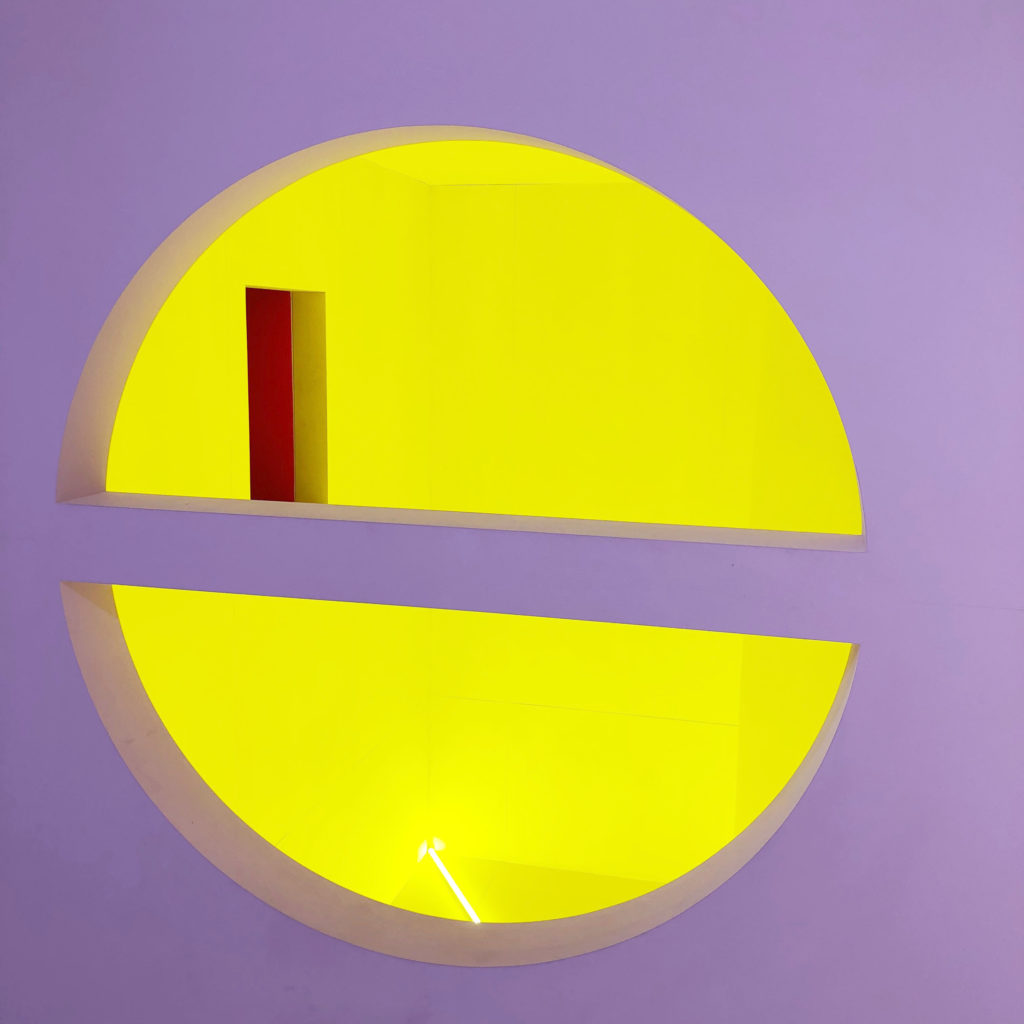
Anish Kapoor’s exhibition at Lisson Gallery’s 24th Street location is a reflective wonderland where the sculptures twist your perception of your surroundings as you move around them. If his work looks familiar, he has created many public outdoor works including Cloud Gate, also known as “The Bean”, which is permanently installed in Millennium Park in Chicago.

The exhibition continues at Lisson Gallery’s smaller 10th Avenue space with several of Kapoor’s colorful wall-based circular sculptures in semi-reflective hues.

Both of these exhibitions close 12/20/19.


Dec 192019
 

For Peter Halley’s Heterotopia II, at Greene Naftali’s ground floor gallery in Chelsea, he has created a delightful, brightly colored maze-like installation.

From the press release–

In Des Espaces Autres (1984), Michel Foucault defines heterotopia in opposition to utopia. While utopias are unrealized representations of a perfected society, heterotopias exist within all societies as realms differentiated from everyday life. Examples include ceremonial, sacred, and institutional spaces such as chapels, cemeteries, libraries, and prisons. They are spaces designated for special activities – creating their own sense of time and operating according to their own standards.

Through a range of media – painting, architectural installation, digital prints, and critical writing – Peter Halley’s work has illuminated the structures of social space and communication that shape our experience of contemporary life. For his second solo exhibition at Greene Naftali, Halley presents Heterotopia II, the latest in a series of large-scale installations exploring the relationship between painting and architectural space. Halley has created a multi-colored, labyrinthine structure in the ground floor gallery housing eight new shaped-canvas paintings, titled after imaginary planets from Isaac Asimov’s science-fictional universe.

The installation is enclosed by tall neon yellow walls coated in Roll-a-Tex, with only a narrow slot in the front wall offering the viewer a preemptive glimpse inside. The interior space is organized around a glowing yellow core – an inaccessible inner sanctum whose light is solely visible through three distinctive apertures. Around the core are arrayed eight interconnected rooms rendered in vivid colors, each defined by architectural elements, including staircases, keyhole windows, beams, and columns. The arrangement of these elements playfully nods to motifs in the work of architects Peter Eisenmann, Hans Hollein, Luis Barragán, and Louis Kahn, as well as to Halley’s own oeuvre. Halley’s installation, with its candy colored surfaces, is a postmodern reverie on neoplasticism and modernist geometry, founded on a tension between rationalist geometry and lyrical color.

Visitors circulating through the maze-like installation encounter Halley’s shaped-canvas paintings one-by-one, as the interactions between two-dimensional image and three-dimensional architecture unfolds. Composed of multiple interlocking prisons and cells, the paintings create ambiguous figure-ground relationships, while echoing the geometric plan of their three-dimensional setting.

This exhibition closes 12/20/19.

Oct 222019
 

Alex Prager’s exhibition at Lehmann Maupin’s 22nd Street location combines sculpture and still photography with her new film Play The Wind. The photographs in the show recreate scenes from the film, but are not from the film itself.  There are also photos of scenes that could have been from the film, but are not. These allow the viewer to consider alternate narratives to the story they have just seen. The photos also offer an opportunity to see many of the details from the film seen only briefly while watching.

Running for eight minutes, Play the Wind is a journey into a bizarre version of Los Angeles. It’s seen mainly through the window of a car, the way many Los Angeles residents often see it. Places seem familiar, as do many of the large cast of extras who inhabit this world, even if you are not personally familiar with the city.

The cab driver, played by Dimitri Chamblas (dean of the Sharon Disney Lund School of Dance at CalArts), drives through situations that seem both surreal and possible at the same time, like many things that happen in LA. At one point the cab driver, drives past an accident on the highway and sees a car vertical between two other cars with children in a school bus leaning out of the windows to observe. He passes alongside and moves on. It’s just another moment in a chaotic Los Angeles day. When he locks eyes with a woman played by actress Riley Keough, the film changes to her perspective and it all becomes even more dreamlike.

From the press release–

…She anchors her characteristically elaborate fictional scenes within the real Los Angeles, shooting for the first time in many years primarily on location rather than in the studio—a decision that harkens back to when Prager began her career over a decade ago. Though the images contain large constructed set pieces and are populated with carefully cast extras (numbering up to 300), the presence of the Los Angeles streets infuses an element of urban lifeblood that is palpable in the work. Prager’s perception of Los Angeles is one of the artifice and drama befitting Hollywood, with real world chaos that overflows into sci-fi dystopia and post-apocalyptic dread. She toys with these visions of the city disseminated on film, TV, and within the popular imagination, which inform our characterization of a place as much as our own memories.

Technically important to the making of this film was Prager’s collaboration with a team to produce set designs and props that would add a layer of artifice and duplicity to her real-world locations. The interference of these traditional illusionary effects upon the actual Los Angeles streets and locations Prager shot on creates an unnerving sensation, hinting at the reality that might exist just outside of our perception. All of these elements are recast in the series of photographs, which appear in different configurations or on various scales that further destabilize any linear narrative. Drawing on the concept of a distorted memory, Prager has found ways to incorporate objects seen in the photographs and film into the gallery as sculpture, with the intent to further dislodge our understanding of place and time and bring us deeper into her highly constructed world.

Connoisseurs of Prager’s work will likely spot the references to her past series, such as the noir themed Compulsion (2012), or the archetypical ingénue of The Big Valley (2008). This self-referencing becomes yet another layering device, mixing Prager’s career-spanning themes and the greater art historical genres from which they are drawn to create work both entirely new, yet seemingly familiar. Prager’s incorporation of her past into her present work serves as a reminder that while the past may not be returned to, it does remain with us, appearing in surprising, sometimes unsettling ways.

This exhibition closes 10/26/19.

Oct 222019
 

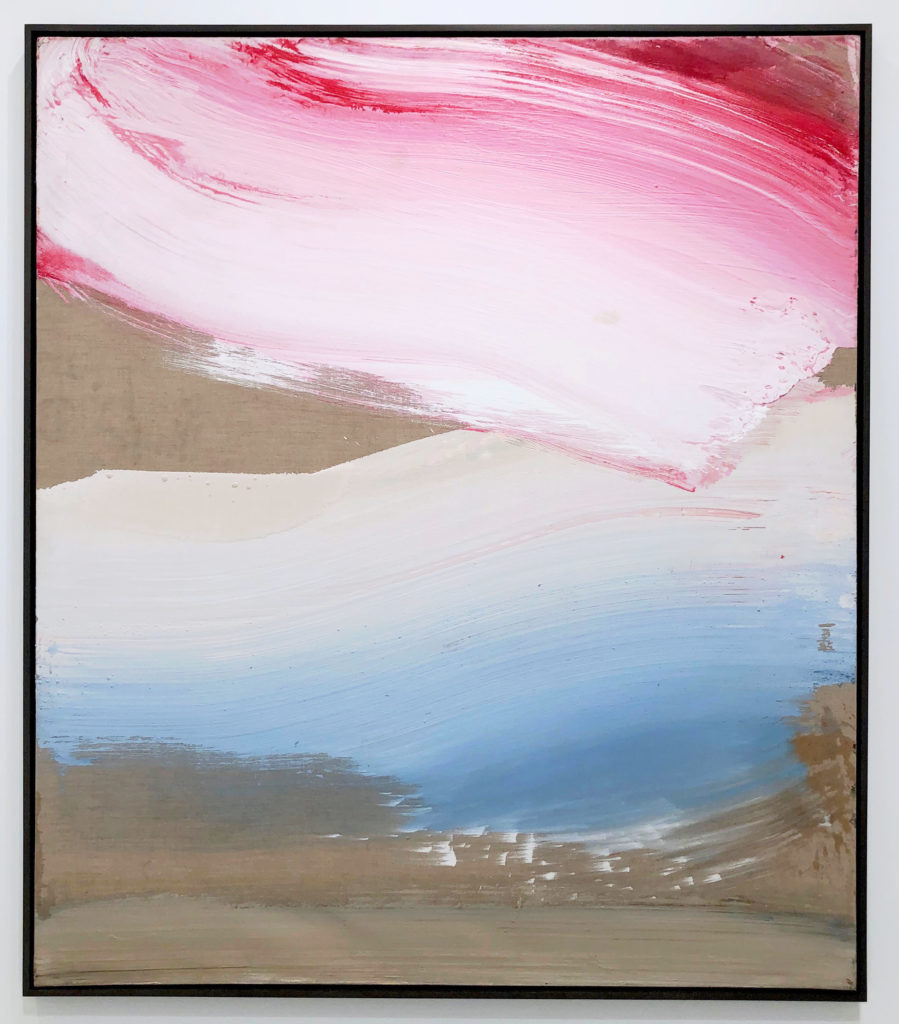
Hauser & Wirth is currently showing two painting exhibitions. On the ground floor of their 22nd Street location are Ed Clark’s gorgeous abstract works, some of which are pictured above. The paintings on view are recent, made between 2000 and 2013. Created on the floor using a push broom, there is a high energy in the motion and blend of color in these canvases.

Sadly, Clark passed away on Friday, October 18th at the age of 93. He was an innovative abstract painter who worked for more than 60 years. This is a wonderful opportunity to see his work in person.

On the second floor of the gallery is Amy Sherald’s the heart of the matter… , (pictured below) her inaugural exhibition with the gallery. If her style looks familiar, it may be because she gained a lot of attention with her portrait of Michelle Obama for the Smithsonian’s National Portrait Gallery.

“If you surrendered to the air you could ride it” (2019)

“Precious jewels by the sea” (2019)

From the press release-

Informed by the artist’s reading of key texts that explore tensions between interior and public realms, the heart of the matter… draws its title from the first chapter of bell hooks’ seminal book ‘Salvation,’ and builds on themes of silence and stillness explored in Kevin Quashie’s ‘Sovereignty of Quiet’ and U.S. Poet Laureate Elizabeth Alexander’s ‘Black Interior.’ In her new paintings, Sherald considers how these relate to the conceptualization of blackness as it is represented publicly, questioning representation of black identity, which often negates the complex reality of an interior life. She envisions black American identity beyond the conceits to which it has largely been restricted, attempting to restore a broader, fuller picture of humanity.

Sherald’s portraits are vivid, large in scale but intimate in effect, capturing both the ordinary likeness and extraordinary essence of her subjects while simultaneously detaching them from everyday reality. Varying in expressiveness, gesture, clothing, and emotional auras, the individuals portrayed maintain a persistent sense of privacy and mystery, requiring viewers to ponder the sitters’ thoughts and dreams. Drawn to each of her subjects instinctively and spontaneously, these ‘Americans doing everyday American things,’ as Sherald has described them, are part of an informal network of people who populate our universe.

Once Sherald commences painting, a transformational moment ensues as the artist begins to view her sitter as an archetype in the history of representation and therefore a vehicle for challenging assumptions. Working from carefully composed and dramatically staged photographs, Sherald situates her subjects in brightly colored, ambiguous environments, then meticulously tweaks expressions and patterns to emphasize a sense of universality and connection. While her subjects are always African-American, Sherald renders their skin-tone exclusively in grisaille – an absence of color that directly challenges perceptions of black identity.

the heart of the matter… debuts two paintings that reach a new, monumental scale for the artist. In these works, Sherald’s monochromatic backgrounds evolve into fully realized scenes that reference quintessential Americana: friends posed at the beach and a man atop a metal construction beam. For the latter, Sherald draws inspiration from Charles C. Ebbet’s iconic photography of 30 Rockefeller Plaza in New York City. Sherald often looks to vintage photography for source material, drawn to what she describes as its capacity ‘to narrate a truer history that counters a dominant historical narrative… Photography was the first medium I saw that made what was absent, visible.’ Sherald continues, ‘It gave people who once had no control over the proliferation of their own image the ability to become authors of their narratives.’ By mining and positioning images associated with archetypal or nostalgic American moments – burgeoning industry, sunny beachside locales – Sherald is able to firmly situate and make fully visible black Americans within the canon of American iconography. In this way, her portraits reclaim space and author a narrative for people that official art history omitted, speaking to the human condition and holding up a mirror to American life.

Lastly,  take a trip to the top floor for the group show Personal Private Public, a group exhibition “exploring the idea of the inner life in three main themes: introspection, intimacy, and voyeurism”.  The exhibition includes work by Jonathan Lyndon Chase, Ivy Haldeman, Celia Hempton, Tala Madani, Paul McCarthy, B. Ingrid Olson, Paul Mpagi Sepuya, Emily Mae Smith, Mira Schor, and Kohei Yoshiyuki.

All three of these exhibitions close 10/26/19.


Oct 182019
 

“Crescent (Timekeeper)”

“Crescent (Timekeeper)”

“Crescent (Timekeeper)” Detail

Sarah Sze’s exhibition at Tanya Bonakdar’s gallery in New York is stunning. There is so much to look at, to appreciate. There are so many pieces to all of the work, and yet it never feels overwhelming. It makes you want to keep looking.

It’s also immersive. The windows on the outside of the gallery are covered in her work, as is the staircase alcove. The video projections in the main room travel all around the room, surrounding you with visuals and sound. Upstairs the floors of the gallery have paint splattered on them, accompanying the works on the walls.

Detail of the above work

In a room on the first floor is a “studio space” where you can gain insight into Sze’s process and how she makes these elaborate works.

From the press release-

Sze’s latest body of work frays “the seam between the real and the image” (Smith). Through complex constellations of objects and a proliferation of images, Sze expands upon the never- ending stream of visual narratives that we negotiate daily, from magazines and newspapers, television and iPhones, to cyberspace and outer space. The works evoke the generative and recursive process of image-making in a world where consumption and production are more interdependent, where the beginning of one idea is the ending of another—and where sculpture gives rise to images, and images to sculpture.

In this new exhibition, Sze expands her work by embedding her nuanced sculptural language into the material surfaces of painting and into the digital realm through the interplay of cloth, ink, wood, paper, metal, paint, found objects, light, sound and structural supports—collapsing distinctions between two, three and four dimensions. This body of work fundamentally alters our sense of time, place, and memory by transforming our experiences of the physical world around us. Both objects and images, Sze says, are “ultimately reminders of our own ephemerality”.

This exhibition closes 10/19/19.


Mar 012019
 

Matvey Levenstein, LY, 2018

Currently at Kasmin Gallery are Matvey Levenstein’s paintings depicting scenes from his life in North Fork, Long Island. There’s a quiet, peaceful quality to the works, which begin with snapshots before they are turned into paintings. This exhibition closes Saturday 3/2/19.

Across the street at another of Kasmin Gallery’s Chelsea locations, and worth a visit, is an exhibition of some of Andy Warhol’s polaroid portraits.

Matvey Levenstein, Pink Moon, 2018

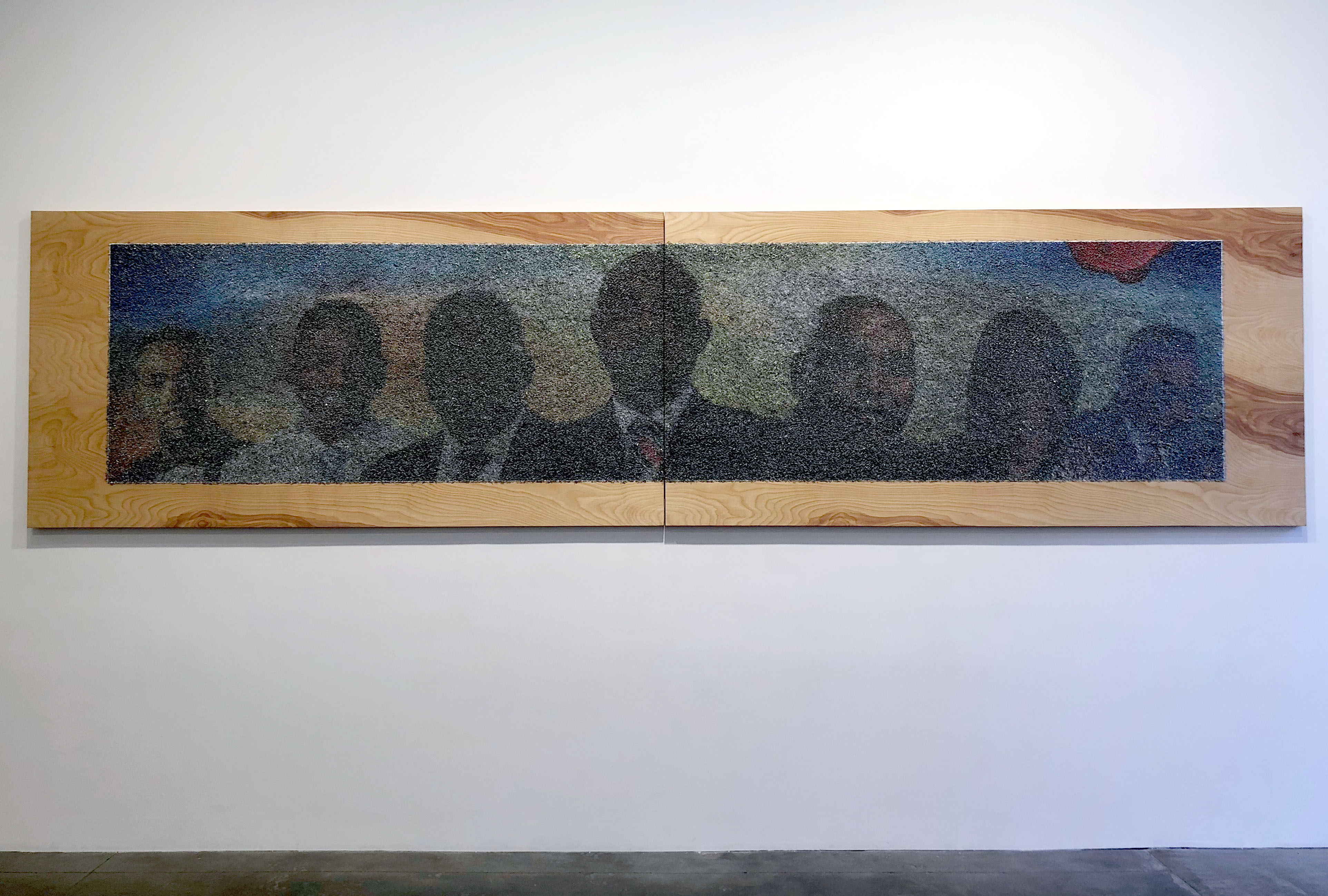
Susan Inglett Gallery is showing Slim… you don’t got the juice, an exhibition of work by Wilmer Wilson IV. His work with staples may seem familiar from its inclusion in the New Museum’s 2018 Triennial: Songs for Sabotage.

From the press release-

Slim… you don’t got the juice presents multidisciplinary departures from familiar modes of figurative representation, as they have evolved in the realm of photographic discourse. Wilmer Wilson IV has developed strategies of redaction and annotation in his work that begin to destabilize the norms of making and viewing portraiture through visual, material, and technical manipulation. An exploration into the complex renderings of individual subject-hood versus object-hood in portraiture, the artist has conceived of a stapled-surface-as-viewing-device that mediates image with material. The device is manifest in a series of staple works that almost fully shroud the photographic subjects beneath dense fields of metal fasteners. The austere, randomized application of the staples onto the surface of each portrait results in a resistance of visual penetration from many angles, complicating access to the underlying figures and deconstructing the voyeuristic inclinations of the viewer.

This exhibition closes 3/16/19.

Wilmer Wilson IV, Host, 2018


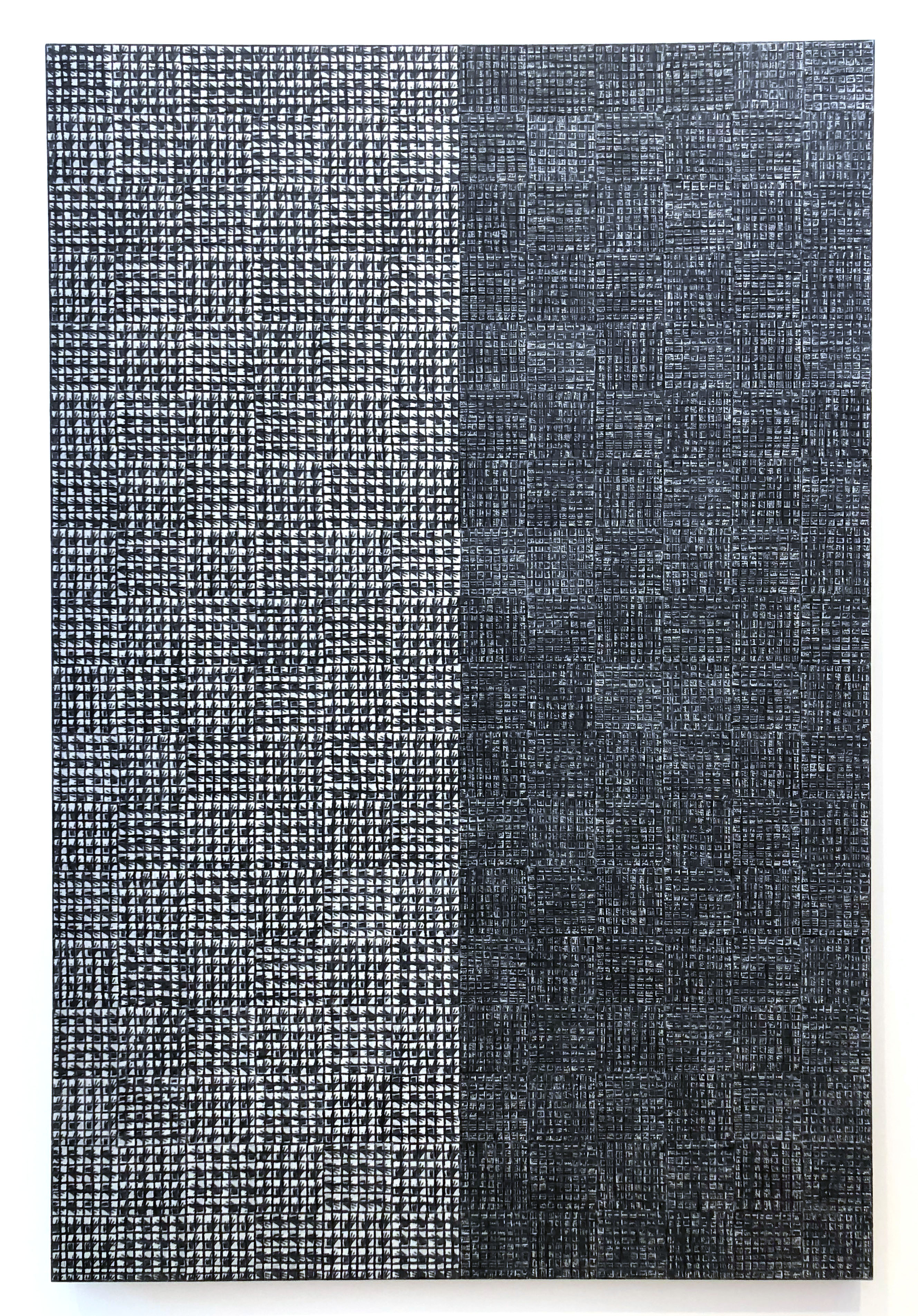
At Lehmann Maupin’s 24th Street location is McArthur Binion, Hand:Work, an exhibition of the artist’s grid paintings created with oil paint stick and paper on board. The patterns created in the work are overwhelming at first glance but then when seen up close, the personal details add a new dimension to the paintings.

From the press release–

…For Binion, his personal documents represent the sum total of one’s social life: relationships, citizenship, vocation, and family life. The revealing and obscuring of these aspects of his life also addresses the larger sociopolitical reality of African-American identity—often obscured or erased from common knowledge, yet always present in tandem with major movements in American culture. In his newest Hand:Work paintings, Binion takes an introspective approach that is more closely aligned with the artist’s own self-perception—effectively, his first self-portraits. Using copies of a photo of the home where he was born, along with a photograph of his hand as the ground layer of the paintings, Binion pares down his identity to its most essential elements. These images are tiled in repeated succession, layered under his repetitious line work in oil stick. These gestures themselves relate to memories Binion has of his early childhood farm life, a disciplined approach to the cyclical, sustained effort he maintains in his work today. Through the insertion of his hand, literally in the photographs, and figuratively in his intricate, overlapping mark-making, the artist relates to his earliest introduction to artistry in his mother’s quilting, a tradition he modified and carried into his practice.

This exhibition closes 3/2/19.

McArthur Binion at Lehmann Maupin

McArthur Binion at Lehmann Maupin, detail of above painting

Robert Mann Gallery is showing the newly discovered work of photographer Ed Sievers. The exhibition of black and white photos also includes his later work from the 1970s in Venice Beach. The gallery also has an exhibition of Michael Kenna’s series of black and white female nudes made in Japan (not shown). Both shows close 3/2/19.

Ed Sievers, Untitled (woman in the shadows), c. 1960s, courtesy of the artist, image via Robert Mann Gallery

Damn! The Defiant, a group show curated by Damon Brandt and Andrew Freiser at Fredericks & Freiser Gallery, brings together “images of rebellion and dissent in contemporary portraiture” and includes a wide variety of work in different mediums from an incredible selection of artists that includes Mary Ellen Mark, Gordon Parks, Dana Schutz, Bruce Davidson, Whitfield Lovell and many more. It’s a show that’s very appropriate for a time period that is going to require more and more defiance.

From the press release-

Nothing creates projected personal territory more than the emotional push back generated from the recalcitrant expression of a defiant subject. Yet ironically, it is the very nature of this engagement that makes it difficult for the viewer to quickly detach or withdraw from what in fact amounts to an extended glare or moment of social tension. In a time of undeniable anxiety, finding both the common and contrasting ground in the portrayal of defiance speaks directly to the angst and pre-occupation for self-determination that has been and continues to be a pervasive human concern.

This exhibition closes 3/2/19.


Installation view of Damn! The Defiant, image via Fredericks & Freiser


Feb 162019
 

Currently at Mitchell-Innes & Nash is Masses & Mainstream, an exhibition of Karl Haendel’s incredibly detailed drawings and his musings on life in current day America. The drawings can be humorous at times, including a comparison of himself to Jared Kushner through a checklist, and a record of his types of sneezes. They are balanced by others, where he expresses his anxiety when it comes to selling art, or a smaller piece that lists “wishful thinking” items that includes healthcare, education, housing, and equity for all.

From the press release-

While Karl Haendel’s newest work covers a wide range of subject matter from a stack of lawnmowers to a portrait of Barbara Walters, the common thread that links these disparate images is a dialogue between memory, both personal and collective, and national identity. Many of the works on view are drawn from overlooked sources in contemporary American life—cultural leftovers the artist combs through and resuscitates in order to represent an alternate picture of American reality. Other works, like the aforementioned stack of lawnmowers, come from the artist’s personal history and experiences—a once-submerged detail from his childhood home that has floated to the surface of recollection—that could also be read, more symbolically, as the paraphernalia of American comfort, excess and, perhaps even, of the endangered middle class.

This exhibition closes 2/16/19.

Mar 242018
 

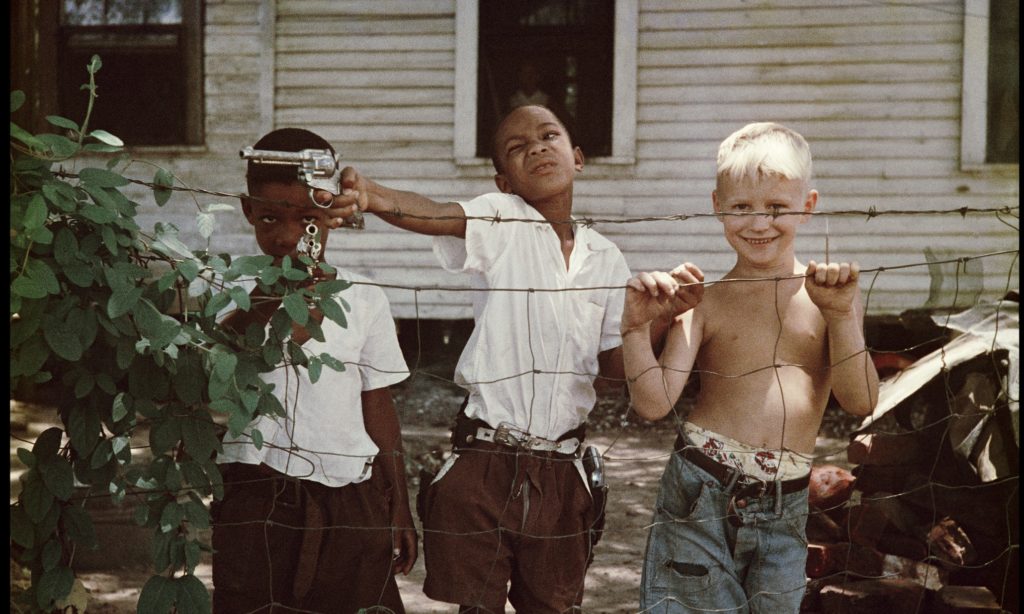
Gordon Parks, “Untitled”, Alabama (1956)

Gordon Parks was an incredible photographer whose influence continues to be felt in photography today. He had a long creative career that also expanded beyond photography to include writing several books, composing music, and directing films- the most famous being Shaft.

The Gordon Parks Foundation recently hosted the exhibition ELEMENT, which focused on several of the photographs that inspired Kendrick Lamar’s video from his album DAMN, seen below. The photo pictured above can be seen as part of the exhibition of Gordon Parks’ work I Am You Part 2 at Jack Shainman Gallery in New York. It is from his series Segregation Story for Life magazine which focused on the daily lives of three black families in Alabama in 1956.

The photo below is a still from Kendrick Lamar’s Element. The video was directed by Jonas Lindstroem and The Little Homies (Kendrick Lamar and Dave Free).

To see more of Parks’ work and the work he has influenced, The Gordon Parks Foundation’s website is a good resource for upcoming exhibitions around the world.

Jan 092018
 

Jim Shaw “Cloud Maintenance”, 2017

Jim Shaw “The Ties That Bind”, 2017

Currently at Metro Pictures, Jim Shaw‘s current mixed media exhibition is full of works that are interesting, engaging and fun.

From the press release–

Rendered in exquisite detail, Shaw’s virtuosic work combines his analysis of the political, social and spiritual histories of the United States with contemplative reflections of his own psyche. For more than three decades he has examined art history, comic books, subcultural undergrounds and consumer products—to name only a few of his wide-ranging fields of interest—to articulate a distinct visual language that charts the country’s ever-shifting sociopolitical landscape.

The paintings in this exhibition incorporate symbols and characters of the past to comment on our fraught present. Using imagery drawn from Old Testament stories, pagan myths and satirical cartoons, Shaw relies on his encyclopedic knowledge to visualize our common vernacular. His layered symbology reads like an exaggerated mirror of our hyper-mediated, “post-truth” reality.

This show closes 1/9/18.

Work by Elizabeth Murray

At Pace Gallery’s 25th Street location is Elizabeth Murray: Painting in The ’80s, a collection of sixteen unique colorful canvases the artist created during this period.

From the press release-

Elizabeth Murray: Painting in the ‘80s presents formal and narrative content that continues to influence the techniques and subject matter of contemporary painting. Murray arrived in New York in 1967 during the heyday of Minimalism and the rise of Conceptualism, and amid prevailing assertions of painting’s demise. As she recollected, “The mood was that painting was out, that hip people, people who were avant, weren’t involved in painting. That was unnerving, but then I didn’t give a damn.” Fully committed to painting, Murray broke new ground depicting personal, poetic and at times feminist narratives on complex multidimensional shaped canvases. Murray’s compositions from the 1980s suggest large-scale breaking cups, tumbling wineglasses, tilting tables, windows, rooms, attenuated human forms, letters, symbols and abstract shapes constructed through positive and negative, real and imagined space. As Roberta Smith has written, “She has put the vocabulary of twentieth-century abstraction to new and different uses, tracing in irresistible formal terms a psychological narrative that is not explicitly feminine but that women, thanks to society’s relentless conditioning, know best and most completely.”

This show closes 1/13/18.

Jorge Pardo

For Jorge Pardo‘s first painting show at Petzel Gallery, he combines his painted self portraits with a sculptural element. Candid snapshots of the artist are “blown-up, engraved, laser-cut, hand-painted and back-lit with LEDs, to produce, in some cases, vast ornamental objects”. The beautiful large works have the added effect of changing slightly depending on where you stand in the gallery as the light shines through the wood.

This show closes 1/13/18.


Oct 202017
 

Work by Leslie Wayne

If you are heading to Chelsea this weekend, stop in to these galleries which have excellent shows closing 10/21/17-

At Jack Shainman’s 24th Street space are Leslie Wayne’s rich and colorful sculptural paintings for her exhibition Free Experience.

From the press release-

In Free Experience, I have returned to the figure-ground relationship as a way of exploring the range of possibilities for the representation of an illusion in as many different ways as possible, from trompe l’oeil to verisimilitude, while still remaining undeniably within the confines of a traditional painting. These paintings are a collision of abstraction and representation, of illusion and three-dimensional form. They are defined not so much by the shape of the objects they represent, but by the perceptual slippage between object and illusion. They are, like all my work, somewhere between sculpture and painting, and perhaps in Krauss’s view would simply be considered painting in the expanded field.

Looking at art is a free experience. It costs you nothing. But it should also be an experience that is free from encumbrances, one that inspires you to see the world as if for the very first time. But perception is a tricky thing. It is never without personal history. How do we see, what do we think we see? And what makes the experience of looking at a work of art so compelling? The answer lies outside of language, in that transformational moment between looking and seeing, between information and knowledge. In that moment before the need to translate the experience into language moves from the id to the ego. Seeing is indeed forgetting the name of the thing one sees.

Upstairs at David Zwirner’s 20th Street location, is the gallery’s first exhibition of the work of Ruth Asawa (pictured below). It includes many of her famous wire sculptures as well as works on paper, paintings, and vintage photos of her and her work taken by Imogen Cunningham.