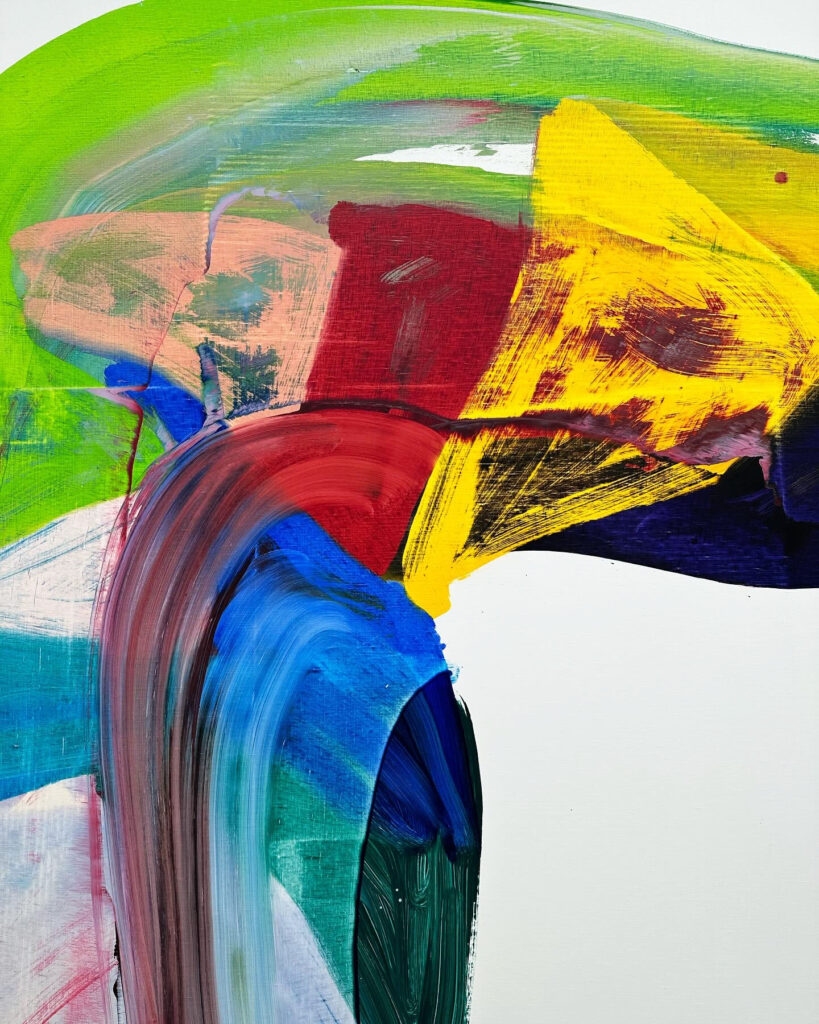
May 172024
 

“New body, new body”, 2024, Oil and graphite on linen

“Our family portrait/ Dancing over the town”, 2024, Oil and graphite on linen

“In Bed” 2024, and “The world was different when Leonard painted Emily”, 2024, Oil and graphite on linen

“I love basketball”, 2024, Oil and graphite on linen

Tanya Merrill’s exhibition, Watching women give birth on the internet and other ways of looking, at 303 Gallery explores the way we look at the world today while referencing classical imagery from the past. What has changed in the way we see ourselves, our place in society, and our place in time? How much has changed because of self documentation and the internet? All of these questions feel even more prevalent now with technology and environmental issues moving at an accelerated pace.

From the press release-

True to her propensity for a cyclical and narrative installation, the show begins and ends with the creation of life. Each painting represents a diverse point of interest and concern to the artist— sexuality and ideas of fertility, the natural world and the fraught state of the environment, and the broader implications of contemporary technology, sports, and religion on the artist’s experience as a woman today.

The scale of the subjects in each canvas approximate life, creating a one-to-one perspective when standing in front of, say, a tree trunk, a cat perched on a fish tank, or a man admiring himself with a basketball. One work shows a trompe l’oeil stack of papers illustrating a 15th century manuscript: an early representation of a woman’s fertility cycle in relation to the stars. The modes for distributing images have changed, but the need to see them has not—jump ahead 800 years and the show’s namesake painting frames the edge of a computer screen, documenting the recent phenomenon of sharing one’s birthing story and corresponding photographs publicly on the internet.

Humans have always employed tools for looking. The earliest manufactured mirrors were made from volcanic glass in Turkey and date some 8000 years ago, the invention of the telescope advanced our understanding of Earth’s place in the cosmos, a phone now captures our own image with a recent poll finding 92 million selfies are taken every day around the world: the Allegory of Sight and mythology of Narcissus regenerates.  In I love basketball, a naked man gazes affectionately at himself in the mirror. Coyly, he holds a basketball in front of his own genitalia; pensive yet playful, he engages the long tradition of masculinity in sports seen throughout art history. Across the gallery, a pregnant woman is doubled in the frame and photographs her changing body. The technology she clutches, perhaps soon to be obsolete, will be inextricably linked to the start of the 21st century.

The North American cecropia moth is seen on its host plant, a white birch tree, one of the few plants a Cecropia larva can eat. A recent report found dramatic rates of decline that may lead to the extinction of 40% of the world’s insect species over the next few decades. And with a single nest of baby birds needing up to 9,000 caterpillars before they are ready to fledge, the looming demise and precarity of our food chain is blatant. Merrill is compelled to paint the species that are still here, a record that they really did live before they died. The ecologist David Wagner says of the insect decline, “… We don’t know if it’s an apocalypse or Armageddon.”

In Our family portrait/ Dancing over the town, three skeletons– two human and one dog– are seen romping joyfully, even in death. The couple, winged and facing eternity together, point to religious imagery from a 17th century wall tomb, while the surrounding landscape references the art movements of Europe which inspired the Hudson River School Painters— an homage to the place this exhibition was made. Merrill’s studio in the Hudson Valley can be seen nestled in the bottom left corner of the canvas.

This exhibition closes 5/18/24.

May 142024
 

“Swirl of Sounds- The Ghost in the Banyan Tree”, 1976, Oil on canvas

“Flotilla”, 1962, Oil on linen

“The Blue Drum Path to the Open Coast”, 1977, Oil on canvas

The paintings in Alice Baber: Reverse Infinity at Berry Campbell are alive with color. The delightful paintings were created using thinned-down oils and acrylics to give the work a watercolor effect.

On one wall, the gallery has included the quote below in which Baber described her process-

“When I first conceive of a painting‭, ‬I must feel it‭, ‬I hear it‭, ‬I taste it‭, ‬and I want to eat it‭. ‬I start from the driving force‭ ‬of color‭ (‬color hunger‭); ‬then comes a second color to provide light‭, ‬luminous light‭. ‬It will be the glow to reinforce the first color‭. ‬I then discover the need of one‭, ‬two‭, ‬three‭, ‬or more colors which will indicate and make movement‭, ‬establish the psychodynamic balance in midair‭, ‬allow freedom to take place‭, ‬add weight at the top and bottom of painting‭, ‬and create mythical whirlpools between larger forms‭.”

Alice Baber‭, ‬Color‭, ‬1972‭

This exhibition closes 5/18/24.

May 142024


Kris Lemsalu’s sculptures for One foot in the gravy at Margot Samel are well crafted explorations into life and death, using a lot of tongues. There’s a lot of humor in the work, and this levity is nice to see in the galleries- especially in our current times.
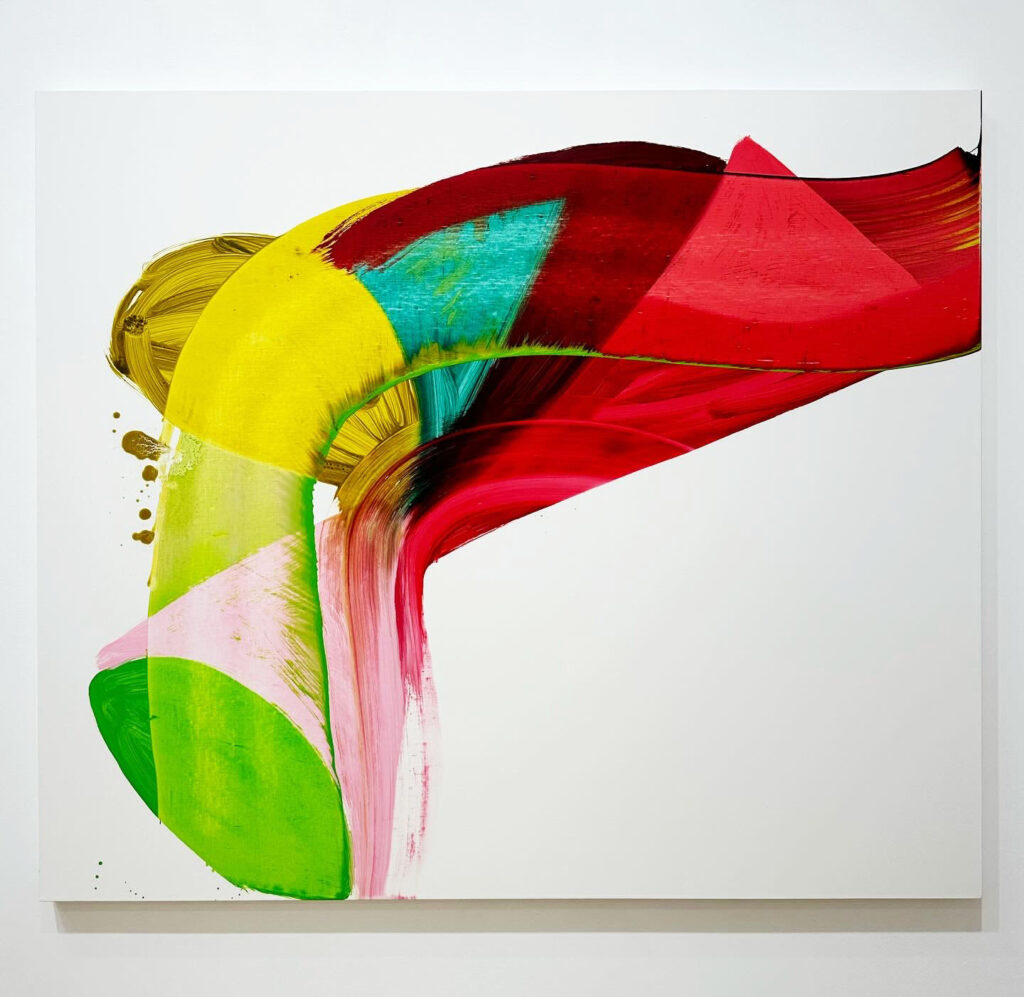
The press release is interesting too-

One should acknowledge, with infinite joy, the fact of being alive. We should celebrate our existence and recognize its fragility in every moment. It’s easy to forget, to get distracted by mundane circumstances of our day-to-day life. On the other hand, life’s impermanence may induce panic, an all-encompassing fear that leaves us searching for answers. Still, we are resilient to becoming just another customer at Café Gratitude, its slogan ringing in our ears like a mosquito — What Are You Grateful For? Baruch Spinoza introduced the concept of conatus, which illustrates the internal drive of every being to persevere in its existence. The conatus is inherent to every substance; it is the engine that propels life. However, older philosophies get boiled down to artificially made bite-sized snacks at Café Gratitude — Live Laugh Love — pushing us to habitually flee from quick, feel-good moments.

Celebrating life doesn’t seem to intimidate Estonian artist Kris Lemsalu. Her work emphasizes, with absolute honesty, life and its different stages. This direct form of communication is not new to the artist. In 2019, she presented the work Birth V – Hi and Bye at the Venice Biennale which was an unmediated exploration of cycles relating to birth, life, death, and (fortunately) rebirth. Lemsalu continues her celebratory, inquisitive, and pagan journey in her exhibition at Margot Samel. We are welcomed with a grand altar inscribed with “VITA”, each letter created with an anthropomorphic character that references Baubo, a figure from Greek mythology associated with vitality and renewal, famed for making Demeter laugh in her most tragic moment. This figure often recurs in Lemsalu’s work, appearing with a jaw (or vulva) as a head, wearing a pair of cargo pants with tongues leaning out from its utilitarian pockets.

Tongues multiply in various sizes and formats throughout the space. Sometimes they are raised like the bright flag of a grand country, other times they rest on a rocking chair, contemplating life. The tongue is a familiar symbol in Lemsalu’s work. The artist often correlates the body part to the Hindu deity Kali, a controversial figure, who in the ecstasy of an uncontrolled dance, extended her great tongue to drink the blood of demons, resulting in a triumph over negative forces. Kali’s tongue is a symbol that evokes both laughter and fear, simultaneously bestowing life and death, creation and destruction.

When we enter the world of Lemsalu’s work, our experience functions as a ritual. Each work acts as a rite that celebrates our conatus and the perseverance of our existence, shamelessly celebrating our fragility and the passage of time, commemorating life with flowers, with one foot deep into the gravy.

Enrique Giner de Los Ríos

May 142024
 

Kwakwaka’wakw artist and activist Chief Beau Dick’s (1955-2017) carved masks for the exhibition Walas Gwa’yam / Big, Great Whale at Andrew Kreps Gallery draw you in with their intriguing visages.

From the press release-

Our whole culture has been shattered. It’s up to the artists now to pick up the pieces and try and put them together, back where they belong. Yeah, it does become political. It becomes beyond political; it becomes very deep and emotional.” – Beau Dick speaking in the 2017 film ‘Maker of Monsters: The Extraordinary Life of Beau Dick.

Beau Dick’s works are deeply informed by the tradition of potlatch, a gift-giving ceremony practiced by Indigenous people of the coast of Pacific Northwest Canada, which focused on the redistribution of wealth as a tool for building solidarity. Outlawed by the Canadian Government for nearly seventy years as part of an ongoing history of forced assimilation, the seclusion of Dick’s birthplace on Kingcome Inlet (Gwa’yi) allowed his community to continue practicing customs relatively free from the gaze of colonial authorities. Trained in wood-carving by his father, grandfather, and other master carvers, and completing his education in Vancouver, Dick was acutely aware of inherent tensions between contemporary consumer culture and Kwakwaka’wakw teachings. Refuting his masks as static objects, his carvings reference supernatural figures, like Dzunuk’wa, the “wild woman of the woods,” and her counterpart, Bakwas, “wild man of the woods,” which are reanimated to combat what Dick saw as capitalism’s “ravenous” oppression. Frequently employing his works in dances and performances, in 2012 he took forty Atlakim (Forest) masks to his community in Alert Bay, where after one final ceremony, they were ritually burned, referencing the ongoing responsibility for rebirth, and recreation in the face of erased tradition.

May 142024
 

A large heart hangs in netting below the skeleton of a mysterious creature in one of Joy Curtis’s sculptures for Night Hike and Ocean Grandma at Klaus von Nichtssagend Gallery.  As you walk around the sculptures you are invited to invent the story behind them. Titles like Ocean Grandma, Sympathetic/ Parasympathetic, and Future Organs, and Night Hike (Epiphytes) provide clues.

Throughout the run of the exhibition, performers activated several of the smaller wearable sculptures. These performances are currently on view on the  gallery’s website and Instagram.

From the press release-

Joy Curtis’s new show of immersive textile sculptures takes on a folkloric quality, addressing ideas of evolution, environmental history, continuity, and change. Curtis sculpts with fabrics dyed to align with multiple historical traditions. These soft materials are quilted and sewn onto wire armatures, assembled to imply animal and plant forms, yet veering into abstraction.

Roots, vertebrae, leaves, and organs drape from figurative or animaloid fabric structures, creating canopies with an ambiguous narrative. Curtis hand-dyes her cloth using techniques inspired by Nigerian (Yoruba) Adire and Japanese Shibori processes, employing natural hues such as amber, ochre, iron, and indigo. Some pieces incorporate synthetic elements, such as reflective discs sewn into the works, causing visual sparks or glimmers amidst the more subdued textiles. The mixture of materials creates rich textures, as well as both reflective and absorbent variations in the light.

Some sculptures are large and hang dramatically from the ceiling, allowing the viewer to walk underneath and between them. A series of smaller works hang on the walls, actively wearable as garments. When dressed on individuals, these sculptures transform the wearer into an extension of Curtis’s formal style.

May 132024
 

“A beautiful figure without a tongue”, 2024, oil and pencil on canvas

“A beautiful figure without a tongue”, 2024, oil and pencil on canvas (detail)

“Open Season”, 2024, oil and pencil on canvas

“Open Season”, 2024, oil and pencil on canvas (detail)

“Where our love once lay, a dark and tortured jungle grew”, 2023, oil and pencil on canvas

“Where our love once lay, a dark and tortured jungle grew”, 2023, oil and pencil on canvas (detail)

A sense of foreboding looms over the paintings in Sanam Khatibi’s exhibition We Wait Until Dark at P.P.O.W gallery. In the details are smaller skeletons, ritual objects, and dead animals blood soaks the ground. Life and death are personified in both the figures and the natural surroundings. Flowers bloom or wilt, bones are scattered, a hummingbird shares a moment with a skeleton in one painting while a dead bird lies on the ground in another. Khatibi’s works have many potential meanings, like their art historical predecessors, and leave it to the viewer to come to their own conclusions.

From the press release-

…People who devote their lives to art can often cite an event that placed them on their destined path. Among the earliest memories Belgian artist Sanam Khatibi recalls is the day she discovered a book on Hieronymous Bosch left out on the table by her mother. She was five. That one might advance from consuming the rapturous reproductions of The Garden of Earthly Delights at such a young age to painting expansive, primal scenes of a troubled Paradise is one excellent example of artistic “fate.”

In Khatibi’s paintings and sculptures, the veil between desire and restraint, life and death, and the natural and spirit worlds proves thin. Again and again, the artist returns to t­he figure of a nude goddess navigating a verdant, savage land beyond the protective scrim of “civilization.” In the absence of technology, politics, bills, e-mail, and even clothing, she exhibits her most feral qualities for survival: devouring, eating, attacking, killing, and hunting. Khatibi’s subjects are perennial (desire, seduction, domination, submission), and her references to allegorical forms are extensive (17th-century Dutch still life vanitas, the motif of Death and the Maiden, antiquarian amulets, and anthropological relics), all channeled into displays of human folly and erotic obsession.

Paintings by Khatibi are full of expressions of voracity: for sex, earthly delights, experience, and transcendence, and what happens when you tempt the devil. In Where our love once lay, a dark and tortured jungle grew (2023), a fey skeleton seizes a beautiful maiden by the hair under a lightening blue sky –– a grotesque quid pro quo that recalls Lucas Cranach the Elders’ The Ill-Matched Couple (1553); or even Kawanabe Kyōsai’s Hell Courtesan (1831–1889). Decrepit and aging, his skull sprouts strawlike strands of hair, the last indication of vitality. In Open Season (2024), an Amazonian goddess places an intimate offering of amulets and animal sacrifices before a pool of water. There is a sense of reckless abandon: a human skull, a pomegranate cracked open, blood spilling over the cerulean earth––a feast for ravenous souls.

Khatibi’s Eden is repeatedly transformed into a Bosch-like tale of passionate, potentially fatal encounters (a locus amoenus turned upside down into a “locus terribilis”). In A beautiful figure without a tongue (2024), the skeletal personification of Death reappears. A maniacal grin spreads across his decaying face as he slinks away, clutching an ornate vase to his chest. Are these the spoils of Death to be hoarded in a cavernous underworld?

Throughout the exhibition, Khatibi faithfully intertwines two genres of painting (figurative landscape and still life), leaving seemingly ancillary details from one scene to reveal as sharp memento mori in another––as in Overnight Black Aphids Appeared, growing on the tips of the Sophora Sun King (2023). Here, the reappearance of skulls, amulets, and small creatures sans personnages gives the impression of a romantic sojourn set apart from the larger narrative. Each of Khatibi’s objects pulses into realism with near-scientific observation, appearing magnificent and fragile, possibly even forbidden. Placed against a velvety black ground, they fall into shadow as if pulled amorously into the afterlife. –Lola Kramer

Also included in the exhibition are several smaller works, like the one pictured below. In these darker paintings the details stand out against their black background, but the mystery of their meaning remains.


“Overnight Black Aphids Appeared, growing on the tips of the Sophora Sun King”, 2023 oil on canvas

May 132024
 

“The Lazy Logic of Ignava Ratio”, 2009, Acrylic on canvas

“The Lazy Logic of Ignava Ratio”, 2009, Acrylic on canvas (detail)

Ryan McGuiness’s brightly colored screen printed paintings for WYSIWYG at Miles McEnery Gallery are incredibly dense with imagery, yet still manage not to feel too overwhelming. The combinations of graphics and patterns do require a closer look though.

The title of the exhibition references the acronym for What You See Is What You Get, which refers to software that allows creators to see and edit their product in the form it will resemble when printed or displayed.  Whether there is more to these paintings than what is seen remains up to the viewer.

“Condition Report”, 2022 and “Recreational Use”, 2022, Acrylic on wood

“Only a Thief Thinks Everybody Steals”, 2008, Acrylic on canvas

May 132024
 

“Capturing the Moment”, 2023, Acrylic on canvas

“Prismatic Window”, 2023, Acrylic on canvas

“El Paraíso”, 2023, and “Coin Laundry”, 2023, Acrylic on canvas

“Kurashiki Ki”, 2023, Acrylic on canvas

“Daikanyama”, 2023, Acrylic on canvas

Brian Alfred’s paintings for his exhibition Beauty is A Rare Thing at Miles McEnery Gallery capture moments from his travels around the world. Small details are removed to focus on shapes and colors, resulting in works that are extremely pleasing to the eye.

From the press release-

…Alfred’s process, honed over the past two decades, distills his source imagery to its most essential forms, layering idyllic elements together and segmenting forms into two dimensional planes of mostly-solid color to reveal a sense of stillness that can be tranquil, unsettling, or both. His compositions are reminiscent of architectural ukiyo-e prints, both in technique and style, while his exploration of collage continues to inform the resulting paintings.

“Alfred captures the ephemeral, silencing the noise of the world and focusing solely on the composition,” writes Annabel Keenan. “In every image, there is a sense that he is not only preserving the memory of a place, but also the essence of a specific time. This show… is more personal than his others.” Beauty is a Rare Thing casts a newfound appreciation on the everyday, presenting an aura of hope over our ever changing world.

Also included in a separate room are his portraits of contemporary musicians, pictured below.

Mar 152024
 

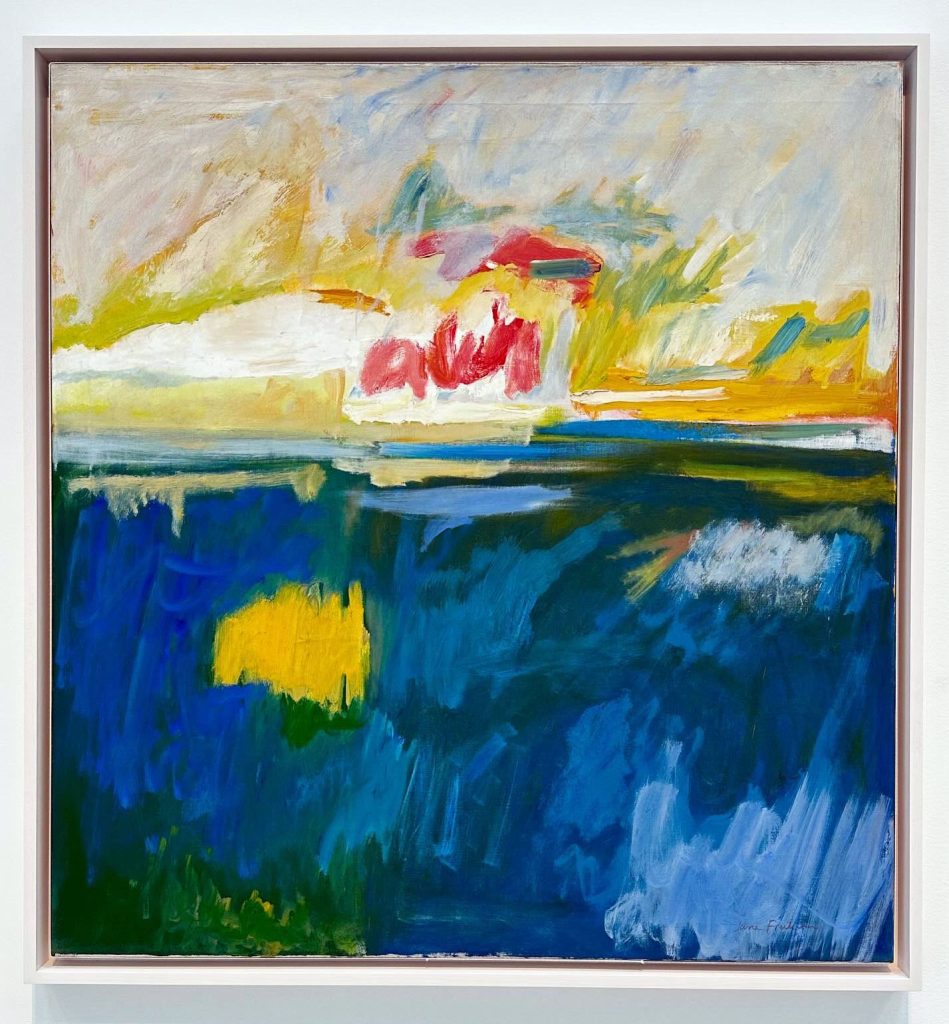
“Northern Lights”, 1959, oil on linen

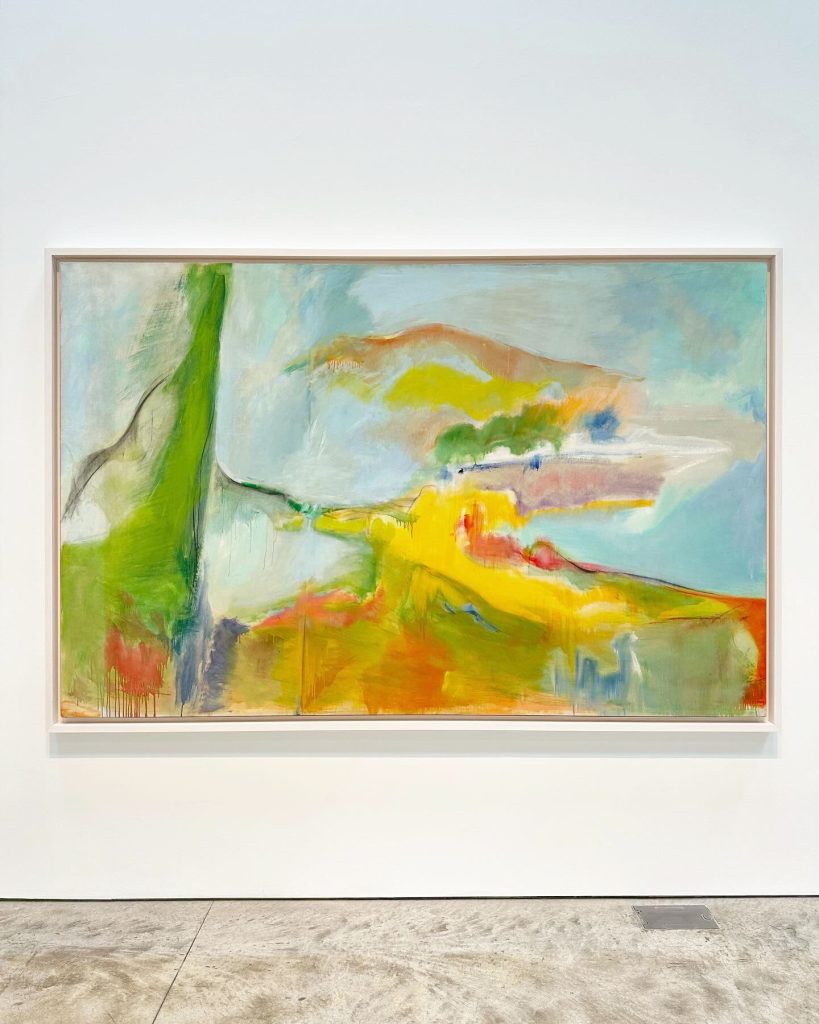
“Untitled (Near the Cove)”, c. 1958, oil on linen

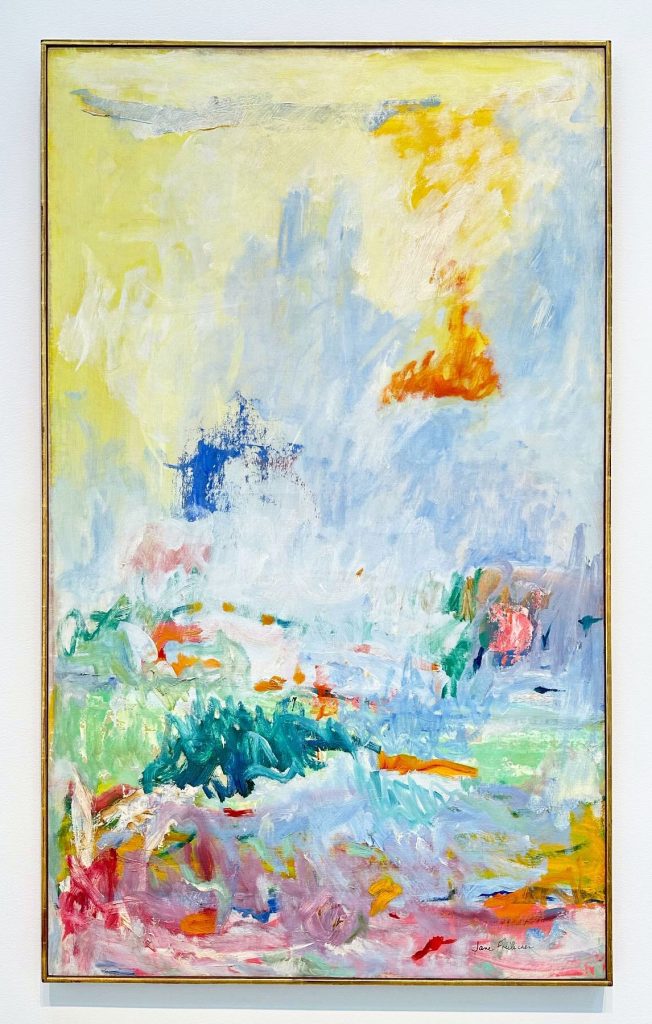
“Fresh Air”, c.1958-1962, oil on canvas

Although better known for her figurative paintings, Jane Freilicher also created several large abstract paintings which were on view last year at Kasmin gallery in NYC.  The paintings hint at a recognizable landscape, but through her use of color and energetic brush strokes she evokes the feeling of being immersed in the beauty of nature- without the boundaries of a more realistic representation.

From the gallery about the work-

The exhibition presents a group of paintings in degrees of abstraction, realized by Freilicher between 1958 and 1962, a period of great inventiveness when the artist was spending stretches of time in Long Island but had yet to establish a studio there. The series marks a crucial moment of discovery and focus for Freilicher, who went on to integrate the freedom, fluidity, and confidence developed during this period into her more recognizable still lifes and landscapes of later decades.

Freilicher’s abstractions have their roots in observation, informed by her studies with legendary abstract painter Hans Hofmann at his schools in New York and Provincetown. In this group of paintings, pastoral landscapes from Water Mill, Long Island, are translated through the lens of the artist’s memory into confident gestural compositions defined by their use of color and sensitive depiction of light. In a 2006 interview for The New York Sun, the artist tells writer Jennifer Samet of this evolutionary moment in her practice: “I remember being overwhelmed by aqueous light and the obliteration of the horizon by fog.” Freilicher’s palette returns repeatedly here to a combination of off-white and light blue, rendered in loose brushwork across an expansive pictorial space to give a palpable impression of the airy, open landscape of the country.

Breaking out of the domestic scale necessitated by previous studio spaces, this generative period saw Freilicher regularly visiting Water Mill and then returning to her Manhattan studio where she would collapse the formal elements of the rural and coastal environments into energetic, improvisational paintings that were significantly larger than her earlier works. While approaching pure abstraction, the paintings from this period retain a compositional recognition of their ordering principles—the horizon line, a boat’s mast, the position of the sun in the sky, and, in the artist’s words, “long vistas of clouds and water.”

The metamorphosis of landscapes that figure prominently in the artist’s life are representative of, as Roberta Smith identified in 2006, “a more personal, grounded version of Color Field painting.” This observation bridges Freilicher to a loose group of contemporaries whose considerations of their immediate environments brought great warmth and aliveness to varying shades of abstraction—Milton Avery, Etel Adnan, Joan Mitchell, Agnes Martin, and Willem de Kooning (whose own abstract landscapes inspired by his time on Long Island went on view at Sidney Janis Gallery in 1959).

Mar 082024
 

“Valentine”, 2022, oil on linen

“Braid”, 2022, oil on linen

“Braid”, 2022, oil on linen (detail)

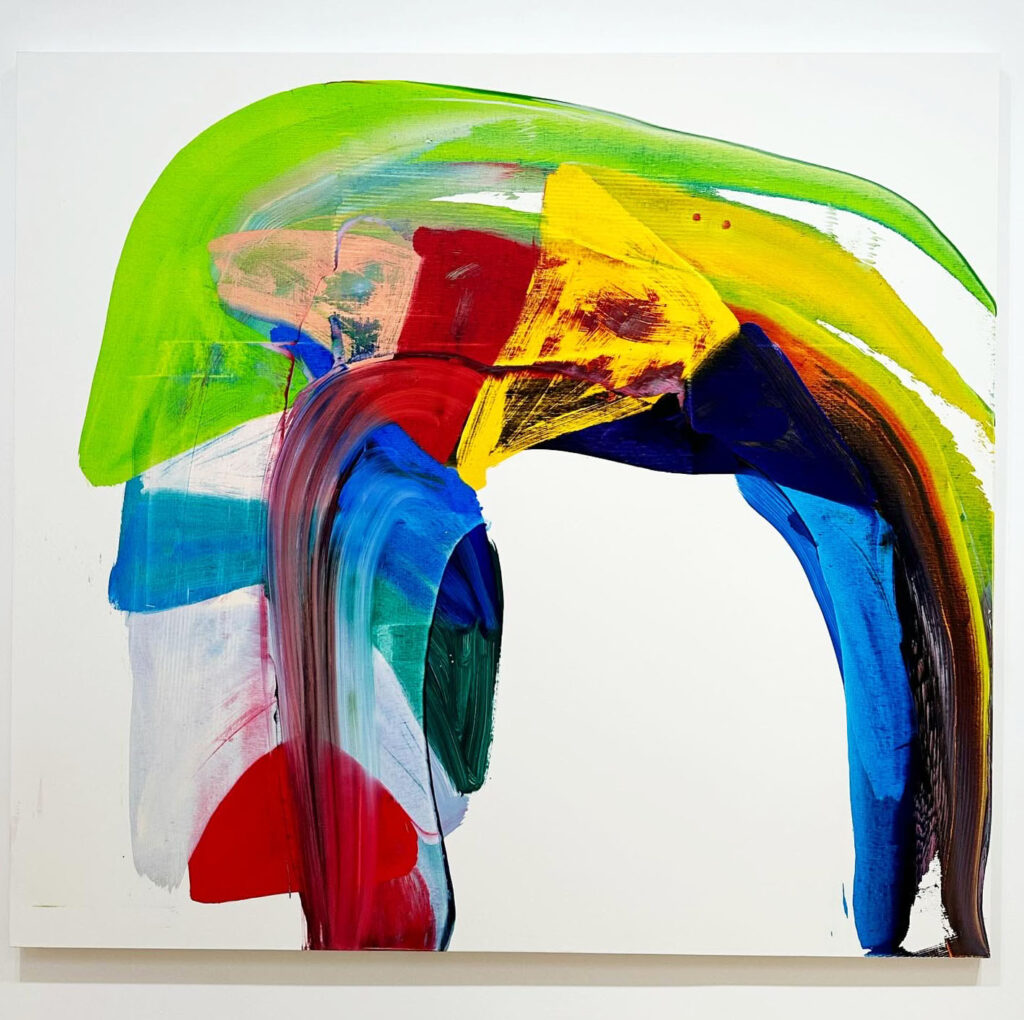
The two colorful paintings above are from Andrea Belag’s 2023 solo exhibition, Currents, at Bienvenu Steinberg & J in New York.

From the gallery’s press release-

Since the 1990s, Belag has constantly modified her approach to abstraction through various transitions and mutations. Her internal genealogy matters as much as her relationship to a tradition of abstraction. In the words of artist and critic Julian Kreimer: “it’s not hard to metaphorize those traces, lines left behind by larger swaths of paint that were wiped away, lines whose own shifting colors reveal how they are made by what they’ve touched and changed. But as with so many of Belag’s paintings, the point isn’t to nail down the metaphors (…) Belag’s work becomes an edge condition for painting without flirting with minimalist near-nothingness; it tests out where beauty can emerge, and what we can get to work. It opens up from a few wiped shapes into a sophisticated object able to transport one into a reverie about slippage, slipping away, the here and not hereness of life, death, and the varieties of love”.

Geometry and order have progressively given place to swirling swaths of color, solidity replaced by suspended motion. Painting is an all consuming action. She paints standing up, leaning over and often walking around the canvas placed horizontally. It starts with the arm and as she walks around the canvas her whole body gets involved. Transparent colors on the surface are not fixed and can create form or dissolve into light. She rubs, smudges, and scraps to create translucent, softly luminous surfaces where the brushwork is strikingly visible. “My paintings are contemporary because I paint in the here and now. It’s unavoidable. The artists I feel indebted to are Henri Matisse, Mary Heilmann, Joan Mitchell, Gerhard Richter, Bill Traylor, and Japanese Zen gardens. Style is a dead-end, but I have a point of view. I love transparency and the touch of materials, so I have created a way of painting where I make this possible. I use mostly transparent pigments and fine linen, and I paint wet into wet. The marks are on one layer of the painted surface with very little overlap or pentimento. Color makes space and light come through the paint and emotion comes through as well. There is fear and desire in painting, and that’s addictive. Haptics are the touchstones.” (Andrea Belag, 2023)

Her current solo exhibition, Twombly’s Green, opened this week at Steven Harvey Fine Art Projects.

From their press release-

This grouping of work is, as the title suggests, inspired by Belag’s recollection of Cy Twombly’s use of the color Hooker’s green in his “Pond Paintings.” She writes-

These paintings are inspired by my memory of Twombly’s green and white paintings that I first saw in the Menil Collection in Houston in 2015. I was stunned by his paint handling and his use of Hooker’s Green.

Since then, I learned he painted quickly and directly with his hands. Discovering the “Pond Paintings” was unexpected and I kept thinking about them. Hooker’s green is opaque and dark. But the dark value doesn’t overwhelm the hue. Instead, there is richness and depth without a trace of yellow.

When I identified the pigment and started to paint with it, I felt a vibration. There was a time when painting with green was taboo and now it is ubiquitous.

Is green in the zeitgeist?

All painted within the last twelve months, these works are a continuation of the artist’s practice of lush, energetic abstraction. Playing with circularity in an ongoing attempt to “get away from the grid,” Belag uses color as forms in space, bodies set in motion. Citing foundational inspirations in Matisse and Guston, who she later studied with at the New York Studio School, Belag’s work can also be related to vanguard practitioners of 80s abstraction such as Bill Jensen, David Reed and Mary Heilmann. Her immediate peers Christopher Wool and Joyce Pensato are also compass points in the stripped down dedication to raw painterly brio they share.

This exhibition is on view until 4/13/24.