Mar 082024
 

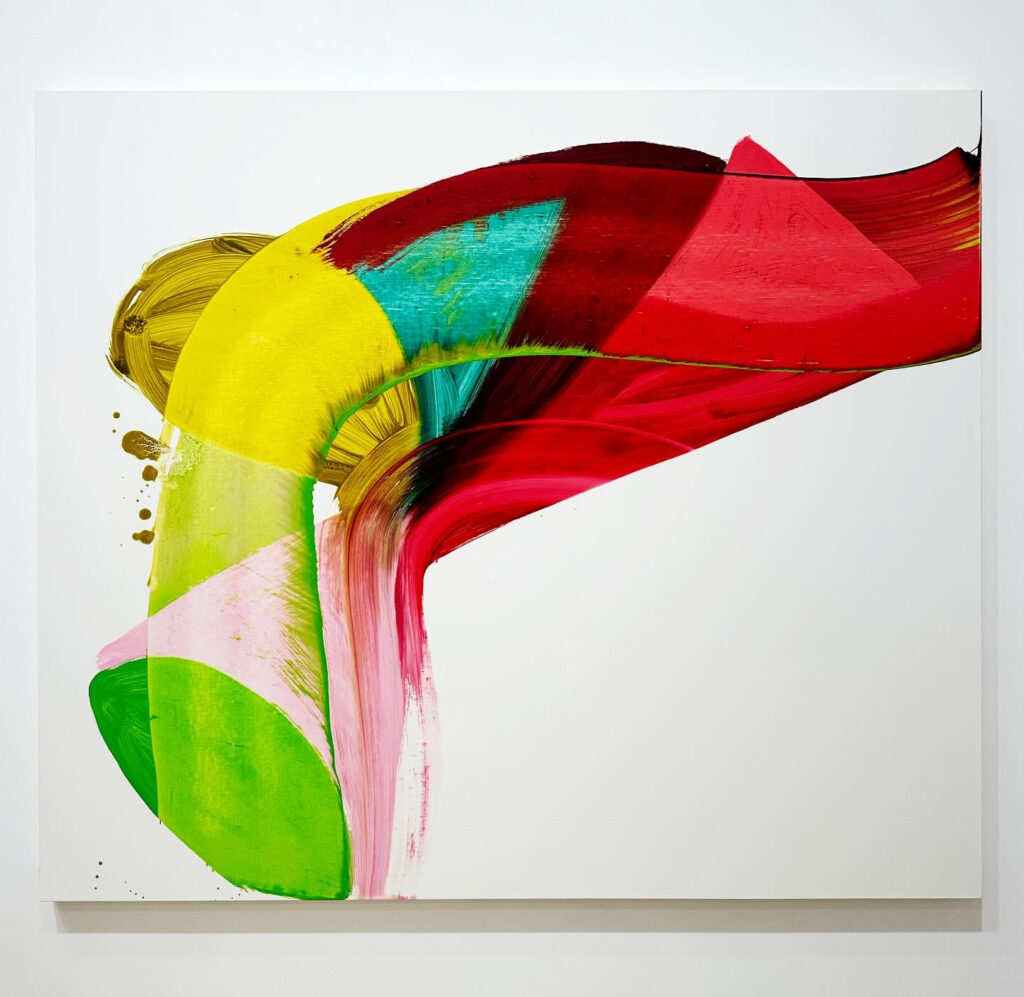
“Valentine”, 2022, oil on linen
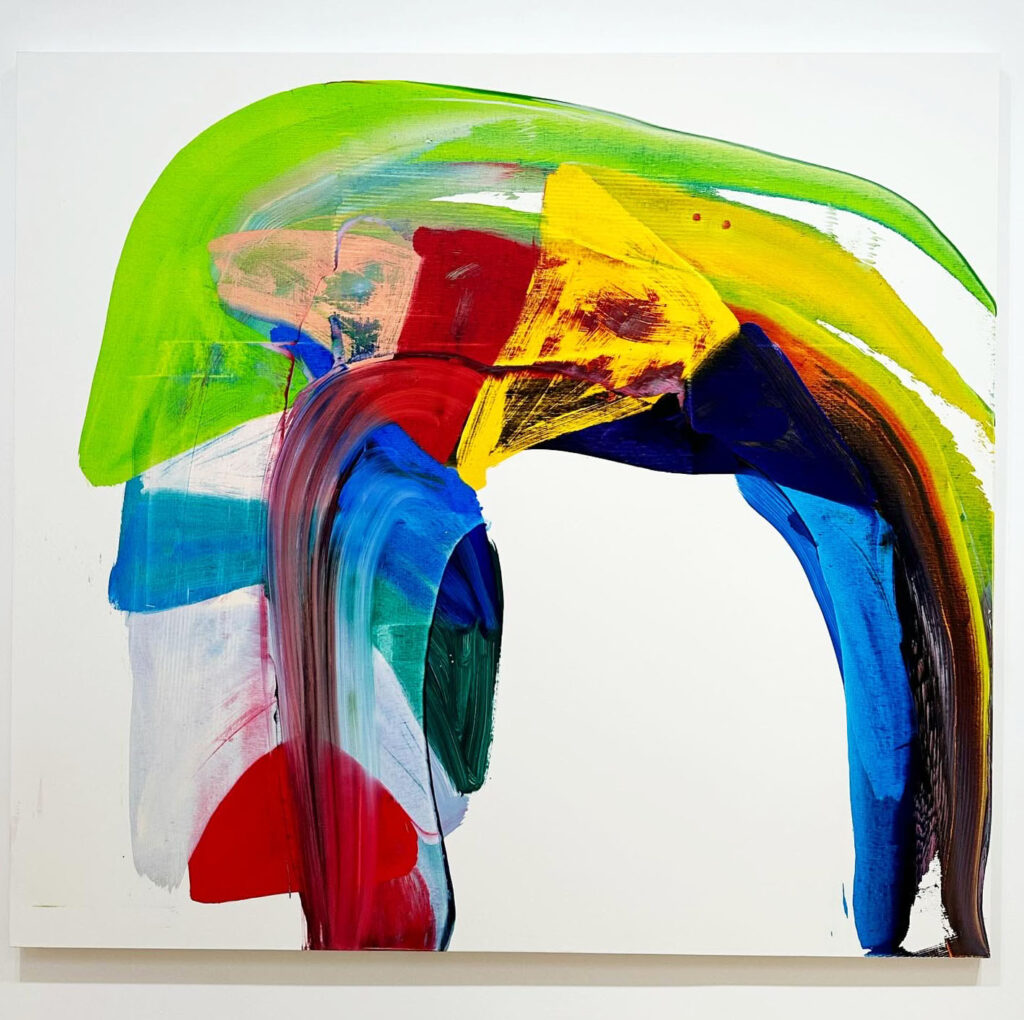
“Braid”, 2022, oil on linen
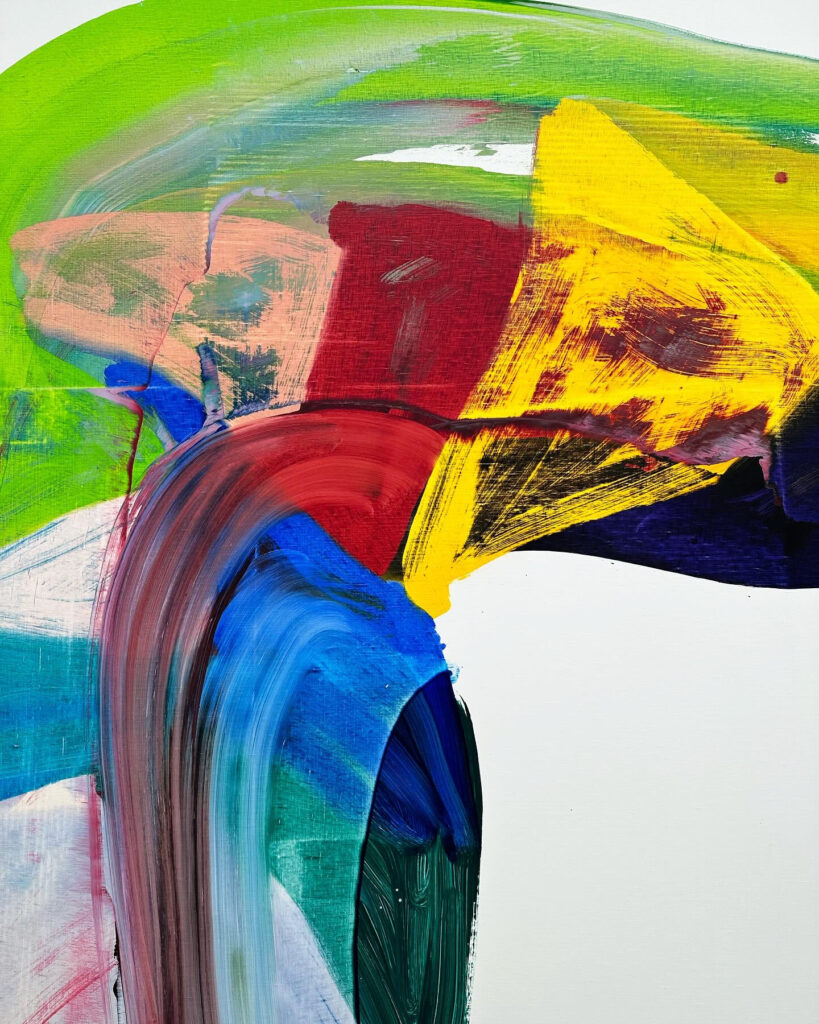
“Braid”, 2022, oil on linen (detail)

The two colorful paintings above are from Andrea Belag’s 2023 solo exhibition, Currents, at Bienvenu Steinberg & J in New York.

From the gallery’s press release-

Since the 1990s, Belag has constantly modified her approach to abstraction through various transitions and mutations. Her internal genealogy matters as much as her relationship to a tradition of abstraction. In the words of artist and critic Julian Kreimer: “it’s not hard to metaphorize those traces, lines left behind by larger swaths of paint that were wiped away, lines whose own shifting colors reveal how they are made by what they’ve touched and changed. But as with so many of Belag’s paintings, the point isn’t to nail down the metaphors (…) Belag’s work becomes an edge condition for painting without flirting with minimalist near-nothingness; it tests out where beauty can emerge, and what we can get to work. It opens up from a few wiped shapes into a sophisticated object able to transport one into a reverie about slippage, slipping away, the here and not hereness of life, death, and the varieties of love”.

Geometry and order have progressively given place to swirling swaths of color, solidity replaced by suspended motion. Painting is an all consuming action. She paints standing up, leaning over and often walking around the canvas placed horizontally. It starts with the arm and as she walks around the canvas her whole body gets involved. Transparent colors on the surface are not fixed and can create form or dissolve into light. She rubs, smudges, and scraps to create translucent, softly luminous surfaces where the brushwork is strikingly visible. “My paintings are contemporary because I paint in the here and now. It’s unavoidable. The artists I feel indebted to are Henri Matisse, Mary Heilmann, Joan Mitchell, Gerhard Richter, Bill Traylor, and Japanese Zen gardens. Style is a dead-end, but I have a point of view. I love transparency and the touch of materials, so I have created a way of painting where I make this possible. I use mostly transparent pigments and fine linen, and I paint wet into wet. The marks are on one layer of the painted surface with very little overlap or pentimento. Color makes space and light come through the paint and emotion comes through as well. There is fear and desire in painting, and that’s addictive. Haptics are the touchstones.” (Andrea Belag, 2023)

Her current solo exhibition, Twombly’s Green, opened this week at Steven Harvey Fine Art Projects.

From their press release-

This grouping of work is, as the title suggests, inspired by Belag’s recollection of Cy Twombly’s use of the color Hooker’s green in his “Pond Paintings.” She writes-

These paintings are inspired by my memory of Twombly’s green and white paintings that I first saw in the Menil Collection in Houston in 2015. I was stunned by his paint handling and his use of Hooker’s Green.

Since then, I learned he painted quickly and directly with his hands. Discovering the “Pond Paintings” was unexpected and I kept thinking about them. Hooker’s green is opaque and dark. But the dark value doesn’t overwhelm the hue. Instead, there is richness and depth without a trace of yellow.

When I identified the pigment and started to paint with it, I felt a vibration. There was a time when painting with green was taboo and now it is ubiquitous.

Is green in the zeitgeist?

All painted within the last twelve months, these works are a continuation of the artist’s practice of lush, energetic abstraction. Playing with circularity in an ongoing attempt to “get away from the grid,” Belag uses color as forms in space, bodies set in motion. Citing foundational inspirations in Matisse and Guston, who she later studied with at the New York Studio School, Belag’s work can also be related to vanguard practitioners of 80s abstraction such as Bill Jensen, David Reed and Mary Heilmann. Her immediate peers Christopher Wool and Joyce Pensato are also compass points in the stripped down dedication to raw painterly brio they share.

This exhibition is on view until 4/13/24.
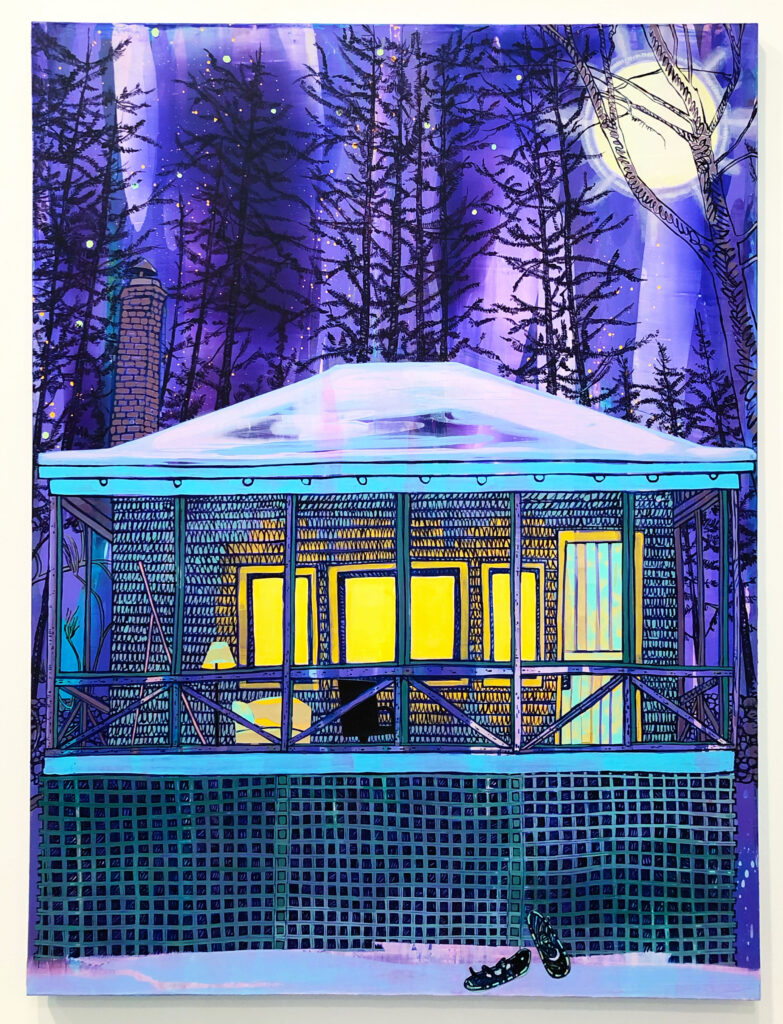
 

Feb 242024
 

Hope Gangloff’s painting MacDowell Cheney Cabin in the Winter Super Moon, 2019, was shown at her 2019 solo exhibition at Susan Inglett Gallery in NYC.  It is one of several created during her residency at MacDowell Colony in Peterborough, New Hampshire.

Feb 162024
 

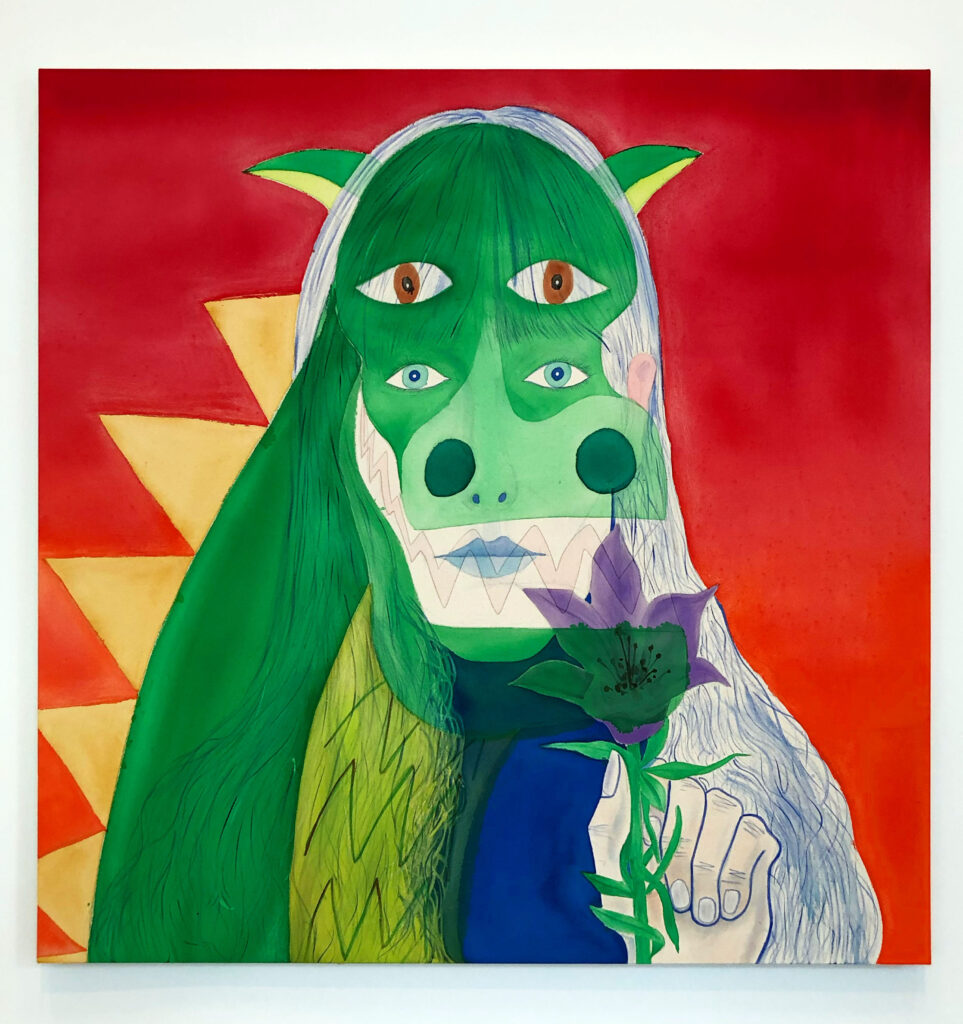
Gentle Ladies Dragon Man, 2021, (Acrylic and graphite on canvas) by Jason Fox was part of the group show Time-Slip at Petzel Gallery in New York in 2021.

Feb 012024
 

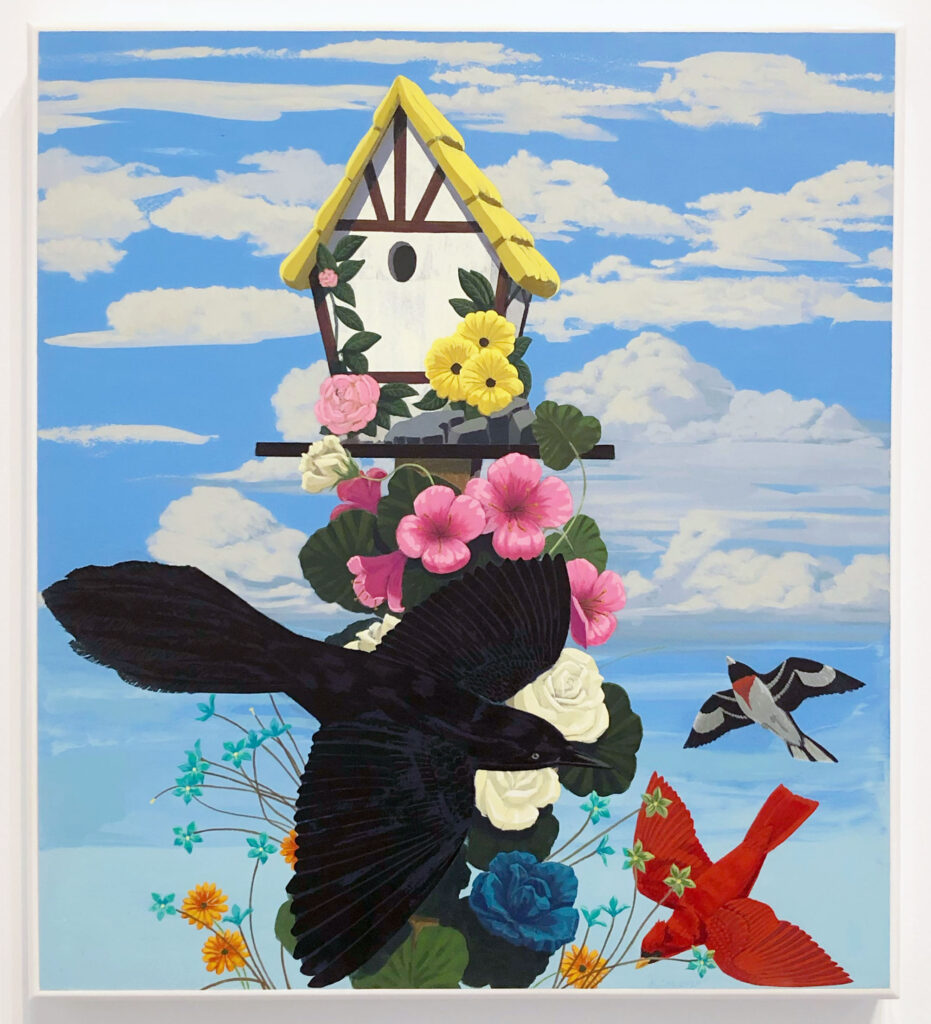
Black and part Black Birds in America: (Grackle, Cardinal & Rose-breasted Grosbeak), 2020, by Kerry James Marshall, was part of the group exhibition 20/20 at David Zwirner gallery in NYC in December of 2020. The painting is part of a series that explores black identity, his love of birding, and by the history and work of John James Audubon.

Below is an excerpt from a New York Times article about the work and its Audubon connection-

“There’s a disconnect between the house that’s built and the birds,” Mr. Marshall said of the crow and grackle. “It’s not designed for them, you know?” The scene considers, he said, “the pecking order.”

The series itself has been brewing in Mr. Marshall’s mind for eight or nine years, he said, and he began painting the works just before transmissions of the coronavirus accelerated in the United States in March.

A casual bird enthusiast who has been fascinated by Audubon’s draughtsmanship since he was a child, Mr. Marshall has long put Black protagonists at the center of his complex, richly layered compositions. “Many Mansions” (1994), one of his large-scale depictions of housing projects, features three Black men gardening — and, not incidentally, there are two bluebirds holding up a banner, too. The pointed inclusion of Black figures is part of what he has called a “counter-archive” to the familiar, white-centered story of Western art.

For the new series, the images hinge on Audubon’s own racial heritage: Many people believe he was, as Mr. Marshall’s title suggests, “part Black” — born in what is now Haiti, as Jean Rabin, to a white, plantation-owning father and a Creole chambermaid who may have been of racially-mixed descent. But, the theory goes, he was able to pass as white.

Jan 262024
 

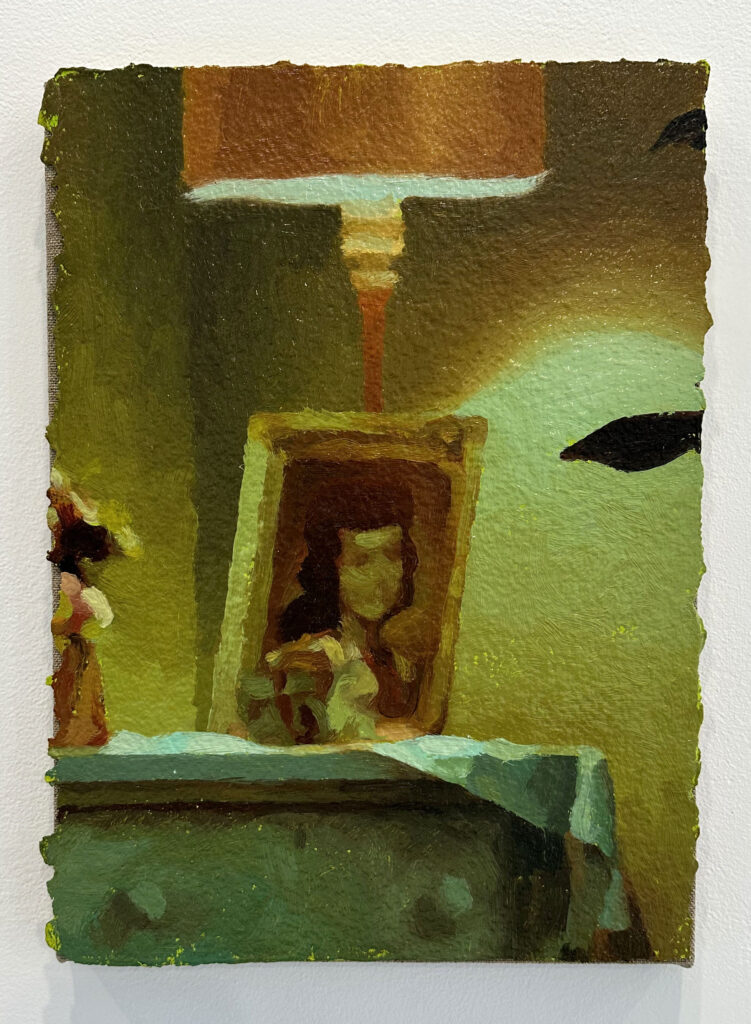
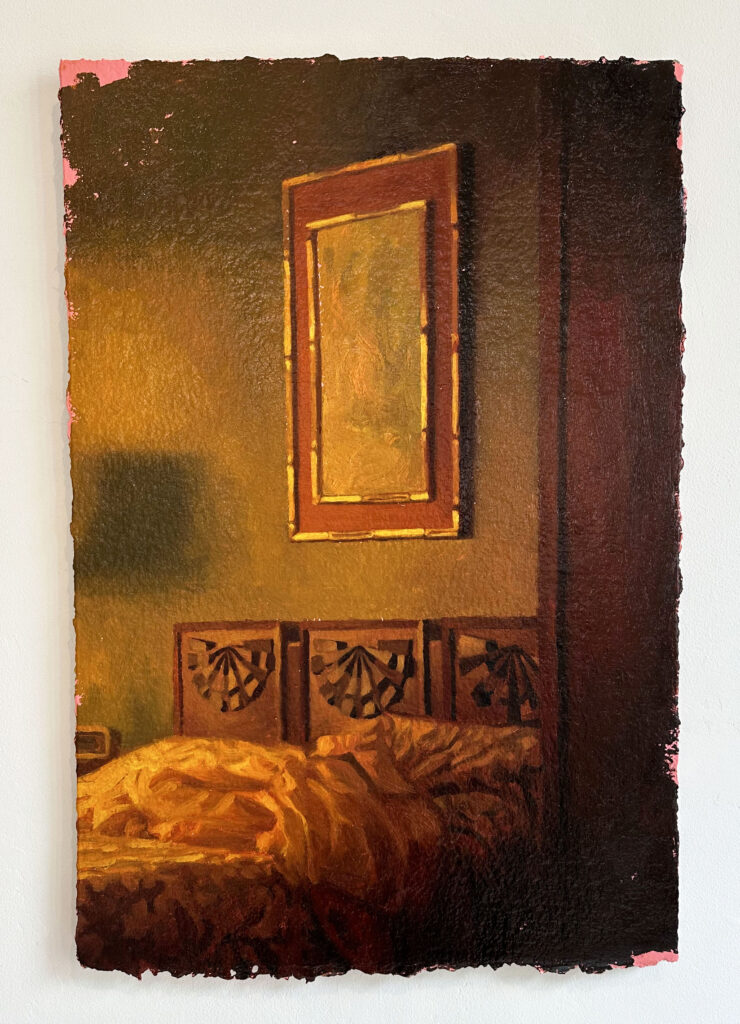
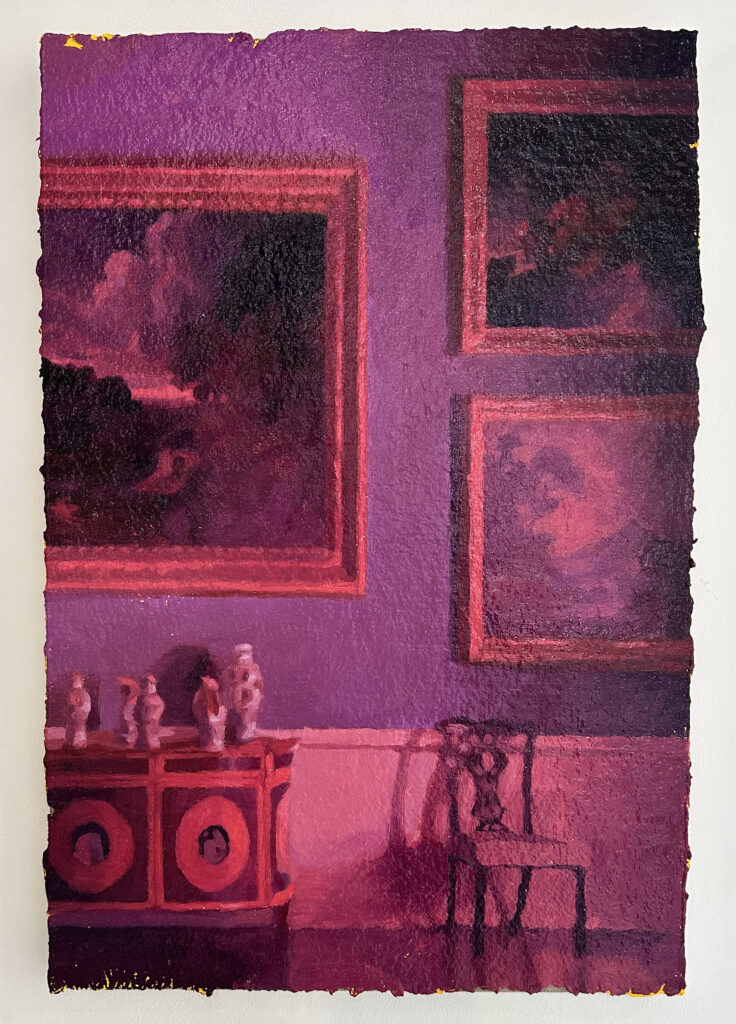
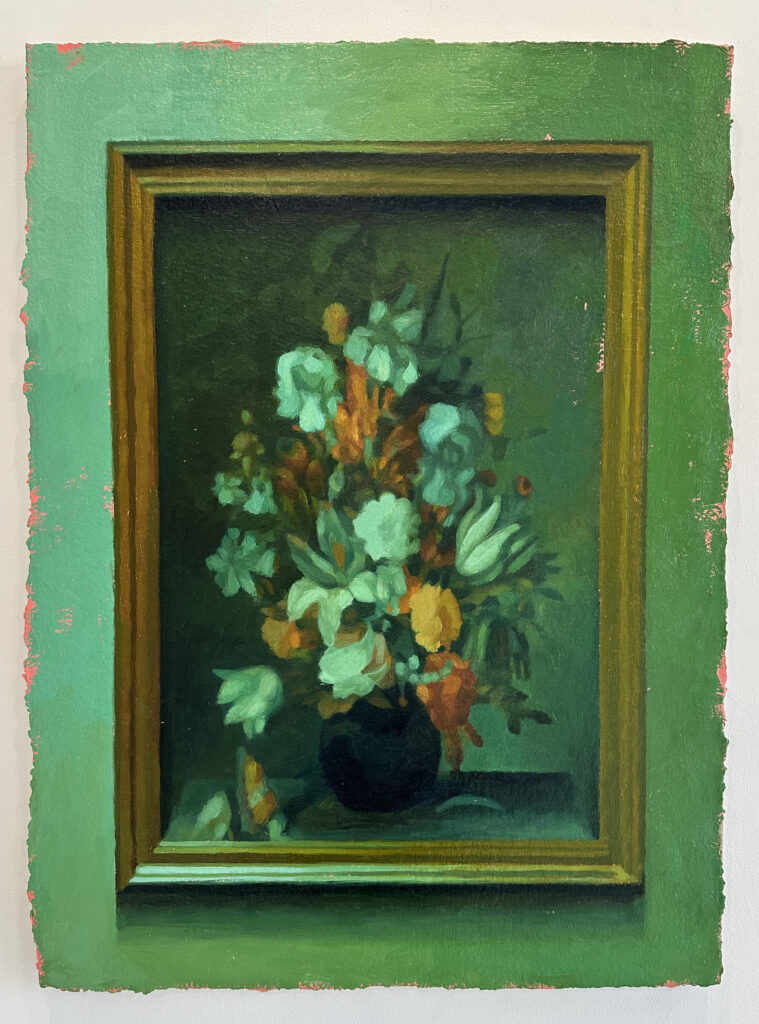
Paintings by Tim Wilson from his 2023 solo exhibition, Pictures Aside, at Nathalie Karg gallery in NYC.

From the press release-

“Everything is deceptive, only the mask never lies.”
—Pierre de Marivaux

On the surface, Wilson presents a group of paintings depicting an assortment of mirrored reflections, paintings, prints, photographs, and reproductions. These pictures within the paintings adorn a variety of provisional spaces; foyers, waiting areas, bedside tables, drawing rooms, and motels. Like his previous work, Wilson recasts images of interior spaces and set dressing found in the seemingly endless availability of streaming television and film. These repurposed screen grabs are then filtered through the historical lens of premodern tendencies in representation. This practice, an attempt at slowing the viewer down for reflection remains, yet here, Wilson doubles down by zooming in on the re-depiction of those quoted histories within his own pictures. This reframing literally and metaphorically rearranges the conditions with which one engages in that contemplation.

“To me, the recursive nature of these paintings is analogous to the infinite regress of thought and meaning—in the way that the definition of words require the use of other, yet to be defined, words to describe them, and so on. Painting is a way of re-contextualizing these strange loops and harnessing meaning indirectly. For example, to quote me speaking now in this context is altogether different than the previous paragraph, despite the fact that I wrote them both.”
—Tim Wilson

He is currently showing work at JDJ gallery in Tribeca, for the group exhibition, Feels Like Home, running until 3/2/24.

Jan 202024
 

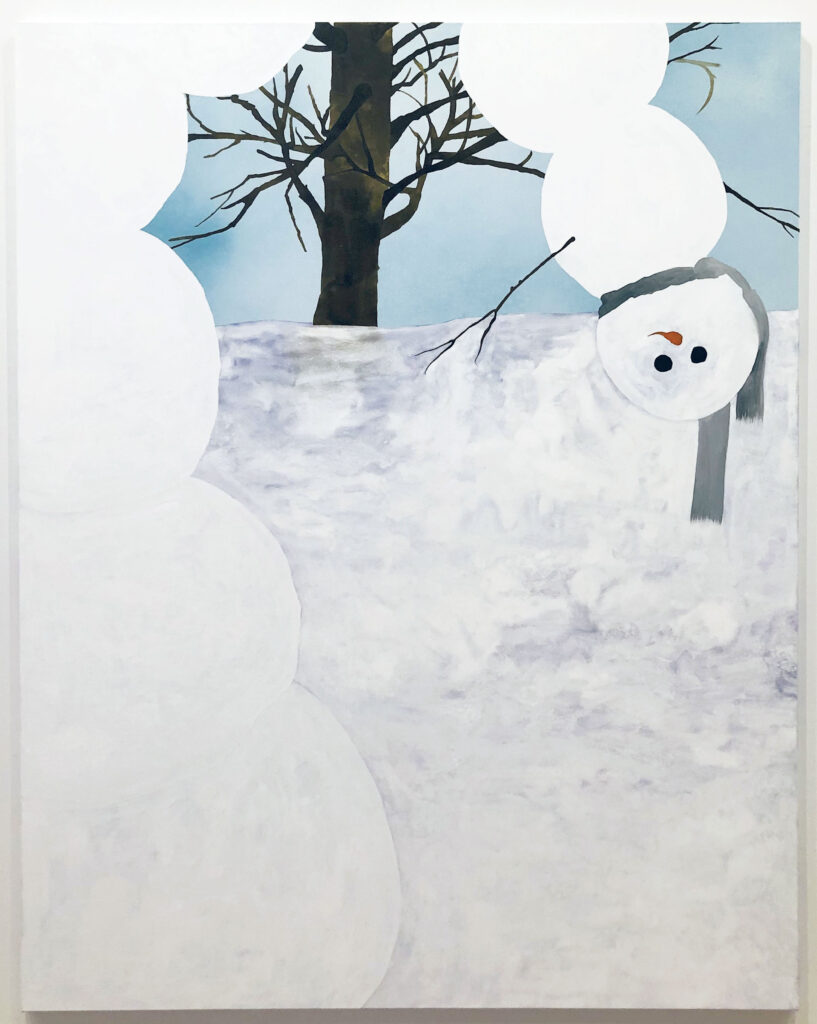
Calvin Marcus’ Tall Snowman, 2019, (Watercolor and vinyl paint on linen), was one of several of his large paintings included in Whitney Museum’s 2019 Biennial.

He and fellow Los Angeles artist Laura Owens will be in an exhibition together at Gaga gallery’s Guadalajara, Mexico location, opening 2/2/24.

Dec 272023
 

This painting, Night Breeze, by Sarah Lee, was part of a group exhibition last year at 1969 Gallery in NYC. It seemed like a good choice to post in honor of tonight’s full moon, the last of 2023, known as the Cold Moon.

Lee is currently part of two group exhibitions- Quiet Storm at Long Story Short’s Paris location and Standing Still at Gana Art’s Los Angeles location.

Dec 222023
 

José Parlá’s majestic paintings, pictured above, are from his series CICLOS: Blooms of Mold. They are currently on view as part of the Brooklyn Museum exhibition, Brooklyn Abstraction: Four Artists, Four Walls. The other artists included are Maya Hayuk, Kennedy Yanko, and the late Leon Polk Smith.

From the museum about the work-

In his monumental compositions, José Parlá layers and scrapes paint to obscure, reveal, and abstract both text and narrative, creating landscapes with textured gestural skies interwoven with a unique code of writing to reveal a new horizon with a universal line. Parlá’s abstracted text visually recalls underground mycelium formations, complex and mysterious fungi communication networks he references that interconnect everything on earth through a web of life. The five newly created paintings on view draw upon his youth as a Cuban American in Miami in the 1980s, his world travels, his almost fatal battle with COVID-19 in 2021, and his survival and recovery.

While in a three-month-long coma after contracting the virus, Parlá experienced dreams that carried him through his healing process. While recovering in the hospital, he transformed these visions into acrylic on paper drawings and, once back in the studio, into these powerful, otherworldly paintings that evoke natural landscapes. Their distinct horizon lines and internal, precise, psychological geographies remind us of our shared humanity.

Blooms of Mold, this new body of large-scale paintings, was inspired by what the art historian Simon Schama, in describing the art of Dutch painter Rembrandt van Rijn, once called “blooms of mold,” which one encounters on decaying urban and natural landscapes.

Parlá chose the subtitle Ciclos (from the Greek Kúkos, meaning circle) to refer to the life cycle and the function of the mycelium. It connects to ecosystems, providing nutrients and information to trees, which, in turn, convert carbon dioxide into oxygen, providing critical support for the respiratory systems of humans and all other living beings. Without mycelium, there would be no life.

The exhibition will be on view until 7/28/24.

Nov 172023
 

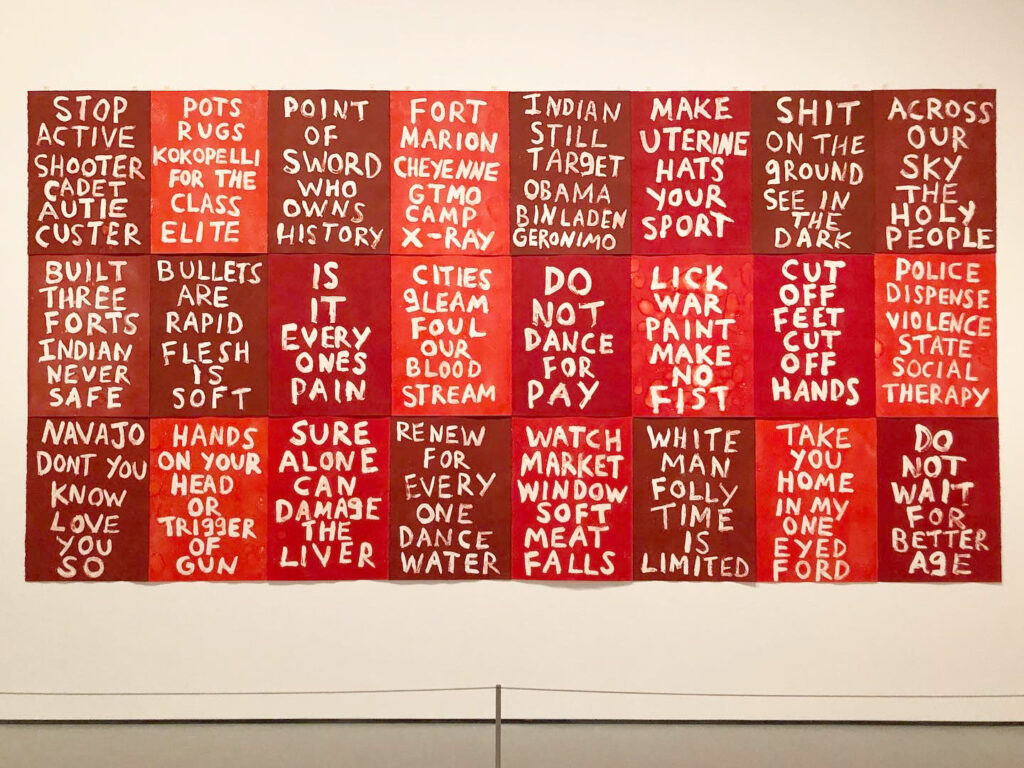
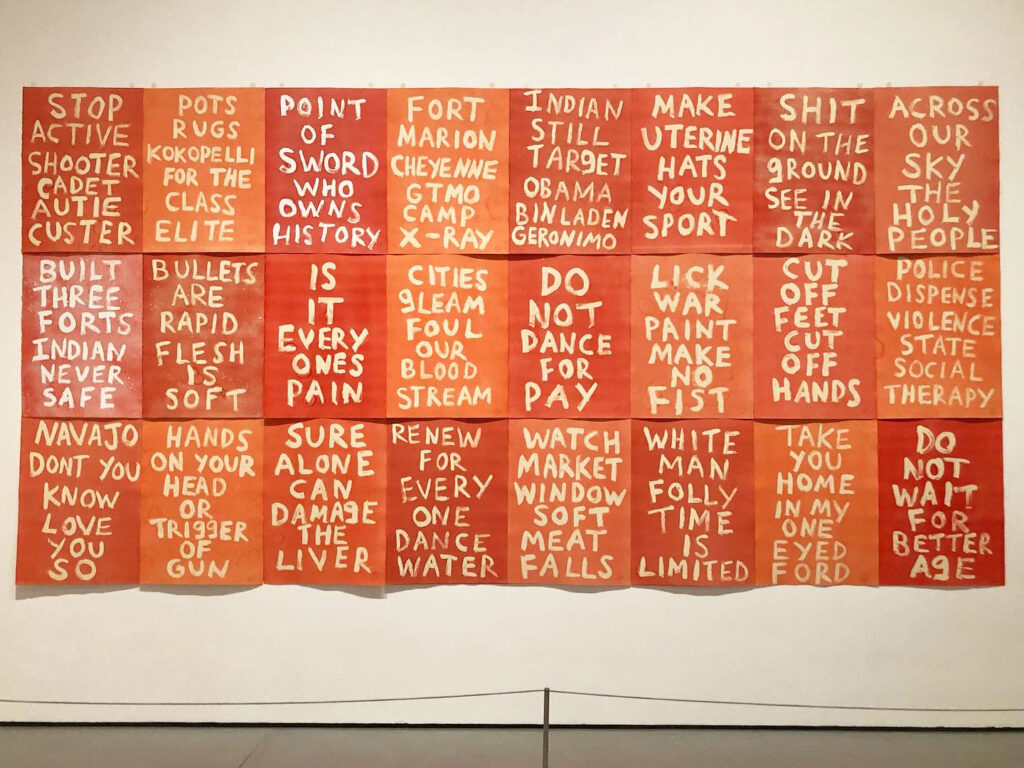
Above is Hock E Aye Vi Edgar Heap of Birds’s work Surviving Active Shooter Custer, 48 monoprints, 2018, from the Museum of Modern Art in New York City, on view in 2021.

From the museum about the work-

The term “active shooter” is one we hear too often in today’s news. Here, Heap of Birds uses this contemporary phrase to characterize massacres committed by United States troops against Native Americans in the 1800s. Each of this work’s panels contains six lines of text evoking the violence of not only this country’s history but ongoing acts of oppression against Indigenous communities. The prints on the right are “ghost prints” of those on the left, made by using the residual ink remaining on the printing plate after the first print was produced. For the artist, these prints recall the “ghosts of a whole culture.”

In the video below from the museum, the artist discusses the work with two of MoMa’s curators.

Nov 082023
 

The image above is Boris Anisfeld’s Clouds over the Black Sea-Crimea, 1906, from Brooklyn Museum’s exhibition Monet to Morisot: The Real and Imagined in European Art which highlights European art from the 19th and early twentieth-century from their collection. The exhibition “focuses on a period of significant societal transformation, when artistic techniques, subject matter, and patronage underwent profound changes”.

About the painting from the museum-

Boris Anisfeld’s canvas presents a vertiginous view of the Black Sea from the top of the Ayu-Dag mountain in southern Ukraine. The viewer has the sensation of being placed in midair, looking down through billowing clouds at an expanse of blue water, in the midst of which is a small boat. Although the scene represents a vast space, the artist’s complex composition challenges the illusion of depth in traditional landscapes by flattening the elements-cloud, land, and horizon-onto a single plane.

This painting was included in the 1906 Salon d’Automne in Paris in the Russian galleries organized by the ballet impresario Sergei Diaghilev, for whom Anisfeld designed stage sets and costumes. After the 1917 Russian Revolution, the artist came to the United States, and within a year the Brooklyn Museum hosted his first American one-person exhibition.

This exhibition closes on 11/12/23.