May 132024
 

“The Lazy Logic of Ignava Ratio”, 2009, Acrylic on canvas

“The Lazy Logic of Ignava Ratio”, 2009, Acrylic on canvas (detail)

Ryan McGuiness’s brightly colored screen printed paintings for WYSIWYG at Miles McEnery Gallery are incredibly dense with imagery, yet still manage not to feel too overwhelming. The combinations of graphics and patterns do require a closer look though.

The title of the exhibition references the acronym for What You See Is What You Get, which refers to software that allows creators to see and edit their product in the form it will resemble when printed or displayed.  Whether there is more to these paintings than what is seen remains up to the viewer.

“Condition Report”, 2022 and “Recreational Use”, 2022, Acrylic on wood

“Only a Thief Thinks Everybody Steals”, 2008, Acrylic on canvas

May 132024
 

“Capturing the Moment”, 2023, Acrylic on canvas

“Prismatic Window”, 2023, Acrylic on canvas

“El Paraíso”, 2023, and “Coin Laundry”, 2023, Acrylic on canvas

“Kurashiki Ki”, 2023, Acrylic on canvas

“Daikanyama”, 2023, Acrylic on canvas

Brian Alfred’s paintings for his exhibition Beauty is A Rare Thing at Miles McEnery Gallery capture moments from his travels around the world. Small details are removed to focus on shapes and colors, resulting in works that are extremely pleasing to the eye.

From the press release-

…Alfred’s process, honed over the past two decades, distills his source imagery to its most essential forms, layering idyllic elements together and segmenting forms into two dimensional planes of mostly-solid color to reveal a sense of stillness that can be tranquil, unsettling, or both. His compositions are reminiscent of architectural ukiyo-e prints, both in technique and style, while his exploration of collage continues to inform the resulting paintings.

“Alfred captures the ephemeral, silencing the noise of the world and focusing solely on the composition,” writes Annabel Keenan. “In every image, there is a sense that he is not only preserving the memory of a place, but also the essence of a specific time. This show… is more personal than his others.” Beauty is a Rare Thing casts a newfound appreciation on the everyday, presenting an aura of hope over our ever changing world.

Also included in a separate room are his portraits of contemporary musicians, pictured below.

May 042024
 

Ewuresi Archer’s Indescribable Charm was created for Land Studio’s rotating space The Art Wall in Cleveland’s Public Square. Archer is a Ghanaian American artist who is based in the city and graduated from the Cleveland Institute of Art.

From the artist about this work-

Indescribable Charm is a piece about capturing the indescribable feeling of tranquility through a vibrant landscape. With exaggerations in the textured grass with natural shades of green contrasted with bright oranges and distorted landscapes, this piece provides a space for people to stop, think, and reflect. Within this charming scene, a figure stands front and center with features associated with African Americans. My art is about celebrating myself and my culture; with this piece, I’m celebrating the beauty of black people. Putting an African American figure in a field of grass that calls for admiration gives a viewer no choice but to also admire the figure’s aesthetics. This piece puts them in a place of admiration. His strong yet ethereal presence adds depth to the piece as a whole. The serene landscape, in contrast to the figure’s beauty, creates a wonderfully harmonious composition that invites viewers to contemplate the majestic charm of the grass and the mysterious beauty of the figure.

You can also find Ewuresi Archer on Instagram.

May 032024
 

In March, Strauss Studios hosted Diane Belfiglio: An Artist’s Legacy, an exhibition celebrating the late artist. The Ohio artist and educator’s exploration of light and shadow give her subjects a unique graphic quality.

Here Belfiglio discusses her acrylic paintings-

My paintings prominently feature closely-cropped, sunlit architectural forms. Although realistic in their presentation, I rely heavily on their underlying abstract qualities to give to the already imposing images an even greater sense of power. Shadows, ethereal by nature, take on a rigid structural aspect in these compositions. Colors range from brilliant to subtle in an effort to reproduce the strong sense of sunlight streaming through each piece. Although these images are visually powerful, the delicate details in the architecture—and often in the surrounding vegetation–are also prominently featured in my work. The resultant blend produces a heightened, stylized reality. I work to transform the mundane into the extraordinary, so that we see beauty in images that generally go unnoticed by most of us on a daily basis.

And here she talks about her decision to work with watercolor, like in the pair above-

Never say never. For the majority of my life, I have not taken to watercolor as a medium I ever wanted to use professionally. But in 2015-16, the Canton Museum of Art had a spectacular show of Joseph Raffael’s watercolor paintings. The colors and luminosity in his work were so amazing that I just couldn’t get the images out of my head. A couple of years later, I was called upon to teach Watercolors at Walsh University, a class I normally don’t teach. So there was another toe in the water (pun intended). Fast forward to 2020, when I finally had the urge to vanquish my demons and give it a try. I started slowly, making plenty of mistakes, but soon realized that I could create the luminosity that I crave in my work in this medium.

Tomorrow (5/3/24), Strauss Studios will be open late for Canton First Friday and showing the new exhibition Exploring Light and Darkness featuring artists Emily Orsich, Heather Bullach, Jo Westfall, Joe Ostrowske, Mary Crane Nutter, Patricia Zinsmeister Parker, and Susan Wilkof.


May 022024


Emil Robinson’s paintings for Interiors, on view at Abattoir Gallery in Cleveland, are a meditation on space. The doors, slightly ajar, closed, or allowing glimpses of the outside world, invite the viewer to think about their own interiors.

From the press release-

The work stems from conversations about the history of interior paintings which serve as both records of domestic spaces as well as vessels for psychological profiles. Robinson, a classically-trained painter from Ohio, spent the past year studying local spaces, ranging from abandoned university buildings to the personal spaces of home and studio. With this show, the artist has focused his virtuoso brushwork onto smaller scale compositions in order to capture the essence of place.

Robinson has exhibited in institutions and galleries throughout the Midwest as well as in San Francisco, New York, and London. He is the recipient of grants from the Elizabeth Greenshields Foundation and the Ohio Arts Council, among others.

Interior spaces invite a range of associations. Their open spaces welcome reflection and their spatial interludes are indicative of the various thresholds we encounter throughout our lives. The function and formal simplicity of the built environment is synonymous with psychological complexity in my paintings. I want the viewer to recognize my subjects while simultaneously losing a grip on the comfort of utility which rooms doors and all other functional spaces invite.

– Emil Robinson 

This exhibition is on view until 6/1/24.

Apr 272024
 

“Pale Rider”, 2019, Oil on canvas

The large painting above is from Srijohn Chowdhury’s 2019 exhibition, A Divine Dance, at Anat Ebgi in Los Angeles.

From the gallery-

Srijon Chowdhury’s paintings are characterized by moody symbolist compositions of richly colored floral and domestic settings. He conjures poetic and allegorical narratives through the use of myth, memory, and repetition.

Pale Rider, the largest painting in the exhibition, depicts an angelic woman with flowing hair riding horseback; its monumental scale envelopes viewers in a mystical narrative. The rider appears translucent and wields a scythe as she moves across a meadow of blooming flowers—an allusion to death and birth. In the foreground, there is a fence composed from a poem by William Blake titled “A Divine Image” that Chowdhury has turned into a sigil—an ancient practice of transforming pictorial text into a symbol that is considered to have magical powers. The poem speaks about destructive abstracts of human nature: cruelty, jealousy, terror, and secrecy.

Chowdhury’s work confronts universal physical and emotional themes. Soft aura of moonlight, glow of flowers, and dancing flames invite quiet contemplation. He sensitively vacillates between despair and hopelessness at the human condition, while brightening at joy, beauty, and hope that like flowers, life will go on.


Apr 262024
 

This tribute to artist Margaret Kilgallen was spotted in Los Angeles in 2014. The quote is paraphrasing what she said during an interview for the PBS program Art21. The full quote reads- “I do spend a lot of time trying to perfect my line work… when you get close up, you can always see the line waver. And I think that’s where the beauty is.” Kilgallen died of cancer in 2001, at only 33, but left behind a remarkable body of work.

You can currently see one of these works at Cantor Arts Center’s as part of the group exhibition, Day Jobs, on view until 7/21/24. The exhibition examines the impact of day jobs in the lives and work of several famous artists.

Image courtesy of Cantor Arts Center: Margaret Kilgallen, “Money to Loan (Paintings for the San Francisco Bus Shelter Posters)” [detail], 2000. Mixed media on paper and fabric, sheet 68 × 48½ inches Courtesy of the Margaret Kilgallen Estate, photo by Tony Prikryl

You can learn more about Kilgallen, her husband and fellow artist Barry McGee, and several other artists including Shepard Fairey, Mike Mills, Ed Templeton and Harmony Korine in Aaron Rose’s film Beautiful Losers.


Apr 192024
 

Meryl Engler, “Lying in Red”, 2023, Woodcut

Work by Michael Loderstedt (left), Eva Pozler (center) and Lori Kella (right)

Work by Lori Kella, Maria Uhase, and Meryl Engler (right two pieces)

Lori Kella, “Mudslide and Forsythia”, 2022, Inkjet print (left) and Corrie Slawson, “Amalgam 4”, 2022 (top) and “Amalgam 3”, 2022 (bottom), Oil and screenprint on plywood

Today (4/19/24) is the last day to see Life Out of Balance at the Emily Davis Gallery at The University of Akron. The group show show includes work by Maria Uhase, Meryl Engler, Lori Kella, Benjamin Lambert, Michael Loderstedt, Eve Polzer, Ron Shelton, Ariel Bowman, and Corrie Slawson.

From the gallery-

When a tree falls in a forest, we may see it as the death of the tree. It stops photosynthesizing, growing, feeding its mycorrhizal symbionts, flowering, developing fruit, dispersing seeds, taking in carbon dioxide, and producing oxygen. But in the ecosystem, it begins a whole new life in decay. It feeds the soil and microbes through the decomposition of its tissues; it provides a place for fungi, mosses, and lichens to grow; and it becomes a protected habitat for a myriad of insects, mammals, and birds. This same tree, therefore, can be both dying and living at the same time, depending on perspective. It can be dead if considered separate from its surroundings, or it can be alive in its continued relationship within its ecosystem.

Humans can feel more alive by being integrated with the rest of the natural world. We are not living to our full potential, or allowing nature to be its full potential, when we consider ourselves as separate from it.

If we are to have hope for solving the complex environmental issues that are facing us today, we need to work with, rather than against, the forces of nature.

Below are a few more selections.

Ron Shelton, “Yellow Mosaic”, 2021, Plastic and wire

Ariel Bowman, “Wall Trophy Series”, 2019, (Cave Bear, Antique Bison, Early Horse, Saber Cat, Dodo, Brontotherium, Parasaurolophus), Unglazed, high fired porcelain; Maria Uhase, “Splitting Headache”, 2022 Ink on paper and “Softly”, 2023, Graphite on paper

Ariel Bowman, “Wall Trophy Series”, 2019, (Cave Bear, Antique Bison, Early Horse, Saber Cat, Dodo, Brontotherium, Parasaurolophus), Unglazed, high fired porcelain

Benjamin Lambert, “A pint for a gallon”, 2020 and “I Found Your Damn Lost Shaker of Salt”, 2020, Stoneware, underglaze, glaze, epoxy

Corrie Slawson, “Stage Set Tapestry 1, for Feast: a ballet. Of Bats, Blue Footed Boobies, Penguins and other threatened fauna and flora. Pastoral landscape after Rubens”, 2020, Oil and mixed media on muslin

Corrie Slawson, “Stage Set Tapestry 1, for Feast: a ballet. Of Bats, Blue Footed Boobies, Penguins and other threatened fauna and flora. Pastoral landscape after Rubens” (detail)

Michael Loderstedt, “Snakehead”, 2023, “Thistles”, 2023, Cyanotypes on fabric, embroidery, fabric collage

Lori Kella, “Mayflies in the Grass”, and “Yellow Irises”, 2024, Framed inkjet prints

Maria Uhase, “Encircled”, 2023, Oil on linen panel, “Worm”,2023, Oil on linen and “Conglomeration in the Spiders’ Ghost Town”, 2020, Oil on canvas

Eva Polzer, “Gift from a Cat”, 2024, Ceramic, underglaze, velvet jewelry box, and “Gift from a Rat”, 2024, Ceramic, underglaze, petri dish

Meryl Engler, “Waiting”,2023, Woodcut Block


Apr 192024
 

I was very sad to hear the news of artist and activist Faith Ringgold’s recent passing. Throughout her incredible career she created work in a variety of mediums including painting, sculpture, and narrative quilts. She also wrote and illustrated several children’s books- including the wonderful Tar Beach, based on one of the quilts, which won several awards.

Pictured above is American People Series #20: Die, 1967, currently on view at the Museum of Modern Art in New York.

From the museum about the work-

Recalling her motivation for making this work, Ringgold has explained, “I became fascinated with the ability of art to document the time, place, and cultural identity of the artist. How could l, as an African American woman artist, document what was happening around me?” Ringgold’s American People Series confronts race relations in the United States in the 1960s. This mural-sized painting evokes the civil uprisings erupting around the country at the time. On the canvas, blood spatters evenly across an interracial group of men, women, and children, suggesting that no one is free from this struggle.

Apr 122024
 

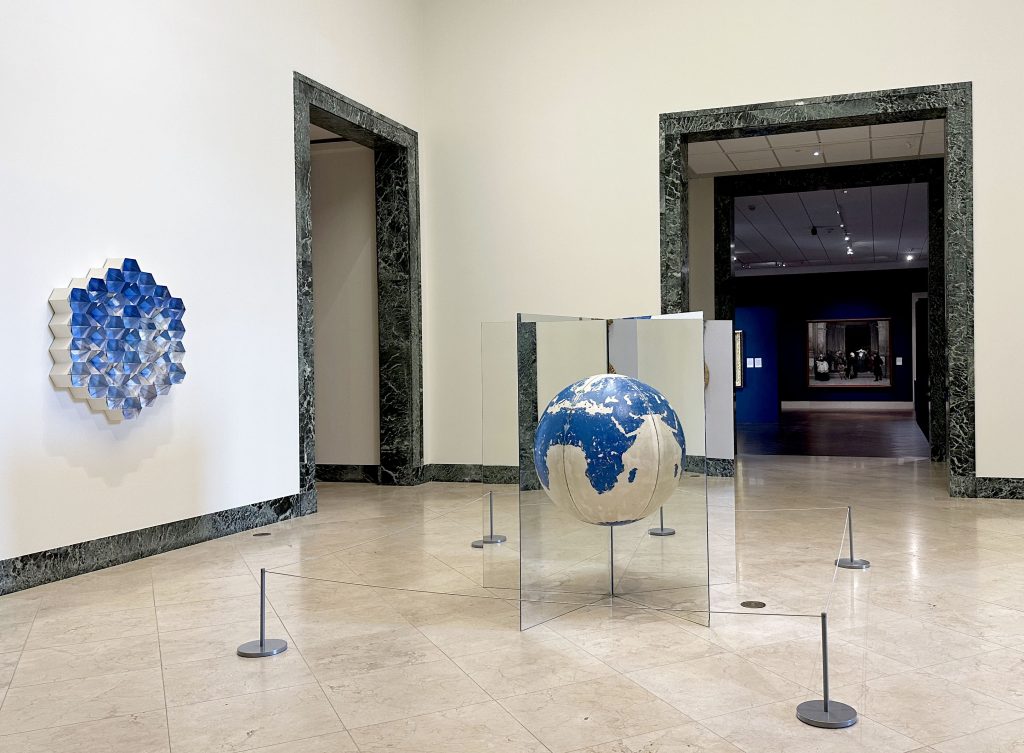
Brookhart Jonquil, “Groundless”, 2023, Mirrors, steel, acrylic paint, enamel paint
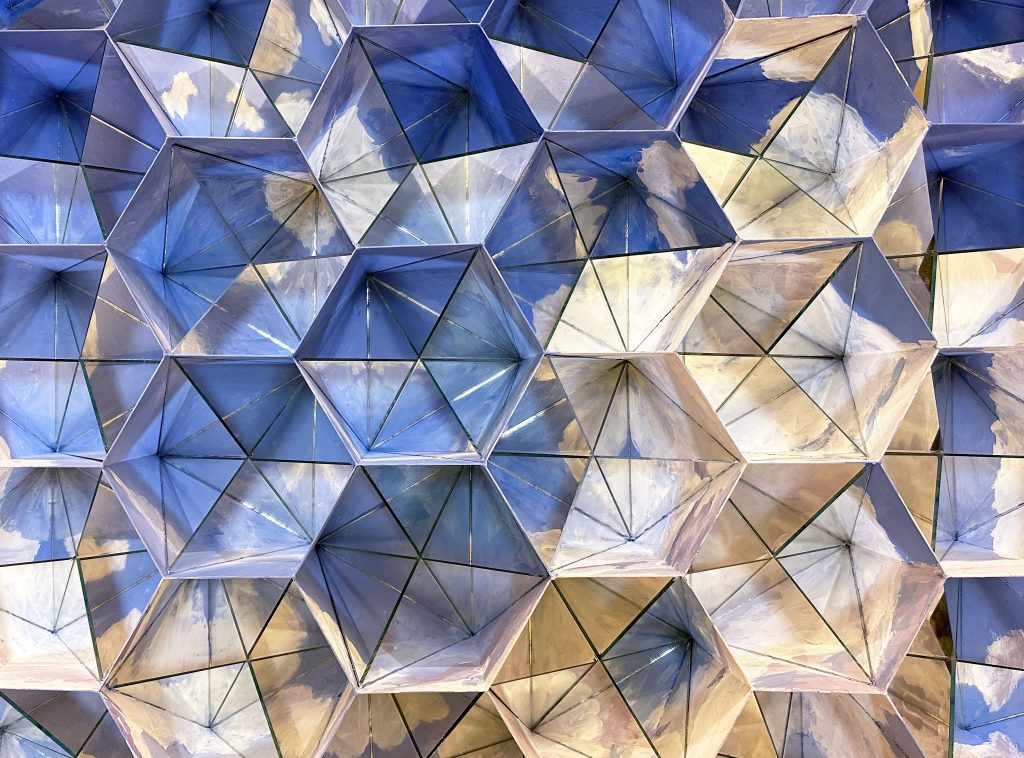
Brookhart Jonquil, “Groundless”, 2023, Mirrors, steel, acrylic paint, enamel paint (detail)
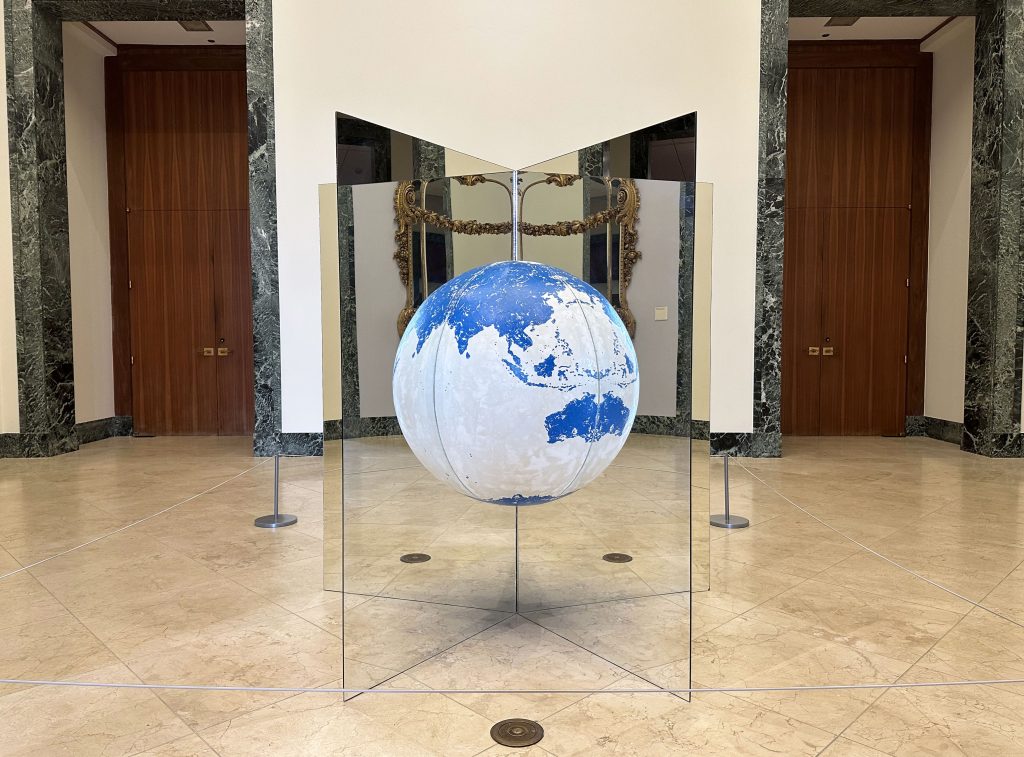
Brookhart Jonquil, “E)A)R)T)H)”, 2012, Mirrors, EPS, MDF, plaster, paint
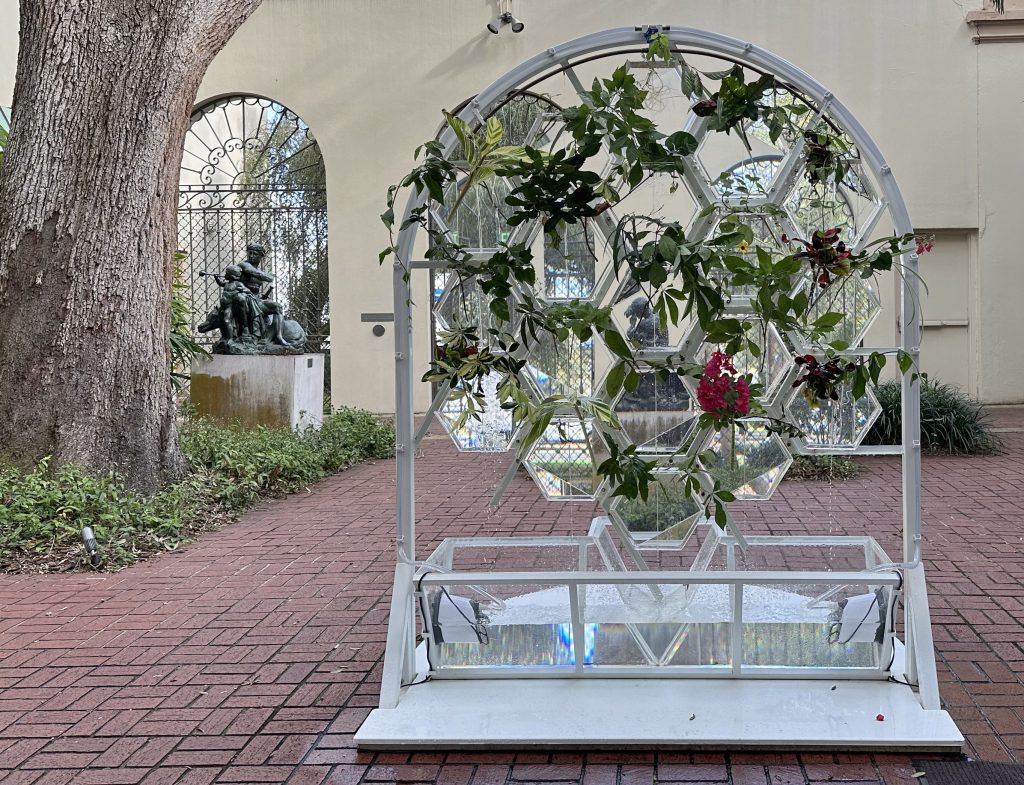
Brookhart Jonquil, “Multiplication Portal”, 2022, Plexiglass, water, powdercoated steel, plant cuttings, marine polymer sheet, pump system

Brookhart Jonquil, “Multiplication Portal”, 2022, Plexiglass, water, powdercoated steel, plant cuttings, marine polymer sheet, pump system
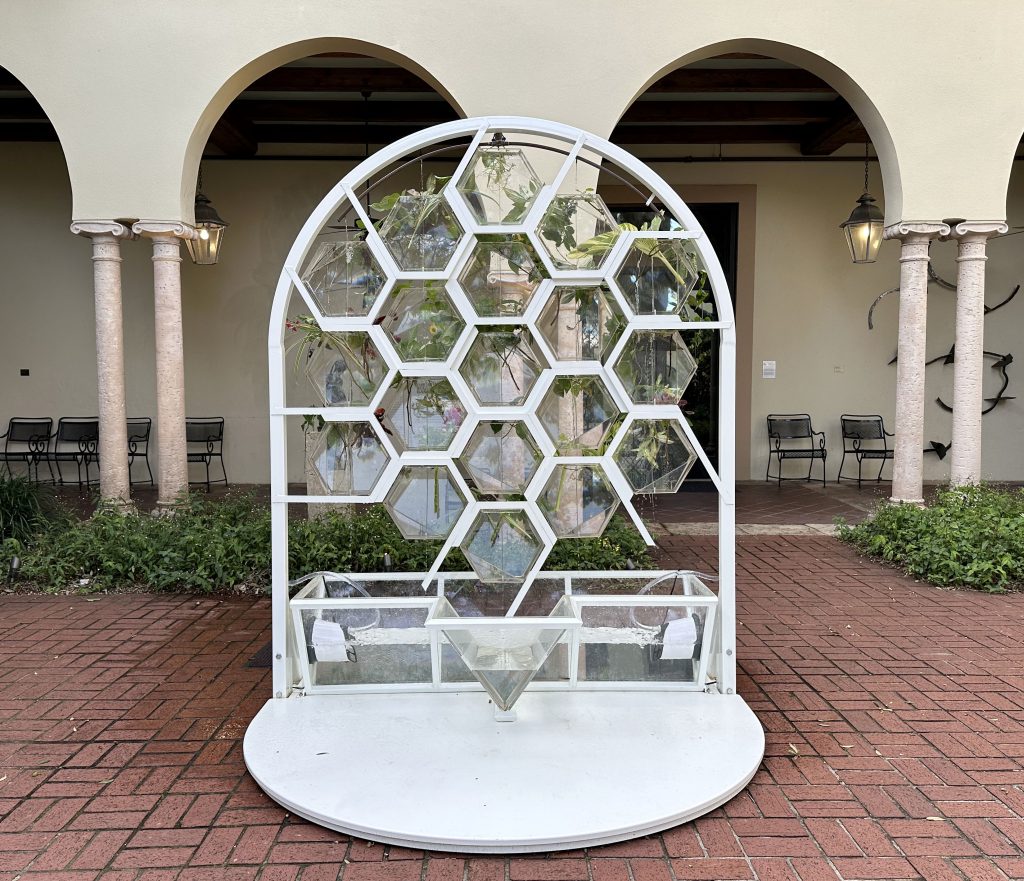
Brookhart Jonquil, “Multiplication Portal”, 2022, Plexiglass, water, powdercoated steel, plant cuttings, marine polymer sheet, pump system
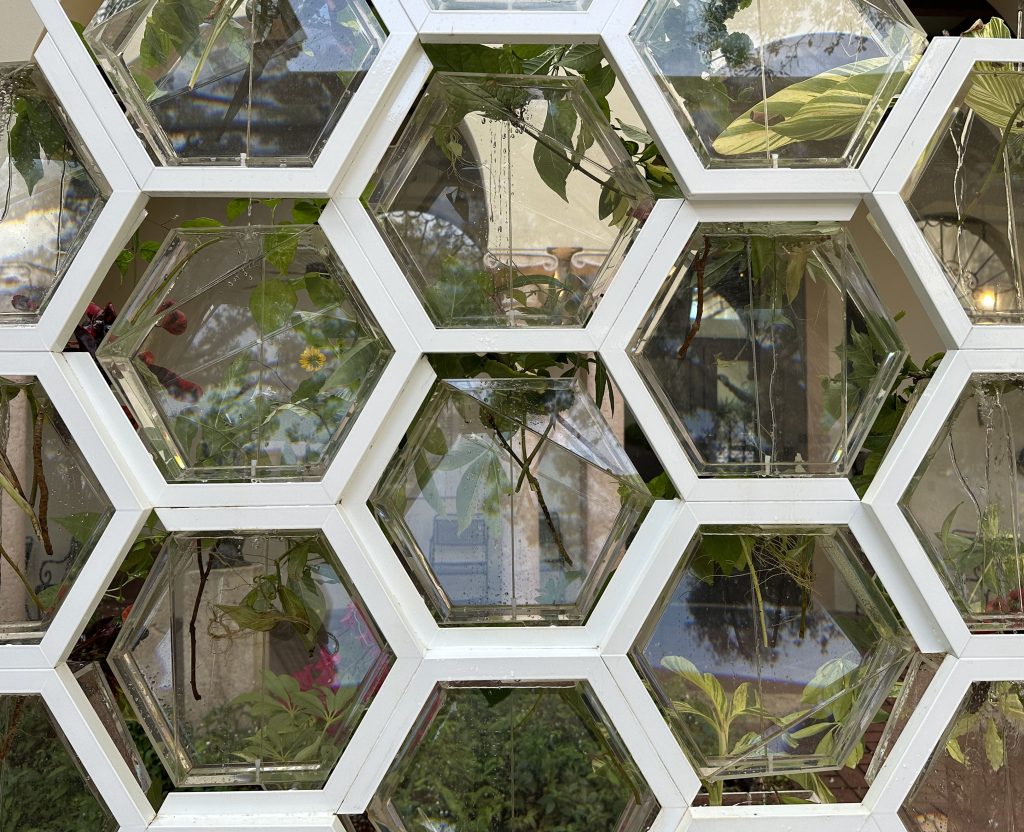
Brookhart Jonquil, “Multiplication Portal”, 2022 (detail)

For The Nature of Art at the Museum of Fine Arts St. Petersburg, work from the exhibition is spread throughout different sections of the museum. In the Great Hall and Sculpture Garden are installations by Brookhart Jonquil.

From the museum about these works-

In this group of installations, Brookhart Jonquil creates art that engages physics, architecture, and ecology to explore the immaterial, shifting aspects of the natural world. His work reflects influences ranging from Minimalism to theories of utopia and perfection; it offers viewers new ways of seeing and a nuanced understanding of our place in the world. The works exhibited here and in the Sculpture Garden encompass over a decade of his career, illustrating how nature has always influenced his artistic practice.

Groundless is Jonquil’s most recent work, inspired by painting en plein air, the Impressionist practice of working outdoors. However, the artist has complicated this by incorporating mirrored surfaces that deny full control of his compositions. Jonquil notes, “Each stroke of paint multiplies unpredictably as I place it, while shifting colors and cloud-forms evade fixity.”

The floor-based sculpture E)A)R)T)H) uses five pieces of mirror glass to dissect an earthly sphere. Unlike Groundless, these mirrors reflect the Great Hall, foyer, and surrounding galleries, suggesting a macro-and micro-viewing of our planet. To further a sense of dislocation, Jonquil has inverted the colors typically associated with land and water: bodies of water are depicted in white, while land is blue.

Multiplication Portal-on view in the Sculpture Garden- is a participatory sculpture highlighting the care and responsibility involved in cultivating plants. Reminiscent of both a kaleidoscope and a beehive, it was inspired by chaos theory-also known as the butterfly effect, which is the idea that one tiny gesture can have colossal consequences within dynamic systems. Brookhart created Multiplication to fight environmental disillusionment. Can one individual impact the impending climate disaster? What is the point of separating paper and plastic? Does turning off the lights make a difference? Multiplication Portal serves as a reminder that our seemingly small actions have the potential for significant consequences.

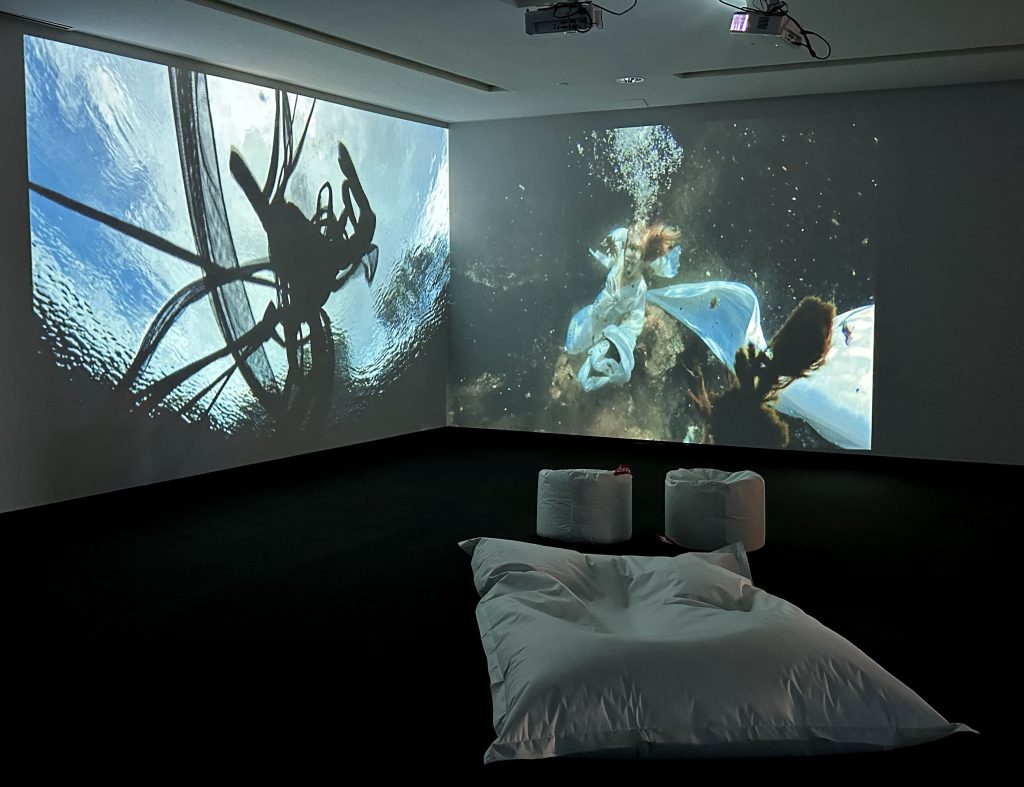
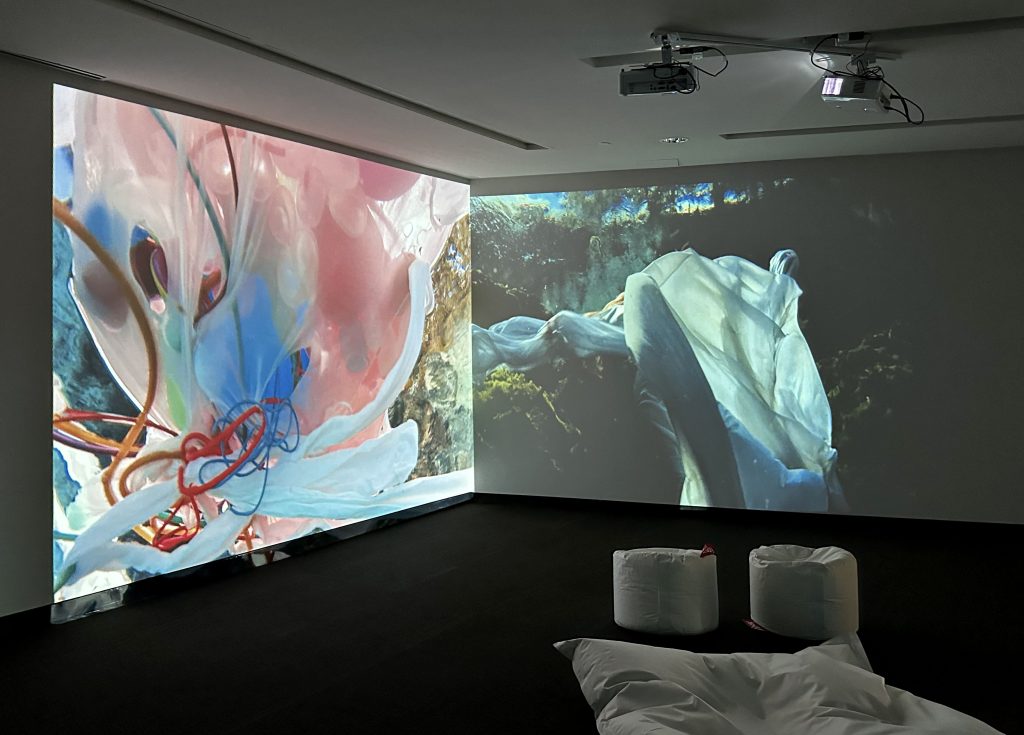
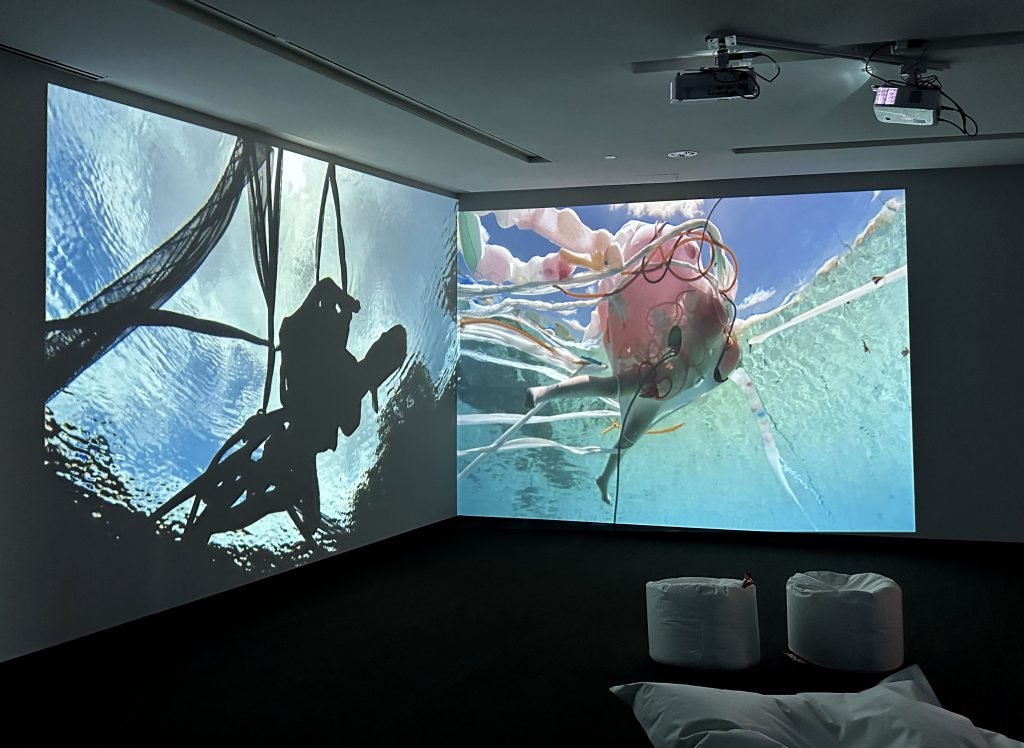
In an upstairs gallery is the video installation, Blood, Sea by Janaina Tschäpe (seen below). The dreamy video takes you underwater to explore transformation through sea maiden myths.

Information on the installation from the museum-

Reminiscent of Voltaire’s Micromégas, Janaina Tschäpe’s fantastical scenes dissolve boundaries, seamlessly intertwining in an ever-flowing continuum of evolution and transformation in a grand opera that delves into themes of change, gender, and the construction of myth and history. The universe created by Tschäpe beckons one into a parallel world of ambiguous scale-indeterminate in both time and space. The spring-fed grotto provides the scenographic impetus for this grand production, a captivating fusion of a theme park nestled within a state park and bearing the distinction as one of Florida’s oldest roadside attractions. The sea maiden mythologies that inform Blood, Sea link endless stories from across time and space, as many cultures have some version of a water goddess. Millennia of previously unknown deep-sea creatures caught in fishermen’s nets spawned the mythic narratives that gave rise to these goddess/creature tales. From the Mami Wata spirits of West Africa to the water sprites of Irish lore, the trope of the sea maiden appears around the world and across time. Tschäpe’s primary connection is her namesake, the Orixa lemanja of Candomblé. This powerful water spirit is the Brazilian version of the many syncretic gestures born of the Yoruban Afro-Atlantic diaspora. But lemanja is merely one character in the global pantheon of the water goddess.

The split-tail mermaid motifs that adorn the exterior walls of centuries-old homes in the landlocked Swiss Alps are a testament to the enduring allure of the fish woman’s imagery. The split-tail represents the hybrid presence of both home and away, the perpetual dual identity of the émigré, and a curious cipher of Tschäpe’s experience living between the culturally antipodean points of Germany and Brazil. This existence places her between logic and magic, between Protestant rationalism and the mystical worldview of Candomblé, between the grey angst of northern Romanticism and the sensual elegance of the southern hemisphere. This ever-changing identity is evidenced clearly in Blood, Sea, where the video’s perspective perpetually shifts. At certain moments, the viewer finds themselves aboard a ship, assuming the role of a scientist discovering a previously unknown life form. In other instances, we have the privilege of swirling amidst the creatures, becoming one with them.
This exhibition closes on 4/14/24.