May 212024
 

“blood compass” 2023, Cotton and acrylic yarn

“summer somewhere (for Danez)”, 2020, Woven cotton and acrylic yarn

“how to approach a foal”, Cotton and acrylic yarn, 2024

“american wedding”, 2019, Cotton and acrylic yarn

Diedrick Brackens’ weavings for blood compass, currently at Jack Shainman’s two New York City locations, have a mystical language all their own. In the gallery’s newest space, inside the landmark Clock Tower Building, his creations look particularly majestic.

From the gallery-

In these weavings, the artist maps an imagined place —visualizing the internal mechanisms and symbols that animate his work while removing the anchor of direct narrative. The scenes depicted in each weaving exist out of time, suspended between a distant past and a world to come. The works in this series are set at dusk, twilight, and deep night—hours that become vehicles for ritual and interiority. The silhouetted inhabitants of this in-between realm are archetypes that Brackens once described as ciphers, or “needles through which I slip the threads of biography and myth, and pass through a mesh of history and context.”

His figures are accompanied by an ecosystem of symbols and shapes that have recurred over the course of his practice. The animals, natural elements, and man-made objects, accrue significance every time they are cast in this ever-evolving mythology. The characters in this series are placed in dialogue with lightning bolts, waning suns, and sourceless orbs of light—open-ended devices of orientation. In these distilled arrangements, footholds for straightforward interpretation dissolve—inviting viewers to parse the compositions and uncover meaning.

Brackens’ semiotic language emerges from lived experience, but also through revisiting books, poems, and legends. In blood compass, some of these references—alluded to in his titles— include the novel Mind of My Mind by Octavia Butler, the poem “How you might approach a foal” by Wendy Videlock, and the Bible’s parable of the prodigal son. These stories, though dramatically diverse in genre and subject, speak to Brackens’ inclination to loop, lose, and locate one’s self in that which is known, but also to shape-shift, forming new meaning from that which is “familiar.” He approaches these symbols—weighted with memory, context, and history—with fresh eyes or, as Videlock’s poem concludes, ”like you / are new to the world.”

The show closes downtown on 5/24, but continues through 6/1/24 at the Chelsea location where the selections below are from.

“if you have ghosts”, 2024, Cotton and acrylic yarn


“towards the greenest place on earth”, 2023, Cotton and acrylic yarn

“favorable conditions”, 2023, cotton and acrylic yarn

May 192024
 

Ann Schaumburger, “Silver Moon in Darkened Sky House”, 2023, Flashe on wood

Ann Schaumburger

Ann Schaumburger

The three exhibitions currently on view at A.I.R. Gallery in Brooklyn all focus on homes in unique ways. In the first gallery, Ann Schaumburger’s paintings of houses for New Work continue her exploration of color.

From the gallery-

For over fifty years, Schaumburger has used the house as a basic structure—a scaffold—for exploring how colors interact with one another. Schaumburger builds her houses with blocks of four pigments, using stencil brushes and tape to fill each house with modular forms. Influenced by the theories of Josef Albers, Schaumburger’s approach to color is meticulous yet playful. Different colors dazzle and dance when placed in proximity, creating a sense of surprise.

The paintings in this new body of work depart from Schaumburger’s earlier explorations in one key detail: the houses are now mounted on wheels. This choice was inspired by Schaumburger’s reading of the biography of Henry David Thoreau, whose family had attached wheels to their domicile, allowing them to transport the house across different sites in Concord, Massachusetts. “The idea of taking a solid house, attached to the ground, and letting it roll away,” Schaumburger says, “seems both comical and deeply suggestive of our times.”

Schaumburger has described her color choices as an attempt to “solve an aesthetic problem.” Yet the work is not entirely abstract. Titles like Forest House Under Summer Sky and Moonscape Moving House gesture toward the fact that certain color relationships become evocative of different seasons, places, and times of day. All of the paintings in the exhibition feature a crescent or small globe in the upper left or right quadrant. Sometimes, this globe is rendered in metallic gold or bronze, recalling the sun. Other times, it is a lunar silver. The round shape of the globe mirrors the house’s circular wheels. Just as the earth rotates around the sun, the wheels rotate around their own axles, allowing the house to move.

The wheeled house becomes a spirited metaphor for Schaumburger’s practice. Dynamic rather than stationary, it embodies the liveliness and energy of Schaumburger’s color choices, as well as the open-ended nature of her process.

Roberta Dorsett’s photos for Sleepwalking explore isolation and uneasiness in her family’s suburban home.

Roberta Dorsett, “Sleepwalking”

Roberta Dorsett, “Sleepwalking”

Roberta Dorsett, “Sleepwalking”

From the gallery-

Dorsett’s Sleepwalking is a series of photographs examining isolation in the suburbs and how a sense of danger often accompanies seemingly idyllic environments. The work depicts three women, Dorsett’s aunt, her cousin, and Dorsett herself, occupying the shared space of a suburban home in Connecticut. Tension arises from the camera’s interaction with the women. The camera acts as an intrusive person, an interloper, and a voyeur as it captures the women in moments of discomfort and vulnerability.

In Dorsett’s previous work, she took on the role of family historian, photographing moments of in-betweenness that result in candid and uncontrived images. Her obsession with taking photographs of her family is driven by their lack of extant family albums or other visual documentation. Because of the family’s socioeconomic status, photography was considered a luxury and only done for special occasions. Moreover, Dorsett’s mother had to leave behind her family’s photographic history when she immigrated from Jamaica to the United States.

Dorsett initially intended Sleepwalking to be a straightforward documentation of her aunt and cousin’s experience as first-time Black homeowners. But she found herself drawn into the project’s narrative and began photographing her family in a more constructed and story-driven way, drawing inspiration from slasher and horror films. Dorsett captures the visceral thrills of these types of films by continuing to utilize her family to explore the concepts of voyeurism and anxiety. The single-family home, once a symbol of milestone achievement, now becomes a surreal site of both safety and terror. As she stood behind and in front of the camera, registering the uneasiness and distress of these three women inside their home, Dorsett dreamed up a distorted reality and asked herself, “Am I awake or sleepwalking?”

Finally, Denisse Griselda Reyes multimedia installation for Did you have a hard time finding me?  explores home and identity using a combination of original artwork and family archives.

Denisse Griselda Reyes, “Did you have a hard time finding me?

Denisse Griselda Reyes

From the gallery-

Featuring short films and familial ephemera alongside a new body of paintings, this exhibition humorously meditates on questions of self-formation, reparative representation, and archival preservation, inviting us to dwell in the absurdity these ambitions unintentionally generate. This is Reyes’s first solo exhibition in New York City.

Presenting what Reyes has called a “maximalist constellation of memory,” the exhibition juxtaposes materials from their family archives with paintings and multimedia projections within an installation space that recalls, yet does not perfectly reproduce, the domestic interiors of Reyes’s family. Anchoring this exhibition is a short film that ties together two threads. First, the border crossings of Reyes’s grandmother Anita that were necessitated by the peril of the Salvadoran Civil War, and this history’s impact on Reyes’s mother. Second, the queer dating life of Reyes’s indignant and savvy alter-ego, Griselda. Part-narrator, part-drag-persona, part-survival-strategy, Griselda offers Reyes a means to dictate the terms of their own representation against the expectations that constrict queer Latinx artists in the United States. Still, Griselda is also beholden to identitarian demands. Reyes allows their avatar to straddle the line of spectacle, flirting with failure, acknowledging that self-formation might be an impossible endeavor. By juxtaposing Griselda’s exploits with the narrative of their grandmother, Reyes interrogates whether familial, social, and historical processes have the final word on what generates a self.

Reyes has produced Griselda as a mediating figure—one who negotiates their own identity between femininity and non-binary gender, and who personifies the absurdity of any singular narrative of origin. In its plenitude and play, the exhibition exceeds the ostensible facticity of the familial and historical archive. Featuring new paintings that hazily recreate family photographs, a vitrine full of childhood teeth that parodies genres of museal presentation, screens that toggle between home videos and the simulation of archival footage, and striking blue-green walls that recall the past domestic spaces of Reyes’s family in El Salvador, the exhibition transforms processes of preservation into acts of mythmaking. The exhibition is less a recreation of the artist’s family’s domiciles than a space of critical reflection and ambiguity. Guests are invited to join in this meditation—and may find their own notions of selfhood implicated as a result.

These exhibitions close 5/19/24.

May 182024
 

“Equulus Duo (Two Horseys)”, 1993, Resin, steel, toy horses

“Noven Beastiolae et Octo Massae (Nine Animals and Eight Blocks)”, 1994/99 Resin, stuffed animals, steel, wood, paint

“Sub-Tristis (Somewhat Sad)”, steel, paper towel roll, resin, bees wax, dead fly, 1989

“Notae Litterarum (Foreign Trade)”, 2003, Book, glue, steel

Lucy Puls’s sculptures for Here Everywhere at Nicelle Beauchene encourage the viewer to think about objects in a new way, while also seeing them in the context of their own history. The thrift store toys in her resin sculptures are reminiscent of specimens in a jar or bugs in amber. A roll of paper towels, coated in resin and bees wax, also has a fly on it as if, like the people preserved at Pompeii, an event caused it to be trapped in this moment.  Casts of ships that no longer sail, and books detailing things no longer important, are made and remade into new forms with new codes to decipher. Consumerism, technology, even language itself (her titles are in Latin and English), evolve and change.  What will remain of the present day as we move into the future? Are there clues in what Puls has made using remnants of the past?

From the press release-

Showcasing selected works from 1989 to 2003, Here Everywhere highlights Puls’ unique and overlooked approach to materials and form, surveying her early experiments in making sculpture with found objects, wax, and resin.

In the late 1980s and early 1990s, Puls turned to making small, resin-cast sculpture with personal effects, found objects, and outmoded household items. At the time, Puls had been making large-scale fiberglass and corrugated metal sculpture; as a reprieve from this labor-intensive work, she began to experiment with leftover waxes and resins on more intimately sized works using items that were on hand in the studio or discovered during thrift shop runs.

Here Everywhere presents selected artworks made across almost fifteen years, loosely arranged into three categories that broadly describe their materials: Small Things, In Resin, and Of Book.

Comprising Small Things is an example of one of Puls’ very first experiments in wax from 1989, Dicis Causa (For the Sake of Appearances). Puls coated a fur hat in a mixture of wax and resin, tipping the form on its edge and affixing insects to its interior surface. Once a status symbol, here the fur hat transforms from a useable object to relic, recognizable, yet made distant through the artist’s material interventions and presentation on a steel shelf.

Works from In Resin include heavily sanded, amberized sculptures arranged throughout the gallery at varying heights atop artist-made shelves and pedestals. Assembled in this series are objects that made their way into thrift stores en masse throughout the 1990s, including once sought-after goods such as the Macintosh 512K and My Little Pony toys. Puls primarily acquired items that had been marked down at resale stores, thus seeking to understand the ways our consumer tendencies pave the way for trend cycles and widespread obsolescence. Children’s toys, in particular, mark this system for the artist; Res Parvus (Little Things) (1991) and Pueri Arma (Child’s Gun) (1991) reveal assembled compositions of the consumer objects that denote childhood—from the innocence and ubiquity of small, plastic figurines to the targeted marketing of BB guns to young boys.

Made a decade later, Imperfectus (Encyclopedia Britannica) (2002) and Involvo (Websters Twentieth Century, Red) (2002) from the series Of Book were created in a time-intensive process of gluing and layering. Unbinding and re-articulating the ideologic form of the encyclopedia, Puls meticulously transformed thousands of loose pages into solid, illegible objects.

The goal across all three series, Puls says, was to achieve in sculpture that which is done with relative ease in painting and drawing: to reduce “representation” to its simplest means while physically separating the object, or artwork, from real-time reality. This is to suggest the idea of a physical object that is both there and not there, devoid of any use-value yet rife with manifold meanings and associations. Through a “strangely alluring sense of loss,” as Glen Helfand described of the work in 2005, Puls turns Dada and Minimalist principles inside out, asking us to more deeply consider the influence of everyday objects and the way they reflect essential ideas of who we are.

This exhibition closes 5/18/24.

May 142024


Kris Lemsalu’s sculptures for One foot in the gravy at Margot Samel are well crafted explorations into life and death, using a lot of tongues. There’s a lot of humor in the work, and this levity is nice to see in the galleries- especially in our current times.

The press release is interesting too-

One should acknowledge, with infinite joy, the fact of being alive. We should celebrate our existence and recognize its fragility in every moment. It’s easy to forget, to get distracted by mundane circumstances of our day-to-day life. On the other hand, life’s impermanence may induce panic, an all-encompassing fear that leaves us searching for answers. Still, we are resilient to becoming just another customer at Café Gratitude, its slogan ringing in our ears like a mosquito — What Are You Grateful For? Baruch Spinoza introduced the concept of conatus, which illustrates the internal drive of every being to persevere in its existence. The conatus is inherent to every substance; it is the engine that propels life. However, older philosophies get boiled down to artificially made bite-sized snacks at Café Gratitude — Live Laugh Love — pushing us to habitually flee from quick, feel-good moments.

Celebrating life doesn’t seem to intimidate Estonian artist Kris Lemsalu. Her work emphasizes, with absolute honesty, life and its different stages. This direct form of communication is not new to the artist. In 2019, she presented the work Birth V – Hi and Bye at the Venice Biennale which was an unmediated exploration of cycles relating to birth, life, death, and (fortunately) rebirth. Lemsalu continues her celebratory, inquisitive, and pagan journey in her exhibition at Margot Samel. We are welcomed with a grand altar inscribed with “VITA”, each letter created with an anthropomorphic character that references Baubo, a figure from Greek mythology associated with vitality and renewal, famed for making Demeter laugh in her most tragic moment. This figure often recurs in Lemsalu’s work, appearing with a jaw (or vulva) as a head, wearing a pair of cargo pants with tongues leaning out from its utilitarian pockets.

Tongues multiply in various sizes and formats throughout the space. Sometimes they are raised like the bright flag of a grand country, other times they rest on a rocking chair, contemplating life. The tongue is a familiar symbol in Lemsalu’s work. The artist often correlates the body part to the Hindu deity Kali, a controversial figure, who in the ecstasy of an uncontrolled dance, extended her great tongue to drink the blood of demons, resulting in a triumph over negative forces. Kali’s tongue is a symbol that evokes both laughter and fear, simultaneously bestowing life and death, creation and destruction.

When we enter the world of Lemsalu’s work, our experience functions as a ritual. Each work acts as a rite that celebrates our conatus and the perseverance of our existence, shamelessly celebrating our fragility and the passage of time, commemorating life with flowers, with one foot deep into the gravy.

Enrique Giner de Los Ríos

May 142024
 

Kwakwaka’wakw artist and activist Chief Beau Dick’s (1955-2017) carved masks for the exhibition Walas Gwa’yam / Big, Great Whale at Andrew Kreps Gallery draw you in with their intriguing visages.

From the press release-

Our whole culture has been shattered. It’s up to the artists now to pick up the pieces and try and put them together, back where they belong. Yeah, it does become political. It becomes beyond political; it becomes very deep and emotional.” – Beau Dick speaking in the 2017 film ‘Maker of Monsters: The Extraordinary Life of Beau Dick.

Beau Dick’s works are deeply informed by the tradition of potlatch, a gift-giving ceremony practiced by Indigenous people of the coast of Pacific Northwest Canada, which focused on the redistribution of wealth as a tool for building solidarity. Outlawed by the Canadian Government for nearly seventy years as part of an ongoing history of forced assimilation, the seclusion of Dick’s birthplace on Kingcome Inlet (Gwa’yi) allowed his community to continue practicing customs relatively free from the gaze of colonial authorities. Trained in wood-carving by his father, grandfather, and other master carvers, and completing his education in Vancouver, Dick was acutely aware of inherent tensions between contemporary consumer culture and Kwakwaka’wakw teachings. Refuting his masks as static objects, his carvings reference supernatural figures, like Dzunuk’wa, the “wild woman of the woods,” and her counterpart, Bakwas, “wild man of the woods,” which are reanimated to combat what Dick saw as capitalism’s “ravenous” oppression. Frequently employing his works in dances and performances, in 2012 he took forty Atlakim (Forest) masks to his community in Alert Bay, where after one final ceremony, they were ritually burned, referencing the ongoing responsibility for rebirth, and recreation in the face of erased tradition.

May 142024
 

A large heart hangs in netting below the skeleton of a mysterious creature in one of Joy Curtis’s sculptures for Night Hike and Ocean Grandma at Klaus von Nichtssagend Gallery.  As you walk around the sculptures you are invited to invent the story behind them. Titles like Ocean Grandma, Sympathetic/ Parasympathetic, and Future Organs, and Night Hike (Epiphytes) provide clues.

Throughout the run of the exhibition, performers activated several of the smaller wearable sculptures. These performances are currently on view on the  gallery’s website and Instagram.

From the press release-

Joy Curtis’s new show of immersive textile sculptures takes on a folkloric quality, addressing ideas of evolution, environmental history, continuity, and change. Curtis sculpts with fabrics dyed to align with multiple historical traditions. These soft materials are quilted and sewn onto wire armatures, assembled to imply animal and plant forms, yet veering into abstraction.

Roots, vertebrae, leaves, and organs drape from figurative or animaloid fabric structures, creating canopies with an ambiguous narrative. Curtis hand-dyes her cloth using techniques inspired by Nigerian (Yoruba) Adire and Japanese Shibori processes, employing natural hues such as amber, ochre, iron, and indigo. Some pieces incorporate synthetic elements, such as reflective discs sewn into the works, causing visual sparks or glimmers amidst the more subdued textiles. The mixture of materials creates rich textures, as well as both reflective and absorbent variations in the light.

Some sculptures are large and hang dramatically from the ceiling, allowing the viewer to walk underneath and between them. A series of smaller works hang on the walls, actively wearable as garments. When dressed on individuals, these sculptures transform the wearer into an extension of Curtis’s formal style.

May 012024
 

Claes Oldenburg and Coosje van Bruggen created Free Stamp, the 70,000 pound sculpture, pictured above, in 1985.

Cleveland Historical, which has detailed numerous historical sites in the city, provides a detailed history of the sculpture. They also have an app to simplify exploring the city.

Below is a section from their website about Free Stamp

…Commissioned by the Amoco Company in 1982, the Stamp was designed and fabricated in 1985. At the time, Amoco owned Sohio (Standard Oil of Ohio) and the building now known as 200 Public Square, and the piece was intended to reside in front of the building. But in 1986, before installation could happen, Amoco, Sohio and the building were acquired by BP America. The new owners refused to mount the sculpture—perhaps believing that “Free Stamp” was a metaphoric aspersion. Art historian Edward J. Olszewski has also noted that, in England, Pop Art is viewed more cynically and politically than in the United States, where it is considered primarily whimsical. Oldenburg is on record as saying that “free,” references the emancipation of American slaves during and after the Civil War—a plausible explanation given the piece’s planned proximity to the Soldiers’ and Sailors’ Monument.

So instead of adorning Public Square, the Free Stamp was denied its freedom: imprisoned instead in a warehouse in Illinois. There it gathered dust for five years before then-mayor George Voinovich invited Oldenburg and van Bruggen to Cleveland in hopes of selecting another site.

It eventually was decided that the Stamp should be located in Willard Park on Lakeside Avenue just west of East 9th Street; and BP agreed to gift it to the city of Cleveland with all installation and maintenance expenses covered. However, disagreements arose about how the sculpture would be positioned. The original intent was for the Stamp to stand face down on Public Square. However, Cleveland city planners felt that this approach was not right for Willard Park and the Stamp ultimately was mounted angularly, with the faux-rubber “FREE” proudly visible. According to Oldenburg, it was as if “a giant hand picked up the Free Stamp and angrily hurled it several blocks to its current location at Willard Park.” Not surprisingly, the Stamp—formally dedicated on November 15, 1991—aims directly at 200 Public Square “It’s pointed on a diagonal to the 23rd floor, which were [BP’s] corporate offices,” notes Olszewski. “It leads the viewer back to the original site.”

Apr 192024
 

Meryl Engler, “Lying in Red”, 2023, Woodcut

Work by Michael Loderstedt (left), Eva Pozler (center) and Lori Kella (right)

Work by Lori Kella, Maria Uhase, and Meryl Engler (right two pieces)

Lori Kella, “Mudslide and Forsythia”, 2022, Inkjet print (left) and Corrie Slawson, “Amalgam 4”, 2022 (top) and “Amalgam 3”, 2022 (bottom), Oil and screenprint on plywood

Today (4/19/24) is the last day to see Life Out of Balance at the Emily Davis Gallery at The University of Akron. The group show show includes work by Maria Uhase, Meryl Engler, Lori Kella, Benjamin Lambert, Michael Loderstedt, Eve Polzer, Ron Shelton, Ariel Bowman, and Corrie Slawson.

From the gallery-

When a tree falls in a forest, we may see it as the death of the tree. It stops photosynthesizing, growing, feeding its mycorrhizal symbionts, flowering, developing fruit, dispersing seeds, taking in carbon dioxide, and producing oxygen. But in the ecosystem, it begins a whole new life in decay. It feeds the soil and microbes through the decomposition of its tissues; it provides a place for fungi, mosses, and lichens to grow; and it becomes a protected habitat for a myriad of insects, mammals, and birds. This same tree, therefore, can be both dying and living at the same time, depending on perspective. It can be dead if considered separate from its surroundings, or it can be alive in its continued relationship within its ecosystem.

Humans can feel more alive by being integrated with the rest of the natural world. We are not living to our full potential, or allowing nature to be its full potential, when we consider ourselves as separate from it.

If we are to have hope for solving the complex environmental issues that are facing us today, we need to work with, rather than against, the forces of nature.

Below are a few more selections.

Ron Shelton, “Yellow Mosaic”, 2021, Plastic and wire

Ariel Bowman, “Wall Trophy Series”, 2019, (Cave Bear, Antique Bison, Early Horse, Saber Cat, Dodo, Brontotherium, Parasaurolophus), Unglazed, high fired porcelain; Maria Uhase, “Splitting Headache”, 2022 Ink on paper and “Softly”, 2023, Graphite on paper

Ariel Bowman, “Wall Trophy Series”, 2019, (Cave Bear, Antique Bison, Early Horse, Saber Cat, Dodo, Brontotherium, Parasaurolophus), Unglazed, high fired porcelain

Benjamin Lambert, “A pint for a gallon”, 2020 and “I Found Your Damn Lost Shaker of Salt”, 2020, Stoneware, underglaze, glaze, epoxy

Corrie Slawson, “Stage Set Tapestry 1, for Feast: a ballet. Of Bats, Blue Footed Boobies, Penguins and other threatened fauna and flora. Pastoral landscape after Rubens”, 2020, Oil and mixed media on muslin

Corrie Slawson, “Stage Set Tapestry 1, for Feast: a ballet. Of Bats, Blue Footed Boobies, Penguins and other threatened fauna and flora. Pastoral landscape after Rubens” (detail)

Michael Loderstedt, “Snakehead”, 2023, “Thistles”, 2023, Cyanotypes on fabric, embroidery, fabric collage

Lori Kella, “Mayflies in the Grass”, and “Yellow Irises”, 2024, Framed inkjet prints

Maria Uhase, “Encircled”, 2023, Oil on linen panel, “Worm”,2023, Oil on linen and “Conglomeration in the Spiders’ Ghost Town”, 2020, Oil on canvas

Eva Polzer, “Gift from a Cat”, 2024, Ceramic, underglaze, velvet jewelry box, and “Gift from a Rat”, 2024, Ceramic, underglaze, petri dish

Meryl Engler, “Waiting”,2023, Woodcut Block


Apr 182024
 

There’s an unsettling tension in the room that houses Mel Chin’s installation Spirit (1994), at the Columbus Museum of Art. Is the rope strong enough to support the barrel? What will be its breaking point?

Some details from the museum about the work-

The rope that seems to carry the weight of Spirit’s enormous cask is made from tallgrass. This native plant was once central to a vast prairie ecosystem spanning over 170 million acres of North America. By 1930, most all of this was decimated as a result of agricultural and industrial settlement, and what remains is protected habitat (Chin received special permission to harvest a portion for this sculpture).

Wooden barrels are traditionally used to measure and transport dry goods like grain, beans, as well as beer, oil and wine, and were central to the process of European settlement and trade in North America. Here, the image of this rope bearing such a massive weight suggests the precarious status of nature in a world of outsized human development. Even the gallery walls, which curve inwards on all sides, seem to respond to the strain.


Apr 122024
 

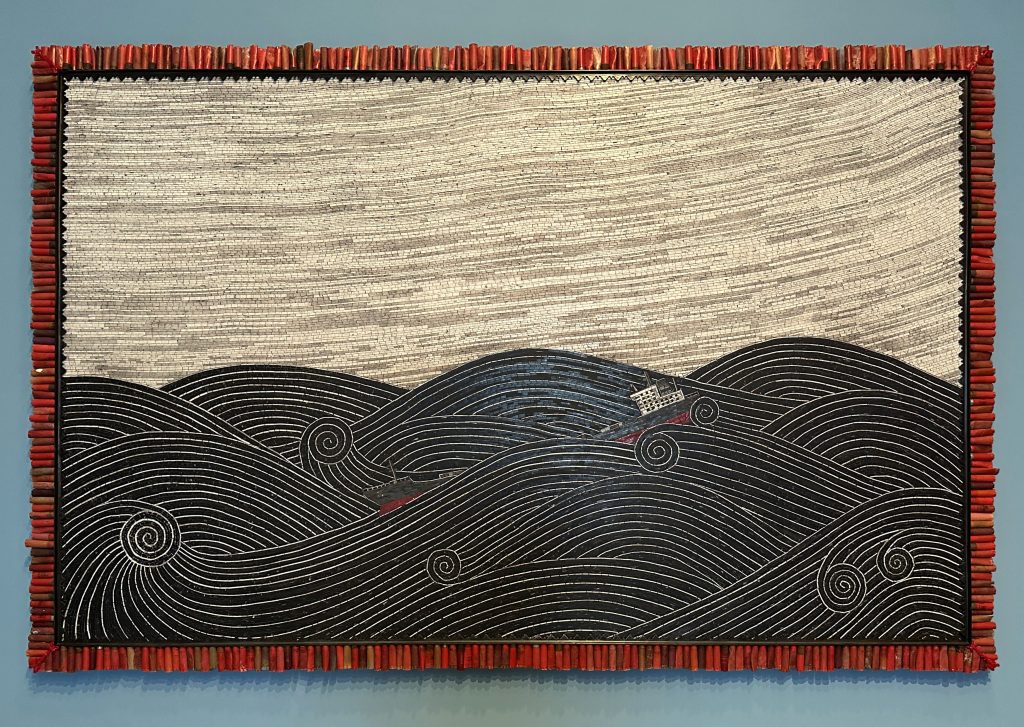
“Erika”, 2021, VCT, shotgun shells, and drink stirrers

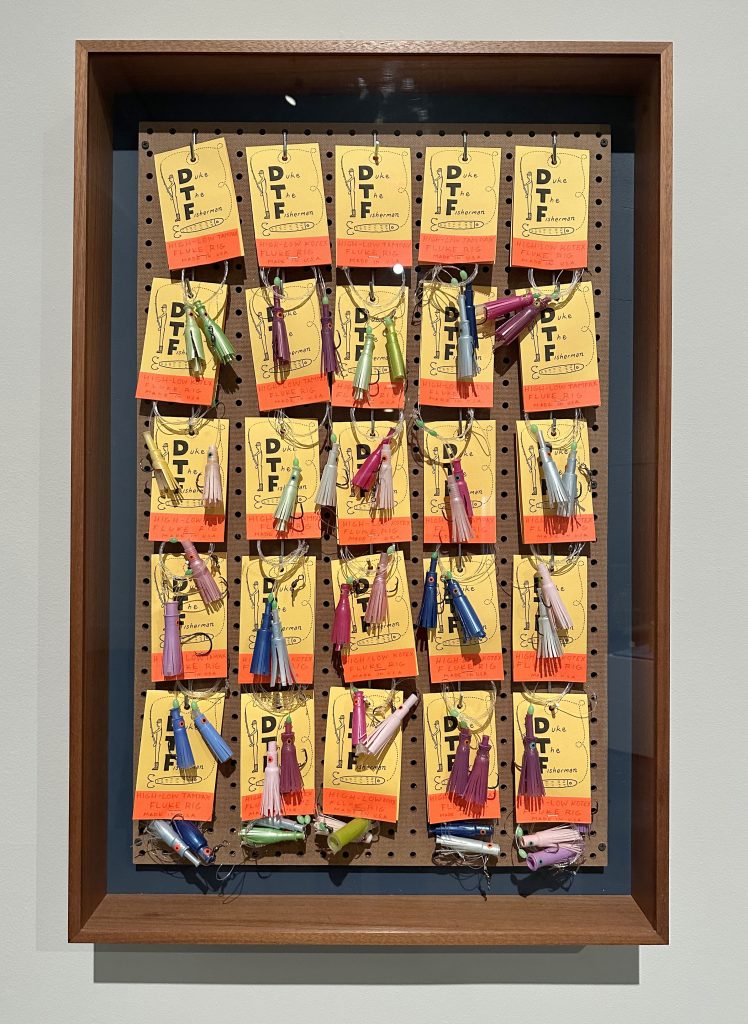
“Duke the Fisherman’s High Quality Fluke Rigs Made in the USA™”, 2022, Found tampon applicators, fishing line, fishing hooks, nail polish, peg board, card stock

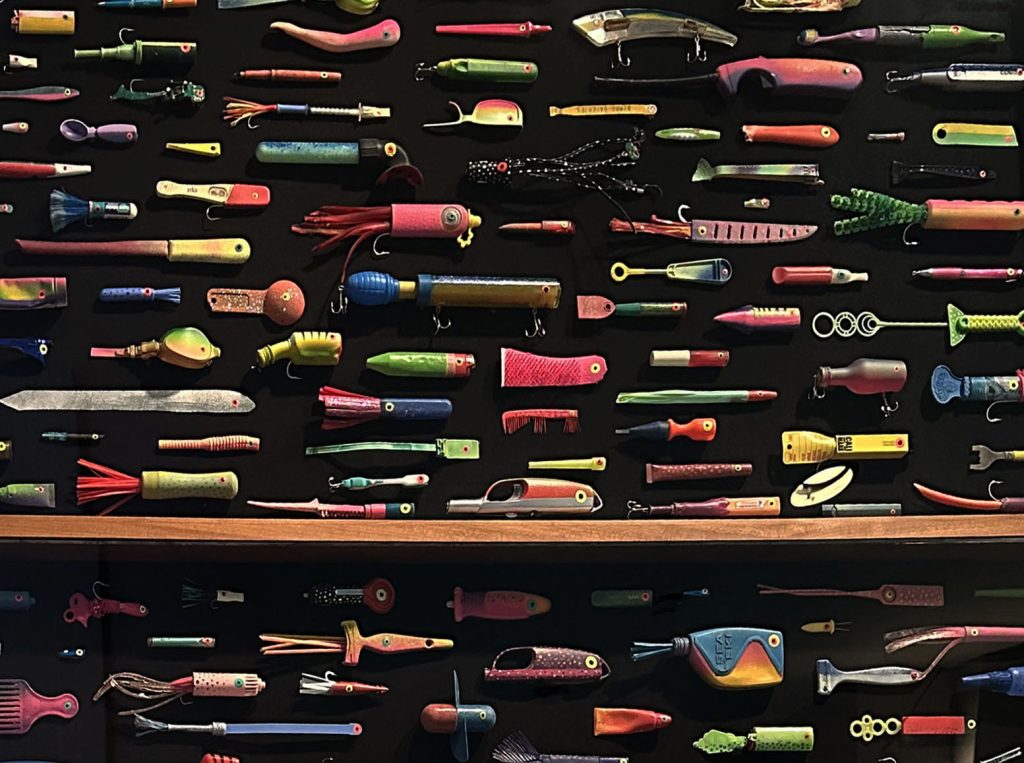
Detail of “Monument to Five Thousand Years of Temptation and Deception V, VI, VII”, 2022, Salvaged plastic, paint, fishhooks

The images above are from Duke Riley’s exhibition DEATH TO THE LIVING, Long Live Trash, on view at Brooklyn Museum in 2023. The artist’s inventive fishing lures, made from discarded plastic items found around waterways, are engaging to look at but highlight the grim reality of how much garbage is polluting our natural environment.

From the museum-

In DEATH TO THE LIVING, Long Live Trash, Brooklyn-based artist Duke Riley uses materials collected from beaches in the northeastern United States to tell a tale of both local pollution and global marine devastation. Riley’s contemporary interpretations of historical maritime crafts—such as scrimshaw, sailor’s valentines, and fishing lures—confront the catastrophic effect that the oil, food, and beverage industries have had on the environment through single-use plastics. The works are presented in the seventeenth- and eighteenth-century Jan Martense Schenck and Nicholas Schenck Houses, alongside a selection of historical scrimshaw from our collection, directly connecting environmental injustices past and present.

In his contemporary interpretations of scrimshaw—ink drawings etched into bone by sailors—Riley replaces the medium’s customary whale teeth with repurposed plastic containers, detergent bottles, toothbrushes, and other waste. The works incorporate the maritime imagery traditional to scrimshaw, but expand it to portray international business executives that the artist identifies as responsible for the perpetuation of single-use plastics. Also on view are Riley’s fishing lures and sailor’s valentines, similarly created with detritus found on northeast coastal beaches. The exhibition juxtaposes corporation-driven pollution with new short films by Riley that highlight New York community members working to remediate plastic damage and restore our waterways.

Erika, the mosaic pictured above, depicts the 1999 shipwreck of MV Erika which, after splitting in two during a heavy storm, released thousands of tons of oil into the Bay of Biscay off the coast of Brittany.

In the video below, Riley gives a brief tour of the Brooklyn show.

Some of the work from this exhibition is currently on view at Museum of Fine Arts St. Petersburg as part of their exhibition, The Nature of Art.