Oct 132022
 

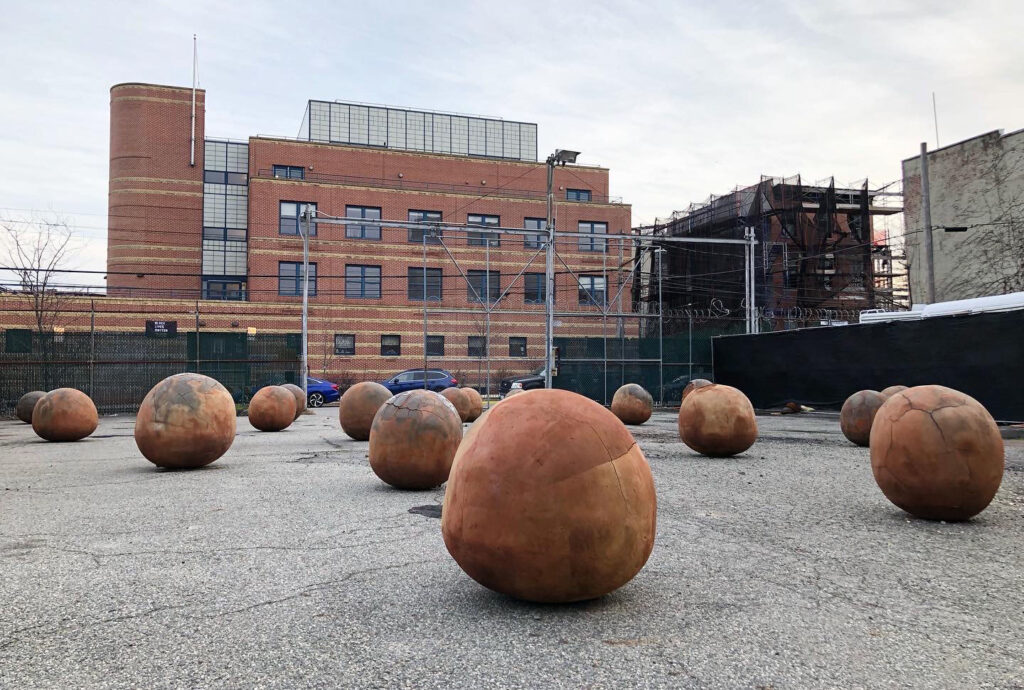
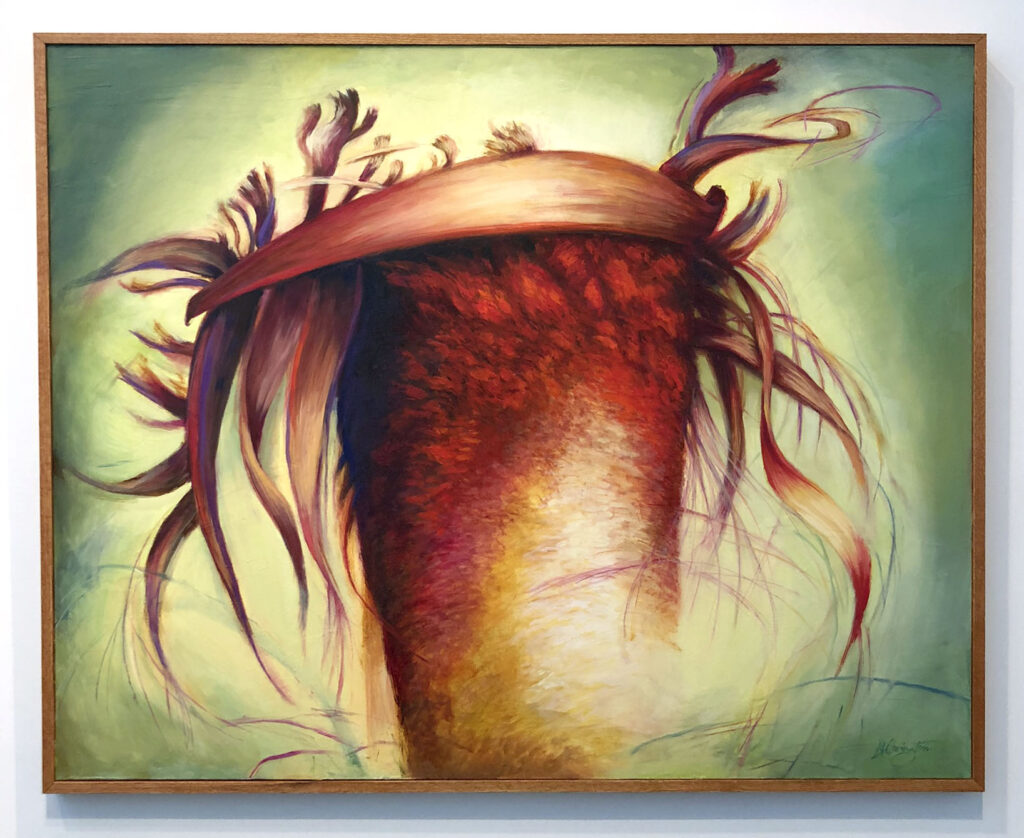
This is the last weekend to see Jason Hackenwerth’s exhibition DARKMATTER at Creative Pinellas in Largo, Florida. It includes the two giant balloon sculptures shown above, as well as several of the artist’s paintings and drawings.

To hear the artist discuss his work, and see more views of the sculptures and artwork in the gallery, check out this video.

This weekend is also Third Saturday at Pinewood (Creative Pinellas, Florida Botanical Gardens, and Heritage Village). For this event Hackenworth will be leading a family arts workshop where he will be teaching visitors how to create sculptures from balloons.

DARKMATTER closes on Sunday, 10/16/22.

Sep 182022
 

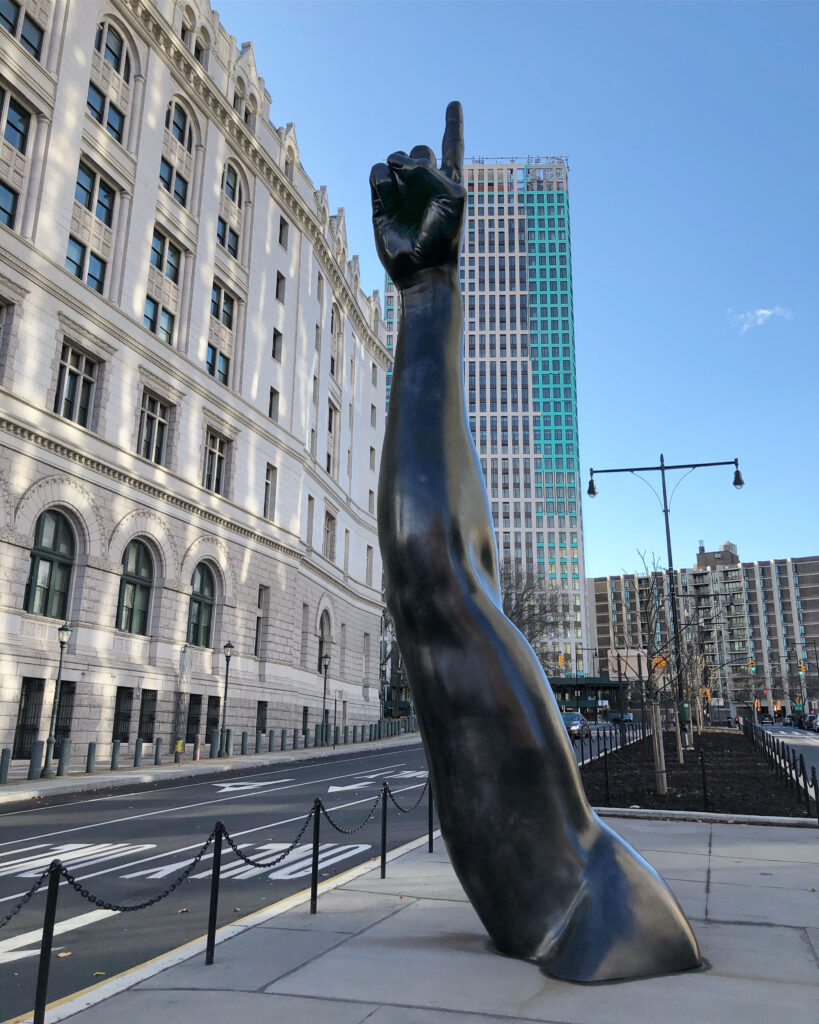
Unity, was created by Hank Willis Thomas in 2019 as part of the Department of Cultural Affairs Percent for Art Program. The 22.5 foot sculpture is a replica of NBA player Joel Embiid’s right arm.

From the artist on the work (via Downtown Brooklyn)-

“The sculpture is an homage to and celebration of the unique and multi-faceted character of the borough of Brooklyn. The spirit of Brooklyn has always been about upward mobility and connection to roots. The large-scale sculpture of a bronze arm pointing toward the sky is intended to convey to a wide audience a myriad of ideas about individual and collective identity, ambition, and perseverance”.

Thomas will be speaking with UCLA professor and author Robin D.G. Kelley today (9/18/22) at 2pm The Broad Museum about his art practice, his activism, and his piece in the museum’s current exhibition, This is Not America’s Flag.

The program will be live-streamed on The Broad’s website and their Facebook page.

Sep 112022
 

Ofer Wolberger’s photo of Spencer Finch’s installation Trying to Remember the Color of the Sky on that September Morning, 2014, located at the 9/11 Memorial & Museum.

From the museum’s webpage about the work-

At the heart of the 9/11 Memorial & Museum’s mission is the promise to commemorate the 2,983 killed as a result of the 9/11 and February 26, 1993 attacks. The Memorial and the Museum fulfills this sacred responsibility in many ways—through memorialization, through education and, in some cases, through artistic expression.

One of the Museum’s most recognizable installations is a piece by artist Spencer Finch titled “Trying to Remember the Color of the Sky on That September Morning.” This work runs prominently through Memorial Hall, or the space that connects the two main exhibitions at bedrock in the Museum. This larger-than-life installation is part of the Memorial Museum’s permanent collection and was commissioned in 2014 before the Museum opened its doors to the public.

The piece is comprised of 2,983 individual watercolor squares—each representing a victim of the 2001 and 1993 attacks—and symbolizes the idea of memory. Many remember the beauty of the clear blue sky on the morning of 9/11. But, our own perception of the color blue might not be the same as that of another person. However, just like our perception of color, our memories share a common point of reference.

Within the larger art installation is the quote “No Day Shall Erase You From the Memory of Time” from Book IX of The Aeneid by Roman poet Virgil. Each letter was forged from recovered World Trade Center steel by New Mexico artist Tom Joyce. This quote suggests the transformative potential of remembrance and succinctly reinforces the 9/11 Memorial & Museum’s mission. Today, while the Memorial and the Museum are temporarily closed, these words remain as true as ever.

The image of the work shown above was included in Mint Museum’s 2021 exhibition, W|ALLS: Defend, Divide, and the Divine.


Aug 262022
 

There/Here: A Cry For Help, 2008/2011/2020

Three Carbon Catchers, 2021

The two works above are from Balance of Water, an exhibition of collaborative work by Carol Mickett and Robert Stackhouse,  at Leepa-Rattner Museum of Art in Tarpon Springs, Florida.

Information from the museum about the first image-

There/Here: A Cry For Help, 2008/2011/2020, is a map of the Gulf of Mexico with an overlay of a map of all the world’s water currents. It is meant to indicate that the world waters, as the world itself, is all connected. The Tarpon, representing all life in our waters, is encountering the effects of global warming.

For the second image-

Three Carbon Catchers, 2021- The Mangrove is a major absorber of carbon dioxide. Carbon dioxide, if left in the atmosphere or in our waters is one of the main contributors to global warming. This painting honors the mangrove.

Mangroves thrive in saltwater environments where most plants cannot. They protect our shorelines from erosion and flooding. Worldwide, mangroves absorb about 24 million metric tons of carbon in the soil each year.

From LRMA’s website about the exhibition-

Balance of Water highlights contemporary artists Carol Mickett and Robert Stackhouse whose collaborative work raises awareness of the effects of climate change on our waterways. As this delicate ecosystem nears a tipping point, they explore ways to alleviate the warming of our waters and reveal the consequences of the rapidly changing climate with a sense of mindfulness and urgency. Since relocating from St. Petersburg to Tarpon Springs in 2017, Mickett and Stackhouse unveil their work to their recently adopted community in north Pinellas County for the first time with a series of monumental paintings that tell the overarching story of the effects of global warming.

This exhibition closes on 8/28/22.


Aug 192022
 

Celo, 2015

Celo, 2015 (detail)


The World is Too Much With Us, 2021

The work above is from artist and retired UNC-Asheville Professor of Art Virginia Derryberry. It was part of the 2021 group exhibition FABRICated at Center for Craft. She curated the show with fellow artist Marcia Goldstein, whose work is included along with five emerging artists.

From the Center for Craft’s website-

FABRICated presents an intergenerational look at new boundaries in art and craft through works that merge fiber-based processes with other media, like painting, sculpture, and blacksmithing. Each of the seven artists explores ideas of the body, identity, and their unique, personal stories by using a medium with a rich history of craft. Stitching, in and of itself, is slow and methodical and invites the audience to slow down and look carefully at the physicality of the thread, the textures of the fabric, and the paint and the found objects that are introduced into the mix. The result is an exhibition that questions the nature of what constitutes women’s work, the relationship of fine art and craft, and how these elements can come together to form a new kind of community conversation.

And from Derryberry’s website about her work-

Virginia Derryberry’s current work includes large scale oil on canvas figure paintings along with fabric/costume constructions, that blend narrative elements from mythology and alchemy, the forerunner of modern science. The intent is to suggest multiple interpretations rather than straightforward illustration of a specific narrative. At first glance, it seems that a “real” space is being defined, but in fact, the painted images are constructed from multiple viewpoints and lighting systems. Passages of volumetric rendering set next to more abstract, painterly areas result in the creation of a virtual, shifting world where nothing is quite what it seems.

Aug 042022
 

“THERE IS A PERIOD WHEN IT IS CLEAR THAT YOU HAVE GONE WRONG BUT YOU CONTINUE. SOMETIMES THERE IS A LUXURIOUS AMOUNT OF TIME BEFORE ANYTHING BAD HAPPENS.”

This 1989 sculpture by Jenny Holzer is part of the permanent collection at Santa Barbara Museum of Art.

Jul 222022
 

Typewriter Eraser, Scale X, 1999, part of The ARIA Fine Art collection in Las Vegas

Artist Claes Oldenburg passed away this week at the age of 93. He was most famous for his large scale sculptures of everyday objects, many of which were produced with his wife Coosje van Bruggen, who passed away in 2009.

While primarily working in sculpture, early in his career in the 1960s he also created “happenings”- theatrical art related performances and collaborations with other artists in his circle. In 1985 he returned to performance and along with van Bruggen, architect Frank Gehry, and writer Germano Celant presented Il Corso del Coltello (The Course of the Knife) in Venice, Italy. In 2021, Pace Gallery in NYC, as part of the two gallery exhibition Claus & Coosje, showed work from this performance, pictured below.

From Pace’s website about the performance-

This ambitious event involved the creation and embarkation of a sea-worthy sculpture in the shape of a giant Swiss army knife. With oars protruding from its red-enameled hull as if from a Viking longship, the image of Oldenburg and van Bruggen’s Knife Ship sailing the Grand Canal has become iconic, while the massive kinetic sculpture was later shown in the rotunda of the Guggenheim Museum in New York, at the Centre Pompidou in Paris, and finally at the Museum of Contemporary Art, Los Angeles.

With so much of Oldenburg’s work, the examination of the ordinary object engages the viewer with what they might previously taken for granted and gives them a chance to look again with new eyes. There is also something lighthearted and fun, as well as investigative, about his body of work.

(image via Whitney Museum’s website)

The Whitney Museum has a video showing the process of assembling his soft sculpture Giant BLT (Bacon, Lettuce, and Tomato Sandwich) 1963, which involves putting the sandwich together piece by piece.

For more on Oldenburg, MoMA has a tribute that includes the words of people who knew him as well as his own. His 1961 artist statement is wonderful and worth reading in its entirety, here is the opening section-

I AM FOR

I am for an art that is political-erotical-mystical, that does something other than sit on its ass in a museum.
I am for an art that grows up not knowing it is art at all, an art given the chance of having a starting point of zero.
I am for an art that embroils itself with the everyday crap and still comes out on top.
I am for an art that imitates the human, that is comic, if necessary, or violent, or whatever is necessary.
I am for all art that takes its form from the lines of life itself, that twists and extends and accumulates and spits and drips, and is heavy and coarse and blunt and sweet and stupid as life itself.

I am for an artist who vanishes, turning up in a white cap painting signs or hallways.

The Guardian’s obituary is also worth a read for more information on the artist’s history.

Jul 042022
 

Jasper Johns’ Three Flags, 1958, is currently on view at the Whitney Museum of American Art in NYC.

Information about the work from the Whitney’s website-

In 1954, Jasper Johns began painting what would become one of his signature emblems: the American flag. As an iconic image–comparable to the targets, maps, and letters that he also has depicted–Johns realized that the flag was “seen and not looked at, not examined.” The execution and composition of Three Flags elicit close inspection by the viewer. The painting draws attention to the process of its making through Johns’s use of encaustic, a mixture of pigment suspended in warm wax that congeals as each stroke is applied; the resulting accumulation of discrete marks creates a sensuous, almost sculptural surface. The work’s structural arrangement adds to its complexity. The trio of flags—each successively diminished in scale by about twenty-five percent—projects outward, contradicting classical perspective, in which objects appear to recede from the viewer’s vantage point. By shifting the visual emphasis from the flag’s emblematic meaning to the geometric patterns and variegated texture of the picture surface and the canvas structure, Johns explores the boundary between abstraction and representation. As he remarked, this painting allowed him to “go beyond the limits of the flag, and to have different canvas space.”