A Brief History of John Baldessari (narrated by Tom Waits)
American conceptual artist John Baldessari passed away last week on January 2, 2020 at the age of 88.

A Brief History of John Baldessari (narrated by Tom Waits)
American conceptual artist John Baldessari passed away last week on January 2, 2020 at the age of 88.

Death March, 2012
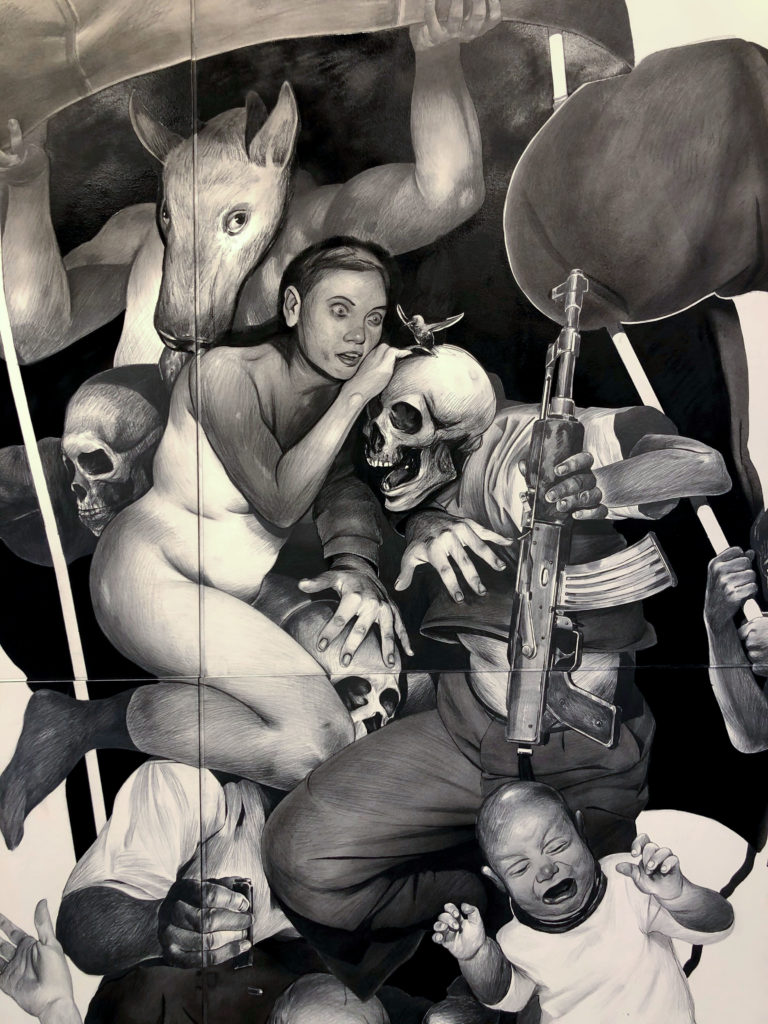
Death March, 2012 (detail)
Currently at Luis de Jesus Los Angeles is Hugo Crosthwaite’s incredible exhibition, TIJUAS!(Death March, Tijuana Bibles, and Other Legends).
From the press release-
Hugo Crosthwaite has spent much of his adult life working on both sides of the U.S. and Mexico border, observing and documenting the extraordinary ebb and flow of humanity that makes this region one of the most existentially dynamic places on the North American continent. In Tijuas!, Crosthwaite will present selections from several bodies of work that continue his exploration of this ever-evolving culture, among them the Tijuana Bibles, a new series of animated videos and books, recent graphite-and-ink on canvas and panel paintings, new Tijuanerias ink drawings, and Death March, a phenomenal and monumental work that preceded his celebrated performative murals. This will be the first time this work will be presented since it was commissioned in 2010 for Morbid Curiosity: The Richard Harris Collection at the Chicago Cultural Center.
This exhibition closes 1/4/20.
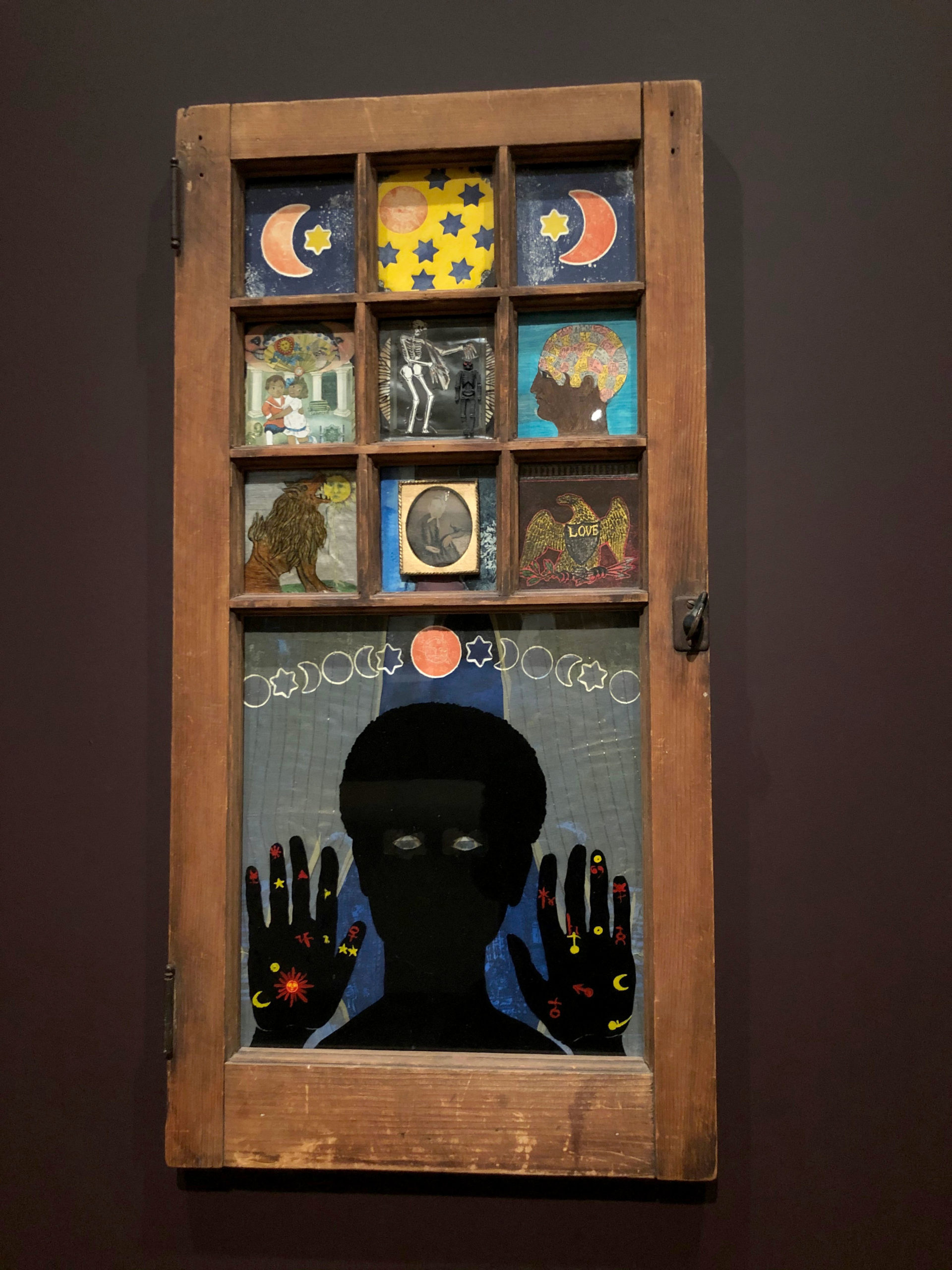
Black Girls Window, 1969

Mystic Window for Leo, 1966
As part of MoMA’s Opening Season, they are showing Betye Saar’s 1969 work, Black Girl’s Window, along with several of her works on paper.
The exhibition “explores the relation between her experimental print practice and the new artistic language debuted in that famous work, tracing themes of family, history, and mysticism, which have been at the core of Saar’s work from its earliest days.”
This exhibition closes 1/4/20.
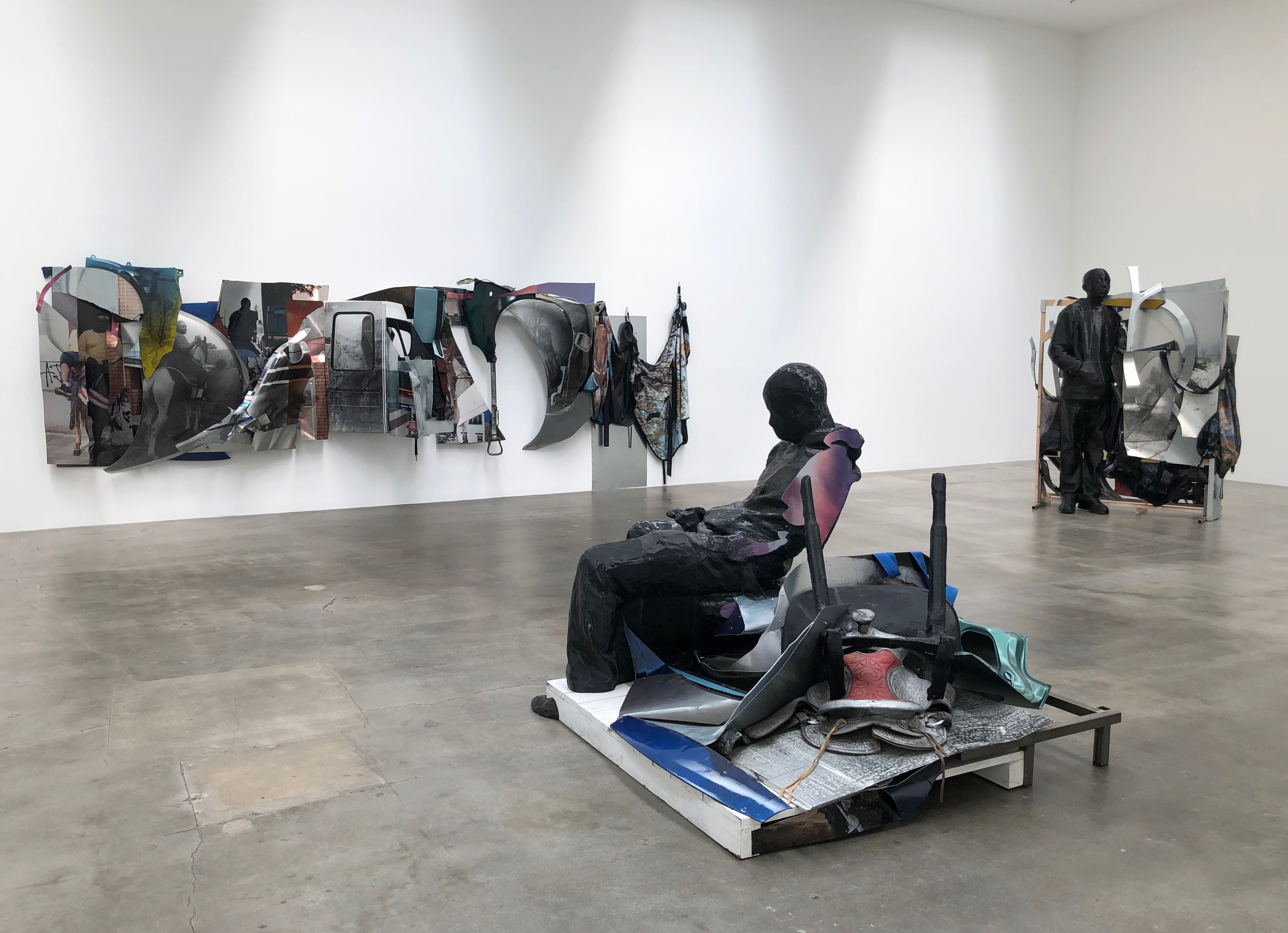
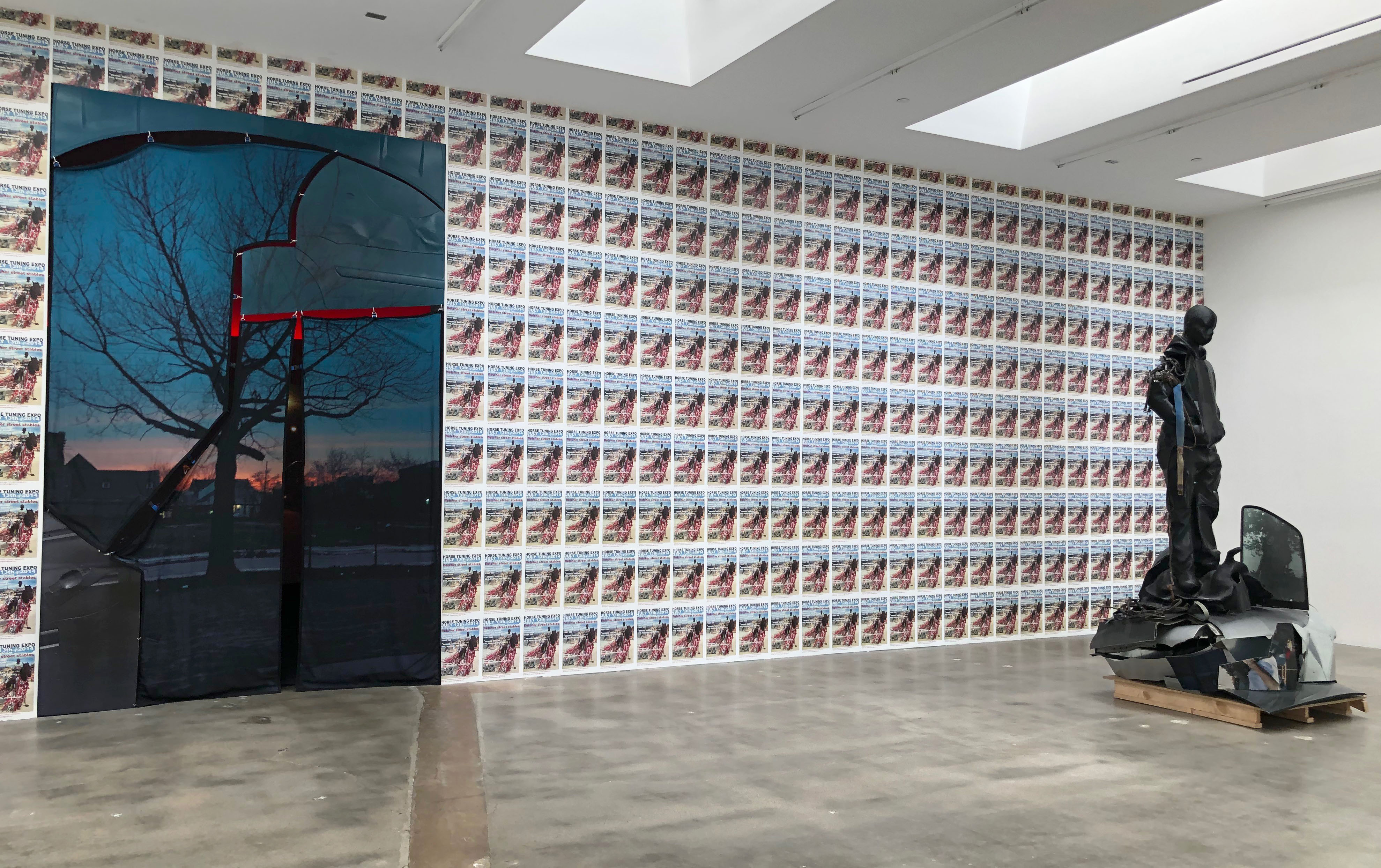
Paris-based Algerian artist Mohamed Bourouissa’s first solo exhibition in Los Angeles, Pour une poignée de Dollars (For A Fistful of Dollars), at Blum & Poe, combines film, sculpture, drawing and photography to expand on his project Horse Day, also on view at the gallery.
From the press release-
Initially driven to capture his own community and generation of immigrant youth living in the outskirts of Paris, in recent years Bourouissa’s focus has expanded to the US, the UAE, and beyond. In 2014 the artist spent nearly a year in North Philadelphia, PA living among the young men of the Fletcher Street Urban Riding Club, a non-profit established over 100 years ago by African American cowboys. This area increasingly struggles with unemployment and drug abuse, economic and social conditions from which the center attempts to provide a refuge—rescuing horses and mentoring boys who may otherwise find support hard to come by. Bourouissa instigated a collaboration with the community of riders and local artists—a riding competition and pageant called “Horse Day” in which equestrian participants arrived clad in decadent regalia, costumes including linked blank CDs, streamers, fake flowers, or fabric Pegasus wings. Using the cowboy as an emblem of a narrative of domination, the critical documents Bourouissa and the Fletcher Street community produced—sculptures, costumes, drawings, photography, and a video mixing tropes of westerns, documentaries and hip-hop—explore social injustice as it relates to geographical space, spotlight contemporary America’s culture of segregation, and intend to forge a new creative space for marginalized groups. Within a new body of sculptural work, the artist integrates images of riders and/or horses into the body parts of automobiles, as curator Okwui Enwezor once put it: “Bringing together two myths, the cowboy and the urban lowrider with his customized car, a sort of collision of the frontier and Compton.” This 3-D montage connects representations of domination and power, as well as industries and communities facing crisis.
Bourouissa’s work focuses on rituals of friendship, an exploration of alterity and the role images play in channels of distribution, investigations into the politics of representation and subjectivity. Seeking to humanize his community as social subjects, Bourouissa engages all sorts of imagery, initiating agency where is it often deprived. Bourouissa’s work is a hybrid of documentation and formal composition, collaborative choreographed representations of reality on the margins, channeling a wide range of historical precedents from Caravaggio and Delacroix to Fanon, rap music, and the Harlem Renaissance.
In a separate space behind the main gallery is Anya Gallaccio’s Stroke (pictured below), a room where the walls are painted with dark chocolate. The work was originally created in September of 1994, for Blum & Poe’s inaugural exhibition at their original location in Santa Monica. Twenty-five years later, it has been recreated in an exhibition space the exact dimensions of the original gallery.
It’s worth checking out for the smell alone. It’s overpowering.
From the press release-
Stroke plays with perceptions of desire and their disconnection from reality. In this chocolate-covered room, an idea pulled from a childlike fantasy comes to life and goads the viewer’s appetite for pleasure. The whimsical notion of an edible room is contrasted with the strikingly rich, dark color of the walls and their heavy, sometimes putrid, smell. Of this disconnect, Gallaccio states, “the idea of a chocolate room is one thing, and the reality of a chocolate room is very much something else.” Created by thousands of small, repeated brush strokes for which the installation is named, prolonged looking is rewarded when one sees new colors, textures, and patterns appearing out of the darkness.
Rooted in the formal language of Minimalism, Gallaccio’s practice uses organic materials to subvert and reframe that male-dominated moment in art history. Trees, flowers, fruit, and ice are investigated for their fluidity and impermanence, and decay becomes a part of the installation to be embraced. The unpredictability of these ephemeral materials yields a freeing inability to control the final product, from which unexpected results emerge. These materials, pulled from a feminine, domestic space, challenge a masculine past and reclaim a place in history. As noted in the original press release from 1994: “Feminist in material, natural in its decay, subversively Freudian, Stroke is an enigmatic and challenging work.”

Both of these exhibitions close 10/26/19.

“Crescent (Timekeeper)”

“Crescent (Timekeeper)”

“Crescent (Timekeeper)” Detail
Sarah Sze’s exhibition at Tanya Bonakdar’s gallery in New York is stunning. There is so much to look at, to appreciate. There are so many pieces to all of the work, and yet it never feels overwhelming. It makes you want to keep looking.
It’s also immersive. The windows on the outside of the gallery are covered in her work, as is the staircase alcove. The video projections in the main room travel all around the room, surrounding you with visuals and sound. Upstairs the floors of the gallery have paint splattered on them, accompanying the works on the walls.


Detail of the above work
In a room on the first floor is a “studio space” where you can gain insight into Sze’s process and how she makes these elaborate works.

From the press release-
Sze’s latest body of work frays “the seam between the real and the image” (Smith). Through complex constellations of objects and a proliferation of images, Sze expands upon the never- ending stream of visual narratives that we negotiate daily, from magazines and newspapers, television and iPhones, to cyberspace and outer space. The works evoke the generative and recursive process of image-making in a world where consumption and production are more interdependent, where the beginning of one idea is the ending of another—and where sculpture gives rise to images, and images to sculpture.
In this new exhibition, Sze expands her work by embedding her nuanced sculptural language into the material surfaces of painting and into the digital realm through the interplay of cloth, ink, wood, paper, metal, paint, found objects, light, sound and structural supports—collapsing distinctions between two, three and four dimensions. This body of work fundamentally alters our sense of time, place, and memory by transforming our experiences of the physical world around us. Both objects and images, Sze says, are “ultimately reminders of our own ephemerality”.
This exhibition closes 10/19/19.
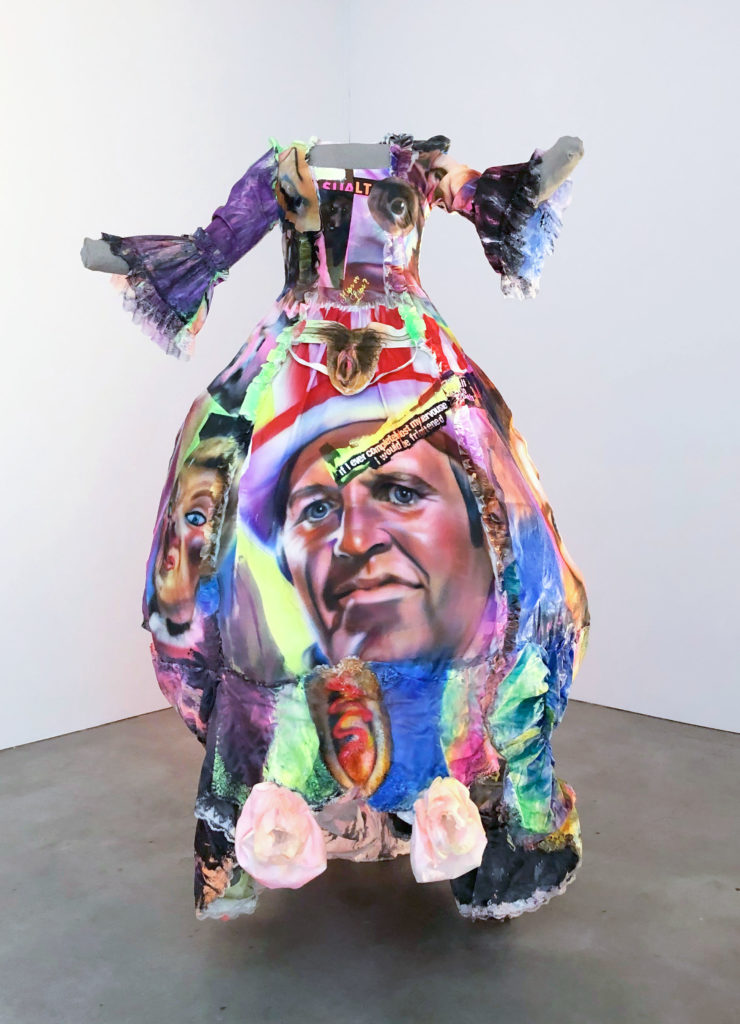
Jim Krewson’s “tribute to a vanishing subculture”, A Requiem for Paul Lynde, currently in the Viewing Room in the back of Marlborough Gallery’s downtown location, “questions the loss and amnesia of marginal identity in a new age of equality, instant access, Instagram influencers and celebrity, from homosexuality to homogenization in 20 short years.”
The airbrushed wedding dress spins with images that include Lynde himself, as well as Lady Elaine Fairchild from Mister Rogers’ Neighborhood, and the Madame puppet, a Wayland Flowers creation. Flowers’ puppet had her own sitcom in 1982 and also took over Paul Lynde’s center square on Hollywood Squares. Sadly Flowers, an openly gay entertainer, passed away in 1988 at the age of 48 from AIDS related Kaposi’s sarcoma.
If you love of a certain time period of pop culture and Paul Lynde than it will be hard not to embrace this project. But it’s also interesting as a meditation on the state of gay pop culture in the past, the place it is in today, and the question of where it may go in the future now that it is has such a strong, but less subversive place, within mainstream media.
In the main viewing space of Marlborough Gallery is Joe Zucker’s multi-panel 100-Foot-Long-Piece created from 1968 to 1969.
From the press release–
This masterwork, exhibited here with a large body of related archival material, comprises a blueprint for Zucker’s long and diverse practice. It plants a flag for the artist’s ongoing inventiveness, irony, and eclecticism.
With the creation of this work, Zucker presents the viewer with a puzzle-like, encyclopedic visual vocabulary, anticipating subsequent pictorial and conceptual approaches such as New Image, Neo-Expressionism, Appropriation, Neo Geo, as well as more recent process- based abstraction, with a self-referential, wry regard for the embedded, associative meaning of his imagery and materials.
100-Foot-Long Piece is a linear aggregate in which gestural abstraction rubs elbows with hard edged grids, silk-screened passages, sculptural reliefs, and a host of other styles and forms. One is mindful of both physical and critical tropes of progressive art history from the physicality of the frieze to a qualitative timeline tracing the contributions of Modernism.


Both shows close 10/5/19.

When trying to talk about the David Hammon’s exhibition at Hauser and Wirth Los Angeles, his first in Los Angeles in 45 years, it’s hard to know where to start. There are no titles or descriptions of any of the works in the show, although there is writing on the walls in certain places. The press release, shown below, is a mass of lines and a dedication to jazz musician Ornette Coleman.

Before you enter either of the two massive galleries housing the exhibition you encounter a courtyard filled with tents, some with “this could be u and u” stenciled on them. Tents also line the corridor under Martin Creed’s neon piece, EVERYTHING IS GOING TO BE ALRIGHT, with a rack of fancy vintage coats nearby. Once predominantly in Skid Row, Los Angeles’ tent cities have been growing rapidly on street corners and under bridges and highways all over the city, but they often just blend into the background for people walking and driving past. What does a fake tent city in the courtyard of a high end gallery in a newly gentrified neighborhood mean? Is its fake version more affecting than the real one to gallery and restaurant patrons wandering by?

The work in the show feels at times random, clever, humorous, and confounding, but also impressive, thought provoking, and most importantly never dull. There are stacks of art history books sitting on scales. A water filled bowl that contains what once was a snowball Hammons had sold on the street at one point in his career, sits on a wooden shelf. A room with empty glass cubes on wood columns requires you to bend down to see the feet underneath. A book titled A History of Harlem is filled with empty black pages.
In the room pictured below is a three legged chair next to a wall of photos of women sitting in it. Nearby, one of Ornette Coleman’s suits is surrounded by glass.

Another room is filled with paint splattered and damaged fur coats, one facing an antique mirror that is covered. The symbolism feels a bit heavy handed, like the tents, but it works in that there are still several ways to interpret what Hammons might be saying.

Throughout the exhibition paintings are covered in various ways. One in paper, ripped with a bit of the painting visible. Others are partially hidden with tarps, plastic, different fabrics, even an antique rug (shown below). Once again, you can interpret the meaning of this in several ways. With the rug, for example, it’s turned so that only a bit of its design is visible in front of a painting that is not completely visible. These rugs are often associated with old money and sometimes are hung on walls themselves as artwork. Or is it just another assemblage, a visual combination to be taken at face value.

Ultimately the interpretation of all of the work is up to the viewer. There is something freeing in that, not being given answers. Sure, it’s nice to have an explanation of an artist’s intentions sometimes, but you often add your own ideas anyway. Art should make you think, question things, look at the world from a new perspective- this exhibition does all of that and more.
David Hammons at Hauser & Wirth Los Angeles closed 8/11/19.

Juan Capistrán, Psychogeography of Rage (sending up searchlights in the form of flames) Western, 2019

Kim Fisher- Los Angeles Hedge, 2019
Kim Fisher, Woman Behind Rocks, 2019

Sabrina Gschwandtner, Cinema Sanctuary, 2019

Sabrina Gschwandtner, Cinema Sanctuary (close-up)

Enrique Castrejon, You, me, and all of us are in this together/Reach out to those that don’t know their status, 2019

Enrique Castrejon, You, me, and all of us are in this together/Reach out to those that don’t know their status, 2019 close-up
Every year The City of Los Angeles Department of Cultural Affairs (DCA) awards grants to the city’s best mid-career artists. The work created with these grants is then shown in the Los Angeles Municipal Art Gallery (LAMAG) in Barnsdall Park for the C.O.L.A.(City of Los Angeles) exhibitions.
COLA 2019 is made up of 11 artists working in various mediums. Two of the artists, Juan Capistrán and Kim Fisher were also shown together as part of Hammer Museum’s biennial exhibition, Made in L.A. 2014. For this show, Capistrán created large brick sculptures that he placed in sites in South Los Angeles that haven’t been rebuilt since the 1992 LA Riots. In his section of work in the gallery, he includes photos of these temporary site specific installations as well as some of the brick sculptures- two of which have balloons tied to them spelling GRATIS. The bricks can be seen as objects of destruction or building blocks, and the dual meanings work well in the context of the work.
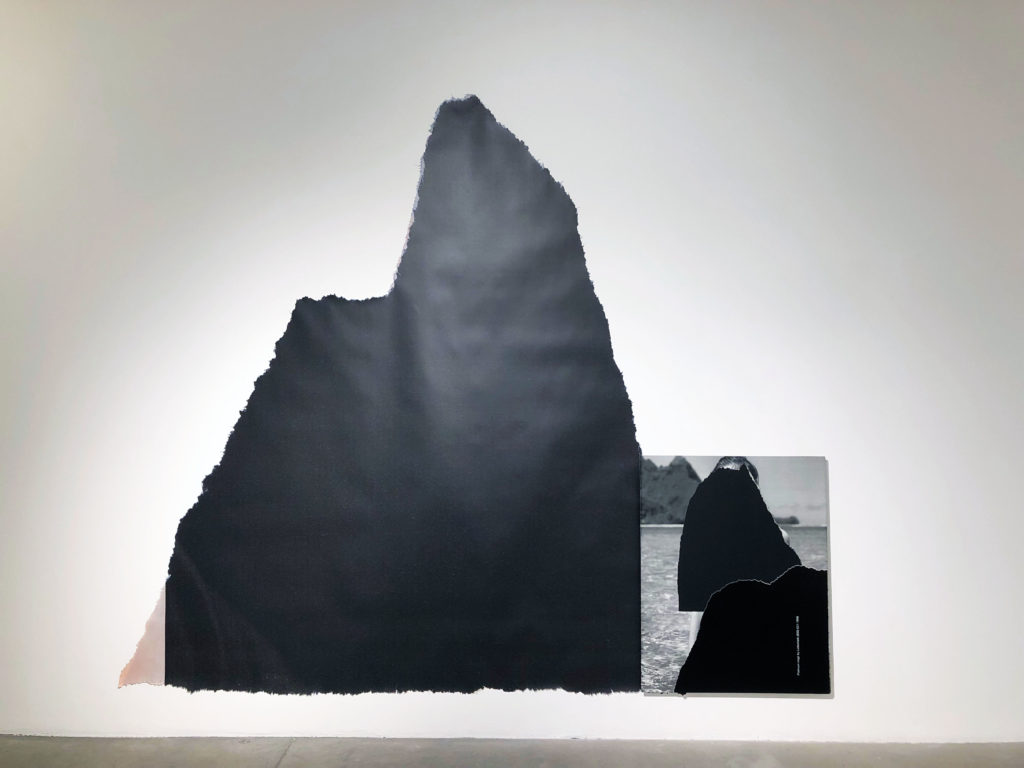
Kim Fisher’s large collages capture another side of Los Angeles. From the hedge she used for the largest piece, to the ocean, swimming pools, and car culture, included in her others, the graphics and color come together in a way that feels very much like the traditional ideas associated with the city. The different sections, created to look as if they were torn or cut from magazines, form collages that feel like scattered memories that have somehow arranged themselves cohesively.
Sabrina Gschwandtner took forgotten films made by female directors and stitched them together to form patterns drawn from the history of quilt-making. The use of a craft that is traditionally associated with women and tying it an artistic pursuit that women are only more recently being acknowledged for is an interesting juxtaposition. The resulting work is stunning graphically and reminiscent of Agnés Varda’s colorful house of film reels created for LACMA’s Agnés Varda in Californialand from 2014.
Enrique Castrejon created sculptures that stem from his work in an LGBTQ center in Los Angeles. His sculptures of fragmented bodies are surrounded by strips of paper with HIV infection rates. The humanity of the figures contrasts with the overwhelming strips of typed documentation that swarms all around them.
All of the work created for this exhibition is incredibly strong and these annual exhibitions are a great way to see some of the best work being created by Los Angeles artists today. If you can’t make it to the exhibition there is a video on the site that takes you on a walk through with one of the curators. Also make sure to catch Stephanie Taylor’s Municipal Art Song, which plays at the entrance to the exhibition. She created song lyrics based on text from LAMAG and DCA’s websites and catalogs, and used them to create sheet music using Schoolhouse Rock! as an inspiration. The result is really funny, especially if you read a lot of press releases.
This exhibition closes 7/14/19.


This is the last weekend to see the excellent exhibition Charles White: A Retrospective at LACMA.
From the press release-


Taking up an entire level of the BCAM Building at LACMA, Robert Rauschenberg: The 1/4 Mile or 2 Furlong Piece, is a wonderful testament to the artist’s work and creativity. It is also the first time it has ever been shown in its entirety.
There is so much variety in the materials, subjects, colors, and styles, that as you wander from section to section, it’s easy to notice new things the longer you look. Despite the differences among the different sections, they are bound together by a creative exuberance. LACMA recommends an hour to wander the 1/4 mile of work, but you may want to spend longer.
This exhibition will close on 6/9/19.


