May 192024
 

Ann Schaumburger, “Silver Moon in Darkened Sky House”, 2023, Flashe on wood

Ann Schaumburger

Ann Schaumburger

The three exhibitions currently on view at A.I.R. Gallery in Brooklyn all focus on homes in unique ways. In the first gallery, Ann Schaumburger’s paintings of houses for New Work continue her exploration of color.

From the gallery-

For over fifty years, Schaumburger has used the house as a basic structure—a scaffold—for exploring how colors interact with one another. Schaumburger builds her houses with blocks of four pigments, using stencil brushes and tape to fill each house with modular forms. Influenced by the theories of Josef Albers, Schaumburger’s approach to color is meticulous yet playful. Different colors dazzle and dance when placed in proximity, creating a sense of surprise.

The paintings in this new body of work depart from Schaumburger’s earlier explorations in one key detail: the houses are now mounted on wheels. This choice was inspired by Schaumburger’s reading of the biography of Henry David Thoreau, whose family had attached wheels to their domicile, allowing them to transport the house across different sites in Concord, Massachusetts. “The idea of taking a solid house, attached to the ground, and letting it roll away,” Schaumburger says, “seems both comical and deeply suggestive of our times.”

Schaumburger has described her color choices as an attempt to “solve an aesthetic problem.” Yet the work is not entirely abstract. Titles like Forest House Under Summer Sky and Moonscape Moving House gesture toward the fact that certain color relationships become evocative of different seasons, places, and times of day. All of the paintings in the exhibition feature a crescent or small globe in the upper left or right quadrant. Sometimes, this globe is rendered in metallic gold or bronze, recalling the sun. Other times, it is a lunar silver. The round shape of the globe mirrors the house’s circular wheels. Just as the earth rotates around the sun, the wheels rotate around their own axles, allowing the house to move.

The wheeled house becomes a spirited metaphor for Schaumburger’s practice. Dynamic rather than stationary, it embodies the liveliness and energy of Schaumburger’s color choices, as well as the open-ended nature of her process.

Roberta Dorsett’s photos for Sleepwalking explore isolation and uneasiness in her family’s suburban home.

Roberta Dorsett, “Sleepwalking”

Roberta Dorsett, “Sleepwalking”

Roberta Dorsett, “Sleepwalking”

From the gallery-

Dorsett’s Sleepwalking is a series of photographs examining isolation in the suburbs and how a sense of danger often accompanies seemingly idyllic environments. The work depicts three women, Dorsett’s aunt, her cousin, and Dorsett herself, occupying the shared space of a suburban home in Connecticut. Tension arises from the camera’s interaction with the women. The camera acts as an intrusive person, an interloper, and a voyeur as it captures the women in moments of discomfort and vulnerability.

In Dorsett’s previous work, she took on the role of family historian, photographing moments of in-betweenness that result in candid and uncontrived images. Her obsession with taking photographs of her family is driven by their lack of extant family albums or other visual documentation. Because of the family’s socioeconomic status, photography was considered a luxury and only done for special occasions. Moreover, Dorsett’s mother had to leave behind her family’s photographic history when she immigrated from Jamaica to the United States.

Dorsett initially intended Sleepwalking to be a straightforward documentation of her aunt and cousin’s experience as first-time Black homeowners. But she found herself drawn into the project’s narrative and began photographing her family in a more constructed and story-driven way, drawing inspiration from slasher and horror films. Dorsett captures the visceral thrills of these types of films by continuing to utilize her family to explore the concepts of voyeurism and anxiety. The single-family home, once a symbol of milestone achievement, now becomes a surreal site of both safety and terror. As she stood behind and in front of the camera, registering the uneasiness and distress of these three women inside their home, Dorsett dreamed up a distorted reality and asked herself, “Am I awake or sleepwalking?”

Finally, Denisse Griselda Reyes multimedia installation for Did you have a hard time finding me?  explores home and identity using a combination of original artwork and family archives.

Denisse Griselda Reyes, “Did you have a hard time finding me?

Denisse Griselda Reyes

From the gallery-

Featuring short films and familial ephemera alongside a new body of paintings, this exhibition humorously meditates on questions of self-formation, reparative representation, and archival preservation, inviting us to dwell in the absurdity these ambitions unintentionally generate. This is Reyes’s first solo exhibition in New York City.

Presenting what Reyes has called a “maximalist constellation of memory,” the exhibition juxtaposes materials from their family archives with paintings and multimedia projections within an installation space that recalls, yet does not perfectly reproduce, the domestic interiors of Reyes’s family. Anchoring this exhibition is a short film that ties together two threads. First, the border crossings of Reyes’s grandmother Anita that were necessitated by the peril of the Salvadoran Civil War, and this history’s impact on Reyes’s mother. Second, the queer dating life of Reyes’s indignant and savvy alter-ego, Griselda. Part-narrator, part-drag-persona, part-survival-strategy, Griselda offers Reyes a means to dictate the terms of their own representation against the expectations that constrict queer Latinx artists in the United States. Still, Griselda is also beholden to identitarian demands. Reyes allows their avatar to straddle the line of spectacle, flirting with failure, acknowledging that self-formation might be an impossible endeavor. By juxtaposing Griselda’s exploits with the narrative of their grandmother, Reyes interrogates whether familial, social, and historical processes have the final word on what generates a self.

Reyes has produced Griselda as a mediating figure—one who negotiates their own identity between femininity and non-binary gender, and who personifies the absurdity of any singular narrative of origin. In its plenitude and play, the exhibition exceeds the ostensible facticity of the familial and historical archive. Featuring new paintings that hazily recreate family photographs, a vitrine full of childhood teeth that parodies genres of museal presentation, screens that toggle between home videos and the simulation of archival footage, and striking blue-green walls that recall the past domestic spaces of Reyes’s family in El Salvador, the exhibition transforms processes of preservation into acts of mythmaking. The exhibition is less a recreation of the artist’s family’s domiciles than a space of critical reflection and ambiguity. Guests are invited to join in this meditation—and may find their own notions of selfhood implicated as a result.

These exhibitions close 5/19/24.

Apr 192024
 

Meryl Engler, “Lying in Red”, 2023, Woodcut

Work by Michael Loderstedt (left), Eva Pozler (center) and Lori Kella (right)

Work by Lori Kella, Maria Uhase, and Meryl Engler (right two pieces)

Lori Kella, “Mudslide and Forsythia”, 2022, Inkjet print (left) and Corrie Slawson, “Amalgam 4”, 2022 (top) and “Amalgam 3”, 2022 (bottom), Oil and screenprint on plywood

Today (4/19/24) is the last day to see Life Out of Balance at the Emily Davis Gallery at The University of Akron. The group show show includes work by Maria Uhase, Meryl Engler, Lori Kella, Benjamin Lambert, Michael Loderstedt, Eve Polzer, Ron Shelton, Ariel Bowman, and Corrie Slawson.

From the gallery-

When a tree falls in a forest, we may see it as the death of the tree. It stops photosynthesizing, growing, feeding its mycorrhizal symbionts, flowering, developing fruit, dispersing seeds, taking in carbon dioxide, and producing oxygen. But in the ecosystem, it begins a whole new life in decay. It feeds the soil and microbes through the decomposition of its tissues; it provides a place for fungi, mosses, and lichens to grow; and it becomes a protected habitat for a myriad of insects, mammals, and birds. This same tree, therefore, can be both dying and living at the same time, depending on perspective. It can be dead if considered separate from its surroundings, or it can be alive in its continued relationship within its ecosystem.

Humans can feel more alive by being integrated with the rest of the natural world. We are not living to our full potential, or allowing nature to be its full potential, when we consider ourselves as separate from it.

If we are to have hope for solving the complex environmental issues that are facing us today, we need to work with, rather than against, the forces of nature.

Below are a few more selections.

Ron Shelton, “Yellow Mosaic”, 2021, Plastic and wire

Ariel Bowman, “Wall Trophy Series”, 2019, (Cave Bear, Antique Bison, Early Horse, Saber Cat, Dodo, Brontotherium, Parasaurolophus), Unglazed, high fired porcelain; Maria Uhase, “Splitting Headache”, 2022 Ink on paper and “Softly”, 2023, Graphite on paper

Ariel Bowman, “Wall Trophy Series”, 2019, (Cave Bear, Antique Bison, Early Horse, Saber Cat, Dodo, Brontotherium, Parasaurolophus), Unglazed, high fired porcelain

Benjamin Lambert, “A pint for a gallon”, 2020 and “I Found Your Damn Lost Shaker of Salt”, 2020, Stoneware, underglaze, glaze, epoxy

Corrie Slawson, “Stage Set Tapestry 1, for Feast: a ballet. Of Bats, Blue Footed Boobies, Penguins and other threatened fauna and flora. Pastoral landscape after Rubens”, 2020, Oil and mixed media on muslin

Corrie Slawson, “Stage Set Tapestry 1, for Feast: a ballet. Of Bats, Blue Footed Boobies, Penguins and other threatened fauna and flora. Pastoral landscape after Rubens” (detail)

Michael Loderstedt, “Snakehead”, 2023, “Thistles”, 2023, Cyanotypes on fabric, embroidery, fabric collage

Lori Kella, “Mayflies in the Grass”, and “Yellow Irises”, 2024, Framed inkjet prints

Maria Uhase, “Encircled”, 2023, Oil on linen panel, “Worm”,2023, Oil on linen and “Conglomeration in the Spiders’ Ghost Town”, 2020, Oil on canvas

Eva Polzer, “Gift from a Cat”, 2024, Ceramic, underglaze, velvet jewelry box, and “Gift from a Rat”, 2024, Ceramic, underglaze, petri dish

Meryl Engler, “Waiting”,2023, Woodcut Block


Apr 182024
 

There’s an unsettling tension in the room that houses Mel Chin’s installation Spirit (1994), at the Columbus Museum of Art. Is the rope strong enough to support the barrel? What will be its breaking point?

Some details from the museum about the work-

The rope that seems to carry the weight of Spirit’s enormous cask is made from tallgrass. This native plant was once central to a vast prairie ecosystem spanning over 170 million acres of North America. By 1930, most all of this was decimated as a result of agricultural and industrial settlement, and what remains is protected habitat (Chin received special permission to harvest a portion for this sculpture).

Wooden barrels are traditionally used to measure and transport dry goods like grain, beans, as well as beer, oil and wine, and were central to the process of European settlement and trade in North America. Here, the image of this rope bearing such a massive weight suggests the precarious status of nature in a world of outsized human development. Even the gallery walls, which curve inwards on all sides, seem to respond to the strain.


Apr 122024
 

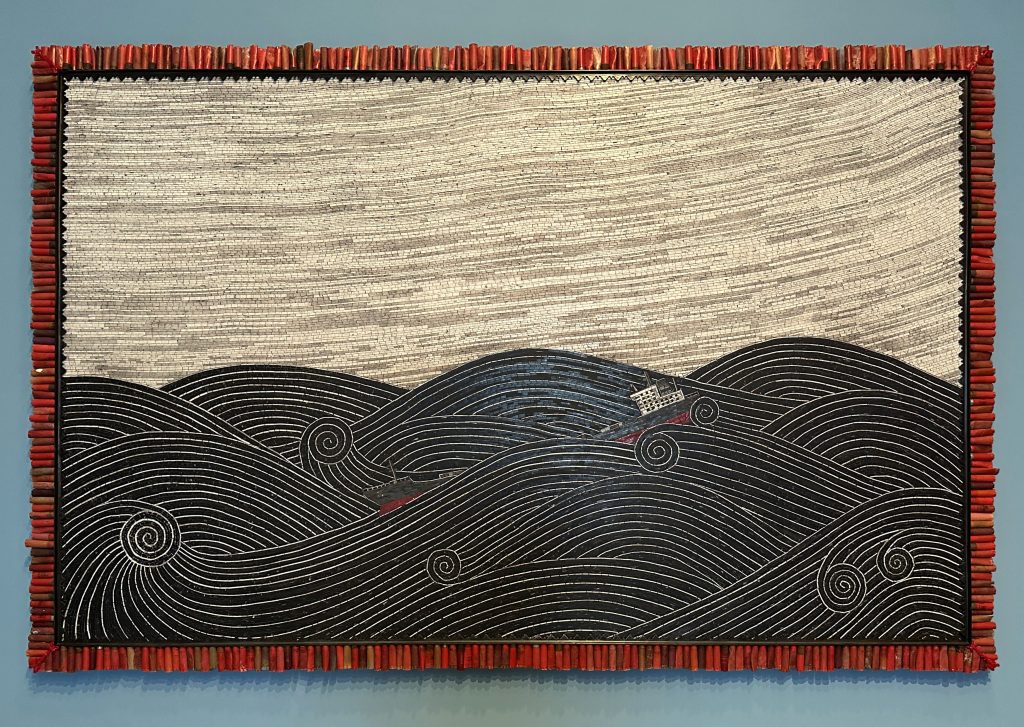
“Erika”, 2021, VCT, shotgun shells, and drink stirrers

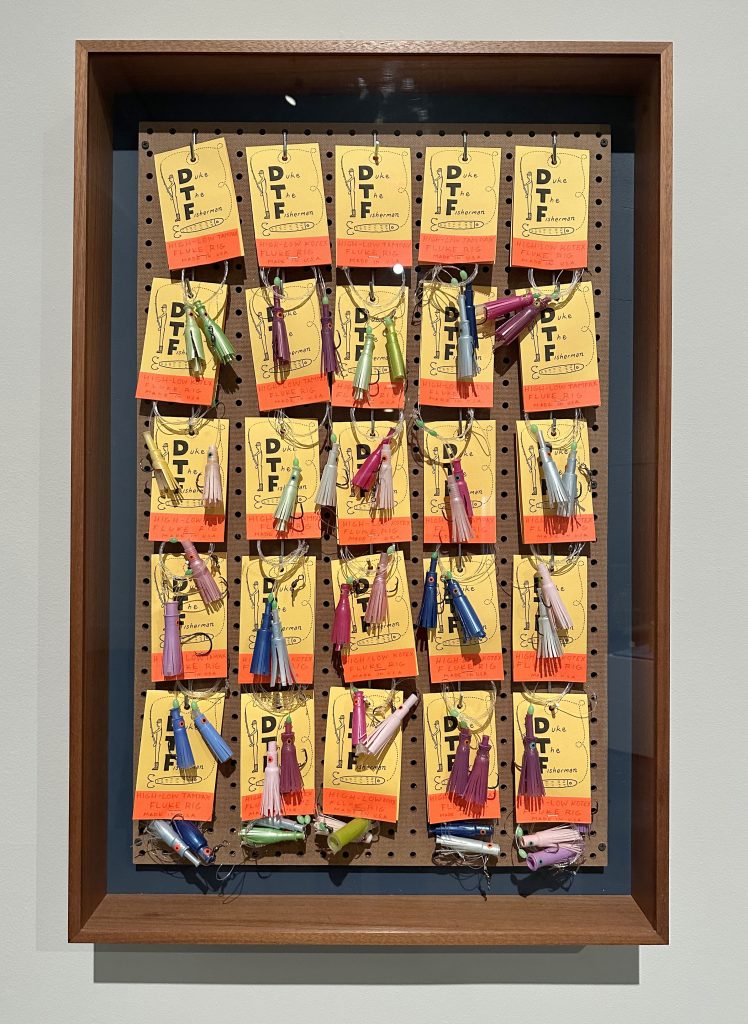
“Duke the Fisherman’s High Quality Fluke Rigs Made in the USA™”, 2022, Found tampon applicators, fishing line, fishing hooks, nail polish, peg board, card stock

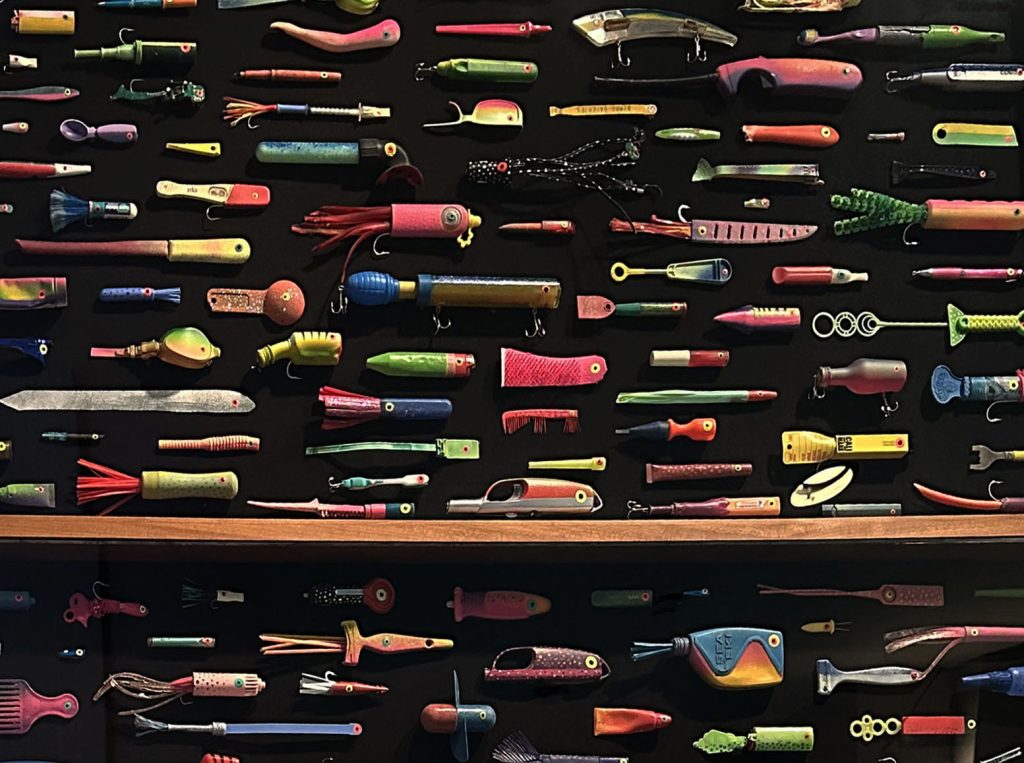
Detail of “Monument to Five Thousand Years of Temptation and Deception V, VI, VII”, 2022, Salvaged plastic, paint, fishhooks

The images above are from Duke Riley’s exhibition DEATH TO THE LIVING, Long Live Trash, on view at Brooklyn Museum in 2023. The artist’s inventive fishing lures, made from discarded plastic items found around waterways, are engaging to look at but highlight the grim reality of how much garbage is polluting our natural environment.

From the museum-

In DEATH TO THE LIVING, Long Live Trash, Brooklyn-based artist Duke Riley uses materials collected from beaches in the northeastern United States to tell a tale of both local pollution and global marine devastation. Riley’s contemporary interpretations of historical maritime crafts—such as scrimshaw, sailor’s valentines, and fishing lures—confront the catastrophic effect that the oil, food, and beverage industries have had on the environment through single-use plastics. The works are presented in the seventeenth- and eighteenth-century Jan Martense Schenck and Nicholas Schenck Houses, alongside a selection of historical scrimshaw from our collection, directly connecting environmental injustices past and present.

In his contemporary interpretations of scrimshaw—ink drawings etched into bone by sailors—Riley replaces the medium’s customary whale teeth with repurposed plastic containers, detergent bottles, toothbrushes, and other waste. The works incorporate the maritime imagery traditional to scrimshaw, but expand it to portray international business executives that the artist identifies as responsible for the perpetuation of single-use plastics. Also on view are Riley’s fishing lures and sailor’s valentines, similarly created with detritus found on northeast coastal beaches. The exhibition juxtaposes corporation-driven pollution with new short films by Riley that highlight New York community members working to remediate plastic damage and restore our waterways.

Erika, the mosaic pictured above, depicts the 1999 shipwreck of MV Erika which, after splitting in two during a heavy storm, released thousands of tons of oil into the Bay of Biscay off the coast of Brittany.

In the video below, Riley gives a brief tour of the Brooklyn show.

Some of the work from this exhibition is currently on view at Museum of Fine Arts St. Petersburg as part of their exhibition, The Nature of Art.


Apr 122024
 

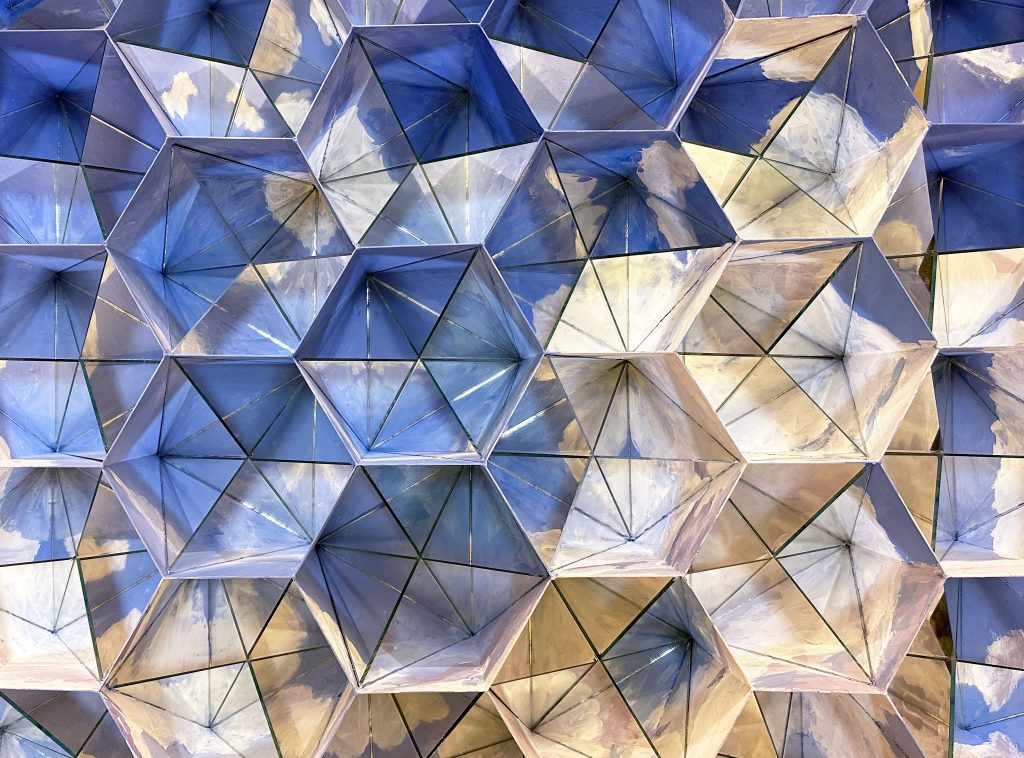
Brookhart Jonquil, “Groundless”, 2023, Mirrors, steel, acrylic paint, enamel paint

Brookhart Jonquil, “Groundless”, 2023, Mirrors, steel, acrylic paint, enamel paint (detail)

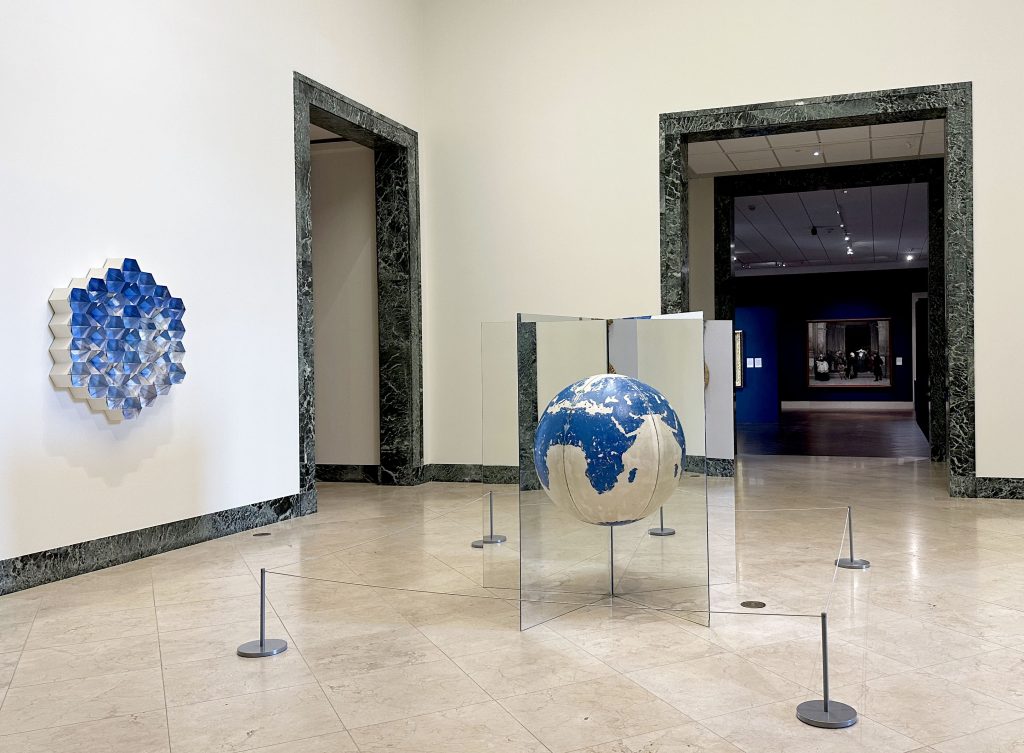
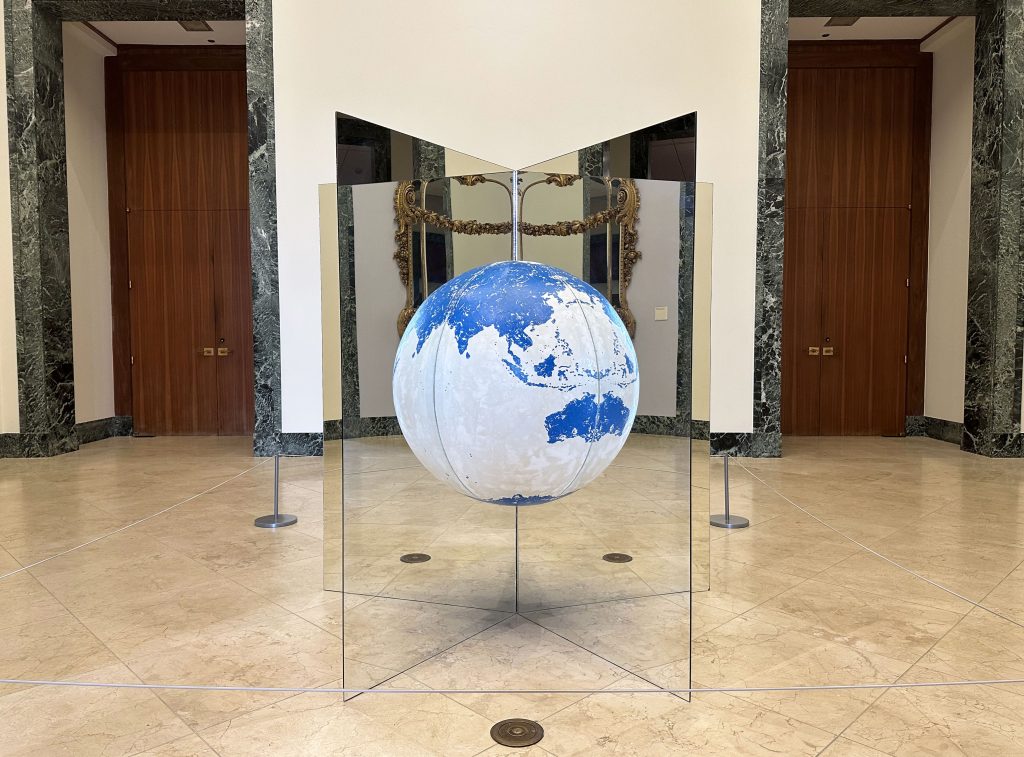
Brookhart Jonquil, “E)A)R)T)H)”, 2012, Mirrors, EPS, MDF, plaster, paint

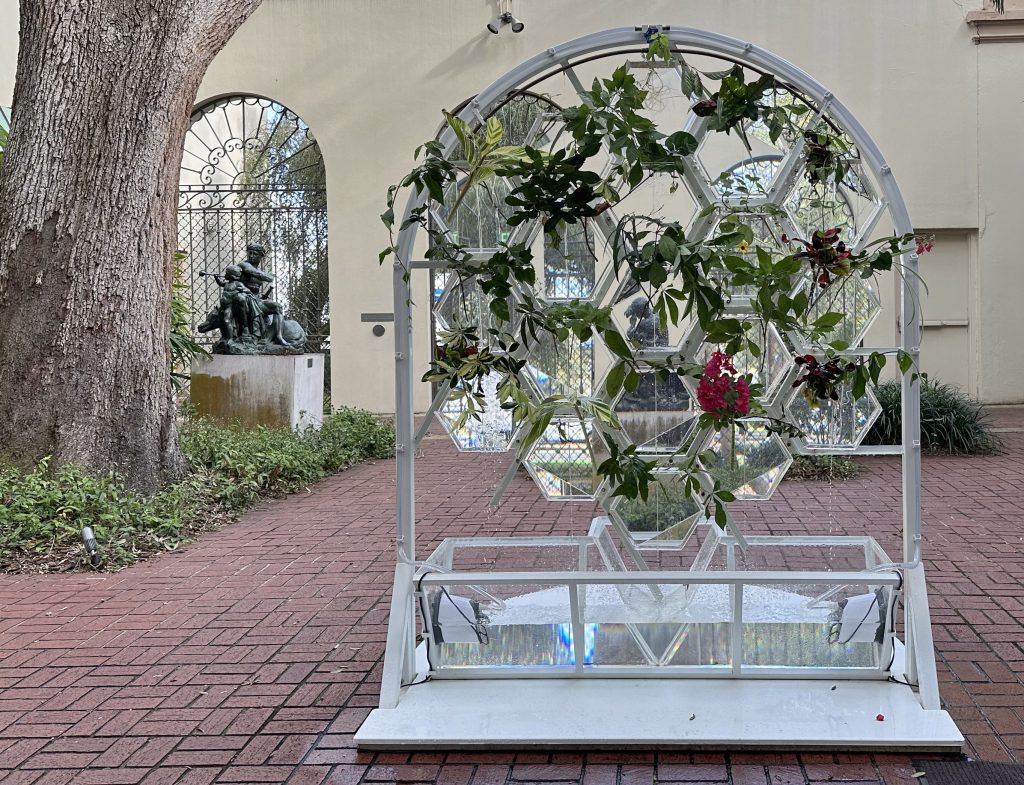
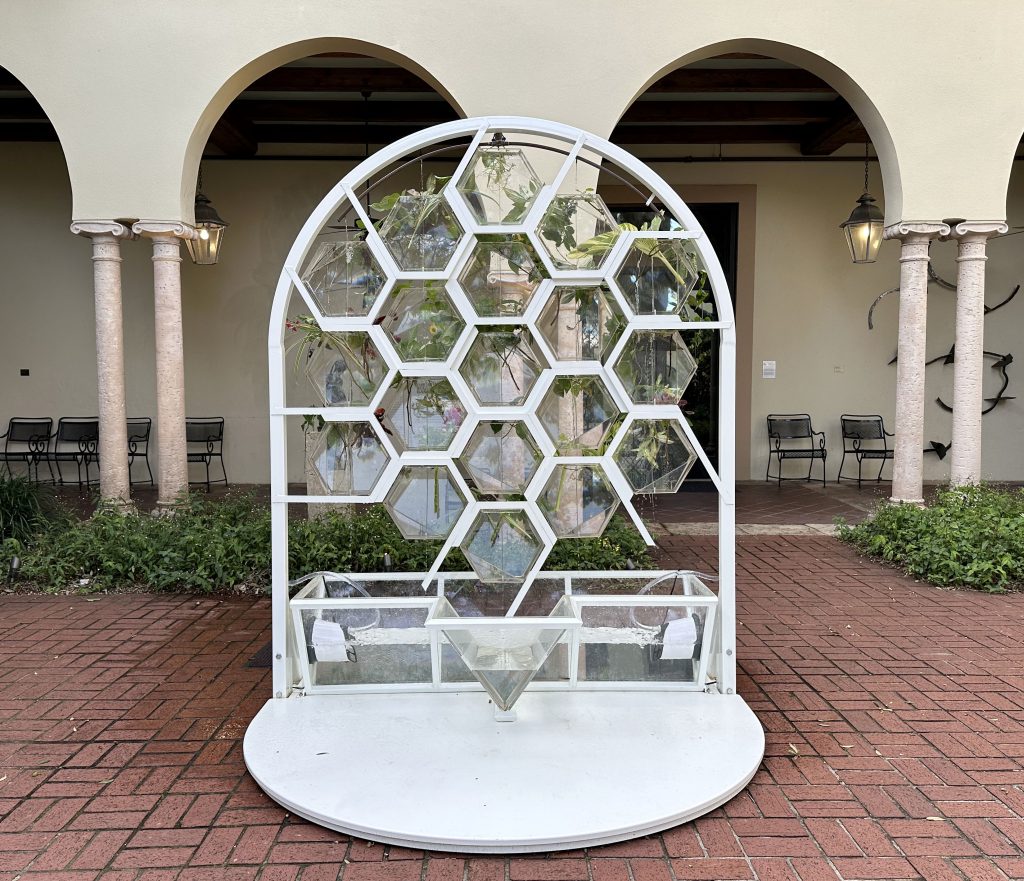
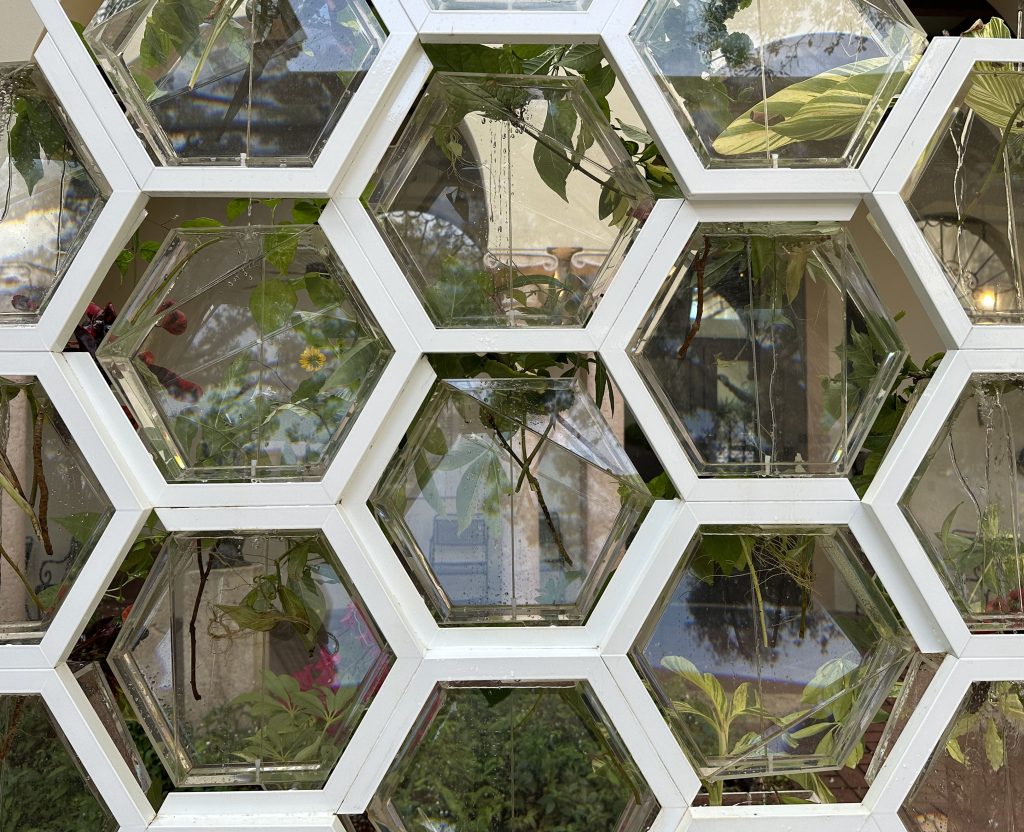
Brookhart Jonquil, “Multiplication Portal”, 2022, Plexiglass, water, powdercoated steel, plant cuttings, marine polymer sheet, pump system

Brookhart Jonquil, “Multiplication Portal”, 2022, Plexiglass, water, powdercoated steel, plant cuttings, marine polymer sheet, pump system

Brookhart Jonquil, “Multiplication Portal”, 2022, Plexiglass, water, powdercoated steel, plant cuttings, marine polymer sheet, pump system

Brookhart Jonquil, “Multiplication Portal”, 2022 (detail)

For The Nature of Art at the Museum of Fine Arts St. Petersburg, work from the exhibition is spread throughout different sections of the museum. In the Great Hall and Sculpture Garden are installations by Brookhart Jonquil.

From the museum about these works-

In this group of installations, Brookhart Jonquil creates art that engages physics, architecture, and ecology to explore the immaterial, shifting aspects of the natural world. His work reflects influences ranging from Minimalism to theories of utopia and perfection; it offers viewers new ways of seeing and a nuanced understanding of our place in the world. The works exhibited here and in the Sculpture Garden encompass over a decade of his career, illustrating how nature has always influenced his artistic practice.

Groundless is Jonquil’s most recent work, inspired by painting en plein air, the Impressionist practice of working outdoors. However, the artist has complicated this by incorporating mirrored surfaces that deny full control of his compositions. Jonquil notes, “Each stroke of paint multiplies unpredictably as I place it, while shifting colors and cloud-forms evade fixity.”

The floor-based sculpture E)A)R)T)H) uses five pieces of mirror glass to dissect an earthly sphere. Unlike Groundless, these mirrors reflect the Great Hall, foyer, and surrounding galleries, suggesting a macro-and micro-viewing of our planet. To further a sense of dislocation, Jonquil has inverted the colors typically associated with land and water: bodies of water are depicted in white, while land is blue.

Multiplication Portal-on view in the Sculpture Garden- is a participatory sculpture highlighting the care and responsibility involved in cultivating plants. Reminiscent of both a kaleidoscope and a beehive, it was inspired by chaos theory-also known as the butterfly effect, which is the idea that one tiny gesture can have colossal consequences within dynamic systems. Brookhart created Multiplication to fight environmental disillusionment. Can one individual impact the impending climate disaster? What is the point of separating paper and plastic? Does turning off the lights make a difference? Multiplication Portal serves as a reminder that our seemingly small actions have the potential for significant consequences.

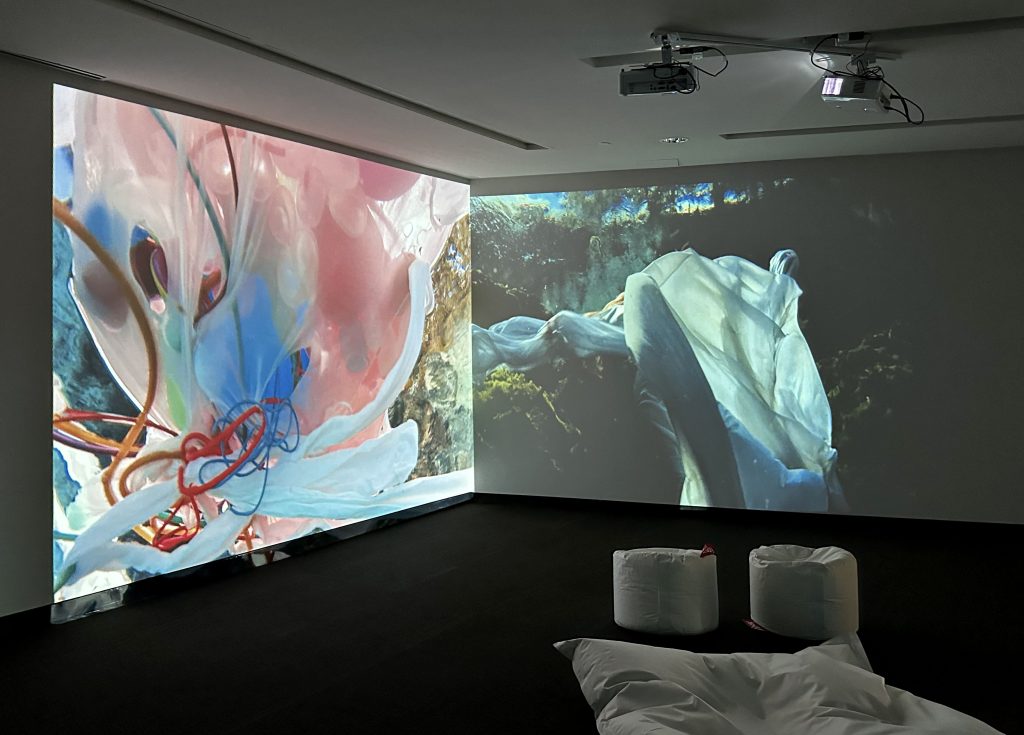
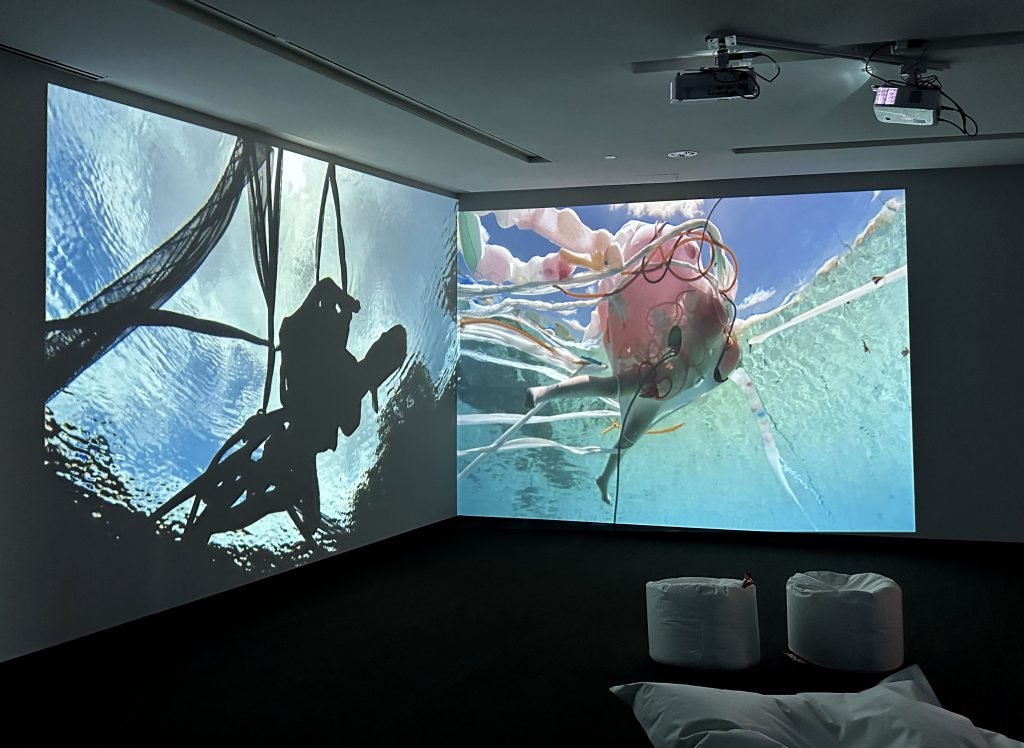
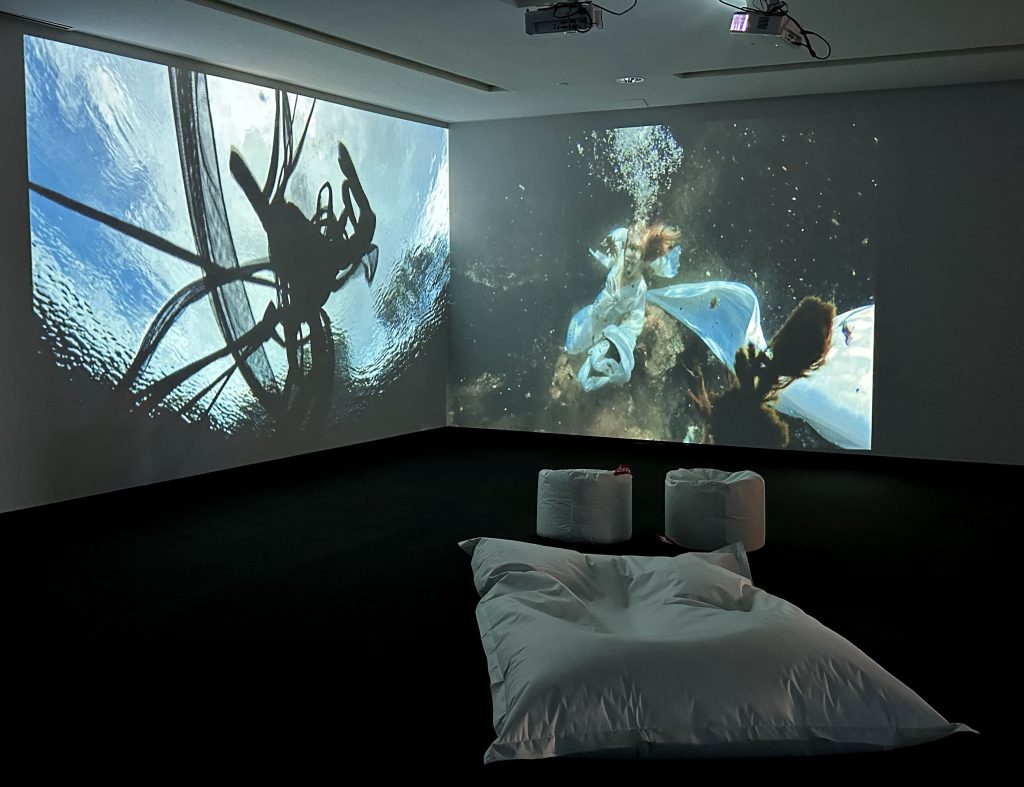
In an upstairs gallery is the video installation, Blood, Sea by Janaina Tschäpe (seen below). The dreamy video takes you underwater to explore transformation through sea maiden myths.

Information on the installation from the museum-

Reminiscent of Voltaire’s Micromégas, Janaina Tschäpe’s fantastical scenes dissolve boundaries, seamlessly intertwining in an ever-flowing continuum of evolution and transformation in a grand opera that delves into themes of change, gender, and the construction of myth and history. The universe created by Tschäpe beckons one into a parallel world of ambiguous scale-indeterminate in both time and space. The spring-fed grotto provides the scenographic impetus for this grand production, a captivating fusion of a theme park nestled within a state park and bearing the distinction as one of Florida’s oldest roadside attractions. The sea maiden mythologies that inform Blood, Sea link endless stories from across time and space, as many cultures have some version of a water goddess. Millennia of previously unknown deep-sea creatures caught in fishermen’s nets spawned the mythic narratives that gave rise to these goddess/creature tales. From the Mami Wata spirits of West Africa to the water sprites of Irish lore, the trope of the sea maiden appears around the world and across time. Tschäpe’s primary connection is her namesake, the Orixa lemanja of Candomblé. This powerful water spirit is the Brazilian version of the many syncretic gestures born of the Yoruban Afro-Atlantic diaspora. But lemanja is merely one character in the global pantheon of the water goddess.

The split-tail mermaid motifs that adorn the exterior walls of centuries-old homes in the landlocked Swiss Alps are a testament to the enduring allure of the fish woman’s imagery. The split-tail represents the hybrid presence of both home and away, the perpetual dual identity of the émigré, and a curious cipher of Tschäpe’s experience living between the culturally antipodean points of Germany and Brazil. This existence places her between logic and magic, between Protestant rationalism and the mystical worldview of Candomblé, between the grey angst of northern Romanticism and the sensual elegance of the southern hemisphere. This ever-changing identity is evidenced clearly in Blood, Sea, where the video’s perspective perpetually shifts. At certain moments, the viewer finds themselves aboard a ship, assuming the role of a scientist discovering a previously unknown life form. In other instances, we have the privilege of swirling amidst the creatures, becoming one with them.

This exhibition closes on 4/14/24.

Apr 122024
 

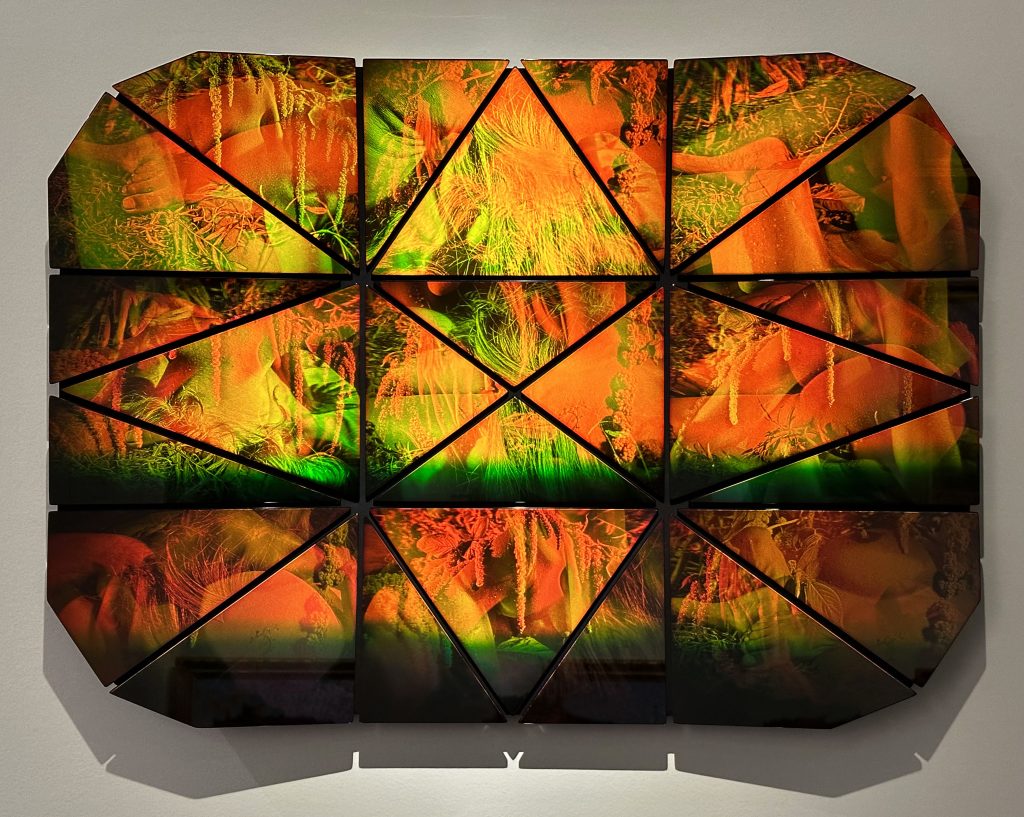
Sarah Meyohas, “Interference #19”, 2023, Holograms, mirrored black glass, aluminum
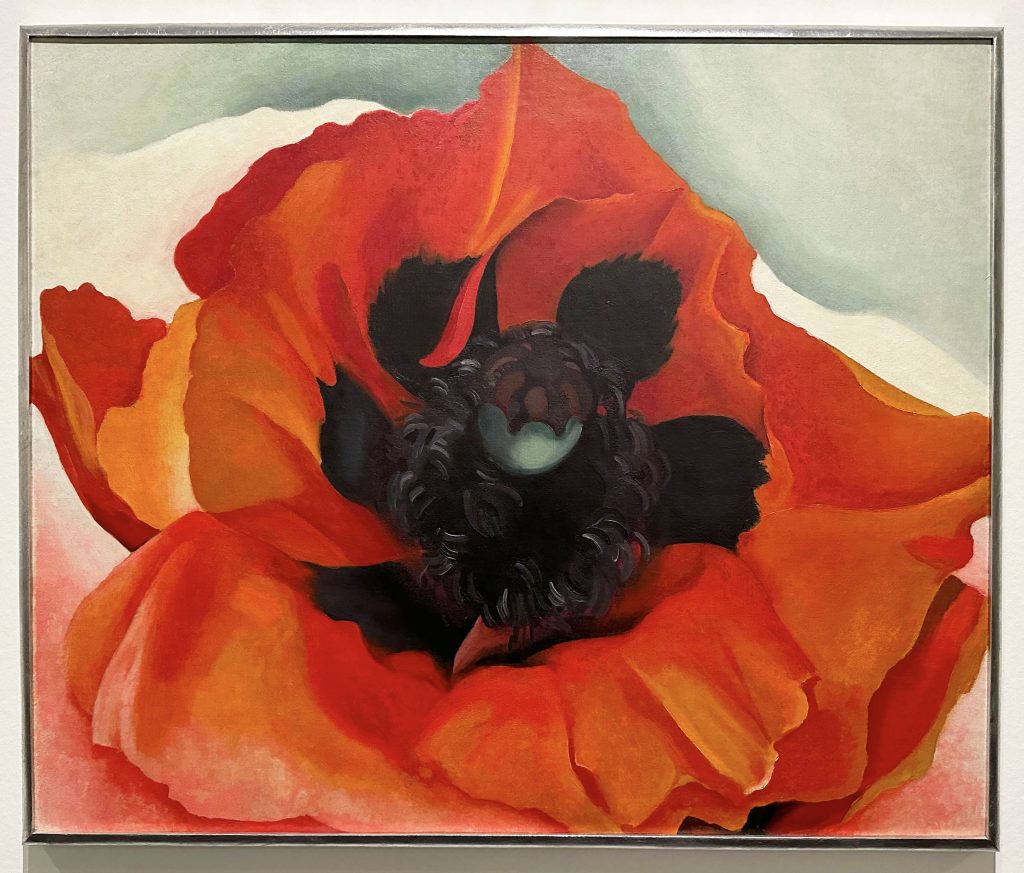
Georgia O’Keeffe, “Poppy”, 1927, Oil on canvas

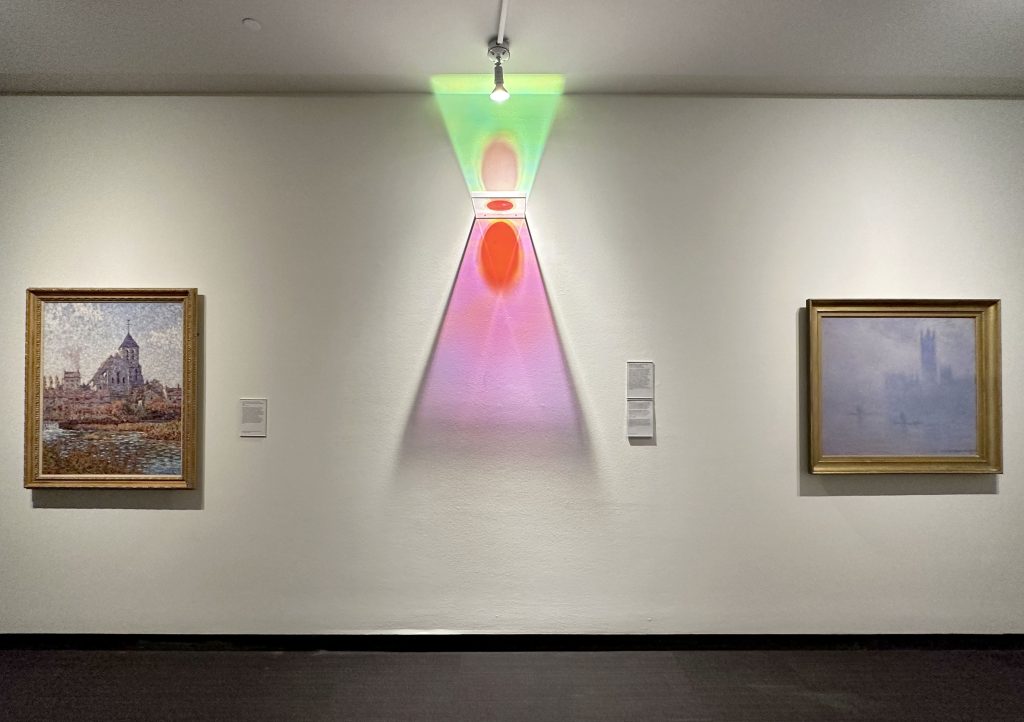
Francis Picabia “The Church of Montigny, Effect of Sunlight” 1908, Oil on canvas (left); Christian Sampson “Projection Painting”, 2023, Acrylic and films with LED light; and Claude Monet “The Houses of Parliament, Effect of Fog, London” 1904, Oil on canvas (right)
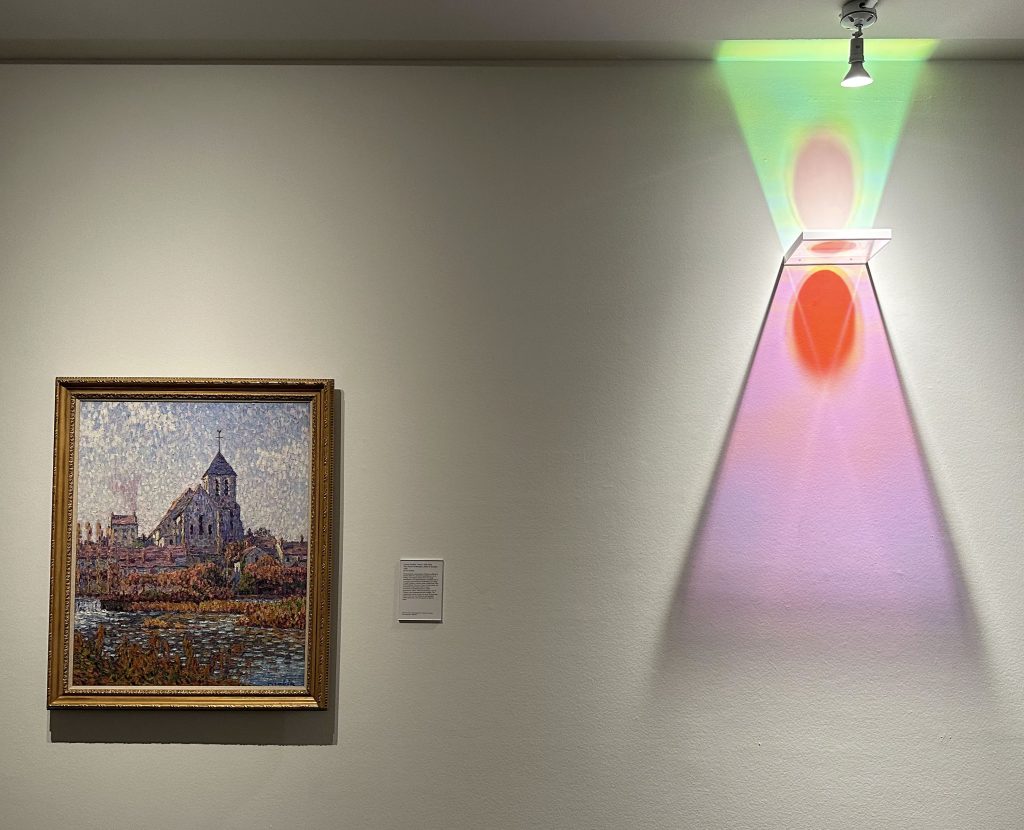
The Nature of Art exhibition at the Museum of Fine Arts St. Petersburg merges art from the museum’s collection with loaned works to explore- “art’s crucial role in our evolving quest to understand our relationship with nature and our place in the cosmos”.

One of the benefits of an encyclopedic museum is that visitors have the opportunity to experience art throughout history, and to revisit works that resonate with them. For the section titled Artist as Curator, Sarah Meyohas and Christian Sampson chose pieces from the museum’s collection to pair with their own work.

From the museum-

At first glance, perhaps, these may seem like unusual combinations, but upon deeper contemplation, their selections reveal complementary artistic intents. For instance, Meyohas and Georgia O’Keeffe share an interest in close looking, particularly in finding new ways to examine underappreciated aspects of the natural world. Sampson, influenced by the California Light and Space Movement, is interested in current scholarship that suggests the hazy fog found in Claude Monet’s work is an early depiction of air pollution, offering an entirely new perspective on the artist’s representations of light.

Sampson also created the four-part installation, Tempus volat, hora fugit, on view until 2025 at the museum.

Below are some of the works from additional sections of the exhibition.
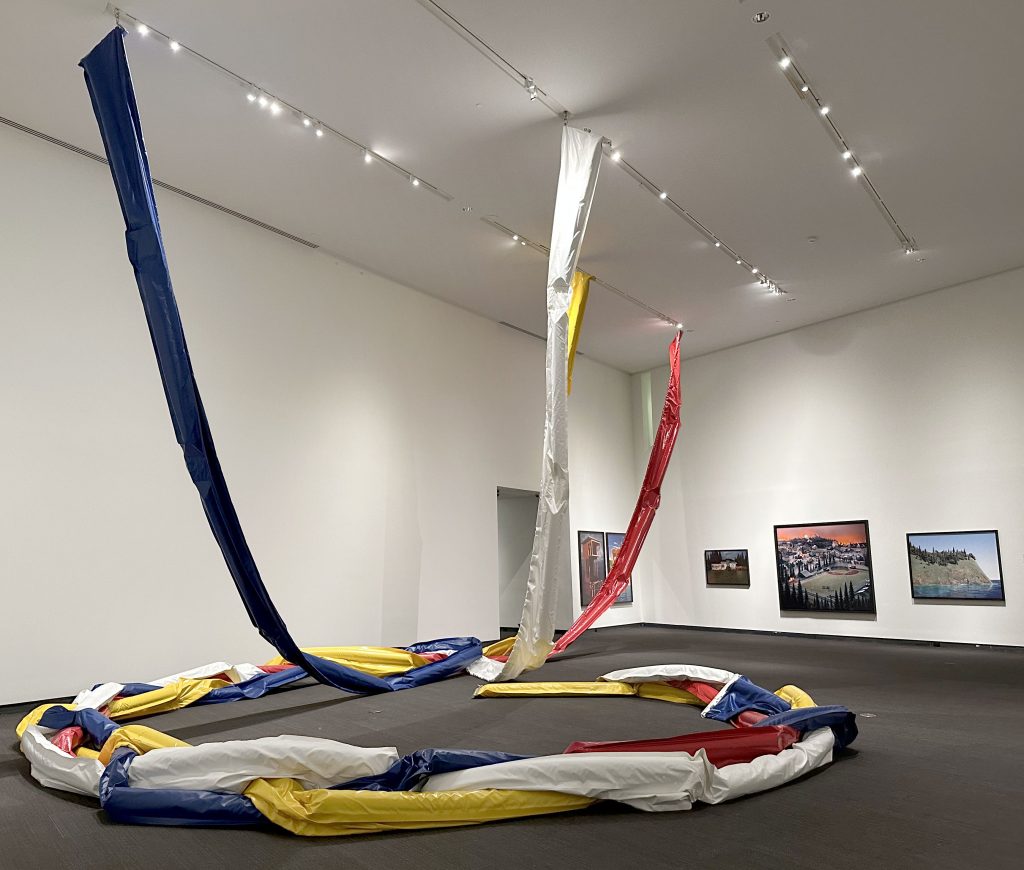
Postcommodity, “kinaypikowiyâs”, 2021, Four 30.5-metre industrial debris booms
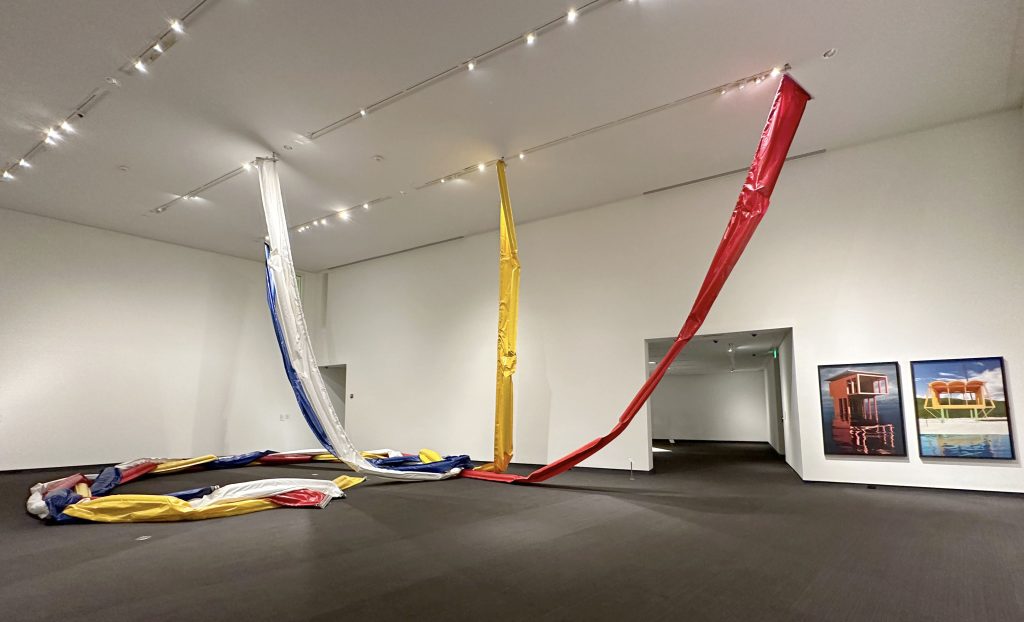
Postcommodity, “kinaypikowiyâs”, 2021, Four 30.5-metre industrial debris booms

Postcommodity is an interdisciplinary art collective comprised of Cristóbal Martínez (Genizaro, Manito, Xicano), and Kade L. Twist (Cherokee).

About Postcommodity’s work, kinaypikowiyâs, (seen above) from the museum-

This work is composed of debris booms, used to catch and hold environmental contaminants such as garbage, oil, and chemicals. The colors of the booms correspond to different types of threats— red (flammable), yellow (radioactive), blue (dangerous), and white (poisonous)-in the labeling system for hazardous materials. To indigenous peoples, these are shared medicine colors that carry knowledge, purpose and meaning throughout the Western Hemisphere. Suspended like hung meat, the booms represent a snake that has been chopped into four parts. Each part represents an area of the colonial map of the Western Hemisphere: South America, Central America, North America, and all of the surrounding islands. The title, kinaypikowiyâs, is a Plains Cree word, meaning snake meat. Divided by borders, Postcommodity asserts that all people living in the Americas are riding on the back of this snake.
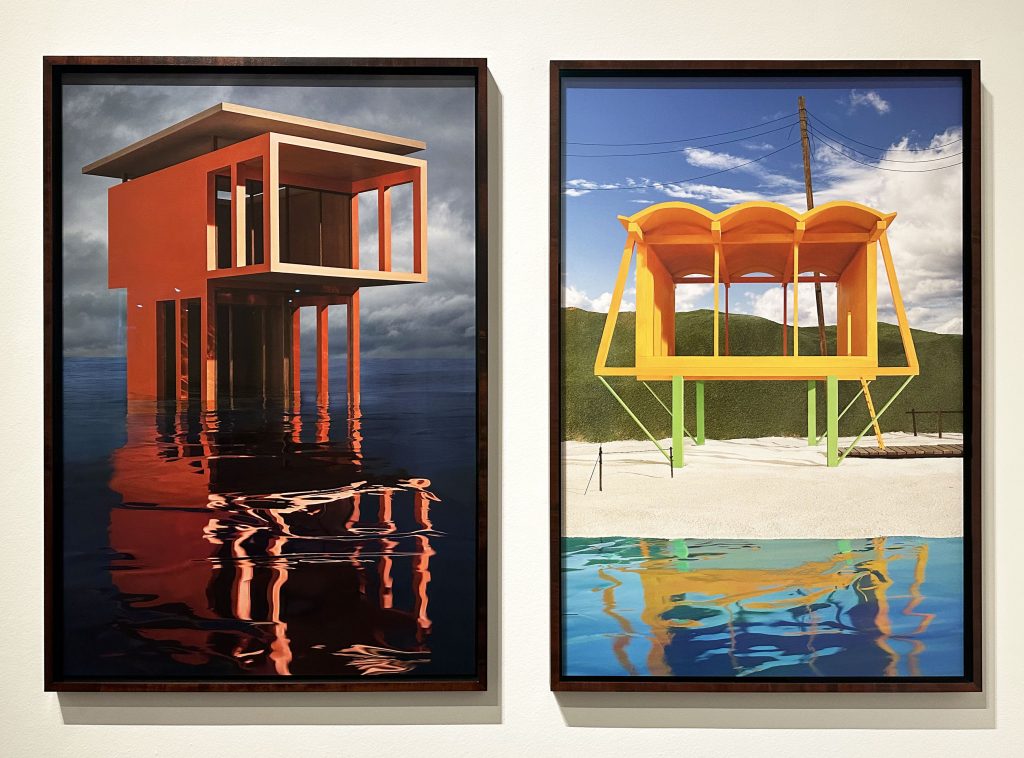
James Casebere, “Red/Orange Solo Pavilion”, and “Orange Guesthouse”, 2018, Archival pigment print mounted to Dibond
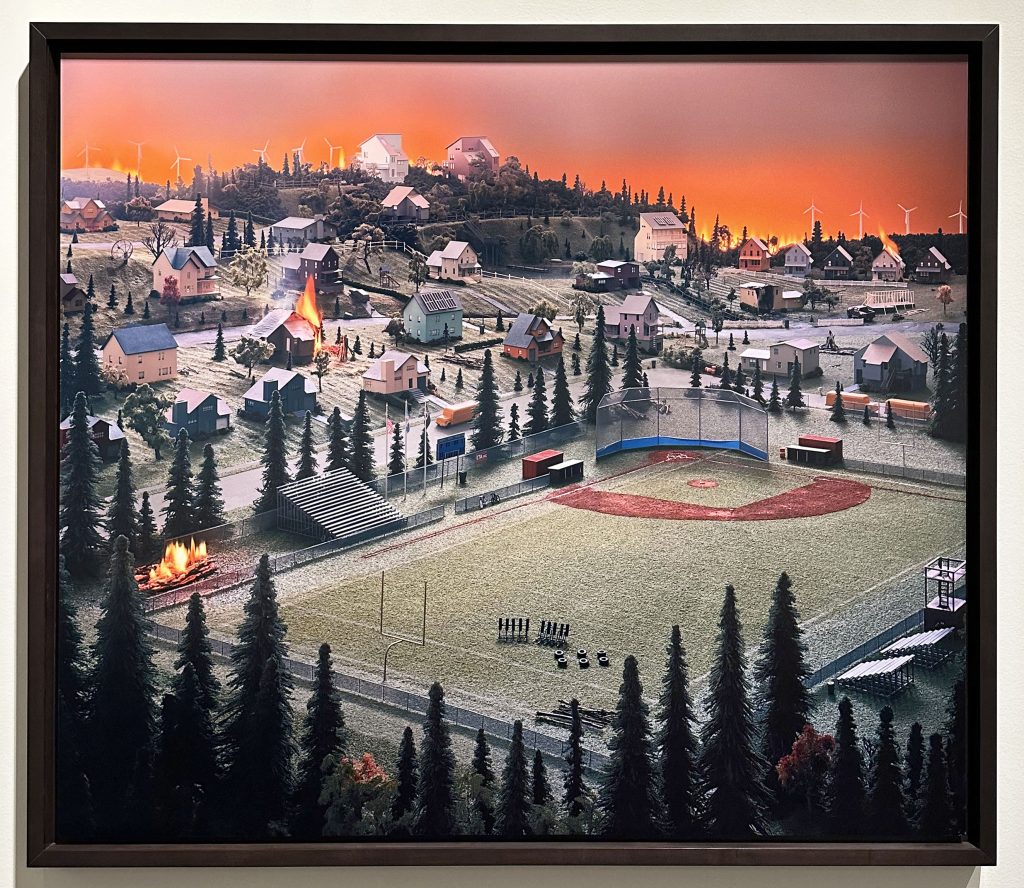
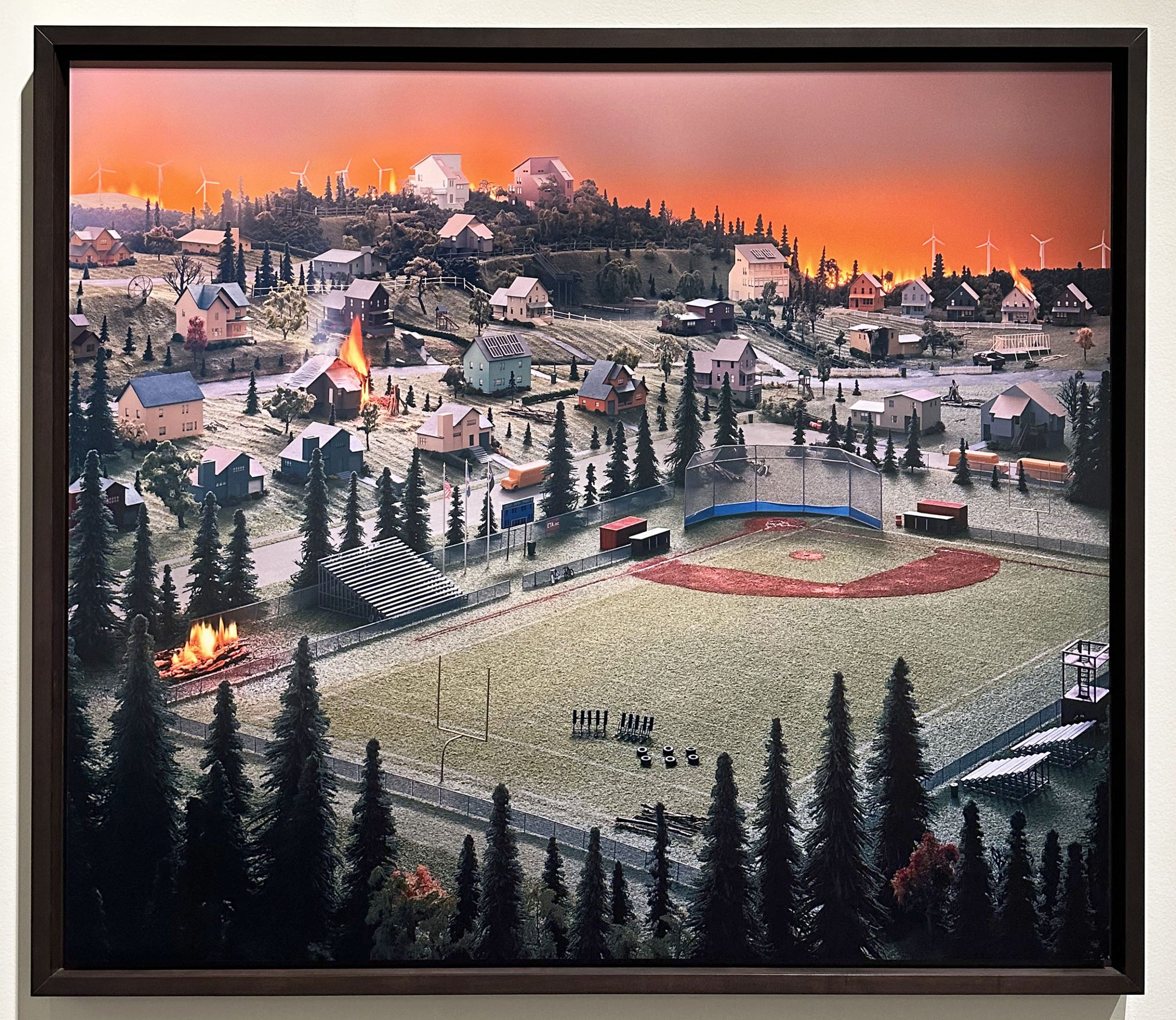
James Casebere, “Landscape with Houses (Dutchess County, NY), 2009, Archival pigment print mounted to Dibond

James Casebere creates architecturally based models for the large scale photographs seen above.
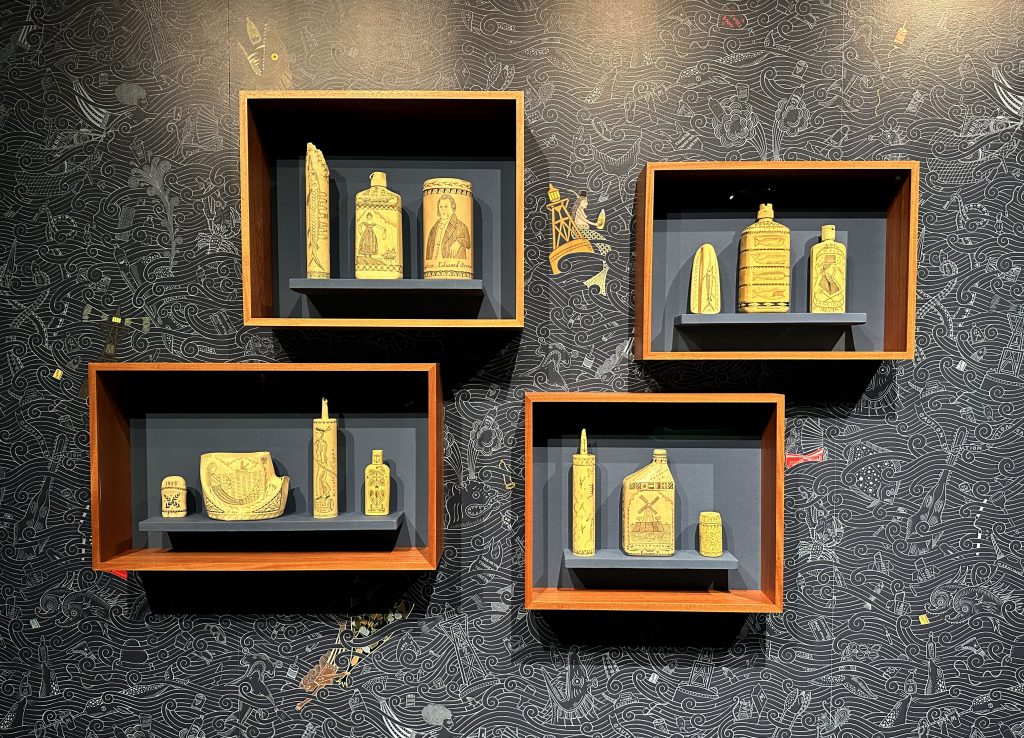
Reclaimed ocean plastic sculptures and “Tidal Fool” wallpaper by Duke Riley
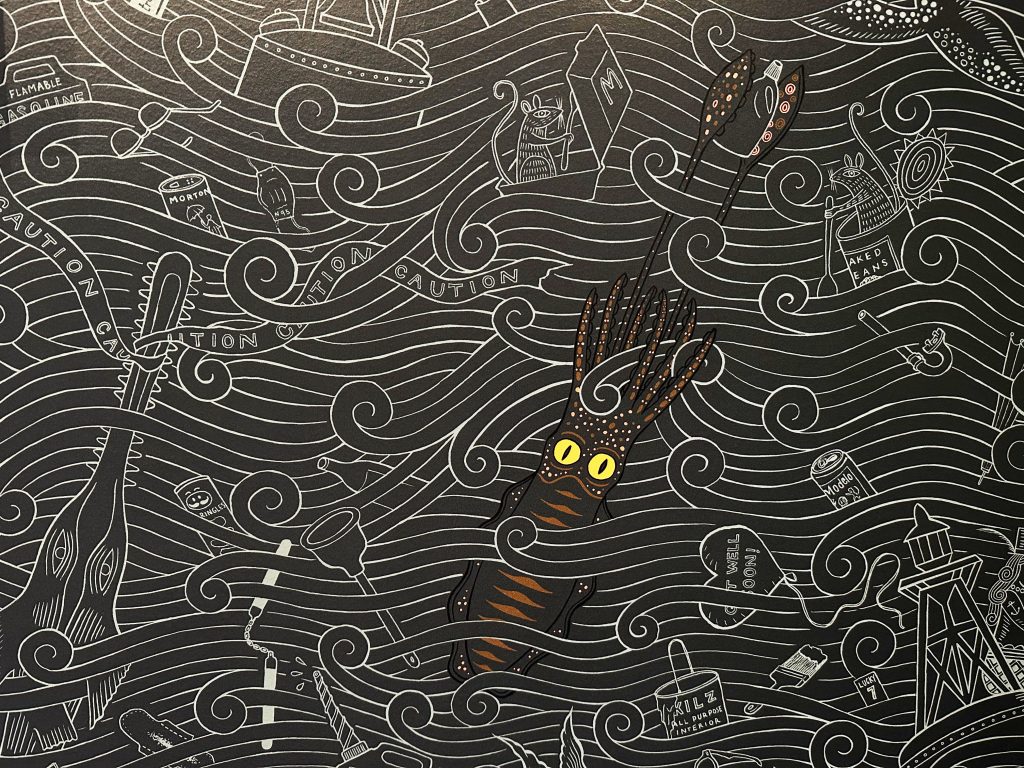
Duke Riley custom wallpaper, Tidal Fool, detail
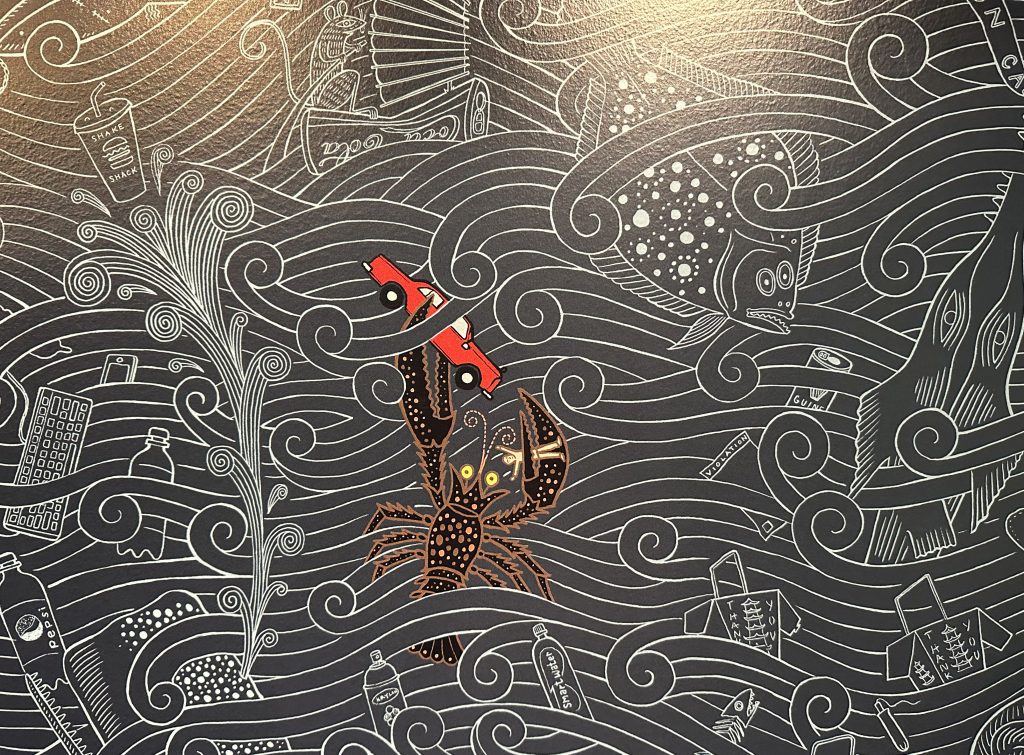
Duke Riley custom wallpaper, Tidal Fool, detail

Duke Riley’s work, which was previously shown at Brooklyn Museum, addresses issues of environmental pollution by using discarded plastics found in the ocean and other waterways to create new work inspired by the past. You can hear him discuss his work in this video.

From the museum-

Inspired by the maritime museum displays he saw while a child growing up in New England, Riley’s scrimshaw series is a cutting observation of capitalist economies-historic and today-that endanger sea life. The sculptures were created for the fictional Poly S. Tyrene Memorial Maritime Museum, and are contemporary versions of sailors’ scrimshaw, or delicately ink-etched whale teeth and bone. Riley first thought about using plastic as an ode to scrimshaw when he saw what he thought was a whale bone washed up on the beach in Rhode Island; it turned out to be the white handle of a deck brush. Riley regularly removes trash from beaches and waterways, and often uses this refuse in his work.

Riley collaborated with Brooklyn-based Flavor Paper to create these two custom wallpapers for his solo exhibition DEATH TO THE LIVING, Long Live Trash at the Brooklyn Museum. Tidal Fool exhibits Riley’s trademark humor in the face of devastating water pollution; notice the Colt 45-guzzling mermaid. Wall Bait vibrantly references Riley’s meticulous fishing lures, which he crafts from refuse found in the waters around New York City.
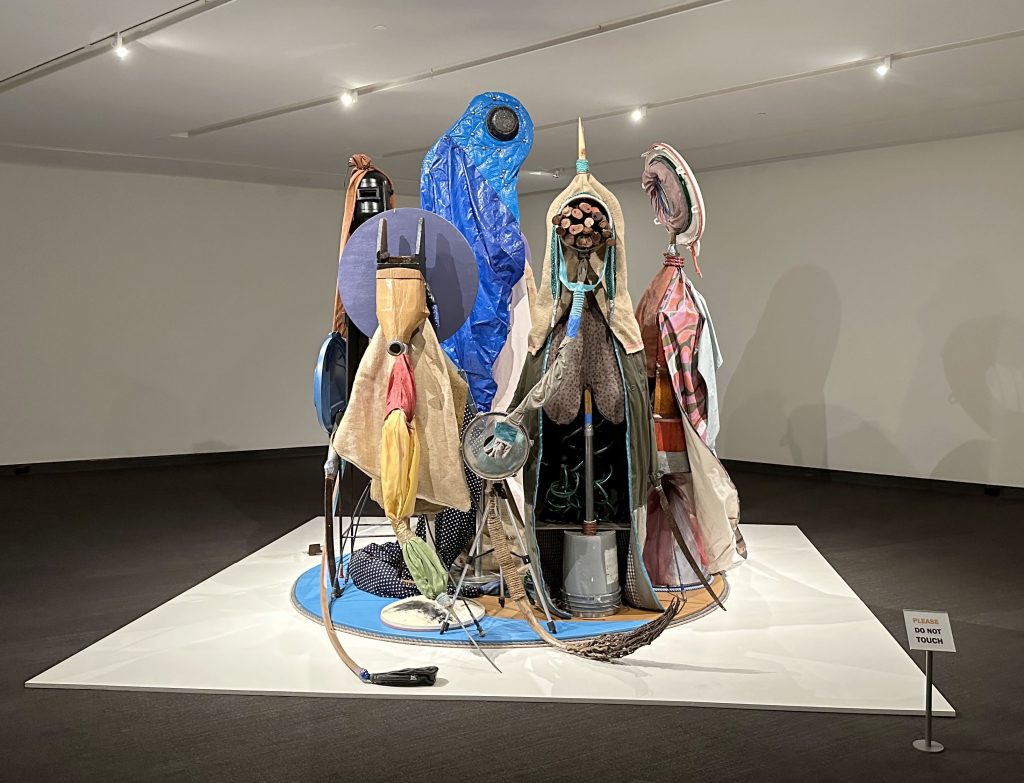
Daniel Lind-Ramos,”Centinelas de la luna nueva (Sentinels of the New Moon)”, 2022-2023, Mixed media
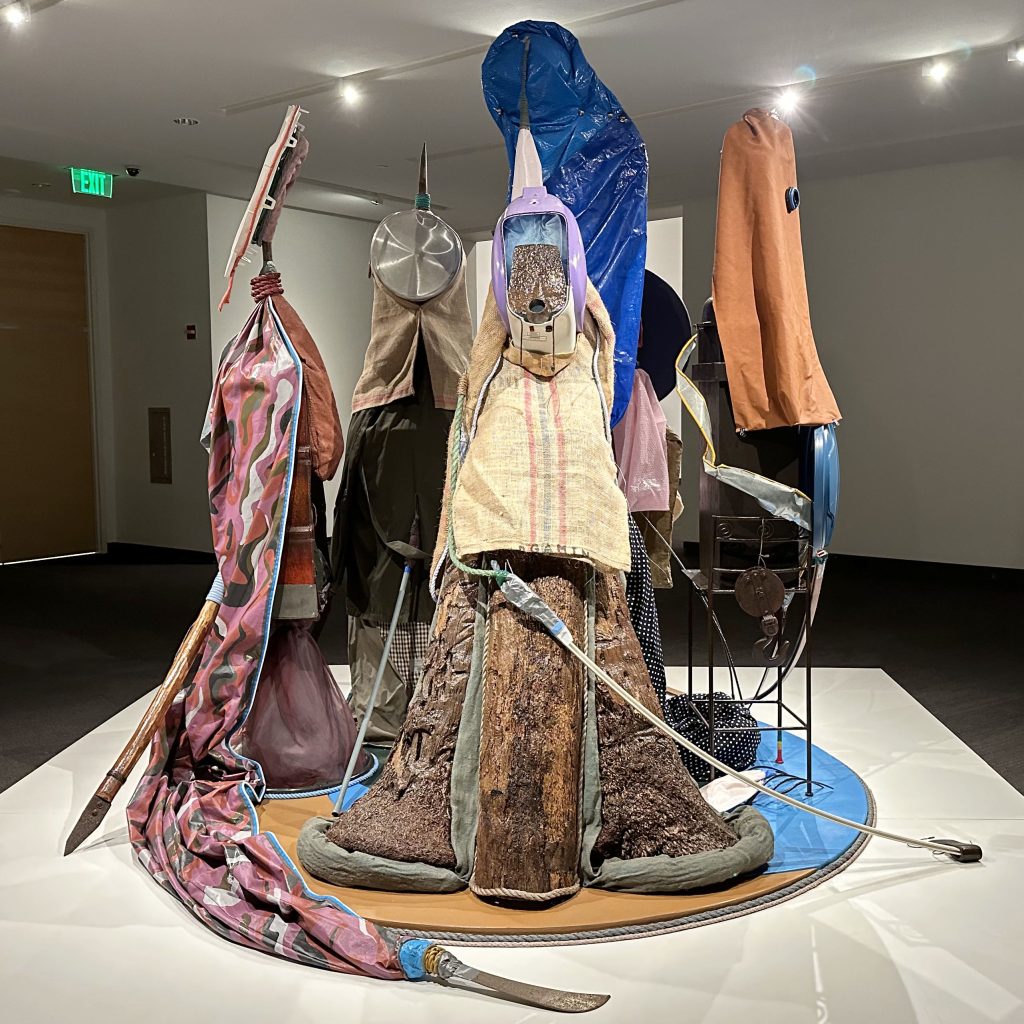
Daniel Lind-Ramos,”Centinelas de la luna nueva (Sentinels of the New Moon)”, 2022-2023, Mixed media

Daniel Lind-Ramos also uses a variety of recycled objects to create his sculptures.

From the museum about this work-

In Centinelas de la luna nueva, he evokes the elders of the mangroves, spiritual beings who watch over and ensure the health of this essential coastal tree. Mangroves are the basis for a complex ecosystem that shelters sea life and serves as the first line of defense in the tropical storms that batter the sub-tropics—including Florida.

Lind-Ramos’s practice reflects the vibrant culture of his native Loíza, Puerto Rico, by honoring local agriculture, fishing, cooking, and masquerade. His sculptures also evoke Hurricane Maria (2017), the COVID-19 pandemic, and ongoing environmental degradation. Lind-Ramos is committed to the survival and sustenance of Afro-Taíno traditions and people of the Puerto Rican archipelago. However, his art engages the global community through shared emotions, parallel histories, and the commonality of human experience.

The next post will discuss two other artists in the exhibition, Brookhart Jonquil and Janaina Tschäpe.

Apr 102024
 

Nalani Stolz “Bread Bodies”, bread, ceramic, muslin

Nalani Stolz, “”like floating in thick waters”, fermented membrane, stainless steel

Nalani Stolz, “a small ocean swallowed” baking soda, ceramic, cheesecloth, vinegar, pump, latex

“a small ocean swallowed”, closer

Nalani Stolz, “a wild wetland in our gut” ceramic, plum vinegar, muslin, stuffing, salt

Nalani Stolz, “a wild wetland in our gut” ceramic, plum vinegar, muslin, stuffing, salt

The Sculpture Center in Cleveland is currently showing Nalani Stolz’s Bodies Still Becoming and Zachary Smoker’s Inured.

With the sound of water dripping, the bread stretching fabric, and growth covered vessels leaking into mattresses- Stolz’s sculptures engage the viewers senses, at times viscerally.

She has also included her film Traces in the exhibition. For this work she and her mother slowly sew their hair together through a sheet of gauze.

From the gallery about the exhibition

The bodies Nalani Stolz crafts bulge, grow, and break down. Materials such as rising dough expand and constrict, cloth sculptures leak and ooze, fermented membranes and porous clay forms seep vinegar, growing warts across their surfaces. These bodily processes draw on the often-gendered experiences of how our physical forms take in and expel matter; the feelings of expansion and fullness and those of emptying out, of breaking down when weeping, menstruating, and experiencing miscarriage, abortion, and pregnancy. These moments shift our seemingly solid edges and reveal our porous boundaries; reminding us that we are dying, changing, decaying vessels, loosely contained by skin, muscle, and bone.

Zachary Smoker’s sculptures for Inured address issues related to U.S. currency, power, capitalism, and material culture. In two of the works, familiar items ask questions about purpose. The whiffle ball bat /police baton combination mixes violence and play. Shopping carts now have associations with living on the street, as well as for buying goods in a store- which one will this be used for when assembled?

Zachary Smoker, “Crony Tikes”, Plastic Whiffle ball bats, pegboard, double hooks, 2024

Zachary Smoker, “Anyone can make Art, not everyone can buy it”, Demonetized U.S. currency, BFK Rives, Elmer’s glue stick, safety wire glass, poplar, enamel paint, paint marker, 2023

Zachary Smoker, “A place for everyone, and everyone in their place”, Steel shopping cart, polyurethane wheels, enamel paint, 2024

Both of these exhibitions close on 4/13/24.

Apr 032024
 

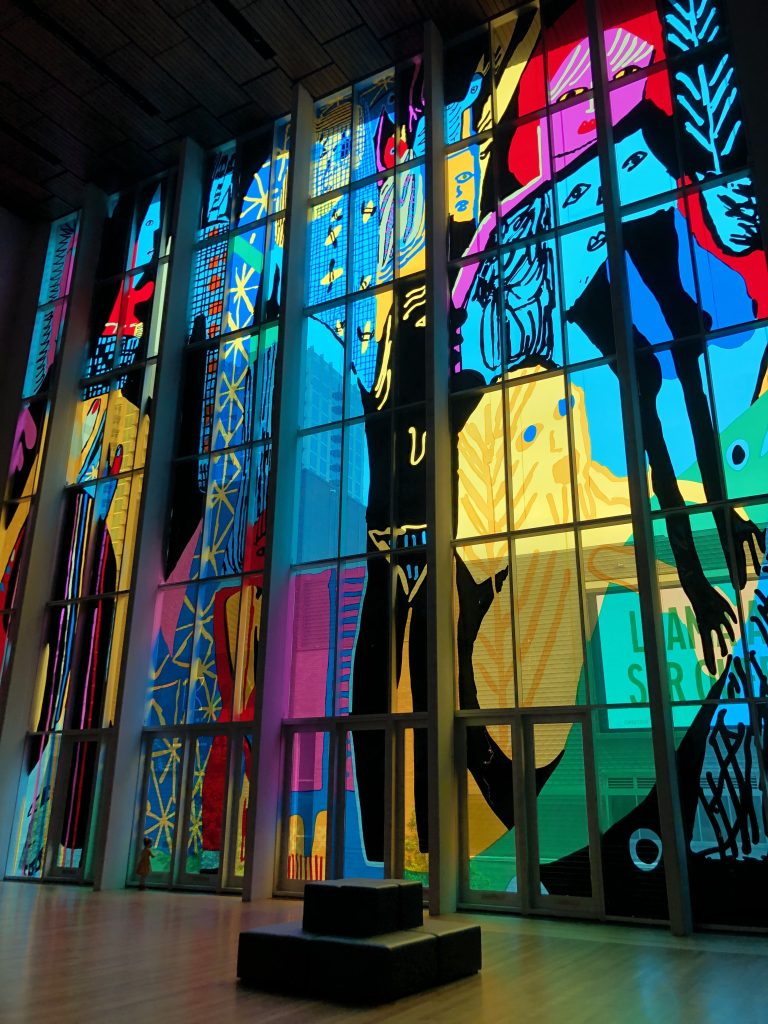
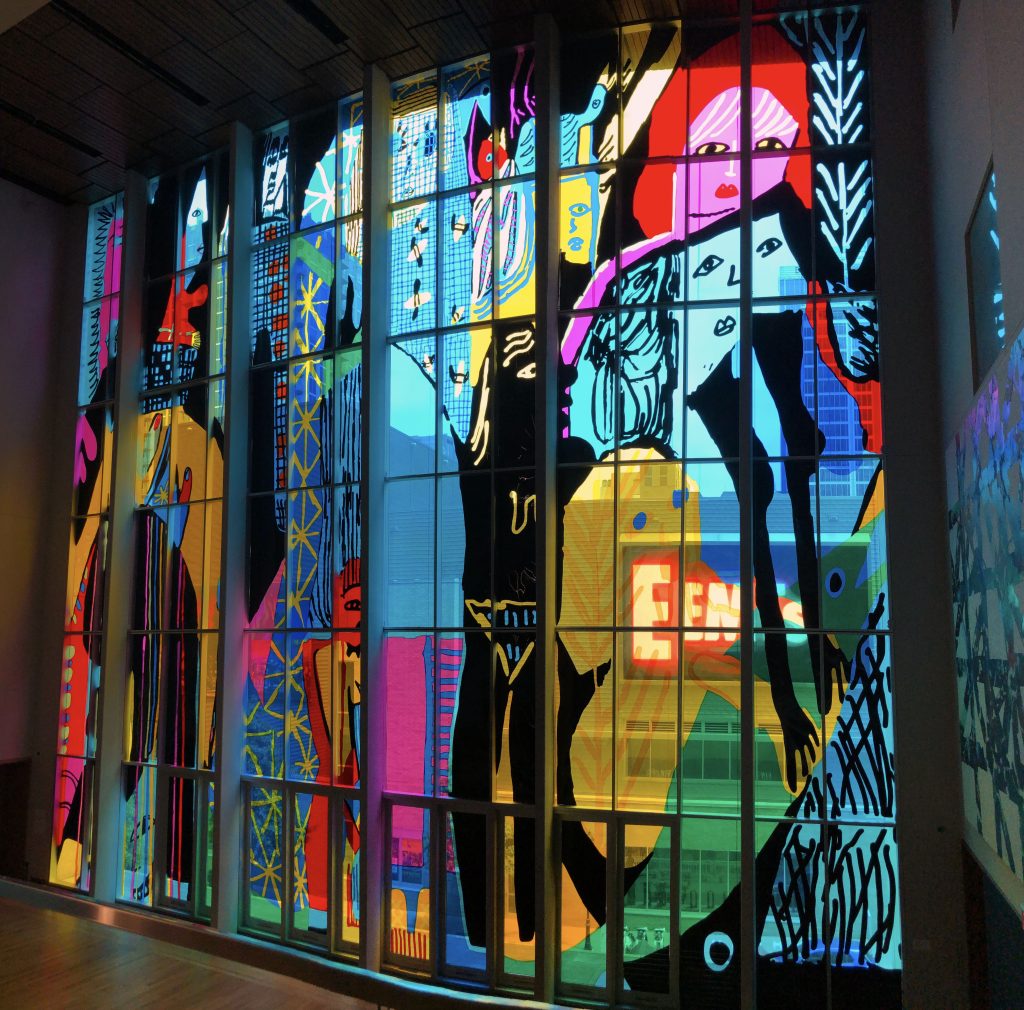
Summer Wheat created this mural, Foragers, in 2020 for the Mint Museum in Charlotte, North Carolina, where it remains on view today.

From the museum about the work-

This monumental “stained glass” installation celebrates the resilience of North Carolina’s community of makers and providers and creates a space where our present-day Charlotte community can gather for contemplation and inspiration. Collaging sheets of colored vinyl, Wheat has created a towering, prismatic composition that fills all 96 windows of the Mint atrium with female figures of varied sizes, ages, shapes, and races performing acts of labor: fisherwomen, beekeepers, hunters, mothers, caretakers, farmers, bankers.

Following the tradition of stained-glass windows found in places of worship, Wheat offers a narrative of hope and resilience that can be enjoyed in a few minutes or studied over hours. Wheat says that “Foragers presents a tradition in which women were the original hunters, technologists, and artists. This array of women connected by geometric patterns echoes the psychological space of women supporting each other. They are marching together, connecting to creatures from land and water, demonstrating their inherent link to natural elements and to the intricate depths of the unconscious.”

The women in Foragers also call attention to the underrecognized populations who have cultivated the land that we now call North Carolina, from the indigenous tribes to the colonial settlers to the enslaved Africans and all those who have followed. The region is home to myriad traditions-ceramics, basket weaving, quilting, furniture construction, textile production-and The Mint Museum specifically celebrates that legacy through its collection and exhibitions. Foragers salutes North Carolina’s history of creativity and industry, both by those whose names we know and those who remain anonymous.

Her latest exhibition, Fertile Ground, is currently on view at Nazarian/Curcio in Los Angeles, closing on 4/6/24. It includes new paintings and three stone mosaic sculptures.

Mar 282024
 

Jazzalyn Palma, “21st st”, Oil on canvas, 2023

Rachel Augustson, “Gaze”, Ink on Paper, 2023

Ashton Burton, “…”, Oil on canvas, 2023

Cleveland Institute of Art’s 78th Student Independent Exhibition is currently on view in their Reinberger Gallery. The juried show is organized by the students and includes work from all mediums.

There are so many great pieces in this show, above and below are just a few selections.

This exhibition closes 4/7/24.

James Schaffer, “Bound”, Oil on canvas, 2023

James Schaffer, “Bound”, Oil on canvas, 2023 (detail)

Gwen Putz, “Viv!”, Monoprint, 2023

Tristen Kovacs, “897”, Spray paint and acrylic on canvas, 2023

Emily Fontana, “Untitled”, Acrylic and spackle on fabric, 2024

Emily Fontana, “Untitled”, Acrylic and spackle on fabric, 2024 (detail)

Mar 222024
 

Pictured is Jacob Hashimoto’s This Particle of Dust, on view at Tampa Museum of Art through 2025.  At first glance, it may seem monochromatic, but on closer inspection the blue color and star patterns begin to emerge on the darker pieces. It also changes depending on the viewer’s vantage point and the changing natural light.

From the museum about the work-

The artist takes inspiration from cloud formations and the cosmos, with each navy blue kite featuring star-like markings. Depending on the time of day and the natural light filtering through the atrium skylights, the kites will shift in color intensity. This Particle of Dust explores the visual poetics of light and dark, color and form, as well as space and architecture.

Created from over 2,500 handmade kites, This Particle of Dust is a site-specific installation and unique to the Tampa Museum of Art’s architecture. The installation represents Jacob Hashimoto’s exploration of abstract landscape and his interest in blurring the boundaries between painting and sculpture. This Particle of Dust evokes the experience of observing the night sky through various cloud clusters. Thousands of transparent and opaque white discs hang suspended from a bespoke armature. Navy blue kites, imprinted with white and cerulean blue star patterns, hang amidst the cloud shapes and catch the light as the sun rises over the Museum and dips into the horizon over the Hillsborough River. Depending on one’s vantage point, either from the lobby, stairwell, or galleries, the experience of This Particle of Dust shifts—from below the cloudscape appears to drift into the sky while at eye-level the viewer looks directly into the stars.

Hashimoto began making kite sculptures twenty-years ago while an art student in Chicago. Inspired by traditional Chinese kite making in the city of Weifang, where the artform of sculptural dragon kites originated, Hashimoto has made hundreds of thousands of kites from Japanese paper and resin. He appreciates kites as a universal object of joy that is recognized across the globe. Transformed into monumental artworks, Hashimoto’s kites convey happiness, wonder, and serenity.

Below is Tampa Museum of Art’s video of the artist discussing this installation.

Hashimoto is also showing several wall-mounted sculptural works for his solo exhibition, Fables, at Rhona Hoffman Gallery in Chicago. It will be on view until 4/20/24.