Dec 052019
 

Murals of La Jolla is a project started in 2010 by The Athenaeum and the La Jolla Community Foundation. It commissions artists to create work to be displayed on buildings around La Jolla. The works are on view for a minimum of two years (a map of current work here)

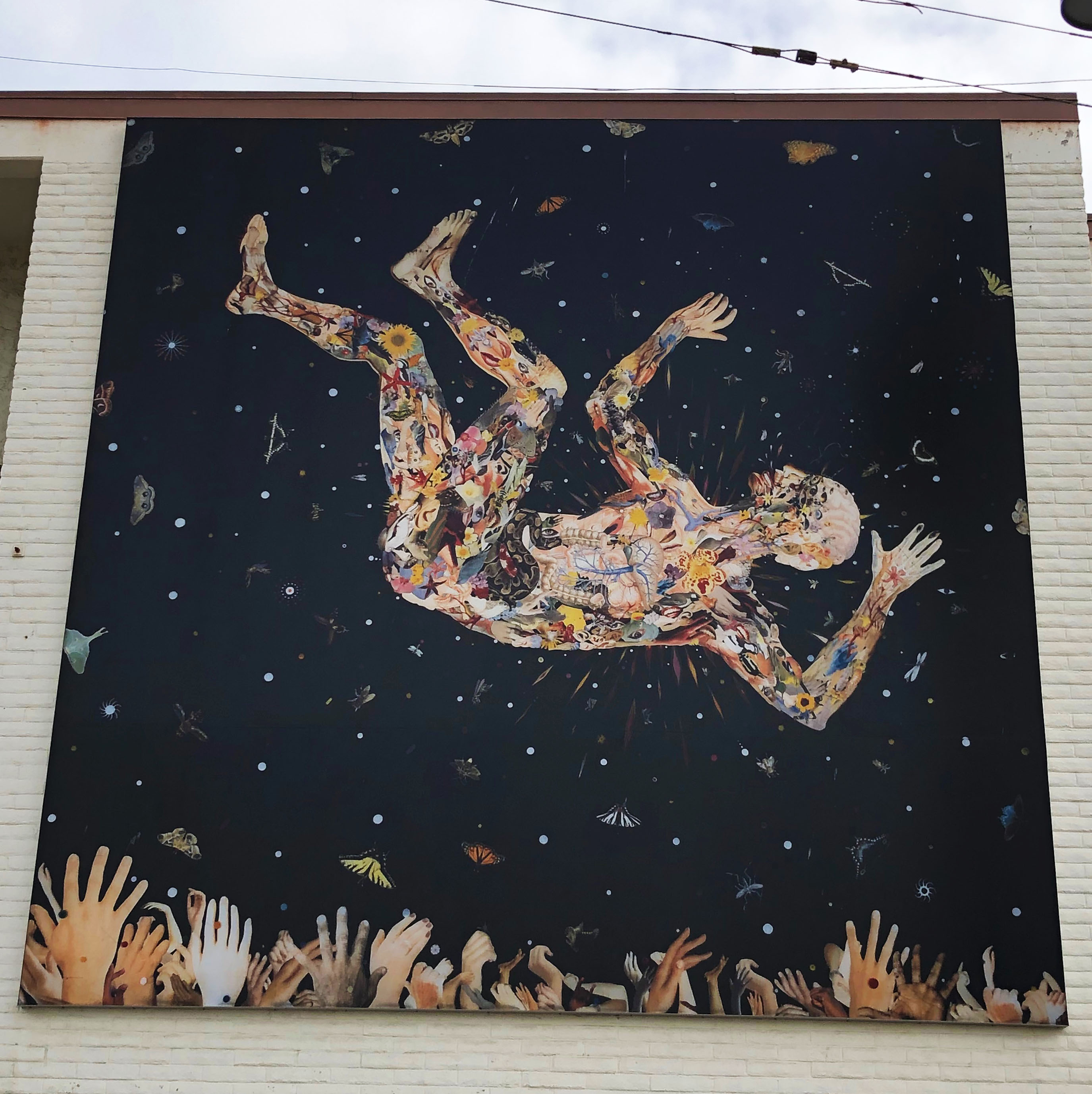
The above work, Expecting to Fly (for the Zeros), 2013, is by Fred Tomaselli and honors Chula Vista based Chicano punk band, The Zeros.

From the Murals of La Jolla website about the work-

It combines cutout images of insects, animals, plants, butterflies, birds, and body parts to create a visionary image of a man falling through space. The title of this work, Expecting to Fly, is the title of a song written by Neil Young and performed by Buffalo Springfield in the late ’60’s.  The man falling through space can be read as a crowd surfer, an image that comes out of the Punk Rock movement. One traditional idea of the “sublime” deals with losing oneself to the vastness of the universe. In this case, the crowd-surfer is losing himself to the vast, collectivist  “organism” of the crowd.  “In this piece I try to find commonalities in the pursuit of a modern sublime that stretch through time and past ideologies”.

This mural is located at 7569 Girard Avenue.

Nov 232019
 

The Second Home Serpentine Pavilion, designed by Spanish architects Lucia Cano and Jose Selgas of SelgasCano, is a bright and colorful addition to the park that houses the La Brea Tarpits and LACMA.

The installation will be up and accessible to the public until 11/24/19 (although tickets are available for Monday 11/25 and Friday 11/29). Get free tickets here.

Nov 012019
 

It’s the last weekend to see Theaster Gates’ exhibition Line Drawing for Shirt and Cloak at Regen Projects in Los Angeles, closing 11/2/19.

From the press release

Line Drawing for Shirt and Cloak presents a complex reflection on desire, consumption and surrender using contemporary activations of the storefront as a vehicle for expressing both emotional and aesthetic intent. With a highly honed metal strategy and the artist’s entire wardrobe, this multi-faceted installation represents a conscious movement toward the freedom found when one’s appetite and the world’s insistence asks for everything, and a moment of clearing when emotive freedom is found.

Referencing the exhibition’s title, the gallery will be transformed by a series of free-standing and wall-mounted metal structures that demarcate the interior of the space, forming a series of line drawings onto which varying sculptural and quotidian works will hang. Additional sculptural forms supported by large stone pillars and large metal and wood platforms form the basis of an extant atelier. In preparation for the exhibition, Gates will transform his entire wardrobe into many smaller symbolic works, which will be placed en masse as a large sculptural work. This body of work, while a departure in material motif, underscores Gates’ ongoing interest in both the transcendental acts of reclusion and denouncement, and his inability to totally reconcile his appetite for spiritual truth with his competing desire for the things of this world. Through painting, sculpture, sound, and up-cycling, Gates continues to find truth in the unseen and evidence growth in ways unexpected.

A new vocal score conceived of and performed by Gates punctuates the exhibition space. The lyrics of the piece playfully riff on the biblical verse from which the exhibition’s title is inspired, and offer an explication for the artist’s metamorphosis.

“I’ve always been a lover of material things; fashion, antiques, adornment. A believer in the beautiful. But in this moment, I’ve never felt more need to question my own contempt and appetite. This process is not a spiritual attempt; it’s actually quite worldly. I can’t feel growth because I’m weighted by the things around me and people can’t see my growth. The accumulations are a distraction. But the title has much to do with what happens when the world charges you – the outside forces that judge and gnaw and hate. If the world wants to pursue me for this shirt, well, they can have it all.

The sculptural intent of the show is to introduce an unexpected spatial strategy at Regen that gives me permission to be free of conventional gallery tropes and form a set of new sculptural dictates that consider more of the everyday world of fashion and street activity. The project is a minor response to the growth of interest that the fashion world has in art and perhaps my own reckoning with the power of the hyper-public, hyper-everyday considerations that fashion affords. I’m in dialogue with Willie Wear, Girbaud, the Prada concern, retail projects in China, the historic fashions that Chicago House Music produced, and my mama’s church hats. While none of these things need to be immediately perceived, they are no-less present.” –Theaster Gates, 2019

Nov 012019
 

Closing 11/2 at Tanya Bonakdar’s Los Angeles location is Ernesto Neto’s interactive exhibition Children of the Earth.

From the press release-

In Children of the Earth, Neto creates an alluring environment of color, materials, fragrances and sound, transforming the gallery into a living organism, where visitors are encouraged to wander, touch, feel, interact and connect.

Upon entering the gallery, a curtain in green and brown patterns invites the viewer to walk through a tunnel-like path which leads to the main gallery space. Entitled Children of the Earth, a large-scale installation of crochet, spices and leaves hangs from the ceiling to the floor. The large biomorphic shape—hand knitted in vibrant colors of yellows, greens, purples and reds—is flanged by drop-shaped crochet vines that serve as counterbalance and establish the delicate equilibrium of the piece. Here, references to nature interconnect with formal questions of tension, gravity and weight. On the floor, tracing the outline of the structure above, a soft surface of handmade textile is installed. Ceramic vases sprout from the ground, representing the diversity of peoples inhabiting the planet, and that ultimately, we are all the children of the earth. Musical instruments, spices, and crystals comprise an integral part of this malleable, highly tactile sculpture, which engages the five senses, and invites viewers to connect with one another in new and meaningful ways. In expanding the boundaries of physical space and calling for a new type of interaction, Neto creates an experience that is physical, sensorial, intellectual and social all at once.

Surrounding the piece, as another layer of skin, hand-sewn fabric hangs. The organic pattern and color pallet further recall the natural world, as they invoke the forest, wood grain, or the circulatory system of a plant. The path the visitor follows throughout the space, and from within the piece—like an organic line in nature—is analogues to Neto’s conception of life where there is “no separation between humans and nature, nor between art making and art experience”, highlighting that in the exhibition, as in life, everything is connected.

In the back gallery a hanging platform with a crochet canopy and crochet tendrils is installed. Designed for direct interaction, this is a healing bed that offers a moment of rest and respite, where people can connect to themselves, as to one another.  The tendrils function as ‘connectors’, as they amplify the pulse of life while connecting us to the environment and to our own physicality. Embracing the participant in its serenity, the healing bed investigates the meeting point of art, sensation, personal connection and the human body.

The exhibition as a whole connects mind, body and nature through a sensory experience that is unmediated. It is an invitation to connect to ourselves and to our planet at a time when connectivity is most needed. For Neto, sculpture is an extension of the body, and the body is ultimately an extension of earth.

Oct 302019
 

Currently at Gladstone Gallery’s 21st Street Location in New York is Allora & Calzadilla’s exhibition Cadestre.

From the press release

The exhibition revisits the Surrealist encounter with the anti-colonial movement in the Caribbean to consider present forms of coloniality and its relation to climate justice. The artists have taken inspiration from the radical and transformative collection of poems by Martinican poet and politician Aimé Césaire under the same name. The term “cadastre” refers to the means by which the territorial limits of private property are publicly registered. Taking cue from the powerful mechanics of Césaire’s writing, Allora & Calzadilla’s exhibition Cadastre brings together three works all informed by a poetics of mark making, traces, and survival.

In April 1941, the anti-colonial Martinican poets and theoreticians Susanne and Aimé Césaire, founders of the literary journal Tropiques, met with a group of artists and intellectuals fleeing Nazi-occupied France, whose boat had temporarily docked at the West Indian port of Fort-de-France. The refugees included Helena Benitez, André Breton, Wifredo Lam, Jacqueline Lamba, Claude Lévi-Strauss, André Masson, and Victor Serge, among others. Penumbra takes as its point of departure the now mythic hikes the group took in the gouffre d’Absalom valley in Martinique, which served in part as inspiration for Lam’s masterpiece, The Jungle. Penumbra is a soundscape of “shadow tones,” a psycho-acoustic phenomenon perceived when two real tones create the semblance of a third. The original musical composition by David Lang uses nonlinear distortion of violin sounds to evoke the sensation of walking through that tropical forest.

In Graft, thousands of cast blossoms of the Tabebuia chrysantha tree, a common native species in the Caribbean, appear as though a wind had swept them across the gallery floor. Graft alludes to environmental changes set in motion through the interlocking effects of colonial exploitation and global climatic transformation. Systemic deforestation and depletion of the Caribbean’s original flora and fauna is one of the primary legacies of colonialism. Nevertheless, the Caribbean remains a biodiversity hotspot and, along with thirty-five other hotspots worldwide (which amount to just 2.4% of the earth’s land surface), supports nearly 60% of the world’s plant, bird, mammal, reptile, and amphibian species. As rising global temperatures result in more frequent and violently destructive weather, adding even more pressure to the Caribbean, the uncanny presence of tropical tree blossoms in Graft stands as a potent harbinger for the immeasurable losses that continue unabated after centuries of colonial plunder.

Measuring 6 feet in height and 70 feet in length, and covering the east and south walls, the exhibition’s eponymous work, Cadastre takes electromagnetism as its subject and medium. To make the work, Allora & Calzadilla dropped iron filings on top of a canvas and placed it above an array of copper cables connected to an electrical breaker in the artists’ studio in San Juan, which gets its power from the Puerto Rico Electric Power Authority. When the breaker is turned on, the electrical current causes the iron particles to self-organize into a composition of lines and shapes governed by the electromagnetic field. As the Latin title and full subtitle (Meter Number 18257262, Consumption Charge 36.9kWh x $0.02564, Rider FCA-Fuel Charge Adjusted 36.9 kWh x $0.053323, Rider PPCA-Purchase Power Charge Adjusted 36.9kWh x $0.016752, Rider CILTA-Municipalities Adjusted 36.9kWh x $0.002376, Rider SUBA Subsidies $1.084) suggest, the work probes the propriety politics of electricity and the power grid. Cadastre is part of a continuum of multiple sites and actors that the artists are probing through their artistic process working with electricity, from the oil futures market, to the transnational holders of PREPA bond debt, to the local consumers who are forced to pay for the recently privatized power company’s fiscal mismanagement.

This exhibition closes 11/2/19.

Recently, their film, The Great Silence, was shown at Marciano Art Foundation in Los Angeles. It is subtitled with thoughts from the perspective of an endangered Puerto Rican parrot who lives in the same area as the Arecibo Observatory, which was created to capture and transmit radio waves from and into outer space. The parrot questions why humans look to communicate and make a connection with extraterrestrial life, when there are parrots who can potentially use human language nearby.

It’s a thought provoking and moving piece, well worth a watch.

Oct 292019
 

Closing this week on 11/1/19 is Enrique Martínez Celaya’s exhibition The Tears of Things, at Kohn Gallery.

From the press release-

This new body of work consists of a series of paintings and one sculpture that revolve around three dualities: our alienation from and interconnectedness with all that there is, the absurdity and redeeming possibility of embarking, and the tension between promise and risk. The imagery brings together skaters, ice-covered lakes, black apple trees, golden landscapes, bullfighting, moonlit butterflies, and whale bones. The work featured in The Tears of Things continues Martínez Celaya’s concern with displacement and exile in its psychological sense, while deepening his ongoing exploration of the limitations and possibilities of art’s capacity to reveal or create meaning.

Martínez Celaya is widely celebrated for a practice that arises from sustained engagement with literature, poetry, philosophy, and science, as well as his own writing practice. An artist, author and former physicist, he works in a variety of mediums and materials that include oil, wax, tar, mirrors, dirt, steel, silk and bronze, which he weaves together with physical, emotional and conceptual qualities into a multi-layered exploration of the human condition evoking both immediacy and timelessness. His practice is laden with a depth of textures and philosophical touchstones, often incorporating elements of mysticism and fairy tales, yet he creates works that resist narrative interpretations. His paintings, sculptures, photographs and environments address universal questions about life and the individual experience, loss, memory, failure and one’s place in an emotionally radiant yet chaotic world.


Oct 252019
 

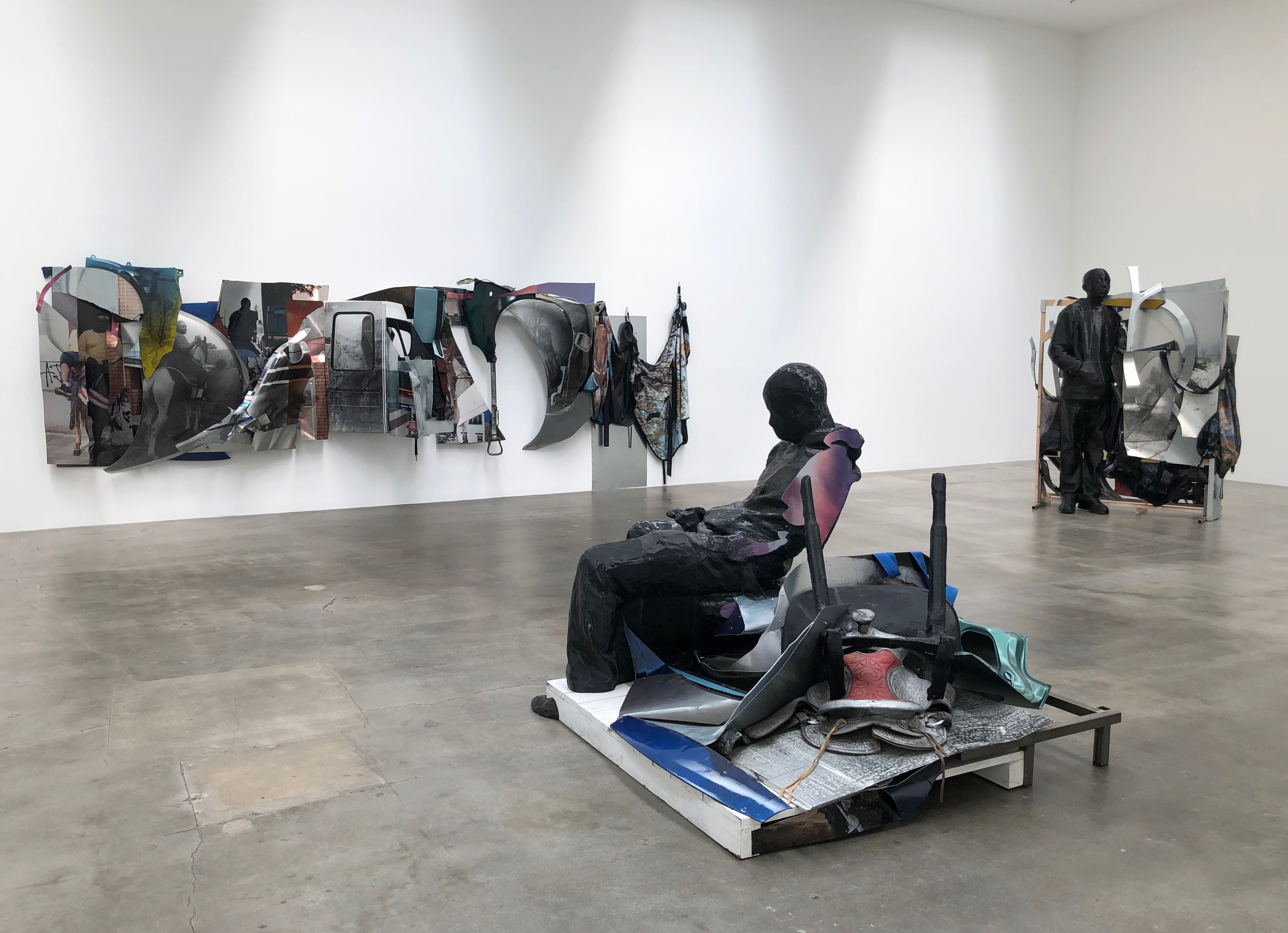
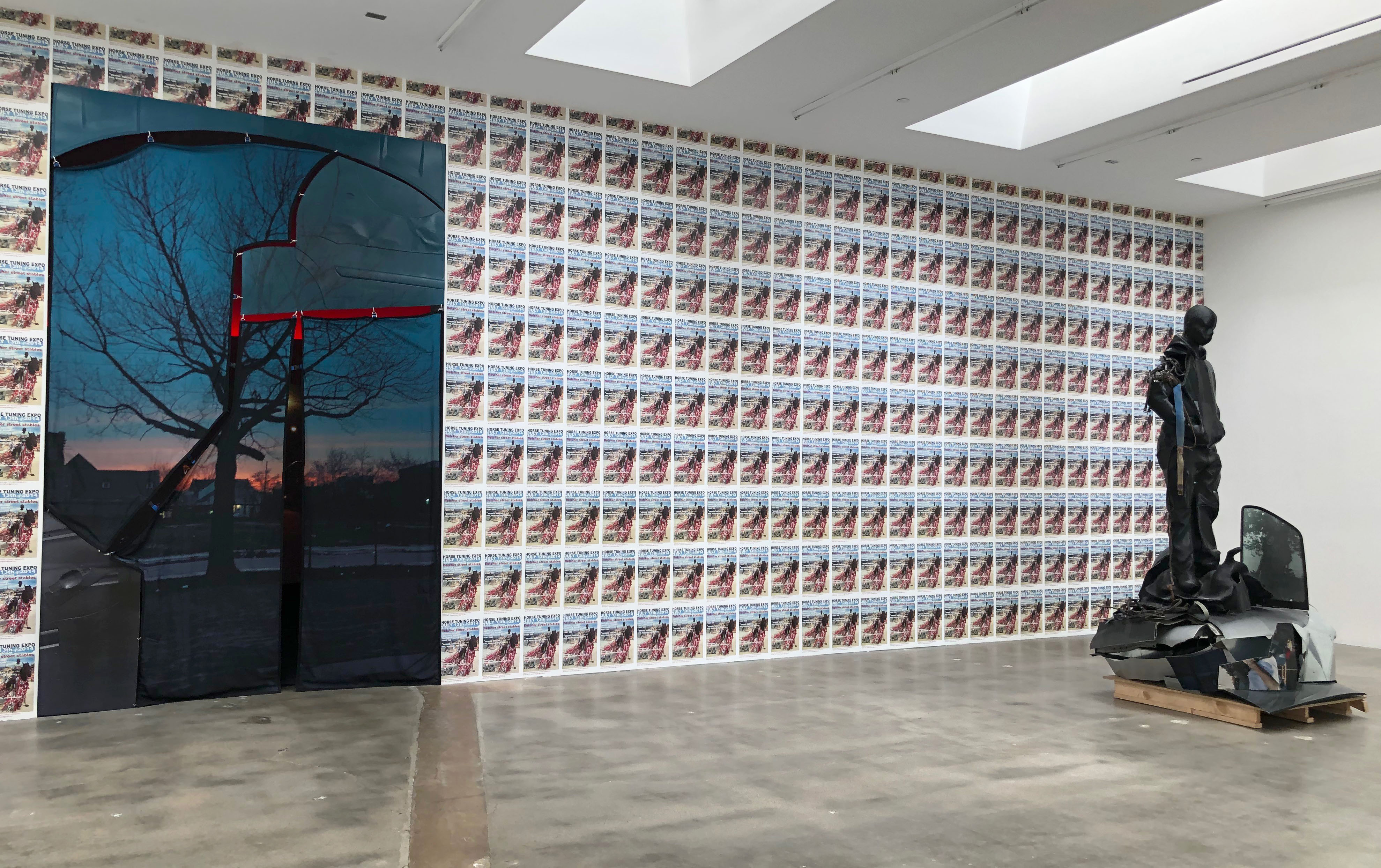
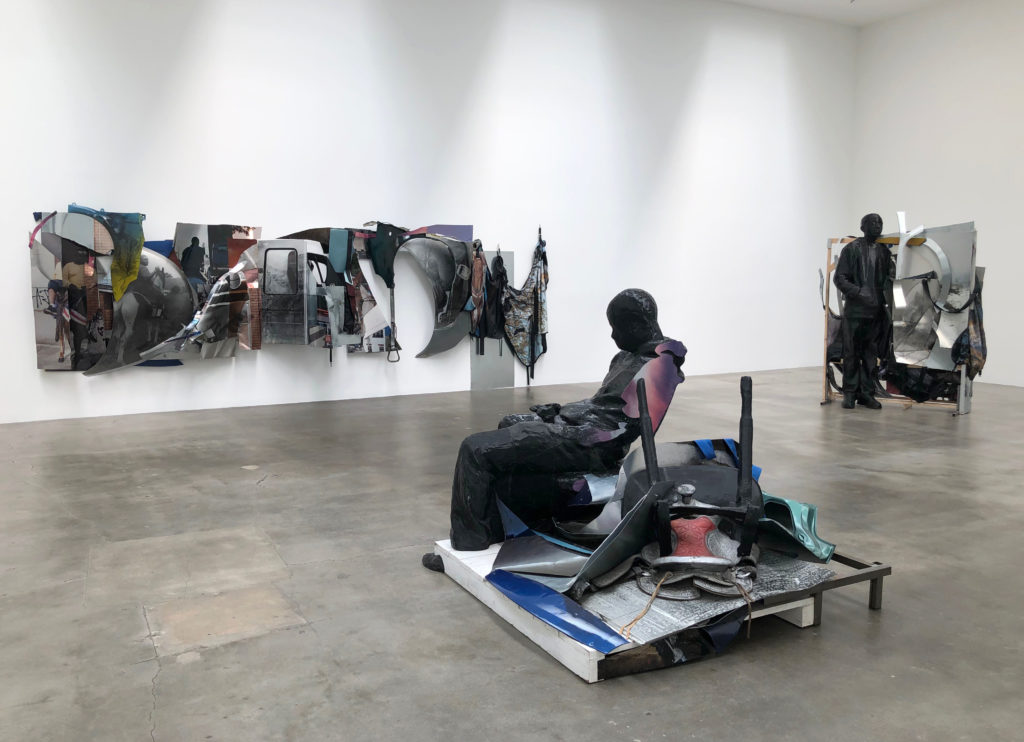
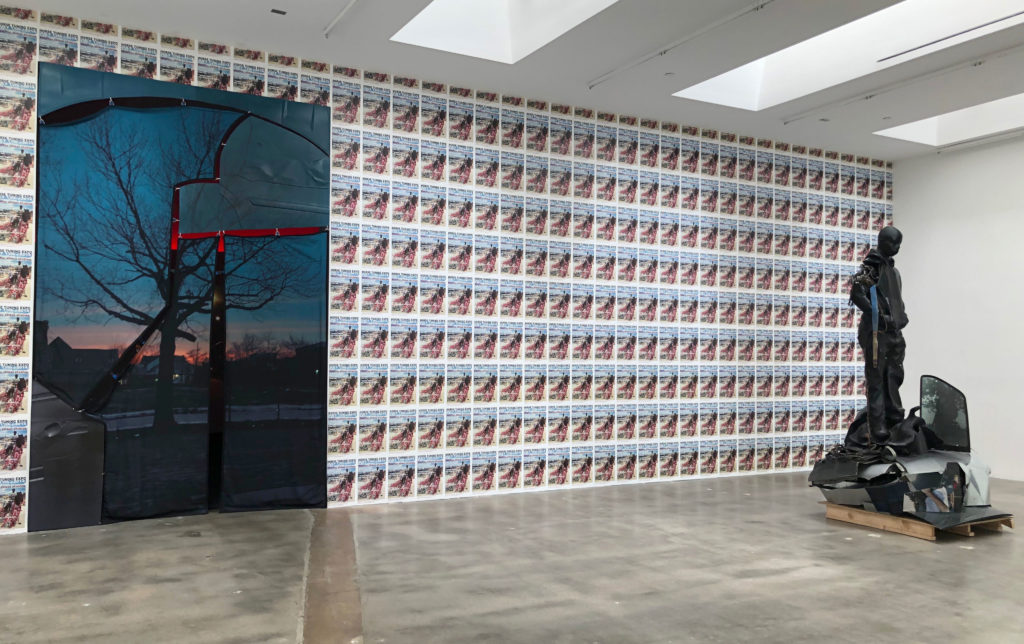
Paris-based Algerian artist Mohamed Bourouissa’s first solo exhibition in Los Angeles, Pour une poignée de Dollars (For A Fistful of Dollars), at Blum & Poe, combines film, sculpture, drawing and photography to expand on his project Horse Day, also on view at the gallery.

From the press release-

Initially driven to capture his own community and generation of immigrant youth living in the outskirts of Paris, in recent years Bourouissa’s focus has expanded to the US, the UAE, and beyond. In 2014 the artist spent nearly a year in North Philadelphia, PA living among the young men of the Fletcher Street Urban Riding Club, a non-profit established over 100 years ago by African American cowboys. This area increasingly struggles with unemployment and drug abuse, economic and social conditions from which the center attempts to provide a refuge—rescuing horses and mentoring boys who may otherwise find support hard to come by. Bourouissa instigated a collaboration with the community of riders and local artists—a riding competition and pageant called “Horse Day” in which equestrian participants arrived clad in decadent regalia, costumes including linked blank CDs, streamers, fake flowers, or fabric Pegasus wings. Using the cowboy as an emblem of a narrative of domination, the critical documents Bourouissa and the Fletcher Street community produced—sculptures, costumes, drawings, photography, and a video mixing tropes of westerns, documentaries and hip-hop—explore social injustice as it relates to geographical space, spotlight contemporary America’s culture of segregation, and intend to forge a new creative space for marginalized groups. Within a new body of sculptural work, the artist integrates images of riders and/or horses into the body parts of automobiles, as curator Okwui Enwezor once put it: “Bringing together two myths, the cowboy and the urban lowrider with his customized car, a sort of collision of the frontier and Compton.” This 3-D montage connects representations of domination and power, as well as industries and communities facing crisis.

Bourouissa’s work focuses on rituals of friendship, an exploration of alterity and the role images play in channels of distribution, investigations into the politics of representation and subjectivity. Seeking to humanize his community as social subjects, Bourouissa engages all sorts of imagery, initiating agency where is it often deprived. Bourouissa’s work is a hybrid of documentation and formal composition, collaborative choreographed representations of reality on the margins, channeling a wide range of historical precedents from Caravaggio and Delacroix to Fanon, rap music, and the Harlem Renaissance.

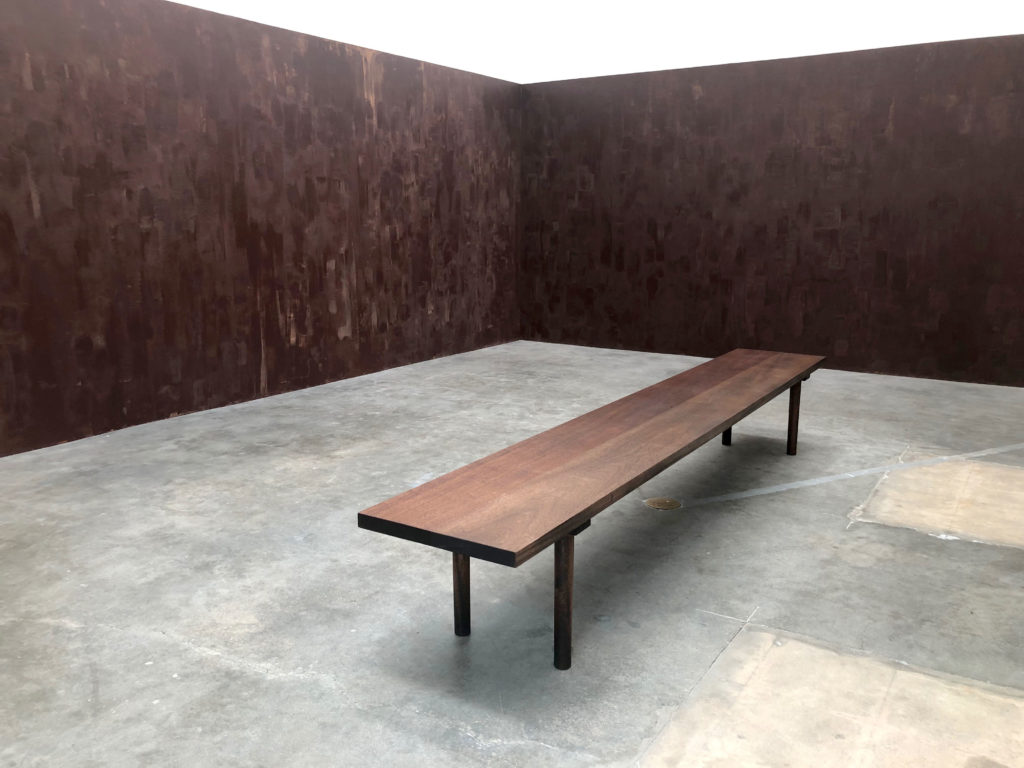
In a separate space behind the main gallery is Anya Gallaccio’s Stroke (pictured below), a room where the walls are painted with dark chocolate.  The work was originally created in September of 1994, for Blum & Poe’s inaugural exhibition at their original location in Santa Monica. Twenty-five years later, it has been recreated in an exhibition space the exact dimensions of the original gallery.

It’s worth checking out for the smell alone. It’s overpowering.

From the press release-

Stroke plays with perceptions of desire and their disconnection from reality. In this chocolate-covered room, an idea pulled from a childlike fantasy comes to life and goads the viewer’s appetite for pleasure. The whimsical notion of an edible room is contrasted with the strikingly rich, dark color of the walls and their heavy, sometimes putrid, smell. Of this disconnect, Gallaccio states, “the idea of a chocolate room is one thing, and the reality of a chocolate room is very much something else.” Created by thousands of small, repeated brush strokes for which the installation is named, prolonged looking is rewarded when one sees new colors, textures, and patterns appearing out of the darkness.

Rooted in the formal language of Minimalism, Gallaccio’s practice uses organic materials to subvert and reframe that male-dominated moment in art history. Trees, flowers, fruit, and ice are investigated for their fluidity and impermanence, and decay becomes a part of the installation to be embraced. The unpredictability of these ephemeral materials yields a freeing inability to control the final product, from which unexpected results emerge. These materials, pulled from a feminine, domestic space, challenge a masculine past and reclaim a place in history. As noted in the original press release from 1994: “Feminist in material, natural in its decay, subversively Freudian, Stroke is an enigmatic and challenging work.”
 

Both of these exhibitions close 10/26/19.

Oct 242019


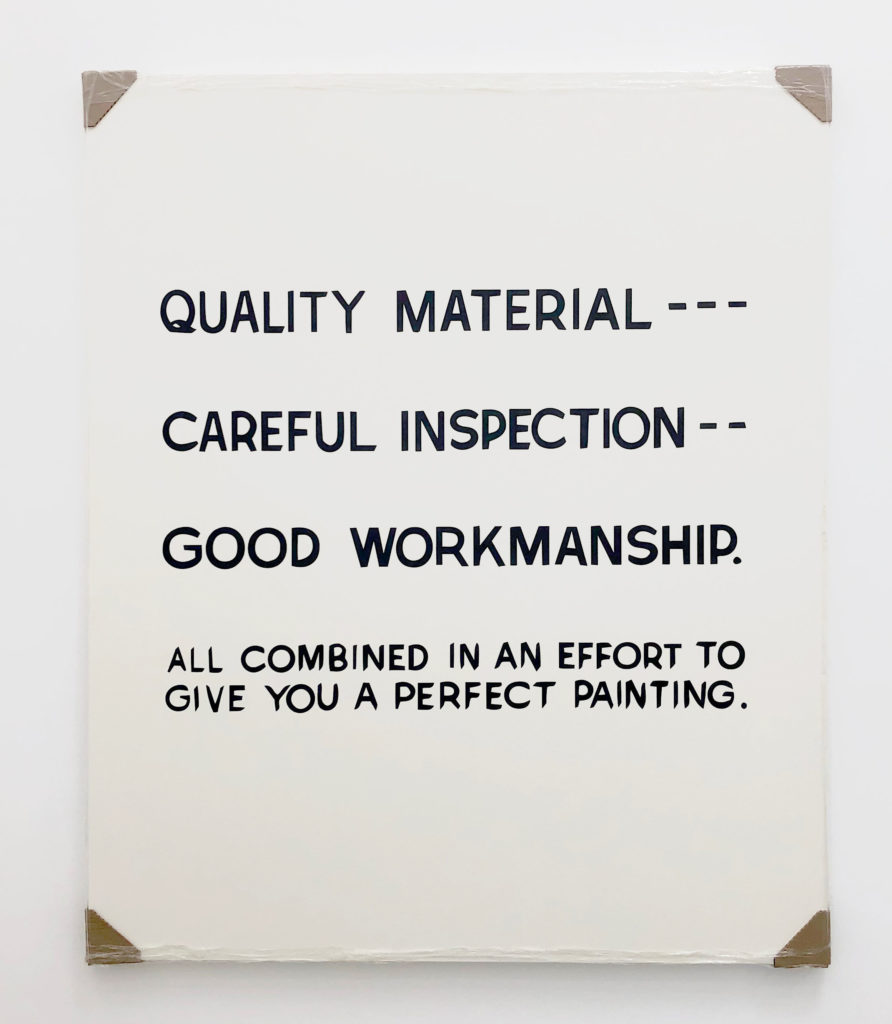
Tammi Campbell’s exhibition Boring Art at Anat Ebgi in Culver City takes on the male dominated art world canon in a fun way. She’s recreated iconic works and then covered them with bubble wrap, packaging tape, and cardboard corners. But yet those materials are an illusion. They have been made with acrylic painting medium.

From the press release-

The gesture of covering these works emphasizes the preciousness of the goods they contain, while simultaneously highlighting the frequently invisible network of art world laborers, art handlers, shippers, registrars, studio assistants, etc. who support and care for them as they circulate. The coverings also obscure the originals and draw our attention to their fixed state of transition.

…Campbell is concerned with memorializing art history, while also making a break from it. Her work literally envelopes, secures, and mummifies historical paintings; it asks viewers to ponder what is valued and allows us to imagine making room for something new. Full of contradictions, Campbell’s work pays homage to the past, while simultaneously taking it hostage.

The title, Boring Art, is a reference to John Baldessari’s I Will Not Make Anymore Boring Art, but this exhibition is anything but dull. See it before it closes on 10/26/19.


Oct 222019
 

An assortment of beaded and marble creations have taken over Marianne Boesky Gallery in Chelsea, courtesy of The Haas Brothers’ exhibition Madonna.

From the press release-

As is now a signature of The Haas Brothers’ presentations, Madonna will transport viewers into an otherworldly realm, where fantastical animals and odd hybrids reside. Here, colorful sculptures and objects that resemble futuristic creatures will be positioned among seemingly rare tropical plants, and connected into a cohesive environment through undulating platforms. The featured works capture the Brothers’ wide-ranging artistic processes, from intricate beading techniques to monumental stonework to the incorporation of woven elements, and produce an incredibly tactile and evocative experience. The exhibition also highlights the Brothers’ diverse collaborations, including with workshops in California, South Africa, and Portugal, and encapsulates their deep engagement and support for those working in traditionally understood craft.

The Haas Brothers were first introduced to beading in 2015, when they met a group of women artisans selling beadworks in a craft market in Cape Town, South Africa. The Brothers’ were enamored with both the complexity of the technique and the incredible artistry in the women’s work. Seizing the serendipity of the moment, the Brothers’ established a collaboration with the artisans, which led to the development of the Afreaks series, a group of beaded creatures that were shown at the Cooper Hewitt’s Design Triennial in 2016. Since then, The Haas Brothers’ collaboration with the collective of women, who warmly go by The Haas Sisters, has grown and matured.

For Madonna, the collective will support the production of the featured beaded objects, guided by The Haas Brothers’ preparatory drawings and using a selection of Murano glass beads produced in Venice between 1880 and 1980, which The Haas Brothers purchased after the factory became defunct. In addition, Simon Haas has developed a complex system that captures the expansive creative opportunities that beading allows and that provides a guide to learning the craft. This system has been articulated in The Haas Brothers’ Bead Book, which has allowed Simon and Niki to teach the techniques to people local to the area of Lost Hills in Central California, establishing a workshop that offers work and pay in an area that lacks employment options. As part of their work with different communities and artisans, The Haas Brothers establish fair pay systems that include both economic support for the creation of works as well as in some instances profit sharing from sales.

“Part of the vision for our practice, and what we see as essential to the creation of art, is the establishment of communities. We are constantly asking how we can engage with others to achieve something new; something beautiful; something that excites or brings joy—that is really the importance and value of art and artmaking,” said The Haas Brothers. “At the same time, we recognize the platform and voice that we have been given, and think it is critical that we use both to uplift and support others, especially women who have traditionally not been recognized for their craftwork and skills. We feel so lucky to have developed this relationship with The Haas Sisters, and to have the opportunity to shed light on their dedication and tremendous work, while also paying a fair and right wage for their contributions.”

The beadwork in the exhibition will be augmented by several sculptures made with Portuguese Pele de Tigre marble. The Brothers first came to stone carving in their youth, learning from their father, artist Berthold Haas, and recently returned to the material, showing several large pieces at Marianne Boesky Gallery’s Aspen location in June 2018. The solid, smooth, and monumental nature of the stone works provides a powerful counterpoint to the more delicate and finely detailed beadworks and highlights the range of The Haas Brother’s practice. Here too, community proves an important element, as The Haas Brothers’ engagement has helped spur the development of stone-carving as an economic engine at the quarry that they use. The anchor figure, the Madonna, within the upcoming exhibition combines the efforts and visions of the various communities with which the Brothers are involved—each lending to an aspect of its creation and making it a true embodiment of their collaborative vision.

This exhibition closes 10/26/19.

Oct 182019
 

“Crescent (Timekeeper)”

“Crescent (Timekeeper)”

“Crescent (Timekeeper)” Detail

Sarah Sze’s exhibition at Tanya Bonakdar’s gallery in New York is stunning. There is so much to look at, to appreciate. There are so many pieces to all of the work, and yet it never feels overwhelming. It makes you want to keep looking.

It’s also immersive. The windows on the outside of the gallery are covered in her work, as is the staircase alcove. The video projections in the main room travel all around the room, surrounding you with visuals and sound. Upstairs the floors of the gallery have paint splattered on them, accompanying the works on the walls.

Detail of the above work

In a room on the first floor is a “studio space” where you can gain insight into Sze’s process and how she makes these elaborate works.

From the press release-

Sze’s latest body of work frays “the seam between the real and the image” (Smith). Through complex constellations of objects and a proliferation of images, Sze expands upon the never- ending stream of visual narratives that we negotiate daily, from magazines and newspapers, television and iPhones, to cyberspace and outer space. The works evoke the generative and recursive process of image-making in a world where consumption and production are more interdependent, where the beginning of one idea is the ending of another—and where sculpture gives rise to images, and images to sculpture.

In this new exhibition, Sze expands her work by embedding her nuanced sculptural language into the material surfaces of painting and into the digital realm through the interplay of cloth, ink, wood, paper, metal, paint, found objects, light, sound and structural supports—collapsing distinctions between two, three and four dimensions. This body of work fundamentally alters our sense of time, place, and memory by transforming our experiences of the physical world around us. Both objects and images, Sze says, are “ultimately reminders of our own ephemerality”.

This exhibition closes 10/19/19.