Oct 102019
 

From the press release-

Klowden Mann is proud to present San-Diego-based artist Andrea Chung’s first solo exhibition with the gallery, … Only to meet nothing that wants you. The exhibition features large-scale cyanotype works depicting under-sea images of coral that have then been bleached with sugar crystals—a material woven throughout Chung’s practice for over a decade in reference to its relationship to colonialism in the Caribbean. The cyanotypes are placed in context with a brass chandelier that recalls designs from the 19th century; where crystals would hang, Chung has hung glass vials filled with sugar in various shades.

Chung’s practice often utilizes perishable and precious materials with strong underlying histories, forming relationships to pre-emancipation images of the Caribbean, touristic misrepresentations of people and place, the export or import of goods and materials, and the labor of the human body. Completing the quote by Nayyirah Waheed that Chung used as the title of her first solo museum exhibition at the Museum of Contemporary Art San Diego in 2017, “You broke the ocean in half to be here,” the title of the exhibition at Klowden Mann answers with the second half of the phrase, “…Only to meet nothing that wants you.”

In the cyanotype works, coral bleaching becomes a metaphor for colonialism, and the expanding of the philosophy and impact of imperialism on colonial populations and cultures. The addition of sugar crystals to the already highly sensitive cyanotypes underlines Chung’s interest in creating work that defies the notion of artworks as static objects that are meant to remain unchanging and unyielding in the face of shifting environments and time; in a way that also reflects the constant uncontrolled and irresponsible effects of human actions on the environment, and on vulnerable populations. The works are intended to shift and change over the course of the exhibition, as the sugar embeds further in the cyanotype, falls, and expands. The works are linked to the environment in which they are placed in a way that Chung cannot predict and control—and along with the chandelier, ask the audience to consider who pays for the superficial opulence and beauty to which so many have become accustomed.

The work in this exhibition is really stunning, and the fact that it is work that is changing with time, makes seeing it feel even more special. Like so much of the beauty in the world, and especially in nature, you appreciate it, while wondering how long it will still be around to be seen.

This exhibition closes 10/12/19.
Oct 082019
 

The Museum of Broken Windows is a free pop-up experience in New York City, a project by the NYCLU currently located Cooper Union.

From the Museum of Broken Windows/ NYCLU websites-

The broken windows theory is an academic theory proposed by social scientists James Q. Wilson and George Kelling in 1982. The academic theory, which first appeared in The Atlantic Monthly, states that signs of disorder in a neighborhood, like a broken window, encourages petty crimes and leads to more serious crimes. This postulation was adopted by the New York City Police Department and has led to the criminalization of poverty and the over-policing of Black and Brown communities at disproportionate rates. The theory has never been proven to be effective at reducing crime.

The Museum showcases the ineffectiveness of broken windows policing, which criminalizes our most vulnerable communities. The strategy of broken windows policing is outdated and has never been proven to be effective at reducing crime. For decades, communities of color have been disproportionately impacted by broken windows policing.

It is time for a change. New Yorkers are coming together for important conversations on policing and what it means to feel and be safe. Using art and creativity, the Museum of Broken Windows will provide a powerful and emotional experience that critically looks at the system of policing in New York.


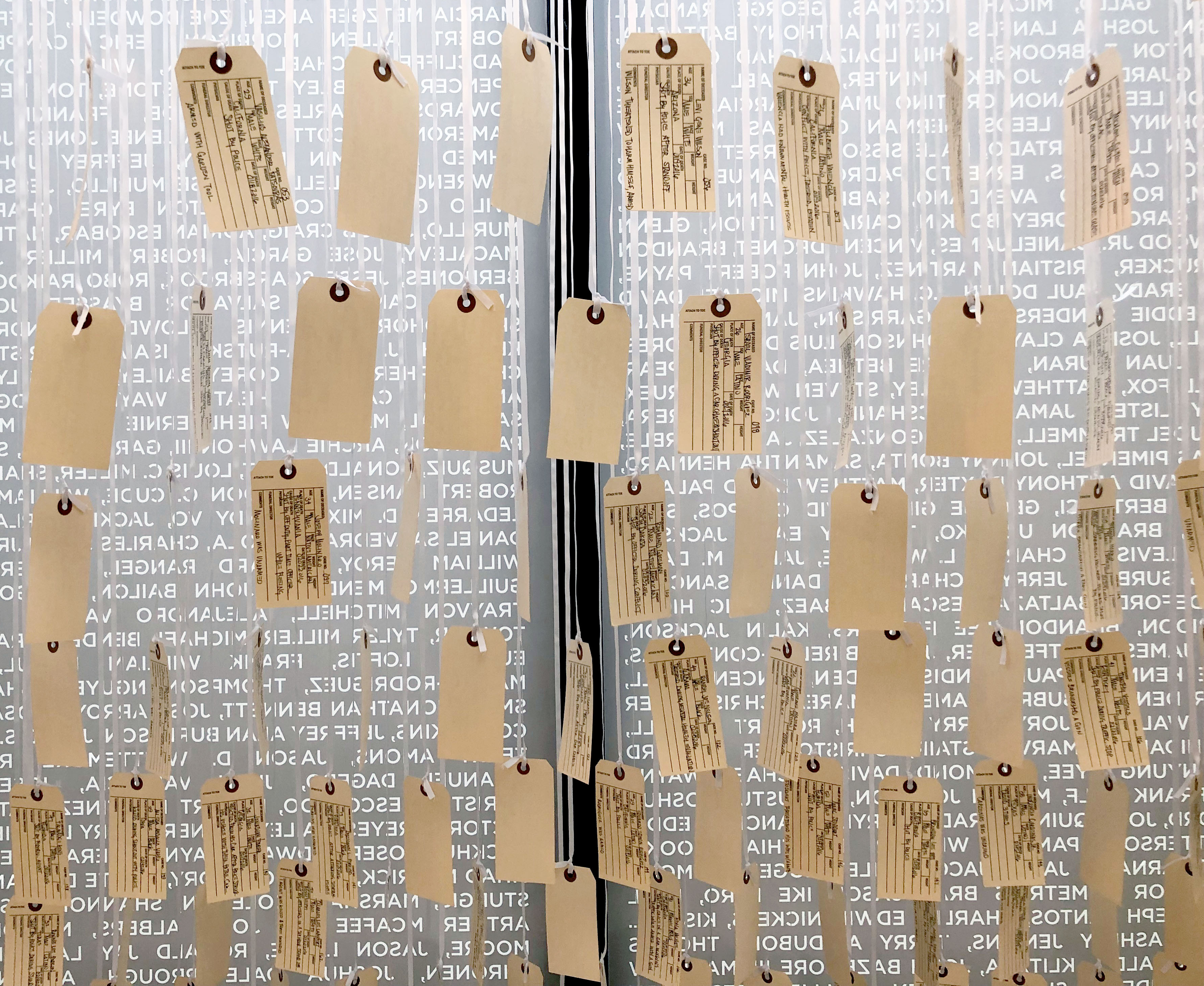
Pictured above are “…and counting” by Ann Lewis (each tag is filled out with the name of a person killed by police) and one of the group of portraits by Tracy Hetzel of women who have lost loved ones because of broken window policing. The one pictured is of Gwen Carr who is holding a picture of her son Eric Garner.

This show ends on 10/8/19.

Oct 032019
 

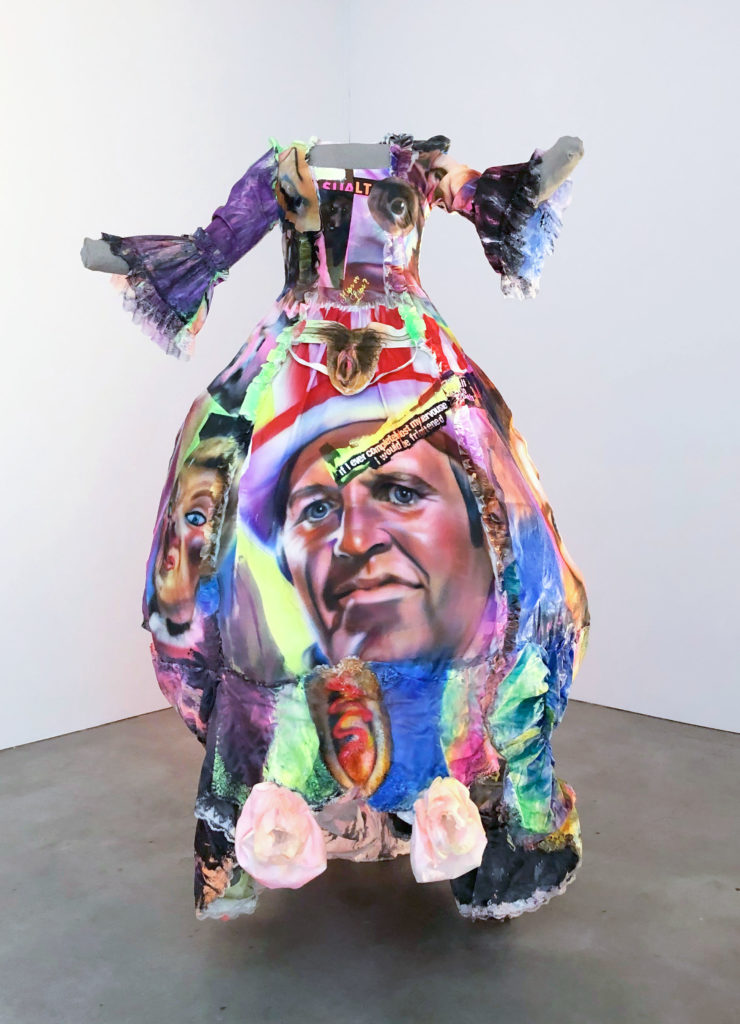
Jim Krewson’s “tribute to a vanishing subculture”, A Requiem for Paul Lynde, currently in the Viewing Room in the back of Marlborough Gallery’s downtown location, “questions the loss and amnesia of marginal identity in a new age of equality, instant access, Instagram influencers and celebrity, from homosexuality to homogenization in 20 short years.”

The airbrushed wedding dress spins with images that include Lynde himself, as well as Lady Elaine Fairchild from Mister Rogers’ Neighborhood, and the Madame puppet, a Wayland Flowers creation. Flowers’ puppet had her own sitcom in 1982 and also took over Paul Lynde’s center square on Hollywood Squares. Sadly Flowers, an openly gay entertainer, passed away in 1988 at the age of 48 from AIDS related Kaposi’s sarcoma.

If you love of a certain time period of pop culture and Paul Lynde than it will be hard not to embrace this project. But it’s also interesting as a meditation on the state of gay pop culture in the past, the place it is in today, and the question of where it may go in the future now that it is has such a strong, but less subversive place, within mainstream media.

In the main viewing space of Marlborough Gallery is Joe Zucker’s multi-panel 100-Foot-Long-Piece created from 1968 to 1969.

From the press release

This masterwork, exhibited here with a large body of related archival material, comprises a blueprint for Zucker’s long and diverse practice. It plants a flag for the artist’s ongoing inventiveness, irony, and eclecticism.

With the creation of this work, Zucker presents the viewer with a puzzle-like, encyclopedic visual vocabulary, anticipating subsequent pictorial and conceptual approaches such as New Image, Neo-Expressionism, Appropriation, Neo Geo, as well as more recent process- based abstraction, with a self-referential, wry regard for the embedded, associative meaning of his imagery and materials.

100-Foot-Long Piece is a linear aggregate in which gestural abstraction rubs elbows with hard edged grids, silk-screened passages, sculptural reliefs, and a host of other styles and forms. One is mindful of both physical and critical tropes of progressive art history from the physicality of the frieze to a qualitative timeline tracing the contributions of Modernism.

Both shows close 10/5/19.

Sep 202019
 

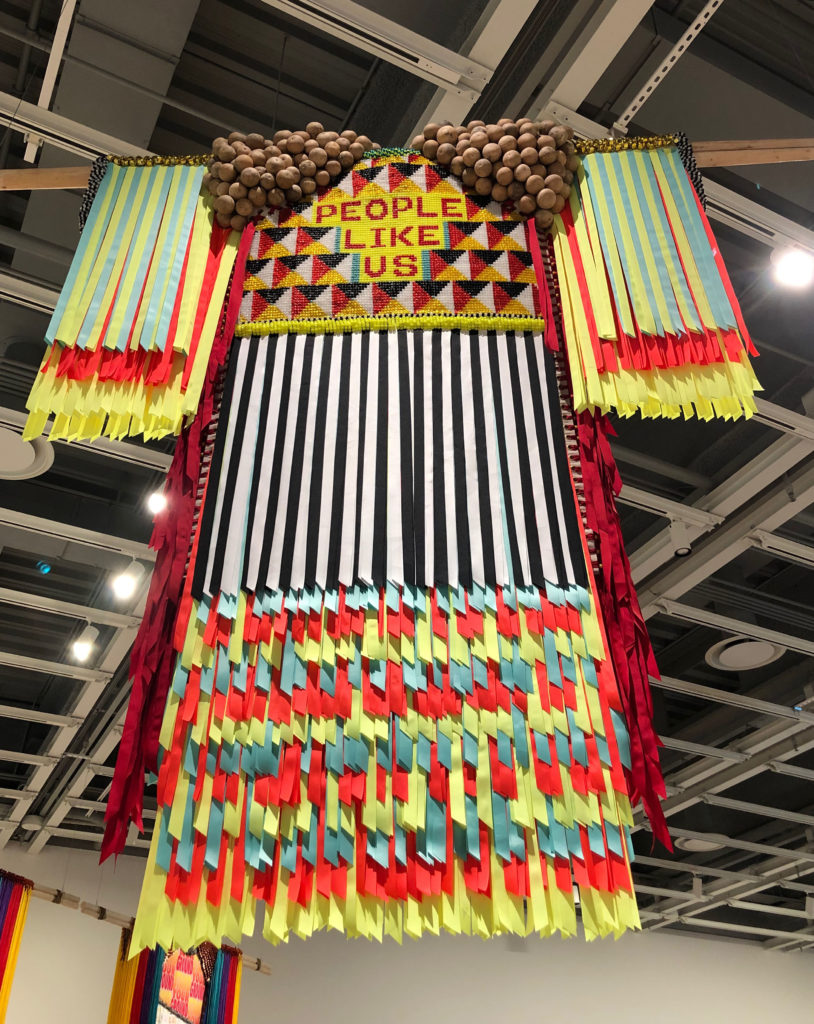
Jeffrey Gibson, “PEOPLE LIKE US”, 2019

Jeffrey Gibson

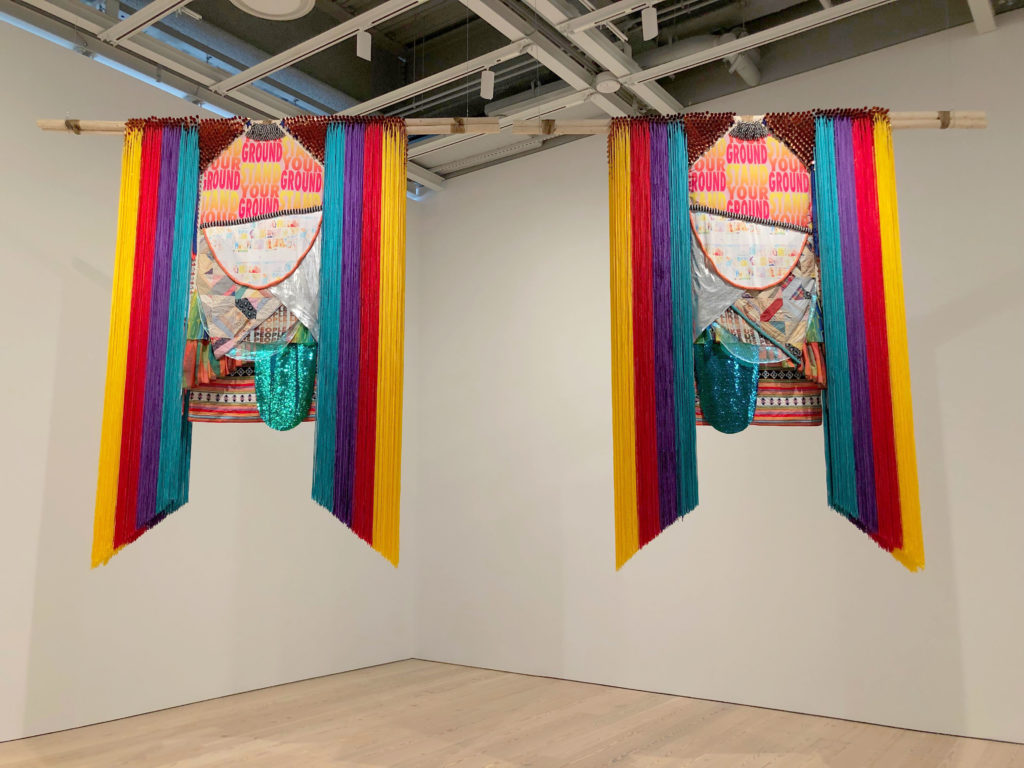
2019’s Whitney Biennial presents an interesting selection of work, by a mostly young and diverse group of artists. The works included in the show are consistently good, and often intriguing, but this time around nothing is particularly outrageous or polarizing- a contrast to many of the previous iterations.

Not that there wasn’t any drama surrounding the show. This time around, however, the controversy was not with an artwork but with former Whitney executive board member Warren B. Kanders and his ownership of Safariland, a tear-gas canister maker. He has since resigned after protests and threats of withdrawal from several of the artists included in the show. Artist collective Forensic Architecture’s film, Triple Chaser, on view in the exhibition, investigates Safariland and Kanders.

Below are a few highlights from the exhibition.

Janiva Ellis ” Uh Oh, Look Who Got Wet”, 2019

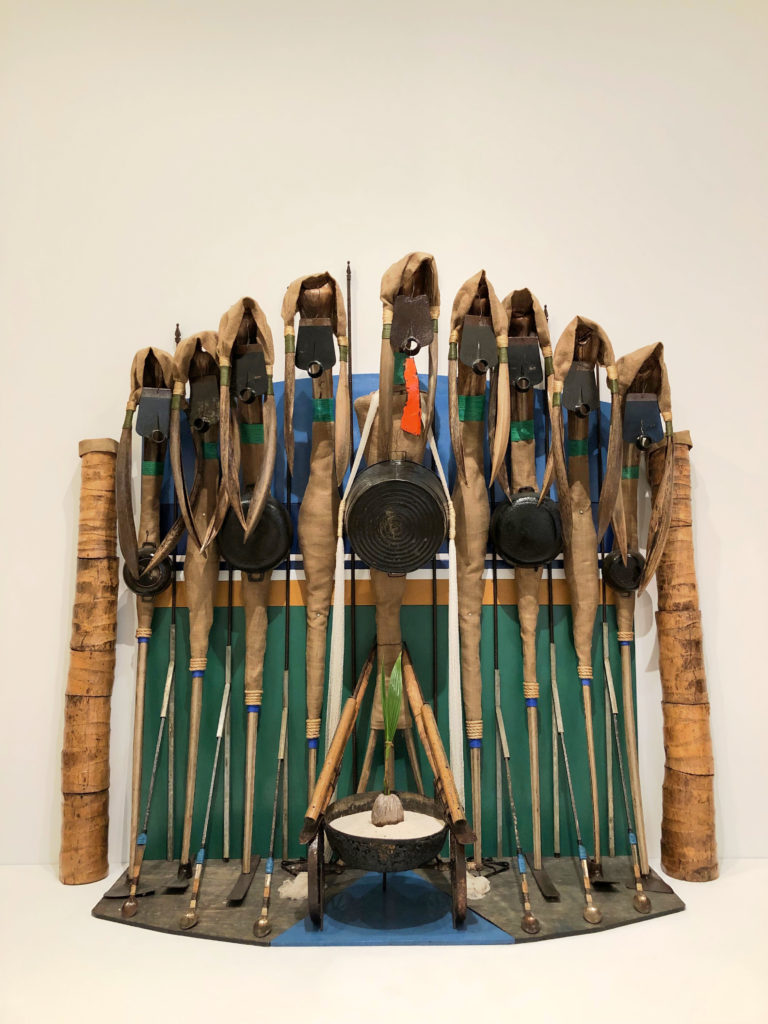
Daniel Lind-Ramos, “Centinelas (Sentinels)”, 2013

Section of Nicole Eisenman’s, “Procession”, 2019

This exhibition closes 9/22/19.


Aug 222019
 

A Universe of One, 2018

A Universe of One, 2018 (detail)

The Dream of Flight, 2019

The Dream of Flight, 2019 (detail)

Currently at Kohn Gallery is New York-based artist María Berrío’s first solo exhibition in Los Angeles.

From the press release-

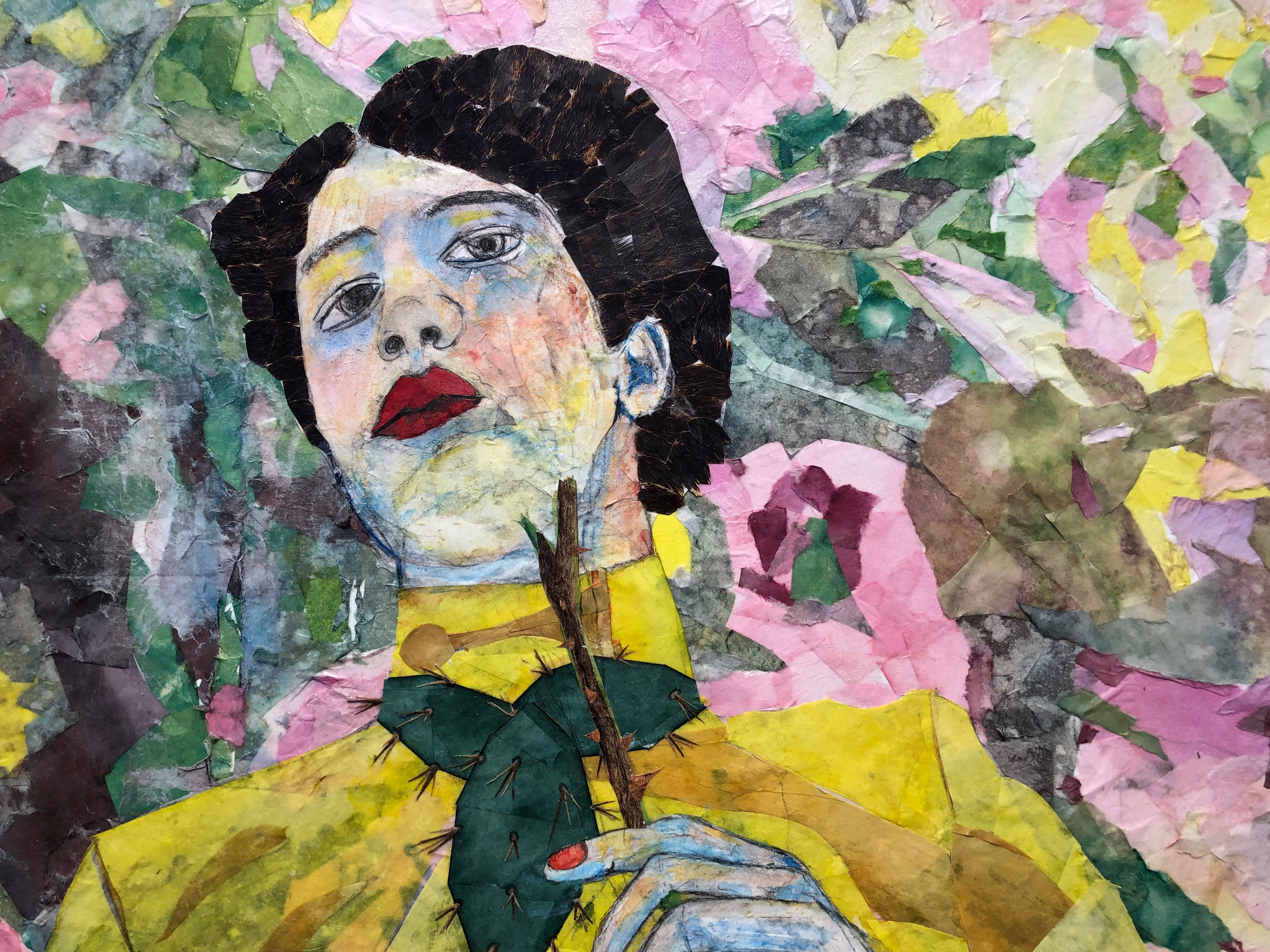
Inspired by her youth in the countryside of Bogotá, Colombia, Berrío’s paintings explore the experience of immigrant identity, intercultural connectivity and the beauty that is found in the diversity of cultures and countries. Berrío depicts her figures with richly detailed and patterned backgrounds of exteriors and interiors. The large, detailed mixed media canvases employ lush, carefully crafted, multilayered Japanese papers and paint, resulting in scenes replete with pensive yet confident figures amid a scene of visual exuberance.

Berrío’s work often places female figures at the center of her intricately woven landscapes. Painted with watercolor details, her figures stare out of the composition determined to confront the viewer from their own surreal surroundings. Her work is evocative of predecessors such as Gustav Klimt and Egon Schiele, both known for their exceptional degree of emotional directness and figural distortion in the place of conventional beauty. Berrío’s works float seamlessly between historical and contemporary artistic styles as they employ a wide visual vernacular ranging from expressionism to graphic, abstract marks.

The variety of media and techniques found in María Berrío’s practice emphasizes the interwoven cultural breadth of the world in which we live, where globalization and injustice touch the lives of everyone. Each character Berrío paints is a symbol of this new reality and the strength that can issue from it. For the artist, a female soldier on the front lines is as brave and mighty as the mother who protects her children from the perils of war. These depictions of women are seen as guiding spirits who are strong, vulnerable, compassionate, courageous and in harmony with Nature and themselves. With these combinations of human traits and emotions, Berrío fortifies her belief that with womanhood every action is considered beautiful and strong, no matter how small or large.

For her current show, A Cloud’s Roots, Berrío focuses especially on place and migration. The individuals are seen in preparation for their travels, in moments of transition, and in various states of uncertainty. Berrío states, “the ambiguity is intentional; although I may have a specific idea in mind when making the work, the actual piece lacks cultural specificity to allow for all symbolic possibilities.” Berrío therefore gravitates towards symbols with global cultural significance, such as braids, birds, and flowers, with the hope that they allow diverse audiences to bring their own understanding to the work.

In her recent work, A Cloud’s Roots (2018), Berrío creates a fictional species of tree based on the dragon’s blood tree, found exclusively on an island off the coast of Yemen. The dragon’s blood tree has adapted perfectly to the island’s desert-like climate and rocky soil, inhospitable to most other plant life. It is a powerful symbol of survival and resilience, able to thrive even in the most unlikely conditions. The figures in the piece are compelled to leave their home but they carry with them the knowledge that they too have the power to put down roots wherever they go.

By reflecting on the beauty of our immigrant nation, Berrío’s new body of work aims to rewrite the narrative of American history to include the stories of people who have long been excluded. It makes space for those who were not born in this country, but come here full of hope and desire to make it their home. As the art canon expands its scope and redefines its boundaries, Berrío imagines a future in which people with diverse perspectives can walk into an institution and see themselves reflected back. Berrío states, “so many immigrants, myself included, are stuck in the inbetween, not quite from here, and no longer from there. I create work that bears witness to this liminal state of being and acknowledges it as an essential part of being American. I wish to convey that which can never be conveyed: the sheer joy of being, of creation, and the undiscoverable mystery of being alive.”

This exhibition closes 8/24/19.

Also, if you are in New York City, she recently created several glass and ceramic mosaics that can be seen in the Fort Hamilton Pkwy Station.


Aug 252018
 

The Marciano Art Foundation, established by Paul and Maurice Marciano (co-founders of the Guess clothing brand), opened its doors in May of 2017 in Los Angeles and is a great addition to the city’s art spaces. It is currently showing Olafur Eliasson: Reality Projector (pictured above), an immersive kaleidoscopic piece created specifically for this location, with a soundscape created by Jónsi of Sigur Rós. A rotating selection of works from the Marcianos’ permanent collection is also on view as well as Instagram favorite Yayoi Kusama’s With All My Love For The Tulips, I Pray Forever.

The foundation is housed in a former Scottish Rite Masonic Temple and there is a room dedicated to objects that the Masons left behind.

Both the inside and outside of the building retain the symbols and remnants of the Masonic history as well.

It is free to go to the MAF but it is recommended that you reserve tickets online.

Apr 282018
 

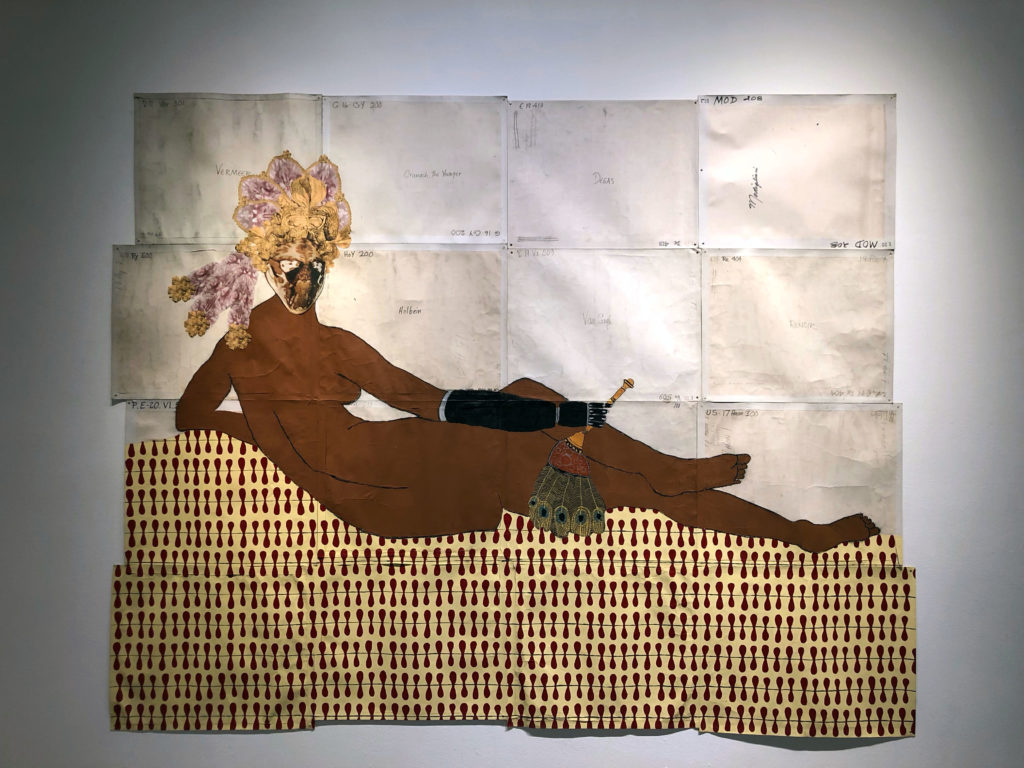
After Ingres, 2014

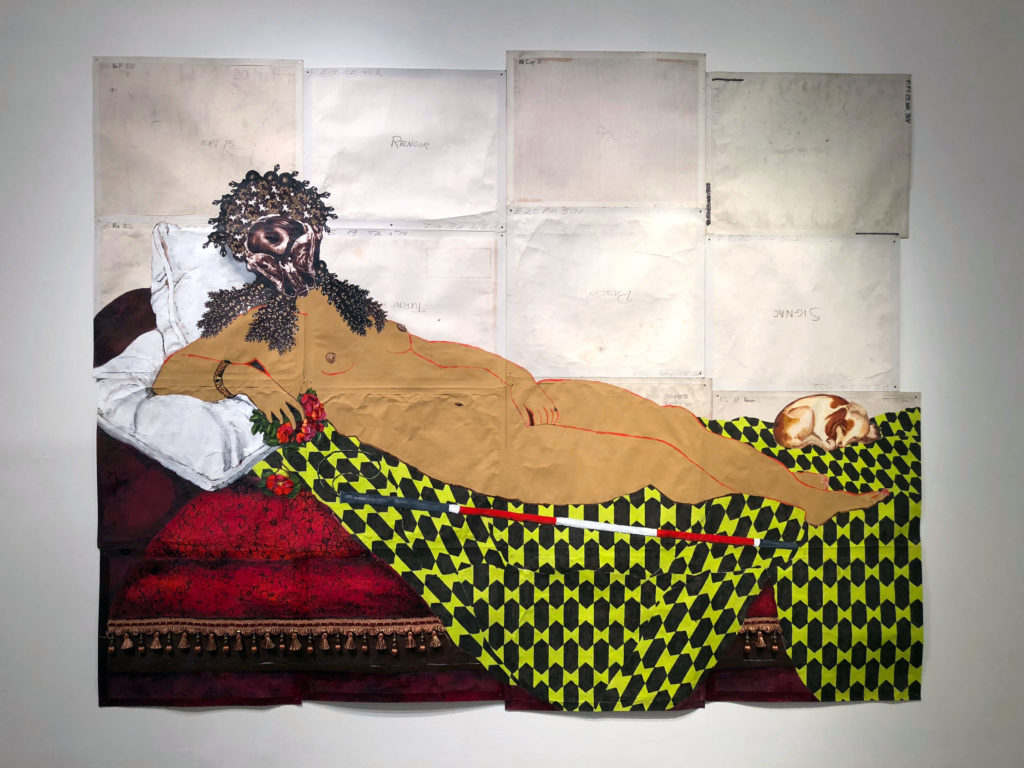
Blind Venus (for G),2018

Currently at Walter Maciel Gallery is Katherine Sherwood’s solo exhibition, The Interior of the Yelling Clinic.  The title, according to the press release, takes its name from an organized group of six artists, including Sherwood, “who have an interest in the intersections between war and disability. The Yelling Clinic was created to mix artistic practice with community outreach, art instruction and activism.”

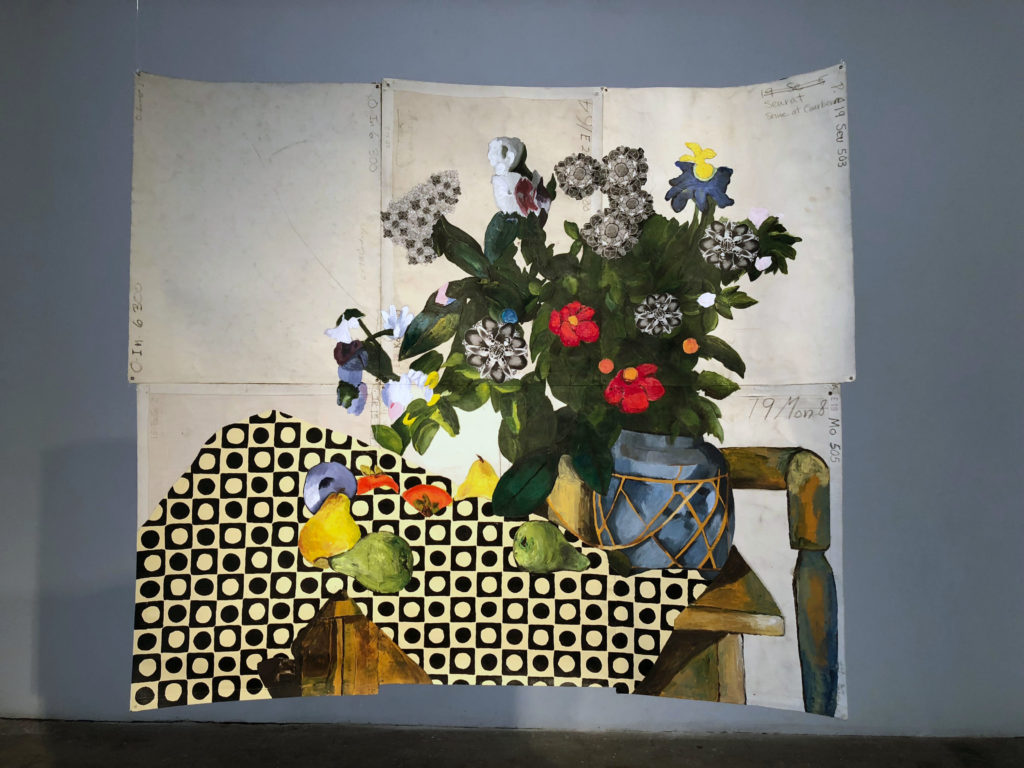
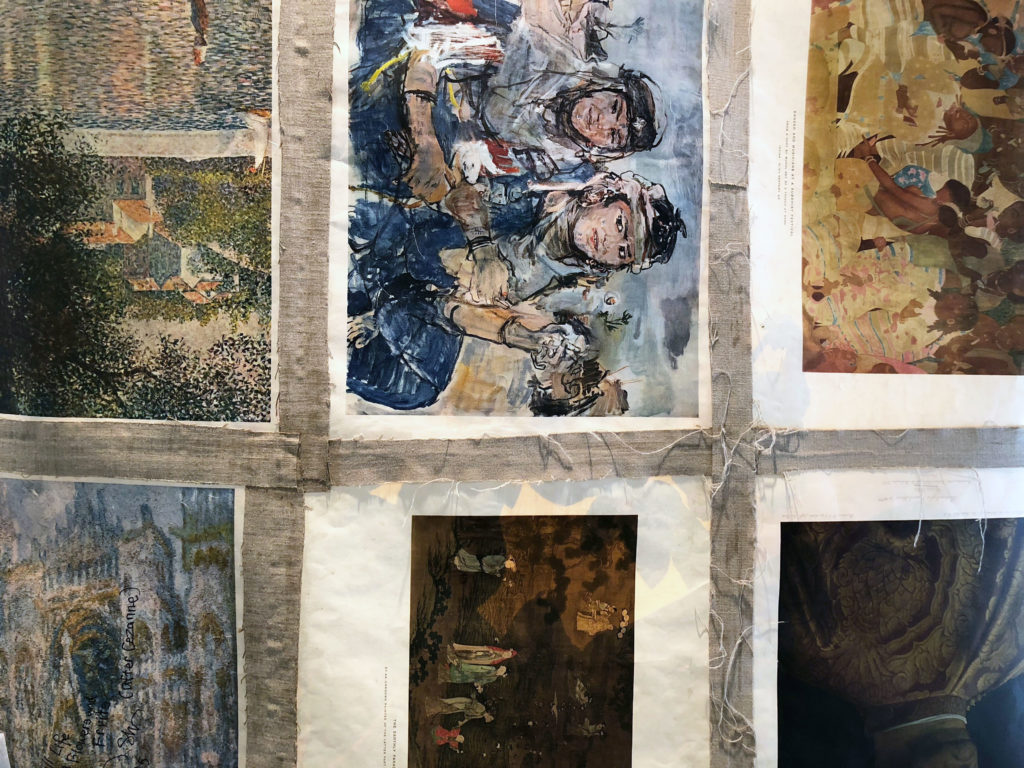
Sherwood’s paintings are influenced by famous European works, but also include evidence of physical disabilities (like the cane in Blind Venus, pictured above), and her own brain scans. After a cerebral hemorrhage at 44, the artist lost the use of her right arm and hand and was forced to learn to paint with her left. The nudes mix the personal with the traditional while also challenging notions of beauty and the idealized female form. Adding another dimension to the paintings, they are created on the backs of old art history painting reproductions that she saved from being thrown away by the UC Berkeley Art Department where she taught. The gallery has hung one of her flower paintings (pictured below) from the ceiling so that you can see an example of what is on the other side of the work.

This exhibition closes 4/28/18.

Feb 112017
 

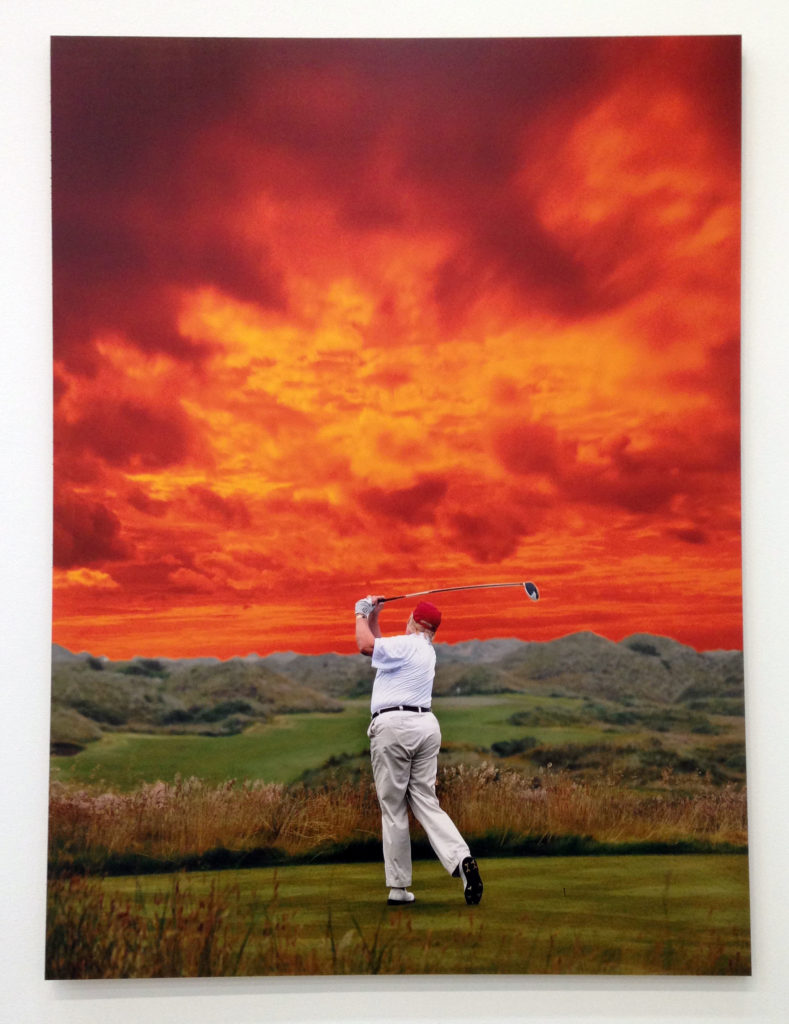
                                         Jonathan HorowitzDoes she have a good body? No. Does she have a fat ass? Absolutely. 2016

For their current exhibition, Petzel Gallery decided to focus on the issues raised by the recent election by having a group show related to that theme. In addition they are encouraging visitors to “write down their reactions, thoughts, anxieties, hopes for the future.”

There is a lot of great work in the show by a long list of artists that includes Barbara Kruger, Robert Longo, Glenn Ligon, Jenny Holzer, Charles Gaines and Sam Durant.  Although it can be exhausting these days to follow politics, it is encouraging to see creative expression thriving in the midst of the chaos.

Dec 222016
 

terrywintersatmatthewmarks

terrywintersyellowmatthewmarks

To keep these posts a little shorter, I have split them up into two parts. The following continues the list of Chelsea exhibitions-

Terry Winters‘ vibrant paintings at Matthew Marks Gallery are made up of layers of marks in oil, resin, and wax.

From the press release-

“These recent paintings are a series of accumulations,” Winters says. “There’s a range of paint application in terms of both material and technique. Each color is a marker, a stage of development. I’m moving across the surface, modulating the material in different ways. That inflection produces an amplification of colors, both physical and chemical. But color is basically wild and full of surprises.”

padraigtimoneyatandrewkrepsgallery

Pádraig Timoney‘s work in The Deedle Eye, at Andrew Kreps Gallery, is a diverse combination of painting, photography, and installation.

From the press release-

Despite the visually distinct results, at the work’s core is a focused inquiry into the mechanics of images. Timoney conversely works in both directions – creating new images from abstractions (the captivating results of processes achieved in the studio), or rebuilding them part-by-part from photographs or observation. In each, he acknowledges the inherent flaws of these constructions, from the faultiness of recognition, the errors of translation, and further, the subjectivity of both viewers and the artist.

These in turn become generative openings in Timoney’s work as they are distanced from their original context. The images exist within thrilling, new visual constellations, allowing for the introduction of artifice and illusion, and the question of not only what they depict, but why? Each work records an index of decisions that determine its final state, materially and cognitively, displaying a history that is intentionally left open-ended. Figuration appears to hover only a hair away from abstraction, as if the movement of a line would cause one to collapse into the other. The narrowing of this gap suggests that the works’ initial disparate appearance may lead to an alternate understanding of their connections; a net that widens only to close anew, though what’s caught within it is left for the viewer to decide.

Also make sure to go to the space next door to see Klaus Weber’s sculpture Emergency Blanket.

klausweberatandrewkreps

Ai Weiwei has four shows up in NYC right now. Two of which are in Chelsea, at Mary Boone Gallery and Lisson Gallery, one is at the Mary Boone Gallery uptown, and one is at Deitch Projects in SoHo. Mary Boone Gallery and Lisson are both showing Weiwei’s Roots and Branches work, which includes large scale sections of dead trees, sometimes like the one seen below in cast iron at Lisson, and a 25 foot sculpture made up of tree parts bolted together. The uptown gallery includes a circle made up of 40,000 spouts broken off from Chinese teapots. Deitch Projects gallery has Laundromat, in which Weiwei has arranged items of clothing left behind by Syrian refugees (after they were forced to leave camps near the border of Greece) that he collected and laundered.

aiweiweilissongallery

Dec 102016


todd-murphy-nov2017-stag

todd-murphy-murmuration-12016

Marc Straus gallery on the Lower East Side has two great sculpture shows closing this weekend (12/11/16). Todd Murphy’s mixed media sculptures are gorgeous creations which glow on the walls of the upstairs space.

On the first floor of the gallery, are Chris Jones’ intricate pieces created with images from discarded magazines and books. The details within these worlds become more and more apparent the longer one looks at them, including plants growing into other spaces and laundry tumbling out into other frames.
joneschris-after-they-had-left-2015

joneschris-portrait-1-14-25-x-11-5-x-1-in

jones-chris-of-vanished-alphabets-2016-05

(images via Marc Straus)