Jan 042020
 

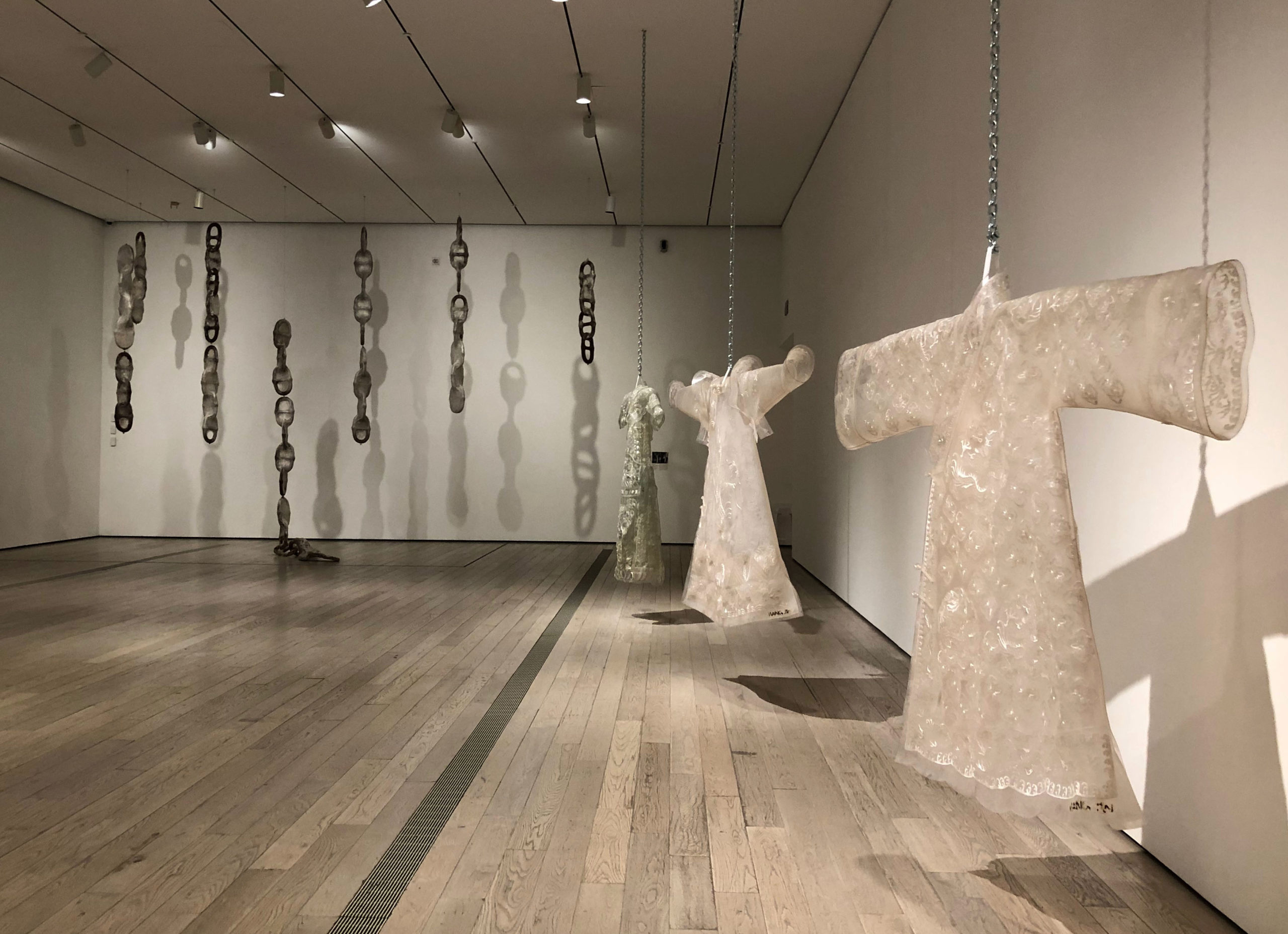
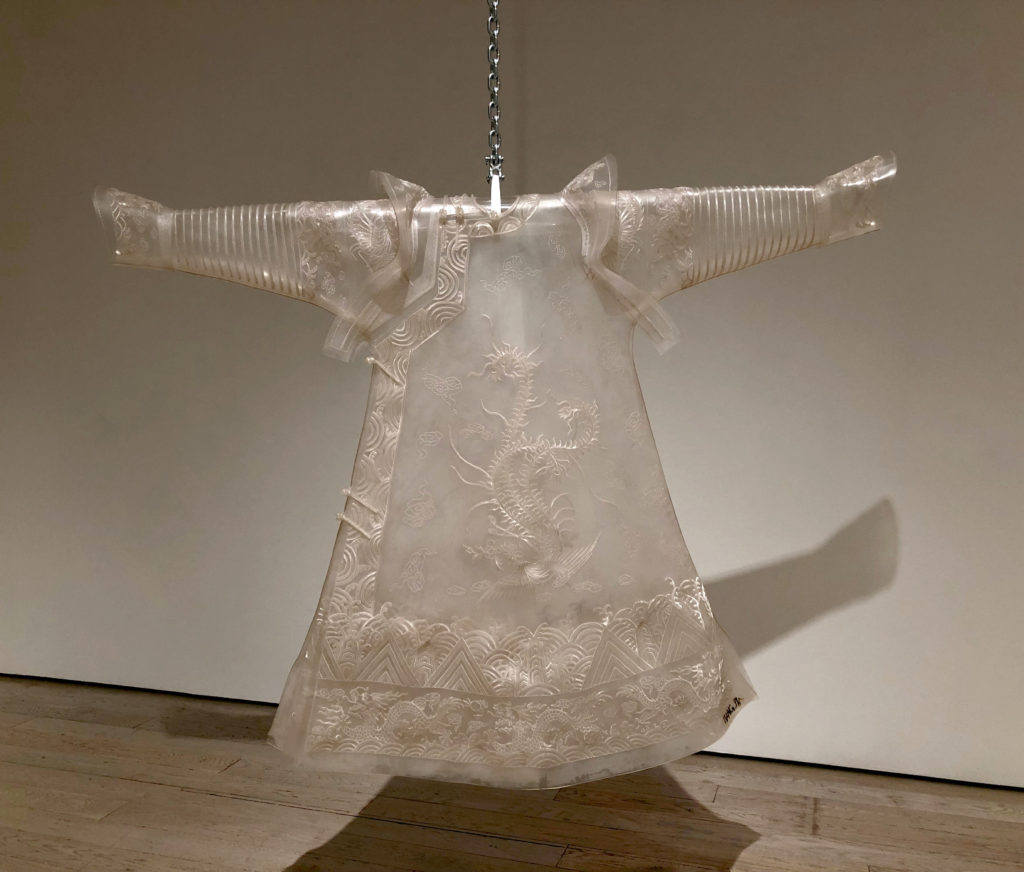
A Chinese Dream by Wang Jin

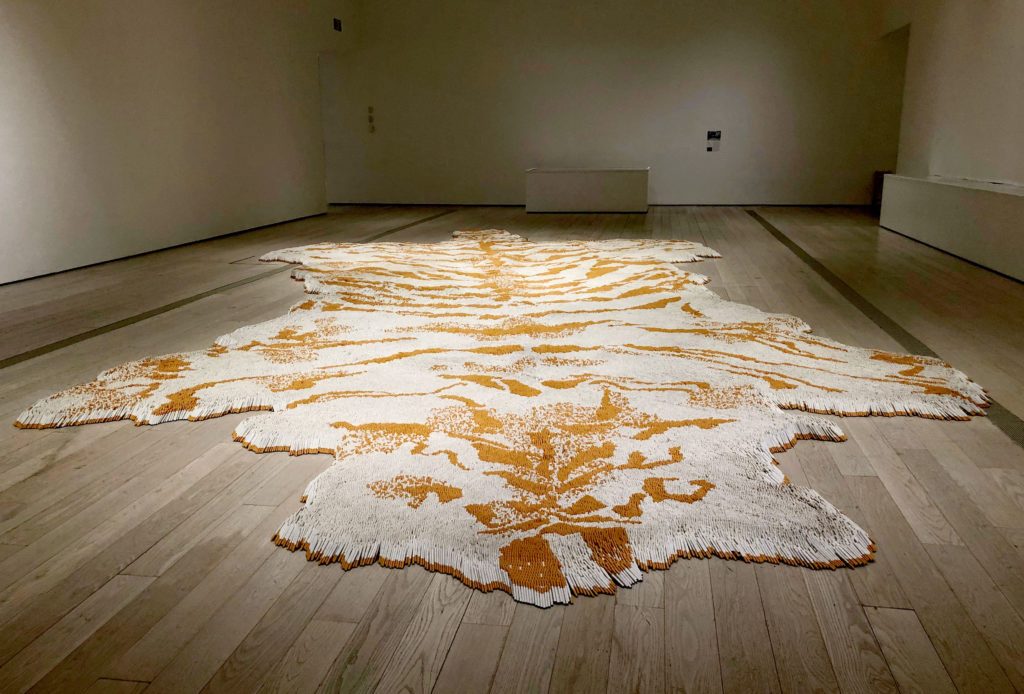
First Class by Xu Bing

First Class (detail)

Closing 1/5/20 is The Allure of Matter: Material Art from China at LACMA.

From their website-

Since the 1980s, Chinese contemporary artists have cultivated intimate relationships with their materials, establishing a framework of interpretation revolving around materiality. Their media range from the commonplace to the unconventional, the natural to the synthetic, the elemental to the composite: from plastic, water, and wood, to hair, tobacco, and Coca-Cola. Artists continue to explore and develop this creative mode, with some devoting decades of their practice to experiments with a single material. The Allure of Matter: Material Art from China brings together works from the past four decades in which conscious material choice has become a symbol of the artists’ expression, representing this unique trend throughout recent history. Some of the most influential Chinese contemporary artists today are featured in this exhibition, including Xu Bing, Cai Guo-Qiang, Lin Tianmiao, and Ai Weiwei.

There are a lot of impressive pieces in the show, including Xu Bing’s First Class, pictured above. Inspired by a photograph of a tiger-skin rug in a colonial home in Shanghai, it was created using cigarettes, also considered a luxury item by many. 

Also pictured are Wang Jin’s imperial robes/theatrical costumes that were created using PVC and fishing wire- replacing the traditional silk material. According to the wall description, the title Chinese Dream “alludes to the commercialization of tradition”. Held up by thick metal chains, they are also much heavier than the originals they copy.

Jan 032020
 

Closing 1/5/20  at Hauser & Wirth’s Los Angeles location is Charles Gaines’ exhibition Palm Trees and Other Works. This exhibition will debut new works from his signature Gridworks series.

Using photographs of native trees from Palm Canyon near Palm Springs, Gaines selectively layers paint on acrylic sheets atop black and white photographs of corresponding landscapes with trees. Following this process, each tree is assigned a distinctive color and a numbered grid that reflects the positive space of the tree in the original photographic image.

The exhibition also includes new watercolor work and Manifesto 3– which takes Martin Luther King, Jr.’s speech given at the University of Newcastle upon Tyne (1967) and James Baldwin’s essay Princes and Powers (1957) and using a rule-based system to convert letters from the text into their equivalent musical notes creating a musical score.

From Hauser & Wirth’s website-

Reflecting on his personal history, Gaines observed that ‘one thing that made me different from other conceptual artists is that I was not shying away from language or meaning or content’ – a truth perhaps best exemplified by ‘Manifestos 3’ (2018). This work functions as a systematic transliteration of revolutionary manifestos into musical notation. The installation is comprised of two parts: a single channel video monitor that scrolls the manifesto texts, and two large graphite drawings of the music scores that were produced by the translation. Each text scrolls in succession on a monitor while a recording of the music produced by Gaines’s system plays. Created by way of a rule-based system, Gaines transcribes letters ‘A – H’ from the text into their equivalent musical notes. The use of the letter ‘H’ represents the code used in early Baroque tradition for B-flat. All other letters and spaces between words are noted as rests or silent beats. While the resulting composition does sound intentional, it is controlled only by the preconceived notation system that follows the compositional structure of language. This produces the fluidity that the audience hears.

The two political texts transcribed in ‘Manifestos 3’ are Martin Luther King, Jr.’s speech given at the University of Newcastle upon Tyne (1967), wherein King nominates racism, poverty, and war as the three most urgent problems of the contemporary world, and James Baldwin’s essay ‘Princes and Powers’ (1957) which describes the dominating power of cultural control. These two manifestos are systematically translated into the above described musical notations as written and arranged for piano by Gaines and edited by John Eagle.

This series not only takes social justice and politics on as its subject, but also as it may critique our understanding of the relationship of the practice of art and politics. By converting these powerful and poignant texts into music, Gaines unites the rational, mathematical, and lyrical structures of music with the irrationality of violence, racial tensions, and social injustice. The predetermined process developed by Gaines widens the distance between concepts and their interpretation, effectively removing the artist’s subjectivity while empowering the viewer’s. The combination of the elegiac music with the stirring words of the scrolling manifestos creates an unexpected conflict for the viewer; it is within this dissonance that the indelible truths of Gaines’s work are revealed.


Jan 032020
 

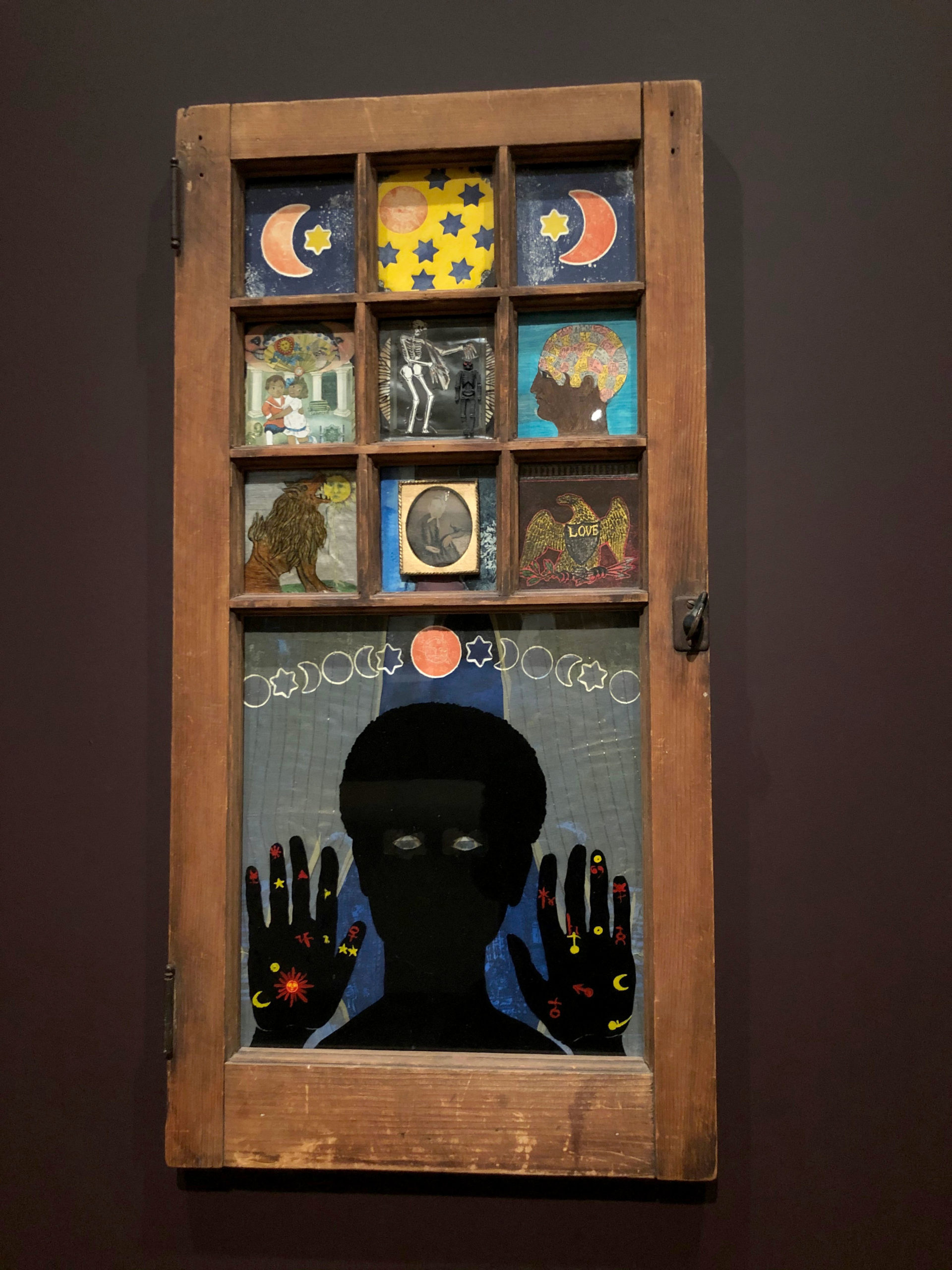
Black Girls Window, 1969

Mystic Window for Leo, 1966

As part of MoMA’s Opening Season, they are showing Betye Saar’s 1969 work, Black Girl’s Window, along with several of her works on paper.

The exhibition “explores the relation between her experimental print practice and the new artistic language debuted in that famous work, tracing themes of family, history, and mysticism, which have been at the core of Saar’s work from its earliest days.”

This exhibition closes 1/4/20.

Dec 282019
 

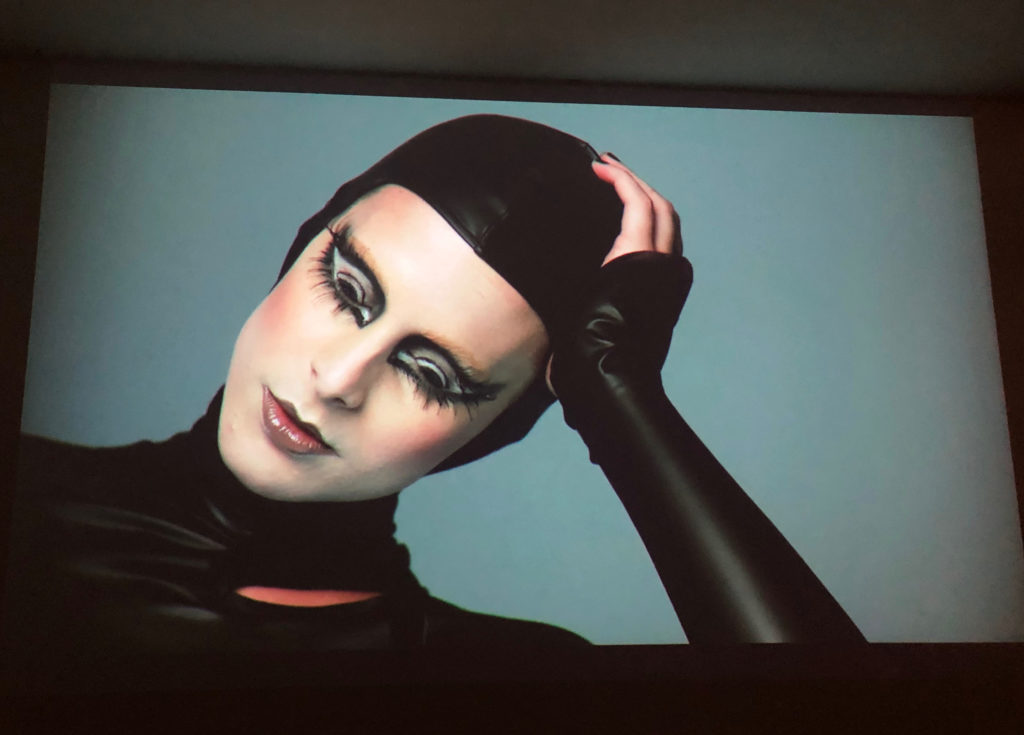
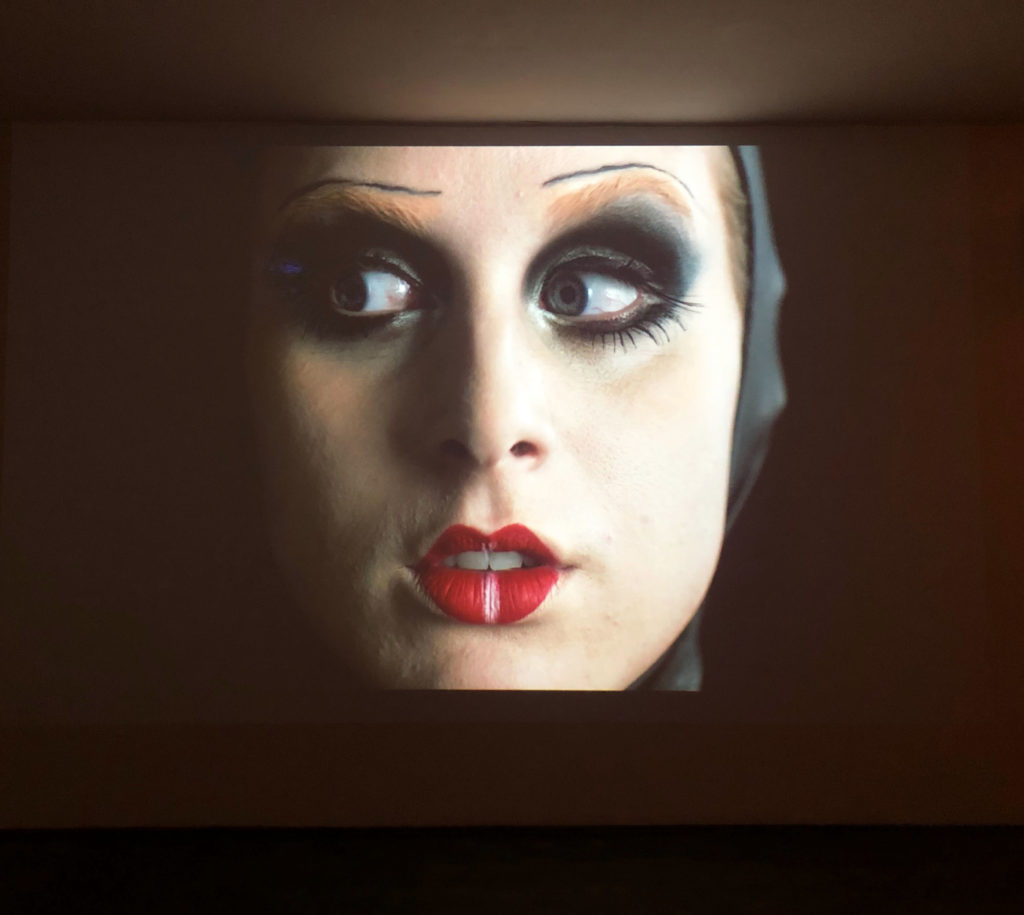
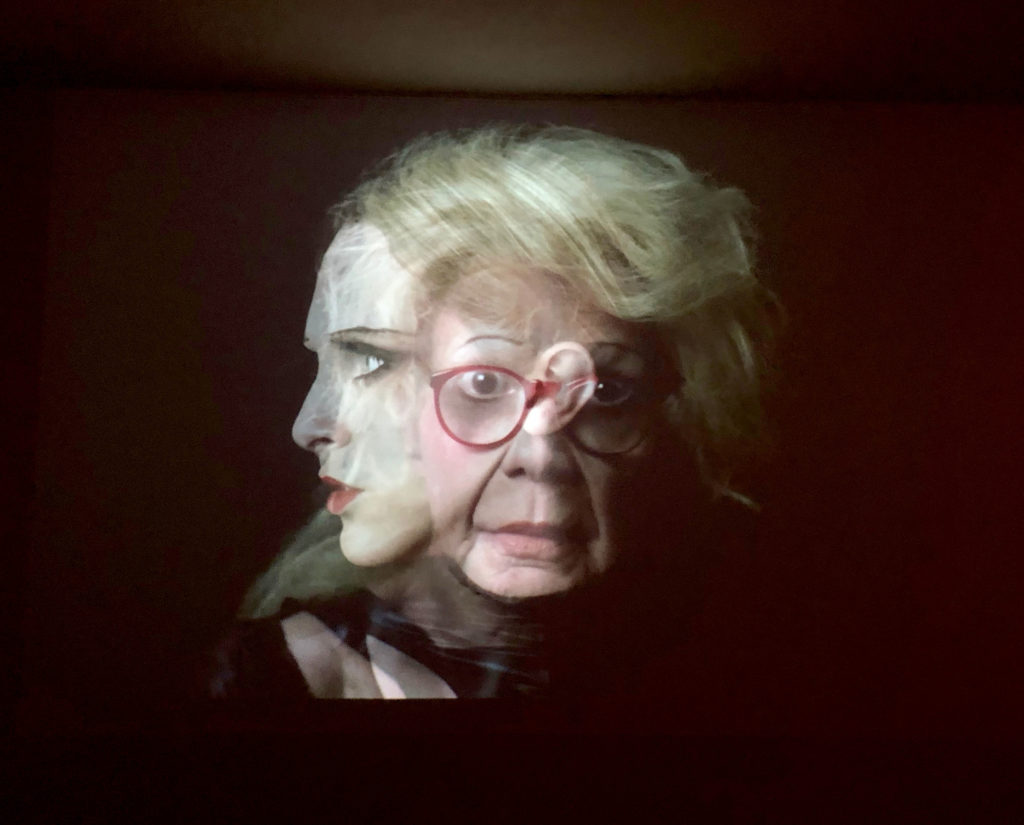
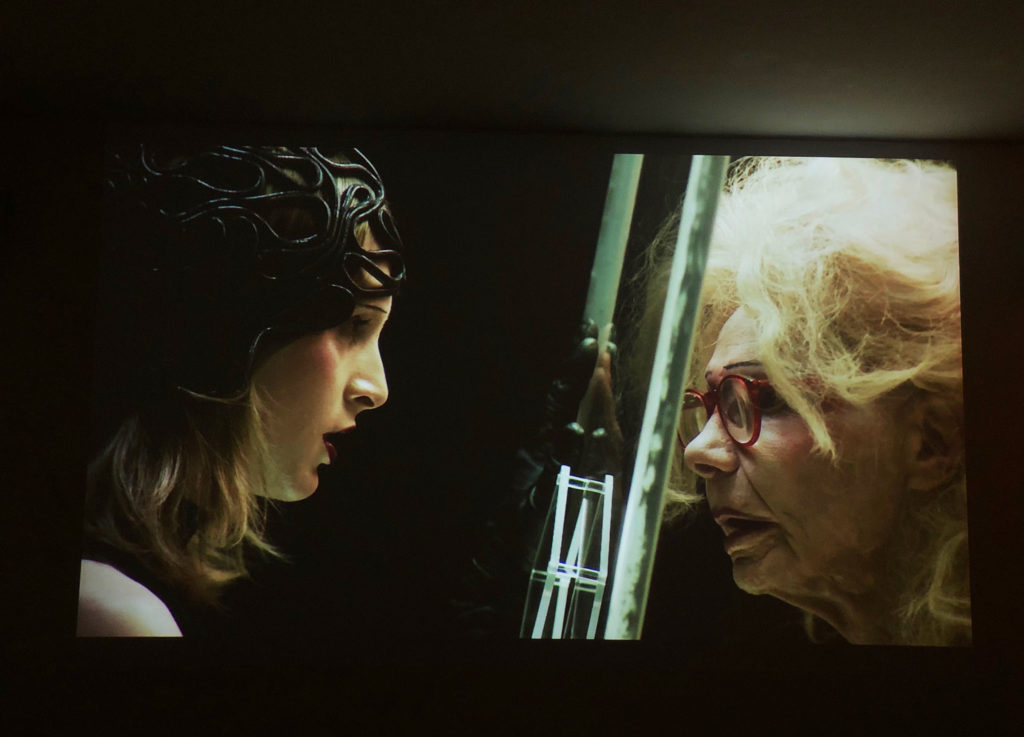
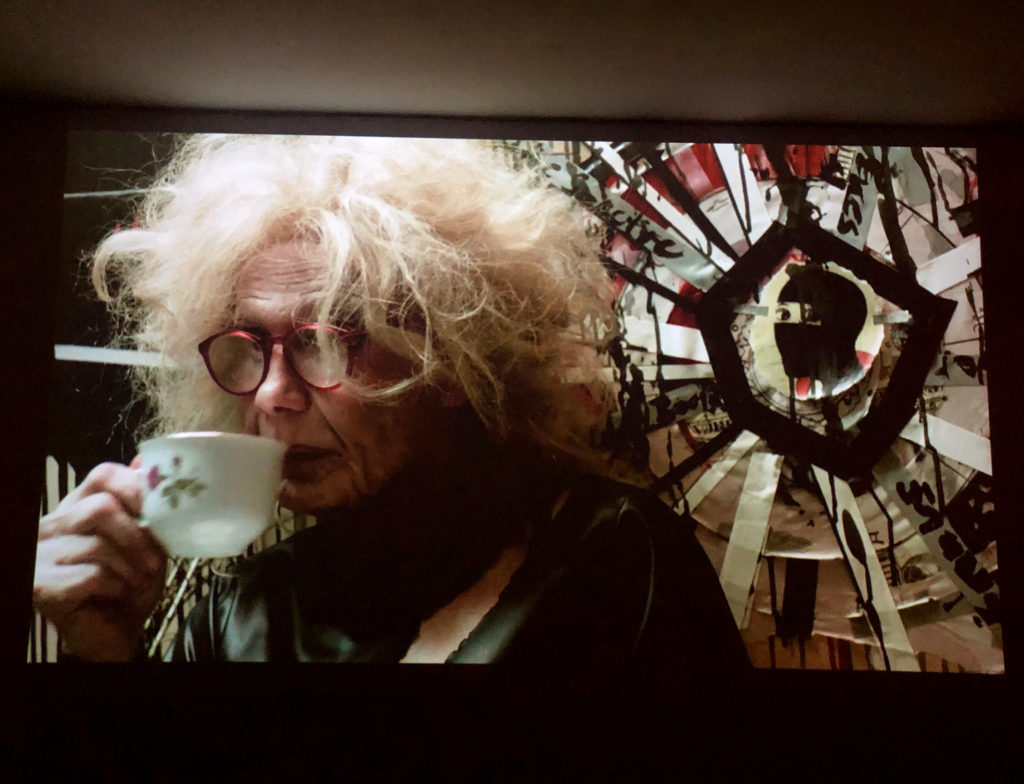
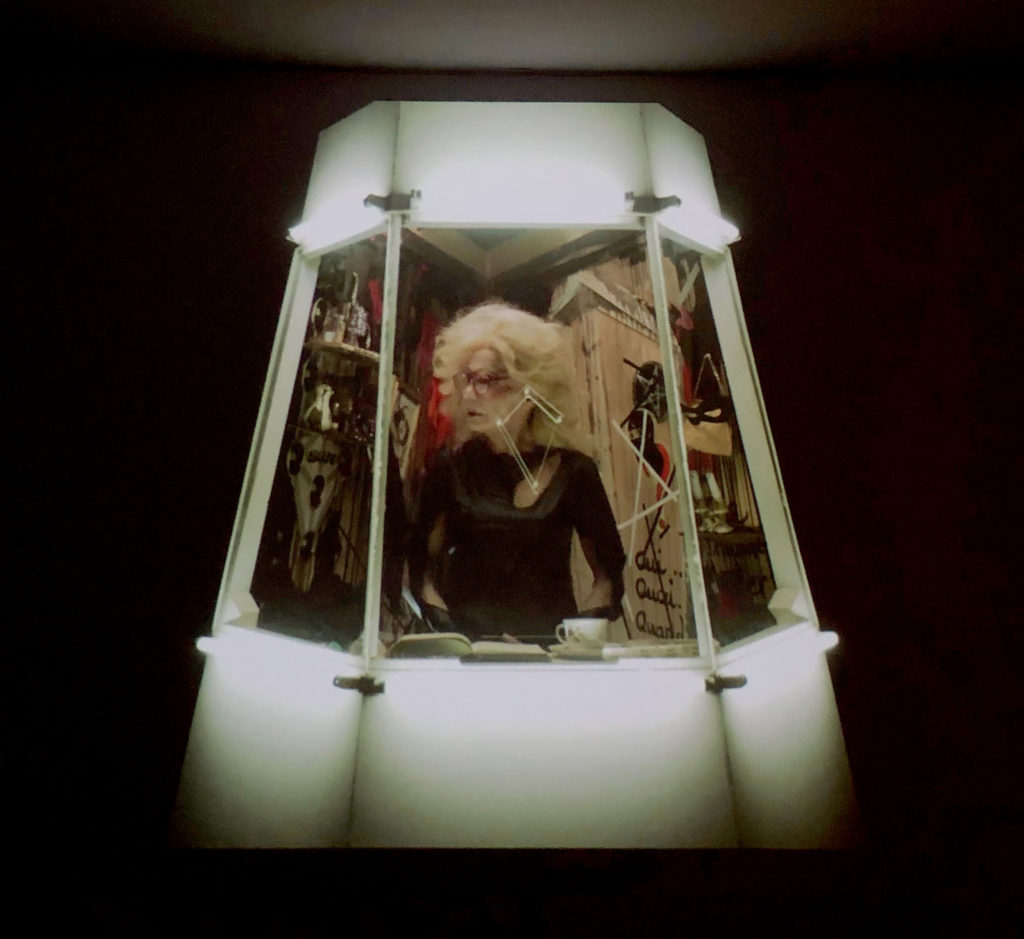
The images above are from Michelle Handelman’s film Irma Vep, The Last Breath, starring Zackary Drucker and the late Flawless Sabrina.

The video installation is based on Musidora, the French silent film actress, and the character she is best known for Irma Vep from the 1915 film Les Vampires directed by Louis Feuillade.

From the exhibition’s caption-

It’s a piece about living in the shadows, criminal anxiety, and the relationship between the artist and her creation, both fictional and real.

Irma Vep and Musidora are played by Zackary Drucker (Transparent) and the late Flawless Sabrina (The Queen), two artists whose identities transgress the border of art and life. Together, they developed a relationship that documents a cultural evolution of gender.

Musidora was an early 20th century feminist who took control of her career, not only acting, but also producing/directing films and theater. She was an artistic force of her time, producing several works by her lover Colette and having many documented affairs with both men and women. After financing dried up for her projects, she lived in relative obscurity until her death in Paris, 1957. In her later years, she worked the ticket booth of the Cinematheque Francaise, where few people ever knew that the woman selling them their movie tickets was France’s beloved vamp of the silver screen.

Irma Vep, The Last Breath takes up motifs from the silent movie such as gazes, affected body language and the figure of the masked woman. It’s shot on a starkly illuminated set that makes space for anxious projections of desire on the void that is Irma Vep- a space between genders, between vamps of the silent era and the contemporary queer- smashing the shiny veneer to reveal dark, subconscious layers of fluid identity.

The film is part of the larger exhibition Idol Worship, a group show curated by Emily Colucci, at Smack Mellon which “celebrates the ongoing cultural, social and political significance of role model adoration as an essential survival strategy”.

The exhibition closes 12/29/19.

Dec 272019
 

Volcanic Eruption At The Junk Yard, 2019

Standoff at the Bedrock Bunny Club, 2019

After The Rapture (Border Town), 2019

Rosson Crow’s paintings for her exhibition Trust Fall at The Hole are bright, chaotic, and very reflective of the times we are living in.

From the press release-

Rosson Crow is in one sense an American History Painter—capitalized—who has made paintings across a range of subjects, foreign and domestic, but always meditating on the American story and her place in it. Since her debut show at Canada Gallery in 2004 while still an undergrad, Crow has established herself as a big, brainy, macho painter who nonetheless maintains a performative seduction with color and content.

This new exhibition features ten immersive panorama paintings that meditate on our 2019 moment in America. In what is her most urgent and timely work to date, she grapples with the erosion of American institutions and even of reality and truth itself. “Chaos autopsies” she calls them, each taking on specific aspects of her thinking—or dreaming—about current issues. KonMari is about the latest trend of disciplinary minimalism but depicts a giant landfill of “fast fashion”; After the Rapture in a Border Town shows a human-free street at the Mexican border; Volcanic Eruption at the Junk Yard is a fierce, fiery pit of melting old cars, while Ocean Front Property in Arizona is pretty self explanatory. No humans are present in any of the works, unless a cardboard cutout or statue; in this trust fall there is no one to catch us.

Using luminous oil paint, spray paint and thrown enamel, Crow builds up the surfaces of her works as she layers their content; bleeding into one another, the paintings feel like a tinted vintage post card, hi-contrast outlines whose colors have melted with time. Using moments of photo transfer for snippets of text, bumper stickers or beer cans, the repeating transfers confer a sense of glitching in the painted image, heightening their theatrical illusionism while questioning their reality; has this image been photoshopped? Has this video been edited? How much can we trust our own eyes?

The paintings are topical but not didactic. Ignorance, absurdity and swirling misinformation make the current political landscape untraversable; to a civilian psyche it makes analysis and action extremely difficult.  The exhaustion that comes from this onslaught must make artmaking even harder; most retreat, make head-in-the-sand works that don’t attempt any sociopolitical issues. Crow has always made works that highlight the staged nature of space, that look at fake or contrived scenes, like the painting above; in this Garden of Eden recreation from a religious-themed creationism park, the plants look like they are from Home Depot not an actual tropical jungle. Looking “behind the curtain” at manipulated reality is a non-partisan issue that speaks to both sides of the cultural divide, as everyone is stuck in this morass together; everyone wants to unravel the myriad ways we are secretly controlled and how power is written into our lived and virtual environment.

This exhibition closes 12.29.19.

Dec 192019
 

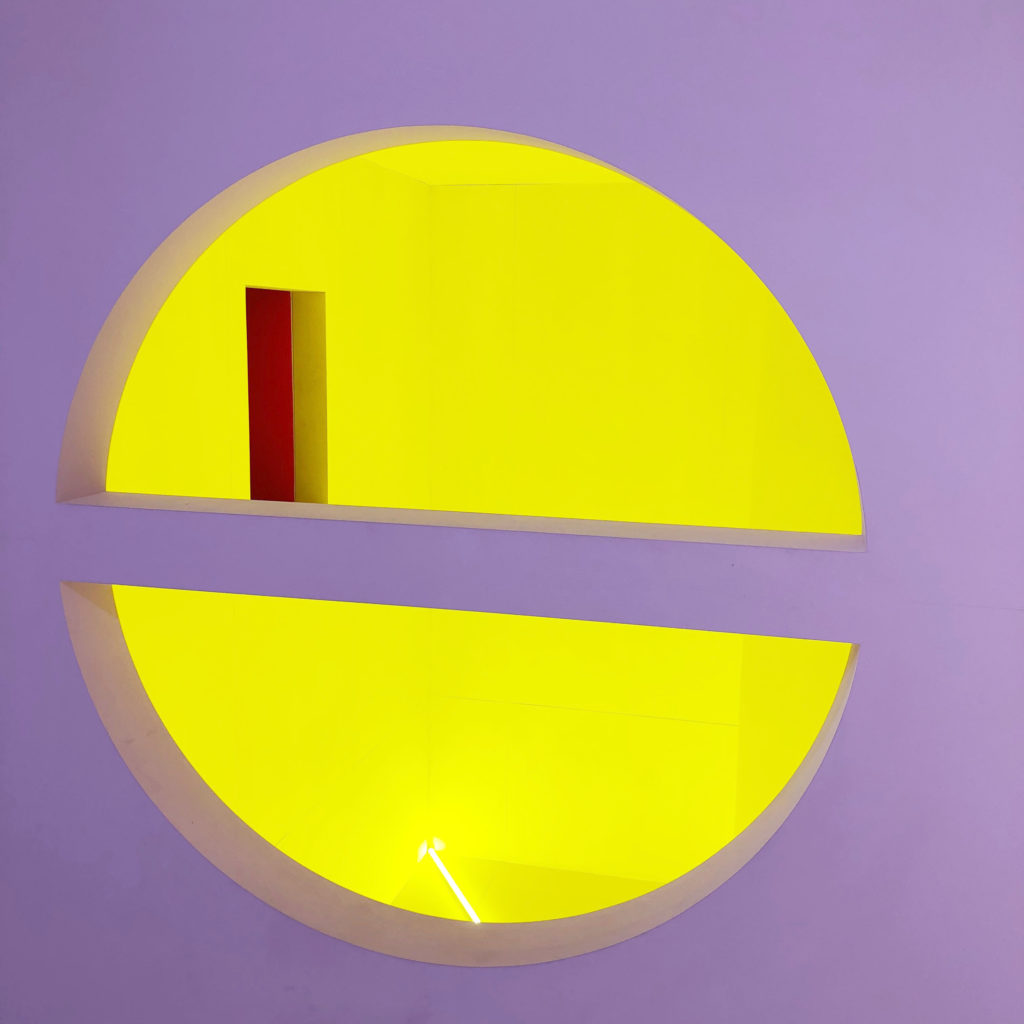
For Peter Halley’s Heterotopia II, at Greene Naftali’s ground floor gallery in Chelsea, he has created a delightful, brightly colored maze-like installation.

From the press release

In Des Espaces Autres (1984), Michel Foucault defines heterotopia in opposition to utopia. While utopias are unrealized representations of a perfected society, heterotopias exist within all societies as realms differentiated from everyday life. Examples include ceremonial, sacred, and institutional spaces such as chapels, cemeteries, libraries, and prisons. They are spaces designated for special activities – creating their own sense of time and operating according to their own standards.

Through a range of media – painting, architectural installation, digital prints, and critical writing – Peter Halley’s work has illuminated the structures of social space and communication that shape our experience of contemporary life. For his second solo exhibition at Greene Naftali, Halley presents Heterotopia II, the latest in a series of large-scale installations exploring the relationship between painting and architectural space. Halley has created a multi-colored, labyrinthine structure in the ground floor gallery housing eight new shaped-canvas paintings, titled after imaginary planets from Isaac Asimov’s science-fictional universe.

The installation is enclosed by tall neon yellow walls coated in Roll-a-Tex, with only a narrow slot in the front wall offering the viewer a preemptive glimpse inside. The interior space is organized around a glowing yellow core – an inaccessible inner sanctum whose light is solely visible through three distinctive apertures. Around the core are arrayed eight interconnected rooms rendered in vivid colors, each defined by architectural elements, including staircases, keyhole windows, beams, and columns. The arrangement of these elements playfully nods to motifs in the work of architects Peter Eisenmann, Hans Hollein, Luis Barragán, and Louis Kahn, as well as to Halley’s own oeuvre. Halley’s installation, with its candy colored surfaces, is a postmodern reverie on neoplasticism and modernist geometry, founded on a tension between rationalist geometry and lyrical color.

Visitors circulating through the maze-like installation encounter Halley’s shaped-canvas paintings one-by-one, as the interactions between two-dimensional image and three-dimensional architecture unfolds. Composed of multiple interlocking prisons and cells, the paintings create ambiguous figure-ground relationships, while echoing the geometric plan of their three-dimensional setting.

This exhibition closes 12/20/19.

Dec 132019


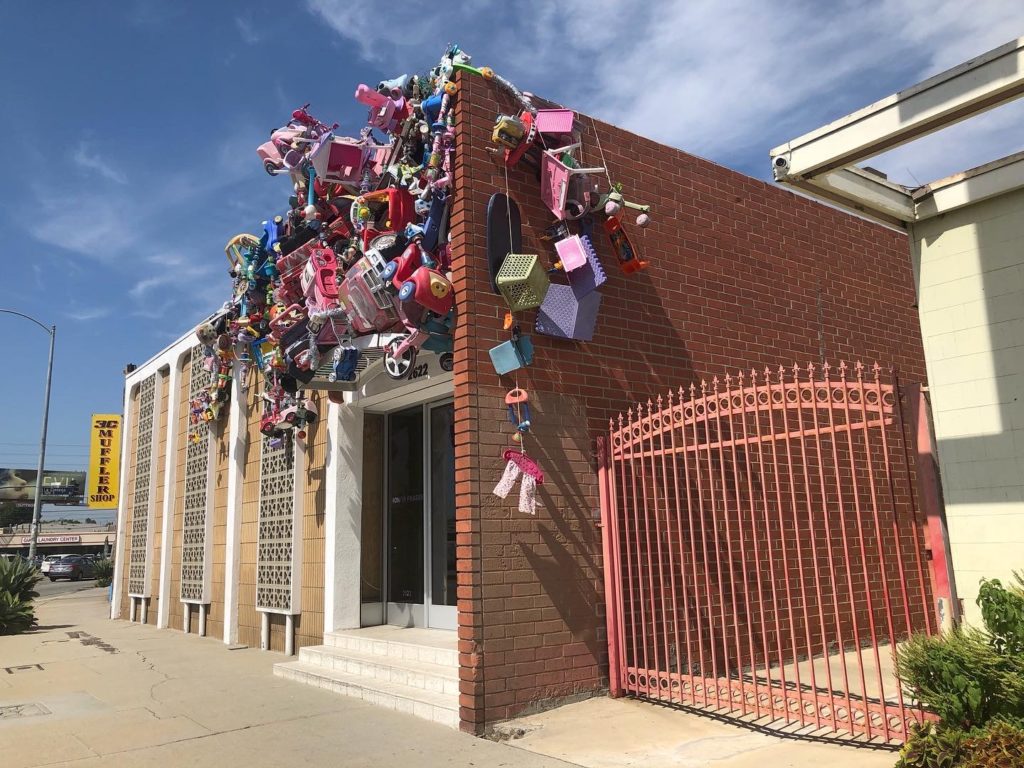
Closing on 12/14/19 is Kenny Scharf’s current exhibition at Honor Fraser, Optimistically Melting!. The exhibition includes multiple installations, paintings, and sculptures- including new ceramic work.

From the press release-

After four decades of constant production, Scharf’s latest group of paintings introduces a new subject: the still life. The trope of flowers in a vase appears throughout Western art, notably in the work of artists such as Jan Brueghel the Elder, Vincent Van Gogh, and Andy Warhol. In Flores Flores Flores (2019), happy flowers spring from a vase casually set on a table at the center. Closer inspection finds a less happy flower at the edge of the table with X’s over its eyes, a cartoon signifier of death. Further, the viewer notices the drips of darkness in the background, adding to a growing sense of unease in the work, something sinister lurks behind the pleasant centerpiece. These signifiers of global anxiety become more overt in the artist’s Sloppy Melt series of paintings, also to be included in the exhibition, which feature dripping cartoon figures and screen-printed news headlines in English and Korean about climate change. With clear memories of smog days as a child growing up in Southern California, environmental concerns have appeared throughout Scharf’s oeuvre. The artist believes it is important to be mindful of future damage we will cause to the environment if we continue to prioritize comfort and ease in the present.

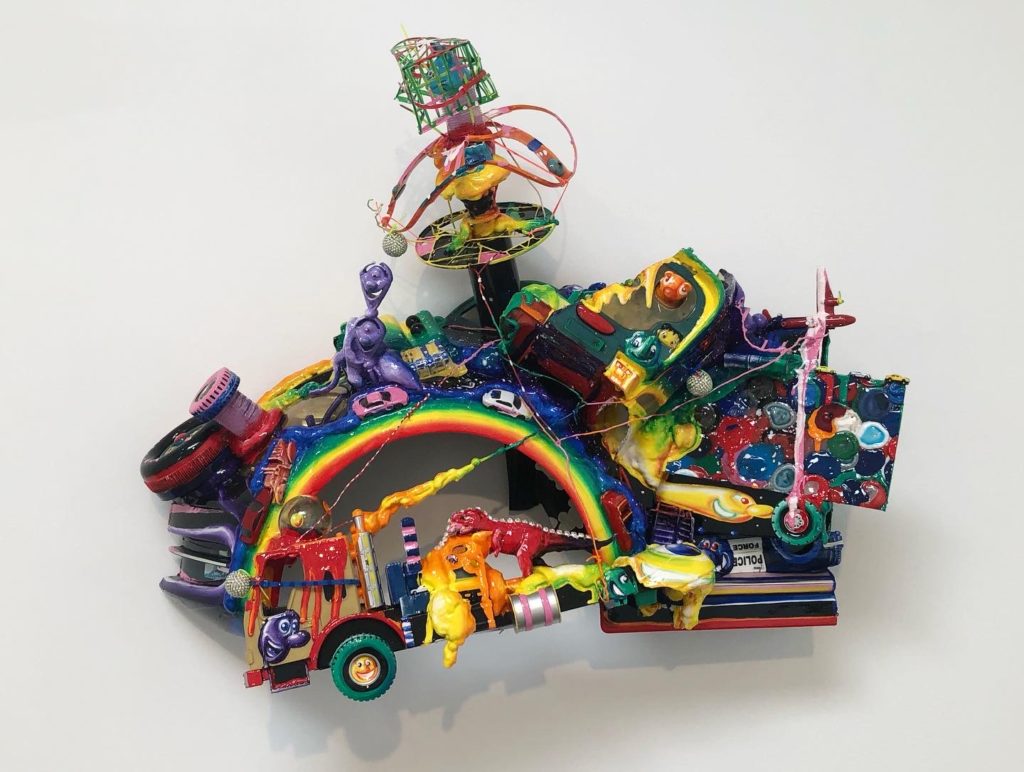
In the 80s, Kenny Scharf began collecting plastic detritus that he found along the beach in Brazil, where he was living at the time. The artist would assemble these discarded items into sculptures for the wall, giving them new life as aesthetic objects called Lixos (“trash” in Portuguese). Though the sculptural practice has continued intermittently, Scharf made a habit of collecting discarded plastics from around the world, which have not degraded over the years. More recently, the artist began collecting all of his single-use plastics and stringing them together as a garland around his studio, a constant reminder of daily waste. In light of the current reckoning with the overproduction of plastics and climate change denial, Scharf will present a new body of Lixos in the gallery along with a giant garland wrapped around the outside of the building. Materials for the garland will be collected at Honor Fraser Gallery throughout the summer and leading up to the exhibition. In addition to creating a personal alternative to recycling methods that require more toxic chemicals, Scharf aims to shine more light on this urgent issue. As in his paintings, deep concerns about our future lie beneath these brightly colored works.

Expanding his sculptural practice, Kenny Scharf will unveil a group of large ceramics featuring his signature characters in the round. Produced in collaboration with Stan Edmondson in Pasadena, these works were fired locally and hand-glazed by the artist. Bordering on living sculpture, the pots will contain greenery to be nurtured beyond the term of the exhibition, a gesture of possibility and hope rom the artist. In addition to converting carbon dioxide into oxygen, caring for plants has proven to be a beneficial practice for humans as it requires patience, reduces stress, and promotes close observation. These plants grown by the artist himself contain Scharf’s intention for a more respectful and conscientious future.

Dec 122019
 

Petzel Gallery is currently showing Walead Beshty’s solo show “Abstract of A Partial Disassembling of an Invention Without a Future: Helter-Skelter and Random Notes in Which the Pulleys and Cogwheels Are Lying Around at Random All Over the Workbench”. The sheer volume of work covering the walls is overwhelming and impressive in its assembly.

From the press release-

The work A Partial Disassembling of an Invention Without a Future: Helter-Skelter and Random Notes in Which the Pulleys and Cogwheels Are Lying Around at Random All Over the Workbench, was originally commissioned by the Barbican Centre, London. The London-born, Los Angeles-based artist first exhibited the work there in 2014, covering the 273 ft long Curve gallery from floor to ceiling in cyanotype prints. The prints were produced over the duration of a year (October 9, 2013–October 8, 2014) and are chronologically installed in proportion to the exhibition space. For its New York première at Petzel, approximately 5,120 cyanotypes (38% of the total 15,616 sq. ft work) will be presented.

In A Partial Disassembling of an Invention … , each cyanotype (a 19th Century photographic process using ferric ammonium citrate and potassium ferro-cyanide) was produced by placing tools and other objects used in the production process of the studio on cellulose waste material generated by that same process (such as wood, cardboard, or paper) that was coated with UV-sensitive cyanotype material. After being exposed to sunlight and washed in water, the object’s silhouette appears in reverse against a cyan-blue background.

In using everyday objects, such as receipts, prescriptions, invoices, financial statements, legal documents, letters, gallery invitations, etc. from the working life of the studio, an inherent transparency is embedded in the work, demystifying the artwork and exposing its process of coming to be. Representative of the lives of those who made it, the cyanotypes expose both aspects of identity and circumstance, situating the work within political, social, and economic exchange without being representational or depictive in the conventional sense. While both the Barbican and Petzel iterations deal with debris, this new display has a more overtly American immediacy to it. Considering the resurgent discourse on the politics of representation, there is a new urgency to exhibiting the work for the questions it evokes about the modes and uses of representation, such as how art can accurately display real world conditions of labor, production and power, and whether a truly accurate and transparent form of representation is possible.

Beshty will also show Prologue to A Partial Disassembling of an Invention Without a Future: Helter-Skelter and Random Notes in Which the Pulleys and Cogwheels Are Lying Around at Random All Over the Workbench, which are the cyanotypes that were produced in anticipation of the Barbican work from August 1, 2013–October 8, 2013, along with seven volumes of the 59-volume archive of the work. The books—in their Prologue and Opus volumes—comprise bound pages printed recto and verso of the entire work reproduced at 1:2 scale. The volumes create both an archival record of Beshty’s workspace as well as an index of all the tools and artefacts used for the work’s own making.

The title of the project is a reference to Hollis Frampton’s hypothetical lecture he muses about in a talk delivered at the Whitney Museum of American Art, but never actually gives. The title of this phantom lecture alludes to the origins of the medium, and its inevitable obsolescence. It also calls forward the question of the role objects play when they have ceased being useful. Wrenched by time from their intended use, the objects become purely aesthetic, becoming the focus of contemplation in both historical and poetic terms.

This exhibition closes 12/14/19.

Dec 062019
 

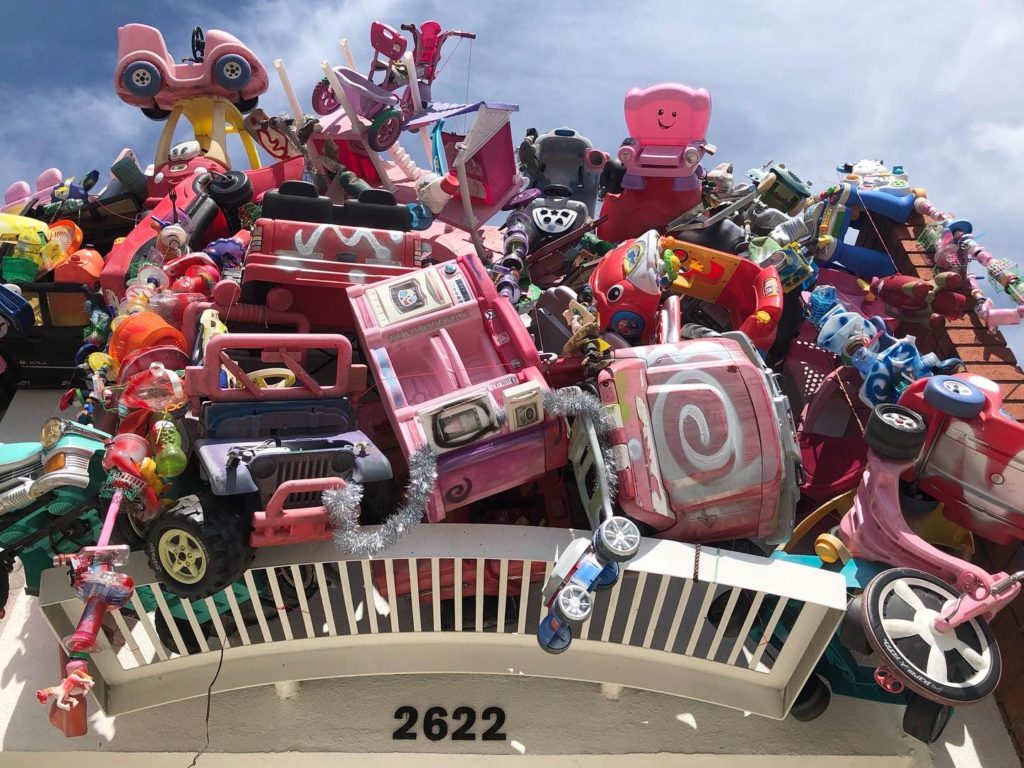
Murals of La Jolla is a project started in 2010 by The Athenaeum and the La Jolla Community Foundation. It commissions artists to create work to be displayed on buildings around La Jolla. The works are on view for a minimum of two years (a map of current work here)

The above work is Favorite Color (2010) by Roy McMakin.

From the Murals of La Jolla website regarding this work-

…“The idea was very simple. I have always, since a child, been intrigued at both my own emotions around color preference, and also others. It has been important, and part of my identity to know what my favorite color is. I often recall times that I discussed color with my friends as a child and the talk always centered around preference. And I have found as an adult that most people still enjoy sharing what their favorite color is.”

“My proposal for the wall in La Jolla was to create a visual document of what a somewhat arbitrary group of people, of various ages, etc., choose as their favorite color. I began the process by asking people their favorite color, and then I presented them with a selection of 4 to 6 colors, of which they choose the one that was closest to the color they liked best. For example, if someone said “blue”, then I showed them blue swatches and they chose one. One square was painted that color. I like the idea that this takes place at a certain time, and that the ultimate form of the mural was dictated by the number of folks that showed up.”

This mural is located at 7596 Eads Avenue.


Dec 062019
 

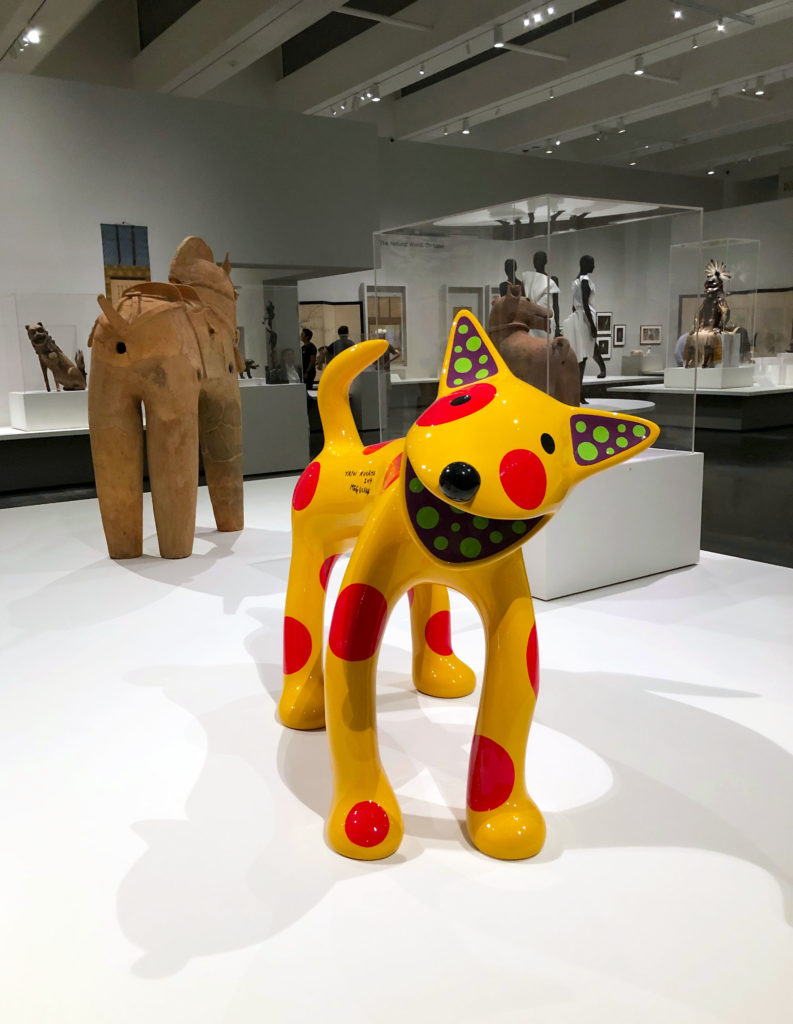
Closing 12/8/19 at LACMA is Every Living Thing: Animals in Japanese Art. It’s a really fun of exhibition with a good selection of art from different time periods, including Yayoi Kusama’s dog sculptures from Megu-chan (2014), two of which are pictured above.

From LACMA’s website-

Every Living Thing: Animals in Japanese Art celebrates one of the most distinctive and compelling aspects of Japanese art: the depiction of animals. Underpinned by Japan’s unique spiritual heritage of Shintō and Buddhism, the Japanese reverence for nature—and the place of animals within that realm—is expressed in sculpture, painting, lacquer-work, ceramics, metalwork, cloisonné, and woodblock prints.

Lions, dogs, horses, oxen, cats, fish, insects, birds, dragons, phoenixes—animals warm and cold-blooded, real and imaginary—are meticulously and beautifully rendered in myriad works from ancient 6th-century clay sculpture to contemporary art. Arranged in themes such as Zodiac Animals, Animals from Nature, Religion, Myth and Folklore, and Leisure, the exhibition draws heavily from LACMA’s permanent collection and includes masterpieces from Japanese and American public and private collections, some of which are on view for the first time.