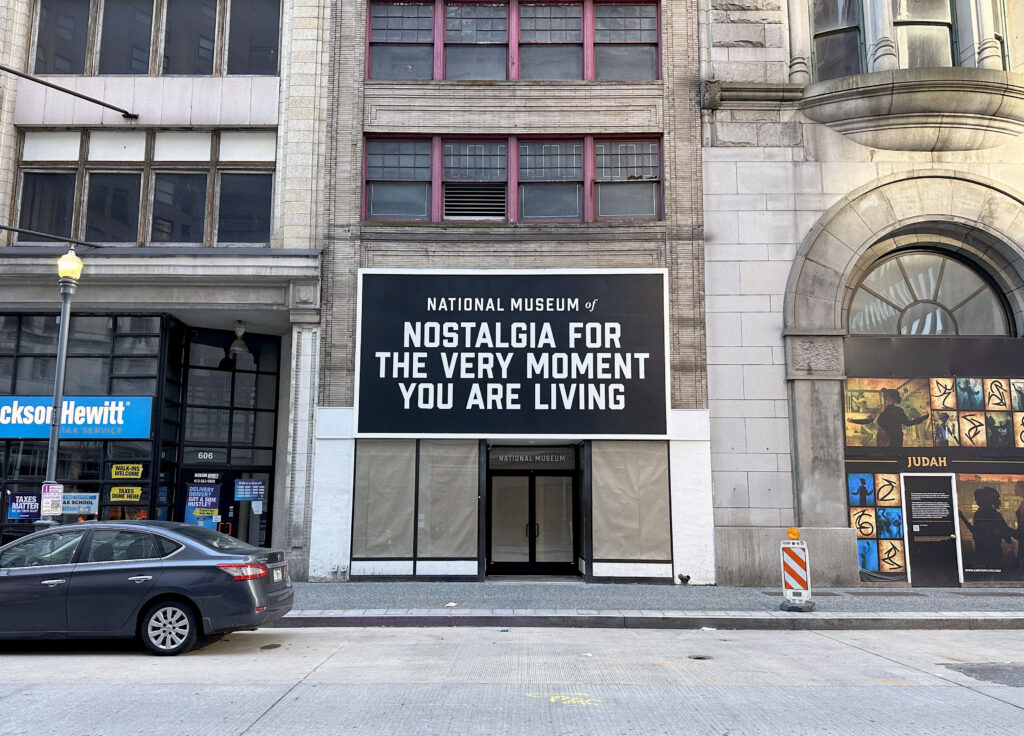
The National Museum is a public art project founded and curated by Jon Rubin and presented by Pittsburgh Cultural Trust. Different artists are invited to change the name of the museum and an essay is written using the title as a jumping off point. The first iteration is by artist and writer Pablo Helguera.
About the project from Jon Rubin’s website–
The National Museum repeatedly asks which stories, histories and futures are deemed worth saving and which are ignored or forgotten. Each month, a different artist is invited to change the name of the museum and a national writer is invited to use that museum title as the jumping off point for an essay. In its first year, the project currently consists of storefront signage, street posters, printed broadsheets, a website and monthly accompanying essays.
When a name starts with “The National Museum” it triggers contentious and political associations with borders, nationhood, even citizenship and belonging. Who gets to determine the belonging of an entire group of people bound only by the fact of their geographical location. There’s something absurd about that, if you think about it. Instead of claiming ownership over a diverse populous or even a disparate set of objects, can the notion of the “national” be rethought as something that is less tangible, less object-oriented?
There is a fundamental hubris and absurdity in calling something, anything, a museum, let alone The National Museum. But, in many ways, it’s really no different than any other museum that someone, usually with far more money, privilege, and power than any of my artist peers or myself, has simply made up. So, in a way, the project functions as a kind of loophole or work-around, a participatory fiction that allows a variety of artists to put forth an ongoing series of grand propositions, a theoretical institution that repeatedly brings into question the certainty and reality of our pre-existing institutions.
The National Museum elucidates how museums, especially national ones, are perhaps no different than the nation-states in which they reside. Each is an imagined political construct, a collective fiction used to collect, categorize, narrativize, and control. Throughout modern history museums have used the collections they steward and the stories they tell to validate extractive legacies of colonialism. And, although our current museums, both national and private, are staffed by people with experience in the arts and humanities, the ultimate decision-makers in many of these institutions are wealthy donors and trustees who derive financial benefits from, and exert ideological control over, the fundamental mission of museums. So, while the general public think museums are nominally for “everyone,” the truth is that they are delimited by economic, geographic, racial, and cultural boundaries that restrict their function, design, and access to select publics.
Pablo Helguera’s essay on building façades as art and metaphor, Creditable Unrealities, is included on the broadsheet for the project (as well as his Substack Beautiful Eccentrics) and is a highly enjoyable read.
It includes this passage on how he came up with his name for the museum-
“Ultimately, I reasoned that façades are the most direct indicator of the time when they were built: they are the things that we try to use as visual reference to identify a city we know in a historic photograph; they are time markers. And when it comes to museums, they traditionally seek to project timelessness, especially those august institutions whose neoclassic façades promise a container of art for the ages. So I thought that this façade should be the threshold not of art history but of our own awareness of that history and our minuscule place in it, knowing that the present that we are living so vividly will soon wash away, largely unimportant within the broader scope of human life. In 2001, doing research on people who consumed ecstasy, I was struck by the effect that their drug had in some people’s temporal awareness, and how it resonated with my own (drug-free) experiences. Thus the phrase “I have nostalgia for the moment I am living”, which gave the inaugural title to the National Museum.”
The next iteration of the museum will feature Edgar Heap of Birds (Hock E Aye Vi). The broadside will be written by poet, writer, lecturer, curator and policy advocate Suzan Shown Harjo.