Jan 162020
 

Sexy Robot_Floating, 2019 by Hajime Sorayama

Tokyo Pop Underground curated by Tokyo gallerist Shinji Nanzuka and currently at Jeffrey Deitch gallery in Los Angeles “explores the complex history of Japanese contemporary art from the 1960s to the present through the works of seventeen artists who emerged from pop and underground culture”.

From the press release-

Shinji Nanzuka explains that “originally in Japan, most of what is referred to as art are practical items, developed together and in integration with popular culture.” He cites examples from calligraphy to folding screens, paintings on sliding paper doors, lacquerware, netsuke, and the Ukiyo-e prints that served as posters and commercial portraits. He also mentions art historian Naoyuki Kinoshita’s study of intricately realistic handicrafts such as iki-ningyou, life-like dolls that were made for exhibitory performances. Nanzuka’s mission in this exhibition is to present contemporary artistic commentaries on this Japanese artistic heritage.

Deviating from the mainstream current of “art for art’s sake” when he opened his Tokyo gallery in 2005, Nanzuka decided to focus on artists whose works at the time were not considered to be art. Artists like Keiichi Tanaami, Harumi Yamaguchi, and Hajime Sorayama, whose works are now celebrated in the international art world, were looked down upon as producers of commercial and popular art. Nanzuka saw them as prime exponents of the idiosyncratic nature of Japan’s culture and history.

Another reason that Tanaami, Yamaguchi, Sorayama, and Toshio Saeki did not receive recognition until recently is the radical intensity of their practice. The expressions of sex and violence in their work are statements of anti-authority and anti-uniformity. The aggressive portraits of women painted by Harumi Yamaguchi show her engagement with the women’s liberation movement of the 1970s. Sorayama’s sexualized robots predict a dystopian future.

There are strong links between the underground Japanese culture from which many of these artists emerged and the American graffiti and skateboard subcultures that were embraced by Japanese youth. Haroshi, one of the younger artists in the show, constructs his works entirely from wood sliced from skateboards donated by friends and professional skateboarders to compose a collective portrait of his enlarged, international community.

The artists in Tokyo Pop Underground reflect the strains in contemporary Japanese culture as it rebuilt itself after the ruins of war and confronts numerous natural disasters. Their work reflects what Nanzuka describes as “the crazy cross-cultural exchange” between the West, the East, and the Far East, shaping a new international artistic language.

This exhibition closes 1/18/20.

Jan 092020
 

Blum & Poe in Los Angeles is currently showing two very different exhibitions. In the main gallery is a selected survey of work by Harvey Quaytman spanning three decades.

From the press release-

Harvey Quaytman (b. 1937, Rockaway, NY; d. 2002, New York, NY) came of age in the downtown art scene of 1960s New York, living and working in SoHo studios first on Grand Street and later at 231 Bowery, where he would remain through the late ’90s. Long considered an artist’s artist, the painter enjoyed a close-knit and vibrant artistic and social milieu, over the years sharing studio addresses with Brice Marden, Ron Gorchov, and James Rosenquist, among others. Quaytman’s emerging career as a young painter began in the heyday of Ab Ex with a marked allegiance to Gorky and de Kooning. This approach was slowly shed as the decade unfolded, as his work began to lean towards sculpture—compositions with curvilinear shaped canvases and rectilinear U-shaped bases that inhabited a newfound objecthood. This was followed by a forty-year engagement with geometric abstraction, his approach to painting in contradistinction to the prevailing trends of the era—first with Pop Art and later Neo Expressionism. Despite painting being declared “dead” by Minimalist and Conceptual artists of the time, Quaytman maintained a commitment to the medium and to his vision throughout, helping to shape an alternate trajectory for American painting.

The artist’s work in the ‘70s developed into shield-like forms that balance on curved platforms, conjuring a motion that would result in a critic calling them “rocking rectangles”—the body of work later known simply as “rocker” paintings. These eccentrically shaped works were hand-crafted (he would steam and bend the wooden stretchers himself), and inherently related to movement—inspired by Islamic calligraphy, rocking chairs, and the flight patterns of airplanes and birds. His experiments with shape continued in the late ‘70s, and through the manipulation of geometric intersections and overlapping forms that all the while imply motion, a unique group of paintings resembling anchors or pendulums emerged. In the 1980s, Quaytman began his cruciform paintings, investigations of the cross shape not as emblem but as two meeting vectors; Constructivist, perpendicular geometric compositions that focused on the reduced palette of black, white, red, rusted iron, and metallic gold. While these paintings represented a stark departure from his previous work, Quaytman continued to pursue visual movement as he conjured an interplay of symmetry and asymmetry.

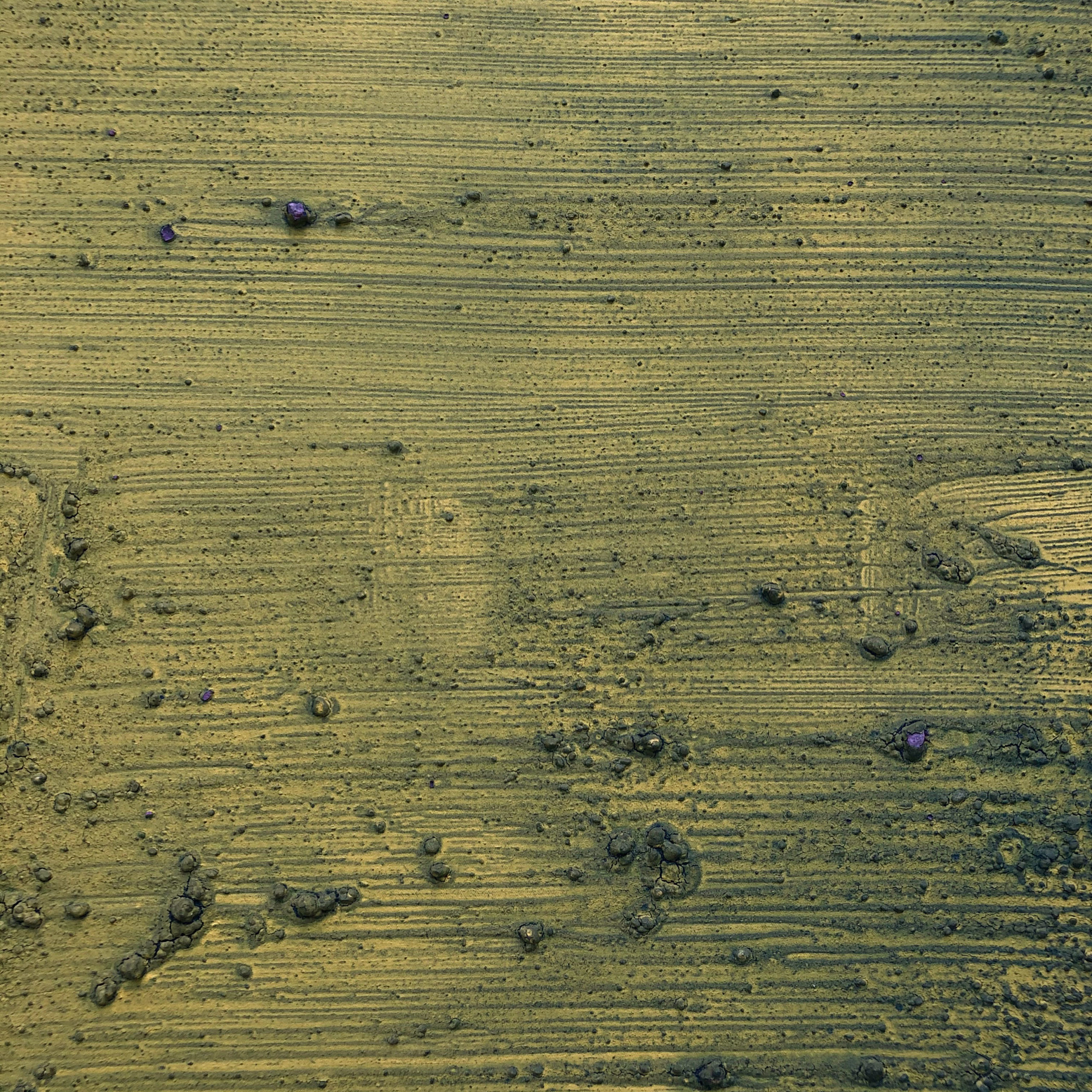
Many of the works become even more intriguing up close.  His use of different materials to achieve varying tones and textures makes them come alive.

The press release discusses a bit about his process in creating them-

As his paintings evolved in form and shape, variously touching upon Abstract Expressionism, Minimalism, Process Art, and Constructivism, Quaytman simultaneously developed a rigorous practice of experimentation with pigment. He was interested in the history, alchemy, and chromatic effects of color, seeking out unique tonalities at specialty stores at home and abroad, becoming a master of color and texture. He skillfully poured paint, spreading Rhoplex over canvas with broad wallpaper brushes after dusting it with pure pigment that settled in thick, unpredictable strata. He later flecked canvas with glass or iron filings and used additives such as marble dust in paint he always mixed himself. On this subject, he said: “It is very important to me to be reminded that I am not an alchemist but a man engaged in coded, layered conversation with my fellow man on what I hope to be (on another) level than words or music.”

On the second floor are Matt Johnson’s delightful sculptures whose familiar materials seem to defy gravity as they balance on each other in the compositions.

From the press release–

In an ever-expanding practice in search of the peculiar and the sublime, Johnson elevates the mundane to the exceptional. With a new body of work in carved and polychromed wood sculpture, Johnson depicts configurations of raw industrial materials from cinder block, brick, rebar, to traffic cones—permutations of information composed according to gravity, balance, and primitive instinct. A crude horse, a procession of block figures, cantilevered props, and fragile towers make reference to the concept of knowledge with small gestures—a lighter, a match book, a lightbulb, an atlas, and a monograph on Matisse. The doweled joints of glue and/or epoxy between bricks, blocks, and bars exist here not to defy gravity but to freeze balance and preserve delicate moments of experimental groupings. Like a still life, these works are organized information, like subatomic particles, atoms and elements, molecules and compounds, glued by gravity, and magnetic polarity, surfing in a sea of electrical conductivity.

Both of these exhibitions close 1/11/20.


Jan 042020
 

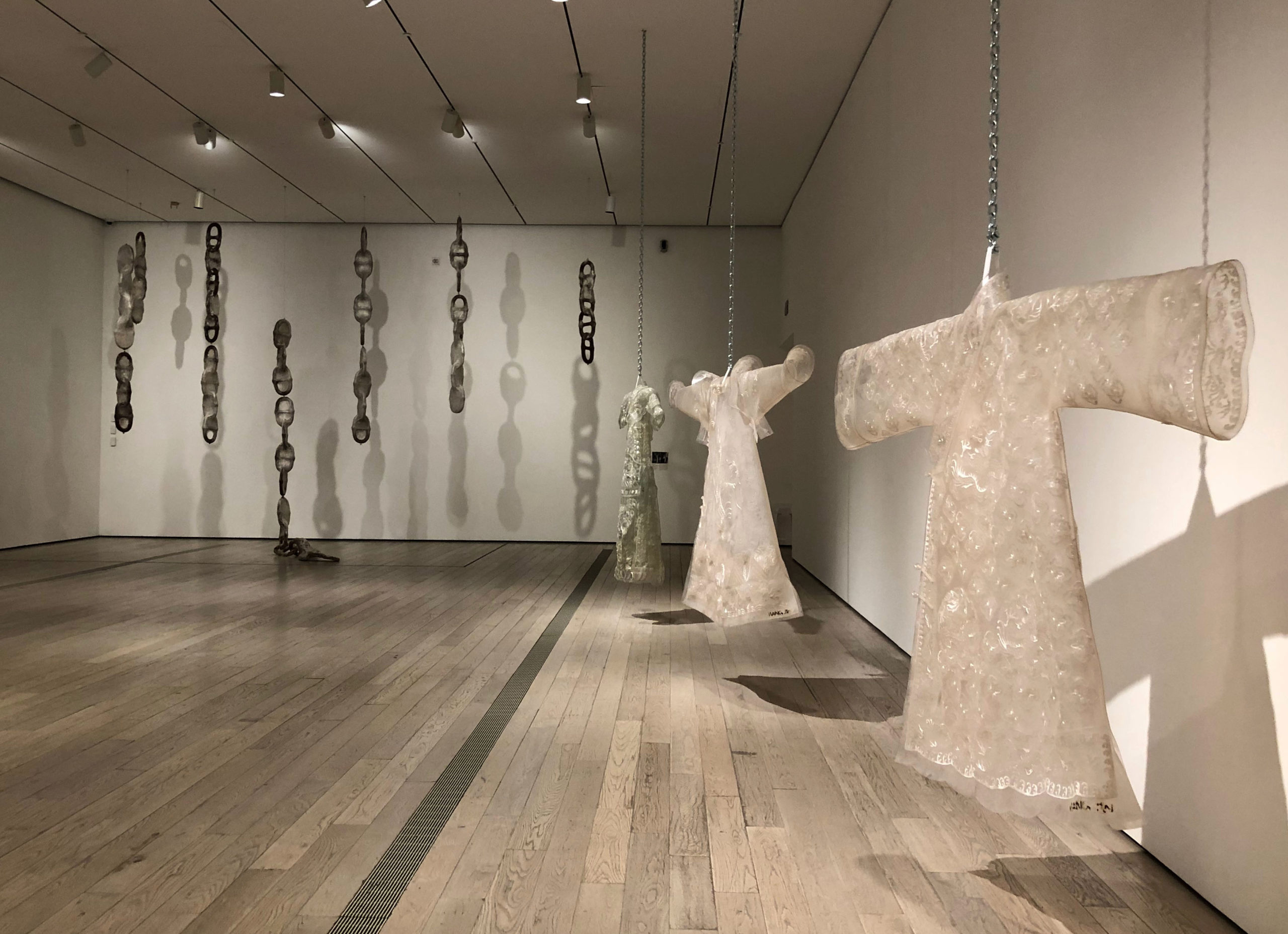
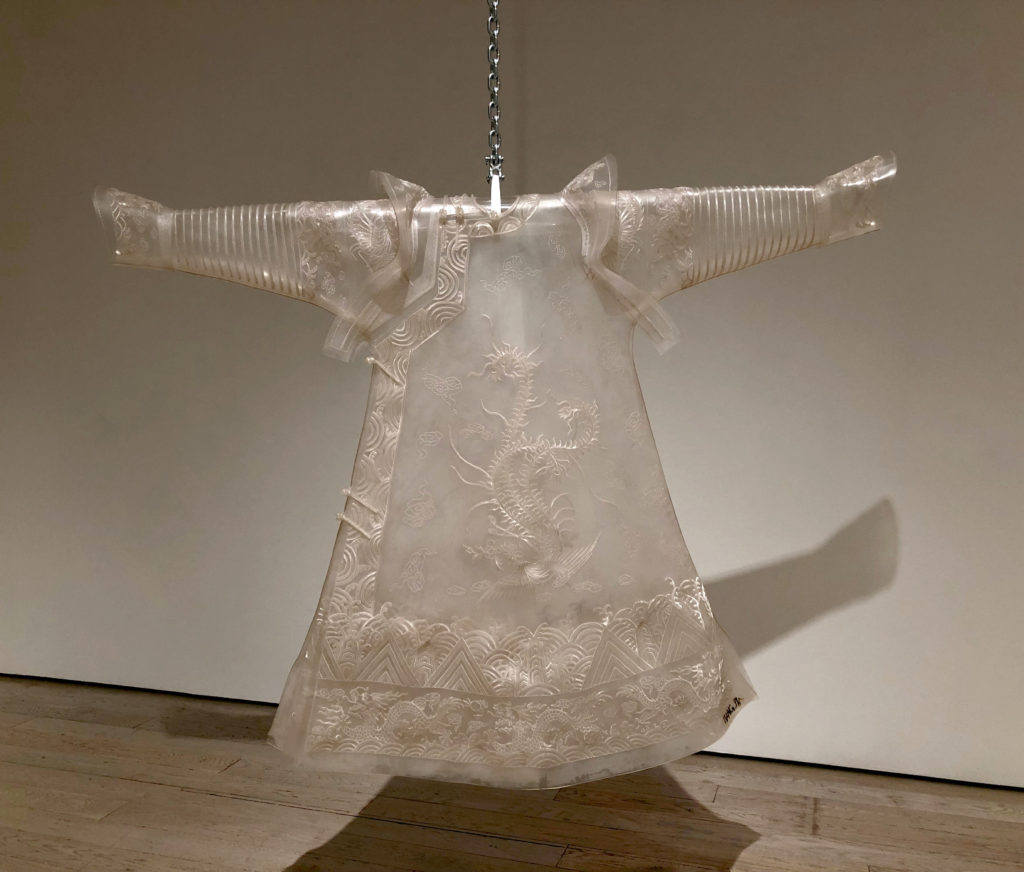
A Chinese Dream by Wang Jin

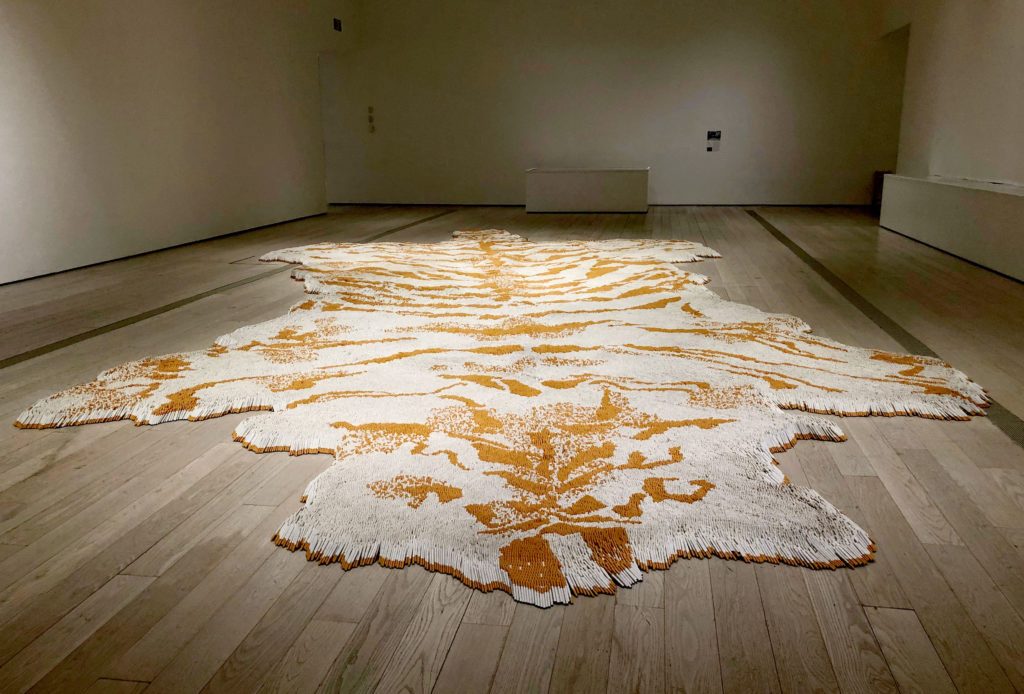
First Class by Xu Bing

First Class (detail)

Closing 1/5/20 is The Allure of Matter: Material Art from China at LACMA.

From their website-

Since the 1980s, Chinese contemporary artists have cultivated intimate relationships with their materials, establishing a framework of interpretation revolving around materiality. Their media range from the commonplace to the unconventional, the natural to the synthetic, the elemental to the composite: from plastic, water, and wood, to hair, tobacco, and Coca-Cola. Artists continue to explore and develop this creative mode, with some devoting decades of their practice to experiments with a single material. The Allure of Matter: Material Art from China brings together works from the past four decades in which conscious material choice has become a symbol of the artists’ expression, representing this unique trend throughout recent history. Some of the most influential Chinese contemporary artists today are featured in this exhibition, including Xu Bing, Cai Guo-Qiang, Lin Tianmiao, and Ai Weiwei.

There are a lot of impressive pieces in the show, including Xu Bing’s First Class, pictured above. Inspired by a photograph of a tiger-skin rug in a colonial home in Shanghai, it was created using cigarettes, also considered a luxury item by many. 

Also pictured are Wang Jin’s imperial robes/theatrical costumes that were created using PVC and fishing wire- replacing the traditional silk material. According to the wall description, the title Chinese Dream “alludes to the commercialization of tradition”. Held up by thick metal chains, they are also much heavier than the originals they copy.

Jan 032020
 

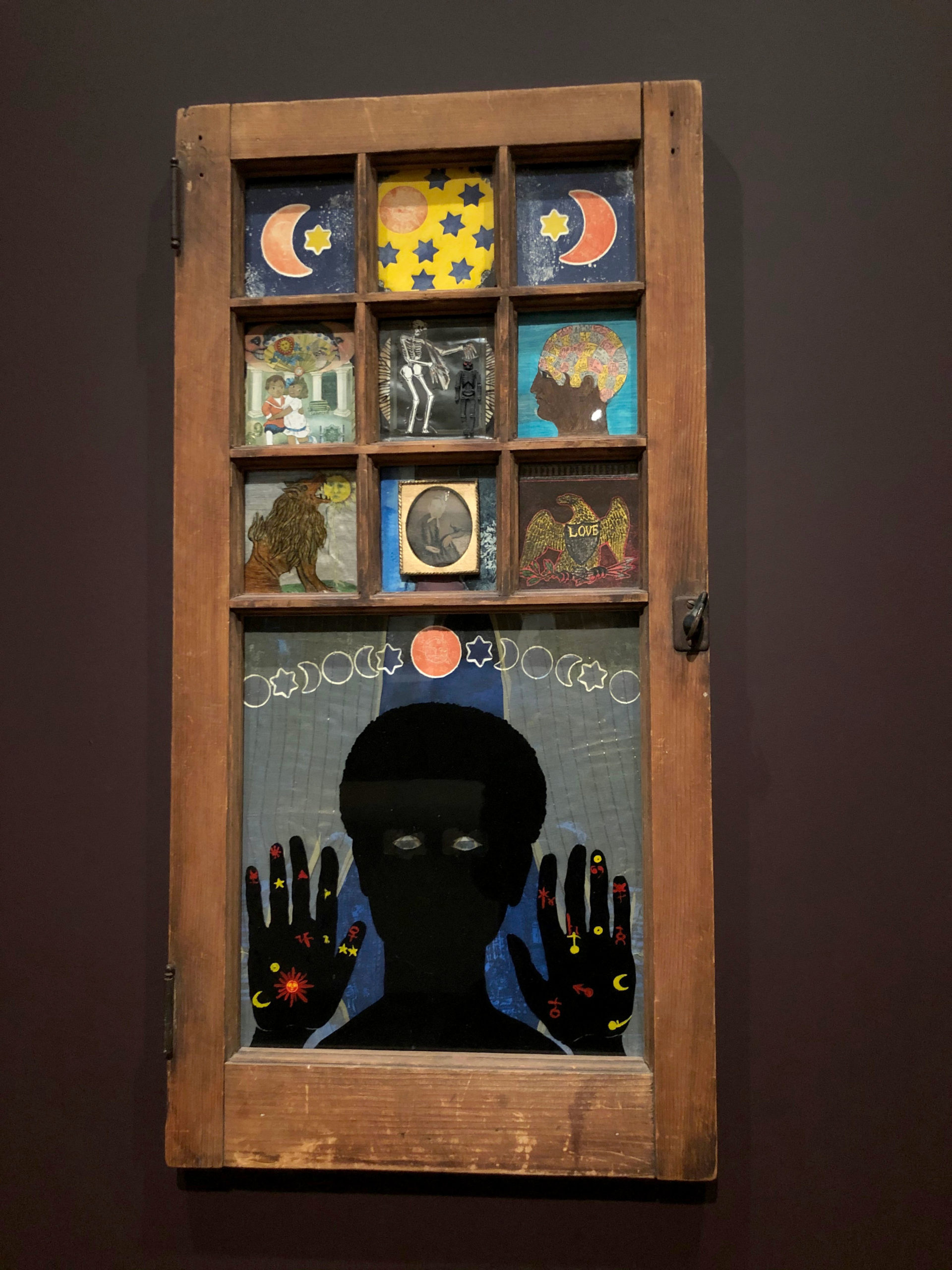
Black Girls Window, 1969

Mystic Window for Leo, 1966

As part of MoMA’s Opening Season, they are showing Betye Saar’s 1969 work, Black Girl’s Window, along with several of her works on paper.

The exhibition “explores the relation between her experimental print practice and the new artistic language debuted in that famous work, tracing themes of family, history, and mysticism, which have been at the core of Saar’s work from its earliest days.”

This exhibition closes 1/4/20.

Dec 202019
 

Artist Jennifer Bartlett has been exploring the image of the archetypal house since the 1970s. For her current exhibition at Marianne Boesky Gallery, The House was Quiet and the World was Calm: Jennifer Bartlett 1970–2014, a variety of these works are on display. It’s interesting to think of the traditional basic shape of the house, one often used to draw a house as a child, here expanded upon and explored in various ways and mediums. The viewer is also challenged to think about what they imagine when they think of the concept of house, of home.

From the press release–

… For Bartlett, the appeal of the house lies, in part, in its incredible universality. The simple square crowned with a triangle conjures an expansive array of emotions, memories, and associations across the spectrum of individuals. And in the U.S., it holds a particular place in the national psyche—a symbol of the deeply entrenched notion of the American dream. Subjected to Bartlett’s ongoing and systematic explorations of painting and printing techniques, however, the house in instances is flattened, reformulated, and distorted to a range of formal and emotional effects.

This exhibition closes 12/21/19.

Dec 192019
 

Anish Kapoor’s exhibition at Lisson Gallery’s 24th Street location is a reflective wonderland where the sculptures twist your perception of your surroundings as you move around them. If his work looks familiar, he has created many public outdoor works including Cloud Gate, also known as “The Bean”, which is permanently installed in Millennium Park in Chicago.

The exhibition continues at Lisson Gallery’s smaller 10th Avenue space with several of Kapoor’s colorful wall-based circular sculptures in semi-reflective hues.

Both of these exhibitions close 12/20/19.


Dec 192019
 

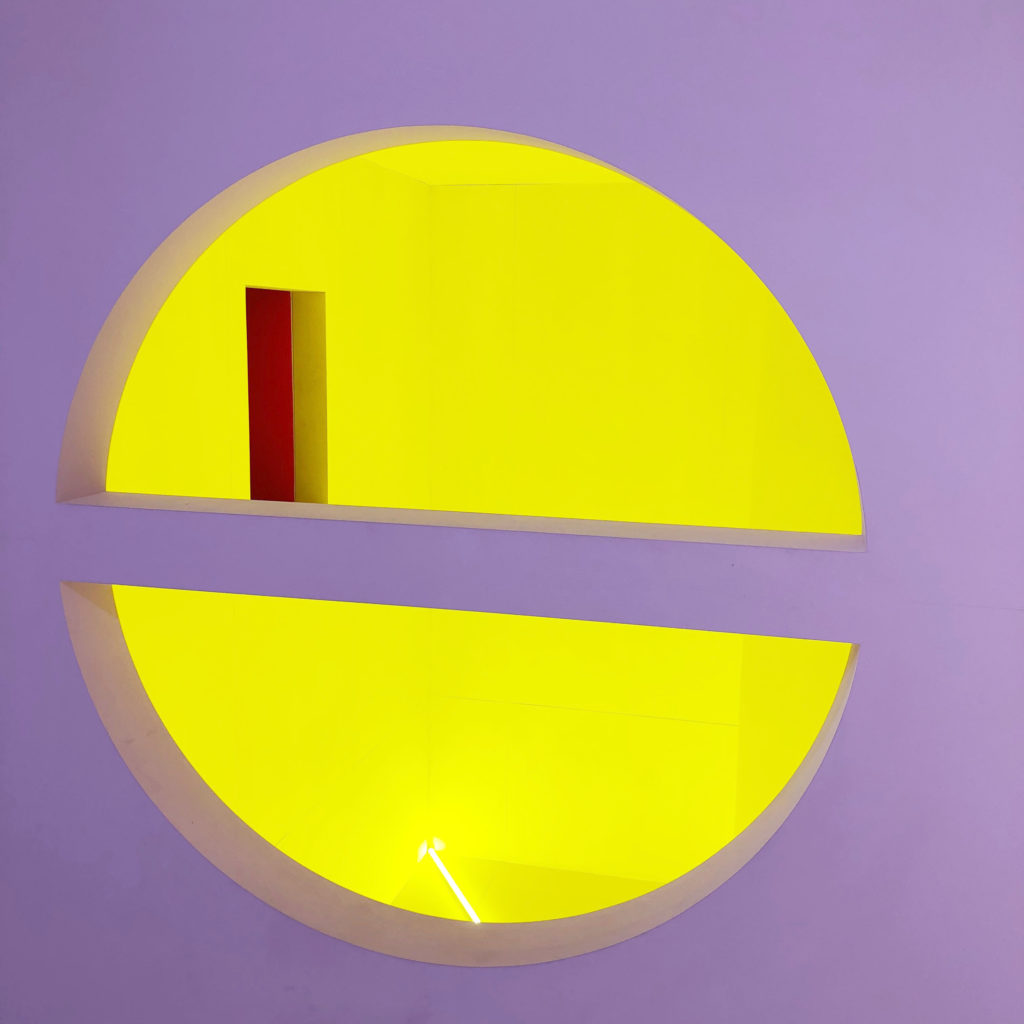
For Peter Halley’s Heterotopia II, at Greene Naftali’s ground floor gallery in Chelsea, he has created a delightful, brightly colored maze-like installation.

From the press release–

In Des Espaces Autres (1984), Michel Foucault defines heterotopia in opposition to utopia. While utopias are unrealized representations of a perfected society, heterotopias exist within all societies as realms differentiated from everyday life. Examples include ceremonial, sacred, and institutional spaces such as chapels, cemeteries, libraries, and prisons. They are spaces designated for special activities – creating their own sense of time and operating according to their own standards.

Through a range of media – painting, architectural installation, digital prints, and critical writing – Peter Halley’s work has illuminated the structures of social space and communication that shape our experience of contemporary life. For his second solo exhibition at Greene Naftali, Halley presents Heterotopia II, the latest in a series of large-scale installations exploring the relationship between painting and architectural space. Halley has created a multi-colored, labyrinthine structure in the ground floor gallery housing eight new shaped-canvas paintings, titled after imaginary planets from Isaac Asimov’s science-fictional universe.

The installation is enclosed by tall neon yellow walls coated in Roll-a-Tex, with only a narrow slot in the front wall offering the viewer a preemptive glimpse inside. The interior space is organized around a glowing yellow core – an inaccessible inner sanctum whose light is solely visible through three distinctive apertures. Around the core are arrayed eight interconnected rooms rendered in vivid colors, each defined by architectural elements, including staircases, keyhole windows, beams, and columns. The arrangement of these elements playfully nods to motifs in the work of architects Peter Eisenmann, Hans Hollein, Luis Barragán, and Louis Kahn, as well as to Halley’s own oeuvre. Halley’s installation, with its candy colored surfaces, is a postmodern reverie on neoplasticism and modernist geometry, founded on a tension between rationalist geometry and lyrical color.

Visitors circulating through the maze-like installation encounter Halley’s shaped-canvas paintings one-by-one, as the interactions between two-dimensional image and three-dimensional architecture unfolds. Composed of multiple interlocking prisons and cells, the paintings create ambiguous figure-ground relationships, while echoing the geometric plan of their three-dimensional setting.

This exhibition closes 12/20/19.

Dec 132019


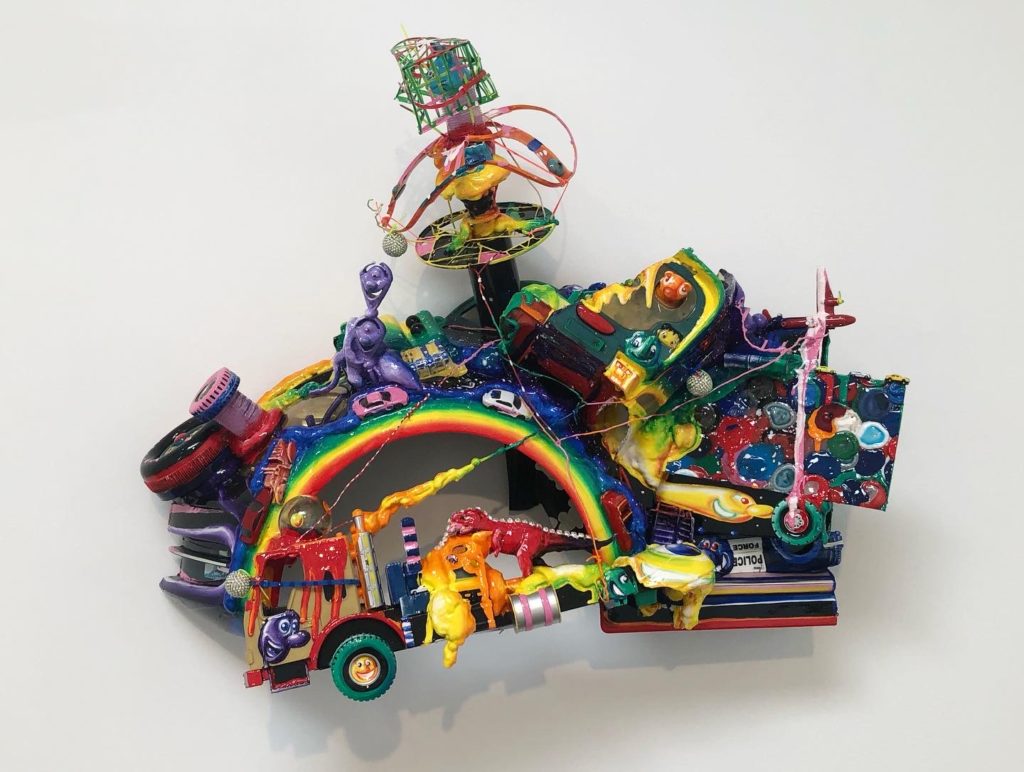
Closing on 12/14/19 is Kenny Scharf’s current exhibition at Honor Fraser, Optimistically Melting!. The exhibition includes multiple installations, paintings, and sculptures- including new ceramic work.

From the press release-

After four decades of constant production, Scharf’s latest group of paintings introduces a new subject: the still life. The trope of flowers in a vase appears throughout Western art, notably in the work of artists such as Jan Brueghel the Elder, Vincent Van Gogh, and Andy Warhol. In Flores Flores Flores (2019), happy flowers spring from a vase casually set on a table at the center. Closer inspection finds a less happy flower at the edge of the table with X’s over its eyes, a cartoon signifier of death. Further, the viewer notices the drips of darkness in the background, adding to a growing sense of unease in the work, something sinister lurks behind the pleasant centerpiece. These signifiers of global anxiety become more overt in the artist’s Sloppy Melt series of paintings, also to be included in the exhibition, which feature dripping cartoon figures and screen-printed news headlines in English and Korean about climate change. With clear memories of smog days as a child growing up in Southern California, environmental concerns have appeared throughout Scharf’s oeuvre. The artist believes it is important to be mindful of future damage we will cause to the environment if we continue to prioritize comfort and ease in the present.

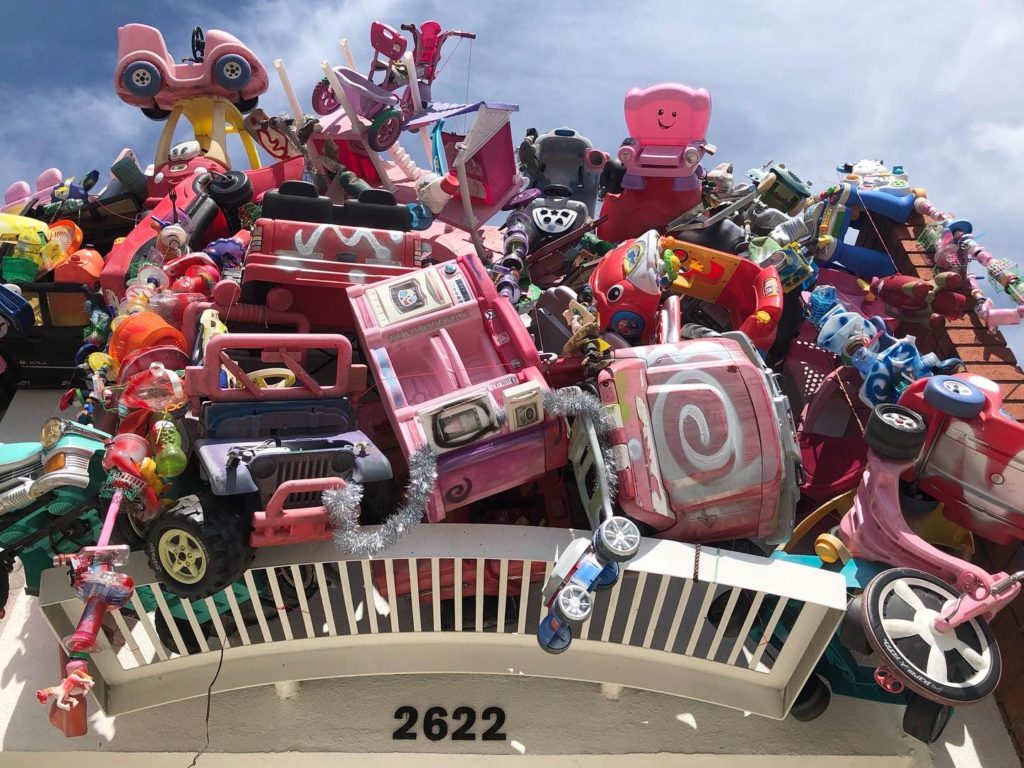
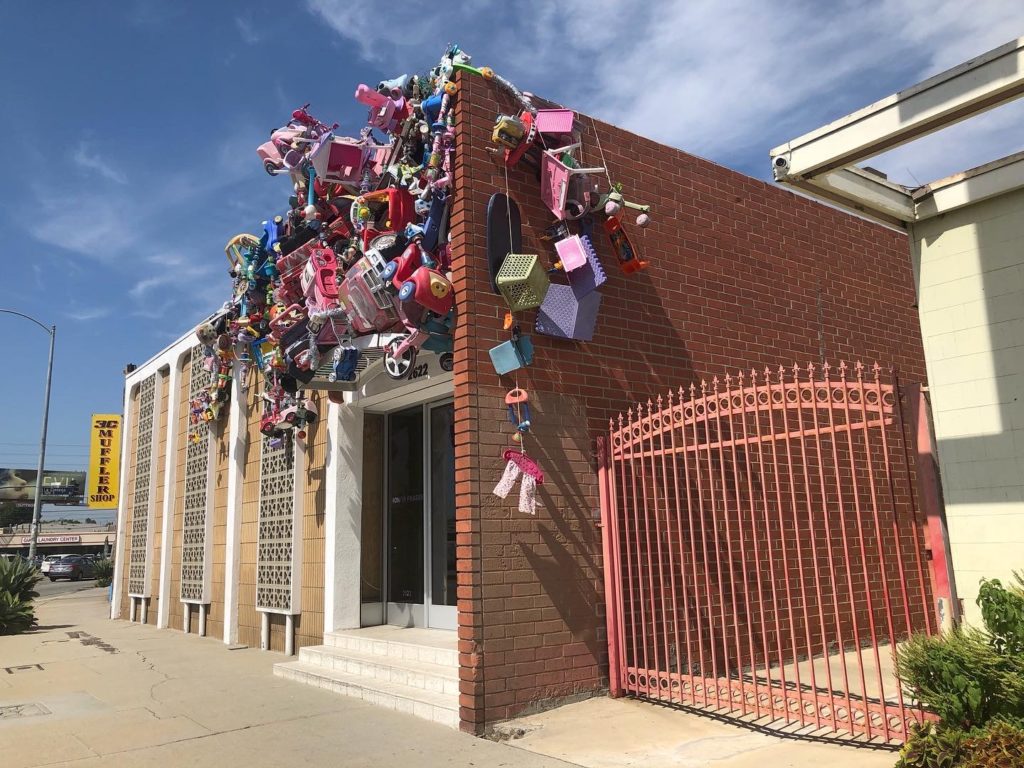
In the 80s, Kenny Scharf began collecting plastic detritus that he found along the beach in Brazil, where he was living at the time. The artist would assemble these discarded items into sculptures for the wall, giving them new life as aesthetic objects called Lixos (“trash” in Portuguese). Though the sculptural practice has continued intermittently, Scharf made a habit of collecting discarded plastics from around the world, which have not degraded over the years. More recently, the artist began collecting all of his single-use plastics and stringing them together as a garland around his studio, a constant reminder of daily waste. In light of the current reckoning with the overproduction of plastics and climate change denial, Scharf will present a new body of Lixos in the gallery along with a giant garland wrapped around the outside of the building. Materials for the garland will be collected at Honor Fraser Gallery throughout the summer and leading up to the exhibition. In addition to creating a personal alternative to recycling methods that require more toxic chemicals, Scharf aims to shine more light on this urgent issue. As in his paintings, deep concerns about our future lie beneath these brightly colored works.

Expanding his sculptural practice, Kenny Scharf will unveil a group of large ceramics featuring his signature characters in the round. Produced in collaboration with Stan Edmondson in Pasadena, these works were fired locally and hand-glazed by the artist. Bordering on living sculpture, the pots will contain greenery to be nurtured beyond the term of the exhibition, a gesture of possibility and hope rom the artist. In addition to converting carbon dioxide into oxygen, caring for plants has proven to be a beneficial practice for humans as it requires patience, reduces stress, and promotes close observation. These plants grown by the artist himself contain Scharf’s intention for a more respectful and conscientious future.

Dec 122019
 

Petzel Gallery is currently showing Walead Beshty’s solo show “Abstract of A Partial Disassembling of an Invention Without a Future: Helter-Skelter and Random Notes in Which the Pulleys and Cogwheels Are Lying Around at Random All Over the Workbench”. The sheer volume of work covering the walls is overwhelming and impressive in its assembly.

From the press release-

The work A Partial Disassembling of an Invention Without a Future: Helter-Skelter and Random Notes in Which the Pulleys and Cogwheels Are Lying Around at Random All Over the Workbench, was originally commissioned by the Barbican Centre, London. The London-born, Los Angeles-based artist first exhibited the work there in 2014, covering the 273 ft long Curve gallery from floor to ceiling in cyanotype prints. The prints were produced over the duration of a year (October 9, 2013–October 8, 2014) and are chronologically installed in proportion to the exhibition space. For its New York première at Petzel, approximately 5,120 cyanotypes (38% of the total 15,616 sq. ft work) will be presented.

In A Partial Disassembling of an Invention … , each cyanotype (a 19th Century photographic process using ferric ammonium citrate and potassium ferro-cyanide) was produced by placing tools and other objects used in the production process of the studio on cellulose waste material generated by that same process (such as wood, cardboard, or paper) that was coated with UV-sensitive cyanotype material. After being exposed to sunlight and washed in water, the object’s silhouette appears in reverse against a cyan-blue background.

In using everyday objects, such as receipts, prescriptions, invoices, financial statements, legal documents, letters, gallery invitations, etc. from the working life of the studio, an inherent transparency is embedded in the work, demystifying the artwork and exposing its process of coming to be. Representative of the lives of those who made it, the cyanotypes expose both aspects of identity and circumstance, situating the work within political, social, and economic exchange without being representational or depictive in the conventional sense. While both the Barbican and Petzel iterations deal with debris, this new display has a more overtly American immediacy to it. Considering the resurgent discourse on the politics of representation, there is a new urgency to exhibiting the work for the questions it evokes about the modes and uses of representation, such as how art can accurately display real world conditions of labor, production and power, and whether a truly accurate and transparent form of representation is possible.

Beshty will also show Prologue to A Partial Disassembling of an Invention Without a Future: Helter-Skelter and Random Notes in Which the Pulleys and Cogwheels Are Lying Around at Random All Over the Workbench, which are the cyanotypes that were produced in anticipation of the Barbican work from August 1, 2013–October 8, 2013, along with seven volumes of the 59-volume archive of the work. The books—in their Prologue and Opus volumes—comprise bound pages printed recto and verso of the entire work reproduced at 1:2 scale. The volumes create both an archival record of Beshty’s workspace as well as an index of all the tools and artefacts used for the work’s own making.

The title of the project is a reference to Hollis Frampton’s hypothetical lecture he muses about in a talk delivered at the Whitney Museum of American Art, but never actually gives. The title of this phantom lecture alludes to the origins of the medium, and its inevitable obsolescence. It also calls forward the question of the role objects play when they have ceased being useful. Wrenched by time from their intended use, the objects become purely aesthetic, becoming the focus of contemplation in both historical and poetic terms.

This exhibition closes 12/14/19.