Jan 252024
 

The Mangrove Refuge (The Vorasane Family and Friends; Gandy Beach circa 1980) by Michael Vasquez was created for the 2023 edition of SHINE Mural Festival in St. Pete, Florida.

The artist’s statement about the mural-

A displaced Lao family (and friends) find refuge and a moment of reflection amidst the mangroves of Tampa Bay’s Gandy Beach.

A 1978 Datsun 280Z serves as a centerpiece and point of pride, fusing together car culture and masculinity. Similar aspects of clothing and style signal togetherness, emulation, and a shared sense of identity—yet their solitary gazes set them apart from one another and allude to a deeper and more personal past, present, and future…

Vasquez is currently part of the group show TRADITIONS: Honoring Heritage, Ritual and Family at Muzeo in Anaheim, California. The show is curated by Thinkspace and Tlaloc Studios and is on view until 2/25/24.

Also check out his Instagram for current work.

Jan 252024
 

The image above is of Squeak Carnwath’s painting, Best Borrowed, 2005, Oil and alkyd on canvas, taken at Palm Springs Art Museum in 2018.

A solo exhibition of her work is currently at Pt.2 Gallery in Oakland, California, on view until 2/16/24.


Jan 222024
 

Ride on the sPEACEship! by Chris Dyer was created for the 2023 SHINE Mural Festival in St. Pete, Florida.

Check out more of his work on Instagram.

Jan 202024
 

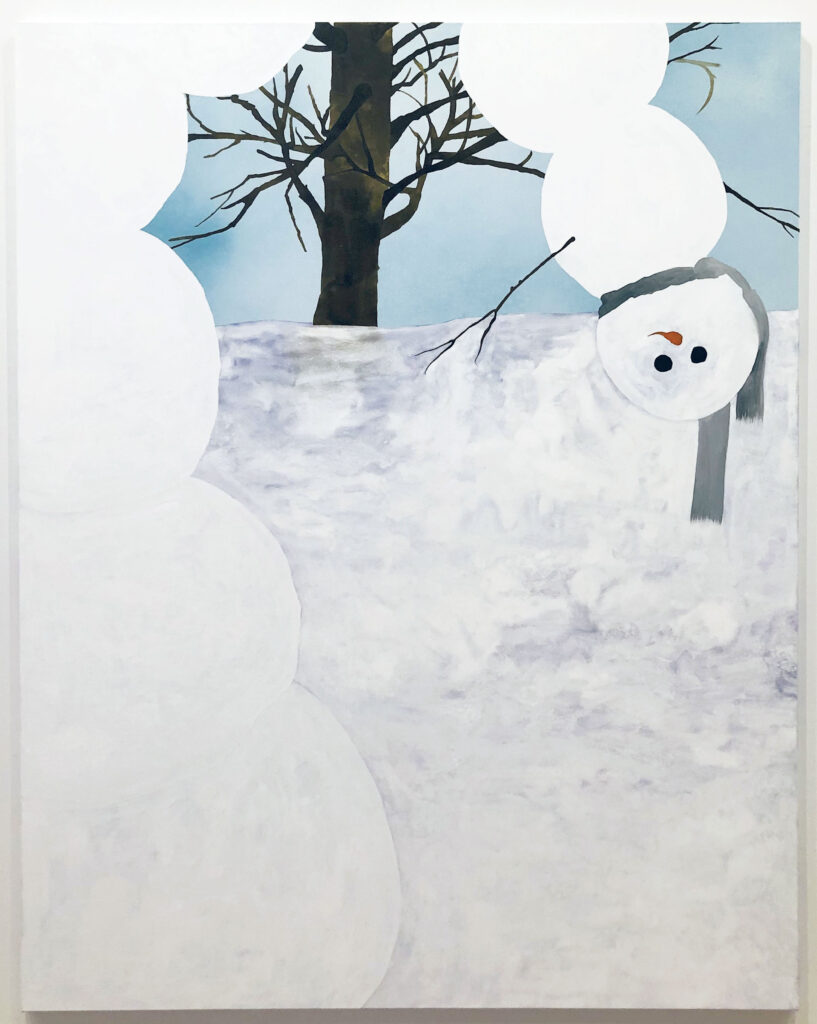
Calvin Marcus’ Tall Snowman, 2019, (Watercolor and vinyl paint on linen), was one of several of his large paintings included in Whitney Museum’s 2019 Biennial.

He and fellow Los Angeles artist Laura Owens will be in an exhibition together at Gaga gallery’s Guadalajara, Mexico location, opening 2/2/24.

Jan 192024
 

Pictured above is Drossos P. Skyllas‘ painting, Wisconsin Ice Cave, 1950, part of LACMA’s 2018 exhibition, Outliers and American Vanguard Art.

About the artist from the National Gallery of Art in Washington D.C. where the exhibition was also on view-

Drossos Skyllas achieved the exquisitely detailed, jewel-like surfaces of his paintings with tiny brushes he fashioned himself. He applied miniscule dabs of luminous oil paint in a pointillist manner, which gave his subjects a petrified yet shimmering quality. His refined technique and adherence to the academic genres of still life, landscape, portraiture, and mythological scenes demonstrate his knowledge of art history. And inspired by the old masters, he perfected the difficult depiction of reflective surfaces, including gems, mirrors, water, and ice. At the same time, his uniform clarity of detail, imposed symmetry, and sense of frozen time create a dreamlike mysteriousness reminiscent of magic realism. In addition to high art sources, Skyllas likely drew upon commercial illustration and photography. Untitled (Roses) resembles both traditional floral still lifes and midcentury advertisements for jewelry and flowers. Wisconsin Ice Cave relates as much to northern Renaissance landscape painting as to mass-produced picture postcards.

Born in Greece, Skyllas worked in his father’s tobacco business before emigrating to the US shortly after World War II. He settled in Chicago and devoted himself to becoming a professional artist, though he had no formal artistic training. Supported financially by his wife, Skyllas produced thirty-eight paintings from the late 1940s until his death in 1973. Some of these he submitted to the annual juried exhibition at the Art Institute of Chicago, Chicago and Vicinity, which featured his work in 1955, 1967, 1969, and 1973. He also sought commissions to paint portraits, but with asking prices as high as $30,000, he never found any patrons.

Skyllas’s work was discovered after his death by Chicago gallerist Phyllis Kind, who added him to her roster of self-taught artists in 1974. He was likely known to artists Jim Nutt and Gladys Nilsson before this, as they had exhibited alongside him in the 1967 Chicago and Vicinity exhibition and are enthusiastic collectors of self-taught artists (Wisconsin Ice Cave is in their collection). The meticulous finish of Skyllas’s paintings, which simultaneously evokes advertising art and Renaissance illusionism, appealed to Nutt, Nilsson, and fellow Chicago imagist Roger Brown, whose art collection also included the self-taught Greek master.


Jan 162024
 

(photograph by Richard Avedon from The New Yorker’s website)

Above is Richard Avedon’s portrait of Martin Luther King Jr. with his father, Martin Luther King, and his son, Martin Luther King III, 1963. The image is part of the 1964 book Nothing Personal, Avedon’s collaboration with writer James Baldwin.

Jan 112024
 

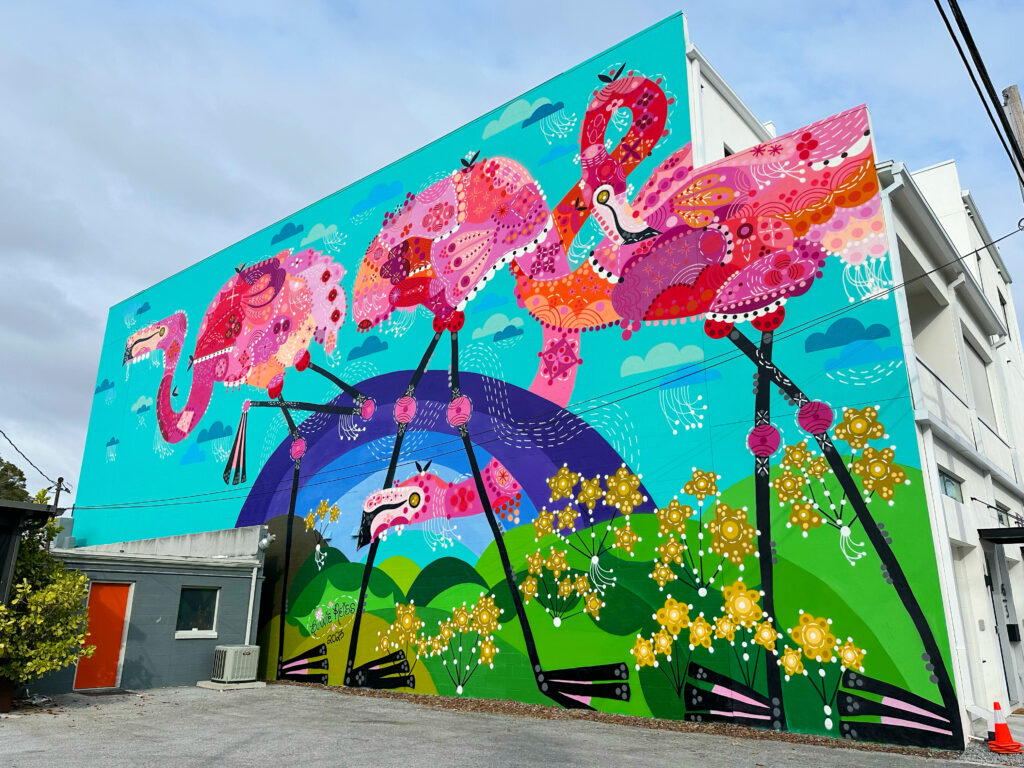
This mural by Bunnie Reiss was created for the 2023 edition of the SHINE Mural Festival in St. Pete, Florida.

Also check out her Instagram for updates on her current work.

Jan 022024
 

Frank Weston Benson, “Natalie”, 1917, Oil on canvas

Childe Hassam, “Gathering Flowers in a French Garden”, 1888, Oil on canvas

Luther Emerson Van Gorder, “In the Park”, before 1894, Oil on canvas

Tampa Museum of Art’s current exhibition, Frontiers of Impressionism: Paintings from the Worcester Art Museum, features paintings by American and European impressionists and is a lovely reminder of the extraordinary works these artists created during this time period. The enduring popularity of the impressionists throughout the years makes sense when walking among these paintings. The use of color and brush work, as well as the details and beauty of the subject matter (not to mention the wealth and comfort often depicted)- make the viewer feel like they are being transported through time to the artist’s idyllic world.

From the museum-

In 2024, the term “impressionism” celebrates its 150th anniversary. Such a significant occasion inspires reflection on the profound impact that a relatively small group of artists in Paris made by positing a new mode of painting: one that favored painting outdoors over in a studio, immediacy over planning, the everyday over the grand, and the fleeting over the eternal. In doing so, the impressionists upended centuries of traditions in European art. This exhibition explores the radical impulses behind impressionism and its seemingly endless adaptability, as artists from around the world came to Paris to study and returned to their homelands, assimilating what they had absorbed and propelling the movement further.

The Worcester Art Museum pioneered new artistic horizons by embracing impressionism early in its history. The French and American impressionism collections at the Worcester Art Museum have long drawn visitors to the galleries. The first directors purchased works by Monet from his Parisian dealer, Durand-Ruel, as well as directly from American impressionists, making the Museum one of the first in the United States to collect impressionism actively as contemporary art. Over the past 125 years, this collection has grown, encapsulating the story of the movement’s roots and emergence in France and its subsequent expansion to the United States, Germany, Scandinavia, and beyond. Highlighting more than 30 artists, including Claude Monet, Pierre-Auguste Renoir, Camille Pissarro, Mary Cassatt, Childe Hassam, and Max Slevogt, this exhibition demonstrates impressionism’s international allure, captured in subjects as far-flung as Monet’s famed Giverny lily pond to the natural wonders of the Grand Canyon.

Below are a few more selections from the show.

Max Slevogt, “Selbstbildnis im Garten (A Self-Portrait in the Garden at Godgramstein), 1910, Oil on canvas

Max Slevogt, “Selbstbildnis im Garten (A Self-Portrait in the Garden at Godgramstein), 1910, Oil on canvas (detail)

Paul Signac, “Golfe Juan”, 1896, Oil on canvas

Thomas Cole, “View on the Arno, near Florence”, 1837, Oil on canvas

Lovis Corinth, “Vordem Spiegel (At the Mirror)”, 1912, Oil on canvas

John Singer Sargent, “Katherine Chase Pratt”, 1890, Oil on canvas

About the unfinished painting above (from the museum)-

A successful society portraitist, Sargent painted the elite from his international social circles. In June 1890, Sargent visited Worcester, Massachusetts, where he was inundated by requests for portraits. The sitter’s father, Frederick Pratt, a noted collector and eventual acting director of the Worcester Art Museum (1908 and 1917), became friends with the artist and invited him to return a few months later to paint his daughter, Katherine- although the idea for Katherine’s portrait originated in Sargent’s first trip to Worcester, when he had made a sketch of hydrangeas. Sargent’s vision of Katherine against a backdrop of flowers, however, proved less than satisfactory for his client and he abandoned the painting for another, more formal depiction. As an unfinished work, this painting reveals the immediacy of Sargent’s process, with careful attention to broad swaths of color and patterns in the brushwork to convey flower petals or folds of clothing.

This exhibition will be on view until 1/7/2024.

Dec 292023
 

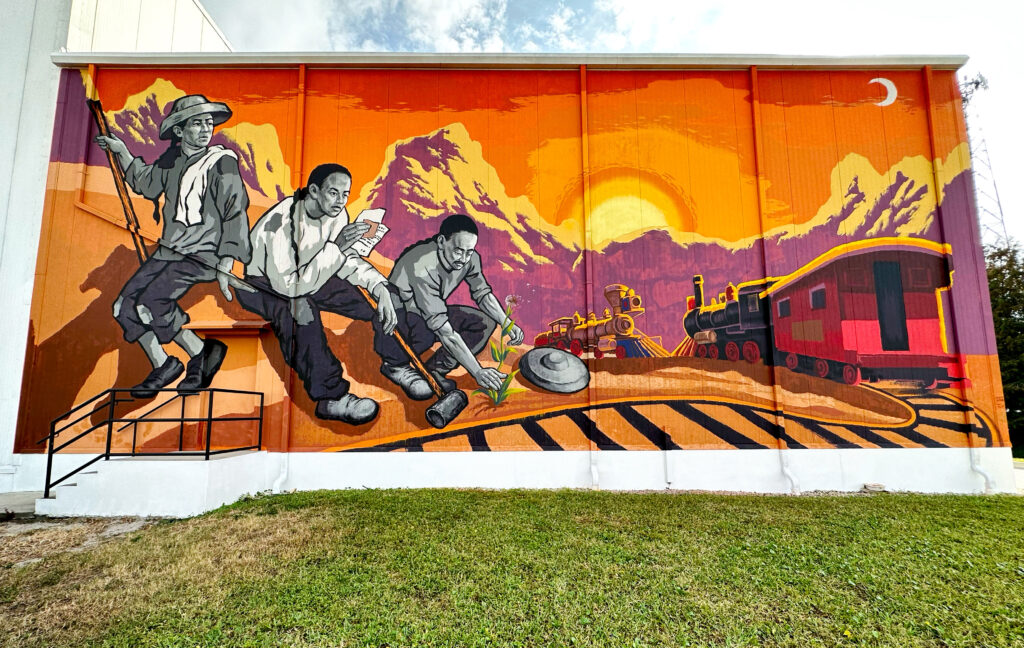
This year The James Museum partnered with SHINE Mural Festival and Chenlin Cai to create the mural seen above, The Path We Came. It was inspired by the museum’s current exhibition From Far East to West: The Chinese American Frontier.

Dec 292023
 

Hung Liu “Portrait of China Mary”, 2006, Oil on canvas

Currently at The James Museum in St. Pete, is From Far East to West: The Chinese American Frontier, an informative show that includes many beautiful paintings. There’s so much history in America that often doesn’t get taught in school. This is a great opportunity to learn about this immigration story through artwork as well as text.

From the museum about the exhibition-

While European American settlers gradually pushed the United States frontier westward throughout the 1800s, the West coast of the country was developing independently as well. Accelerated by the discovery of gold mid-century, the population boom included Chinese immigrants who crossed the Pacific Ocean to California.

Most 19th century Chinese immigrants came to their new country from the coastal Canton region (province of Guangdong today) in southeastern China. Starting over on a different continent away from familiar surroundings and culture would be challenging, but for many decades anti-Chinese hostility and exclusion laws made settling in the United States even more difficult. The achievements of Chinese immigrants paved a path for future generations and are a testament to strength and perseverance.

The foundation for the exhibition highlights narratives of Chinese America from the 1850s to the 1930s. The paintings-all created by Chinese Americans in the 21st century-reflect inspiration from this history. The painters are also fueled by their own, more recent immigration stories to the United States after China’s Cultural Revolution (1966-1976) and their rigorous art training in the government-sponsored movement of Socialist Realism. After China opened to the rest of the world in the late 1970s, many Chinese artists-like Mian Situ, Jie Wei Zhou, Benjamin Wu, Hung Liu, and Z.S. Liang, all featured here were inspired to immigrate to the United States in search of greater opportunity.

Here, these artists’ historical interpretations speak to culture, identity, community, and resilience. Related objects and ephemera from the period support these stories. From the Gold Rush to Angel Island, this exhibition reveals often overlooked but significant contributions and perspectives of Chinese immigrants that deepen our understanding of U.S. history.

Hung Liu “Dandelion with Small Bird”, 2017 Mixed media

About the above painting from the museum-

Dandelions and their fluffy seed pods can be found anywhere in the world and thrive wherever they land. Their migratory nature allows them to survive a journey across vast lands even across oceans and take root anywhere in the world. For Liu, the dandelion represents her own tenacity and ability to thrive in the face of adversity.

The dandelions, fragile in nature and tattered by the lightest breeze, mimic how images, and personal narratives, too, can be scattered by time and the winds of history —as well as by the rhythms of feast and famine …
–Hung Liu

Mian Situ “Blasting a Route Through the Sierra Nevada, 1865, Central Pacific Railroad”, 2018, Oil on canvas

Mian Situ “The Gold Seekers , Chinese Camp, 1850”, 2015, Oil on canvas

Jie Wei Zhou “Dragon Parade”, 2012, Oil on Linen

This exhibition is on view until 1/28/24.