Jul 032023
 

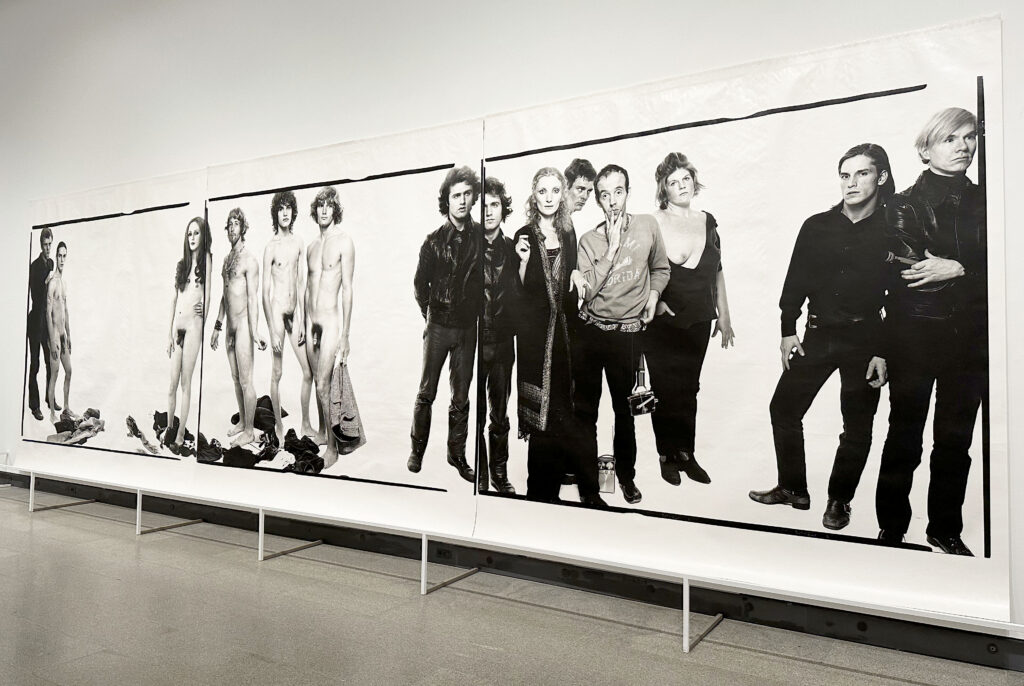
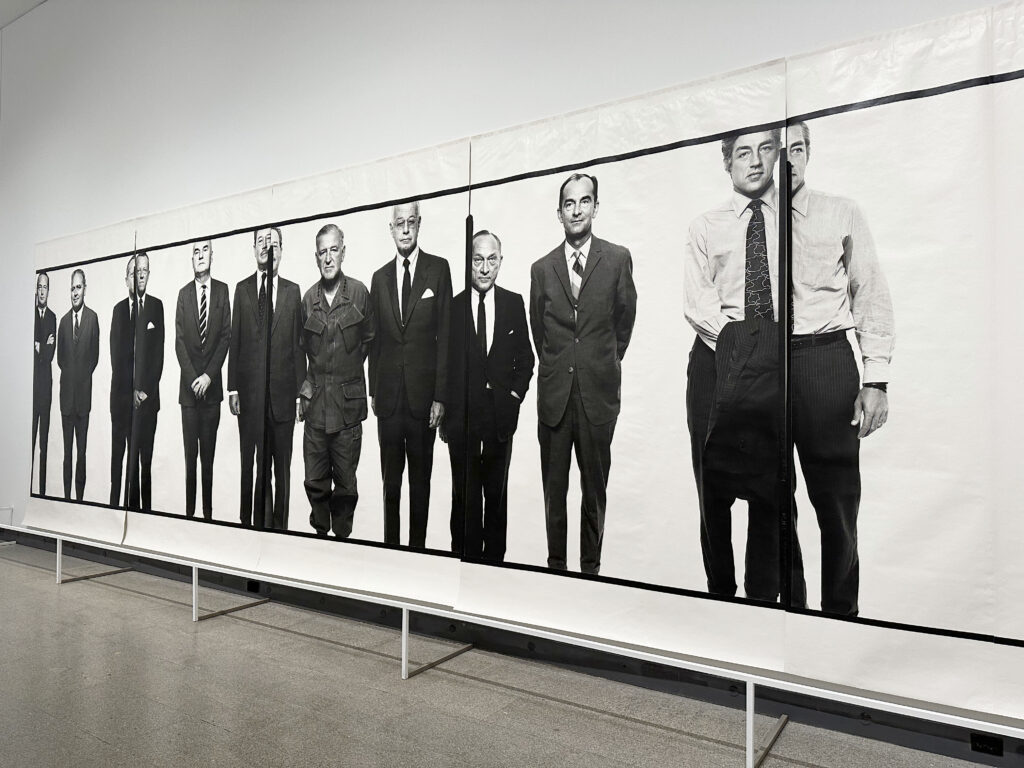
There are currently two exhibitions in New York celebrating Richard Avedon’s photography. At The Metropolitan Museum of Art is Richard Avedon: Murals. Pictured above are two of the large murals included. The first is of Andy Warhol and members of The Factory and the other is of members of the Mission Council in Saigon.

From The Met’s website about the show-

In 1969, Richard Avedon was at a crossroads. After a five-year hiatus, the photographer started making portraits again, this time with a new camera and a new sense of scale. Trading his handheld Rolleiflex for a larger, tripod-mounted device, he reinvented his studio dynamic. Instead of dancing around his subjects from behind a viewfinder, as he had in his lively fashion pictures, he could now stand beside a stationary camera and meet them head-on. Facing down groups of the era’s preeminent artists, activists, and politicians, he made huge photomural portraits, befitting their outsized cultural influence. On the centennial of the photographer’s birth, Richard Avedon: MURALS will bring together three of these monumental works, some as wide as 35 feet. For Avedon, the murals expanded the artistic possibilities of photography, radically reorienting viewers and subjects in a subsuming, larger-than-life view.

The murals are society portraits. In them, Avedon assembles giants of the late twentieth century—members of Andy Warhol’s Factory, architects of the Vietnam war, and demonstrators against that war—who together shaped an extraordinarily turbulent era of American life. Presented in one gallery, their enormous portraits will stage an unlikely conversation among historically opposed camps, as well as contemporary viewers. The formal innovations of Avedon’s high style—of starkly lit bodies in an unsparing white surround—are best realized in these works, where subjects jostle and crowd the frame, and bright voids between them crackle with tension. Uniting the murals with session outtakes and contemporaneous projects, the exhibition will track Avedon’s evolving approach to group portraiture, through which he so transformed the conventions of the genre.

About Andy Warhol and members of The Factory

Avedon fantasized about throwing an annual fete for New York society and watching the group evolve over time. This mural is his downtown take on such a party, featuring a new “smart set” of sexual revolutionaries. They were affiliated with Andy Warhol’s Factory, the studio and gathering place for a coterie of avant-garde filmmakers, artists, and socialites. Avedon summoned them to his own studio, where they met over a series of weeks. Working in his most directorial mode, he arranged his subjects—including transgender actress Candy Darling and adult film star Joe Dallesandro—in a lateral frieze across adjoining frames, the fracture and repetition of their bodies in space suggesting the filmic passage of time.

The culmination of much trial and error, the mural’s composition took time to perfect, as evidenced by session outtakes displayed nearby. Avedon later praised the professionalism of his cast but joked, “You couldn’t keep the clothes on anybody in those years. . . . Before you could say ‘hello,’ they were nude and ready to ride.” If this unabashed undress tests gallery decorum, it is a provocation grounded in art history: in the central panel Avedon presents a male version of the “three graces,” riffing on a gendered tradition in allegorical painting with an ironic, Warholian wink.

About The Mission Council, Saigon, South Vietnam

Avedon knew he would have mere minutes to photograph the U.S. generals, ambassadors, and policy experts who ran the war in Vietnam—not the weeks he spent refining his first mural. Planning in advance, he requested the heights of the men known collectively as the Mission Council and mapped out their positions, with careful attention to rank and influence. He rigged a makeshift studio at the embassy in Saigon, and recalled that once assembled, they “lined up like high school boys. They all wanted to be in the picture.” This is true of all but Ted Shackley, the camera-averse CIA station chief known to colleagues as the Blond Ghost, who begged out of the sitting for “a meeting,” leaving a void in the rightmost panel.

As blunt and procedural as a police lineup, the mural recalls Avedon’s first photography gig as a teenager in the Merchant Marine, where he made mugshot-style portraits of new recruits. Here, scrutinizing the faces of the war’s top brass, Avedon invokes their unseen operatives and victims. When the work was later published, one critic deemed it “a terrifying picture of business as usual.”

This exhibition closes 10/1/23.

For a more comprehensive look at Avedon’s career, Gagosian’s Chelsea location is showing Avedon 100, “a collection of Avedon photographs was selected by more than 150 people—including prominent artists, designers, musicians, writers, curators, and fashion world representatives—who elaborate on the impact of the photographer’s work today.”

The gallery’s website has a video of the installation that is well worth checking out, especially if you can’t see the exhibition in person.

This exhibition will close on Friday, 7/7/23.

Jun 292023
 

Judy Pickett is an Orlando based artist who often shows her work at Soft Water Gallery in St. Pete, Florida. Her beautiful cyanotypes are painted with encaustic to give them added texture.

Jun 192023
 

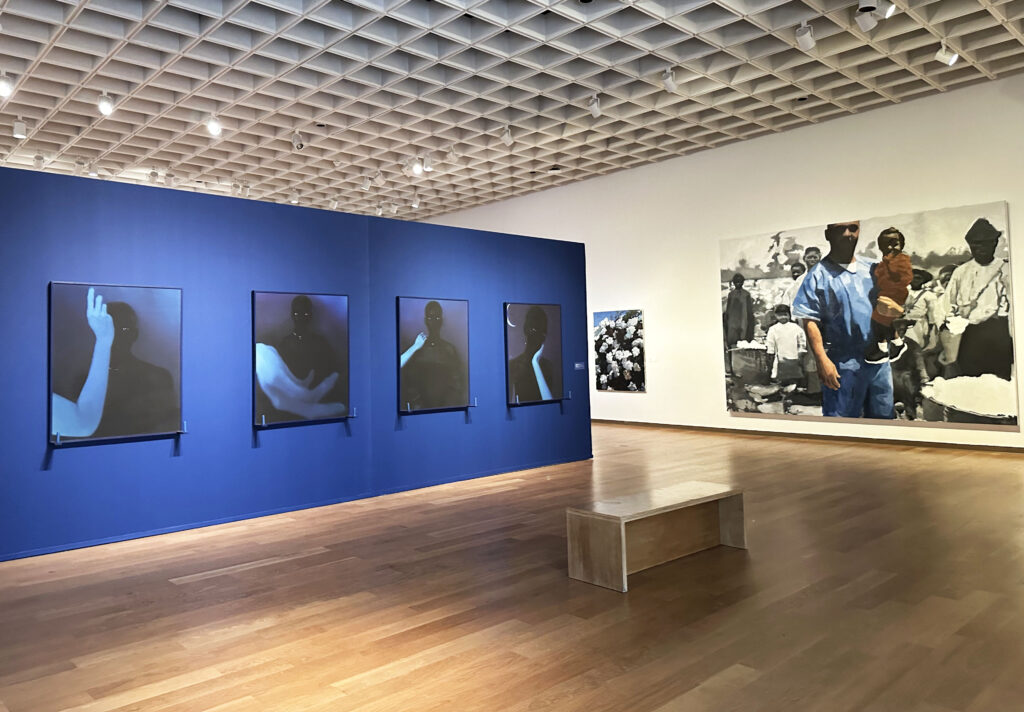
Robert Pruitt, “A Song for Travelers”

Brooklyn Museum’s exhibition, A Movement in Every Direction: Legacies of the Great Migration, is an opportunity to learn about an important period of American history, and see it interpreted through the eyes of twelve contemporary artists.

From the museum’s website-

Between 1915 and 1970, in the wake of racial terror during the post-Reconstruction period, millions of Black Americans fled from their homes to other areas within the South and to other parts of the country. This remarkable movement of people, known as the Great Migration, caused a radical shift in the demographic, economic, and sociopolitical makeup of the United States. A Movement in Every Direction: Legacies of the Great Migration brings together twelve contemporary artists to consider the complex impact of this period on their lives, as well as on social and cultural life, with newly commissioned works ranging from large-scale installation, immersive film, and tapestry to photography, painting, and mixed media. Featured artists are Akea Brionne, Mark Bradford, Zoë Charlton, Larry W. Cook, Torkwase Dyson, Theaster Gates Jr., Allison Janae Hamilton, Leslie Hewitt, Steffani Jemison, Robert Pruitt, Jamea Richmond-Edwards, and Carrie Mae Weems.

A Movement in Every Direction presents a departure from traditional accounts of the Great Migration, which are often understood through a lens of trauma, and reconceptualizes them through stories of self-possession, self-determination, and self-examination. While the South did lose generations of courageous, creative, and productive Black Americans due to racial and social inequities, the exhibition expands the narrative by introducing people who stayed in, or returned to, the region during this time. Additionally, the Brooklyn Museum’s presentation centers Brooklyn as another important site in the Great Migration, highlighting historical and contemporary census data about the borough’s migration patterns. Visitors are encouraged to share their own personal and familial stories of migration through an oral history “pod” available in the exhibition galleries.

About Robert Pruitt’s work, pictured above, from the museum’s wall information plaque-

“A Song for Travelers” celebrates the individual and Black collective experiences that have shaped the histories of rural East Texas and Houston’s Third, Fourth, and Fifth Wards. In this drawing-based on an early 1970’s photograph of a reunion of the artist’s family in Dobbin, Texas -sixteen people gather around a seated central figure about to embark on a journey. During the creation of this work, the masked traveler became a stand-in for Pruitt, who had recently left his hometown of Houston.

Pruitt often draws inspiration from his and others’ family photographs while examining historical events that have impacted Houston’s Black communities. Wearing costumes and adorned with items that reference various aspects of Black culture found in schools, social clubs, and religious spaces, the figures in the work reflect the numerous networks that remained and flourished in the South. Merging the Great Migration period with the present, Pruitt centers the Black neighborhoods across the southern region that served as safe havens and rich sites of cultural expression for migrants during the twentieth century. This link extends to today as many Black Americans leave the northern and western cities that once attracted their elders and return to the South.

Allison Janae Hamilton’s A House Called Florida, below, takes the viewer on a journey through part of northern Florida’s natural beauty.

From the museum’s information plaque about the video installation-

Allison Janae Hamilton produced the three-channel film installation A House Called Florida in her hometown region of northern Florida. The breathtaking landscapes of Apalachicola Bay and the swampy Blackwater Lakes of Florida’s Big Bend frame musicians, dancers, motorists, a Victorian house, and a slow resounding rhythm.

The artist references French Argentinian writer Julio Cortázar’s 1946 short story “Casa Tomada.” (“House Taken Over”) about ghosts that slowly take over a home and eventually push out its owners, room by room. Hamilton echoes the story’s theme of displacement with two regally dressed, spirit-like protagonists who move about the house engaging in mark-making and ritual performances. Hamilton’s film pays tribute to the Black Floridians who remained in the Red Hills and the Forgotten Coast regions, despite the racial violence and environmental precariousness they faced throughout the nineteenth and twentieth centuries.

Carrie Mae Weems‘ personal and moving contribution is in two parts- a series of photographs and a unique digital video installation.

The museum’s description of the work-

Carrie Mae Weems explores a painful family story: the disappearance of her grandfather Frank Weems, a tenant farmer and union activist who was attacked by a white mob in Earle Arkansas, in 1936. Presumed dead, he narrowly escaped and made his way to Chicago on foot, never again reuniting with his family. Frank Weems may have followed the North Star to Chicago. Weems’s series of seven prints, The North Star, makes an apt metaphor for Frank’s life. In Leave! Leave Now! Weems conjures the figure of her grandfather with a Pepper’s Ghost, a late nineteenth-century form of illusion first used in theater. By weaving historical events with fragmented family stories, photographs, poetry, music, and interviews, the artist reveals the tragedy of her grandfather’s disappearance and the aftermath.

This exhibition will close on Sunday, June 25th, 2023.

Jun 102023
 

Ketsy Ruiz, “El Yunque in my Corazón I and II”, acrylic on canvas

Work by (L to R)- Chloe Lewis, Kyra Connolly, Ketsy Ruiz. and Joerod Collier

Photos by Joerod Collier, Ceramics by Babette Herschberger

Currently on view at Parachute Gallery in Ybor City, Tampa, is the group exhibition Buy Me Flowers & Call Me Pretty. The show celebrates the beauty of nature and features seven artists with Florida roots.

The artists included are-

This show is on view until 6/25/23.


Jun 092023
 

Tempus Volta, one of Tempus Projects’ spaces in the Ybor Kress building in Tampa, is currently showing Gigi Lage’s solo exhibition, Exposure Garden.

From the gallery’s website-

Lage uses generative AI as a tool to construct still frames from the artist’s own text input. Lage examines how AI processes its learning patterns from existing data and how its output defines the image, its deranged textures, and the story found within the frame. This work explores themes surrounding the implication of replication, the complexities of a single image, and a machine’s relationship to our natural world.

Exposure Garden uncovers the disturbances between AI-generated realities and our human experiences through the exploration of human life in natural elements as processed by machines. Lage explores the simulation of human connection as re-imagined video stills & film negatives. These extractions of images romanticize a version of our world in a dream-like state; through another type of mind that may or may not be our own.

This show will be up until 6/15/23.

Jun 052023
 

Currently at Jenny Carey’s Gratus Gallery in Ybor City are photographs by Johanna Keefe.

Keefe is a talented ceramicist as well as photographer. For this series she created the objects, photographed them, and than used a specific AI filter to obtain her final results.

This exhibition will be on view until 6/15/23.

May 272023
 

Jaime Aelavanthara, “Cicada Calling “and “Ribs”

As part of St. Pete Month of Photography (SPMOP), Morean Arts Center is showing Photo Laureate 2023: The Nominees.

For more on the five nominees, below are links to their websites and an example from their personal websites of their work.

Jaime Aelavanthara (see first image above)- website and Instagram

Selina Románwebsite and Instagram

Selina Román “Refusal to Unpack”, 2020, image from her website

Emily Willwebsite and Instagram

Emily Will- “Saint Petersburg, Russia”, image from her website

Tristan Wheelockwebsite and Instagram

Tristan Wheelock- “NASCAR Family”, 2014, image from his website

Thomas Sayers-Ellis became the winning finalist and will be the Photo Laureate this year. The 2023 Photo Laureate will create an historical document of events, people and places of Tampa Bay for the next twelve months. The results of this project will be shown next year in a solo exhibition.

Thomas Sayers-Ellis, “The Mirror in Uncle Tom’s Camera”, 2011 image from his Instagram

The best place to see his photography is on his Instagram.

The photo exhibition will be on view until 6/30/23.


May 242023
 

Rachel Ratcliff, “Roll of the Kaleidoscope”, 2021, acrylic on canvas

Richard Logan “Sea Oats”, 2022, photographic transfer on metal with etched glass

Steven Spathelf, “Orange Blossom”, 2022, acrylic on canvas

This past Friday the city of Dunedin, Florida, celebrated the opening of its new City Hall. As part of the celebration, the building and all of its offices were open to the public. It was the first opportunity to see all the wonderful art by Florida artists- selected and commissioned by Elizabeth Brincklow.

Pictured above are works by Rachel Ratcliff (wave painting) and Richard Logan (photography). The third work is by Steven Spathelf whose oranges can be seen adorning buildings and homes all around town.

Scroll through the pages below to see the other works on view.

May 052023
 

“Méduse de bal” gown

Even if fashion isn’t something you normally find interesting, it’s hard to resist the allure of the creations on view at the Brooklyn Museum for the retrospective Thierry Mugler: Couturissime.

From the museum’s web page-

Thierry Mugler: Couturissime is the first retrospective to explore the fascinating, edgy universe of French designer and creator of iconic perfumes Thierry Mugler. A fashion visionary, Mugler established himself as one of the most daring and innovative designers of the late twentieth century. His bold silhouettes and unorthodox techniques and materials—including glass, Plexiglas, vinyl, latex, and chrome—made their mark on fashion history.

In the 1970s, Mugler defined trends with his acclaimed “glamazon,” a chic, modern woman whose style evolved from the hippie fashions of the 1960s. In the 1980s and ’90s, Mugler galvanized the renaissance of haute couture through his provocative collections and theatrical fashion shows, which involved grandiose locations and the era’s most iconic models. Just as his work is still influencing new generations of couturiers, celebrities continue to be drawn to Mugler’s designs: his classic gowns have recently been worn by Beyoncé, Cardi B, and Kim Kardashian.

The exhibition features over one hundred outfits ranging from haute couture pieces to stage costumes, alongside custom accessories, sketches, videos, images by leading fashion photographers, and spectacular installations that mirror Mugler’s futuristic approach. The Brooklyn Museum’s presentation also introduces an expanded section dedicated to fragrance, centered on Mugler’s trailblazing scent Angel. Thierry Mugler: Couturissime is an opportunity to discover and rediscover the fantastical work of this multidisciplinary artist, who revolutionized the world of fashion.


A description of the above gown from the museum’s info plaque-

The “La Chimère” gown-Mugler’s masterpiece made in collaboration with the South African corset maker Mr. Pearl and the artist Jean-Jacques Urcun- has mythical status, considered by some as one of the most expensive creations in couture history, given the meticulous amount of work required in its making.

Mr. Pearl describes that collaboration with Mugler as the most extreme experience of his life: “[‘La Chimère gown] was probably the most intense project, it took six weeks working 24/7, so basically more than one thousand hours just in embroidery. We were about twenty people working on different parts of it along with Jean-Jacques Urcun. It’s about fantasy, it was like going to the University of Beauty. To fulfill his vision and his fantasies with clothes is already a challenge, he is a genius, a perfectionist. You have to try, and he pushes everyone to try what seems impossible to achieve with a needle.”

Also included in the exhibition are several incredible (and often safety-defying) photos Mugler took himself at various landmarks, including the one below at NYC’s Chrysler Building.

“Chrysler Building, New York”, 1989 -Claude Heidemeyer in “Vertigo” by Mugler, 1988

This exhibition closes 5/7/23.


May 022023


Currently on view at Bortolami is Tom Burr’s excellent multimedia exhibition. With new discoveries around every corner, the show keeps you engaged, at times even on an emotional level.

From the press release-

Once more Burr has assumed his dual role as artist and exhibition maker, relocating the act of making from the traditional studio space into the gallery. An architectural intervention of four walls defines the show, a deconstructed box whose contents have been scattered both in view and out of sight yet remain connected on levels of materiality, memory, biography, and history. Moving through the gallery, the viewer is directly confronted by Burr’s work, activating the artworks and the physical space created for them. As the interconnectivity of the different facets of the exhibition comes into view, not only here and now but in its connection to the entirety of Burr’s career, we begin to understand this as not merely an assortment of objects as artworks, but on a larger scale as a total artwork.

Four new wooden panels populate each makeshift wall, continuing the signature plywood sculptural series begun in the 1990s. Each painted a different color, the artist loosely utilizes the shipping crate motif, a point of interest for Burr. Adhering stainless steel and brass plates to each panel, the images portray the artist himself as well as his own simulation of stereotypical “faggy gestures,” as he refers to them, creating an intersection of public expectations of artistic sensibility, identity performance and exposure.

Also on view in the main gallery are a series of furniture-based sculptures. Set behind the walls, each work draws the viewer into the constructed architectural space as they grapple with themes of legacy, memory, and biography. Pulse utilizes various items once belonging to the “lounge” at Burr’s project space in Torrington, Connecticut—a disco ball, a couch, a lamp, a wool blanket — the disco ball being a relic from American Fine Arts, the legendary SoHo gallery run by Colin de Land where Burr exhibited throughout the 1990s and early 2000s. Accompanying the work is a wall text listing the various academic definitions of the word “pulse,” while the last line, a new addition by the artist, is a reference to the infamous shooting at the gay nightclub in Orlando, Florida, a signal to both the individual and communal meanings associated with the word. Similarly, the artist has gathered various items belonging to his father to create Johns (my father’s chest)—a chest of drawers, long johns, a metal storage box, and a handkerchief— evoking the same ideas of legacy and biography.

A new photo series entitled Capricornus I, II, III, and IV lines the outer walls of the main gallery. Depicting Burr in the three public bathrooms of his Torrington space, he is in the midst of various movements—lounging, laying down, reading. In a string of associations from Bruce Nauman to Francesca Woodman, as well as nods to his own past work, here the studio becomes a stage as Burr equates the everyday banal and artmaking.

Occupying the small gallery space, Floor Model (adolescent), is the most recent continuation of the artist’s series His Personal Effects, while in the office Burr has installed a series of new collages made in homage to Stefania Bortolami. The Visit, I, II, III depicts images of a visit by Bortolami to Burr’s space in Torrington, CT, as well as images of plant foliage from Burr’s seminal work, Construction of An American Garden, currently installed in the Torrington space. In the words of scholar and curator Blake Oetting “the body of the dealer emphasizes the commercial system that supports Burr’s work and translates it into exchange-value, a framework, he reveals, that often moves beyond the physical boundaries of the gallery.”

This exhibition closes 5/4/23.