Apr 282023
 

Installation by Molly A. Duff

Work by Trinity Oribio (left) and Manon VanScoder (videos on right)

Currently on view at The USF Contemporary Art Museum is SOMEDAY YOU’LL HAVE TO SAY IT OUT LOUD, an exhibition of eight students graduating with MFA degrees from the USF School of Art and Art History.

The artists included are Molly Duff, Kai Holyoke, Caitlin Nobilé, Trinity Oribio, Rachel Treide, Manon VanScoder, Alicia Watkinson, and Willow Wells.

For the artists’ statements about their work, as well as more information on the exhibition, the museum has produced this PDF.

The show will be on view until 5/6/2023.

Installation by Molly A. Duff, another view

Alicia Watkinson, “Notations in Passing II”, 2023, plywood, lightbulbs, ceramic bases, timers. Duration of light set daily according to the previous day’s activities and observations

Alicia Watkinson, “Notations in Passing II”, 2023 (detail)

Photo transfer on glass by Rachel Treide

Still from video by Rachel Treide

Caitlin Nobilé, “The gap in the door”, 2023 triptych, acrylic on wood

Willow Wells, “Whispers”, 2023, oil painting on panel

Trinidad Oribio “Untitled”, 2023 oil on canvas

Trinidad Oribio, “La Trinidad”, 2023, archival pigment print

Video installation by Manon VanScoder

Manon VanScoder, “each day is an endless scroll”, 2023

Kai Holyoke “Paradise Lakes”, 2023

Kai Holyoke “Paradise Lakes”, 2023


Apr 192023
 

“…from dawn to dusk, (January)”, 2022

“…from dawn to dusk, (May)”, 2022

“…from dawn to dusk, (December)”, 2022

“white blind (bright red) (02.13)”, 2002

“white blind/bright red (02.6)”, 2002

“Untitled (98.5)”, 1998

From “nowhere near” Untitled (NW 18), 1999

“… and to draw a bright white line with light (Untitled 11.10)”, 2011

Uta Barth’s two part exhibition at Tanya Bonakdar Gallery is a fascinating look at the artist’s work.  It includes the New York debut of her most recent piece, …from dawn to dusk, a nearly 360-degree installation of images commissioned by the J. Paul Getty Trust.

From the press release-

Barth’s expansive 2022 series … from dawn to dusk focuses on the intersection of Southern California light with the architecture of the Getty Center. It traces the changing light at one location of the Richard Meier built campus, for the period of one year. The location was photographed every five minutes, from dawn to dusk, on two days each month, for the entirety of the year. Made with a GigaPan, over 64,000 images were captured and a Timelapse video sequence now shows the progression of this movement of light. As the view repeats from panel to panel, there are subtle changes in light as well as more dramatic blurring and color shifts, which invoke inverted optical afterimages and other visual phenomena that occur when staring at a fixed point for a prolonged period of time. Presented as twelve consecutive single views, the video is embedded among the still images of the installation, and it comes as a surprise to discover what one first assumes to be a still photograph to actually be the moving summation of the show.

In the upstairs galleries, Elizabeth Smith’s selection of work reveals the foundations of the artist’s renowned and influential practice, as well as the trajectory that led to the explorations found in …from dawn to dusk. Elizabeth Smith shared her thoughts on Barth’s practice as she approached this exhibition:

It’s been almost thirty years since I worked with Uta Barth to present her first solo museum show at MOCA in 1995. In relation to her newest project, the gallery’s invitation to select some key examples from both her early series and subsequent ones has offered a welcome opportunity to reengage with and consider the full trajectory of her work. From her earliest to her most recent photographs, Barth’s practice has centered on a nuanced investigation of visual experience, free from narrative. Light, color, the passage of time, and the shifting nature of the process of vision through bodily experience are the ongoing subjects of her resonant images, probed in various ways over decades.

Throughout her career, Uta Barth has made visual perception the subject of her work. Regarded for her “empty” images that reference painterly abstraction, the artist carefully renders blurred backgrounds, cropped frames and the natural qualities of light to capture incidental and fleeting moments, those which exist almost exclusively within our periphery. With a deliberate disregard for both the conventional photographic subject and the point-and-shoot role of the camera, Barth’s work delicately deconstructs conventions of visual representation by calling our attention to the limits of the human eye.

As Leah Ollman writes in her recent Los Angeles Times profile of the artist,

From her earliest years as an artist, Barth’s attention has been drawn to the eye’s behavior: what attracts it, what makes it stay, what causes it to double back, what generates after-images and optical fatigue. Learning to photograph was, for her, a way of learning to see.

This exhibition closes 4/22/23.


Mar 292023
 

Hew Locke, “Listening to the Land” room view

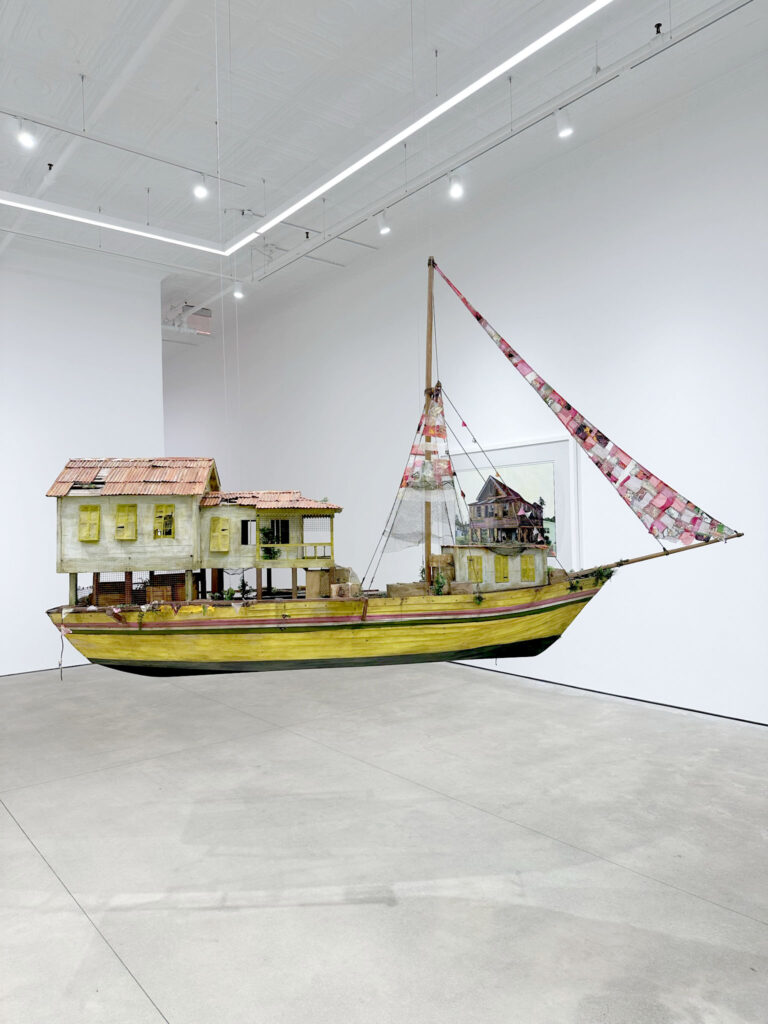
“The Relic”, 2022

“The Relic” 2022 (another side)

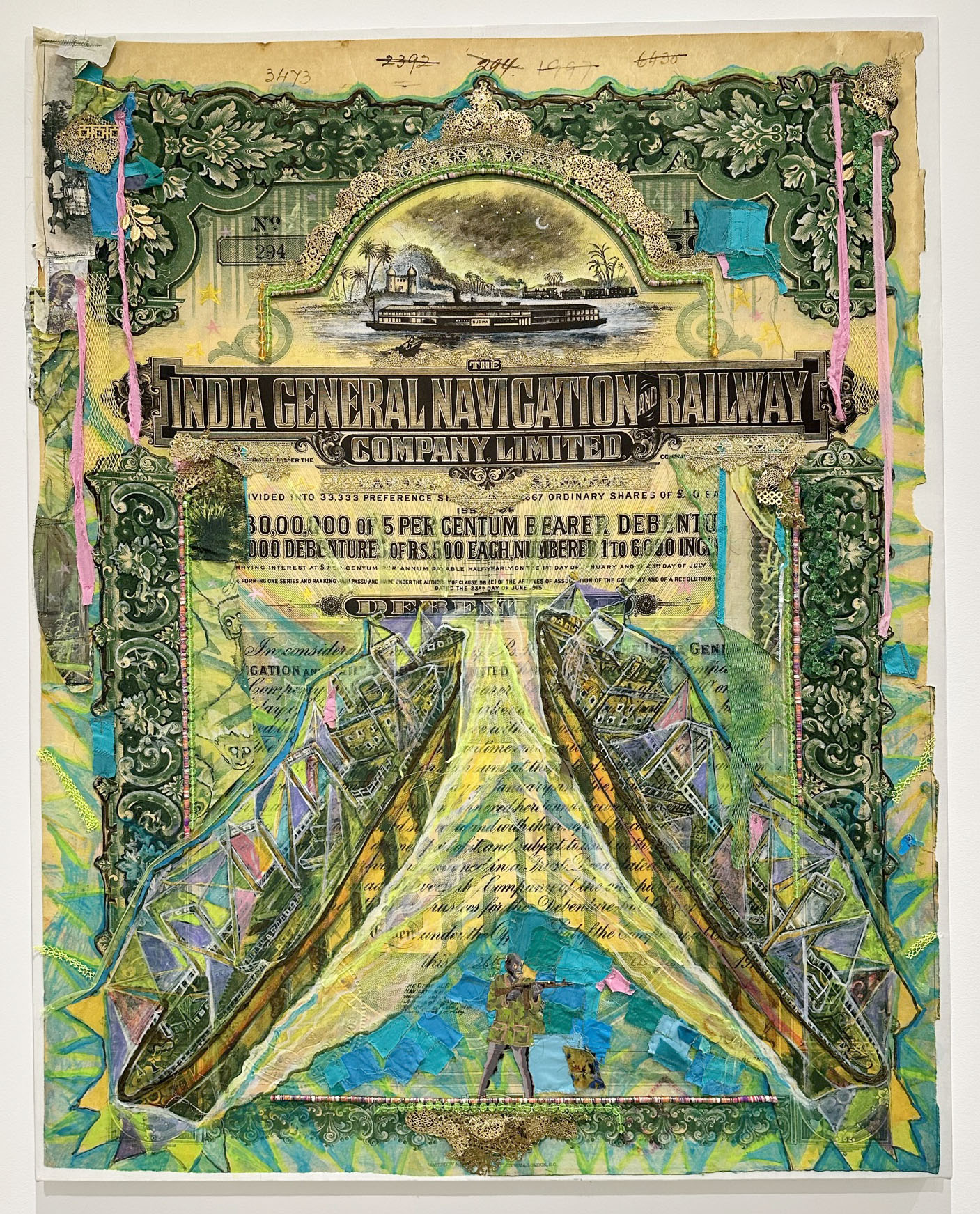
“Raw Materials 3”, 2022

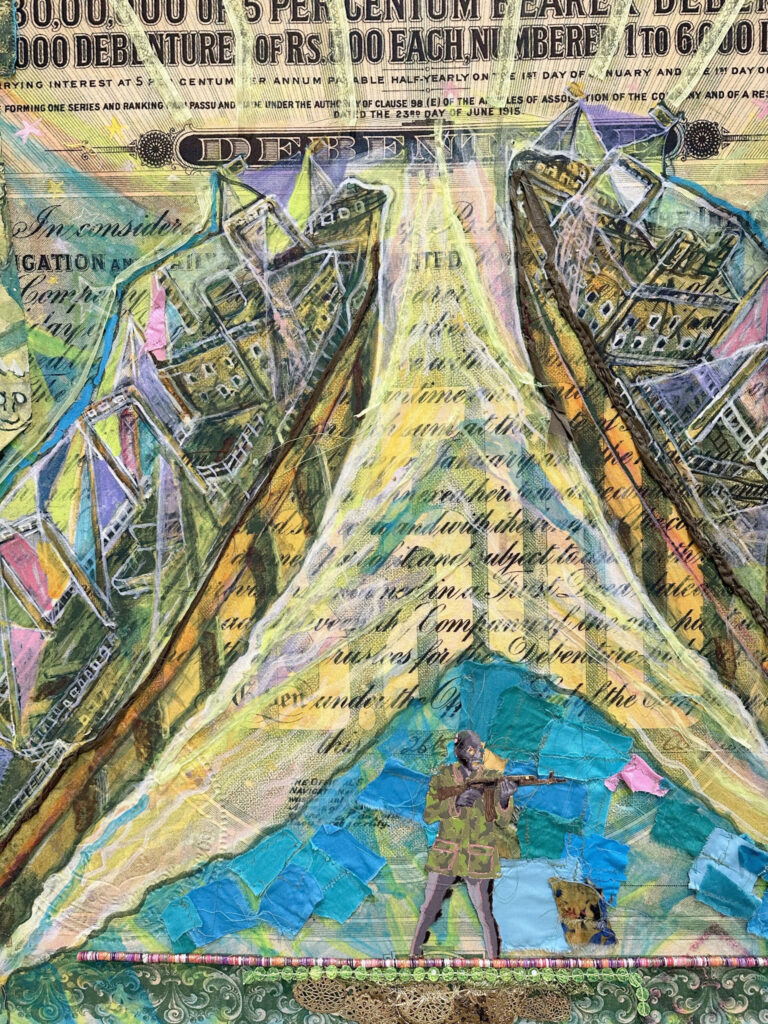
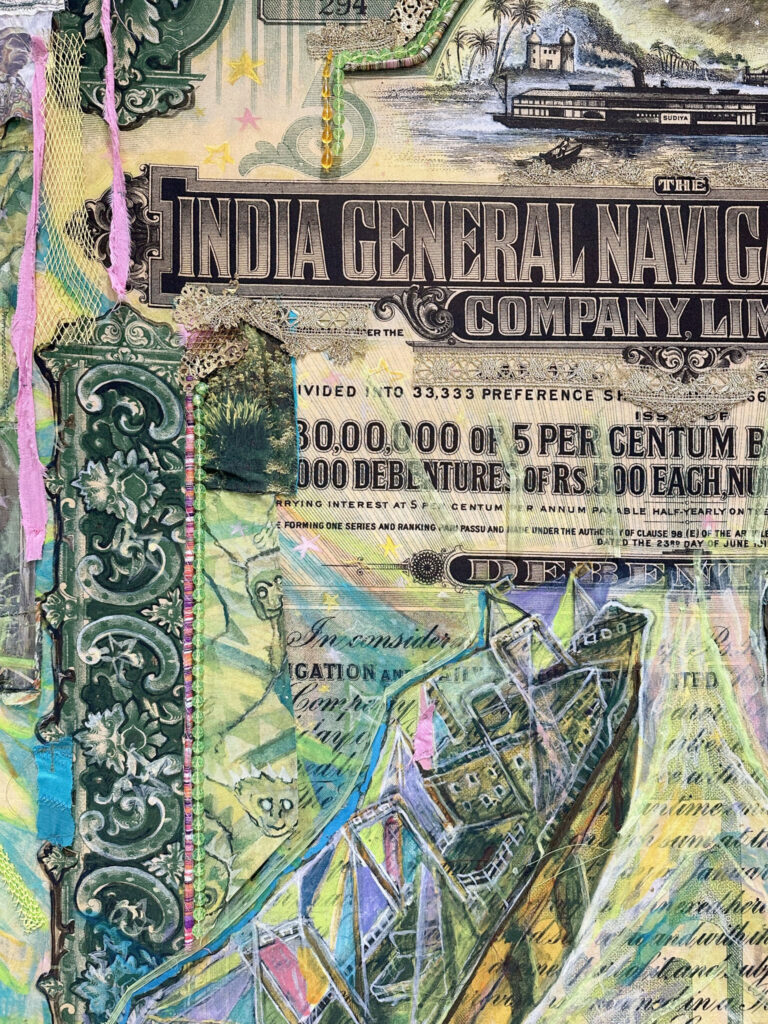
“Raw Materials 3”, 2022 (detail)

“Raw Materials 3”, 2022 (detail)

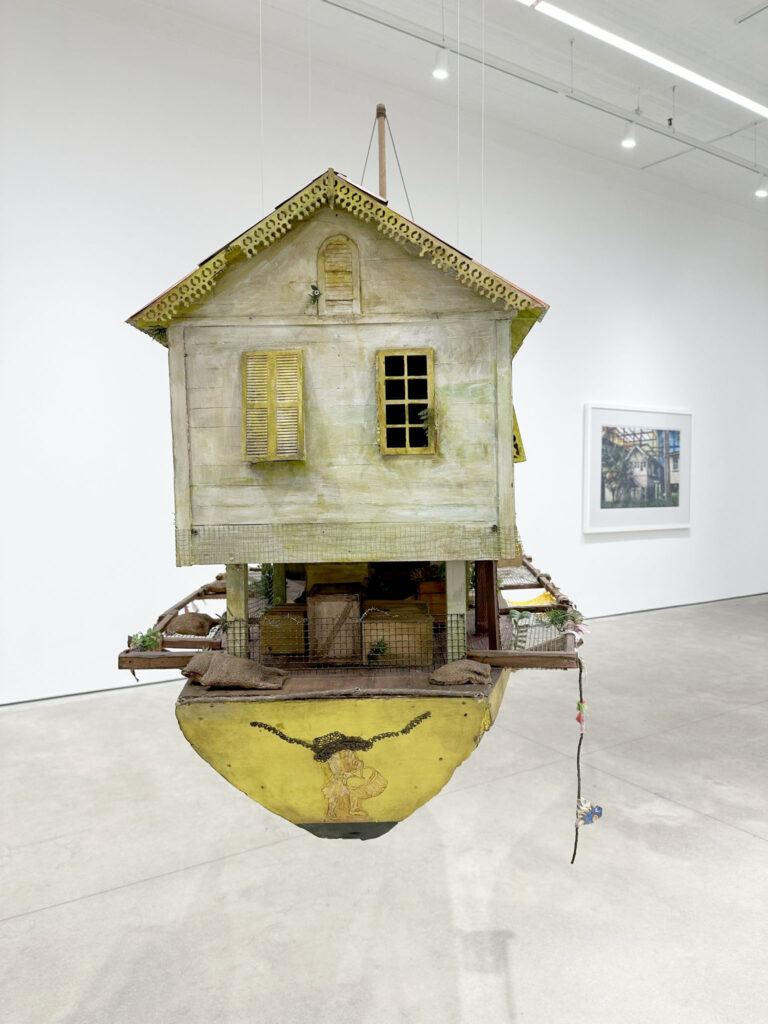
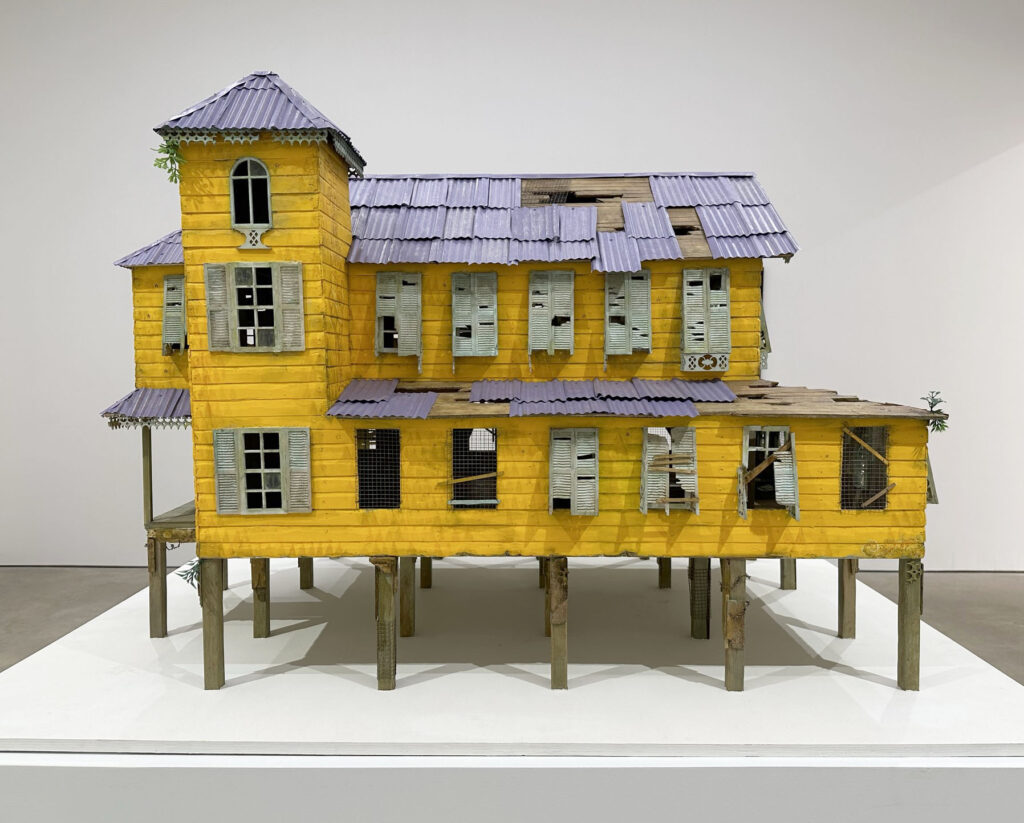
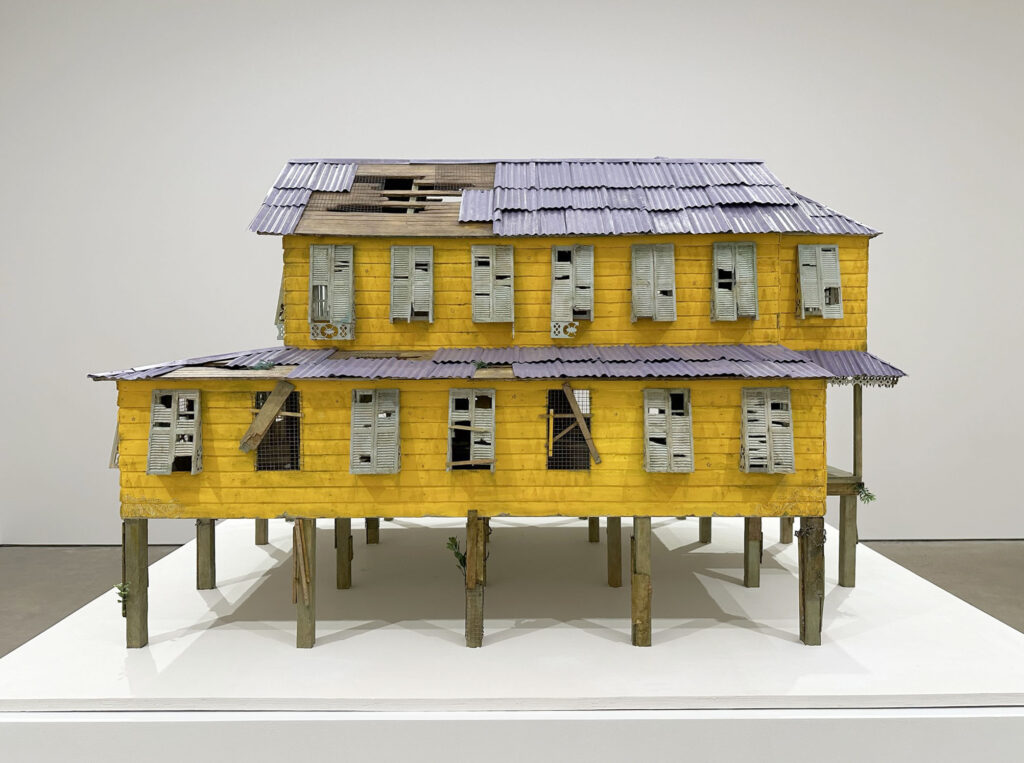
“Jumbie House 2”, 2022

“Jumbie House 2”, 2022

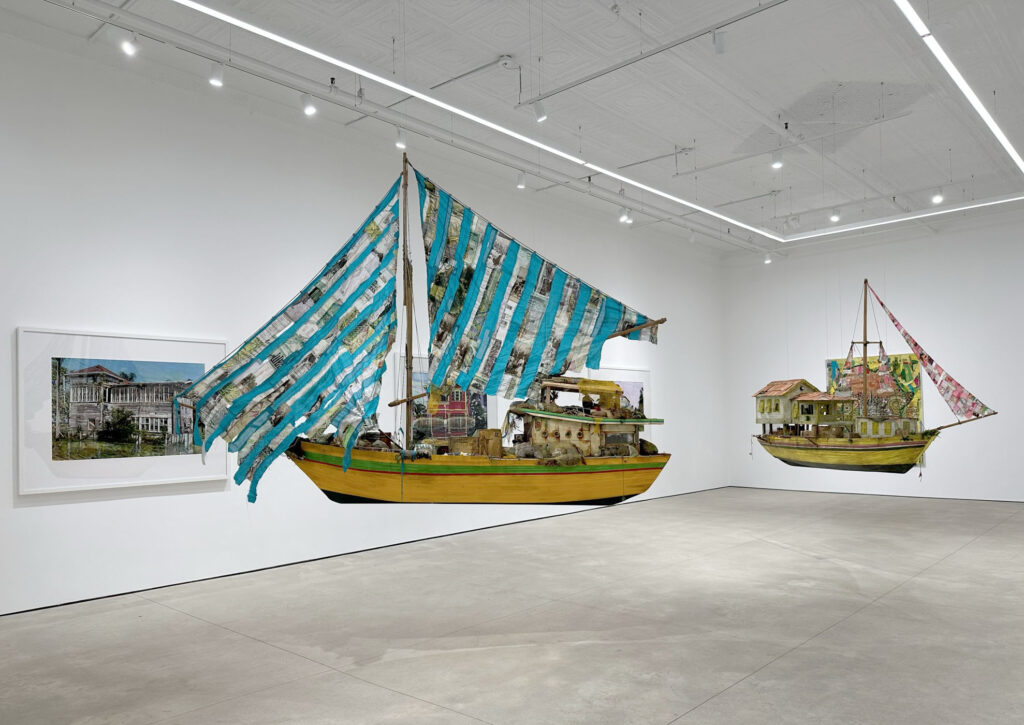
For Hew Locke’s exhibition, Listening to the Land, at P.P.O.W. he has created intricate sculptures and paintings that are fascinating in person.

From the press release-

Locke is known for exploring the languages of colonial and post-colonial power, and the symbols through which different cultures assume and assert identity. Furthering the themes explored in his celebrated commission The Procession at Tate Britain, and his concurrent installation Gilt on the façade of The Metropolitan Museum of Art, this exhibit engages with contemporary and historical inequities while reflecting on the landscape and history of the Caribbean. The exhibition draws its title from a poem by Guyanese political activist and poet Martin Carter which situates itself between two opposing forces of the landscape – sea and forest. Locke’s show features new sculptures and wall works with recurring motifs of stilt-houses, boats, memento mori, and share certificates referencing tensions between the land, the sea, and economic power. Reflecting on these links, Locke notes, “The land was created to generate money for colonial power, now the sea wants it back.”

Translating to ‘land of many waters,’ Guyana and its physical, economic, and political landscape serve as one of the primary sources for Locke’s work. Having spent his childhood in this newly independent nation, the artist witnessed first-hand an era of radical transformation. Now, the country teeters on the precipice of an oil boom and is one of the world’s fastest growing economies. Juxtaposing personal meditations on the climate crisis with political commentary on the history of a globalized world, Locke contemplates the ways in which colonies were exploited to accumulate capital, and observes how Guyana’s economic future lies in the exploitation of its waters. Locke’s new boat sculptures The Relic and The Survivor embody this broad worldview as the two battered wrecks drift through time and history. Evoking the fragmented and diverse legacies of the global diaspora, the boats’ patchwork sails are interspersed with photo transfers of 19th Century cane cutters and banana boat loaders, while their decks are loaded with cargo that could allude to colonial plunder, trade goods or personal belongings.

Based on an abandoned plantation house, Locke’s newest sculpture Jumbie House 2 features layered images that unveil the spirits that haunt this colonial vestige. Presented alongside are a series of painted photographs of dilapidated vernacular architecture across Georgetown and rural Guyana. Constantly under threat of being washed away by storms or rising sea levels, these crumbling structures echo anxieties surrounding climate change and historical erasure. A new series of mixed media wall works, Raw Materials, is derived from antique share certificates and bonds. Locke richly decorates the appliques with acrylic, beads, and patchwork to draw attention to the complex ways in which the past shapes the present. The image of an 1898 Chinese Imperial Gold Loan behind painted Congolese figures connects the global economy at the height of Empire to current Sino-African trade networks. In another work, a painted representation of a Nigerian Ife mask, alongside an image of David Livingstone, is layered on a French-African Mortgage Bond from 1923, connecting exploration and exploitation of African land, to current conversations surrounding the repatriation of artifacts. Taken together, the works in Locke’s Listening to the Land echo William Faulkner’s adage “The past is never dead. It’s not even past.”

This exhibition closes 4/1/23.

The Procession, mentioned above, can now be seen at Baltic Centre for Contemporary Art, in Gateshead, England until June 11th, 2023.

Gilt, also mentioned above, is on view at The Metropolitan Museum of Art until May 30th, 2023.


Mar 282023
 

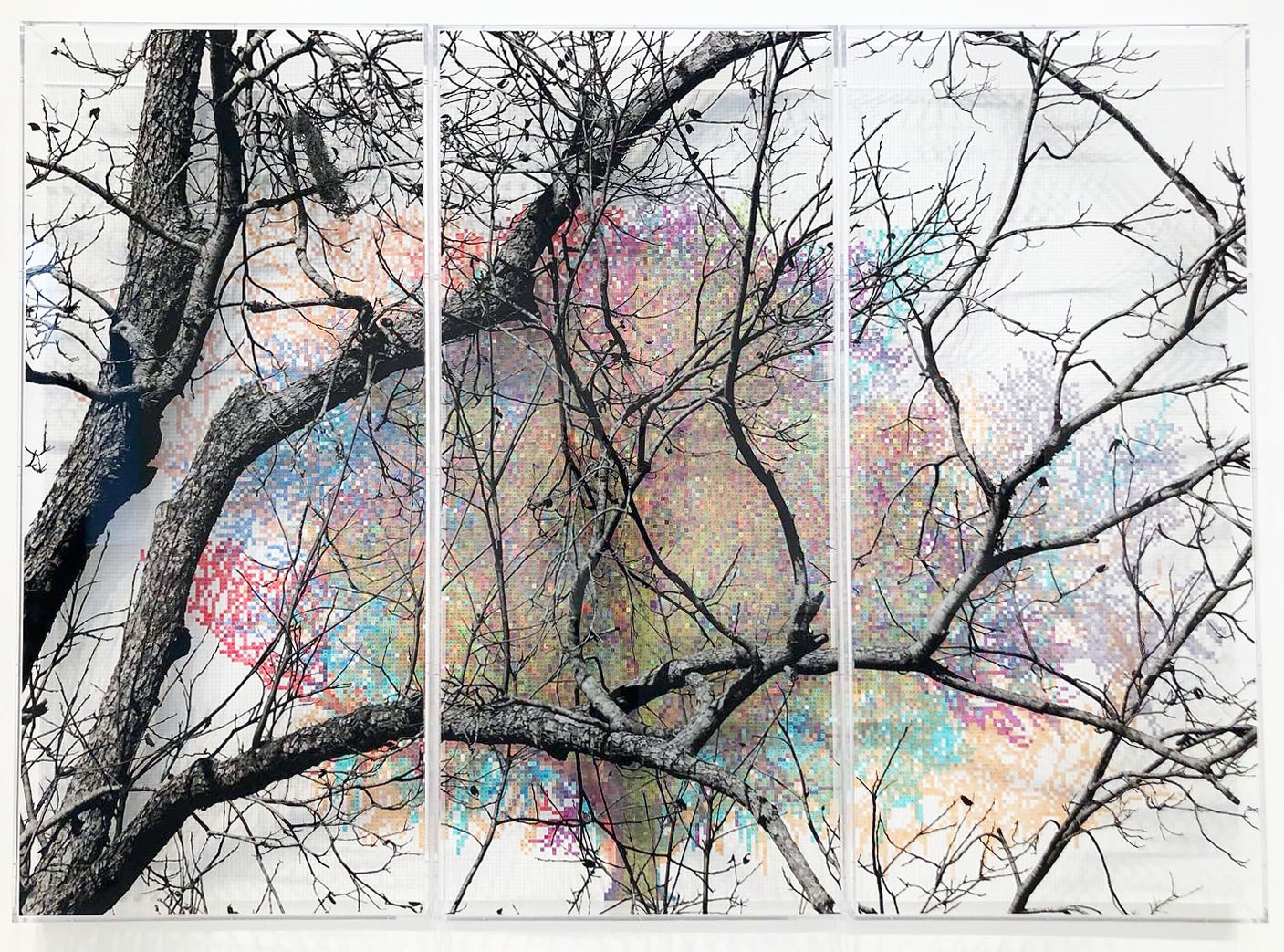
Charles Gaines’ work never fails to impress and his recent exhibition, Southern Trees, at Hauser and Wirth in NYC, is no exception.

From the press release-

One of the most important conceptual artists working today, the show explores the evolution of Gaines’s complex practice, demonstrating how he has continued to forge new paths within the innovative framework of two of his most acclaimed series, Numbers and Trees and Walnut Tree Orchard. The exhibition’s title, ‘Southern Trees,’ alludes directly to the 150-year-old pecan trees pictured in the new works, and symbolically to the opening lyrics of ‘Strange Fruit,’ Billie Holiday’s haunting protest anthem from the 1930s.

The image of the tree has been central to Gaines’s practice since he first began the Walnut Tree Orchard series in the 1970s. In ‘Southern Trees,’ Gaines advances the series using pecan trees photographed on a visit to Boone Hall Plantation in Charleston County, South Carolina––not far from where the artist was born and lived until he was five years old. Presented alongside a key early example from the walnut tree series, eight new triptych works on paper revisit and expand upon this significant original body of work.

‘Walnut Tree Orchard: Set M’ (1977), on loan from the Whitney Museum of American Art, New York, pairs a black and white photograph of a walnut tree with two drawings derived from it––an ink outline of the same tree and a grayscale grid that plots all of the trees included in the series up until that point. The newest series, titled Pecan Trees (2022), begins similarly, with a stark black and white photograph of a tree; yet in the drawings that accompany it, Gaines has filled in the outline of the tree with solid ink and used vibrant watercolors to plot all the previous trees in the final drawing. These successive modifications to scale, color and background demonstrate Gaines’s theory that while ‘the system has never changed, the outcome is always different.’

This extends to Gaines’s new Numbers and Trees Plexiglas series, which begin with the artist assigning each tree a distinctive color and numbered grid––breaking down the composition into individual cells that reflect the full form of the tree depicted in the photograph on the surface. However, Gaines reverses his signature process in this new series by overlaying the forms of the trees one at a time and in progression on the back panel of the work rather than on the front. He then brings the photograph to the surface by printing an enlarged detail of the most recently added tree on the work’s Plexiglas surface. This approach brings the tree’s shadowy branches to the foreground, highlighting its textural details and contrasting tones while obscuring the colorful numbered grids painted underneath it. This reversal produces a dramatically different effect, igniting a more somber, yet stirring, reaction to the work as the austere branches, dripping with moss, dominate the picture.

Created through carefully considered systems rather than through the artist’s own imagination or intuition, these new works remove the artist’s subjectivity by following a set of self-determined rules and procedures. The works call into question both the objective nature of the trees and the subjective natural and material human actions that surround them. The fastidious layering process allows Gaines to reveal the differences between the trees’ shapes where the forms do not align. These differences, highlighted by the artist’s systems, suggest the arbitrary nature of other manufactured systems in our society––such as politics, gender, race and class.

This exhibition closes 4/1/23.

Mar 282023
 

“Oil Bunkering #9, Niger Delta, Nigeria”, 2016

“Gold Tailings #1, Doornkop Gold Mine, Johannesburg, South Africa”, 2018,

“Salt Ponds #1, Near Fatick, Senegal”, 2019

“Salt Ponds #1, Near Fatick, Senegal”, 2019 (detail)

“Uranium Tailings #13, Husab Uranium Mine, Namibia”, 2018

Edward Burtynsky’s photographs are visually arresting and often made more so by the need to look closer to discover what exactly is being captured. Some look like paintings at first glance before you realize there are roads or other man made structures contained within them.

From the Sundaram Tagore’s press release-

Since the early 1980s, Edward Burtynsky has been photographing industrial landscapes across the globe, documenting in remarkable detail the human imprint on the planet through terraforming, extraction, urbanization and deforestation. For African Studies, premiering in New York simultaneously at Sundaram Tagore Gallery and Howard Greenberg Gallery, he focused on Sub-Saharan Africa, traveling to Kenya, Nigeria, Ethiopia, Ghana, Senegal, South Africa, Botswana, Namibia, Madagascar and Tanzania between 2015 and 2020.

Burtynsky’s interest in Africa was sparked 20 years ago while he was working on his landmark 2004 photographic project China, which explores the country’s rapid globalization and the construction of the Three Gorges Dam. The series, and subsequent award-winning documentary film by Jennifer Baichwal, Manufactured Landscapes (2006), chronicle China’s transformation into the world’s leading manufacturer and depository for its waste. Burtynsky witnessed firsthand the immense environmental—and by extension, human—cost of development, and he predicted Africa would be the next, and perhaps the last, region to undergo major industrial expansion.

Presented in large-format photographs, African Studies conveys the fragility of the natural world, bringing together images of lush, undisturbed landscapes and environments irretrievably altered by industry. The series was largely photographed from aerial perspectives, a viewpoint that distills the continent’s diverse topography into graphic patterns and gradients of sumptuous color. The resulting effect seemingly transforms the marks of human infrastructure into painterly abstract compositions. In these images, as in all his work, Burtynsky skillfully integrates critical reporting with sublime visual aesthetics creating a harmonious balance between content and form.

“With this project I hope to continue raising awareness about the cost of growing our civilization without the necessary consideration for sustainable industrial practices and the dire need for implementing globally organized governmental initiatives and binding international legislations in order to protect present and future generations from what stands to be forever lost,” Burtynsky said.

Also on view in another section of the gallery are works from his series, Natural Order. The photographs were taken in Grey County, Ontario, during the lockdown in the spring of 2020.

This quote from Burtynsky was on the wall nearby in regards to the series-

“From the frigid sleep of winter to the fecund urgency of spring, these images are an affirmation of the complexity, wonder and resilience of the natural order in all things. I find myself gazing into an infinity of apparent chaos, but through that selective contemplation, an order emerges an enduring order that remains intact regardless of our own human fate.”

This exhibition closes 4/1 at Sundaram Tagore Gallery and 4/22 at Howard Greenberg Gallery.


Mar 212023
 

The images above are from Annette Kelm’s photography exhibition Present Past Perfect at Andrew Kreps Gallery.

From the press release-

In her work, Kelm moves freely between studio, and documentary photography to explore the function and history of objects, as well as the implications of their representation. A series of new photographs document ephemeral still lives built in her studio, combining colored paper and cardstock backdrops, with vegetation and found objects. Ultimately, these contemporary Vanitas-like compositions are left open-ended, as Kelm discloses their constructed nature, as seen in works like Sumach / Essigbaum, 2023, where the edge of a table and curve of the backdrop suggest the provisional process of the works’ making. Through this strategy, Kelm explores the implications of the framing and display of objects, as well as the value systems in which they exist.

A new series of photographs documenting vintage button pins continue Kelm’s ongoing exploration into the graphic manifestations of protest. Adorned with slogans such as “Keep Abortion Legal” and “If his home is his castle, let him clean it”, each button pin is affixed to a uniformly cropped jean jacket. Sharing an overhead view, and a serial format, the varying placement of each button suggests the individuality of an imagined wearer, culminating in a crowded, all-over composition.

Kelm’s interest in the socio-cultural history of objects is evoked in her 2019 series Recyclingpark Neckartal, presented here for the first time in the United States. The series documents 14 travertine columns originally commissioned by the National Socialists from Lauster quarry in Stuttgart in the 1930s, as part of an unrealized monument to Benito Mussolini planned for “Germania”, the planned reconstruction of Berlin overseen by Albert Speer. Kelm captures these in multiple angles in their current location, a recycling center. Seen through trees and brush, the columns stand overshadowed by a towering waste incinerator, surrounded by parked cars and traces of activity. Together, these views suggest the often uneasy approach society takes to addressing its dark past.

Mar 092023
 

It’s the last few days to see Jean-François Bouchard’s Exile from Babylon at Arsenal Contemporary in NYC. The film in the back room of the gallery gives you a chance to see the people who are missing from the photos. Alone or in groups, they drift between the three screens among the vast open space of the desert.

From the press release-

For this new body of work, the Canadian artist documented a squatters’ camp in California. Driven by homelessness, drug addiction or libertarianism, some Americans choose to reject modern society – Babylon as they call it – to form unlikely communities of squatters and wanderers seeking collective refuge. On a decommissioned military base in the desert, the community photographed by Bouchard lives without any form of local government and without any basic services such as running water, electricity, or garbage removal. On inhospitable grounds, they established themselves in shanties, makeshift tents, shipping containers, crumbling recreational vehicles, and even dens dug into the ground.

For Exile from Babylon, Bouchard has elected to represent the community’s grueling reality metaphorically through a series of still life photographs of trees. Each is adorned with garbage and debris that were either thrown at them or carried through the harsh desert winds. Collectively, these surreal postapocalyptic scenes testify to vast disparities that exist in our modern societies and the quest of fascinating characters for a sense of fulfillment derived through absolute freedom and how it is acquired at a great personal sacrifice.

This exhibition closes 3/11/23


Mar 042023
 

Alex Prager’s photographs, top floor of the gallery

Alex Prager, “Run” film still

Alex Prager, “Run” film still

Alex Prager, “Run” film still

Alex Prager, “Run” film still

It’s hard not to be delighted by Alex Prager’s latest exhibition, Part Two: Run at Lehmann Maupin gallery in NYC. Upon arriving on the lower level of the gallery you are met with a pinball machine, brightly colored photos, and the sculpture of a woman’s body with her head crushed under a giant silver ball. In the next room, the short film Run sucks you in to it’s strange world.

From the press release-

Directly responding to a period of cultural ambivalences and uncertainties, the exhibition urgently examines human perseverance and explores the opportunities for empathy, participation, and action present both within art and everyday life.

Across her practice, Prager crafts rich, often ambiguous narratives that examine the cultural mythologies and archetypes that shape collective existence. As she deploys and deconstructs artistic and narrative conventions, Prager explores how both our senses of self and our engagement with others are often mediated by familiar stories and tropes. Occupying a tenuous relationship to time and place, the artist’s carefully choreographed figures remain suspended between the past and the present, and Prager gestures to a collective will to exist that not only transcends our immediate circumstances but persists despite them.

The foundation for Prager’s latest body of work is the artist’s powerful new film, Run. Featuring musical compositions by Ellen Reid and Philip Glass and starring Katherine Waterston, the film deploys cinematic archetypes and absurdist humor as it examines human resilience in the face of catastrophe. An otherwise ordinary day in an uncannily generic setting erupts into chaos when a massive, mirrored sphere propels itself through a community. Here, forward motion is countered by retrospection. Figures collide into their own reflections in the sphere’s surface, and Prager suggests a curative, collective reckoning with those forces outside of our control.

The New York exhibition presents Run in dialogue with photographs and sculptures that further complicate and enrich the film’s fundamental concerns. Prager’s photographic work Sleep (2022) shows the intricately staged mass of people from Run, as they momentarily lay on the ground, after each colliding with the accelerating mirrored ball. Sleep humorously deconstructs the conventions of the film still, and Prager unveils the absurdist potential of suspending a single moment in time. Dramatizing the scene’s ambiguities, the work offers a narrative with a multitude of possible conclusions. Directly engaging the film’s central image, Prager’s sculpture Ball (2022) shows a hyper-realistic figure of a woman, whose head appears to be crushed by the mirrored sphere. As viewers approach the object, they are likewise confronted by their reflections, and they, too, become enfolded within Prager’s lively narratives. Here, as throughout the exhibition, Prager invites viewers into her visually and symbolically saturated works, suggesting that they, too, have critical parts to play.

Part Two: Run marks the culmination of a multipart exhibition, which also included distinct presentations at Lehmann Maupin Palm Beach in November 2022 and Lehmann Maupin London in January 2022.

Make sure to head to the top floor of the gallery as well, where the exhibition continues with more photographs.

This exhibition closes 3/4/23.

Mar 032023
 

Renée Stout, “Navigating the Abyss”, 2022

Renée Stout, “A Question for Christoper Wool“, 2022

Renée Stout, “Escape Plan D (with Hi John Root, Connecting the Dots)”, 2022

Renée Stout, “Wall of the Forlorn”, 2022

Renée Stout, exhibition room

Renée Stout, “Armored Heart/Caged Heart”, 2005

Renée Stout’s exhibition at Marc Straus in NYC,  Navigating the Abyss, presents a collection of her recent work in various mediums. From sculpture and painting to photography, her skillful and inventive work draws you in.

From the press release-

Starting out as a photo-realist painter depicting life in everyday urban neighborhoods, Stout soon developed an interest in the mystical and spiritual traditions in African American communities. Fascinated with fortunetelling and the healing power of Hoodoo, Vodou and Santeria still practiced within the African Diaspora in the American Southeast and Caribbean, she delved into ancient spiritual traditions and belief systems. She has drawn inspiration from a wide variety of sources such as current social and political events, Western art history, the culture of African Diaspora, and daily city life. While her artistic practice is rich with references and resonances, her works are eventually unique manifestations of her own imagination, populated by mysterious narratives and imagined characters derived from the artist’s alter ego.

In this exhibition, we encounter a group of portraits depicting Hoodoo Assassins and Agents (#213 and #214) who, in Stout’s imagination, are healers, seers, and empaths from a Parallel Universe in which fairness and balance rules. Erzulie Yeux Rouge (Red Eyes) is a spirit from the Haitian Pantheon of spirits whose empathic nature makes her a fierce guardian or protector of women, children, and betrayed lovers. Ikengas, originating in the Igbo culture of Southeastern Nigeria, are shrine figures that are meant to store the owner’s chi (personal god), his ndichie (ancestors) and his ike (power), and are generally associated with men. Stout’s Ikenga (If You Come for the Queen, You Better Not Miss) is a powerful female figure with her breasts and horns turned into weapons, and she is adorned with jewels and charms to boost her powers. Beyond the playful yet powerful imagination of these female characters are serious undertones of political commentary as Stout ponders the concepts of these deities while witnessing the recent rulings in our society that infringe on women’s rights.

In Escape Plan D (With Hi John Root, Connecting the Dots) Stout maps out her potential escape to the Parallel Universe when the daily news weighs unbearably on her psyche.

Visions of the Fall, in Thumbnails is a series of five small paintings that comments on the current state of our world and its imagined future with the titles as upcoming stages of its evolution.

American Memory Jar is an entirely black sculpture consisting of a glass jar covered with thin-set mortar, plastic and metal toy guns, topped with a doll head and adorned with a bead and rhinestone cross pendant. Memory Jugs are an American folk-art form that memorializes the dead adorned with objects associated with the deceased. Stout’s jar is a bitter but painfully accurate assessment.

While Stout’s work alludes to history, racial stereotyping, societal decay, and a set of alarming tendencies in our socio-political structures and ecosystem, it also reveals possibilities and the promise of healing. Various works reference healing herbs, potions, and dreams. Herb List, Spell Diagram and The Magic I Manifest speak of Stout’s belief in the power of consciousness, in the existence of more solid and fertile grounds, and of individual responsibility.

There is one overarching narrative that clearly emerges from Stout’s work – her personal history and spiritual journey as a woman and as an artist.

This exhibition closes 3/5/23.


Mar 022023
 

Artist Miguel Luciano– Vinyl banner from the public art project “Mapping Resistance: The Young Lords in El Barrio”, 2019 Image: Young Lords Member with Pallante Newspaper (1970)” by Hiram Maristany and “The People’s Pulpit” (2022), a repurposed vintage pulpit from the First Spanish Methodist Church in East Harlem.

Miguel Luciano- Vinyl banner from the public art project “Mapping Resistance: The Young Lords in El Barrio”, 2019 Image: Young Lords Member with Pallante Newspaper (1970)” by Hiram Maristany


Poor People’s Art: A (Short) Visual History of Poverty in the United States at USF Contemporary Art Museum in Tampa uses installations and artworks to tell the story of, and expand perspectives on, The Poor People’s Campaign- from its origins in the late 1960s to the present day form, as well as comment on poverty and other social issues. Both educational and engaging, it shows that despite long struggles and some progress, we are still very far from much needed social change, especially in regards to poverty.

The museum also produced a free full color, 48 page workbook that you can pick up there or download as a PDF that can be downloaded from their website.

From the gallery’s website-

Dr. Martin Luther King Jr. is well known for his “I Have a Dream” speech, yet much less emphasis is placed on his campaign to seek justice for America’s poor, “The Poor People’s Campaign.” This was a multi-cultural, multi-faith, multi-racial movement aimed at uniting poor people and their allies to demand an end to poverty and inequality. Fifty-three years after Dr. King’s death, the Reverend William Barber II launched a contemporary push to fulfill MLK’s ambitious brief — one that calls for a “revolution of values” that unites poor and impacted communities across the country. The exhibition Poor People’s Art: A (Short) Visual History of Poverty in the United States represents a visual response to Dr. King’s “last great dream” as well as Reverend Barber’s recent “National Call for Moral Revival.”

With artworks spanning more than 50 years, the exhibition is divided into two parts: Resurrection (1968-1994) and Revival (1995-2022). Resurrection includes photographs, paintings, prints, videos, sculptures, books, and ephemera made by a radically inclusive company of American artists, from Jill Freedman’s photographs of Resurrection City, the tent enclave that King’s followers erected on the National Mall in 1968, to John Ahearns’ plaster cast sculpture Luis Fuentes, South Bronx (1979). Revival offers contemporary engagement across a range of approaches, materials, and points of view. Conceived in a declared opposition to poverty, racism, militarism, environmental destruction, health inequities, and other interlocking injustices, this exhibition shows how artists in the US have visualized poverty and its myriad knock-on effects since 1968. Participating artists include John Ahearn, Nina Berman, Martha De la Cruz, Jill Freedman, Rico Gatson, Mark Thomas Gibson, Corita Kent, Jason Lazarus, Miguel Luciano, Hiram Maristany, Narsiso Martinez, Adrian Piper, Robert Rauschenberg, Rodrigo Valenzuela, William Villalongo & Shraddha Ramani, and Marie Watt.

Below are some images from the show and the descriptions from the museum.

About the two works above from the museum’s walls-

A multimedia visual artist whose work explores themes of history, popular culture, and social justice, Miguel Luciano revisits the history of the Young Lords, a revolutionary group of young Puerto Rican activists who organized for social justice in their communities beginning in the late 1960s. Luciano’s first contribution to Poor People’s Art is a vinyl banner from the public art project Mapping Resistance: The Young Lords in El Barrio (2019), a collaboration with artist Hiram Maristany. It features the photograph “Young Lords Member with Pa’lante Newspaper (1970)” by Maristany, who was the official photographer of the Young Lords and a founding member of the New York chapter. This banner, along with nine other enlarged Maristany photographs, were installed throughout East Harlem at the same locations where their history occurred 50 years prior.

Luciano’s second contribution to Poor People’s Art is the sculpture The People’s Pulpit (2022), a repurposed vintage pulpit from the First Spanish Methodist Church in East Harlem. The Young Lords famously took over the church in 1969 and renamed it “The People’s Church”; they hosted free breakfast programs, clothing drives, health screenings, and other community services there. In this exhibition, The People’s Pulpit features an historic recording of Nuyorican poet Pedro Pietri reciting the celebrated poem Puerto Rican Obituary during the Young Lord’s takeover of The People’s Church.

Placards created by USF Contemporary Art Museum students, faculty and staff

Martha De La Cruz, “Techo de Sin (Roof of Without)”, 2021, made from stolen, scavenged and donated materials found in Southwest Florida.

About the above work from the wall plaque-

Afro-Taino artist Martha De la Cruz fashioned her sculptural installation Techo de sin (Roof of Without), 2021, from stolen, scavenged and donated materials found in Southwest Florida. According to the artist, “Florida is home to a large population of Latin American migrants who have ended up in the US largely due to economic pressures, exploitation and veins of power etched by Europe and the US.” Her powerful work deals with the results of this disjunction and the “symptoms thereabouts (e.g. houselessness, fugitiv-ity, government corruption, and income disparity, etc.).” According to De la Cruz, the word “sin” is a common Dominican mispronunciation for the word “zinc.” The sculpture is animated by a single light bulb that turns on for just ten minutes a day.

Narsiso Martinez “Hollywood & Vine”, 2022

Jason Lazarus “Resurrection City /Poor People’s Campaign: A National Call for Moral Revival / A Third Reconstruction”, 2023, plywood, utility fabric, blankets, sleeping cot, paint, lamp, plastic, research library, historical ephemera

From the wall plaque about the Lazarus installation-

Jason Lazarus’s sculptural installation Resurrection City/Poor People’s Campaign: A National call for Moral Revival/A Third Reconstruction (2023) is anchored in the artist’s historical research and several key photographs of Resurrection City. A tent-like shelter inspired by the temporary residences that populated the 1968 mass protest, the interactive sculpture contains simple sleeping quarters and a curated library filled with physical literature and ephemera centered on both the 1968 Poor People’s Campaign and the 2018 Poor People’s Campaign: A National Call for Moral Revival, co-led by Rev. Dr.William Barber and Rev. Dr. Liz Theoharis. The library allows for audiences to trace, listen, and talk about the history of advocating for the poor, from 1865 to the present. Additionally, the artist provides a custom transcription (and a QR hyperlink) to Barber’s 49-minute address on the syndicated radio show “The Breakfast Club” in which he carefully outlines his powerful vision for how we might address poverty going forward.

Inside the Jason Lazarus installation

A book and magazine from Jason Lazarus’ installation floor

Mark Thomas Gibson, “Town Crier July 23rd”, 2021

Rico Gatson, “Audre #2”, 2021

Jill Freedman, “Poor People’s Campaign, Resurrection City” 1968

About Jill Freedman’s photograph-

In the spring of 1968, the talented young street photographer Jill Freedman quit her day job as a copywriter in New York City to join the Poor People’s March on Washington. Freedman lived in Resurrection City for the entire six weeks of the encampment’s existence, photographing its residents as they rallied, made speeches, protested in front of government buildings, confronted police, built makeshift kitchens, organized clothing swaps, and dealt with flooding, petty crime, and illness. One of the most important postwar documentarians, and one of the few women photographers of the era, Freedman captured it all. Freedman’s 2017 book, Resurrection City, 1968-from which this exhibition draws a dozen powerful images-showcases the photographs that she made as a participant in the original Poor People’s Campaign. In multiple ways, Freedman’s images are the sympathetic perch upon much of which much of the present exhibition loosely hangs.

This exhibition closes 3/4/23.