Oct 222019
 

Alex Prager’s exhibition at Lehmann Maupin’s 22nd Street location combines sculpture and still photography with her new film Play The Wind. The photographs in the show recreate scenes from the film, but are not from the film itself.  There are also photos of scenes that could have been from the film, but are not. These allow the viewer to consider alternate narratives to the story they have just seen. The photos also offer an opportunity to see many of the details from the film seen only briefly while watching.

Running for eight minutes, Play the Wind is a journey into a bizarre version of Los Angeles. It’s seen mainly through the window of a car, the way many Los Angeles residents often see it. Places seem familiar, as do many of the large cast of extras who inhabit this world, even if you are not personally familiar with the city.

The cab driver, played by Dimitri Chamblas (dean of the Sharon Disney Lund School of Dance at CalArts), drives through situations that seem both surreal and possible at the same time, like many things that happen in LA. At one point the cab driver, drives past an accident on the highway and sees a car vertical between two other cars with children in a school bus leaning out of the windows to observe. He passes alongside and moves on. It’s just another moment in a chaotic Los Angeles day. When he locks eyes with a woman played by actress Riley Keough, the film changes to her perspective and it all becomes even more dreamlike.

From the press release–

…She anchors her characteristically elaborate fictional scenes within the real Los Angeles, shooting for the first time in many years primarily on location rather than in the studio—a decision that harkens back to when Prager began her career over a decade ago. Though the images contain large constructed set pieces and are populated with carefully cast extras (numbering up to 300), the presence of the Los Angeles streets infuses an element of urban lifeblood that is palpable in the work. Prager’s perception of Los Angeles is one of the artifice and drama befitting Hollywood, with real world chaos that overflows into sci-fi dystopia and post-apocalyptic dread. She toys with these visions of the city disseminated on film, TV, and within the popular imagination, which inform our characterization of a place as much as our own memories.

Technically important to the making of this film was Prager’s collaboration with a team to produce set designs and props that would add a layer of artifice and duplicity to her real-world locations. The interference of these traditional illusionary effects upon the actual Los Angeles streets and locations Prager shot on creates an unnerving sensation, hinting at the reality that might exist just outside of our perception. All of these elements are recast in the series of photographs, which appear in different configurations or on various scales that further destabilize any linear narrative. Drawing on the concept of a distorted memory, Prager has found ways to incorporate objects seen in the photographs and film into the gallery as sculpture, with the intent to further dislodge our understanding of place and time and bring us deeper into her highly constructed world.

Connoisseurs of Prager’s work will likely spot the references to her past series, such as the noir themed Compulsion (2012), or the archetypical ingénue of The Big Valley (2008). This self-referencing becomes yet another layering device, mixing Prager’s career-spanning themes and the greater art historical genres from which they are drawn to create work both entirely new, yet seemingly familiar. Prager’s incorporation of her past into her present work serves as a reminder that while the past may not be returned to, it does remain with us, appearing in surprising, sometimes unsettling ways.

This exhibition closes 10/26/19.

Oct 182019
 

“Crescent (Timekeeper)”

“Crescent (Timekeeper)”

“Crescent (Timekeeper)” Detail

Sarah Sze’s exhibition at Tanya Bonakdar’s gallery in New York is stunning. There is so much to look at, to appreciate. There are so many pieces to all of the work, and yet it never feels overwhelming. It makes you want to keep looking.

It’s also immersive. The windows on the outside of the gallery are covered in her work, as is the staircase alcove. The video projections in the main room travel all around the room, surrounding you with visuals and sound. Upstairs the floors of the gallery have paint splattered on them, accompanying the works on the walls.

Detail of the above work

In a room on the first floor is a “studio space” where you can gain insight into Sze’s process and how she makes these elaborate works.

From the press release-

Sze’s latest body of work frays “the seam between the real and the image” (Smith). Through complex constellations of objects and a proliferation of images, Sze expands upon the never- ending stream of visual narratives that we negotiate daily, from magazines and newspapers, television and iPhones, to cyberspace and outer space. The works evoke the generative and recursive process of image-making in a world where consumption and production are more interdependent, where the beginning of one idea is the ending of another—and where sculpture gives rise to images, and images to sculpture.

In this new exhibition, Sze expands her work by embedding her nuanced sculptural language into the material surfaces of painting and into the digital realm through the interplay of cloth, ink, wood, paper, metal, paint, found objects, light, sound and structural supports—collapsing distinctions between two, three and four dimensions. This body of work fundamentally alters our sense of time, place, and memory by transforming our experiences of the physical world around us. Both objects and images, Sze says, are “ultimately reminders of our own ephemerality”.

This exhibition closes 10/19/19.


Oct 172019
 

From Ishiuchi Miyako’s “Scars” series (1991-)

Images from the “ひろしま/ hiroshima” series, 2007-present

Ishiuchi Miyako’s exhibition occupies both floors of Fergus McCaffrey’s Chelsea gallery space and includes over 70 photographs from five series made over four decades, including many early and never-before-seen works.

On the first floor are the artist’s somber black and white photos of the buildings of her hometown of Yokosuka. Yokosuka was also the home of a US Naval Base, established in 1945.  In another room is work from her Scars series, for which she photographed the damage left behind by injury, illness, and trauma. These portraits focus not on the people but on the imprints on their bodies. Despite that, they don’t feel impersonal or voyeuristic. There is a tenderness to these images.

Photographs of objects dominate the rest of the exhibition. There are a series of images of her mother’s possessions, taken before she passed away. She also photographed Frida Kahlo’s belongings, including a pair of her shoes that were different sizes- accommodating the physical issues Kahlo had after her bout with polio as a child.

The photos of items donated to the Hiroshima Peace Museum, for the ひろしま/ hiroshima series, are especially moving. The articles of clothing worn by residents of Hiroshima when the atomic bomb was dropped on the city are worn and damaged. It’s hard not to think of what happened to the people who owned them.

Each series of photographs is unique, but tying them together is the idea of capturing what gets left behind. It can be a city or a scar or a person’s possessions after they die, but they have an effect. Ishiuchi’s photos record that effect in an impressive and thought provoking way.

This exhibition closes 10/18/19.


Oct 102019
 

From the press release-

Klowden Mann is proud to present San-Diego-based artist Andrea Chung’s first solo exhibition with the gallery, … Only to meet nothing that wants you. The exhibition features large-scale cyanotype works depicting under-sea images of coral that have then been bleached with sugar crystals—a material woven throughout Chung’s practice for over a decade in reference to its relationship to colonialism in the Caribbean. The cyanotypes are placed in context with a brass chandelier that recalls designs from the 19th century; where crystals would hang, Chung has hung glass vials filled with sugar in various shades.

Chung’s practice often utilizes perishable and precious materials with strong underlying histories, forming relationships to pre-emancipation images of the Caribbean, touristic misrepresentations of people and place, the export or import of goods and materials, and the labor of the human body. Completing the quote by Nayyirah Waheed that Chung used as the title of her first solo museum exhibition at the Museum of Contemporary Art San Diego in 2017, “You broke the ocean in half to be here,” the title of the exhibition at Klowden Mann answers with the second half of the phrase, “…Only to meet nothing that wants you.”

In the cyanotype works, coral bleaching becomes a metaphor for colonialism, and the expanding of the philosophy and impact of imperialism on colonial populations and cultures. The addition of sugar crystals to the already highly sensitive cyanotypes underlines Chung’s interest in creating work that defies the notion of artworks as static objects that are meant to remain unchanging and unyielding in the face of shifting environments and time; in a way that also reflects the constant uncontrolled and irresponsible effects of human actions on the environment, and on vulnerable populations. The works are intended to shift and change over the course of the exhibition, as the sugar embeds further in the cyanotype, falls, and expands. The works are linked to the environment in which they are placed in a way that Chung cannot predict and control—and along with the chandelier, ask the audience to consider who pays for the superficial opulence and beauty to which so many have become accustomed.

The work in this exhibition is really stunning, and the fact that it is work that is changing with time, makes seeing it feel even more special. Like so much of the beauty in the world, and especially in nature, you appreciate it, while wondering how long it will still be around to be seen.

This exhibition closes 10/12/19.

Sep 202019
 

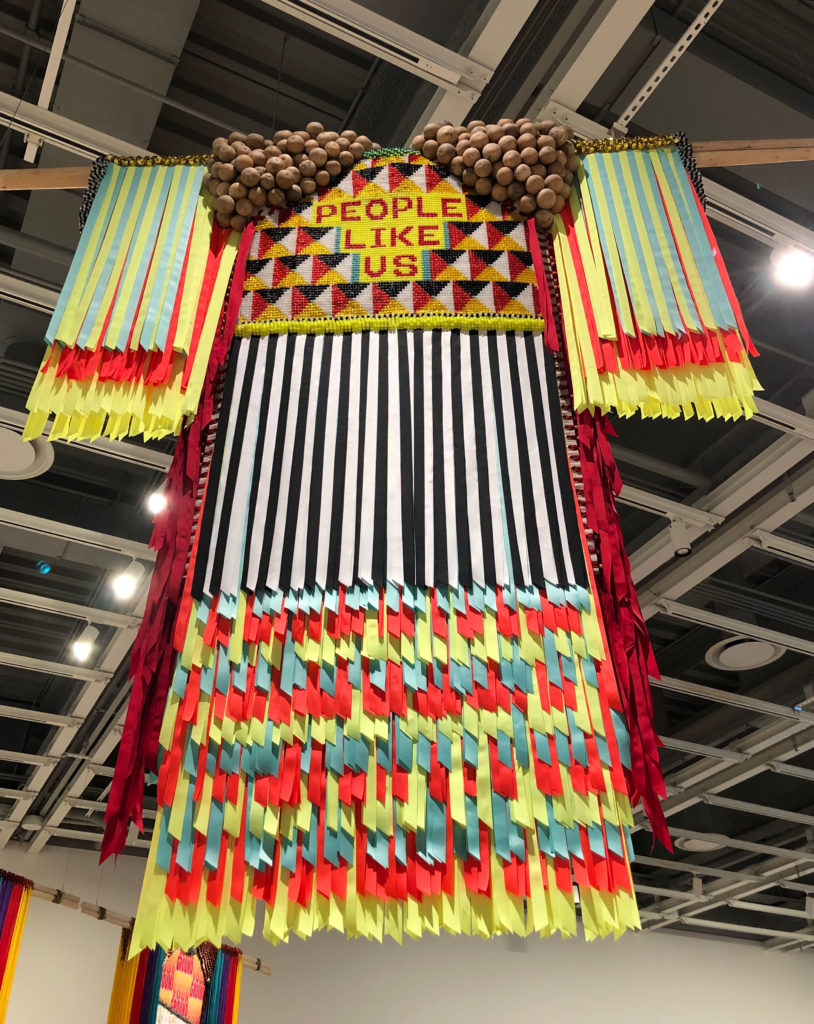
Jeffrey Gibson, “PEOPLE LIKE US”, 2019

Jeffrey Gibson

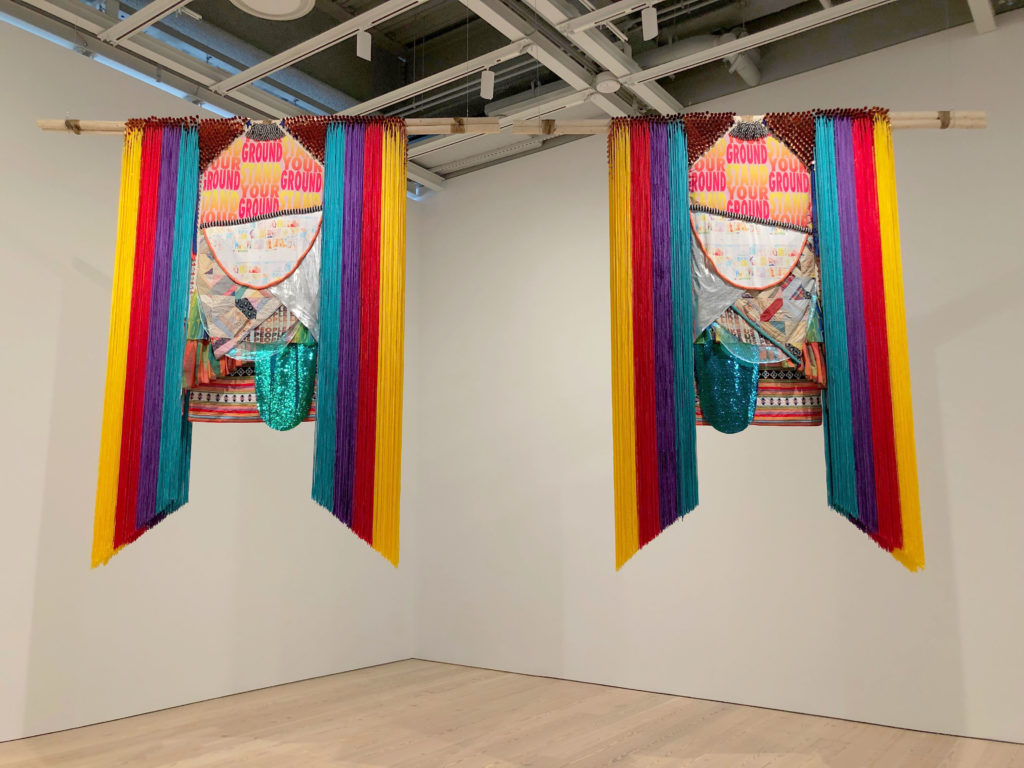
2019’s Whitney Biennial presents an interesting selection of work, by a mostly young and diverse group of artists. The works included in the show are consistently good, and often intriguing, but this time around nothing is particularly outrageous or polarizing- a contrast to many of the previous iterations.

Not that there wasn’t any drama surrounding the show. This time around, however, the controversy was not with an artwork but with former Whitney executive board member Warren B. Kanders and his ownership of Safariland, a tear-gas canister maker. He has since resigned after protests and threats of withdrawal from several of the artists included in the show. Artist collective Forensic Architecture’s film, Triple Chaser, on view in the exhibition, investigates Safariland and Kanders.

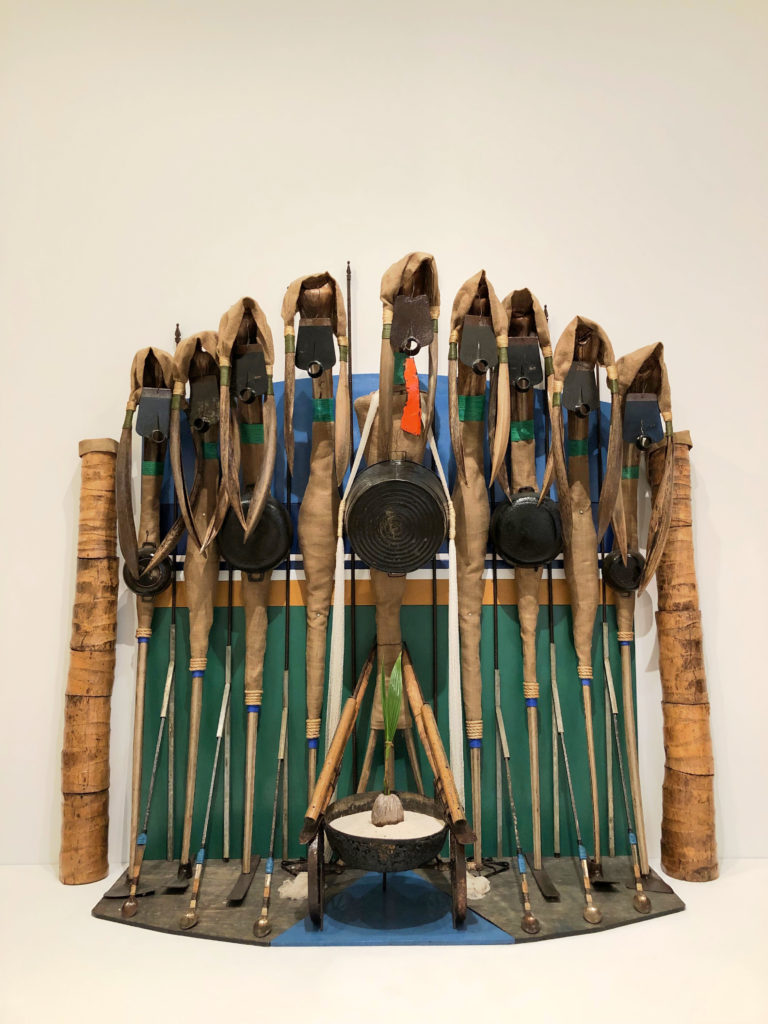
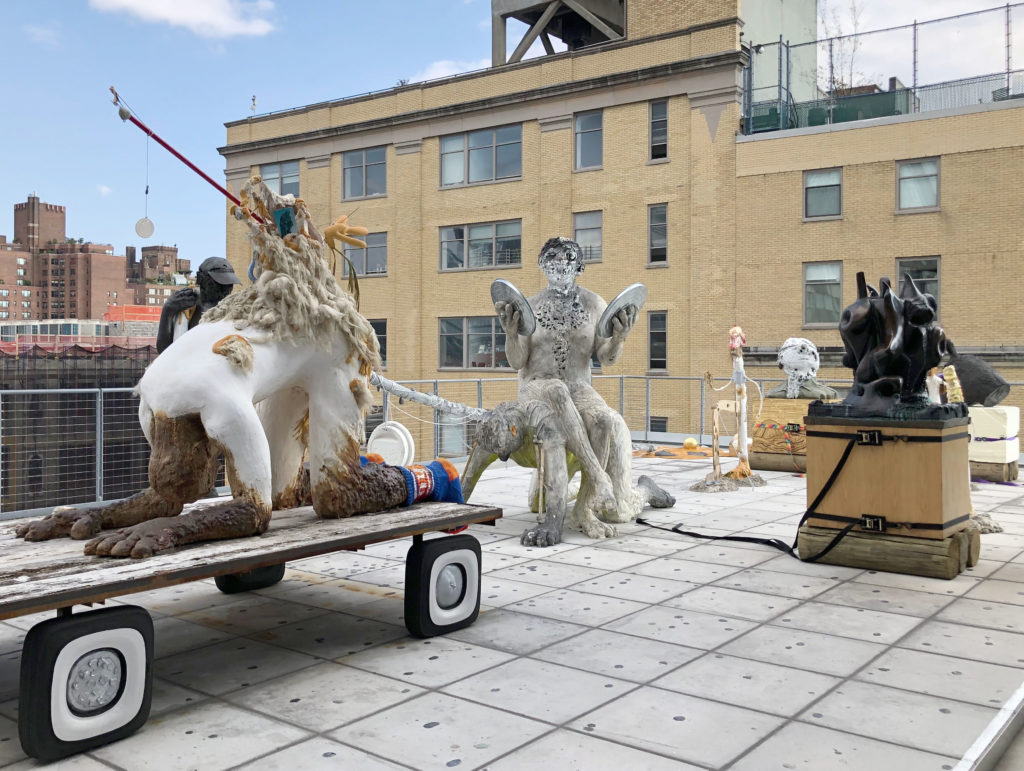
Below are a few highlights from the exhibition.

Janiva Ellis ” Uh Oh, Look Who Got Wet”, 2019

Daniel Lind-Ramos, “Centinelas (Sentinels)”, 2013

Section of Nicole Eisenman’s, “Procession”, 2019

This exhibition closes 9/22/19.


Aug 302019
 

This is the last weekend (closing 9/1) to see Black is Beautiful: The Photography of Kwame Brathwaite at Skirball Cultural Center.

From the center’s website-

See the iconic images that amplified one of the most influential cultural movements of the 1960s: “Black Is Beautiful.” Featuring over forty photographs of black women and men with natural hair and clothes that reclaimed their African roots, Black Is Beautiful: The Photography of Kwame Brathwaite, organized by Aperture Foundation, New York, is the first-ever major exhibition dedicated to this key figure of the second Harlem Renaissance.

Inspired by the writings of activist and black nationalist Marcus Garvey, Brathwaite (b. 1938) combined his political vision with the medium of photography to effect social change. Along with his brother Elombe Brath (1936–2014), Brathwaite founded two organizations that were instrumental in realizing his vision: African Jazz-Art Society and Studios, a collective of artists, playwrights, designers, and dancers, in 1956; and Grandassa Models, a modeling group for black women, in 1962. Working with AJASS and Grandassa Models, Brathwaite organized fashion shows featuring clothing designed by the models themselves, created stunning portraits of jazz luminaries, and captured behind-the-scenes photographs of the black arts community.

During an era when segregation still prevailed across the United States, Brathwaite’s work challenged mainstream beauty standards that excluded women of color. His photographs celebrated black beauty and instilled a sense of pride throughout the community. Black Is Beautiful: The Photography of Kwame Brathwaite demonstrates how the medium of photography is an essential cultural tool in the dissemination of new visual paradigms and political ideas.

Aug 232019
 

CONTACT HIGH: A Visual History of Hip-Hop, Annenberg Space for Photography‘s latest exhibition, includes an excellent selection of photos from the beginning of hip-hop until now. Over 75 original and unedited contact sheets are also being shown. These are a great addition to the exhibition and give the viewer added insight into the thought process that went into the final work.

In the center of the gallery, there is an exclusive new documentary short film featuring several of the photographers from the show at work and in conversation. There is also a pop-up record shop featuring rare hip-hop on vinyl.

This exhibition closes 8/25/19.

Aug 092019


When trying to talk about the David Hammon’s exhibition at Hauser and Wirth Los Angeles, his first in Los Angeles in 45 years, it’s hard to know where to start. There are no titles or descriptions of any of the works in the show, although there is writing on the walls in certain places. The press release, shown below, is a mass of lines and a dedication to jazz musician Ornette Coleman.

Before you enter either of the two massive galleries housing the exhibition you encounter a courtyard filled with tents, some with “this could be u and u” stenciled on them. Tents also line the corridor under Martin Creed’s neon piece, EVERYTHING IS GOING TO BE ALRIGHT, with a rack of fancy vintage coats nearby. Once predominantly in Skid Row, Los Angeles’ tent cities have been growing rapidly on street corners and under bridges and highways all over the city, but they often just blend into the background for people walking and driving past. What does a fake tent city in the courtyard of a high end gallery in a newly gentrified neighborhood mean? Is its fake version more affecting than the real one to gallery and restaurant patrons wandering by?

The work in the show feels at times random, clever, humorous, and confounding, but also impressive, thought provoking, and most importantly never dull. There are stacks of art history books sitting on scales. A water filled bowl that contains what once was a snowball Hammons had sold on the street at one point in his career, sits on a wooden shelf. A room with empty glass cubes on wood columns requires you to bend down to see the feet underneath. A book titled A History of Harlem is filled with empty black pages.

In the room pictured below is a three legged chair next to a wall of photos of women sitting in it. Nearby, one of Ornette Coleman’s suits is surrounded by glass.

Another room is filled with paint splattered and damaged fur coats, one facing an antique mirror that is covered. The symbolism feels a bit heavy handed, like the tents, but it works in that there are still several ways to interpret what Hammons might be saying.

Throughout the exhibition paintings are covered in various ways. One in paper, ripped with a bit of the painting visible. Others are partially hidden with tarps, plastic, different fabrics, even an antique rug (shown below). Once again, you can interpret the meaning of this in several ways. With the rug, for example, it’s turned so that only a bit of its design is visible in front of a painting that is not completely visible. These rugs are often associated with old money and sometimes are hung on walls themselves as artwork. Or is it just another assemblage, a visual combination to be taken at face value.

Ultimately the interpretation of all of the work is up to the viewer. There is something freeing in that, not being given answers. Sure, it’s nice to have an explanation of an artist’s intentions sometimes, but you often add your own ideas anyway. Art should make you think, question things, look at the world from a new perspective- this exhibition does all of that and more.

David Hammons at Hauser & Wirth Los Angeles closed 8/11/19.


Jun 292019
 

“Graduation”, (1949) © Estate of Roy DeCarava

We look at so many images today that often the value of individual photos decreases with the abundance of them. That’s why it is such a pleasure to spend time with Roy DeCarava’s black and white photographs at The Underground Museum. His images have a meditative beauty to them. They catch your eye and hold it. There is a richness to his compositions, his use of textures and light.

While at The Underground Museum, also take a moment to look through a copy of De Carava’s book collaboration with writer Langston Hughes, The Sweet Flypaper of Life in the book store.  The images in it influenced artist Kahlil Joseph’s film Flypaper (2017), which was recently shown at MOCA.  Kahlil Joseph’s brother, artist Noah Davis, who sadly passed away in 2015, founded The Underground Museum with his wife, artist Karon Davis, in 2012.

Roy DeCarava: The Work of Art closes 6/29/19.


“Bill and son”(1962) © Estate of Roy DeCarava


May 242019
 

Wendy White’s exhibition Racetrack Playa, at Shulamit Nazarian, is a very American show. Her collages of old car ads ,and their often blatant sexism, combined with the use of denim as a sculptural medium, play with the iconography of America’s past to force us to think about America today. How do you reconcile a love of the open road and exploring natural landscapes with the environmental destruction caused by using cars fueled with oil to get there? How much of the past perception of women as objects still informs thinking today? Will America get out of its wood paneled basement to move into a better place- or will its longing for the past continue to slow its progress?

From the press release-

Shulamit Nazarian is pleased to announce representation of New York-based artist Wendy White. The artist’s first solo exhibition in Los Angeles, Racetrack Playa, will feature new paintings, sculptures, pigment prints, and a site-specific installation.

The exhibition takes its name from a three-mile dry lakebed in Death Valley National Park where sliding rocks or “sailing stones” have inscribed mysterious linear imprints on the landscape. Using this scarred landscape as a metaphor for our current times, the works in Racetrack Playa explore power, entitlement, and imperialism via the aesthetics and evolution of American car culture.

In pieces that function as both homage and critique, White collapses signs of racing and car culture with references to 20th-century American painting. Multiple-canvas works such as Posi Track and Burnout (both 2019) take cues from James Rosenquist’s famous Vietnam War-era painting F-111 (1964–65). In White’s versions, images of mangled engines, worn tire treads, and damaged landscapes suggest a trampling of both philosophical ideals and the natural environment. In addition, the works make reference to Andy Warhol’s Death and Disasters series and Jackson Pollock’s drip paintings.

The exhibition also includes new works from the artist’s ongoing Jeans series. These pieces make use of worn denim, a quintessentially American fabric associated with labor and a sense of rugged individualism. Co-opting the material and its cultural connotations as a substrate for painting, White makes marks with dripped and splattered bleach before garnishing each piece with flat cut-out rainbows, beer bottles, and energy drinks.

A site-specific installation complete with wood paneled walls, carpet, and one of White’s signature denim sofas creates a quasi-automotive shop backdrop for a new suite of unique pigment prints. Carving directly into the paneling, White references the DIY aesthetic of the 70s muscle car era by way of hand-drawn symbols, slogans and logos.

Taken together, the works in Racetrack Playa riff on the visual cues of car culture, the resilient materiality of denim, and the sexiness of commercial graphics to examine a society long drawn to speed and dominance. Reexamining this typically male-dominated arena, White pushes back on advertising’s false promise that perhaps all of your desires are for the taking, if you just smoke the right cigarettes and drive the right car.

This exhibition closes 5/25/19.