Apr 102024
 

Nalani Stolz “Bread Bodies”, bread, ceramic, muslin

Nalani Stolz, “”like floating in thick waters”, fermented membrane, stainless steel

Nalani Stolz, “a small ocean swallowed” baking soda, ceramic, cheesecloth, vinegar, pump, latex

“a small ocean swallowed”, closer

Nalani Stolz, “a wild wetland in our gut” ceramic, plum vinegar, muslin, stuffing, salt

Nalani Stolz, “a wild wetland in our gut” ceramic, plum vinegar, muslin, stuffing, salt

The Sculpture Center in Cleveland is currently showing Nalani Stolz’s Bodies Still Becoming and Zachary Smoker’s Inured.

With the sound of water dripping, the bread stretching fabric, and growth covered vessels leaking into mattresses- Stolz’s sculptures engage the viewers senses, at times viscerally.

She has also included her film Traces in the exhibition. For this work she and her mother slowly sew their hair together through a sheet of gauze.

From the gallery about the exhibition

The bodies Nalani Stolz crafts bulge, grow, and break down. Materials such as rising dough expand and constrict, cloth sculptures leak and ooze, fermented membranes and porous clay forms seep vinegar, growing warts across their surfaces. These bodily processes draw on the often-gendered experiences of how our physical forms take in and expel matter; the feelings of expansion and fullness and those of emptying out, of breaking down when weeping, menstruating, and experiencing miscarriage, abortion, and pregnancy. These moments shift our seemingly solid edges and reveal our porous boundaries; reminding us that we are dying, changing, decaying vessels, loosely contained by skin, muscle, and bone.

Zachary Smoker’s sculptures for Inured address issues related to U.S. currency, power, capitalism, and material culture. In two of the works, familiar items ask questions about purpose. The whiffle ball bat /police baton combination mixes violence and play. Shopping carts now have associations with living on the street, as well as for buying goods in a store- which one will this be used for when assembled?

Zachary Smoker, “Crony Tikes”, Plastic Whiffle ball bats, pegboard, double hooks, 2024

Zachary Smoker, “Anyone can make Art, not everyone can buy it”, Demonetized U.S. currency, BFK Rives, Elmer’s glue stick, safety wire glass, poplar, enamel paint, paint marker, 2023

Zachary Smoker, “A place for everyone, and everyone in their place”, Steel shopping cart, polyurethane wheels, enamel paint, 2024

Both of these exhibitions close on 4/13/24.

Apr 032024
 

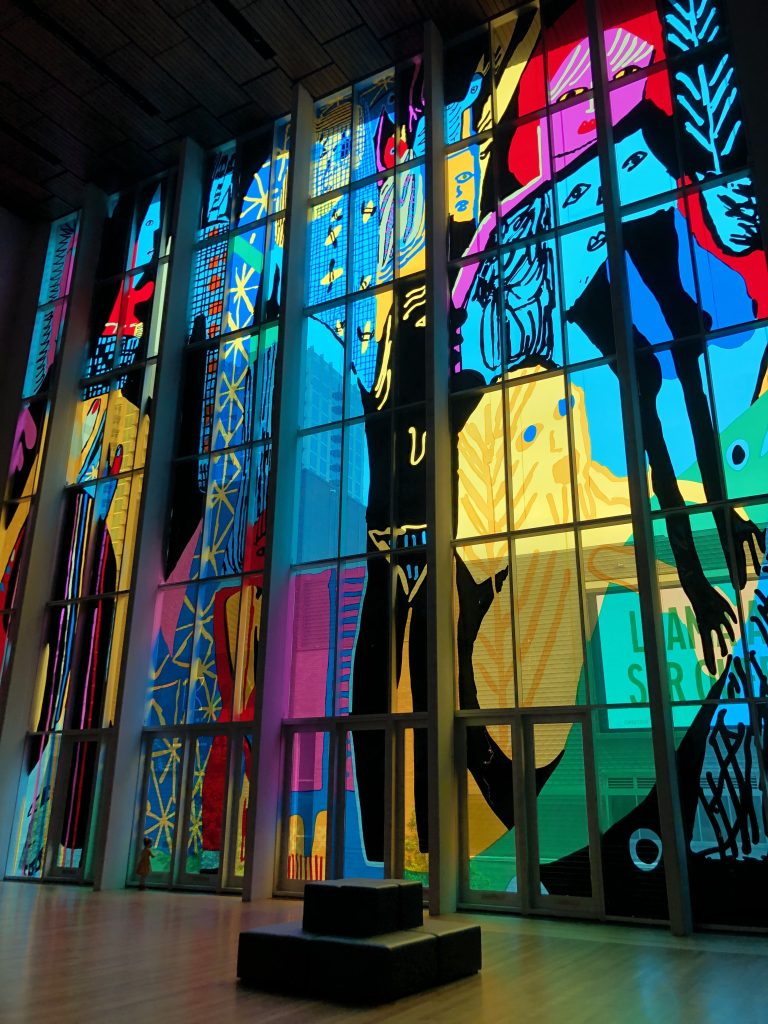
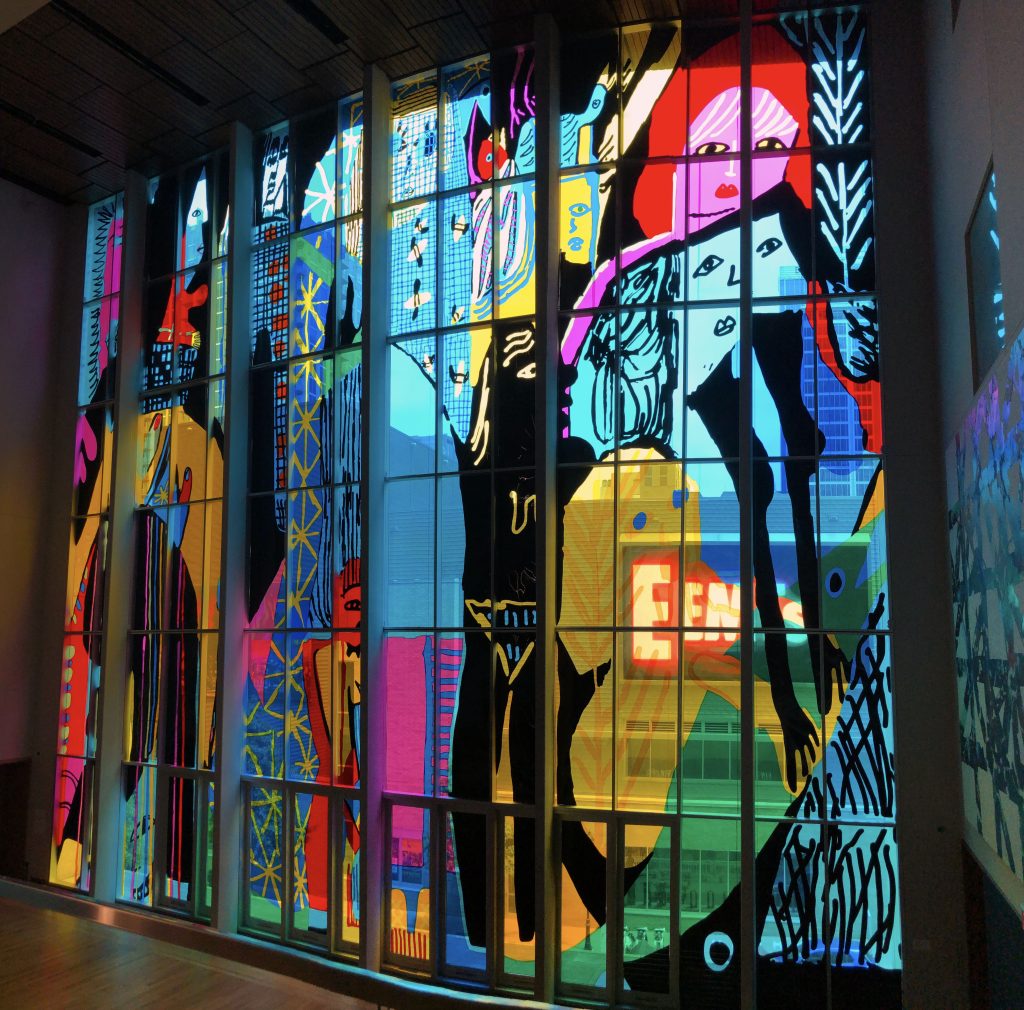
Summer Wheat created this mural, Foragers, in 2020 for the Mint Museum in Charlotte, North Carolina, where it remains on view today.

From the museum about the work-

This monumental “stained glass” installation celebrates the resilience of North Carolina’s community of makers and providers and creates a space where our present-day Charlotte community can gather for contemplation and inspiration. Collaging sheets of colored vinyl, Wheat has created a towering, prismatic composition that fills all 96 windows of the Mint atrium with female figures of varied sizes, ages, shapes, and races performing acts of labor: fisherwomen, beekeepers, hunters, mothers, caretakers, farmers, bankers.

Following the tradition of stained-glass windows found in places of worship, Wheat offers a narrative of hope and resilience that can be enjoyed in a few minutes or studied over hours. Wheat says that “Foragers presents a tradition in which women were the original hunters, technologists, and artists. This array of women connected by geometric patterns echoes the psychological space of women supporting each other. They are marching together, connecting to creatures from land and water, demonstrating their inherent link to natural elements and to the intricate depths of the unconscious.”

The women in Foragers also call attention to the underrecognized populations who have cultivated the land that we now call North Carolina, from the indigenous tribes to the colonial settlers to the enslaved Africans and all those who have followed. The region is home to myriad traditions-ceramics, basket weaving, quilting, furniture construction, textile production-and The Mint Museum specifically celebrates that legacy through its collection and exhibitions. Foragers salutes North Carolina’s history of creativity and industry, both by those whose names we know and those who remain anonymous.

Her latest exhibition, Fertile Ground, is currently on view at Nazarian/Curcio in Los Angeles, closing on 4/6/24. It includes new paintings and three stone mosaic sculptures.

Mar 222024
 

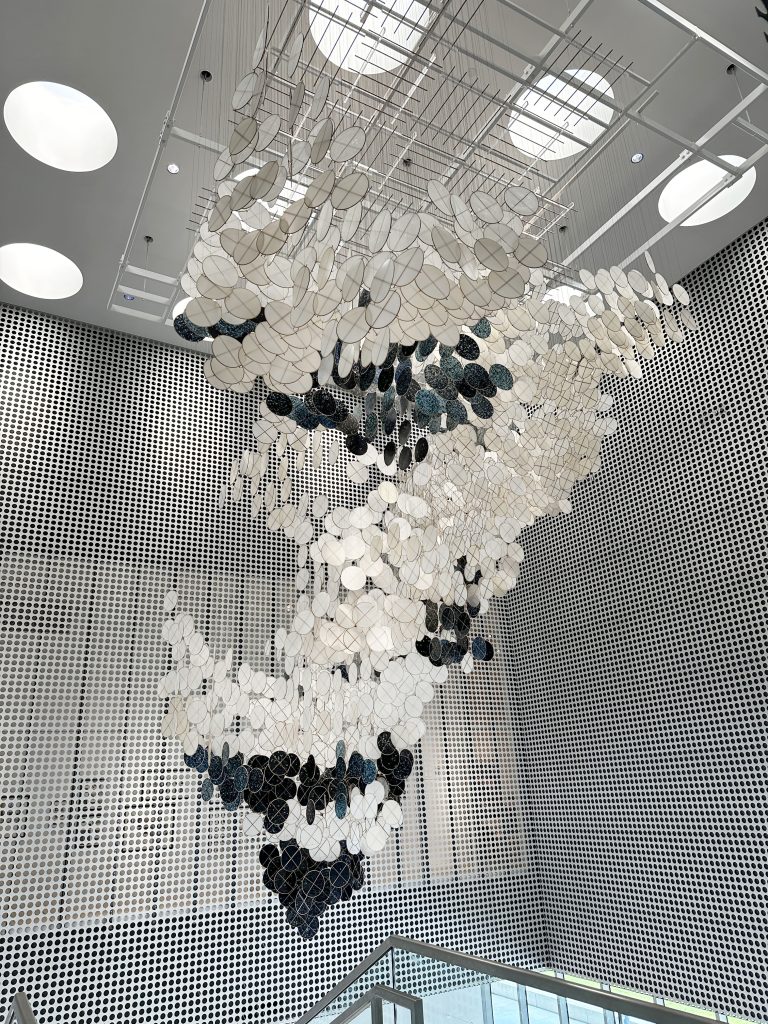
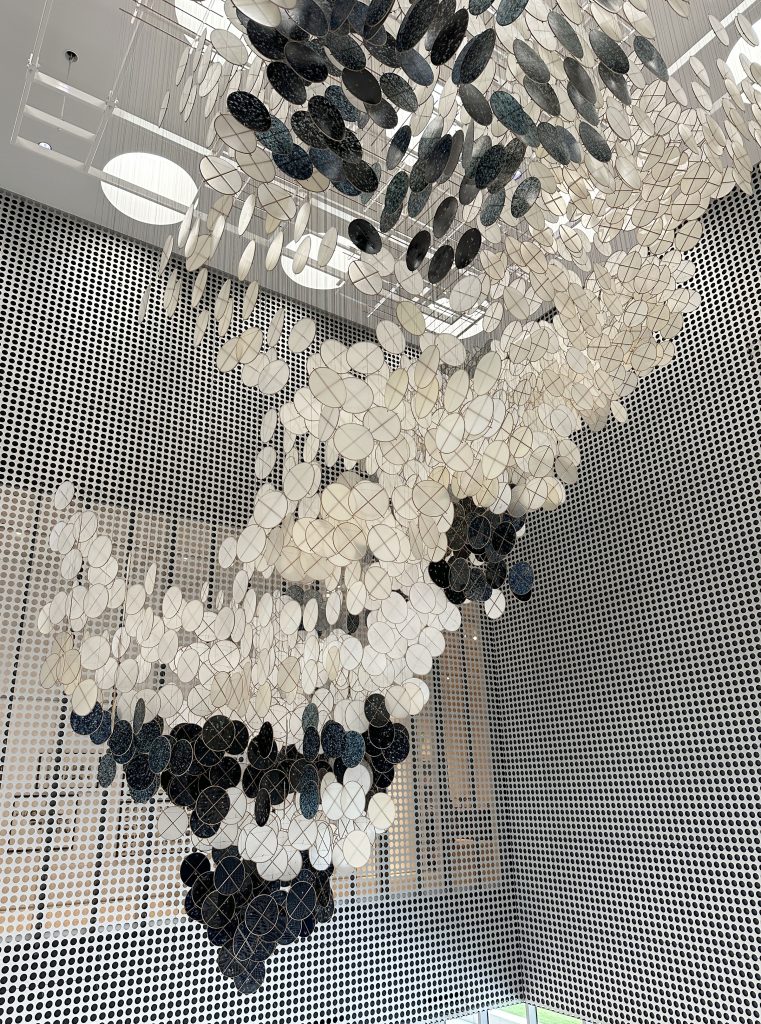
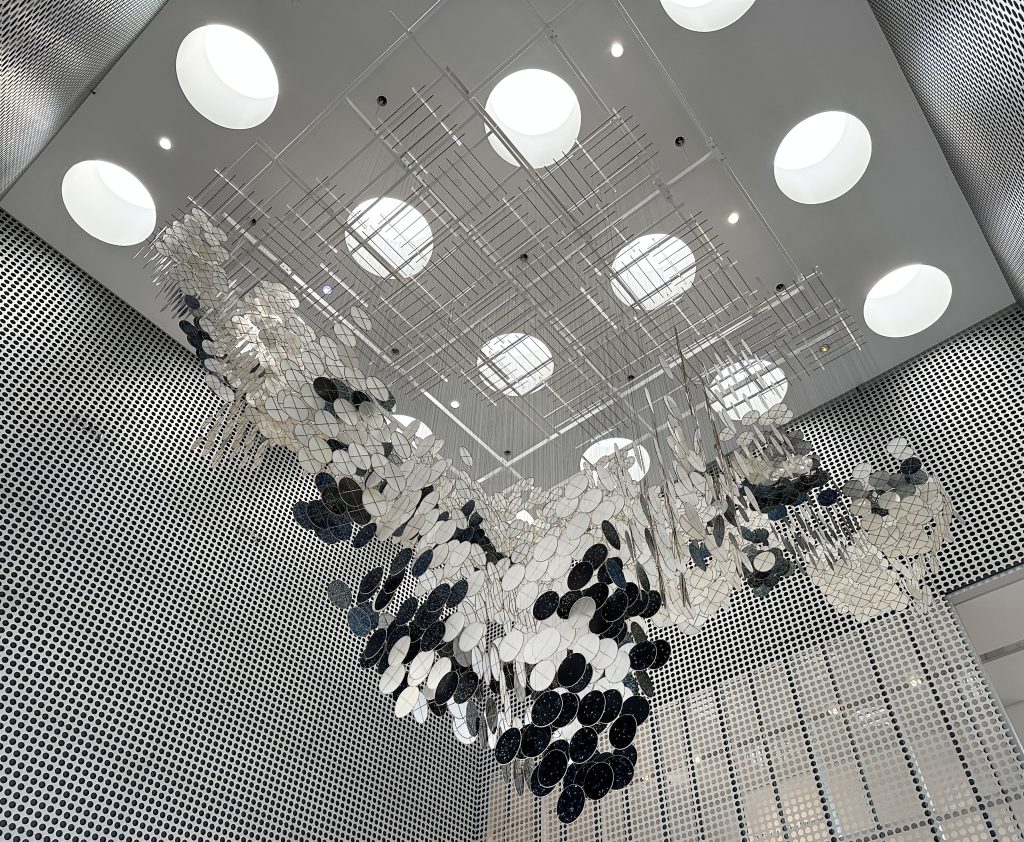
Pictured is Jacob Hashimoto’s This Particle of Dust, on view at Tampa Museum of Art through 2025.  At first glance, it may seem monochromatic, but on closer inspection the blue color and star patterns begin to emerge on the darker pieces. It also changes depending on the viewer’s vantage point and the changing natural light.

From the museum about the work-

The artist takes inspiration from cloud formations and the cosmos, with each navy blue kite featuring star-like markings. Depending on the time of day and the natural light filtering through the atrium skylights, the kites will shift in color intensity. This Particle of Dust explores the visual poetics of light and dark, color and form, as well as space and architecture.

Created from over 2,500 handmade kites, This Particle of Dust is a site-specific installation and unique to the Tampa Museum of Art’s architecture. The installation represents Jacob Hashimoto’s exploration of abstract landscape and his interest in blurring the boundaries between painting and sculpture. This Particle of Dust evokes the experience of observing the night sky through various cloud clusters. Thousands of transparent and opaque white discs hang suspended from a bespoke armature. Navy blue kites, imprinted with white and cerulean blue star patterns, hang amidst the cloud shapes and catch the light as the sun rises over the Museum and dips into the horizon over the Hillsborough River. Depending on one’s vantage point, either from the lobby, stairwell, or galleries, the experience of This Particle of Dust shifts—from below the cloudscape appears to drift into the sky while at eye-level the viewer looks directly into the stars.

Hashimoto began making kite sculptures twenty-years ago while an art student in Chicago. Inspired by traditional Chinese kite making in the city of Weifang, where the artform of sculptural dragon kites originated, Hashimoto has made hundreds of thousands of kites from Japanese paper and resin. He appreciates kites as a universal object of joy that is recognized across the globe. Transformed into monumental artworks, Hashimoto’s kites convey happiness, wonder, and serenity.

Below is Tampa Museum of Art’s video of the artist discussing this installation.

Hashimoto is also showing several wall-mounted sculptural works for his solo exhibition, Fables, at Rhona Hoffman Gallery in Chicago. It will be on view until 4/20/24.

Mar 162024
 

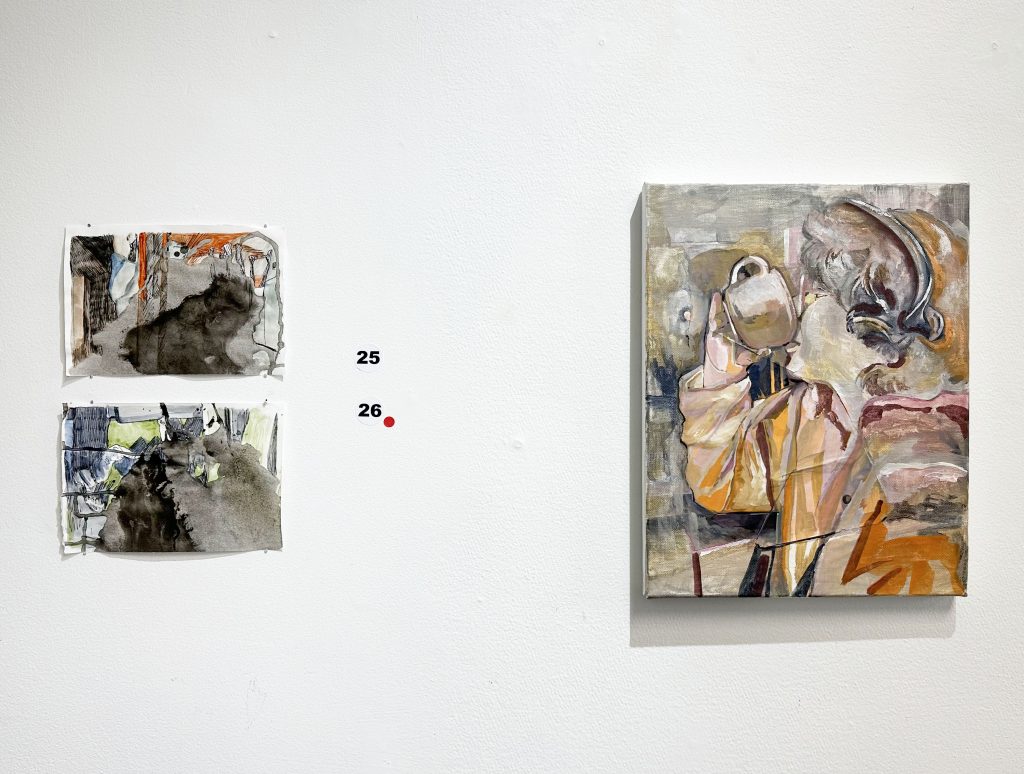
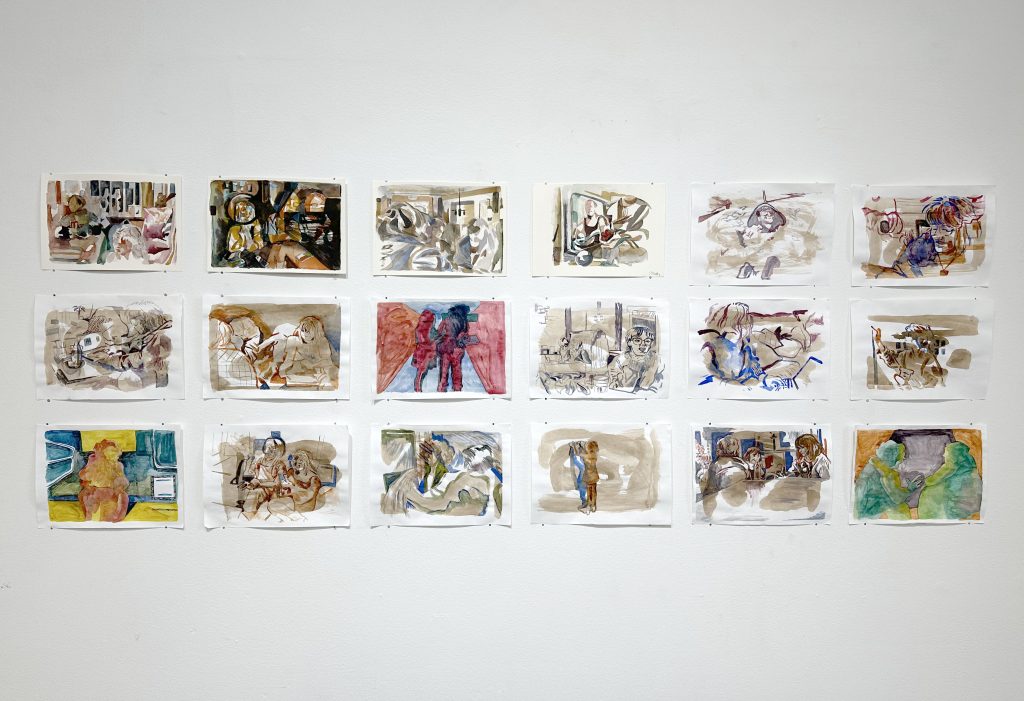
Watercolor paintings by Katherine Strobel

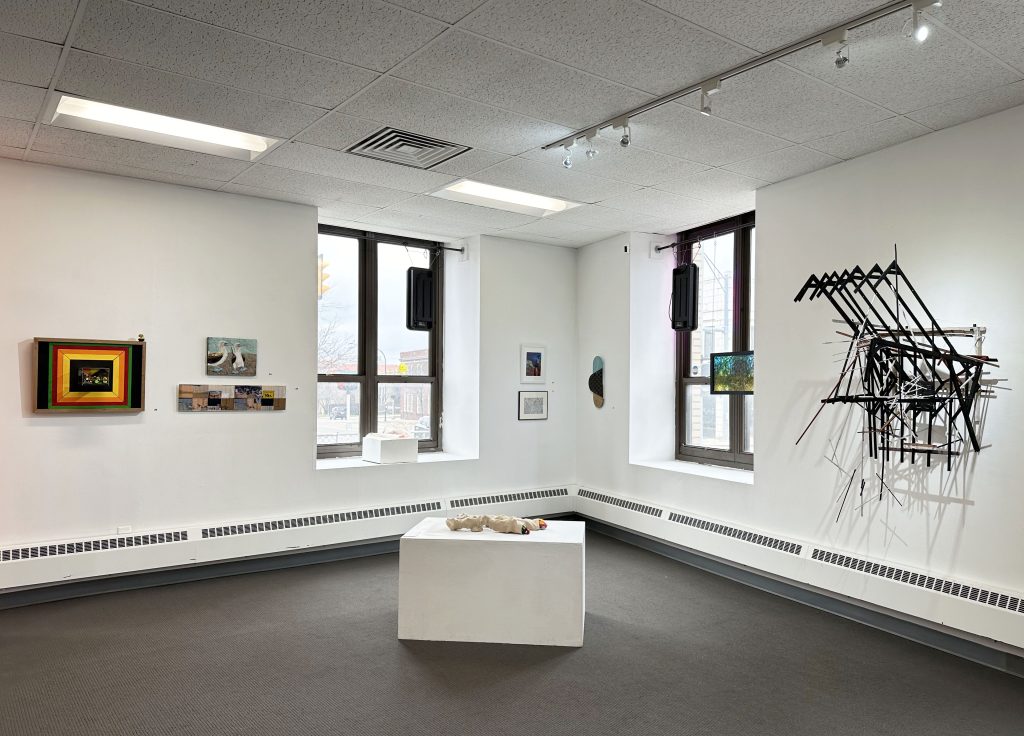
There is A LOT of work currently on view at Summit Artspace for their Winter Exhibitions (see the previous two posts) and it is worth mentioning these shows as well.

In the Welcome Gallery are watercolor paintings (seen above) by Katherine Strobel, for her exhibition, Bad Nostalgia.

Her statement about the work-

People forget to take pictures of things that don’t matter because it’s impossible to photograph qualities such as the feeling of an inside joke, the sound of an exhale through the nose, or dirty silverware that must be returned to the kitchen and replaced. These things act as set, pieces for what make up the rest of our lives. This series is a catalog of work that focuses on memory and candidness of a scene or subject. The people pictured are painted from life or candid photographs which are then emphasized from a naive image to something more. When an image is exaggerated with new colors and shapes it serves to make the mundane more desirable. The paintings are watercolors with a textured surface; the texture creates a sense of play with paper elements. In my work watercolor is often indicative of memory because of its ephemeral quality and transparent layers. This is because of how impossible it is to clarify every element that makes up a color when the layers are all compressed and viewed as a complete state.

Below are works from FRESH, an annual exhibition of local artists juried by Pita Brooks, Executive Director of Akron Soul Train. The website has all of the artists included and their statements and bios- definitely worth taking a look at what is being created in the area.

Michelle Eisen, “I’ve Made My Bed”, Silkscreen on hardboard

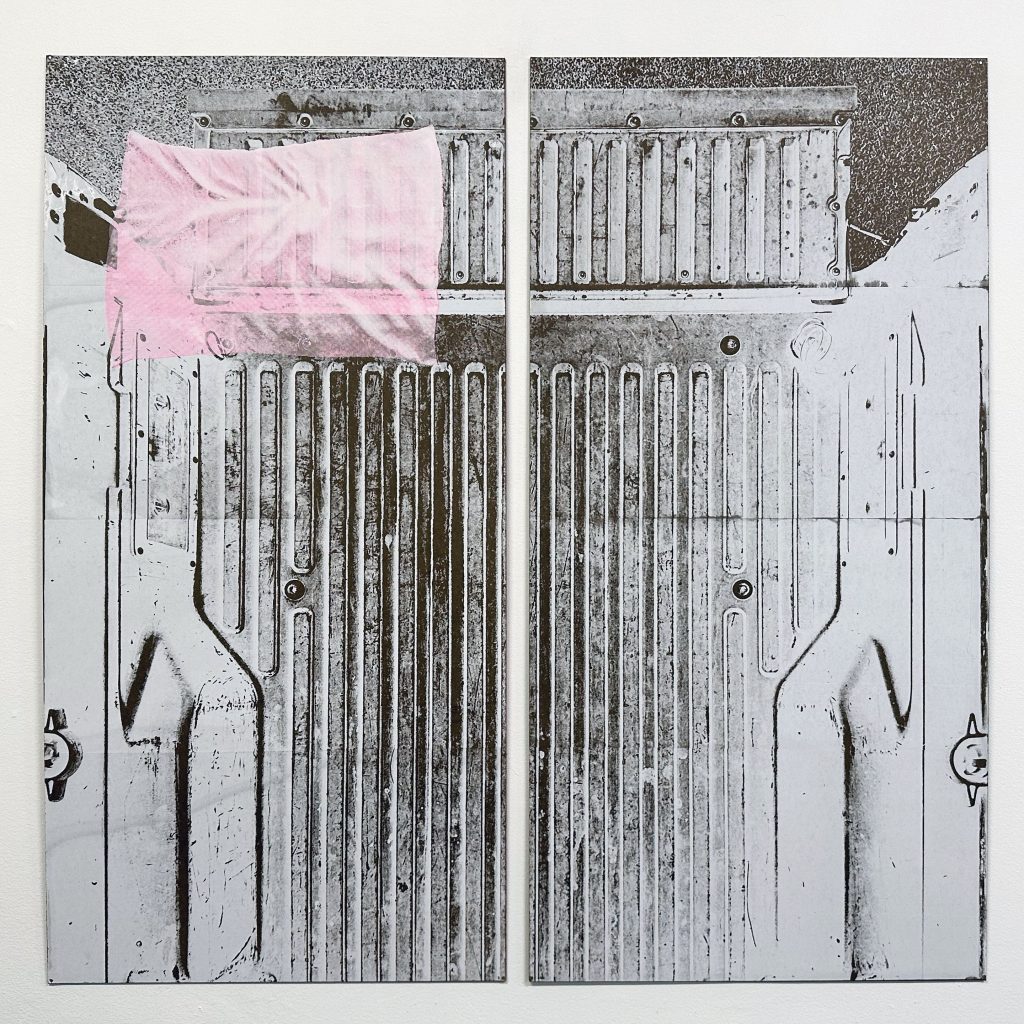
Steven Mastroianni “Fathomable Series #24”, Unique cameraless photogram, silver gelatin print

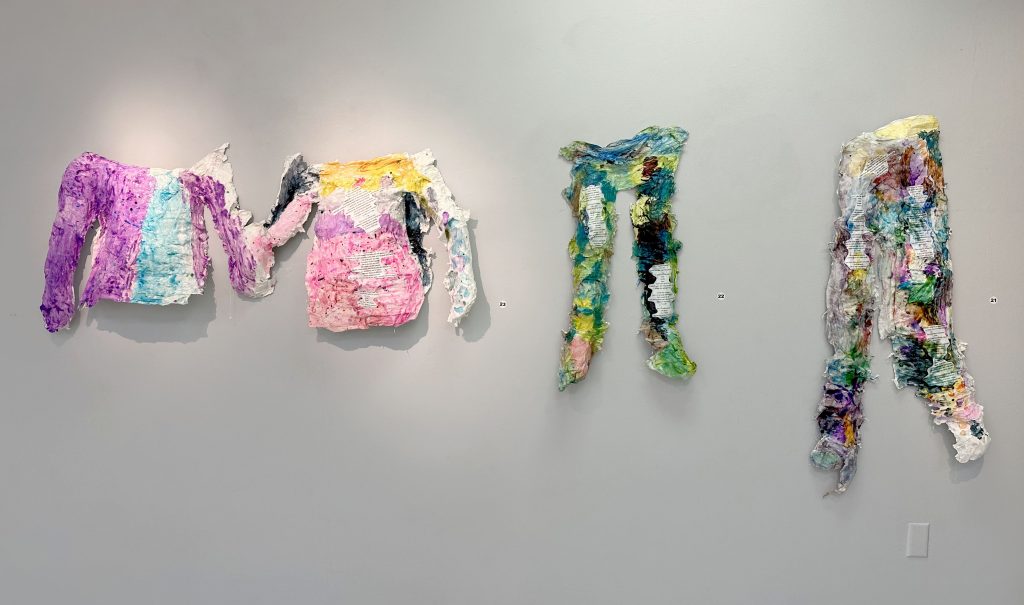
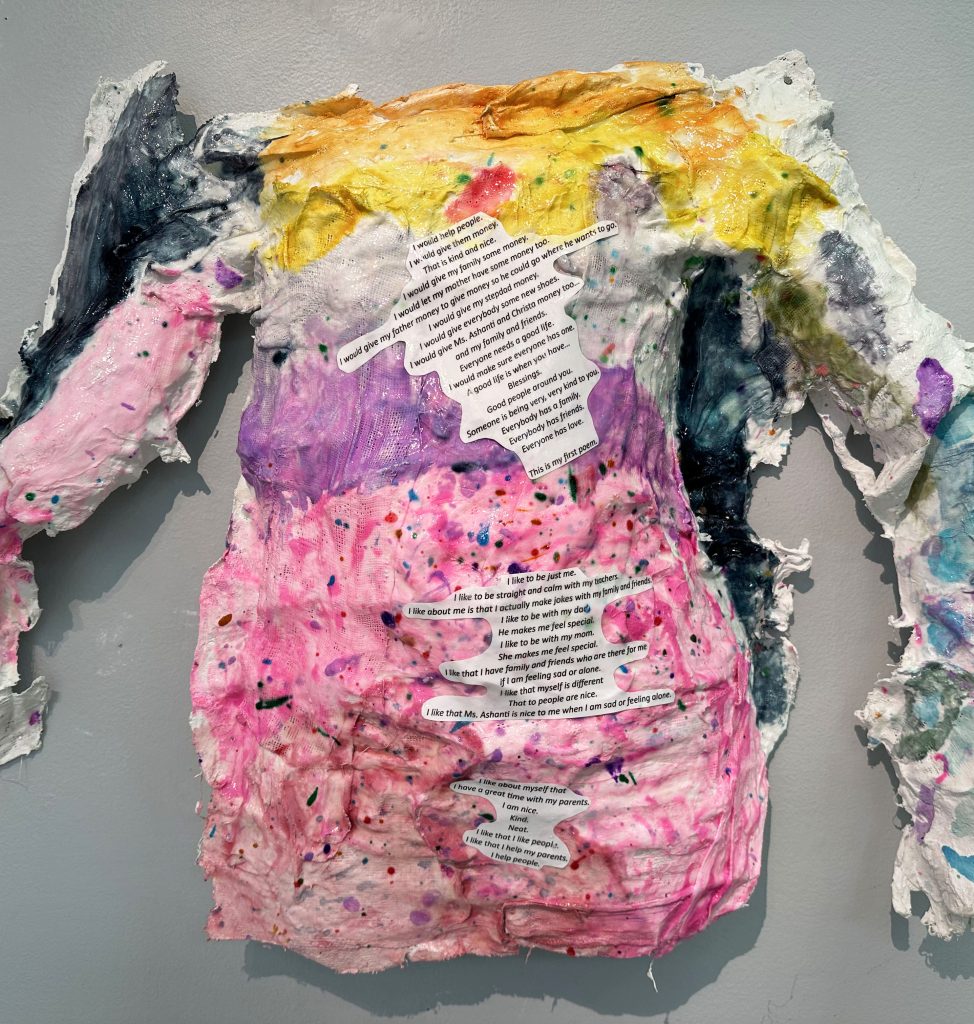
Finally, on view throughout the building are works by local students, teachers, and school leaders for Taking Care of Our House: Communities Coming Together and Making a Difference. The exhibition is made with the organization Art Resistance Through Change (ART-C). The works pictured below are a few of the sculptures created that included the personal narratives of the artists.

It’s worth mentioning that along with these exhibitions there are artists studios and galleries also in the building and worth checking out. Summit Artspace is open Fridays 12-7pm and Saturdays 11am-5pm.

Feb 142024
 

Esterio Segura’s Goodbye My Love, 2013, three sculptures created with fiberglass and automobile paint, are currently on view at Tampa Museum of Art.

From the museum about the work-

A new acquisition to the Museum’s permanent collection, Goodbye My Love represents Esterio Segura’s (Cuban, b. 1970) ongoing exploration of the meaning of airplanes and flight. Produced in multiple editions at different scales, this version is nearly the largest. In describing the series, Segura explained,  “In this work, the reference to the airplane hybridizes with a reference to another well-known universal symbol: a simplified image of the heart. This is fused with an easily understood title with several meanings, from the most corny and sentimental to the most controversial, from a political and social standpoint. With this work, I reference the experience of uprooting, nostalgia, memory, loss—how we experience the breakdown of everything we love.”

He discusses the work in the video below in a bit more detail.

Jan 292024
 

Whimzeyland, the “Bowling Ball House”, is a local landmark located in Safety Harbor, Florida, created by artists Todd Ramquist and Kiaralinda.

About the house from their website

In 1985, they purchased the beige house on Third Street in Safety Harbor, Florida. They traveled everywhere, actively seeking out inspirational and unusual places. Inspired by these travels, they began transforming their house. One of the earliest additions were the wooden triangles to the eaves of their house. The beige house became bold in color, too.

One day, they went to a flea market and saw a sign that said that anybody could take 10 free bowling balls. They took the bowling balls and began painting and placing them around the property. This is how they became known as the bowling ball house of Safety Harbor.

Todd and Kiaralinda even branched out of decorating their home, creating two different art cars, designed a restaurant, and making public sculptures, among other things. They began calling themselves the Whimzey Twinz because they work together on all of their projects.

Their travels soon included visits to folk artists and artists that they met at their shows. These friends visited them, too. Todd and Kiaralinda’s bowling balls inspired many of them. They would create bowling balls for Todd and Kiaralinda, who got so many of these works from artist friends that they started a gallery in their home. They created a “Call for Balls” which made a lot more of these art works roll into their home. Today, they have over 80 bowling balls from various artists around the world and people still bring them bowling balls as gifts.

If you are in the area, make sure to also stop by Safety Harbor Art and Music Center (SHAMc), a nonprofit they opened in 2017. It has an art gallery and shop, and hosts music events and art classes as well.


Dec 122023


Heiress Gallery in St. Pete is currently showing Melissa Spitz’s solo show You Have Nothing to Worry About, a moving portrait of her mother’s mental illness and substance abuse.

From the gallery about the exhibition-

In her solo exhibition at HEIRESS, Spitz presents medium-to large-format prints of her iconic images. The works are installed in a chaotic environment, scattered amongst the detritus of familial tragedy: her mother is found in the context of hundreds of pills and pill bottles, a glimpse into the chaos that Spitz and her family have dealt with for many years. Thousands of 4×6 glossy photos are scattered on a table in the center of the space and invites gallery visitors to attempt to make sense of the nostalgia that they hold. In addition to photographs, Spitz has included new sculptural works including ten enameled hammers titled, You Are the Nail, which encourages an examination of the over-reliance of pharmaceutical solutions in the United States. Spitz’s work freezes moments of chaos in time, to be dissected and understood by the artist after the fact. The majority of her most intimate traumatic life experiences are captured through her lens, and finds a second life in the digital sphere on Instagram, to a community of over 50 thousand followers, which blurs the lines between catharsis and entertainment.

From the artist about the exhibition-

Since 2009, I have been making photographs of my mentally ill, substance-abusing mother. Her diagnoses change frequently-from alcoholism to dissociative identity disorder–and my relationship with her has been fraught with animosity for as long as I can remember. I am fully aware that my mother thrives on being the center of attention and that, at times, our portrait sessions encouraged her erratic behavior.

The photographs are simultaneously upsetting and encouraging; honest and theatrical; loving and hateful. By turning the camera toward my mother and my relationship with her, I capture her behavior as an echo of my own emotional response. The images function like an on going conversation.

The series in installation form encourages an examination of the role prescription drugs play in the United States. Aiming to prompt discussions on the cultural, social, and individual implications of an overreliance on pharmaceutical solutions. Through visual metaphors and imagery, You Have Nothing to Worry about continues to raise awareness about the need for a balanced and holistic approach to health and well-being. While acknowledging the limitations and potential pitfalls of relying solely on prescription medications.

The immersive exhibition functions as a thought-provoking commentary on the pervasive and complex issue of prescription drug culture in America. Through the meticulous arrangement of pill bottles, pills, photographs, and family ephemera, I seek to engage viewers in a dialogue about the consequences of our society’s reliance on pharmaceutical drugs.

The Vanity, pictured above, which includes family notes and photos, adds even more depth to the family’s struggles.

From the artist-

I have always been interested in sculptural installations and photography. Sandy Skoglund, Jeff Wall and Carrie Mae Weems are a few big names who have directly inspired me. The obsessive nature of details and experience only add to telling a story and I’ve been eager to find a way to participate. This vanity belonged to my great-aunt Sophie and has been in my bedroom my whole life, it went to college and graduate school with me, and my brother has been storing it since I moved to New York. This exhibition presented the perfect opportunity to utilize it. Informed by actual experiences, The Vanity, showcases family ephemera, letters from my mom, pill bottles, scattered pills, lipsticks and flickering candles. The mirror allows viewers to reflect on their own shared familiarity.

Spitz also created You Are The Nail, pictured below, for the exhibition.

Her description of the work-

I’m not sure when I first heard the phrase “when your only tool is a hammer, you begin to see everything as a nail” but it was used regarding my mom being over medicated and her prescriptions mixing, sending her into another psychotic episode. It wasn’t the doctors’ fault, or mom’s or the pharmacist but the drugs, they were to blame. I was frustrated and angry and confused, but too young to understand that doctors received kickbacks for writing certain prescriptions and that patients like my mom were a goldmine. I do want to be clear that I know anti-psychotic medications have saved people’s lives and mom would not be able to function normally without a carefully balanced mix of mood stabilizers, anti-depressants and anti-anxiety pills. But all too quickly do I find doctors in almost any capacity pushing drugs on me…I was alarmed to learn that the United States pharmaceutical industry generates over 110 bilion dollars of revenue each year.

You are the Nail is a series of ten hammers representing the ten most prescribed anti-psychotic / antidepressant pharmaceutical drugs in the United States. Several of which my mom is prescribed. Informed by Abraham Maslow’s theory of over reliance, you are the nail visually depicts our mental health field’s greatest tool, prescription drugs. The hammers are titled, Zoloft, Lexapro, Trazadone, Prozac, Wellbutrin, Cymbalta, Seroquel, Celexa, Vensir and Abilify.

This exhibition closes 1/13/24.

Dec 072023
 

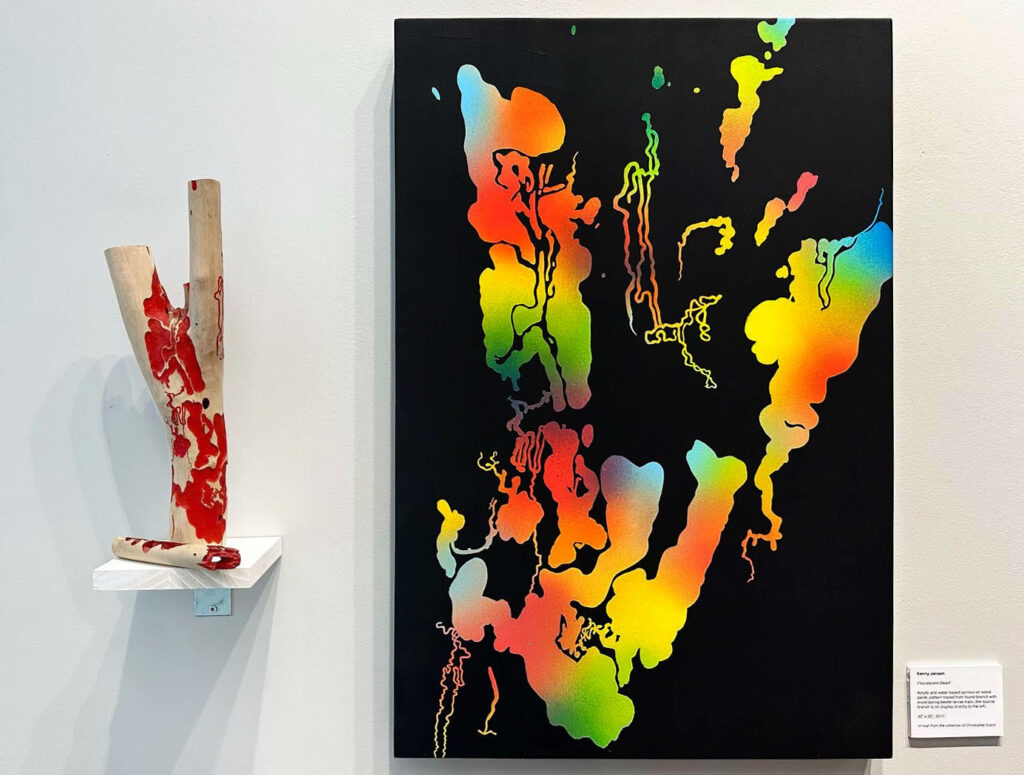
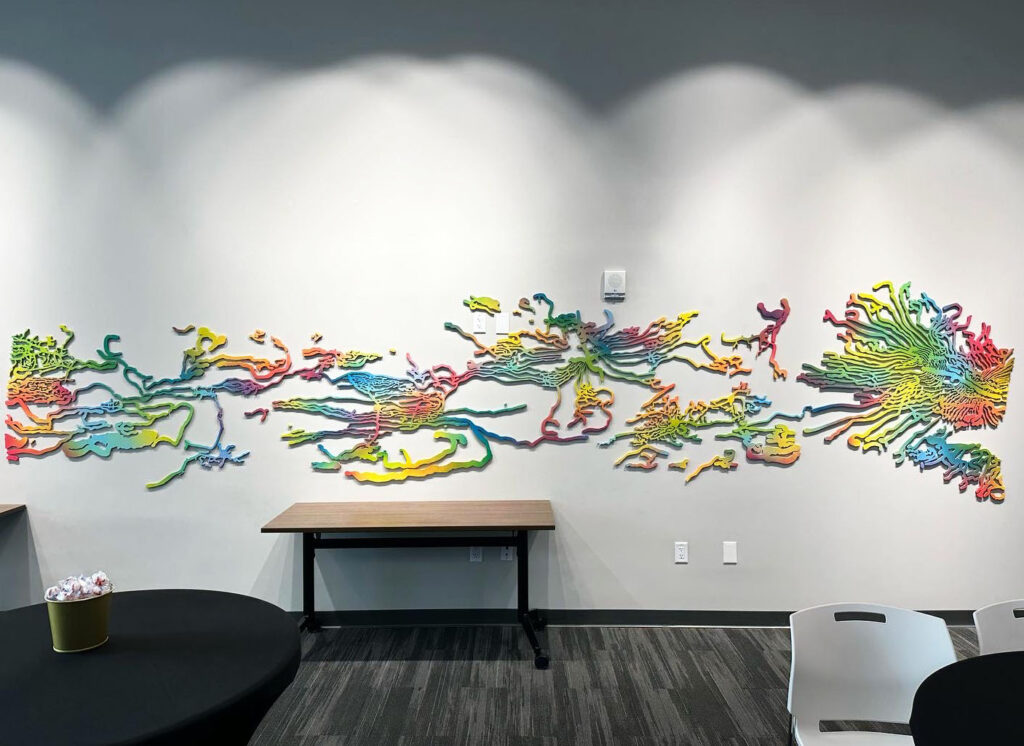
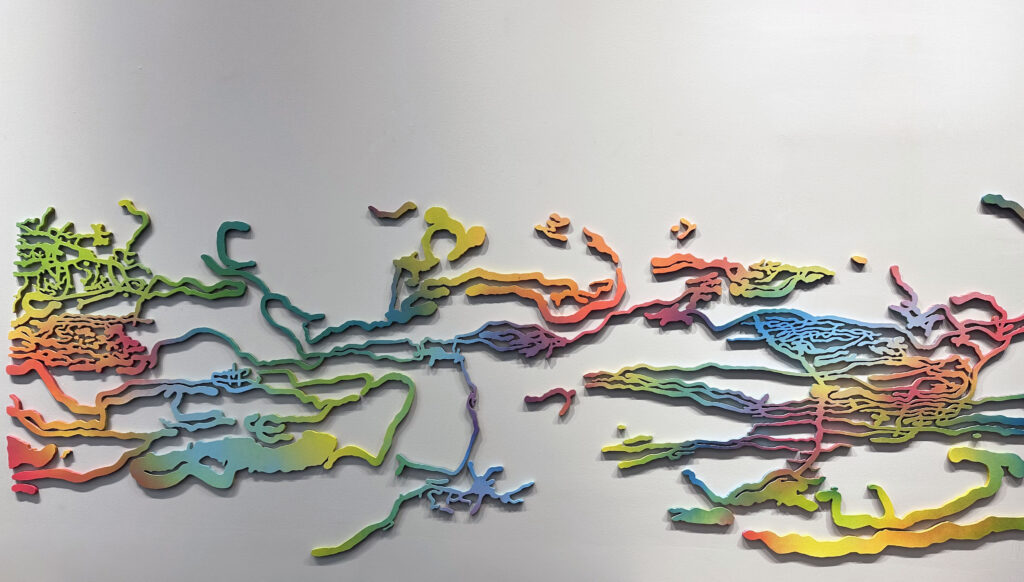
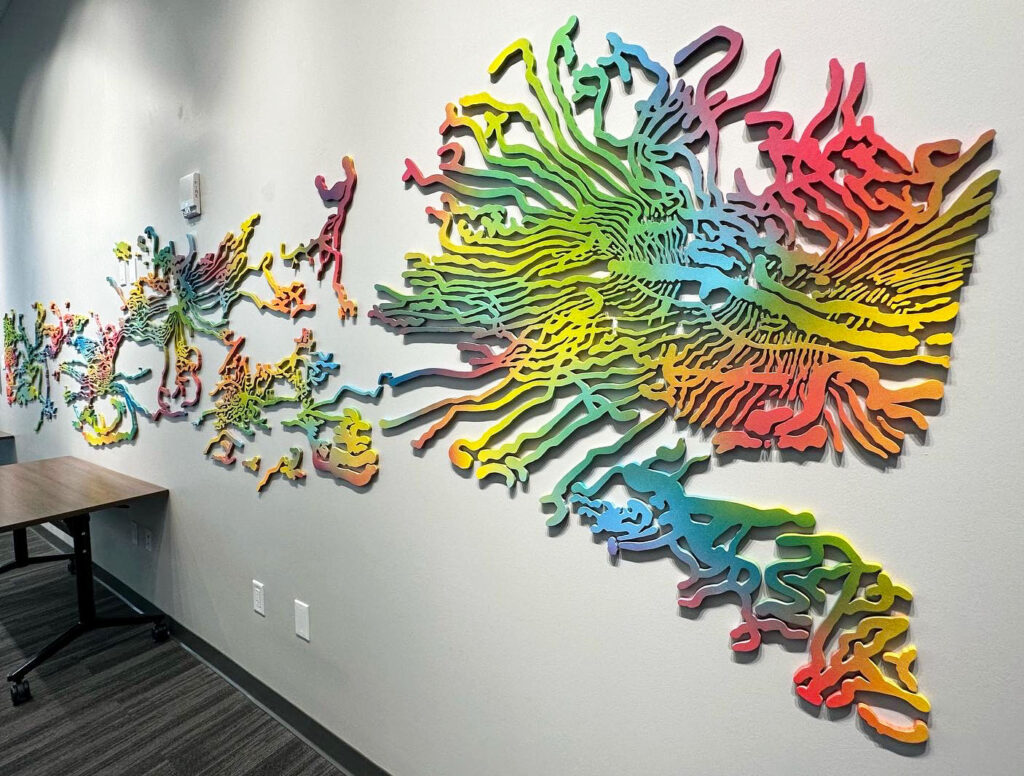
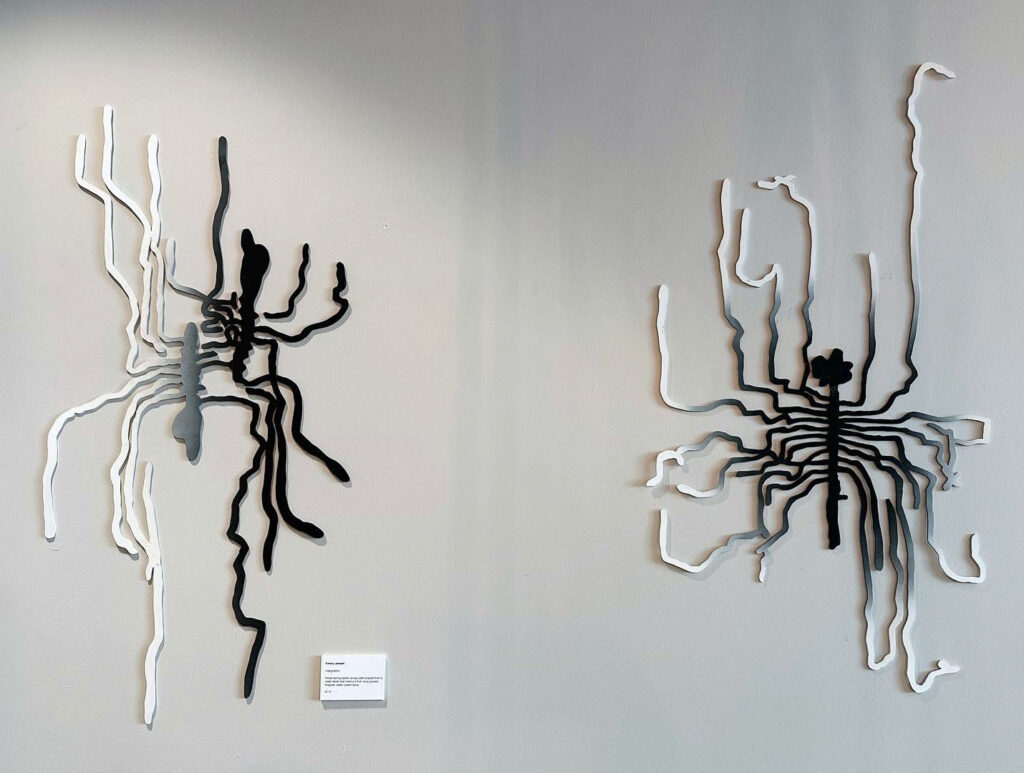
“Fluorescent Dwarf”, 2017, Acrylic and water based aerosol on wood panel, pattern traced from found branch with wood boring beetle larvae trails (the source branch is on display directly to the left)

“The Expanding Universe”, 2017, Hand cut (jigsaw) plywood, water based spray, nails, pattern traced from found branch with wood boring beetle larvae trails

“Transcend and Include”, 2019, Wood boring beetle larvae paths traced from a dead cedar tree hand-cut from re-purposed Aluplast, water based spray

Community Foundation Tampa Bay works to match people and organizations with the resources they need to carry out projects that make a positive impact on local communities. In their space in St. Pete they also exhibit work by local artists. Currently on view are selections from Kenny Jensen’s Paths of Consumption series.

From the artist about this work-

As a Florida native who spent much of my childhood outdoors both in the city and the country, I have always had an essential connection to our unique natural environment. This relationship has steadily deepened over the years through my evolving art practice, and related ecological research. Becoming a parent has also raised the stakes and heightened my ecological awareness and concern. As a result there is a tension present in my work – An earnest desire to share the wonder and mystery I continually encounter in common, overlooked nature while also expressing grief and frustration over what is actively being lost.

All of the work on display here is a part of an ongoing environmentally focused sculpture project entitled Paths of Consumption which recreates found patterns eaten out of by various insect larvae at exaggerated scale and with a full spectrum of layered hues. This series is a meditation on our consumption of the natural environment. The inverted insect paths act as a kind of metaphorical map to guide us to reflect on our own record of consumption as we develop and grow, both as individuals and as a society.

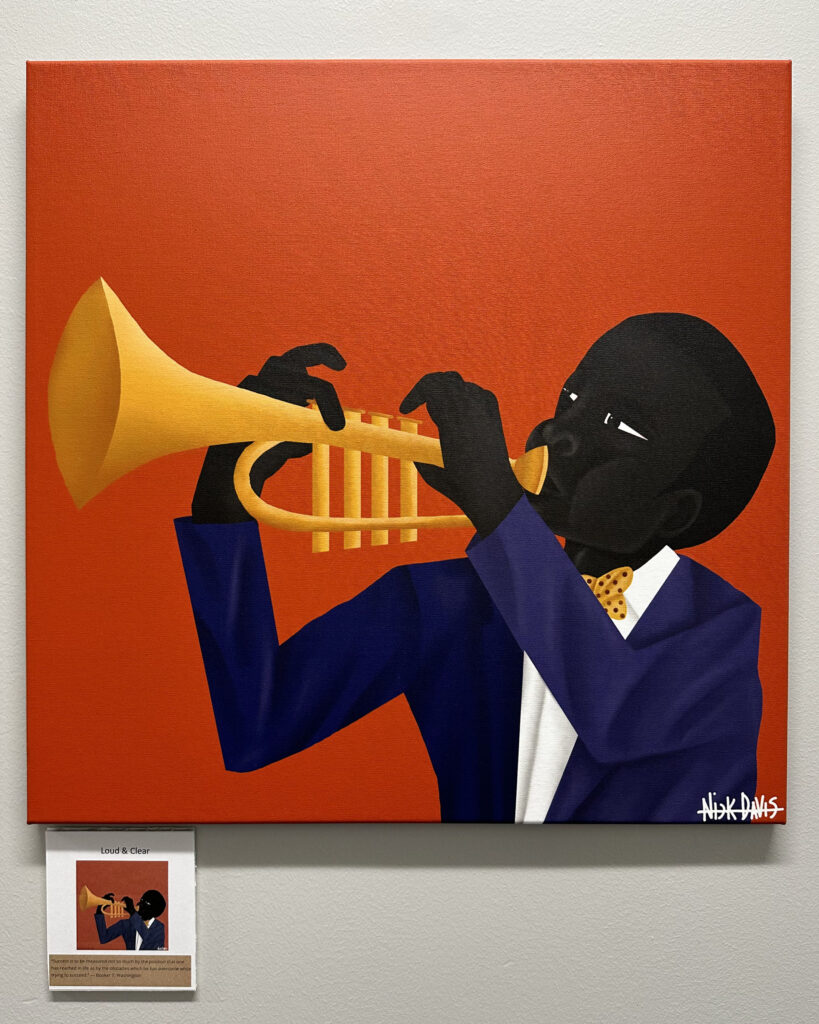
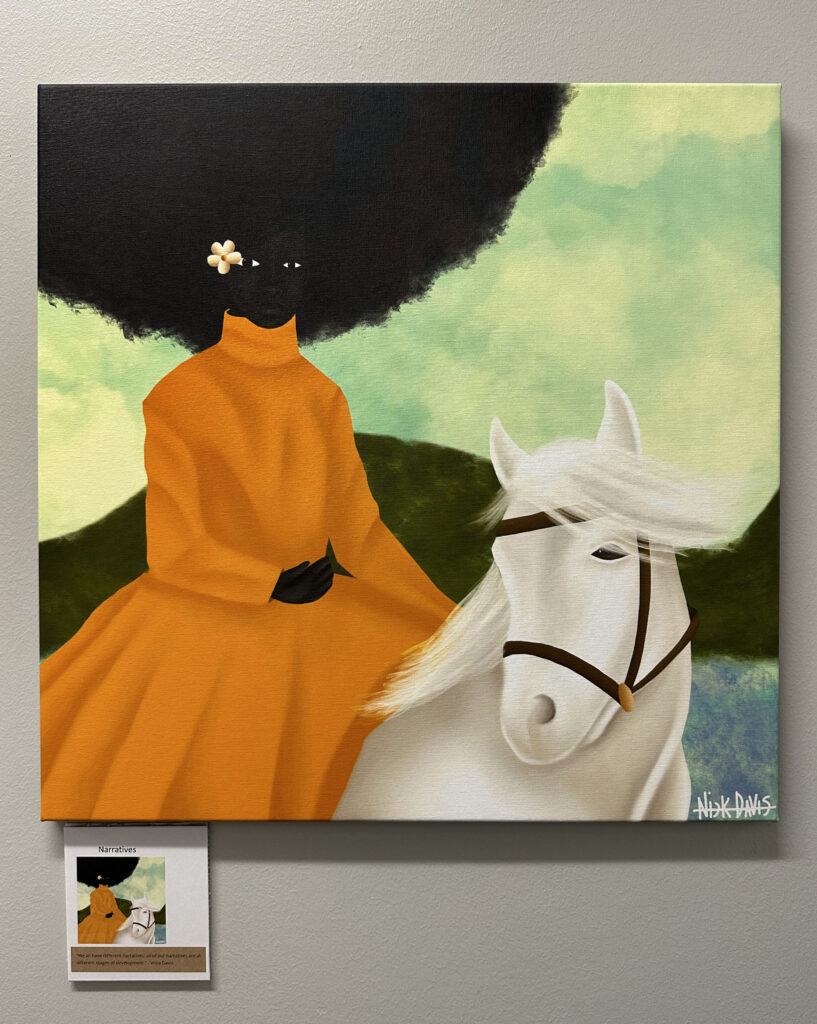
Also on view at the gallery are digital works from Nick Davis’s Black is Beautiful series. Sadly, Davis passed away in December of 2022.


Nov 232023
 

ALIVE! by artist Jeffrey Gibson was created for the first edition of the biennial Desert X in 2017, and is on view in the sculpture garden of the Palm Springs Art Museum.

It was recently announced that Gibson was selected by the U.S. State Department to represent the country at the 2024 Venice Biennale. He is a member of the Mississippi Band of Choctaw Indians and of Cherokee descent, and will be the first Indigenous artist to have a solo exhibition in the U.S. Pavilion at the event.

The artist’s statement about the work from the Desert X site-

ALIVE! is a found object ready made sculpture altered with paint and text that reads: I am alive! You are alive! They are alive! We are living!

I chose to work with a wind turbine blade because of how it alters one’s perceptions when they look out across the desert landscape. They are enormous and when viewing one up close you get a sense of the expansiveness of the desert landscape that they occupy. They are also really beautiful in form and their shape reminds me of something like a wing, a fin, or a bone from a massive whale. The text references the people who live in Palm Springs and the original indigenous people who occupied this land and their belief that the landscape is living.

Nov 152023
 

The images above are from SUPERFLEX: This Is The Tip Of The Iceberg, GENERATOR: USF Contemporary Art Museum’s inaugural exhibition. The two part exhibition includes a sculptural installation and the mesmerizing interactive animation Vertical Migration, in which viewers encounter a siphonophore that reacts to their movements.

From the gallery about the exhibition-

This Is The Tip Of The Iceberg emerges from SUPERFLEX’s in-depth research into the deep sea, biodiversity, and the climate. The exhibition immerses viewers in two parallel and interconnected realms, separated by a curtain which acts as an imaginary filter between land and sea. Passing through the curtain brings visitors from a terrestrial space unsettled by rising water to the ocean’s dark depths, to meet one of the most important cleaners of the ocean, the siphonophore. Relatives of the jellyfish, siphonophores bring between two and six billion tons of carbon a year from the surface down to the seabed, where it is stored. This Is The Tip Of The Iceberg offers an opportunity to encounter this unfamiliar species, prompting reflection on the impacts and consequences of climate change, especially relevant to Florida and its coastal communities, and encouraging humans to imagine a future defined by interspecies living and ecological coexistence.

For a more detailed discussion of the work, the gallery has created an exhibition catalogue that can be viewed online or downloaded as a pdf.

Vertical Migration was originally created in 2021 by SUPERFLEX for ART 2030  and was projected on the United Nations Secretariat Building in NYC during the 76th United Nations General Assembly.

SUPERFLEX’s statement on the project-

The sea is not an abyss. It teems with an almost unimaginable array of life. Every night, the largest biological migration on Earth takes place, as trillions of creatures travel closer to the surface to feed. Some of these animals, like shrimp, are well-known. Others, like siphonophores—relatives of jellyfish—are unfamiliar: varying wildly in size, from the slightness of a fingernail to the length of a whale, they look like nothing that we find on land.

How does it feel to be one of these creatures? To explore this question, SUPERFLEX designed a computer-generated siphonophore and created an animated film, Vertical Migration, depicting its ascent. At first, the film mechanically circles the creature, getting closer and closer while giving the audience a view of it from all angles. But eventually the perspective shifts, the camera’s movements become more fluid, and the viewer sees the world from the perspective of the siphonophore.

Unsettling our perceptions of scale and otherness, Vertical Migration is an intimate encounter with a life form that bears no resemblance to human beings, though we share a planet, an ecosystem, and a future. Because of sea-level rise, humans will also be migrating vertically in the coming centuries, to higher elevations and raised buildings. The siphonophore’s story is our story. Though we can never experience its journey through the pitch-black ocean depths, we can shift our perspective to recognize that we’re connected, that our actions affect each other, and that we share a common fate.

For a look at the work in motion, below is the trailer from ART 2030.

About SUPERFLEX from their website-

SUPERFLEX was founded in 1993 by Jakob Fenger, Bjørnstjerne Christiansen, and Rasmus Rosengren Nielsen. Conceived as an expanded collective, SUPERFLEX has consistently worked with a wide variety of collaborators, from gardeners to engineers to audience members. Engaging with alternative models for the creation of social and economic organisation, works have taken the form of energy systems, beverages, sculptures, copies, hypnosis sessions, infrastructure, paintings, plant nurseries, contracts, and public spaces.

Working in and outside the physical location of the exhibition space, SUPERFLEX has been engaged in major public space projects since their award-winning Superkilen opened in 2011. These projects often involve participation, involving the input of local communities, specialists, and children. Taking the idea of collaboration even further, recent works have involved soliciting the participation of other species. SUPERFLEX has been developing a new kind of urbanism that includes the perspectives of plants and animals, aiming to move society towards interspecies living. For SUPERFLEX, the best idea might come from a fish.

This exhibition closes 11/22/23.