Jun 012024
 

It’s easy to become a bit overwhelmed at Arthur Jafa’s exhibition BLACK POWER TOOL AND DIE TRYNIG at 52 Walker. His latest show includes a large installation, photography, sculpture, painting and a new film. Passing the reflective black surface and walking through his sculptural installation, Picture Unit II,  you’ll find portraits of bikers, a photo from the Manson murders, a subway car, and a stripper at a club next to a photo from a Rwandan genocide memorial. Next to where a video plays a collage of clips, an installation of cut out figures includes himself, Miles Davis, The Sex Pistols, and artists Cady Noland and Adrian Piper.

Death plays a large part in the show, as does personal and collective history. His best friend of forty years, cultural critic Greg Tate, recently passed away, also contributing to the heaviness of this recent work.

From the press release-

Lauded for his achievements as a filmmaker and cinematographer as well as a visual artist, Jafa has developed an incisive, chameleonic practice, through which he seeks to unravel the cultural significance and strictures ascribed in tandem upon Black existence in the Western world. In BLACK POWER TOOL AND DIE TRYNIG, Jafa invokes the body’s personal, political, and industrial guises in one fell swoop, deftly interweaving images and objects to create a forceful and maximal space that beckons toward engulfment and revelation alike.

Jafa’s exhibition at 52 Walker brings to the surface questions of form, force, and resistance— in addition to tensions that result from common slips and errors. The title of the show, BLACK POWER TOOL AND DIE TRYNIG, applies strategies of sequencing and juxtaposition, channeling various meanings in its wordplay—including political ideologies, industrial terminologies, and the specter of death—while also nodding to the complexities of the word “black” and its many inflections. Favoring intuitive arrangement over uniformity, the artist eschews traditionally monolithic modes of presentation and instead coheres multiple simultaneous events, applying a decidedly Black and non-Western viewpoint that confronts twentieth-century art historiography and museology’s indebtedness to African aesthetics.

In the video below, also on the 52 Walker website, Jafa discusses the show with screenwriter Judnick Mayard and is worth watching for additional insights.

This exhibition closes 6/1/24.

May 252024
 

There are many little stories within Sascha Mallon’s lovely installation for Wolf Tales, on view at Kentler International Drawing Space. It includes sculptures and drawings, with pieces emerging from the walls. Each little section captures the imagination.

The press release below includes a poem by Erich Fried, as well as a more detailed discussion on the artist’s motivations and process.

WOLF TALES

“It is madness
says reason
It is what it is
says love
It is unhappiness
says caution
It is nothing but pain
says fear
It has no future
says insight
It is what it is
says love
It is ridiculous
says pride
It is foolish
says caution
It is impossible
says experience
It is what it is
says love.”
– Erich Fried

This installation synthesizes the artist’s engagement with drawing, glazed porcelain, and mohair silk crochet yarn, bringing all these elements into one monumental work that flows around the edges of the space. For Wolf Tales, Mallon is going back to her roots of drawing after being actively engaged with molding, firing, and glazing porcelain objects. In this exhibition she is primarily a draftsman on a quest, mirroring the main heroes of the story as they go through transformations. Going back to drawing in this more monumental format signifies for Mallon her long-cherished wish of making this method more dynamic, forgetting its static nature, and allowing drawings to flow.

The titular wolf is an ambivalent embodiment of spirit and energy that is at first at odds with a human presence of a girl and then goes through a series of spiritual and physical changes, inner and outer shifts. In his newly published autobiographical book, Japanese author Haruki Murakami devotes significant attention to how a narrative of a novel shifts when characters are presented indirectly versus being contemplated from within their own mind-frame. In her drawings for this exhibition, Sascha Mallon likewise changes the degree of her engagement with the heroes and heroines whom we see. Themes of belonging, sustainability, mistrust, loneliness, and connection are based on narrative points presented through figures of a human girl, a wolf, a raven, and others. Yet Mallon uses her subtle drawing skills to connect disparate parts of the narrative so that we can subconsciously see the connections and let the story unfold in our own time. The tale we see is one that stays with a viewer long after they leave the space. Drawing in motion is what this presentation underlines, tying all the elements together in one mandala directly drawn on the wall by this practicing Buddhist. The drawings are airy, frequently working with and playing with a negative space.

As do many artists, Mallon creates narratives based on issues she faces in her life, and as a Buddhist she thinks often about one’s perception of reality, how we create reality, how we can make a better world by changing the mind. She is fond of questioning rather than responding, leaving spaces for stillness and freedom for the viewers. Mallon’s body of work does not develop from project to project, it is one big story that keeps changing and transforming itself. To an observer, it is more of a conversation that she continues having with herself by visual means, artistic practice presented as a gestational thought process. You do not know where it starts and where it ends; it is fluid and dynamic.

As a story, Wolf Tales also develops on multiple planes and in multiple temporal frameworks. It is not a fairy tale, but rather an artistic representation of ideas and feelings, thinking through the poem by Erich Fried, which has occupied a special place in Mallon’s life for many years. Out of all of these narratives and feelings, she weaves characters and stories in the way that fairy tales do. There are no solutions. It’s about what is happening with our lives and our emotions, and it is complex. In the seminal analysis of fairy tale structure that Vladimir Propp published in 1927, the author outlines seven main characteristics important for a fairy tale (Zaubermärchen ): miraculous helper, miraculous spouse, miraculous adversary, miraculous task, miraculous object, miraculous power or gift, and other miraculous motives. In our time we need to emphasize the importance of miraculous, which could be understood to mean harmonious, compassionate, human.

Mallon is not a research-driven artist, as what we see on the walls is transmitted (or unearthed?) through sitting still and reflecting upon dharma talks and her work as a resident artist at The Creative Center at Mount Sinai Hospital. Working with people who have limited capacities affects Mallon, bringing an existential degree to her contemplation of humanity, anger, attachment, and suffering. A native of Austria, she studied art therapy, but ultimately developed her own intuitive technique of drawing and sculpting in order to perfect what she needed to say. This self-taught quality and a certain remoteness from the official and often overtly commercial art system creates a space for honesty, deep engagement, and compassion in Mallon’s works. Being informed by the understanding of larger and more painful experiences influences one’s ability to look at life. Mallon’s life informs her works and vice versa. Even with her patients she tries to find the healthy part and work with it.

Miraculous is an element of the drawings around us. Sascha Mallon offers to bring each of us home, just as a wolf and a girl who are tied in an ambiguous, but ultimately symbiotic relationship are able to do. What is the alternative if we turn away instead of looking into each other’s faces? Compassion is an essential part of Mallon’s work, a quality that we see less and less of in the polarized society of today’s United States. For the artist, an enemy that is initially perceived on the outside turns out to be an enemy on the inside. In this story, the lines get blurred, become vague and nonessential: you don’t know any more if it’s describing a girl or a wolf. Yet the hope of the artist is that through her heroes we are able to move toward peace rather than confrontation.

—Nina Chkareuli-Mdivani is a Georgian-American curator, writer, and researcher living in New York.

This exhibition closes 5/25/24.

May 222024
 

Artist and activist Andrea Bowers is based in Los Angeles but was born and raised in Ohio. This provides the connection to the work in Exist, Flourish, Evolve, currently on view at moCa Cleveland, which advocates for environmental protections for the area. The educational material informs the viewer, while the artwork reminds us how much beauty there is to lose.

From the museum-

LA-based artist Andrea Bowers bears witness in her work, drawing attention to and inspiring movement around the most urgent issues of our time. Her drawings, sculptures, installations, and films chronicle and preserve history as it occurs, documenting collective action and amplifying the labor and lived experiences of activists dedicated to socio-political change.

Developed through an ongoing partnership with the Community Environmental Legal Defense Fund (CELDF) and activist Tish O’Dell, Exist, Flourish, Evolve is a new, multi-site, multimedia campaign that builds awareness and action around the dangers facing Lake Erie and all of the Great Lakes ecosystems. It features a monumental neon sculpture installed on a waterfront balcony of the Great Lakes Science Center; a documentary investigating the impact of factory farming on Lake Erie’s ecosystem; and a presentation in moCa’s Lewis Gallery that includes a newly-created drawing of the Lake Erie Bill of Rights, first-of-its-kind legislation protecting an entire US ecosystem that is part of the global Rights of Nature Movement.

Bowers was raised in the small town of Huron, Ohio and spent her childhood on the shores of Lake Erie, connecting to the lake itself like a member of her family to be cared for, cherished, and protected. Yet, Lake Erie and its watershed are abused and endangered by corporate practices such as contaminant dumping, toxic runoff from industrial farming, and the introduction of non-native invasive species. Exist, Flourish, Evolve demands justice for the Great Lakes, urging us to prioritize the preservation of our natural ecology over industrialization and capitalism.

Within moCa’s gallery, a timeline connects Bowers’s new and recent artworks with historical facts and archival materials using two catastrophic climate events as bookends to Bowers’s life thus far: the 1969 fire on the Lake Erie-connected Cuyahoga River (a result of oil slicks covering the water) and the massive 2014 algae bloom that blanketed Lake Erie and invaded Toledo’s water systems, preventing residents from using tap water.

From the Maumee to the Cuyahoga, the works in Exist, Flourish, Evolve come together to share the histories of our water, demonstrate the interconnectedness of ourselves and our natural world, and remind us, as Dr. Vandana Shiva states, “nature is not out there; we are a part of it.”


This exhibition closes 5/25/24.

May 222024
 

There’s only a few days left to see Frank Stella’s recent sculptures at Deitch’s New York location. The large colorful works look drastically different depending on the angle with which they are viewed.

Stella sadly passed away at the beginning of this month. Although it is sad that we won’t be able to see what he would have come up with next, these sculptures help demonstrate how inventive he remained throughout his career.

From the gallery’s website-

Double wide flatbed trucks navigated the bridges into Manhattan to transport five monumental works by Frank Stella to Jeffrey Deitch’s SoHo gallery.

They are among the most ambitious and most radical works being made by any artist today. They extend Stella’s forms even further into three dimensions. The works are not painted sculptures or relief paintings. They completely fuse painting and sculpture in a way that has never been achieved before. The sculptures have never been shown in New York City.

Frank Stella said that one of the objectives of his recent artistic approach has been to “build a painting rather than painting a painting.” The new work is a realization of this ambition. Stella combines traditional artists’ techniques with high technology to create his new work. His monumental sculptures begin with computer models that are transformed into a series of small sculptural maquettes through 3-D printing. The artist refines these models in the studio and then sends them to fabricators in the Netherlands and Belgium where they are engineered and constructed using technology derived from shipbuilding. The sections are then shipped to Stella’s studio in the Hudson Valley where they are refined and painted with automotive paint.

The exhibition features works from two series, Scarlatti Sonata Kirkpatrick from 2014, and Atlantic Salmon Rivers from 2021-23. The Scarlatti Sonata Kirkpatrick sculptures are created with high density foam covered in fiberglass. The Grand Cascapedia, inspired by the Canadian river known for salmon fishing, is made from aluminum. As in all of Stella’s work, the forms embody their materials. The materials inspire the forms.

Stella’s work of the 1980s were characterized by its extension of two-dimensional painting into his version of baroque space. These new works extend beyond baroque space into outer space. The forms seem to float in anti-gravity. They ascend, transcending their weight. They do not have front or a back, existing in the round.

Frank Stella has expanded the art discourse for more that six decades. His new work continues to advance art into a place where it has never been before.

If you are able to see the work in person at the gallery, make sure to take the steps to the top where you will find a diorama containing the sculptural models (pictured below).

May 212024
 

“blood compass” 2023, Cotton and acrylic yarn

“summer somewhere (for Danez)”, 2020, Woven cotton and acrylic yarn

“how to approach a foal”, Cotton and acrylic yarn, 2024

“american wedding”, 2019, Cotton and acrylic yarn

Diedrick Brackens’ weavings for blood compass, currently at Jack Shainman’s two New York City locations, have a mystical language all their own. In the gallery’s newest space, inside the landmark Clock Tower Building, his creations look particularly majestic.

From the gallery-

In these weavings, the artist maps an imagined place —visualizing the internal mechanisms and symbols that animate his work while removing the anchor of direct narrative. The scenes depicted in each weaving exist out of time, suspended between a distant past and a world to come. The works in this series are set at dusk, twilight, and deep night—hours that become vehicles for ritual and interiority. The silhouetted inhabitants of this in-between realm are archetypes that Brackens once described as ciphers, or “needles through which I slip the threads of biography and myth, and pass through a mesh of history and context.”

His figures are accompanied by an ecosystem of symbols and shapes that have recurred over the course of his practice. The animals, natural elements, and man-made objects, accrue significance every time they are cast in this ever-evolving mythology. The characters in this series are placed in dialogue with lightning bolts, waning suns, and sourceless orbs of light—open-ended devices of orientation. In these distilled arrangements, footholds for straightforward interpretation dissolve—inviting viewers to parse the compositions and uncover meaning.

Brackens’ semiotic language emerges from lived experience, but also through revisiting books, poems, and legends. In blood compass, some of these references—alluded to in his titles— include the novel Mind of My Mind by Octavia Butler, the poem “How you might approach a foal” by Wendy Videlock, and the Bible’s parable of the prodigal son. These stories, though dramatically diverse in genre and subject, speak to Brackens’ inclination to loop, lose, and locate one’s self in that which is known, but also to shape-shift, forming new meaning from that which is “familiar.” He approaches these symbols—weighted with memory, context, and history—with fresh eyes or, as Videlock’s poem concludes, ”like you / are new to the world.”

The show closes downtown on 5/24, but continues through 6/1/24 at the Chelsea location where the selections below are from.

“if you have ghosts”, 2024, Cotton and acrylic yarn


“towards the greenest place on earth”, 2023, Cotton and acrylic yarn

“favorable conditions”, 2023, cotton and acrylic yarn

May 012024
 

Claes Oldenburg and Coosje van Bruggen created Free Stamp, the 70,000 pound sculpture, pictured above, in 1985.

Cleveland Historical, which has detailed numerous historical sites in the city, provides a detailed history of the sculpture. They also have an app to simplify exploring the city.

Below is a section from their website about Free Stamp

…Commissioned by the Amoco Company in 1982, the Stamp was designed and fabricated in 1985. At the time, Amoco owned Sohio (Standard Oil of Ohio) and the building now known as 200 Public Square, and the piece was intended to reside in front of the building. But in 1986, before installation could happen, Amoco, Sohio and the building were acquired by BP America. The new owners refused to mount the sculpture—perhaps believing that “Free Stamp” was a metaphoric aspersion. Art historian Edward J. Olszewski has also noted that, in England, Pop Art is viewed more cynically and politically than in the United States, where it is considered primarily whimsical. Oldenburg is on record as saying that “free,” references the emancipation of American slaves during and after the Civil War—a plausible explanation given the piece’s planned proximity to the Soldiers’ and Sailors’ Monument.

So instead of adorning Public Square, the Free Stamp was denied its freedom: imprisoned instead in a warehouse in Illinois. There it gathered dust for five years before then-mayor George Voinovich invited Oldenburg and van Bruggen to Cleveland in hopes of selecting another site.

It eventually was decided that the Stamp should be located in Willard Park on Lakeside Avenue just west of East 9th Street; and BP agreed to gift it to the city of Cleveland with all installation and maintenance expenses covered. However, disagreements arose about how the sculpture would be positioned. The original intent was for the Stamp to stand face down on Public Square. However, Cleveland city planners felt that this approach was not right for Willard Park and the Stamp ultimately was mounted angularly, with the faux-rubber “FREE” proudly visible. According to Oldenburg, it was as if “a giant hand picked up the Free Stamp and angrily hurled it several blocks to its current location at Willard Park.” Not surprisingly, the Stamp—formally dedicated on November 15, 1991—aims directly at 200 Public Square “It’s pointed on a diagonal to the 23rd floor, which were [BP’s] corporate offices,” notes Olszewski. “It leads the viewer back to the original site.”

Apr 182024
 

There’s an unsettling tension in the room that houses Mel Chin’s installation Spirit (1994), at the Columbus Museum of Art. Is the rope strong enough to support the barrel? What will be its breaking point?

Some details from the museum about the work-

The rope that seems to carry the weight of Spirit’s enormous cask is made from tallgrass. This native plant was once central to a vast prairie ecosystem spanning over 170 million acres of North America. By 1930, most all of this was decimated as a result of agricultural and industrial settlement, and what remains is protected habitat (Chin received special permission to harvest a portion for this sculpture).

Wooden barrels are traditionally used to measure and transport dry goods like grain, beans, as well as beer, oil and wine, and were central to the process of European settlement and trade in North America. Here, the image of this rope bearing such a massive weight suggests the precarious status of nature in a world of outsized human development. Even the gallery walls, which curve inwards on all sides, seem to respond to the strain.


Apr 122024
 

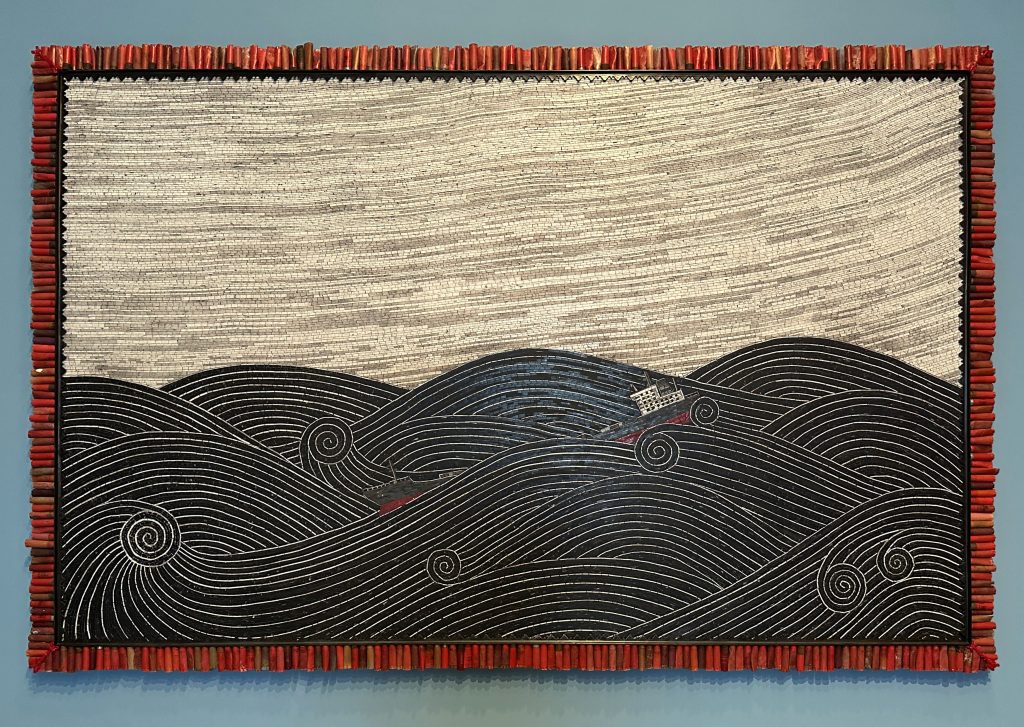
“Erika”, 2021, VCT, shotgun shells, and drink stirrers

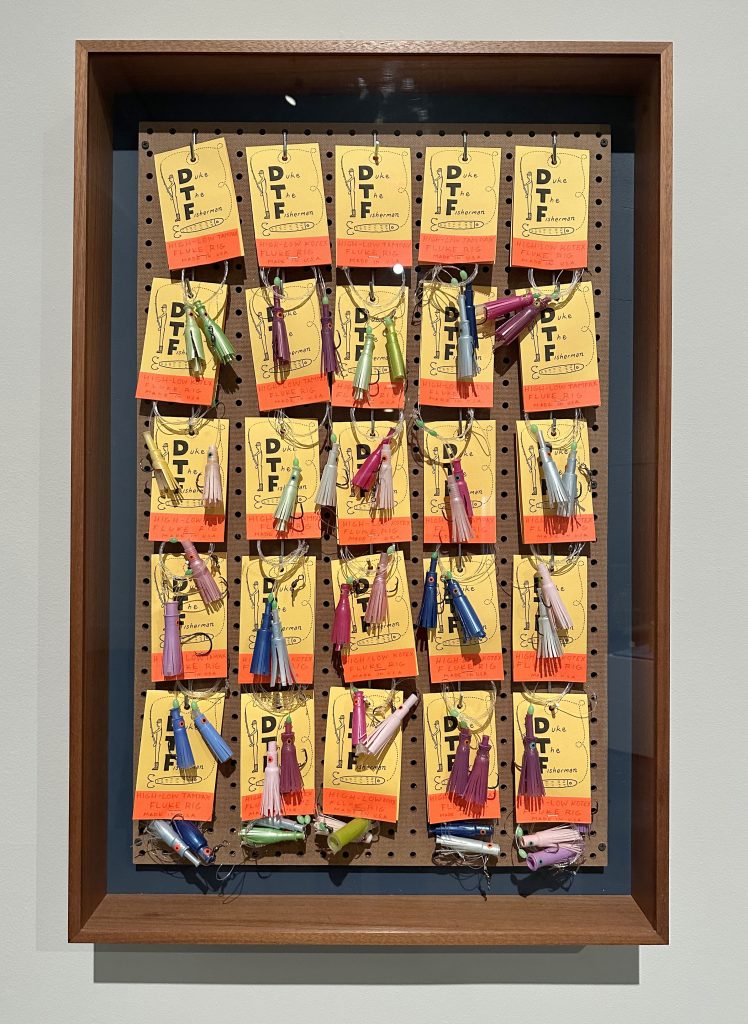
“Duke the Fisherman’s High Quality Fluke Rigs Made in the USA™”, 2022, Found tampon applicators, fishing line, fishing hooks, nail polish, peg board, card stock

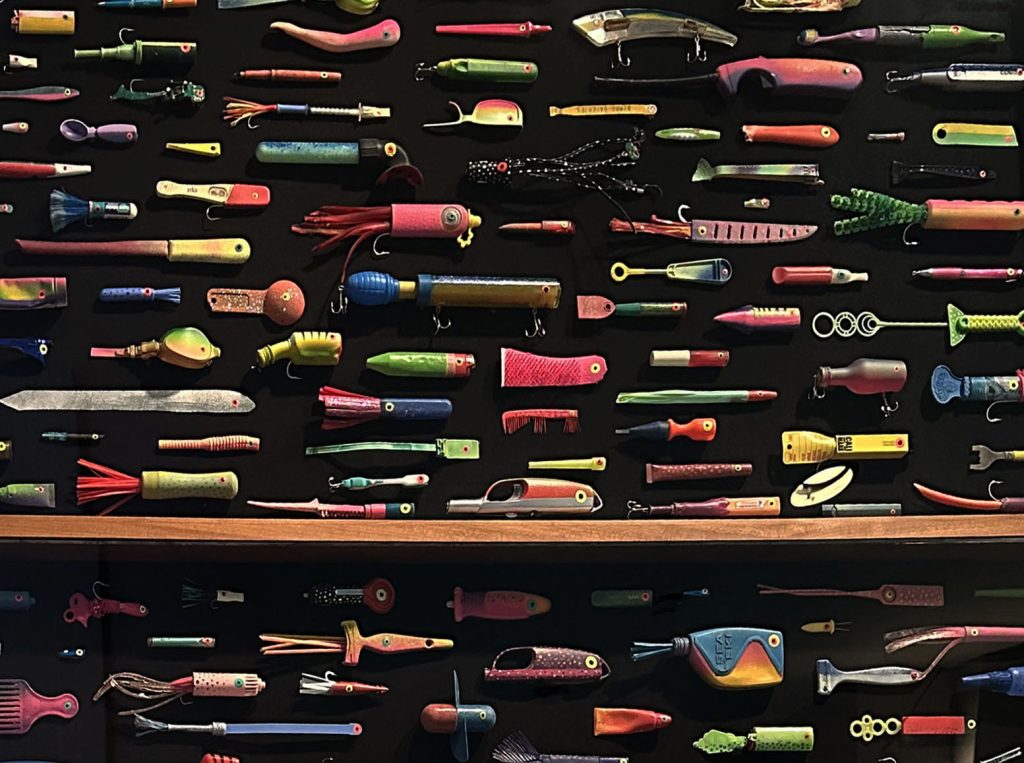
Detail of “Monument to Five Thousand Years of Temptation and Deception V, VI, VII”, 2022, Salvaged plastic, paint, fishhooks

The images above are from Duke Riley’s exhibition DEATH TO THE LIVING, Long Live Trash, on view at Brooklyn Museum in 2023. The artist’s inventive fishing lures, made from discarded plastic items found around waterways, are engaging to look at but highlight the grim reality of how much garbage is polluting our natural environment.

From the museum-

In DEATH TO THE LIVING, Long Live Trash, Brooklyn-based artist Duke Riley uses materials collected from beaches in the northeastern United States to tell a tale of both local pollution and global marine devastation. Riley’s contemporary interpretations of historical maritime crafts—such as scrimshaw, sailor’s valentines, and fishing lures—confront the catastrophic effect that the oil, food, and beverage industries have had on the environment through single-use plastics. The works are presented in the seventeenth- and eighteenth-century Jan Martense Schenck and Nicholas Schenck Houses, alongside a selection of historical scrimshaw from our collection, directly connecting environmental injustices past and present.

In his contemporary interpretations of scrimshaw—ink drawings etched into bone by sailors—Riley replaces the medium’s customary whale teeth with repurposed plastic containers, detergent bottles, toothbrushes, and other waste. The works incorporate the maritime imagery traditional to scrimshaw, but expand it to portray international business executives that the artist identifies as responsible for the perpetuation of single-use plastics. Also on view are Riley’s fishing lures and sailor’s valentines, similarly created with detritus found on northeast coastal beaches. The exhibition juxtaposes corporation-driven pollution with new short films by Riley that highlight New York community members working to remediate plastic damage and restore our waterways.

Erika, the mosaic pictured above, depicts the 1999 shipwreck of MV Erika which, after splitting in two during a heavy storm, released thousands of tons of oil into the Bay of Biscay off the coast of Brittany.

In the video below, Riley gives a brief tour of the Brooklyn show.

Some of the work from this exhibition is currently on view at Museum of Fine Arts St. Petersburg as part of their exhibition, The Nature of Art.


Apr 122024
 

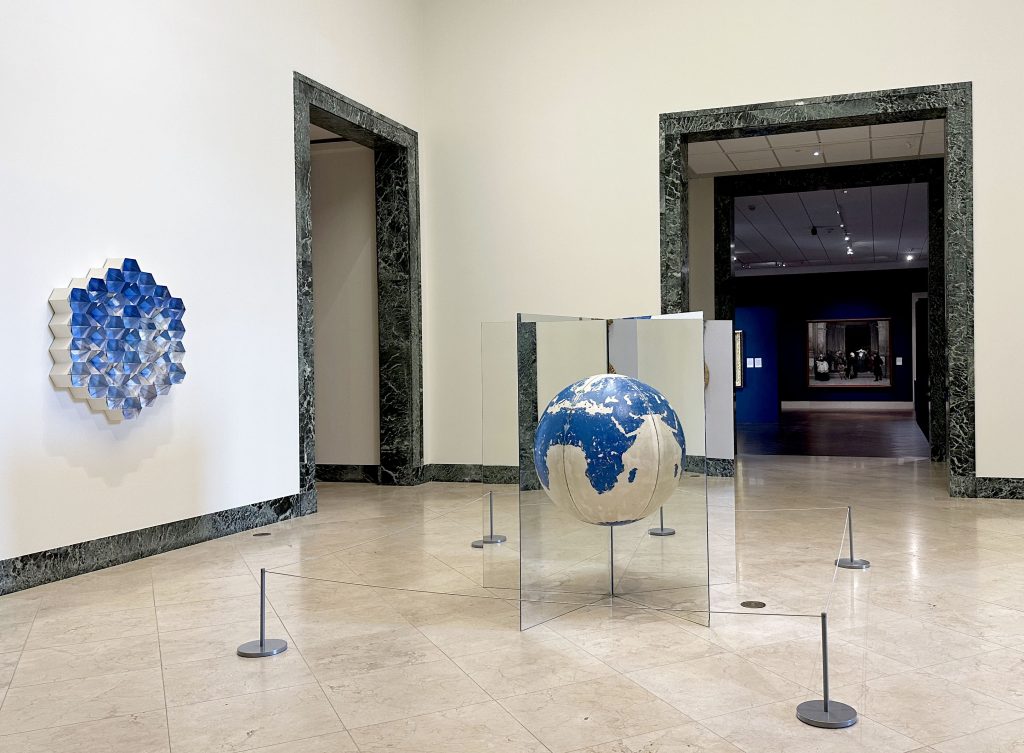
Brookhart Jonquil, “Groundless”, 2023, Mirrors, steel, acrylic paint, enamel paint
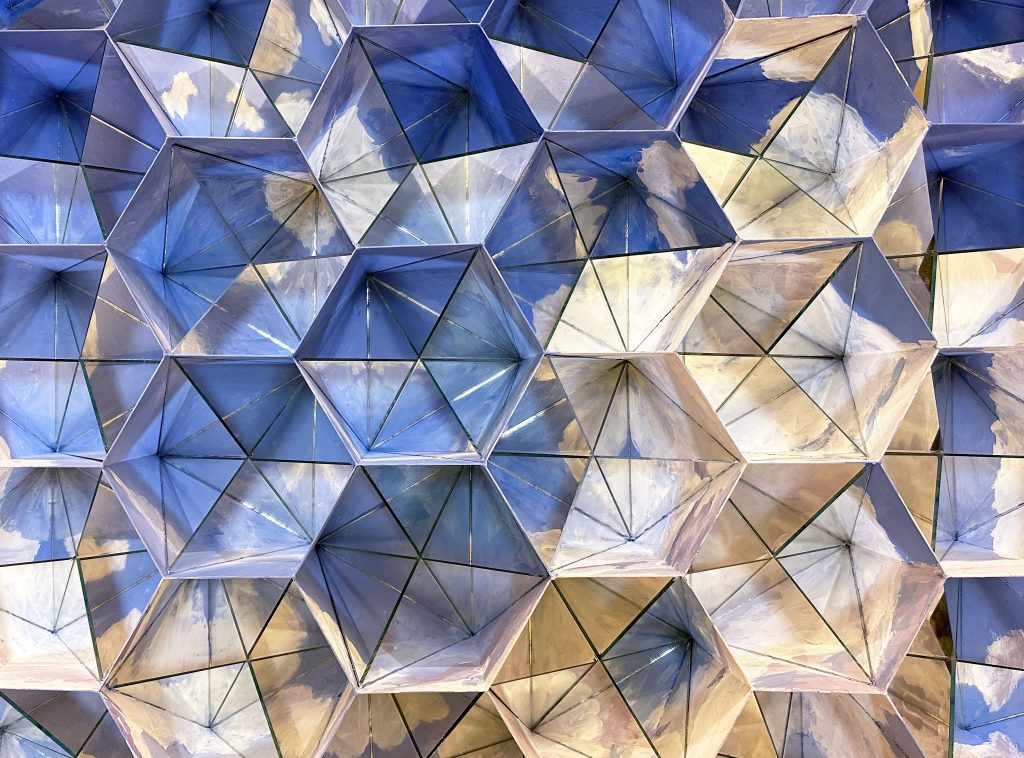
Brookhart Jonquil, “Groundless”, 2023, Mirrors, steel, acrylic paint, enamel paint (detail)
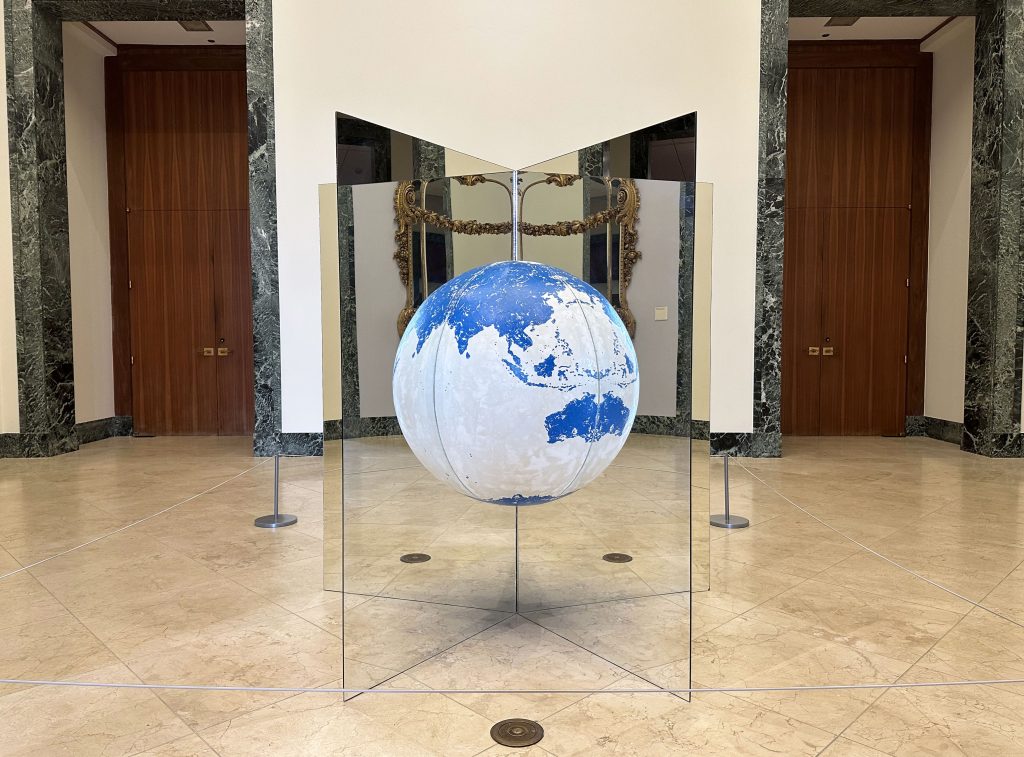
Brookhart Jonquil, “E)A)R)T)H)”, 2012, Mirrors, EPS, MDF, plaster, paint
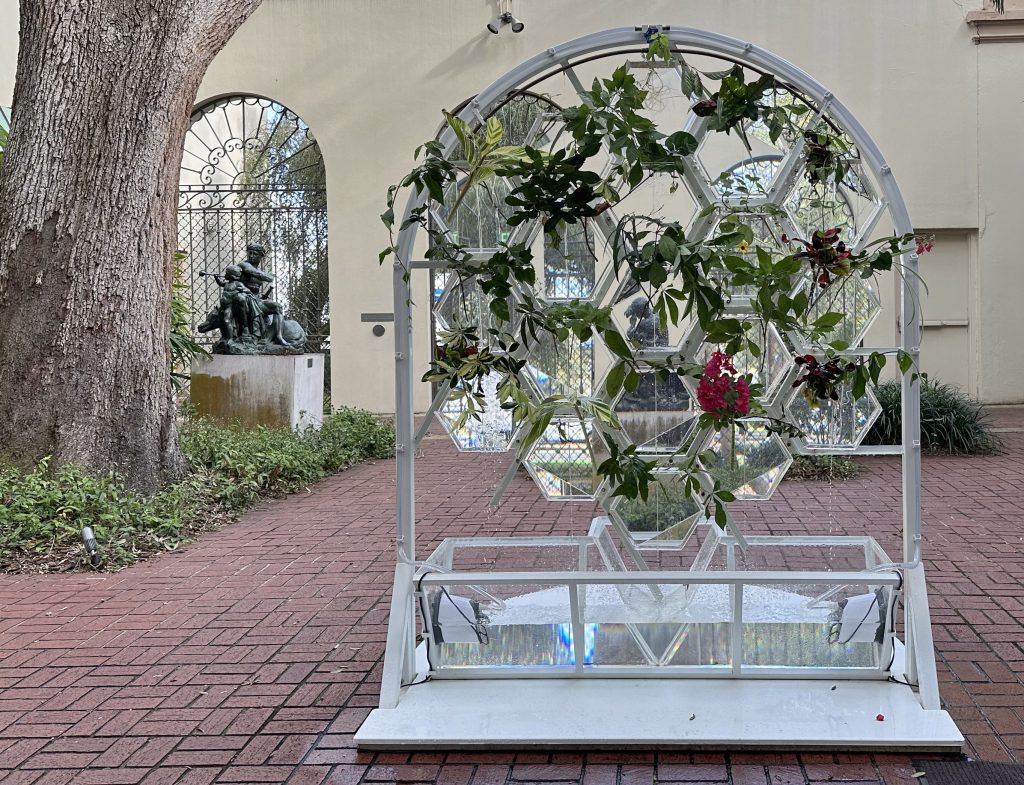
Brookhart Jonquil, “Multiplication Portal”, 2022, Plexiglass, water, powdercoated steel, plant cuttings, marine polymer sheet, pump system

Brookhart Jonquil, “Multiplication Portal”, 2022, Plexiglass, water, powdercoated steel, plant cuttings, marine polymer sheet, pump system
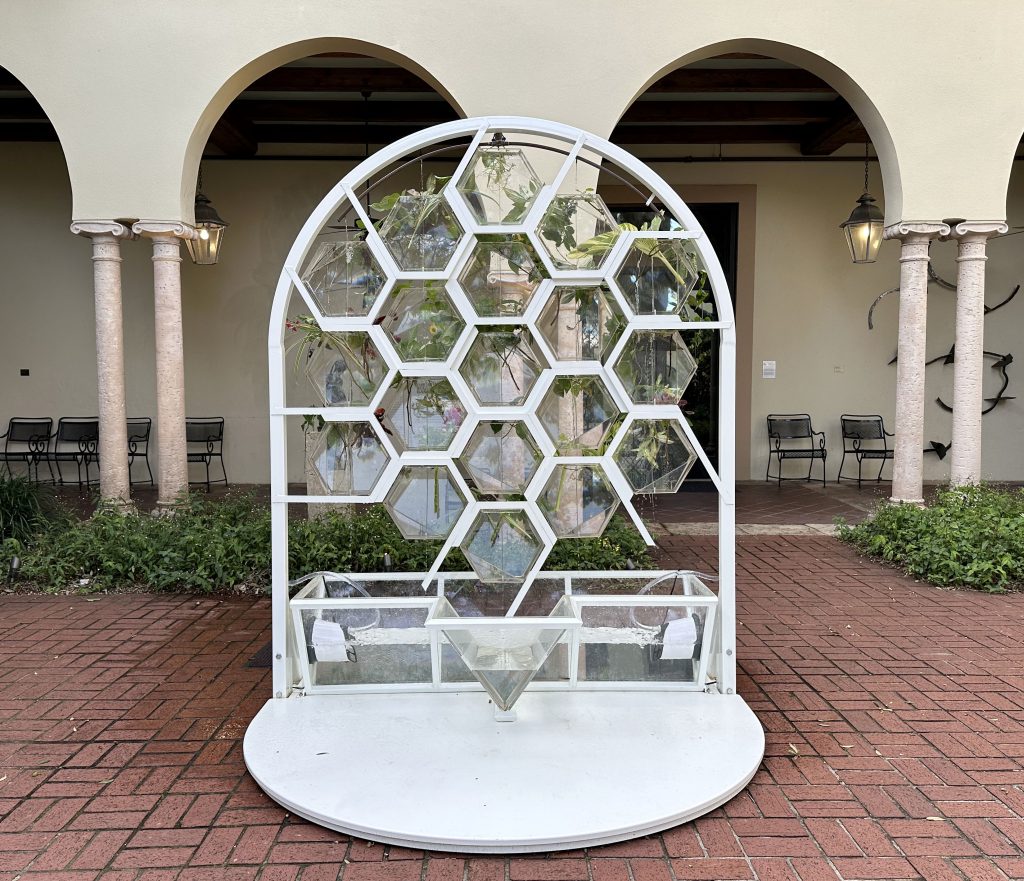
Brookhart Jonquil, “Multiplication Portal”, 2022, Plexiglass, water, powdercoated steel, plant cuttings, marine polymer sheet, pump system
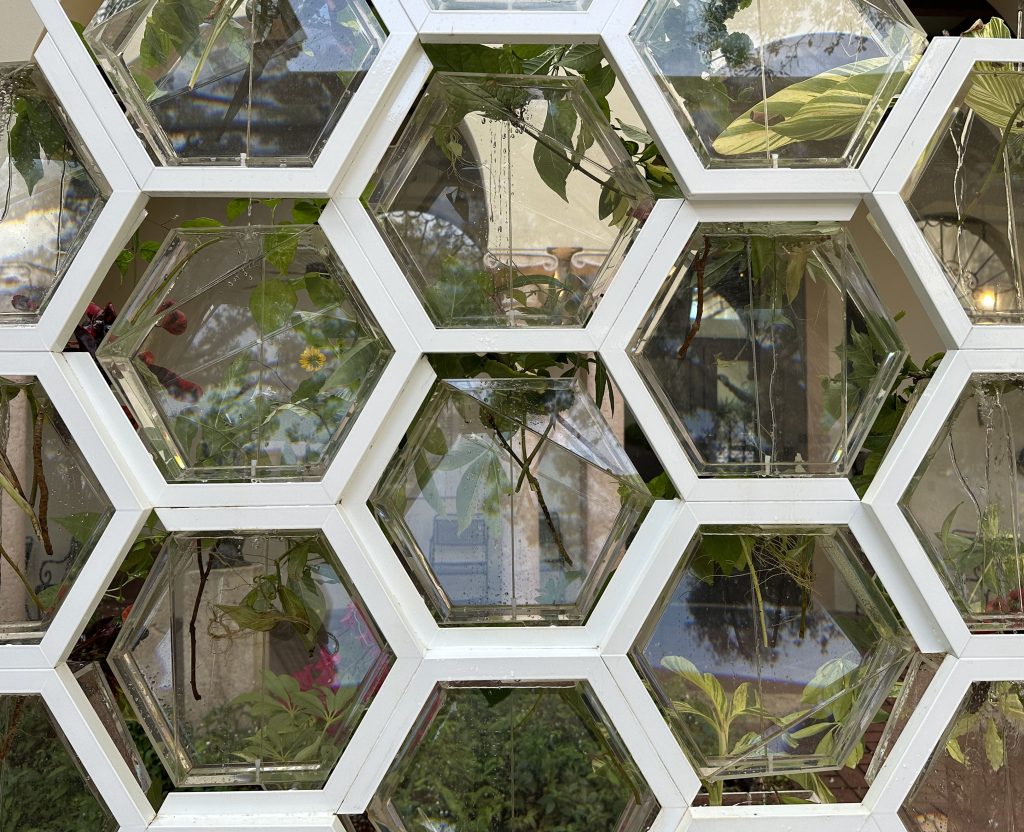
Brookhart Jonquil, “Multiplication Portal”, 2022 (detail)

For The Nature of Art at the Museum of Fine Arts St. Petersburg, work from the exhibition is spread throughout different sections of the museum. In the Great Hall and Sculpture Garden are installations by Brookhart Jonquil.

From the museum about these works-

In this group of installations, Brookhart Jonquil creates art that engages physics, architecture, and ecology to explore the immaterial, shifting aspects of the natural world. His work reflects influences ranging from Minimalism to theories of utopia and perfection; it offers viewers new ways of seeing and a nuanced understanding of our place in the world. The works exhibited here and in the Sculpture Garden encompass over a decade of his career, illustrating how nature has always influenced his artistic practice.

Groundless is Jonquil’s most recent work, inspired by painting en plein air, the Impressionist practice of working outdoors. However, the artist has complicated this by incorporating mirrored surfaces that deny full control of his compositions. Jonquil notes, “Each stroke of paint multiplies unpredictably as I place it, while shifting colors and cloud-forms evade fixity.”

The floor-based sculpture E)A)R)T)H) uses five pieces of mirror glass to dissect an earthly sphere. Unlike Groundless, these mirrors reflect the Great Hall, foyer, and surrounding galleries, suggesting a macro-and micro-viewing of our planet. To further a sense of dislocation, Jonquil has inverted the colors typically associated with land and water: bodies of water are depicted in white, while land is blue.

Multiplication Portal-on view in the Sculpture Garden- is a participatory sculpture highlighting the care and responsibility involved in cultivating plants. Reminiscent of both a kaleidoscope and a beehive, it was inspired by chaos theory-also known as the butterfly effect, which is the idea that one tiny gesture can have colossal consequences within dynamic systems. Brookhart created Multiplication to fight environmental disillusionment. Can one individual impact the impending climate disaster? What is the point of separating paper and plastic? Does turning off the lights make a difference? Multiplication Portal serves as a reminder that our seemingly small actions have the potential for significant consequences.

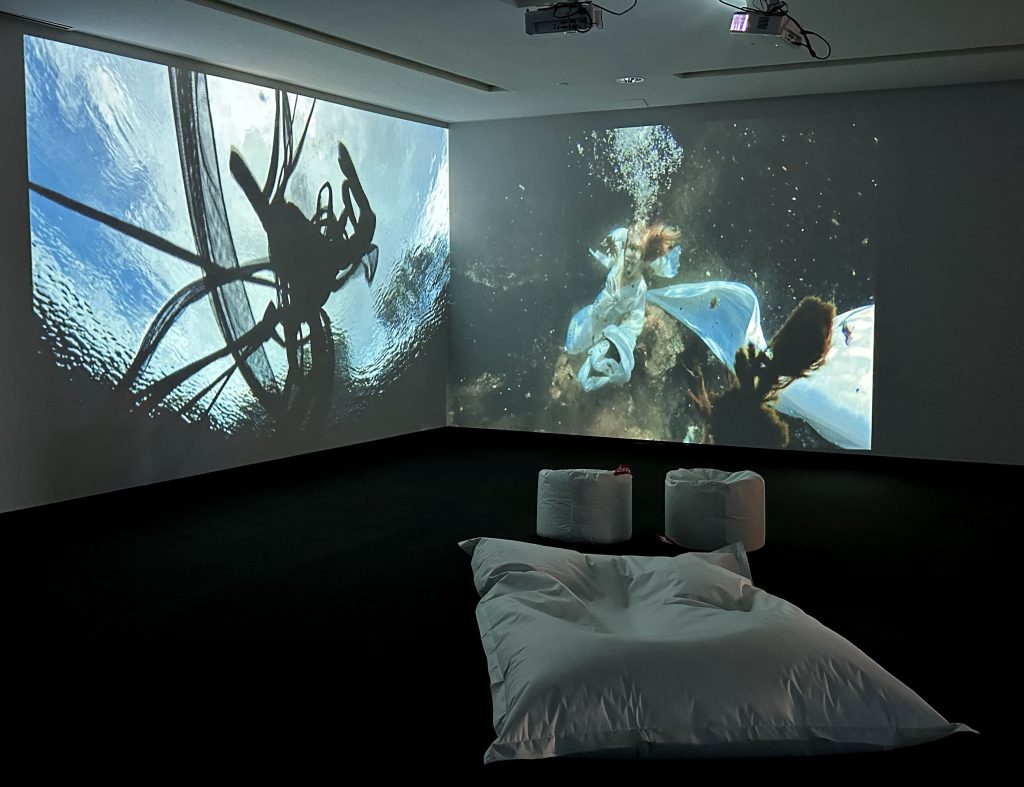
In an upstairs gallery is the video installation, Blood, Sea by Janaina Tschäpe (seen below). The dreamy video takes you underwater to explore transformation through sea maiden myths.

Information on the installation from the museum-

Reminiscent of Voltaire’s Micromégas, Janaina Tschäpe’s fantastical scenes dissolve boundaries, seamlessly intertwining in an ever-flowing continuum of evolution and transformation in a grand opera that delves into themes of change, gender, and the construction of myth and history. The universe created by Tschäpe beckons one into a parallel world of ambiguous scale-indeterminate in both time and space. The spring-fed grotto provides the scenographic impetus for this grand production, a captivating fusion of a theme park nestled within a state park and bearing the distinction as one of Florida’s oldest roadside attractions. The sea maiden mythologies that inform Blood, Sea link endless stories from across time and space, as many cultures have some version of a water goddess. Millennia of previously unknown deep-sea creatures caught in fishermen’s nets spawned the mythic narratives that gave rise to these goddess/creature tales. From the Mami Wata spirits of West Africa to the water sprites of Irish lore, the trope of the sea maiden appears around the world and across time. Tschäpe’s primary connection is her namesake, the Orixa lemanja of Candomblé. This powerful water spirit is the Brazilian version of the many syncretic gestures born of the Yoruban Afro-Atlantic diaspora. But lemanja is merely one character in the global pantheon of the water goddess.

The split-tail mermaid motifs that adorn the exterior walls of centuries-old homes in the landlocked Swiss Alps are a testament to the enduring allure of the fish woman’s imagery. The split-tail represents the hybrid presence of both home and away, the perpetual dual identity of the émigré, and a curious cipher of Tschäpe’s experience living between the culturally antipodean points of Germany and Brazil. This existence places her between logic and magic, between Protestant rationalism and the mystical worldview of Candomblé, between the grey angst of northern Romanticism and the sensual elegance of the southern hemisphere. This ever-changing identity is evidenced clearly in Blood, Sea, where the video’s perspective perpetually shifts. At certain moments, the viewer finds themselves aboard a ship, assuming the role of a scientist discovering a previously unknown life form. In other instances, we have the privilege of swirling amidst the creatures, becoming one with them.
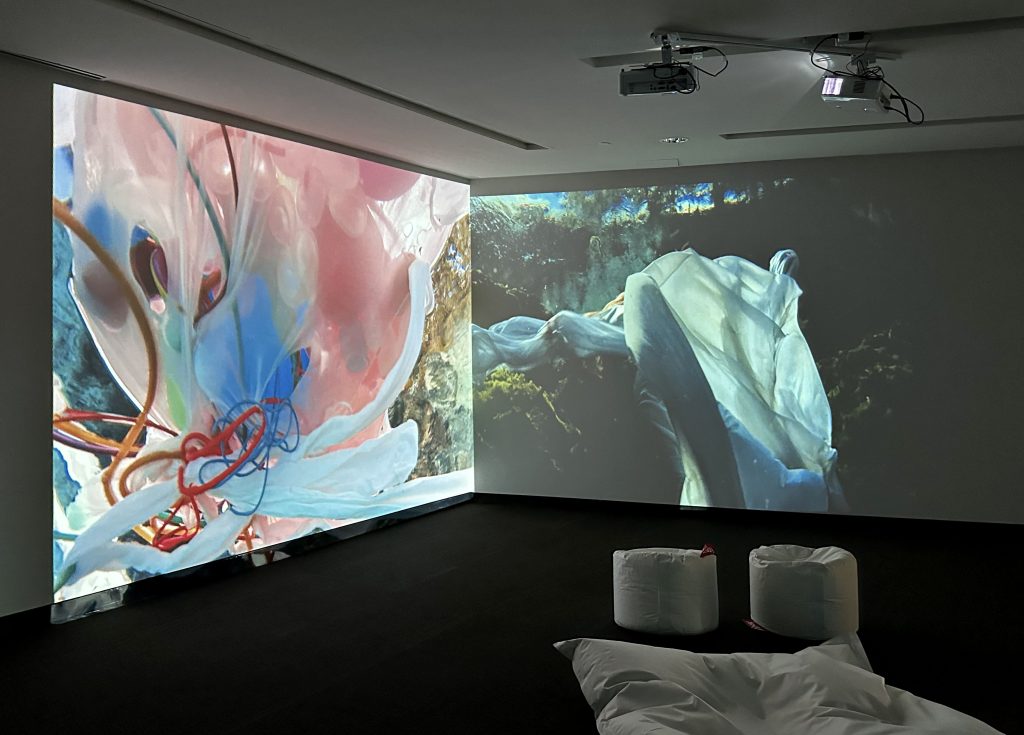
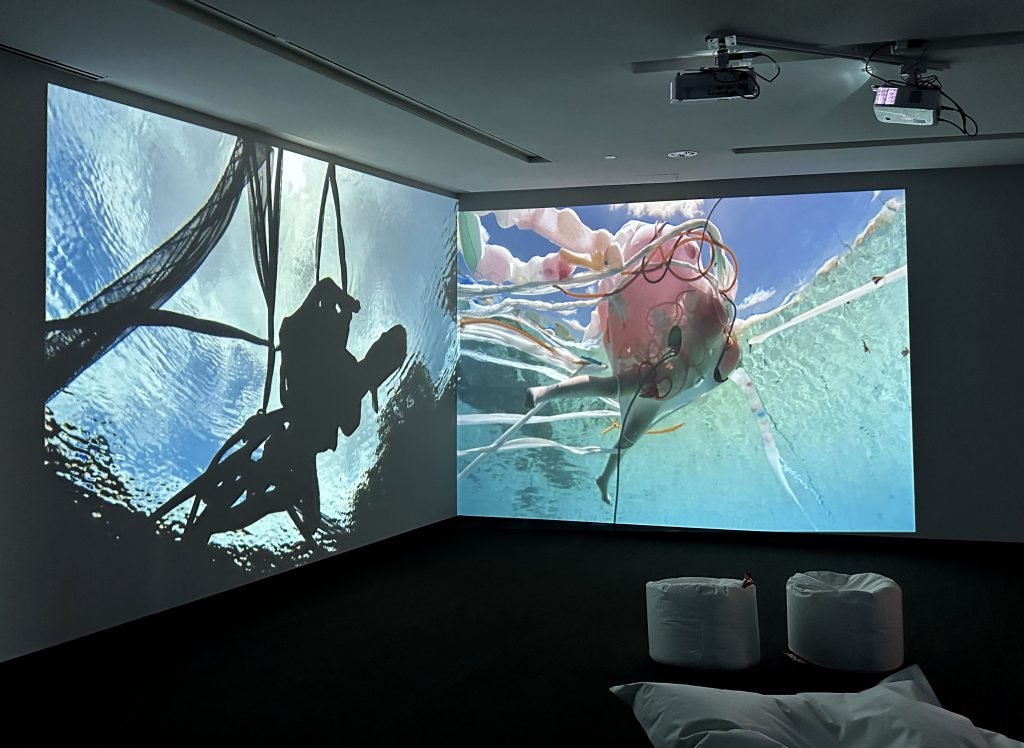
This exhibition closes on 4/14/24.

Apr 122024
 

Sarah Meyohas, “Interference #19”, 2023, Holograms, mirrored black glass, aluminum

Georgia O’Keeffe, “Poppy”, 1927, Oil on canvas

Francis Picabia “The Church of Montigny, Effect of Sunlight” 1908, Oil on canvas (left); Christian Sampson “Projection Painting”, 2023, Acrylic and films with LED light; and Claude Monet “The Houses of Parliament, Effect of Fog, London” 1904, Oil on canvas (right)

The Nature of Art exhibition at the Museum of Fine Arts St. Petersburg merges art from the museum’s collection with loaned works to explore- “art’s crucial role in our evolving quest to understand our relationship with nature and our place in the cosmos”.

One of the benefits of an encyclopedic museum is that visitors have the opportunity to experience art throughout history, and to revisit works that resonate with them. For the section titled Artist as Curator, Sarah Meyohas and Christian Sampson chose pieces from the museum’s collection to pair with their own work.

From the museum-

At first glance, perhaps, these may seem like unusual combinations, but upon deeper contemplation, their selections reveal complementary artistic intents. For instance, Meyohas and Georgia O’Keeffe share an interest in close looking, particularly in finding new ways to examine underappreciated aspects of the natural world. Sampson, influenced by the California Light and Space Movement, is interested in current scholarship that suggests the hazy fog found in Claude Monet’s work is an early depiction of air pollution, offering an entirely new perspective on the artist’s representations of light.

Sampson also created the four-part installation, Tempus volat, hora fugit, on view until 2025 at the museum.

Below are some of the works from additional sections of the exhibition.

Postcommodity, “kinaypikowiyâs”, 2021, Four 30.5-metre industrial debris booms

Postcommodity, “kinaypikowiyâs”, 2021, Four 30.5-metre industrial debris booms

Postcommodity is an interdisciplinary art collective comprised of Cristóbal Martínez (Genizaro, Manito, Xicano), and Kade L. Twist (Cherokee).

About Postcommodity’s work, kinaypikowiyâs, (seen above) from the museum-

This work is composed of debris booms, used to catch and hold environmental contaminants such as garbage, oil, and chemicals. The colors of the booms correspond to different types of threats— red (flammable), yellow (radioactive), blue (dangerous), and white (poisonous)-in the labeling system for hazardous materials. To indigenous peoples, these are shared medicine colors that carry knowledge, purpose and meaning throughout the Western Hemisphere. Suspended like hung meat, the booms represent a snake that has been chopped into four parts. Each part represents an area of the colonial map of the Western Hemisphere: South America, Central America, North America, and all of the surrounding islands. The title, kinaypikowiyâs, is a Plains Cree word, meaning snake meat. Divided by borders, Postcommodity asserts that all people living in the Americas are riding on the back of this snake.

James Casebere, “Red/Orange Solo Pavilion”, and “Orange Guesthouse”, 2018, Archival pigment print mounted to Dibond

James Casebere, “Landscape with Houses (Dutchess County, NY), 2009, Archival pigment print mounted to Dibond

James Casebere creates architecturally based models for the large scale photographs seen above.

Reclaimed ocean plastic sculptures and “Tidal Fool” wallpaper by Duke Riley

Duke Riley custom wallpaper, Tidal Fool, detail

Duke Riley custom wallpaper, Tidal Fool, detail

Duke Riley’s work, which was previously shown at Brooklyn Museum, addresses issues of environmental pollution by using discarded plastics found in the ocean and other waterways to create new work inspired by the past. You can hear him discuss his work in this video.

From the museum-

Inspired by the maritime museum displays he saw while a child growing up in New England, Riley’s scrimshaw series is a cutting observation of capitalist economies-historic and today-that endanger sea life. The sculptures were created for the fictional Poly S. Tyrene Memorial Maritime Museum, and are contemporary versions of sailors’ scrimshaw, or delicately ink-etched whale teeth and bone. Riley first thought about using plastic as an ode to scrimshaw when he saw what he thought was a whale bone washed up on the beach in Rhode Island; it turned out to be the white handle of a deck brush. Riley regularly removes trash from beaches and waterways, and often uses this refuse in his work.

Riley collaborated with Brooklyn-based Flavor Paper to create these two custom wallpapers for his solo exhibition DEATH TO THE LIVING, Long Live Trash at the Brooklyn Museum. Tidal Fool exhibits Riley’s trademark humor in the face of devastating water pollution; notice the Colt 45-guzzling mermaid. Wall Bait vibrantly references Riley’s meticulous fishing lures, which he crafts from refuse found in the waters around New York City.

Daniel Lind-Ramos,”Centinelas de la luna nueva (Sentinels of the New Moon)”, 2022-2023, Mixed media

Daniel Lind-Ramos,”Centinelas de la luna nueva (Sentinels of the New Moon)”, 2022-2023, Mixed media

Daniel Lind-Ramos also uses a variety of recycled objects to create his sculptures.

From the museum about this work-

In Centinelas de la luna nueva, he evokes the elders of the mangroves, spiritual beings who watch over and ensure the health of this essential coastal tree. Mangroves are the basis for a complex ecosystem that shelters sea life and serves as the first line of defense in the tropical storms that batter the sub-tropics—including Florida.

Lind-Ramos’s practice reflects the vibrant culture of his native Loíza, Puerto Rico, by honoring local agriculture, fishing, cooking, and masquerade. His sculptures also evoke Hurricane Maria (2017), the COVID-19 pandemic, and ongoing environmental degradation. Lind-Ramos is committed to the survival and sustenance of Afro-Taíno traditions and people of the Puerto Rican archipelago. However, his art engages the global community through shared emotions, parallel histories, and the commonality of human experience.

The next post will discuss two other artists in the exhibition, Brookhart Jonquil and Janaina Tschäpe.