Oct 162025
 

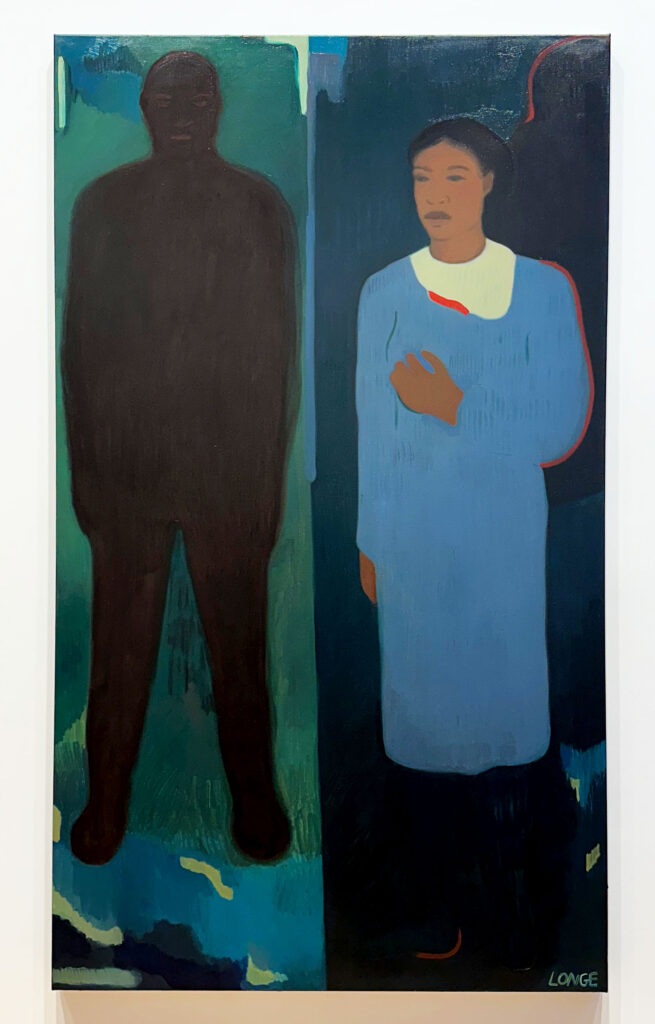
Sahara Longe “Skull”, 2024, Oil on Linen

“As We Are (after Otto Friedrich)”, 2024, Oil on Linen

“Liar”, 2024, Oil on linen

This week’s throwback is to Sahara Longe‘s paintings from her 2024 exhibition at Timothy Taylor gallery in NYC, Sugar.

From the gallery about the work-

Featuring twelve vivid and haunting canvases, Longe’s second exhibition with the gallery sees the artist reconceiving various art histories to arrive at an uncanny interplay of figures, allegories, and enigmatic landscapes. The show will be accompanied by an essay by Ferren Gipson, art historian and writer based in London.

In paintings characterised by a preternatural handling of line, colour, and figuration, Longe depicts partially abstracted subjects in atmospheric environments. Working on thick grain linen with raw pigment in a distinct palette of vermillion, lilac, raw sienna, and ochre, she renders her scenes with a fluid painterly freedom that is nevertheless quiet and precise in its effect. Across her work, she recalls aspects of the Symbolist ethos, which moved between nostalgia and rupture, seeking not to capture something directly, but rather convey the sensations it produces.

In her new paintings, Longe focuses on the nude. Articulated in spare, suggestive gestures, her subjects, largely women, are pictured huddled together, embracing a lover, or striding alone. Some set their gaze on an unknown distance, others stare down the viewer, and one confronts a fish. Each seems possessed by a disquieting tension that is emphasised by a shadowy apparition lurking in many of the works. Masculine in stature, the incubus perches over a scene or cradles another figure therein. Where Longe’s previous series reflect on social dynamics, depicting parties and crowds, these paintings are more personal; the artist explains that the new works look inward rather than outward. Expressive, brushy marks bring subtle notions of agitation, dreaminess, and intimacy to otherwise minimal passages of colour.

These paintings further explore the ideas set out in Longe’s earliest work, which emerged from her study of classical portraiture at Charles H. Cecil Studios in Florence; in her early canvases, Longe integrated and recontextualised themes and styles of old-master paintings. Here, her compositions draw from Secessionist painter Otto Friedrich’s nudes and Symbolist Ferdinand Hodler’s ominous portraits. They likewise reveal the influence of a recent trip to Oslo, where Longe was taken by Henrik Sorensen’s mural (1938–50) in Oslo City Hall (where the Nobel Peace Prize is selected), and the marginalia of illuminated manuscripts. Ushering these disparate sources and traditions into her singular aesthetic, Longe poses subtle questions about representation—who it serves, and what narratives it upholds—just as she underscores figuration’s expressive potential.

Oct 082025
 

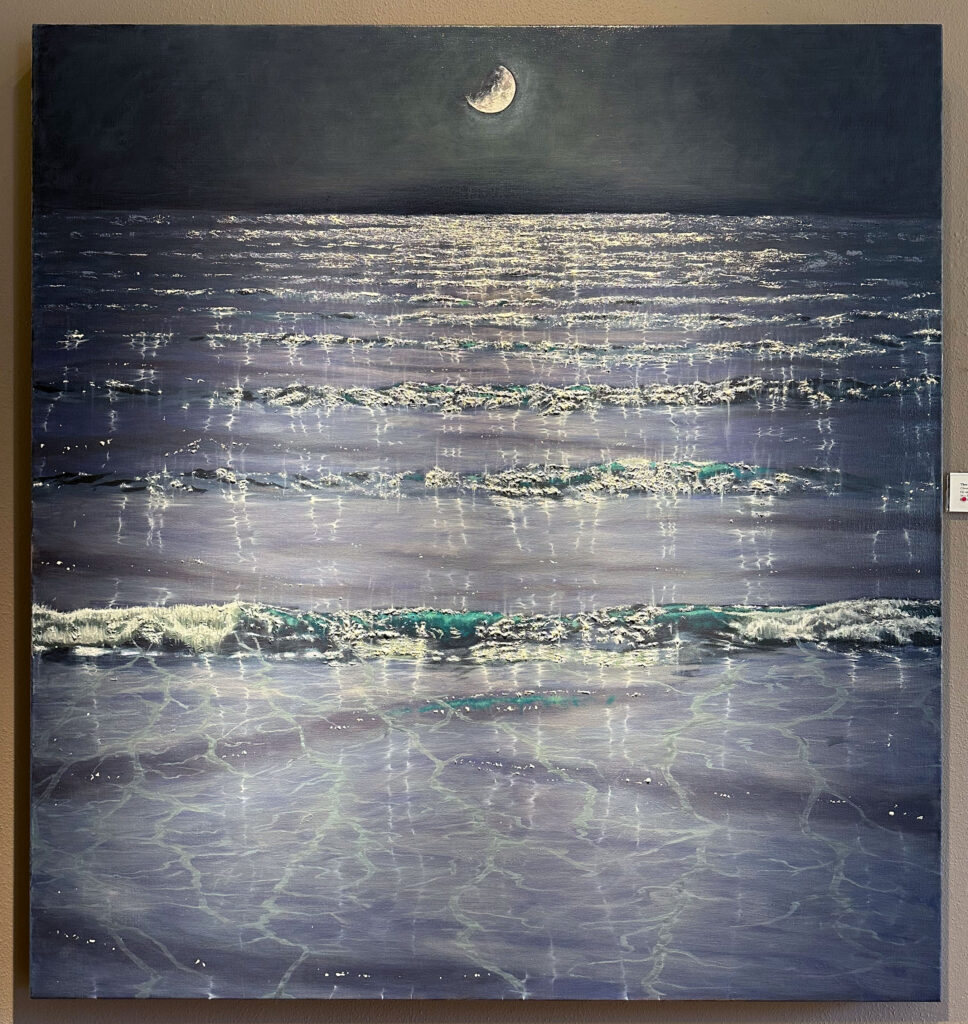
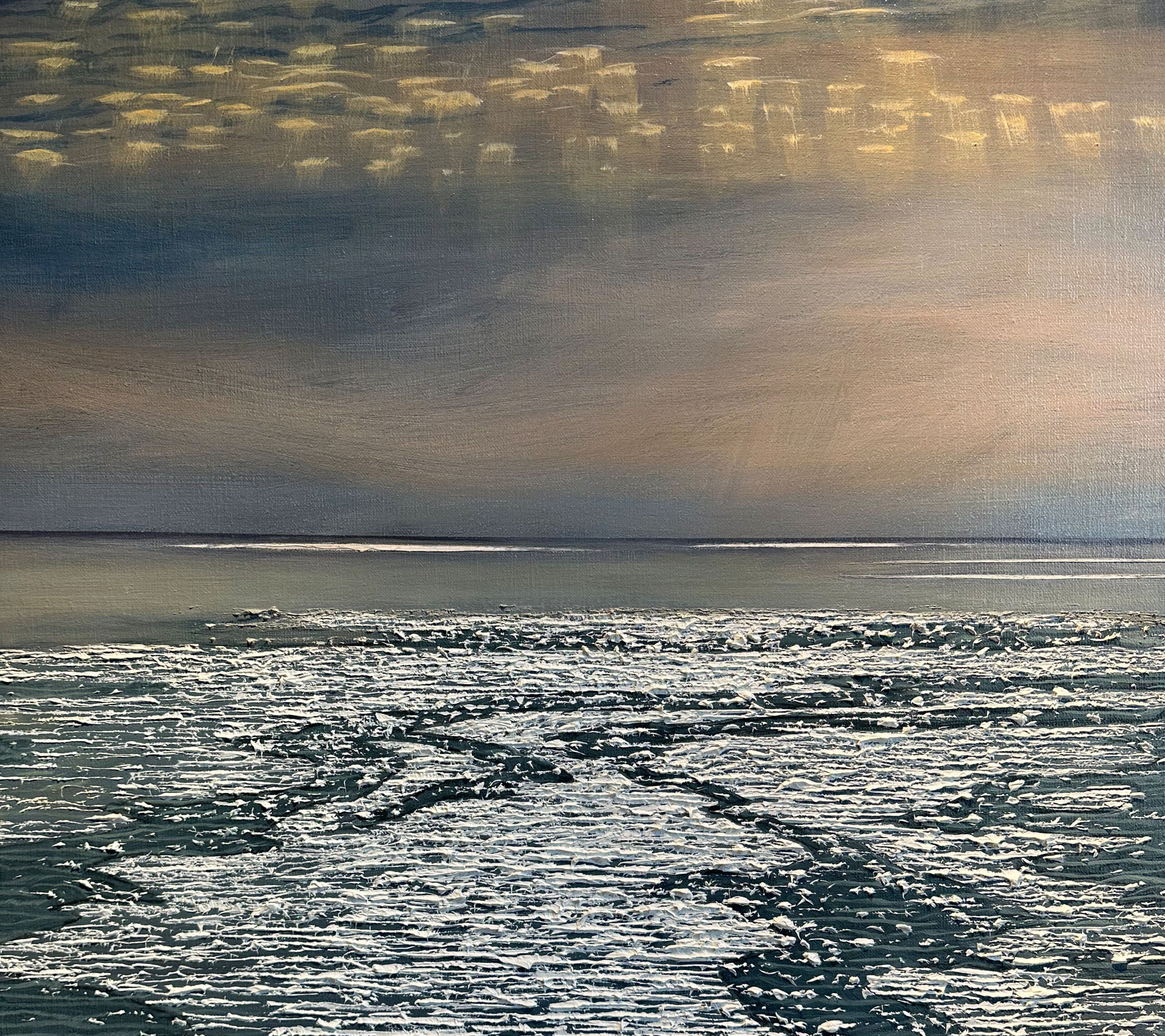
Theo Platt, “Chrome”, Oil on canvas

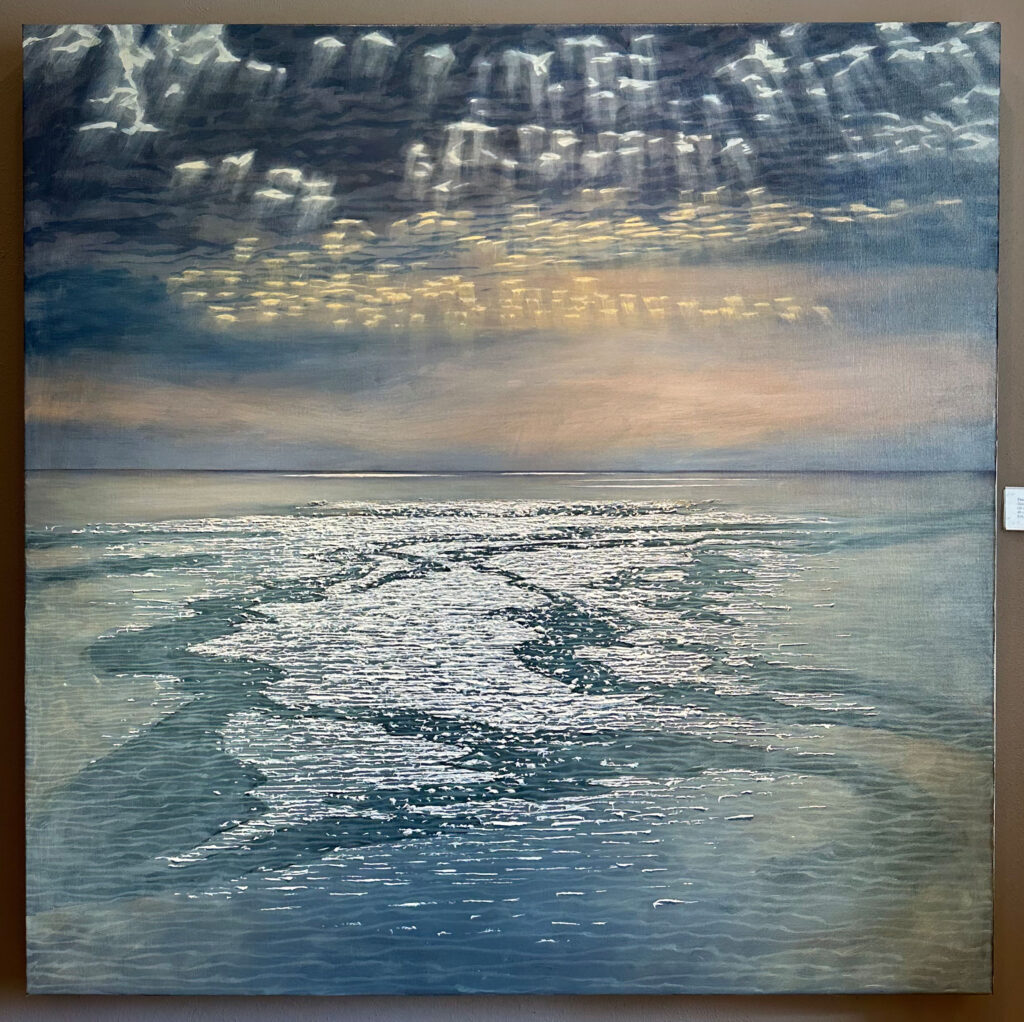
Theo Platt, “Sunstream”, Oil on canvas

Theo Platt, “Sunstream”, Oil on canvas (detail)

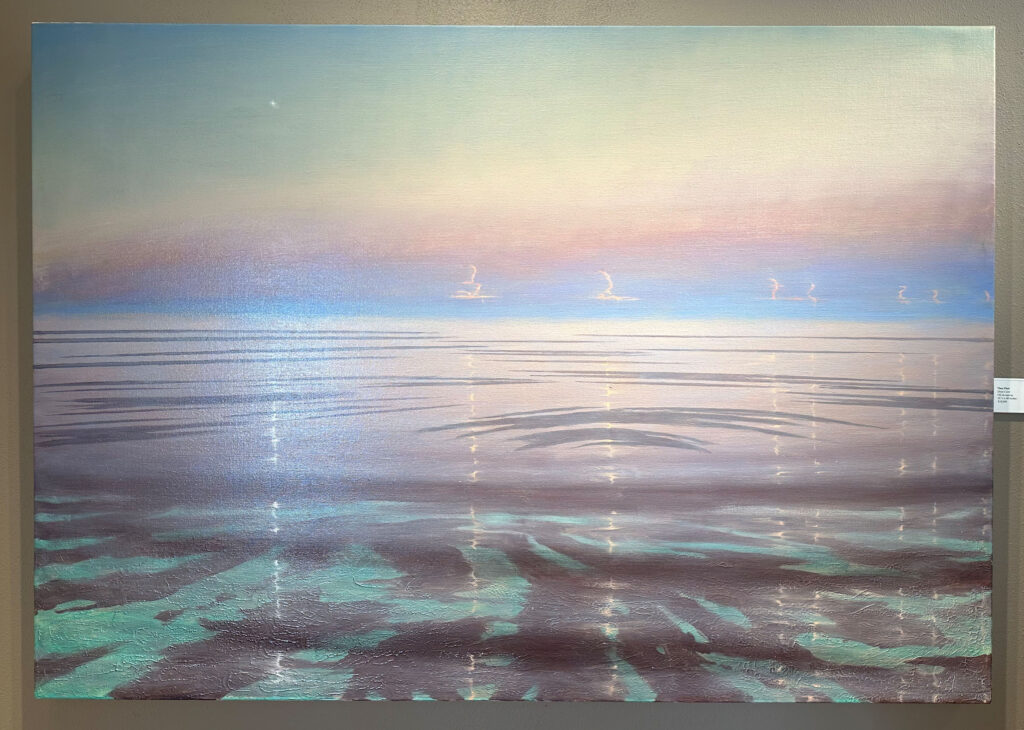
Theo Platt, “Deep Calm”, Oil on canvas

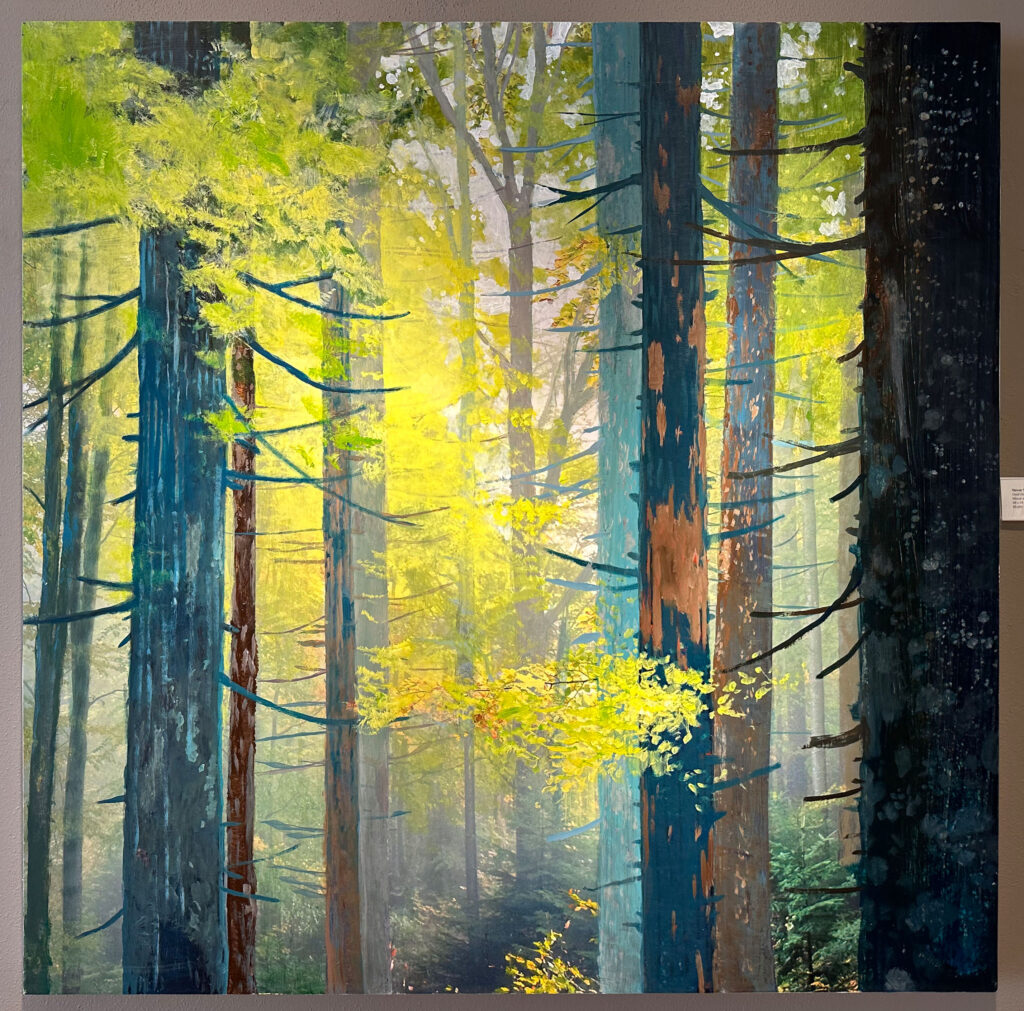
Somerville Manning Gallery is currently showing two painting exhibitions: Theo Platt‘s textured oil paintings from his Oceans series of works (pictured above) and Steven Nederveen‘s Stillness in the Shade of Green.

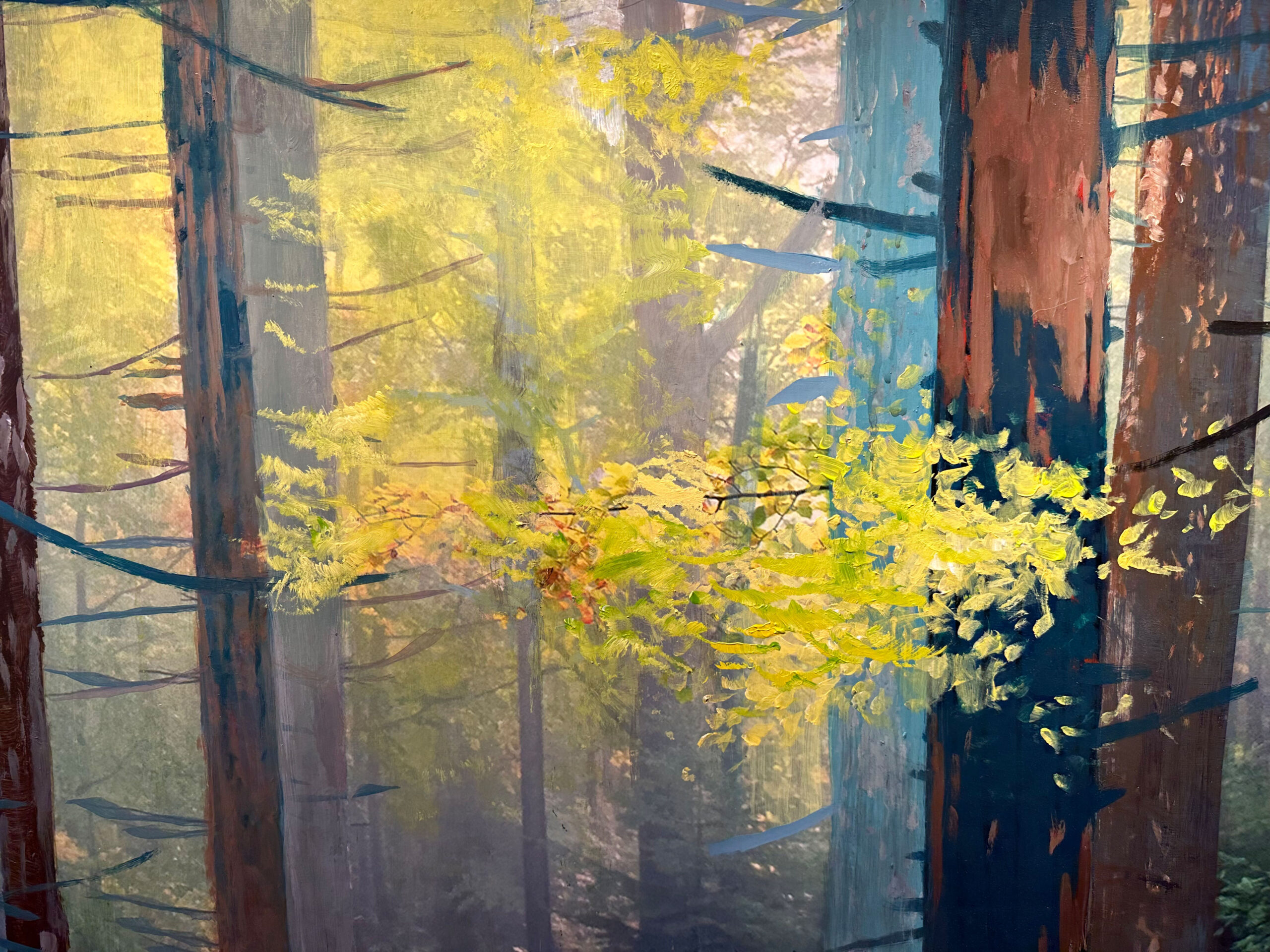
Below Nederveen describes his process for the work (pictured below)-

Using a mixed media approach to image making, I combine acrylic paint and C-print photographs. By layering these elements I can etch down into the emulsion of the photograph to reveal golden hues and also build up the surface with impasto and washes of colour. The result is an image with photo sharp detail in focal areas and painterly brush marks that obscure and create space for the imagination.

Both of these exhibitions close 10/11/25.

Steven Nederveen, “Gold Hidden Within”, Mixed Media

Steven Nederveen, “Gold Hidden Within”, Mixed Media (detail)

Steven Nederveen, “Breathe In the Forest Air”, Mixed Media


Oct 022025
 

Corita Kent (Sister Mary Corita)’s print I Should Like to Be Able to Love My Country and Still Love Justice, 1968, was on view at the Museum of Modern Art in NYC in June of 2024.

From the museum about the artist-

Corita Kent, also known in the Catholic Church as Sister Mary Corita, incorporated a range of references into her silkscreen prints, spanning pop culture imagery and song lyrics, biblical allusions, and literary conceits. After seeing Andy Warhol’s Campbell’s Soup Cans in 1962, she was inspired to embrace the language of Pop art, using bold, graphic designs to convey anti-war messages. In the 1980s Kent’s posters and ephemera were collected by PAD/D (Political Art Documentation/Distribution), a New York-based art activism group with a mission to create an archive of politically concerned art and ephemera from around the world. The materials are now part of the MoMA Archives, Library, and Research Collections.

You can currently see some of her photographic archive at Marciano Art Foundation in Los Angeles for the exhibition Corita Kent: The Sorcery of Images, on view until 1/24/26. The show “focuses on a little seen part of Corita’s artistic practice: her archive of over fifteen thousand 35 mm slides that she and her cohorts took between 1955 and 1968 while she was a beloved teacher in the art department at Immaculate Heart College”.

As part of their press release they include this lovely quote from the artist-

“In a sense, the whole world around the artist is his source, his sorting and relating powers are his sorcery, and the one isn’t much good without the other. … Anything can be a source, even a mistake. The sorcery or the thievery is the art of relating sources into a new solution.”

Her work can also be seen in Los Angeles at the Corita Art Center. The center is free to visit on Saturdays (with appointment).


Sep 192025
 

Wax Monument IV (Free Wax) by Sandy Williams IV was on view at Socrates Sculpture Park in 2020 for Call and Response, Part II of the MONUMENTS NOW exhibition. The outdoor exhibition included ten monuments projects realized by the Park’s 2020 Artist Fellows.

From Socrates Sculpture Park about the work-

A monument to living history, this wax flag can be set alight from multiple-wicks and rests perpendicularly upon a black mulch base shaped like the borough of Queens. Rendered in black and white, the wax flag is reminiscent of – but not equivalent to – the U.S.’s own flag and emblem of patriotism. By enlarging the candle- a commemorative form often spontaneously employed in immediate reaction to events, Williams celebrates this popular, accessible form of expression. Alive with transformative potential, the work invites participation, mark-making, melting, and molding of a malleable symbol.

The 2025 Socrates Annual: Up/rooted– featuring new commissions from the Park’s 2025 Artist Fellows: Natalia Nakazawa, Pioneers Go East Collective, Rowan Renee, Catherine Telford-Keogh, Zipporah Camille Thompson – opened on 9/12 and will be on view until 4/6/26.

Sep 182025
 

Abstract expressionist artist Mark di Suvero‘s sculpture Declaration (pictured above) is located on the Venice Beach Boardwalk in Los Angeles. It was installed in 2001 to commemorate the Venice Art Walk’s 22nd year and in support of the Venice Family Clinic, a local organization that provides quality health care to those in need. Di Suvero turned 92 today, 9/18.

Although he is well known for his large sculptures, he is also a painter. Some of these works were shown in 2019 at L.A. Louver in Los Angeles along with some of his smaller sculptures (pictured below).

From the L.A. Louver press release about the paintings-

A selection of brilliant abstract paintings by the artist accompanies the sculptures. Like the sculptures, his paintings are never still. Created with dazzling colors in dense layers of linear and freeform gestures, they project a swirling sensation akin to the twirling movement in his three-dimensional works. Accented with phosphorescent paints, the works luminesce and reverberate even in the absence of light (and are especially dazzling when activated by black lights installed throughout the gallery space). “The heart of art is the search for form that is electrifying, that gives life to our vision,” explains di Suvero. “This is the language of emotion. Anesthetic is to kill feeling. Aesthetic is the opposite, aesthetic is feeling. The thing that is most important is the dream, the vision for what doesn’t exist that could exist.”

It was recently announced that L.A. Louver will be closing their Venice Beach space, but in happier news they will be donating the gallery’s complete archive and library to The Huntington in San Marino, California.

Sep 052025
 

Mavis Pusey‘s painting, Within Manhattan, 1977, pictured above, was one of several included as part of Whitney Biennial 2024: Even Better Than the Real Thing.

From the museum about the artist and the painting-

Mavis Pusey was born in Kingston, Jamaica, in 1928. She is known for her abstract paintings of bold shapes and hard edged lines found in architectural spaces. Pusey was a prolific artist who found inspiration in the geometric forms found both in fashion patternmaking and in the printmaking process. During sessions at the Robert Blackburn workshop, Pusey began to develop a body of work revealing the process of urban transformation happening in New York City. She was captivated by the shifts in the urban environment that kept the city suspended in a cycle of destruction and reconstruction.

Throughout her career, Pusey taught at institutions for higher education in New York, Pennsylvania, and was a high school teacher in Virginia. In 2019 at the age of ninety, Pusey passed away after years of declining health. Her legacy lives on through the collections of major cultural institutions across the U.S.

Inspired by the ever-evolving changes in the urban landscape, Pusey presents a familiar scene of demolition and construction in the painting Within Manhattan. Geometric forms resemble architectural building blocks in the process of being assembled or possibly deconstructed. The configuration of shapes in the work allows us to imagine the motion present at the site with scaffolding giving way to discarded boards, positioning us as spectators to change.

The first major museum survey of her work, titled Mobile Images, is currently at ICA Philadelphia until 12/5/25.


Aug 292025
 

Today’s flashback, in honor of Labor Day weekend, is to Paul Signac’s Le Démolisseur (The Demolition Worker), 1897–99, which was on view at MoMA in NYC in 2020/2021 as part of- Félix Fénéon: The Anarchist and the Avant-Garde-From Signac to Matisse and Beyond.

About the exhibition-

Who was Félix Fénéon? The first exhibition dedicated to this extraordinarily influential but little-known figure explores how he shaped the development of modernism. A French art critic, editor, publisher, dealer, and collector, Fénéon (1861–1944) championed the careers of young, avant-garde artists from Georges-Pierre Seurat and Paul Signac to Pierre Bonnard and Henri Matisse, among many others. He was also one of the first European collectors of art from Africa and Oceania. A fervent anarchist during a period of gaping economic and social disparities, Fénéon believed in the potential of avant-garde art to promote a more harmonious, egalitarian world.

About the painting from the museum-

Signac called for artists to deliver the “forceful blow of a pickaxe to the antiquated social structure.” Here, he depicts demolition workers tearing down the edifice of the old order as a new dawn rises behind them. The monumental canvas is an allegory for Signac’s anarchist vision of a modern, egalitarian society in which laborers would be treated with fairness and respect.

Anarchism flourished during the late 19th and early 20th centuries in France, a period often referred to as the Belle Époque. Though celebrated for its extraordinary cultural achievements, the era saw horrendous economic devastation for a large swath of the population, instilling in many a profound distrust of state institutions. Anarchists, including Fénéon, Signac, and many of their artist and writer friends, looked to a utopian future, when the dissolution of the capitalist government and bourgeoisie would allow social harmony, economic fairness, and artistic freedom to prevail.

This exhibition is included in MoMA’s Virtual Views series on their website- allowing the public to view the show, learn from the curators, and more.

Aug 272025
 

William T. Williams, “Walter’s Advice”, 1970, Oil on canvas

10-color screen prints by William T. Williams in collaboration with HKL Ltd.

A selection of books surrounded by posters created for The Pennsylvania Opera Company

Six works by painter and printmaker Gabor Peterdi

Prints by Ilya Bolotowsky

Delaware Art Museum is currently showing an impressive collection of prints from a variety of artists for Marisol to Warhol: Printmaking and Creative Collaboration.

From the museum about the exhibition-

Marisol to Warhol: Printmaking and Creative Collaboration, brings together more than a dozen portfolios and suites in DelArt’s collection. The featured prints showcase the creative collaboration of artists who experiment across media. The exhibition presents a who’s who of American artists working in the second half of the 20th century, including Marisol, William Majors, Jacob Lawrence, Andy Warhol, Audrey Flack, Robert Blackburn, Ben Sakoguchi, Lorna Simpson, Lowell Nesbitt, and Luis Jiménez. Produced by individuals and print shops, these groups of prints functioned as tools for commemoration, fundraising, and political awareness in a range of techniques, styles and intentions.

Joining the exhibition is a special loan from Art Bridges, William T. Williams’ painting Walter’s Advice from 1970. Produced the same year as a newly acquired print portfolio by Williams, Walter’s Advice employs similar forms and colors. The two are displayed together to showcase an artist’s creative exploration across media and the collaborative aspect of printmaking.

Below are a few more selections-

Pages from Dead Birds, a book which combined poetry by Christopher Erb with prints by 24 artists.

From the museum-

Dead Birds pairs poetry by Christopher Erb with prints by 24 artists, demonstrating the vibrant artistic community around the poet and his wife Elena Laza, a printer, designer, and typographer. Erb penned the poems and sent them to artists who used them as inspiration for their prints. Once the prints were produced, Laza typeset and printed the text using a turn-of-the-century press and created boxes to house the prints.

Several of the collaborating artists were affiliated with Robert Blackburn’s Printmaking Workshop and the Center for Book Arts in New York, where Erb and Laza exhibited. Others worked and studied at the Art Students League of New York and were introduced to the project through Will Barnet, a master printer and longtime instructor at the League. Dead Birds was among Erb’s most ambitious and collaborative projects.

Above are four prints from Lowell Nesbitt‘s Moon Shot print series.

From the museum-

Lowell Nesbitt produced this suite of prints, published by the Palley Gallery, following his participation in NASA’s Artist Cooperation Program. Artists working for NASA had behind-the-scenes access to witness events like launches and splashdowns up close and in person. For this series, though, Nesbitt reproduces photographs of the one place NASA can’t let him go: the Moon.

Nesbitt is often associated with Photorealism, but these prints take evocative liberties with their approach to depicting the Moon. Bolstered by quotes from astronauts, Nesbitt meditates on the visual experience of seeing the Moon up close and undistorted by the Earth’s atmosphere. The cratered surface appears in shimmering gestural whorls against the black paper-an appropriate stand-in for the unpigmented vacuum of outer space. Nesbitt’s portfolio considers space exploration alongside his printmaking process. One lithograph showing the footprint of an astronaut’s boot pressed into the lunar soil seems to reference the lithographic process itself.

Upstairs in a separate section are prints from Salvador Dalí’s playing card series, seen below.

From the museum-

In 1967 and 1969, Salvador Dali designed a set of playing cards for the renowned French printing house Draeger Freés. Several years later, the artist revisited the project and created a series of 17 designs featuring an ace, jack, queen, king, and joker in each suit. The art dealer Reese Palley later published the 250-print edition with the goal of selling individual prints at an elaborate, 50th birthday party in Paris. The sales scheme, and the chartered Pan American flights from Atlantic City to the event, were widely covered in national press in January 1972. Both the original cards and the prints that followed feature Dali’s surreal motifs and reference many of his most famous paintings.

This exhibition closes 9/7/25.

Aug 222025
 

The work of Murray Bowles, a photographer who covered the punk rock scene in the Bay Area, was recently celebrated at Verge Center for the Arts in Sacramento. The exhibition, HAIL MURRAY: Bay Area Punk Photography from 1982 – 1995, showcased a variety of his exuberant photos of punk rock bands and their audiences, giving viewers a chance to go back in time.

From the gallery-

Using the recently published, 270 page monograph as its launching point, HAIL MURRAY: Bay Area Punk Photography from 1982 – 1995, showcases the work and life of Bay Area punk photographer Murray Bowles. Though Bowles came to reside in Sacramento at the end of his life, he spent over forty years at the epicenter of what would become a definitive movement for punk music and culture. Bands like Green Day, the Dead Kennedys, Rancid, and Operation Ivy exploded onto the scene through Bowles lens. Bowles’ documentation captured a sensibility that would come to define the Bay Area aesthetic. Most importantly, Bowles existed in the Northern Californian punk community as a friend and enthusiast motivated by the sense of community the scene afforded. Most weekends found Bowles, a self-taught photographer, developing prints in his kitchen immediately following a show so that he could sell them at the next show for $.25 each or published in the seminal, volunteer run magazine Maximumrocknroll.

A collection of Bowles photographs were as likely to include the audience or a kid getting a stick ‘n poke tattoo as they were a band shot. The photographs depict scenes ranging from University quads and living rooms to iconic locations including Mabuhay Gardens and 924 Gilman. In addition to Bowles’ ability to capture crisp, perfectly exposed shots of stagedivers in low lit clubs and bars, his photos also feature young people lounging on punk house couches and backyards. Bowles’s photographs provide a context for a culture that includes not just the performers, but the friends, fans, and environments that made the scene possible. Most art exists this way but we’re not always so lucky to have an exhaustive archive of not just the performers and their recordings but of the entire moment that made it feel alive.

Bowles sadly passed away in 2019, but the images he made will live on- enjoyed by fans of this time period in music, as well as the members of the communities he documented so extensively.

Aug 212025
 

Painting by Kelly Irvine

Installation of sculptures by Allison Hudson

Work by Anna Guarneri

Each of the five artists in Bricolage: Artists and Accumulation, currently on view at The Delaware Contemporary, use their materials to express meaning through a layering process.

From the curators, Kasia J. Bunofsky and Leah Triplett-

“I have a very simple theory. I have always pretended that objects themselves formed a self-composition. My composition consisted of allowing them to compose themselves.” – Armand Pierre Fernandez (Arman) (November 17, 1928 – October 22, 2005)

When ‘assemblage’ first circulated as an art-historical term in the early twentieth century, it referred to the primarily formalist practice of joining tangible, often discarded or found, materials. Like a three-dimensional collage, assemblages made novel juxtapositions of individual components to create a whole artwork with its own impact. As the topography of the art world shifted mid-century, assemblage was often used to critique the post-war era’s burgeoning consumerism. Similarly, “accumulation” refers to a kind of assemblage that emphasizes materiality through the mass repetition of similar objects or forms. Accumulations lent themselves particularly well to expressing discontent with consumerism. They underscored the commodity’s necessity as a medium while maintaining the artist’s agency to reclaim meaning through the processes of recontextualization and repetition. As time persisted, assemblage continued to inspire and lend credibility to avant-garde contemporary movements. Even the new wave of ‘conceptual art’–a blatant rejection of materiality–was seen as an assemblage that forwent concrete objects to assemble ideas, language, or concepts. From installation art, to performance, to ‘relational aesthetics’, assemblage and accumulation helped pave the way for today’s contemporary art world and its many innovations.

Assemblage and accumulation emphasize the importance of each material element to the message of the completed work of art. This idea evokes a sense of collectivism; a metaphorical microcosm of material cooperation that might inspire a yearning to change our individualistic society, as art reminds us the whole cannot exist without the contributions of every one of its parts.

The artists and works featured in Bricolage: Artists and Accumulation reference the tradition of assemblage, accumulation, and their many corollaries; either through the performance held within their artistic process, their compilation of abstract concepts, or their passion to speak through material. They build, assemble, accumulate, gather, and collect. Using assemblage as both a method and technique, these artists engage assemblage as an action that is always in perpetual evolution of form. Be their medium drawing or sculpting, painting or installation-their material glass or found objects, acrylic or graphite- Anna Guarneri, Allison Hudson, Brynn Hurlstone, Kelly Irvine, and Emilio Maldonado, apply an iterative, intuitive approach to making, resulting in a bricolage.

This aesthetic- in which the whole is a sum of parts-demonstrates a depth of material knowledge. The works presented here require long looks to unfold and reveal their discrete components. Layering, stacking, blending, and amalgamating are processes and aesthetic devices that enable the viewer to experience the work in an instinctual way. Throughout these artists’ individual practices, an emphasis on transformation through collecting and comingling materials, media, and forms is paramount, with bricolage being a means for metamorphosis.

Below are additional works by the artists and information from the museum-

Allison Hudson

“My work explores the nature of cycles and the emergence of growth from decay. It’s tactile and fragile- a combination of unfired clay, wool, fabric, resin, and wax. Driven to manipulate raw materials into something new and unrecognizable, I enjoy the physicality of building, tearing apart, and mending together – striving to create work that is at once ethereal and visceral.”

Kelly Irvine

“My abstract color field paintings invite the viewer to step into a lush, translucent world of color. Drawn to the beauty of layered transparent hues from an early age, I use sheer color, overlapping forms, gestural brush work, organic forms, and repeating motifs that flow and intersect, resulting in delicious new hues and increased tonal depth. Contrast is important in my work as well; hard edges are in conversation with areas of soft gradation, while vibrant, neon hues pop against muted tints and natural, raw canvas.

I’m especially inspired by the canvas staining techniques and paintings of Helen Frankenthaler and Washington Color School artists Morris Louis and Kenneth Victor Young. I pair that inspiration with constant experimentation and manipulation of materials, developing new processes as a natural outcome.”

Anna Guarneri‘s work explores the possibilities of suggestive imagery and the devotional connotations of stained glass. She uses crude marks and associations to tap into early human experience, pulling from a range of sources – ancient art, architecture, dance history, and her own body. Colors in her work conjure poignant memories, turning drawn forms and glass structures into celebrations, memorials, or premonitions.

Guarneri’s latest body of work pulls from the visual world of postpartum life, incorporating imagery of bodily landscapes and interiors, and the various devices, accessories, and toys encountered during pregnancy, birth, and early motherhood.

Brynn Hurlstone

In Time explores the process of healing from trauma, and the permanent transformation left behind once that process begins. Layers of broken safety glass are frozen within ice and slowly melt over a steel platform. The thaw allows for the release of contained breakage onto the foundation, where it rests in a slowly evaporating pool of water. Over time the water evaporates and the shattered glass may be swept away, but the foundational steel upon which the process took place will forever carry its traces.”

Emilio Maldonado

“I create art to explore personal narratives and navigate life through the material culture of capitalist America.
My work raises questions about social constructs, structural inequalities, and the dynamics of race and class. Through a multidisciplinary approach, I repurpose discarded objects as a means to reflect on memory, identity, and social conventions.”

This exhibition is on view until 8/24/25.