Aug 152024
 

After seeing the Albert Frey exhibition at Palm Springs Art Museum Architecture and Design Center, you can visit his recently unveiled Aluminaire House near the museum’s main location. It’s incredible at every angle as it reflects its surroundings.

The structure has an interesting history. Before it arrived in Palm Springs, it was rebuilt on architect Wallace Harrison’s property in Huntington, Long Island where it remained from 1931 until 1987. From 1988-2012, it was partially rebuilt on New York Institute of Technology’s Central Islip campus before being dismantled and stored in a trailer.

From the museum-

Designed by Albert Frey, Aluminaire House is one of the first examples of European-style modernist architecture in the United States. Built in 1931 as a full-scale model house for a temporary exhibition, it was intended to be a prototype of mass-produced housing, factory made with modern materials. Composed primarily of aluminum, steel, and glass, it was an experiment in realizing a democratic ideal in architecture of creating affordable, well-designed homes using modern industrial methods and materials. Palm Springs Art Museum acquired the Aluminaire House to add to its rich holdings by Albert Frey, who spent most of his life and career in Palm Springs.

Aug 142024
 

Frey House I (1940) as pictured in House & Garden magazine, January 1948

More images of Frey House I

Palm Springs is famous for its mid-century modern architecture and architect Albert Frey played a large part in creating that legacy. Palm Springs Art Museum’s Architecture and Design Center’s Albert Frey: Inventive Modernist celebrates his career with a creatively curated show filled with an extensive collection of historical photographs.

From the museum-

Albert Frey (American, born Switzerland, 1903-1998) helped to establish Palm Springs as a world-recognized center for modern architecture and design. He was the first architect to design a modern International Style structure for Palm Springs and paved the way for modern architecture and the architects that followed.

Steeped in early European modernism, Frey’s adroit handling of low-cost and low-maintenance industrial materials, sublime desert color combinations, and appealing geometric compositions give him a unique and permanent place in the idiom of “desert modernism” and succinctly expressed his two greatest loves—nature and architecture.

His mark on Palm Springs is indelible and includes such recognized icons as the Palm Springs City Hall, Fire Station #1, The Palm Springs Visitors Center, The Palm Springs Aerial Tramway Valley Station, The Loewy House, and his final home, known as Frey House II, as well as hundreds of other notable projects.

“….the sun, the pure air and the simple forms of the desert create perfect conditions for architecture.”

Albert Frey in a letter to Le Corbusier, 1935 about Palm Springs

More selections from the exhibition below-

In 1937, Frey left California to join the staff of Philip Goodwin who was commissioned to design the new Museum of Modern Art in New York. The museum has included documentation, photos and a model of the building- pictured above.

Above are stills taken from North Shore Yacht Club (1958), a promotional video for the structure that Frey built when the Salton Sea was a thriving resort destination. The refurbished building is now used for community events in Mecca, California.

The Tramway Gas Station, pictured above, is now the location of the Official Palm Springs Visitor Information Center.

From the museum-

At the same location where some 23 years earlier Clark & Frey had designed the graceful stone entry gates to Palm Springs, Frey created another welcoming structure-the Tramway Gas Station, a bold and assertive monument. Architecturally speaking, its roof offers a hyperbolic paraboloid design. Its cantilever suggests a spectacular soaring bird and indicates that visitors were entering a decidedly mid-century modern, forward-thinking city. About its genesis Frey said, “When you think about what nature produces in fantastic forms, in birds and animals-that’s where creativity comes in.”

In 1996 the building was approved by the city for demolition, sparking the beginning of the mid-century preservation movement in Palm Springs. The building was saved by those who bravely stood up for and championed its daring artistry, its physical representation of a moment in time and place, and the legacy of Albert Frey.

This exhibition closes 8/18/24.

If you are a modernism fan, every year Palm Springs celebrates Modernism Week- this year with a four day event in October and next year a week long event in February.


Aug 102024
 

Melissa Chandon, “Abstract Blue in Ultramarine”, 2023, Oil on canvas (left) and Kory Alexander, “Night Splash 2”, 2024, Oil on canvas (right)

Skidmore Contemporary Art, which recently moved from Bergamot Station in Santa Monica to El Paseo in Palm Desert, is currently showing the group exhibition, Summer Splash.

The exhibition features the work of eleven California-based artists, including Melissa Chandon and Kory Alexander, whose paintings (pictured above) are perfect for these hot August days.

This exhibition closes 8/30/24.


Aug 022024
 

The above image is of Jessie Homer French’s  Mapestry California 2012, 2012 (fabric, thread, fabric paint, and pen), which was on view in 2018 at Palm Springs Art Museum.

From the museum about the work-

This work is from a series of “mapestries” that the artist made between 2012-2017. These textile works graphically map out natural elements and forces in California, from prominent flora and fauna, natural monuments and mountain ranges, as well as hidden fault lines that spur the earthquakes that constantly threaten the region and its inhabitants. The work reflects the artist’s hyperawareness of the environment around her. Their flat, graphic qualities are similar in form to the artist’s paintings. The mapestries were made specifically for Californians, as artworks that could do no harm hanging over one’s bed in case of an earthquake.

One of her paintings is currently part of the benefit exhibition Art for a Safe and Healthy California at Gagosian Beverly Hills. The exhibition, presented by Jane Fonda, along with the gallery, is raising money to protect communities from toxic oil drilling.

Jul 262024
 

This beautiful painting, San Jacinto Mountains, was created in 1960 by Eva Slater. It is currently on view at the Palm Springs Museum of Art. You can also see her study for the painting on view as part of the exhibition A Shadow Set Free.

California Desert Art has more information on the artist as well as an image of the study.

From the museum about the work-

Eva Slater’s painting, San Jacinto Mountains, conveys the majesty and mystery of the mountain range that dominates the western boundary of the Coachella Valley. Its clean lines, broad areas of rich color, flat simplified forms, and well-defined edges are characteristic of the California Hard-Edge style of painting that Slater helped to establish. However, the delicate triangles that flow throughout the composition are a unique contribution to this movement. Slater described these forms as “cells” that functioned much like the cells in our body. Each triangular “cell” is stretched and molded to conform to the contours of the layered mountain peaks, and the subtle color changes create a sense of atmosphere and depth.

Jul 262024
 

Helen Lundeberg, “Interior with Two Paintings”, 1982, acrylic on canvas

Room with sculpture by Chakaia Booker, “The Privilege of Eating”, 2012, rubber tires, wood, shovel

Max Neumann, “Untitled”, 1986, oil on linen

Liza Lou, “Dog”, 2002, glass beads on fiberglass and plaster

Ori Gersht, “Against the Tide, Diptych Monks”, 2010, archival pigment print on aluminum

There’s a lot of exceptional work on view for A Shadow Set Free, the group exhibition at Palm Springs Art Museum. Above are a few of the standouts, as well as one of two walls on which numerous works are grouped together.

From the museum about the exhibition and its theme-

A Shadow Set Free presents a selection of sculpture, photography, painting, drawings and prints from roughly the last 100 years. Though very different in style, subject matter and historical context, the works are united in their ability to evoke a sense of memory and convey an otherworldly aura.

The artists forgo an interest in the bright light of objective reality in favor of creating dream worlds, maintaining a rootedness in everyday reality while remaining free from specific histories. Together they demonstrate the various ways that modern and contemporary art imbues the familiar, external world with a spirit of subjectivity.

This exhibition closes 8/4/24.


Jul 122024
 

The painting above is 3 Oracles, 2022, by Sayre Gomez, on view at Columbus Museum of Art. It is part of the exhibition New Encounters: Reframing the Contemporary Collection of the Columbus Museum of Art .

From the museum about the work-

Based in Los Angeles, Sayre Gomez often employs techniques borrowed from Hollywood set painting and commercial advertising to heighten the sense of lifelikeness in his paintings. In 3 Oracles, Gomez’s depiction of a vacant big-box store renders the shifting forces of the consumer economy in exacting, photo-realistic detail. The three appliance brands represented on the store’s façade, DieHard, Craftsman, and Kenmore, were all formerly owned by Sears Corporation, a retail giant that filed for bankruptcy in 2018.

Gomez recently co-curated the Feed the Streets Benefit Show at Sebastian Gladstone in Los Angeles. The opening is tomorrow evening (7/13) from 6-9pm and the exhibition will be on view until 8/3/24.

The group exhibition includes work by- Alfonso Gonzalez Jr. , Andrew Park, Bennet Schlesinger, Bryan Ruiz, Calvin Marcus, Chad Murray, Eddie Martinez, Emma McMillan, Evan Holloway, Greg Ito, G.V. Rodriguez, Jaime Muñoz, Jake Longstreth, Jonas Wood, Josh Smith, JPW3, Julia Yerger, Juliana Halpert, Justin Caguiat, Kalan Strauss, Mario Ayala, Max Hooper Schneider, Mungo Thomson, Nick Angelo, Nick Clark, Nihura Montiel, Richard Tinkler, Ryan Preciado, Sam Moyer, Sayre Gomez, Sterling Ruby, timo fahler, and Tristan Unrau.

All proceeds benefit Feed the Streets and their ongoing mission of colecting donated food, hygiene products, clothing, and educational items for hand to hand distribution in Los Angeles and New York. Feed the Streets also provides athletic and creative resources for underserved youth.

Apr 272024
 

“Pale Rider”, 2019, Oil on canvas

The large painting above is from Srijohn Chowdhury’s 2019 exhibition, A Divine Dance, at Anat Ebgi in Los Angeles.

From the gallery-

Srijon Chowdhury’s paintings are characterized by moody symbolist compositions of richly colored floral and domestic settings. He conjures poetic and allegorical narratives through the use of myth, memory, and repetition.

Pale Rider, the largest painting in the exhibition, depicts an angelic woman with flowing hair riding horseback; its monumental scale envelopes viewers in a mystical narrative. The rider appears translucent and wields a scythe as she moves across a meadow of blooming flowers—an allusion to death and birth. In the foreground, there is a fence composed from a poem by William Blake titled “A Divine Image” that Chowdhury has turned into a sigil—an ancient practice of transforming pictorial text into a symbol that is considered to have magical powers. The poem speaks about destructive abstracts of human nature: cruelty, jealousy, terror, and secrecy.

Chowdhury’s work confronts universal physical and emotional themes. Soft aura of moonlight, glow of flowers, and dancing flames invite quiet contemplation. He sensitively vacillates between despair and hopelessness at the human condition, while brightening at joy, beauty, and hope that like flowers, life will go on.


Apr 262024
 

This tribute to artist Margaret Kilgallen was spotted in Los Angeles in 2014. The quote is paraphrasing what she said during an interview for the PBS program Art21. The full quote reads- “I do spend a lot of time trying to perfect my line work… when you get close up, you can always see the line waver. And I think that’s where the beauty is.” Kilgallen died of cancer in 2001, at only 33, but left behind a remarkable body of work.

You can currently see one of these works at Cantor Arts Center’s as part of the group exhibition, Day Jobs, on view until 7/21/24. The exhibition examines the impact of day jobs in the lives and work of several famous artists.

Image courtesy of Cantor Arts Center: Margaret Kilgallen, “Money to Loan (Paintings for the San Francisco Bus Shelter Posters)” [detail], 2000. Mixed media on paper and fabric, sheet 68 × 48½ inches Courtesy of the Margaret Kilgallen Estate, photo by Tony Prikryl

You can learn more about Kilgallen, her husband and fellow artist Barry McGee, and several other artists including Shepard Fairey, Mike Mills, Ed Templeton and Harmony Korine in Aaron Rose’s film Beautiful Losers.


Apr 032024
 

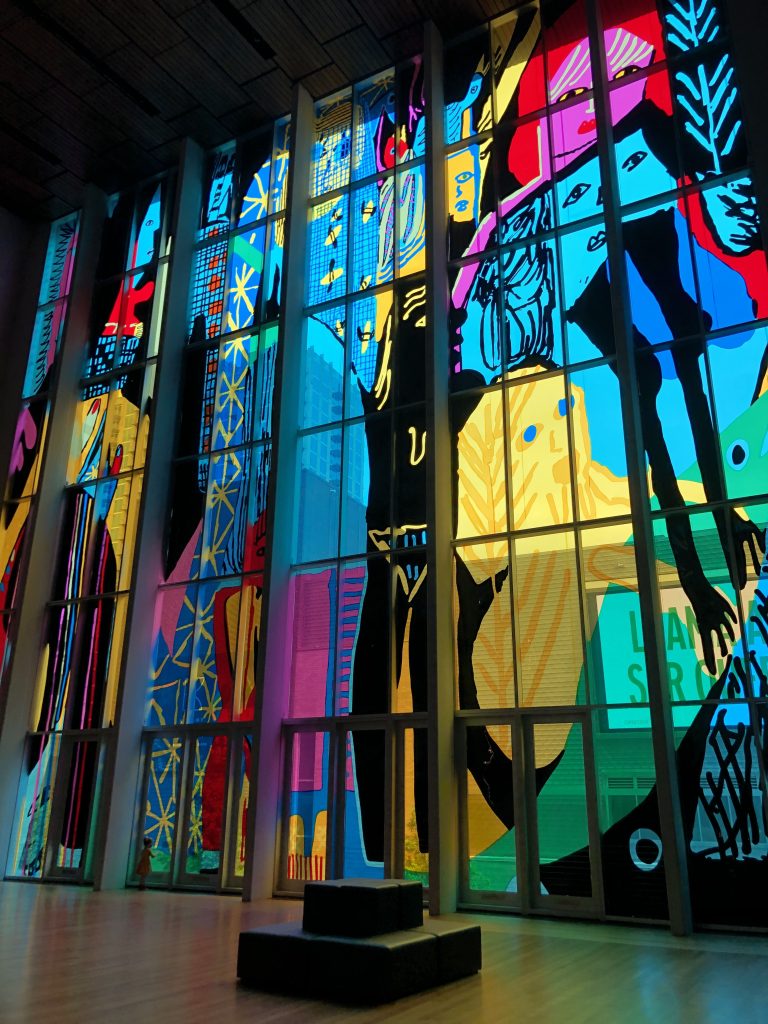
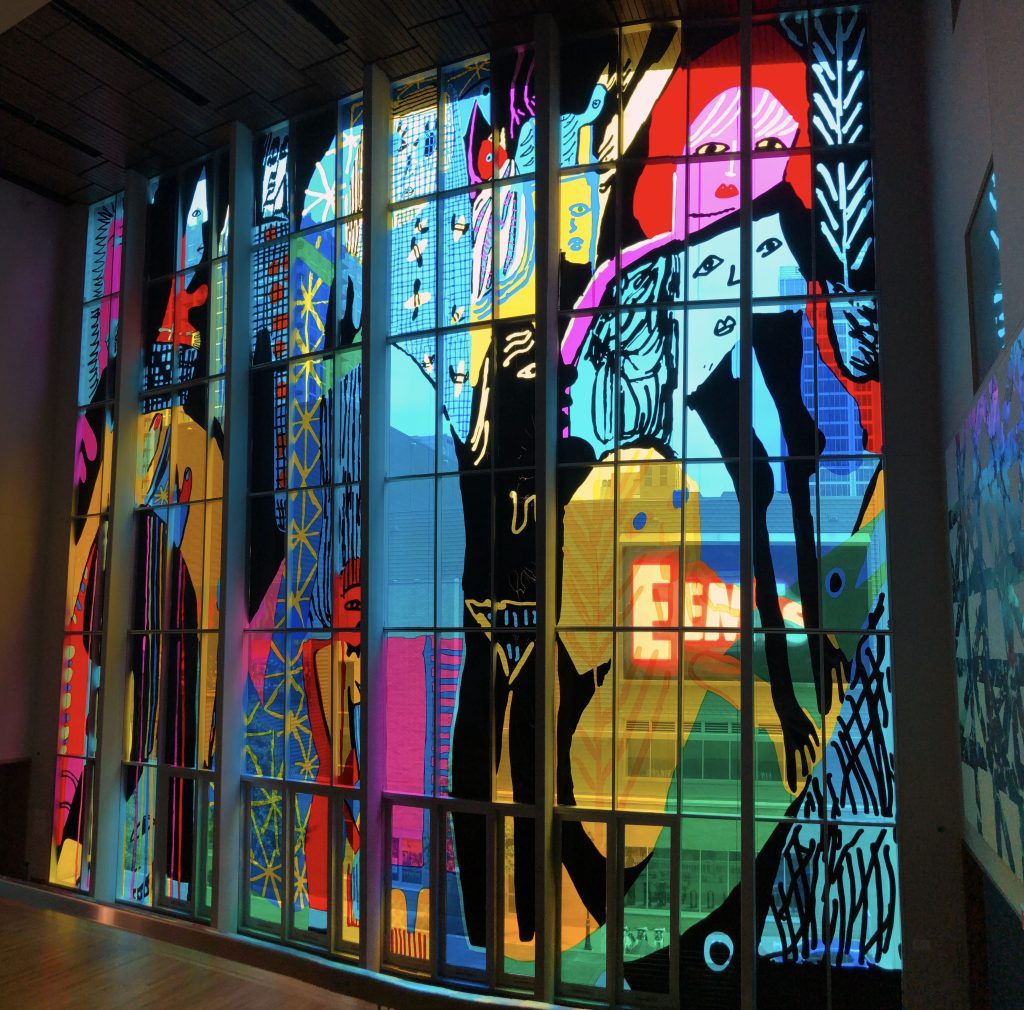
Summer Wheat created this mural, Foragers, in 2020 for the Mint Museum in Charlotte, North Carolina, where it remains on view today.

From the museum about the work-

This monumental “stained glass” installation celebrates the resilience of North Carolina’s community of makers and providers and creates a space where our present-day Charlotte community can gather for contemplation and inspiration. Collaging sheets of colored vinyl, Wheat has created a towering, prismatic composition that fills all 96 windows of the Mint atrium with female figures of varied sizes, ages, shapes, and races performing acts of labor: fisherwomen, beekeepers, hunters, mothers, caretakers, farmers, bankers.

Following the tradition of stained-glass windows found in places of worship, Wheat offers a narrative of hope and resilience that can be enjoyed in a few minutes or studied over hours. Wheat says that “Foragers presents a tradition in which women were the original hunters, technologists, and artists. This array of women connected by geometric patterns echoes the psychological space of women supporting each other. They are marching together, connecting to creatures from land and water, demonstrating their inherent link to natural elements and to the intricate depths of the unconscious.”

The women in Foragers also call attention to the underrecognized populations who have cultivated the land that we now call North Carolina, from the indigenous tribes to the colonial settlers to the enslaved Africans and all those who have followed. The region is home to myriad traditions-ceramics, basket weaving, quilting, furniture construction, textile production-and The Mint Museum specifically celebrates that legacy through its collection and exhibitions. Foragers salutes North Carolina’s history of creativity and industry, both by those whose names we know and those who remain anonymous.

Her latest exhibition, Fertile Ground, is currently on view at Nazarian/Curcio in Los Angeles, closing on 4/6/24. It includes new paintings and three stone mosaic sculptures.