Jessica Caldas, “I come honouring your power (Clytemnestra)”, 2023, house linens, poly fiber fill, house patterned quilt, fabricated structures from gifted furniture, fabric wallpaper, found and embellished light fixture
Saumitra Chandratreya, “Throne”, 2022, Cyanotype on sateen, hand embroidery
Touchy/Feely at Hillsborough Community College’s Gallery 221 in Tampa has a lot of great interactive (and non-interactive work) on view. The three artists in the exhibition- Jessica Caldas, Saumitra Chandratreya, and Emiliano Settecasi– have contributed work that explores important themes while also adding an element of fun by allowing the viewer to become actively involved in the show.
The Curatorial Statement by Alyssa Miller-
Art touches you, and sometimes you get to touch it back. Challenging conventional gallery manners, Touchy/Feely encourages visitors to assume the role of participant by handling and manipulating several of the works on view. Contemporary fiber artists disrupt the long-held distinction between art and craft, blending the conceptual with the experiential in a highly tactile medium. In Touchy/Feely, artists Jessica Caldas, Saumitra Chandratreya, and Emiliano Settecasi go one step further in collapsing the space between artist and viewer, exploring themes of labor, motherhood, relationships, conscious choice, and joy through fiber art that both holds and is held.
So much of art and history is exhibited at a distance, close enough to see but never touch. Whereas engaging with the nature of textiles can be familiar, exciting, and sensational. Combinations of art and cloth have a long and fraught history within contemporary art, such as the novelty of interactive exhibitions that can become a commodity in contemporary museums. Ogled and beaten become the play spaces, tarnished and brassy the sculptures, worn and bruised the forms become overtime through the nature of interaction. Touchy/Feely aims to be a space in between museum rules and contemporary art photo-ops. Here, artists display a mix of interactive and static artwork that exemplifies intense feeling, encouraging the viewer to make decisions in real time, and submerge themselves in something they did not expect.
Ultimately, this exhibition satisfies my urge to explore, manipulate, caress, and experience art in a way not many individuals are able to do. In working behind the scenes, I am allowed to safely satisfy my interest in exploration. I will forever be grateful to the HCC Art Galleries team for their dedication to students, staff, and artists for this exhibition and the work they do year-round. I hope that visitors come away from this exhibition with a new experience, perspective, feeling, or sensation.
This exhibition closes on 10/12/23.
Jessica Caldas, “A name can be in a lot of places at once (Helen)”, 2023, house linens, crochet, fabricated structures from gifted furniture, polymer clay, yarn, polyfiber fill, fake pearls, and ceramic
Emiliano Settecasi, “Neon Green Furry Shelf”, 2023, faux fur, plywood, metal brackets; “Hand Bags (Purple)”, 2023 velvet Velour, polypropylene pellets; “Inman Ottoman”, 2023, ottoman reupholstered with vintage fabric that matches family chairs; Hand Bags (Merlot), 2023
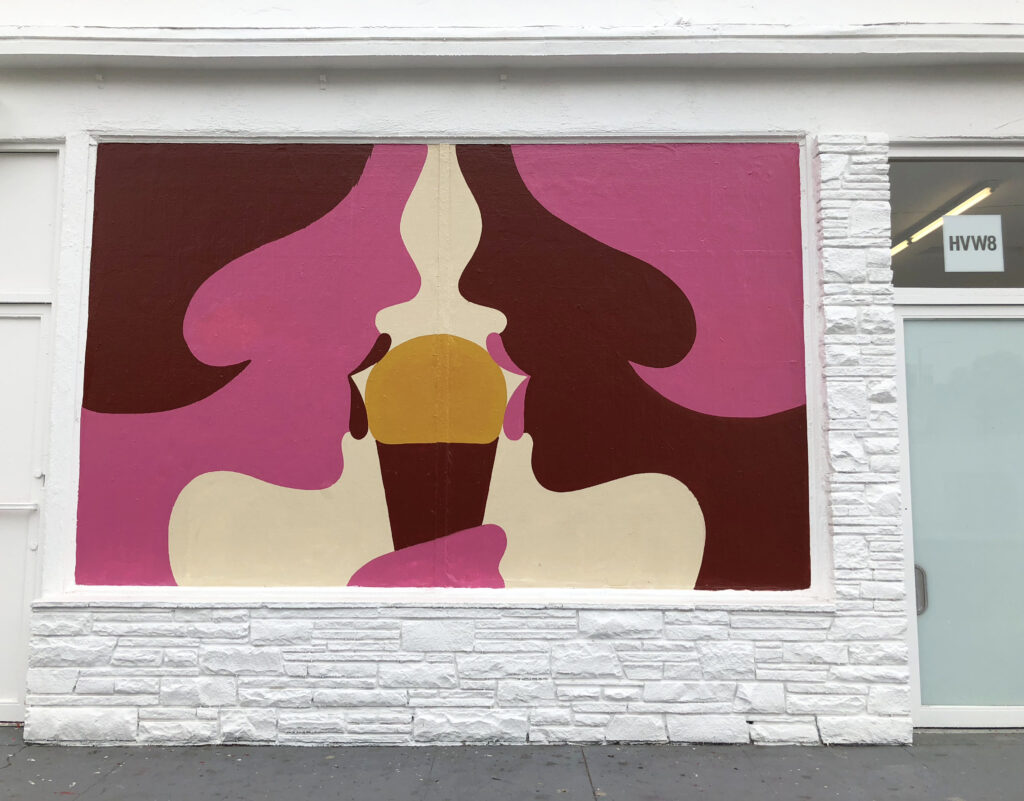
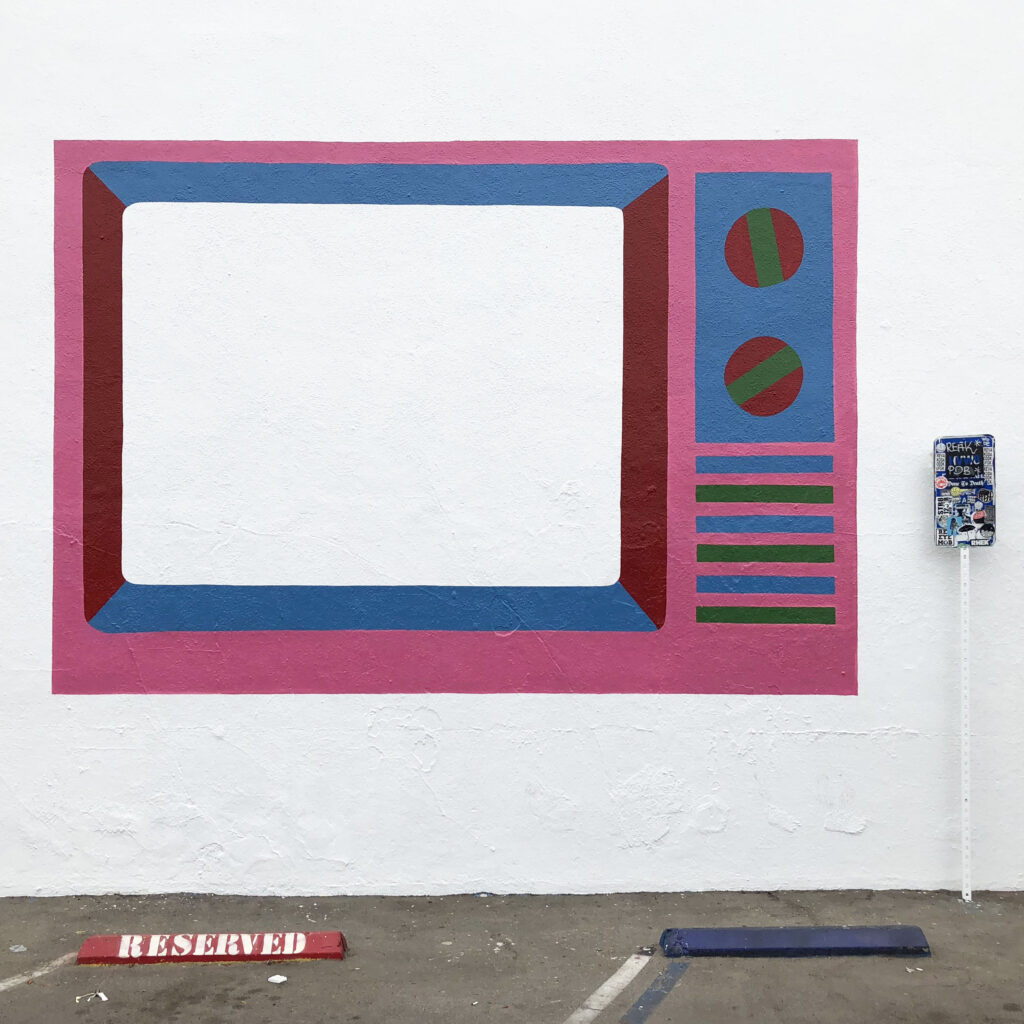
Above are images from Olimpia Zagnoli’s 2018 exhibition Cuore di Panna at HVW8 Gallery in Los Angeles. She is currently showing her work, along with her talented family at Antonio Colombo Gallery in Milan, Italy. That exhibition, ZaLiZaZa. Inventario di famiglia will be on view until 11/19/23.
The press release from the gallery-
Galleria Antonio Colombo is pleased to present the exhibition ZaLiZaZa. Inventario di famiglia, curated by Francesca Pellicciari, featuring a group of artists belonging to the same family: the photographer Miro Zagnoli (Za), the artist Emi Ligabue (Li) and their two daughters: the illustrator Olimpia Zagnoli (Za), already connected with the gallery, and the costume designer Emilia Zagnoli (Za).
The members of ZaLiZaZa are a very modern family, but also one of days gone by: were they not engaged in making their own various artifacts, we could imagine them operating in a family workshop in the Renaissance or Baroque spirit, experimenting with new painting techniques, revolutionizing styles or using them as examples to make their own; creating majestic theatrical wings, garbed in their style which is simultaneously classic and eccentric.
After all, this image is not so far from what ZaLiZaZa are doing today, in the 21st century, each in his or her own field – contiguous and often overlapping ambits – constantly coming to grips with their own research and experimentation, relying on a shared language, a true family lexicon.
The exhibition pathway is an inventory of works of all kinds – drawings and photographs, wooden books, collages, object/sculptures, fabrics, screens and magic boxes – in an intense dialogue of correspondences, where the four voices alternate and take turns, without a chronological order; a dialogue accompanied by a selection of items (sketches, notes, postcards, family photos) that document a methodology, while at the same time emphasizing the constant presence of art in the private life of ZaLiZaZa.
Thus it is no coincidence that many subjects are similar in the work of ZaLiZaZa.
While for decades design has pervaded the still analog settings and photographs of Miro (Za), it is also a recurring theme in the works of Emi (Li), from the Cicognino of Albini to the life and work of Charlotte Perriand, or anonymous design found for sale online: “I have no taboos, no type of respect or norm.” Similar use of anonymous and unconventional materials is found in the “Souvenir” clothing series by Emilia (Za), made from touristy dishtowels with the map of Italy, just as certain archetypes return in the thousands of stripes traced by Olimpia (Za), always in pursuit of the perfect synthesis between the idea and its representation.
Beyond this, beyond design, mountains, figures, bodies, portraits, chiaroscuro effects, balconies, there is the continuing echo – in the various generations of ZaLiZaZa of what Matisse said one day to Picasso, as Emi (Li) reminds us: “In the end, Picasso, we don’t have to try to be so smart. You and I are alike: what we try to rediscover in art is the atmosphere of our First Communion.” To always observe the world with the eyes of children, with the gaze of ZaLiZaZa.
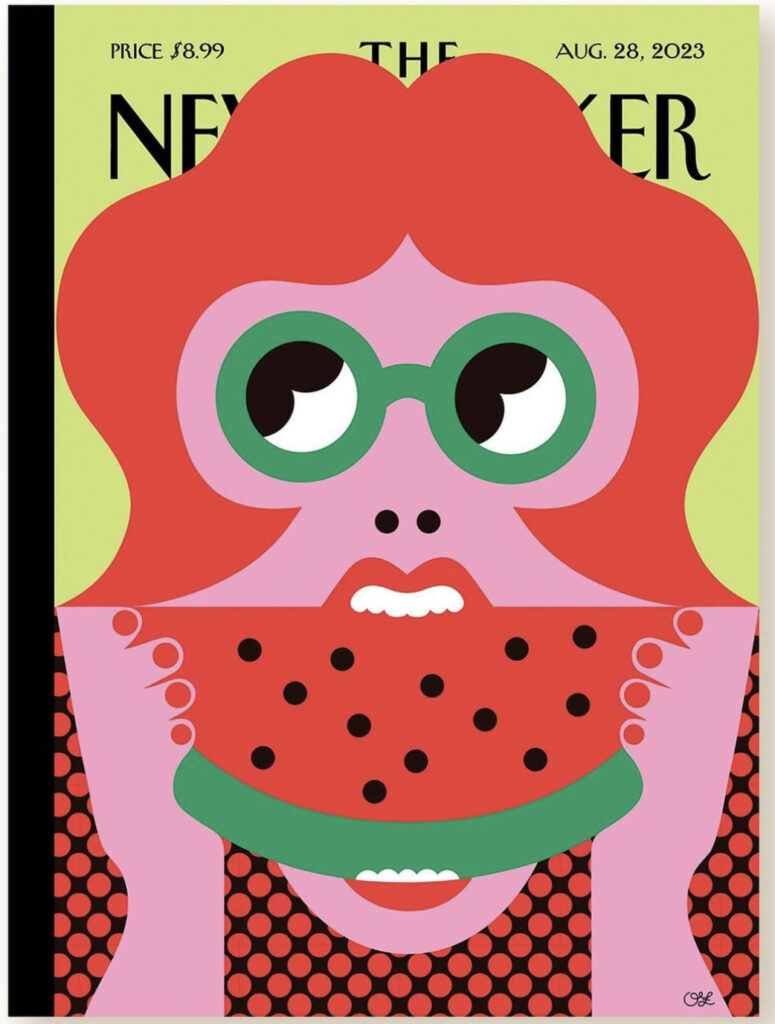
If Olimpia Zagnoli’s work looks familiar, she also designed The New Yorker’s August 28th issue, seen below.
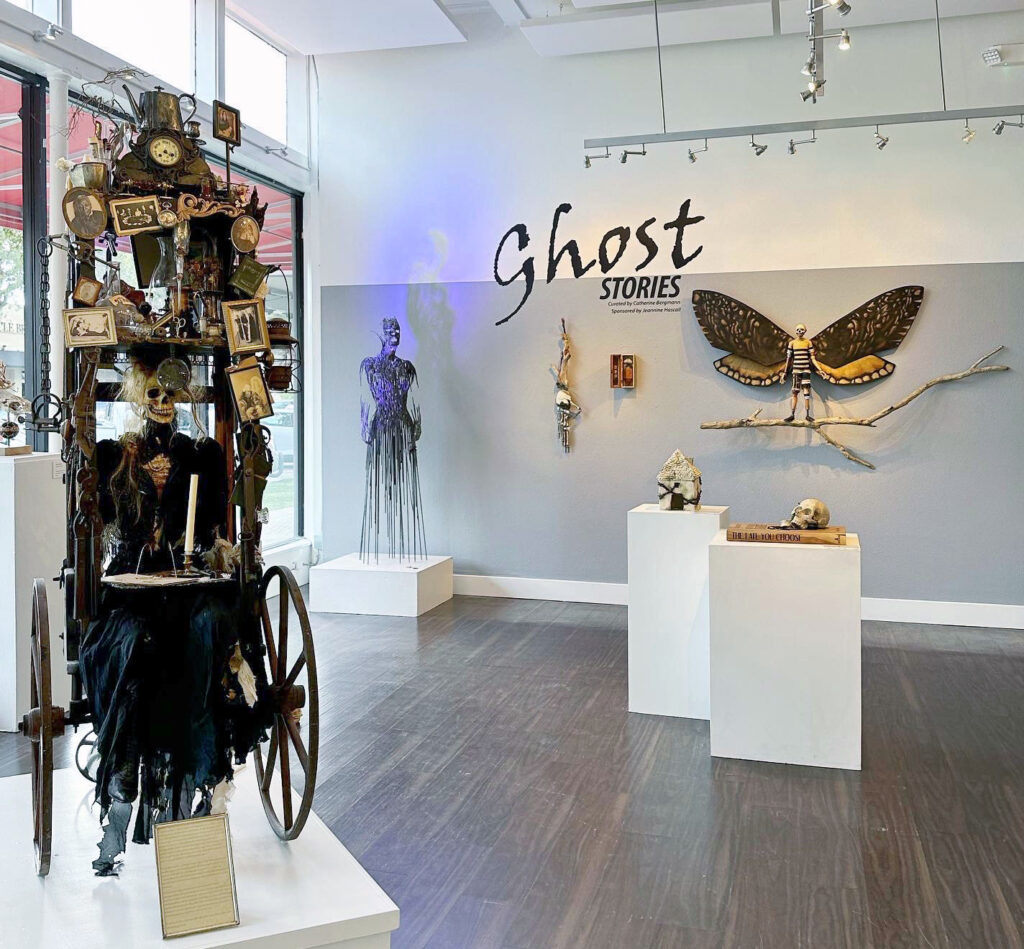
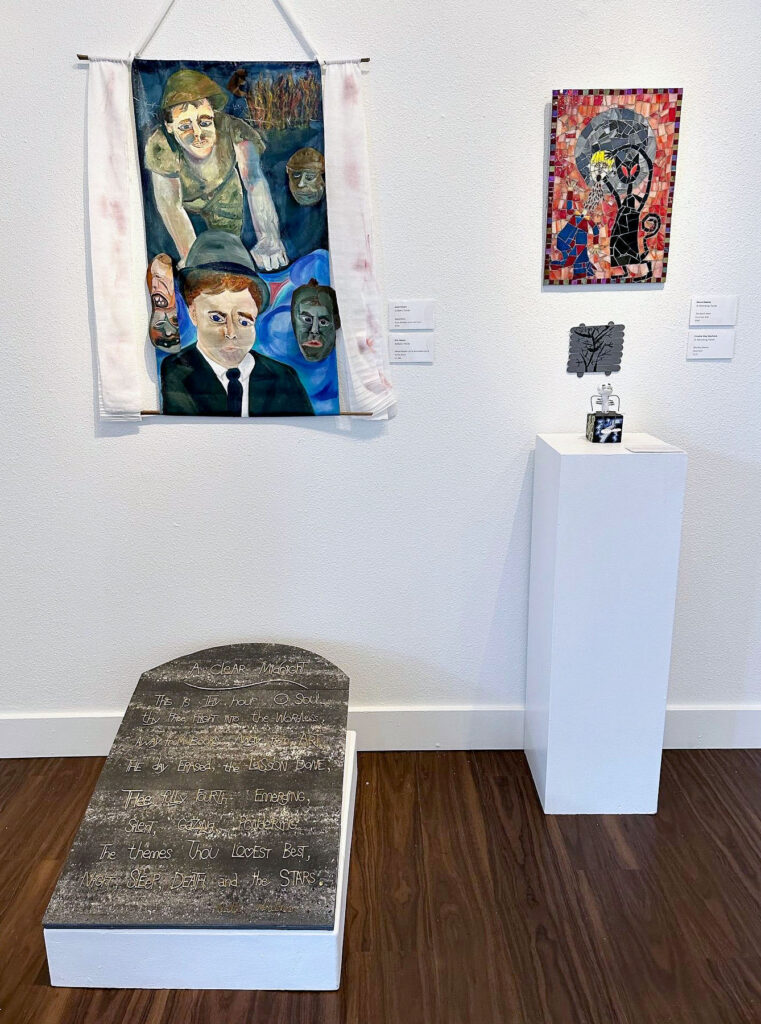
On Thursday, 10/5/23, in partnership with Keep St. Pete Lit, a group of local writers will be telling ghost stories at the gallery inspired by pieces from the exhibition. The reading will take place at 6pm.
Below are a few more selections-
Work by Alegrobot, Hand sculpted paper clay, acrylic paint
Janet Folsom, “Apparitions”, Mixed media (top left); Eric Folsom, Gravestone, bronze on marble; Donna Slawsky, (top right) “The Devil’s Work”, Stained glass, beads, and Creative Clay, Stephanie,(bottom right) “Monkey Dreams”, Mixed Media
About Creative Clay, who contributed several works to the exhibition-
“Creative Clay achieves its mission by providing ongoing studio arts workshops for individuals with disabilities five days per week. Creative Clay teaching artists provide students with education and experience in artistic techniques, as well as vocational skills related to the display, promotion, and sale or their expressive work.”
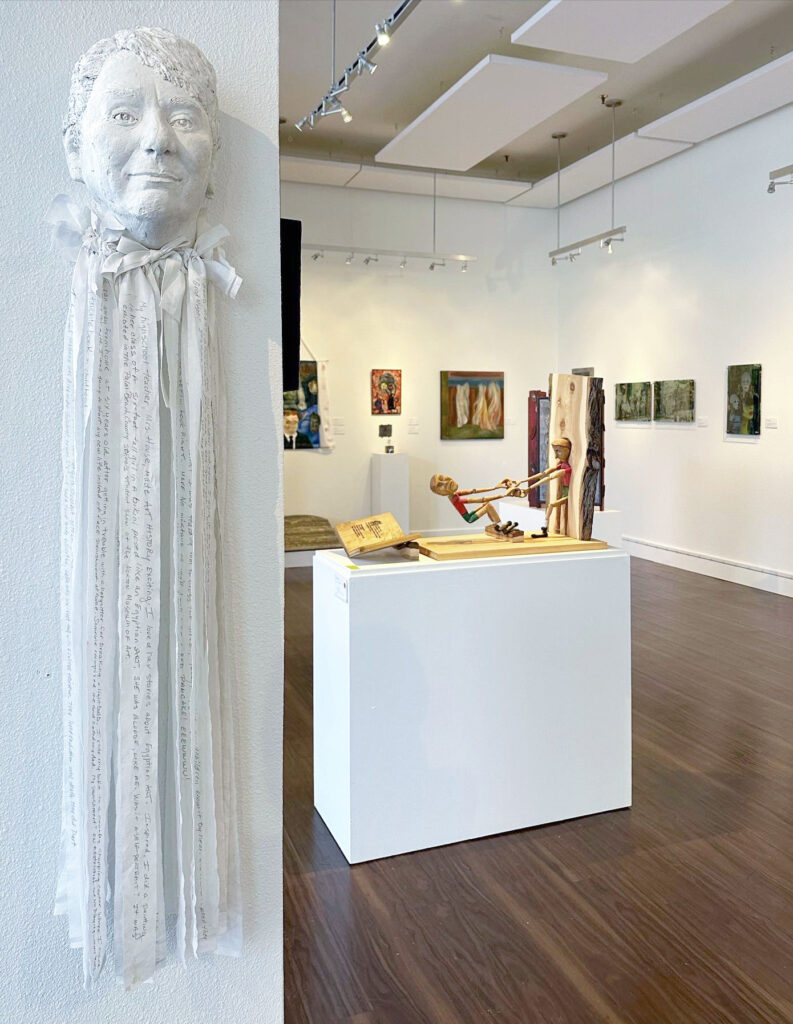
Katie Deits, “Haunted by the Past”, Ceramic, cotton, pencil, acrylic paint (left) and Nick Reale, “Out of the Wood” wood sculpture
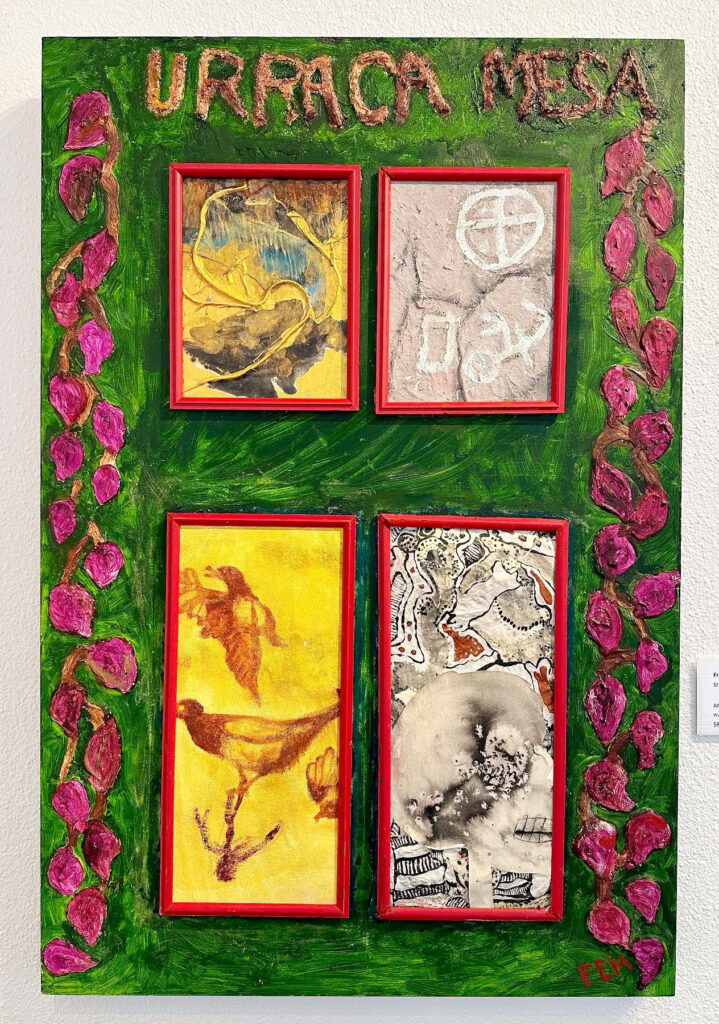
Francine Michel “Mysteries of Urraca Mesa”, Water mixable oil, collage
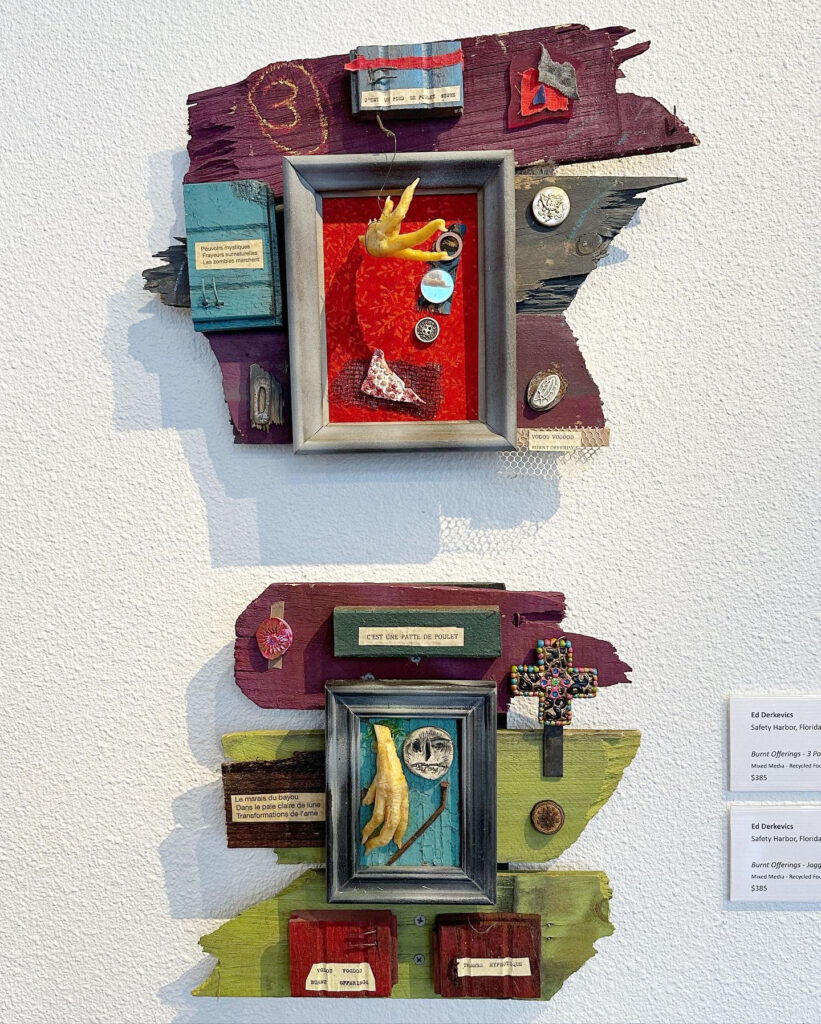
Ed Derkevics, “Burnt Offerings”- “3 Potions” and “Jagged”- Mixed Media, recycled found objects
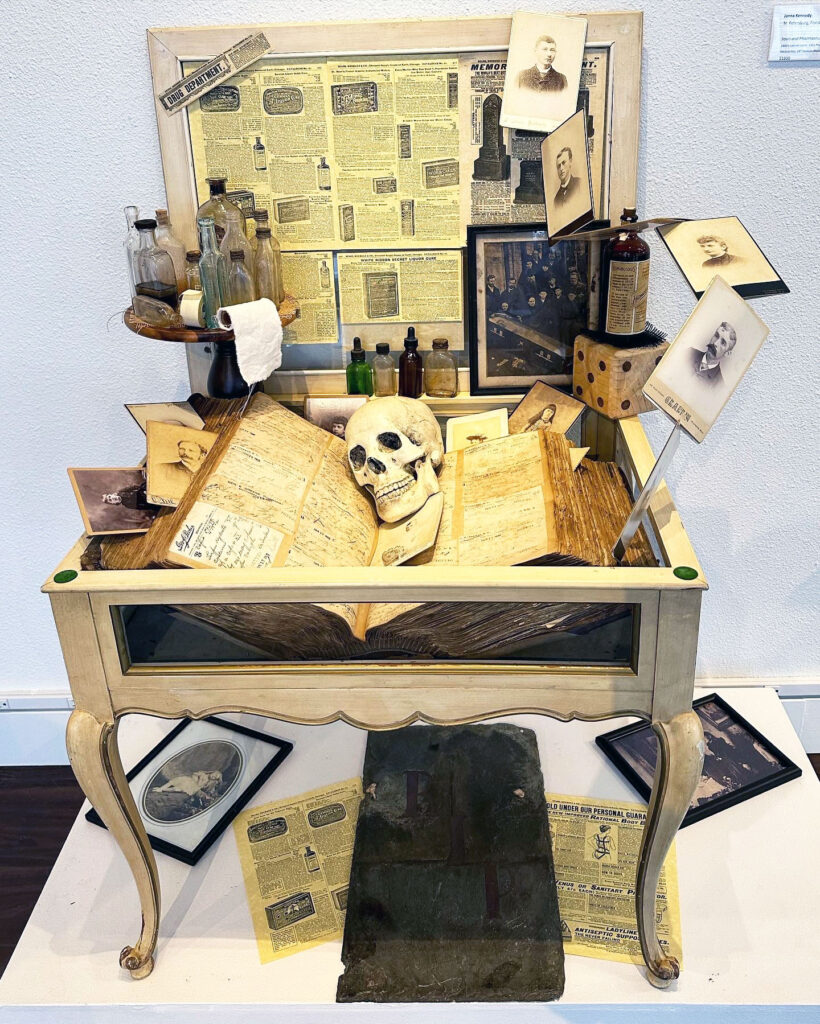
Janna Kennedy, “Souls and Pharmaseuticles”, 1800s Cabinet Cards, 1902 Pharmacy Ledger & Medical Ads, 19th Century Medicine Bottles
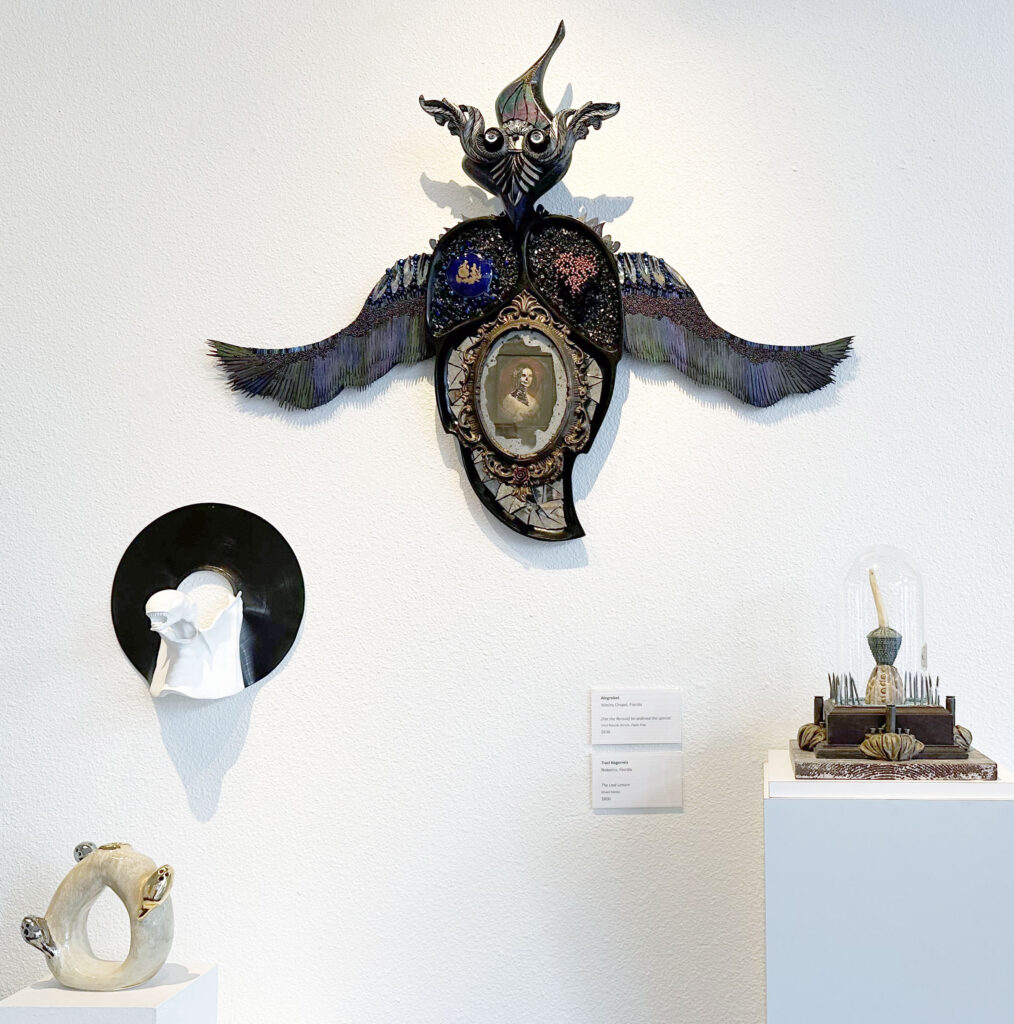
LA Finfinger, Ghost Ceramic work (bottom left); Alegrobot, “(For the Record) he ordered the special”, Vinyl record, paper clay; Traci Kegerreis, “The Lost Lenore”, Mixed media (center top); Demeree Barth, “Remembering Sedlec Ossuary”, Clay, bullet casings, wood display stand, found objects (bottom right)
“System of (architecture)” 2023, (black) and “System of (emotion)”, 2023, (pink), Stoneware and glazes
“Line, Dot, Squiggle (a search for something more)”, 2022, Micron, colored pencil, silver leaf, vellum and colored porcelain on paper
“Line, Dot, Squiggle (a search for something more)”, 2022, (detail)
Pictured above are some of the works from Iren Tete’s exhibition systems of (entanglement) at Art Center Sarasota. These engaging sculptures (and one mixed media work) explore the various systems that surround and influence our daily lives.
The artist’s statement about the exhibition-
things fold and unfold meander, bend, and twist until they become other things
We make deliberate and accidental choices which result in further deliberate and accidental choices. This evolves into a network of choices, a system leading from present to future, defined by scientific reasoning yet clouded by emotional irrationality.
Systems surround us, and perhaps even define us. Systems of (entanglement) navigates, questions, and tenderly accepts these systems –
systems of thought
systems of architecture
systems of gravity
systems of language
systems of emotion
systems of logic
systems of history
systems of memory
systems of time
systems of
I engage with these numerous systems while making. My thoughts oscillate between those of simple actions – pinch, coil, squeeze- to those of things that are infinitely complex and a part of something else – such as time. These separate systems interconnect and grow into something bigger that is a part of the entangled network of systems where one thing becomes another.
“Paolo and the Bomb”, 2023, Assemblage of diverse materials
“Lions Escape from the Zoo or Portrait of Andy Kaufman”, 2023, Assemblage of diverse materials
Center work- “Hive, Helmet, and Butter Brick”, 2023, Assemblage of Diverse Materials
“Colossus in Repose”, 2023, Assemblage of diverse materials
“All Their Friends Are Rabbits”, 2023, Assemblage of diverse materials
After visiting Ry McCullough in his studio back in May to see what he was working on, I was very excited to finally see his exhibition SUPERPOSITIONS at Art Center Sarasota. His mixed media sculptures capture the imagination as the viewer imagines the connections between the objects in the work. The titles provide often humorous clues, but make sure to check out his Instagram for more background on his inspirations.
About the work from the center-
McCullough’s practice engages the fields of printmaking, creative writing, drawing, sound, and sculpture to create unique systems that probe the margins and boundaries of how art crafts language and communicates meaning. Using these systems of making as a guide for a range of media processes, they articulate parameters that can expand or collapse, generating opportunities for discovery in thematic investigations of the philosophical, abstract, and fluid state of being across time and space. SUPERPOSITIONS is inspired by an affection for the traditions of still life, modernist abstraction, and humor.
Artist Statement-
The SUPERPOSITIONS project comprises works of collage, sculpture, and wall-bound hybrids that exist between two-dimensional and three-dimensional space. The tension between these two spatial expressions is celebrated within this project through the playful application of collage. More than a tradition of material operations, McCullough views collage as a bundle of behaviors, a toolbox, and a signifier of fragmentation that forms an ethos of revision and reorganization.
McCullough is attracted to humble materials such as plywood and paper, concrete and plaster, foam and found things, essential stuff that requires intervention to establish meaningful presence through the relations it forms to other components in each work. The formal language is idiosyncratic; combinations of hard and soft edges, geometric and organic form, and a buffet of color with a penchant for balance. These works are propelled by the forces of potential change, by the energies of process, and by developing a poetic and clumsy status of unfinishedness.
He is currently showing his work at The Little House, located at 451 N. La Cienega Blvd. in Los Angeles, presented by Dries Van Noten.
From their press release-
On view will be a selection of recent work by Sam Falls which merges photography, painting, and installation which results in captivating pieces that invite viewers to explore the relationship between humans and the environment. The works in the exhibition offer a meditation on the sublime dichotomy of mortality, including ceramics combining fossilized images of nature and the human form, as well as found airbags from crashed cars that are embroidered with symbolic idioms on the transience of time and life quoted from ancient Greek and Roman sundials.
Falls’ artistic process explores the varying representations of nature and materials through the passage of time. Rain, sunlight, wind, and the gradual effects of weathering all contribute to the unique aesthetic of each piece, creating a dialogue between art and nature that captures the essence of life represented in time and space. By exposing his artwork to elements, he invites the environment to act as a collaborator in reinterpreting organic materials into new forms.
Launched in 2006 to support the next wave of contemporary portraiture in the United States, the National Portrait Gallery’s celebrated triennial Outwin Boochever Portrait Competition is a major survey of the best American portraiture selected by internationally prominent jurors and curators. Now in its sixth edition, The Outwin: American Portraiture Today presents 42 works selected from over 2,700 entries, that foreground the vibrancy and relevance of portraiture today. In addition to paintings, photographs, drawings, and sculptures, The Outwin includes video, performance art, and textiles, highlighting the limitless possibilities of contemporary portraiture.
Open to both emerging and established artists, this year’s entrants were encouraged to submit work that moves beyond traditional definitions of portraiture, and to explore a portrait’s ability to engage with the social and political landscape of our time. The variety of media and subjects featured in the exhibition invite audiences of all backgrounds to find relation in the human experience.
Since its inception, finalists for the exhibition have been determined by a panel of jurors including three Portrait Gallery staff members and four external professionals (critics, art historians, artists). The competition is endowed by and named for Virginia Outwin Boochever (1920 – 2005) who, for 19 years, volunteered as a docent at the Portrait Gallery. Her commitment to advancing the art of portraiture is continued through the support of her children.
Below are a selection of works from the show and information about them from the museum.
Alison Elizabeth Taylor– Anthony Cuts under the Williamsburg Bridge, Morning, 2020 (pictured above)
On walks around her Brooklyn neighborhood during the COVID-19 lockdowns, Alison Elizabeth Taylor encountered the hair groomer Anthony Payne, who,with his workplace shuttered, had taken his scissors, mirror, and chair to the streets. Payne sought to financially support the Black Lives Matter movement, especially in the aftermath of George Floyd’s murder, and turned over proceeds from his donation-based haircuts to organizations advocating for social justice.
Taylor’s process, one she developed and named “marquetry hybrid,” incorporates vivid paints, inkjet prints, and the natural grains of over one hundred veneers. Marquetry, with its inlaid combination of woods, can “memorialize,” Taylor notes. She acknowledges the history of the craft, which was favored by Louis XIV (1654-1715) when he was acquiring furniture for Versailles. By giving Payne this “royal treatment,” Taylor aims to pay tribute to him.”I want him to see how much his example meant to me,” she explained.
Kira Nam Greene, “Kyung’s Gift in Pojagi (From the series “Women in Possession of Good Fortune”)”, 2019 Oil, gouache, colored pencil, and acrylic ink on canvas
Kira Nam Greene– Kyung’s Gift in Pojagi (From the series “Women in Possession of Good Fortune”), 2019
In this mixed-media work, by Kira Nam Greene, the artist Kyung Jeon faces us with relaxed self-assurance. She is carefully positioned on her couch as her long black hair falls over her orange and turquoise tunic. In the foreground, a wooden cylinder containing paint brushes reveals her medium of choice. A plate with persimmons, consumed during the harvest festival Chuseok to celebrate good fortune, brims with potential while the rest of the painting pulsates with action.
Greene situates her friend in a fantasy world that echoes Jeon’s artwork and their mutual interest in the traditional Korean fabric quilting technique of pojagi. Two rabbits, representing Jeon’s Chinese zodiac, appear to be concocting a potion. Flowers sprout as kaleidoscopic patterns envelop her. The reference to pojagi, the visible paint drips in the background painting, and the hands of the sitter- left unfinished- invoke the role of tradition, process, and exploration in artmaking.
Stuart Robertson, “Self Portrait of the Artist” from the “Out and Bad” series, 2020, Aluminum, earth, acrylic paint, enamel, paper,metallic bubble wrap, sequins, and gold foil on wood
Stuart Robertson– Self Portrait of the Artist from the Out and Bad series, 2020
“In my world, skin is high-tech, amorphous, and armored,” the artist Stuart Robertson observes. “Blackness is percussive, lustrous, flexible, and indestructible.” Self-Portrait of the Artist depicts a fragment of a man- half of his face and his upper torso-shiny and monumental. A black beard delineates his jaw, and a small gold hoop adorns his ear. Although the figure is cropped beyond recognition, the work’s title provides a clue.
Through the alternation of flat and repoussé aluminum sheets, Robertson achieves a hypnotic effect, a poignant tension playing on what he reveals or hides from us viewers. His refusal to depict his entire face or figure challenges the notion of what a portrait should be and blocks the objectification of the Black male body, so often sexualized in visual culture. Simultaneously, Robertson delivers an irrepressible, resplendent image of that body, one inspired by the aesthetics of Jamaica’s dancehall culture.
Vincent Valdez, “People of the Sun (Grandma and Grandpa Santana)”, 2019, Oil on canvas
Vincent Valdez– People of the Sun (Grandma and Grandpa Santana), 2019
An elderly couple faces us with the gentle authority that old age provides. People of the Sun (Grandma and Grandpa Santana) is a portrait of Vincent Valdez’s maternal grandparents. “My grandparents spent most of their time outside,” the artist recalled. “Grandpa spent his entire life working under the blazing Texas sun as a carpenter and yard worker, cutting lawns in the wealthy communities of San Antonio right up until he passed away. Grandma was constantly working with her hands–raising kids, washing, sewing clothes, and tending the plants in her yard.”
The Santanas are depicted in a space defined by details the artist remembers: their vintage AM radio, their plants, their homemade clothes. The bedsheet, like the Virgen de Guadalupe’s aura, signals their spiritual role in the family. This portrait connects the pair to the Indigenous and mestizo cultures of the American Southwest, including the Aztec and Maya, who honored the sun.
For more work from the exhibition, please head to page 2.
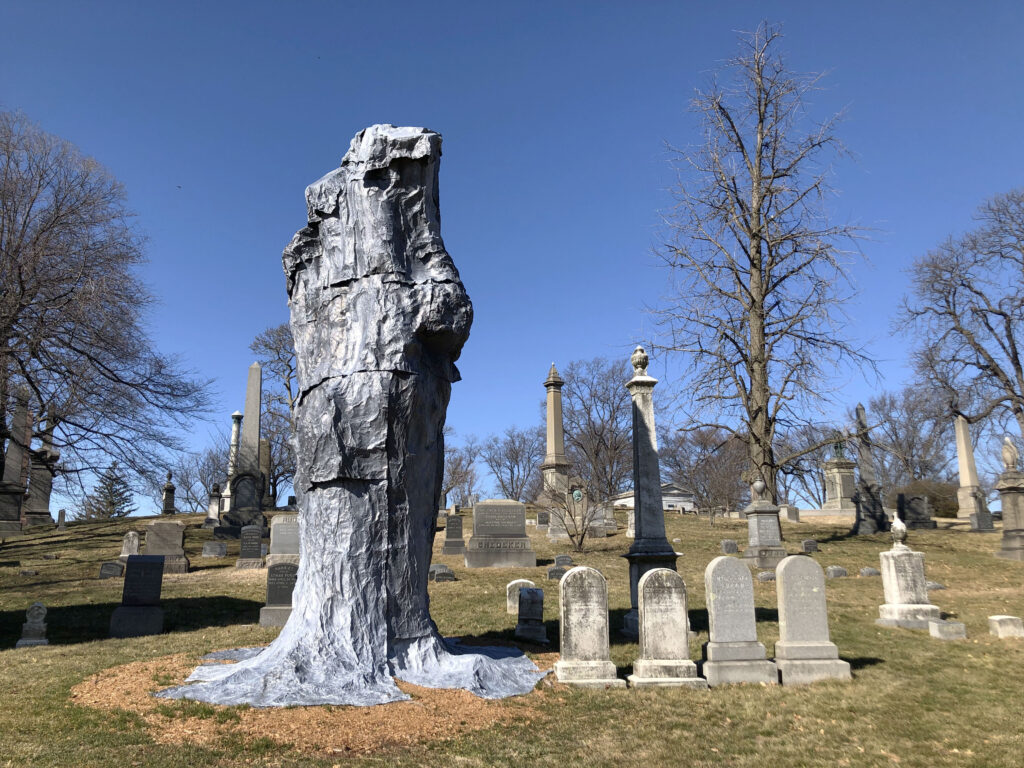
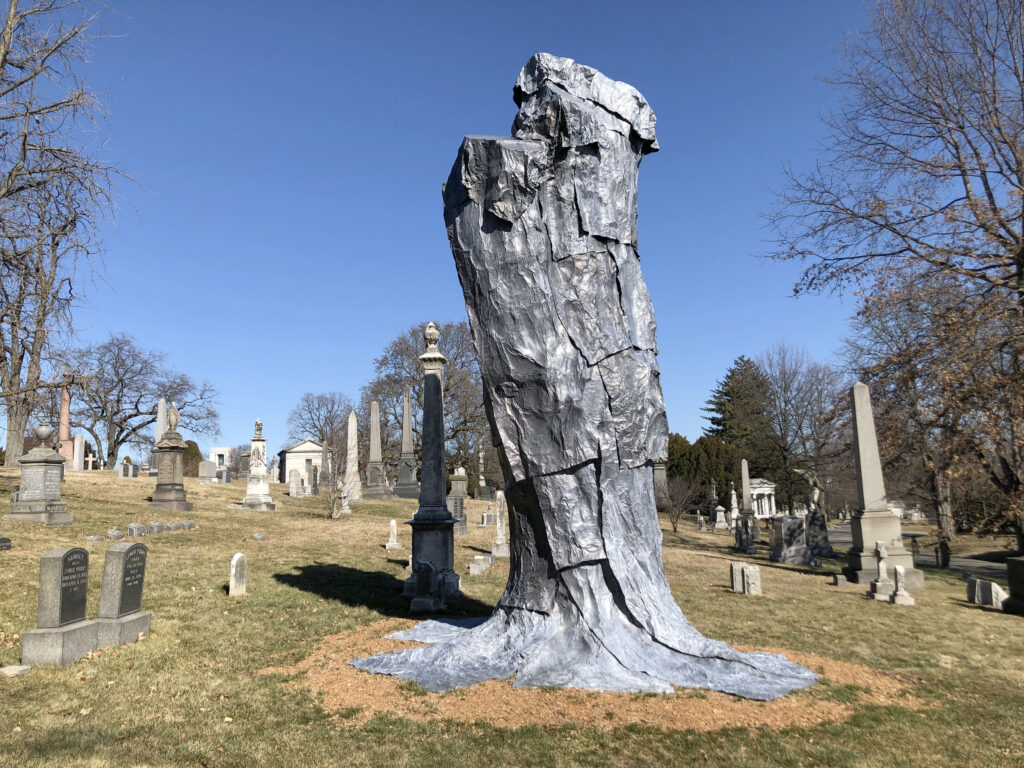
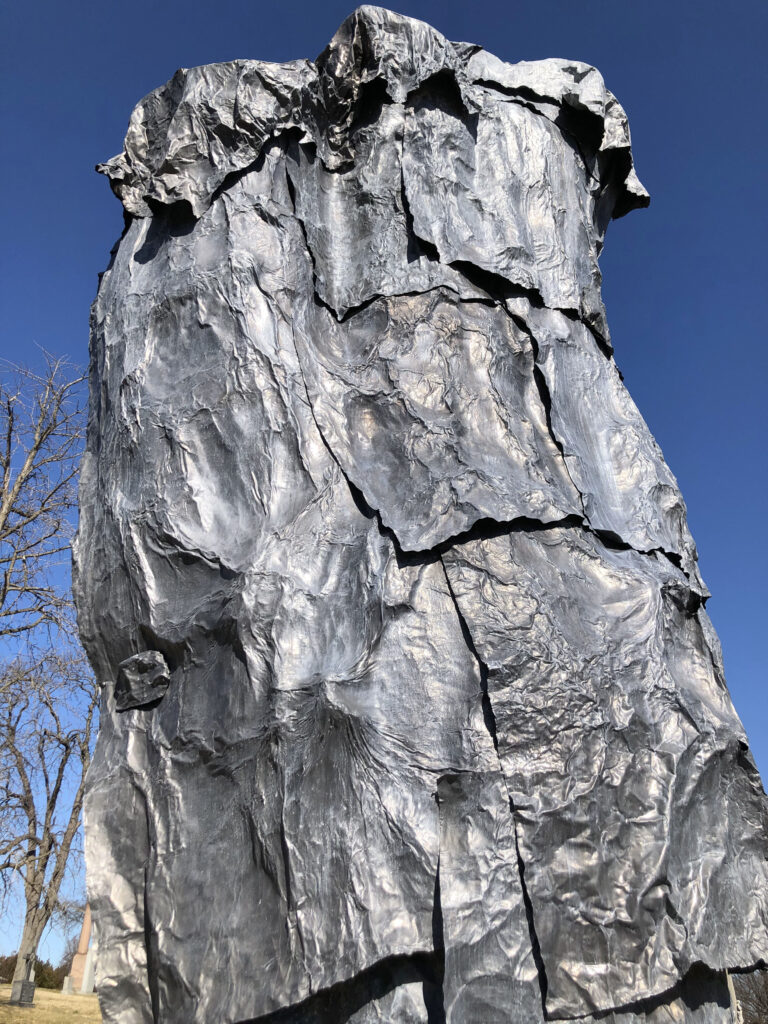
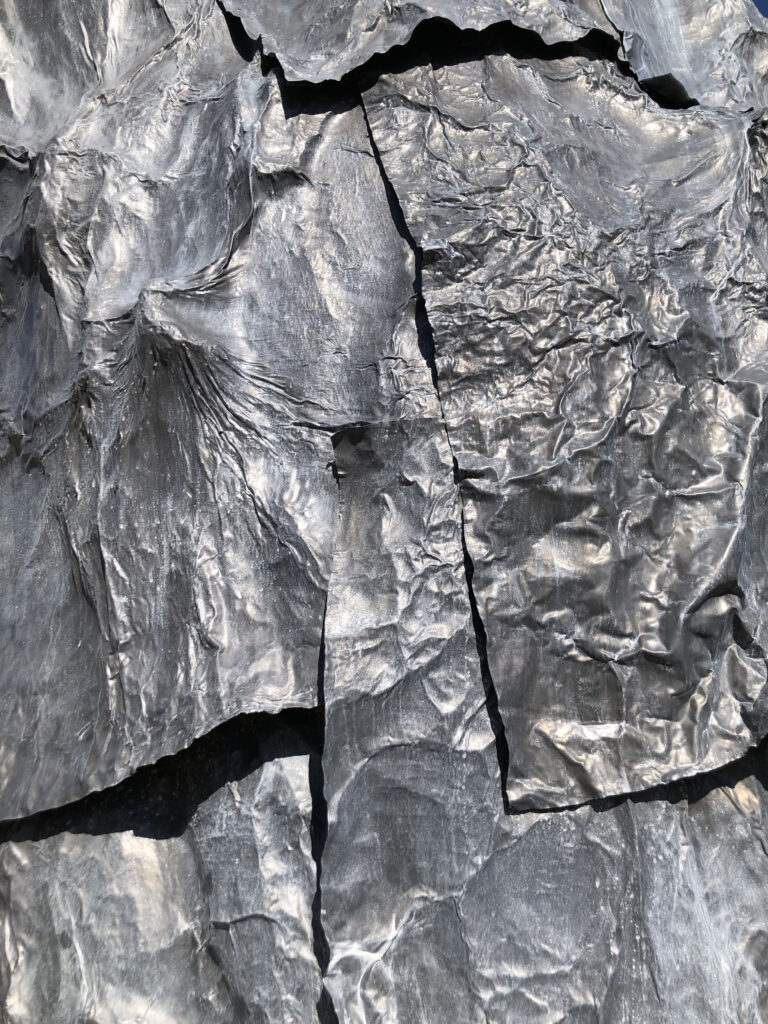
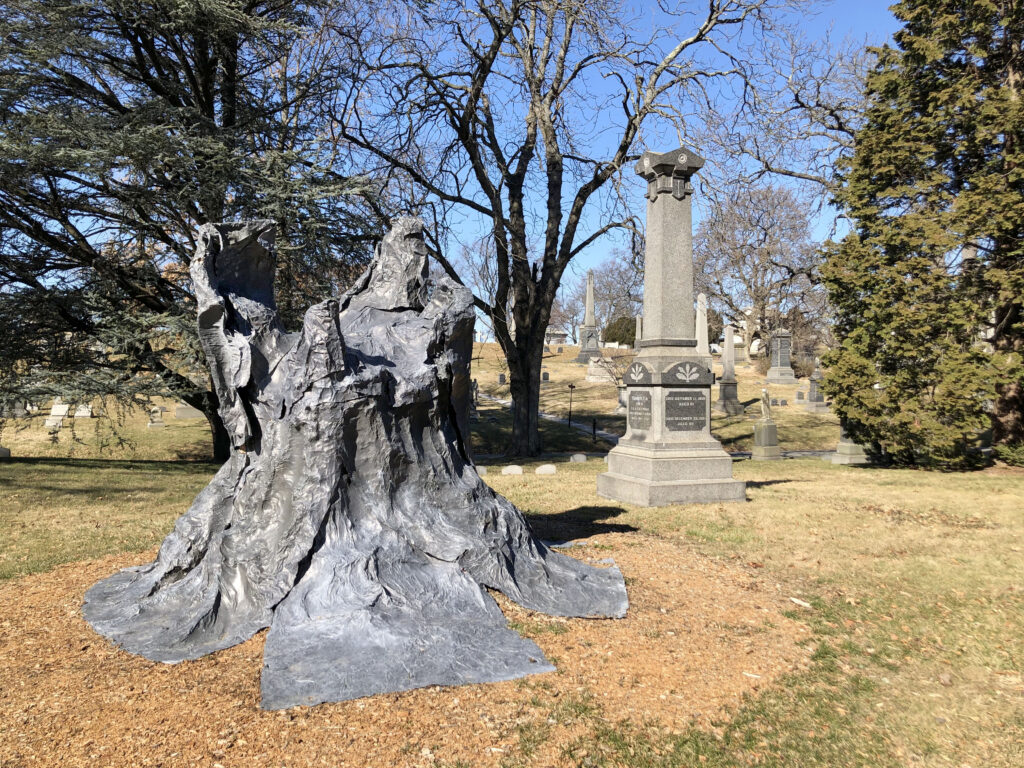
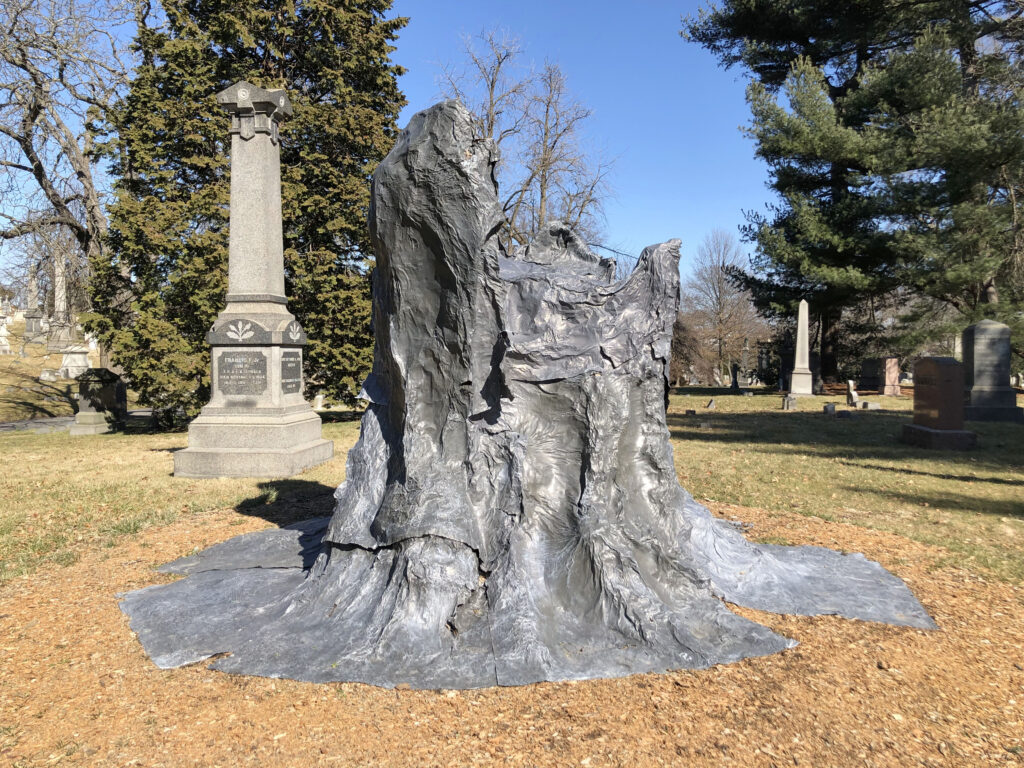
Above are two of the works from Athena LaTocha’sThe Remains of Winter (Battle Hill, East), 2022, currently at Greenwood Cemetery in Brooklyn.
From the cemetery’s website about the work-
Athena LaTocha creates large-scale works inspired by her close observations of the natural world, from the deserts and mountains of the Southwest to the Great Plains. She often incorporates elements of these environments, including soil, sand, bark, and rocks. Recently, she has been particularly drawn to trees, considering them as record keepers that bear the markings of time.
Inspired by Green-Wood’s centuries-old trees and its legacy as a place of remembrance, LaTocha has created The Remains of Winter. She cloaked the remains of two massive European beeches on Battle Hill in thin sheets of lead, a material that has been used for centuries in coffins to slow the decomposition of the body. By hand-forming this malleable metal onto the trees, LaTocha captures the unique details of their shapes and forms, even as they slowly degrade beneath the lead.
All around these sculptures, the Cemetery is in a continuous cycle of transformation. Felled trees are turned into mulch for new plantings, earth is removed then replaced for each new burial, and even the stone monuments themselves slowly erode. Through The Remains of Winter, LaTocha memorializes these shifts and changes while also raising profound questions about what we choose to commemorate and mourn—whether it is what we can witness before us or that which, like the movement of continents and land masses, unfolds over lifetimes.
The sculptures will remain on view through September 2023.
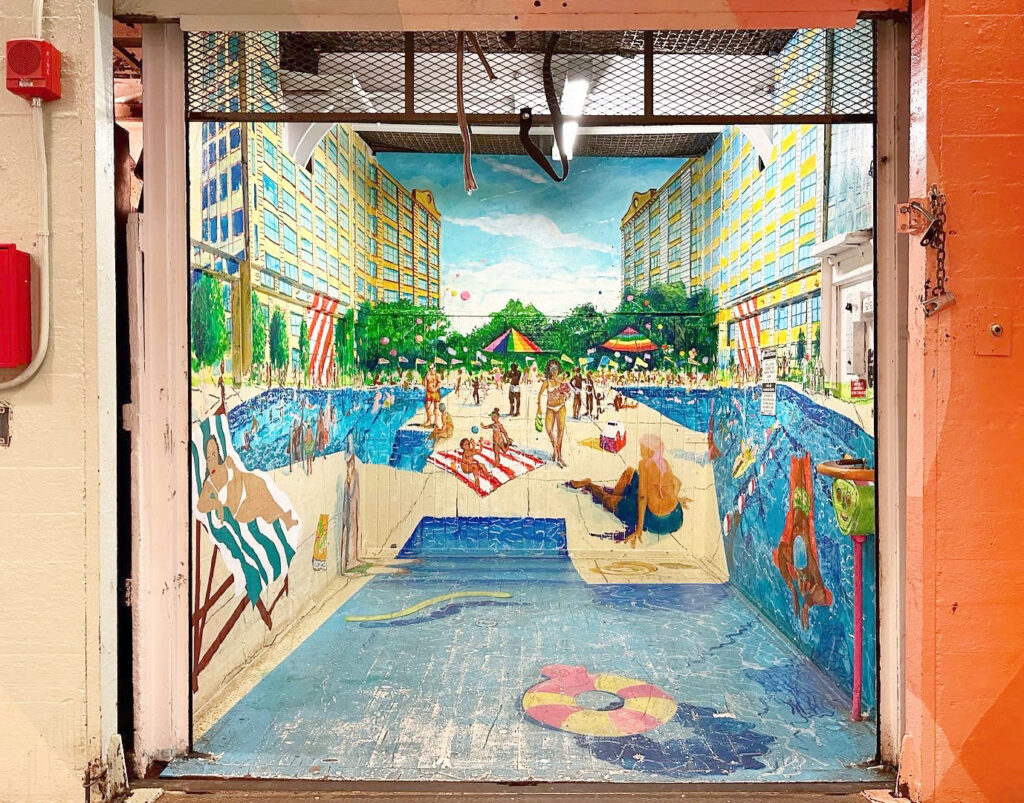
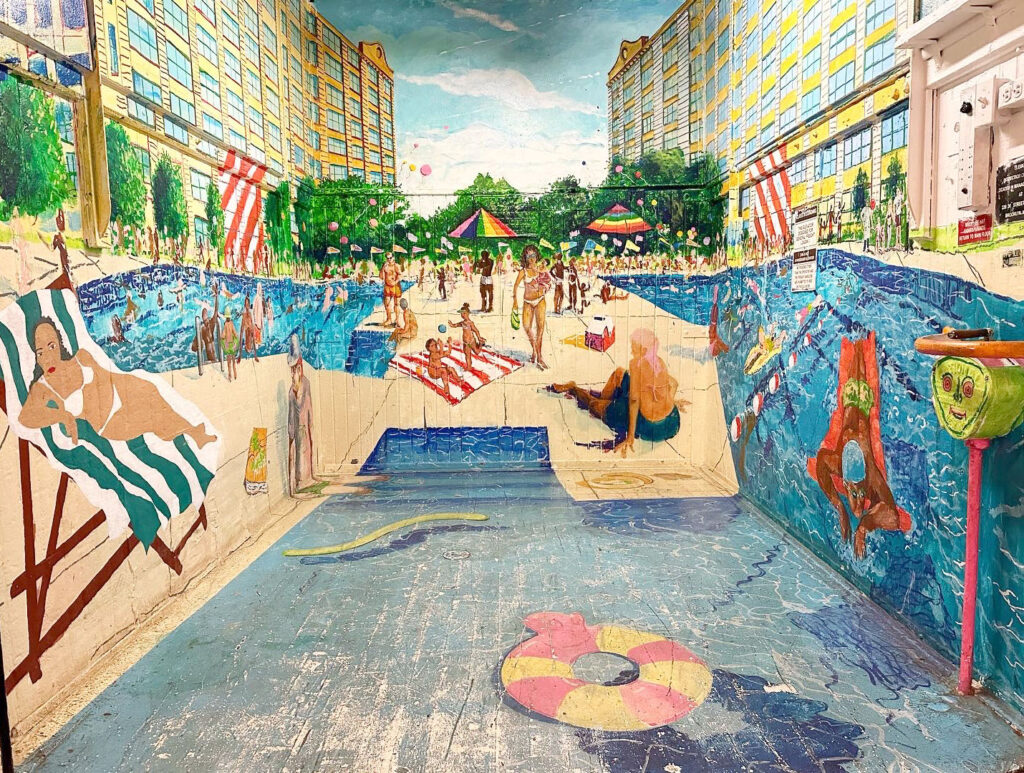
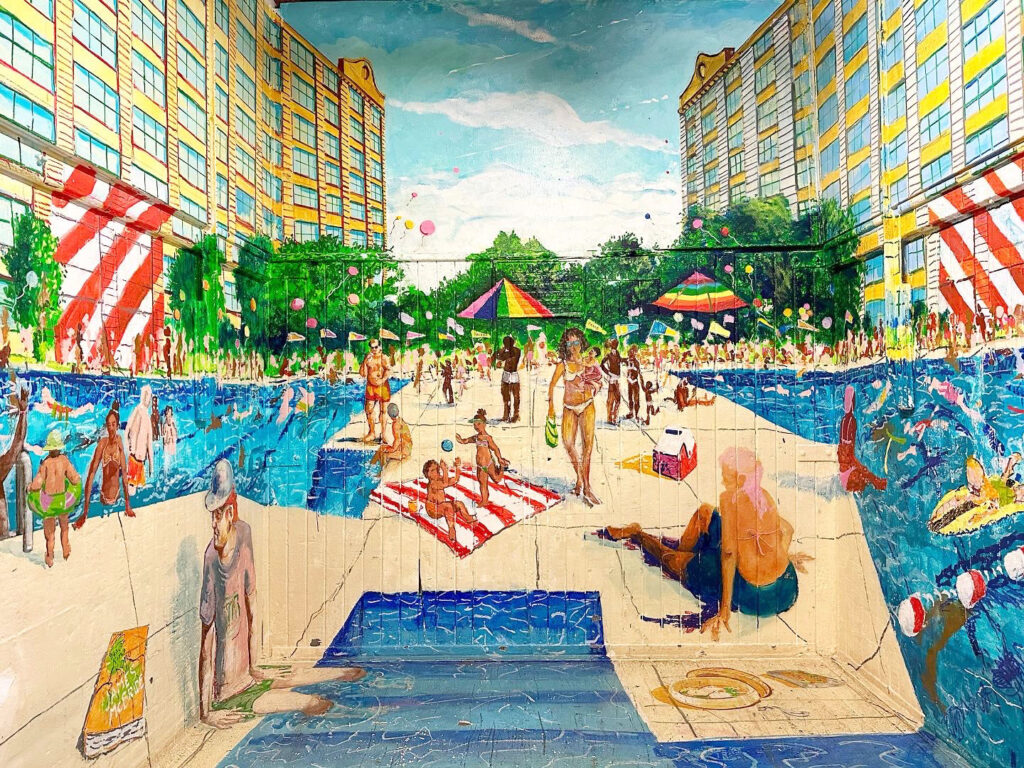
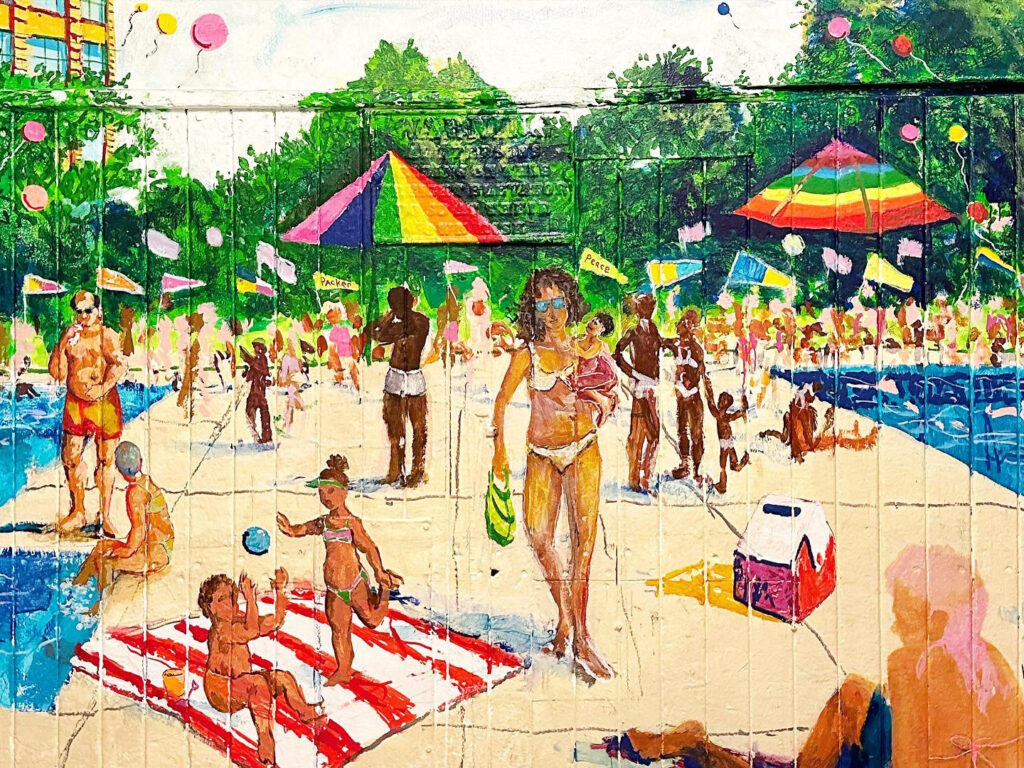
This installation represents both the reality and fantasy. The reality is depicted in the inspiring monumental architecture, while the fantasy emerges in the joyful addition of a swimming club with a celebration of swimming, sunbathing, recreation and play. For Rush, the work is a homage to Impressionist painters like Monet and Suerat, and the way that they depicted urban and rural pleasures. This is a group project between Rush and three of his students from High School Visual Arts at Packer Collegiate Institute in Brooklyn Heights.
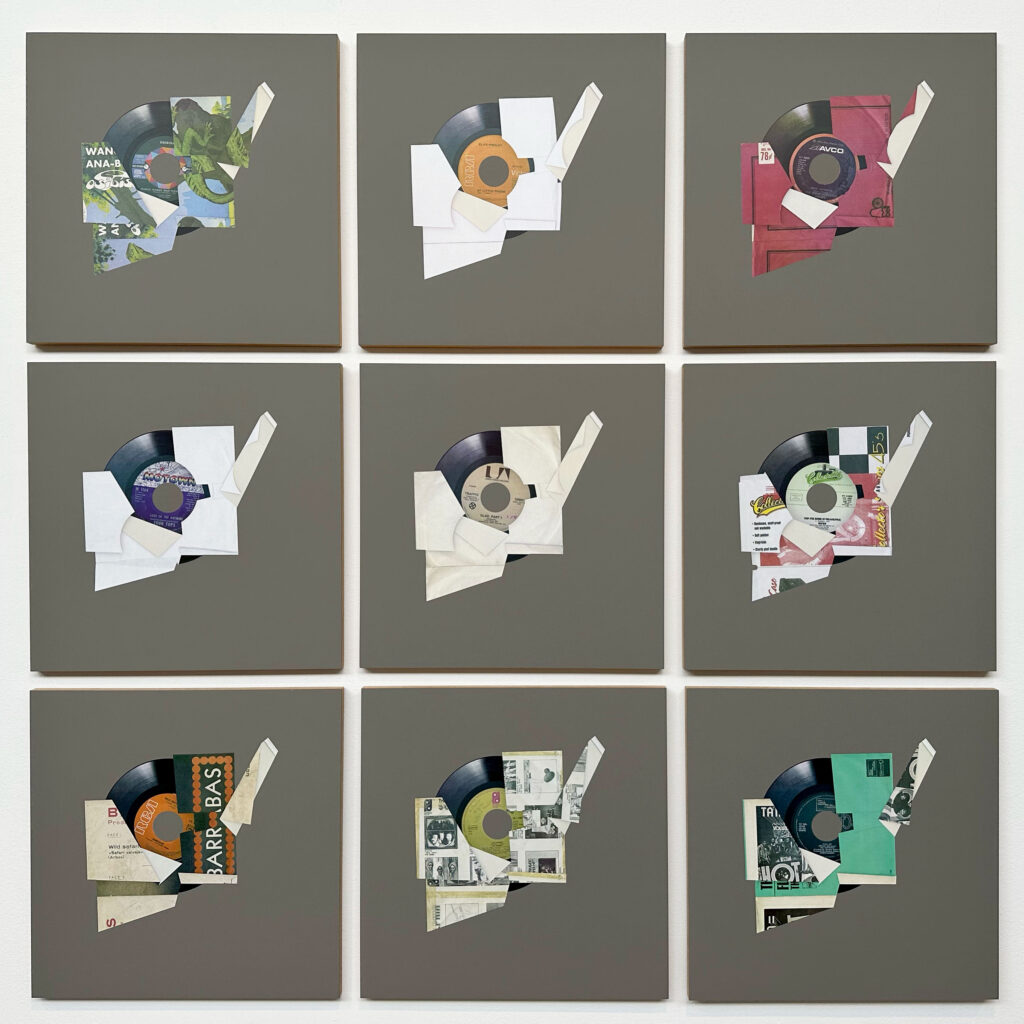
Known for his manipulation of long-circulating images from advertising and other sources, Kelley Walker examines the consumption of visual culture using collage, screen-printing, sculpture, and installation. Bose Glitter Stock (2016) and Untitled (Screen to Screen) (2017) contain montages of superimposed silkscreen images printed on polyester mesh substrate, the armature for screen printing. Pioneer PL-518 7-inch Series Love (Is The Answer) (2015) is a grid of silkscreened panels that reproduce vinyl records and their packaging. Walker referenced the legendary Pioneer brand of turntables, famously advertised by Andy Warhol, as part of his investigation into the visual culture of the 1970s and 1980s New York disco scene.
Below is the song that the title references. It is included among the records pictured and is from the Four Tops album, Still Waters Run Deep.