Jan 202024
 

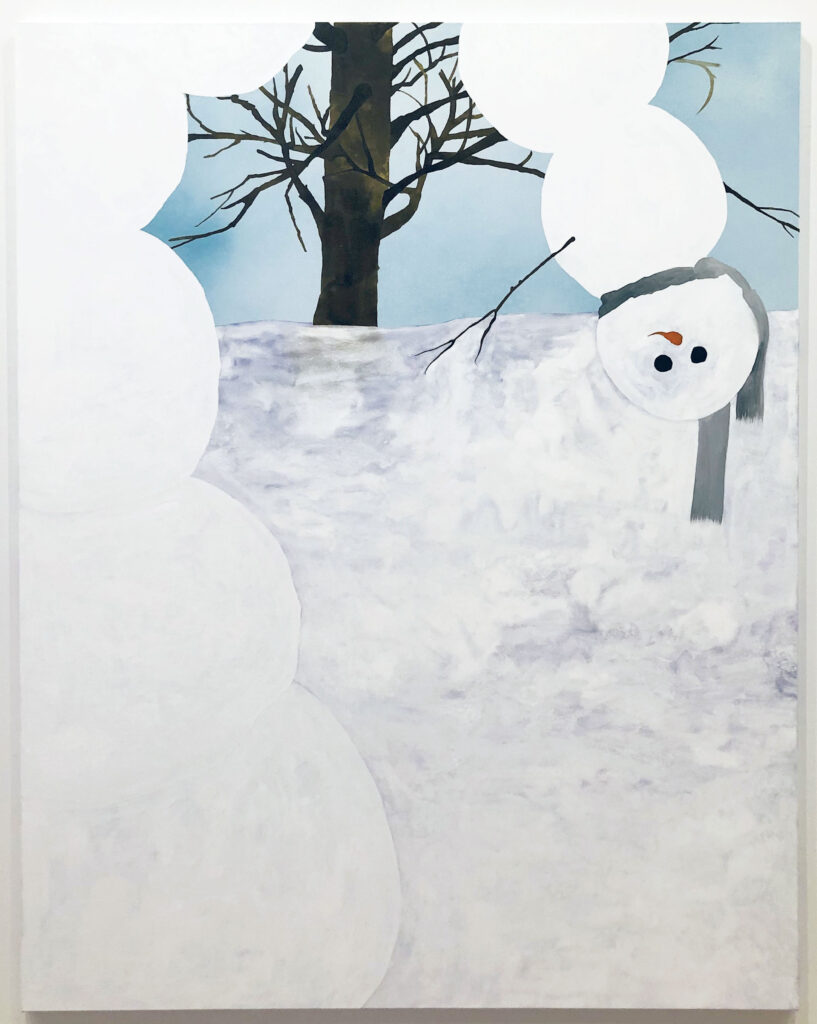
Calvin Marcus’ Tall Snowman, 2019, (Watercolor and vinyl paint on linen), was one of several of his large paintings included in Whitney Museum’s 2019 Biennial.

He and fellow Los Angeles artist Laura Owens will be in an exhibition together at Gaga gallery’s Guadalajara, Mexico location, opening 2/2/24.

Jan 192024
 

Pictured above is Drossos P. Skyllas‘ painting, Wisconsin Ice Cave, 1950, part of LACMA’s 2018 exhibition, Outliers and American Vanguard Art.

About the artist from the National Gallery of Art in Washington D.C. where the exhibition was also on view-

Drossos Skyllas achieved the exquisitely detailed, jewel-like surfaces of his paintings with tiny brushes he fashioned himself. He applied miniscule dabs of luminous oil paint in a pointillist manner, which gave his subjects a petrified yet shimmering quality. His refined technique and adherence to the academic genres of still life, landscape, portraiture, and mythological scenes demonstrate his knowledge of art history. And inspired by the old masters, he perfected the difficult depiction of reflective surfaces, including gems, mirrors, water, and ice. At the same time, his uniform clarity of detail, imposed symmetry, and sense of frozen time create a dreamlike mysteriousness reminiscent of magic realism. In addition to high art sources, Skyllas likely drew upon commercial illustration and photography. Untitled (Roses) resembles both traditional floral still lifes and midcentury advertisements for jewelry and flowers. Wisconsin Ice Cave relates as much to northern Renaissance landscape painting as to mass-produced picture postcards.

Born in Greece, Skyllas worked in his father’s tobacco business before emigrating to the US shortly after World War II. He settled in Chicago and devoted himself to becoming a professional artist, though he had no formal artistic training. Supported financially by his wife, Skyllas produced thirty-eight paintings from the late 1940s until his death in 1973. Some of these he submitted to the annual juried exhibition at the Art Institute of Chicago, Chicago and Vicinity, which featured his work in 1955, 1967, 1969, and 1973. He also sought commissions to paint portraits, but with asking prices as high as $30,000, he never found any patrons.

Skyllas’s work was discovered after his death by Chicago gallerist Phyllis Kind, who added him to her roster of self-taught artists in 1974. He was likely known to artists Jim Nutt and Gladys Nilsson before this, as they had exhibited alongside him in the 1967 Chicago and Vicinity exhibition and are enthusiastic collectors of self-taught artists (Wisconsin Ice Cave is in their collection). The meticulous finish of Skyllas’s paintings, which simultaneously evokes advertising art and Renaissance illusionism, appealed to Nutt, Nilsson, and fellow Chicago imagist Roger Brown, whose art collection also included the self-taught Greek master.


Jan 022024
 

Frank Weston Benson, “Natalie”, 1917, Oil on canvas

Childe Hassam, “Gathering Flowers in a French Garden”, 1888, Oil on canvas

Luther Emerson Van Gorder, “In the Park”, before 1894, Oil on canvas

Tampa Museum of Art’s current exhibition, Frontiers of Impressionism: Paintings from the Worcester Art Museum, features paintings by American and European impressionists and is a lovely reminder of the extraordinary works these artists created during this time period. The enduring popularity of the impressionists throughout the years makes sense when walking among these paintings. The use of color and brush work, as well as the details and beauty of the subject matter (not to mention the wealth and comfort often depicted)- make the viewer feel like they are being transported through time to the artist’s idyllic world.

From the museum-

In 2024, the term “impressionism” celebrates its 150th anniversary. Such a significant occasion inspires reflection on the profound impact that a relatively small group of artists in Paris made by positing a new mode of painting: one that favored painting outdoors over in a studio, immediacy over planning, the everyday over the grand, and the fleeting over the eternal. In doing so, the impressionists upended centuries of traditions in European art. This exhibition explores the radical impulses behind impressionism and its seemingly endless adaptability, as artists from around the world came to Paris to study and returned to their homelands, assimilating what they had absorbed and propelling the movement further.

The Worcester Art Museum pioneered new artistic horizons by embracing impressionism early in its history. The French and American impressionism collections at the Worcester Art Museum have long drawn visitors to the galleries. The first directors purchased works by Monet from his Parisian dealer, Durand-Ruel, as well as directly from American impressionists, making the Museum one of the first in the United States to collect impressionism actively as contemporary art. Over the past 125 years, this collection has grown, encapsulating the story of the movement’s roots and emergence in France and its subsequent expansion to the United States, Germany, Scandinavia, and beyond. Highlighting more than 30 artists, including Claude Monet, Pierre-Auguste Renoir, Camille Pissarro, Mary Cassatt, Childe Hassam, and Max Slevogt, this exhibition demonstrates impressionism’s international allure, captured in subjects as far-flung as Monet’s famed Giverny lily pond to the natural wonders of the Grand Canyon.

Below are a few more selections from the show.

Max Slevogt, “Selbstbildnis im Garten (A Self-Portrait in the Garden at Godgramstein), 1910, Oil on canvas

Max Slevogt, “Selbstbildnis im Garten (A Self-Portrait in the Garden at Godgramstein), 1910, Oil on canvas (detail)

Paul Signac, “Golfe Juan”, 1896, Oil on canvas

Thomas Cole, “View on the Arno, near Florence”, 1837, Oil on canvas

Lovis Corinth, “Vordem Spiegel (At the Mirror)”, 1912, Oil on canvas

John Singer Sargent, “Katherine Chase Pratt”, 1890, Oil on canvas

About the unfinished painting above (from the museum)-

A successful society portraitist, Sargent painted the elite from his international social circles. In June 1890, Sargent visited Worcester, Massachusetts, where he was inundated by requests for portraits. The sitter’s father, Frederick Pratt, a noted collector and eventual acting director of the Worcester Art Museum (1908 and 1917), became friends with the artist and invited him to return a few months later to paint his daughter, Katherine- although the idea for Katherine’s portrait originated in Sargent’s first trip to Worcester, when he had made a sketch of hydrangeas. Sargent’s vision of Katherine against a backdrop of flowers, however, proved less than satisfactory for his client and he abandoned the painting for another, more formal depiction. As an unfinished work, this painting reveals the immediacy of Sargent’s process, with careful attention to broad swaths of color and patterns in the brushwork to convey flower petals or folds of clothing.

This exhibition will be on view until 1/7/2024.

Dec 292023
 

Hung Liu “Portrait of China Mary”, 2006, Oil on canvas

Currently at The James Museum in St. Pete, is From Far East to West: The Chinese American Frontier, an informative show that includes many beautiful paintings. There’s so much history in America that often doesn’t get taught in school. This is a great opportunity to learn about this immigration story through artwork as well as text.

From the museum about the exhibition-

While European American settlers gradually pushed the United States frontier westward throughout the 1800s, the West coast of the country was developing independently as well. Accelerated by the discovery of gold mid-century, the population boom included Chinese immigrants who crossed the Pacific Ocean to California.

Most 19th century Chinese immigrants came to their new country from the coastal Canton region (province of Guangdong today) in southeastern China. Starting over on a different continent away from familiar surroundings and culture would be challenging, but for many decades anti-Chinese hostility and exclusion laws made settling in the United States even more difficult. The achievements of Chinese immigrants paved a path for future generations and are a testament to strength and perseverance.

The foundation for the exhibition highlights narratives of Chinese America from the 1850s to the 1930s. The paintings-all created by Chinese Americans in the 21st century-reflect inspiration from this history. The painters are also fueled by their own, more recent immigration stories to the United States after China’s Cultural Revolution (1966-1976) and their rigorous art training in the government-sponsored movement of Socialist Realism. After China opened to the rest of the world in the late 1970s, many Chinese artists-like Mian Situ, Jie Wei Zhou, Benjamin Wu, Hung Liu, and Z.S. Liang, all featured here were inspired to immigrate to the United States in search of greater opportunity.

Here, these artists’ historical interpretations speak to culture, identity, community, and resilience. Related objects and ephemera from the period support these stories. From the Gold Rush to Angel Island, this exhibition reveals often overlooked but significant contributions and perspectives of Chinese immigrants that deepen our understanding of U.S. history.

Hung Liu “Dandelion with Small Bird”, 2017 Mixed media

About the above painting from the museum-

Dandelions and their fluffy seed pods can be found anywhere in the world and thrive wherever they land. Their migratory nature allows them to survive a journey across vast lands even across oceans and take root anywhere in the world. For Liu, the dandelion represents her own tenacity and ability to thrive in the face of adversity.

The dandelions, fragile in nature and tattered by the lightest breeze, mimic how images, and personal narratives, too, can be scattered by time and the winds of history —as well as by the rhythms of feast and famine …
Hung Liu

Mian Situ “Blasting a Route Through the Sierra Nevada, 1865, Central Pacific Railroad”, 2018, Oil on canvas

Mian Situ “The Gold Seekers , Chinese Camp, 1850”, 2015, Oil on canvas

Jie Wei Zhou “Dragon Parade”, 2012, Oil on Linen

This exhibition is on view until 1/28/24.

Dec 272023
 

This painting, Night Breeze, by Sarah Lee, was part of a group exhibition last year at 1969 Gallery in NYC. It seemed like a good choice to post in honor of tonight’s full moon, the last of 2023, known as the Cold Moon.

Lee is currently part of two group exhibitions- Quiet Storm at Long Story Short’s Paris location and Standing Still at Gana Art’s Los Angeles location.

Dec 222023
 

José Parlá’s majestic paintings, pictured above, are from his series CICLOS: Blooms of Mold. They are currently on view as part of the Brooklyn Museum exhibition, Brooklyn Abstraction: Four Artists, Four Walls. The other artists included are Maya Hayuk, Kennedy Yanko, and the late Leon Polk Smith.

From the museum about the work-

In his monumental compositions, José Parlá layers and scrapes paint to obscure, reveal, and abstract both text and narrative, creating landscapes with textured gestural skies interwoven with a unique code of writing to reveal a new horizon with a universal line. Parlá’s abstracted text visually recalls underground mycelium formations, complex and mysterious fungi communication networks he references that interconnect everything on earth through a web of life. The five newly created paintings on view draw upon his youth as a Cuban American in Miami in the 1980s, his world travels, his almost fatal battle with COVID-19 in 2021, and his survival and recovery.

While in a three-month-long coma after contracting the virus, Parlá experienced dreams that carried him through his healing process. While recovering in the hospital, he transformed these visions into acrylic on paper drawings and, once back in the studio, into these powerful, otherworldly paintings that evoke natural landscapes. Their distinct horizon lines and internal, precise, psychological geographies remind us of our shared humanity.

Blooms of Mold, this new body of large-scale paintings, was inspired by what the art historian Simon Schama, in describing the art of Dutch painter Rembrandt van Rijn, once called “blooms of mold,” which one encounters on decaying urban and natural landscapes.

Parlá chose the subtitle Ciclos (from the Greek Kúkos, meaning circle) to refer to the life cycle and the function of the mycelium. It connects to ecosystems, providing nutrients and information to trees, which, in turn, convert carbon dioxide into oxygen, providing critical support for the respiratory systems of humans and all other living beings. Without mycelium, there would be no life.

The exhibition will be on view until 7/28/24.

Dec 172023
 

The Arts Annual at Creative Pinellas is always a great way to see what the artists in the area are creating. For 2023’s larger than ever edition, there is also a separate space for a video program that includes short films, theater productions, poetry readings, musical performances and more.

Artists included in the exhibition-

Tatiana Baccari, Elizabeth Barenis, Christina Bertsos, Daniel Barojas, Chomick + Meder, Courtney Clute, Neverne Covington, Sheila Cowley, Patricia Kluwe Derderian, Nikki Devereux, Javier T Dones, Dunedin Music Society, Sara Ries Dziekonski, Sarah Emery, Roxanne Fay, Jean Blackwell Font, John Gascot, Denis Gaston, Mason Gehring, Donald Gialanella, Jim Gigurtsis, Kevin Grass, Sheree L. Greer, Jason Hackenwerth, Steph Hargrove, Patrick Arthur Jackson, Reid Jenkins, Kenny Jensen, Charlotte Johnson, Victoria Jorgensen, Steven Kenny, Candace Knapp, Akiko Kotani, Teresa Mandala, Cora Marshall, Carol Mickett & Robert Stackhouse, Miss Crit, Mark Mitchell, Chad Mize, Desiree Moore, Zoe Papas, Gianna Pergamo, Rose Marie Prins, Gabriel Ramos, Babs Reingold, George Retkes, Heather Rippert, Ashley Rivers, Marlene Rose, Ric Savid, Tom Sivak, Sketzii, Emily Stehle, Rachel Stewart, Erica Sutherlin, Takeya Trayer, Judy Vienneau, Kirk Ke Wang, Angela Warren, and Joseph Weinzettle

The show is on view until 12/31/23.

Below are some additional selections from the exhibition.  

Reid Jenkins, “Holding Court”, Acrylic

Candace Knapp, “What the Blue Heron Sees” and “The Light Within” Acrylic on canvas

Daniel Barojas, “Future Ancestor”, Gouache, acrylic, gold leaf on canvas and “Future Ancestor #3”, Gouache and resin on paper

Rachel Stewart, “Caribbean Currents” Colored pencil, oil stick and collage on Archers archival paper; “Under a Different Sky”, Wall installation Painted relief wood construction with cooper and mixed media materials; Printing Ink and collage on rice paper

Mark Mitchell, “The BurgHive”, Acrylic on Hexagonal canvases

Sketzii,”Out of the Pink Concrete”, “Reclamando Mis Raices” and “A Señora’s Dream”, Acrylic on canvas

Steph Hargrove, “Catch You Later”, Acrylic paint, paper on canvas

Marlene Rose, “Three Bell Tower”, Sandcast glass and “Map Triptych” Sandcast glass

Heather Rippert, “Shakti” (center) and “Hawk 1, 2, and 3”, acrylic on canvas


Dec 142023
 

Mirror House, 2016 by artist Paige Jiyoung Moon was one of the paintings in her 2019 exhibition, Days of Our Lives at Steve Turner in Los Angeles. Her works are all of scenes from her life, painted from memory.

She is currently part of Hammer Museum’s most recent biennial, Made in L.A. 2023: Acts of Living, its sixth iteration, on view until 12/31/23.

The house in the painting, Mirage, was created by Doug Aitken for Desert X in 2017. On the fictional television series, The Curse, created by Nathan Fielder and Benny Safdie, the main characters are building houses with similar look.

Dec 122023


Heiress Gallery in St. Pete is currently showing Melissa Spitz’s solo show You Have Nothing to Worry About, a moving portrait of her mother’s mental illness and substance abuse.

From the gallery about the exhibition-

In her solo exhibition at HEIRESS, Spitz presents medium-to large-format prints of her iconic images. The works are installed in a chaotic environment, scattered amongst the detritus of familial tragedy: her mother is found in the context of hundreds of pills and pill bottles, a glimpse into the chaos that Spitz and her family have dealt with for many years. Thousands of 4×6 glossy photos are scattered on a table in the center of the space and invites gallery visitors to attempt to make sense of the nostalgia that they hold. In addition to photographs, Spitz has included new sculptural works including ten enameled hammers titled, You Are the Nail, which encourages an examination of the over-reliance of pharmaceutical solutions in the United States. Spitz’s work freezes moments of chaos in time, to be dissected and understood by the artist after the fact. The majority of her most intimate traumatic life experiences are captured through her lens, and finds a second life in the digital sphere on Instagram, to a community of over 50 thousand followers, which blurs the lines between catharsis and entertainment.

From the artist about the exhibition-

Since 2009, I have been making photographs of my mentally ill, substance-abusing mother. Her diagnoses change frequently-from alcoholism to dissociative identity disorder–and my relationship with her has been fraught with animosity for as long as I can remember. I am fully aware that my mother thrives on being the center of attention and that, at times, our portrait sessions encouraged her erratic behavior.

The photographs are simultaneously upsetting and encouraging; honest and theatrical; loving and hateful. By turning the camera toward my mother and my relationship with her, I capture her behavior as an echo of my own emotional response. The images function like an on going conversation.

The series in installation form encourages an examination of the role prescription drugs play in the United States. Aiming to prompt discussions on the cultural, social, and individual implications of an overreliance on pharmaceutical solutions. Through visual metaphors and imagery, You Have Nothing to Worry about continues to raise awareness about the need for a balanced and holistic approach to health and well-being. While acknowledging the limitations and potential pitfalls of relying solely on prescription medications.

The immersive exhibition functions as a thought-provoking commentary on the pervasive and complex issue of prescription drug culture in America. Through the meticulous arrangement of pill bottles, pills, photographs, and family ephemera, I seek to engage viewers in a dialogue about the consequences of our society’s reliance on pharmaceutical drugs.

The Vanity, pictured above, which includes family notes and photos, adds even more depth to the family’s struggles.

From the artist-

I have always been interested in sculptural installations and photography. Sandy Skoglund, Jeff Wall and Carrie Mae Weems are a few big names who have directly inspired me. The obsessive nature of details and experience only add to telling a story and I’ve been eager to find a way to participate. This vanity belonged to my great-aunt Sophie and has been in my bedroom my whole life, it went to college and graduate school with me, and my brother has been storing it since I moved to New York. This exhibition presented the perfect opportunity to utilize it. Informed by actual experiences, The Vanity, showcases family ephemera, letters from my mom, pill bottles, scattered pills, lipsticks and flickering candles. The mirror allows viewers to reflect on their own shared familiarity.

Spitz also created You Are The Nail, pictured below, for the exhibition.

Her description of the work-

I’m not sure when I first heard the phrase “when your only tool is a hammer, you begin to see everything as a nail” but it was used regarding my mom being over medicated and her prescriptions mixing, sending her into another psychotic episode. It wasn’t the doctors’ fault, or mom’s or the pharmacist but the drugs, they were to blame. I was frustrated and angry and confused, but too young to understand that doctors received kickbacks for writing certain prescriptions and that patients like my mom were a goldmine. I do want to be clear that I know anti-psychotic medications have saved people’s lives and mom would not be able to function normally without a carefully balanced mix of mood stabilizers, anti-depressants and anti-anxiety pills. But all too quickly do I find doctors in almost any capacity pushing drugs on me…I was alarmed to learn that the United States pharmaceutical industry generates over 110 bilion dollars of revenue each year.

You are the Nail is a series of ten hammers representing the ten most prescribed anti-psychotic / antidepressant pharmaceutical drugs in the United States. Several of which my mom is prescribed. Informed by Abraham Maslow’s theory of over reliance, you are the nail visually depicts our mental health field’s greatest tool, prescription drugs. The hammers are titled, Zoloft, Lexapro, Trazadone, Prozac, Wellbutrin, Cymbalta, Seroquel, Celexa, Vensir and Abilify.

This exhibition closes 1/13/24.

Dec 122023
 

Artists from L to R: Julie Schumer, Vivien Collens (sculpture), Maggie Kruger, and Blair Vaughn-Gruler

Renee Mendler, “Rainbow Vision I and II”, Acrylic, Gold leaf, and resin on panel (left) and “Pure Joy No. 10 and No. 14”, Acrylic on canvas by Hans Petersen

Imani Bilál, “If Dreams Could Wander”, Acylic paint and ink on canvas (left) and work from the “Accumulation” series by Blair Vaughn-Gruler, Oil, mixed media, wood, on canvas

Michelle Gordon, “Ocean Splash”, Oil on canvas

This past weekend was the Second Saturday ArtWalk in St. Pete, Florida with numerous galleries staying open into the evening. Above are images from the recently opened Drew Marc Gallery, part of The Factory St. Pete’s complex in the Warehouse District. In addition to the artwork, the gallery also had live painting by Michelle Gordon.

At Morean Center for Clay is Lauren Hope: Time (pictured below), a solo exhibition that includes the artist’s ceramic work and photography.

From the gallery-

...Time is an investigation of alternative photographic process, using clay as a catalyst for record keeping. Using ceramic vessels as pin hole cameras, Lauren captures moments in time and transfers them onto ceramic surfaces. This exhibition will be a collection of photographic prints, vessels, cyanotypes, and handmade pinhole cameras. 

 Her statement about her work-

My work is heavily influenced by the complexity of hues, forms, and patterns found in the natural world. This studio practice has become deeply cathartic, signifying the ephemeral and fleeting notions of time.

Ceramic vessels within this collection are wheel-thrown, altered, and sculpted. Every striation carved serves as a visual representation and a gentle reminder of the delicate passing moment. This method of subtractive carving has become transformative, developing into deep states of meditation and reflection.

Experimental photography is used as an explorative process, allowing for the convergence of internal and external experiences. By casting memories and photographic recollections onto stoneware, I attempt to immortalize my profound experiences and revelations.

This exhibition will be on view until 12/30.

For selections from additional galleries, head to the next page.